Three Prominent Palestinian Organizers, Journalists Ordered to Further Imprisonment without Charge or Trial
Samidoun Palestinian Prisoner Solidarity Network – June 8, 2017
Three prominent Palestinian activists were ordered to additional periods of administrative detention, imprisonment without charge or trial. Palestinian journalist Hasan Safadi, youth organizer Hassan Karajah and leftist community leader Rami Fadayel, all of Ramallah, were ordered to further imprisonment without charge or trial by Israeli military courts.
Fadayel, 37, has been imprisoned for 18 months under administrative detention; this is the fourth time the order against him has been renewed. He has spent over seven years in total in Israeli prisons and was ordered to another four months of imprisonment without charge or trial. He was hit with another four-month detention order on Wednesday, 7 June.

Rami Fadayel
Haneen Nassar, Fadayel’s wife and an organizer with the Palestinian Prisoners’ Committee, a popular organization in Palestine that works to support the prisoners’ struggle and demand their freedom, said that she and her husband have never been able to enjoy a free and safe life since their marriage. Fadayel has been arrested repeatedly; they marked their engagement while he was imprisoned. She noted that their daughter, Mays, 10, has not seen her father in their home for nearly half of her life.
Fadayel is well-known in Ramallah as a leader in the Popular Front for the Liberation of Palestine, the Palestinian leftist political party. Nasser noted that his administrative detention has been repeatedly renewed under the pretext of a “secret file;” all of the appeals of his lawyer have been rejected.
Palestinians held without charge or trial under administrative detention orders can be detained indefinitely; these one- to six-month orders can be repeatedly renewed on the basis of so-called “secret evidence.” There are currently over 500 Palestinian administrative detainees imprisoned by the Israeli occupation. Some Palestinians have spent years at a time under administrative detention on the basis of this so-called secret evidence. Over 50,000 administrative detention orders have reportedly been issued since 1967; the practice dates from the colonial British mandate over Palestine and was re-imposed by the Israeli occupation.

Hasan Safadi
Meanwhile, Hasan Safadi, Palestinian journalist and the Arabic media coordinator of Addameer Prisoner Support and Human Rights Association was also ordered on 8 June 2017 to another six months in administrative detention by an Israeli occupation military court. He had been scheduled for release on 8 June, but was instead hit with another arbitrary detention renewal.
Safadi, 26, has been imprisoned since 1 May 2016, when he was seized by Israeli occupation forces as he crossed the Karameh/Allenby bridge between Jordan and Palestine, returning from an Arab youth conference organized in Tunisia. After 40 days of interrogation in the Moskobiyeh interrogation center, he was ordered to administrative detention without charge or trial, which has since been renewed twice. His new administrative detention order is scheduled to expire on 8 December 2017.

Hassan Karajah
Hassan Karajah, a prominent youth activist with the Stop the Wall Campaign and a boycott, divestment and sanctions (BDS) activist, was seized by Israeli occupation forces on 12 July 2016 at a military checkpoint west of Ramallah. He has been held under administrative detention without charge or trial since that time; his detention was also renewed on 7 June 2017 for the third time for a four-month period.
Karajah was previously arrested on 23 January 2013 and freed on 19 October 2014, accused of participation in a prohibited organization and contact with an enemy state, an allegation frequently used to target Palestinians who travel to conferences and events in Lebanon and other Arab countries.
These orders came after the Ofer military court confirmed even more administrative detention orders on Wednesday, 7 July. The military court approved six-month detention orders against Raed Abd al-Admu of al-Khalil, Tayseer Maher Hamed, Mohammed Badr al-Alouneh, Islam Fayeq Nimer of Ramallah and Suhaib Ahmed Mohammed of Tulkarem. It approved four-month imprisonment orders against Nidal Hashim Abdel Hadi and Yousef Ahmed Nasser of Jenin and Khalil Hassan Hamed, Ayman Naim Hamed, Hamza Ibrahim Zahran and Omar Mohammed Abu Latifa of Ramallah. It also affirmed a two-month detention order against Rabie Mohammed Musallah of Jenin.
Israel mulls closing Al Jazeera bureau in Jerusalem al-Quds: Report
Press TV – June 13, 2017
A report says Israeli Prime Minister Benjamin Netanyahu is considering shutting down the Jerusalem al-Quds bureau of the Qatar-based Al Jazeera broadcaster, as a diplomatic rift escalates between a Saudi-led bloc of countries with Qatar.
Israeli daily Yedioth Ahronoth reported on Tuesday that Netanyahu had met with members of the foreign ministry, ministry of military affairs, and other institutions on Monday and discussed preliminary steps for closing the Al Jazeera office in Jerusalem al-Quds.
Saudi Arabia, the UAE, Bahrain, and Egypt have already blocked several Qatari media outlets, including Al Jazeera. The four countries cut their diplomatic and transport ties with Qatar on June 5, accusing Doha of destabilizing the region with its support for terrorism, an accusation rejected by the Qatari government.
In a relevant development on Monday, Avigdor Lieberman, Israel’s minister for military affairs, compared Al Jazeera to the Nazi- and Soviet-era propaganda apparatuses.
“Some [Arab countries’] interests overlap with Israeli interests, including the issue with Al Jazeera,” Liberman said. “Al-Jazeera is not media… It’s an incitement machine. It is pure propaganda, of the worst variety, in the style of Nazi Germany or Soviet Russia.”
Lieberman also accused Al Jazeera of supporting Iran, saying, “I’ve been tracking Al Jazeera for many years. You’ll never see a single article against Iran.”
The potential move to close the Al Jazeera office in Jerusalem al-Quds and the unprecedented remarks by Lieberman are indicative of how the Israeli and Saudi regimes may be increasingly tilting toward one another. There have already been signs that the ties between Israel and certain Arab regimes — traditionally putative adversaries — have been covertly expanding in recent years.
Netanyahu has on several occasions talked of the development of ties between Israel and certain Arab countries. So have other Israeli officials. Moshe Ya’alon, Israel’s former minister of military affairs, in February 2016 pointed to open channels between the regime and some Arab states.
Back in January 2016, Netanyahu said during an interview with CNN that Saudi Arabia now saw Tel Aviv “as an ally rather as an enemy.”
Russia warns US against attacks on Syrian forces
By M K Bhadrakumar | Indian Punchline | June 12, 2017
Diplomats dissimulate, journalists exaggerate, politicians waffle, but an army general has no reason to obfuscate the stark ground reality. Therefore, the rare remarks by the commander of Russian forces in Syria, General Sergey Surovikin, merit great attention. Excerpts are reproduced below:
- The US-led coalition lets militants of the Islamic State terrorist group leave Raqqa instead of killing them… The US-led coalition enters into collusion with ringleaders of the ISIS, who give up their settlements without fighting and head to the provinces where the Syrian government forces are active… The Russian force in Syria sees in the Raqqa area militants leaving the city and its suburbs unhindered. In early June, ISIS terrorists left the populated localities 19 kilometers southwest of Raqqa offering no resistance and headed toward Palmyra.
- The Americans are using ISIS to robustly block the movement of government troops… The aviation of the US-led coalition is impeding the struggle of Syrian government forces against terrorists… They have blocked the way of government forces, who are eliminating ISIS militants and setting up border posts along the border with Iraq to the north-east of Al-Tanf.
The long and short of Gen. Surovikin’s chilling account is that although President Donald Trump vows to fight the ISIS with tooth and nail, Pentagon guys may have other ideas. They continue to use the ISIS with a hidden agenda where the Syrian government (and Iran) is the number one enemy. The US objective appears to be two-fold in Syria: a) create a buffer zone in southern Syrian regions bordering Israel and Jordan, which will be dominated by “good terrorists”; and, b) take control of the entire Syrian-Iraqi border on a North-South gradient so that Iran’s logistical capability to render help to the beleaguered Syrian government forces is sharply reduced.
Indeed, a ‘frozen conflict’ would effectively balkanize Syria. The Washington Institute for Near East Policy, a think tank which is closely associated with the American-Israel Public Affairs Committee (a pro-Israel lobby group in Washington), featured a commentary recently, entitled Growing Risk of International Confrontation in the Syrian Desert. It implicitly warns Moscow of dire consequences if Russian forces intervene to disrupt the efforts by the US to prevent a Syrian government consolidation in the Al-Tanf / Deir Ezzur — Palmyra region.
However, no matter what the pro-Israeli think tankers in Washington pontificate, General Surovikin’s remarks underscored that Moscow is seized of the strategic importance of the Syrian government forces succeeding in re-establishing control over the country’s border with Iraq. Russia had earlier adopted a wary approach vis-a-vis the scramble for control of the Syrian desert regions bordering Iraq. But that seems to be changing — although Russian priority is to work with the Americans.
On Saturday, Russia has put the US on notice that the Syrian government forces intend to advance on Al-Tanf itself. The Russian Foreign Minister Sergey Lavrov told US Secretary of State Rex Tillerson that US air strikes on the Syrian government forces are unacceptable. He called for “concrete measures to prevent similar incidents in the future.”
A Syrian army statement went a step further to announce on Saturday their intent to advance to the Iraqi border north of Al-Tanf. It warned the western forces in the area against interfering — “The general command of the army and armed forces warn of the risks of repeated attacks of the so-called ‘international coalition’ and their efforts to block the advances of the Syrian Arab Army and its allies in their war on terror.”
The planned Syrian operations north of Al-Tanf will scuttle the US plans to stage a ground operation with “good terrorists”, aimed at reaching Deir Ezzur city ahead of the government forces who are advancing in easterly direction from Palmyra. The Iranian reports suggest that Russian jets are actively backing the Syrian government operations in the region to the northeast of Palmyra.
Simply put, Iran is creating new facts on the ground in southeastern Syria, which the US (and Israel) will have to learn to live with. An Iranian war dispatch says that “thousands of (Syrian) army men and Hezbollah combatants entered the countryside of Palmyra city to resume a fresh phase of one of the army’s greatest operation in Homs (province) in recent years.”
Israel blocks road to Bedouin village, preventing 100 children from going to school
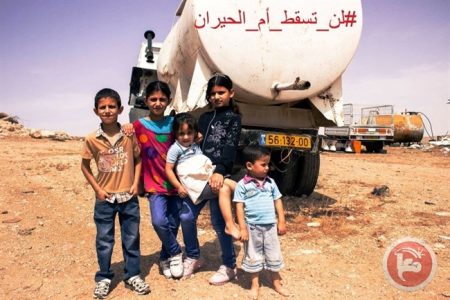
Children in the Bedouin village of Umm al-Hiran in the Negev
Ma’an – June 12, 2017
BETHLEHEM – A recently installed guardrail on an Israeli highway has isolated a Bedouin community in southern Israel for days, preventing 100 Bedouin children from attending school, NGO Adalah reported on Sunday.
According to the group, which focuses on the rights of Palestinian citizens of Israel, Israeli authorities effectively sealed off Umm Bidoun, a Bedouin community in the Negev desert unrecognized by Israel, by blocking off the only dirt road connecting the village to Highway 31 with a guardrail.
The road surface markings on the highway near other passage out of Umm Bidoun have also recently been changed, making it illegal for vehicles to cross the road, Adalah added.
The recent changes have effectively prevented any vehicles, including school buses, from accessing the village, Adalah said.
As a result, the legal NGO stated that, due to the absence of schools in Umm Bidoun, 100 children who study in the village of al-Furaa 15 kilometers away have been unable to go to school for days.
Adalah said on Sunday it had contacted officials from the Israeli Education Ministry, the al-Qasoum regional council, and Netivei Israel, the national roads authority, to demand that the obstacles to freedom of movement for the residents of Umm Bidoun be lifted.
Adalah field researcher Marwan Abu Freih told Ma’an on Monday that Netivei had told the organization that it was examining the issue.
Spokespersons from the Ministry of Education did not immediately respond to a request for comment on the case on Monday.
“It is inconceivable that some 100 students can — in such a sudden and arbitrary manner — be prevented from attending school without any advance notice to or consultation with parents,” Abu Freih said on Sunday. “Adalah and the families demand that the Education Ministry act immediately to correct this situation.”
Abu Freih added on Monday that members of Israel’s parliament, the Knesset, representing Palestinian citizens of Israel, had reached out to Adalah to offer their assistance in resolving the case.
Bedouin villages were established in the Negev soon after the 1948 Arab-Israeli war following the creation of the state of Israel. Many of the Bedouins were forcibly transferred to the village sites during the 17-year period when Palestinians inside Israel were governed under Israeli military law, which ended shortly before Israel’s military takeover of Gaza and the West Bank, including East Jerusalem, in 1967.
Between 160,000 and 170,000 Bedouins are believed to reside in the Negev today, more than half of whom reside in unrecognized villages, according to the Association for Civil Rights in Israel (ACRI).
The classification of their villages as “unrecognized” prevents Bedouins from developing or expanding their communities, while Israeli authorities have also refused to connect unrecognized Bedouin villages to the national water and electricity grids, and have excluded the communities from access to health and educational services.
A Knesset report on Bedouins in Israel noted that “(school) dropout rates are high, among various reasons due to lack of access and public transportation to their schools.”
Meanwhile, Jewish-Israeli communities in the Negev continuously expand, with five new Jewish plans approved last year. According to an investigation undertaken by Israeli rights groups ACRI and Bimkom, two of the approved communities are located in areas where unrecognized Bedouin villages already exist.
Rights groups have claimed that Israeli policies in Bedouin communities are specifically aimed at depopulating the Negev of its Bedouin residents to make room for the expansion of Jewish Israeli communities.
Saudi Arabia teams up with Israel in anti-Qatar lobbying in the US Congress
By Abdus Sattar Ghazali – Journal of America – June 10, 2017
US proposed legislation – Palestinian International Terrorism Support Prevention Act of 2017 – threatening to sanction Qatar for its support of the so-called “Palestinian terror” was sponsored by 10 lawmakers who received more than $1m over the last 18 months from lobbyists and groups linked to Israel, Saudi Arabia, and the United Arab Emirates, Al Jazeera reported Friday.
The HR 2712 bill was introduced to the US House of Representatives on May 25, but the text wasn’t available until Friday morning, hours after Saudi Arabia, UAE, and Egypt put 59 people and 12 institutions linked to Qatar on a “terror list”, Al Jazeera said.
HR 2712’s sponsors received donations totaling $1,009,796 from pro-Israel individuals and groups for the 2016 election cycle alone, according data collected by the Center for Responsive Politics, an independent research group tracking money in US politics and its effect on elections and public policy, and then compiled by Al Jazeera.
Sponsors of the bill are: Congressmen Brian Mast (FL-18), Josh Gottheimer (NJ-5), Foreign Affairs Committee Chairman Ed Royce (CA-39) and Foreign Affairs Committee Ranking Member Eliot Engel (NY-16). The bill is co-sponsored by Congressmen Brad Sherman (CA-30), Ileana Ros-Lehtinen (FL-27), Ted Poe (TX-2), Ted Lieu (CA-33), Ted Deutch (FL-22) and Thomas Suozzi (NY-3).
Al Jazeera reported that Royce received $242,143 from pro-Israel sources for the 2016 election cycle, $190,150 went to Engel. Mast, who volunteered with the Israeli military after he finished serving in the US Army, received $90,178.
“Following my service in the U.S. Army, I chose to volunteer alongside the Israeli Defense Forces because our countries share the common ideals of freedom, democracy and mutual respect for all people. Hamas preaches destruction to Israel and death to the values we hold dear in the United States. They have murdered more than 400 Israelis and at least 25 American citizens.” Rep. Mast was quoted as saying.
According to Trita Parsi, the founder of the National Iranian American Council (NIAC), a nonprofit that aims to strengthen the voice of US citizens of Iranian descent, there are similarities between the US-allied Arab nations’ “terror list” and HR 2712 show[ing] growing cooperation between Gulf Arab states and Israel.
“The coordination between hawkish pro-Israel groups and UAE and Saudi Arabia has been going on for quite some time,” Parsi told Al Jazeera. What is new, he continued, is pro-Israel groups such as the Foundation for Defense of Democracies “coming out with pro-Saudi [articles] and lobbying for them on Capitol Hill”.
Parsi was quoted as saying that the sponsors of the bill are traditional pro-Saudi lawmakers, however they are in the pro-Likud camp. Likud is the party of Israeli PM Benjamin Netanyahu.
President is required
The Palestinian International Terrorism Support Prevention Act requires the President to submit to Congress an annual report for the next three years identifying foreign persons, agencies or instrumentalities of a foreign state who knowingly and materially assist Hamas, the Palestinian Islamic Jihad, or an affiliate or successor of one of those organizations.
After identifying the organizations, the President must impose two or more sanctions, including denying
a) Export-Import guarantees,
b) defense support under the Arms Export Control Act,
c) export of munitions to any agreement to which a person identified is a part,
d) export of goods or technology controlled for national security reasons,
e) loans more than $10 million, or
f) seizure of property held within the United States.
The bill also requires the President to report to Congress on each government that provides support for acts of terrorism and provides material support to Hamas, the Palestinian Islamic Jihad, or any affiliate or successor organization, or the President determines to have engaged in a significant transaction to knowingly and materially provide support to Hamas, the Palestinian Islamic Jihad or any affiliate or successor organization.
After identifying the governments, the President must suspend U.S. assistance to that government for one year, instruct the executive directors of each international finance institution to vote against any loan or technical assistance to that government and prohibit any munitions export to that government for one year.
Additionally, the President must prohibit that government’s transactions in foreign exchanges that are subject to the jurisdiction of the United States and prevent that government’s transfers of credits or payments between financial institutions subject to the jurisdiction of the United States.
Important Sections of the HR 2712 Bill
Section 2: Findings and Statement of Policy
Subsections (a)(3) and (4) state that “Hamas has received significant financial and military support” from Qatar and that the Under Secretary of Treasury for Terrorism and Financial Intelligence confirmed that “Qatar, a longtime US ally has for many years openly financed Hamas.” The bill also finds that Qatar hosts a number of high-ranking Hamas officials, including Khaled Mashal.
Subsections (a)(5) through (7) outline Iran’s material and financial support and subsections (8) through (10) detail Iranian support to the PIJ.
Section 3: Imposition of Sanctions with Respect to Foreign Persons and Agencies and Instrumentalities of Foreign States Supporting Hamas, the PIJ, or Any Affiliate or Successor Group
No later than 120 days after H.R. 2712 is enacted—then once a year for no more than three years—the president must report to Congress the foreign persons, agencies, and instrumentalities of foreign states that provide support to the aforementioned groups. Two exceptions are reserved for the president, however. If the president notifies Congress 15 days prior to completing a “significant transaction” with a foreign entity or agency that is in the “national interest” of the United States, the foreign entity or agency may be exempt from sanctions. The other exception is reserved for the president to issue waivers that would exempt a foreign entity or agency from sanctions for 120 days, as long as Congress is notified seven days prior.
Set forth in this bill are sanctions on the following:
- Banking and financing (e.g., extensions of credit, guarantees, insurance, etc.)
- Defense-related sales (including munitions, defense services, and construction services)
- Goods and technologies regulated through the Export Administration or included in the US Munitions List
- Medical, agricultural, and humanitarian goods and services are not included among sanctioned items.
Section 4: Imposition of Sanctions with Respect to Foreign Governments That Provide Material Support to Hamas, the PIJ, or Any Affiliate or Successor Thereof
Much like Section 3, Section 4 sets a 120-day deadline after enactment for the president to report to Congress any governments the Secretary of State has determined “repeatedly provided support for acts of international terrorism.” This report must be resubmitted, with relevant information, every 180 days.
The sanctions set forth in this section include the prohibition or suspension of the following for one year:
- US aid to the foreign government
- Extension of loans and financial or technical services
- Export of items on the US Munitions List or Commerce Control List
- Transactions in foreign exchanges in which the United States has jurisdiction
- Transfers of credit or payments between one or more financial institutions subject to US jurisdiction
- Should the president determine it is in US security interests and notify Congress seven days in advance, he can waive any foreign government sanctions for 180 days.
Section 5: Report on Activities of Foreign Countries to Disrupt Global Fundraising, Financing, and Money Laundering Activities of Hamas, the PIJ, or Any Successor or Affiliate Thereof
This bill outlines a reporting requirement for the president, no later than 180 days after the bill’s enactment. The president must report a list of foreign countries providing support for the aforementioned organizations and further assessments including:
- Steps the foreign government is taking to freeze assets of these groups
- Any reasons the government is not taking adequate steps to freeze assets
- Measures taken by the United States to freeze assets
- List of countries where the aforementioned groups fundraise and steps those countries are taking to disrupt the fundraising efforts
- List of countries from which the groups receive surveillance equipment and what measures are being taken to disrupt the acquisition.
To borrow from Marcus Montgomery, an Analyst at the Washington DC-based Arab Center, the language of HR 2712 is interesting since it introduces sanctions for actions likely already covered under existing legislation. Hamas and the PIJ are both designated Foreign Terrorist Organizations (FTOs) and Specially Designated Global Terrorists (SDGTs) by the State and Treasury Departments, respectively. With that in mind, it is already illegal for US entities or institutions to support such groups. Thus, the sanctions proposed in this bill that pertain to US jurisdiction are redundant.
Formally targeting Iran is redundant as well because Tehran has been declared a state sponsor of terror by the State Department and prohibitions against exports of arms, financial and technical services, and US aid to Iran are already in place.
For Marcus Montgomery, Qatar would be the truly new target under this legislation, but as an ally with which the United States has economic and military ties, it is tough to see many in the Senate agreeing to label Qatar a de facto state sponsor of terror.
Erdogan vows to stand by ‘Qatari brothers’
Interestingly, Turkish President Tayyip Erdogan Friday called for full removal of a Saudi-led blockade of Qatar after approving the deployment of Turkish troops there, saying Riyadh needed to put brotherhood ahead of animosity.
Erdogan said isolating Qatar would not resolve any regional problems and vowed to do everything in his power to help end the regional crisis. “We will not abandon our Qatari brothers,” Erdogan told members of his ruling Justice and Development (AK) Party at a fast-breaking meal on Friday in Istanbul during the Muslim holy month of Ramadan.
“I also have a special request from the Saudi administration. You are the largest and most powerful state in the Gulf. We call you the Custodian of the Holy Places. You especially should work for brotherhood, not animosity. You have to work for bringing brothers together. This is what we expect from Saudi, the Custodian of the Holy Mosques,” Erdogan was quoted by Al Jazeera as saying.
“I say it should be lifted completely,” Erdogan said of the embargo.
Turkey, which has maintained good relations with Qatar, as well as several of its Gulf Arab neighbors, offered food and water supplies to stave off possible shortages. “There are those who are uncomfortable with us standing by our Qatari brothers, providing them with food. I’m sorry, we will continue to give Qatar every kind of support,” Erdogan said, adding that he had never witnessed Doha supporting “terrorism”.
On Wednesday, Turkey’s parliament ratified two deals on deploying troops to Qatar and training the Gulf nation’s security forces. The deal to send Turkish soldiers in Qatar, aimed at improving the country’s army and boosting military cooperation, was signed in April 2016 in Doha.
After an initial deployment of Turkish soldiers at a base in Doha, Turkish fighter jets and ships will also be sent, the mass-circulation Hurriyet newspaper said on its website on Friday.
“The number of Turkish warplanes and Turkish warships going to the base will become clear after the preparation of a report based on an initial assessment at the base,” Hurriyet said.
A Turkish delegation will go to Qatar in the coming days to assess the situation at the base, where about 90 Turkish soldiers are currently based, Hurriyet said adding: there were plans send some 200 to 250 soldiers within two months in the initial stage.
Abdus Sattar Ghazali is the Chief Editor of the Journal of America.
Israel’s Netanyahu calls for UN Palestinian refugee agency to be shut down
RT | June 11, 2017
The UN Palestinian relief agency “perpetuates” the refugee issue instead of solving it and should be “dismantled,” the Israeli PM stated, adding that he had conveyed the idea to the US envoy to the UN. The agency dismissed his proposal as “fantasy.”
Israeli Prime Minister Benjamin Netanyahu made the comments on the United Nations Relief and Works Agency (UNRWA) during a weekly cabinet meeting on Sunday.
“It is time UNRWA be dismantled and merged with the United Nations High Commissioner for Refugees,” Reuters quoted Netanyahu as saying.
According to the Israeli PM, as cited by the Jerusalem Post, “in various UNRWA institutions there is a lot of incitement against Israel, and therefore the existence of UNRWA – and unfortunately its work from time to time – perpetuates the Palestinian refugee problem rather than solve it.”
Netanyahu added that he had already conveyed the idea of shutting the agency down to US Ambassador to the UN Nikki Haley during her visit earlier this week.
“I told her it was time the United Nations re-examine UNRWA’s existence,” Netanyahu said.
The UNRWA was established by the UN General Assembly in 1949, when hundreds of thousands of Palestinians fled or were evicted from their homes during the 1948 war which followed the emergence of the state of Israel. The agency currently helps over five million registered Palestinian refugees across the region, according to the UNRWA’s own statistics.
The UNRWA’s chief spokesman, Chris Gunness, dismissed Netanyahu’s ideas, stating that dismantling the agency lays outside both of his and Haley’s powers and that only the General Assembly, by a majority vote, could change the agency’s mandate.
“In December 2016, UNRWA’s mandate was extended for three years by the General Assembly by a large majority,” Gunness told Reuters in an emailed statement.
A Gaza-based spokesman for the UNRWA, Adnan Abu Hasna, said that Netanyahu was pursuing a “fantasy.”
Netanyahu’s remarks came two days after the UNRWA said it had uncovered an alleged Hamas-built tunnel running under two agency-managed schools in a refugee camp in the Gaza Strip. The UNRWA condemned the construction of the tunnels as a violation of its neutrality and protested it to Hamas. The Islamist organization, however, denied involvement.
“UNRWA condemns the existence of such tunnels in the strongest possible terms. It is unacceptable that students and staff are placed at risk in such a way,” the agency said in a statement. “The construction and presence of tunnels under UN premises are incompatible with the respect of privileges and immunities owed to the United Nations under applicable international law, which provides that UN premises shall be inviolable. The sanctity and neutrality of UN premises must be preserved at all times.”
Israeli Ambassador to the United Nations Danny Danon submitted a letter of protest to UN Secretary-General Antonio Guterres and the UN Security Council, urging them to label Hamas a terrorist organization and “safeguard” the UNRWA, as well as other agencies “from abuse by terrorist organizations.”
READ MORE:
Israel is ‘key driver’ of Palestinian hardships in occupied territories – UN report
Hamas pledges not to intervene in the affairs of Arab countries amid Qatar crisis
Ma’an – June 10, 2017
BETHLEHEM – Days after Saudi Arabia, Bahrain, the United Arab Emirates, and Egypt severed diplomatic ties with Qatar, accusing the Gulf state of supporting “terrorism,” the Hamas movement — named as one of the groups allegedly receiving Qatari sponsorship — pledged Saturday it would not intervene in the affairs of any Arab countries “regardless of the pressures.”
“Hamas’ weapons will be directed only at the enemy (Israel), and Hamas will maintain its policy of not intervening in Arab countries’ affairs regardless of pressures or events,” Deputy Hamas chief Mousa Abu Marzouk was quoted in an official Hamas statement as saying.
Disagreements among Arab countries, “are their own business,” he said, though the question of Palestine “will remain the core issue for everybody, and support for the Palestinian plight should be indisputable regardless of any situation that may arise.”
Abu Marzouk added that Hamas has come under pressure in the past from the Arab world and internationally, and said “we will always deal with such pressures responsibly. We won’t be in disagreement with any country.”
In a similar statement Friday, member of Hamas’ politburo Khalil Al-Hayya that “the Palestinian armed resistance is directed only towards the Israeli occupation, and that the Palestinian resistance will not deviate from this track,” he said, reiterating the faction’s rejection of its designation as a terrorist organization by the US, Israel, and several other countries. Hamas identifies as a Islamist national resistance movement.
Meanwhile, Qatari Foreign Minister Sheikh Muhammed bin Abd al-Rahman al-Thani reportedly said Saturday that, “The US views Hamas as a terror organization, but to the rest of the Arab nations it is a legitimate resistance movement. We do not support Hamas, we support the Palestinian people.”
“Hamas’s presence in Qatar doesn’t mean there’s support for Hamas in Qatar,” he said, highlighting the fact that Qatar also cooperates with the occupied West Bank-based Palestinian Authority to promote Palestinian reconciliation between Hamas and Fatah.
Following the abrupt severing of political ties with Qatar, Hamas slammed the development as a “politicized” attempt to force Qatar to abide by the interests of Israel and the United States.
Ahmad Yousif, a former senior Hamas figure who remains close to the movement’s leadership, described the political developments as part of an “American-Israeli-Saudi coalition” in the region — a sentiment expressed by other commentators owing to US President Donald Trump’s visit to Saudi Arabia and Israel in recent weeks and Saudi Arabia’s growing ties with Israel over the years.
Saudi Arabia’s Minister of Foreign Affairs Adel al-Jubeir had stated that Qatar would have to cut support to Hamas and the Muslim Brotherhood if the country wanted to restore diplomatic relations.
Qatar has also reportedly expelled members of Hamas from the country owing to the pressure, however, Hamas denied these claims, saying several leaders left Qatar “willingly” in order to avoid adding to Qatar’s difficulties.
Corbyn and UK Labour Victory Signals Pro-Palestine Mood, Diminished Israeli Legitimacy

Jeremy Corbyn at a pro-Palestinian rally in London, 2014. | Photo: Palestine Solidarity Committee
teleSUR | June 9, 2017
Jeremy Corbyn’s gains in the British general election mollified his political opponents, ranging from Rupert Murdoch’s yellow press to officials Tel Aviv, drawing outrage due to his support for causes considered taboo in Western capitals. Foremost among these causes is the popular opposition to Israeli war crimes and settler-colonialism in Palestine.
In fact, the Israeli state was established thanks, in no small part, to the British Empire’s occupation of the region following the collapse of the Ottoman Empire, with Labour Party support playing a crucial role in laying the early groundwork for the state’s creation. Labour’s support for Zionism began when Sidney Webb, a founding leader of the Fabian socialist movement, penned the Memorandum on the Issues of War in August 1917, three months before the issuance of the Balfour Declaration, which recommended the creation of a “national home for the Jewish people.”
The document codified British Labour’s embrace of the First World War on the grounds that “the world may henceforth be made safe for democracy” through British war efforts while ironically denouncing “the imperialist aims of governments and capitalists” in the Middle East. The document also made a firm commitment to the resettlement of Jews in Palestine, calling for a “free state” to which European Jewry would be entitled the right to “work out their salvation, free from interference by those of alien race and religion.” Of course, British support for Zionism was a cynical and self-serving means to advance its own geopolitical interests in the region.
Labour’s 2017 election manifesto reflected, to some extent, a pro-Palestine mood among the party’s increasingly young support base that resembles Corbyn’s own record of solidarity with the Palestinian cause. In addition to revealing a social democratic aspect of Labour long suppressed or hidden from sight, the document stated the party’s commitment to a “two-state solution” to Israeli expansionism in Palestinian territories, warning Israeli authorities that it won’t tolerate further militarist excesses. It also states that a Labour government would “immediately recognize” the de jure Palestinian West Bank state. The manifesto further calls for a “world free from all forms of racism, anti-Semitism and Islamophobia.”
However, the Israeli lobby – through the Labour Friends of Israel and the press – spared no effort to have references to West Bank settlements as “wrong and illegal” removed from the final draft of the party platform while also axeing a line referring to the “the continued humanitarian crisis in the Occupied Palestinian Territories.” The manifesto also falsely equates Palestinian resistance “rocket and terror attacks” with the highly-advanced, destructive weaponry of the Israeli state.
The equivocation surrounding the drafting of points on the Israeli-Palestinian “conflict” raised questions about Corbyn’s willingness – or, rather, his ability – to consistently stand alongside the Palestinian struggle for self-determination while simultaneously leading Britain’s institutional center-left party.
Corbyn himself has visited Palestine nine times, in addition to multiple visits to refugee camps in Lebanon and Syria. In 2013, following his return from the Gaza Strip, he wrote to then-Foreign Secretary William Hague and urged that the U.K. “stop allowing Israel’s criminal politicians to come to our country.” The Labour leader has also called for the lifting of the blockade on Gaza, an end to the abuse of Palestinian civilians by Israeli occupation forces, and the holding of Israeli politicians accountable for crimes against humanity and other rights abuses.
While Corbyn has conceded that the two-state solution would be difficult to implement given the significant Israeli-backed illegal settlement activity in the West Bank, he remains a supporter of the widely-discredited proposal as “all that’s on offer.” To his credit, though, Corbyn is on record noting that the fundamental “key” to addressing the root of the tragedy is ensuring the Palestinian people’s right to return to the homes and lands from which they were ethnically cleansed during the Nakba of 1948 and the 1967 Israeli onslaught and annexation of remaining Palestinian territories.
While not a supporter of the Boycott, Divestment and Sanctions (BDS) movement’s call to reject Israeli cultural, academic and economic products – a call seen as “reasonable” by two of five Brits from across the political spectrum, according to recent polls – he has called for “targeted” boycotts of universities involved in weapons research and the boycott of goods produced in illicit Israeli settlements in the Occupied Territories. Despite that, the Labour manifesto fails to call for sanctions on the Israelis.
Corbyn also advocates engaging in diplomacy with regional players such as Palestinian Hamas and Hezbollah of Lebanon, noting their significant support base and the fact that, whether Tel Aviv likes it or not, they represent mass popular opinion in their respective countries.
Predictably, Britain’s right-wing – including many among the aggressively pro-U.S. Blairite New Labour clique – frantically sought to brand Corbyn’s humanitarian support for the Palestinian people as a reflection of “the new anti-Semitism,” a slur commonly applied to any stance opposing Israeli war crimes and impunity to the slightest extent.
Ultimately, British voters seemed unmoved by alarmist calls denouncing Labour as a bigoted party. This was proven when people from all walks of life – including British Jews – turned out in droves to support the party’s program and its candidates.
Labour’s victory came in spite of the hyperbolic attacks on Corbyn, perhaps signaling the shifting winds of public opinion regarding the Israeli occupation.
However, the longer-term question of whether an ascendant Corbyn will be able to sideline or dislodge U.S.-loyal and pro-Zionist layers within his own party – or resist the temptation to compromise with the Israeli lobby for the sake of political expediency – remains yet to be seen.
Major Chilean Universities Heed BDS Call, Cancel Events Sponsored by Israeli Embassy
IMEMC | June 10, 2017
 Student-led BDS campaigns resulted in two major Chilean universities canceling events co-sponsored by the Israeli embassy and featuring Joe Uziel, a director of the Israel Antiquities Authority (IAA). On Monday, Alberto Hurtado of the University’s Anthropology Department announced the event’s cancellation, and yesterday the University of Chile’s Social Sciences Faculty did the same.
BDS Chile highlighted the reasons behind the campaign to cancel the event:
Universities cannot be passive accomplices in grave human rights violations. The State of Israel maintains an illegal occupation, colonization and apartheid regime against the Palestinian people, and the Israeli Embassy is this regime’s representative in Chile. In addition, the Israel Antiquities Authority is a government entity illegally based in occupied East Jerusalem that carries out illegal excavations in the occupied Palestinian West Bank. Some of these illegal excavations are directed by the invited speaker, Joe Uziel.
The confiscation and theft of Palestinian cultural heritage are part of Israel’s attempts to erase Palestinian memory and cultural identity. Since 1967, the IAA has been deeply involved in cultural crimes and serious violations of international law, such as illegally removing and plundering hundreds of thousands of precious artifacts from the Occupied Palestinian Territory (OPT), including East Jerusalem. Fearing BDS campaigns, Israel has been trying to prevent information about archeological work in the OPT from being made public and to whitewash these violations by promoting events like these abroad.
Sharaf Qutaifan, from the Palestinian Campaign for the Academic and Cultural Boycott of Israel (PACBI) said:
Through the Israel Antiquities Authority, Israel attempts to bury the history of the indigenous people of Palestine, which was always home to groups with diverse cultures and religions. This is an extension of Israel’s policies of expulsion and cultural theft that it has carried out against Palestinians since its establishment. Israel has a troubling record of systematically looting Palestinian lands and properties, cultural treasures and even books and artworks, which continues until today.
We salute the Chilean students for pressuring the Anthropology Department of Alberto Hurtado University and the Social Sciences Faculty of University of Chile to take principled positions. Academic institutions should not lend their good names to Israel’s denial of Palestinian rights. We hope to see all Chilean universities fully free of Israeli apartheid.
BDS Chile celebrated the victory:
We welcome the decisions of Alberto Hurtado University and the University of Chile. The Palestinian people expect principled acts of solidarity in support of their human rights and the respect of international law. These cancellations demonstrate Chilean students’ determination to denounce Israel’s oppression and to work towards interrupting our universities’ ties with institutions complicit in Israeli apartheid.
This latest news is another stride in the growing academic boycott of Israel in Chile. Last year, law faculty students at the University of Chile overwhelmingly voted in support of BDS, as did more than 90% of the social sciences students. At the Catholic University of Chile, the Student Council also passed a BDS resolution by a large majority.
The cancellations are also another strike against the Israel Antiquities Authority. At the end of 2016, the 8th World Archaeological Congress published a resolution condemning Israel’s excavations in the Occupied Palestinian Territory and called on international academic publishers to refuse publishing works related to archaeological research in those areas.
The Palestinian Campaign for the Academic and Cultural Boycott of Israel (PACBI) was initiated in 2004 to contribute to the struggle for Palestinian freedom, justice and equality. PACBI advocates for the boycott of Israeli academic and cultural institutions, given their deep and persistent complicity in Israel’s denial of Palestinian rights as stipulated in international law. Visit PACBI at https://bdsmovement.net/pacbi and follow us on Twitter @PACBI
Featured Video
John Mearsheimer Talking Iran with Iran
or go to
Aletho News Archives – Video-Images
New Book
The silver that medicine dropped — four thousand years of clinical use, four decades to erase.
Colloidal Silver — First Edition, 2026, Paperback
Lies are Unbekoming | October 16, 2026
Silver was medicine. Not alternative medicine. Not folk medicine. Medicine. In surgery. In obstetrics. In the burn ward. In water treatment. In the household medicine chest. Every physician before 1938 knew this.
By the 1870s, silver nitrate was standard in surgical wound care across the leading hospitals of Britain, Germany, and the United States. Colloidal silver preparations — Collargol, Argyrol, Protargol — entered European and American practice through the 1890s and early 1900s and became standard antiseptics in military field medicine. By the time Fleming grew his first penicillin mould in 1928, silver was the first-line antimicrobial of the Western pharmacopoeia. The Lancet and the British Medical Journal carried the clinical reports in volume. The practice ran continuously through the Victorian era, the Edwardian era, the First World War, the interwar period. By 1980, almost all of it was gone.
What has not been treated at book length, until now, is how a four-thousand-year clinical record disappeared from mainstream medicine within four decades of the Flexner Report — and what the honest account of silver looks like once that record is reassembled.
Colloidal Silver reconstructs the pre-1938 record from The Lancet, the British Medical Journal, and the primary literature of the era; recovers Robert Becker’s bioelectric framework from the regeneration research the pharmaceutical model buried; and places silver inside a practical terrain-paradigm guide to its current place — in water, on the body, inside the body, and in the chronic conditions where antibiotics have failed. … continue
Blog Roll
 Aletho News
- Pharma- and Gates-Funded GAVI Seeks to Assure Parents
- John Mearsheimer Talking Iran with Iran
- Inside Bill C-22, Canada’s Patriot Act.
- China’s FM: Palestinian cause is ‘greatest injustice of the century’
- US sympathy for Palestinians surpasses support for Israelis
- Israeli rabbi permits occupiers to steal Palestinian olive harvest in West Bank
- Spanish firm sells Latvia vehicles equipped with Israeli tech despite arms embargo
- Saudi Arabia under fire… Yemen is burning down the House of Saud
- Israeli Spy Pollard stole the files, today’s it’s delivered through official channels
- Why Iran Didn’t Walk Away
- If Americans Knew
- NPR investigation finds evidence of widespread fraud at mall kiosks tied to Israeli skincare brand
- Tucker Carlson exposes Israeli Lies about the Oct 7th attack, Charlie Kirk, and the U.S.
- Israel has detained thousands of Palestinian children since Oct 7th – over half spent time in solitary, many uncharged
- Israeli Analysis: Is Netanyahu Planning an ‘October Surprise’ Attack Before Israel’s Election?
- Israeli settlers brutally attack Palestinians and Washington Post female photographer, 65
- Words Have Changed, Occupation Continues: The Reality of the Gaza Ceasefire
- Gaza’s child amputees are growing faster than their prosthetics allow
- Israel keeps Palestinians struggling just to survive–Daily Update
- Israeli firm used online ads to run vast spy operation, researchers say
- No, the world zionist movement is not an antisemitic conspiracy theory
- No Tricks Zone
- New Study Suggests Large Regions Of The Pacific Ocean Have Been Cooling For The Last 80 Years
- Germany’s Green Energy Debacle: High Energy Costs Force Kahla Porzellan to Close After 182 Years!
- New Study: 50 Years Of The Most Aggressive ‘Net Zero’ Policies Can Only Affect The Global Climate By 0.03°C
- US September “Heat” Was No Record…Many Records Set Decades Ago
- Latest European Green Energy Debacle; Portugal’s Largest Flagship Solar Park Insolvent!
- Green Energy Debacle: German Expert Professor Fritz Vahrenholt Warns Of Severe Economic And Social Consequences
- Two More Paleo Reconstructions Affirm Meters-Higher Sea Levels Across Ireland, Brazil 7000-6000 Years Ago
- New Study: Earth And Venus Surface Warmth Largely Explained By Convection And Lapse Rate, Not CO2 Or Radiation
- 2025 Nature Paper Claiming Worsening Global Drought Gets RETRACTED …Heavily Flawed
- New Study: ‘Global Drought Shows No Detectable Recent Acceleration Under Climate Warming’

