The signing of the first commercial contract between China and Iran to redesign Iran’s Arak heavy water reactor is a landmark event in the implementation of the Joint Comprehensive Cooperative Plan of Action (JCPOA) of July 2015.
The Arak plant was a major sticking point in the saga of the Iran nuclear issue. Its conversion for purely commercial / civil use is a vital template of the Iran nuclear deal. The US and Iran agreed that China could be entrusted with the sensitive task of converting Arak plant, and China which played a significant role in the negotiation of the JCOPA agreed to undertake that task.
It has taken almost two years to flesh out the commercial contract. The contract was signed in Vienna where the IAEA is headquartered. The timing of the contract is extremely interesting – on the eve of a meeting of the commission on April 25 in Vienna, which is expected to review the progress of implementation of the JCPOA.
Today’s meeting in Vienna, in turn, is invested with high importance as it will be the occasion for the US to formally present its perspective on the JCPOA before the international audience after Donald Trump became president. Does the US intend to stick to the JCPOA or does it have ulterior designs to undermine it? The answer to this big question will emerge at today’s meeting in Vienna.
In the run-up to today’s meeting, top figures in the Trump administration have spoken about the JCPOA. Most notably, US Secretary of State Rex Tillerson reported to the US Congress a week ago that Iran is complying with the terms and conditions of the JCPOA. Trump himself may say Iran is violating the “spirit” of the nuclear deal, but, importantly, Defence Secretary James Mattis underscored on Friday that not only is Iran sticking to the JCPOA but also that the 2015 agreement “still stands”.
Mattis’s remark resonates because he said this while on a visit to Israel and at a joint press conference with Defence Minister Avigdor Liberman. Clearly, despite its virulent opposition to the nuclear deal when it was under negotiation, Israel is now inclined to see the JCPOA as the best guarantee against Iran embarking on a nuclear weapon programme.
Conceivably, Trump who had threatened during the election campaign last year to tear up the Iran nuclear deal also sees things differently today. One principal reason would be that the US simply lacks international support to abandon the nuclear deal, which also carries the sanctity of UN approval. The European powers are pleased with Iran’s implementation of JCPOA. Russia strongly supports the JCPOA and with the signing of the commercial contract on Arak in Vienna yesterday, Beijing asserted that there is no question of going back on the nuclear deal.
However, the clout of the Israeli-Saudi Arabian lobbies in Washington cannot be ignored. These lobbies will do their utmost to cause disruptions in any normalization between US and Iran. They simply dread the prospect of US-Iranian normalization, which of course could phenomenally reset Middle East’s geopolitics.
Tehran has not gone into panic mode that Trump might tear up the JCPOA. It also understands the motivations driving the Trump administration’s allegations of Iran’s support of terrorism. Conceivably, if President Hassan Rouhani emerges victorious in the May 19 election, which seems almost certain, Tehran will use diplomacy and ‘soft power’ as its principal tools in turning the hostile external neighbourhood incrementally to its favour. (See my blog Iran’s presidential election takes predictable turn.)
Tehran will count on a savvy, street smart businessman like Trump to begin counting the loss to American interests at some point by continued self-denial of business in the Iranian market, especially when Russia and China are not wasting time to dip their fingers in the honey pot. (By the way, at a meeting yesterday, Chinese Foreign Minister Wang Yi and his Iranian counterpart Mohammad Javad Zarif agreed on stepping up Sino-Iranian ‘comprehensive strategic partnership’ within the framework of One Belt One Road.)
For the present, though, Trump will tap into the Saudi fear of Iran to sell weapons to that country, extract petrodollars as investment in the American economy to create jobs as well as to promote American exports to the Gulf. In particular, Trump (and Wall Street) is besotted with the Saudi Aramco’s IPO, which is likely in 2018. The Saudis have an option to list the IPO in New York or London — or, by Jove, in Hongkong. Trump knows jolly well that the partial privatization could value Aramco at $2 trillion.
Unsurprisingly, therefore, Tillerson and Mattis made a beeline to Riyadh within the first 100 days of the Trump presidency. Don’t be surprised if Trump also packs bags and travels to Riyadh in the coming weeks. All in all, US-Iran normalization lies in the womb of time, but Trump’s advantage in the near term lies in making abrasive noises about Iran, which would play well in the Saudi court (and pacify Israel.) But the JCPOA as such will remain untouched.
April 24, 2017
Posted by aletho |
Economics, Ethnic Cleansing, Racism, Zionism, Timeless or most popular, Wars for Israel | Iran, Israel, JCPOA, Middle East, Sanctions against Iran, Saudi Arabia, United States, Zionism |
Leave a comment
US-instigated and propelled wars have continued to rage for 15 years in fulfillment of influential neoconservative ideologue Michael Ledeen’s envisioned “creative destruction” through “total war.” General Wesley Clark related the Bush administration’s intention, reported by a Pentagon friend, to “take out” seven countries: Iran plus six Middle Eastern and North African Arab countries – all of which happened to be unfriendly to Israel. Egypt and Jordan, which had peace treaties with Israel, were not on the list. Nor was oil a common denominator. The list included Lebanon, of interest only to Israel, not Exxon, and did not include the oil-saturated Gulf states that collaborate with Israel despite lip service paid the Palestinians. This agenda fits Israel’s long-term strategic game plan recounted in 1982 by Israeli Foreign Service senior official and Jerusalem Post journalist Oded Yinon to control the Arab world by shattering its countries into sectarian political shards emasculated as nations. As John Pilger titled two documentary films 25 years apart, “Palestine is Still the Issue” – the ever-bleeding heart of the Middle East.
The imperial monster behind this agenda is clearly non-partisan. Like the bullfight picadors weakening the bull in preparation for the matador, Bill Clinton had prepared Iraq for easy takedown with eight years of suffocating sanctions that killed an estimated half-million children. Obama/Clinton followed Bush with the wholesale destruction of Libya, a secular, socialist, well-developed nation with the highest human development index in Africa, and using weapons looted from Gaddafi’s arsenal, launched the Syrian war in collusion with the Saudis, Qatar, Turkey and Israel, each with its own motives, none of which Americans should support. However rationalized as oil-driven, currency-protecting or strategic moves on the global chessboard, the monumental financial, moral and societal costs of these wars vastly exceed any benefits, real or imagined. Without the regional conflicts long caused by Israel and relentless pressure and political extortion by the Israel lobby, most or all of these terrible debacles might well have been avoided.
But change – perhaps revolutionary change – seems in the air. Israel no longer exerts automatic mastery of her neighbors and the US government. As Gideon Levy titled his 2014 Haaretz article, “The World Is Sick of Israel and Its Insanities.”
Israel failed to prevent the Palestinian Authority from filing war crimes evidence with the International Criminal Court. The Israel lobby failed to stampede the US into attacking Syria. It failed to derail the nuclear negotiations with Iran. After an unbroken 44-veto win streak, it failed to strong-arm an American president into vetoing the 2016 UN Security Council resolution condemning settlements. It is desperately fighting a losing battle against the BDS movement despite mounting a full-court press in American universities, ecumenical faith communities, the mainstream media, and the academic and entertainment industries with its familiar, shrill accusations of “anti-Semitism” and dubious claims of indispensability to American “interests” and “shared values.” In an April 5, 2017 Portland, Oregon city council hearing to consider divestment from socially irresponsible corporations, a third of citizens testifying cited business practices enabling Israeli abuses of Palestinians as a divestment criterion. And on April 16, the reliably pro-Israel New York Times unexpectedly published an occupation-searing op-ed by Palestinian activist Marwan Barghouti, long-imprisoned in Israel for presumed complicity in three attacks that killed five people during the second intifada.
The Palestinian solidarity movement shows signs of burgeoning life, but with uncertain direction now that President Trump announced departure from 23 years of formal US insistence on the fraudulent two-state solution – “as long as both sides agree.” Agreement, of course, is the devil in substance as well as details. Palestinians have the rightful position under international law, but Israel has all the power in the relationship and has never come close to agreeing to anything remotely approaching justice. With Palestinians rendered helpless for 69 years, responsibility for justice falls by default upon “the international community.”
World opinion outside the US is not sanguine toward Israel. Not one among the four other permanent and 10 rotating UNSC members ever joined the US in those 44 UNSC votes. Israel is effectively a US protectorate clinging tenuously to its claims upon the American taxpayer to fund its occupation and its assurance of US protection in the UN from international justice, with a loose cannon in the White House inclined to unpredictable reactions when offended.
With pressure building and the impasse shaking loose, several possible developments are in play.
Trump’s ambiguity evoked immediate UN and Arab League declarations reaffirming a two-state solution as “the only way to achieve comprehensive and just settlement to the Palestinian cause.” But the long-stalled, tentative two-state “Geneva Initiative” blueprint developed through the interminable “peace process” – which largely ignored the refugee and diaspora population’s rights – is neither comprehensive nor just.
Israeli Education Minister Naftali Bennett, leader of the pro-settlement Jewish Home Party, is pushing Netanyahu to abandon the idea of a Palestinian state altogether, abandon restraints and annex a settlement of 40,000 population near Jerusalem for starters.
Hamas and Fatah continue to press for an independent state, anticipating that a single state by annexation would merely create “one state, two systems” continuing Israeli control without even a token pretense of PA administration.
J street also opposes this. Annexation would dismantle the myth of democracy Israel projects to the world. J Street president Jeremy Ben-Ami dreads the one-state model as “not a solution but a dissolution” since this would publicly formalize their apartheid system with a Jewish minority ruling over a Palestinian majority. He is right. But alternatively, were Israel to annex the Palestinian territories and provide constitutionally protected equal citizenship rights to all – which the Arab population would demand, supported by international pressure – this would end Israel as a self-definable “Jewish state.” The Jewish and Palestinian Arab populations of the combined areas are now approximately equal, and Palestinians exercising their right of return coupled with predictable exodus of Jews unwilling to live as equals with Palestinians will shift the demographic balance decisively.
With its collective identity embattled and its stability threatened by BDS, Israel is becoming increasingly desperate, arresting BDS founder Omar Barghouti, a non-citizen resident of Israel, for allegedly evading taxes on income from a Ramallah-based company for 10 years they hadn’t apparently noticed until now, and passing a law banning foreign nationals who support BDS from entry despite significant economic and public image risks. Most troubling to their control obsession, American Jews are no longer reliable Israel supporters. The recent annual AIPAC protest demonstration in Washington was the largest and most vociferous yet, conspicuously amplified by Jewish protesters.
Although this protest was Palestinian-organized with numerous well-known groups and figures, the media spotlight was captured by hundreds of young, spirited American Jews who made themselves newsworthy by blocking entrance to the convention center with a human chain and speaking with passion to the press, demanding freedom, equality, justice and dignity for Palestinians. The stated goal of their main organization, If Not Now, is “to end American Jewish support for the occupation.” Without unison on thorny related issues, their proximal focus is simply the intolerable here and now.
Logically and morally, Jewish voices deserve no special privilege. We all have the same duty to protect human rights. And almost all US taxpayers involuntarily supporting Israel are non-Jewish. But politically, American Jewish voices carry special weight in confronting AIPAC, ADL and 336 tax-exempt “Israel affinity organizations” depriving the US Treasury of tax revenues on $5-6 billion annually supplementing Israel’s current foreign aid allowance of over $3 billion. Anti-Zionist Jewish voices can dispel conflation of Palestine support with anti-Semitism and confer permission to the non-Jewish 97% to challenge Israel without fear of being so labeled. However imbalanced the media coverage of the protest, the size, energy and unequivocal repudiation of Israel by young American Jews may mark a turning point smoothing the path ahead for others.
However, the 2-edged sword here should not be overlooked. The largest, best-established Jewish organization challenging Israel is Jewish Voice for Peace. At the recent Portland hearing, six of 14 advocating divestment from companies enabling the abuse of Palestinians were JVP members. With annual budgets in the $3 million range, JVP is also the largest, best-financed organization within the Palestine Solidarity Movement, which provides it disproportionate visibility and influence. This influence is not without potential hazards.
JVP has endorsed strong positions including the BDS movement, which includes the right of return among its three bottom-line objectives. The right of return was declared by UN Resolution 194 in 1948, has been re-confirmed annually, and remains a yet-unfulfilled condition of Israel’s 1949 admission to the UN. This has been a major roadblock to conflict resolution. A 2009 survey by One Voice, an organization that tries to paper over conflicting goals to discover or manufacture appearances of Israeli/Palestinian agreement, nevertheless found the greatest disagreement on the right of return, with 95% of occupied Palestinians rating this, including compensation, as “essential” to a final resolution, an outcome rated “unacceptable” by 77% of Israelis.
Both JVP and upstart If Not Now are focused on ending the ugly occupation, a deformity on the face of Judaism. But what next? It is the Palestinians who for 69 years have suffered armed robbery, forced exile, political imprisonment, extrajudicial killing, continuous humiliation under apartheid within Israel, suffocating military occupation and blockade in their own land outside Israel, and who, as the oppressed people, have the inalienable right to determine the course and outcomes of their movement. The rights to redress and restitution belong to the victims and cannot as a matter of justice be parsed by the perpetrator or its friends. Full and fair justice for Palestinians will mean significantly restructuring Israel/Palestine. Will JVP be willing to go that far?
It is less a question of principles than of competing loyalties. Can people with personal, familial, cultural and/or financial stakes connected to Israel honestly follow the path to full justice? How many JVP members are potentially compromised by such ties? For example, JVP executive director Rebecca Vilkomerson’s husband, Jonathan Lebowitsch, is employed as a “solution architect” for an Israeli company, Check Point Software Technologies, founded by an IDF Intelligence Corps veteran. Imagining itself ever-threatened, Israel relies heavily on surveillance/security technology and would predictably intend to continue such intrusions to undermine Palestinian self-determination under any new political arrangement. What position would JVP take when faced with restoration of proportional Palestinian political power in historic Palestine with its transfiguring on-the-ground implications?
To be in solidarity as allies of an oppressed people, the rest of us including Jewish Americans must provide unequivocal support along whatever paths toward whatever goals of freedom, equality, justice and dignity under international law Palestinians themselves choose to seek, without efforts to steer them in other directions or toward lesser goals.
Whether within two genuinely equal states, a federation, or a unified single state with universal rights, this would not end the right of Jews to live there as their homeland but would end their current supremacy and privilege, just as the US is the homeland for people of many ethnicities and religions living (at least formally) in political equality. Israel could become a normal country rather than, as encouraged by IDF General Moshe Dayan, “like a mad dog, too dangerous to bother.” To be honest allies, I believe Jewish supporters of Palestinians must embrace this transformative vision.
Jack Dresser, Ph.D. is National vice-chair, Veterans for Peace working group on Palestine and the Middle East and Co-Director of Al-Nakba Awareness Project in Eugene, Oregon
April 24, 2017
Posted by aletho |
Ethnic Cleansing, Racism, Zionism, Illegal Occupation, Solidarity and Activism, Timeless or most popular, Wars for Israel | Human rights, Israel, Palestine, United States |
Leave a comment
International media outlets have already reported extensively on Israeli commandos’ missions inside Syria to rescue wounded militants but a senior regime official’s acknowledgement of a link with ISIS is unprecedented.
Ya’alon’s explosive revelation came during an interview reported Saturday on Israeli Channel 10’s website, content portal Mako, which acts as a gateway to Israeli media outlets and websites.
Mako also incorporated footage of the event in the northern city of Afula, during which the former military affairs chief was seen describing an occasion in which Syria-based ISIS terrorists had fired into the Golan Heights.
Golan is a Syrian territory, which Tel Aviv has been occupying since 1967 and lays claim on it as its own property. Save some rare alleged rocket attacks from Egypt’s Sinai Peninsula, for which ISIS has reportedly claimed responsibility and have not resulted in any human injury or losses, the group has generally refused to target either Israel or the territories under its occupation.
However, Ya’alon said, after opening fire on Golan, ISIS served Tel Aviv with a quick apology, pointing to the alliance between the two, and also suggesting that the group had agreed not to target Israeli interests in line with the rapport.
“On most occasions, firing comes from regions under the control of the (Syrian) regime. But once the firing came from ISIS (ISIS) positions–and it immediately apologized,” he said.
Israeli media outlets, meanwhile, refused to report on the ISIS strike, probably because of either a media blackout or military censorship, reported Tikun Olam, a Seattle-based liberal blog dedicated to outing “the excesses of the Israeli national security state,” which also reported Ya’alon’s remarks.
“In the midst of complaining about the Islamist threat to Israel and the world, Bibi (Benjamin) Netanyahu (Israel’s prime minister) conveniently forgets that his own country enjoys a tacit alliance with ISIS in Syria,” said New York-born Dr. Richard Silverstein, who runs the blog. “It is an alliance of convenience to be sure,” he added.
According to him, Ya’alon has been speaking more candidly about the inner workings of the regime since falling out with Netanyahu and being replaced by successor Avigdor Lieberman.
“But he did reveal how closely tied Israel is to ISIS in Syria,” wrote the blogger, who has also documented Israeli collaboration with al-Nusra Front, al-Qaeda’s Syria branch, which has rebranded itself.
In June 2015, the blog published a story reporting on Israel’s interventions in the foreign-backed militancy in Syria in favor of anti-Damascus militants.
It said Tel Aviv and al-Nusra had forged an alliance, featuring the former’s building camps for terrorists and their families in Israel-held territory, holding regular meetings with terrorist commanders, and providing military and other critical supplies to them.
The report incorporated a video showing Israel’s provision of medical assistance to the terrorists who had been wounded in Syria.
It also cited an incident in which locals had intercepted one Israeli ambulance carrying two wounded ISIS forces, forcing the medics to flee and beating up one of the terrorists to death. The other was also seriously injured when the regime’s forces intervened to saved him.
April 24, 2017
Posted by aletho |
Ethnic Cleansing, Racism, Zionism, Timeless or most popular | ISIS, Israel, Syria, Zionism |
Leave a comment
Weirdly, even some self-declared “anti-fascists” who claim to be intent on “punching Nazis” get uncomfortable when you criticize the Jewish Defense League.
In an incident akin to Canadians organizing to thwart freedom riders during the US civil rights movement, the Toronto-based JDL organized a mob that attacked protesters at last month’s American Israel Public Affairs Committee conference in Washington DC. Over the past decade the JDL has built itself up by aggressively harassing pro-Palestinian activists in Toronto, which has won them active or passive support from much of the Jewish establishment, dominant media and the city’s broader power structure. As I was slandered for discussing in a previous article, JDL Toronto is now seeking to export their extremist ideology to the USA and is building neo-fascist alliances focused on bashing Muslims in Toronto.
Until recently liberals largely treated JDL thuggery with kid gloves. For many years the former head of the Canadian Jewish Congress, Bernie Farber, gave the group political cover. The same can be said for former Canada-Israel Committee board member Warren Kinsella, who spoke at a JDL meeting in 2009. These prominent liberals supported JDL intimidation of Palestinian solidarity activists. But, they are now uncomfortable with the group’s racism against Canadian Muslims and ties to other more marginal white supremacist groups such as the English Defence League and Soldiers of Odin.
Incredibly, some people on the “left” also seem to share this opinion. Alex Hundert says it’s anti-Semitic to challenge the JDL if you’re not Jewish or Muslim. In response to my article on the JDL, he tweeted “If ur neither jewish nor muslim, and obsessed w@JDLCanada, ur definitely an anti-Semite.” He added that “a small group of Kahanist [JDL] extremists banding together can’t b excuse for Engler to target Jewish ‘Establishment.’” And to make sure no one was confused about his opinion of my article he slandered me directly, writing “I wish I had the energy to actually take on antisemites like Engler.”
Two weeks earlier some other self-described leftists became similarly defensive when an activist posted a picture in an anti-racist Facebook group of a man wearing a JDL jacket with their arm around somebody in a Soldiers of Odin jacket. A tag was added to the picture of the Toronto rally saying, “JDL and Soldiers of Odin: this has the making of a hilarious sitcom.”
A number of individuals in the forum criticized making light of the growing alliance between the JDL and Soldiers of Odin as a threat to Jews, not to the Muslims or People of Colour mostly targeted by those groups. One person wrote, “I feel really uncomfortable about this being made into a joke. … as a Jew this is less hilarious to me and more shameful – and scary, because it gives leftists ammunition against Jews and puts us in further danger.” Another individual on the private leftist anti-racism forum wrote, “this is exactly what i was afraid of – now in order to be considered one of the ‘good jews’ i have to repudiate the JDL loudly and vocally and make sure no one thinks i’m a zionist, or else no one on the left will protect me.”
While sympathetic to individuals working out their conflicted loyalties and testing their political positions, it is important to note no one was asked to “repudiate” anything in the Facebook group. And it should go without saying that anti-racist leftists would have no qualms denouncing an organization the FBI labeled “a right-wing terrorist group” in 2001.
Sensitivity towards criticism of the JDL undermines both Palestinian solidarity activism and work to counter the group’s role in rekindling fascism in the city.
But perhaps people are confused by their limited knowledge of history. Weren’t Jews the victims of fascism? It’s counter-intuitive that Jews – though some leading members of the JDL may not be Jewish – would play an important role in reviving white supremacist/fascist politics in Toronto.
But, historically, some Jews did support and even help build the original fascism. In A History of Fascism, 1914–1945 Stanley Payne writes:
The Fascist movement was itself disproportionately Jewish — that is, Jews made up a greater proportion of the party at all stages of its history than of the Italian population as a whole. Five of the 191 sansepolcristi who had founded the movement in 1919 had been Jewish, 230 Jewish Fascists had participated in the March on Rome, and by 1938 the party had 10,215 adult Jewish members.
Labeling Margherita Sarfatti “The Jewish Mother of Fascism”, Ha’aretz described Benito Mussolini’s favoured and most influential mistress this way:
The aristocratic, intellectual and ambitious wife of wealthy Zionist lawyer Cesare Sarfatti, and mother of their three children, did not only share her bed with Il Duce. She also helped him forge and implement the fascist idea; she contributed advice — and Sullivan says, money — to help organize the 1922 March on Rome in which Mussolini seized power.
Additionally, Francisco Franco received support from many Moroccan Jews when he sought to oust Spain’s Republican government in 1936 and some prominent figures in Portugal’s small Jewish community backed António de Oliveira Salazar. Early on a small number of German Jewish fascists even backed Hitler. The Association of German National Jews, for instance, supported the Nazis.
Hitler’s efforts to eliminate European Jewry obviously discredited fascism in the eyes of most Jews. But, Israeli politics has seen a surge of supremacist neo-fascism in recent years, which has strengthened the JDL in Toronto.
Another explanation for why people don’t associate Jews with fascism/white supremacy is a perception that Jews are an “oppressed community”, as Anne Frank Center director Steven Goldstein recently put it on Democracy Now. But, Canadian Jews are widely viewed as white and the community is well integrated into Toronto’s power structures. Possibly the best placed of any in the world, the Toronto Jewish community faces little economic or political discrimination and has above average levels of education and income.
As such, a militant group ‘representing’ Toronto Jewry would tend to be “supremacist” rather than “defensive”. To understand this point it may help to consider similar types of groups/actions.
No matter one’s opinion about their tactics, it wasn’t supremacist when Montréal feminists aggressively disrupted Roosh V last year since the “pro-rape” blogger crassly reinforces patriarchy. Ditto for a Black Panther Party patrol. The English Defence League, on the other hand, is a supremacist organization because those it claims to be “defending” – white, English, people – actually dominate that country.
Considering their minority religious status, the history of anti-Jewish prejudice and continued cultural (if not structural) anti-Semitism, the “supremacist” character of the JDL isn’t as clear-cut as in the case of the EDL. But, when it comes to the Palestinian struggle the JDL is an entirely supremacist organization. On that issue the JDL acts as the thuggish tool of the Israeli nationalist Jewish establishment, which themselves operate within a decidedly pro-Israel Canadian political culture.
Despite film of JDL thugs beating a 55-year-old Palestinian professor and a younger Jewish activist, the Centre for Israel and Jewish Affairs couldn’t bring itself to criticize the attacks. CIJA spokesperson Martin Sampson responded to a National Post inquiry by simply stating, “the approach adopted by the JDL is not reflective of the mainstream Canadian Jewish community.”
But, where does the JDL get its funds? Why has it been allowed to march in Toronto’s annual Walk with Israel? Why has it been allowed to recruit in Jewish schools? CIJA, B’nai B’rith and the other Zionist organizations that have enabled the JDL should be pressed to answer for its violence.
Palestinian solidarity activists should also exploit the tension between those who back the JDL’s anti-Palestinian posture, but oppose its alliances with fascist/white supremacist organizations. We must consistently point out that if you are against all forms of racism, including anti-Semitism, you must oppose all forms of fascism. History points to where that leads.
Yves Engler is the author of A Propaganda System: How Canada’s Government, Corporations, Media and Academia Sell War and Canada in Africa: 300 years of aid and exploitation.
April 23, 2017
Posted by aletho |
Ethnic Cleansing, Racism, Zionism, Timeless or most popular | Canada, Israel, JDL, Palestine |
Leave a comment
The New York Times columnist Thomas Friedman has written in his latest piece: “Why should our goal right now be to defeat the Islamic State in Syria? This is a time for Trump to be Trump — utterly cynical and unpredictable. ISIS right now is the biggest threat to Iran, Hezbollah, Russia and pro-Shiite Iranian militias — because ISIS is a Sunni terrorist group that plays as dirty as Iran and Russia… Trump should let ISIS be Assad’s, Iran’s, Hezbollah’s and Russia’s headache — the same way we encouraged the mujahedeen fighters to bleed Russia in Afghanistan…”
The daily and the columnist enjoy reputations as old warhorses empathising with Israeli interests. The probability is that Friedman is advancing Israel’s project to refuel the US’ stalled project of ‘regime change’ in Syria. Israel is pulling out all the stops to ensure that the swathe of Syrian territory bordering its ‘occupied territories’ in the Golan Heights remain in the hands of Al-Qaeda and ISIS. Israel nurtured these groups to create a buffer zone between the Syrian territory it illegally occupies and where Damascus’ writ ends.
The Israeli attacks on Syrian forces operating near Golan Heights are becoming more frequent. Another major attack took place two days ago. Every time Israel attacks Syrian government assets, it provides an alibi, but in reality these attacks coincide with Syrian government operations against al-Qaeda and ISIS groups. Clearly, Israel intervenes to protect its al-Qaeda and ISIS proxies.
Friedman’s piece falls into perspective. On two occasions in recent weeks, Russian Foreign Minister Sergey Lavrov voiced unease that the US may rekindle the regime change agenda in Syria and give it precedence over the fight against the ISIS. He said on April 12:
- US-led coalition only delivered strikes on selected ISIS positions. Jabhat al-Nusra has always been spared. We strongly suspect, and nobody has dispelled this suspicion so far, that al-Nusra is being spared so as to enact Plan B to overthrow Bashar al-Assad’s regime. I have mentioned the potential consequences of such an action. We have seen this in Iraq and Libya. I hope that those who can draw lessons from history will prevail.
Two days back, Lavrov again warned against a “return to the old plan for changing the Syrian government.” Of course, the US’ strategy to use ‘jihadi’ groups as geopolitical tools dates back to the CIA’s Afghan war in the eighties. The former Afghan President Hamid Karzai has warned repeatedly about such a scenario repeating, with ISIS furthering the US’ plan to weaken Russian influence in Central Asia.
All this draws attention to India’s policies toward Israel. Prime Minister Narendra Modi will be visiting Israel in June. Modi is on record that one main purpose of his visit is to buttress the interests of Gujarati diamond merchants who have lucrative business dealings with Israel. Presumably, fat cats who thrive on kickbacks from Israeli arms deals and our security experts struggling with the ‘Intifada’ in J&K are also stakeholders in Modi’s Israel trip.
However, Modi should have a frank conversation with his Israeli counterpart Benjamin Netanyahu regarding Israel’s clandestine dealings with the Al-Qaeda and ISIS. Our intelligence agencies are constantly planting stories in the Indian newspapers highlighting the ISIS threat to India’s security, with a focus on the Malabar region. Praveen Swamy of Indian Express has been copiously reproducing such raw intelligence reports. (here, here, here and here) Such sensational reports cannot be totally dismissed as rumor-based fear-mongering garbage propagated by interest groups within the Indian establishment to raise the bogey of a ‘Kerala Islamic State’ (to borrow a colourful expression from Swamy) who aim at Hindu-Muslim polarization in the southern state.
Incidentally, Fox News reported last week that the ISIS is shifting its ‘capital’ from Raqqa to Dier es-Zor to the south, closer to the Israeli border. The American drones spotted ISIS convoys heading for Dier es-Zor but didn’t interdict them – presumably because of Israeli interests involved. (It is useful to recall that last September, US and Israel had attacked the Syrian military base in Dier es-Zor to ‘degrade’ it just hours before a major ISIS offensive to capture it.)
According to Swamy, our Malabari radicals fighting for ISIS eventually hope to return home to take revenge on the 2002 anti-Muslim pogrom in Gujarat. And yet, clearly, ISIS in Syria serves Israeli interests. Suffice it to say, Israel’s unholy alliance with Al-Qaeda and ISIS seriously undermines India’s security interests and it is only proper that Modi makes a strong demarche with Netanyahu regarding Israel’s indirect backing for the radicalization of our region. We can forgo diamond trade but not national security.
April 23, 2017
Posted by aletho |
Ethnic Cleansing, Racism, Zionism, Timeless or most popular | al-Qaeda, India, ISIS, Israel, Kerala Islamic State, Malabar, New York Times, Syria, Thomas Friedman |
Leave a comment
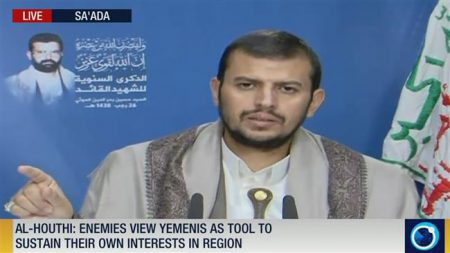
Leader of Yemen’s Houthi Ansarullah movement, Abdul-Malik Badreddin al-Houthi, speaks during a televised speech in Sa’ada, on April 23, 2017.
Leader of Yemen’s Houthi Ansarullah movement, Abdul-Malik Badreddin al-Houthi, says the United States and the Israeli regime are two sides of the same coin and together they seek to destroy Yemen through a brutal military campaign launched by Saudi Arabia.
Addressing a group of Yemenis in Sa’ada, thorough a video conference, Houthi further said on Sunday that the US, Israel and their allies are trying to impose their values on regional nations, adding that enemies view Yemenis as a worthless tool to sustain their own interests in the region.
“Independent forces in the region from Yemen to Syria, Lebanon and Iraq are considered as rogue from the American perspective, and sympathy for the oppressed in these countries is viewed as a crime,” he said, adding that Washington is trying hard to turn regional players into its own puppets.
The Yemeni leader also noted that collusion in the atrocities committed against the Yemeni people is not an issue in the eyes of the American leaders, but when the oppressed and independent forces cooperate with each other, the US perceives it as a crime.
He called on all Yemenis to stand united against the aggressors and defend their country.
“[When] anyone says Israel is a threat to our nation, the United States and its allies say they are supporters of Iran, and with the help of this false justification, they (Washington and allies) target anyone that does not accept adopting a hostile attitude towards Iran,” he added.
He also said the only sin committed by Iran, from the perspective of the United States, was that it freed itself from being a puppet country in the 1979 Islamic Revolution.
‘US, Israel main source of terrorism worldwide’
The Yemeni leader added that Washington considers regional or international threats all those countries that are not its ally, “but the reality is that the US and Israel are themselves the main source of terrorism worldwide.”
Elsewhere in his remarks, Houthi said the Yemeni nation, from all walks of life, should boost their awareness of the realities of regional developments and use it as a tool to battle the US propaganda against the Arab country. Ignorance, he said, makes people an easy target for the US and the Zionists.
Houthi also stated that only Yemenis can decide about their future and the internal affairs of their country and that absolutely no other country or organization, even the United Nations and the Arab League, can impose their so-called solutions to the crisis in Yemen.
He described as utterly ridiculous Washington and Riyadh’s claim that they want to liberate Yemeni cities from “Yemeni occupation.”
“You are Yemenis, who have occupied the capital Sana’a? The US wants to liberate Sana’a from Yemenis?!” he asked.
Houthi reiterated that the Yemeni nation’s resistance against the Riyadh regime’s incessant attacks was deeply rooted in religious orders and was meant to safeguard national sovereignty and freedom.
Saudi Arabia launched its deadly campaign against Yemen in March 2015 to push back the Houthi Ansarullah fighters from Sana’a and to bring back to power Abd Rabbuh Mansur Hadi, Yemen’s president who has resigned and is a staunch ally of Riyadh.
The campaign, which lacks any international mandate and has faced increasing criticism, has claimed the lives of more than 12,000 people, most of them civilians.
Certain Arab countries, including the United Arab Emirates, Bahrain and Qatar, are partners to the military aggression.
April 23, 2017
Posted by aletho |
Ethnic Cleansing, Racism, Zionism, Illegal Occupation | Bahrain, Israel, Qatar, Saudi Arabia, United Arab Emirates, United States, Yemen |
Leave a comment
“Religion is regarded by the common people as true, by the wise as false, and by rulers as useful.”
— Seneca
“When the CIA goes to church, it doesn’t go to pray.”
— South American aphorism
Let’s be clear. Syria is invading nobody. North Korea is attacking damn all. And Russia is threatening zilch. But on the eve of the apocalypse these nations are the ones being stoned. The sanctimonious are having a field day crucifying the leaders of these countries and stomping all over the humanity of their peoples.
In a godless universe the tormentors of Syria, Russia and North Korea are behaving as if god is on their side. If god is another word for barbaric stupidity: they’re right. In that case, though – the universe ain’t empty – it’s full of fucking god.
The silver lining to this toxic theism is the fact that god has a habit of bringing down empires. That’s the point of Edward Gibbon’s The History of the Decline and Fall of the Roman Empire. It’s also the point of Friedrich Nietzsche’s The Genealogy of Morals. God tends to turn mighty empires and mighty individuals into junk.
In other words, piety and the hypocrisy that accompanies it – overtime undermines physical and political power. Let’s hope so. But do we have enough time? Because it’s beginning to feel like the end-time. The ‘mother of all bombs’ is preparing the way for the ‘mother of all suicides’.
The Bible Belt in America and the Koran Knot in Asia are being pulled so tight that the only ones who can breathe today are the Jewish and Islamic states. In the 21st century this doesn’t make sense. After a few hundred years of humanism and rationalism you’d think the world would know better.
In fact the world does know better. God is no longer an unknown entity. The Enlightenment and it’s revolutionaries revealed a long time ago that god is a human creation. “His” only purpose in the past was to create a distraction. And “His” only purpose now is to create chaos – cue the CIA.
Today’s world was created in the 1980s. After Vietnam, the gods living in and around Washington D.C. had a plan: zero taxes and zero standards for the rich. And god for everyone else. It was crude. But crude capitalism likes a crusade.
This proposal, however, wasn’t just for America but for the world. It reflected a mindset that was not only totalitarian but was also simplistic and vindictive. It sought to control life on earth at both the macro-level and the micro-level. And god help anyone who got in the way.
To cover up it’s profound imperialism, Washington D.C. around 1980 covered itself in religion: President Reagan mobilised the Protestants; his director of the CIA, William Casey, mobilised the Catholics; and Carter’s National Security Advisor, Zbigniew Brzezinski, mobilised the Moslems. The Jews were already mobilised so they just followed (or led) the pack. And the Hindus weren’t far behind.
As a result of all this Machiavellian metaphysics an almighty tsunami of religion washed over the earth during the 1980s (we’re still drowning in it). God became a weapon of mass destruction. And “He” was aimed at all those who criticised the rich and celebrated the victory of Vietnam. The popes, preachers and prophets were unleashed.
It was the imams however which became the heroes of Washington D.C. Because it was they who fatally wounded the USSR and Yugoslavia. In books like Devils Game by Robert Dreyfuss and The Lost Hegemon by F. William Engdahl, the Holy Alliance between Islamic fundamentalism and the CIA is laid out for all to see.
While Opus Dei (the Roman rapists) and the evangelicals (the gospel gangbangers) did god’s dirty work in the Americas, Africa and Europe – the jihadis did god’s filthiest work in the Orient. The horrendous Afghan jihad (Operation Cyclone) which Brzezinski started in 1979 became the template for US policy throughout the Orient (Algeria, Chechnya, Iraq, Libya, Mali and Syria). Indeed jihad emerged as Washington’s only answer to the rise of China. On the grand chessboard the White House was a thousand years behind it’s opponents. It had voluntarily abandoned reason in favour of religious terror.
Listen to the CIA deep thinker and RAND Corporation philosopher, Graham E. Fuller, speaking in the late 1990s:
“The policy of guiding the evolution of Islam and of helping them against our adversaries worked marvelously well in Afghanistan against the Russians. The same doctrines can still be used to what remains of Russian power, and especially to counter the Chinese influence in Central Asia.”
This is the guts of recent and current US strategy – straight from the horse’s mouth (or asshole). It’s not complicated – it’s completely nuts. Rather than being based on trade – it’s based on traditional ignorance. Instead of fanning the warm glow of international cooperation. It wilfully fans a conflagration of medieval mendacity. It’s not a pivot towards Asia but a pivot towards hell.
And the reason for this obscurantism? It’s to be found in the physical part of metaphysics. It’s to be found in the bowels of the earth. It’s the oil and gas and whatever else the US must steal and spoil to “keep America great forever”. As chief US strategist George F. Kennan wrote in 1948:
“We have about 50% of the world’s wealth but only 6.3% of its population…. Our real task in the coming period [the coming century] is to devise a pattern of relationships, which will permit us to maintain this position of disparity. To do so we will have to dispense with all sentimentality…. We should cease to talk about vague…. unreal objectives such as human rights [humanism, rationalism, secularism, modernism], the raising of living standards, and democratisation. The day is not far off when we are going to have to deal in straight power concepts. The less we are hampered by idealistic slogans, the better.”
The straightest “power concept” of them all is: god. And the oldest “pattern of relationships” is also summed up in the word: god. “He” is up there and we are down here. And our job is to worship “Him”. Washington D.C. liked this model because after Vietnam it was the last model they had left in their reactionary political / philosophical arsenal. And around 1980 they used it with a vengeance. After 1980 Washington D.C. was Mecca, Jerusalem and the Vatican rolled into one. God’s word was and still is “the Washington Consensus” plus the Pentagon. And god help anyone who got in the way.
So who is in the way of the “Washington Caliphate”? Where is the current “axis of evil”? You guessed it: Syria, Russia and North Korea. The Arab Republic, the communist state and the ex-communist empire refuse to genuflect to the White House. And for committing this secular sin the mindless gods are mercilessly kneecapping them.
These three rebel states however continue to resist. In the face of almighty pressure each refuses to surrender their pride and sovereignty.
We’re witnessing a battle of wills like never before. This arc of resistance which stretches across the Eurasian landmass – from the Mediterranean Sea to the Sea of Japan – is Brzezinski’s worst nightmare come true. Indeed viewed as one instead of three it is a formidable barrier to the totalitarian ambition of the CIA. Viewed as one instead of three it can prevail.
Why can they prevail? Because they possess the fire of the gods. They possess that which made the gods in Washington D.C. great in the first place: independence and reason. Syria, Russia and North Korea harken back to a time when modernism meant something – a time when western imperialism was the problem rather than the solution. And for this reason alone their perspective is a thousand times more real than the perspective of the god-lovers who terrorise them.
And the fire? The ultimate fire which they possess and will protect them is the nuclear bomb. Good old fashioned science (Prometheus) has given Russia and North Korea – and indirectly Syria too – the key to freedom. Say what you like about the nuclear bomb but in the hands of the weak – the Empire must back down. And in the space created we can breathe. And recall the fact that god is dead. And the emperor in Washington is wearing no clothes.
Aidan O’Brien is a hospital worker in Dublin, Ireland.
April 23, 2017
Posted by aletho |
Book Review, Timeless or most popular | CIA, Israel, North Korea, Russia, Syria, United States |
Leave a comment
Three Syrian forces have been killed in a fresh Israeli attack on a military camp near the southwestern city of Quneitra, a military official says.
The attack hit the al-Fawwar camp on Sunday, wounding two others, the unnamed official told the French news agency AFP.
It was not clear whether the assault was an airstrike or shelling. The attack comes after Israel struck a Syrian army position in the province of Quneitra on the Golan plateau on Friday, “causing damage.”
A Syrian military source told the official SANA news agency that the Israeli aggression came after an attempt by terrorists to infiltrate military positions in Quneitra was foiled and the assailants suffered heavy losses.
The Israeli military confirmed the raid in a statement, saying it was conducted shortly after three mortar shells allegedly fired from Syria hit an open area in the northern occupied Golan Heights.
The Tel Aviv regime regularly hits positions held by the Syrian army in the Golan Heights, claiming that the attacks are retaliatory. Syria says the raids aim to help Takfiri militants fighting against government forces.
In the past, the Syrian army has confiscated Israeli-made arms and military equipment from terrorists fighting the government forces. There are also reports that Tel Aviv has been treating the extremists wounded in Syria.
Israel seized the Golan Heights from Syria after the 1967 Six-Day War and later occupied it in a move that has never been recognized by the international community.
The regime has built tens of illegal settlements in the area ever since and used the region to carry out military operations against the Syrian government.
Army advances against militants
Separately on Sunday, Syrian forces recaptured Halfaya town in the west-central Hama Province, the Lebanon-based al-Mayadeen TV channel reported.
Meanwhile, pro-opposition media reported fierce clashes between the so-called Free Syrian Army (FSA) militants and US-backed Syrian Democratic Forces (SDF) in the northern countryside of Hama.
US defense officials also told Fox News that the Daesh terrorist group is now centered in the city of Dayr al-Zawr, some 144 kilometers southeast of Raqqah, the Takfiri outfit’s de facto capital in Syria.
They said that US military drones have watched hundreds of Daesh “bureaucrats” or administrators, leaving Raqqah in the past two months.
April 23, 2017
Posted by aletho |
Ethnic Cleansing, Racism, Zionism, War Crimes | Israel, Syria, Zionism |
Leave a comment

NABLUS – Israeli forces shot and injured four Palestinians with rubber-coated steel bullets, after residents in a Palestinian village south of Nablus in the northern occupied West Bank gathered to defend their homes from a mob of Israeli settlers that stormed the community. Hours later, two Palestinians were hospitalized when a group of settlers attacked Palestinians in a nearby village.
Ghassan Daghlas, an official who monitors settler activities in the northern West Bank, told Ma’an that some 100 “extremist settlers” from the illegal Yitzhar settlement entered the village of Urif from its east side and proceeded to smash windows of houses, included one belonging to resident Munir al-Nouri.
He added that the settlers were about to break into the house before Palestinian villagers gathered and forced them away.
According to a Facebook group for Urif, loudspeakers from the village’s mosque were used to inform residents of the incident and to urge them to help defend the homes from the “herds of settlers” attacking the village.
Minutes later, Daghlas said, a number of Israeli military vehicles stormed the village to protect the Israelis.
Clashes erupted between Palestinians youth and Israeli forces who “haphazardly” fired tear gas canisters, stun grenades, and rubber-coated steel bullets at Palestinians, according to Daghlas.
Daghlas said that four Palestinians were shot with rubber-coated steel bullets, one of whom was hit in the head. Medical sources said that Adel al-Safadi, Jihad Saad, Mustafa Fawzi, and Sharif Abd al-Hafith were taken to Rafidiya hospital to be treated for the gunshot injuries.
An Israeli army spokesperson told Ma’an that a “violent dispute erupted between Israelis and Palestinians” who she said were “mutually throwing rocks at each other in an area around the village.” When Israeli forces arrived to “disperse the dispute, several Palestinians shot flares at (Israeli) forces.”
In response, Israeli forces used “riot dispersal means,” she said. No Israeli were reported injured
Later Saturday afternoon, Daghlas said that another group of Israeli settlers attacked Palestinian homes in the town of Huwwara, just a few kilometers away from Urif, on the southeastern edge of Yitzhar.
Daghlas said that dozens of settlers attacked Palestinians and their homes with stones and “sharp objects.” A 72-year-old woman, Badiah Muhammad Hamdan, and a young man identified as Ahmad Yousif Udah were hospitalized. Daghlas said Hamdan sustained head injuries.
A video shared on social media showed the woman, bloodied and incapacitated, being evacuated in an ambulance.
Separately, a young Palestinian man was run over by an Israeli settler later Saturday afternoon in al-Masoudiyya west of Nablus city, Daghlas said.
Daghlas told Ma’an that 19-year-old Asim Salim from Nablus city was evacuated to Rafidiya hospital, where doctors said he sustained moderate wounds. Daghlas added that Salim was trying to cross the road in al-Masoudiyya when a settler’s vehicle hit him and fled the scene.
An Israeli border police spokesperson could not be reached for comment on the reported hit and run.
According to the Applied Research Institute – Jerusalem (ARIJ), since the state of Israel confiscated land from Urif and other Palestinian villages to establish the illegal Yithzar settlement in the 1980s, “attacks and violence perpetrated by settlers has had a profoundly negative impact on Palestinian residents and their property,” stressing that Yitzhar “poses a daily threat to residents of the neighboring Palestinian villages.”
Settlers have also been known to steal crops, damage and burn trees and other plants, and attack places of worship in the area, in an attempt to intimidate Palestinian villagers and farmers from using their land.
On Friday, a video was released showing 15 masked Israeli settlers attacking Israeli activists in the central West Bank, throwing rocks and hitting the activists with clubs.
Many Palestinian activists and rights groups have meanwhile accused Israel of fostering a “culture of impunity” for Israeli settlers and soldiers committing violent acts against Palestinians.
In March, Israeli NGO Yesh Din revealed that Israeli authorities served indictments in only 8.2 percent of cases of Israeli settlers committing anti-Palestinian crimes in the occupied West Bank in the past three years.
Between 500,000 and 600,000 Israelis live in Jewish-only settlements across occupied East Jerusalem and the West Bank in violation of international law, with recent announcements of settlement expansion provoking condemnation from the international community.
According to the United Nations Office for the Coordination of Humanitarian Affairs (OCHA), there were a total of 221 reported settler attacks against Palestinians and their properties in the West Bank and occupied East Jerusalem in 2015, and 107 in 2016.
April 22, 2017
Posted by aletho |
Ethnic Cleansing, Racism, Zionism, Subjugation - Torture | Human rights, Israel, Israeli settlement, Palestine, West Bank, Zionism |
Leave a comment
US Defense Secretary General James Mattis has arrived in Israel for talks expected to focus on Iran and Syria as well the strategic relations between Tel Aviv and Washington.
Mattis arrived in Tel Aviv Thursday afternoon from Cairo on the third leg of a week-long tour of the US allies in the Middle East.
Marking the first time he has visited Israel as the Pentagon chief, Mattis was greeted by an official honor guard at army headquarters in Tel Aviv on Friday morning.
He then met the Israeli minister for military affairs, Avigdor Lieberman, and is scheduled to hold talks with Prime Minister Benjamin Netanyahu and President Reuven Rivlin.
Mattis hopes to hear directly from Israeli leaders their concerns about regional issues, with Iran’s influence topping the list.
‘No doubt Syria has chemical weapons’
The conflict in Syria, where the US and Israel seek to remove President Bashar al-Assad from power, is also on the agenda, according to the prime minister’s office.
Israel was one of the first US allies to salute President Donald Trump for a recent missile strike on a Syrian airbase, where they alleged a suspected chemical attack originated.
Speaking during a press conference with Lieberman on Friday, Mattis said there can be “no doubt” that Syria has retained some chemical weapons and warned President Assad not to use them.
“There can be no doubt in the international community’s mind that Syria has retained chemical weapons in violation of its agreement and its statement that it had removed them all. There is no longer any doubt,” he said.
The US, Israel and Saudi Arabia have been pushing to overthrow the Syrian government through the use of proxy militant forces in the country.
Iran has been lending advisory support to Syria in its battle against the foreign-backed militants, but has avoided direct military involvement in the conflict.
Known as the “Mad Dog,” Mattis has famously said the three gravest threats to US national security were “Iran, Iran, Iran.”
While in Riyadh on Wednesday, the Pentagon chief reiterated the Trump administration’s position that Iran seeks to “destabilize” the region.
He told reporters after meeting with senior Saudi officials that “everywhere you look if there is trouble in the region, you find Iran.”
US-Israeli ties reached a low point over the 2015 nuclear agreement between Iran and world powers, including the United States.
Former President Barack Obama pushed for the agreement, to the dismay of Netanyahu who argued it would only strengthen Iran in the region.
Israeli leaders were emboldened by the election of Donald Trump, who has described the nuclear accord as “the worst deal ever negotiated” and threatened to “rip it up.”
In his latest criticism on Thursday, Trump blasted the deal as “a terrible agreement” that “shouldn’t have been signed,” and accused Iran of “not living up” to its spirit.
April 21, 2017
Posted by aletho |
Ethnic Cleansing, Racism, Zionism, Wars for Israel | Iran, Israel, Middle East, Sanctions against Iran, Syria, United States, Zionism |
Leave a comment
WASHINGTON – US intelligence remains in a high-level of confusion about the capabilities of the Islamic State terror group (Daesh), including its chemical weapons arsenal, retired US Air Force Lt. Col. Karen Kwiatkowski told Sputnik.
“The level of confusion in the US intelligence community is extremely high,” Kwiatkowski said on Thursday. “The political product from the US intelligence community seems incomplete and inaccurate, and likely not the result of an honest consensus among the intelligence agencies.”
The White House has accused Syrian President Bashar Assad of being responsible for the April 4 chemical attack in the village of Khan Shaykun in Idlib province because it alleges that no one else could have done it.
However, Kwiatkowski dismissed this reasoning as superficial and false.
“The White House is clearly wrong with ‘no one else could have done it.’ While it is not completely clear what type of chemical exploded in Idlib last week, we have known about Islamic State and rebel group possession of chemical agents and production of them for several years,” she pointed out.
Daesh and other forces in the region certainly have the capabilities and resources to mount limited chemical weapons attacks such as the one carried out in Khan Shaykhun, Kwiatkowski observed.
“They, as well as other state players or intelligence operations of various states are also capable of ensuring a chemical release pretty much anywhere in the region,” she said.
President Donald Trump and his advisers were misguided in imagining that Assad could have had any motive to use chemical weapons at a time when his army and air force had established a clear ascendancy over Daesh forces and were rolling them back without need to use such weapons, Kwiatkowski pointed out.
“To suggest that Assad had a motive to use a chemical weapon against civilians at this stage of the win is beyond comprehension, and that logic alone should lead to a broad investigation of cui bono, and how it happened,” she remarked.
The US government remains handicapped because it does not have a consistent Syria or Iraq policy, nor does it have a consistent Daesh policy, Kwiatkowski explained.
“Airstrikes launched in the absence of an intelligence consensus and of an actual military and political strategy are pointless,” she stated.
Daesh could have received chemical weapons from several sources, Kwiatkowski also said.
“We know or suspect that various parts of the Islamic State are resourced by Saudi Arabia, Yemen, Qatar, Turkey, Kuwait, Israel and the United States. We know that the Islamic State had been selling Iraqi oil on a black market, and this activity could have included funds to buy chemical weapons and their precursors,” she noted.
The use of chemical weapons by Daesh could now be blamed on Iraqi forces or on Assad’s forces, Kwiatkowski concluded.
April 21, 2017
Posted by aletho |
Deception, False Flag Terrorism, Mainstream Media, Warmongering, Timeless or most popular | Israel, Saudi Arabia, Syria, Turkiye, United States |
Leave a comment
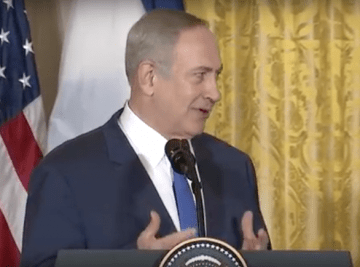
Israeli PM Benjamin Netanyahu making opening remarks at a joint White House press conference with President Donald Trump on Feb. 15, 2017. (Screenshot from White House video)
The other day, I asked a longtime Democratic Party insider who is working on the Russia-gate investigation which country interfered more in U.S. politics, Russia or Israel. Without a moment’s hesitation, he replied, “Israel, of course.”
Which underscores my concern about the hysteria raging across Official Washington about “Russian meddling” in the 2016 presidential campaign: There is no proportionality applied to the question of foreign interference in U.S. politics. If there were, we would have a far more substantive investigation of Israel-gate.
The problem is that if anyone mentions the truth about Israel’s clout, the person is immediately smeared as “anti-Semitic” and targeted by Israel’s extraordinarily sophisticated lobby and its many media/political allies for vilification and marginalization.
So, the open secret of Israeli influence is studiously ignored, even as presidential candidates prostrate themselves before the annual conference of the American Israel Public Affairs Committee. Hillary Clinton and Donald Trump both appeared before AIPAC in 2016, with Clinton promising to take the U.S.-Israeli relationship “to the next level” – whatever that meant – and Trump vowing not to “pander” and then pandering like crazy.
Congress is no different. It has given Israel’s controversial Prime Minister Benjamin Netanyahu a record-tying three invitations to address joint sessions of Congress (matching the number of times British Prime Minister Winston Churchill appeared). We then witnessed the Republicans and Democrats competing to see how often their members could bounce up and down and who could cheer Netanyahu the loudest, even when the Israeli prime minister was instructing the Congress to follow his position on Iran rather than President Obama’s.
Israeli officials and AIPAC also coordinate their strategies to maximize political influence, which is derived in large part by who gets the lobby’s largesse and who doesn’t. On the rare occasion when members of Congress step out of line – and take a stand that offends Israeli leaders – they can expect a well-funded opponent in their next race, a tactic that dates back decades.
Well-respected members, such as Rep. Paul Findley and Sen. Charles Percy (both Republicans from Illinois), were early victims of the Israeli lobby’s wrath when they opened channels of communication with the Palestine Liberation Organization in the cause of seeking peace. Findley was targeted and defeated in 1982; Percy in 1984.
Findley recounted his experience in a 1985 book, They Dare to Speak Out: People and Institutions Confront Israel’s Lobby, in which Findley called the lobby “the 700-pound gorilla in Washington.” The book was harshly criticized in a New York Times review by Adam Clymer, who called it “an angry, one-sided book that seems often to be little more than a stringing together of stray incidents.”
Enforced Silence
Since then, there have been fewer and fewer members of Congress or other American politicians who have dared to speak out, judging that – when it comes to the Israeli lobby – discretion is the better part of valor. Today, many U.S. pols grovel before the Israeli government seeking a sign of favor from Prime Minister Netanyahu, almost like Medieval kings courting the blessings of the Pope at the Vatican.
During the 2008 campaign, then-Sen. Barack Obama, whom Netanyahu viewed with suspicion, traveled to Israel to demonstrate sympathy for Israelis within rocket-range of Gaza while steering clear of showing much empathy for the Palestinians.
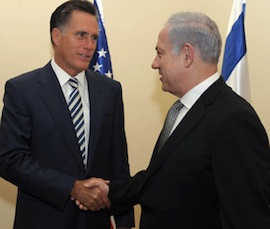
Mitt Romney and Benjamin Netanyahu
In 2012, Republican nominee Mitt Romney tried to exploit the tense Obama-Netanyahu relationship by stopping in Israel to win a tacit endorsement from Netanyahu. The 2016 campaign was no exception with both Clinton and Trump stressing their love of Israel in their appearances before AIPAC.
Money, of course, has become the lifeblood of American politics – and American supporters of Israel have been particularly strategic in how they have exploited that reality.
One of Israel’s most devoted advocates, casino magnate Sheldon Adelson, has poured millions of dollars in “dark money” into political candidates and groups that support Israel’s interests. Adelson, who has advocated dropping a nuclear bomb inside Iran to coerce its government, is a Trump favorite having donated a record $5 million to Trump’s inaugural celebration.
Of course, many Israel-connected political donations are much smaller but no less influential. A quarter century ago, I was told how an aide to a Democratic foreign policy chairman, who faced a surprisingly tough race after redistricting, turned to the head of AIPAC for help and, almost overnight, donations were pouring in from all over the country. The chairman was most thankful.
The October Surprise Mystery
Israel’s involvement in U.S. politics also can be covert. For instance, the evidence is now overwhelming that the Israeli government of right-wing Prime Minister Menachem Begin played a key role in helping Ronald Reagan’s campaign in 1980 strike a deal with Iran to frustrate President Jimmy Carter’s efforts to free 52 American hostages before Election Day.
Begin despised Carter for the Camp David Accords that forced Israel to give back the Sinai to Egypt. Begin also believed that Carter was too sympathetic to the Palestinians and – if he won a second term – would conspire with Egyptian President Anwar Sadat to impose a two-state solution on Israel.
Begin’s contempt for Carter was not even a secret. In a 1991 book, The Last Option, senior Israeli intelligence and foreign policy official David Kimche explained Begin’s motive for dreading Carter’s reelection. Kimche said Israeli officials had gotten wind of “collusion” between Carter and Sadat “to force Israel to abandon her refusal to withdraw from territories occupied in 1967, including Jerusalem, and to agree to the establishment of a Palestinian state.”
Kimche continued, “This plan prepared behind Israel’s back and without her knowledge must rank as a unique attempt in United States diplomatic history of short-changing a friend and ally by deceit and manipulation.”
But Begin recognized that the scheme required Carter winning a second term in 1980 when, Kimche wrote, “he would be free to compel Israel to accept a settlement of the Palestinian problem on his and Egyptian terms, without having to fear the backlash of the American Jewish lobby.”
In a 1992 memoir, Profits of War, former Israeli intelligence officer Ari Ben-Menashe also noted that Begin and other Likud leaders held Carter in contempt.
“Begin loathed Carter for the peace agreement forced upon him at Camp David,” Ben-Menashe wrote. “As Begin saw it, the agreement took away Sinai from Israel, did not create a comprehensive peace, and left the Palestinian issue hanging on Israel’s back.”
So, in order to buy time for Israel to “change the facts on the ground” by moving Jewish settlers into the West Bank, Begin felt Carter’s reelection had to be prevented. A different president also presumably would give Israel a freer hand to deal with problems on its northern border with Lebanon.
Ben-Menashe was among a couple of dozen government officials and intelligence operatives who described how Reagan’s campaign, mostly through future CIA Director William Casey and past CIA Director George H.W. Bush, struck a deal in 1980 with senior Iranians who got promises of arms via Israel in exchange for keeping the hostages through the election and thus humiliating Carter. (The hostages were finally released on Jan. 20, 1981, after Reagan was sworn in as President.)
Discrediting History
Though the evidence of the so-called October Surprise deal is far stronger than the current case for believing that Russia colluded with the Trump campaign, Official Washington and the mainstream U.S. media have refused to accept it, deeming it a “conspiracy theory.”
One of the reasons for the hostility directed against the 1980 case was the link to Israel, which did not want its hand in manipulating the election of a U.S. president to become an accepted part of American history. So, for instance, the Israeli government went to great lengths to discredit Ben-Menashe after he began to speak with reporters and to give testimony to the U.S. Congress.
When I was a Newsweek correspondent and first interviewed Ben-Menashe in 1990, the Israeli government initially insisted that he was an impostor, that he had no connection to Israeli intelligence.
However, when I obtained documentary evidence of Ben-Menashe’s work for a military intelligence unit, the Israelis admitted that they had lied but then insisted that he was just a low-level translator, a claim that was further contradicted by other documents showing that he had traveled widely around the world on missions to obtain weapons for the Israel-to-Iran arms pipeline.
Nevertheless, the Israeli government along with sympathetic American reporters and members of the U.S. Congress managed to shut down any serious investigation into the 1980 operation, which was, in effect, the prequel to Reagan’s Iran-Contra arms-for-hostages scandal of 1984-86. Thus, U.S. history was miswritten. [For more details, see Robert Parry’s America’s Stolen Narrative; Secrecy & Privilege; and Trick or Treason.]
Looking back over the history of U.S.-Israeli relations, it is clear that Israel exercised significant influence over U.S. presidents since its founding in 1948, but the rise of Israel’s right-wing Likud Party in the 1970s – led by former Jewish terrorists Menachem Begin and Yitzhak Shamir – marked a time when Israel shed any inhibitions about interfering directly in U.S. politics.
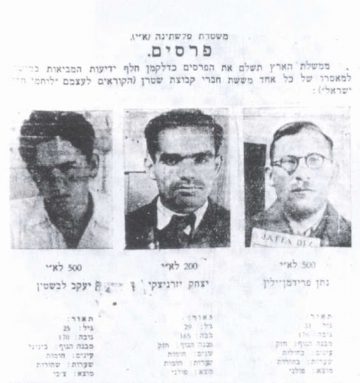
Wanted Poster of the Palestine Police Force offering rewards for the capture of Stern Gang terrorists: 1. Jaacov Levstein (Eliav), 2. Yitzhak Yezernitzky (Shamir), 3. Natan Friedman-Yelin
Much as Begin and Shamir engaged in terror attacks on British officials and Palestinian civilians during Israel’s founding era, the Likudniks who held power in 1980 believed that the Zionist cause trumped normal restraints on their actions. In other words, the ends justified the means.
In the 1980s, Israel also mounted spying operations aimed at the U.S. government, including those of intelligence analyst Jonathan Pollard, who fed highly sensitive documents to Israel and – after being caught and spending almost three decades in prison – was paroled and welcomed as a hero inside Israel.
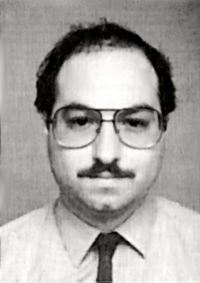
Convicted Israeli spy Jonathan Pollard in the photo from his U.S. Naval Intelligence ID
A History of Interference
But it is true that foreign interference in U.S. politics is as old as the American Republic. In the 1790s, French agents – working with the Jeffersonians – tried to rally Americans behind France’s cause in its conflict with Great Britain. In part to frustrate the French operation, the Federalists passed the Alien and Sedition Acts.
In the Twentieth Century, Great Britain undertook covert influence operations to ensure U.S. support in its conflicts with Germany, while German agents unsuccessfully sought the opposite.
So, the attempts by erstwhile allies and sometimes adversaries to move U.S. foreign policy in one direction or another is nothing new, and the U.S. government engages in similar operations in countries all over the world, both overtly and covertly.
It was the CIA’s job for decades to use propaganda and dirty tricks to ensure that pro-U.S. politicians were elected or put in power in Europe, Latin America, Asia and Africa, pretty much everywhere the U.S. government perceived some interest. After the U.S. intelligence scandals of the 1970s, however, some of that responsibility was passed to other organizations, such as the U.S.-funded National Endowment for Democracy (NED) and the U.S. Agency for International Development (USAID).
NED, USAID and various “non-governmental organizations” (NGOs) finance activists, journalists and other operatives to undermine political leaders who are deemed to be obstacles to U.S. foreign policy desires.
In particular, NED has been at the center of efforts to flip elections to U.S.-backed candidates, such as in Nicaragua in 1990, or to sponsor “color revolutions,” which typically organize around some color as the symbol for mass demonstrations. Ukraine – on Russia’s border – has been the target of two such operations, the Orange Revolution in 2004, which helped install anti-Russian President Viktor Yushchenko, and the Maidan ouster of elected pro-Russian President Viktor Yanukovych in 2014.
NED president Carl Gershman, a neoconservative who has run NED since its founding in 1983, openly declared that Ukraine was “the biggest prize” in September 2013 — just months before the Maidan protests — as well as calling it an important step toward ousting Russian President Vladimir Putin. In 2016, Gershman called directly for regime change in Russia.
The Neoconservatives
Another key issue related to Israeli influence inside the United States is the role of the neocons, a political movement that emerged in the 1970s as a number of hawkish Democrats migrated to the Republican Party as a home for more aggressive policies to protect Israel and take on the Soviet Union and Arab states.
In some European circles, the neocons are described as “Israel’s American agents,” which may somewhat overstate the direct linkage between Israel and the neocons although a central tenet of neocon thinking is that there must be no daylight between the U.S. and Israel. The neocons say U.S. politicians must stand shoulder to shoulder with Israel even if that means the Americans sidling up to the Israelis rather than any movement the other way.
Since the mid-1990s, American neocons have worked closely with Benjamin Netanyahu. Several prominent neocons (including former Assistant Defense Secretary Richard Perle, Douglas Feith, David Wurmser, Meyrav Wurmser and Robert Loewenberg) advised Netanyahu’s 1996 campaign and urged a new strategy for “securing the realm.” Essentially, the idea was to replace negotiations with the Palestinians and Arab states with “regime change” for governments that were viewed as troublesome to Israel, including Iraq and Syria.
By 1998, the Project for the New American Century (led by neocons William Kristol and Robert Kagan) was pressuring President Bill Clinton to invade Iraq, a plan that was finally put in motion in 2003 under President George W. Bush.
But the follow-on plans to go after Syria and Iran were delayed because the Iraq War turned into a bloody mess, killing some 4,500 American soldiers and hundreds of thousands of Iraqis. Bush could not turn to phase two until near the end of his presidency and then was frustrated by a U.S. intelligence estimate concluding that Iran was not working on a nuclear bomb (which was to be the pretext for a bombing campaign).
Bush also could pursue “regime change” in Syria only as a proxy effort of subversion, rather than a full-scale U.S. invasion. President Barack Obama escalated the Syrian proxy war in 2011 with the support of Israel and its strange-bedfellow allies in Saudi Arabia and the other Sunni-ruled Gulf States, which hated Syria’s government because it was allied with Shiite-ruled Iran — and Sunnis and Shiites have been enemies since the Seventh Century. Israel insists that the U.S. take the Sunni side, even if that puts the U.S. in bed with Al Qaeda.
But Obama dragged his heels on a larger U.S. military intervention in Syria and angered Netanyahu further by negotiating with Iran over its nuclear program rather than bomb-bomb-bombing Iran.
Showing the Love
Obama’s perceived half-hearted commitment to Israeli interests explained Romney’s campaign 2012 trip to seek Netanyahu’s blessings. Even after winning a second term, Obama sought to appease Netanyahu by undertaking a three-day trip to Israel in 2013 to show his love.
Still, in 2015, when Obama pressed ahead with the Iran nuclear agreement, Netanyahu went over the President’s head directly to Congress where he was warmly received, although the Israeli prime minister ultimately failed to sink the Iran deal.
In Campaign 2016, both Clinton and Trump wore their love for Israel on their sleeves, Clinton promising to take the relationship to “the next level” (a phrase that young couples often use when deciding to go from heavy petting to intercourse). Trump reminded AIPAC that he had a Jewish grandchild and vowed to move the U.S. Embassy from Tel Aviv to Jerusalem.
Both also bristled with hatred toward Iran, repeating the popular falsehood that “Iran is the principal source of terrorism” when it is Saudi Arabia and other Sunni sheikdoms that have been the financial and military supporters of Al Qaeda and Islamic State, the terror groups most threatening to Europe and the United States.
By contrast to Israel’s long history of playing games with U.S. politics, the Russian government stands accused of trying to undermine the U.S. political process recently by hacking into emails of the Democratic National Committee — revealing the DNC’s improper opposition to Sen. Bernie Sanders’s campaign — and of Clinton campaign chairman John Podesta — disclosing the contents of Clinton’s paid speeches to Wall Street and pay-to-play aspects of the Clinton Foundation — and sharing that information to the American people via WikiLeaks.
Although WikiLeaks denies getting the two batches of emails from the Russians, the U.S. intelligence community says it has high confidence in its conclusions about Russian meddling and the mainstream U.S. media treats the allegations as flat-fact.
The U.S. intelligence community also has accused the Russian government of raising doubts in the minds of Americans about their political system by having RT, the Russian-sponsored news network, hold debates for third-party candidates (who were excluded from the two-party Republican-Democratic debates) and by having RT report on protests such as Occupy Wall Street and issues such as “fracking.”
The major U.S. news media and Congress seem to agree that the only remaining question is whether evidence can be adduced showing that the Trump campaign colluded in this Russian operation. For that purpose, a number of people associated with the Trump campaign are to be hauled before Congress and made to testify on whether or not they are Russian agents.
Meanwhile, The Washington Post, The New York Times and other establishment-approved outlets are working with major technology companies on how to marginalize independent news sources and to purge “Russian propaganda” (often conflated with “fake news”) from the Internet.
It seems that no extreme is too extreme to protect the American people from the insidious Russians and their Russia-gate schemes to sow doubt about the U.S. political process. But God forbid if anyone were to suggest an investigation of Israel-gate.
Investigative reporter Robert Parry broke many of the Iran-Contra stories for The Associated Press and Newsweek in the 1980s.
April 20, 2017
Posted by aletho |
Corruption, Deception, Timeless or most popular, Wars for Israel | AIPAC, Israel, New York Times, United States, Zionism |
Leave a comment
 Aletho News
