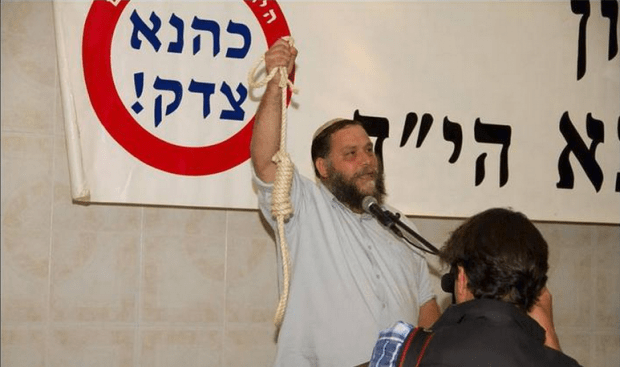
The right-wing Jewish group ‘Lehava’ held a protest outside of the YMCA in Jerusalem, shouting at Palestinian Christian children and families as they were entering and leaving the annual Christmas-tree decoration party.
Lehava is a group that calls for the expulsion of the indigenous Palestinian population from their homes in what is now Israel, in Jerusalem and in the West Bank. At a protest last year outside of a business that had some Palestinian employees, the group chanted “Stop hiring Arabs,” “stop dating our women” and “employing Arabs equals Assimilation.”
The group, whose name in Hebrew stands for the “Organization for the Prevention of Assimilation in the Holy Land”, has also disrupted weddings between Palestinians and Israeli Jews, and handed out fliers saying they are trying to “save the daughters of Israel” by preventing them from dating or marrying Arab men.
A 2011 investigation by the Israeli newspaper Ha’aretz found that around half of the annual budget of the controversial Lehava organization was funded directly by the Israeli government.
The leader of the group, Benzi Gopstein, was reportedly present at the YMCA protest on Friday. Gopstein is on the record voicing support for Pinhas Aburamed, an Israeli man who murdered a Palestinian who he thought was trying to flirt with a Jewish girl. Gopstein said that Aburamed is a hero and should receive a medal.
The event that the right-wing Jewish Lehava group chose to protest was a family event described on the YMCA’s website as “A festive evening in the YMCA lobby decorating the Christmas tree, singing carols and enjoying holiday treats.”
The protesters shouted anti-Palestinian and anti-Christian slogans at the children who came to decorate the Christmas tree, including, “The Arabs won’t defeat us with knifes, and the Christians won’t buy us with presents,” and “Jews want a hanukkiah [menorah], not a fir tree”, according to Israel National News.
Around 1% of the population of Israel, the West Bank and Gaza is Christian. The percentage had been higher before the Israeli military occupation and theft of Palestinian land began. The emigration of Palestinian Christians to other countries increased significantly after the Oslo Accords were signed in 1993 and Israeli settlement expansion increased exponentially.
Many Palestinian Christians in Bethlehem, Jerusalem and Nazareth can trace their ancestry back to early Christians who have remained continuously on the land where Christians believe that Jesus was born, died and resurrected.
Kurdish and Turkish smugglers are transporting oil from ISIS controlled territory in Syria and Iraq and selling it to Israel, according to several reports in the Arab and Russian media. An estimated 20,000-40,000 barrels of oil are produced daily in ISIS controlled territory generating $1-1.5 million daily profit for the terrorist organization.
The oil is extracted from Dir A-Zur in Syria and two fields in Iraq and transported to the Kurdish city of Zakhu in a triangle of land near the borders of Syria, Iraq and Turkey. Israeli and Turkish mediators come to the city and when prices are agreed, the oil is smuggled to the Turkish city of Silop marked as originating from Kurdish regions of Iraq and sold for $15-18 per barrel (WTI and Brent Crude currently sell for $41 and $45 per barrel) to the Israeli mediator, a man in his 50s with dual Greek-Israeli citizenship known as Dr. Farid. He transports the oil via several Turkish ports and then onto other ports, with Israel among the main destinations.
In August, the Financial Times reported that Israel obtained 75% of its oil supplies from Iraqi Kurdistan. More than a third of such exports go through the port of Ceyhan, which the FT describe as a “potential gateway for ISIS-smuggled crude.”
It’s been well-established that Turkey is a major transportation hub for ISIS oil smuggling operations. But where is the oil sent? Someone has to buy it. The answer, apparently, is: Israel.
Al-Araby published an extensive investigation which lays out in detail how oil is transported from ISIS-controlled wells to Israel via Turkey.
Hilary Benn is very serious about his power grab and has been laying the ground for it very carefully. On 18 November BICOM – the British Israeli Communications and Research Centre – published this:
Shadow Foreign Secretary Hilary Benn told a Labour Friends of Israel (LFI) lunch yesterday that relations with Israel must be based on cooperation and rejected attempts to isolate the country.
Addressing senior party figures in Westminster, Benn praised Israel for its “progressive spirit, vibrant democracy, strong welfare state, thriving free press and independent judiciary.” He also called Israel “an economic giant, a high-tech centre, second only to the United States. A land of innovation and entrepreneurship, venture capital and graduates, private and public enterprise.”
Consequently, said Benn, “Our future relations must be built on cooperation and engagement, not isolation of Israel. We must take on those who seek to delegitimise the state of Israel or question its right to exist.”
It is worth reading the next article BICOM published. Brigadier General Michael Herzog, head of strategy for the Israeli defence Force, sets out a strategy for Israeli interests in Syria which dovetails precisely with what Benn and Cameron were pushing in the Commons. Note that Herzog says an overall diplomatic solution is not realistic and rather de facto partitioning of Syria suits Israel’s interests. Therefore there should be no waiting for diplomatic progress before western military action.
With his abandonment of any pretended concern for the slow and agonising genocide of the Palestinians, and his strident support for Trident, Benn is embracing the Israeli establishment and the British military and political establishment. In return, the Tories roared his speech to the rafters, while the media, and especially the Genie Energy linked media, are boosting him to the Labour leadership.
The United Kingdom has, temporarily, an opposition leadership which is not controlled, Zionist, neo-con and in the pocket of the arms industry. Benn has positioned himself very carefully to offer himself as the vehicle for the entire establishment to move to correct this aberration.
Rasha Oweissi, 23, was a good 30 feet back from a West Bank checkpoint when she was shot and killed, clutching a knife and a bag with a suicide note. Hadeel Awwad, 16, waved a pair of scissors at a Jerusalem security guard and was brought down in a hail of bullets. Ashrakat Qattanani, 16, was killed as she lunged at a woman near a military post.
Their names appear in a New York Timesstory today, which informs us that some 20 percent of alleged attackers in the past two months have been women, a new and surprising turn of events in the annals of resistance to the Israeli occupation. The article goes on to examine why so many young women in the current Palestinian uprising are “wanting to be killers.”
But the story avoids the obvious question here: How is it that some Palestinians are now courting martyrdom by showing up at checkpoints armed with kitchen knives?
Diaa Hadid and Rami Nazzal skirt this issue throughout the article. There are quotes from Ashrakat’s father who proudly states that his daughter chose to be a martyr, and there is talk of the “romantic” aura of dying for the cause of Palestinian freedom, but nothing is said of the Israeli role here: the summary executions carried out under the thinnest pretexts.
The practice is well known to Palestinians, however, and B’Tselem, the Israeli monitoring group, recently wrote an open letter to Prime Minister Benjamin Netanyahu demanding an end to a “horrific string” of unlawful killings. The letter states, “There can only be one outcome in cases that combine an individual with Arab appearance and a knife: execution on the street.”
As a result, any troubled young person looking for martyrdom knows she has only to hold a knife in hand and walk toward a checkpoint to achieve her goal. Thus, Rasha Oweissi could write her suicide note, confident that the executioners would do their job.
The real story here, so carefully avoided in the Times, is the presence of willing executioners at the checkpoints. This angle, however, does not fit into the narrative of Israeli victimhood, so we find this print headline on the article today: “Palestinian Women Assert Role in Uprising,” as if we are celebrating their emancipation as they take up arms.
But there is little to celebrate. The story reports that most of the would-be female attackers have been killed in the two months since the recent spate of knife and vehicular assaults began and that those who survived have been taken into custody. At the same time, not a single Israeli has died at their hands.
Readers do not learn, however, that several of these women died under disputed circumstances. Hadeel Hashlamoun, 18, was the first victim of the trigger-happy forces in this recent surge in violence. She was shot in late September at a checkpoint in Hebron, and although Israeli officials reported that she had a knife, eyewitnesses dispute this. B’Tselem noted the discrepancies and called her death an extrajudicial execution.
The Times story today, however, asserts that Hadeel “pulled out a knife,” ignoring the controversy surrounding her killing.
Hadid and Nazzal note that B’Tselem called the deaths of Hadeel Awwad and Ashrakat Qattanani “public, summary street executions,” but the full import of the B’Tselem charges are not to be found in the Times.
In fact, the organization asserts that the highest levels of the Israeli government are responsible for the series of unlawful killings. “Your government permits—and encourages—the transformation of police officers, and even of armed civilians, into judges and executioners,” B’Tselem writes in its open letter to Netanyahu.
The letter notes that senior members of the government have incited this violence through “inflammatory statements,” and it continues, “A new pseudo-normative reality has effectively emerged in which a ‘shoot to kill’ approach must always be adopted, no matter the circumstances, even when the suspect no longer presents any danger whatsoever.”
Thus reports show that Ashrakat Qattanani was killed after she had been run over by a car and that Nourhan Awwad was shot at close range after being beaten to the ground by a man wielding a chair. Likewise, Hadeel Hashlamoun stood behind a barrier and several feet from heavily armed officers when a hail of bullets ended her life.
A careful reader of the Times story might have noticed that security forces indulged in overkill, emptying rounds of bullets into the bodies of young women after they were already immobilized and lying wounded on the street, but the article avoids any close look at the behavior of police and soldiers, not to mention the provocative comments of government officials.
Once again the Times averts its gaze from the reality on the ground in Palestine. Here we had an opportunity to look at the tragic intersection of youthful romanticism and Israeli brutality, but the newspaper can provide only one side of this equation: Israel gets a pass, as usual, even when the evidence for its crimes is in plain sight.
While the current box office hit “The Martian” by director Ridley Scott and starring Matt Damon depicts coordination between the U.S. and Chinese space programs, that’s not the way it’s playing out in the real world.
Secretary of the Air Force Deborah Lee James on Wednesday at the National Press Club responded to a question about the U.S. blocking efforts by Russia and China and over 100 other countries to ensure the disarmament of outer space by alleging that China and Russia are engaging in activities in space that are are “worrisome.”
Sec. James stated “we don’t have weapons in space in the United States.” She then added: “Now what has been very worrisome in recent years is that some other countries around the world, notably China and Russia, are investing and they’re testing in different types of capabilities which could shoot satellites out of orbit, and do other things to our capabilities and the capabilities of allies in space, which is worrisome.” [Question at 54:00, video of event.]
Sec. James’ comments were in response to a question this reporter submitted citing a UN vote last month which was 122 in favor to 4 against disarmament outer space. The U.S. was one of the nations voting against the resolution. [full question and response below.]
John Hughes, the president of the National Press Club and moderator of the event, in his introduction of James, noted that she was recently made “the principle space adviser with expanded responsibilities of all Pentagon space activities.”
Still, Sec. James stated today “I’m not familiar with that vote.”
Alice Slater, who is with Nuclear Age Peace Foundation and the Abolition 2000 coordinating committee and is a leading activist on disarmament said today: “It’s hard to believe that the U.S. Secretary of the Air Force is unaware of the U.S. military program to ‘dominate and control the military use of space’ as set forth in Pentagon documents such as Vision 2020 [PDF] or that the U.S. also has tested anti-satellite weapons in space.”
A summary of the votes in question on Nov. 3 on the UN’s website states: “The text, entitled ‘No first placement of weapons in outer space,’ reaffirmed the importance and urgency of the objective to prevent an outer space arms race and the willingness of States to contribute to that common goal.” The UN summery references a “draft treaty, introduced by China and the Russian Federation. … The draft was approved by a recorded vote of 122 in favour to 4 against (Israel, Ukraine, United States, Georgia), with 47 abstentions.” Yet, James, in her remarks painted Russia and China as the aggressors.
But consider Sec. James’ exact words. While she indicates the U.S.: “we don’t have weapons in space” — she has a different standard when talking about Russia and China: They “are investing and they’re testing in different types of capabilities which could shoot satellites out of orbit” — which the U.S. obviously is doing as well. There is a race to weaponize space though it would seem Russia, China and most other nations are making moves through the UN to stop it and the U.S. government appears to be hindering that.
In addition to Vision 2020, the Project for a New American Century also called for U.S. control of space as one of its goals: “CONTROL THE NEW ‘INTERNATIONAL COMMONS’ OF SPACE AND ‘CYBERSPACE,’ and pave the way for the creation of a new military service — U.S. Space Forces — with the mission of space control.” [archived PDF]
Slater added: “It is common knowledge that when the wall came down in Europe, Gorbachev and Reagan met in Rekjavik and were prepared to negotiate the total elimination of nuclear weapons, except the negotiations were aborted because Reagan refused to give up his dream of a U.S. military shield in space, commonly referred to at the time as Star Wars.
“Less well known, but nevertheless true, is that Putin offered Clinton a deal to cut our arsenals of 16,000 nuclear weapons to a 1,000 weapons each and call all the parties to the table to negotiate for nuclear abolition if the U.S. would cease its plans to put missile bases in Eastern Europe. Clinton refused and Putin backed out of his offer. Shortly thereafter, Bush actually walked out of the 1972 Anti-Balllistic Missile Treaty and put US missiles and bases in Turkey, Romania and Poland. …
“In 2008, Russia and China proposed a draft treaty to ban space weapons which the U.S. blocked from going forward in the consensus bound committee on disarmament in Geneva. This year the U.S. voted to abstain from a Russian proposal to ban weapons in space at the UN First Committee of the General Assembly, joining only Israel and Palau, in not going forward to support the ban.”
In a quest for increased transparency in journalism, here are background material on the piece above.
I asked a couple of other questions about air wars and killer drones which were not asked, though several questions were asked about drones, including one about killing of civilians:
Here were the questions I submitted in writing before the event:
Q: airwars.org estimates that the current bombing campaign in Iraq and Syria over the last 482 days has leveled about 8,600 strikes and killed 682 to 2,104 civilians. Do you have an estimate for the number of civilians killed by U.S. airstrikes?
Q: The Guardian reports on four former drone pilots who recently wrote an impassioned plea to the Obama administration, calling for a rethink of a military tactic that they say has “fueled the feelings of hatred that ignited terrorism and groups like Isis, while also serving as a fundamental recruitment tool similar to Guantánamo Bay … We cannot sit silently by and witness tragedies like the attacks in Paris, knowing the devastating effects the drone program has overseas and at home.” Do you have any information on the long term consequences of the US government’s killer drone program? Can you tell us what countries US drones operate in? How do you respond to their letter from the former drone pilot whistleblowers — these are people who left lucrative careers operating drones because they concluded it was morally contemptible to continue.
Neither was asked, though the moderator, Hughes, did ask a number of questions about drones and raised the issue of civilian deaths in this question:
Q: You talked about the effort to minimize collateral damage, or civilian deaths, in this effort how satisfied are you that you’ve been able to minimize civilian deaths in this campaign? And as you step up this effort now, will the risk of more civilian deaths rise?
Deborah Lee James: I am satisfied that our combined efforts and the way we are approaching this campaign is unprecedented in the history of warfare in terms of the care that we take to do everything possible to try to avoid civilian casualties. Is it 100 percent? No, because there are, from time to time, terrible tragedies. But with the thousands of sorties [a deployment or dispatch of one military unit, be it an aircraft, ship, or troops, from a strongpoint] that have been flown, the fact that there have only been a handful of these incidents, I think, is almost a miracle. So I am convinced we’re doing a good job, I saw some of it in action myself when I was in the CAOC [Combined Air and Space Operations Center] and the CGOC [Company Grade Officer’s Council], and enormous care is taken.
Here’s the full question about weaponization of space:
Q: This questioner says, ‘One month ago at the UN there was a vote for disarmament in space. The vote was 122 for and 4 against, the U.S. was one of the four against. Why is the U.S. against disarmament in space?
Deborah Lee James: “Well, I’m not familiar with that vote, but what I will tell you about space and the proposition of space is this — number one, we don’t have weapons in space in the United States. Number two, we’re very focused on not creating debris in space. So to back up for just a minute, if you go back 20, 30 years there were relatively few countries, and few companies for that matter, who even could get themselves to space, but flash forward to the present day and there are many more countries and many more companies. Plus there is debris in space, there is space junk. So you’ve got thousands of these pieces of material whirling around at 40 or 50 thousand miles per hour and even a small piece of debris can do some serious damage to a billion dollar satellite. So debris is bad and we want to make sure that we minimize that at all costs. Now what has been very worrisome in recent years is that some other countries around the world, notably China and Russia are investing and they’re testing in different types of capabilities which could shoot satellites out of orbit, and do other things to our capabilities and the capabilities of allies in space- which is worrisome. And so what we have said is we need to focus more attention on space, we need to invest more in space, the resiliency of space, and we need to at all times get this point across- –particularly to some of these other countries that are investing and testing in these ways — that debris is bad, that debris hurts all of us.”
Senator Rand Paul, supported by a number of other congressmen, has demanded that the 28 pages of the 9/11 Commission Report that explored the Saudi Arabian role in the terrorist attack be made public. The redacted section of the report, which apparently concluded that the Saudi government itself played no direct role in 9/11, nevertheless contained considerable evidence suggesting that wealthy Saudis and even members of the Royal Family had been supporting and funding al-Qaeda. Some who have actually read the 28 pages were reported to be shocked by what was revealed.
Recent comments by presidential aspirant Donald Trump indicating that he was aware of people celebrating the terrorist attack in New Jersey, whom he described as “Muslims” numbering in their thousands, might well be regarded as misremembering events that took place over fourteen years ago. Or it could just possibly be part of a deliberate scheme to establish a false narrative that would fit nicely with Trump’s stated desire to surveil mosques, waterboard suspects and subject all Muslims to extraordinary scrutiny by the police.
The Trump over-the-top comments were greeting with disbelief and debunked by many media pundits. They were even denounced by some Republicans competing with him for the GOP nomination. But what is really astonishing about the reaction was the failure to connect the dots with what actually happened on 9/11. There were indeed people celebrating as the Twin Towers were burning and collapsing, but they were not Muslims. They were Israelis.
If the Saudi role in 9/11 is still classified secret it is regrettable, but the Israeli role, insofar as can be determined, was never seriously investigated at all and any conclusions, if there were any, were never included in the final report. This time around with the story being resurfaced by Trump one would think that a journalist or two just might be able to make the connection and realize that Donald may have actually been referring to a reported incident involving Israelis rather than Arabs and that he is possibly confusing one with the other.
But of course no one in the mainstream media did pick up on the connection, inhibited no doubt by the understanding that there are some things that one just does not write about Israel if one hopes to remain employed. That is true in spite of the fact that the Israeli angle to 9/11 is without a doubt a good story, one that has never been satisfactorily explored, but it is a tale that will have to remain mired in the alternative media where it can be marginalized by critics as a conspiracy theory or the product of anti-Semitism.
So for the benefit of Mr. Trump and for anyone else who might be interested, I will take it upon myself to relate what happened. Quite possibly Senator Paul will read this and decide that giving billions of dollars in aid annually to a country that just might have been linked to what occurred on 9/11 might no longer be a good idea. He might even demand an inquiry or a commission to look into it and determine what exactly the U.S. government does and does not know. That would be very interesting.
In the year 2001 Israel was running a massive spying operation directed against Muslims either resident or traveling in the United States. The operation included the creation of a number of cover companies in New Jersey, Florida and also on the west coast that served as spying mechanisms for Mossad officers. The effort was supported by the Mossad Station in Washington D.C. and included a large number of volunteers, the so-called “art students” who traveled around the U.S. selling various products at malls and outdoor markets. The FBI was aware of the numerous Israeli students who were routinely overstaying their visas and some in the Bureau certainly believed that they were assisting their country’s intelligence service in some way, but it proved difficult to actually link the students to actual undercover operations, so they were regarded as a minor nuisance and were normally left to the tender mercies of the inspectors at the Bureau of Customs and Immigration.
American law enforcement was also painfully aware that the Israelis were running more sophisticated intelligence operations inside the United States, many of which were focused on Washington’s military capabilities and intentions. Some specialized intelligence units concentrated on obtaining military and dual use technology. It was also known that Israeli spies had penetrated the phone systems of the U.S. government, to include those at the White House to include those at the White House.
In its annual classified counterespionage review, the FBI invariably places Israel at the top for “friendly” countries that spy on the U.S. In fact, the pre-9/11 Bureau did its best to stay on top of the problem, but it rarely received any political support from the Justice Department and White House if an espionage case involved Israelis. By one estimate, more than 100 such cases were not prosecuted for political reasons. Any Israeli caught in flagrante would most often be quietly deported and most Americans who were helping Israel were let off with a slap on the wrist.
But the hands-off attitude towards Israel shifted dramatically when, on September 11, 2001, a New Jersey housewife saw something from the window of her apartment building, which overlooked the World Trade Center. She watched as the buildings burned and crumbled but also noted something strange. Three young me were kneeling on the roof of a white transit van parked by the water’s edge, making a movie in which they featured themselves high fiving and laughing in front of the catastrophic scene unfolding behind them. The woman wrote down the license plate number of the van and called the police, who responded quickly and soon both the local force and the FBI began looking for the vehicle, which was subsequently seen by other witnesses in various locations along the New Jersey waterfront, its occupants “celebrating and filming.”
The license plate number revealed that the van belonged to a New Jersey registered company called Urban Moving Systems. At 4 p.m. the vehicle was spotted and pulled over. Five men between the ages of 22 and 27 years old emerged. They were detained at gunpoint and handcuffed. They were all Israelis. One of them had $4,700 in cash hidden in his sock and another had two foreign passports. Bomb sniffing dogs reacted to the smell of explosives in the van.
According to the initial police report, the driver identified as Sivan Kurzberg, stated “We are Israeli. We are not your problem. Your problems are our problems. The Palestinians are the problem.” The four other passengers were Sivan’s brother Paul, Yaron Shmuel, Oded Ellner and Omer Marmari. The men were detained at the Bergen County jail in New Jersey before being transferred the FBI’s Foreign Counterintelligence Section, which handles allegations of spying.
After the arrest, the FBI obtained a warrant to search Urban Moving System’s Weehawken, N.J., offices. Papers and computers were seized. The company owner Dominick Suter, also an Israeli, answered FBI questions but when a follow-up interview was set up a few days later it was learned that he had fled the country for Israel, putting both his business and home up for sale. The office space and warehouse were abandoned. It was later learned that Suter has been associated with at least fourteen businesses in the United States, mostly in New Jersey and New York but also in Florida. Suter and his wife Omit Levinson Suter were the owners of 1 Stop Cleaner located in Wellington Florida and Dominick was also associated with Basia McDonnell, described as a Polish “holocaust survivor,” as a business partner in yet another business called Value Ad. Florida was a main focus for the Israeli intelligence operation in the U.S. that was directed against Arabs.
The five Israelis were held in Brooklyn, initially on charges relating to visa fraud. FBI interrogators questioned them for more than two months. Several were held in solitary confinement so they could not communicate with each other and two of them were given repeated polygraph exams, which they failed when claiming that they were nothing more than students working summer jobs. The two men that the FBI focused on most intensively were believed to be Mossad staff officers and the other three were volunteers helping with surveillance.
The Israelis were not exactly cooperative, but the FBI concluded from documents obtained at their office in Weehawken that they were targeting Arabs in New York and New Jersey, most particularly in the Paterson N.J. area, which has the second largest Muslim population in the U.S. They were particularly interested in local groups possibly linked to Hamas and Hezbollah as well as in charities that might be used for fund raising. The FBI also concluded that there was a distinct possibility that the Israelis had actually monitored the activities of at least two of the 9/11 hijackers.
To be sure, working on an intelligence operation does not necessarily imply participation in either the planning or execution of something like 9/11, but there are Israeli fingerprints all over the place, with cover companies and intelligence personnel often intersecting with locations frequented by the hijackers. And even possessing bits and pieces relating to the plot does not necessarily imply significant prior knowledge of it.
Apart from the interrogations of the five men from Weehawken, the U.S. government has apparently never sought to find out what else the Israelis might have known or were up to in September 2011. There are a lot a dots that might well have been connected once upon a time, but the trail has grown cold. Police records in New Jersey and New York where the men were held have disappeared and FBI interrogation reports are inaccessible. Media coverage of the case also died, though the five were referred to in the press as the “dancing Israelis” and by some, more disparagingly, as the “dancing Shlomos.”
Inevitably, the George W. Bush White House intervened. After 71 days in detention, the five Israelis were released from prison, put on a plane, and deported. Two of the men later spoke about their unpleasant experience in America on an Israeli talk show, one explaining that their filming the fall of the Twin Towers was to “document the event.” In 2004 the five men sued the United States government for damages, alleging “that their detention was illegal and that their civil rights were violated, suffering racial slurs, physical violence, religious discrimination, rough interrogations, deprivation of sleep, and many other offenses.” They were represented by Nitsana Darshan-Leitner, who in the previous year had founded the Shurat HaDin Israel Law Center which seeks to bankrupt groups that Israel considers to be “terrorists.” Shurat HaDin is closely tied to the Israeli government.
Now it is just possible that the Urban Moving Israelis were indeed uninvolved in 9/11 but nevertheless working for Mossad, which one has to suspect is the case. More than fourteen years later it is perhaps past time to reveal what exactly the FBI knew and currently knows about both the scale and modus operandi of Israeli espionage in the United States. Did Israel have critical intelligence either in broad outline or possibly in specific detail about 9/11 and let it happen to bind Washington more closely to it in a “global war on terror?” If Senator Rand Paul wants to learn more about the Saudis, it is fair to ask “What about Israel?” If Donald Trump wants to pillory fictional celebrating Muslims it is perhaps appropriate that he begin to take note of the actual celebrating Israelis who were caught in the act on 9/11.
We work so hard to establish ourselves and to get where we are and to have somebody (Jonathan Pollard) screw it up… and then have Jewish organizations line up behind this guy and try to make him out a hero of the Jewish people, it bothers the hell out of me…
— Admiral Sumner Shapiro, US Navy Rear Admiral who served as Director of the Office of Naval Intelligence (1978-82), Washington Post, 6/16/2008
We … feel obligated to go on record with the facts regarding Pollard in order to dispel the myths that have arisen from the clever public relations campaign… aiming at transforming Pollard from greedy, arrogant betrayer of the American national trust into Pollard committed Israeli patriot.
— Sumner Shapiro, William Studeman, John Butts and Thomas Brooks, former Directors of Naval Intelligence cited in Ronald Olive, Capturing Jonathan Pollard: How one of the Most Notorious Spies in American History Was Brought to Justice, Annapolis Maryland: Naval Institute Press, 248.
Over two decades ago, Harvard political science professor, Samuel Huntington, argued that global politics would be defined by a ‘clash of civilizations’. His theories have found some of the most aggressive advocates among militant Zionists, inside Israel and abroad.
During the past month, the Israeli regime has been slaughtering and wounding thousands of Palestinians in the West Bank, Gaza and Israel. The Israeli state terrorists, who commit mass murder in Palestine, are part of a movement that sees an inevitable mortal final battle between Zionism and the Islamic and Western world.
Many Western democratic leaders have questioned Huntington’s prognosis and discreetly refuted the Zionist belief that different faiths and cultures cannot live and work together.
In the aftermath of the Paris attacks, leading Western Zionist ideologues have argued that, while liberal values should be reaffirmed, the US and EU leaders must recognize ‘malign global Islamic trends’. Influential Western Zionist journalists and ideologues, who dominate the mass media, argue that ‘hardline Islamism’ is on the rise, even in previously moderate Muslim countries like Turkey, Malaysia and Bangladesh… These ideologues (for example Gideon Rachman of the Financial Times ) systematically avoid commenting on the rise of hardline Zionism in its most racist form in Israel and the conversion of formerly moderate Zionist organizations into willing accomplices of Israeli state terror against a captive people.
Together, these developments in Israel and among the major Zionist organizations in the US and the European Union have limited the space for critics of the ‘clash of civilizations’ dogma.
State terror assaults, such as those taking place daily in Palestine, incite tensions between Zionists and non-Zionists – and that is their intent. Larger structural and systemic forces are at work and are driving Zionist radicalization. One of the most pernicious is the way in which wealthy US and EU Zionist individuals and organizations, in particular the Presidents of the 52 Major American Jewish Organizations, have used their economic power to spread the most intolerant forms of Judaism into the rest of the Western World.
The effects are now visible in the major political institutions and media of the US, England and the Continent. Previously, France was held up as an example of a successful multi-cultural nation – a dubious assumption as any historian of colonial France can testify. But that image is rapidly changing. Influential Zionists have fomented widespread Islamophobia and authored legislation restricting free speech which has outlawed criticism of Israel as ‘anti-Semitism’.
French civil libertarians have noted that political and social space has increasingly narrowed for ‘non-Zionists’, especially for anyone critical of Israel’s state terrorism. In other words, there is immense pressure in France to ‘keep quiet’ or self-censor in the face of Zionist racist brutality – so much for Les Droits de L’Homme et Du Citoyen.
For over a decade, Zionist influence, especially from Israel’s far-right Netanyahu regime, has eroded the French version of ‘moderate Zionism’, replacing it with a more doctrinaire, exclusivist and authoritarian version. World-wide condemnation of Israel’s massacre of over 4,000 entrapped Palestinians in Gaza, the world largest prison camp, led the Netanyahu regime to resort to a virulent Zionist version of ‘identity politics’ to rally support for the slaughter – or enforce silence among the horrified. Israeli Cabinet ministers recently denounced US President Obama and Secretary of State Kerry as ‘anti-Semites’ for their administration’s negotiations over Iran. Numerous prestigious rabbis have blessed the killing of unarmed Palestinians. A prominent Israeli jurist, Justice Minister Ayelet Shaked urged the killing of Arab women so they would not give birth to ‘little snakes’. Israeli-Jewish judges have exonerated Israeli soldiers, police, and settlers for killing Palestinian children – even unarmed teenage Arab girls hysterical over their brutal humiliation. And world public opinion is ordered to ‘move along, look away, nothing for you to see here…’
All the major overseas Jewish organizations have marched in step. In the United States, a country with a democratic constitution and centuries-old Bill of Rights, self-styled ‘mainstream Zionists’ have defended Israeli spies and criminals, as well as un-extraditable swindlers, and organized nation-wide networks of university, professional and business organizations to demand the firing of colleagues and to suppress free speech and free assembly of Israel’s critics.
First and foremost, major Zionist organizations and leaders have stoked the fire of anti-Muslim and anti-Arab racist rhetoric, which has become commonplace in the mass media and among Republican candidates engaged in the current Presidential nomination campaign.
The convergence of these developments in Israel and among the Zionist power configuration in North America, Europe and the Middle East is fueling the idea of a ‘clash of civilizations’.
The ideological marriage of Herzl and Huntington is fast eroding the former reality of Jewish and non-Jewish integration and intermingling across the globe. The alternative to a plural civilization is more primitive and brutal injustice, violence and death.
Contemporary Manifestations of Zionist Power: The Release of the Most Damaging Spy-Traitor in US History
On November 20, 2015, former Naval Intelligence Analyst, Jonathan Pollard, the American-Jewish spy for Israel, was freed by the Obama regime under Zionist pressure after repeated refusals by three Republican and one Democratic President and over the objections of the heads of all 27 major US intelligence agencies. The significance of this release has to be viewed against the history of Pollard’s crimes.
Fabricating Lies to Justify Obama’s Release of Pollard
The mass media and the 52 Presidents of the Major American Jewish Organizations (AIPAC, ADL, etc…), claim that 1) Pollard committed espionage against US security for ‘altruistic reasons’ — a deep concern for Israel’s security and because US intelligence agencies had refused to share crucial information with Israel’s intelligence counterparts (out of anti-Semitism), 2) the information Pollard handed over had no lasting harm and did not endanger US security, and 3) Pollard’s punishment was ‘excessive’, his ‘repentance’ was sincere and his example precluded any future Israeli espionage activity against the US. These assertions are completely false.
Pollard was a mercenary, spying against the US out of greed. He lived a decadent, expensive lifestyle and had demanded the Israelis pay him a total package of over $250,000 for his work. The Israeli Embassy was known to have paid Pollard, a US Naval Analyst, to spy against the United States government. Court records reveal that he collected over $50,000 for ‘expenses’ during his espionage career, including expensive jewelry, and a monthly stipend of $2500. Court records furthermore reveal that he offered to sell additional secret documents to Pakistan, Apartheid South Africa, Australia, Russia and some Middle East countries. He collected dozens of box-loads of confidential documents, many of which had nothing to do with the ‘security of Israel’, but were deemed essential to US global security, including a top secret ten volume set of National Security Agency high level codes exposing the most advanced means and methods of espionage and the main targets of intelligence collection. Some of his ‘vacuumed-up’ treasure trove included the identity of US intelligence operatives and assets in Warsaw pact countries and the Soviet Union. The 27 US intelligence agencies have consistently opposed Pollard’s release because his sale of this information to the Israelis led to the capture and execution of US operatives after Israel handed over this top-secret information to the Soviet Union in exchange for allowing Soviet Jews to immigrate to Israel in massive numbers. Needless to say, this treason crippled US intelligence operations and led to deaths. US military and intelligence officials view Pollard as having ‘blood on his hands’. So much for the ‘altruistic American Zionist keen on helping insecure, little Israel.’ Years of Zionist propaganda and lobbying have obscured this aspect of Pollard’s crimes.
Excessive Punishment or Excessive Leniency?
Far right Israeli Cabinet Ministers and liberal American Jews, supporters and opponents of Pollard, pundits and editorialists argue that the life imprisonment given to Pollard was out of proportion to the crime of treason. They claim that, after 30 years, he was ‘overdue’ for release.
The severity of the punishment is determined by the crime and the damage caused. In case of treason and espionage committed by US officials, (especially for money), the sentence is always severe. The leaders of the John Anthony Walker Naval spy ring were given multiple life sentences in 1985 and there are many other similar cases.
Among the documents Pollard handed over to his Israeli handlers (operating out of the Israeli Embassy), was US intelligence on strategic installations in Syria, Lebanon and Iraq. No doubt, this provided Israel with strategic coordinates to bomb major security facilities in those countries as well as facilitated their brutal invasion and occupation of Lebanon in the 1980s. Pollard’s treachery led to the death of thousands of civilian lives in Lebanon and facilitated the wars in Iraq and Syria. The damage to those countries and to innocent people would not have been considered by the judge in Pollard’s life sentence – but it must be considered here, in understanding the enormity of his crimes. Pollard has boasted that he was operating out of a ‘racial imperative’ to protect Israel.
Pollard did not serve a life sentence. In fact, while in prison he became an Israeli citizen, a salaried officer in the Israeli armed forces and, after divorcing his American wife (who had also engaged in espionage for pay and served several years in prison), he re-married a Canadian-Israeli woman. This sheds a different light on the ‘severity’ of a life sentence for treason.
Pollard did not serve this ‘life sentence’. He was paroled in November 2015 (to the cheers of his adoring Jewish-American fans) demonstrating the wealth and power of American Zionists and their ability to buy the support of US politicians, domestic and foreign notables and the entire Israeli-Jewish political spectrum-and push aside the objections of the heads of the three major US armed services and intelligence agencies.
Israeli public opinion overwhelmingly supports Pollard and regards him as a ‘role model’ for other US Zionists in official positions. Contrary to Israeli lies, several other major Israeli spy operations occurred in the US after Pollard, including the case involving AIPAC officials, Rosen and Weissman, and Pentagon analyst Larry Franklin during George W. Bush’s administration.
In stark contrast to the freeing of an Israeli spy responsible for endangering the security of thousands of US operatives abroad and millions of innocent civilians, two authentic American political prisoners, who have fought for the rights of minorities, rot in jail with no prospect of freedom. Leonard Peltier, a Native American leader has spent 38 years in the highest security prison and Mumia Abu-Jamal, an African-American leader from Philadelphia, whose 33 years in prison have been on death row or brutal solitary confinement. Both were framed by perjured evidence in a parody of justice, which has revolted millions around the world. Neither threatened US security. Over the years, numerous witnesses, legal authorities and academics have testified regarding the miscarriage of justice that characterized their ‘show trials’ and have pleaded for their humanitarian release.
Unlike Pollard, and despite decades of worldwide campaigns for their release, Peltier and Abu-Jamal will probably die entombed in prison. Unlike Pollard, their cases were never about treason, selling information and greed. They have worked hard for justice within their communities, hence earning the hatred of the police state. They fought to serve their oppressed American communities, rather than an oppressive and racist Israeli elite – determined to oppress and erase the native Palestinian population.
The decisive factor has been the political power of Pollard’s supporters, the US Zionist Power Configuration, which leads President Obama and 430 US members of Congress by the nose. Through their media connections, they can lie about Pollard’s case and his motives. They can minimize the consequences of his treason and twist the arms of obedient politicians to support a traitor. Despite the fact that scores of high-ranking US intelligence and military officials have repeatedly attested to the damage inflicted by Pollard on the US, campaign finance hungry politicians recite the Zionist line that Pollard’s treason did not warrant a harsh sentence!
Beyond the immediate shame of a US president caving in to Israeli pressure with regard to this spy, there is the issue of the flagrant double standard:
Why do Israeli spies (or American Zionist traitors) evoke the unconditional support of the entire US Zionist apparatus? Why do thousands of rabbis, hundreds of movie executives and media moguls and scores of billionaires (talk about the 0.01%!) campaign on behalf of this arrogant, greedy thief? Why does Pollard merit a totally different standard of justice, in stark contrast to the vast majority of American minorities – who can rot in dungeons even when clearly innocent? Why does a self-described Israeli (who renounced his US citizenship in jail), who sold vital national secrets to fund a decadent life-style and for what he described as a ‘race imperative’ merit such favors while hundreds of thousands of poor US citizens are routinely denied leniency – let alone mercy? Clearly, the interests of Israel, a foreign regime, carry much greater weight within the US judicial system than millions of American minorities…
Cyber Crimes of Our Times: Billionaire Israeli Swindlers and the Chinese Military
For over three years, the Obama administration, the NSA and the Secretary of Defense, Ashton Carter have fed their media mouthpieces breathless denunciations against China for cyber-theft. Every week, there are lurid stories about the theft of confidential US industrial, military and political intelligence committed by the Chinese. The Obama regime has followed up his charges of ‘cybertheft” by threatening to confront China in the South China Sea, apply sanctions and raise the military ante in the Pacific against the world’s most dynamic economic superpower.
Assistant Secretary of State, Victoria Nuland (Nudelman-Kaplan) has claimed that Chinese cyber theft is a top national security threat requiring an immediate military-security response. US officials have provided no evidence that Chinese officials, at any level, are involved in espionage. Moreover, they have presented no proof that cyber theft is a policy of the Chinese government! There has been no evidence that these alleged thefts have damaged US companies or security interests. Nevertheless, US hostility toward China has been justified by unproven accusations and are used to increase the possibility of a major confrontation.
Contrasted with the ‘allegations’ against the Chinese, three ‘Israeli businessmen’ have been officially charged by US prosecutors with running a multi-billion dollar cyber-hacking scam within the US over the past five years. Dubbed the biggest financial hack in US history, the story hardly made headlines in the US media and was conveniently buried by subsequent ‘terror attacks’ in Europe.
The case is instructive. Three Israelis (one a US-Israeli dual citizen) hacked-attacked ten of the largest US financial institutions, including JP Morgan Chase and Fidelity Investments, as well as the Wall Street Journal … downloading protected information on over 100 million Americans – the biggest hack-attack in US history. Gery Shalon, Ziv Orenstein and Joshua Samuel Aaron employed hundreds of employees in Israel and elsewhere running a mega-cybercriminal enterprise.
According to the Financial Times (11/11/2015, p1), “the hacks took place from 2012 to mid-2015 and were aimed at aiding stock market manipulation that generated tens of millions of dollars.” In addition to selling ‘pumped-up’ stocks to millions of customers of the companies they had hacked, Shalom et al. launched cyber attacks to launder millions (more likely billions) for illegal drug and counterfeit software dealers, malicious malware distributors, illegal online casinos and an illegal ‘bitcoin exchange’ known as ‘Coin.mx.’ Someone within the financial security apparatus of the US government (white collar crime unit) must have tipped them off. They are safe in Israel; the Netanyahu regime has yet to act on a US extradition order, although they are reportedly under ‘house arrest’ in their villas.
In contrast to the on-going bellicose rhetoric, which Washington has directed against China’s alleged hackers, Washington has been ‘very reluctant’ to press the issue of extraditing the cyber-thieves with its ‘special partner’ in Tel Aviv.
Israeli super-hackers launched virulent attacks against major US financial institutions and American investors with apparent impunity, following the practice of Israeli info-tech operatives who have raided US military, technology and industrial sites for years.
While the US sends air squadrons and an armada of warships to Chinese waters over a few sand-bars, and brays about arresting Chinese researchers (who it later released with no charges) for alleged cyber-theft, it cannot persuade its ‘closest strategic ally’, Israel, to hand over a trio of formally charged swindlers. Instead, the US increased its annual $3 billion in military aid and provides an open market for Israeli ‘security’ products based on stolen US technology!
The reason for the differential response is not the nature of the ‘crimes’ – it is who commits the crimes! Israeli dominance of US politics via the unconditional support of its US Zionist power configuration ensures impunity for Israeli citizens, including the ability to delay or postpone the extradition of notorious multi-billion cyber thieves! Washington feels free to accuse China, without proof of official Chinese complicity, despite overwhelming evidence, while it cannot persuade its close ‘friend’ Israel to extradite criminals. Netanyahu, backed by his Israeli-Jewish public will decide if, when and where to extradite. When it comes to shielding Israeli or American-Israeli criminals from American justice, Israel treats its ally in Washington like an enemy.
Zionist political clout is evident in Washington’s judicial leniency toward other mega-swindlers with ties to Israel. Michael Milken contributed millions of (swindled) dollars to Israeli and US Zionist programs and won a ‘get out of jail’ card despite his conviction for major financial scams. He served 2 years out of a 10-year sentence and was granted a ‘humanitarian release’ because he was ‘dying’ of extensive terminal metastatic prostate cancer. So far, Michael’s quarter century of miraculous remission from ‘terminal metastatic prostate cancer’ constitutes a first in the annals of urologic cancer! He has gone on to re-constitute his fortune and prominence, while welfare mothers who took a few extra dollars rot in jail.
Ivan Boesky, another uber-Zionist and mega-donor to Israel was a swindler of gargantuan proportions. He raked in hundreds of millions a year. He was tried, convicted and sentenced to a mere 42 months in prison. He was out in less than 24 months, thanks to the support of ….
Marc Rich, a mega- billionaire rogue trader who broke US sanctions against trading with enemies, was also a self-described agent for the Israeli Mossad. Despite having been convicted in absentia in US courts for fraud, (he had skipped bail for Switzerland), President ‘Bill’ Clinton pardoned the ‘absentee felon’ in absentia– a historical first for a criminal who had never spent a day in jail. Mrs. Rich’s $100,000 donation to the Hilary Clinton New York senatorial campaign probably did little to influence the President’s sense of mercy…..
However, ‘Bernie’ Madoff, a $50 billion dollar swindler’ who gave huge amounts of illicit earnings to Zionist charities and projects in Israel was convicted and sentenced to over 100 years in prison. Unlike the above mentioned ‘untouchables’, Madoff will never breathe free again because he made the unforgivable mistake of mostly swindling other Jews, ardent Zionists and even ripping off a number of pro-Israel foundations. His differential treatment stems from his poor choice of victims rather than the crimes… Otherwise he might now be enjoying a comfortable villa in Israel rather than a cold cell in Pennsylvania.
Conclusions
Israeli capacity to manipulate and influence the American judicial process is based on 52 powerful front organizations – organized in the Presidents of the Major American Jewish Organizations. This situation has made a mockery of the American court system and feeds the cynicism and bitterness of the average American. Zionist officials and allies occupy strategic position within the White House and judiciary.
Through their influence in the mass media, they converted a grotesque mercenary spy, like Jonathan Pollard, into an altruistic, Israeli-Jewish patriot, celebrated throughout Israel and within US Zionist circles. Veteran American intelligence and military officials who opposed his release have been painted with the broad brush of ‘anti-Semite’. The formidable Zionist power configuration, nurtured and financed by mega-swindlers, successfully secured his release. Zionist dominance essentially guarantees that the US will treat an indicted Israeli cyber-thief with extreme tact, supplicating the Israeli government for their extradition, while going ballistic over an alleged Chinese hacker.
Few progressive web sites or even the micro-Marxist journals confront these issues, more out of moral cowardice (self-censorship) than ignorance. Instead they bleat general clichés and ‘radical rhetoric’ about ‘US imperialism’ and the ‘rise of the right’ without identifying the precise social and political identity of the forces who move national policy. In a word, the Zionist Power Configuration gets more than a ‘free ride’. Across the political spectrum it continues to campaign on behalf of Israeli spies and Zionist financial swindlers. This corruption of the American judicial system and the betrayal of American trust have far-reaching consequences and undermine efforts to effectively address major national problems.
By John Chuckman | Aletho News | November 30, 2015
Jeremy Corbyn, leader of the British Labour Party, is a man of genuine integrity and honesty in his opposition to British bombing of Syria.
Indeed, he is everything the Prime Minister of Britain, David Cameron, is not.
I think we see from the storm in the British press against Corbyn just how much the establishment values integrity and honesty, which is to say, not at all.
Almost every word of Cameron’s on the subject of bombing is deliberately deceptive.
He is in fact an intimate part of “the club” which privately regards ISIS and other murdering rogues as tools to an end, and that end is to destroy Assad and turn Syria into a rump state. The club’s members always falsely describe the situation in Syria as a civil war rather than what it truly is, an invasion of a peaceful land by the creatures of outside powers.
They freely admit ISIS is horrible, innumerable propaganda videos having established the fact for the public, but they make no move to do something genuine about it. They portray the only man who is doing something to help Syria’s brave army, Vladimir Putin, as some kind of evil figure with dreams of empire. There is a stream of propaganda and lies about everything Russia does, from its cruise missiles hitting Iran to its planes bombing hospitals, all offered with zero evidence.
Cameron’s every word on Syria is inappropriate. A British Prime Minister has no business pronouncing on the legitimacy of this or that government, especially one supported by the majority of the country’s people, clans, and armed forces. Cameron himself, posing as some cheap knock-off defender of democracy, positively Churchillian in his own eyes, enjoys the support of about 35% of British voters.
Assad’s government has fought bravely against monsters shipped in by Turkey and supplied by Saudi Arabia, Israel, and America for years now, while David Cameron sat back and pontificated.
Assad is not an angel, but he runs a state with tolerance for all religious groups in a region where that is not common, and he has often been generous in helping those badly hurt by the likes of David Cameron – for example, the millions of refugees created by the criminal invasion of Iraq. The reason Assad is hated by Cameron and his associates in “the club” is his independent-mindedness in not following Washington’s dictates. Cameron functions as a noisy little lap dog yapping and snapping at anyone ignoring his master, always in expectation of another approving stroke on the head. It truly is that simple, and all the rest we read and hear is just noisy propaganda.
Washington and Tel Aviv are determined to see Assad gone. And you must ask yourself why that should be a shared goal of the two most violent societies on earth today, each of them in a state of perpetual war and oppression of millions.
Yes, Turkey and Saudi Arabia hate Assad, too, but they mostly do as they are told by Washington.
And remember, one of those countries, Turkey, is run by a lunatic who assassinates journalists and any Kurdish person he can get his hands on, and the other, Saudi Arabia, is run by a senile absolute monarch who regularly cuts off heads and crucifies people and is conducting an illegal war in Yemen, killing civilians daily.
Those are the characters with which David Cameron shares his bed.
What is really at stake here is virtually never discussed in public: the right of countries to exist in peace without outside interference from aggressive states like America and Israel. The United Nations should be in the forefront of demanding just that, but it has been reduced to servility through internal manipulations and threats, especially threats of withholding American financial support as was done some years back. Ban Ki-moon is perhaps the most ineffectual Secretary General in memory, sometimes sounding like a pope enjoining peace with no one listening.
Britain’s bombing in Syria would be just plain old-fashioned aggression adding to that already being done by ISIS, al-Nusra, and other cutthroats. We don’t know what targets Cameron has in mind, but he simply has no business in the country, and we can be sure that if he were sincere about only attacking terrorists, Syria would have welcomed him in its desperate fight. Cameron just keeps repeating, like an unpleasant child who thinks repetition makes something so, that the government of Syria must go.
The government of Syria has not sought Britain’s help, and contrary to arrogant people like David Cameron, Syria does indeed have a government, as legitimate as most in the world.
The only people doing any bombing with the permission of the government are the Russians, and they are supporting the only people doing any real fighting, the Syrian army.
This is not a small point for all those concerned about the rule of law, which you might think would be a prime concern for those who claim they oppose terror.
It took centuries to establish some rule of law in international affairs, and today states like America and Israel and Turkey ignore it completely.
Good old David Cameron wants to join the mob, getting his bit of attention.
And it can’t have escaped Cameron’s attention how handsomely the war criminal, Tony Blair, has been rewarded for doing his dirty part in tearing apart Iraq. He has been showered with gold and sinecures.
Wouldn’t it be natural for Cameron to expect a bit of that for dropping bombs on Syria?
Here is the situation in Syria as I see it : Russia is taking a long-range view and wants stability in post-ISIS Syria. France and the United States are taking the short-range view and really have no achievable plans for Syria’s future stability. Turkey appears to have given little thought to Syria’s future. Ankara may be willing to see indefinite chaos in Syria if it hurts the Assad regime on the one hand and the Kurds on the other.
Part I – Russia
The Russians may be the only party interested in the long-term political stability of Syria. There is certainly no doubt that President Putin is more determined than Western leaders to act on the fact that the various so-called moderate parties standing against the Assad regime cannot work together, and that this fault cannot be corrected by enticements from the United States. For the Russians, this fact makes the Damascus government the only source of future stability.
This understanding, and not Soviet-era nostalgia, has led Russia to support the Assad regime, which possesses a working government, a standing army, and the loyalty of every religious minority group in the country.
Some might object that both Assad and Putin are dictators and thugs (by the way, thugs in suits in the U.S. government are all too common). However, this cannot serve as a serious objection. The only alternative to Damascus’s victory is perennial civil war fragmenting the country into warlord zones. With the possible exception of Israel, this scenario is in no one’s interest, although it seems that the leaders of in Washington and Paris are too politically circumscribed to act on this fact.
Part II – U.S. and France
Thus, it would appear that neither the U.S. nor France really cares about Syria as a stable nation. Once the present military capacity of ISIS is eliminated, Washington and Paris may well clandestinely continue to support a low-level civil war against the Assad regime. In this effort they will have the help of Turkey, the Kurds and Israel. The result will be ongoing decimation of the Syrian population and fragmentation of its territory.
As if to justify U.S. strategy, President Obama, with French President Hollande by his side, recently boasted that the United States stood at the head of a “65-country coalition” fighting terrorism in Syria. However, this is a hollow claim. Most of these countries are coalition members in name only, and some of them, like Saudi Arabia and the Gulf state governments, play a double game. And then Obama dismissed Russia and Iran as “outliers” and “a coalition of two.” Yet those two countries are the Syrian nation’s best hope for future stability.
The fact is that U.S. policy in Syria has been a losing proposition from the beginning just because of its hostility to the Assad government. Despite its air campaign against ISIS, Washington has no ground component nor any answer to the political vacuum in Syria. Both missing parts are to be found in an alliance with Damascus.
Refusal to make that alliance has also opened Washington to building neoconservative political pressure to increase U.S. military presence in the area. However, American “boots on the ground” in Syria is both a dangerous option as well as an unnecessary one. Syrian government boots can do the job if they are properly supported. The support has come from Russia, Iran and Hezbollah. It is the United States and its coalition who are the “outliers.”
Part III – Turkey
It is not easy to explain Turkey’s animosity toward Damascus. Prior to the civil war in Syria, the two countries had good relations. Then something changed. It may have been something as foolish as President Erdogan’s taking personal offense against President Assad because the latter chose to heed the advice of Iran rather than Turkey at the beginning of the war. Whatever happened, it sent Ankara off on an anti-Assad crusade.
That anti-Assad mindset is probably the backstory to the recent reckless Turkish decision to shoot down a Russian warplane operating in support of Syrian government troops close to the Turkish border.
The Turks say that the Russian jet strayed into Turkish airspace. The Russians deny this. The Turks claim that they tried to communicate with the Russian plane to warn it away. When it did not respond, they destroyed it. Of late the Turkish Prime Minister, Ahmet Davutoglu, has said that Ankara “didn’t know the nationality of the plane that was brought down … until Moscow announced it was Russian.” This statement is frankly unbelievable given that Davutoglu followed it up with an admission that Turkey had complained to Russian about military flights in this exact border area. He also asserted that both Russian and Syrian operations in this region of northern Syria should stop because ISIS has no presence there. This assertion makes no sense, since Damascus’s aim is to reassert government authority by the defeat of armed rebels regardless of their organizational affiliation.
It is hard to say whether the Turks are telling the truth about an incursion into their airspace. Most of their evidence, such as recorded Turkish warnings to the Russian plane, is easily fabricated. However, in the end it does not really matter if the plane crossed the border. There was no need to shoot it down.
If the Russian jet strayed into Turkish airspace, there would have been a range of options. The Turks could be very sure that the Russian plane had no hostile intention toward their country, and they should have assumed, for the sake of minimizing any consequences, that no provocation was meant on the part of the Russia. In other words, they should have acted as if the alleged overflight was a mistake. The Turks could have then shadowed the Russian plane in a way that coaxed it back into Syrian airspace and followed the incident up with a formal protest to Moscow. Instead they made the worst possible choice and shot the plane down. Now both Ankara and Washington are shouting about Turkey’s right to defend its territory despite the fact that the Russian plane never posed any threat.
Part IV – Conclusion
In all of the bloodshed, population displacement and terror that has accompanied the Syrian civil war, the least-considered party has been the Syrian people and their future. ISIS, or at least its present infrastructure, will ultimately be destroyed. However, while that destruction is necessary, it is an insufficient outcome because it fails to provide long-term stability. Right now that vital ingredient can only be supplied by the reimposition of order by Damascus. The folks in Washington, Paris and Ankara might not like that, but they are not the ones facing a future of anarchy. And indeed, the more they stand in the way of Damascus, the more chaos they will help create.
Iran says it has never reciprocated cyber attacks with counter raids, although it has been a victim of such illegal attacks in the past years.
“Iran has never responded to these illegal attacks with reciprocal cyber attacks,” Iran’s Foreign Ministry spokesman Hossein Jaberi Ansari said on Friday.
He also noted that the Islamic Republic has been the victim of serious cyber attacks, such as the Stuxnet case, in recent years.
The spokesman was referring to the 2010 cyber attacks on Iran’s nuclear energy facilities by the Stuxnet computer worm, built jointly by the US and the Israeli regime.
He made the remarks in response to a recent New York Times report, which cited unnamed US officials as claiming that there has been a surge in cyber attacks by Iran against US State Department officials over the past month.
Jaberi Ansari went on to say that the lack of an efficient legal system in the international arena to prevent and prohibit cyber attacks is one of the serious shortcomings in countering cyber raids.
Pointing to Iran’s rotating presidency of the Non-Aligned Movement (NAM), the top diplomat said Tehran has always been committed to adopting and strengthening international deterrent mechanisms to prevent cyber attacks, urging all countries, especially the West, to cooperate and prevent such destructive measures.
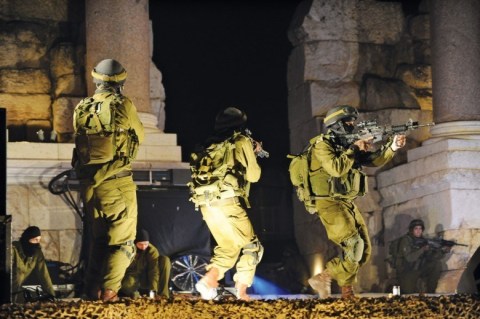
RAMALLAH – At least 67 Palestinians were shot by Israeli military forces during ongoing clashes across the occupied Palestinian territory, the Palestinian Red Crescent said Friday.
A Red Crescent spokesperson told Ma’an that 16 Palestinians were injured by live bullets, as well as two by rubber-coated steel bullets in the Gaza Strip.
Five of those injured by live fire were shot when clashes erupted near the Nahal Oz crossing east of Gaza City, one of whom was shot in the chest and left in critical condition, according to a spokesperson for the Ministry of Health, Ashraf al-Qidra.
Several others were injured in the besieged enclave when Palestinians demonstrated in areas north of Khan Younis, demanding the return of Palestinian bodies currently held by Israel, witnesses told Ma’an.
An Israeli army spokesperson told Ma’an that “multiple violent riots took place near the security fence” between the Gaza Strip and Israel, where Israeli forces used “riot dispersal means” to deter participants attempting to break through the security fence.
The spokesperson said that the forces opened fire on demonstrators after ignoring calls by the forces for the participants to halt.
Palestinians in the Ramallah district meanwhile staged a demonstration near Israel’s Ofer detention center, where medics told Ma’an that Israeli forces opened fire on protesters.
One of those shot by live fire was left in critical condition, medics said, adding that dozens of others suffered from tear gas inhalation.
A total of 22 injuries by live fire were reported from the occupied West Bank, the Red Crescent spokesperson told Ma’an, as well as 27 injured by rubber-coated steel bullets and over a hundred who were treated for tear-gas inhalation.
In Hebron, 14 Palestinians were hit with live bullets, and 10 with rubber-coated steel bullets, the Red Crescent said, adding that Israeli forces targeted an ambulance with tear gas, shattering its windshield.
In Kafr Qaddum near Qalqiliya, Qaisar Jihad,13, and Hamza Mutei, 22, were shot in the legs and lightly injured after Israeli forces trapped protesters and opened fire, according to a spokesperson for the village’s popular resistance committee, Murad Shtewei.
In the village of Bilin in the Ramallah district, locals told Ma’an that photojournalist Hamdi Abu Rahma was shot with a rubber-coated steel bullet in the thigh as Israeli forces fired tear gas, stun grenades and rubber-coated steel bullets at Palestinian demonstrators.
Over 10,300 Palestinians have been injured by Israeli forces since Oct. 1, not including those injured by Israeli settlers.
Around 160 Israelis have been injured by Palestinian individuals during the same time period, according to documentation by the UN Office for the Coordination for Humanitarian Affairs.
… Most American adults of voting age don’t appear willing to reject the applicability of international law to Israel’s ongoing colonization of occupied territories in East Jerusalem, the West Bank and Golan Heights. … Full article
This site is provided as a research and reference tool. Although we make every reasonable effort to ensure that the information and data provided at this site are useful, accurate, and current, we cannot guarantee that the information and data provided here will be error-free. By using this site, you assume all responsibility for and risk arising from your use of and reliance upon the contents of this site.
This site and the information available through it do not, and are not intended to constitute legal advice. Should you require legal advice, you should consult your own attorney.
Nothing within this site or linked to by this site constitutes investment advice or medical advice.
Materials accessible from or added to this site by third parties, such as comments posted, are strictly the responsibility of the third party who added such materials or made them accessible and we neither endorse nor undertake to control, monitor, edit or assume responsibility for any such third-party material.
The posting of stories, commentaries, reports, documents and links (embedded or otherwise) on this site does not in any way, shape or form, implied or otherwise, necessarily express or suggest endorsement or support of any of such posted material or parts therein.
The word “alleged” is deemed to occur before the word “fraud.” Since the rule of law still applies. To peasants, at least.
Fair Use
This site contains copyrighted material the use of which has not always been specifically authorized by the copyright owner. We are making such material available in our efforts to advance understanding of environmental, political, human rights, economic, democracy, scientific, and social justice issues, etc. We believe this constitutes a ‘fair use’ of any such copyrighted material as provided for in section 107 of the US Copyright Law. In accordance with Title 17 U.S.C. Section 107, the material on this site is distributed without profit to those who have expressed a prior interest in receiving the included information for research and educational purposes. For more info go to: http://www.law.cornell.edu/uscode/17/107.shtml. If you wish to use copyrighted material from this site for purposes of your own that go beyond ‘fair use’, you must obtain permission from the copyright owner.
DMCA Contact
This is information for anyone that wishes to challenge our “fair use” of copyrighted material.
If you are a legal copyright holder or a designated agent for such and you believe that content residing on or accessible through our website infringes a copyright and falls outside the boundaries of “Fair Use”, please send a notice of infringement by contacting atheonews@gmail.com.
We will respond and take necessary action immediately.
If notice is given of an alleged copyright violation we will act expeditiously to remove or disable access to the material(s) in question.
All 3rd party material posted on this website is copyright the respective owners / authors. Aletho News makes no claim of copyright on such material.


 Aletho News
