Sheldon Adelson: Wild card
By KENNETH P. VOGEL | POLITICO | April 31, 2015
LAS VEGAS — Luxury buses pulled up to the front entrance of the private hangar here where Sheldon Adelson keeps his corporate jets, dropping off Republican donors to hear Jeb Bush speak.
But Adelson arrived late — and in more extravagant style, pulling right into the massive structure in his Maybach limousine with dark tinted windows trailed by a second Maybach carrying glaring bodyguards.
The grand entrance was vintage Adelson. And it kicked off a Republican Jewish Conference four-day retreat this past weekend in which the 80-year-old casino mogul wowed his guests with a distinct blend of megawatt GOP politics and Vegas opulence, keeping them — and the political class, as a whole — waiting and wondering about what would come next.
The guessing game is creating anxiety among Republican Party elites eager to avoid a repeat of 2012, when Adelson and his family dumped more than $20 million into a super PAC supporting Newt Gingrich’s long-shot GOP presidential campaign. The Adelsons went on to give even more money to help Mitt Romney, but by the time he was the party’s nominee, the damage was done. The infusion to boost Gingrich roiled and prolonged the primary and hurt the party’s chances of winning the White House.
When Adelson summoned Bush and Govs. Chris Christie of New Jersey, John Kasich of Ohio and Scott Walker of Wisconsin to Las Vegas for the annual spring RJC meeting, GOP stalwarts hoped it might mean the megadonor was committing to get behind one of the establishment favorites for 2016, and not going rogue again.
But interviews with Adelson intimates, an analysis of his political alliances and reporting from the Las Vegas retreat suggest that the headstrong billionaire isn’t a new man, but the same gambler he has always been: a true wild card.
“If anybody tells you what Sheldon is going to do, or how or why he is going to do it, they don’t know Sheldon. Sheldon makes up his own mind,” said Ari Fleischer, a longtime Adelson confidant. Fleischer, an RJC board member, was scheduled to lead a board discussion about what Republicans are doing to improve on their 2012 effort.
The possibility that Adelson might use his checkbook to upend the 2016 primary “is worrisome,” Fleischer conceded, though he stressed the same could be said of other very wealthy Republicans.
The new big-money political landscape — in which a handful of donors can dramatically alter a campaign with just a check or two — explains both the eagerness of busy governors to make pilgrimages to Las Vegas, and the obsession with divining Adelson’s 2016 leanings.
All manner of national media flocked to Adelson’s Venetian casino and resort hotel, which hosted the RJC meeting. But reporters were kept away from Adelson by coalition staff, as well as casino and personal security, and his team turned down interview requests, including for an appearance on NBC’s “Meet the Press.”
As Adelson whizzed around his Venetian kingdom on a motorized scooter during the retreat, he was often trailed by GOP operatives, politicians and fellow donors eager to assess his state of mind, advise him on what he should do or just lavish him with praise and gratitude.
The son of poor Jewish immigrants, Adelson was raised in a working-class Massachusetts town. He amassed a fortune estimated at $40 billion today by following his gut and bucking conventional wisdom, forging a business- and family-travel industry in Las Vegas and rushing into the uncertain middle-class gambling market in the Macao region of China.
He donates huge sums to Israeli causes and has ramped up his domestic political giving in recent years, culminating in an unprecedented $100 million spending spree in 2012. Despite his paltry success rate, he has said he intends to spend even more in future campaigns.
At a closed-press Saturday night gala, Adelson quipped that he couldn’t oblige a request from the RJC for a $50 million contribution because the group’s executive director, Matt Brooks, didn’t have change for $1 billion.
Neither Adelson’s speech nor his private conversations over the weekend provided those closest to him with any clearer sense of which way his gut was leading him in the 2016 presidential race, leaving all grasping at clues.
“His priority is Israel. So, if you look at his vetting process, I haven’t sat in any of the meetings, but I assure you that the first question is ‘tell me where you are on the safety and security of the state of Israel,’” said GOP bundler Fred Zeidman, a Houston private equity investor who is friendly with Adelson.
All the prospective candidates who turned up in Vegas stressed their support for Israel in speeches and private meetings with Adelson. There were several veiled swipes at GOP politicians and prospective presidential candidates with more noninterventionist foreign policy perspectives, like Sens. Rand Paul of Kentucky and Ted Cruz of Texas, who are considered unlikely candidates for Adelson’s support. Yet most of the governors who were invited to Vegas have fairly limited foreign policy chops.
Walker conceded as much in a Saturday speech, explaining foreign affairs is “not an area that governors typically look at,” though he mentioned that he is commander in chief of the Wisconsin National Guard. He also sought to forge cultural common ground with RJCers by explaining that he lights a menorah at the governor’s mansion during Hannukah and named one of his two sons Matthew — which means “gift from God” in Hebrew.
Christie’s efforts at playing the Israel card backfired when he inadvertently used a term [occupied territories] for disputed Middle East territory during a Saturday speech that offended Adelson and some of his guests. The New Jersey governor apologized in a private meeting in the casino mogul’s Venetian office shortly afterward.
The foreign policy deficit may, in fact, be a side effect of another factor Adelson has identified as important, according to sources close to him — “executive experience.” That could potentially rule out prospective candidates with more hawkish foreign policy attitudes, like Sen. Marco Rubio of Florida.
Kasich of Ohio played straight to Adelson.
“Hey, listen, Sheldon, thanks for inviting me,” Kasich told Adelson during a Saturday luncheon speech.
“Sheldon and I were kind of talking about his background. I come from a little town outside of Pittsburgh called McKees Rocks — it was very blue collar,” Kasich said, in one of several Adelson-related non sequiturs.
Even when he discussed his effort to clamp down on prescription drug dissemination, he said Adelson — who took as many as 25 medications in a day in 2001 to manage pain from a neurological condition, and whose wife, Miriam Adelson, is a physician who specializes in treating drug addiction — “is someone who knows about this.”
Some possible candidates who seem to meet Adelson’s criteria either weren’t invited or didn’t come to Las Vegas, including former Arkansas Gov. Mike Huckabee. He has both executive experience and a track record of supporting Israel, but seems to face electability hurdles similar to those that hamstrung Gingrich.
Yet late last year, when Adelson at a Zionist Organization of America dinner presented the Adelson Defender of Israel award to Huckabee, he called the ordained Southern Baptist minister “a great politician,” as well as “a great person, a great American and a great Zionist.” Since then, the two have met privately twice — once with their spouses — and are “very good friends [who] share a deep commitment to Israel,” according to a source close to Huckabee.
Mel Sembler — a Florida mall developer, former U.S. ambassador to Italy and major GOP rainmaker — in 2012 urged Adelson to halt his Gingrich super PAC funding stream for the good of the party, as did fellow RJC board member Zeidman. As Sembler boarded a bus taking donors from Adelson’s Palazzo hotel to the Bush speech at the private hangar Thursday night, he suggested that Adelson may have recalibrated his approach based on the 2012 failure. “Sheldon has his own mind, but he’s learned. He’s learned a lot. He’s matured.”
Plus, Zeidman suggested that Adelson’s personal feelings on the various 2016 possibilities won’t factor into his decision as they did in 2012. “None of them have a 20-year history like Newt Gingrich did,” Zeidman said of the former House speaker’s relationship with Adelson.
The goal of hearing from the candidates was to start a vetting process that will produce a consensus — one that includes Adelson — of the best candidate, according to Sembler.
“We’re going to talk about that one,” he said. “We’re going to support the best candidate we can possibly get. That’s who we’re going to support.”
Adelson may have done that in his closed-door meetings with the candidates (he also met privately with House Speaker John Boehner, who was in town for other business). But when it came to the official RJC sessions, the mogul was often late and frequently seemed more interested in kibitzing than in official business. “He mingles pretty good,” remarked Rep. Billy Long of Missouri, as he left a Friday evening Shabbat dinner at which the Israeli ambassador to the U.S. spoke.
Adelson — who is not known as a morning person and also was nursing a cold — skipped Saturday morning speeches from Walker and former Ambassador to the U.N. John Bolton. He entered the hall midway through Christie’s address, walking with the help of a bodyguard to a reserved seat in the front row as Christie talked about his governing style.
He showed up 20 minutes late to a Friday morning RJC board meeting, zipping up to the entrance on his scooter flanked by two Hebrew-speaking bodyguards, one of whom helped him to his feet to walk into the meeting. As other board members queued up to greet him, Adelson perused the breakfast buffet of bagels, lox, pastries and eggs, using his fingers to sample a pinch of shredded cheddar cheese in a serving bowl. The spread was certified kosher by Rabbi Tzvi Braunstein and the Chabad of Southern Nevada, according to an agenda.
“Who let you in here?” he demanded when POLITICO approached. “You can’t come in. This is a private meeting,” he said, rejecting a question about whether he’d try to avoid a costly and protracted primary this time around. “You can ask anything you want, but you’ll have to talk to the wall, because I’m not talking to you,” he said, as one of his bodyguards stepped in, ushered POLITICO from the room, and later called hotel security to bar the reporter from the adjacent hallways.
At the meeting, board members got a briefing on Senate races and were informed of efforts by the group to assist hawkish allies including Sens. Mitch McConnell of Kentucky and Lindsey Graham of South Carolina, and GOP Senate nominee Bill Cassidy of Louisiana in their 2014 Senate primaries. The weekend’s private events drew appearances by Reps. James Lankford of Oklahoma and Cory Gardner of Colorado, both running for Senate, as well as Rep. Sean Duffy of Wisconsin.
Other closed-press sessions included a scotch tasting, a poker tournament and a panel on “the lessons of 2012 and the current path forward for the GOP.” Then there were VIP discussions and photo ops with former Vice President Dick Cheney, Walker and Kasich, four Jewish prayer services for the more devout, and a Saturday night gala featuring a speech by Cheney. He warned against “what I sense to be an increasing strain of isolationism, if I could put it in those terms, in our own party. It’s not taking over, by any means, but there is without question a body of thought now that’s supported by many Republicans and some candidates that the United States can afford to turn its back on that part of the world.”
Cheney said “it’s crucial” to have candidates with muscular foreign policies and for Republicans to “take back the Senate and take back the White House so we can deal with what has been developing” around the world.
Regardless of any shared ideology on foreign policy or other issues, an adviser to former Pennsylvania Sen. Rick Santorum suggested it’s distasteful for the party’s prospective candidates to be flocking to court Adelson.
“It sets a bad precedent for a billionaire to say ‘come hither’ this early on, and some people actually do,” said John Brabender, who was a leading strategist on Santorum’s 2012 presidential campaign and is helping him build a political foundation that could serve as a springboard to a 2016 campaign. Santorum, who is an ardent defender of Israel, didn’t attend the RJC meeting, and Brabender questioned the optics for the possible 2016 rivals who did. “I don’t know why any prospective candidate wants to be seen as the mainstream Republican, because that’s got negative connotations among most Republican primary voters.”
The narrative that holds Adelson went rogue in 2012 and now is realigning himself with the GOP mainstream is flawed, asserted RJC president Matt Brooks, who works closely with Adelson. “The notion that somehow he was a rube and got duped and made awful investments in 2012, and has all these lessons to learn, is misreading what happened,” said Brooks. “The fact is, Republicans got wiped out all across the board. So it’s not like everybody else won and he was the outlier who put his money into losing causes.”
Except that Adelson is distinct from other conservative megadonors in his willingness to choose sides in primaries, then go it alone, seemingly immune from peer pressure. The only conservative donors who rival his spending power, Charles and David Koch, mostly avoid major involvement in primary fights and focus instead on building consensus among a wide network of donors. Plus, they try — increasingly unsuccessfully — to keep a lower profile.
Still, there is growing overlap between Koch world and the Adelson-RJC crew, with Adelson attending a 2012 Koch donor seminar and Tim Phillips, president of the Kochs’ Americans for Prosperity group, attending his first RJC meeting last weekend.
Democrats have mostly kept their deepest pockets in line, thanks to a smaller universe of super PACs and megadonors, and greater ideological unity — not to mention the rallying of deep pockets behind early presumed front-runner Hillary Clinton.
“The parties have to some degree switched procedures,” said Fleischer. “Republicans used to be the hierarchical, organized party.” Now, though, “Democrats, because they have the White House, and because so many of them are lined up behind Hillary, if she runs, are the hierarchical party, at least for the moment.”
Still, he said, all it takes is one headstrong billionaire to throw everything into chaos, and nobody can stop it.
“If you think that people like Sheldon or George Soros or Tom Steyer are going to be influenced by the thinking of others, you don’t know the mindset of highly successful, entrepreneurial individuals who have made it their own way their whole lives,” said Fleischer. “At the end of the day, these individuals are going to do what they think is the best right thing to do, and it may not necessarily be reflective of the good of the greater party.”
Also on POLITICO:
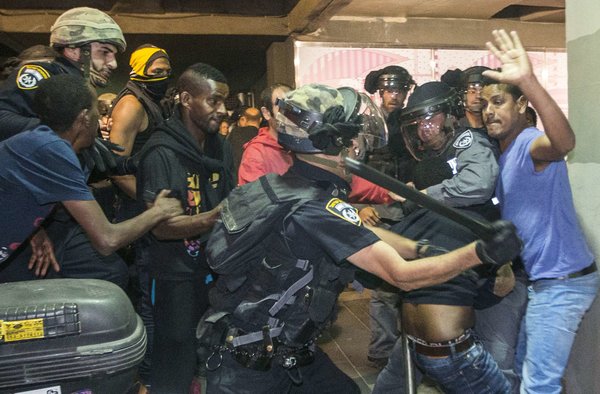
Protest over Zionist Police Brutality Turns Violent in Tel Aviv
Al-Manar | May 4, 2015
A protest in Tel Aviv over police mistreatment of Ethiopian Jews turned violent Sunday, resulting in 57 officers being injured, according to the Zionist police.
Most of those injuries were minor, according to police, but one officer was described to be “moderately injured.” Police say 12 protestors were injured. The extent of those injuries is not known, according to CNN.
The planned demonstration by the Ethiopian Jewish community — incensed over a video gone viral that shows a uniformed IOF soldier of Ethiopian descent being assaulted by police — had been peaceful for hours before things took a violent turn.
Authorities employed horses, water cannons and smoke to disperse the crowd in Rabin Square, where demonstrators had been chanting slogans such as “a violent cop should be in jail.”
Forty-three protesters were arrested, according to Israeli police spokeswoman Luba Samri.
The videotaped episode from April 26 was a tipping point for Ethiopian Jews, some 125,000 strong, who say they have long felt like second-class citizens since arriving in two waves of mass immigration in the 1980s and early 1990s.
Prime Minister Benjamin Netanyahu released a statement saying that “all claims will be looked into but there is no place for violence and such disturbances.” Netanyahu will meet with Pakada on Monday, as well as with leaders in the Ethiopian community, according to the statement.
Following the Money: The New Anti-Semitism?

By Jim Lobe and Charles Davis | LobeLog | May 1, 2015
In the 1976 docudrama about the Watergate affair and the fall of Richard Nixon, All the President’s Men, Bob Woodward’s source at the FBI, Deep Throat, tells him to “follow the money.” To the Washington Post editorial board in 2015, doing just that is problematic—and probably anti-Semitic. Or at least that’s their charge in a piece published last Friday entitled, “Argentina’s President Resorts to Anti-Semitic Conspiracy Theories,” the Post opens by asking:
What do lobbyists at the American Israel Public Affairs Committee and the director of a Washington think tank have to do with hedge-fund manager Paul Singer and the Argentine prosecutor, Alberto Nisman, who died mysteriously in January? Well, according to Argentine President Cristina Fernandez de Kirchner, they are all part of a “global modus operandi” that “generates international political operations of any type, shape and color.”[Links added]
The Post’s problem is that Kirchner posted a “rant” on her website highlighting the fact that Paul Singer—whose hedge fund, Elliott Management, is seeking to force Argentina to repay the full amount of its defaulted debt—has contributed a whole lot of cash to the same neoconservative organizations in Washington that have been tarring the South American nation as a deadbeat ally of Iranian-backed terrorism. These same groups have also uncritically promoted the work of prosecutor Alberto Nisman, who in 2006 issued a highly controversial 900-page indictment charging seven senior Iranian officials with ordering the 1994 bombing of the Jewish community center in Buenos Aires, the Argentine Israelite Mutual Association (AMIA), that killed 85 people. Nisman died in his apartment from a bullet to the head January 18, the night before he was set to testify before the Argentine congress in support of new charges that Kirchner and her foreign minister, Hector Timerman, had conspired with Tehran to quash international arrest warrants against those same Iranians, including Supreme Leader Ayatollah Ali Khamenei and then President Ali Hashemi Rafsanjani, in exchange for a favorable trade agreement.
Making the Links
In 2013, Inter Press Service (IPS) ran a two-part feature by Charles (here and here) on the links between Singer and Nisman’s neoconservative fan club in the United States. The Argentine press and the president herself recently cited this work. The Post, however, plays dumb: “How do Singer, AIPAC and Mark Dubowitz of the Foundation for Defense of Democracies [FDD] come into this?” it asks.
Mr. Singer—or “the Vulture Lord,” as Ms. Kirchner called him—won a court battle on behalf of holders of Argentine debt last year; Ms. Kirchner chose to default rather than pay. Mr. Dubowitz’s think tank has published papers on Argentine-Iranian relations, while AIPAC has criticized the Obama administration’s preliminary nuclear deal with Iran. Confused?
Conspicuously and no doubt consciously missing from the Post’s retelling is the fourth sentence of Kirchner’s “rant”: “[Singer] contributed to the NGO Foundation for the Defense of Democracies (FDD), $3.6 million from 2008 to 2014.” By leaving this out, the Post is better able to pretend the only link between Singer and Dubowitz and Nisman is their Judaism.
Argentina, whose politics are reputedly as byzantine and Machiavellian as any country’s, does indeed have a history of anti-Semitism. Not only did it offer a refuge to fleeing Nazis after World War II, but the military junta that took power in 1976 included elements that extolled the Third Reich, as eloquently retold by perhaps the most famous survivor of the junta’s torture chambers, Jacobo Timerman (the foreign minister’s late father) in his 1981 book, Prisoner Without a Name, Cell Without a Number.
Kirchner may indeed have a political interest in claiming that an international conspiracy is defaming her government, but the evidence for such a conspiracy in this case is much stronger than the Post suggests. As noted above, millions of dollars have flowed from Singer’s pockets to the various neoconservative groups whose advocacy of confrontation with Iran has extended to attacking Argentina, in particular over its ties to the Islamic Republic.
Singer, who sits on the board of the hawkish Republican Jewish Coalition, turns out to be a generous funder of not only FDD, but AIPAC and the American Enterprise Institute (AEI), as well as a number of other right-wing groups and politicians that have stoked hostility toward Iran. In 2010, for example, his personal and family foundations contributed a combined $1 million to the American Israel Education Foundation, the fundraising wing of AIPAC and the sponsor of its congressional junkets to Israel. The $3.6 million he gave to FDD between 2008 and 2011, meanwhile, makes him the group’s second largest donor during those three years. So, it’s pretty clear that what ties AIPAC and FDD together is not only their anti-Iran efforts, but also Paul Singer’s largesse. And that’s the link Kirchner highlights but the Post leaves out.
Make no mistake: Singer and Elliott Management stand to make as much as $2 billion if they can collect full value on the debt they bought for pennies on the dollar after the country’s 2001 default. About 93 percent of Argentina’s bondholders agreed to accept a fraction of what they were originally owed (a fact the Post also conveniently omitted). But Singer—who has done this sort of thing before with other nations that have defaulted on their debt—sued in U.S. court to recover the full amount, a move the Kirchner government has fought every step of the way. The Obama administration and the International Monetary Fund, as well as most of Latin America and Washington’s closest European allies, have also sided with Argentina, viewing Singer’s actions as a threat to the international financial system.
The Iranian “Connection”
What has this got to do with Nisman, though? His allegations of Iranian direction in the 1994 bombing in Buenos Aires—and subsequent charges that the Kirchner government was trying to cover up that involvement so as to not undermine its growing economic relations with the Tehran—proved quite useful in another arena: the court of public and congressional opinion. According to IPS’s Gareth Porter, Nisman’s 2006 indictments were based virtually entirely on the testimony of a long-discredited former Iranian intelligence officer and several members of the cult-like Mujahedin-e Khalq (MEK), an Iranian opposition group that fought alongside Saddam Hussein’s forces in the Iran-Iraq war.
But the claims have undoubtedly been useful to Singer’s cause. “We do whatever we can to get our government and media’s attention focused on what a bad actor Argentina is,” Robert Raben, executive director of the American Task Force Argentina (ATFA) explained to The Huffington Post. ATFA, a group Singer helped create with other hold-out creditors in 2007, spent at least $3.8 million dollars over 5 years doing whatever it could to paint Argentina as a pariah, according to IPS. Connecting the Kirchner government to Iran has clearly furthered that purpose.
“Argentina and Iran: Shameful Allies” was the headline of one ATFA ad that ran in Washington newspapers back in June 2013 as the Obama administration was considering whether to file an amicus brief with the U.S. Supreme Court in Argentina’s favour. The ad featured adjoining photos of Kirchner and outgoing President Mahmoud Ahmadinejad connected by the question, “A Pact With the Devil?”
“What’s the TRUTH About Argentina’s Deal with Iran?” asked another very flashy full-page ad featuring unflattering photos of Kirchner and Hassan Rouhani published in the Post’s front section shortly thereafter. The ad included excerpts of letters denouncing the joint investigation from members of Congress, including Mark Kirk (R-IL) who received more than $95,000 from employees of Singer’s firm, Elliott Management, in the 2010 election. The signer of one letter urging the administration against siding with Argentina, former Rep. Michael Grimm (R-NY)—who after his re-election in 2014 pleaded guilty to federal tax evasion and resigned shortly thereafter—received $38,000 in campaign contributions from Elliott in 2012, nearly twice as much as his next largest donor.
Singer’s generosity also appears to have produced results in the think tank world, with Dubowitz’s FDD leading the way. In May 2013, as ATFA was running the Kirchner-Ahmadinejad ad, FDD release an English-language summary of a new “ground-breaking” report by Nisman detailing “Iran’s extensive terrorist network in Latin America.” (In an extended exchange with ProPublica here and here, Jim pointed out the summary’s many serious holes, leaps of logic, and other weaknesses.) The report triggered a flood of op-eds by FDD fellows and fellow-travellers at other neo-conservative organizations, as well as a series of hearings held by the House Homeland Security Subcommittee. According to FDD’s vice president, Toby Dershowitz, the report provided:
a virtual road map for how Iran’s long arm of terrorism can reach unsuspecting communities and that the AMIA attack was merely the canary in the coal mine. …The no-holds-barred, courageous report is a ‘must read’ for policy makers and law enforcement around the world and Nisman himself should be tapped for his guidance and profound understanding of Iran’s terrorism strategy.
Nisman’s death, on the eve of his testimony before the Argentine Congress about his charges against Kirchner and Timerman (since dismissed by two courts), produced another outpouring of articles by FDD fellows recalling the prosecutor’s tireless efforts to document Iran’s alleged involvement in the AMIA bombings and Kirchner’s purported courtship of Iran. Within a month, FDD announced the establishment of an “Alberto Nisman Award for Courage.” “We must pay careful attention to the detailed Iranian playbook he left behind and from it, heed important lessons in counter-terrorism and law enforcement,” Dershowitz said in the announcement. (For an interesting take on Nisman’s work, see “Why Nisman is No Hero in Argentine Bombing Case” by Argentine journalist Graciela Mochkofsky published last month in The Forward.)
Although FDD clearly lent itself with gusto to Singer’s efforts to tar Argentina and Kirchner with the Iranian brush, AIPAC has been more reserved. It has focused on the issue of Iranian terrorism in its own tireless drive to promote sanctions legislation and a policy of confrontation against the Islamic Republic. In 2010, however, the same year in which Singer and his foundation contributed $1 million to the premier pro-Israel lobby, Nisman was featured on a panel entitled, “Dangerous Liaisons: Iran’s Alliances With Rogue Regimes” at the group’s annual policy conference.
AEI Joins In
As for AEI, Singer would find it attractive not only for its pro-Israel hawkishness and long-standing hostility toward Iran and leftist governments everywhere, but also to its domestic agenda: a hands-off policy toward Wall Street. In other words, he may have had several reasons to give the group $1.1 million in 2009—its second-biggest donor that year—and another $1.2 million over the next two. Whatever his reasons, those who received those millions surely (and demonstrably) knew well enough not to upset their benefactor. And AEI fellow Roger Noriega, a former senior Bush administration official, has certainly pushed the Argentina-Iran/Nisman connection.
As Charles reported in 2013, Noriega has himself been paid at least $60,000 by Elliott Management since 2007—the same year AFTA was founded—to lobby on the issue of “Sovereign Debt Owed to a U.S. Company.” In 2011, he published an article on AEI’s website citing Nisman’s AMIA indictment and denouncing Iran’s offer to cooperate with Argentina in investigating the AMIA bombing as “shocking, in light of Tehran’s apparent complicity in that attack.” The article—“Argentina’s Secret Deal With Iran?”—cited secret documents suggesting that Tehran and Buenos Aires had recently renewed their cooperation on nuclear development as part of a deal “brokered and paid for” by Venezuela’s Hugo Chavez.
Two years later, Noriega and Jose Cardenas, a contributor to AEI’s “Venezuela-Iran Project,” co-authored a seven-page policy brief on AEI’s website entitled “Argentina’s Race to the Bottom,” which, among other things, charged that Kirchner’s government was “casting its lot with rogue governments like those in Venezuela and Iran.” Noting that two-way trade with Iran had grown from $339 million in 2002 to $18.1 billion in 2011, the article asserted:
…[T]he Kirchner government has been turning its back on its historical alliances and increasingly tilting its economic relationships toward countries of dubious international standing where rule of law is less of a concern.
And a week after FDD announced its Nisman Award for Courage, Noriega was back at it with an article headlined “Argentina’s Kirchner Reeling from Scandal.” The piece called for a “credible international investigation into Nisman’s case… to ensure that his 10-year search for the truth was not in vain and that justice is attained not only for his family but also for the victims of the 1994 AMIA bombing.” In a veiled reference to Singer’s quest, he wrote:
From ongoing battles with bondholders playing out in a New York courtroom to pressuring critical news outlets through threats and intimidation to failed attempts to jumpstart a flagging economy, the Kirchner administration cannot end soon enough for many Argentines. Candidates lining up to replace Kirchner in the October elections will likely position themselves as far away from the kirchnerista record as possible. A new administration will have ample opportunity – and likely significant public support – to chart a new economic course. That means reconciling with international financial institutions and markets, restoring trust among foreign investors, and rooting out corruption.
Perhaps Noriega is simply interested in tarring Argentina with the Iranian brush in keeping with his long-standing crusade against any Latin American government that defies Washington’s writ. But like others engaged in this campaign, he and his organization have been paid generously by a very wealthy individual with a clear financial stake in seeing that Argentina’s current government is excised from the community of respectable nations, at least until it pays what he thinks he is owed.
If the Post had “followed the money,” it perhaps would not have been so “confused” by the connections Kirchner highlighted between Singer and those who have attacked her government over its allegedly nefarious relations with Iran. Ignoring Deep Throat’s advice and acting as if that trail of money doesn’t exist allowed the paper to better roll out the powerful charge of anti-Semitism. In truth, it’s not the president of Argentina’s supposed bigotry that offends, though, but the powerful enemies she’s made (and how much they’re worth).
Washington Post Columnist Cherry-Picks Estimates on Israel Nukes
By ALISON WEIR | CounterPunch | May 2, 2015
Washington Post “Fact Checker” columnist Glenn Kessler chastises Iran’s Foreign Minister for saying that Israel has 400 nuclear weapons.
Specifically, Foreign Minister Mohammad Javad Zarif said: “It’s laughable that Netanyahu has become everybody’s nonproliferation guru. He is sitting on 400 nuclear warheads, nuclear warheads that have been acquired in violation of the NPT.”
In an otherwise valuable article, Kessler uses omission to make the claim of 400 nuclear weapons sound unwarranted, concluding “… his figure is more than double the median for the most recent estimate, and five times higher than another credible estimate. Zarif could make his political point without inflating the numbers. He earns Two Pinocchios.”
However, it appears that perhaps the Pinocchios should actually go to Kessler himself for omitting reports on the subject that didn’t fit his own views, thus skewing the numbers.
For instance, A 2009 study by U.S. think tank Center for Strategic and International Studies stated that an Israeli “stockpile of up to 300-400 weapons is possible.”
A report by Col. Warren Farr from the United States Air Force Center for Unconventional Weapons Studies stated that in 1997 Israel had “400 deliverable thermonuclear and nuclear weapons.”
An Israeli analyst wrote in 2012 that Israel has 100-400 nuclear warheads.
In a 2012 Time Magazine interview, former U.S. President Jimmy Carter placed the number at “around 300” nuclear weapons.
The Israel Country Study Guide, Volume 1 Strategic Information and Developments, states: “Israel nuclear might is commonly estimated as moving between 200 to 400 nuclear warheads.”
The U.K. Campaign for Nuclear Disarmament reports on its website: “Israel is thought to have between 100 and 400 nuclear weapons.”
And Middle East expert Juan Cole wrote in 2012, “Israel is thought to have 400 atom bombs.”
I could go on and on.
Given this expanded context, Zarif’s claim no longer looks as outlandish as Kessler makes it out to be. In fact, many others say the same thing.
Two Pinocchios for Glenn Kessler.
Alison Weir is the president of the Council for the National Interest and executive director of If Americans Knew. She is the author of Against Our Better Judgment: How the US was Used to Create Israel.
How Air Canada broke the law, laid off thousands of workers, and outsourced operations to Israeli military drone maker
ThinkPol | March 9, 2015

Air Canada had a very simple plan to increase its profits.
Step 1: Spin the airline’s heavy maintenance unit off as a separate entity
Step 2: Starve the spin-off of work and bankrupt it gradually
Step 3: Outsource the operations to an Israeli military drone manufacturing company wholly owned by the government of Israel.
Air Canada spun off its in-house maintenance, repair and overhaul (MRO) unit Air Canada Technical Services as a separate company, AVEOS, in 2007, four years after the national carrier entered into bankruptcy protection.
In 2011, many Air Canada workers were transferred against their will to AVEOS, despite a legal challenge by International Association of Machinists and Aerospace Workers to prevent this transfer.
Slowly, but surely, Air Canada started taking work away from AVEOS, and sending it abroad. First it was to Germany then to China. As Air Canada accounted for 90% of AVEOS’s business, Air Canada’s actions hit the maintenance company hard, and AVEOS was forced to file for bankruptcy in March 2012 leaving 2,600 employees jobless.
Air Canada CEO Calin Rovinescu, who raked in $9.5 million the same year, justified Air Canada’s actions by placing the blame squarely on AVEOS for not being “cost competitive”.
The Attorney General of Canada filed a law suit against Air Canada for breaching the Air Canada Public Participation Act which reads:
6. (1) The articles of continuance of the Corporation shall contain
…
(d) provisions requiring the Corporation to maintain operational and overhaul centres in the City of Winnipeg, the Montreal Urban Community and the City of Mississauga;
In February 2013, the Quebec Superior Court issued a 139-page ruling finding Air Canada guilty of violating the Air Canada Public Participation Act.
“The court concludes that Air Canada doesn’t respect the law put in place when it privatized in 1988,” Justice Martin Castonguay wrote.
Georges Bujold, general chairman, eastern region, for the International Association of Machinists and Aerospace Workers warned the workers not to have too high expectations about getting their jobs back anytime soon, as he expected Air Canada to drag this all the way to the Supreme Court, and a final ruling won’t be made for years.
Bujold’s prediction came true in the form of a terse email from Air Canada: “Air Canada will be appealing this Quebec Superior Court decision, given the importance of the matter, and makes no further comment at this time.”
Even if the Supreme Court rules in the Canadian workers’ favour, Bujold fears that the Harper government will simply pass legislation to overturn the decision.
“We never know with the Tories what position they would take but it wouldn’t surprise the IAM that Air Canada would make that request to the prime minister or the minister of transport to revisit the Air Canada Act and make those modifications,” Bujold said.
In January 2014, the Air Canada CEO accompanied Stephen Harper on the Prime Minister’s official visit to Israel. A year later, Air Canada signed a maintenance deal with Israel Aerospace Industries, a company wholly owned by the government of Israel, and considered to be a pioneer of drone technology.
Senate Judiciary Committee – Subcommittee on Constitution, Civil Rights and Human Rights heard from journalist and author Peter Bergen that “Israel is the world’s largest exporter of drones and drone technology, and the state-owned Israeli Aerospace Industries (IAI) has sold to countries as varied as Nigeria, Russia and Mexico. IAI has also reportedly sold a ‘loitering weapon’ called the Harop to India, Turkey, France, and Germany.”
Meanwhile, it has been a turbulent time for many of the 2,600 workers who lost their jobs and had to wait almost two years to hear any news of their severance pay or pensions. Some workers are hopeful that Air Canada will drop its appeal and bring maintenance jobs back to Canada. Many others, however, are not holding their breath.
US House committee approves funds for Israel missile system
Press TV – May 2, 2015
The US House of Representatives Armed Services Committee has approved funding for Israel’s missile systems and an amendment authorizing research and development of an anti-tunneling system.
The committee allocated $474 million for the Iron Dome short-range missile system, the David’s Sling medium-range system and the Arrow program. The bills are now awaiting approval from the US Senate.
The $267.6 million funds for research on the anti-tunneling system show Washington and Tel Aviv’s concern about the underground tunnels in the Gaza Strip.
The tunnels are used by the Palestinian resistance movement of Hamas to bring in vital goods and other necessities for the people living under Israel’s blockade of the coastal enclave.
The Gaza Strip has been under a crippling Israeli siege since 2007. The blockade, which has cut off the territory from the outside world, has led to an economic and humanitarian crisis in the densely-populated enclave.
On April 30, the UN urged Israel to end its crippling blockade of the Gaza Strip.
The American Israel Public Affairs Committee (AIPAC) has urged the US Congress to approve the funds.
“AIPAC urges the full House and Senate to include these vital funds in the final versions of the Fiscal Year 2016 defense authorization and appropriations bills,” AIPAC said in a statement.
The United States provides Israel with some $8.5 million in military aid per day, adding up to over $3 billion annually.
Human Rights Center: Seven Palestinians Killed in April; 375 Kidnapped

IMEMC News | May 1, 2015
The Ahrar Center for Detainees’ Studies and Human Rights issued its monthly report on Israeli violations against the Palestinians during April of 2015, and said that seven Palestinians were killed, and 375 were injured.
The report documents Israeli violations against the Palestinians in the besieged Gaza Strip, the West Bank and occupied Jerusalem.
Head of the Ahrar Center Fuad al-Khoffash said occupied Jerusalem remains the most targeted district compared to other Palestinian districts in the occupied West Bank, especially since the soldiers and police conduct daily violations against the Palestinians, their homes and property.
Three Palestinians were killed in the last week of April, while at least 39 others, including four children have been injured.
Two other children were also wounded due to the explosion of a remnant object of the Israeli military, south of Qalqilia, in the northern part of the West Bank.
Two Palestinian civilians were killed in two separate incidents in Hebron and Jenin in the West Bank, while the third, who was a child, was killed at a military checkpoint in occupied Jerusalem.
In occupied Jerusalem also, 26 Palestinian civilians, including two paramedics, were wounded during protests that followed the killing of the child; 12 others, including three children, were wounded during other protests in the West Bank and the fourth child was wounded in the Gaza Strip.
Ahrar said the army kidnapped at least 19 Palestinian women, including legislator Khaleda Jarrar, and that most of the arrests took place in the courtyards of the al-Aqsa Mosque in occupied Jerusalem. It added that the army kidnapped at least 55 children, mainly in Jerusalem, followed Hebron and Bethlehem, during repeated Israeli military invasions and assaults.
In occupied Jerusalem, soldiers kidnapped at least 113 Palestinians (including the 55 children), 86 in the southern West Bank District of Hebron, 54 Palestinians in the northern West Bank district of Nablus, 40 in Bethlehem, 29 in Ramallah, 11 in Qalqilia, 4 in Tulkarem, and one in Salfit.
Palestinians Killed In April, As Documented And Reported By The IMEMC
On 27 April 2015, Israeli forces opened fire at 19-year-old civilian while he was in his farmland near the annexation wall in the west of Arqa village, west of Jenin. As a result, he sustained a bullet wound to the testicles due to which he suffered severe hemorrhage and died hours later.
On 25 April 2015, Israeli forces killed a 20-year-old Palestinian civilian crossing via an electronic gate at the entrance of the Ibrahimi mosque, south of the old city in Hebron, reportedly, after he stabbed an Israeli soldier at the said gate.
On April 24, soldiers shot and killed a young Palestinian, near the Zaim military roadblock, east of occupied Jerusalem.
On April 14, a fighter of the Al-Qassam Brigades, the armed wing of Hamas, died of serious complications resulting from his injury by an Israeli missile during the Israeli onslaught on Gaza eight months ago.
On April 10, Israeli soldiers shot and killed a young Palestinian man during the funeral ceremony of a former detainee, who was denied access to proper medical attention, while being held by Israel.
On April 8, another Palestinian was shot and killed allegedly after stabbing two soldiers, north of the central West Bank city of Ramallah.
Baltimore and the Human Right to Resistance: Rejecting the framework of the Oppressor
By Ajamu Baraka | Black Agenda Report | April 29, 2015
Anti-Black racism, always just beneath the surface of polite racial discourse in the U.S., has exploded in reaction to the resistance of black youth to another brutal murder by the agents of this racist, settler-colonialist state. With the resistance, the focus shifted from the brutal murder of Freddie Gray and the systematic state violence that historically has been deployed to control and contain the black population in the colonized urban zones of North America, to the forms of resistance by African Americans to the trauma of ongoing state violence.
The narrative being advanced by corporate media spokespeople gives the impression that the resistance has no rational basis. The impression being established is that this is just another manifestation of the irrationality of non-European people – in particular, Black people – and how they are prone to violence. This is the classic colonial projection employed by all white supremacist settler states, from the U.S., to South Africa and Israel.
The accompanying narrative is that any kind of resistance that does not fit the narrow definition of “non-violent” resistance is illegitimate violence and, therefore, counter-productive because – “violence doesn’t accomplish anything.” Not only does this position falsely equate resistance to oppression as being morally equivalent to the violence of the oppressor, it also attempts to erase the role of violence as being fundamental to the U.S. colonial project.
The history of colonial conquest saw the U.S. settler state shoot and murder its’ way across the land mass of what became the U.S. in the process of stealing indigenous land to expand the racist White republic from “sea to shining sea.” And the marginalization of the role of violence certainly does not reflect the values of the Obama administration that dutifully implements the bi-partisan dictates of the U.S. strategy of full spectrum dominance that privileges military power and oppressive violence to protect and advance U.S. global supremacy. The destruction of Libya; the re-invasion of Iraq; the civil war in Syria; Obama’s continued war in Afghanistan; the pathological assault by Israel on Palestinians in Gaza and the U.S. supported attack on Yemen by the Saudi dictatorship, are just a few of the horrific consequences of this criminal doctrine.
Race and oppressive violence has always been at the center of the racist colonial project that is the U.S. It is only when the oppressed resist — when we decide, like Malcolm X said, that we must fight for our human rights — that we are counseled to be like Dr. King, including by war mongers like Barack Obama. However, resistance to oppression is a right that the oppressed claim for themselves. It does not matter if it is sanctioned by the oppressor state, because that state has no legitimacy.
No rational person exalts violence and the loss of life. But violence is structured into the everyday institutional practices of all oppressive societies. It is the deliberate de-humanization of the person in order to turn them into a ‘thing’ — a process Dr. King called “thing-afication.” It is a necessary process for the oppressor in order to more effectively control and exploit. Resistance, informed by the conscious understanding of the equal humanity of all people, reverses this process of de-humanization. Struggle and resistance are the highest expressions of the collective demand for people-centered human rights – human rights defined and in the service of the people and not governments and middle-class lawyers.
That resistance may look chaotic at this point – spontaneous resistance almost always looks like that. But since the internal logic of neoliberal capital is incapable of resolving the contradiction that it created, expect more repression and more resistance that will eventually take a higher form of organization and permanence. In the meantime, we are watching to see who aligns with us or the racist state.
The contradictions of the colonial/capitalist system in its current expression of neoliberalism have obstructed the creation of decent, humane societies in which all people are valued and have democratic and human rights. What we are witnessing in the U.S. is a confirmation that neoliberal capitalism has created what Chris Hedges called “sacrificial zones” in which large numbers of black and Latino people have been confined and written off as disposable by the system. It is in those zones that we find the escalation of repressive violence by the militarized police forces. And it is in those zones where the people are deciding to fight back and take control of their communities and lives.
These are defining times for all those who give verbal support to anti-racist struggles and transformative politics. For many of our young white comrades, people of color and even some black ones who were too young to have lived through the last period of intensified struggle in the 1960s and ‘70s and have not understood the centrality of African American resistance to the historical social struggles in the U.S., it may be a little disconcerting to see the emergence of resistance that is not dependent on and validated by white folks or anyone else.”
The repression will continue, and so will the resistance. The fact that the resistance emerged in a so-called black city provides some complications, but those are rich and welcoming because they provide an opportunity to highlight one of the defining elements that will serve as a line of demarcation in the African American community – the issue of class. We are going to see a vicious ideological assault by the black middle class, probably led by their champion – Barack Obama – over the next few days. Yet the events over the last year are making it more difficult for these middle-class forces to distort and confuse the issue of their class collaboration with the white supremacist capitalist/colonialist patriarchy. The battle lines are being drawn; the only question that people must ask themselves is which side they’ll be on.
Israeli military drill sparks fire on Palestinian farmland
Ma’an – April 27, 2015
TUBAS – A fire sparked by an Israeli military drill swept across thousands of dunams of Palestinian farmland in the northern Jordan valley on Monday, the Palestinian civil defense said.
Some 3,000 to 4,000 dunams of farmland in the Humsa area of eastern Tubas district were affected by the fire after Israeli forces opened fire during a military exercise.
The district of Tubas is one of the West Bank’s most important agricultural centers, and the civil defense said the land had been planted with wheat and barley.
Tubas Governor Rabih al-Khandaqji condemned Israeli “violations” in the area, aimed at “displacing people from their lands and deliberately inflicting grave losses to their resources.”
Civil defense crews arrived from Qalqiliya and Nablus to fight the fire but were prevented from reaching the area as Israel has declared it a closed military zone.
The majority of the Jordan Valley is under full Israeli military control, despite being within the Palestinian West Bank.
According to the Applied Research Institute of Jerusalem, more than 15,000 dunams of land in the Tubas district have been confiscated by Israel for military bases with a further 8,000 dunams seized for illegal Israeli settlements.
14-year-old shot by Israeli forces in Gaza Strip in critical condition
Ma’an – April 28, 2015
 GAZA CITY – A 14-year-old Palestinian is in critical condition and has been transferred to Ramallah for treatment after he was hit by a stray Israeli bullet on Friday at his home in the central Gaza Strip, his family said Tuesday.
The family of Fadi Abu Mandil, 14, said that the teen will undergo surgery in his spine as he is currently unable to walk.
His uncle told Ma’an that the child was hit with a stray Israeli bullet while studying at his home when Israeli forces opened fire on Palestinian farmers.
On Friday medical sources said that the 14-year-old from al-Mughazi refugee camp had been transferred to Shuhada al-Aqsa Hospital in Deir al-Balah city.
Israeli forces were again firing on Gazan farmers on Tuesday, damaging property and forcing farmers to flee their land, and on Sunday, they shot and injured a 37-year-old man.
Israeli forces have repeatedly opened fire on Gazans since the ceasefire agreement signed Aug. 26, 2014 that ended a devastating 50-day war between Israel and Hamas.
In March alone, there were a total of 38 incidents of shootings, incursions into the coastal enclave, and arrests, according to the Palestinian Center for Human Rights.
That was up from 26 incidents through February, and left seven Palestinians injured and one dead.
The attacks come despite Israeli promises at the end of the ceasefire to ease restrictions on Palestinian access to both the sea and the border region near the “security buffer zone.”
General strike, demonstration in 1948 Occupied Palestine
Palestine Information Center – April 28, 2015
RAMALLAH – The Palestinians in 1948 Occupied Palestine have been on general strike since the morning hours on Tuesday protesting the Israeli government policy of the demolition of Palestinians’ houses.
This followed a decision made by the higher follow up committee for Arabs in 1948 Occupied Palestine. The strike includes educational institutions and commercial shops.
The Israeli radio announced that the Palestinians are going to take to the streets in Tel Aviv at 5 p.m. in the first national demonstration of its kind. Such marches were previously arranged in cities and towns inhabited by Arabs only.
The Israeli authorities adopt displacement campaigns aiming at expelling the Palestinians in 1948 Occupied Palestine through demolishing their houses under false pretenses.
Featured Video

Iran’s Next Strike May Not Explode. It Could Shut You Down
or go to
Aletho News Archives – Video-Images
Book Review
New paperback: Butchered by “Healthcare”
Lies are Unbekoming | October 20, 2026
 Butchered by “Healthcare” is Robert Yoho’s plain-spoken account of how American medicine stopped being a profession and became an industry. 341 pages. Over a thousand references. Thirty-eight chapters.
“Screening Tests Are Useless”, on tests that find diseases that would never have hurt you. “The FDA Protects the Big Drug Companies”, on an agency funded by the companies it regulates. “The Journals’ Sins Are the Editors’ Sins”, on ghostwritten studies and captured peer review. “Opioids and ‘Pain Management’”, on how a generation was prescribed its way into addiction. “Prozac and Relatives” and “Antipsychotics Are Disastrous”, on what psychiatry does to adults and children. “Surgery: Money Before Patients”. “Failed Cancer Treatments”. “Futile CPR and Overprescribing”. “Billing Scams & Specialty Warfare”. “Hospitals Are Sharks”. Each with a Patient Tips section at the end on how to survive it.
If you have ever walked out of a doctor’s office with a prescription you didn’t ask for, or watched a parent put through a treatment that made them worse, this is the book you want on your shelf before the next appointment. … Full review
Butchered by “Healthcare” is available on Lulu now.
Blog Roll
 Aletho News
- Iran’s Next Strike May Not Explode. It Could Shut You Down /Col Doug Macgregor
- Iran: US political targets legitimate if assassinations return
- Iraq shuts key border crossing with Iran under US pressure: Report
- Undersea Internet cables could be targeted in retaliation for attacks on Iran: IRGC deputy chief
- EU sending ‘biased’ observers to interfere in Serbian election – president
- White House envoy declares kinetic action against Yemen ‘fruitless’
- Ukraine deployed thousands of microdrones in Iraqi Kurdistan: Tasnim
- Iran calls for emergency UNSC meeting over Trump’s ‘brazen’ bomb talk, Israeli threats
- Iranian sources reveal details of Russia-China Hormuz proposal
- Plan for more US-Israel integration puts our military tech at risk
- If Americans Knew
- Americans at National Conservatism Conference held in Israel this year criticize Israel
- Christiane Amanpour exits CNN with a legacy shaped by the debate over Israel
- Israel’s war on Iran is the final move in a decades-old strategy
- Israel Denies Entry to French Journalist, U.S. Researcher Amid Rise in Entry Denials
- Gaza’s hospitals are running out of life-saving fuel – Daily Update
- Mysterious bot accounts reportedly spread fake ‘man on the street’ videos for Michigan Senate candidate
- Israeli Defense Minister Katz Says Over 60 Lebanon Villages Have Been Destroyed
- Why Is Israel Running TV Ads in Iowa Ahead of the Midterms?
- Hind Rajab’s Alleged Killer Is in the United States. HRF Demands His Arrest.
- US Officials Face Fresh Pressure After Another American ‘Brutalized’ by Israeli Settlers in West Bank
- No Tricks Zone
- E-Cars Reduce CO2 Emissions By Only 41% Compared To Internal Combustion Engine Vehicles
- Predictions Made By Renowned Climate Professor Over Past Decades Have Been Proven To Be Poor
- New Study Suggests Large Regions Of The Pacific Ocean Have Been Cooling For The Last 80 Years
- Germany’s Green Energy Debacle: High Energy Costs Force Kahla Porzellan to Close After 182 Years!
- New Study: 50 Years Of The Most Aggressive ‘Net Zero’ Policies Can Only Affect The Global Climate By 0.03°C
- US September “Heat” Was No Record…Many Records Set Decades Ago
- Latest European Green Energy Debacle; Portugal’s Largest Flagship Solar Park Insolvent!
- Green Energy Debacle: German Expert Professor Fritz Vahrenholt Warns Of Severe Economic And Social Consequences
- Two More Paleo Reconstructions Affirm Meters-Higher Sea Levels Across Ireland, Brazil 7000-6000 Years Ago
- New Study: Earth And Venus Surface Warmth Largely Explained By Convection And Lapse Rate, Not CO2 Or Radiation

