UNRWA calls for end of Gaza siege
IMEMC News | September 3, 2014
UNRWA Commissioner-General, Pierre Krähenbühl, says that the reconstruction process of Gaza may take over a decade, if the current blockade on the Gaza Strip is not lifted.
According to Al Ray Palestinian Media Agency, Kraehenbuel declared, during a two-day official visit to Switzerland, that the blockade on Gaza “must be lifted”.
“I would like to thank the government and people of Switzerland for their generous and unwavering support to UNRWA and the refugees we serve. The recent fighting in Gaza and the UNRWA response demonstrated once more how vital our services have become,” he said.
“As the discussions intensify about the reconstruction of Gaza, it is becoming clear that UNRWA will be central to that effort. But we have to remember that Swiss funds are supporting our services beyond Gaza, across the Middle East in war-torn Syria, Lebanon, Jordan and the West Bank.”
Mr. Krähenbühl announced that at least 20,000 homes were destroyed during the recent Israeli assault on the Gaza Strip, and that there had been widespread destruction of public infrastructure.
He states that it was “an imperative for the international community and for the people of Gaza to reconstruct after the devastation”, which was unprecedented in recent history:
“I visited Gaza three times during the recent conflict and the impact of the fighting on individual human lives, particularly the young, is palpable and profound. Hundreds of thousands of children are deep in trauma. We estimate that of one thousand injured children out of three thousands will suffer permanent disabilities.”
Krähenbühl noted that several hundred UNRWA counselors are working to restore a sense of normality to the region. “UNRWA will do all it can to restore human dignity to a community that has suffered enough,” he said.
He also expressed his concern for “more than 50,000 people” who are still living in Gaza’s UNRWA schools due to the fact that their homes had been destroyed:
“We need to do all we can to find alternative accommodation for these people, as we are determined to begin our delayed school year on 14 September… It will be a challenge.”
Russian sale of S-300 system to Egypt a threat to Israel
MEMO | September 3, 2014
Israeli military magazine Israel Defence has reported that Israel is concerned over the possibility of Russia supplying Egypt with the developed anti-aircraft system S-300.
According to foreign media reports, Israel does not possess the proper technology to undermine the work of such an advanced system.
Sources told the magazine that Israel may not allow for Egypt to deploy such anti-aircraft missiles, if they are in fact being obtained, in the Sinai Peninsula.
A source in the Russian military industrial complex told Russia News Agency last month that the anti-aircraft system Egypt is currently negotiating with Russia over was initially produced for Syria. However, Egyptian partners have now “expressed interest in S-300 purchases”.
“The system may be re-equipped for Egypt in a short period of time,” the source added.
Israel Defence noted that if the anti-aircraft system were to be placed in Suez, its radar would cover half of Israel, and if placed in Port Said, it would cover almost the entire area of Israel.
This means that any Israeli plane flying towards Egypt or any Israeli rocket launched at Egypt would be monitored while still inside Israel.
EU source: Gaza reconstruction aid is ‘made in Israel’

A Palestinian school damaged during Operation Protective Edge. 7 August, Gaza City. [Jordi Bernabeu Farrús/Flickr]
EurActiv | September 3, 2014
A row is brewing over claims that Israel is earning millions of euros from a de facto policy of preventing non-Israeli reconstruction aid from entering the Gaza Strip.
At least 65,000 people in the Gaza Strip are homeless after the recent seven-week conflict. Infrastructure ranging from water desalination centres to power plants lies in ruins.
No formal Israeli ban prevents the import of reconstruction materials that were not made in Israel, but EU sources speaking on condition of anonymity say that in practice, Israeli security demands present them with a fait accompli.
“If you want aid materials to be permitted to enter, they will almost inevitably come from Israeli sources,” an EU official said. “I don’t think you’ll find it written down anywhere in official policy, but when you get to negotiate with the Israelis, this is what happens. It increases construction and transaction costs, and is a political problem that has to be dealt with.”
As well as Israel’s security restrictions on aid, “it can be very difficult to export materials to Gaza,” the official said. “A lot of goods for a Gaza private sector reconstruction project we had, ended up being held in Ashdod port for very lengthy periods of time – months if not years – so there was de facto no alternative but to use Israeli sources.”
The source added that the policy had benefited Israel’s economy to the tune of millions of euros and was, in his view, deliberate.
The European Commission donates some €300 million in development aid to Gaza and the West Bank every year, and around €200 million in humanitarian aid.
The EU official’s allegation received backing from international agencies canvassed by EurActiv and is broadly in line with findings in a UN report due to be published later today (3 September).
The United Nations Conference on Trade and Development (UNCTAD) study will say that half of all donor assistance to Palestinians in the West Bank and Gaza – who the UN body say constitute a captive market – is spent on servicing a trade deficit to Israel.
‘Dual use items’
Tel Aviv imposed a full blockade on the Gaza Strip in 2007 after the ascent to power of the Islamist Hamas movement, which has used suicide bombing and rocket attack tactics against Israel’s occupation, that have claimed hundreds of civilian lives.
But the UN and international NGOs have protested the blockade’s prevention of free movement and trade for the vast majority of Gazans as a collective punishment.
Building materials such as steel and cement, necessary for the reconstruction of Gaza, have been designated by Israel as ‘dual use’ items – adaptable for munitions – that may only be imported to Gaza by the UN and aid agencies under Israeli supervision.
Mark Regev, a spokesman for the Israeli prime ministers’ office, denied claims that Israel’s entry policy to Gaza prevented non-Israeli-made reconstruction materials from entering the Strip.
“I know that policy, and it is not true,” he told EurActiv over the phone from Jerusalem. He was unable though to give examples of non-Israeli reconstruction materials allowed into Gaza, referring inquiries on to Cogat.
The Israeli body, Cogat, which coordinates the entry of aid into Gaza, did not respond to requests for comment.
But “there are not many choices,” Amir Rotem, the public affairs director for Gisha, an Israeli NGO, told EurActiv. “The Israeli market has a monopoly of cement in just one company, and I don’t know of any Palestinian-made cement in the West Bank, so there’s not much to choose from.”
‘Chutzpah writ large’
International reactions to the EU official’s claims were strong.
“It is outrageous that a country which has just demolished 25,000 houses is demanding that their construction industry benefit from rebuilding them at the expense of the international community,” one Western diplomat told EurActiv.
“Talk about chutzpah writ large!” he said.
Mahmoud el-Khafif, UNCTAD’s special coordinator for assistance to the Palestinian people, told EurActiv that he believed the EU official’s claims were correct.
“If you look at steel or cement, I think the only source for it would be Israel,” he said. “It is a serious problem in my opinion as an economist. What happened in Gaza and what is happening in the West Bank in terms of controlling Area C is an ongoing process to reduce the ability of the Palestinian economy to produce, and the only alternative is to import from Israel.”
Later today, a new UNCTAD report will say that economic growth (measured by GDP) in the economy of the occupied Palestinian Territories declined from 11% in 2011 to just 1.5% last year, far below the rate of population growth.
‘An unliveable place before 2020’
Even before the recent fighting, unemployment in Gaza was running at 36% and people were poorer than in the 1990s, when the Oslo peace process began.
Rebuilding the battered Strip now will take 20 years under the current regime of restrictions, according to a report published earlier this week by Shelter Cluster, an NGO chaired by the Norwegian Refugee Council, with the participation of the UNHCR and the International Red Cross.
That could be too late for many Gazans. The UN’s relief and works agency (UNRWA) has previously estimated that Gaza will not be “a liveable place” by 2020 because of population increase and a depletion of fresh water sources by 2016.
“lf Gaza was going to be an unlivable place by 2020 – before the latest fighting – it will now be an unlivable place considerably before then,” Christopher Gunness, a spokesman for UNRWA told EurActiv, from the Gaza Strip.
“With at least 20,000 homes damaged or destroyed, with miles of water infrastructure devastated, with millions of gallons of raw sewage flowing into the sea every day, and the corrosive impacts of blockade, the sustainability of Gaza will be even more short lived,” he said.
More than 2,100 Palestinians – mostly civilians – were killed in Israel’s recent Operation Protective Edge, as were 73 Israelis – mostly soldiers.
The international reconstruction effort in Gaza could cost more than $6 billion, according to the Palestinian deputy prime minister.
Hamas: US is partner to Israeli crimes in Gaza
MEMO | September 2, 2014
Senior Hamas leader Mahmoud Al-Zahar said on Monday that the United States is a partner to the Israeli occupation and its crimes committed in the Gaza Strip.
Speaking to the Palestinian Al-Quds television, he said: “We mean the US administration, not the American people, who took to the streets in large rallies against Israel’s crimes.”
He explained that lifting the Israeli siege of Gaza is not a demand, but a right. “We have the right to exist and lifting the siege is one of our rights,” he said, “it has to be lifted without a price.”
Regarding the Israeli soldiers who were abducted during Israel’s latest invasion of the Gaza Strip, he said their price is the release of the Palestinian prisoners. “This is our policy, which the enemy knows very well,” he said.
He continued: “There are two kinds of prisoners: MPs, former ministers, Hamas leaders and those prisoners freed in previous swaps; and the prisoners who are spending long terms in Israeli jails.”
The first kind should be released without a price, he asserted, while “the Israeli prisoners in our hands” are the price for the second kind of prisoners.
He also spoke about the seaport and airport that Hamas insisted on during the ceasefire talks in Cairo. “The airport was built during the time of late Yasser Arafat, but the occupation forces demolished it,” he said. “It is our right to rebuild it.”
“The seaport was supposed to be built in Gaza’s central port, but the occupation forces have stopped any positive measures from happening in the Strip, including the seaport,” he explained. “The Palestinian Authority was too weak to defend establishing the seaport. It is our right, which we seek to achieve. Whoever attacks us, we will attack them.”
Al-Zahar stressed that the Israeli occupation has to be prosecuted before the International Criminal Court (ICC). If the Palestinian Authority does not carry out this mission, individuals in Europe and Latin America and every free country should pursue Israeli criminals at the ICC.
He concluded by comparing negotiations and resistance as methods to gain Palestinians rights. “There are diplomatic negotiations, which supporters think will gain a Palestinian state,” he said. “However, they have now failed and its supporters warn that they are going to join international organisations if negotiations are not revived.”
Meanwhile, he said the resistance programme is more “successful” and it insists on not making any concessions on Palestinians’ rights.
Report: Netanyahu says will not send delegation to Cairo talks

Ma’an – 02/09/2014
JERUSALEM – Israeli Prime Minister Benjamin Netanyahu does not plan to send a delegation for negotiations in Cairo as stipulated by the ceasefire agreement that ended seven weeks of fighting in Gaza, Israeli media reported Monday.
Channel 10 said in a TV report that Netanyahu told his cabinet in a closed session that he would not send as agreed a delegation to Egypt for further talks regarding a seaport and airport in Gaza, the release of Palestinian prisoners, the demilitarization of Gaza factions, and the delivery of bodies of Israeli soldiers presumed held by Hamas, among other unresolved issues.
Netanyahu spoke proudly to his cabinet about the Gaza offensive, saying Hamas had not achieved any of its demands, according to the report.
Qais Abd al-Karim, member of the Palestinian negotiation team to be sent to Cairo, told Ma’an that any Israeli step that shows a lack of commitment to the ceasefire’s terms would render the ceasefire null and void.
Abd al-Karim said the Palestinian delegation is awaiting the Egyptian invitation for negotiations and that it is committed to the terms of the ceasefire agreement.
Israel and Palestinian militant groups in the Gaza Strip ended over seven weeks of fighting last Tuesday with a long-term ceasefire agreement in which Israel agreed to ease its siege on the coastal enclave and expand the fishing zone off its coast. Further negotiations regarding many other key unresolved issues were to take place in Egypt a month later.
The Israeli assault on Gaza left over 2,100 Palestinians dead and some 11,000 injured, the vast majority of them civilians. Some 71 Israelis also died in the fighting, 66 of them soldiers.
Israel Demolishes Orphanage Dairy Factory In Hebron
Ma’an – September 2, 2014
HEBRON – Israeli bulldozers demolished a dairy factory in Hebron and Bedouin homes east of Jerusalem early Tuesday, witnesses told Ma’an.
Locals said Israeli troops escorted two bulldozers and two excavators to the al-Rama neighborhood in northern Hebron and began demolishing the factory, which is owned by Hebron’s Islamic Charitable Society.
Journalists and bystanders were not allowed to approach the area which the Israeli army declared a closed military zone during the demolition, witnesses said.
Hatim al-Bakri, who chairs the board of directors of the Islamic Charitable Society, said the damages inflicted a loss of “about 2 million US dollars.”
“Services the Charitable Society offers to orphans in the Hebron district will be badly affected,” al-Bakri said.
He said Israeli forces had confiscated the factory’s belongings during the month of Ramadan.
Israel accuses the organization of being tied to Hamas, he added.
Separately, a Ma’an reporter said Israeli forces demolished Bedouin homes and structures near Jabaa village east of Jerusalem.
A spokeswoman for Israel’s civil administration told Ma’an via email that Israeli forces on Tuesday “carried out the demolition of an illegal building which was built without the necessary permits in the Hebron area.”
“The building was demolished after the appropriate enforcement procedure was completed and a demolition order was delivered.”
The spokeswoman also confirmed the demolitions in Jabaa. She said five buildings were destroyed by Israeli bulldozers.
“The buildings were demolished after 45 days were given to the residents to apply for a building permit. After this wasn’t completed, it was decided to enforce the existing demolition orders on these buildings.”
Israel rarely grants construction permits to Palestinians in the West Bank, and regularly demolishes structures built without permits.
In May, the EU missions in Jerusalem and Ramallah urged Israel to halt home demolitions in Area C of the West Bank, describing such actions as “forced transfer of population and demolitions of Palestinian housing and infrastructure.”
Israel has demolished 359 Palestinian structures in the West Bank so far in 2014, according to the Israeli Committee Against House Demolitions.
Some 27,000 Palestinian homes and structures have been demolished by Israel since it occupied the West Bank in 1967.
Jews, Hollywood, and Gaza: Some Thoughts
By Andrew Joyce — Occidental Observer — September 1, 2014

A few days ago I noticed the appearance of a truly remarkable full-page ad in the Hollywood Reporter. The ad, which I initially saw as a piece of poorly conceived propaganda, was concocted by the Anti-Defamation League, and called upon world leaders and ‘decent people everywhere’ to make sure that ‘Hamas terrorists’ cannot be rearmed so the ‘people of Gaza and Israel can move toward a more peaceful future.’
My immediate impression was that the ad failed on two levels. The first is the quote from the truly hideous Golda Meir: “We can forgive [them] for killing our children. We cannot forgive them for forcing us to kill their children. We will only have peace with [them] when they love their children more than they hate us.”
Presented in bold, the quote reeks of an ADL desperate to counter the images of slaughtered children that continue to fill our television screens. A couple of important textual and contextual changes have been made to the quote — note the substitution of “the Arabs” from the original quote with the less pejorative “them.” But even more significantly, the original quote was referring to the deaths of sons and daughters on either side — soldiers rather than infants. The ADL has simply adapted the quote contextually in order to fit the current Israeli policy of mass child murder.
Even examining it in its new context, the central message being conveyed is that Israel is being forced to kill Palestinian children, and further, that Israel is distraught at being made to do this. Such a claim is ridiculous given world has seen images of Israelis making the bombing of Gaza’s schools and hospitals into a social occasion complete with snacks, drinks and selfies.
On top of this there is the sinister implication, alluded to by playwright Wallace Shawn, that “Golda Meir can be interpreted as saying here that she plans to kill the children of Arabs up until the moment when, in her sole judgment, the Arabs stop feeling ‘hate’ and become sufficiently unprovoking and pacified.” As far as warm and fuzzy ‘feel-good’ quotes go, this one left a lot to be desired.
The second ‘fail’ in the ad is the ludicrous marching out of Hollywood Jewry against ‘Hamas terrorists.’ So much for the ‘grain of truth’ lie — that there is a mere ‘grain of truth’ to the idea that Jews control Hollywood. It was quite easy for tje ADL to bring out almost every single major Hollywood executive, and every one of them a strongly identified Jew. Among those signing the letter were MGM chairman and South African Jew Gary Barber, Lionsgate CEO Jon Feltheimer, Relativity Media CEO Ryan Kavanaugh (his original family name was Konitz), Nu Image/Millennium Films co-chairman Avi Lerner, Quentin Tarantino’s personal Jewish mogul Lawrence Bender, Sony Pictures Entertainment co-chair Amy Pascal, Saban Capital Group chairman and CEO Haim Saban, and President of the CORE media group Marc Graboff.
The question begged: what do these figures know about the history of the conflict in Palestine? And so I was almost ready to dismiss it out of hand as another shoddy and pointless ADL production.
However, looked at more closely, and with some consideration for context, it quickly became apparent to me that such a question was irrelevant to the true aim of the ad: what was being presented here was not so much a claim for moral legitimacy as a Jewish ‘show of strength.’ Kevin MacDonald has pointed out that the recent slaughter in Gaza has presented “another situation where the public pronouncements of people who matter have to be squelched.” Indeed, the number of celebrities who dared to express sympathy with innocent Palestinians, even fleetingly, was remarkable. Some, such as Penelope Cruz and Javier Bardem, even went so far as to sign an open letter condemning “Israeli genocide” of the Gazans.
The response of organized Jewry to this mass expression of free-thinking was hurried and harsh. Nervous celebrities then clamoured to ‘clarify’ their initial statements of solidarity with the Palestinians, instead now uttering mealy-mouthed ‘hopes’ for peace and panicked refutations of anti-Semitism. Take, for example, Bardem’s effort:
This week, along with a number of artists in my home country of Spain, I spoke out about the conflict in Gaza urging all governments to intervene in this escalating crisis. My signature was solely meant as a plea for peace. Destruction and hatred only generate more hatred and destruction. While I was critical of the Israeli military response, I have great respect for the people of Israel and deep compassion for their losses. I am now being labelled by some as anti-Semitic, as is my wife — which is the antithesis of who we are as human beings. We detest anti-Semitism as much as we detest the horrible and painful consequences of war.
Time will tell whether Bardem’s grovelling will be sufficient to stop his career going down the toilet — a consequence that Jackie Mason would like to see for any uppity goy actor who doesn’t know his place. MacDonald also noted that Mason has been quite clear that these people should suffer professional consequences—that the Jews who run Hollywood should punish celebrities who offend the pro-Israel crowd.
They come from these kinds of anti-Semitic, low-class backgrounds where a Jew is the most disgusting thing in the world to them,” Mason answers, according to audio obtained by The Hollywood Reporter. “The ironic thing is that it’s Jewish people who own these Hollywood studios … And they all hire these people and they depend on them for a living. Every penny they made is made from Jews and they hate every Jew just by nature.
These celebrities are justifiably afraid that Hollywood Jews will act as Jews in exerting pressure on them to conform, because the idea that Hollywood executives are ‘just’ Americans who ‘happen’ to be Jewish ‘by faith’ is nonsense. In my analysis of Jewish self-deception regarding participation in the media, I pointed out that
Although not religious, moguls like Carl Laemmle, Louis Mayer, Harry Cohn, Irving Thalberg, and the Warner brothers moved in an almost exclusively Jewish social milieu. On a larger scale, ethnic “connections and sympathies opened the flourishing Hollywood commerce to thousands of transplanted New Yorkers, in turn offering possible escape routes to Jewish filmmakers in Europe.” There were so many Jews working for Mayer’s MGM that the company was known in Jewish circles as “Mayer’s Ganze Mishpokhe” (“Mayer’s entire family). RCA founder David Sarnoff struggled “to maintain Jewish cultural identity.” Almost all of the moguls maintained links with Jewish organized crime, particularly with Chicago’s Jewish mobster and former pimp, Willie Bioff. Although outwardly, and perhaps even inwardly, maintaining the pretence of an assimilated citizen of the world, Mayer himself was notorious for interfering on the set of the Andy Hardy series by issuing pronouncements on “how the Gentiles behave.” Despite these realities, there appears to have been a great deal of self-deception and hypocrisy at work in the group. Buhle notes that, despite the fact that these moguls operated in an almost exclusively Jewish world, they were at pains to present the image of “the benevolent melting pot, usually exaggerating its virtues on the screen.”
Little has changed. In fact, Jews might have more of a monopoly on the entertainment industry now than at any time in their history. However, self-deception regarding Jewish participation in the media today can only be said to be very weak at best. For a start, I think today’s moguls are more openly and unapologetically Jewish than before. Take Ryan Kavanaugh. Before signing his name to the ADL ad, Kavanaugh, described by The Hollywood Reporter as “an outspoken supporter of Israel” and a past recipient of the ADL’s Entertainment Industry Award, claimed in an open letter to renegade celebrities that “Israel is perhaps the closest free-thinking place to Hollywood.” After a rambling, and very clumsy defense of Israeli actions, Kavanaugh then brings out a classic Jewish argument-ender:
My grandmother, a Holocaust survivor, used to say, “Remember Ryan … remember this happened. Remember that the U.S. stood by and allowed Hitler to take over Poland and so many other countries, and slaughter 6 million Jews.” It took five years before the U.S. did anything, and one-third of the Jewish population was captured and killed. Remember the very streets in London with rallies chanting “Free Palestine” are the same streets where some British citizens rallied and chanted in favor of the Nazis. And remember our government did nothing.
Yes, that’s right, Kavanaugh is actually drawing a parallel between people protesting against the killing of Palestinian children and support for Nazi Germany. As an exercise in logic, it’s little more than an ADL special served up with a side of irony. It means nothing beyond the emotive response the trigger words ‘Holocaust’ and ‘Nazis’ might elicit from the indoctrinated, the uninformed, and the unsuspecting. But it says a lot about the mentality of your typical Jewish media mogul. Note the resented and ‘not forgotten’ failure of the United States to intervene in World War II at a speed sufficiently pleasing to the Jews. This is the classic, and often stereotyped, Jewish sense of entitlement together with that notorious sense of historical grievance.
Kavanaugh was also among the first to bring Bardem and Cruz under fire, at one point stating that he didn’t want to work with them again. Kavanaugh told the Holywood Reporter that their expression of sympathy with Gaza “makes my blood boil… As the grandson of Holocaust survivors, anyone calling it Israeli ‘genocide’ vs. protecting themselves are either the most ignorant people about the situation and shouldn’t be commenting, or are truly anti-Semitic.”
Never a guy to miss an opportunity to dwell on the past, Kavanaugh went on to say that the lack of support for Israel “is akin to the silence when concentration camps started during World War II.” Kavanaugh, who has produced such cultural treasures as Fast & Furious 6, 21 Jump Street and The Social Network, has spent a great deal of time in Israel, and works to strengthen American Jewish identity by arranging trips for business leaders, politicians and fellow industryites to tour the region. His statement: “As a Jew, I’m shocked that other Jews in America and our industry aren’t being more proactive,” stands in marked contrast to the denials of moguls in my essay on self-deception, particularly that of producer David Selznick who was always eager to superficially maintain “I am an American, not a Jew.”
The ‘media Jew’ has evolved, and he is certainly now more assertive and aggressive in protecting Jewish interests. Gary Barber, (Chairman and CEO, Metro-Goldwyn-Mayer Pictures), Jon Feltheimer (CEO, Lionsgate Entertainment),Jeffrey Katzenberg (CEO, DreamWorks Animation), and Avi Lerner (Chairman and Founder, Nu Image/Millennium Films) have all had open associations with the ADL in the past.
The reason for this disparity is that we live in a different age. In the postscript to my exploration of the manufactured rise of Spinoza in academia I commented that
It appears that Jews are becoming more and more flamboyant and confident (or aggressive) in asserting their dominance. While the ADL would like us not to think of Jewish power and influence at all, there are recurrent examples where Jews unabashedly assert their influence. … Jews see their future in a world where their claims of Jewish superiority are met with mere acceptance or apathy from the White population. This is neatly summed up in the 1979 ADL-sponsored book Anti-Semitism in America (by Harold Quinley and Charles Glock; New York: The Free Press). The authors state (p. 2) in relation to accusations that Jews are a moneyed elite that “a majority of Jews are in fact moneyed in the sense of having above-average incomes.” The writer added (p. 2) that 97% of American respondents to a survey on this fact said they weren’t bothered by it because they attributed it to individual merit, rather than seeing Jews as a group. This is precisely the goal sought by organizations like the ADL. The ADL’s enmity is aroused when, as Quinley and Glock put it (p. 3), discussion of such facts goes “beyond a simple recognition.”
So the ADL will be quite happy to place its name beside a list comprising the big-hitters of Hollywood Jewry — especially if it includes such loyal and hardworking members of the Tribe as the pathological Ryan Kavanaugh.
Just don’t question the deeper significance of that list, or Jewish control of Hollywood. Because that, dear friends, would be anti-Semitic.
Jewish assertiveness in Hollywood has also now culminated in a mirror image of the Gaza effort, with a pro-Israel open letter now claiming the signatures of 190 Hollywood celebrities. It’s clear even from a quick glance that around 95% of individuals on the list are Jewish. The vast majority of the signatories are actors like Roseanne Barr, Seth Rogen, and Aaron Sorkin. Some of the non-Jewish conformists included Minnie Driver, Arnold Schwarzenegger, and Sylvester Stallone who apparently has some Jewish ancestry. As a publicity exercise this particular effort struck me as empty and derivative, even a little immature. But again, this isn’t about scoring moral points with the masses — this is about putting non-Jewish Hollywood in its place.
When it comes to putting the uppity goy actors in their place there has been no hesitation at all on the part of Jews like Mason, Kavanaugh, or the ADL to making very explicit the scale of Jewish power and influence in Hollywood, and the kind of consequences a renegade can expect. Organized Jewry and its muzzling arm, the ADL, are fully aware of the power they wield in Hollywood. The ADL stalks its prey with the term ‘anti-Semite’ as a safari hunter would a trophy with a high-powered rifle. One shot, one kill.
In the world of entertainment, there are few recoveries. In terms of raw power, the eighteen names on the ADL ad are more than match for the hundreds of celebrities who have signed open letters or penned offending tweets. The message might be lost on the public at large, but to those entertainers it is crystal clear — “We own you.”
Defending Apartheid: Then in South Africa, Now in Palestine
By Nima Shirazi | Wide Asleep In America | August 30, 2014
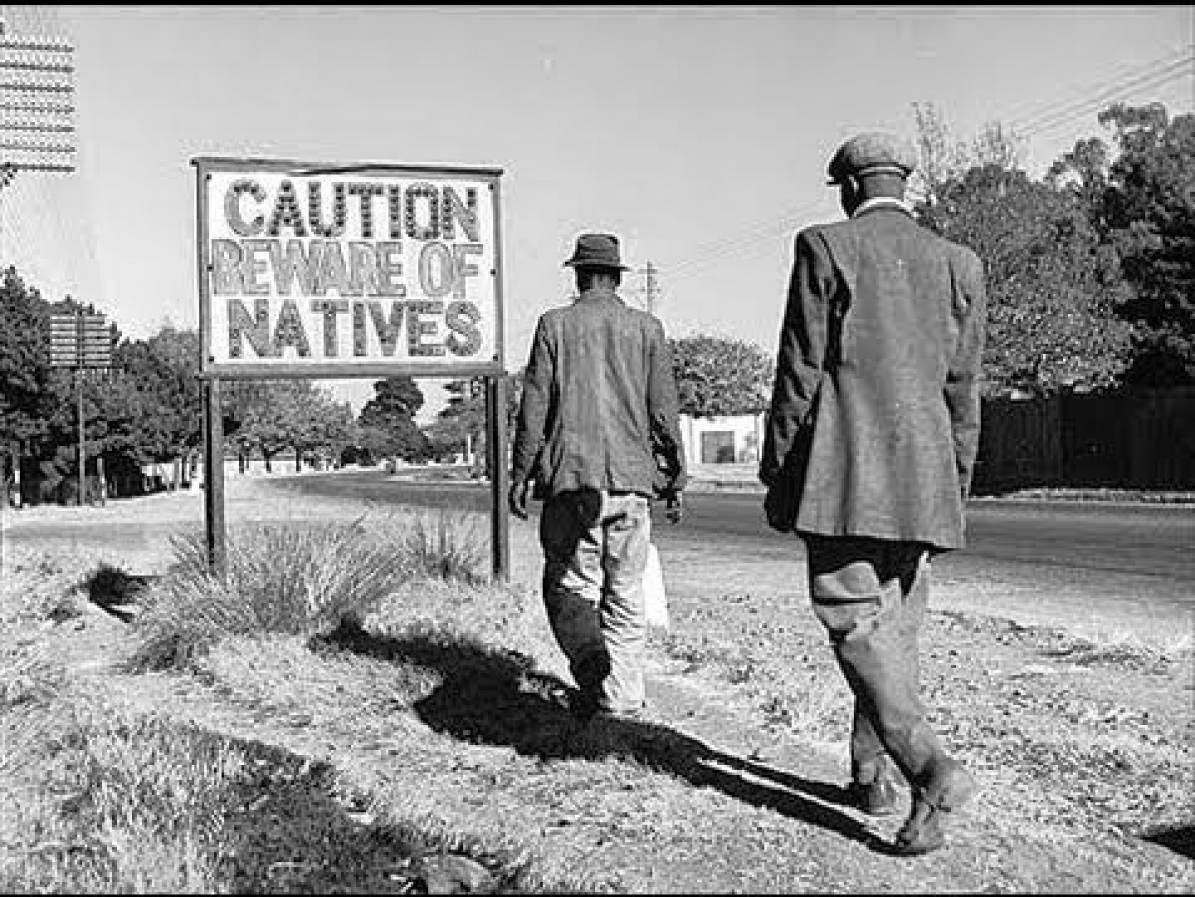
Just like another Israel,
by enemies surrounded, lost in the veld,but for another Canaan elected,
led forward by God’s plan.– Reverend J.D. du Toit, Potgieter’s Trek (1909)
This past May, in a relatively banal column touting the necessity of an impossible “two-state solution” in the context of what he deemed to be U.S. Secretary of State John Kerry’s “specious comparison” of a potential Israeli future to South African apartheid, former Ha’aretz editor-in-chief David Landau wrote:
This resort to apartheid infuriates the majority of Israelis and Israel-lovers, including those in the peace camp, and one can readily understand why. Apartheid was based on racism; Israeli Jews are not racist. They may occupy, persecute and discriminate Palestinians, but they act out of misguided patriotism and a hundred years of bloody conflict. Not out of racism.
It would be a gross understatement to say that Landau’s formulation was fundamentally flawed.
First and foremost, there is a vast amount of evidence proving that Jewish Israeli society – built wholly upon the 19th century premise (and promise) of ethnic and religious superiority, exclusivity, and privilege enforced through ethnic cleansing, forced expulsion, displacement and dispossession, segregation, colonization and occupation – is somehow becoming even more openly racist. Poll after poll reveals increasingly bigoted trends.
The work of reporters like David Sheen and Max Blumenthal, for instance, routinely demonstrates a viciously militarized and unjust society masquerading as an embattled liberal democracy, acting with aggression and impunity. More recently, pogroms targeting migrants and refugees from Africa, incitement against Palestinians inside Israel, and explicit anti-miscegenation campaigns are becoming more frequent and more dangerous.
A country for “the white man”
In a mid-2012 interview, Israel’s Interior Minister Eli Yishai said that Africans, “along with the Palestinians, will bring a quick end to the Zionist dream,” since “[m]ost of those people arriving here are Muslims who think the country doesn’t belong to us, the white man.” Referring to refugees from Sudan and Eritrea as an “infiltrator threat,” he told the press he was eager to deport all African immigrants for, in his words, “the benefit of the Zionist dream.”
A chapter in a forthcoming book, detailing a three-year, anthropological study of the attitudes of typical, secular Israeli high school students conducted by Dr. Idan Yaron, is stark in its assessment of the cultural racism and hatred present in Israeli society. Reporter Ori Kashti notes that, based upon Yaron’s observations, “such hatred is a basic everyday element among youth, and a key component of their identity. Yaron portrays the hatred without rose-colored glasses or any attempt to present it as a sign of social ‘unity.’ What he observed is unfiltered hatred.”
Landau’s desperate defense against the apartheid label perfectly demonstrates the Liberal Zionist need to insist that Israel and its founding ideology are not inherently racist, a position less and less palatable to people who are actually paying attention.
His claim that because “Israeli Jews are not racist,” and therefore Israel can’t possibly be deemed a “apartheid” state, not only misunderstands the actual definition of apartheid, which isn’t merely race-based discrimination and oppression. It also mirrors precisely the arguments made by defenders of South African apartheid in opposition to calls for equal human and civil rights.
Zionism’s defenders mirror apartheid’s apologists
Beyond the shared “promised land” and “chosen people” rhetoric that has inspired both the Afrikaner and Zionist ideologies of racial, religious, and ethnic supremacy, so has that of land redemption through settler-colonialism and transplanting indigenous populations. As historian Donald Akenson has written, “The very spine of Afrikaner history (no less than the historical sense of the Hebrew scriptures upon which it is based) involves the winning of ‘the Land’ from alien, and indeed, evil forces.”
This past June, settler leader Dani Dayan argued in the New York Times that, as summarized by David Samel, “Israel retain control of ‘Judea and Samaria,’ that it continue to exercise military rule over millions of stateless Palestinians, but that it loosen its stranglehold by making concerted efforts to make Palestinians happier despite the permanent loss of freedom, equality in the land of their birth, and justice under international law.”
Dayan’s essay calls for what is essentially, in Samel’s words, “window dressing of reduced restrictions on Palestinians” in order to “keep the natives happy.” Just like his more “liberal” counterparts like David Landau on the west side of the Green Line, Dayan insists, “we settlers were never driven — except for fringe elements — by bigotry, hate or racism.”
This argument effectively relies on the disingenuous presumption that the actual victims of an exclusivist, 19th century European ideology – the colonized indigenous population – are merely incidental to the ideology itself. That is, as Landau wrote, “misguided patriotism and a hundred years of bloody conflict” are really to blame for the oppression, discrimination and violence against Palestinians, not the racist obligations of Zionism.
In October 1964, Foreign Affairs published the lengthy essay, “In Defense of Apartheid,” by Charles A. W. Manning. Not only did Manning accuse outside meddlers and finger-waggers of refusing to acknowledge South Africa’s right to exist as an apartheid state, he also justified its racist policies as “a heritage from a complicated past.”
Quoting approvingly from the 1954 Tomlinson Commission, Manning wrote that while “a continuation of the policy of integration would intensify racial friction and animosity… the only alternative is to promote the establishment of separate communities in their own separate territories where each will have the fullest opportunity for self-expression and development.”
Two states for two peoples.
In the face of international opprobrium, apartheid is “the philosophy of patriots,” Manning explained, “a remedial treatment for a state of things deriving from the past.” He added that apartheid is a matter of “nationalism, rather than racialism.”
It is easy for the foreigner to deride a nationalism which he does not share; but nowhere in human history has nationalism ever been destroyed by foreign scorn. Admittedly, Afrikaner nationalism is a form of collective selfishness; but to say this is simply to say that it is an authentic case of nationalism. For what is nationalism anywhere if not collective self-love? What underlies apartheid is at bottom an attitude not toward the black man, but toward the forefathers-and the future-of the Afrikaner people.
Manning continued:
Deplore the white man’s collective self-concern, and you may equally well damn every other example of nationalism, white or black. It is absurd to assume that nationalism is nice, or nasty, according to its color.
Manning bemoaned that, as a result of misunderstanding the necessity and, yes, benevolence of apartheid, even South Africa’s best friends were beginning to abandon it. “Israel finds it necessary to ignore the analogy between South Africa’s predicament and her own,” he lamented.
Still, Israel maintained diplomatic relations with South Africa into 1987 and was one of the last countries to join the international boycott campaign.
‘National suicide’
In 2012, Israel’s High Court upheld the state’s explicitly discriminatory “Citizenship and Entry” law, which, as Ben White has explained, “places severe restrictions on the ability of Palestinian citizens of Israel to live with spouses from the Occupied Palestinian Territories, as well as from so-called ‘enemy states’ (defined as Syria, Lebanon, Iran and Iraq).” The ruling stated that “Palestinians who gain Israeli citizenship through marriage pose a security threat.”
Writing in Al Jazeera, following the decision, White elaborated:
In the majority opinion, Justice Asher Grunis wrote that “human rights are not a prescription for national suicide”, a term often invoked by those worrying about what realising Palestinian rights would mean for Israel’s Jewish majority. This same phrase was invoked by the Interior Minister Eli Yishai, while coalition chair and Likud MK Ze’ev Elkin applauded the High Court judges for understanding, as he put it, that “human rights cannot jeopardize the State”.
A particularly instructive reaction came from Kadima MK Otniel Schneller, who said that the decision “articulates the rationale of separation between the (two) peoples and the need to maintain a Jewish majority and the (Jewish) character of the state”.
The notion that advocating and legislating in favor of “human rights” and equality would be the death knell of the Israeli state – “national suicide” – perfectly articulates that inherent injustice of Zionism; indeed, it is a self-indicting statement.
And, as has already been noted here and elsewhere, is yet one more example of how Israel’s apologists employ precisely the same logic, arguments and excuses – often literally the same words, verbatim – as the staunch defenders of the apartheid system in South Africa.
In April 1953, on the eve of assembly elections in South Africa, Prime Minister D.F. Malan warned that outside forces – including “the United Nations, Communist Russia… as well as a hostile press” – were “trying to force upon us equality, which must inevitably mean to white South Africa nothing less than national suicide.”
Malan added, “I consider the approaching election South Africa’s last chance to remain a white man’s country.”
Just months after Malan and his National Party won the election and consolidated power, South Africa’s London-based High Commissioner A.L. Geyer delivered a speech on August 19, 1953 entitled, “The Case for Apartheid,” before the city’s Rotary Club. He argued against the indigenous claims of the native black population (“South Africa is no more the original home of its black Africans, the Bantu, than it is of its white Africans”); that the apartheid state is the only “homeland” known to white South Africans (“the only independent white nation in all Africa… a nation which has created a highly developed modern state”); and that “South Africa is the only independent country in the world in which white people are outnumbered by black people.”
These claims echo common hasbara tropes: that Palestinians are an “invented people” and that the Arab majority in Palestine was due to immigration into Palestine rather than an ancient indigenous population with roots in that land for centuries, if not millennia; that Israel is the “only democracy in the Middle East,” a bright bastion of technology and Western modernism amidst a sea of darker-skinned barbarians.
In his speech, Geyer – who was national chairman of the South African Bureau of Racial Affairs, known, ironically, by the acronym “SABRA” – turns to the question of what the future South Africa will look like and sees “two possible lines of development: Apartheid or Partnership.” He explains:
Partnership means Cooperation of the individual citizens within a single community, irrespective of race… [It] demands that there shall be no discrimination whatsoever in trade and industry, in the professions and the Public Service. Therefore, whether a man is black or a white African, must according to this policy be as irrelevant as whether in London a man is a Scotsman or an Englishman. I take it: that Partnership must also aim at the eventual disappearance of all social segregation based on race.
Geyer, speaking on behalf of those intent on maintaining a stratified and discriminatory society, was obviously not a fan of this prospective outcome. Just as those who still push for an illusory “two-state solution” insist that a Jewish majority must be artificially engineered to exclude as many non-Jews as possible within the area controlled by Israel for a “Jewish and democratic” state to continue existing, Geyer too bristled at the idea of true self-determination wherein the result wasn’t already predetermined through gerrymandered demographics.
If the black population were to be given full voting rights, for instance, whites would no longer hold a monopoly on political power in the country. The inevitable result, Geyer warned, would be “black domination, in the sense that power must pass to the immense African majority.”
This sentiment was similarly articulated by Ehud Olmert, then the Israeli Prime Minister, in a 2007 interview with Ha’aretz. “If the day comes when the two-state solution collapses, and we face a South African-style struggle for equal voting rights (also for the Palestinians in the territories),” he said “then, as soon as that happens, the State of Israel is finished.”
Here’s how Geyer, in 1953, articulated his argument against such a horrifying future of democracy, equality, and justice:
Need I say more to show that this policy of Partnership could, in South Africa, only mean the eventual disappearance of the white South African nation? And will you be greatly surprised if I tell you that this white nation is not prepared to commit national suicide, not even by slow poisoning? The only alternative is a policy of apartheid, the policy of separate development.
Indeed, as Israeli Justice Grunis reminded us, “human rights are not a prescription for national suicide.” Geyer couldn’t have agreed more. Denying basic and fundamental rights, while promoting and implementing a policy of demographic segregation and geographic separation, was a matter of survival, Geyer argued – just like his Zionist successors do now.
“Apartheid is a policy of self-preservation,” Geyer said. “We make no apology for possessing that very natural urge. But it is more than that. It is an attempt at self-preservation in a manner that will enable the Bantu to develop fully as a separate people.” As the native black Africa population in South Africa was, Geyer noted, “still very immature,” efforts must be made “to develop the Bantu areas both agriculturally and industrially, with the object of making these areas in every sense the national home of the Bantu.”
Thirty years later, very little had actually changed.
In his infamous “Rubicon” speech, delivered in Durban on August 15, 1985, South African president P.W. Botha declared that “most leaders in their own right in South Africa and reasonable South Africans will not accept the principle of one-man-one-vote in a unitary system. That would lead to domination of one over the other and it would lead to chaos. Consequently, I reject it as a solution.”
Botha added, “I am not prepared to lead White South Africans and other minority groups on a road to abdication and suicide. Destroy White South Africa and our influence, and this country will drift into faction strife, chaos and poverty.”
In response, ANC president Oliver Tambo condemned Botha’s disingenuous statements about his apartheid regime’s commitment to “the protection of minorities” and “the just and equal treatment of all parts of South Africa.” Botha, he said, had instead committed to the continued “oppression of the overwhelming majority of our people” and “promised our people more brutal repression.”
Calling for increased resistance, through both armed struggle and the imposition of international sanctions, Tambo declared that all victims of apartheid were “ready to make any and all sacrifices to achieve justice and democracy based on the principle of one man, one vote in a unitary South Africa.”
That very same year, Raphael Israeli, a professor at Hebrew University of Jerusalem and future client of the neoconservative PR firm Benador Associates, published an essay promoting increased Zionist colonization of the West Bank and Gaza and then subsequent partition of what he called “Greater Palestine” (which includes Jordan) as part of a potential solution to the Israeli-Palestinian conflict. Israeli argued that “the seemingly reasonable claim that the ‘state belongs to all its inhabitants'” anticipates the “nightmare of a bi-national state” in which “Israel is no longer a state of the Jews or a Jewish state.”
The essay, entitled “One Palestinian People and One Palestine,” was eventually included in a collection edited by Israeli himself entitled, “Dangers of a Palestinian State.”
In laying out his vision for a bizarre tripartite entity within “Greater Palestine,” with redefined parameters of sovereignty and self-determination in which a “Palestinian government” is established in Amman, Jordan, alongside the Hashemite monarchy, and Israeli military control over the West Bank continues until a final settlement on borders is agreed upon.
Israeli stresses that Jewish citizens of the Zionist state reject the implementation of a “one person, one vote” system throughout Israel and the territories it occupies because they would be “faced with an intractable dilemma: either a democratic and egalitarian Israel with rights for all, with the corollaries of a bi-national state immediately and an Arab-majority state in the future; or Jewish Israel where the Jews would maintain rights and rule and the Arabs would be devoid of both.”
“No Israeli government,” the renowned academic wrote, “could face that dilemma and resolve it in any acceptable way.”
For Zionism, as it was for apartheid, equality and human rights are non-starters. The fear that a “one person, one vote” system and of a “state for all its citizens” instills in Zionists is no different from that expressed by defenders of South African apartheid.
Defended by de Klerk
Following John Kerry’s “apartheid” comment earlier this year, F.W. de Klerk, the former South Africa prime minister who presided over the dismantling of the apartheid regime, came to Israel’s defense. “I think it’s unfair to call Israel an apartheid state,” he said.
This is the same de Klerk, however, who two years earlier reflected that, while “[i]n as much as it trampled human rights, [apartheid] was and remains morally indefensible,” he still defended what he said was the system’s “original concept of seeking to bring justice to all South Africans through the concept of nation states.”
De Klerk explained that the Bantustanization of South Africa was conceived as a way to “bring justice for black South Africans in a way which would not – that’s what I believed then – destroy the justice to which my people were entitled.” He added that it was “not repugnant” to believe that “ethnic entities with one culture, with one language, can be happy and can fulfill their democratic aspirations in [their] own state,” separate from one another.
After his comments sparked negative reactions, de Klerk’s spokesman walked back his comments. When “an artificial creation” like apartheid fell, the spokesman said, “you can go two ways – either by going your separate ways like in the Soviet Union or in what is being suggested for Israel and Palestine, or by trying to build a multicultural society.”
When “the first option” failed in South Africa, apartheid leaders “changed course,” he said, continuing, “It is not immoral for the Afrikaners to want to rule themselves any more than it is for the Israelis or the Scots to wish for the same things.”
Israel and its defenders go to great lengths to insist the “Jewish state” is not an apartheid one. Curious, then, that the only arguments they can muster in their favor are precisely those that were used to apologize for South Africa’s decades of indefensible discrimination and violence.
U.S. Senators Urge Ecuador to Restore Relations with Israel
teleSUR | August 27, 2014
Ecuador will continue supporting Palestine despite U.S. pressure to restore diplomatic relations with Israel.
The successful campaign “Ecuador with Palestine” organized by civil society and the Ministry of Foreign Affairs resulted in 20 tons of medical supplies and other crucial donations that will be delivered to Gaza next week.
The end of the campaign on August 25 coincided with a letter sent by U.S. Senators Marco Rubio, Bob Menendez, Mark Kirk and James Risch, urging the governments of Ecuador, Brazil, El Salvador, Peru and Chile to restore diplomatic relations with Israel.
The letter read, “Your actions send a troubling message to the United States about your government’s commitment to long-lasting peace between Israel and the Palestine Liberation Organization.”
In early August President Rafael Correa canceled a trip to Israel scheduled for the second half of this year. This decision was made in the midst of the “Operation Protective Edge,” which saw a ceasefire begin Tuesday after leaving more than 2,200 Palestinians dead.
The government of Ecuador recalled its ambassador in Tel Aviv and has opened an embassy in Ramallah.
Reacting to the letter sent by the senators, Foreign Minister Ricard Patiño said, “These men should give advice in their own house, they are not going to give the Ecuadorian government advice, worse is this type of advice of a political nature.”
“We are going to keep developing other agreements to enter in strong bilateral relations,” said Palestinian Ambassador in Ecuador Hani Remawi, “We have a lot to give Ecuador, and Ecuador also has more, much, much more to offer Palestine.” … Full article
Featured Video

Prof Seyed Marandi: Will the US Collapse the Global Economy?
or go to
Aletho News Archives – Video-Images
From the Archives
The toxic legacy of nuclear weapons testing serves as a stark warning of the danger these weapons pose
By Scott Ritter | RT | March 11, 2021
Millions of people suffer and die from the effects of radiation exposure from decades of nuclear weapons testing. Their experience should give serious pause to those who continue to embrace the viability of a nuclear deterrent.
A dust storm originating in the Sahara Desert swept across parts of Spain, France, the UK, and Ireland last month. In addition to bringing a red tinge to the sky, the dust caused a slight, yet noticeable, spike in radiation in the areas it reached. This radiation spike was caused by the presence of cesium-137, a radioactive isotope produced through the nuclear fission of uranium-235 in nuclear weapons. A legacy of French nuclear weapons testing that occurred in Algeria during the 1960s, the cesium-137 contamination is a reminder that while the testing of nuclear weapons may have been halted for the time being, the consequences of these tests live on through the poisoning of the planet mankind calls home.
The Saharan radioactive dust cloud is but the most recent visible phenomenon of a plague that has infected much of the world. … continue
Blog Roll
 Aletho News
- IRGC says it struck US military positions, warns of broader response
- Russia stops record number of Ukrainian drones overnight – MOD
- Denmark admits ‘no evidence’ for Russian drone hysteria
- Washington agreement ‘will not pass’: MP Fadlallah
- Iran mocks US for ‘solving’ domestic hunger problem, lecturing others on issue
- Germany, Israel hold joint naval drill off Haifa amid Gaza genocide
- Trump’s war on Iran becomes ‘most unpopular conflict’ in US history
- The Middle East is wringing its hands of Washington. Finally
- The Starmer legacy the establishment media won’t tell you: Celebrity sex crimes, imprisoning Assange and torture terror
- 13-18 DAYS: The PRACTICAL DIESEL BUFFER… Does It Preclude Bombing Iran?
- If Americans Knew
- Four Reasons the Netanyahu-Backed Plan to ‘End’ U.S. Military Aid to Israel Is a Scam
- Archbishop of Canterbury vows to help Palestinians achieve ‘freedom you deserve,’ calls for end to Israeli occupation
- The scars left behind by Israel’s white phosphorus in Lebanon
- Drones and decomposing babies: What’s in UN report on Israel’s genocide of Palestinian children
- Crimson Thread: The new Israeli separation wall that cuts through the ‘breadbasket of Palestine’
- Gaza ceasefire talks back to square one as Israel changes the rules – Daily Update
- The NDAA Proposed Merger of the U.S. and Israeli Military is Strategically Unwise and Inherently Unconstitutional
- Victories by Pro-Palestinian Democrats Show the Party’s Shift on Israel
- Massie moves to strike $3.3B in Israel military aid from the budget
- How Jeffrey Epstein’s Israeli Network Shaped Congo’s Deadly Mineral Trade
- No Tricks Zone
- 2025 Study: Cloud Effects Reduce Downwelling Longwave Radiation, Overriding The CO2 Impact
- 3 New Studies Find Increasing Trends In Solar Radiation Since The 1980s – Easily Explaining Warming
- THE TRANSCEIVER PARADOX: Why Organoid Intelligence (OI) Could Become Our Ultimate Alien Predator
- German Wind Turbines Face Regulatory Shutdown Due To Excessive Noise
- New Study: Chile’s Relative Sea Level Was 3.2 Meters Higher Than Today During The Mid-Holocene
- Beyond The Pitch: Why FIFA’s World Cup Is One Of Humanity’s Best Investments
- Climate Alarmists Now Using Natural Phenomena To Support Their Claims
- New Study: Significant CO2 Fluxes From Non-Volcanic Sources Are Largely Neglected In Carbon Budgets
- Women Climate Scientists Being Harassed, Insulted By Skeptics, Claims Berkeley Earth Researcher
- Germany’s Longterm Spring Climate Data Show “No Climate Trend”
 Aletho News