Israeli government closes case of killing of unarmed protester; cites ‘lack of evidence’
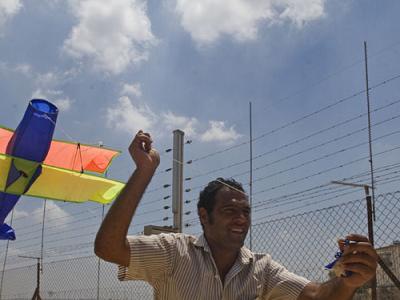
 Bassem Abu Rahme flying a kite (image from palestinechronicle)
B’Tselem – September 10, 2013
Four and a half years have passed since the killing of Bassem Abu Rahmeh by a tear gas canister fired at him directly from a short range. The death was documented by three video angles, but the Israeli state announced Monday it is closing the case citing lack of evidence
Military Advocate General (MAG) Maj. Gen. Danny Efroni decided to close the case file in the investigation of the circumstances of the killing of Bil’in resident Bassem Abu Rahmeh, citing lack of evidence. The MAG made this decision in late July, and it was recently conveyed to the Israeli High Court of Justice as part of an updating statement by the Office of the State Attorney in a petition filed by Subhiya Abu Rahmeh, Bassem’s mother, together with Bil’in Village Council and Israeli human rights organizations B’Tselem and Yesh Din.
According to the statement signed by Senior Deputy at the Office of the State Attorney, Att. Michal Michlin-Friedlander, and Assistant to the State Attorney, Att. Udi Eitan, also former Deputy State Attorney Yehoshua Lemberger had reached the same conclusion.
30-year-old Bassem Abu Rahmeh, a resident of the village of Bil’in, whose story was told in the film “Five Broken Cameras” nominated for Best Foreign Film in the Academy Awards, was killed in April 2009 after he was struck in the chest by an extended-range tear gas grenade during a demonstration against the Separation Barrier in his home village of Bil’in. Three video segments filmed during the demonstration prove that Abu Rahmeh was situated to the east of the barrier, did not act violently, and did not endanger the soldiers in any way. An analysis of the video footage of the incident, by visualization experts determined that the grenade was fired directly at Abu Rahmeh, in complete contravention of open-fire regulations.
In its response, the state did not explain the rationale behind its decision, limiting itself to the following laconic wording: “There is not enough evidence needed for criminal proceedings for adopting legal measures against any of the soldiers involved in the incident.” No information was given regarding the findings of the investigation, which the state argued had included “comprehensive and rigorous investigative actions,” or about the versions provided by the soldiers who had been questioned. Neither did the statement provide the contents of the opinions given by experts of the Israeli military and police and their interpretation of the findings disclosed by the video footage.
Ever since Bassem Abu Rahmeh was killed, his family – aided by NGOs Yesh Din and B’Tselem – has been continuously striving to have the truth of the incident brought to light and to have those responsible for their son’s death prosecuted. Their efforts have been repeatedly thwarted by the sluggish conduct of the MAG Corps. Due to the initial refusal by the MAG at the time to launch a Military Police investigation, the investigation was opened a year and half later than it should have. The foot-dragging and procrastination in the case have continued even once the investigation was launched over three years ago. Only a petition to the High Court of Justice finally brought about a decision in the case.
In response to the statement submitted by Office of the State Attorney, Att. Emily Schaeffer of Yesh Din’s legal team said: “The decision to close the file in the killing of Bassem Abu Rahmeh is unacceptable, particularly in view of the expert opinion that determined that the tear-gas grenade was fired directly at Abu Rahmeh from a close range. Despite three separate videos that recorded the killing of Bassem, the MP and police have failed to find the factors that caused the death of an unarmed demonstrator. The conduct of law enforcement bodies in this case is further proof of the feebleness of the authorities in cases of Palestinian casualties. Moreover, it seems that there might be no intention of finding out the truth or prosecuting the offenders even in extreme cases such as this, in which there is clear-cut and unambiguous evidence. Bassem’s family, together with B’Tselem and Yesh Din, will continue in its struggle to bring the parties responsible for his death to justice.”
Att. Yael Stein, Director of Research at B’Tselem, said in response: “The unbearable procrastination taken by the authorities in this case, and the fact that the MAG only made a decision due to a High Court Petition, once again demonstrate that the MAG Corps must adopt the recommendations of the Turkel Commission without delay. This includes determining a pre-defined schedule for each stage of the investigation, and ensuring that each stage is brief. Also, the statements made by investigative bodies about their decisions must include the reasoning underlying the decision so as to enable lodging effective appeals.”
Questions on Syria’s Chemical Weapons disarmament
By Dr. Kaveh L. Afrasiabi | Press TV | September 11, 2013
Citing a “potential positive development” in the Russian proposal regarding Syrian chemical weapons stockpile, US President Barack Obama has put a temporary break on the express train of war on Syria and, simultaneously, accelerated the White House push for a congressional authorization for a military strike.
This new development, following a purportedly off-the-cuff press statement by US Secretary of State John Kerry, has been viewed as a potential game-changer that may result in a win-win scenario, whereby Obama can safeguard his reputation, heal the rifts with Moscow, avoid another US entanglement in Middle East conflicts, and simultaneously declare victory by resorting to “credible military threat,” an important consideration given the close links with the US’s Iran policy (of nuclear containment).
The Russian proposal, put forth by Foreign Minister Sergei Lavrov, has two skeletal components respecting the international supervision and monitoring the Syrian chemical stockpile and the provisions for the destruction of that stockpile, yet to be fleshed out. The Syrian foreign minister has welcomed this initiative and so has UN Secretary General Ban Ki-Moon, who has warned that a unilateral US strike without the UN authorization would be illegal. Iran’s initial reaction has been positive as well, in the light of a statement by the Foreign Ministry spokesperson articulating the position of the Islamic Republic of Iran.
In turn, a number of important questions have been raised as a result of this new development. First, how feasible and practical is the idea of international supervision of the chemical weapons stockpile in the present context of warfare in Syria? The likelihood of danger to the inspectors being relatively great, will they need to be accompanied by an international force and, if so, is the UN willing to risk its peacekeepers in a war zone?
Second, although the international community is correct to push Syria to join the Protocol on Chemical Weapons and to disarm, such a decision cannot be taken in the vacuum of regional realities, above all the fact that historically these weapons have served a deterrent purpose for the Syrian regime vis-à-vis Israel, which has reportedly amassed a huge arsenal of chemical weapons over the years; a recent CIA document confirms this by referring to Israel’s “nerve gas facilities” which went into production decades ago. Indeed, the deterrent value of Damascus’ chemical weapons capability have been demonstrated in the current crisis, whereby Israel has been forced to take several drastic steps such as mass distribution of masks, early installation of Iron Dome defense shield, etc.
Henceforth, Syrian disarmament without a parallel disarmament of the Israeli stockpile would, in strictly military terms, shift the balance in Israel’s favor. Therefore, it is important to explore the short and long-term implications of Syrian disarmament with respect to the long-standing territorial dispute between Syria and Israel. Perhaps Israel should pledge to refrain from the use of chemical weapons against Syria as a part and parcel of the Syrian disarmament agreement.
Third, what happens if the Syrian regime disarms but the rebels, who are reportedly in possession of chemical weapons, do not and resort to these weapons? The threat of chemical weapons by the Syrian rebels has so far been completely overlooked by the White House and, yet, must be taken into consideration in any agreement on Syrian disarmament. In other words, a total disarmament covering the rebels as well as the government, irrespective of the difficulties with respect to the leading rebel groups, which have known Al-Qaeda ties. In principle, this is the right approach that would not discriminate toward any group suspected of possessing and or using the ghastly weapons.
Fourth, a complicating factor is the role of certain regional states that support the rebels and may not consent to any such deal, which raises the question what happens if these sates are not brought on board the agreement on Syrian chemical weapons disarmament? The US should push for explicit and unequivocal endorsement of the plan by Saudi Arabia, Qatar, and other Persian Gulf Cooperation Council member states.
Finally, the two issues of supervision and destruction of Syrian chemical weapons stockpile should not be conflated, and a preliminary investigation of the merits of the former without the necessity of the latter should be conducted. Given the stated concern of Obama and other Western leaders regarding the future use of chemical weapons, the stationing of international monitors on the ground will go a long way in terms of confidence-building that the regime will not use them. This more moderate approach is far more realistic than the issue of “control” that raises serious practical difficulties, such as interfering in the Syrian system of military “command and control.”
For now, however, a glimmer of hope against a US strike on Syria has sparked on the horizon that may not be long-lasting, if the disarmament issue is used by the White House to acquire a “yes” vote on the war power authorization and then attack Syria with the excuse that it has skirted its disarmament obligation.
Theoretically, it is now easier for Obama to lobby the US Congress, by nuancing the pitch in the name of the noble objective of chemical weapons disarmament. In that case, the potential breakthrough in the Russia disarmament proposal may only serve the ultimate US’s war aims which have been partly checked, ironically, by Syrian chemical weapons threats to Israel. By removing these weapons, the imminent threat of US strike may be put to rest and, yet, the paradoxical effect is likely to be a weakened Syria more vulnerable to foreign threats and pressures. In a word, a war-saving proposal adversely affecting Syrian national security interests may be an invitation to war in the future.
False-flag meme goes viral on 9/11 anniversary
By Dr. Kevin Barrett | Press TV | September 11, 2013
On the 12th anniversary of 9/11, everyone is talking about false-flag operations.
Pat Buchanan, a leading American conservative, says that the Syria chemical weapons incident “reeks of a false flag operation.” Buchanan says he cannot believe that Syrian President Assad would be so stupid as to order a chemical strike with no military purpose except to invite the US to bomb his country.
Assad’s opponents, on the other hand, would have every reason to launch such a strike and blame it on Assad.
Ron Paul agrees, saying: “I think it’s a false-flag.” His son Rand Paul adds: “There is a great incentive for this to actually have been launched by rebels, not the Syrian army.”
Rush Limbaugh suspects a false-flag with Obama’s complicity. Limbaugh cites Yossef Bodansky: “The rebels nerve gassed themselves in order to engineer a response that takes out Bashar, putting the US on the side of Al-Qaeda.”
Lawrence Wilkerson, Colin Powell’s Chief of Staff, went one step further. Citing sources in the intelligence community, Wilkerson said the chemical weapons attack was an Israeli false-flag operation. Wilkerson explained that “Israel is in a very, very dangerous situation right now. Netanyahu is clueless as to this. I hope that President Obama gave him a lecture into geo-strategic realities.”
Wilkerson’s statement that Israel is in a “very, very dangerous situation” seemed on the surface to refer to the turmoil in the Middle East. But Wilkerson may have been conveying another message as well: By orchestrating a barely-disguised chemical weapons false flag designed to force Obama to attack Syria on or around the 9/11 anniversary, Netanyahu showed he is “clueless” about one very important fact: More and more senior members the US military and intelligence establishments, including Wilkerson, know that Israel also orchestrated the 9/11 false flag operation. And they are ready to push back.
These senior US decision-makers are unhappy that Israel orchestrated the murder of almost 3,000 Americans on 9/11 in order to drag the US into endless wars against Israel’s enemies. They are seething about Israel’s continuing deception of the American public through its domination of the mainstream media. They are furious about the Israel lobby’s influence over Congress via bribery and threats. They are disgusted at the way Israel’s false-flag attack on 9/11 led to the evisceration of both the Constitution and the national treasury, drowning America in debt to the international bankers and destroying the nation’s economic future.
Wilkerson was saying (between-the-lines) that if Netanyahu thinks he can drag the US into yet another major war for Israel, by staging a transparently obvious false-flag attack close to the 9/11 anniversary, he is treading on very dangerous ground.
Dr. Alan Sabrosky, an ex-Marine and former Director for Strategic Studies at the US Army War College, is more forthright than Wilkerson: “I have had long conversations over the last two weeks with contacts at the Army War College and the headquarters, Marine Corps, and I’ve made it absolutely clear in both cases that it is 100% certain that 9/11 was a Mossad operation. Period. The Zionists are playing this as an all-or-nothing exercise. If they lose this one, they’re done.”
Dr. Sabrosky, who says he expresses his Jewish identity through cuisine not foreign policy, explains what he means by “they’re done”:
“If these Americans and those like them ever fully understand just how much of their suffering – and the suffering we have inflicted on others – is properly laid on the doorsteps of Israel and its advocates in America, they will sweep aside those in politics, the press and the pulpits alike whose lies and disloyalty brought this about and concealed it from them. They may well leave Israel looking like Carthage after the Romans finished with it. It will be Israel’s own great fault.”
This is what Wilkerson means when he says Netanyahu was “naïve” to launch the Syrian false flag chemical attack: Naïve Netanyahu imagines he can keep on fooling the Americans forever. He thinks he can get away with rubbing Israeli false-flags in America’s face just in time for September 11th. He is putting Israel in a “very, very dangerous” position.
Naturally, Israel’s American fifth column is trying to save Netanyahu from the consequences of his own folly. They are pushing back hard against the rapidly-rising awareness of false-flags.
Example: Netanyahu’s American megaphone for liberals, the Daily Beast, has published an article attacking the false-flag “conspiracy theories” about Syria.
The Daily Beast is owned by Jane Harmon – who while in Congress was caught by the FBI spying for Israel – and Hollywood Zionist mogul Barry Diller. The Daily Beast’s latest attempt to nip false-flag awareness in the bud is headlined “Enough Already: Syria Wasn’t a False Flag Operation.”
Author Jamelle Bouie admits “there’s no hard confirmation that Assad gave the order to use sarin gas against civilians.” Since there is no evidence implicating Assad, Bouie conjures up “the logistical complexity of setting up the attack and a subsequent cover-up.”
But this “logistical complexity” implicates Israel, not Syria. Israel’s spy service, the ruthless and reckless Mossad, has as its motto: “By way of deception thou shalt do war.” The Mossad is undoubtedly the world’s most experienced intelligence service in the field of logistically-complex false flag deceptions.
Playing dumb, Bouie pretends that Wilkerson cannot explain why Israel would stage such a false flag attack. Since Israel has no motive, Bouie claims, it cannot have perpetrated the attack. But wait a minute – a few paragraphs earlier, Bouie ridiculed those who said Assad had no motive, so he probably didn’t do it!
In fact, Israel does have a motive. Netanyahu has been working overtime in his efforts to drag Obama into war against Syria and Iran. AIPAC and the rest of the Israel lobby are the only significant political force in the US that wants an attack on Syria. And that attack could not possibly happen without a chemical weapons incident attributed to Assad. Obviously, Israel is the prime beneficiary – and the likely culprit.
When someone like Lawrence Wilkerson warns Israel to stop using false-flag atrocities to drag America into ill-advised wars, the Israelis had better listen. When the American people finally wake up to these deceptions – especially 9/11 – Israel could end up, as Dr. Sabrosky suggests, as a smoking pile of rubble.
Getting Off The Tree
By Gilad Atzmon | September 10, 2013
As the Jewish Lobby (AIPAC, the Anti-Defamation League, the Conference of Presidents of Major American Jewish Organizations and other Jewish groups) faces its first colossal defeat, Jewish media outlets and Zionists commentators are desperate to find a respectful way for AIPAC to ‘get off the tree’.
Yesterday, a Jerusalem Post editorial went out of its way to save American Jewry from the Lobby’s blunder. “Just as Israelis are split on support for US military intervention against Assad, so undoubtedly is the American Jewish community.” This may be true, American Jews are probably divided on the topic, yet, we didn’t hear about a lobby of hundreds of ‘progressive’ Jews awaiting to raid the Capitol Hill and advocate the push against the war. If anything, we came across the usual sporadic so-called ‘progressive Jewish voices’ who shamelessly attempted to divert the attention from the tribal nature of AIPAC/ADL‘s pro war operation.
The Jerusalem Post also contends that Israeli leaders are actually against the war. “Defense Minister Moshe Ya’alon stressed that we are not involved and not interfering in what is happening in Syria. We repeat and emphasize that.” But if this is indeed the case, then AIPAC and other Jewish Lobby groups shouldn’t be conceived anymore as ‘The Israeli Lobby’. Supposedly the Lobby doesn’t follow Israeli policy. It is actually an autonomous collective that promotes what it believes to be ‘good for the Jews’.
In order to save American Jewry from the stupidity of their lobbies, The Jerusalem Post has produced the most ludicrous argument ever:
”AIPAC, the Anti-Defamation League, the Conference of Presidents of Major American Jewish Organizations and other Jewish groups have the same right as other American organizations to come out publicly in support of military intervention in Syria.”
I guess that this is a true statement as far as it goes; however, as long as they do it under a Jewish banner, as they clearly did, their activity will continue to reflect on Jews as a collective. This is indeed a disaster and Jews had better address this issue once and for all, and hopefully from a universal perspective.
Veteran IDF Concentration camp Guard Jeffery Goldberg, is obviously embarrassed by AIPAC’s failure. He looks for someone to blame but he wouldn’t dare criticize his fellow Zionists.
“If I believed in conspiracies,” says Goldberg, “I’d be tempted to think that President Barack Obama… dragged the group (AIPAC) into what at the moment looks like a losing battle to get Congress to approve an intervention in Syria just to tarnish AIPAC’s reputation as all-knowing and all-powerful.”
Actually, I believe that Goldberg’s ‘conspiratorial’ narrative is far from being farfetched. By now our Western political universe is hijacked by some sinister Lobbies (Jewish and others). The Jewish Lobby was pushing for a war the American people didn’t agree with. Obama and his administration were hanging in the middle. The president was left with one simple option. He told his paymasters, If you really want a war, make sure you fight for it; if the congress says No, you have yourself to blame. If the congress says Yes, and we once again end up with a military blunder, the Lobby would have to take the heat.
Goldberg is far from being stupid. He grasps that AIPAC’s defeat this week is just a beginning of a far greater and more important battle. “If American support for Israel wanes, then AIPAC is in trouble. If Americans shift their opinions on Iran or become comprehensively isolationist, then AIPAC will have difficulty with that portfolio, too.”
For Goldberg, Dershowitz and other unsavoury Zionist characters, Syria wasn’t really the issue. They are obviously after Iran. They see the big picture. And for them Israel is the centre of the universe. They are willing to get off the Syrian tree only because they have a much bigger tree in mind.
Some Israeli diplomats and foreign affairs experts have been horrified all along by the Lobby’s public push for a war. Ben Caspit, a leading Israeli analyst quoted yesterday a long-standing Israeli diplomatic source who attacked the attempts to activate AIPAC. “It is not wise, it is not correct, it is excessive,” said the diplomat. “Israel is too often viewed as a country that drags the United States into conflicts and wars.”
Seemingly, Israeli analysts and foreign affair experts do know very well that Mearsheimer, Walt, Petras and yours truly are hitting the nail on the head pointing at the Jewish Lobby as a grave danger to world peace.
And yet, a few crucial questions remain open. How did AIPAC, ADL and the Conference of Presidents of Major American Jewish Organization fall into this trap? How did they manage to walk into this ambush openly and loudly advocating a war against America’s will? Couldn’t they foresee the possible outcome? Couldn’t they predict Jews being once again blamed for global scale conflict? Are they really that stupid?
My answer is simple. They are far from being stupid but they are clearly blind, because blindness is, unfortunately, intrinsic to chosenness, which implies dismissal of the other as well as otherness. Chosenness is a narcissistic modus operandi. It doesn’t leave much room for self-reflection, let alone regret or compassion.
Chosenness is the birth of the Jewish tragedy, a theme I explored in my latest book The Wandering Who. I guess that ‘The Jewish question’ must be addressed again and sooner the better, but this time we must verify first what the meaning of Choseness is and how it fits with Jewish culture, ideology and politics.
CBS’s Face the Nation: Blatant Pro-Israel Pro-War Bias Revealed
By Michael Gillespie | Dissident Voice | September 9, 2013
CBS’s Face the Nation host Bob Schieffer brought together this morning what he characterized as “one of our best panels of analysts ever,” a group of five supposed experts, to discuss President Obama’s plan to launch military action against Syria: the Washington Post‘s Bob Woodward, the Weekly Standard‘s Bill Kristol, the New York Times‘ David Sanger, the Washington Post‘s David Ignatius, and the American Enterprise Institute (AEI)’s Danielle Pletka. Schieffer presented this group as if his audience might expect it to represent a range of views. Nothing could be further from the truth.
Daniel Pletka is vice president of AEI, a neoconservative think tank that was instrumental in dragging the US into the hideously expensive and stunningly counterproductive war in Iraq. Several AEI scholars—including Richard Perle and Michael Ledeen—were associated with war profiteering and the phony intelligence used by pro-Israel neoconservative operatives inside the Bush/Cheney administration to stampede the USA into war in Iraq. Pletka was last in the news for smearing the then-Secretary of Defense nominee, former Senator (R-NE) and decorated Vietnam War veteran Chuck Hagel, as an anti-Semite. (Secretary of Defense Hagel is reported to be privately unenthusiastic about plans for military action against Syria.)
David Ignatius routinely defends Israel and champions proposed Israeli solutions to the Israel-Palestine conflict without letting facts get in the way. In 2009, Ignatius caused an international incident that adversely affected Turkish-Israeli relations when, during a panel discussion about the 2008-2009 Gaza War at the World Economic Forum in Davos, Switzerland, he allowed Israeli President Shimon Peres to speak twice as long as the other participants and then attempted to silence Turkish Prime Minister Recip Tayyip Erdogan. The panel featured two heads of state, the U.N. secretary-general, and the secretary of the Arab League, and it dealt with an extremely sensitive issue. In allowing Peres to go last, giving him twice as much time to speak, and then repeatedly attempting to cut off Erdogan’s response, Ignatius showcased his pro-Israel bias on a world stage.
David Sanger has long propagandized for a US war against Iran in the pages of the New York Times. According to SourceWatch: “A few days after Ehud Barak, the Israeli Defense minister, admitted that Iran was not pursuing a nuclear weapons program, the New York Times ran a series of articles slighting Barak’s assertion all the way to confirming the opposite, i.e., that Iran was actually pursuing such weapons program. Sanger was key in the NYT’s drum beating.” Ray McGovern, a former CIA senior officer who briefed several US presidents, had this to say about Sanger’s articles: “Next it was time for the Times to trot out David Sanger from the Washington bullpen. Many will remember him as one of the Times’ stenographers/cheerleaders for the Bush/Cheney attack on Iraq in March 2003. An effusive hawk on Iran also, Sanger was promoted to a position as chief Washington correspondent, apparently for services rendered. In his Jan. 22 article, ‘Confronting Iran in a Year of Elections,’ Sanger pulls out all the stops, even resurrecting Condoleezza Rice’s “mushroom cloud” to scare all of us—and, not least, the Iranians.”
Bill Kristol is the chairman and co-founder of the Project for the New American Century (PNAC) and a board member of the Emergency Committee for Israel. Author David Corn has referred to Kristol as “the No. 1 cheerleader for the Iraq War.” Kristol was one of the architects of the blueprint for regime change and “creative destruction” in the Middle East dreamed up by PNAC. Kristol signed the September 20, 2001, PNAC letter endorsing President George W. Bush’s “admirable commitment to ‘lead the world to victory’ in the war against terrorism.” Kristol said in a January 14, 2003, PBS Frontline interview “that the significance of President George W. Bush’s State of the Union address in 2002 (the ‘axis of evil’ speech) is too easily forgotten—that it was a rare moment, ‘the creation of a new American foreign policy’—and that Bush deserves credit for realizing very quickly after Sept. 11 that his presidency would be judged by how he handled the post-9/11 threat of weapons of mass destruction.” Weapons of mass destruction that, as it happened, could not be found because they did not exist.
Bob Woodward is yet another pro-Israel propagandist for executive power and for war. Andrew Bacevich, an accomplished author, Professor of International Relations and History at Boston University, and a retired career officer in the United States Army has described Woodward this way: “Once a serious journalist, the Washington Post’s Bob Woodward now makes a very fine living as chief gossip-monger of the governing class. … Back in 2002, for example, during the run-up to the invasion of Iraq, Woodward treated us to Bush at War. Based on interviews with unidentified officials close to President George W. Bush, the book offered a portrait of the president-as-resolute-war-leader that put him in a league with Abraham Lincoln and Franklin Roosevelt. But the book’s real juice came from what it revealed about events behind the scenes. ‘Bush’s war cabinet is riven with feuding,’ reported the Times of London, which credited Woodward with revealing ‘the furious arguments and personal animosity’ that divided Bush’s lieutenants. Of course, the problem with the Bush administration wasn’t that folks on the inside didn’t play nice with one another. No, the problem was that the president and his inner circle committed a long series of catastrophic errors that produced an unnecessary and grotesquely mismanaged war,” wrote Bacevich. Somehow, Woodward missed all of that and a great deal more. “That war has cost the country dearly—although the people who engineered that catastrophe, many of them having pocketed handsome advances on their forthcoming memoirs, continue to manage quite well, thank you,” declared Bacevich.
This then is “one of our best panels of analysts ever,” according to Bob Schieffer, who once might have rightly claimed to be something other than a stooge for the Israeli foreign ministry. What CBS’s collection of well-heeled pro-Israel propagandists all agree on is this: The US government should launch military action in Syria in order to maintain political and military pressure on Iran, which Israel views as enemy No. 1 (though Iran has not attacked another country in well over 200 years).
One detail the panelists didn’t mention is that Syria is in the Russian sphere of influence and Russia has warships stationed in the eastern Mediterranean off the coast of Syria. Another thing the panelists didn’t mention is that Israeli air and sea forces attacked a lightly armed US Navy signals intelligence vessel, the USS Liberty, in the eastern Mediterranean on June 8, 1967, killing 34 US personnel and wounding 171. Nor did the panelists mention that in the middle 1980s Israeli spies handling an American-Jewish traitor, Jonathan Pollard, stole thousands of highly classified intelligence documents from the US Navy counter-terrorism intelligence facility where Pollard was employed, or that Israel provided many of those documents to the Soviet Union causing great harm to US intelligence capabilities and interests.
What CBS panelists didn’t say is that Syria is the next stop on Israel’s road to a US war against Iran. What they dare not say is that a US attack on Syria might well draw the USA into a much wider war in a region already severely destabilized by more than a decade of enormously expensive, ill-conceived, poorly managed, hideously destructive, and extraordinarily counterproductive US military actions undertaken largely at the insistence of pro-Israel neoconservatives whose wildly inordinate influence over the Washington foreign policy establishment poses an imminent threat to a great many legitimate US national interests, if not to the uninterrupted progress of human civilization.
~
Michael Gillespie, in addition to his regular freelance work for Washington Report on Middle East Affairs, is also a contributing editor and the Des Moines, IA correspondent for The Independent Monitor, the national newspaper of Arab Americans, published by Sami Mashney in Anaheim, CA.
Related article
- Neocons Take Flight Over Syria (lobelog.com)
Egypt’s coup leaders grateful for Israeli support
By Shazia Arshad | MEMO | September 9, 2013
The Egyptian army and Israel have grown much closer in the weeks since the coup d’etat. In a Ha’aretz report, Amos Harel, suggested that the Egyptian and Israeli relationship now was in fact stronger than it was during the rule of Mubarak. Following the coup, it was Israel that the Egyptians turned to ensure that the American government and the new Egyptian coup regime would reach an understanding. Although the toppling of the democratically elected government was widely accepted as a coup, Israel prevented the use of the term and encouraged America to accept events as a regime change. In doing so, Israel ensured that American financial support to Egypt could continue, as acceptance of a coup would mean that aid would have to be suspended under American law.
Israel’s role in securing continued US aid for Egypt’s army has made it possible for a stronger bond between the two to develop. Events in Egypt since the coup have demonstrated how grateful Egypt’s army are to Israel. Indeed, the Egyptian army’s particular focus on the Sinai and Gaza has won favour with the Israelis. Gazans in particular have been bearing the brunt of the warmer relationship between the two regimes. In recent weeks, the Egyptian army have closed all tunnels between Egypt and Gaza and restricted the border crossing at Rafah. The closure of the tunnels has had a significant impact, forcing Gaza to turn to Israel and import fuel through Israel at six times the cost. The tunnel economy, which has provided basic needs for Gaza’s blockaded residents, has been shut down and will cause further financial stress to the Gazan economy. The restrictions on the Rafah crossing have limited the travel of Palestinians in to and out of Gaza, including those who need access to urgent medical treatment. The Rafah crossing had allowed freer movement during the presidency of Mohamed Morsi, much to Israel’s chagrin.
Egypt’s new political direction has also left Hamas out in the cold, this time much to Israel’s delight. Prior to the coup, with increasing support from the Muslim Brotherhood in Egypt Hamas’ strength in Gaza had increased and Hamas used the opportunity to oppose Assad’s civil war in Syria. With the opposition to Assad, Hamas relied on Egypt, but with the turn of events, Hamas now face increasing isolation. To further weaken Hamas, the Egyptian army circulated rumours of Hamas’s involvement in terrorist activities in Egypt. Last week’s attempted assassination of the Egyptian interior minister was used to implicate Hamas, when local media sources suggested that they had been involved in the bomb attack. Despite the clear fallacy of the claim, the rumours have worked to suppress Hamas in Gaza, as the Israeli’s have wanted to do for some time now.
In the Sinai, the Egyptian army has been circulating rumours of terrorist activity too. With claims that Islamist terror groups are active in the region, the army has increased its presence with more troops, tanks and helicopters in the region. Under the Israel-Egypt peace treaty the Egyptians require Israel’s agreement for them to be able to do so, and in yet another example of the Egypt-Israel bond growing stronger, the Israelis have sanctioned the increase. The Egyptian army has reportedly killed 100 activists in the Sinai, wounded and arrested hundreds of others. Further reports have indicated that the Egyptian army is currently developing a buffer zone in the Sinai to prevent weapons and terrorist smuggling into and out of Gaza. Reports suggested that the buffer zone would be a military controlled area and that the residents currently there were being forced from their homes with no warnings.
The Egyptian army have been able to mount a coup against the democratically elected Egyptian president, ensure that America continues to bank roll the country and strengthen their grip on power since the coup thanks to the work, and the words, of the Israelis. Whilst they may not be making the strengthening of their relationship public, the Egyptians want to ensure that the Israeli’s know how grateful they are for their support. In this vein, the army’s attacks to protect Israel’s interests are sure to increase.
Related articles
Israel’s Lobbyists Pushing Hard for another War in the Middle East
By Jeremy Salt | Palestine Chronicle | September 8, 2013
Ankara – Two million refugees out of Syria, some of them Palestinian refugees from 1948 and 1967 and some Iraqi refugees from 2004. They are the consequences of war and yet the raging beast that is devouring the Middle East is still not satiated. Another war looms. Another country already devastated is to be shattered by missile attacks. Who wants this war: who could want it? Who could even think of avenging the dead by calling for more killing?
It is not the people of the world. All polls show they are against it. Not just the people of Latin America, Africa, the Indian subcontinent, southeast Asia and China but the American people, the British people, the French people and the Turkish people. It is only the politicians who want this war: Obama, Kerry, Hagel, McCain and others in the US; Cameron and Hague in Britain; Hollande in France; and Erdogan in Turkey. None of them has any proof of their accusation that the Syrian army used chemical weapons around Damascus, but proof is beside the point. Their Muslim contras have failed to destroy the government in Damascus and now in the chemical weapons attack they have their pretext for doing the job themselves.
The US administration is now deciding how long this attack should last. Should it be a few days, or a few months? Should it be aimed at just punishing the ‘regime’ or should it be aimed at destroying it altogether, which seems to be the emerging consensus? They are talking this over confidently, almost nonchalantly, McCain playing poker on his mobile phone because he is so bored, as though their missile attacks on other countries have lulled them into thinking that their military power is so great they could not possibly be hurt themselves.
Erdogan wants a ‘Kosovo-style’ aerial campaign. In 1999, NATO aircraft flew more than 38,000 ‘sorties’ over Yugoslavia, of which number 10,484 were strike attacks. Operation Allied Force lasted for 78 days, not the 30 days claimed by Kerry when being questioned by the Senate committee which finally voted for war on Syria. In 2011 NATO launched Operation Unified Protector against Libya ‘to protect the people from attack or threat of attack.’ This particular ‘operation’ lasted for seven months, during which 26,500 ‘sorties’ were flown, 9700 of them strike sorties. Even the National Transitional Council, the incoming government after the destruction of the government in Tripoli, said 25,000 people had been killed. A similar operation over Syria, a country much better able to defend itself, and with powerful allies besides, would cause enormous further destruction and the death of many thousands of people. This is the meaning of ‘Kosovo-style’ aerial warfare. In fact, what is shaping up is even worse, an air war that will have more in common with Iraq than the bombing of Yugoslavia. The targets and objectives are being expanded all the time.
Saudi Arabia has no politicians and no public opinion polls which would tell us what the Saudi people think of their government and its role in the destruction of Syria. The only country in which the government and the people are clearly united in their support for an attack on Syria is Israel. Polls show that nearly 70 per cent of Jewish Israelis – Palestinians are fully against it – are in favor of the US striking Syria, while thinking that Israel should stay out unless Syria or Hezbollah retaliate with strikes against Israeli targets. The British vote against war and Obama’s hesitation forced Israel and its lobbyists in the US to break cover, ending the silly pretense that Israel is not involved in Syria and does not really care who wins. David Horowitz, the former editor of the Jerusalem Post, wrote an infuriated piece about ‘how a perfect storm of British ineptitude and gutlessness sent the wrong message to the butcher of Damascus and left Israel more certain than ever that it can rely only on itself.’ The novelist Noah Beck accused Obama of being spineless. Others in the media called him weak and unreliable. By ‘blinking’, he had sent a dangerous message to ‘cruel regimes’ and terrorists everywhere. Debkafile, an outlet for disinformation and other scrapings from the floor of Israeli intelligence, echoed this line. Obama’s ‘about turn’ had let Iran, Syria and Hezbollah ‘off the hook ’, creating a ‘military nightmare’ for Israel, Jordan and Turkey.
The same lines of attack and support were duplicated by Israel’s formal and informal lobbyists in the US. Charles Krauthammer of the Washington Post sneered at Obama for hesitating: ‘Perhaps we should be publishing the exact time the bombs will fall lest we disrupt dinner in Damascus’. Wrote William Kristol in the Weekly Standard: ‘Is President Obama going wobbly on Syria? No. He’s always been wobbly on Syria – and on pretty much everything else … the worst outcome would be for Obama not to call Congress back or not to act at all but to falter and retreat. For his retreat would be America’s retreat and his humiliation America’s humiliation.’ Kristol’s stablemate, Thomas Donnelly, thought Obama content ‘‘to see Assad kill his own people – which he has done in the tens if not hundreds of thousands – as long as Assad doesn’t use chemical weapons’. Thomas Friedman wrote in the New York Times that the most likely option for Syria was partition, ‘with the pro-Assad, predominantly Alawite Syrians controlling one region and the Sunni and Kurdish Syrians controlling the rest.’ The fragmentation of Syria on ethno-religious lines, of course, has been a Zionist objective for decades. No mention by Friedman of the Druze, but never mind that: in the interim, America’s best option is not the launching of Cruise missiles ‘but an increase in the training and arming of the Free Syrian Army – including the antitank and antiaircraft weapons it’s long sought.’ Friedman thought this might increase the influence on the ground of the ‘more moderate groups over the jihadist ones.’
At the Washington Institute for Near East Policy, the entire stable was off and running. ‘Forget the red line and engage in Syria,’ wrote David Schenker, as if the US has not been intensely engaged in Syria for the past three years, fomenting the violence which has built up to the present catastrophic situation. Wrote Robert Satloff: ‘Given the strategic stakes at play in Syria which touches [sic.] on every key American interest in the region, the wiser course of action is to take the opportunity of the Assad regime’s flagrant violation of global norms to take action that hastens the end of Assad’s regime … this will also enhance the credibility of the president’s commitment to prevent Iran’s acquisition of a nuclear weapons capability.’ Michael Herzog thought the US could learn from Israeli air attacks on Syria: ‘In Israel’s experience Assad has proven to be a rational (if ruthless) actor. He was deterred from responding to recent and past strikes because he did not want to invite the consequences of Israeli military might. Therefore, the United States has a good chance of deterring him as well.’
In Commentary, Max Boot called on the US to use air power in cooperation with ground action by ‘vetted’ rebel forces to ‘cripple and ultimately bring down Assad’s regime, making impossible further atrocities such as the use of chemical weapons.’ How these forces are to be ‘vetted’ and how they, rather than the Islamist groups who are doing most of the fighting, could bring down the ‘regime’ Boot does not say, most probably because he doesn’t know. Daniel Pipes, the long-term advocate of Israeli violence in the Middle East, writing in National Review online, wanted not a ‘limited’ strike but something that would do real damage and brings the ‘regime’ down.
Outside these journals and the think tanks, former ‘government advisers’ and ‘foreign policy experts’ signed a petition calling for ‘direct military strikes against the pillars of the Assad regime’. Many of the names will be familiar from the Project for the New American Century and plans laid long ago for a series of wars in the Middle East: Elliott Abrams, Fouad Ajami, Gary Bauer, Max Boot, Ellen Bork, Eliot A. Cohen, Paula Dobriansky, Thomas Donnelly, Douglas Feith, Reuel Marc Gerecht, Robert Kagan, William Kristol, Bernard-Henri Levy, Michael Makovsky, Joshua Muravchik, Martin Peretz, Karl Rove, Randy Scheunemann, Leon Wieseltier and Radwan Ziadeh.
AIPAC and the Jewish organizations piled the pressure on Congress and the White House. AIPAC’s statement on Syria stressed the sending of a ‘forceful message of resolve to Iran and Hizbullah’ at a time ‘Iran is racing towards obtaining nuclear capability.’ The Politico website quoted unnamed AIPAC officials as saying that ‘some 250 Jewish leaders and AIPAC activists will storm the halls on Capitol Hill beginning next week to persuade lawmakers that Congress must adopt the resolution or risk emboldening Iran’s efforts to build a nuclear weapon … they are expected to lobby virtually every member of Congress’. Their ‘stepped-up involvement’ comes at a welcome time for the White House, wrote the Politico correspondent, given its difficulty in securing support for the resolution. The two top Republican leaders in the Senate, minority leader Mitch McConnell and minority whip John Cornyn, had already been urged ‘by top Jewish donors and AIPAC allies’ to back the war resolution.
The Conference of Presidents of Major Jewish Organizations called for an attack that would demonstrate ‘accountability’ to ‘those who possess weapons of mass destruction, particularly Iran and Hezbollah.’ Morris Amitay of the pro-Israel Washington Political Action Committee thought that ‘for our [United States] credibility we have to do something.’ Bloomberg reported the Republican Jewish Coalition as sending an ‘action alert’ to its 45,000 members ‘directing them to tell Congress to authorize force.’ The same message of support for an attack was sent out by the National Jewish Democratic Council and Abe Foxman of the so-called Anti-Defamation League, who stressed that while ‘he’s not doing this for Israel,’ the attack may have serious consequences for Israel.
With the exception of the Foxman statement, these organizations carefully kept any mention of Israel out of their public statements. In off the record discussions, however, it was the central concern. On August 30 Obama had a conference call with 1,000 rabbis, with Syria, ‘at the White House’s request,’ according to Bloomberg, being the first question asked. Iran was not mentioned either but, said a leading rabbi from New York, ‘we have a strong stake in the world taking seriously our insistence that weapons of mass destruction should not proliferate’. Bloomberg quoted Obama as ‘arguing’ that ‘a military response is necessary to uphold a longstanding international ban on the use of chemical weapons use and to deter Assad from using them again on his own people or such neighbors as Israel and Jordan.’ Of course, this was not an argument at all but Obama telling the rabbis what they wanted to hear. In a separate approach, 17 leading rabbis ‘covering the religious and political spectrum’, according to the Jewish Telegraphic Agency, sent a letter to Congress calling on it to authorize force against Syria. The language could scarcely be more Orwellian: ‘Through this act, Congress has the capacity to save thousands of lives.’
Another conference call was held between representatives of the Conference of Presidents of Major Jewish Organizations and White House deputy national security advisors Tony Blinken and Ben Rhodes. The representatives waited until Blinken and Rhodes were ‘off the call’ before advising constituent organizations ‘not to make their statements ‘Israel-centric’,’ according to the Jewish Telegraphic Agency. A powerful figure wheeled out by the lobby is Sheldon Adelson, the casino billionaire who funds settlement in Jerusalem and on the West Bank and spent (along with his wife) $93 million trying to see Obama defeated in the presidential election last year. Adelson is a board member of the Republican Jewish Coalition and supports the pressure it is putting on Congress to authorize a military attack on Syria.
The carefully crafted outlines of this deceitful campaign are very evident:
1. This is not about Israel
2. This is about America’s national interest.
3. This is about punishing a government which has used chemical weapons on its own people.
4. This is about saving lives
5. This is about a government that has no respect for international law and norms.
6. This is about sending a ‘forceful message of resolve to Hezbollah and Iran.’
7. This is about showing that Obama’s red lines are not empty threats.
Obama’s own ‘full court press strategy’ includes interviews with six television anchors ahead of the congressional vote. The moment Obama said everything AIPAC wanted to hear during the primaries was the moment he took the first step into the tight corner in which he now finds himself. This is now a global confrontation with a lot at stake besides Israel’s interests, but it is pushing as hard as it can to make sure this war goes ahead. Like David Cameron, a congressional vote against war will allow Obama to back out of the corner by saying that the American people have spoken and he cannot take them into war against their wishes. Will he do that, or is really going to plunge his country into war irrespective of what Congress or the American people think? By the end of the coming week we should have the answer.
– Jeremy Salt is an associate professor of Middle Eastern history and politics at Bilkent University in Ankara, Turkey.
Related articles
Obama regime calls on EU to postpone ban on Israel
Press TV – September 8, 2013
US Secretary of State John Kerry has urged the European Union (EU) to delay a planned ban on Israel over the Tel Aviv regime’s continued settlement activities in the occupied Palestinian territories, according to a senior US official.
On July 19, the EU published new guidelines in its Official Journal, banning its 28 members from funding projects in the illegal Israeli settlements in al-Quds (Jerusalem), the West Bank or Golan Heights, which the Tel Aviv regime occupied during the 1967 war.
The ban sparked anger among the Israeli officials, with Israeli Prime Minister Benjamin Netanyahu and President Shimon Peres threatening that the new directive would undermine attempts by Kerry to relaunch talks between Israel and the Palestinian Authority.
A senior US State Department official, whose name was not mentioned in the reports, said that, in a meeting with EU foreign ministers in the Lithuanian capital, Vilnius, on Saturday, Kerry called on the Europeans to consider postponing the implementation of the EU guidelines.
Kerry also asked EU diplomats to support the talks between the Israeli regime and the Palestinian Authority, which resumed in July after a three-year hiatus.
Meanwhile, the EU is to send a team to Israel on Monday to move forward on the guidelines against Israeli organizations in the occupied Palestinian territories.
Israel has announced plans to construct more than 3,000 housing units in al-Quds and the occupied West Bank since the resumption of the talks with the Palestinian Authority in July.
On August 11, Israel’s Housing Minister Uri Ariel gave final approval for the construction of 793 settlement units in the occupied east al-Quds (Jerusalem) and 394 others in the West Bank.
A day later, the EU described as “illegal” the Israeli regime’s decision to approve the building of settlement units.
Yasser Abed Rabbo, a top aide to Mahmoud Abbas, the acting Palestinian Authority (PA) chief, said on September 4 that continued Israeli settlement construction had undermined the talks with Israel.
Palestinians demand that Israel withdraw from the occupied Palestinian territories.
Related article
Yes, Syria and Hezbollah Will Hit Israel if US Strikes
By Sharmine Narwani | Al-Akhbar | 2013-09-06
Informed insiders have confirmed that Syria and Hezbollah plan to retaliate against Israel in the event of an American-led military attack on Syria. Says one: “if even one US missile hits Syria, we will take this battle to Israel.”
An official who spoke to me on the condition that neither his name or affiliation is published, says the decision to retaliate against Israel “has been taken at the highest levels within the Syrian state and Hezbollah.”
Why attack Israel after a US strike?
“Israel has been itching for a fight since their 2006 defeat by Hezbollah,” explains an observer close to the Lebanese resistance group. “They have led this campaign to draw the US into a confrontation with Syria because they are worried about being left alone in the region to face Iran. This has become an existential issue for them and they are now ‘leading’ from behind America’s skirts.”
The “Resistance Axis” which consists of Iran, Syria, Hezbollah and a smattering of other groups, has long viewed attacks on one of their members as an effort to target them all.
And Israeli aggression against this axis reached a new high in 2013, with missile strikes and airstrikes unseen for many years in the Levant.
Israel has reportedly conducted at least three separate, high profile missile strikes against Syria this year, effectively ending a 40-year ceasefire between the neighboring states. The last overt violation of this uneasy truce was in 2007 when the Jewish state destroyed an alleged nuclear site inside Syria.
Then two weeks ago, Israel launched its first airstrike in Lebanon since the 2006 war, bombing a Popular Front for the Liberation of Palestine–General Command (PFLP-GC) target in an entirely unprovoked attack. Earlier, four rockets had been launched into Israel from Lebanese territory, but an unrelated Al Qaeda-linked group took credit for that incident.
When asked whether Syrian allies Russia and Iran would participate in retaliatory strikes against Israel or other targets, the official indicated that both countries would back these efforts, but provided no information on whether this support would include direct military engagement.
The Russians have stated on several occasions that they will not participate in a military confrontation over Syrian strikes. Iran has not offered up any specifics, but various statements from key officials appear to confirm that strikes against Syria will result in a larger regional battle.
On Tuesday during an official visit to Lebanon, Iranian parliamentarian and Chairman of the (Majlis) Committee for National Security and Foreign Policy Alaeddin Boroujerdi told reporters: “The first party that will be most affected by an aggression on Syria is the Zionist entity.”
His comments follow a steady stream of warnings by senior Iranian officials, which have escalated in tenor as western threats to attack Syria have intensified.
“The US imagination about limited military intervention in Syria is merely an illusion, as reactions will be coming from beyond Syria’s borders,” said the Commander of the Islamic Revolution Guards Corps Major General Mohammad Ali Jafari last Saturday.
Even Iran’s Supreme Leader Ayatollah Ali Khamenei has stepped into the fray, warning the US and its allies: “starting this fire will be like a spark in a large store of gunpowder, with unclear and unspecified outcomes and consequences”.
Concurrent with these warnings, both Iran and Russia have been urging the West to avoid further confrontation and return to the negotiating table to resolve Syria’s 29-month conflict. But instead, western officials and diplomats in the Mideast have spent the past few weeks hitting up their regional sources for information on how Syria’s allies will react to a strike.
An unusual visit to Tehran by UN Under-Secretary-General for Political Affairs Jeffrey Feltman (a former senior US State Department official) was one such “feeler.”
According to several media outlets, the Iranians had a singular response to Feltman’s efforts to gauge their reaction to a US strike: if you are serious about resolving the Syrian crisis, you must first go to Damascus, and follow that by launching negotiations in Geneva.
Gunning for a fight
While Israel plays heavily in the background, by turns provoking and encouraging western military intervention in Syria, it publically denies any role in this business.
Just this week, Israeli President Shimon Peres attempted to distance the Jewish state from events in Syria by insisting: “It is not for Israel to decide on Syria, we are in a unique position, for varying reasons there is a consensus against Israeli involvement. We did not create the Syrian situation.”
He’s right about one thing. Any visible Israeli military intervention in Syria will likely raise the collective ire of Arabs throughout the region. But Peres is being disingenuous in suggesting that Israel hasn’t played a pivotal role in dragging the region to the brink of a dangerous confrontation.
In fact, since its establishment as a state, Israel has possibly never been more motivated to force a military confrontation in the Mideast:
The Arab uprisings, a shift in the global balance of power, increased isolation and the waning influence of Israel’s superpower US ally have all served to remind Israel that it stands increasingly alone in the Mideast in confronting its longtime adversaries – Iran, Hezbollah, Syria and various Palestinian resistance groups.
Before a US exit from the region becomes patently clear to one and all, Israel needs to disarm its foes – and it needs the Americans to do that. For years, the Israeli establishment has regularly threatened military strikes against Iran, in most part attempting to inextricably embroil Washington in this military venture.
Forcing ‘red line’ narratives into western political discourse – whether it be the use of chemical weapons in Syria or a civilian nuclear program in Iran – has become a clever way to commit allies to an Israeli military agenda.
When US President Barack Obama last week appeared to suddenly revise his plans to launch a strike on Syria by deferring the decision to Congress, Israel went into overdrive:
Two Israeli missiles were launched off the Syrian coast in the Mediterranean Sea to raise temperatures again. Whether this was meant to be veiled threat, a provocation, or an attempt to pin the deed on Syrians is unclear. What is certain is this: Russian early radar systems caught the activity and publicized it quickly to ward off misunderstandings that might trigger counterstrikes.
This quick reaction forced Israel – under US cover – to acknowledge it had participated in unannounced ballistic missile tests. The Iranians reacted very skeptically. Chief of Staff of the Iranian Armed Forces General Hassan Firouzabadi said the missiles were “a provocative incident” conveniently executed as western nations withdrew from plans to attack Syria, and called Israel “the region’s warmonger.” He further charged: “If the Russians had not traced the missiles and their origin, a Zionist liar would have alleged that they belonged to Syria in a bid to pave the way for breaking out a war in the region.
On an entirely different front, Israel has been amassing its considerable army of US supporters and lobbyists to ensure a compliant Congressional vote on strikes against Syria.
All its heavy hitters have now stepped up to push US lawmakers into backing military intervention, even though polls continue to show the majority of Americans rejecting strikes.
The Israeli lobbying effort has been particularly critical to ensure there is bipartisan consensus and that Obama’s Republican opponents join the bandwagon. To ensure this, the scope of the “surgical strikes” had to be expanded for GOP members opposed to a cursory punitive strike against Syrian government interests.
Key Republicans have since piled on, and already there are soundings of ‘mission creep.’ Obama told lawmakers on Tuesday that his plan “also fits into a broader strategy that can bring about over time the kind of strengthening of the opposition and the diplomatic, economic and political pressure required – so that ultimately we have a transition that can bring peace and stability, not only to Syria but to the region.”
This suddenly sounds remarkably like President George W. Bush’s plans to remake the Middle East. And it is everything Syria and its allies have both feared and suspected from the start.
Existential for you, existential for me
If ever there was a real ‘red line’ in the region, this is it. Any “limited” or “broad” military intervention in Syria is simply unacceptable to Syria, Iran, Russia, Hezbollah, China and a whole host of other nations that want to turn the page on US hegemonic aspirations in the region and beyond.
Washington has miscalculated in thinking that an attack in any shape or form would be palatable to its quite incredulous adversaries. They are all intimately familiar with the slippery slope of American interventionism and its myriad unintended consequences.
Israel, in particular, appears to be victim to a false sense of security. Analysts and commentators there seem to think that the lack of a Syrian military response to recent Israeli missile strikes is a trend likely to continue. Or that Hezbollah and Iran would have no ‘grounds’ to climb aboard a counterattack if Syria were attacked.
But the fact is that, to date, no member of the Resistance Axis has faced a collective western-Israeli-GCC effort to strike a blow at their core. This promised US-plus-allies strike against Syria makes their calculation an easy one: there is nowhere to go but headfirst into the fracas.
As Israeli warplanes pounded Lebanon during the 2006 war, then-US Secretary of State Condaleeza Rice got one thing right. Refusing to call for a ceasefire, Rice explained that battle was sometimes necessary to break free of the status quo and emerge with a new regional order. The carnage, in short, was simply “the birth pangs of a New Middle East” – something to endure in order to reach a desired outcome.
But in 2006, conditions were not yet ripe for an all-out confrontation on multiple fronts. Today’s confrontation, however, has all the ingredients to fundamentally shift the region in a clear new direction, depending on which side emerges victorious.
What Rice did not anticipate seven years ago was that a few thousand Hezbollah fighters could shake the region beyond Lebanon’s small borders in a mere 33 days – simply by emerging from battle with Israel, leadership and capabilities intact.
The US has never predicted outcomes successfully in the Middle East and is unlikely to do so this time given that its strategic and military objectives seem even more muddled than usual. What we do know is that Hezbollah Secretary-General Hassan Nasrallah has promised that the “next battle” will take place inside Israel’s borders and that he will fight proportionately this time – striking Israeli cities when Israel hits Lebanese ones.
On the Syrian front, Israel imagines a war-weary adversary. But the Syrian armed forces have the kinds of conventional weapons and ballistic missiles that can level a town in short shrift – that is not an outcome Israel has the capacity to endure.
In yet another corner is Iran, boasting a rare combination of military manpower, hardware, technology and tactical skills that Israel has never faced in any adversary on the battlefield. Russia looms large too – it may provide military intelligence to its allies or it may just use its clout in the UN Security Council to intervene at opportune moments in the fight. Either way, Moscow is a huge asset for the Resistance Axis – and will be joined by China to coach and calibrate responses to the fighting from the ‘international community.’
Meanwhile, as if unable to stop a ‘war trajectory’ once it starts, the US Senate’s Foreign Relations Committee has just voted to widen and deepen the scope of a US attack on Syria. The new goal? To “reverse the momentum on the battlefield” against the Syrian army and “hasten Assad’s departure.”
This is no different than Libya, Afghanistan or Iraq. Israelis and Americans need to understand that language and behavior threatening ‘regime-change’ gives their adversaries only one choice: to retaliate with all their capabilities and assets on all fronts. Washington just made this existential. No more games, no more rhetoric. Any strike on Syria will be ‘war on.’ In US military parlance: a ‘full-spectrum operation’ will be heading your way. And you can call it Operation “Tip of the Iceberg” out of sheer accuracy, for a change.
Sharmine Narwani is a commentary writer and political analyst covering the Middle East. You can follow Sharmine on twitter @snarwani.
Related articles
- The Israel Lobby and the Organized Jewish Community Want Regime Change in Syria (alethonews.wordpress.com)
- Israel concerned with US hesitation on Syria (alethonews.wordpress.com)
Featured Video

or go to
Aletho News Archives – Video-Images
New Documentary
“Inside Gaza” wins best documentary at Montreal’s Cinemania film festival
Palestine Information Center – November 16, 2026
MONTREAL – The documentary “Inside Gaza,” which chronicles the experiences of Palestinian journalists working with Agence France-Presse (AFP) while covering the Israeli war on the Gaza Strip, won the Best Documentary Award at the 32nd Cinemania International Francophone Film Festival held in Montreal, Canada.
Directed by Helene Lam Trong, the 72-minute film follows the daily lives of four AFP journalists who bear witness to the difficulties of reporting in a war-torn territory largely closed off to international media.
The film is compiled from material produced by the team on the ground, as well as from interviews conducted after they left.
The film also won the People’s Choice Award at the festival on Saturday. … continue
Blog Roll
 Aletho News
- How The Jensen Huang Chinese Spy Hoax Is Russiagate 2.0
- Austria seeks to strip former foreign minister of citizenship over Russia ties
- “Inside Gaza” wins best documentary at Montreal’s Cinemania film festival
- Activists block German munitions plant over arms exports to ‘Israel’
- The Nasser Hospital attack and Israel’s relentless lies
- Could it be satan? No, Huckabee, just the Americans you work for
- AIPAC and more: Network of pro-Israel influence in US Congress
- Putin aide reveals Moscow’s stance on Europe at peace talks
- Imran Khan warns Pakistani judges he may die in prison
- IOF used Amazon facial recognition to track millions of Palestinians
- If Americans Knew
- An error has occurred; the feed is probably down. Try again later.
- No Tricks Zone
- Argentina’s Perito Moreno Glacier Joins Antarctica and Arctic In Defying Doomsday Melt Claims
- New Study: Barents Sea Temperatures Were Warmer And Sea Ice Less Extensive In The 1700s Than Today
- German Authorities Start Initiative To Evaluate Public Register For Climate “Disinformation” Spreaders!
- Zonal Asymmetry of Temperature Change in the Antarctic Circumpolar Current
- New Study: The Net Fossil Fuel Contribution To Rising Atmospheric CO2 Has Been Zero For 500 Years
- Germany’s Green Energy Transition Becoming Increasingly Expensive…Another 6 Trillion Euros!
- Sudden Stratospheric Warming, Powerful El Niño Combination May Lead To Extreme Europe Cold, Energy Crisis!
- Two New Studies Find Thwaites Glacier Melt Cannot Be Driven By Human Activity Or A Warming Ocean
- E-Cars Reduce CO2 Emissions By Only 41% Compared To Internal Combustion Engine Vehicles
- Predictions Made By Renowned Climate Professor Over Past Decades Have Been Proven To Be Poor

