Israel’s propagandists shoot themselves in the foot as they shoot off their mouths
By Greg Felton | September 30, 2009
If you have ever visited a blog or on-line discussion group on the Middle East you have doubtless had the misfortune to run into them.
They are known by the language they use: depraved sexual insults, bile, bigotry, threats, disinformation and character assassination. That’s right: I’m talking about “hasbarats,” Zionist trolls who infect the Internet with hasbara, pro-Israel propaganda. Of course, mainstream media hasbarats have been around for decades, as have “hasbaratchiks,” fifth-columns in foreign governments who subvert national policies to serve Israel. The Internet, though, is the latest, some might say the greatest, propaganda playground, and Israel cannot cope with factual, passionate, well-documented stories that expose its war crimes and unrepentant criminality.
If you’ve come across a hasbarat, on-line or otherwise, you have learned that no amount of reasoned argument or intellectual maturity has any effect. That’s because hasbarats don’t care if they come across as ignorant, obnoxious, nasty or inane. All that matters for them is sabotaging criticism of Israel and support for Muslims. They’re like anti-intellectual stink bombs: designed to cause maximum discomfort but have little if any real power.
This deliberate proliferation of on-line hasbarats raises two points. The first concerns why anyone would spend hours a day to prostitute themselves for Israel. Money, of course. Ilan Shturman, deputy director of the Israeli foreign ministry’s hasbara department (!), told an Israeli business newspaper in July that US$150,000 had been allocated for the first stage of a campaign to seed the Internet with hasbarats:
“Our people will not say: ‘Hello, I am from the hasbara department of the Israeli foreign ministry and I want to tell you the following.’ Nor will they necessarily identify themselves as Israelis. They will speak as net-surfers and as citizens, and will write responses that will look personal but will be based on a prepared list of messages that the foreign ministry developed.”
The second point is why Israel felt it had to resort to intellectual fraud on an international scale. The Internet has shown that Israel is a failed oppressor state that commits crimes against humanity as a matter of policy. The last straw for many was “Operation Cast Lead,” an act of such unspeakable unapologetic sadism that allusions to Nazi Germany are entirely appropriate.
Every day, it seems, the mythic foundations of Israel’s legitimacy—the holocaust, Jewish victimhood, Jewish “people,” Israeli “democracy,” “evil” Muslims—are exposed for all to see.
In January, Amir Gissin, Israel’s consul-general in Toronto, sent out a hasbara recruitment letter, which read in part: “If you are frustrated or concerned with the portrayal of Israel in Canadian News and with biased [!] depictions, your voice can be heard. Now, think that you’re not alone 10,000 voices like yours can respond every day: praise, protest, inform, correct on leading Canadian news websites, in real time, effectively.”
The weakness with this tactic, as you probably figured out, is that hasbarats will inevitably shout and whine themselves into irrelevance. Eventually, intelligent people will tune out the Zionist boilerplate, the anti-Muslim smears, and the interminable drone about the holocaust. Already, the once-dreaded epithet “anti-Semite” has lost all significance, as if it ever had any, and the person who hurled it is more likely to be mocked than feared.
Two recent events demonstrate the growing desperation and ineptitude of Israel’s propaganda industry. Today, we look at an example of “positive hasbara.”
Toronto International Film Festival
A major tactic of hasbarats is to project the illusion that Israel is a normal Western democracy, thereby taking focus away from Israel’s mistreatment of Palestinians. Also, countries that buy into the deceit will be unwilling to criticize Israel for fear of calling into question their role in covering up zionist war crimes.
This tactic was tried at the recent Toronto International Film Festival (TIFF) as Tel Aviv was spotlighted in a City-to-City program with Toronto. The ostensible purpose was to use an apolitical, cultural event to obscure the tyranny that Tel Aviv represents, but more than 1,000 filmmakers and performers, weren’t fooled. They put their names to The Toronto Declaration: No Celebration of Occupation, an open letter to the TIFF that protested the co-optation of the festival by the Israeli propaganda machine.
The protest accomplished precisely what the hasbarats tried to prevent. “Rather than talking about Israel’s rich cinematic culture, the buzz this week in Toronto has centered on the one thing Israeli officials had sought to avoid: the conflict with the Palestinians,” reported the Jewish Telegraph Agency.

The hasbara campaign to ‘re-brand’ Israel during the Toronto International Film Festival failed miserably. So much attention was paid to the protest that it overshadowed the political objectives of Israel’s propaganda machine.
Another major defeat for Israel came courtesy of Chicago Sun-Times movie critic Roger Ebert. After offering a knee-jerk condemnation of the City-to-City protests, he reversed himself the next day:
“I wasn’t prepared with enough facts about the events leading up to the Festival’s decision to showcase Tel Aviv in the City-to-City section. I [initially] thought of it as an innocent goodwill gesture, but now realize it was part of a deliberate plan to ‘re-brand’ Israel in Toronto, as a pilot for a larger such program. The Festival should never have agreed to be used like this. It was naïve for the plan’s supporters to believe it would have the effect they hoped for.”
Speaking of naïve, how about Ron Huldai, mayor of Tel Aviv! Whether out of overconfidence or stupidity, he publicly admitted the underlying hasbara in an interview with the JTA:
“While the City to City program was initiated by the festival, the Israeli ministry of foreign affairs was involved as part of its Brand Israel media and advertising campaign, which was launched last year.”
Quite obviously, Israel would have been better off if the hasbarats had not tried to manipulate the festival. Even the predictable pro-Israel counter-protest merely added to the protest’s notoriety and detracted from the cultural propaganda. Moreover the standard claim that the protest was an attack on Israel and artistic freedom was demonstrably false. If anything, the protest highlighted Israel’s active suppression of Palestinian culture. According to the authors of the Toronto Declaration:
“Many Palestinian artists and filmmakers, denied freedom of movement by Israel’s Occupation and pass system, are de facto boycotted, unable to communicate with their communities or travel freely. The double standard is mind-boggling and, slowly, these are the issues we are helping to put under a spotlight.”
Finally, it is important to note that the Declaration’s authors succeeded without any media help. They had no money to place ads, and no newspaper would publish their open letter. On the other hand, hasbarats had the full support (read: “obedience”) of Canada’s national media, and lost.
If a modest, unfunded, popular protest can effectively defeat an orchestrated propaganda campaign, what does that say about Israel’s ability to pose as a legitimate, democratic state? Even though hasbarats get their disinformation out with relative ease, it is not clear that it’s generally accepted.
Related article
Will Gaza have a date with ‘lean’ years in the future?
By Sufian al-Shorbeiji | Alestqlal News* | August 22, 2013
A state of anxiety and confusion has taken over the residents of Gaza as the tunnels leading to the Egyptian border have been almost entirely closed off. Humanitarian crises are beginning to emerge as it becomes increasingly difficult to move consumer goods both into and within the Gaza Strip. Many fear that Gaza will once again be under siege as a result of the tensions occurring in the Egyptian arena. The current situation differs greatly from the sense of relief and mobility that Gazans experienced last year when the blockade was gradually lifted.
Hamas has recently called on regional and international forces to make every possible effort to break the siege on Gaza that occurred after the majority of tunnels were destroyed and the Rafah border was closed off entirely.
Political and economic analyst Mohsen Abu Ramadan believes that the situation in the Gaza Strip is regressing back to the initial stages of the 2007 siege. Ramadan anticipates that this time, the consequences will be more severe in terms of the ability to move both goods and people, which are restricted by Israel’s continued siege of the Strip. Conditions will be worsened by the decreasing amounts of supplies brought in through the tunnels as the chaos in the Egyptian arena continues. He pointed out that the commercial crossing linking Israel to the Gaza strip provides a mere thirty per cent of the needs of the people; whereas, the remaining seventy per cent of goods come through the Egyptian tunnels.
In a conversation with Alesteqlal, Abu Ramadan explained that Egyptian procedures and restrictions related to the tunnels and the closure of the Rafah border have pushed Hamas to call on convoys to break the siege. The group has also asked for the creation of a waterway that would link the Gaza Strip to the world. Abu Ramadan pointed out that while the proposal is legitimate and while Gazans do deserve to have a channel that links it to the international community, it is more important to remedy the lack of connections between the West Bank and the Gaza Strip. The divisions must first be solved by forming a national government as soon as possible, so that any passage that is built would be considered part of the Palestinian Territories and not just particular to Gaza.
Large implications
Abu Ramadan stressed that the return of a severe siege on Gaza would have seriously detrimental repercussions for the residents of the Strip. The humanitarian conditions will also be negatively impacted due to the various crises resulting from the Israeli blockade and the closure of the crossings. He noted that if the situation in Egypt continues in this vein, it would have a negative impact on the social and humanitarian quality of life for Gaza’s population.
Abu Ramadan pointed out that the best way to break the siege on Gaza is to achieve solidarity among the masses, in addition to working towards achieving national reconciliation and the formation of a unified national government. The new unified government would then work towards breaking the siege that has been imposed upon Gaza for years.
All tunnels found under the border of the Gaza Strip and Egypt previously provided residents with supplies, food, fuel and other daily necessities. However operations within the tunnels have been fully stopped in the wake of security threats following the coup against President Morsi.
‘Explosion’ in the South
Political analyst Hamza Abu Shanab confirmed that Gaza is currently living under extremely difficult conditions as a result of the lack of stability in the Sinai and the direct effect this is having on the Palestinian scene. In 2008, the Egyptian leadership broke the barrier that separated Egypt from the Gaza Strip. This resulted in mass migrations of Palestinians towards the city of Al-Arish in order to buy their necessities. Abu Shanab noted that the Egyptian leadership learned from this experience and realised from a humanitarian standpoint that any siege on Gaza leads to an ‘explosion’ of people moving towards the south. For that reason, although restrictions will be likely implemented, they will not reach the severity of a siege.
In regards to the situation’s effect on communication between Gaza and Egypt, Abu Shanab said: “Regardless of how much communication increases or decreases, there will always be common interests between Egypt and the Gaza Strip. Egypt’s national security remains tied to Gaza regardless of what government is in power and for that reason communication will ultimately not change.”
“The political situation differs from the economic situation. This blockade might be directed towards the political leadership affiliated with Hamas and based on the lack of mobility in Egypt. However, in the end, Egypt will cooperate with whoever is running the Gaza Strip because it benefits the country’s strategic interests,” Abu Shanab added. He explained that the government in the Gaza Strip will attempt to revive the issue of breaking the siege in order to relieve some of the pressure on the Rafah border and on working conditions. However, it is currently too early to speak of solidarity efforts due in large part to the conditions in the surrounding areas.
Abu Shanab believes that the Israeli occupation will not tighten the siege on Gaza in the near future due to a truce between Hamas and Israel. He added that the Israeli occupation does not want the situation in Gaza to escalate and that Israel is avoiding the Gaza Strip altogether until the end of negotiations with the Palestinian Authority.
Abu Shanab also noted that Hamas’ attempts to break the siege are currently limited; however, the group can take advantage of one factor, which is to use pressure from the masses to break the siege. It helps that Hamas’ allies in the region, mainly Turkey and Qatar, currently do not have a stable relationship with Egypt. Furthermore, the security situation coupled with Hamas’ ability to control movement within its territory will force Egypt to deal with the government in Gaza.
Insistent force
According to Jamal Khudairi, the chairman of the People’s Committee against the siege, the Israeli occupation is the first force that is responsible for the severe siege imposed on the Gaza Strip over the last few years. They are also responsible for the difficulties that resulted from closing all border crossings with the exception of one, which is used at all times and under all conditions. Israel forces all travellers to travel through the Beit Hanoun crossing and prevents all goods and necessities from entering the Strip, in addition to prohibiting exports. Khudairi also pointed out that speaking about third parties diminishes Israel’s culpability in the matter.
In his conversation with Alesteqlal, Khudairi said that the door for solidarity campaigns with Gaza is open and that efforts that result from them must be put into effect in the coming months. All solidarity projects bring about legitimate results whether they come in the form of ships breaking the siege, or journalists, human rights groups, or parliamentary groups. Khudairi emphasized that all of the efforts are effective in creating a catalyst for breaking the siege. He also stressed the need to form a Palestinian, Arab, and international force that would raise more pressure for breaking the siege that has been imposed on the Gaza Strip for many years.
Khudairi expects a wide international response to the calls for solidarity based on what happened during the last siege; however, he also stressed that each group must be given the ability to determine how much they can help and what means they ought to use based on their own particular capabilities. The most important thing is that these groups call for permanently and completely removing the blockade. He stressed that the occupying forces must be collectively punished and held accountable for the siege, which is in violation of international law.
* Translated by Middle East Monitor
Related articles
- Israeli major general: “If we kill 500 in the Gaza Strip, they will calm down” (alethonews.wordpress.com)
- Hamas calls for biggest ever sea convoy to bust Gaza blockade (occupiedpalestine.wordpress.com)
Israeli officers torture detained Palestinian children
Palestine Information Center – 23/08/2013
NAZARETH — B’Tselem organization published on Thursday a report that includes testimonies from children detained in Israeli jails, on charges of throwing stones at soldiers, saying they were subjected to torture during their interrogation.
B’Tselem said that since November 2009, it has received testimonies from dozens of Palestinian residents of the Bethlehem and al-Khalil, most of them minors, saying that they were subjected to threats and violence, sometimes amounting to torture, during their interrogation at the police station at Gush Etzion.
The testimonies describe interrogations in which the minors were forced to confess to alleged offenses, mostly stone-throwing.
The report included the testimony of a minor, aged 14 from Husan in Bethlehem. He said “The interrogator made me go into a room. He grabbed my head and started banging it against the wall. Then he punched me, slapped me and kicked my legs. The pain was immense, and I felt like I couldn’t stand any longer.”
“Then he started swearing at me. He said filthy things about me and about my mother. He threatened to rape me, or perform sexual acts on me, if I didn’t confess to throwing stones,” the child added.
He said: “His threats really scared me, because he was very cruel and it was just the two of us in the room. I remembered what I’d seen on the news, when British and American soldiers raped and took photos of naked Iraqis.”
B’Tselem reported that until July 2013 its field researchers collected 64 testimonies from residents of eight communities in the southern West Bank who reported such incidents. “Fifty-six of them were minors at the time of their interrogation.”
Related article
- Five-year-old Palestinian boy detained in Hebron (imemc.org)
Erdogan’s policy on Syria counterproductive
By Prof. Rodney Shakespeare | Press TV | August 23, 2013
Turkey’s policy is being smashed apart. It has no depth, no vision, no principle and no morality. It is not just a case of muddle or a failure of cynical opportunism. Rather, it is something which is completely inexplicable without there having been some sort of big bribe (probably of the “We will make you the regional big-wig” variety) for Erdogan, the Prime Minister.
Turkey had a clear, simple policy – be friends with all neighbors. It was a very sensible policy and, as a result, Turkey was able to build its economic and political strength and was increasingly being recognized as a regional leader. (Remember the deal arranged between Turkey, Brazil and Iran over 20% uranium enrichment which made Obama look like a fool, as he is?)
Importantly, Turkey was also seen as a successful example of how Islam and politics can integrate in a modern way.
But now look what has happened! History has many examples of countries, led by incompetent prime ministers, shooting themselves in the foot. However, in the case of Turkey, it’s an instance of shooting itself in both feet.
In Syria, no doubt dreaming of a huge territorial expansion under his benign rule, Erdogan went from friend to not just enemy but to being the worst thing of all – a vicious sectarian out to put the whole of the Middle East at each other’s throats. What a disgraceful turnabout for a man who was being held up as an example to the world!
And look at the consequences! Can anybody guess how many hundreds of thousands, even millions, of refugees will soon be living within Turkey’s borders? What is that going to do for Turkey’s economy?
Can anybody guess what will be the consequences for the unity of Turkey itself (which has a large Kurdish minority) given that the Kurds of Syria have to fight against the Takfiri throat-slitters supported by Turkey?
Will the Kurds in Turkey remain silent? And what about those throat-slitters in Syria (who also like a bit of head-chopping and gas-choking on the side)? Are they going to leave Turkey alone (since they have no intent of leaving anybody else alone)? Turkey is arming them and establishing secret routes for them, in fact, doing everything to ensure that Turkey itself is one day going to be attacked by them. How idiotic can you get?
Moreover, goodness me! What about Turkey’s middle class? They are enraged with Erodogan’s Syria policy and, as history teaches, politicians who upset the middle classes do so at their peril….
Erdogan has been doing some slimy creepy-crawling to the Israelis and Americans (after all, they were the ones promising that he would become the Big Caliph big-wig if he only did a bit of their bidding). But now, Erdogan is being given a nasty dose of reality – the last thing the USA and Israel want is a Big Caliph: rather, all they want is a Greater Israel (from the Mediterranean across to the River Euphrates and down to the Nile).
So, Erdogan is now accusing Israel of being behind Morsi’s ouster in Egypt which is a very reasonable accusation given that Israel (together with the USA and Saudi Arabia) is a member of the Axis of Evil which interferes everywhere in the Middle East. Of course, the USA is angry that anybody should even hint that Israel is behind anything but, then, the USA is another country regularly shooting itself in the foot and, in its case, the feet are very big, clumsy ones.
Thus, Turkey is finding out the hard way that it cannot rely on the USA or Israel as allies (and who, in their right mind, would think otherwise?)
Behind all this, of course, are some big geo-political realities one of which is that China, Russia and Iran are holding firm in backing Assad of Syria. Therefore, the USA is unlikely to intervene in Syria even though it wants to.
So, Turkey’s Syria policy is now down the drain and it’s beginning to look as if Turkey itself is going down the drain (although the country will probably push Erdogan down the drain before it gets near to going down itself….)
Where will Erdogan turn now? He is promoting sectarianism and, by doing so, has betrayed Islam.
The obvious thing to do would be to turn away from the West and Israel and look more to stronger relationships with Muslim countries. But to whom? Saudi Arabia? That would be another strategic mistake (and it is disgraceful that Erdogan has allowed a disgusting Saudi Arabia to become more influential.) Egypt? Unlikely. Iraq? Very unlikely …
Erdogan’s made a ripe mess, hasn’t he? He’s alone. Why should anybody trust him when he has betrayed everybody else? We can expect the Turkish people to be taking action soon.
Related article
“Global Jihad” accused of rocket attacks on occupied Palestine, Zionist warplanes raid PFLP site
Syrian rockets land in eastern Lebanon
Al-Akhbar | August 22, 2013
Several Syrian rockets landed in Lebanon’s border region on Thursday, causing material damage, the Lebanese National News Agency reported.
The rockets landed at dawn in the Wadi Khaled region in the Bekaa, damaging a number of houses, an NNA correspondent said. There were no reports of human casualties.
The source of the rockets was unknown. … Full article
Alert in Northern Zionist Entity as 4 Rockets Fired from Lebanon
Al-Manar | August 22, 2013
Four modified Grad missiles landed on Thursday in the northern area of Occupied Palestine, local and international media outlets reported, as Zionist army spokesman accused the “global jihad” of the attack.
Witnesses reported hearing several blasts near the northern coastal town of Nahariya, while al-Mayadeen TV said that rockets landed between Aka and Nahariya.
“Unknown gunmen fired four rockets from two positions, south and east of Tyre, at Israel,” a military source told Agence France Presse.
“The rockets were fired from primitive wooden launch pads, 700 meters afar from residential areas,” a Lebanese security source told Al-Manar website reporter.
The Lebanese army cordoned the area and urged citizens to keep away, amid intensive flights of the enemy spy drone, the reporter added.
No casualties or damage were immediately reported, however, the Zionist Magen David Adom declared state of alert.
Following the explosions, sirens in northern Palestine went off for about a minute.
The Zionist army said the Iron Dome defense system intercepted one rocket, without specifying its location or giving any details about the other rockets.
Shelters have been opened in West Galilee as Zionist police urged settlers of the north Occupied Palestine to remain close to fortified zones.
Zionist Warplanes Raid Popular Front for Liberation of Palestine Naameh Site
Al-Manar | August 23, 2013
Israeli warplanes raided Friday at dawn the Popular Front for Liberation of Palestine military site in Naameh, south of Beirut, according to the National News Agency.
For his part, the Front’s chief in Lebanon, Ramez Moustafa, confirmed the news and clarified that the Zionist warplanes fired one rocket onto Naameh valley and that no losses or damages were recorded.
“We will not respond to this assault in the way that serves the Zionist plan to lure us, yet in the proper place and at the proper time,” Moustafa pointed out.
The spokesman of the Israeli army asserted that the assault responds to the rockets that were fired Thursday from the Lebanese territories into Nahariya and Akka, north of occupied Palestine.
Twin bombing hits Lebanon’s Tripoli
Al-Akhbar | August 23, 2013
Two bombs exploded within minutes of each other outside separate mosques in Lebanon’s northern city of Tripoli on Friday following the end of prayers, state news and television networks reported.
One of the bombs exploded near the Taqwa mosque. Minutes later a second explosion struck the Salam mosque in the Mina area near the waterfront.
Gunfire was heard following the explosions, according to TV reports. TV images from the two attacks showed plumes of smoke billowing from the sites of the explosions.
Casualties are not yet known.
Erasing Palestine From the Map
By ROBERT ROSS | August 20, 2013
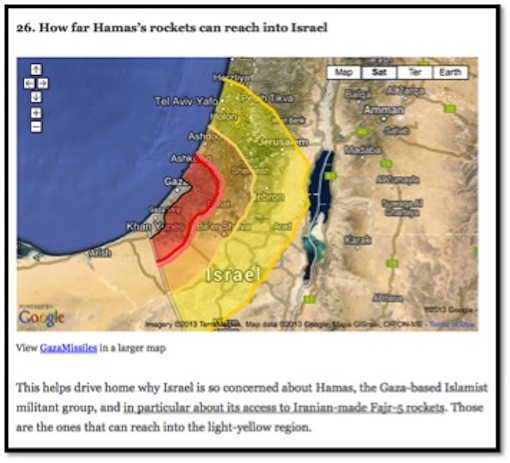
A foreign affairs blogger for The Washington Post recently posted “40 Maps that explain the world.” Some of the maps are important (“Economic inequality around the world”), some are interesting (“Meet the world’s 26 remaining monarchies”), but others grossly distort the reality they purportedly represent. Chief among this latter category is “How far Hamas’s rockets can reach into Israel” .
All about Hamas’s rockets
There are two principal problems with this map. First, the map attempts to “explain” the Israeli-Palestinian conflict by pointing exclusively to the capacity of Hamas’s rockets to reach ever-extensive points within Israel. Four color-coded, concentric semi-circles spread out from the Gaza Strip, each showing the distance different rockets could travel, the furthest making it all the way to the Dead Sea. Max Fisher, the Post’s chief foreign affairs blogger, writes in a caption to the map, “This helps drive home why Israel is so concerned about Hamas, the Gaza-based Islamist group, and in particular about its access to Iranian-made Fajr-5 rockets. Those are the ones that can reach into the light-yellow region.”
Erasing Palestine from the Map
The second major problem with this map is that Palestine—both historic and contemporary—is erased from it. A white dotted line traces the border between the West Bank and Israel but the line is barely visible beneath the yellow-shaded ring. Moreover, “West Bank” (not “occupied West Bank,” or “occupied Palestinian territory,” or “Palestinian West Bank” or “Palestine,” mind you) appears in font so small that it seems to designate some tiny city northeast of Jerusalem, not the Palestinian territory occupied by Israel since 1967. And while Israeli municipalities such as Arad, Ashdod, Holan, and Hrzliya, among others, are included, nowhere can one find the Palestinian cities of Ramallah, Nablus, Bethlehem, or Jericho, much less al-Bira, Jenin, or Qalqilia. Only Jerusalem and Hebron, West Bank cities that are significant to both Israelis and Palestinians, are featured. Even Jaffa, the coastal Palestinian city north of Tel Aviv, has been replaced by the Israeli-Hebrew version, “Yafo.”
So what does this map tell us about the Israel-Palestine conflict? It’s not apparent what or where Palestine is, or that it even exists, but the map suggests that an ever-menacing, Iranian-supported Islamist group threatens more than half of Israel. And therefore, Israel is “concerned.” Presumably, the reader might conclude, that “concern” forces Israel to periodically defend itself, launching its own counter-attacks into the Gaza Strip. The West Bank, meanwhile, appears for all intents and purposes, part of Israel and in no way related to the Gaza Strip or the cartographically cleansed “Palestine.” So Israel’s geography is simplified into a need to defend itself and Palestine is wiped off the map.
Concealing more than it reveals
The Washington Post’s map (which is actually just a simple google map lifted from someone named “Gene,” whose cartographic resume also includes google maps of “Richmond Bars/Restaurants” and “Jane Austin’s England”) doesn’t reveal how and to what extent Israel has “defended” itself against the perceived threat of Hamas’s rockets. The threat is all that is deemed important; a map showing where and with what deadly ramifications Israel’s responses have taken place, such as this one produced by the Alliance for Justice in the Middle East at Harvard University and the MIT Center for Future Civic Media, didn’t make the Post’s list.
Any attempt to cartographically represent the context within which Hamas’s rockets and Israel’s “response” may have been launched, such as this UN map, is also entirely missing from the Post’s compilation.
In addition to nearly erasing the Palestinian West Bank altogether, the Post’s map reveals nothing about the multiple ways in which the territory is occupied by Israel. Maps of Israeli-only roads, checkpoints, the separation barrier, settlements, and the ethnically-based divisions of the West Bank (such as these from Btselem, the Israeli Committee Against Home Demolitions, and The Applied Institute for Research – Jerusalem) don’t, according to the Washington Post, help explain this part of the world as much as Gene’s map of Hamas’s rocket-firing potential.
The Washington Post’s map of choice sheds no light on the Palestinian villages within Israel that were ethnically cleansed and destroyed in 1948-1949. References to these maps from the Palestinian Academic Society for the Study of International Affairs (PASSIA) and Visualizing Palestine could have at least begun to cartographically resurrect these erased landscapes.
The Dangers of Distorted Cartography
In sum, The Washington Post’s map explains very little about this part of the world. But what the map does reveal is The Washington Post’s myopic view of Israel and Palestine. The ongoing colonization of Palestine by Israel is reduced and reversed, in this map’s representation, to a normal country that must fend off existential threats from its shadowy neighbors. The effects of this distorted cartography are dangerous—erasing the geographies of Palestine is yet another step in the ongoing occupation and ethnic cleansing of Palestine.
Robert Ross is an Assistant Professor of Global Cultural Studies at Point Park University, in Pittsburgh, Pennsylvania. His research and teaching focus upon the political-economic geographies of Israel, Palestine, Lebanon and the United States. He is also a member of the Pittsburgh Palestine Solidarity Committee and the Israel-Palestine Mission Network of the Presbyterian Church (USA).
Sailing From Gaza to Break the Blockade
By ALESSANDRA BAJEC | August 19, 2013
 A new mission vows to challenge the blockade of Gaza by sea following Freedom Flotilla efforts since 2010, and Free Gaza missions preceding Cast-Lead in 2008. Not a Gaza-bound aid convoy this time.
With a crew of Palestinians and international activists on board, Gaza’s Ark will sail from the port of Gaza, carrying Palestinian products to buyers around the world, to defy Israel’s illegal and inhuman blockade.
Gaza’s Ark is rebuilding a cargo vessel that will attempt to open the sea to Palestinian exports to show to the outside world that Palestine is a productive land, while drawing public attention on the 7-year blockade.
Because nearly all previous attempts to reach Gaza were blocked by the Israeli navy, and given Israel-imposed three mile limit from the Gazan coast, campaigners are well aware that Israeli forces will hardly let any boat leave Gaza port.
David Heap, French-language and linguistics associate professor at the University of Western Ontario, is a spokesperson for Gaza’s Ark. He talked about the new solidarity initiative.
How did the idea of Gaza’s Ark come about?
D.H: After the last flotilla sailing I was involved in with other members, we realised we obviously need to carry on our work, trying to think of ways to continue direct action. Not just talking about the siege, but acting directly against the siege to change the premises of it.
Gaza’s Ark is the continuation of the Freedom Flotilla movement, but it’s different in significant ways due to the direction, the non-humanitarian connotation, and because fundraising efforts are being spent primarily in Gaza.
Why is this initiative important?
DH: Freedom of movement is a fundamental human rights issue that has been systematically denied to all Palestinians, in particular most severely to Palestinians of Gaza. I feel it’s an obligation to try, even in a small, symbolic way, to demand some kind of hope for these people, especially the young ones. When I visited Gaza last autumn, I was struck by the youth and their thirst for contact with the outside world.
What makes Gaza’s Ark different from previous attempts to break the siege?
D.H: Gaza’s Ark has a broader focus. We don’t just talk about the sea blockade but the whole blockade imposed on Palestine. What we’re addressing is freedom of movement –both commercial goods and people- national sovereignty and territorial integrity. We will have goods on board from all over Palestine, as Palestinians themselves have told us they should be exporting goods from not only Gaza but also the West Bank and Jerusalem.
Could you discuss how trade rather than aid may help Gaza more effectively?
D.H: Working with the Palestinian civil society in Gaza, what we at Freedom Flotilla Coalition hear is they’re sick of being recipients of international humanitarian aid. Palestinians tell us they don’t want more humanitarian aid, they want to live on their own economy as they’re very capable of doing. They claim the same freedom of movement rights that everybody enjoys.
Gaza, in particular, had a very prosperous economy in the past. But the infrastructure was systematically destroyed by Israel, and the only factories that are surviving can’t function due to the Israeli blockade.
What potential do you think the project has in comparison with the flotillas that have so far tried to sail to Gaza?
DH: If we take the Flotilla Movement as a whole, it has almost had as many successful arrivals to Gaza as attacks. This is something that goes easily forgotten in the mainstream media.
The choice of allowing us to sail safely to other destinations in the Mediterranean is something the occupier decides, not us. We can only control what we do. When the Israeli navy assaulted prior flotillas, the rhetoric used was that the boats posed a threat to Israel’s security. Which is absolutely false, none of the inbound voyages created a security risk for anyone, nobody ever found dangerous items on the flotillas that could possibly threaten the security of Israel.
Given that Gaza’s Ark is outbound, it will be interesting to see what the response from the Israeli military will be. They won’t be able to use the security argument since, even if we carried anything dangerous –which is to exclude- Israel shouldn’t care about a boat sailing out. However, I’m sure they will come up with a pretext, but It will be even harder to defend in international public opinion.
How open are international consumers to Palestinian products from Gaza?
D.H: We’ve been conditioned to think of Palestinians, Gazans in particular, as being dependant on aid. We don’t think of them as capable of having a productive economy. Part of our work is to educate the world that Palestinians can and do produce goods, and they have goods that they could export. Most people don’t know what products are available in Gaza, for example.
There’s a small selection of products that can be viewed on our website, including dugga, za’atar, dates, olive oil to name a few. Our campaign partners based in a number of countries are putting together group purchases of products from interested businesses, individuals and community groups to have their goods exported onboard Gaza’s Ark. Whichever goods potential buyers are more appealed to, whether agricultural or handicraft products, we will match them with producer organizations in Gaza.
Whatever happens to the boat, there will be a connection established between purchaser and producer in the end. Even in the event the goods don’t reach the port of destination, commercial partners in other countries will be connected to Palestinian produce organizations, they will know they bought goods and who sent them. That puts a human face to Palestinians as people who produce, and has the longer term function of building relationships which will ultimately help challenge the power of the occupier as well as the complicity of our governments in the West.
How doable is it for Palestinian producers of Gaza to secure trade deals with purchasers when there’s a real risk that goods will be confiscated by the Israeli military?
D.H: Although there’s commercial deal, it’s a special kind of commercial deal. We work with civil society partners, businesses and organizations. Purchasers in Europe, North America, Australia or South Africa have to be prepared to secure full payment before the boat sails. Palestinian producers are assured they will be paid the full purchase price of the goods before anything travels.
The risk is borne outside of Gaza by supporters of Palestinian businesses who believe that Palestinians should have their own economy. Then if something happens during the sailing, the risk is being shared by many people keeping in mind the human and commercial interest involved in this mission.
Only a small number of people can board a small boat in the east Mediterranean. But hundreds or thousands of people from different countries can potentially get on board with the campaign by buying parts of the cargo.
You intend to raise awareness and mobilize to action. How do you hope Gaza’s Ark will help put pressure on national governments and international organizations?
DH: There are bilateral trade agreements between Israel and the EU stipulating that there must not be obstacles to trading with occupied Palestinian territories. When we sail, and European buyers have purchased goods stocked on Gaza’s Ark, if the Israeli navy interferes with that sailing that’s an obstacle to trade. European commercial businesses will then have a very strong case to go to their governments and claim that, despite that they have commercial relations -with documentation proving the purchase of those goods- their imports have been confiscated.
We usually address human rights parliamentary commissions in Europe, now we may also appeal to commerce commissions. People have so far protested about human rights in reference to flotillas, but this initiative opens up another avenue, the commercial one, to bring up the blockade issue. Why is there free trade with Israel while there isn’t free trade for Palestinians? Why can’t Palestinians use their only port in Gaza?
Israel has used violence to stop other boats from leaving or entering the port of Gaza. What do you expect Gaza’s Ark will achieve?
DH: Again, the choice to use violence lies with the occupier, it’s not our choice. Everybody that sails with us is committed to non-violence, and we are very transparent about it. Whoever goes will make the choice to sail knowing the implications and possible consequences. Unfortunately we are dealing with a state that attacks unarmed civilians with impunity, as our governments in the West don’t hold it accountable.
When I went on the Gaza relief boat earlier in 2011, I was very aware of the risks. I and two dozen other activists were kidnapped, beaten and illegally arrested after Israeli naval forces seized the Canadian vessel we were on. The Canadian government did nothing. Canadians don’t overall support the blockade of Gaza, this government is in discordance with Canadian public opinion. So how can we make pressure? By putting Canadians and other internationals on the frontline. When I embark on a boat to break the blockade, I don’t just sail against the occupier, I sail against my own government.
What will be the next step if Gaza’s Ark will not reach its destination?
D.H: There’s always an after campaign. People are still following up actions from past flotilla sailings with regards to Gaza relief boats that have been seized in the last few years. With Gaza’s Ark, there will be more people involved because there are also purchasers on board. So we’ll be also bringing commercial actions against whoever happens to steal goods on the ship. We will also continue to stand in solidarity with the fishing fleet of Gaza, which is daily subject to violent constraints from the Israeli navy.
When do you anticipate Gaza’s Ark will be ready to sail?
D.H: We’re set to depart sometime this year hopefully. It depends on a lot of factors that we don’t control. The process of rebuilding the vessel has been difficult, especially this past month, raising funds internationally has not gone as fast as we would like.
But the date of sailing is for us less important than the lead up to it. The lesson we’ve learned from 2012 flotilla is a long campaign is an advantage because it allows you to develop more support in more countries. As long as we’re developing support for Palestinians of Gaza, spending most of the donated money in Gaza, we’re achieving the goal of affirming our support for a Palestinian economy. So if we don’t sail in 2013, we will sail after. The important thing is we keep opposing the blockade.
Alessandra Bajec lived in Palestine between June 2010 and May 2011 starting to work as a freelance journalist. Her articles have appeared in various Palestinian newswires, the European Journalism Centre’s magazine, The Majalla, among others.
Tel Aviv: “Axis of Evil” Cannot Be Allowed to Win in Syria
By Yahya Dbouk | Al-Akhbar | August 16, 2013
It is perhaps one of those rare times that Israel openly clarifies its position regarding the Syrian crisis, and from the mouths of high-ranking officials: the Resistance cannot be allowed to win.
Tel Aviv is increasingly worried about the developments taking place in Syria. They want the West to be more involved, particularly as Washington seems less certain about how far it should go in supporting the opposition there.
This prompted Israel’s minister of war Moshe Yaalon to make his concerns known to his visitor from Washington, chairman of the Joint Chiefs of Staff Martin Dempsey, for all the media to hear: “The axis of evil, which extends from Tehran to Damascus and Beirut, cannot be allowed to win in the ongoing war in Syria.”
After explaining that the most important thing happening in the region is the change sweeping through many Arab countries, he asked Dempsey to consider Iran’s role and the threat it poses to Israel’s security.
“The lack of stability in the region,” Yaalon insisted, “is due to many reasons, at the top of which is the Iranian regime and its involvement in all the crises taking place in the Middle East.”
According to Israel Defense magazine, the minister said that he believed the Syrian crisis would continue for a long time and would not end even if Bashar al-Assad falls, noting that “there are bloody accounts to be settled between the Alawis and Sunnis, in addition to other minorities engaged in the fighting.”
Yaalon repeated statements he had made after the Syrian opposition’s defeat in Qusayr, that Syria is going through a period in which the state is breaking up, suggesting that the Assad regime, contrary to what recent developments suggest, is weakening.
“I don’t see a change [in the regime’s favor],” the minister maintained, “because in Syria there are many places where the opposition is hitting the regime hard, as in Aleppo and the Latakia area, in addition to the Golan. This suggests that the opposition controls more territory than before.”
In the same vein, a high-ranking Israeli official criticized the US administration’s policy, and the weakness it has shown in handling a number of files in the region. On the occasion of Dempsey’s visit to Israel, the official told Yedioth Ahronot that Washington’s hesitation “will only increase Russia’s influence in the area.”
“Israel is very worried about America’s position regarding the region,” the same source added. “The Russians are taking advantage of America’s weakness, and they are waging their battles like a superpower, therefore proving to the countries of the region and President Assad that they can be relied on, while the Americans abandon their allies and partners.”
Of more concern to the source is that the US’ weak stand extend to its confrontation with Iran, asking Washington not to fall into the trap of the country’s new president, Hassan Rouhani, and “to squeeze Iran until it surrenders.”
The source explained that Israelis are generally comfortable with what is going on around them, despite the upheaval taking place in Egypt: “We can work with the Egyptians, Jordanians and other countries, for we have common interests with many parties in the region, and Israel is the one holding up the tent these days.”
Related articles
- Chair of US Joint Chiefs of Staff arrives in Israel for talks (alethonews.wordpress.com)
- some israeli politicians have a real talent for rhetoric (and this is not one of them) (niqnaq.wordpress.com)
ISM statement: Hoax video designed to harm the Palestinian popular struggle
International Solidarity Movement | August 15, 2013
A video has been put online on a website claiming to be a human right organization with a woman impersonating an ISM volunteer. In the video a woman who claims to have volunteered with the ISM in Palestine says that she was sexually harassed by a prominent Palestinian activist. The ISM want to make clear that this video is a hoax: the woman is not an ISM volunteer and the Facebook and Twitter pages are not of any human rights organization.
We believe this video is designed to harm the Palestinian popular struggle and the international solidarity movement in Palestine.
It is not the first time a video in which someone claims to be an International activist has been produced in order to attack the popular struggle and the solidarity movement. For example, before the freedom flotilla left for Gaza, a hoax video was released in which an Israeli actor posed as a solidarity activist and was eventually exposed.
When cases of sexual harassment or assault occur, as they do everywhere in the world, ISM and our Palestinian partners take reports very seriously and take action to protect people from sexual harassment and violence.
In solidarity,
International Solidarity Movement
Featured Video

or go to
Aletho News Archives – Video-Images
New Documentary
“Inside Gaza” wins best documentary at Montreal’s Cinemania film festival
Palestine Information Center – November 16, 2026
MONTREAL – The documentary “Inside Gaza,” which chronicles the experiences of Palestinian journalists working with Agence France-Presse (AFP) while covering the Israeli war on the Gaza Strip, won the Best Documentary Award at the 32nd Cinemania International Francophone Film Festival held in Montreal, Canada.
Directed by Helene Lam Trong, the 72-minute film follows the daily lives of four AFP journalists who bear witness to the difficulties of reporting in a war-torn territory largely closed off to international media.
The film is compiled from material produced by the team on the ground, as well as from interviews conducted after they left.
The film also won the People’s Choice Award at the festival on Saturday. … continue
Blog Roll
 Aletho News
- Brand ‘rape’ case just doesn’t add up. Was he framed?
- How The Jensen Huang Chinese Spy Hoax Is Russiagate 2.0
- Austria seeks to strip former foreign minister of citizenship over Russia ties
- “Inside Gaza” wins best documentary at Montreal’s Cinemania film festival
- Activists block German munitions plant over arms exports to ‘Israel’
- The Nasser Hospital attack and Israel’s relentless lies
- Could it be satan? No, Huckabee, just the Americans you work for
- AIPAC and more: Network of pro-Israel influence in US Congress
- Putin aide reveals Moscow’s stance on Europe at peace talks
- Imran Khan warns Pakistani judges he may die in prison
- If Americans Knew
- Mossad abducted Iranian general in Turkey, tortured him for weeks before killing him: Report
- I Am a Palestinian-American. Israeli Soldiers Occupied My Home for Weeks and Trashed It
- Jeffries Accused of “Straight Up Lie” for Claiming AIPAC Is Ending Donations
- DAILY UPDATE: Latest essential news on Palestine, Israel, & region
- Mothers fear for their children as polio returns to Gaza amid Israel’s ongoing genocide
- Inside the Israel-backed ‘NAZA’ disinformation campaign
- US Restrictions Prevent Palestinian Clergy From Speaking in Washington
- Gazan medics detained on shift, tortured – and return to work
- AIPAC and more: Network of pro-Israel influence in US Congress
- Israel Pays “Conservative” Media to Propagandize Americans
- No Tricks Zone
- Argentina’s Perito Moreno Glacier Joins Antarctica and Arctic In Defying Doomsday Melt Claims
- New Study: Barents Sea Temperatures Were Warmer And Sea Ice Less Extensive In The 1700s Than Today
- German Authorities Start Initiative To Evaluate Public Register For Climate “Disinformation” Spreaders!
- Zonal Asymmetry of Temperature Change in the Antarctic Circumpolar Current
- New Study: The Net Fossil Fuel Contribution To Rising Atmospheric CO2 Has Been Zero For 500 Years
- Germany’s Green Energy Transition Becoming Increasingly Expensive…Another 6 Trillion Euros!
- Sudden Stratospheric Warming, Powerful El Niño Combination May Lead To Extreme Europe Cold, Energy Crisis!
- Two New Studies Find Thwaites Glacier Melt Cannot Be Driven By Human Activity Or A Warming Ocean
- E-Cars Reduce CO2 Emissions By Only 41% Compared To Internal Combustion Engine Vehicles
- Predictions Made By Renowned Climate Professor Over Past Decades Have Been Proven To Be Poor


