Susiya resists mass demolition orders
“We will not give up; to give up is to die”
International Solidarity Movement | June 27, 2013
Susiya, Occupied Palestine – Today, June 27, 2013, the Israeli Civil Administration served thirty-four demolition orders in the Susiya village, which is in Area C and surrounded by the Israeli colony of Suseya. Due to previous demolition orders, every existing structure in the village is now threatened with destruction if they do not obtain permits by July 17.
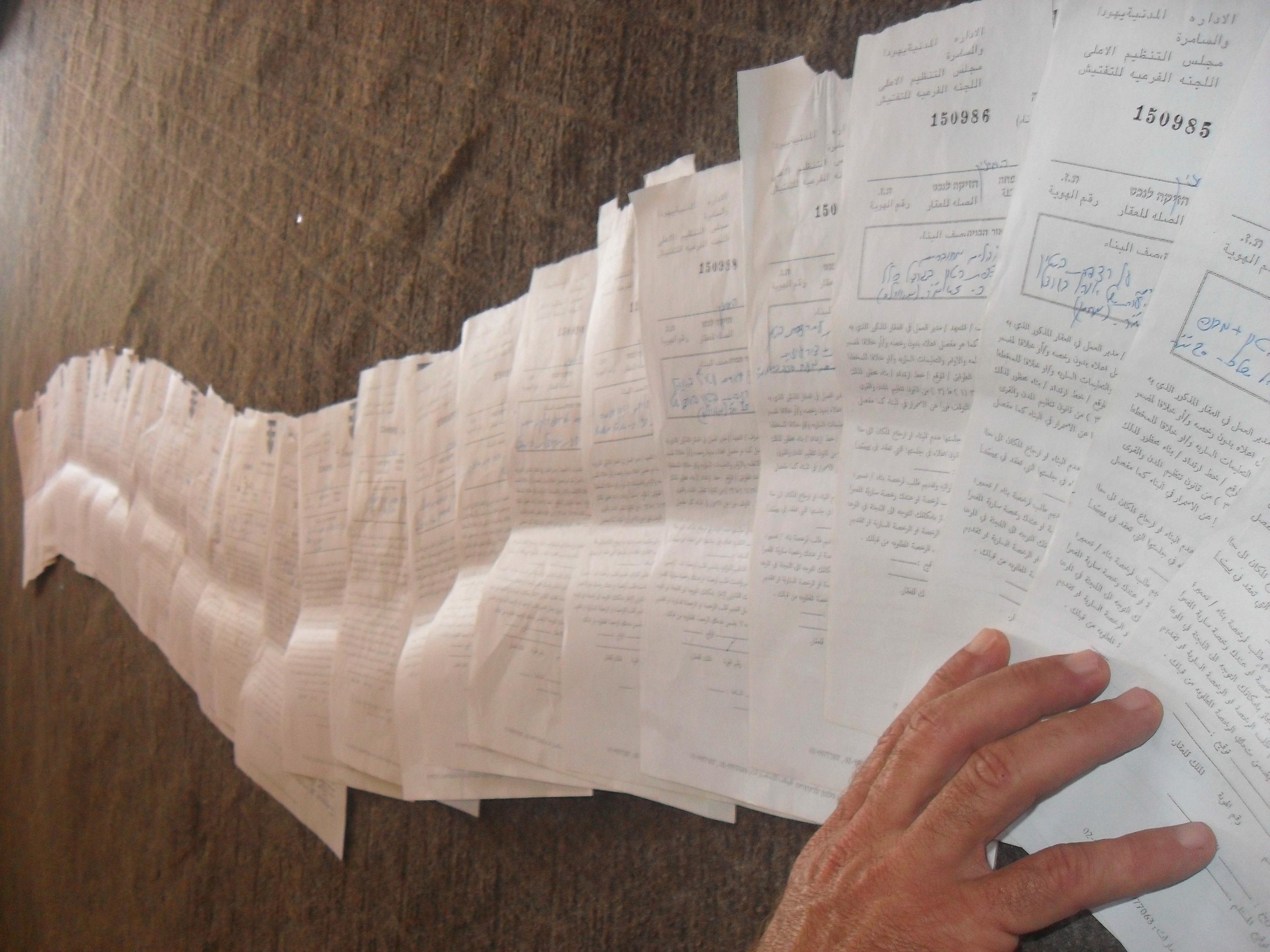
Original copies of all the demolition orders served today (Photo by ISM)
The residents of Susiya include more than thirty families, who were all evacuated from their homes in the old Susiya village and forced to relocate 200 meters to the southeast, in 1986. Susiya residents collaborate with the nearby villages in Masafer Yatta, a closed military “firing zone,” also in Area C and threatened with demolition. On July 15, a hearing will decide whether all the villages in Masafer Yatta can be evacuated by the military. Hafez Huraini, leader of the South Hebron Hills Popular Committee and himself a refugee from 1948, emphasizes that the villagers in Susiya are targeted simply for existing, so everything they do from grazing sheep to visiting family members in the nearby city of Yatta draws violence from the Israeli military and the local settlers.
Susiya has faced six mass demolitions since the establishment of the Israeli Suseya colony in 1983. The last wave of demolitions in 2011 repeatedly displaced 37 people including 20 children [1]. Residents of Susiya, most of whom rely on subsistence agriculture, are subject to some of the worst living conditions in the West Bank. Their houses were destroyed by Israeli forces and they now live in tents and shelters, paying more than five times the price nearby villages pay for water and consuming less than 1/3 of the WHO standard per capita [2]. Settlers have violently denied Susiya residents access to over 300 hectares of their land, including 23 water cisterns. Documented cases of settler violence include beatings, verbal harassment and destruction of property. Settlers then annex parts of the land by exploiting the Palestinian owners’ inability to access their land.
Of over 120 complaints that have been filed based on monitoring from Rabbis for Human Rights, regarding settler attacks and damage to property, around 95 percent have been closed with no action taken. In 2010, when 55 Susiya residents petitioned the High Court to be granted access to their land, the State responded that it intended to map land ownership of the area. Since then they have only closed to settlers 13% of the land Palestinians have been denied access to, reversing only one incursion [3].
Susiya has been the site of creative non-violent resistance for years, resistance that is continually met with brutality. Events have included marches, picnics on land likely to be confiscated, and Palestinian “outposts.” This coming Saturday Susiya will be part of a festival in the South Hebron Hills aimed at raising awareness about the situation of Masafer Yatta residents and stress their right to remain on their land [4]. In the words of Hafez Huraini, coordinator of the South Hebron Hills Popular Committee, “We will not give up.”
Sources:
[1] Strickland, Patrick O. “Palestine’s Front Line: The Struggle for Susiya.” Palestine Note RSS. N.p., n.d. Web. 27 June 2013.
[2] “Susiya: At Imminent Risk of Forced Displacement.” Susiya: At Imminent Risk of Forced Displacement – OCHA Factsheet (30 March 2012). N.p., Mar. 2012. Web. 27 June 2013.
[3] “South Hebron Hills.” Khirbet Susiya. N.p., 01 Jan. 2013. Web. 27 June 2013.
[4] Al Mufaqarah. “Al Mufaqarah R-Exist.” Weblog post. Al Mufaqarah RExist. N.p., 24 June 2013. Web. 27 June 2013.
Related articles
- The occupation plans to expand settlement of Susiya in al-Khalil (occupiedpalestine.wordpress.com)
- Jewish settlers setting up tent and planning road on Palestinian owned land in Al Khalil (alethonews.wordpress.com)
- Settler dogs attack Palestinian villagers near Hebron (occupiedpalestine.wordpress.com)
Related video
- From Al-Araqib to Susiya (palestinefreedomnow.wordpress.com)
UN committee slams Israeli forces’ torture of Palestinian children

A child sits in front of a destroyed home in Rafah. (Photo: European Commission DG ECHO/cc/flickr)
Al-Akhbar | June 20, 2013
A United Nations human rights body accused Israel on Thursday of mistreating Palestinian children, including by torturing those in custody and using others as human shields.
Palestinian children in the Gaza and the West Bank, captured by Israeli forces in the 1967 war, are routinely denied registration of their birth and access to health care, decent schools and clean water, the UN Committee on the Rights of the Child said.
“Palestinian children arrested by (Israeli) military and police are systematically subject to degrading treatment, and often to acts of torture, are interrogated in Hebrew, a language they did not understand, and sign confessions in Hebrew in order to be released,” it said in a report.
The Israeli Foreign Ministry said it had responded to a report by the UN children’s agency UNICEF in March on ill-treatment of Palestinian minors and questioned whether the UN committee’s investigation covered new ground.
“If someone simply wants to magnify their political bias and political bashing of Israel not based on a new report, on work on the ground, but simply recycling old stuff, there is no importance in that,” spokesman Yigal Palmor said.
The report by the UN Committee on the Rights of the Child noted that, while both Israeli and Palestinian children end up killed and wounded, Palestinians constitute a much larger proportion of these casualties.
Most Palestinian children arrested are accused of having thrown stones, an offense which can carry a penalty of up to 20 years in prison, the committee said. Israeli soldiers had testified to the often arbitrary nature of the arrests, it said.
The watchdog’s 18 independent experts examined Israel’s record of compliance with a 1990 treaty as part of its regular review of a pact signed by all nations except Somalia and the United States. An Israeli delegation attended the session.
The UN committee regretted Israel’s “persistent refusal” to respond to requests for information on children in the Palestinian territories and occupied Syrian Golan Heights since the last review in 2002.
“Hundreds of Palestinian children have been killed and thousands injured over the reporting period as a result of the state party military operations, especially in Gaza where the state party proceeded to (conduct) air and naval strikes on densely populated areas with a significant presence of children, thus disregarding the principles of proportionality and distinction,” the report said.
The 10-year period examined by the committee included the second Intifada, which took place between 2000 and 2005.
Israel withdrew its troops and settlers from the Gaza Strip in 2005, but maintains a heavy blockade on the Hamas-run enclave.
During the 10-year period, an estimated 7,000 Palestinian children aged 12 to 17, but some as young as nine, had been arrested, interrogated and detained, the UN report said.
Many are brought in leg chains and shackles before military courts, while youths are held in solitary confinement, sometimes for months, the report said.
It voiced deep concern at the “continuous use of Palestinian children as human shields and informants”, saying 14 such cases had been reported between January 2010 and March 2013 alone.
Israeli soldiers had used Palestinian children to enter potentially dangerous buildings before them and to stand in front of military vehicles to deter stone-throwing, it said.
“Almost all those using children as human shields and informants have remained unpunished and the soldiers convicted for having forced at gunpoint a nine-year-old child to search bags suspected of containing explosives only received a suspended sentence of three months and were demoted,” it said.
Israel’s illegal occupation of Palestinian territory and the Syrian Golan Heights, continued expansion of Jewish settlements, construction of the apartheid wall into the West Bank, land confiscation and destruction of homes and livelihoods “constitute severe and continuous violations of the rights of Palestinian children and their families,” it said.
Israeli settlements in the West Bank are deemed illegal by international law, a charge the Zionist state disputes.
The UNICEF report in March showed that Israel was the only country in the world where children were “systematically tried” in military courts.
Over the past decade, Israeli forces have arrested, interrogated and prosecuted around 7,000 children between between 12 and 17, mostly boys, UNICEF found, noting the rate was equivalent to “an average of two children each day.”
Figures from the end of January show that 233 children are currently being held in custody, 31 of them under the age of 16.
(Reuters, Al-Akhbar)
Related article
New wall construction to surround Azzun Atma
International Solidarity Movement | June 20, 2013
Azzun Atma, Occupied Palestine – On the 18th of June, two bulldozers arrived with Israeli forces in the village of Azzun Atma, southeast of Qalqilya, and began to work on the land behind the village’s school, to what is believed to be the construction of the new wall.
Accompanying the bulldozers to the village was the Israeli army and border police, including the local Israeli army commander who said the action was based on a High Court decision by the Israeli government. He said it was in order to protect their citizens, and if anybody tried to stop the construction, they would then close the gate to the village, the only way in and out.
Two weeks prior to this, the Israeli army put up signs stating that this is where the construction of the new wall would begin. The villagers fear that this new construction is being done in order to replace the current two metre barbed mesh fence that surrounds the village from all sides and separates it from the settlements nearby, with the concrete wall. The wall’s existence and constant deviation from the Green Line is justified by the Israeli authorities by citing security concerns for its citizens, in this case the illegal settler colonisers in the area.
Azzun Atma is located two kilometres east of the Green Line and encompassed on three sides by the current wall, constructed in 2002, which leaves the village within a settlement block and separates it from the rest of the West Bank. The only way in and out of the village is through a military checkpoint with a small gate. The village is thus stranded in the “seam zone” between the Green Line and the wall, surrounded by settlements, placing it under full Israeli military control. Access to the village, therefore, is dictated by the Israeli military and the checkpoint is regularly closed, denying the villagers their right to freedom of movement. The villagers thus live under the constant threat of the gate being closed and work permits for the other side of the Green Line being denied.
Palestinians living in the “seam zone” require permanent resident permits from the Israeli authorities to live in their own homes and work on their land. There are often few health and education services available in the “seam zone”, and those living inside it have to rely on checkpoints being open to reach workplaces and essential services.
The school where the construction is taking place has provided education for 300 children in Azzun Atma and a neighbouring village since 1966. Every day, the current wall and checkpoint restricts the freedom of movement of teachers and students. The school has so far lost one dunum of land to the wall and the septic system faces demolition orders.
When the second wall is constructed, Azzun Atma will be isolated from the rest of the West Bank by the already existing wall (see the red line on the map) and the new wall which will further close off the village from the settlement block and the rest of the West Bank (see the black line on the map).
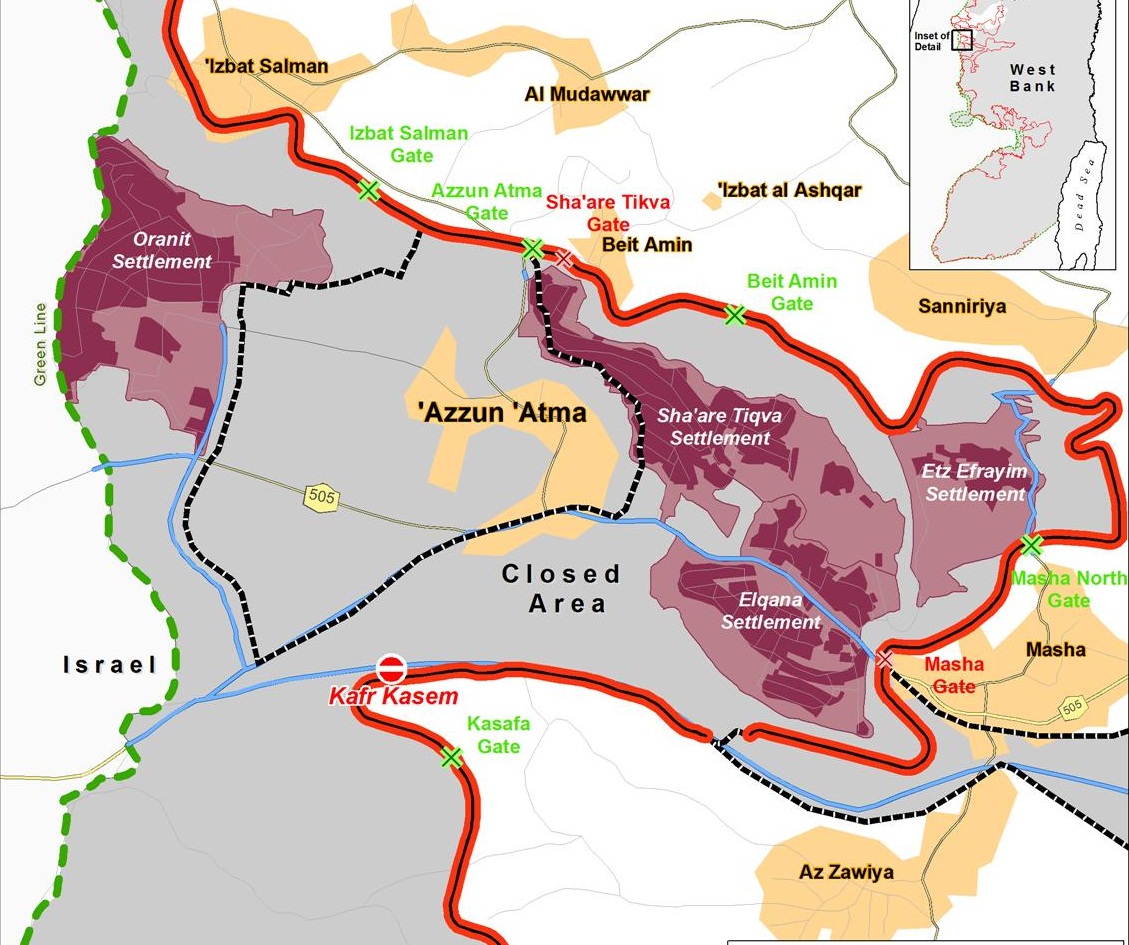
Azzun Atma (Map by OCHA)
In 1982, the Israeli authorities established two illegal settlements: Oranit to the northwest and Sha’are Tiqva to the northeast of Azzun Atma. The settlements have expanded over the years, and more than 2500 dunums of the village’s land have been stolen by them. Sha’are Tiqva now comes within metres of Azzun Atma, and since 2005, villagers have been subject to verbal harassment from settlers. The wall, though purported to be a security measure, is essentially another way for the Israeli government to steal land from their Palestinian owners and isolate villages and cities from each other, turning them into easily controllable cantons.
Isolating people and making daily life as hard as possible under occupation is a tactic used by the Israeli authorities to force villagers to leave their land and homes. However, residents of Azzun Atma remain steadfast in their land and will continue to resist the land theft, isolation and deprivation of their lives by organising protests.
Related articles
- Israeli settlers threaten to occupy Palestinian village of Azzun (occupiedpalestine.wordpress.com)
- West Bank Barrier creates hardship for Palestinian villagers (euronews.com)
UN statement on Israeli plan to relocate Palestinians to build houses for settlers
MEMO | June 17, 2013
A UN organisation has highlighted the plight of small Palestinian farming communities in the hills to the east of Jerusalem which are at risk of forced displacement due to a “relocation” plan advanced by the Israeli authorities. The UN Office for the Coordination of Humanitarian Affairs in Occupied Palestinian Territory (UNOCHA) said that the Israelis try to justify their plan on the grounds that the residents do not “possess title over the land”. Around 80 per cent of the people affected are refugees who were forced from their original lands in the south of the country in the early 1950s.
“A combination of measures adopted by the Israeli authorities has created a coercive environment for the communities,” said OCHA. They have restricted access to grazing land and markets to sell their produce. “These acts have undermined their livelihoods and increased their dependency on humanitarian assistance.”
In addition to demolition and the threat of demolition of homes, schools and animal shelters, as well as corresponding restrictions on obtaining building permits, the authorities have also failed to protect the communities from intimidation and attacks by Israeli settlers, alleges OCHA. “The communities have been told that they have ‘no choice’ but to leave.”
The UN organisation stated that the Israeli authorities have allocated public (state) land in two sites designated for the relocation, and prepared planning schemes, which are at final stages of approval. It added that this step raises cultural concerns as it threatens the traditional way of life for these people.
Israel’s plan includes the construction of thousands of housing units for illegal settlers in the E1 area, which creates a continuous built-up area between the Ma’ale Adumim settlement and Jerusalem. OCHA said that this plan has been frozen since the late 1990s, but the Israel government has recently reactivated it.
“The affected area is also planned to be surrounded by the Barrier [West Bank Separation Wall],” said OCHA. “If implemented, these plans will undermine Palestinian presence in the area, further disconnect East Jerusalem from the rest of the West Bank, and disrupt the territorial contiguity of the occupied territory.”
According to the OCHA report, “The UN Secretary General has stated that the implementation of the proposed ‘relocation’ would amount to individual and mass forcible transfers and forced evictions, prohibited under international humanitarian law and human rights law.”
The Secretary General based his statements on the following grounds:
- As an occupying power, Israel has an obligation to protect the Palestinian civilian population and to administer the territory for the benefit of that population.
- The destruction or confiscation of private property, including homes, as well as the transfer of settlers into occupied territory, is also prohibited.
OCHA pointed out that these residents are “calling for the international community to protect them and assist them in their current location and to afford adequate planning and permits for their homes and livelihood-related properties.”
Related articles
- Israel lawmakers approve plan to displace Negev Bedouins
- Israel threatens to demolish ‘illegal’ Bedouin school
- ISRAEL: Water being used to coerce Bedouin villagers, says NGO
- The Negev’s Hot Wind Blowing
- Palestinian Bedouins threatened with ethnic cleansing
- Israeli cabinet announces plan to forcibly displace tens of thousands of indigenous Bedouins
Israeli army detains a 10-year-old during the weekly demonstration in Kafr Qaddum
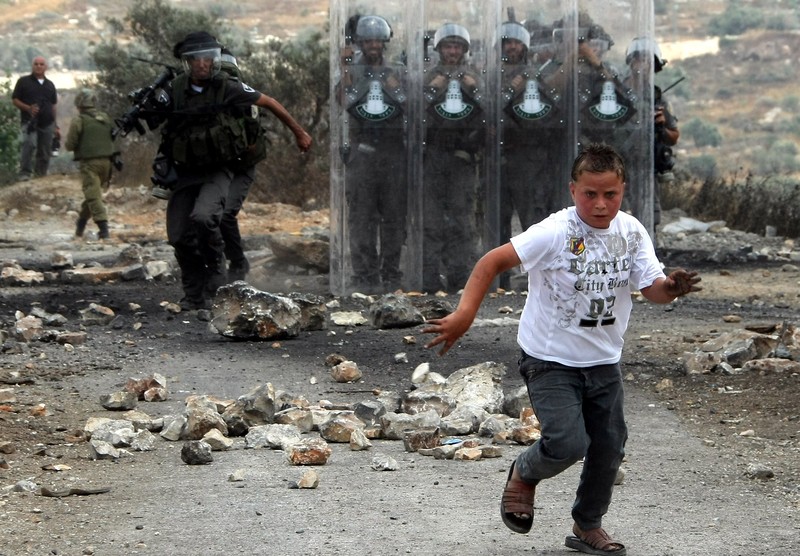
A young Palestinian protester runs away from Israeli soldiers during a demonstration against the expropriation of Palestinian land by Israel in the village of Kafr Qaddum, near the West Bank city of Ramallah on June 22, 2012. – Source
International Women’s Peace Service | June 14, 2013
Kafr Qaddum, Occupied Palestine – On Friday 14 June, the Israeli army arrested a 10-year-old child during the weekly protest in Kafr Qaddum. Israeli soldiers fired tear gas canisters and sound bombs at the villagers; many local residents suffered from tear gas inhalation.
At approximately 12:00, when residents and international solidarity activists started gathering for the demonstration before the Friday prayers, nearly 30 foot soldiers stormed the village from the main road leading toward the illegal Israeli settlement Qedumim. As they entered the village, they fired tear gas canisters directly at the group before the demonstration even began. Local youth resisted the incursion, chasing the soldiers back from the bystanders toward a hill overlooking the village.
Over the next two and a half hours, soldiers shot tear gas and threw sound bombs at demonstrators in the olive groves next to the main road of the village. At approximately 12:30, soldiers detained a 10-year-old boy. While in their custody, soldiers tied his hands, grabbed him by the neck, beat him and threatened to “drop [him] from this rock.”
Nearly one and a half hours later, the boy was released and residents of Kafr Qaddum celebrated his return. Soldiers continued to fire tear gas at local youth protesting at the edge of the village close to the illegal settler colony of Qedumim. No further arrests were made and the demonstration ended at around 15:00.
Kafr Qaddum is a 3,000-year-old agricultural village that sits on 24,000 dunams of land. The village was occupied by the Israeli army in 1967; in 1978, the illegal settler-colony of Qedumim was established nearby on the remains of a former Jordanian army camp, occupying 4,000 dunams of land stolen from Kafr Qaddum.
The villagers are currently unable to access an additional 11,000 dunams of land due to the closure by the Israeli army of the village’s main and only road leading to Nablus in 2003. The road was closed in three stages, ultimately restricting access for farmers to the 11,000 dunams of land that lie along either side to one or two times a year. Since the road closure, the people of Kafr Qaddum have been forced to rely on an animal trail to access this area; the road is narrow and, according to the locals, intended only for animals. In 2004 and 2006, three villagers died when they were unable to reach the hospital in time. The ambulances carrying them were prohibited from using the main road and were forced to take a 13 km detour. These deaths provoked even greater resentment in Kafr Qaddum and, on 1 July 2011, the villagers decided to unite in protest in order to re-open the road and protect the land in danger of settlement expansion along it.
Kafr Qaddum is home to 4,000 people; some 500 residents attend the weekly demonstrations. The villagers’ resilience, determination and organization have been met with extreme repression. More than 120 village residents have been arrested; most spend 3-8 months in prison; collectively they have paid over NIS 100,000 to the Israeli courts. Around 2,000 residents have suffocated from tear-gas inhalation, many in their own homes. Over 100 residents have been shot directly with tear-gas canisters. On 27 April 2012, one man was shot in the head by a tear-gas canister that fractured his skull in three places; the injury cost him his ability to speak. In another incident, on 16 March 2012 an Israeli soldier released his dog into the crowded demonstration, where it attacked a young man, biting him for nearly 15 minutes whilst the army watched. When other residents tried to assist him, some were pushed away while others were pepper-sprayed directly in the face.
The events of the past week are part of a continuous campaign by the Israeli military to harass and intimidate the people of Kafr Qaddum into passively accepting the human rights violations the Israeli occupation, military and the illegal settlers inflict upon them.
Related articles
- Kafr Qaddum – Blocked from life’s basics; pushed back when doing something about it (alethonews.wordpress.com)
- Palestinians demonstrate across West Bank (altahrir.wordpress.com)
- “We are the army…we will catch you or we will come to your house” – Soldiers threaten children of Kafr Qaddum (palsolidarity.org)
- Violent repression continues by the Israeli Army against protesters in Kufr Qaddum (occupiedpalestine.wordpress.com)
Settlers from Bracha attack and harass farmer on his land
International Solidarity Movement | June 13, 2013
Al Rujeib, Occupied Palestine – On Friday 7th June five settlers from the illegal settlement of Bracha attacked a farmer on his land, using sling shots to throw stones at him near Huwwara checkpoint. The same settlers continued to harass the farmer in the following days as he tried to graze his sheep and gather his crops, unprotected by the Israeli authorities.
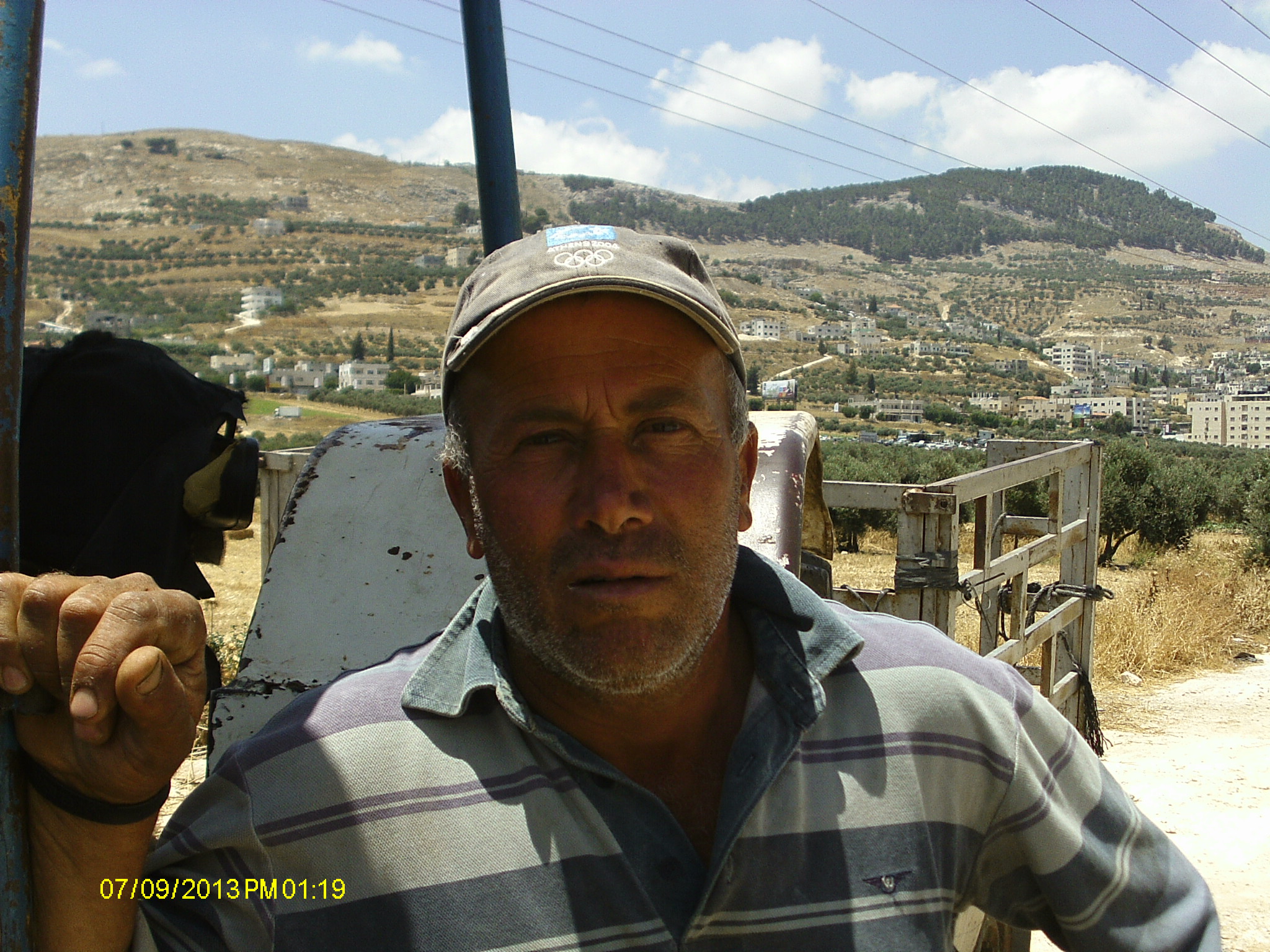
Salah Sukamel Deweket (Photo by ISM)
Salah Sukamel Deweket rents 70 dunums of land between his home in Al Rujeib and the occupation forces’ checkpoint at Huwwara. The land is mainly used to plant crops for his sheep to graze upon.
On Friday 7th June Salah was working hard to enable his sheep to feed when he was surprised by five settlers, thought to be an old man and his four sons who brought their own sheep to eat Salah’s wheat. The settlers threw rocks using slingshots at Salah and his flock. Salah had no one who could help him as he had no number for the District Coordination Office (DCO) – the Palestinian liasion with Israeli authorities or other organisations. Unable to get the number, he returned to his land to find that the settlers had ripped apart his bales of wheat.
The settlers resumed throwing stones at him in full view of soldiers stationed at the Israeli occupation forces checkpoint at Huwwara. The soldiers did nothing but watch as the Palestinian farmer was attacked. As an occupying power the Israeli military are meant to protect all citizens in the territory.
Salah asked the older settler why he had destroyed his wheat. “People who stay in Israeli land have to be good Israeli people”, the settler replied. “If this is Israeli land, where’s Palestinian land?” Salah asked. “There is no Palestinian land” the settler shouted back. The settlers continued to graze their sheep on Salah’s land and then encouraged their sheep to eat the olive trees of another Palestinian farmer who came to protect his land. It was only then that army jeeps came to intervene – asking why the Palestinian farmers were there. Salah tried to explain the problem with the settlers to the army, who told him to take photos and go to DCO. Salah then asked the soldiers if they were going to arrest the settlers, to which they said, ” we don’t know, it’s up to the judge.” When the soldiers were asked why they did not come earlier, they replied that it wasn’t their problem. The next day Salah tried to fix his wheat bales but the settlers kept coming and causing problems. Soldiers eventually came and told both Salah and the settlers to leave but said that the Palestinians must leave first.
Palestinians face many attacks by settlers of varying severity. Religious extremists living in illegal settlements attack Palestinian people, lands and crops. Palestinians have almost no means of legal recourse or protection from settler attacks but are routinely targeted by the army in mass arrests in the alleged defence of the Israeli occupation and settlements. Even when Palestinians can contact the DCO, the coordination office can often not solve issues with settlers who generally are treated with impunity under Israeli law. Settlements are illegal under international law under the fourth Geneva convention.

Salah Sukamel Deweket’s wheat fields (Photo by ISM)
Related articles
- Jewish settlers setting up tent and planning road on Palestinian owned land in Al Khalil (alethonews.wordpress.com)
- After the flames, only determination remains in Burin and Madama (alethonews.wordpress.com)
- VIDEO | 82-year-old Hebron woman Umm Salah challenges Israeli settlers, troops. Alone. (occupiedpalestine.wordpress.com)
- Jewish settler fires at Palestinian workers wounding one of them (occupiedpalestine.wordpress.com)
After the flames, only determination remains in Burin and Madama
International Solidarity Movement | June 3, 2013
Burin and Madama, Occupied Palestine – On Monday 3rd June, around a dozen settlers from the illegal colony of Yizhar set fire to Palestinian’s fields in the villages of Burin and Madama, destroying at least 50 acres of arable land with olive trees. The settlers were joined by a jeep of border police when 40-50 Palestinians from the village of Burin came out to attempt to put out the fire, with some being stopped from doing so by the border police present.
As people from the two villages south of Nablus were hoping for an uneventful workday, the settlers from Yizhar, renowned for being one of the worst for settler violence, set fire to fields in the Khallat al-Injas neighbourhood of Madama. One young person there desribed how, “then I went there quickly with my friends and tried to extinguish it. During that time the settlers went to the eastern area which is between Madama and Bureen. They set fire into the hills there.”Before long, the enormous fires spread across the field and towards the olive tree groves of neighbouring Burin. Shortly after, Israeli border police turned up at the scene in Burin’s land, delaying the extinguishing of the fire.
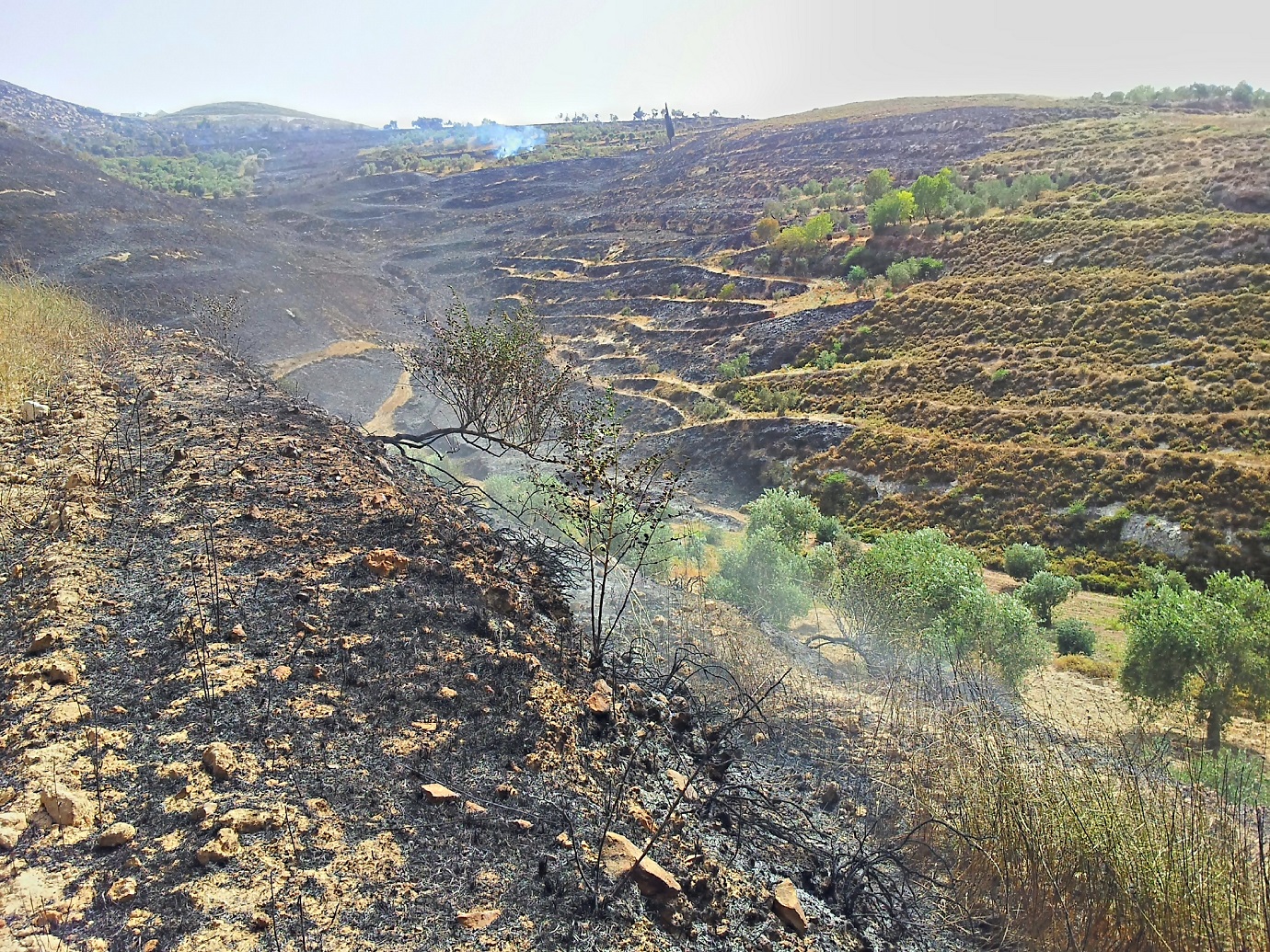
Salman Valley was a major source of income for Burin (photo: ISM)
Of the Palestinians that gathered, the Israeli border police only allowed uniformed firemen and those from the Palestinian Authority’s civil volunteer service to put out the raging fires. Those who approached to help were threatened with pepper spray. The fire was eventually slowed down when the border police left and the community was able to help. Areas of the hills still burned when volunteers were leaving at around 6 o’clock in the evening. The Israeli fire service appeared in case the fire spread to settler-occupied land, but did nothing to help the Palestinians nearby.
This level of violence is far from unheard of in the villages of Madama and Burin, which like other villages in proximity to Yizhar, are both subject to regular crop burnings, harassment and serious violence from the illegal settlement, who, with the assistance of the Israeli occupation forces, show no signs of stopping their assault on the surrounding Palestinian land and its inhabitants. Residents of Burin also face harassment from the Israeli army, which includes the tear-gassing of a Burin home, with a months old baby inside, during this February’s ‘al-Manatir‘ demonstration. A protest for which the village has received several military reprisals since, including destruction of the local cultural centre.
Yizhar is at the forefront of settler violence and operates a strict “price tag” policy, where any action taken by the Israeli government on illegal settlements within the West Bank must be met by carrying out harsh and violent crimes on Palestinian communities. It’s has frequently produced anti-Palestinian propaganda, including literature justifying the killing of Palestinian children and material supporting the actions of mass murderer Baruch Goldstein.
Related articles
- Villages of Urif, Burin and Asira violently attacked by settlers (palsolidarity.org)
- Jewish settlers setting up tent and planning road on Palestinian owned land in Al Khalil (alethonews.wordpress.com)
- Arson attack on Asira village by illegal settlement of Yitzhar (palsolidarity.org)
- Palestine: Israelis kill more than 750 olive trees with chemicals last week & 100 dunums of Salfit land confiscated (realisticbird.wordpress.com)
- Settlers Spray Olive Trees With Toxic Chemicals (imemc.org)
Canadian church boycotts companies in Israeli settlements
MEMO | May 31, 2013
Canada’s largest Protestant church, the United Church of Canada, has decided to boycott three Israeli companies as part of its campaign against products manufactured in illegal settlements in the Occupied Palestinian Territories. The “Unsettling Goods: Choose Peace in Palestine and Israel” campaign is set to start on Saturday and will last for a year. It calls for “education and for economic action by United Church members to end the Israeli occupation of Palestinian Territories.”
Last week, the church’s governing General Council approved the proposal to boycott Keter Plastic, SodaStream and Ahava which all operate in illegal settlements. The move builds on last year’s agreement to boycott products manufactured in Israeli settlements in the occupied West Bank and Jerusalem which the Church regards as the principal obstacle to peace in the region.
A statement on the United Church’s website said that in the coming months it “will engage in dialogue” with the three companies and request them to cease production in settlements: “They will be informed that failure to do so will result in economic action against their products.”
Report Censures Israel For Demolishing Palestinian and EU Property’
By Bernhard Schell | In Depth News | May 28, 2013
Brussels – Hundreds of Palestinian homes and structures have been bulldozed and approvals for illegal settlements have increased despite the 27-nation European Union (EU) asking Israel to stop settlement expansion, forced displacement, and demolition of Palestinian property in an unprecedented statement one year ago, says a new report.
EU foreign ministers adopted on May 14, 2012 some of the most extensive and far-reaching recommendations on the issue of the Israeli policies in the occupied Palestinian territory (OPT). In particular, the EU ministers approved specific recommendations for developing Area C which constitutes 60 percent of the West Bank and falls under full Israeli military and civil control. An estimated 150,000 Palestinians live there among 325,000 Israelis living in settlements that are illegal under international law.
EU foreign ministers called for improvement of Israel’s policies that are currently damaging to the development of Palestinian livelihoods and for the future viability of a Palestinian state. It also called on the Government of Israel to end impunity on settler violence, as well as allow the EU to pursue development projects in Palestinian communities without risks of Israeli demolitions. In addition, for the first time, the EU declared: “Ending the conflict was a European interest.”
 In a report released on May 27, 2013, the Association of International Development Agencies (AIDA), a coordinating body representing over 80 international aid and development agencies working in the occupied Palestinian territory, have urged the EU to “match their strong words with action in order to effectively challenge Israeli government policies”.
These policies, says the report – Failing to Make the Grade: How the EU can pass its own test and work to improve the lives of Palestinians in Area C – are creating “unbearable conditions” in Area C, which is home to some of the most vulnerable Palestinian communities who are isolated from services provided by the Palestinian Authority in other parts of the West Bank. Palestinians living in that area rely heavily on humanitarian and development assistance.
According to AIDA, “chances for a just and durable solution that allows Palestinians and Israelis to live with peace and security were slipping away as the situation on the ground continues to deteriorate”.
The report points out that more than 600 houses have been built in the past year in the illegal Israeli settlements while 535 Palestinian-owned homes and structures have been destroyed, leaving 784 people homeless or displaced.
Around 30 European-funded structures have been demolished during this same time and dozens more, including basic tents, water cisterns and animal pens are under threat of demolition.
“Europe has made clear its objections to Israel’s continued settlement expansion and demolition of Palestinian and European property. Yet, its response has mostly come in words only, with action remaining on an ad hoc and uncoordinated basis,” says the report. “If this continues, living conditions for Palestinians are set to worsen, and vital European tax-payers’ investments will be wasted,” it adds.
“Just a year ago, EU governments injected fresh hope that they would collectively use their political weight to improve the living conditions of Palestinians and halt Israeli violations of international law, but looking back, we can say they are at serious risk of failing both Palestinians and Europeans,” said Charles Silva, Country Director for Action Against Hunger (ACF) and AIDA Chair.
‘Honor Pledges’
The report explains what they can and must do to put their words into action that results in positive changes on the ground. It emphasizes the need for Europe to “honor its pledges to increase much-needed development aid for Area C and to push the government of Israel to remove restrictions that leave Palestinians vulnerable to demolition and prevent them from building proper homes, schools, roads, water infrastructure and electrical grids”.
The report illustrates how some European countries have been working to protect communities in Area C from demolition by investing in village plans. “While the Israeli authorities are in the process of considering applications, none of the 32 European-funded village plans to date have been fully approved. This is in sharp contrast to the endering of at least 1,967 new settlement housing units in the year since the EU statement, a four-fold increase from 2011,” says the report.
It points out that Israeli government demolition of Palestinian structures typically takes place because they lack building permits, which are hard to obtain, with 94 percent of Palestinian applications for building permits denied in recent years.
“Last year EU governments said for the first time it was also in their own interest to bring an end to the conflict in Israel and Palestine – if they are serious, they can and must work together to address harmful policies of the Israeli government and support the most vulnerable Palestinians in the West Bank,” said Nishant Pandey Oxfam Country Director.
Tony Laurance, CEO from Medical Aid for Palestinians added: “Israel is morally and legally responsible for the wellbeing of Palestinian men, women and children in the occupied Palestinian territory. EU countries have an obligation to address violations of International Law and collectively to put pressure on Israel to end policies impeding Palestinian development.”
Related article
- Jewish settlers setting up tent and planning road on Palestinian owned land in Al Khalil (alethonews.wordpress.com)
Jewish settlers setting up tent and planning road on Palestinian owned land in Al Khalil
International Solidarity Movement | May 27, 2013
Hebron, Occupied Palestine – This morning, settlers from Kiryat Arba, an illegal israeli settlement in the city of Al Khalil (Hebron), started to place road markers for the construction of a road through the Palestinian olive groves of Wadi al-Hussein. They were accompanied by Israeli military and police.
Palestinians, including the owners of the land, gathered in the area to stop any attempt of illegal construction in their land and were confronted by armed Israeli settlers, police and army. A number of international observers were there to monitor the situation. The settlers claimed that they had a court order for road construction. However, they were unable to bring any official papers to back this claim.
A while later, some settlers who remained in the area started putting up a tent in the olive groves, unhindered by the police who have the legal duty to prevent them from land theft. They equipped the tent with chairs and surrounded it with Israeli flags.
Wadi al-Hussein is a Palestinian neighbourhood in Al Khalil, which, due to its proximity with the illegal israeli settlements of Kiryat Arba and Givat Ha’avot, has suffered a lot from settler violence and oppression by the Israeli forces.
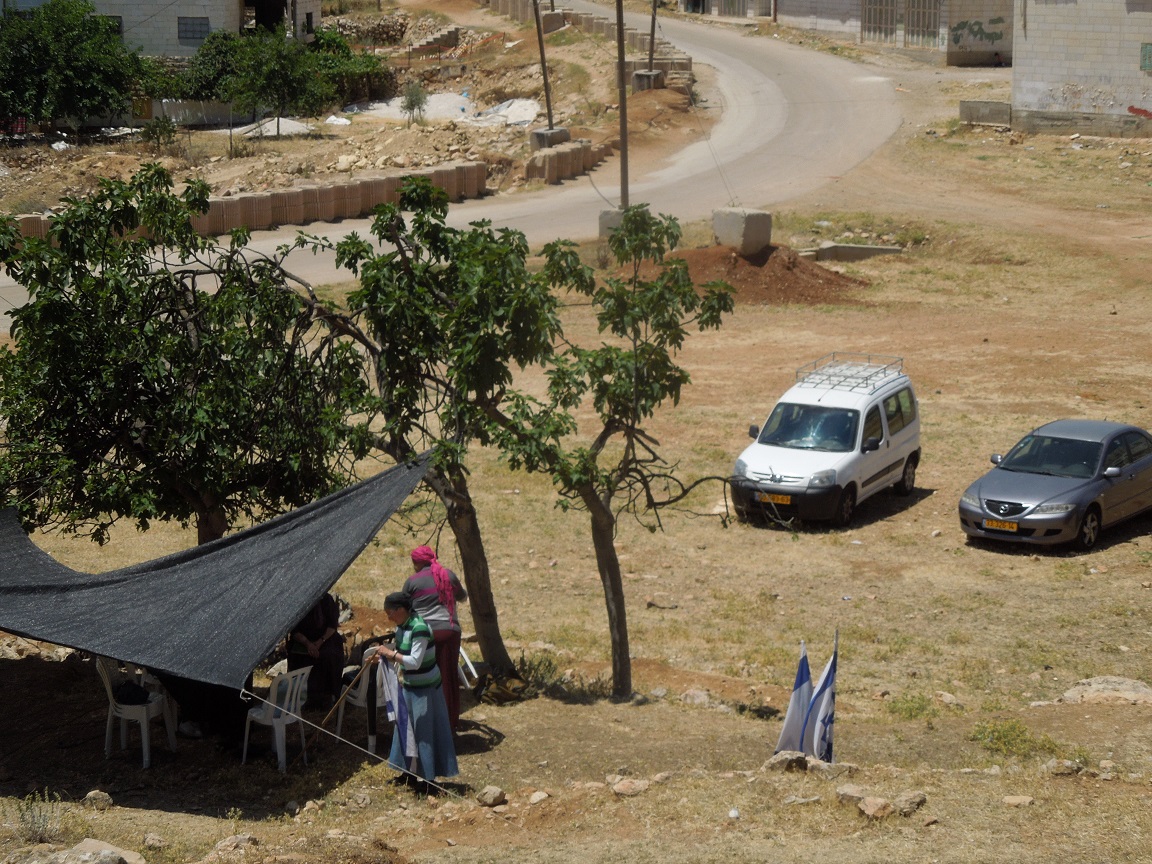
Settlers tent in the Palestinian olive groves (Photo by ISM)
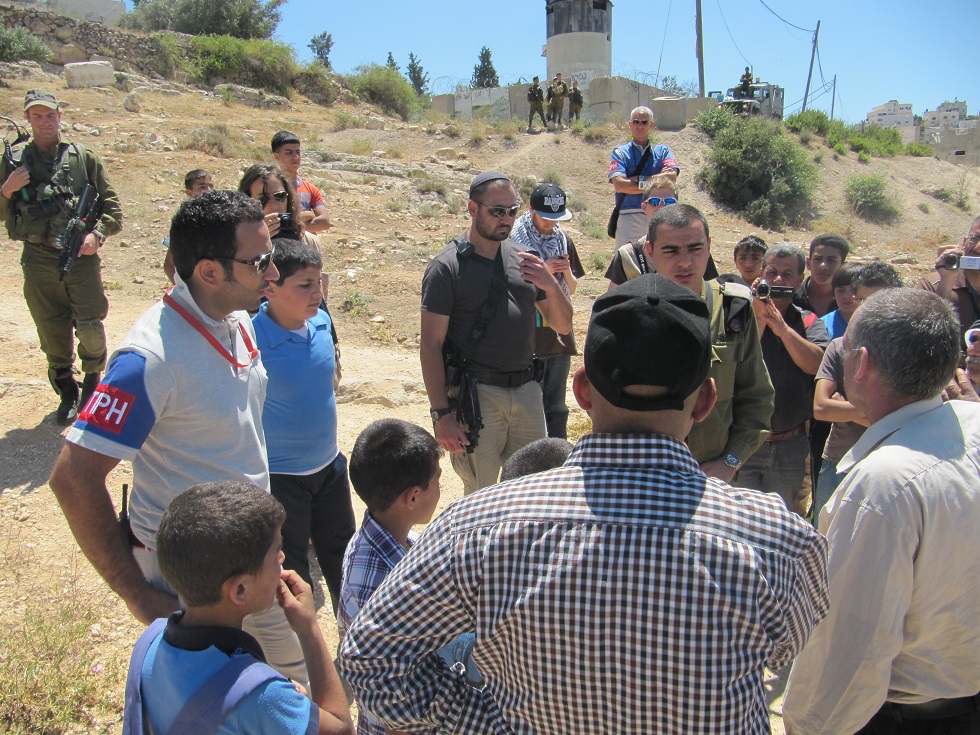
Israeli forces and Palestinian land owners arguing about the settlers tent (Photo by ISM)
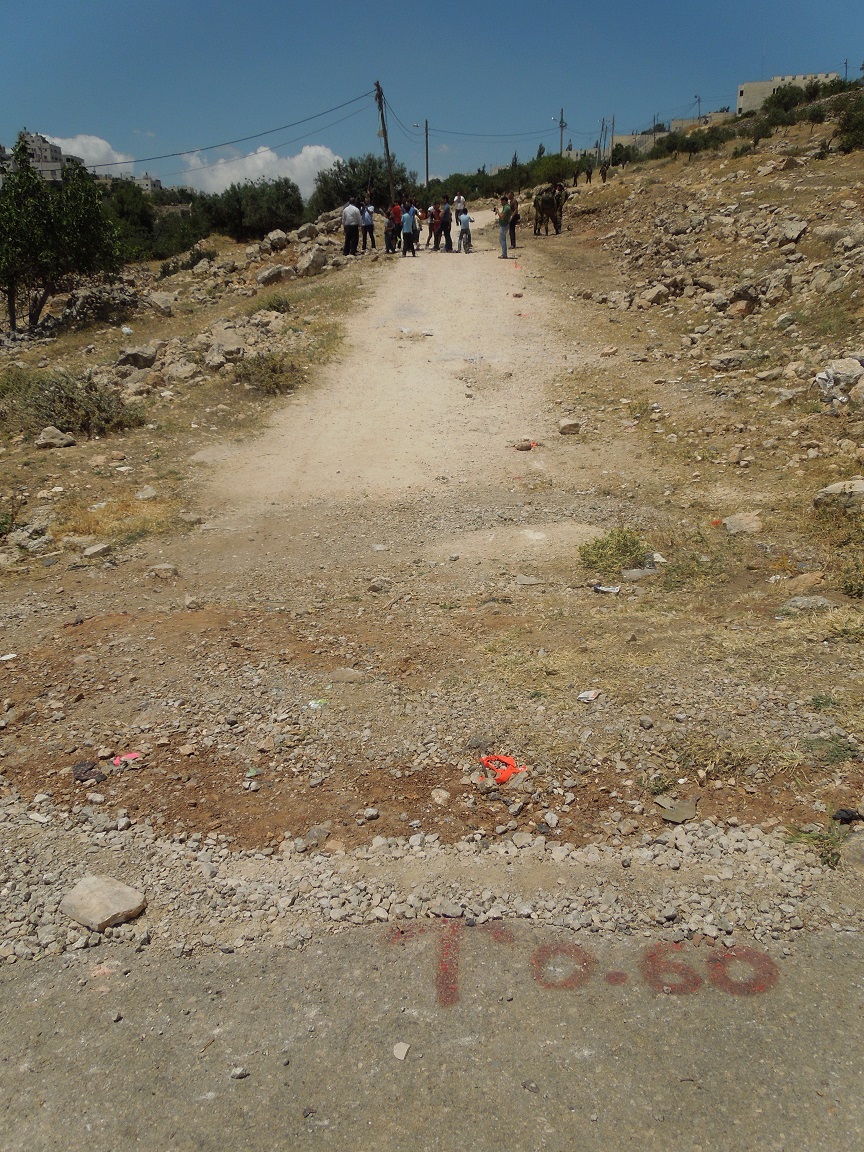
Road marker placed by settlers (Photo by ISM)
Related articles
- AL-KHALIL (HEBRON) REFLECTION: Trapping children (alethonews.wordpress.com)
- AL-KHALIL (HEBRON): New report documents the loss of childhood (alethonews.wordpress.com)
- Life in Hebron disrupted by another settler “tour” (palsolidarity.org)
- UPDATE: Woman arrested in Hebron is accused of stone throwing by a settler (palsolidarity.org)
- Another 7-year old girl injured in Jewish settler hit and run vehicular assault (alethonews.wordpress.com)
- Three Palestinian children arrested after attack by Jewish settler children – Swedish activist also arrested (alethonews.wordpress.com)
Another 7-year old girl injured in Jewish settler hit and run vehicular assault
IMEMC & Agencies | May 26, 2013
Sunday May 26 2013; Palestinian medical sources in Hebron, in the southern part of the occupied West Bank, have reported that a 7-year old child was injured after being rammed by a settler’s vehicle in the city.
The sources said that Bayan Kamel Shatat, 7, suffered moderate injuries and was moved to the Hebron governmental hospital.
Rateb Jabour, coordinator of the Popular Committee Against the Wall and Settlements in Hebron, said that the child is a first grade student, and that she was returning home from school. The settler fled the scene after the incident.
On Wednesday May 22, a 9-year-old child was seriously injured after being rammed by a settler’s car in the As-Salayma neighborhood, east of the Ibrahimi Mosque, in Hebron city.
On the same day, a 16-year-old child identified as Marwan Zakariyya ‘As’ous, suffered serious injuries and was moved to the Rafidia Hospital, after being rammed by a settler’s car at the Beta Junction, south of Nablus.
On May 14, Hanin Bassem Al-Ja’bary, 7, was injured after a settler rammed her with his vehicle close to the Ibrahimi Mosque, in the Old City of Hebron. The settler fled the scene.
There have been numerous similar incidents in Hebron and other parts of the West Bank, and despite repeated claims filed to the Israeli Police, no actual and effective measure were taken against the assailants.
Related articles
- Jewish settlers injure children in two separate vehicular assaults (alethonews.wordpress.com)
- Three Palestinian children arrested after attack by Jewish settler children – Swedish activist also arrested (alethonews.wordpress.com)
- Witnesses: Settlers open fire at Palestinian homes in Hebron village (altahrir.wordpress.com)
- Jewish terror state Kidnapped 28 Children In The first Half Of May, Dozens Injured (uprootedpalestinians.blogspot.com)
Featured Video

BRITAIN’S WARNING: PREPARE FOR WAR
or go to
Aletho News Archives – Video-Images
From the Archive
How Ukraine Tortured and Slaughtered Donbass
By Kit Klarenberg | Al Mayadeen | July 11, 2024
Almost immediately after the proxy war erupted, ISIS-tier footage of the torture and murder of Russians in Ukrainian custody emerged.
On July 6th, the New York Times published an astonishing investigation: In Ukraine, Killings of Surrendering Russians Divide an American-Led Unit. The article documents in grim detail how Chosen Company, an international volunteer battalion for Kiev, routinely executes Russian prisoners of war. It is the very first mainstream admission that this practice – a brazen breach of the Geneva Conventions, and a grave war crime – is widespread among Ukraine’s fighters, both foreign and homegrown. … continue
Blog Roll
 Aletho News
- Israel Demolishes Home Of Lebanese Journalist Whose Viral Film Exposed Pager Attack
- Record Oil, Empty Tanks: The UAE’s Miracle Recovery
- Burnham tackles Britain’s poverty with aggression in Yemen
- Peace in Ukraine: the easy way – or the hard way
- Trump & the Rrrrussians
- US taxpayer money laundered back through Ukraine – Musk
- Before COVID, an NIH lab chief proposed making a SARS-like bat virus more infectious
- Gates, Bourla on Trial in Netherlands Accused of ‘Great Reset’ Scheme at Vaccine Injury Hearing
- BRITAIN’S WARNING: PREPARE FOR WAR
- “Historic Russia”: The Land Putin Will Not Give Back
- If Americans Knew
- An error has occurred; the feed is probably down. Try again later.
- No Tricks Zone
- Two New Studies Find Thwaites Glacier Melt Cannot Be Driven By Human Activity Or A Warming Ocean
- E-Cars Reduce CO2 Emissions By Only 41% Compared To Internal Combustion Engine Vehicles
- Predictions Made By Renowned Climate Professor Over Past Decades Have Been Proven To Be Poor
- New Study Suggests Large Regions Of The Pacific Ocean Have Been Cooling For The Last 80 Years
- Germany’s Green Energy Debacle: High Energy Costs Force Kahla Porzellan to Close After 182 Years!
- New Study: 50 Years Of The Most Aggressive ‘Net Zero’ Policies Can Only Affect The Global Climate By 0.03°C
- US September “Heat” Was No Record…Many Records Set Decades Ago
- Latest European Green Energy Debacle; Portugal’s Largest Flagship Solar Park Insolvent!
- Green Energy Debacle: German Expert Professor Fritz Vahrenholt Warns Of Severe Economic And Social Consequences
- Two More Paleo Reconstructions Affirm Meters-Higher Sea Levels Across Ireland, Brazil 7000-6000 Years Ago

