Jewish settlers injure children in two separate vehicular assaults
By Saed Bannoura | IMEMC & Agencies | May 23, 2013
Palestinian medical sources have reported that two Palestinian children have been seriously injured, on Wednesday, in two separate incidents after being rammed by settlers’ vehicles in the West Bank districts of Hebron and Nablus.
The sources said that a 9-year-old child was seriously injured after being rammed by a settlers’ car east in As-Salayma neighborhood, east of the Ibrahimi Mosque, in Hebron city. She was moved to a local hospital; the settler fled the scene.
Furthermore, a 16-year-old Palestinian child, identified as Marwan Zakariyya ‘As’ous, suffered serious injuries and was moved to the Rafidia Hospital, after being rammed by a settler’s car at the Beta Junction, south of Nablus.
Usama Malhees, head of the Rafidia Hospital, stated that the ‘As’ous suffered various fractures and is currently on life support at the Intensive Care Unit.
On May 14, Hanin Bassem Al-Ja’bary, 7, was injured after a settler rammed her with his vehicle close to the Ibrahimi Mosque, in the Old City of Hebron. The settler fled the scene.
Dozens of claims have been filed with the Israeli police and the military in the occupied territories regarding hit and run ramming incidents carried out by Israeli settlers, but no actual measures were taken on the ground.
Related articles
- Three Palestinian children arrested after attack by Jewish settler children – Swedish activist also arrested (alethonews.wordpress.com)
- Settlers Attack Palestinian Property, Graves, Near Nablus (imemc.org)
- Jewish terror state Kidnapped 28 Children In The first Half Of May, Dozens Injured (uprootedpalestinians.blogspot.com)
- Settlers Attack, Injure A Palestinian Near Nablus (imemc.org)
- New road connects Israeli settlement with the Ibrahimi Mosque (ramyabdeljabbar.wordpress.com)
- Settlers Attack Schoolchildren Near Nablus – International Middle East Media Center (ramyabdeljabbar.wordpress.com)
Israeli forces open fire on Palestinians, injure 11
Al-Akhbar | May 18, 2013
Israeli troops shot and wounded nine Palestinians near the West Bank city of Ramallah on Friday night, and injured two others north of Hebron, security officials and medics said.
Palestinian security officials said that Palestinians from the Jalazoun refugee camp, near Ramallah, were hurling stones at Israeli motorists near an illegal Jewish settlement before coming under fire from soldiers.
They said that six of the injured were sent home after receiving first aid at a Palestinian hospital and three were kept in, although none of them was in life-threatening condition.
An army spokeswoman said that troops opened fire with 0.22 ammunition after tear gas and rubber bullets failed to disperse the crowd of about 50 people engaged in “a violent disturbance.”
Earlier in the day, troops fired tear gas at Palestinians demonstrating against the confiscation of land by Israel in the nearby village of Deir Jarir.
On Saturday the Israeli army used road blocks to shut the main road connecting Deir Jarir and other villages with Ramallah near the location of the attack, according to the head of the village council Imad Alawi.
Alawi told Wafa news agency that the road is the only direct passage to Ramallah for seven villages in the area. Its closure means Palestinians traveling to Ramallah must now take an extended route through the notorious Qalandia checkpoint.
It was unclear if the closure was directly linked to incidents on Friday.
And also on Friday, in al-Arrub refugee camp north of Hebron, Israeli forced shot two Palestinians with rubber-coated bullets, breaking the jaw of one man, and hitting the other in the hand, according to medics.
Luay al-Badawi was hit in the face with a plastic-coated bullet that broke his jaw, and then shot again in the head, Red Crescent official Nasser Qabaja told Ma’an news agency.
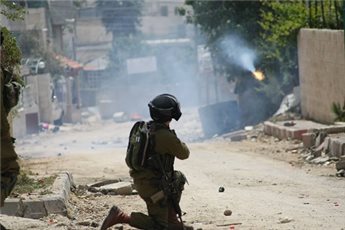 Badawi is in a critical condition in Al-Ahli Hospital in Hebron, Qabaja said.
Witnesses said a second man, who was not identified, was shot in the hand.
Locals said clashes erupted after Israeli forces stormed the camp. Residents confronted the soldiers and threw stones at them, and the soldiers fired tear gas and rubber coated-coated bullets.
An Israeli military spokeswoman said soldiers responded to a “violent riot in which Palestinians hurled rocks at Israeli security forces” with “riot dispersal means.”
She told Ma’an that forces used rubber bullets and that two Palestinians were injured.
(AFP, Wafa, Ma’an)
Related articles
- Jewish settlers attack West Bank village with Israeli army support (alethonews.wordpress.com)
- Live ammunition fired at Deir Jarir demonstration against land grab and settler violence (palsolidarity.org)
PALESTINE REFLECTION: A right to education
CPTnet | May 16, 2013
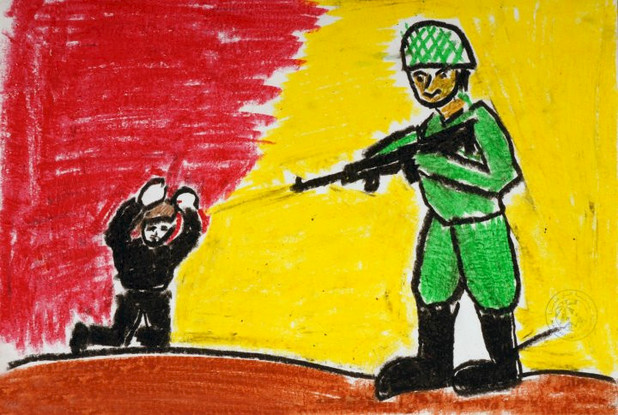 On May 12, we arrived at Al Fakheit School where we were met by “Al Jazeera” journalists filming a documentary about the difficulty that children face in getting to school in Occupied Palestine. They told us about one school near East Jerusalem where children have to pass through a sewer pipe to reach their school.
As we were describing similar difficulties faced by children in the South Hebron Hills, and the dangers of living in a live firing zone, the headmaster approached us looking crestfallen. He told us that soldiers had just stopped three teachers as they were driving to Jinba School and told them that the police would arrest them since they were not allowed to be in a closed military area. Police then came and took the teachers into a nearby illegal Israeli settlement and held them for two hours before release. They allowed two teachers to continue on to the school, but made one return home. The police had previously arrested him at a non-violent protest against the firing zone, and said he was not permitted to return to the area.
Children in Al Fakheit and Jinba face daily disruptions from the army, whose helicopters often hover over their schools. As we were playing football with the children in Jinba, they suddenly started shouting “jesh, jesh” (army, army) and we saw a large military jeep whiz through the village, passing very close to the school and houses. Within five minutes it was back again, speeding through the village, kicking up stones and dust. Children have got used to the military presence near their homes, but are still fearful of what might happen. Will the army stop and arrest someone? Will they come to demolish something? On our way home, we stopped in the village of Mirkez. An old lady invited us in for tea. She told us that a few days ago, while a 14-year-old boy was herding his flock, the army took him into a nearby settlement but later released him.
Imagine the insecurity of living in an area where soldiers or police could pick you up any day for no reason. The people living in this area also face threats and acts of violence from settlers. A few days before our visit, settlers damaged 60 thirty-year-old olive trees. The olive tree is a symbol of peace. Villagers in the South Hebron Hills are committed to non-violent resistance. I am inspired by their continued strength and struggle. They face so many obstacles just trying to do things that people I know take for granted, like getting an education and grazing their sheep on their own land. Who knows how the daily intimidation and fear will affect these children in the future? I hope and pray that when they are ready to bring up children themselves, the occupation will have ended, and they will be able to go to school and herd their flocks free of fear.
~
Please sign this petition to tell Israel that this behavior must stop.
Related articles
- “Nothing forbidden for them, but nothing allowed for us” (alethonews.wordpress.com)
- ‘Price tag’ attack in South Hebron Hills (palsolidarity.org)
“Nothing forbidden for them, but nothing allowed for us”
International Solidarity Movement | May 14, 2013
Qaryut, Occupied Palestine – Settlers from the illegal colony of Shilo set fire to land belonging to the nearby village of Qaryut. Around 25 families own land in this area. The land contained wheat crops and olive trees and is next to land previously stolen by settlers, which they had been cultivating for themselves only two days before.
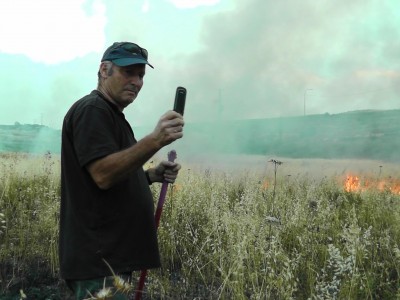
Illegal Shilo settler Moshka takes pictures of his handiwork, torching Palestinian land (Photo by Qaryut villagers)
Red Crescent paramedics went to the scene of the fires at around 6pm, where many villagers had already arrived hoping to put out the fires. However they were prevented from doing so by four settlers and half a dozen soldiers who had turned up to protect the settlers. Villagers were made to stand and watch their future harvest go up in flames. With the fires building up they had nothing to do but argue in vain with the soldiers about the gross immorality of the situation.
The settlers present also prevented the fire from spreading on to the annexed land they have been cultivating. It was clear to see the fires had been deliberately lit as there were many separate fires in a close range, rather than one large fire spreading on the overcast and wet day. Villagers witnessed Moshka, one of the settlers – (who is a regular problem causer; his son is a patrolman for the settlement too) – use a lighter to set fire to their land. The fire was only put out by the arrival of heavy and atypical rain from a thunderstorm an hour later.
Two days prior to this attack the settlers had started ploughing stolen land and cut down four trees. They have been expanding the settlement on the Palestinian side of the highway to Ramallah and Jerusalem. Fifteen dunams of land was torched. Meanwhile two dunums of wheatfields had been burnt in the South Hebron Hills earlier that day.
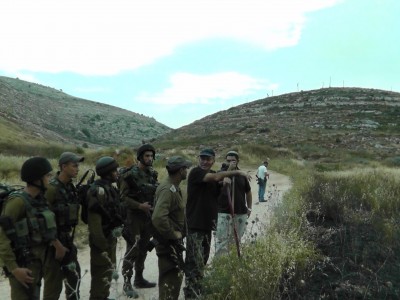
A familiar sight, soldiers and settlers working together (Photo by Qaryut villagers)
Related articles
- Tree planting met by tear gas and settlers’ death threats (palsolidarity.org)
- Witnesses: Settlers open fire at Palestinian homes in Hebron village (altahrir.wordpress.com)
- Settlers Attack Palestinian Property, Graves, Near Nablus (imemc.org)
Israel approves nearly 300 new settlements to coincide with Kerry-Livni meeting
MEMO | May 9, 2013
As Israeli justice minister, Tzipi Livni, met with US Secretary of State John Kerry in Rome on Wednesday, the Israel Civil Administration approved a plan to build 296 housing units in the West Bank settlement of Beit El; an Israeli newspaper reported.
 The newspaper, Yedioth Ahronoth, today described the decision as “A move which could be interpreted as an attempt to Judaize the West Bank.”
Israeli Defence Minister Moshe Ya’alon approved the construction of the new housing units in line with a promise the government had made to settlers. A previous Israeli government had promised to build 90 new housing units in the settlements in an attempt to prevent clashes during the eviction of the Ulpana settlement.
Israeli Prime Minister Benjamin Netanyahu had previously made undertakings to stop further settlement construction until next June when he met with Kerry, angering heads of settler groups.
According to the newspaper, Ya’alon met with heads of Jewish settlers on Tuesday and told them that construction would indeed continue. Netanyahu confirmed that there were delays in issuing construction bids due to errors, but that they would be issued soon.
Settlers hoped that the approval of new housing units would mean the beginning of further settlement plans in the West Bank and Jerusalem.
In Rome, Livni hoped that “enthusiastic and determined” Kerry would move the peace process forward after four years of stalemate.
“We believe that re-launching the negotiations and achieving an agreement between Israel and the Palestinians is in the Israeli interest, but yet there is a need for Secretary John Kerry’s efforts to create something new after four years of stagnation,” Livni said.
Kerry has been holding talks with Israeli, Palestinian and other Arab officials for months. The Israeli newspaper said that he is expected to meet Netanyahu and Abbas separately later in May.
The US Secretary of State said, “I think it is fair to say that we are working through threshold questions and we are doing it with a seriousness of purpose, which I think Minister Livni would agree with, has not been present for a while.”
Stressing the importance of achieving something as soon as possible Livni said, “We all believe that we are working with a short time span. We understand the imperative to try to have some sense of direction as rapidly as we can.”
Kerry has been mobilizing Arab support for Palestinian president Mahmoud Abbas in case he is obliged to offer concessions to Israelis in order to reach a peace deal. Kerry also hopes to set up foundations for a wider peace with the Arab states.
Recently, he achieved a diplomatic victory when the Arab league delegation in Washington announced an agreement to accept that a land swap deal could be reached between Palestinians and Israelis based on the 1967 borders.
Jewish settlers attack West Bank village with Israeli army support
Al-Akhbar | May 5, 2013
Jewish settlers raided a West Bank village near Ramallah on Saturday night, attacking several houses and prompting clashes between residents and Israeli forces, Ma’an news agency reported.
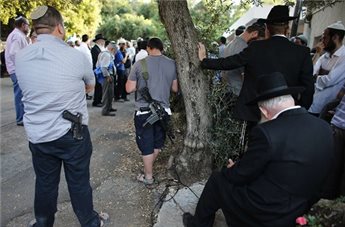 Israeli forces were standing guard as hundreds of settlers stormed the village of Ras Karkar, reportedly barring ambulances from entering the village before allowing an ambulance to take only two people to the hospital.
Eight residents of Ras Karkar were wounded as Israeli troops fired tear gas and rubber bullets at them. Live bullets were also fired into the air to scare the residents and prevent them from defending their property.
Rubber-coated bullets hit one Palestinian in the eye, one in the head and another in the chest. Four others sustained bruises and fractures from the attack by settlers and Israeli troops, locals said.
According to local sources, three houses in Ras Karkar were attacked and set on fire, as well as a number of olive trees.
One settler was wounded after being hit by a stone.
Settlers were also gearing up to attack another village near Ramallah on Sunday, Ma’an reported.
According to a witness, dozens of settlers were being escorted by Israeli troops and police officers near the village of al-Janiya in northwest Ramallah.
Residents of al-Janiya were trying to close the road to the village with rocks, only to be met with stun grenades and tear gas. Activists used the village mosque’s loudspeakers to urge residents to defend their village.
Settlers routinely attack Palestinians and their property in the occupied West Bank, as Israeli forces regularly turn a blind eye or even assist settler crimes.
According to figures compiled by Israeli group Yesh Din, nine out of 10 police investigations about settler crimes fail to lead to a prosecution.
(Ma’an, Al-Akhbar, Photo Credit – Ma’an)
Palestinian stabs West Bank settler
Al-Akhbar | April 30, 2013
A Palestinian man stabbed dead an Israeli settler in the occupied West Bank on Tuesday, the Israeli ambulance service and police said, in what may have been a response to a violent settler attack on a nearby village one day earlier that left two elderly Palestinians hospitalized.
“The Palestinian suspect stabbed an Israeli sitting at a bus stop. He died,” police spokeswoman Luba Samri told AFP, adding that the incident took place near a major junction which lies south of the city of Nablus.
It was the first time an Israeli has been killed by a Palestinian in the West Bank since 2011.
Israeli media said the attacker was standing at a bus stop used by settlers, Israeli soldiers and Palestinians when he stabbed the Israeli, a man in his 20’s.
The suspect then seized a gun carried by the settler. He began shooting at security services who arrived on the scene, Israeli police spokesman Mickey Rosenfeld said, adding that the man was in custody.
The Palestinian, a resident of the northern town of Tulkarem, was injured and admitted to an Israeli hospital.
The incident may have been motivated by a settler attack Monday in Nablus that left two elderly Palestinian men with severe head injuries.
Ghassan Daghlas, who monitors settlement activity in the northern West Bank, told Ma’an that three settlers from the Itamar outpost raided Beit Furik and attacked residents with “sharp tools.”
Fawzi Nasasra, 60, and Abdul Rahman Khatatba, 50, were taken to hospital to be treated.
Settler attacks against Palestinians and their property is routine in the occupied West Bank and rarely punished by Israeli authorities.
Annual figures compiled by Israeli rights group Yesh Din have repeatedly shown that nine out of 10 police investigations about settler crimes fail to lead to a prosecution.
The Israeli internal security service, Shin Beit, has said that during 2012 no Israelis were killed in the West Bank. In March 2011 two settlers and three of their young children were stabbed to death in their home.
Nine Palestinians have been killed by Israeli forces in the West Bank since the beginning of the year in various attacks, mainly in clashes that have risen sharply in recent months.
According to B’Tselem, an Israeli Information Center, an estimated 520,456 settlers live in illegal settlements in the West Bank and East Jerusalem.
There are over 121 settlements and around 100 “settlement outposts.” There are around 12 settlements in Jerusalem in areas annexed from Palestinian neighborhoods. Settlements in the West Bank are connected by Jewish-only highways.
Israel has come under widespread international criticism for ramping up its construction of settlements in the Palestinian territories, notably in occupied east Jerusalem.
All Israeli settlements on Palestinian land beyond the so-called 1949 Green Line are considered illegal under international law.
(Reuters, AFP, Al-Akhbar, Ma’an)
Related articles
- Settlers plant trees in Palestinian fields near Nablus (altahrir.wordpress.com)
- Israel demolishes West Bank homes, water wells (alethonews.wordpress.com)
Palestinian monastery loses court battle over apartheid wall

Al-Akhbar | April 26, 2013
A Catholic monastery and convent in a secluded valley outside Bethlehem lost a seven-year legal battle against the building of Israel’s apartheid wall on its land on Friday, according to its lawyers.
The Society of Saint Yves, a Catholic human rights group which argued the case on the monastery’s behalf, said an Israeli appeals court had endorsed a plan to expand the barrier it had built in the area.
The apartheid wall would surround the convent on three sides and cut it off from most of its land, Saint Yves said in a statement.
Salesian monks and nuns tend lush vineyards and olive trees on terraced hillsides under the gaze of Israeli settlements there. A convent school teaches 400 local children.
Israel started building the barrier, a mix of metal fencing, barbed wire and concrete walls, in 2002. It claims the apartheid barrier keeps its citizens safe from militants.
Saint Yves said “that the plan would violate international law and conventions protecting religious minorities and the right to education and freedom of religion”, said Anica Heinlein, its advocacy officer.
Around 50,000 Palestinian Christians, including 17,000 Catholics, live among 4 million Muslims in the Israeli-occupied West Bank and in Gaza.
They say Israel’s checkpoints and apartheid barrier cut them off from their neighbors and holy places in Jerusalem.
Some 90 percent of Palestinian Christians live in a 20-km stretch from Ramallah and East Jerusalem to Bethlehem – an area locked in a labyrinth of Jewish settlements, Israeli-only roads and a drab concrete walls.
Built mostly within occupied land and not on the “Green Line”, which was the de facto border before the 1967 War, the apartheid barrier inside the West Bank is deemed illegal by the UN’s International Court of Justice.
The Palestinian Authority says the Christian population in the West Bank has shrunk over the last three decades due to emigration, but it lacks accurate figures.
“The occupation hurts Christians and Muslims both, but affects the Christian community more because it’s a smaller percentage of the population,” said Xavier Abu Eid, a diplomat in the Palestine Liberation Organization (PLO).
“This is a matter of their survival, as this is one of the last pieces of land the community owns,” he said.
Israeli President Shimon Peres will meet the newly elected pope next week during a visit to Italy.
The two men are due to discuss ties between Israel and the Vatican and improving relations between Christians and Jews. It was not immediately clear if the new pontiff would raise the issue of the monastery.
(Reuters, Al-Akhbar)
Death threats issued to UN Human Rights defender, Issa Amro
International Solidarity Movement | April 18, 2013
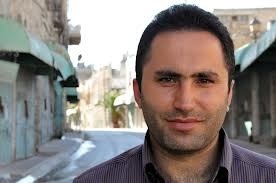 Hebron, Occupied Palestine – There are growing concerns for the safety of non-violent Palestinian activist and organiser Issa Amro, following a recent letter to Israeli security forces from Israeli settlers of Hebron, accusing Amro of terrorism and incitement, and warning that a failure of the Israeli authorities to remove him “could be costly”, and threatening “bloodshed”. This is the latest in a long line of threats and attacks against UN human rights award winner Amro.
In the letter, the mayor of the Jewish “Hebron Municipal Council” and the director general of the “Hebron Jewish Community” insist that army commanders “use administrative detention until you are able to find a long-term solution to completely end this hostile and dangerous activity” referring to Amro’s extensive work with various human rights groups. The full letter can be read here.
Amro has been violently attacked by this same community of Israeli settlers many times in the past – his nose and wrist have been broken and he received five stitches to his head. He and his family regularly receive death threats from the settlers of Hebron over the phone, continuing their campaign of threats and violence against him.
Despite having received numerous death threats and abuse from settlers over a period of many years, Amro is particularly concerned about the letter of the 20th March, because of the status and influence of its authors. Various Zionist websites have since issued calls for his execution, publishing various pictures of his face marked by red circles. Despite Amro’s long dedication to non-violent principles he is constantly identified as a terrorist by these websites.
You can see examples of this here :
1. http://rotter.net/forum/gil/26497.shtml
2.http://rotter.net/forum/gil/18247.shtml
3.http://www.youtube.com/watch?v=QerqKiWwUwM
4.http://www.kr8.co.il/BRPortal/br/P102.jsp?arc=408240
5.http://www.kr8.co.il/BRPortal/br/P102.jsp?arc=562306&order=down
6.https://www.facebook.com/hebron.machpela/posts/385071061601175
Amro states “I have been arrested and detained on too many occasions to count, but I have never been charged with anything.” He says that he is regularly abducted by soldiers from his home, blindfolded and driven around for several hours before being left back at his house. On other occasions, he has been beaten by soldiers who have threatened to kill him and his family. During his most recent arrest in March 2013, Amro was stripped naked and made to stand outside for three hours.
On the 27th of March 2013 there was an arson attempt against the Youth Against Settlements community centre in Tel Rumeida – Amro was verbally abused and humiliated by police officers when he attempted to file a complaint and was ejected from their office twice before the complaint was filed. There has yet to be any investigation by the police.
Background
Issa Amro has been involved in founding many non-violent organisations in Hebron, working peacefully against the occupation. This includes the Hebron branch of the International Solidarity Movement (ISM), the Arab Non-Violence Network, Youth Against Settlements and the Hebron Defenders. He won the One World media award in 2009 for his involvement B’tselem’s “Shooting Back” project, which provides media training and distributes cameras to Palestinians to document settler and military abuse for Palestinians. Amro’s work with these organisations, as well as numerous other projects intending to document and non-violently resist human rights abuses and expansion of illegal Israeli settlements led to his winning of the UN OHCHR ‘Human Rights Defender of the Year in Palestine’ award in 2010.
Related articles
- Zionists attempt to intimidate International Solidarity Movement (alethonews.wordpress.com)
- Journalists detained in Hebron, leading to two arrests and threats to restrict Palestinian movement (alethonews.wordpress.com)
Obama’s Peace Antics in Israel – Four More Years of This?
By Ramzy Baroud | Palestine Chronicle | March 26, 2013
At the precise moment US President Barack Obama’s Air Force One touched down at Ben Gurion Airport on March 20, persisting illusions quickly began to shatter. And as he walked on the red carpet, showered with accolades and warm embraces of top Israeli government and military officials, a new/old reality began to sink in: Obama was no different than his predecessors. He never had been.
On the day of Obama’s arrival, Israeli rights group B’Tselem, released a disturbing video. It was of Israeli soldiers carrying out a ‘mass arrest’ of nearly 30 Palestinian children on their way to school in the Palestinian city of al-Khalil (Hebron). The children plead and cried to no avail. Their terrified shrieks echoed throughout the Palestinian neighborhood as they tried to summon the help of passersby. “‘Amo’ – Uncle,” one begged, “for God sake don’t let them take me.” Nonetheless, several military vehicles were filled with crying children and their school bags. But what made the release of the video truly apt is the fact that it was released on the day president Obama was meeting Israeli children at a welcoming ceremony at the home of Israeli President Shimon Peres.
“Their dreams are much the same as children everywhere,” he said, referring to Israeli children, of course. “In another sense though their lives reflect the difficult reality that Israelis face every single day. They want to be safe, they want to be free from rockets that hit their homes or their schools.”
Many Palestinians immediately pointed out the moral discrepancies in most of Obama’s statements throughout his stay in Israel. Still, his visit was ‘historic’ declared numerous headlines in the US and Israeli media.
However, aside from the fact that it was his first trip to Israel as a president, it was barely momentous. His unconditional support for Israel has been tedious and redundant, predictable even. Those who have followed his unswerving pro-Israel legacy – including his visit to Israel as a presidential candidate in 2008, his talks before the Israeli lobby group AIPAC and many other examples – could barely discern a shift, except perhaps, in the total disinterest in political sensibility and balance.
He truly delivered in Israel. This was to the total satisfaction of the Israeli Prime Minister and his pro-settler government which was assembled shortly before Obama’s arrival. Obama spoke as if he were entirely oblivious to the political shift to the extreme right underway in Israel. Indeed, the new Israeli government is more right-wing than ever before. The extremist Jewish Home party has three important ministries, including Jerusalem and Housing and the ultra-nationalists of Yisraeli Beiteinu have been awarded the tourism ministry. It means that the next few years will be a settlement construction bonanza, ‘ethnic cleaning’ and greater Apartheid.
“It’s good to be back in The Land (Israel),” Obama said in Hebrew, at the Tel Aviv airport. “The United States is proud to stand with you as your strongest ally and your greatest friend.”
It is believed that for four years, Obama has failed to live up to the nearly impossible expectations of Israel. Israel requires a president with good oratory skills – for example, to emphasize the ‘eternal’ bond between his country and Israel, as Obama did – who is able to sign big checks and ask few questions. Obama has of course done that and more. Aside from the 3.1 billion dollars in financial support, he has rerouted hundreds of millions of US funds to bankroll Israel’s air defense system, the Iron Dome, whose efficiency is questionable at best.
Obama’s past transgression, as far as Israel is concerned, is that he dared ask the right-wing government of Netanyahu to temporarily freeze settlement construction as a pre-condition to restart the stalled – if not dead – peace process. Of course, there is the widely reported matter of Obama’s lack of fondness of Netanyahu, his antics and renowned arrogance. But that matters little, since Israel’s illegal settlements continued to thrive during Obama’s first term in office.
Expectedly, Netanyahu was gloating. He has managed to assemble a government that will cater mostly to extremist Jewish settlers in the West Bank and also masterfully managed to humble the US president, or at least quash his ambitions that the US is capable of operating independently in the Middle East, without Israeli consent or interests in mind.
Now that Jewish colonies are flourishing – with occupied East Jerusalem area EI being another major exploit – Netanyahu is once more aspiring for a war against Iran, one that would not be possible without US funding, support and likely direct involvement. “Thank you for standing by Israel at this time of historic change in the Middle East,” Netanyahu said while standing near the mostly US-funded Iron Dome. “Thank you for unequivocally affirming Israel’s sovereign right to defend itself, by itself against any threat.”
Obama did in fact spare a few, although, spurious thoughts for Palestinians. “Put yourself in their shoes — look at the world through their eyes,” he said to an Israeli audience. “It is not fair that a Palestinian child cannot grow up in a state of her own, and lives with the presence of a foreign army that controls the movements of her parents every single day.”
One would even applaud the seeming moral fortitude if it were not for the pesky matter that the US had voted against a Palestinian state at the United Nations last November and tried to intimidate those who did. And of course, much of the horror that Palestinian ‘eyes’ have seen throughout the years was funded and defended by US money and action. If Obama is trying to resurrect the myth that the US is a well-intentioned bystander or an ‘honest broker’ in some distant conflict, then he has utterly failed. His country is fully embroiled in the conflict, and directly so. Many Palestinian children would still be alive today if the US government had conditioned its massive support of Israel on ending the occupation and ceasing the brutality against Palestinians.
In a joint press conference in Ramallah, alongside Palestinian Authority President Mahmoud Abbas, Obama even demanded Palestinians drop their condition (proposed by Obama himself) of a settlement freeze in order to return to the so-called peace talks. “That’s not to say settlements aren’t important, that’s to say if we resolve the (main) problems, then settlements will be resolved,” he said. “If to begin the conversation we have to get everything right from the outset … then we’re never going to get to the broader issue,” Obama added. The broader issue, according to the US president is “how do you structure a state of Palestine,” which again, Obama voted against last year, and passionately so.
Aside from resounding rhetoric about peace, Obama is finally towing the Israeli line exactly as Netanyahu and the lobby would expect of him, or of any other US president. He has little to offer Palestinians, or Arab nations, but much to expect from them. Arab states must seek normalized relations with Israel, and Palestinians must “recognize that Israel will be a Jewish state, and that Israelis have the right to insist upon their security,” he lectured in Jerusalem on the second day of his trip, reported CNN online. The obvious danger here lies in the fact that Israel oftentimes conflates ‘security’ and its ‘right to defend itself’ by mass arresting children on their way to school in Hebron, or by inflicting or supporting wars against other nations – Lebanon, Iraq and now Iran.
Obama will eventually get back to his Oval Office desk, ready to resume work as usual. This will include the signing of many papers concerning additional funds, loans, military technology transfers and much more for Israel. Palestinians meanwhile will carry on with their long fight for freedom, without his noted oratory skills.
Meanwhile, the families of the 30 children kidnapped by the Israeli army in Hebron will have many days ahead of them in Israeli military court. But that, of course, is a different matter, of no concern to Obama and his many quotable peace antics.
– Ramzy Baroud (www.ramzybaroud.net) is an internationally-syndicated columnist and the editor of PalestineChronicle.com. His latest book is: My Father was A Freedom Fighter: Gaza’s Untold Story.
Related article
- Obama Gives Up on Peace (nationalinterest.org)
Journalists detained in Hebron, leading to two arrests and threats to restrict Palestinian movement
International Solidarity Movement | March 24, 2013
Hebron, Occupied Palestine – In the afternoon of the 24th March, two Palestinian Al Jazeera journalists arrived into Hebron to interview a Palestinian family living near the illegal Israeli settlement in the area of Tel Rumeida. When they arrived, settlers called the Israeli military and police, who arrived and confiscated the journalists’ ID cards, despite having seen their press credentials. The Al Jazeera reporters had their ID cards returned after around an hour, but two Hebron Palestinians who attempted to intervene on their behalf with police were arrested and removed in a police car. Their status is currently unknown and no reason was given for their arrest.
After the journalists were apprehended, police and settlers arrived into the area with rolls of barbed wire, informing another Palestinian resident that his primary access to the main road would be closed. Hashem Azzeh and his family live underneath the Tel Rumeida settlement, with their access to the main road running directly next to the settlement. This path has been repeatedly closed by the Israeli authorities since 2000, and was only opened most recently in late 2012 after extensive legal battles in the Israeli courts.
The police and settlers claimed today that the path would be closed because unapproved people had been walking along it. According to the Israeli authorities, only Hashem, his family and guests walking with them have permission to use the path. Hashem states that he has no knowledge of strangers using this route to access his house.
Without the path, Hashem and his family have to travel a much longer, rock-strewn and hazardous route to leave their home. Hashem said today, “I think they will close my access now, they will say it is for security reasons.” He thinks that the settlers used the arrival of the journalists and the subsequent confusion as a pretext to close his path and restrict his family’s movement, in further attempts to drive them from their home – they already face regular hassle from Israeli authorities and attacks from the settlers, including on Hashem’s young children.
Related articles
- 9 Year old Palestinian boy attacked by settlers (alethonews.wordpress.com)
- Stranded in Shuhada: Hebron’s Qurtuba school (alethonews.wordpress.com)
Featured Video
BRITAIN’S WARNING: PREPARE FOR WAR
or go to
Aletho News Archives – Video-Images
From the Archive
How Ukraine Tortured and Slaughtered Donbass
By Kit Klarenberg | Al Mayadeen | July 11, 2024
Almost immediately after the proxy war erupted, ISIS-tier footage of the torture and murder of Russians in Ukrainian custody emerged.
On July 6th, the New York Times published an astonishing investigation: In Ukraine, Killings of Surrendering Russians Divide an American-Led Unit. The article documents in grim detail how Chosen Company, an international volunteer battalion for Kiev, routinely executes Russian prisoners of war. It is the very first mainstream admission that this practice – a brazen breach of the Geneva Conventions, and a grave war crime – is widespread among Ukraine’s fighters, both foreign and homegrown. … continue
Blog Roll
 Aletho News
- Israel Demolishes Home Of Lebanese Journalist Whose Viral Film Exposed Pager Attack
- Record Oil, Empty Tanks: The UAE’s Miracle Recovery
- Burnham tackles Britain’s poverty with aggression in Yemen
- Peace in Ukraine: the easy way – or the hard way
- Trump & the Rrrrussians
- US taxpayer money laundered back through Ukraine – Musk
- Before COVID, an NIH lab chief proposed making a SARS-like bat virus more infectious
- Gates, Bourla on Trial in Netherlands Accused of ‘Great Reset’ Scheme at Vaccine Injury Hearing
- BRITAIN’S WARNING: PREPARE FOR WAR
- “Historic Russia”: The Land Putin Will Not Give Back
- If Americans Knew
- DAILY UPDATE: Latest essential news on Palestine, Israel, & region
- Damning report shows the media must confront its failures on Gaza
- BBC senior broadcaster speaks out on Gaza coverage
- Netanyahu vows vast West Bank invasion in response to 20-minute skirmish that left 2 Israeli soldiers and 2 Palestinian fighters dead
- Tied up and tortured: Israel using US-made electroshock weapons on Palestinian detainees
- The outsourced risk: how newsrooms rely on Gaza’s freelancers without protecting them
- Gaza bakeries forced to shut as Israel blocks flour shipments
- Gaza’s breast cancer patients face a deadly wait for treatment amid Israel’s genocide
- DAILY UPDATE: Latest essential news on Palestine, Israel, & region
- The Israel Lobby’s Changing Fortunes
- No Tricks Zone
- Two New Studies Find Thwaites Glacier Melt Cannot Be Driven By Human Activity Or A Warming Ocean
- E-Cars Reduce CO2 Emissions By Only 41% Compared To Internal Combustion Engine Vehicles
- Predictions Made By Renowned Climate Professor Over Past Decades Have Been Proven To Be Poor
- New Study Suggests Large Regions Of The Pacific Ocean Have Been Cooling For The Last 80 Years
- Germany’s Green Energy Debacle: High Energy Costs Force Kahla Porzellan to Close After 182 Years!
- New Study: 50 Years Of The Most Aggressive ‘Net Zero’ Policies Can Only Affect The Global Climate By 0.03°C
- US September “Heat” Was No Record…Many Records Set Decades Ago
- Latest European Green Energy Debacle; Portugal’s Largest Flagship Solar Park Insolvent!
- Green Energy Debacle: German Expert Professor Fritz Vahrenholt Warns Of Severe Economic And Social Consequences
- Two More Paleo Reconstructions Affirm Meters-Higher Sea Levels Across Ireland, Brazil 7000-6000 Years Ago

