Iran denies responsibility for ‘depraved’ attack on Kuwait desalination plant
The Cradle | March 30, 2026
The Iranian military denied on 30 March the recent attack, which hit a desalination plant in Kuwait, labeling the strike a US-Israeli false-flag operation aimed at “destabilizing and destroying the region.”
“The brutal aggression by the Zionist regime against the desalination facility in Kuwait, carried out in recent hours under the pretext of accusing the Islamic Republic of Iran, is a sign of the vileness and depravity of the Zionist occupiers,” the Khatam al-Anbiya Central Headquarters of the Iranian army said in a statement.
“We declare that US bases, personnel, and their interests in the region, as well as the military, security, and economic infrastructure of the Zionist regime in the occupied Palestinian territories, remain powerful targets for us,” it added.
The Iranian military went on to urge “countries of West Asia must remain vigilant against the sedition of the US–Zionist axis aimed at destabilizing and destroying the region.”
Regional states “must put an end to the presence of the criminal US army and occupying Zionists in the region,” it stressed.
The attack on the desalination plant took place on Sunday.
“A service building at a power and water desalination plant was attacked as part of the Iranian aggression against the State of Kuwait, resulting in the death of an Indian worker and significant material damage to the building,” said a spokesperson for the Kuwaiti Electricity Ministry.
This is not the first attack Tehran has labeled a false flag.
Iran has also denied recent strikes on fuel tankers in Oman and a refinery in Iraq’s Erbil, as well as one that targeted an Aramco facility in Saudi Arabia at the start of the month.
US journalist Tucker Carlson reported earlier in March that Mossad agents were detained in Gulf states for planning bombings.
Iran’s Foreign Minister Abbas Araghchi said on 15 March that the US has been using its new Lucas drone – modeled after the Iranian Shahed – to carry out false-flag attacks in the region and attribute them to the Islamic Republic.
Tehran has said only US and Israeli-linked military and economic assets in the Gulf will be struck by its forces.
Iran is warning Gulf governments against allowing Washington to use their bases for attacks on the Islamic Republic.
Iranian drone and missile strikes targeted the Prince Sultan Air Base in Saudi Arabia on 27 March, wounding at least 12 US troops and damaging aircraft and buildings.
A senior Iranian intelligence official told The Cradle on 26 March that the Islamic Republic is preparing a “strong response” against the UAE due to the “active role” it has played in the US-Israeli war on it.
“A decision has been made at the leadership level to end the weeks-long tolerance toward this country. In addition to US military barracks and bases in the UAE, which were targeted in Iran’s defensive attacks, the Emiratis also provided some of their own air bases to the US to be used in attacking Iran,” the intelligence officials went on to say, citing security reports.
“The UAE is considered a foothold for Israel in the region,” the source continued, adding that Abu Dhabi has “carried out misleading operations against Oman and other countries” – likely a reference to false-flag operations pinned on Iran.
Israel’s Iran Strategy Uses US Military & Gulf States as Its Pawns
By Robert Inlakesh | Palestine Chronicle | March 29, 2026
While most honest analysts will conclude that the decision made by the White House came as a result of pressure from the Israelis or that this is a war that is being fought for Tel Aviv’s interests, many fail to see any clear strategy at play.
In order to understand the strategy behind the US-Israeli assault on the Islamic Republic, you must first remove the notion that the United States is in the driving seat to any significant extent.
Almost immediately after the 12-Day War in June of 2025, the Israeli leadership was already preparing for the next round. On July 7, Axios News even reported that officials in Tel Aviv believed that US President Trump would give them another green light to attack.
Meanwhile, the most influential Zionist think tanks in Washington DC, the likes of the Washington Institute for Near East Policy (WINEP) and the Foundation for Defense of Democracies (FDD), were openly discussing the necessity of a new round of confrontations.
These think tanks facilitated discussions and published pieces in which they made it clear that while the next round was inevitable, it had to be the last round, and that the US’s involvement would be important in deciding outcomes.
Understanding the Israeli Strategy
It is no coincidence that senior Israeli officials, all the way from Israeli Prime Minister Benjamin Netanyahu to opposition leader Yair Lapid, have all recently publicly endorsed the “Greater Israel Project”.
This is not simply posturing, this is their goal. But how does this fit into the Iran war? Well, it will begin to make sense when the context is all provided.
Firstly, the Greater Israel Project’s strategy is grounded in an academic article published by a former Israeli intelligence officer and journalist, Oded Yinon. The plan did not advocate for the physical expansion of the Israeli State’s borders over every nation between the Euphrates River and the River Nile, but instead opted for an approach that would transform Israel into a regional empire.
In order to achieve this goal of a “Greater Israel”, it would first necessitate the collapse of all the region’s sovereign States, which would instead be broken up into warring sectarian and ethno-regimes.
The purpose of achieving the disintegration of the surrounding nations is a simple concept to understand. If they are all divided, economically weak, and lack the military capabilities to stand up to Israel, it makes it easy for the Israelis to control them.
Take, for example, the Kurdish Regional Government in northern Iraq, or the semi-autonomous zone in southern Syria’s Sweida Province, now carved out by Israeli-backed separatists.
Syria and Iraq are perfect examples of what happens when a nation is torn apart and sectarianism, or ethno-supremacist ideologies, are spread through deliberate propaganda campaigns.
Although Secular Arab Nationalism failed in the region, the chief proponent of it, former Egyptian President Gamal Abdul Nasser, was indeed correct in his analysis as to why it was a net positive for the region.
A united Arab World would undoubtedly be far stronger than the simple modern nation-states of the region, whose borders were drawn up by European colonial powers.
For the Israelis, they had always sought to impose this long-term solution upon West Asia, of a “Greater Israel”, but were previously seeking to do it in a slow and methodical way, opposed to a ruthlessly violent one.
Part of this way of thinking was centered around the idea that Israel maintained a “deterrence capacity”, meaning that their military power was capable of deterring any significant strategic threat from rising against it.
On October 7, 2023, the Qassam Brigades of Hamas crippled this strategy and debunked the notion of their “deterrence capacity”. A few thousand Palestinian fighters managed to overcome the most militarily advanced army in the region, bursting through the gates of their concentration camp, despite the world’s most advanced surveillance systems being present in the area.
The Palestinian groups themselves appear to have been genuinely surprised by how easily they were capable of achieving their goals. Not only did they inflict a blow on the Israeli military and seize captives, but they also managed to collapse the entire Israeli southern command, all with light weapons.
To Israel, the message was clear: The Arab populations of Jordan and Egypt had taken to the streets, some even pouring across the Jordanian border. The weakest link in the Iranian-led Axis of Resistance had dealt the Israeli military its most embarrassing defeat. Deterrence was dead, and former Secretary General of Hezbollah, Seyyed Hassan Nasrallah, was proven correct: “Israel is weaker than a spider’s web”.
The decision to commit genocide was therefore ordered. Israel believed it had to show the Arab World what it was truly capable of, as a means of asserting its control. In the cases of the Arab populations in Jordan, Egypt, and even the occupied West Bank and Jerusalem, the fear tactics appeared to have worked. Then they made an irreversible mistake.
In September 2024, they assassinated Seyyed Hassan Nasrallah, a move that completely changed the thinking of Iran and its allies. Now, the message had been received loud and clear; preparations for the last war had to be made. Up until then, the Axis of Resistance had been attempting to close the chapter of the Gaza genocide; now, they understood that destroying Gaza wasn’t the end goal of Israel.
Israel had decided it would accelerate its national project of gradual expansion, meaning that the Islamic Republic of Iran had to be deposed. A failure to overthrow the Iranian government would represent an existential threat to this project.
Israel’s Iran War Strategy
As I have been writing in the Palestine Chronicle for the past eight months, the only viable strategy that the Israelis could hope to use, in order to see any gains, is one where Iran’s civilian infrastructure is the primary target.
That means: taking out power stations, desalination plants along with other key water facilities – less than 3% of Iran’s water needs come from desalination – while blowing up oil and gas facilities, bombing factories, destroying agricultural lands, inflicting costly environmental catastrophes, and attempting to cripple the Iranian State’s ability to function. In other words, a policy that replicates the Gaza model on a much wider scale, impacting a nation of 92 million people.
Tel Aviv’s goal here is a long-term regime change operation, one that will happen gradually following the war itself. Israel knows that destroying Iran’s military capabilities was never going to be possible. Yes, they may have some successes, but totally crippling their missile and drone programs through strikes alone won’t work.
Therefore, they seek to try and force Tehran to expend a large portion of its missile arsenal, making it more difficult for them to start a new war in the near future following the conflict’s conclusion.
If you look at Syria, for example, the government of Bashar al-Assad did not collapse during the war. Instead, the Syrian State slowly eroded from the inside, due to its isolation and the US-EU’s maximum pressure sanctions.
In the end, the Syrian State was largely bought out and was so corrupt that there was little left. When Ahmed al-Shara’a marched into Aleppo and then Damascus, he did so without any fight, although there were some exceptions where a few units resisted.
Now, Damascus is open for Israeli citizens, the leadership in Syria meets with Israeli officials face-to-face, and has even set up a joint normalizing mechanism between both sides. Therefore, using the long game strategy against Iran makes the most sense in Israel’s strategic thinking.
Then there comes the convenient side effect of the strategy, which begins to explain how the US leadership is not in the driver’s seat at all. That being the weakening of the Persian Gulf Arab nations.
Qatar, Bahrain, Kuwait, the United Arab Emirates and Saudi Arabia are experiencing untold economic devastation as a result of this war. The reason for this, evidently, is that they all host US bases and have permitted a large presence of American military and intelligence personnel inside their countries.
Oman, and to a lesser extent Qatar, have been the only Gulf nations that appear to be pushing back against the true culprits in this war, the Israelis and US. Muscat in particular has blasted the “security arrangements” in the region and condemned normalising efforts with Tel Aviv, pointing their fingers in the right direction.
Bahrain and especially the UAE have gone in the opposite direction. They are only increasing their pro-Israeli and anti-Iran rhetoric, which comes as little surprise given that both have normalized relations with the Zionists. Riyadh, on the other hand, appears to be on a separate trajectory, with its rhetoric being diplomatic, while its actions suggest it is hostile towards Iran.
The Israelis, despite their efforts to normalize ties with the Gulf States, do not want strong nations to exist anywhere in West Asia under their accelerationist approach to achieving an Israel Empire. This appears to be something that the leadership in Abu Dhabi and Manama have not proven intelligent enough to figure out.
That is why the Israeli leadership had started to announce their next targets, following Iran, were the leaderships in Turkiye and even Pakistan. Turkish President Recep Tayyip Erdogan is not a threat in the way that Iran is, but he does command one of the most powerful military forces in the region and rules over a developing economy, working towards transforming itself into a key global trade hub.
Alone, the idea that Turkiye would begin to build an economic or defence alliance with Saudi Arabia, Pakistan or Egypt, poses a direct threat to the Greater Israel Project. In Syria, we see a similar thing; although Ankara does not present a clear and present military challenge to the Israelis as a result of its influence in Damascus, it acts as a potential competitor, a nation that may seek to curtail Israeli expansionist plots.
The GCC countries, which are in alliance with one another, maintain immense economic power. As we see today, if the Strait of Hormuz is disrupted, the entire world is impacted. Back in 1973, these Persian Gulf Arab States exercised that power temporarily. One thing to keep in mind with the Israelis is that they never forget history and are infamous for holding grudges.
So, the dismantlement of the Gulf Arab nations’ economies, or at the very least, the weakening of these countries, is viewed as a positive development in Tel Aviv. As for the US, this war is similarly disastrous, but Israel fails to care less.
This war has destroyed US power projection, making it open to its top chosen adversaries – Russia and China – in a number of other arenas. Donald Trump personally has business ties in the Gulf, which don’t benefit from this conflict, so even on a personal level, it isn’t exactly a victory. The entire Western World, allying itself with the US and Israel, is suffering economically, and as a result, this will mean social unrest is possible, even if it takes time to come to fruition.
An embarrassment has already been dealt to the US military, which is being made to look like a paper tiger, as Mao Zedong once called it. Its future in the Gulf region may have just been ruined, along with those billions, or trillions as Trump believes, of investments – from Gulf States – may no longer materialize. The entire White House Security Doctrine, published last year, has been torn up and set on fire.
In terms of soldier casualties, the Trump administration is evidently hiding the true figure, but it goes without saying that this isn’t good news. NATO has been forced to flee Iraq. The US has even lifted sanctions on Moscow and a limited number of sanctions on Iranian oil. There is simply nothing that the US stands to gain from this war, even if it were to somehow pull off a victory; at this point, it would prove pyrrhic.
With all of this being said, what the Israelis are doing is making a massive gamble. A series of risks that appear so far to be backfiring, as Tehran appears to have pre-empted the conspiracies set against it. The final results of the war are not yet in, but the odds appear to be on the side of Iran.
– Robert Inlakesh is a journalist, writer, and documentary filmmaker. He focuses on the Middle East, specializing in Palestine. He contributed this article to The Palestine Chronicle.
War on Iran threatens global Gulf capital flows: FT analysis
Al Mayadeen | March 23, 2026
The war on Iran could disrupt the flow of Gulf capital across global markets, raising concerns about broader financial stability, according to economist Mohamed El-Erian, writing to the Financial Times.
While much attention has focused on energy markets and the resumption of oil production and shipments, El-Erian argued that an equally important issue is how the war may affect the Gulf’s relationship with international capital markets in the short term.
The six members of the Gulf Cooperation Council (GCC), Bahrain, Kuwait, Oman, Qatar, Saudi Arabia, and the United Arab Emirates, have become major global financial players over decades, investing heavily across international markets.
El-Erian noted that there is a risk of a temporary shift in capital flows as Gulf countries face increased domestic financial demands amid the war, even if their long-term investment role remains intact. Such a shift could impact global interest rates and the distribution of funding, given the world’s growing reliance on GCC capital.
Before the US-Israel war on Iran, GCC countries had already established themselves as influential forces in global finance, not only as energy suppliers but also as major hubs for transport, tourism, and liquidity.
The region generated a current account surplus exceeding $800 billion over the past four years and has deployed its financial resources across global markets, including public and private investments.
GCC’s growing role in global finance
El-Erian highlighted the growing presence of global financial institutions in the Gulf, where sovereign wealth funds, offices, pension funds, and banks actively manage and allocate capital internationally.
Over time, GCC countries have expanded their investment strategies, now playing a leading role in sectors such as artificial intelligence, life sciences, and robotics.
However, the war on Iran has caused a near “sudden stop” in the energy sector, creating short-term revenue pressures. Governments are expected to increase spending to shield populations from the impact of the war, even as some expenditures decline.
El-Erian emphasized that GCC countries are not uniform, noting that outcomes will depend on financial reserves, revenue recovery speed, and the balance between domestic spending and international investments.
He also warned that any disruption in global capital flows comes at a difficult time, with advanced economies facing large deficits and rising debt issuance, alongside major financing needs driven by technological shifts such as artificial intelligence.
The result is sustained high borrowing costs, which could affect countries, companies, and households, while amplifying financial risks and exposing new vulnerabilities.
Despite the challenges, El-Erian said the GCC will recover its energy exports and maintain its role as a global financial and logistical hub, but stressed that temporary shifts in capital flows must be considered in assessing the broader economic impact of the Iran war.
Washington approves billions in new arms sales to Gulf states as concerns grow over stocks of air defenses
The Cradle | March 20, 2026
Washington has approved around $7 billion in arms to the UAE – as part of a larger package for Gulf states hosting US bases and currently facing retaliatory Iranian strikes, the Wall Street Journal (WSJ) reported.
The US State Department is “not required” to announce the billions in arms to the UAE “under the rules governing U.S. arms exports, which use different modalities for different types of sales,” the report said.
“The Trump administration on Thursday moved forward with $23 billion in weapons sales to the UAE, Kuwait, and Jordan,” in order to “bolster those countries militarily during the conflict with Iran,” US officials told WSJ.
“The proposed weapons sales include more than $16 billion announced earlier on Thursday by the State Department, including air-defense systems, bombs, and radar for the UAE, and $8 billion in air-defense equipment for Kuwait,” the report added.
The officials said the deals include the sale of Patriot PAC-3 Missiles (worth $5.6 billion) and CH-47 Chinook helicopters (worth $1.32 billion) to the UAE.
“The US also approved $37 million in so-called Direct Commercial Sales of Predator XP drones and sustainment programs for light B-250/350 aircraft with an unspecified dollar value,” the officials went on to tell WSJ.
Washington has invoked an emergency clause in the US arms control law for the part of the sales to the UAE. As a result, deals can “bypass” the congressional review protocol, WSJ added.
The State Department said on 19 March that sales to the UAE will improve the Gulf state’s “capability to meet current and future threats.”
According to an Anadolu Agency (AA) report from early March, Gulf countries spent over $3 billion in the first four days of the war alone.
WSJ reported on 2 March that Washington’s Arab allies were in a “race against time” due to quickly depleting stockpiles of US-made interceptors.
“The intensity of interceptor usage that we have seen over the last couple of days can’t be maintained for more than another week – probably a couple of days at most, and then they will feel the pain of interceptor shortage,” Fabian Hoffmann, a missile expert at the University of Oslo, told the outlet at the time.
The report, citing another expert, stated that these countries will have to “ration” their defenses and “change tactics” to a “much more judicious use of those incredibly high-demand interceptors that are running low, and using them only against the highest-value targets, the ballistic missiles.”
The brutal US-Israeli war on Iran has reached the end of its third week.
Tehran has continued its massive and unprecedented campaign of retaliatory strikes on Israel as well as US military assets across the region. Iran closed the Strait of Hormuz to Washington and its allies, and is targeting vessels that attempt to cross in violation of its warnings.
The global price of oil has now shot up past $119.
Tehran struck several major energy facilities across the Gulf on Wednesday: the Ras Laffan site in Qatar, Habshan Gas Facility in the UAE, and SAMREF Refinery in Saudi Arabia.
An Iranian missile also struck Israel’s Haifa Oil Refinery on Thursday.
Israel had bombed Iran’s South Pars Gas Field earlier this week, with direct approval from US President Donald Trump.
Iranian model of warfare bleeds US dry while Persian Gulf states watch and learn: Analyst
Press TV | March 16, 2026
Sixteen days into the American-Israeli war on Iran, the battlefield tells a story that Pentagon planners had not anticipated. Tehran’s streets remain filled with defiant crowds, the Strait of Hormuz remains closed for US-linked ships, and the US military bases in the region smolder.
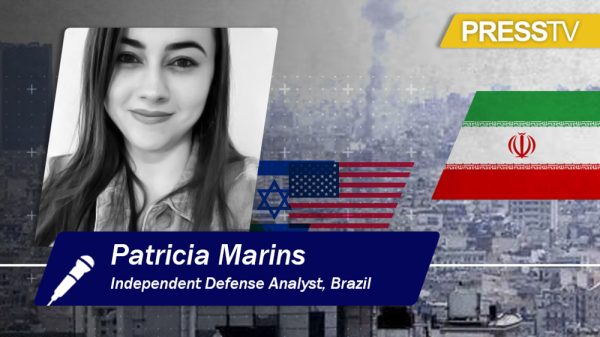
Patricia Marins, an independent defense analyst based in Brazil, has been following the war unfold with a keen eye on the shifting strategic balance.
In an interview with the Press TV website, Marins said she has been witnessing the emergence of something the region has never quite witnessed before: the “Iranian model” of warfare proving itself against the world’s most powerful military.
“The Iranian model possesses several distinct characteristics compared to the American model exported to Arab countries. It is built for attrition warfare and resilience, featuring an extensive network of underground facilities and a focus on long-range precision-guided munitions,” she stressed.
“All of this was achieved through investment in research centers, universities, reverse engineering, and the steady implementation of a domestic defense industry, which in many respects is dual-use.”
On the other hand, the American model exported to the Persian Gulf countries consists of “vulnerable surface installations, almost no degree of indigenous production, and consequently a disconnect between research centers, reverse engineering, and the military industry,” which Marins added is not limited to the US model, but all Western models.
“Kuwait paid over $310 million for each Eurofighter Typhoon, nothing short of extortion,” she said, making a clear distinction between the American and Iranian models.
Today, amid the war that was triggered by the unprovoked US-Israeli attack on February 28, and the assassination of the Leader of the Islamic Revolution, Ayatollah Seyyed Ali Khamenei, and some top-ranking military commanders, that investment is paying dividends.
Marins believes the contrast in the military tech leap is not lost on regional observers.
“I believe this Iranian model is being closely watched by all (Persian) Gulf countries at this moment. I see a high probability of it serving as a reference in several areas. I even believe it has inspired the Saudi missile industry, which is currently absorbing Chinese technology,” she said.
“Iran inspires, yet it still maintains a guarded distance from the (Persian) Gulf countries in this sector.”
Beyond the missile and drone arsenal, Iran also enjoys the geographical advantage, the Brazilian analyst stated.
“Iran’s advantage begins with its geographical position, but it is confirmed by its military prowess. And Iran knows how to leverage both very effectively,” she said
She referred to the Ghadir-class submarine, which is affordable, stealthy, and designed specifically for the waters it operates in – the Persian Gulf – especially in the Strait of Hormuz.
The Strait’s “shallow, high-salinity, and high-temperature conditions create a challenging, noisy, and complex environment for sonar, favoring small, fast, and highly maneuverable platforms,” she asserted.
“It is the perfect marriage between the weapon and the environment in which it operates,” she said. “Iran knows how to use the geography that already favors them.”
Then there is Yemen as well, which has indicated willingness to join the front against the US and Israel, after the Lebanese Hezbollah resistance movement and Iraqi resistance groups.
“Iran has been a master player. Knowing that by maintaining influence in Yemen, in a situation like this, they could exert power over both straits,” Marins said.
“However, all of this requires prudence and maturity.”
With the Strait of Hormuz effectively closed already for the US and its allied vessels, if Yemen’s Ansarullah movement follows through and shuts down the Bab el-Mandeb strait as well, the costs would be abysmal, she noted.
“This would expand the conflict on that axis to European countries, as has already occurred. I believe Iran is weighing the necessity of this escalation and whether it is truly required. While Hormuz involves oil and gas, Bab el-Mandeb involves the flow of goods between the West and Asia,” Marins remarked.
“If this strait is closed, it will have a massive economic impact. I see Iran as prudent and disciplined as a nation must be during a war.”
While media reports have cited figures of $1 billion per day for American attacks, with one estimate putting the first six days at $11 billion, Marins believes the true cost is far higher.
In her projections, she suggests the costs for the US could reach a colossal $360 billion within two months if the war continues unabated, a sum that she stresses “would test the patience of any treasury, let alone American taxpayers already feeling the pinch of soaring oil prices.”
“Israel’s operations during the 12-day war generated a daily cost of around $700 million. However, by the end of the war, once the costs of interceptors and damages were added, this daily cost hit nearly $2 billion,” she told the Press TV website.
“I believe this will be Israel’s cost, but the American cost so far is triple that due to three factors: the number of interceptors expended, the quantity of missiles and guided bombs used, and the cost of damages to bases and radars.”
When these factors are combined, Marins noted, the cost is expected to be “no less than $6-8 billion daily during these two weeks of war.”
On reports that Trump’s advisors are advising him to declare victory and find an exit, Marins doubts the American victory in this war is even possible.
“I don’t think so. I see Iran in a much better strategic position to win the conflict. As long as Iran maintains control of the strait, the pressure will be on Donald Trump’s shoulders, no matter how many bombs he drops,” she said.
But beneath that tactical reality lies a deeper truth about the nature of this war. Iran has demonstrated a capacity to absorb bombings while being resilient, limiting drone actions over its territory, and fighting an asymmetric war on its own terms, Marins said.
“So far, I believe Iran has conducted an asymmetric war with very few mistakes,” Marins said. “One that the US and Israel simply don’t know how to fight.”
Op. True Promise 4: Iran’s missile blitzkrieg dismantles US war machine in West Asia
By Ivan Kesic | Press TV | March 10, 2026
In just ten days, Iran’s military response to the Israeli-American war of aggression has dismantled the core of US power in the Persian Gulf, from Qatar’s Al-Udeid Air Base to the US Fifth Fleet headquarters in Bahrain.
What began on February 28, 2026, as the ill-fated “Operation Epic Fury” has spiraled into a strategic catastrophe for the US military-industrial complex.
The aggression, which led to the martyrdom of the Leader of the Islamic Revolution, Ayatollah Seyyed Ali Khamenei, as well as ordinary civilians, has been met with one of the most devastating and precisely coordinated military campaigns in modern regional history.
Systematically, Iranian missiles and drones have pierced American air defenses, reducing over a dozen military installations to rubble, obliterating advanced radar systems, and crippling US naval power.
Thousands of American personnel now confront an undeniable reality: their assets are no longer safe from Iran’s formidable and far-reaching arsenal.
US military web in the Persian Gulf
To fully grasp the magnitude of Iran’s military achievements, one must first understand the intricate web of US military power that has for decades strangled the Persian Gulf region.
This network has served as the primary instrument of US hegemony over the world’s most vital energy resources and the principal military guarantee for the security of the Zionist entity.
At the apex of this system sits Al-Udeid Air Base in Qatar. A sprawling facility covering approximately fifty square kilometers southwest of Doha, it stands as the largest American military installation in the entire West Asia and the forward headquarters of United States Central Command.
Al-Udeid is the cornerstone of US military strategy in the region, housing over ten thousand personnel and supporting the 379th Air Expeditionary Wing. Its formidable array of bombers, fighter aircraft, surveillance platforms, and drones has, for years, been the launchpad for aggressive operations against regional nations.
Less than two hundred and fifty kilometers from Al-Udeid lies Al-Dhafra Air Base in the United Arab Emirates. This installation complements its Qatari counterpart by providing the United States with advanced intelligence, surveillance, and reconnaissance capabilities.
Al-Dhafra hosts approximately five thousand active-duty US military personnel assigned to the 380th Air Expeditionary Wing.
Their primary missions include aerial refueling and high-altitude intelligence gathering, utilizing platforms such as the Lockheed U-2 Dragon Lady, the Boeing E-3 Sentry AWACS, and the RQ-4 Global Hawk surveillance drones – aircraft that have routinely violated Iranian airspace along the Persian Gulf coast.
The base achieved particular notoriety in 2019 when one of its Global Hawk drones was shot down by Iran’s air defense system, an episode that foreshadowed the far greater defeats to come.
In Bahrain, the Naval Support Activity in Manama serves as the headquarters for both US Naval Forces Central Command and the United States Fifth Fleet.
Supporting over nine thousand military personnel and more than one hundred tenant commands, this facility, established on the grounds of the former British Royal Navy base HMS Juffair, provides the logistical and command infrastructure necessary for the Fifth Fleet to project power throughout the region with its carrier strike groups and supporting vessels.
Kuwait hosts yet another crucial node. Camp Arifjan serves as the primary forward logistics hub for American ground forces, while Ali Al-Salem Air Base hosts the 386th Air Expeditionary Wing, and Mohammed Al-Ahmad Naval Base provides critical naval infrastructure.
This was the fortress America had built, a ring of steel and fire meant to contain and intimidate. And this is the fortress that Iran has just shattered.
Initial wave: Iran’s devastating response to US-Israeli aggression
When the US and the Israeli regime launched their cowardly aggression against Iranian territory on February 28, assassinating Leader of the Islamic Revolution Ayatollah Ali Khamenei and more than two hundred Iranian civilians, including 165 schoolgirls in the city of Minab, they evidently believed that such a devastating blow would leave Iran paralyzed.
The school was attacked twice by the US missiles, debunking the claim that it was not deliberate. As experts noted, the same site cannot be mistakenly targeted twice.
Within hours of the initial wave of aggression, the Islamic Revolution Guards Corps (IRGC) launched Operation True Promise 4, a meticulously planned retaliation that simultaneously targeted more than a dozen American military installations across the region.
At Al-Udeid Air Base in Qatar, Iranian missiles struck with devastating precision. Their impacts were captured on video and broadcast by multiple news agencies. The most significant achievement was the complete destruction of the AN/FPS-132 Upgraded Early Warning Radar, a system valued at approximately $1.1 billion that served as the electronic eye of American air defense throughout the Persian Gulf.
This fixed UHF phased-array radar, designed to detect and continuously track ballistic missiles at extremely long ranges, represented the most critical component of the US early warning architecture in West Asia.
Its obliteration rendered the entire American air defense network effectively blind, forcing surviving batteries to operate with degraded situational awareness and dramatically reducing their effectiveness against subsequent Iranian strikes.
Simultaneously, Iranian missiles and kamikaze drones descended upon Al-Dhafra Air Base in the UAE, destroying the American terrorists’ air warfare center, satellite communication center, early warning radars, and fire control radars, effectively decapitating the base’s command and control capabilities.
The Lockheed U-2 reconnaissance aircraft, Boeing E-3 Sentry AWACS, and RQ-4 Global Hawk drones found themselves without the supporting infrastructure necessary for their operations. Their hangars were damaged or destroyed, their crews scrambling to survive the onslaught.
The strikes extended to the naval infrastructure. At Jebel Ali Port in Dubai, which is the most frequent port of call for US Navy vessels outside the American homeland, Iranian missiles caused significant damage to facilities used for resupplying and maintaining the Fifth Fleet’s warships.
In Bahrain, the headquarters of the United States Fifth Fleet came under direct attack, with multiple missiles and kamikaze drones striking the Naval Support Activity facility.
Video clips captured the moment of impact as projectiles struck buildings within the base complex, including a high-rise structure housing American troops.
The IRGC announced that a service center for the Fifth Fleet had been specifically targeted, and subsequent attacks on March 1 would hit an unnamed US naval command and backup center with two ballistic missiles.
Kuwait’s American installations suffered perhaps the most complete destruction. Ali Al-Salem Air Base, struck on February 28, came under renewed attack on March 1.
The IRGC subsequently declared that the base had been rendered completely out of service. This facility, home to the US Air Force’s 386th Air Expeditionary Wing, was effectively neutralized as a military asset: its runways cratered, its hangars destroyed, its aircraft either damaged or forced to flee. The Mohammed Al-Ahmad Naval Base suffered an equally devastating fate, with three naval infrastructure structures reportedly destroyed.
In a matter of hours, the elaborate fortress America had spent decades building had been shattered.
Strategic significance of America’s lost assets
The full measure of Iran’s military achievement becomes apparent only when one considers what these destroyed facilities actually meant to American strategic power.
The AN/FPS-132 radar at Al-Udeid was not merely an expensive piece of equipment, but the keystone of the entire American air defense architecture in the Persian Gulf.
Without it, the Patriot and THAAD batteries scattered across the Persian Gulf states became fundamentally degraded. Forced to rely on their own shorter-range sensors, they were rendered far more vulnerable to saturation attacks.
The destruction of this single system effectively crippled the integrated air defense network that the United States had spent decades constructing.
Al-Dhafra’s destroyed command and control centers represented an equally significant loss. These facilities were the nerve centers through which American intelligence operations across the Persian Gulf were coordinated.
The satellite communication center had been the primary link transmitting data from surveillance aircraft to analysis centers; its loss temporarily blinded American intelligence collectors across the region.
The damage inflicted upon the Fifth Fleet’s headquarters in Bahrain disrupted the command infrastructure necessary for coordinating carrier strike groups and support vessels across an area encompassing the Persian Gulf, Red Sea, and Arabian Sea.
Without this hub, the fleet’s ability to project power became fundamentally compromised.
The destruction at Jebel Ali Port compounded these difficulties by damaging the primary logistics hub through which the Fifth Fleet received supplies and maintenance support.
A fleet without fuel, without spare parts, without the means to sustain prolonged operations, is little more than a collection of floating metal.
In a single night, Iran did not merely strike American bases; it dismantled the architecture of American power in the region. The radar that saw everything was blinded.
The centers that coordinated everything were silenced. The ports that sustained everything were crippled. The fleet that dominated everything was paralyzed.
Continuing campaign: Sustained pressure on US positions
The second phase of the retaliatory military campaign unfolded on March 8 and 9, with fresh strikes targeting key American installations in the region.
Al-Udeid Air Base came under renewed attack on March 8, with loud blasts and sirens reported. The Qatari Ministry of Defense subsequently acknowledged the strikes, though Iranian military sources framed them as direct hits on the key command hub.
The fact that attacks continued despite Qatari interception claims suggested that many missiles and drones were still getting through. The following day, March 9, Al-Udeid was struck again, with explosions rocking the base for the second consecutive day and verified reports confirming impacts.
The Juffair Naval Base in Bahrain was also targeted on March 8. The IRGC announced a direct strike in retaliation for a US attack on an Iranian desalination plant on Qeshm Island earlier the same day. Foreign Minister Abbas Araghchi stated that the United States had set the precedent by hitting civilian infrastructure, which made Iran’s response more legitimate.
Ali Al-Salem Air Base in Kuwait, already severely damaged in earlier strikes, came under drone attack on March 8. The Islamic Resistance in Iraq claimed responsibility for an operation that allegedly breached Kuwaiti air defenses and hit the installation.
The Prince Sultan Air Base near Al-Kharj in Saudi Arabia was targeted with a volley of ballistic missiles. Although Saudi forces claimed to have intercepted three missiles heading for the base, the installation still suffered significant damage.
Iran’s military-technological triumph
The past 10-11 days of combat have demonstrated conclusively that Iranian military technology has reached a level of sophistication American strategists never anticipated.
Iranian missiles have consistently penetrated American air defenses, striking their targets with precision that rivals, or exceeds, that of US weapons, as experts acknowledge.
Iranian drones have swarmed American bases in numbers that defensive systems simply cannot engage. The destruction of the AN/FPS-132 radar represents perhaps the most significant single technological achievement of the campaign: a billion-dollar system, specifically designed to detect and track missiles like those Iran fired at it, proved utterly incapable of preventing its own destruction.
The performance of Iranian anti-ship missiles against American naval assets, including the reported strike on a US Navy combat support warship, further demonstrates the comprehensive nature of Iran’s capabilities.
No domain, whether air, land, or sea, has remained immune this time.
Beyond technology, the sustained nature of the Iranian campaign reveals logistical and industrial capacities that the US clearly did not anticipate. Iran has fired hundreds of missiles and drones while maintaining the ability to continue such strikes indefinitely, a feat that suggests a production capacity Western intelligence had catastrophically underestimated.
American forces, by contrast, have expended enormous quantities of interceptors attempting to defend against Iranian attacks, depleting stocks that will take years to replenish.
The economics of this war are as devastating as its tactics: a missile that costs Iran a few hundred thousand dollars is met by an interceptor that costs America several million. This is a war of attrition that the United States cannot win.
The technological edge upon which American military dominance has rested for decades has been revealed as a myth in these 11 days. The industrial capacity that was supposed to guarantee American superiority has been exposed as insufficient. And the will to sustain a prolonged war in the face of mounting losses has yet to be tested.
Humiliation of American power
Beyond the purely military dimensions lies the broader strategic impact on American military prestige throughout West Asia, carefully built over the decades, military experts say.
The US has presented itself as the indispensable guarantor of security in the Persian Gulf, the force whose military might ensures the free flow of oil and the stability of friendly regimes.
The events of the past 11 days have exposed this narrative as hollow propaganda, revealing that American power rests not on invincible capability but on the absence of serious challenge.
The Persian Gulf Arab states that have hosted American bases now find themselves in an impossible position, their territories transformed into battlegrounds, their air defense systems exposed as ineffective, their American protectors revealed as vulnerable.
The casualties inflicted upon American forces, estimated in the hundreds by Iranian military sources, represent a human cost that will reverberate through American society.
American families are receiving notification that their loved ones will not return from a war that Washington started and cannot win, a source told the Press TV website.
The images of destroyed bases, burning aircraft, and fleeing personnel convey a message more powerful than any official statement: the United States is not winning this war.
New strategic reality
As the imposed war enters its second week, a new strategic reality has emerged in West Asia, one in which American military dominance has been shattered and Iranian power stands ascendant, military experts note.
“The United States can no longer guarantee the security of its bases in the Persian Gulf. It cannot protect its warships from Iranian missiles. It cannot conduct intelligence operations along Iranian coasts without risking the destruction of its most valuable platforms,” a highly placed military source told the Press TV website.
“The carefully constructed edifice of American military power has been revealed as a house of cards, collapsing at the first serious challenge.”
For Iran, he noted, these military achievements represent not merely a successful retaliation but a strategic victory that fundamentally transforms the entire regional security environment.
The Islamic Republic, through these 34 waves of Operation True Promise 4 (and counting), has demonstrated capabilities that will deter American aggression for years to come.
“The message from Tehran to Washington could not be clearer: the era of American dominance in West Asia has ended. Any future aggression against the Islamic Republic will be met with responses far more devastating than anything yet seen,” the source said.
Iran pledges to ‘respect sovereignty of neighbors’, declares US-Israel assets ‘primary targets’
The Cradle | March 7, 2026
The Iranian armed forces warned that US and Israeli military installations across the region remain legitimate targets, as officials seek to ease tensions with neighboring countries.
“Should the previous hostile actions continue, all military bases and interests of criminal America and the fake Zionist regime on land, at sea, and in the air across the region will be considered primary targets and will come under the powerful and crushing strikes of the mighty armed forces of the Islamic Republic of Iran,” the Iranian Revolutionary Guard Corps (IRGC) said in a statement on Saturday.
The warning came alongside a declaration by Iran’s Khatam al-Anbiya Central Headquarters that Iranian forces “respect the national interests and sovereignty of neighboring countries” and “have not carried out any act of aggression against them.”
Nevertheless, military officials emphasized that installations used by the US or Israel to launch attacks against Iran remain fair game. Lieutenant Colonel Ibrahim Zolfaghari said that at least 21 US personnel have been killed and many more injured in attacks on the US Navy’s Fifth Fleet infrastructure, while additional casualties occurred during strikes on Al-Dhafra Air Base.
He also said Iranian forces targeted a US-owned oil tanker in the northern Persian Gulf.
Earlier in the day, President Masoud Pezeshkian announced that Iran’s interim leadership council had ordered the armed forces to cease striking neighboring countries unless attacks originate from their territory.
“The temporary leadership council approved yesterday that neighboring countries should no longer be targeted and missiles should not be fired unless an attack on Iran originates from those countries,” Pezeshkian said in a pre-recorded address.
Pezeshkian’s statement was made amid increasing tensions over regional airspace with Iran’s neighboring countries.
Turkish authorities claimed this week that NATO missile defenses intercepted a ballistic projectile allegedly launched from Iran that crossed Iraqi and Syrian airspace before approaching the northwestern Syria-Turkiye border.
In Azerbaijan, officials accused Tehran of launching a drone attack that struck the Nakhchivan airport terminal, prompting President Ilham Aliyev to warn Iran “will regret it,” while Iranian authorities denied involvement.
Tehran vehemently denied involvement in either of these attacks.
Saudi journalist Adhwan al-Ahmari said in a recent interview with Asharq News that “not all attacks” targeting Gulf states come from Iran, warning the war could be “an American-Israeli trap to implicate the Gulf countries and draw them into a confrontation with Iran.”
Iranian officials told Middle East Eye (MEE) that some recent drone strikes on Gulf energy infrastructure were not carried out by Tehran, with one official describing the attack on Saudi Aramco’s Ras Tanura facility as “an Israeli effort to sabotage regional peace and alliances between neighbours.”
“I can categorically say that some of the attacks were not carried out by us [Iran],” the anonymous official told MEE.
Saudi Arabia, Qatar, the United Arab Emirates, Kuwait, Bahrain, and Oman have all sustained strikes within their territories due to the presence of US assets within their borders.
Murdering Khamenei Will Kill Trump’s Presidency
By Ian Proud | Strategic Culture Foundation | March 1, 2026
Ayatollah Seyyed Ali Khamenei was assassinated in what is being described in western media as a joint airstrike operation. Even though the Israeli air-force carried out airstrikes in and around Tehran, it is clear that these were supported by the U.S. military. As such, the U.S. is complicit in the murder of the Head of State of a sovereign nation.
And this unilateral military action once again proved both that the United Nations Charter has lost its value and that the UN Security Council is now broken.
In his opening remarks to the Security Council, Secretary General António Guterres condemned the military strikes by the U.S. and Israel, which also condemning the Iranian response, citing Article 2 of the UN Charter.
“All Members shall refrain in their international relations from the threat or use of force against the territorial integrity or political independence of any state, or in any other manner inconsistent with the Purposes of the United Nations.”
The enormous and ongoing military strikes against Iran were clearly in breach of that Article.
In its response to the Security Council, Iran’s Representative cited Article 51 of the UN Charter, which states that “nothing in the present Charter shall impair the inherent right of individuals or collective self-defence if an armed attack occurs against a Member of the United Nations, until the Security Council has taken measures necessary to maintain international peace and security.” Article 51 is one of only two exceptions to the general prohibition on the use of force by UN members set out in Article 2.
The strikes were all the more cynical for taking place part way through talks moderated by the government of Oman. Indeed, Guterres hinted at this in his remarks, saying:
“The U.S. and Israeli attacks occurred following the third round of indirect talks between the U.S. and Iran mediated by Oman.
Preparations had been made for technical talks in Vienna next week followed by a new round of political talks.
I deeply regret that this opportunity of diplomacy has been squandered.”
Pakistan’s representative at the Council was more blunt, saying that “diplomacy has once again been derailed as these attacks have happened right in the middle of negotiations.”
Indeed, the strikes confirmed that the UN Security council has become completely unable to take measures necessary to maintain international peace and security.
On the 80th anniversary of the founding of the UN Secretary General Guterres warned that “fragile” legitimacy of the Security Council could endanger global peace if it remains gridlocked and fails to fulfil its primary purpose.
All of the the western nations around the UN Security Council table last night showed themselves to be weak and silent, in the face of American’s military might.
As one, they criticised Iran’s unprovoked attacks on Gulf states, as Iranian ballistic missiles targeted U.S. military sites in Bahrain, Qatar, the UAE and Kuwait, while also targeting Israel. Self evidently, Iran was targeting U.S. military installations in all of those countries and. Indeed, the U.S.’ fifth fleet Headquarters in Bahrain was struck by at least one ballistic missile. Yet civilian sites also got hit, including in the UAE and in Bahrain.
However, there was no mention at all of the U.S. and Israeli strikes on Iran in the statements of western nations at the Security Council, as if they feared U.S. reprisals if they spoke out. Not a single word from the French, the Latvians, the Danes, the Greeks, even the Bahrainis, only that Iran murdered its citizens and should not be allowed to acquire a nuclear bomb.
In the end the acting UK Permanent Representative, James Kariuki, who I can tell you from personal experience is the most arrogant and puffed up British diplomat that I ever met, said that:
“Iran must refrain from further strikes, and its appalling behaviour, to allow a path back to diplomacy.”
The sitting President of the UN Security Council, the United Kingdom (the U.S. takes over the Presidency today) did not utter a single word about the USA or Israel. No attempt, as the country convening the meeting, to seek common ground and some agreement on the way forward.
Britain’ approach was merely to blame Iran in what the Russian Federation representative described in his intervention as ‘victim blaming’. I already knew that Britain had given up diplomacy in 2014, but this appeared yet another nail in a coffin which the UK refuses to bury as it pretends to be a nation of diplomacy. It is not. Britain is now a nation of warmongers without the troops to fight.
While final confirmation of the fact had yet to be provided at that time, the Prime Minister of Israel and President Trump were already celebrating the possible killing of Khamanei. ‘The dictator is gone,’ Netanyahu crowed.
In his social media statement, President Trump called on Iranian people to rise up and take over their country.
Yet within hours, sources within the CIA were already leaking reports that Khamenei may simply be replaced by IRGC hardliners.
As I have pointed out before, rather than fomenting revolution, unilateral military action against Iran may have the opposite effect and mobilise Iranian resistance.
This idea was stated with great clarity by Professor Robert Pape of Chicago University who said:
“With each passing day of regime-targeting airstrikes, we lose control over the political dynamics they unleash.
It becomes less about individual leaders and more about national survival. Less about dissent and more about resistance.
Imagine if a foreign power struck Washington and called on Americans to overthrow their government. Would citizens rally against their leaders — or against the foreign attacker?”
Iran is a country of 92 million people with an army of over 610,000. It is a tightly controlled state and as we saw in January is more than capable and ready to stifle internal dissent, including through violent means. It also does not have an oven-ready opposition lined up in the wings that can walk in unopposed and miraculously take over the country. To suggest that it does takes us into Bay of Pigs territory.
Having already kidnapped the Head of State of one sovereign nation already this year, the United States of America has now murdered another, Ayatollah Khamenei. This will unleash asymmetric threats against the U.S. and all of its allies that Donald Trump will not be able to control. If this military action drags out inconclusively, and I predict it will, then the mid-terms may prove catastrophic for Trump. I predict that the Iranian regime will outlast his.
How Trump’s Iran Gambit Could Blow Up the Entire Persian Gulf
By Viktor Mikhin – New Eastern Outlook – February 1, 2026
Washington’s aggressive preparations under Donald Trump’s leadership will not bring victory but are guaranteed to result in a humanitarian and economic catastrophe for every single country in the region. This would turn the Gulf’s vital waters into the epicenter of an uncontrollable fire.
The Persian Gulf region is once again teetering on the brink of an abyss. Under the pretext of “promoting regional security,” the United States, led by its unpredictable administration, is engaging in blatantly provocative military escalation. The arrival of the USS Abraham Lincoln carrier strike group and large-scale Air Force exercises are not steps toward stability but classic intimidation tactics. In the current climate of extreme tension, such moves risk a catastrophic blowback.
Tehran has made it clear: this time, any attack, even a “surgical” one, will be considered a declaration of full-scale war. The consequences of this decision, born of desperation and confidence after repelling aggression in June 2025, will fall not on Washington but on Iran’s neighbors across the Gulf. The US, acting as an irresponsible arbiter, is ready to set fire to a house where others live.
Iran as the Cornered Victim: Why Deterrence No Longer Works
The Trump administration seems stuck in the past decade, believing the language of ultimatums and muscle-flexing can still force Tehran to capitulate. Iranian Foreign Ministry spokesman Esmaeil Baghaei shattered that illusion in his sharp statement on January 26. Iran, he said, is “fully prepared to deliver a large-scale and regrettable response.” A key doctrinal change was articulated by a senior Iranian official to Reuters: “This time, we will consider any attack—limited, surgical, or kinetic—as a full-scale war.”
What does this mean in practice? It means Trump’s calculation of a precise strike with no serious consequences is a dangerous fantasy. Iran will no longer tie its hands by responding proportionally to a local incident. A strike on a nuclear facility? The retaliation will target American bases in Qatar, the UAE, and Bahrain, housing thousands of US troops and costly infrastructure. An attempt to eliminate a senior leader? As Brigadier General Abolfazl Shekarchi stated, it would mean Iran “sets their world on fire and deprives them of any peace”—referring to asymmetric warfare by all means. Thus, the US is creating a situation where any spark, any miscalculation, will inevitably escalate into a high-intensity regional conflict.
Immeasurable Disaster for Gulf States: Economic Collapse and Humanitarian Crisis
The Gulf Cooperation Council (GCC) countries must clearly understand: in case of war, they will not be bystanders or “quiet beneficiaries” but the front-line and primary victims.
– Blocking the Strait of Hormuz. This is not a threat but an inevitability in a full-scale conflict. Iran has repeatedly demonstrated the capabilities of its navy and coastal defense missile systems. Shutting down this narrow chokepoint, through which about 30% of the world’s seaborne oil trade passes, would send global prices into chaotic turmoil. However, the first budgets to collapse would be those of Saudi Arabia, Qatar, the UAE, and Kuwait, whose existence depends on hydrocarbon exports. Global economies would withstand the shock, but the Gulf economies would plunge into a deep crisis.
– Strikes on Critical Infrastructure. Oil refineries and petrochemical complexes in Al-Jubail (Saudi Arabia) or Ras Laffan (Qatar), desalination plants, ports, airports —a ll these facilities are within range of Iranian missiles and drones. The result would be not only economic disaster but a humanitarian one: lack of fresh water, halted logistics, collapsed life-support systems in cities.
– Escalation Across All Fronts. The war would not be limited to exchanges between the US and Iran. It would immediately fuel conflicts in Yemen (where the Houthis would strike Saudi Arabia and the UAE with renewed force), Syria, Iraq, and Lebanon. The US, with an ocean ensuring its security, can wage a “projection war.” The Gulf states have nowhere to retreat—the fire will rage at their doorstep and then spread inside.
Trump’s Irresponsibility and “Big Lie” Tactics
Donald Trump, whose foreign policy has always balanced between populism and rash aggression, is displaying glaring irresponsibility in this situation. His administration, instead of seeking diplomatic solutions, is deliberately ratcheting up tension, believing in its own impunity. However, as Baghaei rightly noted, “instability in the region is contagious,” and “any miscalculation by Washington will inevitably lead to the destabilization of the entire Middle East.”
The information warfare tactics employed deserve particular condemnation. As the Iranian Foreign Ministry pointed out, “the Zionist regime is the main source of fake news.” This refers to a targeted campaign of lies and disinformation, compared by Tehran to hysterical propaganda. False reports about secret diplomatic guarantees or mass executions in Tehran aim to create an image of Iran as an irrational and bloody regime in the eyes of the American public and the international community, justifying a “preemptive” strike. Trump, known for his fondness for loud but unverified statements, becomes the perfect conduit for this “big lie,” drowning out voices of reason.
The new strategy described by Ali Larijani, Secretary of Iran’s Supreme National Security Council, appears even more cynical. He stated explicitly that the US has moved to provoking social crises within Iran to create a pretext for military intervention under the guise of “protecting human rights.” Funding and supporting “semi-terrorist urban groups” and attacks on national symbols — all are part of a hybrid war aimed at destroying internal solidarity.
What does this mean for the Gulf monarchies? It is a direct warning. If the US uses such methods against Iran today, tomorrow they could be applied to pressure any country in the region whose policy ceases to suit Washington. Supporting the American gamble today is buying a ticket into tomorrow’s turbulence, where internal stability becomes a bargaining chip in a grand geopolitical game.
Diplomacy: The Only Path to Saving the Region
Against this grim backdrop, the position of the United Arab Emirates provided a hopeful signal. They clearly stated that their territory, airspace, and waters would not be used for hostile actions against Iran. This step reflects a growing, though not always openly expressed, understanding in GCC capitals: the path to their own security lies not through war with Iran but through complex yet essential dialogue and mutual respect for sovereignty.
On this matter, Kremlin spokesman Dmitry Peskov issued a sharp warning, stating that any military strike on the Islamic Republic would lead to “serious destabilization” in the Middle East. Addressing journalists, Peskov called the prospect of an attack “another step towards serious destabilization of the situation in the region,” emphasizing that Moscow expects all international parties to show restraint and resolve differences exclusively through “peaceful negotiations.”
History has repeatedly shown that US military interventions in the Middle East brought only chaos, increased terrorism, and instability (Iraq, Libya, Syria). A new Trump adventure, if realized, would surpass all previous ones in its destructive consequences. It would not “bring order” but would blow up an already fragile region, burying the economic prosperity of the Persian Gulf states under the rubble and setting back their development for decades. Responsibility will lie not only with the reckless US leadership but also with those regional players who, blinded by short-term enmity, failed to prevent the catastrophe. There is still time for sober calculation and urgent diplomacy, but the clock is ticking down by the day.
Murdering Khamenei Will Kill Trump’s Presidency
By Ian Proud | Strategic Culture Foundation | March 1, 2026
Ayatollah Seyyed Ali Khamenei was assassinated in what is being described in western media as a joint airstrike operation. Even though the Israeli air-force carried out airstrikes in and around Tehran, it is clear that these were supported by the U.S. military. As such, the U.S. is complicit in the murder of the Head of State of a sovereign nation.
And this unilateral military action once again proved both that the United Nations Charter has lost its value and that the UN Security Council is now broken.
In his opening remarks to the Security Council, Secretary General António Guterres condemned the military strikes by the U.S. and Israel, which also condemning the Iranian response, citing Article 2 of the UN Charter.
“All Members shall refrain in their international relations from the threat or use of force against the territorial integrity or political independence of any state, or in any other manner inconsistent with the Purposes of the United Nations.”
The enormous and ongoing military strikes against Iran were clearly in breach of that Article.
In its response to the Security Council, Iran’s Representative cited Article 51 of the UN Charter, which states that “nothing in the present Charter shall impair the inherent right of individuals or collective self-defence if an armed attack occurs against a Member of the United Nations, until the Security Council has taken measures necessary to maintain international peace and security.” Article 51 is one of only two exceptions to the general prohibition on the use of force by UN members set out in Article 2.
The strikes were all the more cynical for taking place part way through talks moderated by the government of Oman. Indeed, Guterres hinted at this in his remarks, saying:
“The U.S. and Israeli attacks occurred following the third round of indirect talks between the U.S. and Iran mediated by Oman.
Preparations had been made for technical talks in Vienna next week followed by a new round of political talks.
I deeply regret that this opportunity of diplomacy has been squandered.”
Pakistan’s representative at the Council was more blunt, saying that “diplomacy has once again been derailed as these attacks have happened right in the middle of negotiations.”
Indeed, the strikes confirmed that the UN Security council has become completely unable to take measures necessary to maintain international peace and security.
On the 80th anniversary of the founding of the UN Secretary General Guterres warned that “fragile” legitimacy of the Security Council could endanger global peace if it remains gridlocked and fails to fulfil its primary purpose.
All of the the western nations around the UN Security Council table last night showed themselves to be weak and silent, in the face of American’s military might.
As one, they criticised Iran’s unprovoked attacks on Gulf states, as Iranian ballistic missiles targeted U.S. military sites in Bahrain, Qatar, the UAE and Kuwait, while also targeting Israel. Self evidently, Iran was targeting U.S. military installations in all of those countries and. Indeed, the U.S.’ fifth fleet Headquarters in Bahrain was struck by at least one ballistic missile. Yet civilian sites also got hit, including in the UAE and in Bahrain.
However, there was no mention at all of the U.S. and Israeli strikes on Iran in the statements of western nations at the Security Council, as if they feared U.S. reprisals if they spoke out. Not a single word from the French, the Latvians, the Danes, the Greeks, even the Bahrainis, only that Iran murdered its citizens and should not be allowed to acquire a nuclear bomb.
In the end the acting UK Permanent Representative, James Kariuki, who I can tell you from personal experience is the most arrogant and puffed up British diplomat that I ever met, said that:
“Iran must refrain from further strikes, and its appalling behaviour, to allow a path back to diplomacy.”
The sitting President of the UN Security Council, the United Kingdom (the U.S. takes over the Presidency today) did not utter a single word about the USA or Israel. No attempt, as the country convening the meeting, to seek common ground and some agreement on the way forward.
Britain’ approach was merely to blame Iran in what the Russian Federation representative described in his intervention as ‘victim blaming’. I already knew that Britain had given up diplomacy in 2014, but this appeared yet another nail in a coffin which the UK refuses to bury as it pretends to be a nation of diplomacy. It is not. Britain is now a nation of warmongers without the troops to fight.
While final confirmation of the fact had yet to be provided at that time, the Prime Minister of Israel and President Trump were already celebrating the possible killing of Khamanei. ‘The dictator is gone,’ Netanyahu crowed.
In his social media statement, President Trump called on Iranian people to rise up and take over their country.
Yet within hours, sources within the CIA were already leaking reports that Khamenei may simply be replaced by IRGC hardliners.
As I have pointed out before, rather than fomenting revolution, unilateral military action against Iran may have the opposite effect and mobilise Iranian resistance.
This idea was stated with great clarity by Professor Robert Pape of Chicago University who said:
“With each passing day of regime-targeting airstrikes, we lose control over the political dynamics they unleash.
It becomes less about individual leaders and more about national survival. Less about dissent and more about resistance.
Imagine if a foreign power struck Washington and called on Americans to overthrow their government. Would citizens rally against their leaders — or against the foreign attacker?”
Iran is a country of 92 million people with an army of over 610,000. It is a tightly controlled state and as we saw in January is more than capable and ready to stifle internal dissent, including through violent means. It also does not have an oven-ready opposition lined up in the wings that can walk in unopposed and miraculously take over the country. To suggest that it does takes us into Bay of Pigs territory.
Having already kidnapped the Head of State of one sovereign nation already this year, the United States of America has now murdered another, Ayatollah Khamenei. This will unleash asymmetric threats against the U.S. and all of its allies that Donald Trump will not be able to control. If this military action drags out inconclusively, and I predict it will, then the mid-terms may prove catastrophic for Trump. I predict that the Iranian regime will outlast his.
US Cargo Planes Have Flooded the Persian Gulf Since the First of December
By Larry C. Johnson | SONAR | January 13, 2026
In December 2025 and January 2026 (through early/mid-January), open-source intelligence (OSINT) and flight-tracking data indicate a significant surge in US military transport aircraft (primarily heavy lifters like C-17 Globemaster III and C-5M Galaxy) flying to or toward US bases in the Persian Gulf, such as Al Udeid Air Base in Qatar, with reports consistently describing “dozens” of such movements.
Al Udeid Air Base (also known as Abu Nakhlah Airport) is the largest U.S. military installation in the Middle East, located in the desert approximately 20–35 km (12–22 miles) southwest of Doha, Qatar. It serves as a critical strategic hub for U.S. and allied operations in the region. Al Udeid is the headquarters for the forward element of US Central Command (CENTCOM), US Air Forces Central Command (AFCENT), and the Combined Air Operations Center (CAOC) — which commands and controls airpower across a 21-nation area from Northeast Africa to Central Asia. It also hosts elements of the US Special Operations Command Central and allies like the Royal Air Force (RAF)’s No. 83 Expeditionary Air Group.
Al Udeid is just the tip of the iceberg as far as the US presence in the Persian Gulf is concerned. Here are the other bases:
Naval Support Activity Bahrain (Bahrain, in Manama):
Headquarters for the US Navy’s Fifth Fleet (NAVCENT), responsible for maritime operations in the Persian Gulf, Red Sea, Arabian Sea, and parts of the Indian Ocean.
Hosts ~9,000 personnel (military and civilians).
Key for naval presence, including ships, patrol craft, and support for regional security.
Camp Arifjan (Kuwait, near Kuwait City)
Forward headquarters for US Army Central (ARCENT).
Major logistics, supply, and command hub for ground forces and prepositioned equipment.
Ali Al Salem Air Base (Kuwait, ~40 km from the Iraqi border)
Known as “The Rock”; supports airlift, refueling, transport, and expeditionary air operations (home to the 386th Air Expeditionary Wing).
Camp Buehring (Kuwait, near the Iraq border)
Staging post for Army units deploying to Iraq/Syria and training/operations support.
Al Dhafra Air Base (United Arab Emirates, south of Abu Dhabi)
Shared with UAE Air Force; critical US Air Force hub for reconnaissance, intelligence, fighter operations (e.g., F-22 Raptors), and missions against threats like ISIS.
Prince Sultan Air Base (Saudi Arabia) — Hosts US fighter jets and air defense; reactivated for regional deterrence.
Multiple reports from OSINT sources, flight trackers (e.g., FlightRadar24), and media outlets (including Israeli, European, and international sources) describe dozens of heavy transport aircraft (C-17s and C-5s) departing from US bases, the UK (e.g., RAF Mildenhall), and Germany, heading eastward to Persian Gulf hubs. This activity ramped up notably in early January 2026, with ongoing reports of C-17s, C-5s, and related support aircraft (including tankers like KC-135 and KC-46) en route.
The movements are most likely preparations for an attack on Iran (e.g., protests, air defense boosts), and analysts note similarities to prior buildups. No exact daily or total count is publicly confirmed by the Pentagon, but the scale is described as a “major redeployment” or “heavy airlift,” often in the range of dozens (20–50+ individual aircraft movements, though some may be round-trips or rotations).
In my last piece I listed the deployment of a US carrier task force as a possible indicator of an impending US military attack on Iran. I may be wrong. The surge of US military cargo planes over the last 40 days suggests that the US may opt for an air campaign and is deploying air defense systems to all of the bases listed above in preparation for such an attack. I believe that US planners believe they can knock out Iranian missile sites and, with a bevy of Patriot and THAAD air defense systems, defeat any Iranian retaliation.
All of the information I’ve presented above comes from open source intelligence (OSINT). If I can read it so can the Iranians, the Russians and the Chinese. Would you be shocked to learn that the Russians and the Chinese have satellite systems that are collecting intelligence on these bases as well and passing that information to Iran? Iran will know the location of the US air defense systems.
Based on the Iranian response to the surprise attack on June 13, I expect Iran will initially flood the US bases with drones and older missiles that will drain the US anti-missile defense systems… The US does not have an unlimited supply of Patriot missiles. If Iran has swallowed it pride and has accepted a robust supply of Russian and Chinese air defense units, then it has a better chance of surviving a US attack intended to neutralize Iran’s ability to launch ballistic missiles, which are stored in a number of underground bunkers scattered around Iran.
I still think that the first move by the US will be a cyber attack on Iran’s military command and control system. However, Iran has a robust cyber capability as well and would likely respond in kind to any such attack. Trump will receive a full briefing from Pete Hegseth’s War Department today (Tuesday) and a decision on the US courses of action is likely to follow.
I discussed these issues today with Judge Napolitano and Danny Davis. We also analyzed the war in Ukraine.
Featured Video
America Racing to Strategic Defeat in Iran
or go to
Aletho News Archives – Video-Images
From the Archives
An Expert Military Analysis of War with China
Actually, None is Necessary
By Fred Reed • Unz Review • December 13, 2020
The Correlation of Armed Forces: U.S. goods and services trade with China totaled an estimated $634.8 billion in 2019. Exports were $163.0 billion; imports were $471.8 billion. The U.S. goods and services trade deficit with China was $308.8 billion in 2019. Trade in services with China (exports and imports) totaled an estimated $76.7 billion in 2019. Services exports were $56.5 billion; services imports were $20.1 billion. The U.S. services trade surplus with China was $36.4 billion in 2019.
There is talk within the Washingtoniat of a possible war with China. Steve Bannon, who apparently was dropped on his head as a child, actually favors such a war. We hear the usual shoo-the-boobs alarm about how the Chinese are doing something terrible and we must gird our loins and American values and show them what for, bow wow, woof. The danger is that the current game of who-blinks-first in Asian waters might actually provoke a shooting war. You know the kind of thing: One warship refuses to get out of the way of another, a collision ensues, some retard lieutenant who signed up on waivers opens fire, and we’re off and running. It is not a good idea to let children play with matches.
The said war is discussed either in emotional terms by idiots or in purely naval terms by those familiar with such things, so we hear of the First Island Chain and the Second Island Chain and whose missiles against the other’s missiles and so on. This would be appropriate if we were fighting World War Two again. Which we aren’t. Let’s take a quick-and-dirty look at how such a war might go.
To begin the war, America would overestimate itself and underestimate China. This is doctrine in the Pentagon. … continue
Blog Roll
 Aletho News
- Poland rules out sending Patriot missiles to US/Israel amid war on Iran
- Tehran approves new Hormuz plan with major restrictions
- No Threat Can Force Iran’s Surrender /Trita Parsi & Lt Cl Daniel Davis
- UK’s New Pandemic Plan Would Turn Big Tech Into a Mass Location Tracking Network
- Growing insecurity, soaring prices fuel protests in north as regime bans evacuation: Sources
- Iran denies responsibility for ‘depraved’ attack on Kuwait desalination plant
- Bring The Troops Back. End This War Now!
- Can we please stop calling Israel the ‘only democracy in the Middle East’ now?
- US should start removing its troops from Germany, proposes AfD co-leader Chrupalla
- Iran Red Crescent: 600 educational centers attacked in US-Israeli ‘war crimes’
- If Americans Knew
- The Line Between Affinity and Conspiracy
- As Iran targets US military bases, will they be relocated to Israel? Not a ceasefire Day 171
- Will Trump Go Kamikaze?
- Is the University of Florida Shutting Down College Republicans over Israel Criticism?
- Jewish extremist arrested over alleged plot to firebomb Palestinian activist Nerdeen Kiswani’s home
- More than half of Palestinian child detainees have no charges
- The More Murderous Israel Gets, The More We Hear About “Antisemitism”
- Land Day and the Palestinian struggle after 30 months of genocide
- The Iran War Is About Palestine
- Israeli soldiers echo settler ideology, talk of revenge after targeting Palestinians and detaining CNN crew in the West Bank
- No Tricks Zone
- New Study Finds Warming Saves Lives…Cold Temperatures 12 Times More Deadly Than Excess Heat
- German Science Blog Accuses PIK Climate Institute Of Hallucinating Climate Tipping Points
- Devastating Assessment Of Comirnaty Vaccine By Former Senior Pfizer Europe Toxicologist
- New Study: CO2 Is ‘Effectively Negligible’ As An Explanatory Climate Change Factor Since 2000
- Former Pfizer Toxicologist Dr. Helmut Sterz Tells Bundestag Hearing Pfizer Vaccine Should Have Never Been Approved
- Energy Expert: Germany’s Nuclear Phaseout Was A “500 Billion Euro Mistake”
- New Research: South Australia’s Mid-Holocene Sea Surface Temperatures Were 4°C Warmer Than Today
- Storing Green Energy To Last Germany 10 Days Would Require A 60-Million Tonne Battery
- New Studies: UK Sea Levels Were 4 Meters Higher Than Today During The Mid-Holocene
- Destructive Green New Deal: German Energy And Metal Group Warns Of Drastic Crisis
 Aletho News