Kyrgyzstan Is The US’ Next Regime Change Target
BY ANDREW KORYBKO | AUGUST 13, 2023
Chairman of the Senate Foreign Relations Committee Bob Menendez conveyed his country’s intentions to overthrow the Kyrgyz government in the letter that he sent to President Sadyr Japarov last week. It’s even more damning than the newly leaked Pakistani cable from March 2022 regarding US pressure over Russia that implicated a leading diplomat in that country’s post-modern coup one month later. The present piece will point out the threats in Menendez’s letter and place them in the geostrategic context.
Right off the bat, he declared that “I write to you with deep concern regarding allegations of the Government of the Kyrgyz Republic’s assistance to the Russian Federation, or its proxies, in evading international sanctions, imposed with respect to Russia’s unlawful invasion of Ukraine.” This follows Kyrgyzstan’s foiled coup attempt in early June that was analyzed here and the Washington Post’s (WaPo) report last month on its role in facilitating Russia’s purchase of Western-sanctioned tech from China.
The way that events have thus far unfolded strongly suggests that the failed effort to overthrow the Kyrgyz government just two months ago was intended to punish it for allegedly violating the West’s anti-Russian sanctions regime. Afterwards, WaPo published their report to precondition the public to think that Kyrgyzstan is turning into a “rogue state”, which was meant to make the target audience more likely to accept Menendez’s threatening letter and the US-orchestrated destabilization campaign that’ll follow.
The Senator continued by writing that “I urge the Kyrgyz government to swiftly investigate these allegations and to establish more reliable processes to prevent the illicit flow of goods through your territory bound for Russia. I am also concerned that the Kyrgyz Republic’s failure to uphold international sanctions reflects the alarming erosion in democratic governance and extensive human rights violations occurring in the country.”
Kyrgyzstan doesn’t have to initiate any investigation on any country’s demand, but even if it was driven to do so by the desire to de-escalate rapidly worsening political tensions with the US, this would be futile unless it went along with the narrative that it allegedly violated the West’s anti-Russian sanctions. Anything less would be dismissed as a “sham” and exploited as the pretext to impose even more pressure upon it, which brings the analysis around to the next part of Menendez’s statement.
His unsolicited commentary on Kyrgyzstan’s domestic affairs takes WaPo’s preconditioning even further by making explicit what was previously only implied about that country becoming a “rogue state”. After once again lambasting it for allegedly violating the West’s unilateral restrictions, he then defends them on the grounds that they’re “a vital tool in holding Vladimir Putin to account and reducing threats to the sovereignty, independence, and territorial integrity of other nations, including those in Central Asia.
All of this built up to the threat that he then conveyed in his letter when writing that “In the face of potential threats from Russia, the United States remains steadfast in our support of upholding the sovereignty and independence of nations like the Kyrgyz Republic. However, assisting or permitting systemic sanctions evasion by Russia weakens their effectiveness, which could put at risk the security and economic interests of the Kyrgyz people.”
Menendez’s twisted logic is that the US imposed its anti-Russian sanctions on the partial pretext of supposedly defending Kyrgyzstan’s “sovereignty and independence” from Moscow without ever having asked Bishkek ahead of time and now it claims that the latter’s alleged violation of them will endanger it. Objectively speaking, “the security and economic interests of the Kyrgyz people” are “put at risk” by capitulating to American pressure dump their Russian ally, not strengthening ties with it.
The only realistic way in which Kyrgyzstan’s aforesaid interests “could be put at risk” by defying the US’ demands is if Washington ramps up its support for Color Revolution agents and rebels/militants/terrorists in parallel with imposing crushing secondary sanctions in response. These scenarios would have remained speculative and the Mainstream Media could have gaslit that they’re “conspiracy theories” had Menendez not threatened that these same interests might soon be harmed.
He then went for the kill shot:
“Furthermore, I fear that Kyrgyzstan’s failure to uphold international sanctions on Russia is simply a symptom of its continued democratic backsliding and widespread human rights violations. Your government has weakened institutions, repeatedly violated the rights of journalists and independent media, harassed human rights defenders, and placed restrictions on civil society actors.
A once shining beacon of democracy in Central Asia, the Kyrgyz Republic is headed down a dangerous path toward autocracy. I urge you to lift all restrictions on independent media and journalists, release imprisoned human rights defenders, and repeal measures restricting fundamental freedoms such as the freedom of association.”
This is a de facto declaration of Hybrid War.
What Menendez demands is nothing short of a soft coup brought about by voluntarily reversing Kyrgyzstan’s recent “Democratic Security” successes under the Damocles’ sword of “security and economic” consequences if it dares to refuse. The preceding concept refers to the wide range of counter-Hybrid Warfare tactics and strategies that President Japarov employed to safeguard his country’s national model of democracy from associated threats.
If Menendez has his way, however, then suspected Color Revolutionaries will be released from prison, Western “NGO” intel fronts will be allowed to meddle with impunity, and their allied propaganda outlets will once again incessantly spew anti-state disinformation for provoking riots. He then ended his letter on an ominous note by writing that “Your government’s commitment to these matters is critical for the security and prosperity of the Kyrgyz people. We look forward to receiving your prompt response.”
Neighboring Kazakhstan has already capitulated to American pressure to informally take its side over Russia’s in the New Cold War as proven by its partial compliance with the West’s sanctions regime. It also refuses to close its over $100 million biosecurity laboratory that’s funded by the US. Furthermore, the latest news that it’ll host Microsoft’s regional hub was met with harsh criticism from Moscow after Deputy Foreign Minister Mikhail Galuzin described these plans as serving the US’ intelligence interests.
By contrast, Kyrgyzstan refuses to follow in Kazakhstan’s footsteps and remains committed to maximizing the mutual benefits from its strategic partnership with Russia, which is all the more impressive when remembering that it’s smaller, less developed, and historically more unstable than its northern neighbor. Moscow appreciates this display of sovereignty and is actively implementing workarounds to retain trade with Bishkek in the event that Astana’s compliance with Western sanctions ends up impeding this.
The Governor of Astrakhan Region announced the creation last month of the “Southern Transport Corridor” across the Caspian Sea, which is more expensive and time-consuming than trading with the Central Asian Republics across Kazakhstan but makes up for these costs by being outside of US influence. As this analysis already explained, Kyrgyzstan is a stalwart Russian ally, just like the rest of the region remains apart from newly wayward and increasingly treacherous Kazakhstan.
For these reasons, Russia is expected to help those four countries withstand the “security and economic” punishments that the US might soon inflict on them for their brave defiance of its sanctions pressure, beginning with Kyrgyzstan. Its potential descent into Hybrid War havoc could have far-reaching consequences for all of Central Asia due to the very high risk of overspill, which is why it’s imperative for Russia to thwart the US’ impending destabilization plans lest a “second containment front” emerge.
Iran given roadmap for joining Russia and China in major bloc
Samizdat | September 15, 2022
Iran has signed a memorandum paving the way to transition from its current observer status to full membership of the Shanghai Cooperation Organization (SCO).
The Middle-Eastern nation, which the US has long sought to undermine with diplomatic isolation and economic sanctions, made a formal step on Thursday to become the ninth member of the organization. Among the SCO’s heavyweights are Russia and China, two major powers that are on Washington’s list of geopolitical opponents.
The SCO was created in 2001 as an intragovernmental forum aimed at fostering trust and developing economic and humanitarian ties in Asia.
It currently has eight permanent members: China, India, Kazakhstan, Kyrgyzstan, Russia, Pakistan, Tajikistan, and Uzbekistan. The last is currently hosting the annual summit of the leaders of the member states in the city of Samarkand.
Iran has been an SCO observer since 2005. Its delegation to the summit is headed by President Ebrahim Raisi, who met with senior Uzbek officials on Wednesday.
The memorandum, which spells the commitments that Tehran will undertake to become an SCO member, was signed by Iranian Foreign Minister Hossein Amir-Abdollahian and SCO Secretary-General Zhang Ming, the host country’s foreign ministry reported.
Yury Ushakov, a foreign affairs advisor to Russian President Vladimir Putin, said earlier this week that Iran could qualify for being upgraded to full membership before next year’s SCO summit in India.
Uzbek President Shavkat Mirziyoyev touted this year’s event as a turning point for the organization. He cited the rapidly growing interest of nations in closer involvement with the SCO and said that it served as an example of how a “deep crisis of trust at the global level” can be overcome by parties willing to do so. He also stressed the scale of the group, which accounts for roughly half of the world’s population and a quarter of global GDP.
Belarus, also an SCO observer, is set to start the formal process for full membership this year. Egypt and Qatar formally joined the organization as dialogue partners on Wednesday. Saudi Arabia is scheduled to do the same, while Bahrain, Kuwait, the UAE, Myanmar, and the Maldives are expected to begin their respective paths to receiving the same status.
Iran and SCO sign protocol to start accession process for Tehran
Press TV – March 12, 2022
Iran and the Shanghai Cooperation Organization (SCO) have started a formal process for Tehran’s accession to the major economic bloc.
A Saturday report by Iran’s IRIB News said that a document had been signed a day earlier in the Uzbek capital of Tashkent between representatives of the eight-member SCO and Iran to allow the organization to consider Iran’s accession bid.
Uzbekistan’s Foreign Ministry said in a statement that the signing of the protocol would practically allow the implementation of decision by SCO heads of state in Tajikistan last year to provide membership to Iran.
The next step in the process will be for Iran to sign a memorandum of commitment at an SCO summit in Uzbekistan’s Samarkand in September 2022, said the statement, adding that SCO heads of states will then decide to include Iran in the bloc.
Iran was an observer member of the SCO before applying to join the bloc that includes Russia, China, India, Kazakhstan, Kyrgyzstan, Pakistan, Tajikistan and Uzbekistan.
Experts says Iran’s accession to the SCO will be a major boost to the bloc’s influence in the region mainly because Iran’s massive transportation network can facilitate regional and international trade.
Iran is also expected to benefit economically from membership in the bloc. The Iranian customs office (IRICA) said on Saturday that Iranian exports to SCO members had increased by 41% year on year in the 11 months to late February to reach nearly $18.3 billion.
IRICA figures showed that Iran had imported $14.4 billion worth of goods from the SCO countries between March 2021 and February 2022, an increase of 31% against the previous similar period.
Imran Khan hits out at West for treating Pakistanis like ‘slaves’

Russian President Vladimir Putin and Pakistani Prime Minister Imran Khan in Moscow, February 24, 2022 © Mikhail Klimentyev / Sputnik
RT | March 7, 2022
Prime Minister Imran Khan lashed out at foreign diplomats who pressured Pakistan to join a UN resolution condemning Russia over its military attack on Ukraine, accusing the envoys of treating Pakistan like “slaves.”
At a rally on Sunday, Khan shot back at a March 1 letter from diplomats representing 22 missions, including countries in the European Union along with Japan, Switzerland, Canada, the UK, and Australia, which called on Pakistan to drop its neutrality and join them in condemning Moscow.
“What do you think of us? Are we your slaves… that whatever you say, we will do?” questioned Khan, before asking EU ambassadors whether they wrote “such a letter to India,” which also remains neutral.
Khan claimed that Pakistan had suffered for previously supporting NATO’s military action in Afghanistan and declared, “We are friends with Russia, and we are also friends with America; we are friends with China and with Europe; we are not in any camp.”
Pakistan, along with 34 other countries, abstained from voting on the UN’s resolution condemning Russian “aggression against Ukraine” last week. Pakistan’s neighbors India, Bangladesh, China, Iran, Sri Lanka, Tajikistan, Kyrgyzstan, and Kazakhstan also abstained.
Khan met with Russian President Vladimir Putin in the Kremlin on February 24, the day Moscow launched its military operation in Ukraine, to discuss bilateral ties and regional issues.
Moscow maintains that the attack was launched with the purpose of “demilitarization” and “denazification” of Ukraine, and that it was the only possible option left to protect the people of eastern Ukraine following years of a grueling blockade that claimed thousands of lives. Kiev insists the invasion was unprovoked, saying it had no plans to retake the breakaway Donetsk and Lugansk republics by force.
Opposition parties seize power in Kyrgyzstan amid growing geopolitical rivalry in the region
By Jason Melanovski and Clara Weiss | wsws | October 7, 2020
Opposition forces claim to have seized power over much of Kyrgyzstan’s key government agencies and buildings in the capital of Bishkek on Tuesday after protests broke out in the Central Asian country following parliamentary elections on Sunday.
Over 600 were injured and one protester was killed in protests that have seem to have resulted in the removal of President Sooronbai Jeenbekov.
Jeenbekov, who was first elected in 2017, suggested in a phone interview with BBC that he was prepared to step down and “ready to give the responsibility to strong leaders,” but did not specify to which specific figures or forces he was referring to.
Jeenbekov has fled his government offices and accused opposition forces of “trying to illegally seize power” in a brief video statement released Tuesday. His whereabouts remain unknown. On Wednesday, the parliament initiated impeachment procedures against him.
Sixteen political parties took part in the country’s parliamentary elections held on Sunday. Official results suggested that the majority of votes went to the Birimdik party of President Jeenbekov’s younger brother, Asylbek Jeenbekov, and the Mekenim Kyrgyzstan party led by the powerful Matraimov family which has accrued its fortune through its control of Kyrgyzstan’s customs service. Both parties are considered allies of President Jeenbekov and favor close relations with Russia.
Jeenbekov and his allied political parties are also viewed by the opposition as favoring the country’s agrarian south over the more developed and urban north of the country. The parliamentary elections resulted in giving 100 of the 120 seats to representatives from the south who are aligned with Jeenbekov.
A coalition of 12 political parties refused to accept the results, accusing the government of vote-buying.
Despite accusations of electoral fraud, according to preliminary reports from the Organization for Security and Cooperation in Europe (OSCE), the “voting process was generally efficient, well-organized and peaceful.” Following the protests on Tuesday, the country’s Central Election Commission announced it had invalidated the election’s results and that new elections would be held.
Having quickly seized power, the opposition announced it had set up its own coordination council and was beginning to negotiate among themselves who would fill the country’s key government positions.
The opposition also released several jailed political figures including former President Almazbek Atambayev, who had been imprisoned on an 11-year sentence for corruption involving a deal with a Chinese company. Sadyr Japarov, who was also released by opposition forces from prison, was named the country’s acting prime minister in an emergency parliamentary session on Tuesday.
The US and EU as well as Russia and China have called for a peaceful resolution of the crisis. The US and Chinese governments have urged non-interference from foreign powers. James Dorsey, a senior fellow at the S Rajaratnam School of International Studies, noted that the warnings from China and the US were above all meant for each other.
Kyrgyzstan, a former Soviet Republic of 6 million people, has been the site of increased geopolitical rivalry over the past two decades. It borders China and is close to Russia and Afghanistan, which was invaded by the United States in 2001.

Prior to the current seizure of power, Kyrgyzstan had seen two of its previous presidents overthrown since the fall of the Soviet Union in 1991. In 2005, the US staged a “color revolution” in the country, one of several in the former Soviet Union that were aimed at containing the influence of Russia.
The American press used to tout the country as the United States’ closest ally in Central Asia. For many years, Kyrgyzstan even hosted the United States’ only Central Asian airbase in Manas. The airbase served as the first and last stop for American soldiers entering and leaving Afghanistan. Approximately 5.6 million foreign soldiers passed through the base while it was in operation.
The base was closed in 2014 following the election of former President Atambayev in 2011. Atambayev favored realigning the country with Russia and increasing economic ties to its neighbor, China, which has become Kyrgyzstan’s biggest economic investor and trading partner.
According to Chinese government statistics, bilateral trade amounted to $6.35 billion in 2019. China holds $4 billion of the country’s national debt. Kyrgyzstan only has a GDP of a little over $8 billion. The country is also a central component of Beijing’s Belt and Road Initiative.
Despite the significant economic ties to China, anti-Chinese sentiments in Kyrgyzstan are running high. In 2019, Bishkek became the site of large anti-Chinese protests demanding, among other things, a ban on Kyrgyz-Chinese marriages, and calling for restrictions on the economic influence of China.
The predominantly Muslim country also shares a border with China’s Xinjiang region, which is home to China’s large Muslim minority of the Uygur.
Many Uygurs are ethnic Kyrgyz and have been imprisoned in concentration camps, a situation that has been exploited by the bogus US-led imperialist campaign over human rights abuses against China. In turn, there is a significant Uygur minority in Kyrgyzstan, which is routinely subject to discrimination.
Following the closure of the US Manas airbase in 2014, Kyrgyzstan joined both the Moscow-led Eurasian Economic Union and the post-Soviet military alliance of the Collective Security Treaty Organization. Russia also opened its own military airbase within the country, forgiving $500 million in Kyrgyz debt. The US viewed this as further undermining its geostrategic interests in the region as the war in neighboring Afghanistan has been raging on.
Jeenbekov continued for the most part the close relations with China while seeking to make the Kremlin “the main strategic partner” of the country. By contrast, several of the opposition parties that stormed the parliament have been critical of the country’s ties to Russia, claiming they infringed on Kyrgyzstan’s “independence.”
Reports also surfaced on Tuesday that opposition forces had burned down a Russian-operated factory at Kyrgyzstan’s second-largest gold deposit, Jeruy, causing the site’s owners to suspend operations.
Following the factory burning, Russia put its military base on high-alert and called on “all political forces at this critical moment for the republic to show wisdom and responsibility in order to preserve internal stability and security.”
In addition to the ongoing civil war in Eastern Ukraine, the crisis in Belarus, and the outbreak of actual war between a Russian-allied Armenia and a Turkish-backed Azerbaijan, the crisis in Kyrgyzstan represents yet another major challenge to the Kremlin’s geopolitical position in the former Soviet region. … Full article
The Latin Alphabet in Central Asia — America’s Geopolitical Tool
By Vladimir Odintsov – New Eastern Outlook – 04.12.2019
Central Asia has long been one of the key fronts in America’s ideological battle and information war against Russia.
A year ago, the American geopolitical intelligence platform Stratfor published its forecast for US policy in Central Asia, which focuses much attention on Russia. Analysts from this agency, which is dubbed the “Shadow CIA”, indicated in this forecast that the United States is looking to strengthen ties with countries along the periphery of the former Soviet Union — from Eastern Europe to the Caucasus and Central Asia — in an effort to put more pressure on Russia. A geopolitical war is going to be waged against Russia, or a multi-domain battle to use the American military terminology, affecting the political, economic, energy and military spheres.
Washington has long identified the Central Asian republics and Afghanistan a “zone of US national interests”, which is why this region is targeted with the full spectrum of American information campaigns. In order for these campaigns to be effective, not only have so-called “independent” media outlets and pro-Western NGOs, been making a massive contribution in Central Asia over the past number of years, which the US has been busily implanting in the region, but military specialists in information warfare have also been recruited — servicemen from the United States Army’s 4th Psychological Operations Group. The 8th Psychological Operations Group is responsible for work in Central Asia, which runs the Caravanserai information portal, a website specifically created to counter Russia, sponsored by the United States Central Command and targeted at residents of Uzbekistan, Kazakhstan, Kyrgyzstan and Tajikistan.
The main aim shared by most of the information campaigns Washington supports is to separate the regional population from Russia, mentally and psychologically, and to undermine Russia’s position in Central Asia. The campaigns mainly target young people in the hope that the leaders of the future in these countries will have been brought up on Western “democratic” ideals and will therefore be less inclined to partner with Russia.
Special programs are being launched and implemented by NGOs and “independent” media outlets in order to counteract Russia’s influence in the CIS countries. For instance, a new five-year program called MediaCAMP was presented at the end of last year in Kazakhstan and Tajikistan, which is run in Kazakhstan, Tajikistan and Uzbekistan by an American NGO called Internews Network (California, USA), and receives heavy funding from the United States Agency for International Development (USAID). The program has a budget of $15 million. Its official goal is “to develop a more balanced information environment”, but in reality, it is used for intensive anti-Russian propaganda. Internews Network had its activity suspended in Russia back in 2007, but it has continued to operate efficiently in most Central Asian countries up to this day. The USAID Agency, funded by the United States federal government, also ran programs in Russia up until 2012 when it was banned.
One clear example of the United States’ involvement in this anti-Russian information war in Central Asia would be the material that was published at the end of January by the Pentagon’s Caravanserai information portal mentioned earlier, pushing Central Asian countries to switch to the Latin alphabet. At the same time, Washington does not try to hide the fact that specialists in information warfare are pushing people to use the Latin alphabet instead of the Cyrillic alphabet, and it is part of their plan because it primarily acts as a tool to drive a cultural wedge between Russia and the Central Asian republics, and would erase the Russian language’s historical presence in Eurasia, constricting and shrinking the Russian-speaking cultural sphere and sphere of information.
It is important to remember that the extensive process of transcribing almost all the languages spoken in the Soviet Union into Cyrillic, which began in 1935, was one of the measures the Soviet government took to unite people in the former USSR. This included transliterating languages with a rich written tradition, interrupted by the reforms of the late 1920s, and languages that had only recently adopted a written form. By 1940, the “Cyrillization of the entire country” was largely complete. Dozens of languages acquired a writing system which united them with the Russian cultural sphere, and it was essentially the first time speakers of these languages received access to a single Eurasian space to share information. After the Second World War ended with Soviet victory in 1945, the Cyrillic alphabet was further consolidated as the main alphabet in the Soviet Union and the Eastern Bloc which was beginning to take shape (for example, the Cyrillic alphabet was introduced in Mongolia).
That is why Caravanserai’s sponsors not only see replacing the Cyrillic alphabet with the Latin alphabet as a kind of symbolic act; it is also meant to drive a mental and psychological wedge between Central Asian countries and Russia. This is the precise aim of the language conflict and Russophobia Washington has been encouraging in the Baltic States, Ukraine, and in some countries in the Caucasus.
It was Washington that began stirring things up, stressing the need for Latinization in Central Asian countries through various channels under its control in Kazakhstan, where Russian is not only a native language for the ethnic Russians who live there, but also for many of the Kazakhs, Ukrainians, Germans and Koreans living in Kazakhstan. Now the Russian language has even been erased from Kazakhstan’s national tenge banknotes. Around 300 thousand people have emigrated from Kazakhstan over the past 10 years, most of them Slavs, and to some extent, it is due to this policy. As it was put in an article published in the Polish newspaper Rzeczpospolita in November 2017, “by abandoning the Cyrillic alphabet, Nazarbayev is cutting the umbilical cord with Russia.”
Latinization has also been foisted in Kyrgyzstan and Uzbekistan.
However, as we have seen in recent years, switching to the Latin alphabet has clearly been an unhappy experience in Uzbekistan and Kazakhstan. Thus, it is worth recalling that Uzbekistan looked to the Turkish model in its first years of independence, and switching to the Latin alphabet was viewed a sort of “basis for unity”. Transitioning to the Latin alphabet also came to symbolize national identity and independence for the new Uzbek authorities. At the time however, no one stopped to consider the financial side of this transition, the costs associated with transliterating a huge archive of literature from Cyrillic into Latin script. Another thing no one saw coming was the conflict between generations reading in different alphabets. Relations between Uzbekistan and Turkey cooled within a very short space of time, the alphabet stayed the same, but the country’s education suffered a significant loss, which even affected basic literacy.
Attempts to switch to Latin have unleashed significant problems in Kazakhstan. In the 80 years since Kazakhstan made the transition from Arabic to Cyrillic, a huge network of libraries was created in this country, even in remote villages. The country had already achieved a literacy rate of 100%, which meant that the whole “matrix” of thinking for the entire population would need to be changed in switching to a new alphabet, and that would not only entail significant financial costs, but would also create generational conflict.
People in the region have responded to the attempts the West has been making to replace the Cyrillic alphabet with the Latin alphabet in Central Asian countries as fast as possible. They have increasingly begun to realize that there is no point in making this transition. Russian is a second language in Central Asian countries anyway, these states are geographically, economically, politically and linguistically distant from the West, and they are members of the Eurasian Economic Union, where the working language is Russian. Given these circumstances, there is a growing understanding that this issue requires a logical approach and some common sense, and linguistic problems should not be politicized.
Various foreign NGOs, such as Freedom House and other similar organizations, have been interfering in the domestic affairs of Central Asian states, destroying the linguistic and cultural heritage of the people who live there, and clearly pose a threat to their constitutional order, a threat coming from outside the region, so it is therefore unsurprising that this issue has been discussed more and more heatedly over recent years, with an increasingly resounding negative tone.
US in Afghanistan to Influence Russia, Iran, China – Russian Foreign Ministry
Sputnik – March 14, 2108
The United States retains its presence in Afghanistan to exert influence on neighboring countries and regional rivals – namely, Russia, Iran and China, Russian Foreign Ministry’s Second Asian Department Director Zamir Kabulov told Sputnik in an interview.
“In our opinion, the United States is in Afghanistan primarily with the aim of controlling and influencing the political processes in its neighboring countries, and also demonstrating its power to its regional competitors, primarily China, Russia and Iran. The United States is clearly trying to achieve destabilization of Central Asia and later transfer it to Russia in order to subsequently present itself as the only defender against potential and emerging threats in the region,” Kabulov said.
According to the diplomat, Russia and other countries neighboring with Afghanistan have questions about the true goals and time frame of the US military presence in the Central Asian country.
“If the United States and its NATO allies intend to continue their destructive policy in Afghanistan, this will mean that the West is heading toward the revival of the Cold War era in this part of the world. We closely monitor the developments and are ready to respond in cooperation with our partners and other like-minded people,” Kabulov noted.
The diplomat pointed out that Washington still failed to understand that the Afghan conflict could not be resolved solely by military means, stressing that it was impossible to defeat the Taliban by force.
Moscow is puzzled by the attempts of the United States and NATO to persuade Afghanistan to replace Russian weapons and military equipment, such move leads to reduction of Afghan’s military potential, Zamir Kabulov told Sputnik in an interview.
“The course taken by the United States and NATO to persuade Kabul to replace Russia-made small arms and aircraft is surprising, as it will inevitably lead to a decrease in the combat capabilities of the Afghan armed forces and further deterioration of the situation,” Kabulov said.
The diplomat reminded that a bilateral intergovernmental agreement on Russia’s defense industry assistance to Afghanistan had entered into force in November 2016, adding that the document created the legal framework for Russian assistance in arming and equipping the Afghan security forces.
“At the moment, negotiations are underway on repairs and supplies of spare parts for the Afghan Air Force’s helicopters for various purposes, produced in Russia (the Soviet Union),” Kabulov added.
Afghanistan Parliamentary Election
The parliamentary election in Afghanistan is unlikely to take place in July in the current circumstances, Kabulov said.
“I do not think that the parliamentary elections in Afghanistan will be held in July this year as scheduled. The Taliban continue to control about half of the country’s territory, engage in hostilities, organize and carry out terrorist attacks in large cities, and, apparently, are not going to make compromises and reconciliation with the Afghan government,” Kabulov said.
Afghanistan’s Independent Election Commission (IEC) is also unlikely to accomplish all the necessary procedures before the date set for the vote, given that the commission has announced earlier that the registration of voters will complete only by early August, the diplomat noted.
Furthermore, disagreements between the presidential administration and its political opposition regarding the parameters of the upcoming elections still remain unresolved, the official noted.
“In my opinion, if elections are conducted in the current circumstances, their results will not improve the political situation in the country and confidence in the current government, will not force the armed opposition to cooperate with the government,” Kabulov added.
The diplomat also noted that the Daesh terror group posed a serious threat to holding the election.
“The Daesh jihadists pose a serious threat to the security of the conduct of elections, especially in the north and a number of eastern provinces of Afghanistan. Some polling stations in the provinces of Helmand, Uruzgan, Kunduz, Badakhshan, Faryab and Ghazni are the most problematic in terms of security, according to the IEC data. I think that, in fact, the list of problematic areas in terms of organization of voting is much longer,” Kabulov said.
Afghanistan Reconciliation Talks
Russia considers the so-called Moscow format of talks an optimal platform for the promotion of national reconciliation in Afghanistan, Zamir Kabulov noted.
“Unfortunately, the existence of a large number of international formats on the Afghan issue has not significantly contributed to the involvement of the Taliban in peace negotiations. In this regard, we consider the Moscow format of consultations launched by us in early 2017 as the optimal platform for substantive negotiations to promote national reconciliation and establish a constructive dialogue between the government of Afghanistan and the Taliban movement,” Kabulov said.
Kabulov also noted that Moscow considered the format of talks in the Afghan capital as one approach toward achieving a collective solution to the problems surrounding Afghan settlement.
“A signal of international support for the resolution of the intra-Afghan conflict through political dialogue with the government of Afghanistan has been sent to the Taliban. The Taliban ignored the recent meeting of the ‘Kabul process’ in the Afghan capital, insisting on direct talks with the United States,” the diplomat added.
In February 2017, Russia, China, Pakistan, Iran, India and Afghanistan came together in Moscow for talks to promote the national reconciliation process in Afghanistan through regional cooperation with Kabul in the leading role. Apart from the aforementioned states, the latest round in April gathered five Central Asian countries: Kazakhstan, Kyrgyzstan, Tajikistan, Turkmenistan and Uzbekistan. The United States refused to take part in the meeting.
Afghanistan has long suffered political, social and security-related instability because of the simmering insurgency, including that of the Taliban, but also because of the actions of the Daesh terror group.
The United States has been in Afghanistan for almost 17 years following the 9/11 attacks. Before his election, Trump slammed sending US troops and resources to the Central Asian country.
Propaganda, Confrontation and Profit
By Brian CLOUGHLEY | Strategic Culture Foundation | 06.12.2017
The waves, the artificial tides of anti-Russian propaganda continue to beat upon the ears and eyes of Western citizens, spurred by Washington politicians and bureaucrats whose motives vary from deviously duplicitous to blatantly commercial. It is no coincidence that there has been vastly increased expenditure on US weaponry by Eastern European countries.
Complementing the weapons’ build-up, which is so sustaining and lucrative for the US industrial-military complex, the naval, air and ground forces of the US-NATO military alliance continue operations ever closer to Russia’s borders.
Shares and dividends in US arms manufacturing companies have rocketed, in a most satisfactory spinoff from Washington’s policy of global confrontation, and the Congressional Research Service (CRS) records that “arms sales are recognized widely as an important instrument of state power. States have many incentives to export arms. These include enhancing the security of allies or partners; constraining the behaviour of adversaries; using the prospect of arms transfers as leverage on governments’ internal or external behaviour; and creating the economics of scale necessary to support a domestic arms industry.”
The CRS notes that arms deals “are often a key component in Congress’s approach to advancing US foreign policy objectives,” which is especially notable around the Baltic and throughout the Middle East, where US wars have created a bonanza for US weapons makers — and for the politicians whom the manufacturers reward so generously for their support. (Additionally, in 2017 arms manufacturers spent $93,937,493 on lobbying Congress.)
Some countries, however, do not wish to purchase US weaponry, and they are automatically categorised as being influenced by Russia, which is blamed for all that has gone wrong in America over the past couple of years. This classification is especially notable in the Central Asian Republics.
The US military’s Central Command (Centcom) states that its “area of responsibility spans more than 4 million square miles and is populated by more than 550 million people from 22 ethnic groups, speaking 18 languages… and confessing [sic] multiple religions which transect national borders. The demographics create opportunities for tension and rivalry.” Centcom is deeply engaged in the US wars in Iraq, Syria and Afghanistan, and supports Saudi Arabia in its war on Yemen, and the extent of its influence in the Pentagon’s self-allotted geographical Area of Responsibility is intriguing, to say the least. Some of its priorities were revealed in March 2017 by the Commander of this enormous military realm, General Joseph Votel, in testimony to the Armed Services Committee of the House of Representatives in Washington.
General Votel’s description of US self-allocated “responsibilities” was astonishing in its imperialistic arrogance.
As Commander of Centcom, General Votel gave the Armed Services Committee a colourful tour of his territory, describing nations in terms ranging from condescendingly supportive to patently insolent, and he devoted much time to describing relations with countries abutting Russia, Iran and China, which nations, he declared, are trying “to limit US influence in the sub-region.” That “sub-region” includes many countries immediately on the borders of Russia, Iran and China, and averaging 7,000 miles (11,000 kilometres) from Washington.
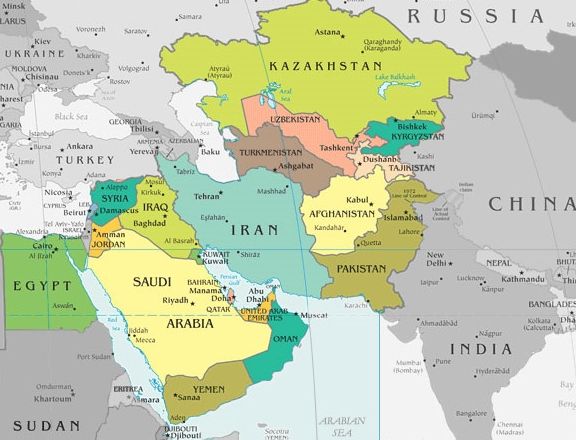
CENTCOM countries (coloured)
First he dealt with Kazakhstan with which the US has its “most advanced military relationship in Central Asia” in furtherance of which Washington is “making notable progress… despite enduring Russian influence.” It is obviously unacceptable to the Pentagon that Russia wishes to maintain cordial relations with a country with which it has a border of 6,800 kilometres. Then General Votel went into fantasyland by claiming that “Kazakhstan remains the most significant regional contributor to Afghan stability…” which even the members of the Congressional Committee would have realised is spurious nonsense.
But more nonsense was to follow, with General Votel referring to Kyrgyzstan in patronising terms usually associated with a Viceroy or other colonial master of a region that Votel describes as “widely characterized by pervasive instability and conflict,” which he failed to note were caused by the US wars in Afghanistan and Iraq.
He told the Committee that Kyrgyzstan “sees political pressure from its larger, more powerful neighbours, including Russia, hosting a small Russian airbase outside the capital, Bishkek. Despite ongoing challenges in our bilateral and security cooperation, we continue to seek opportunities to improve our mil-to-mil relationship.” He did not explain why Kyrgyzstan should be expected to embrace a military alliance with United States Central Command, but Viceroys don’t have to provide explanations.
Votel then moved to consider Tajikistan with which “our mil-to-mil relationship is deepening despite Moscow’s enduring ties and the presence of the military base near Tajikistan’s capital of Dushanbe, Russia’s largest military base outside of its borders.” Not only this, says Votel, but China (having a 400 Kilometre border with Tajikistan) has had the temerity to have “initiated a much stronger military cooperation partnership with Tajikistan, adding further complexity to Tajikistan’s multi-faceted approach to security cooperation.”
No: China hasn’t added any complexity to Tajikistan’s circumstances. What has complicated their relations is the fact that Afghanistan is in a state of chaos, following the US invasion of 2001, and drugs and terrorists cross the border (1,300 kilometres long) from Afghanistan into Tajikistan, which is trying to protect itself. During its sixteen years of war in Afghanistan there has been no attempt by the United States to secure that border.
None of these countries wants to be forced into a military pact with the United States, and Turkmenistan (border with Afghanistan 750 kilometres) has made it clear it doesn’t want to be aligned with anyone. But General Votel states that its “UN-recognized policy of ‘positive neutrality’ presents a challenge with respect to US engagement.” No matter what is desired by Turkmenistan, it seems, there must always be a way for the United States Central Command to establish military relations and, as General Votel told the Defence Committee, “we are encouraged somewhat by Turkmenistan’s expressed interest in increased mil-to-mil engagement with the US within the limits of their ‘positive neutrality’ policy.”
In the minds (to use the word loosely) of General Votel and his kind, it doesn’t matter if a country wants nothing whatever to do with the United States’ military machine, and wants very much to be left alone to get on with things without any interference. Adoption of such a policy by any nation presents a “challenge” and the United States, which in this region is overseen by General Votel’s Central Command, is determined to seek military “engagement” irrespective of what is desired by governments. Arms sales would swiftly follow.
Votel’s tour of his area of responsibility covered Afghanistan, about which his most absurd assertion was “I believe what Russia is attempting to do is they are attempting to be an influential party in this part of the world. I think it is fair to assume they may be providing some sort of support to [the Taliban] in terms of weapons or other things that may be there.”
There was not a shred of evidence provided, but the Committee accepted the pronouncement. Obviously if an allegation is made about Russia it doesn’t matter if it is false. It must be believed. But unfortunately for the imperial Votel and his deferential audience, a person with some sense of truth and balance came up two months later with a statement rubbishing Votel’s unfounded and provocative accusation. In May the Director of the US Defence Intelligence Agency told a Senate Committee that “We have seen indication that [Russia] offered some level of support [to the Taliban], but I have not seen real physical evidence of weapons or money being transferred.” The mainstream media gave no publicity to the truth, and continue to blame Russia for all the ills that befall the US Empire, at home and overseas.
The state of affairs was summed up admirably by Jacob Hornberger of the Future of Freedom Foundation on December 4 when he wrote that “Central to any national-security state is the need for official enemies, ones that are used to frighten and agitate the citizenry. If there are no official enemies, the American citizenry might begin asking some discomforting questions: What do we need a national-security state for? Why not abolish the CIA and dismantle the military-industrial complex and the NSA. Why can’t we have our limited-government, constitutional republic back?”
The Motto of the Pentagon’s Central Command is “Prepare, Pursue, Prevail.” and the Central Asian Republics would be well-advised to bear in mind these threats and think hard about the underlying motif of the US military-industrial complex which is “Propagandise, Provoke, Profit.”
Afghanistan is ripe for proxy war

By M K Bhadrakumar | Indian Punchline | August 20, 2017
Russia has hinted in the past that the United States is covertly sponsoring the Islamic State in Afghanistan. On Thursday, the Russian Foreign Ministry spokesperson raised the bar by alleging that “foreign fighters” who were transferred by “unknown helicopters” have perpetrated a massacre of Hazara Shias in the Sar-e-Pol province in northern Afghanistan. The spokesperson said:
- We can see attempts to stir up ethnic conflict in the country… Cases of unidentified helicopter flights to territory controlled by extremists in other northern provinces of Afghanistan are also recorded. For example, there is evidence that on August 8, four helicopters made flights from the airbase of the Afghan National Army’s 209th corps in Mazar-i-Sharif to the area captured by the militants in the Aqcha district of the Jowzjan province. It is noteworthy that witnesses of these flights began to fall off the radar of law enforcement agencies. It seems that the command of the NATO forces controlling the Afghan sky stubbornly refuses to notice these incidents.
From the above, it appears that sections of the Afghan armed forces and the NATO command (which controls Afghan air space) are hand in glove in these covert operations. No doubt, this is a very serious allegation. The attack on the Hazara Shias must be taken as a message intended for Tehran. Historically and culturally, Iran has affinities with the Hazara Shia community in Afghanistan. Possibly, the Trump administration, which has vowed to overthrow the Iranian regime, is opening a ‘second front’ by the IS against Iran from the east.
Interestingly, the Russian Foreign Ministry also issued a statement on Friday on the alarming drug situation in Afghanistan. It pointed out that:
- A sharp increase in drug production is expected in Afghanistan this year and one-third of the country’s population is now involved in cultivation of opium poppy.
- The geography of the Afghan drug trafficking has expanded and now reaches the African continent.
- Tonnes of chemicals for processing narcotics are illegally imported into Afghanistan – with Italy, France and Netherlands “among main suppliers”.
- The US and NATO are either unwilling or incapable of curbing the illegal activity.
Russia and Iran cannot turn a blind eye to the hostile activities by the US (and NATO) in their backyard, transforming the anti-Taliban war into a proxy war. They cannot but view the Afghan conflict through the prism of their deepening tensions with the US.
What are Russia’s options? The Russian Defense Minister Sergei Shoigu said at a meeting with the top brass in Moscow on August 18 that the Afghan conflict poses a threat to Central Asia’s stability. He said that Russia plans to hold joint military exercises later this year with Kyrgyzstan, Tajikistan, and Uzbekistan. Russia has military bases in Tajikistan and Kyrgyzstan.
Again, Ambassador Zamir Kabulov, Russian presidential envoy to Afghanistan, said recently that if the Afghan government and the US are unable to counter the IS threat, Russia will resort to military force. Kabulov disclosed that Russia has raised in the UN Security Council the air dropping of supplies for the IS fighters in at least three provinces in northern Afghanistan by unidentified aircraft.
Of course, it is inconceivable that Russia will put “boots on the ground” in Afghanistan. But if the IS breaches the borders of the Central Asian states, it becomes the “red line”, Russia will hit back. Russia is reinforcing its bases in Kyrgyzstan and Tajikistan. Significantly, in a joint military exercise with Tajikistan in July, Russia tested its Iskander-M short-range ballistic missiles, one of the most advanced weapons in the Russian arsenal, with a range of 500 kilometers and a payload of 700 kg. Iskander is equipped with terminal guidance systems with the capability to overcome missile defences. Iskander’s accuracy could be better than 10 meters. (Russia has deployed the deadly weapon to Syria.)
With the exit of White House strategist Steve Bannon, an inveterate anti-war ideologue in the Trump administration who wanted the Afghan war to be brought to an end, the generals now have the upper hand in controlling the US policy. Defence Secretary James Mattis and National Security Advisor HR McMaster favour deployment of additional troops to Afghanistan. The ‘known unknown’ is John Kelly, whom Trump recently appointed as his chief of staff. But there are enough indications that Kelly (a retired Marine Corps general and father of a fallen Marine, 1st Lt. Robert Kelly, who was killed in Afghanistan in 2010) almost certainly shares the opinion of Mattis and McMaster.
The more one looks at it, President Donald Trump’s real challenge is not about winning the war against the Taliban, but the high risk he’ll be incurring, by taking his generals’ advice, to put his imprimatur on a full-fledged proxy war in Afghanistan against Russia, Iran and China.
Top General Warns That NATO Wants to Turn Post-Soviet Space ‘Into Another Syria’
Sputnik – 08.09.2016
A top Russian general has voiced his frustration over NATO’s lack of cooperation with a Russian-led alliance involving countries from the former Soviet space, saying that the Western alliance doesn’t seem to want countries in the former USSR to ally with one another, allowing NATO pick them off one by one at their leisure.
Speaking at a press conference in Moscow on Wednesday, Col. Gen. Nikolai Bordyuzha, secretary general of the Collective Security Treaty Organization, a military alliance involving six post-Soviet states, including Russia, Belarus, Armenia, Kazakhstan, Kyrgyzstan and Tajikistan, had some harsh words for Russia’s NATO partners.
The North Atlantic Alliance, he said, has been consistently opposed to any military integration between Russia and its partners in the CSTO, and the reason is that NATO wants to deprive these countries of their collective security guarantees.
“Why do you think NATO does not cooperate with the CSTO?” the general asked. “It’s simple – they have no need to support processes of [defense] integration. This way, things will be like in Syria, and nobody will be able to let out a peep. The country is being pounded, and there’s no one to help them, since it didn’t have any allies. And this is the situation they want to create for us as well,” Bordyuzha said, referring to the members of the CSTO.
Furthermore, the officer warned that the Western media has been engaged in what he called campaign of information warfare against the CSTO. “They will tell lies all day, every day. Everything that is being said about the CSTO is presented in a way that’s the opposite to how things are in reality,” Bordyuzha noted. “This is done, for example, in order to ensure that Tajikistan was not together with Russia,” he added.
Ultimately, Bordyuzha suggested that the Western political, media and military effort’s “most important task is to splinter our unity, to separate our nations into our own ‘national apartments’, and to dictate their terms to everyone individually.”
In this scenario, the officer emphasized that while the CSTO has absolutely no plans to fight a war of aggression against NATO, neither does it fear an attack by the Western alliance. “That’s why the CSTO exists,” Bordyuzha quipped.
The Collective Security Treaty Organization, formed in 1992, shortly after the collapse of the Soviet Union, integrates the defense capabilities of six former Soviet republics, including Russia, Belarus, Armenia, Kazakhstan, Kyrgyzstan and Tajikistan. Afghanistan and Serbia became observers to the organization in 2013. Former members include Azerbaijan, Georgia and Uzbekistan.
Signatories to the alliance are not able to join other military alliances, and aggression against one member is considered aggression against all.
The CSTO holds yearly command exercises and drills to improve coordination between its states militaries, the most recent being Cooperation-2016, which took place last month in Russia’s Pskov region.
Hybrid Wars 4. In the Greater Heartland (III)
By Andrew KORYBKO | Oriental Review | April 8, 2016
(Please read Part I and Part II prior to this article)
Turkmenistan:
The threat facing Turkmenistan is less of a Color Revolution than an Unconventional War. The catalyst for this conflict would be a terrorist invasion coming from Afghanistan that unexpectedly sweeps northwards along the Murgab River. Such an offensive doesn’t even have to reach the national capital in order to be successful, since all that it really needs to do is capture the city of Mary, the capital of the resource-rich Mary Region. This part of the country contains the lion’s share of Turkmenistan’s gas reserve, which includes the massive and decades-long functioning Dauletabad Field and the newly discovered Galkynysh Field, the latter being the world’s second-largest find.
It wouldn’t be all that difficult for terrorists to take over this plot of land either, since the Murgab River is scattered with tiny villages along its banks that could provide cover from government airstrikes and places to provoke pitched battles from. The fertile land nearby is endowed with agricultural potential that’s surely being stored somewhere closely accessible, and this could help feed the occupying forces until greater conquests are made. In short, the Murgab River is the most militarily and logistically sustainable route for an ISIL-like invasion of Turkmenistan, and it leads straight to the gas heart of Eurasia that’s critically connected to China and will possibly be linked to India in the coming decade as well.
The risk of terrorists gaining control of the largest source of China’s gas imports and possibly even destroying the facilities is too much for multipolar strategists in Beijing and Moscow to bear, and it’s assured that they’ve already engaged in some sort of unofficial contingency planning with their counterparts in Ashgabat. An anti-terrorist Chinese intervention is largely precluded due to geographic distances and a lack of support and logistics facilities en route, but the Russian military has no such hindrances and would be much more likely to assist the Turkmen authorities if called upon to do so. This is of course a last resort and would only be commissioned if Turkmenistan proves itself unable to stem the terrorist tide and defend its gas infrastructure, but such an event is most assuredly being planned for just in case the Turkmen-Afghan border proves to be just as fragile of a defense against terrorists as the Syrian-Iraqi one was before it.

Kazakhstan:
Kazakhstan and the other three remaining states of former Soviet Central Asia are greatly at risk of a “Central Asian Spring” breaking out in the Fergana Valley, and Part IV of the Greater Heartland series will focus exclusively on this ever likely scenario. Accordingly, the rest of this section will explore the other Hybrid War vulnerabilities facing these four countries.
The geographically largest state in the Greater Heartland region is surprisingly immune from many of the conventional socio-political factors that lead to Hybrid Wars (excluding the variables that will later be discussed about the “Central Asian Spring”). If one was blind to the domestic and international contexts pertinent to Kazakhstan, then they’d be inclined to believe that the Russian population constitutes the greatest threat to the country’s sovereignty, although this couldn’t be anywhere further from the truth. Theoretically speaking, this demographic satisfies all of the criteria necessary for sparking a Hybrid War, but Kazakhstan’s multipolar alignment with the Eurasian Union and respectful treatment of this influential minority group precludes any chances that they or Russia would ever try to move forward with this scenario. On the reverse, the very inclusion of such a large Russian minority within Kazakhstan ties Astana and Moscow closer together than just about any other state in the former Soviet Union and works to enhance, not deteriorate, relations between them.
The only vulnerability in this relatively secure setup is if the US and its proxy NGO affiliates succeed in brainwashing the Russian-Kazakh population with Pravy Sektor- and Navalny-esque extreme nationalism, which could then create a delicate geopolitical situation where the raucous Russian minority agitates against Astana and attempts to drive a wedge between Kazakhstan and Russia. Security officials in both states are likely well aware of this obvious scenario and can be predicted to have rehearsed coordinated contingency measures for responding to it. Nonetheless, if such a virulent, discriminatory, and destructive ideology as “Greater Russian Nationalism” is allowed to fester in multicultural Kazakhstan and parts of the Russian Federation itself, then a scandalous outbreak in the Near Abroad could provoke a simultaneous cross-border event inside of Russia, especially if ‘sleeper sympathizers’ organize anti-government protests against Moscow’s “betrayal” of its compatriots out of its refusal to replicate the Crimean scenario in Northern Kazakhstan.
Another destabilization possibility that mustn’t be discounted in Kazakhstan is a repeat of the Zhanaozen riots, the ‘localized’ Color Revolution attempt that was sparked by a simmering labor dispute in 2011. The oil field workers were fed up with what they complained to be poor working conditions, low wages, and unpaid salaries, and this created an attractive atmosphere for Color Revolutionaries to exploit. Keeping with Color Revolution tradition, the riots started on 16 December, the 20th anniversary of Kazakh independence, and were presumably expected to signal the beginning of the regime change attempt to other cells across the country, almost one year to the day that the “Arab Spring” Color Revolution first broke out in Tunisia.
Seething with preexisting anger, the workers were extraordinarily easy to exploit, and the carnage they committed killed over a dozen people and injured more than 100 before a state of emergency and necessary military intervention restored order. The authorities’ decisive reaction and the multicultural, patriotic identity of most Kazakhs can be credited with preventing the spread of the Color Revolution virus from the distant Turkmen border all the way to centrally located capital, but the strategic lessons that can be learned from this episode are that: labor disputes and organizing could be both a cover and spark for a Color Revolution; and that destabilizations could start outside of the major cities and originate in the far-flung provinces.
Kyrgyzstan:
This tiny mountainous republic is notably split along a steep North-South divide, with the capital of Bishkek being located along the northern plains while the major population centers of Jalal-abad and Osh reside in the southern Fergana Valley. The clan-based nature of Kyrgyz society has played a strong role in influencing the political system, and this has consequently created identity resentment among whichever group was disproportionately underrepresented at the given moment. Although the situation has relatively stabilized and become somewhat more ‘equitable’ since the 2010 Color Revolution, clan-based tension and its geographic affiliations are still deeply ingrained in the national psyche, and any visible calmness simply belies the aggravating tensions that lay just beneath the surface. As confirmation of this assessment, one need only remember the misleading “stability” that many had inaccurately judged to be prevalent in the country just prior to the 2005 and 2010 Color Revolutions, and after witnessing the ferocious clan-based and ethnic violence that exploded after each of them, it’s improbable to assume that the individual drivers of such identity conflicts simply disappeared on their own after only half a decade.
What really happened is that they went underground as usual and abstained from the national discourse, while still remaining psychologically mobilized and ready to act the moment a future destabilization distracts or dissolves the security forces and provides another strategic opening for settling unresolved blood feuds that still linger from last time. The most violent-prone area of Kyrgyzstan is its southern Fergana region that abuts Uzbekistan, and it’s here where radical Islamic elements have taken root. The difficulty in forcibly eradicating them is that any major Kyrgyz security operation so close to the Uzbek border, let alone one that potentially targets ethnic Uzbeks, could create a hostile impression towards much-stronger Uzbekistan, which in turn could use the events as a pretext for activating a prearranged plan to mobilize in response to the ‘human rights violations’ allegedly being committed against its ethnic compatriots. Tashkent’s geopolitical loyalty has always been nebulous and ill-defined, and the country’s been working more closely with the US ever since the 2014 drawdown in Afghanistan. Washington needs a Lead From Behind partner in Central Asia, and it’s possible that Uzbekistan has been designated this role, which if it doesn’t comply with, could lead to the “Central Asian Spring” scenario that will soon be discussed.
To return to the Hybrid War threats facing Kyrgyzstan, it’s important to highlight that the country’s mountainous terrain is very accommodating to guerrilla warfare. The southern mountain ranges are sparsely populated and the government barely has any presence in some of the more isolated areas. Looking at the regional geography at play, it’s conceivable that Fergana-based terrorists could receive weapons and fighters from Afghanistan by taking advantage of the lack of governance present in Southern Kyrgyzstan and Tajikistan’s Gorno-Badakhshan Autonomous Region. After all, this route is already used to smuggle tons of drugs, so it’s certainly possible that it could be used to transport terrorists and weapons along the way as well (if this isn’t being done already). It’s very difficult for the Kyrgyz authorities to exert full control over this region because of tight financial and human resources, a current prioritization on the more populated areas, and the inhibitive geography involved.
To emphasize the last point, wintertime typically renders all of the few north-south roads impassable and strands the mountainous southern-based citizens in their villages for the duration of the season. This effectively splits the country into two, and if timed to coincide with a Hybrid War, then it could give the regime change insurgents active in that region enough time to consolidate their gains and prepare for the hostilities that would inevitably recommence after the snow melts in spring. When one thinks of a terrorist-driven “caliphate”, the last thing that probably comes to mind is a mountainous, snow-covered retreat, but this is exactly what ISIL or any likeminded group could feasibly create in Southern Kyrgyzstan if they played their cards ‘right’. It would be extremely challenging to dislodge the terrorists in such a scenario, and the danger in doing so would critically spike if it were revealed that they had access to anti-aircraft weapons. The Kyrgyz military would obviously be unsuited for such a difficult task and would have to resort to their Russian partners in the CSTO for assistance, with Moscow predictably helping through a combination of drone surveillance and air strikes just as it’s currently doing in Syria at the moment.
Tajikistan:
The threat facing Tajikistan is structurally similar to the one in Kyrgyzstan, and it’s that the country’s large swath of mountainous geography could be exploited by terrorist groups in facilitating smuggling routes or providing cavernous shelter. It goes without saying that Tajikistan’s border with Afghanistan is perhaps its greatest vulnerability, but some respite could be found in the fact that there are more ethnic Tajiks in Afghanistan than in Tajikistan, and that if this community were properly mobilized to its fullest extent, then it could provide an effective bulwark against the Taliban and other terrorist groups. At the moment, however, this doesn’t seem to be the case, since the Taliban was able to briefly capture the northern provincial capital of Kunduz at the end of September and achieve their greatest military success since 2001.
Up to this point, it had been largely assumed that this part of Afghanistan was the least welcoming to the Taliban owing to the valiant history of the Northern Alliance and the relatively secular Tajik community that inhabits the region. What Kunduz taught observers is that these two factors are no longer the strongest determinants of regional security, and that the Taliban has succeeded in the past decade and a half in proselytizing their ideology, gaining sympathizers, and infiltrating enough fighters into the area so as to set up an effective base of operations. The converts that they’ve claimed, the supporters that they’ve acquired, and the terrorists that they’ve relocated to Northern Afghanistan all played an integral role in the Taliban’s capture of Kunduz, and just because they had to conventionally retreat from the city doesn’t mean that their soft infrastructure had to withdraw as well. The reason that this is relevant to Tajikistan is that it proves that the Taliban have a strong presence right along the Amu Darya river border and that fears about their cross-border militant potential are not misplaced.
More domestically, however, the greatest threat comes from the Islamic Renaissance Party, the newly banned organization that represented the last legal party of political Islam in the region. The process was in the works for a while, but ultimately it was decided that the group was full of terrorists and needed to be shut down as soon as possible, with the decision being spurred by rogue former Deputy Defense Minister Abdukhalim Nazarzoda’s coup attempt earlier that month. He and a group of followers slaughtered over 30 soldiers in the capital of Dushanbe before fleeing into the mountains where they were finally hunted down and killed a week later. The subsequent investigation revealed that the deputy head of the Islamic Renaissance Party, Mahmadali Hayit, had consorted with the coup plotters earlier in the year and that 13 members of the party were suspected of being involved in the attacks, so it makes absolute sense that the organization would be outlawed soon thereafter in the interests of national security. At the same time, however, the proclamation came so abruptly that the authorities didn’t have time to completely extinguish the organization, and countless sympathizers and probable sleeper cells can be assumed to be embedded in society. Whether they’ll make the transition to militant action on behalf of the terrorist organization or repent for their prior allegiance to it and disown its ideology remain to be seen, but the actionable threat remains nonetheless and is obviously a destabilizing factor that could be leveraged in any coming Hybrid War against Tajikistan.
Uzbekistan:
Aside from the “Central Asian Spring” scenario that will be detailed in Part IV, there are still quite a few other Hybrid War threats facing the region’s largest country. Uzbekistan is first and foremost threatened by a complete breakdown in law and order stemming from a succession crisis after the passing of Islam Karimov. The author previously explored the contours of these chilling possibilities in his piece “Uzbekistan’s Bubbling Pot Of Destabilization”, but to concisely summarize, the clan-based nature of Uzbek society coupled with the competition between the National Security Service and the Interior Ministry creates a cataclysmic scenario where a black hole of disorder arises in the heart of Central Asia and rapidly spreads throughout the rest of the region.
The only thing that could stop the previously held-together society from dramatically decentralizing down to Somalian-style warlordship would be the rapid reconsolidation of power under one of the two competing security agencies, but since their rivalry could predictably intensify in the days following Karimov’s death (and with the resultant security breakdown this would entail if they focus more on one another than on their designated subjects), it can’t be precluded that Uzbekistan could unravel before anyone realizes what even happened. Of course, if Karimov publicly designates a successor prior to his death or steps down and allows his designee to rule before then, this could potentially assuage the risks inherent in this scenario, but it doesn’t look too likely that this would happen, nor would these steps prevent the rival agency from attempting a major power play the moment the ‘head honcho’ inevitably dies anyhow.
Parallel with this possible tumult could be an explosion of terrorism from the Islamic Movement of Uzbekistan, Hizb ut Tahrir, ISIL, the Taliban, some yet-to-be-named organization, and/or a combination of these groups, which would exacerbate the already deteriorating security situation in the country and divide the security services’ focus even more. There’s also the likelihood that the Taliban or ISIL might even make a conventional move on Uzbekistan amidst the greater breakdown of regional order, which in that case would usher in a global crisis similar to the one that transpired when ISIL crossed into and began conquering Iraq.
Therefore, true to the theory of Hybrid War, any type of social disruption in the tightly controlled Uzbek society, be it through a Color Revolution, succession crisis, or a combination of factors, would create a tantalizing opportunity for Unconventional Warriors to rise up against the state and increase the odds of regime change. In this case, if there’s no real government in power at the moment, then it would prolong the “regime vacuum” and amplify country’s disorder until it reaches the critical point of spreading to its neighbors. Therefore, in such a scenario as the one previously described, it’s important for some leader or leading entity (e.g. military junta) to assume power as soon as possible in order to preempt a regional breakdown. In hindsight, it was precisely this quick emergence of leadership, however weak and fragmented, that emerged in Kyrgyzstan after the 2010 Color Revolution that helped to miraculously contain the chaos and prevent it from turning into a “Central Asian Spring”.
Before addressing this curious concept that’s been alluded to a few times already, it’s necessary to briefly touch upon a minor socio-political factor in Uzbekistan that shouldn’t be overlooked when discussing forthcoming disorder there. The autonomous republic of Karakalpakstan is a little-known administrative entity in the former Soviet Union that handsomely sits atop rich oil and gas reserves and provides transit to two energy pipelines to Russia. The dried-up majority of the Aral Sea has endowed the region even more oil and gas than was previously accessible, meaning that Karakalpakstan will likely become more important than ever to the Uzbek state.
Still, its energy potential isn’t the exact reason why the autonomous republic is brought up when discussing Hybrid War scenarios, since there lately have been whispers of a Karakalpakstan “independence” movement that provocatively wants to join Russia. In all probability, this isn’t a genuine movement but rather a proxy front controlled by the US to advance the objective of straining the already frayed ties between Russia and Uzbekistan. The appearance of a “pro-Russian” separatist organization at the crossroads of Uzbekistan, Kazakhstan, and Turkmenistan isn’t incidental, and its’ designed to destabilize the entire region if ever given the opportunity. On its own, the Karakalpakstan “independence” movement is powerless to do anything to upset the Central Asian balance, but in the event that the eastern more populated part of the country descends into bedlam following one or some of the abovementioned scenarios, then it’s likely that this group will emerge from the shadows (or more likely, be parachuted or infiltrated into the theater) to violently lay stake to its secessionist claim so that it can then transform into an American protectorate.

To be continued…
Andrew Korybko is the American political commentator currently working for the Sputnik agency. He is the post-graduate of the MGIMO University and author of the monograph “Hybrid Wars: The Indirect Adaptive Approach To Regime Change” (2015). This text will be included into his forthcoming book on the theory of Hybrid Warfare.
Featured Video
Why the U.S. Should Pull Back From the First Island Chain
or go to
Aletho News Archives – Video-Images
From the Archives
Only 19.7% of Americans agree with US State Dept on Israeli settlements
… Most American adults of voting age don’t appear willing to reject the applicability of international law to Israel’s ongoing colonization of occupied territories in East Jerusalem, the West Bank and Golan Heights. … Full article
Blog Roll
 Aletho News
- British Government Employees Were Fact-Checking the News at the BBC. Nobody Told You.
- Albania on fire: who’s behind the riots?
- Egypt’s Civil Democratic Movement rejects involvement in regional war
- Egypt collaborates with Israel to build ‘Green Rafah’ project over erased Palestinian city
- Rising fuel prices and shortages have helped drive ongoing protests and rioting in France
- Tokyo protests demand Takaichi’s resignation over support for ‘Israel’
- Jennifer Kavanagh: Why the U.S. Should Pull Back From the First Island Chain
- Yemen denounces international community’s silence on Saudi aggression, siege
- UAE and Saudi Arabia move toward renewed coordination against Sanaa
- How Iran’s two-week retaliatory strikes exposed cracks in US military architecture in Persian Gulf
- If Americans Knew
- More on how Bari Weiss is using CBS on behalf of Israel
- What the UK Is Doing to Pro-Palestine Novelist Sally Rooney Is an Act of Orwellian Villainy
- ‘We will build palaces for Jews in Gaza’: Right-wing activists establish new outpost near border
- ‘You see us burning, you stay silent’: Family’s agony over mother and sons burned to death in Gaza tent
- Israel keeps Palestinian journalist Bushra al-Tawil in isolation for 46 days
- US-Israel integration plan puts US military tech in Israel’s hands
- Israeli Strike Burns Gaza Mother Alive in Front of Toddler, ‘Without Generating Any Headlines’
- ‘The Israel Experience with Mike Huckabee’: The Ambassador’s Family Sells Trips to Israel
- As Gazans carry out mass burial, food insecurity is getting worse – Daily Update
- Israeli rabbi permits occupiers to steal Palestinian olive harvest in West Bank
- No Tricks Zone
- Predictions Made By Renowned Climate Proifessor Over Past Decades Have Been Proven To Be Poor
- New Study Suggests Large Regions Of The Pacific Ocean Have Been Cooling For The Last 80 Years
- Germany’s Green Energy Debacle: High Energy Costs Force Kahla Porzellan to Close After 182 Years!
- New Study: 50 Years Of The Most Aggressive ‘Net Zero’ Policies Can Only Affect The Global Climate By 0.03°C
- US September “Heat” Was No Record…Many Records Set Decades Ago
- Latest European Green Energy Debacle; Portugal’s Largest Flagship Solar Park Insolvent!
- Green Energy Debacle: German Expert Professor Fritz Vahrenholt Warns Of Severe Economic And Social Consequences
- Two More Paleo Reconstructions Affirm Meters-Higher Sea Levels Across Ireland, Brazil 7000-6000 Years Ago
- New Study: Earth And Venus Surface Warmth Largely Explained By Convection And Lapse Rate, Not CO2 Or Radiation
- 2025 Nature Paper Claiming Worsening Global Drought Gets RETRACTED …Heavily Flawed

