STL defense dismisses prosecution’s “circumstantial” evidence
Al-Akhbar | January 17, 2014
The defense counsel of four Hezbollah members accused of planning the 2005 assassination of former Lebanese Prime Minister Rafik Hariri dismissed evidence presented by the prosecution over Thursday and Friday as unverifiable “observations.”
Prosecutors offered nothing new during their opening arguments, the defense team said at a press conference Friday evening after the Special Tribunal for Lebanon (STL) went to recess.
“There is nothing new in the presentation the prosecutor presented at the beginning of the trial,” Antoine Korkmaz, one of the defense lawyers for the suspects being tried in absentia, told reporters.
“We have not heard anything about the content of the conversations that the prosecutor claims were made between the defendants,” he added.
“The burden of proof lies with the prosecution,” and so far it has only provided circumstantial evidence that does not prove the suspects were behind the bombing that killed Hariri and 21 others on February 14, 2005.
Nor did the prosecutor explain the motive behind the killing of Rafik Hariri, he added, saying that the billionaire maintained good relations with Hezbollah before his assassination.
“The evidence presented by the prosecutor is only theoretical,” defense lawyer Yasser Hassan added. “We have not seen anything new, and there is no court that could issue convictions on the basis of speculation.”
The defense will present their counter arguments when The Hague-based court resumes on Monday.

Ariel Sharon: His Sabra and Shatila Legacy – An Eye Witness Account
By Felicity Arbuthnot and Dr. Ang Swee Chai | Palestine Chronicle | January 15, 2014
As Israel buried Ariel Sharon amid eulogies from world figures, Tony Blair, a Butcher of Baghdad, paid a tribute to the Butcher of Beirut which included the line that Sharon: “didn’t think of peace as a dreamer, but did dream of peace.” Also that: “ … he sought peace with the same iron determination” as he had fought (read slaughtered, across the Middle East.) Re-writing history does not come more blatant, but Blair was ever good at fantasy, think “weapons of mass destruction” and “forty five minutes.”
Surgeon, Dr Swee Chai Ang went to help the wounded of Beirut after the 1982 Israeli invasion and witnessed the Sabra and Shatila massacre of unarmed men woman and children, Palestinian and Lebanese, between the 15th-18th September,1982.
In her book “From Beirut to Jerusalem”, she describes the reality:
“As I walked through the camp alleys looking at the shattered homes (many of these houses had just been rebuilt following earlier bombardments by Israel) I wanted to cry aloud, but was too exhausted emotionally even to do that. How could little children come back to live in the room where their relatives were tortured and then killed? If the Palestinian Red Crescent Society could not function legally, who was going to look after the widows and orphans?
“Suddenly, someone threw his arms around me. It was Mahmoud, a little child who had broken his wrist while trying to help his father rebuild their broken home. He had survived and his wrist had mended, but now his father was dead. Mahmoud cried, but he was glad I was alive because, from his hiding place during the massacre, he had seen the soldiers taking us away. He thought they had killed me.
“Soon I was surrounded by a whole lot of children. Kids without homes, without parents, without futures. But they were the children of Sabra and the children of Shatila. One of them spotted my pocket camera, and wanted a picture taken. Then they all stood together, wanting their pictures taken. “They wanted me to show their picture to the people of the world. Even if they were killed and the camps were demolished, the world would know that they were the children of Sabra and Shatila, and were not afraid. As I focused my camera, they all held up their hands and made victory signs, right in front of their destroyed homes, where many had been killed. Dear little friends, you taught me what courage and struggle are about.”
Dr Swee Chai Ang founded Medical Aid for Palestine as a result of her experiences in Beirut and Sabra and Shatila. On the eve of Ariel Sharon’s burial, she wrote the following. It is published with her permission:
The passing of Ariel Sharon brought back the memories of the horrors of the Sabra Shatilla massacre of September,’82. I arrived in August that year as a volunteer surgeon to help the war victims of Lebanon. The people in Lebanon were wounded, made homeless and lost precious friends and families as the result of ten weeks of ruthless bombardment. That was the “Operation Peace for Galilee”, launched by Sharon who was then the Defence Minister of Israel in June 1982.
No one knew how many were killed as the result of that offensive – the London newspapers estimated a thirty thousand with many times more made homeless. When a ceasefire was agreed with the evacuation of the Palestine Liberation Organisation, Sharon broke that ceasefire and drove tanks under air-cover launching a land invasion into Lebanon’s capitol Beirut. Part of the tanks sealed Sabra Shatilla and prevented the helpless civilian victims from escaping, while sending in Israel’s allies into the camps to carry out the most brutal massacre of defenceless women, children and old people under Israel’s watch. The blame was quickly and deliberately shifted to the Lebanese as perpetrators of the massacres, so that today no one can mention that massacre without blaming the Lebanese Phalange, yet forgetting the Israeli organisers of that event.
I worked in Gaza Hospital in Sabra Shatilla during the massacre trying to save the lives of a few dozen people, but outside the hospital hundreds were killed. My patients and I knew that Sharon and his officers were in control, and without them the massacre would not be possible. The residents of Sabra Shatilla could at least have escaped. Now more than 30 years later, we know that the killers were brought in by Israeli armoured cars and tanks, obeyed Israeli commands, their paths lit by Israeli military flares, and some of them also wore Israeli uniforms. The mutilated bodies of the victims were thrown into mass graves by Israeli bulldozers.
This Sharon continued on to be Israeli Prime Minister, and built the Wall which imprisoned the Palestinians in the West Bank. Sharon’s Wall cut through their lands, separating people from their homes, children from their schools, farmers from their orchards, patients from hospitals, husbands from wives, and children from parents. He marched into the Al-Aqsa Mosque in Jerusalem 2000 with fully armed Israeli soldiers and tried to have the West believe that his intention was for peace.
He was responsible for other massacres such as in Jenin, Qibya and Khan Yunis just to name a few. The older generation in Khan Yunis in Gaza remembers that he killed all the grown men in the massacre of 1956 and left only the women and children to bury the dead.
I thought these facts should be publicised. Those who eulogise Sharon in his role of building Israel should also remember that he built his nation over the dead bodies of the Palestinian people, and the continued dispossession of those who are still alive.
– Dr Ang Swee Chai is the author of From Beirut to Jerusalem, Published by International Librarie, Beirut12 January 2014.
– Felicity Arbuthnot. is a journalist and activist who has visited the Arab and Muslim world on numerous occasions. She has written and broadcast on Iraq, her coverage of which was nominated for several awards. She was also senior researcher for John Pilger’s award-winning documentary Paying the Price: Killing the Children of Iraq.
Related articles
The Whitewashing of Ariel Sharon
By Ramzy Baroud | Palestine Chronicle | January 13, 2014
The death of former Israeli leader Ariel Sharon enlivened US media’s interest in the legacy of a man considered by many a war criminal, and by some a hero. In fact, the supposed heroism of Sharon was at the heart of CNN coverage of his death on January 11.
Sharon spent his last eight years in a coma, but apparently not long enough for US corporate media to wake up from its own moral coma. CNN online’s coverage presented Sharon as a man of heroic stature, who was forced to make tough choices for the sake of his own people. “Throughout, he was called ‘The Bulldozer’, a fearless leader who got things done,” wrote Alan Duke.
In his article, “Ariel Sharon, former Israeli Prime Minister, dead at 85″, Duke appeared to be confronting Sharon’s past head on. In reality, he cleverly whitewashed the man’s horrendous crimes, while finding every opportunity to recount his fictional virtue. “Many in the Arab world called Sharon ‘the Butcher of Beirut’ after he oversaw Israel’s 1982 invasion of Lebanon while serving as defense minister,” Duke wrote.
Nevertheless, Sharon was not called the “The Bulldozer” for being “a fearless leader” nor do Arabs call him “the Butcher of Beirut” for simply “overseeing” the invasion of Lebanon. Duke is either ignorant or oblivious to the facts, but the blame is not his alone, since references to Sharon’s heroism was a staple in CNN’s coverage.
Sharon’s demise however, and the flood of robust eulogies will neither change the facts of his blood-soaked history, nor erase the “facts on the ground” – as in the many illegal colonies that Sharon so dedicatedly erected on occupied Palestinian land.
Following the Israeli occupation of Gaza along with the rest of Palestine in 1967, Sharon was entrusted with the bloody task of “pacifying” the headstrong Strip as he was the head of the southern command of the Israel Defense Forces. Sharon was dubbed the “Bulldozer” for he understood that pacifying Gaza would require heavy armored vehicles, and Gaza’s crowded neighborhoods and alleyways weaving through its destitute refugee camps were not suited for heavy machinery.
Therefore, he resolved to bulldoze thousands of homes, preparing the way for tanks and bulldozers to move in and topple even more homes. Modest estimates put the number of homes destroyed in August 1970 alone at 2,000. Over 16,000 Palestinians were made homeless and thousands were forced to relocate from one refugee camp into another.
The Beach Refugee Camp near Gaza City sustained most of the damage. Many fled for their lives, taking refuge in mosques and UN schools and tents. Sharon’s declared objective was targeting the terrorist infrastructure. What he in fact meant was targeting the very population that resisted and aided the resistance, for they indeed were the very infrastructure he harshly pounded for many days and weeks.
Sharon’s bloody sweep also resulted in the execution of 104 resistance fighters and the deportation of hundreds of others. Some were sent to Jordan, others to Lebanon, and the rest were simply left to rot in the Sinai desert.
Sharon’s violence was part of an equally disturbing logic. He believed that any strategic long-term plan to secure Israel must have at its heart a violent campaign aimed at disorienting Palestinians. He was quick to capitalize on the Allon plan, named after Yigal Allon, a former general and minister in the Israeli government, who took on the task of drawing an Israeli vision for the newly conquered Palestinian territories.
Sharon recounted standing on a dune near Gaza with cabinet ministers, explaining that along with military measures to control the Strip he wanted “fingers” of settlements separating its cities, chopping the region in four. Another “finger” would thrust through the edge of Sinai, helping create a “Jewish buffer zone between Gaza and Sinai to cut off the flow of weapons” and divide the two regions in case the rest of Sinai was ever returned to Egypt. That legacy disfigured and isolated Gaza, even years after Sharon implemented his policy of unilateral “disengagement” in 2005. He relocated the settlers to other illegal colonies in the West Bank and imposed a hermetic siege on the Strip, the consequences of which remain suffocating and deadly.
Sharon was keen on espousing or exploiting the division of his enemies. He moved against Lebanon in 1982, when the country was at its weakest point, exhausted by civil war. And when Israeli forces finally occupied Lebanon in 1982, as Palestine Liberation Organization fighters were shipped by sea to many countries around the Middle East, a triumphant Sharon permitted his Christian Phalangist allies to enter the defenseless Sabra and Shatilla refugee camps.
In the days between September 16-18, 1982, as Israeli troops completely besieged the camps, the Phalangists entered the area and carried out a massacre that gruesomely defined both the Lebanese civil war and the Israeli invasion, killing thousands of Palestinian refugees, mostly butchered with knives, but also gunned down.
Although Sharon was partly discredited after his disastrous war in Lebanon, Israeli voters brought him back repeatedly, to lead the rightwing Likud party in May 1999 and as a prime minister of Israel in February 2001. The aim was to subdue rebelling Palestinians during the Second Intifada. In fact, it was Sharon’s provocative “visit” to one of Islam’s holiest shrines a few months earlier that sparked anger among Palestinians and, among other factors, started the uprising.
Sharon attempted to crush the uprising with the support and blessings of the US, but he failed. By the end of August 2001, 495 Palestinians and 154 Israelis were killed. International attempts at sending UN observer forces were thwarted by a US veto on March 27, thus paving the way for the Israeli army to thrash its way into Palestinian refugee camps and other areas formerly controlled by the Palestinian Authority.
In March and April 2002, Sharon ordered Operation “Defensive Wall”, which resulted in major military incursions into most West Bank cities, causing massive destruction and unprecedented bloodletting. The Israeli operation led to the killing of hundreds of Palestinians, the reoccupation of major Palestinian towns, the destruction of Arafat’s headquarters in Ramallah, and the subsequent besiegement of the Palestinian leader in his barely standing office.
Sharon was no hero. It is time for US media to wake up from its own coma, and confront reality through commonsense and the most basic human rights values. It should not be looking through the prism of the most rightwing, if not fascist elements of Israeli society.
– Ramzy Baroud is an internationally-syndicated columnist, a media consultant and the editor of PalestineChronicle.com. His latest book is My Father Was a Freedom Fighter: Gaza’s Untold Story (Pluto Press, London).
Related article
Ariel Sharon: the Israeli Napoleon who Never Was
By Shafiq Morton | Palestine Chronicle | January 14, 2014
Ariel Sharon, former Israeli Prime Minister, has passed on at the age of 85. After a lingering coma induced by a stroke in 2006, his body has finally shut down – and the curtain has fallen on what can only be described as a colorful, if not chequered career.
Although I never met him personally, Sharon’s presence appeared to haunt me wherever I went in the Middle East. Larger than life, his brazenness has seen him enjoying a career in which a bull in a china shop has seemed like a ballet dancer.
Indeed, no amount of apologetic obituaries will be able to wish away the fact that Ariel Sharon was one of Israel’s most belligerent political figures – the word “political architect” (as used by a US journalist) is certainly inflated language for a man whose solution in 2000 was to suggest the killing of arch foe Yasser Arafat.
Sentimental tributes written about him being an “avuncular figure”, a “warrior statesman” or a “complicated man” wrestling with the inevitability of a Palestinian settlement, are as authentic as Count Dracula being a teddy bear.
The truth is that the arrogantly imperial Sharon was never about peace. “Pragmatic” he may have been, but his chief business was ethnic separation between Israelis and Arabs. As a soldier this meant enforcement by the gun; and as a politician it meant concrete walls, razor wire and illegal settlements.
His response to Ehud Barak’s Camp David talks with PLO leader Yasser ‘Arafat is a typical example of his lack of subtlety. His Al-Aqsa mosque walkabout, accompanied by over 1,000 guards, lit the fires of the second Palestinian Intifada.
As I dig through old notebooks, Sharon’s name crops up time and again. Unit 101, a special “retaliation” force created by Prime Minister David Ben-Gurion – of which Sharon was a 25-year old major – features as prominently as the Deir Yasin massacre.
For in August 1953, Unit 101 attacked the Gazan refugee camp of Al-Bureij, killing at least 20 refugees. This was followed by Sharon leading the Qibya massacre in Jordan two months later. This time there were 69 fatalities with the victims, mainly civilians, being dynamited whilst in their homes.
The Qibya attack was condemned by the UN and the US State Department, but no-one was ever held accountable.
Sharon’s trail of destruction did not end there. In Gaza in 1971, as head of the IDF southern command, he’d bulldozed 2,000 homes, rendered 16,000 people homeless and assassinated over 100 resistance fighters.
As a politician his hand was no less heavy. The Negev Bedouin do not have happy memories of him as Agriculture Minister. In 1979 he declared a 1,500 square kilometer area a “national park”, denying the Bedouin access to their ancestral land.
He created a para-military unit called the Green Patrol that uprooted 900 Bedouin encampments and almost saw the extinction of the black goat, whose wool provided material for traditional nomad tents.
But it was in Lebanon that Sharon, as Defense Minister, became a household name. Space does not permit more than a summary background to Israel’s 1982 invasion, essentially aimed at chasing Yasser Arafat’s PLO out of the Levant and neutralizing the Syrian presence.
Bashir Gemayel, leader of the Kata’ib Party, had been voted into power with the help of western intelligence. Unfortunately, one of his neighbors was a Syrian agent, who blew him up whilst addressing party members. Sharon’s response to the assassination was to blame the Palestinians.
The PLO had just withdrawn from Beirut and Kata’ib – or Phalangist – forces were in the vicinity of the Sabra and Shatila, which were now defenseless Palestinian neighborhoods. In violation of a ceasefire accord, the Israeli IDF had reoccupied the area, sealing off Sabra and Shatila.
According to reports, Ariel Sharon and IDF chief of staff, Rafael Eitan, met with Phalangist units, inviting them to enter Sabra and Shatila. Hours later about 1,500 militias under the command of Elie Hobeika moved in. Watched by Israeli forces, and aided by IDF flares, the raping, mutilation and killing began.
All in all, it’s believed that about 2,000 people were massacred by Phalangist forces whilst the IDF looked on. The UN General Assembly condemned the killings as “genocide” and Israel’s own Yitzhak Kahan Commission fingered Sharon. However, Prime Minister Menachim Begin refused to fire him.
I visited Sabra and Shatila some 15 years after the massacre to do research for a book. Although some buildings were still burnt out and pockmarked with bullets, most of the neighborhood had been rebuilt.
But in the dark and cramped alleys there was still a somber mood. Those who’d survived asked why nobody had protected them and – unsurprisingly – had emotional difficulty recounting events. In Shatila I discovered that the mosque floor had been dug up to bury the dead because of lack of space.
I visited the main graveyard of the massacre, an open, cold space devoid of tombstones. “Too many bodies,” said my translator, “too many bodies.”
But that was not the end of the story. People kept on talking about a secondary massacre, when hundreds of people had been detained and questioned at the sports stadium, some disappearing without trace.
“There are hundreds bodies under the Rihab Gas Station,” I was told.
This took me by surprise, for not even The Independent’s Robert Fisk – who had reported on the stadium events – had spoken about this particular graveyard. Were these yet more trampled ghosts of Sharon’s past? I do not have the answer.
But who exactly was Sharon? The acerbic Israeli commentator, Uri Avnery, describes Sharon as an “Israeli Napoleon”, the ultimate integration of personal and national egocentrism. What was good for Sharon was good for national interest – and whoever wanted to stop him had to get out the way for Sharon, and Sharon alone, could save Israel.
He thought he was well on his way to doing this via Kadima when he met his Waterloo, a debilitating stroke that saw his dream of an ethnically cleansed Israel – with Palestinians finally crammed into Jordan and Gaza – condemned to an inter-space of chronic comatose incapacity between life and death.
– Shafiq Morton is an award-winning Cape Town photojournalist and author.
Related article
Saudi Arabia victim of US policies: Larijani
Press TV – January 6, 2014
An Iranian rights official says Saudi Arabia is a victim of US policies, urging Middle East countries not to support terrorists.
Speaking on the sidelines of a Monday conference in Tehran, Secretary-General of Iran’s High Council for Human Rights Mohammad-Javad Larijani said terrorist measures do not stem from the Middle East.
“Regional countries must know that by supporting terrorists they are only jeopardizing their own interests,” he added.
Regarding the recent bombings taking place in the region, Larijani said, “My position regarding these bombings is completely clear and I believe that the most part of their planning took place outside the region.”
He said Saudi Arabia is a victim of US policies and urged regional countries to stay away from American policies.
Larijani’s remarks come following a wave of terrorist bombings across the region, especially in Iraq, Syria and Lebanon, widely attributed to al-Qaeda-linked groups that are believed to be funded and supplied by Saudi Arabia.
Regional reports suggest al-Qaeda-linked terrorist and leader of the Abdullah Azzam Brigades Majed al-Majed, who was arrested in connection with the twin bombings near the Iranian embassy in Beirut on November 19, 2013 and later pronounced dead in a Lebanese military hospital- was a high-ranking official of Saudi Arabia’s intelligence service.
Media reports said Riyadh had put pressure on Lebanon to extradite al-Majed before his death in detention.
The Saudi terrorist had extensive secret information as he had been active in various countries such as Saudi Arabia, Iraq, Syria, Lebanon, Afghanistan and Pakistan and had direct cooperation or contact with mid- and high-ranking al-Qaeda leaders.
Related articles
Who Benefits from the Shatah Assassination?
By RANNIE AMIRI | CounterPunch | January 3, 2014
The burial of former Lebanese Finance Minister Mohammed Shatah next to assassinated ex-premier Rafic al-Hariri in Beirut’s Muhammad al-Amin mosque was as striking and deliberate in symbolism as the towering structure itself.
Last Friday’s assassination of the Hariri family’s senior advisor and one-time U.S. ambassador was by similar method: a massive car bomb detonated under his convoy as it drove through the heart of Beirut’s upscale downtown district. As if to purposefully underscore the parallels and frame the post-assassination narrative, it also occurred just a few hundred yards from the site where the billionaire Hariri was murdered in February 2005.
Just as after Hariri’s killing, the calculated recriminations of the March 14 coalition, led by the Future Movement, came fast and furious. Blame was laid squarely at the feet of Hezbollah. March 14 supporters were quick to point out that the crime took place less than three weeks before the Special Tribunal for Lebanon (STL; the U.N.-established court tasked with investigating the Hariri assassination) was set to open proceedings against four accused Hezbollah members.
The shoddy STL investigation, relying heavily on telecommunications data wholly compromised by Israeli intelligence and their captured agents, has been previously discussed.
Did the masterminds of the Shatah assassination hope the Lebanese population would turn against Hezbollah, already facing strong rebuke for its intervention in Syria by March 14 politicians (despite that the latter have implicitly lent support to radical takfiri elements involved in the Syrian conflict since its earliest days)?
As with all political upheavals in Lebanon, the question that must be asked is, “who benefits?” Does Hezbollah? Although Shatah was a stalwart March 14 operative who decried Hezbollah’s role in Syria, he was nevertheless regarded as a relative moderate. But the increasingly virulent sectarian discourse of those on the fringes of this political alliance (and many at its center) and the cover they have extended to extremists like fugitive Sheikh Ahmad al-Assir, cannot be ignored. Beirut after all, is still reeling from recent twin suicide car bombings at the Iranian embassy followed shortly thereafter by the assassination of Hezbollah senior commander Hassan al-Lakkis. On Thursday, innocent Lebanese civilians were again victims of a car bomb detonated in the Haret Hreik neighborhood of Beirut’s Shia-majority southern suburbs, known as the dahiyeh.
“Moderate” Sunni politicians like Shatah are viewed as expendable, for their killing only serves to polarize the wider Sunni community by inciting sectarian hatred and thereby marginalize more reasoned voices. Even Lebanon’s Grand Mufti was not spared as he was accosted after mourners’ passions were stoked by Sheikh Ahmad al-Omari, the cleric who delivered the sermon at the funeral of a young man also killed in the assassination. As Al-Akhbar reports, “Omari attacked Hezbollah, describing it as the ‘party of the devil.’ He called on the Shia to ‘disown’ Hezbollah ‘if they are true believers,’ and stressed the ‘patience of the persecuted Sunni sect is running out.’”
Again, does Hezbollah achieve any gain, political or otherwise, with Shatah’s demise?
The irony is that the inflammatory rhetoric and policies of March 14 parliamentary bloc members have led to the exponential growth of radical forces in the country. One only has to recall how former Prime Minister Fouad Siniora, Bahia Hariri and others insinuated the Lebanese Army was responsible for provoking Salafist cleric al-Assir’s armed forces to launch an attack against them this past summer in Sidon, killing 18.
Son of the late prime minister and Future Movement head Saad Hariri also did not waste any time in essentially blaming the victims themselves for Thursday’s attack: “They are at the same time victims of [Hezbollah’s] involvement in foreign wars, particularly in the Syrian war.”
The northern city of Tripoli and the Ain al-Hilwah Palestinian refugee camp near Sidon have provided extremist groups with safe refuge. Details have now emerged pointing to a possible link between those in the camp and recent events.
Just as in Iraq, moderate Sunni politicians have been singled out for assassination by takfiris who seek to exploit their spilled blood, provoke co-religionists into committing crimes against civilians and stir a simmering sectarian pot.
Who are the likely perpetrators behind Mohammed Shatah’s assassination and the dahiyeh bombing?
The very same ones the U.S. and Saudi-backed March 14 coalition have emboldened.
Rannie Amiri is an independent commentator on Middle East affairs.
Related articles
Lines of the Game: Price to Pay for the Shatah Assassination
By Sami Kleib | Al-Akhbar | December 28, 2013
The assassination of former Lebanese Finance Minister Mohammed Shatah will open a dangerous chapter in Lebanon, a bit similar to the one that followed the assassination of late Prime Minister Rafik Hariri. Shatah was no ordinary man in the region, and the attack occurred at a crucial moment in Lebanon and its neighborhood’s history. Here, escalated tensions and sedition will never let such a crime pass by without major repercussions. The killer knew it!
Hariri’s assassination in 2005 was a turning point for Hezbollah’s image in the Arab and Islamic world, and contributed to the Syrian army’s withdrawal from Lebanon. These events weren’t just a result of local demands. Former US President George W. Bush and his French counterpart Jacques Chirac were also involved.
The Sunni-Shia strife that ripped Iraq apart after the American-British invasion was further consolidated when Hezbollah, with its large Shia base, was accused of murdering the new symbol of modern Sunnism in the region: Rafik Hariri. Back then, political accusation preceded all real investigations on the ground.
Now, what to expect after Shatah’s assassination?
Former Lebanese Prime Minister Saad Hariri was brief, while Future bloc leader Fouad Siniora elaborated, hinting that the Syrian regime planned the crime, and its Lebanese allies, mainly Hezbollah, carried it out. In the March 14 statement, Siniora echoed the calls that followed Hariri’s murder, urging to take Shatah’s assassination to the international level, something we expect to hear quite often in the coming weeks amid international pressure on Hezbollah and Lebanon.
Head of the National Struggle Bloc MP Walid Jumblatt was alone in his call for reason and moderation. He knows quite well that some are seeking to exploit the assassination to achieve bigger political gains. He also understands that this assassination is apt to take the country from sectarian sedition to the battlefield.
The Shatah assassination occurred while Lebanon was at a crossroads. The future government and the current presidency are now up for grabs amid political bickering between Hezbollah and March 14. But behind both parties is a larger and deeper conflict taking place in Syria.
The assassination ought to increase pressure on the formation of a Lebanese government and a formula for a presidential agreement. Previously hesitant, the international community is now expected to support these solutions as the death of Shatah and the other martyrs raised the alarm about a bloody year awaiting Lebanon.
Shatah’s murder also paves the way for further assassinations, clashes, and blasts. Obviously there is a plan to transform Lebanon into an arena for a regional and international conflict that has not been settled in Syria.
What if a Hezbollah leader or ally is killed in the coming days? Will we hear that it is a retaliation for the Shatah murder? Who will break this vicious cycle?
Israel may also find an opportunity to conduct a military operation. It is reported that Hezbollah’s incursion in Syria and the widening rift with its former Sunni base offers Israel the right opportunity to strike. In Lebanon, Israel may redeem what it couldn’t achieve in Iran. At least that’s what the Israelis believe.
The assassination put the Syrian regime and Hezbollah in a raging storm of accusations at a critical time. The world is heading toward the Geneva II conference and an historic understanding with Iran. The international tribunal investigating Hariri’s murder will soon begin its sessions.
Martyr Mohammed Shatah was no ordinary man. Neither was martyr Wissam al-Hassan. Shatah, a man with hefty economic and political baggage, was, just like security man Hassan, standing on a pivotal local, regional, and international intersection. With such assassinations, it is easy to point figures, but it is hard to support accusations with evidence as political exploitation comes in smoothly.
A dark period of major transformation is awaiting Lebanon, but unfortunately the fierce battle ahead won’t yield any winners. What if a fait accompli government was imposed on Hezbollah and its allies? How will Hezbollah Secretary General Hassan Nasrallah put his words “don’t mess with us” into action? Those messing with him this time will have an international cover far larger than the one they had before the assassination.
Related article
Beirut murder: Dirty tricks get dirtier
By Finian Cunningham | Press TV | December 28, 2013
The latest deadly attack in Lebanon’s capital Beirut is yet another desperate attempt to destabilize not only that country, but the entire Middle East to precipitate all-out sectarian war.
The murder of senior Lebanese Sunni political figure, Mohamad Shatah, on Friday in a massive bomb blast that hit his motorcade as it drove through downtown Beirut was aimed at implicating the Shia Hezbollah and closely allied Syrian and Iranian governments.
Syria’s government of President Bashar al-Assad, along with Hezbollah and Iran, swiftly condemned the assassination of Shatah, who was formerly Lebanon’s finance minister between 2008 and 2011.
But the condemnations didn’t stop anti-Syria politicians within Lebanon and various Western media outlets from pointing the finger.
“Anti-Assad ex-minister killed in Beirut bomb,” was the headline carried by Reuters and Britain’s Daily Telegraph, among others.
This contrived innuendo betrays who the real perpetrators are.
Mohamad Shatah, a senior political adviser to Lebanese opposition leader Saad Hariri, was indeed a strident critic of Hezbollah and Syria’s Assad, accusing them of fuelling bloodshed in Syria and also sectarian tensions inside Lebanon. His political views were consistent with the narrative of the pro-Zionist Western media, as well as Saudi Arabia.
Shatah could therefore be considered an ally of the West, Saudi Arabia and the Zionist Israeli regime. But that very profile may have been what made him a prime target, not for Hezbollah or Syria, but for his so-called allies.
The day before his killing, Shatah had reiterated criticism of Hezbollah, claiming that the group was using Syria to consolidate its military strength in Lebanon.
Within minutes of Shatah’s murder, the Saudi-backed Lebanese opposition leader Saad Hariri implicated Hezbollah for the attack. “Shatah’s murderers are the same ones who assassinated former premier Rafik Hariri.” This was a reference to the bomb-blast killing of his father, Rafik, also a former prime minister, in 2005.
A United Nations-backed Lebanese tribunal has indicted five members of Hezbollah for that 2005 murder. The trial is set to open in the coming weeks in a Hague court. For the past eight years Hariri’s group have accused Hezbollah as well as Syrian intelligence over that assassination, without the accusations gaining much credibility.
Both Hezbollah and Syria have strenuously denied any involvement, saying that there is no evidence, and that the tribunal is politically driven. Hence, they have refused to cooperate with the forthcoming trial.
That is why Saad Hariri said of the latest killing: “The accused… are the same ones who are running away from international justice.”
Shatah’s assassination this week comes at a sensitive time, which strongly suggests who the real perpetrators might be.
First, the atrocity serves to re-ignite the accusations against Hezbollah, and its regional allies, in the murder of Rafik Hariri just when the case is being re-opened in an international court.
Secondly, there is the forthcoming Geneva II political talks organized to find a peaceful solution to the nearly three-year Syrian crisis. If Hezbollah, and by extension Syria and Iran, can be linked by sensational media claims of involvement in the murder of high-profile Lebanese politicians, then that would have a damaging impact on the Assad government during the Geneva negotiations.
Thirdly, and this is more to the point of who are the likely perpetrators, the murder of Mohamad Shatah comes at a time of mounting sectarian tensions and violence across the region. Lebanon has witnessed a wave of deadly bomb attacks and assassinations in recent months, which have mainly targeted Shia areas of Beirut.
Earlier this month, a senior Hezbollah commander was shot dead. And at the end of last month, a twin suicide bomb attack on the Iranian embassy in Beirut killed 29, including Iran’s cultural attaché, Ebrahim Ansari. Back in August, a bomb outside a Sunni mosque in Sidon reportedly butchered 40 people.
This violence replicates the pattern of sectarian bloodshed unleashed in neighboring Syria and Iraq. There is ample evidence to show that that violence is being systematically fuelled by Saudi Arabia, working in collusion with Israeli and Western intelligence.
Israel in particular has a long track record of sabotaging Lebanon from within, having invaded that country in 1978, 2000 and 2006. There is also evidence that its agents were the real authors of the assassination of Rafik Hariri in 2005.
Lebanon is particularly vulnerable to sectarian strife. The country’s communal wounds are still raw from the 15-year-old civil war between its Sunni, Shia, Christian and Druze communities, which ended in 1990. There have been renewed sectarian clashes between Sunni and Shia/Alawite groups in Sidon, Tripoli and several other towns over the past year. Saudi-backed Sunni clerics have been prominent in agitating sharper tensions in Lebanon.
This pattern of sectarian destabilization within Lebanon and across the Middle East by external forces is consistent with the latest murder of Mohamad Shatah in Beirut. The massive blast is believed to have come from a 50-60 kg bomb wired in a booby-trapped car. Wreckage was scattered 100 meters away and some 40 other cars were damaged, some of them upended. This was a professional hit with a devastating message.
In the grand nefarious scheme of geopolitics it matters little that Shatah was a prominent Sunni figure who was an ardent critic of Hezbollah and Syria. Indeed, from the viewpoint of the agents of subversion and destabilization, Shatah’s political and religious affiliation would have made him a prime target for their purpose of trying to explode sectarian war.
The heinous role played by Saudi, Israeli and Western intelligence in inflicting untold suffering on civilians across the Middle East, whether Shia, Sunni or Christian, means that their capability of using the dirtiest tricks knows no limits. The murder of Mohamad Shatah would be viewed by these dark forces as merely an expendable sacrifice if that means achieving the bigger aim of inciting all-out sectarian war in Lebanon; and engulfing the entire region in internecine flames.
The powers that gain from this atrocity are those that sow division and thrive on conflict in order to shore up their illegitimate hegemony over the region and over the mass of its ordinary, decent people.
Israel’s recurring use of terror on civilians

By Bob Finch | January 26, 2009
Insanely disproportionate use of violence against unarmed civilians
“The stated aim was, as always, to stop the launching of the rockets. The means: killing a maximum of Palestinians, in order to teach them a lesson. The decision was based on the traditional Israeli concept: hit the civilian population again and again, until it overthrows its leaders. This has been tried hundreds of times and has failed hundreds of times.” (Uri Avnery “Kill a Hundred Turks and Rest”: The Five-Day War in Gaza March 2008).
Operation Grapes of Wrath ~ Lebanon, in 1996
“Ehud Barak will be remembered in Israel’s history as the one who introduced the abuse of innocent civilians as political cards. Barak was probably not the first Israeli warrior to abuse civilians on a tactical level, but he was the one who turned it into a central Israeli strategy. Operation Grapes of Wrath in Lebanon, in 1996, with Barak as an influential cabinet member, openly targeted civilians, turning them into refugees to make them put pressure on Beirut’s government. The recent siege on Gaza follows a similar logic: put pressure on civilians to achieve political goals. (A clear war crime, it goes without saying.)” (Ran HaCohen ‘Israel Says ‘No’’ Feb. 2008).
Israelis fire 1,300,000 bullets during first few days of Intifada
“Malka, in an interview with the Israeli paper Ha’aretz on 14 June, revealed that during the first few days of the intifada, Israeli occupation soldiers fired 1,300,000 bullets on Palestinian population centres and other targets. This massive firepower, which had no operational justification given the Palestinians’ inherently inferior firepower (they possessed only light firearms and in limited numbers), showed that the Israeli army was interested more in decimating and harming the Palestinians and less in ending the violence. According to Israeli sources, then-Chief of Staff and now Defence Minister Shaul Mofaz didn’t plan to bring about the end of the conflict. Instead, he thought he had finally seized the opportunity to “beat and vanquish” the Palestinians in order to “burn into their consciousness” and make them “internalise their weakness and inferiority vis-a-vis Israel’s strength”. Mofaz’s ultimate aim, of which he later convinced Israeli Prime Minister Ariel Sharon, was to hector Palestinians into negotiations in a weakened and exhausted state whereby they would have no choice but to accept Israel’s dictates and demands. The new revelations, Palestinian officials argue, prove that the escalation of violence during the first few months of the intifada was, first and foremost, Israel’s responsibility. “This is what we have been saying all along that this is not about Israeli security but rather about Israel’s terrorising the Palestinian people for the purpose of arrogating their land and rights. Israel is now admitting that,” said Michael Tarazi, adviser to Palestinian Authority leader Yasir Arafat.” (Khalid Amayreh ‘The second intifada, an Israeli strategy’ July 2004).
Lebanon 2006
“This intentional and coldly calculated Israeli policy of targeting innocent Lebanese civilians and civilian infrastructure stems from a time-honoured, but hardly ever successful, Israeli doctrine of applying intense “pressure” against a civilian population in order to compel them, in-turn, to pressure the resistance into submitting to Israeli dictates, thereby doing Israel’s bidding by proxy. It has been consistently used against the Palestinians ever since the Nakba of 1948, and is still applied now in the ongoing barbaric offensive and hermetic siege against Gaza. Israel may have plagiarized this doctrine from the legacies of previous oppressors, but it has refined it to a degree that it no longer raises any moral qualms in most of Israeli society, where it is widely accepted by the public as a right, even a duty in the fight for Israel’s “security.” (Omar Barghouti ‘The Massacre at Qana’ August 01 2006); “As Limor and Shelah reveal, in spite of the fact that the conflict on the ground took place on a very narrow strip of land (the Israeli border on the south and Litani River on the north), the Israeli artillery had managed to shoot over 170,000 shells. In comparison, in the 1973 war while fighting against two strong state armies over two very large fronts, the Israelis had launched only 53,000 shells. The figures relating to the Air Force are even more striking. Though less than a few concrete targets were available for the IDF intelligence, the IAF (Israeli Air Force) had launched as many as 17,550 combat missions, this translates into 520 missions a day, almost as many as in the 1973 war (605 a day). Yet, in 1973 the IAF was fighting two well-equipped air forces, it was engaged in a fair amount of air-to-air combat and a relentless struggle against the latest Soviet ground-to-air missiles. None of that happened in the Second Lebanon War. The IAF was engaged solely in hammering the Lebanese soil. It literally threw and launched everything it had in its disposal, presenting a merciless method that in places (southern Beirut for instance), had a similar effect to the infamous 1940s Anglo-American carpet bombardment.” (Gilad Atzmon ‘Saying NO to the Hunters of Goliath’ August 13, 2007); “That was on Aug. 30, by which time U.N. teams had identified 359 separate cluster-bomb sites. Since then, the true dimensions of the problem have become even clearer: 770 cluster-bomb sites have now been identified. And the current U.N. estimate is that Israel dropped between 2 million and 3 million bomblets on Lebanon, of which up to a million have yet to explode.” (Saree Makdisi ‘Israel’s Cluster Bomb War’ Oct. 2006).
Related articles
Why Doesn’t Israel Eliminate Hezbollah Now?
By Yahya Dbouk | Al-Akhbar | December 16, 2013
Israeli political and military leaders of all levels have been issuing almost daily threats against Hezbollah while claiming that the Israeli army stands fully ready to confront – and even crush – Hezbollah. So, why don’t they destroy Hezbollah now?
Recently, Israel began to step up its verbal threats, “flexing the muscles” of its military. Hardly a day passes without a statement, report, or interview coming from the Jewish state raising alarm about Hezbollah’s military capabilities but affirming at the same time the “might” of the Israeli armed forces and their preparedness for any future conflict involving Hezbollah.
Israeli military commanders have all put their two cents in. The Israeli top brass seem to suffer from a curious case of overconfidence, prompting observers to wonder why Tel Aviv has not already proceeded to wage war and end Hezbollah once and for all, with victory so close at hand given Israel’s allegedly full readiness and unmitigated superiority.
The most recent statement on Hezbollah came from Yuval Steinitz, Israel’s intelligence minister. Steinitz was keen to affirm that Hezbollah does not have chemical weapons, and that it had not obtained any, prior to the deal to dismantle Syria’s arsenal being reached.
Steinitz may have been clarifying remarks made earlier by a senior Israeli officer, who said that it could be neither confirmed nor denied whether Hezbollah had acquired part of Syria’s chemical weapons – an issue that aggravates the concerns Israelis have regarding the losses to be expected in the event of a confrontation with Hezbollah.
In recent days, Tel Aviv resumed its campaign against Hezbollah, raising many questions about its aims with regard to timing. Usually, these Israeli campaigns, often instigated by the Israeli army spokesperson, seek to ramp up the perception of Israel’s deterrence vis-à-vis Hezbollah to dissuade it from carrying out any operations, or to warn it against responding if Tel Aviv decides to launch an attack.
The question is: Does this weeks-long campaign seek to achieve one of these goals, or both?
Colonel Asher Ben-Lulu, commander of the Israeli army’s Kfir infantry brigade, stressed the army was ready to face the worst and most complex scenarios involving Hezbollah, though he acknowledged, “The smartest and most formidable enemy we face is Hezbollah, whether at the level of intelligence, combat techniques, or military doctrine.” In an interview with Maariv, Ben-Lulu said, “Hezbollah is a smart enemy. It possesses a network of underground tunnels and has professional fighters and state-of-the-art combat techniques.”
Regarding scenarios for a future conflict with Hezbollah, Ben-Lulu warned, “The conflict will not involve convoys of armored vehicles or legions of soldiers, but [will involve] guerilla warfare and hostilities originating from civilian areas.” The Israeli colonel then stressed the need for additional troops on the ground, and said that the Kfir brigade would be suitable for the job.
Ben-Lulu continued, “The next war will see forces brought in to control the areas where rockets are launched. We at the Kfir brigade train on combat behind enemy lines to inflict heavy losses on the enemy.”
The commander then remarked that Israel’s enemies, especially Hezbollah, are fully aware of Israel’s air superiority, intelligence capabilities, and precise firepower, and said, “Hezbollah will operate underground, will not rely on communications, and will try to invalidate our superiority as a conventional army.”
In the same vein, Raafat Halabi, commander of the Israeli army’s Herev (Sword) battalion, said that his unit was prepared to move from “zero to one hundred” in a matter of seconds. In an interview with the website Israel Defense, the officer in charge of the Druze battalion specialized in combat in Lebanon revealed that preparations had been stepped up recently, with the build-up focusing on training and increased readiness for contingencies along the northern front. He said, “We must be ready in a matter of seconds.”
“Hezbollah members patrol the border in four-wheel drives or disguised as shepherds, who are sometimes seen carrying scopes,” he added.
Concerning whether Hezbollah’s intervention in Syria serves the interests of the Israeli army, Halabi said, “On the one hand, this hurts Hezbollah. But nevertheless, it allows its fighters to accumulate operational experience on how to carry out attacks.” Halabi reckoned that “offensive combat is new to Hezbollah, which has so far played on the defensive.”
Herev’s commander then pointed out that the members of his unit are frequently posted along different border positions with Lebanon to maintain their readiness, saying that in the next war, they will spend a long time inside Lebanese territory and reach the areas where Hezbollah’s rocket-launching platforms are deployed.
According to Israel Defense, a specialized military affairs website, the Herev battalion has developed new techniques to fight Hezbollah. Israel Defense indicated that the Northern Command in the Israeli army is currently considering transferring Herev’s techniques to other units that must also be ready for war.
The website also stated that the soldiers in the battalion were training to fight inside Lebanon in a third Lebanon war and to defend settlements in the Galilee, as Hezbollah Secretary General Hassan Nasrallah had promised “surprises” in any future conflict, for example, in the form of a Hezbollah incursion into northern Israel.
Featured Video
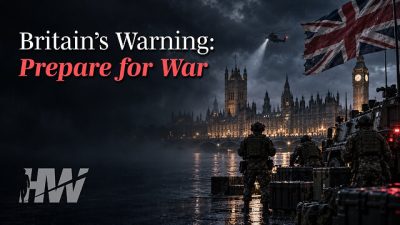
BRITAIN’S WARNING: PREPARE FOR WAR
or go to
Aletho News Archives – Video-Images
From the Archives
British weapons and personnel doing much of the killing in Yemen
Press TV – June 18, 2019
A detailed report published by the Guardian newspaper has shown how Britain is massively contributing to Saudi Arabia’s devastating war on Yemen as it suggests that London is not only supplying the bombs that fall on Yemenis, but it provides the personnel and expertise that keep the war going.
The comprehensive report by Arron Merat published on Tuesday showed that Britain was doing much of the killing in Yemen as the country continues to provide Saudi Arabia with everything it needs to turn its southern impoverished neighbor into a graveyard.
“Every day Yemen is hit by British bombs – dropped by British planes that are flown by British-trained pilots and maintained and prepared inside Saudi Arabia by thousands of British contractors,” said Merat in the report. … continue
Blog Roll
 Aletho News
- Elijah Magnier: Yemen’s Strikes Are Shattering Saudi Arabia’s Long-Term Strategy
- Pentagon designates Chinese cultural centers national security threat
- Israel Demolishes Home Of Lebanese Journalist Whose Viral Film Exposed Pager Attack
- Record Oil, Empty Tanks: The UAE’s Miracle Recovery
- Burnham tackles Britain’s poverty with aggression in Yemen
- Peace in Ukraine: the easy way – or the hard way
- Trump & the Rrrrussians
- US taxpayer money laundered back through Ukraine – Musk
- Before COVID, an NIH lab chief proposed making a SARS-like bat virus more infectious
- Gates, Bourla on Trial in Netherlands Accused of ‘Great Reset’ Scheme at Vaccine Injury Hearing
- If Americans Knew
- An error has occurred; the feed is probably down. Try again later.
- No Tricks Zone
- Sudden Stratospheric Warming, Powerful El Niño Combination May Lead To Extreme Europe Cold, Energy Crisis!
- Two New Studies Find Thwaites Glacier Melt Cannot Be Driven By Human Activity Or A Warming Ocean
- E-Cars Reduce CO2 Emissions By Only 41% Compared To Internal Combustion Engine Vehicles
- Predictions Made By Renowned Climate Professor Over Past Decades Have Been Proven To Be Poor
- New Study Suggests Large Regions Of The Pacific Ocean Have Been Cooling For The Last 80 Years
- Germany’s Green Energy Debacle: High Energy Costs Force Kahla Porzellan to Close After 182 Years!
- New Study: 50 Years Of The Most Aggressive ‘Net Zero’ Policies Can Only Affect The Global Climate By 0.03°C
- US September “Heat” Was No Record…Many Records Set Decades Ago
- Latest European Green Energy Debacle; Portugal’s Largest Flagship Solar Park Insolvent!
- Green Energy Debacle: German Expert Professor Fritz Vahrenholt Warns Of Severe Economic And Social Consequences

