US Ambassador’s Convoy Violates Lebanon’s Antiquities
Al-Manar | February 6, 2013
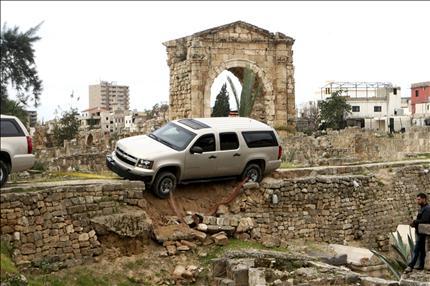 US Ambassador in Lebanon Maura Connelly’s convoy violated on Tuesday the antiquities in the southern city of Tyre, as it insisted to pass near the Roman Arc of Triumph, through a narrow, dirt road supported by an old stone wall.
The act could be considered a message from the embassy, that its staff and vehicles can enter anywhere without any considerations.
Connelly went to the region with the city’s mayor Hussein Dbouk, and the cars accompanying her followed her through the dirt road. However, one of the cars veered off the road and destroyed the stone wall.
The accident did not very much affect Connelly’s visit, it only caused a short delay to the program, as the group had to wait for a winch to arrive and pull the deviated vehicle off the road.
South Lebanon: Israel Admits to Stealing Land in Adaisseh
By Amal Khalil | Al-Akhbar | January 30, 2013
A week ago, Israeli newspaper Maariv published an article titled “Kibbutz Lands Over Lebanese Border.” The story indicated that the management of the Misgav-Am kibbutz, a settlement located across from the Lebanese town of Adaisseh, “was informed by the Israeli interior ministry that a part of [the colony] falls on sovereign Lebanese territory.”
The ministry’s statement came in response to the kibbutz’s request to re-zone certain plots of land from agricultural to residential. The ministry said that the request would be considered following “the withdrawal towards Israeli borders and amending the Blue Line.”
It seems the enemy admitted that Adaisseh was confiscated by the occupation – with the collusion of the UN – when the Blue Line was demarcated following the liberation of South Lebanon in 2000.
This is the land where Israeli bulldozers uprooted what became known as the “Adaisseh tree.” That incident in the summer of 2010 led to a battle between the Lebanese army and its Israeli counterpart where soldiers Abdullah Tufaili and Robert al-Ashi, and Al-Akhbar’s correspondent Assaf Abu Rahhal were killed by Israeli fire.
The Lebanese state should raise the issue of occupied lands and reiterate the points of reservation during the drawing of the Blue Line, especially following this latest Israeli admission. This the least of what is expected of the state.
All the while, Israel, which today admits that the land where its soldiers are deployed belongs to Lebanon, recently protested at the UN a plot of flowers adjacent to the army point where the Adaisseh operation was launched, claiming it falls inside the Blue Line.
Adaisseh mayor Khalil Rammal took us on a long tour of occupied lands and the Blue Line. From the borders at Hounin and Markaba in the south, to Kfar Kila northwards, the enemy has stolen around 2,500 dunams (1 dunam = 1,000 square meters) of property since before the 1948 nakba in Palestine.
The mayor says that every time a demarcation was made, the town lost more of its land, beginning with the demarcation based on the the Sykes-Picot agreement in 1920, to the international demarcation of the borders between Lebanon and Occupied Palestine in the armistice agreement in 1949, and finally during the drawing of the Blue Line in 2000.
Rammal recounts the history of settlements since 1908, when the wooden settlement of Kfar Giladi was set up at the Adaisseh borders near the point now occupied by the Indonesian contingency of the UNIFIL.
Misgav-Am was set up in 1945 on a hill called al-Tayyara. Later, a military road was built and more land appropriated between al-Thughra and Abl al-Qamh and into Khalleh, Arabsalim, Dabsh al-Awjeh, al-Marj al-Faouqani, and Mussaisah, up until the 1978 Israeli invasion.
Rammal mentions that his father, who was mayor then, went to the governor of South Lebanon, Halim Fayyad, to complain about Israeli violations of Adaisseh, including tens of dunams with title deeds.
Fayyad relayed the message to the Lebanese government, which sent a complaint against Israel in Adaisseh’s name to the UN Security Council. He says his father told him that the Israeli ambassador in the Security Council claimed that “the appropriation of land is a precautionary measure. When Palestinian fighters withdraw, we will leave the land.”
Rammal says that the occupied territories amount to 2,000 dunams taken in 1948 and a further 1,200 in 1948. As for the Blue Line, Rammal maintains that the demarcation committee ignored Adaisseh and did not ask for the statement of the mayor or the inhabitants.
In this respect, a security source indicates that the borders at Adaisseh and Shebaa Farms are under reservation by the Lebanese government, which rejected the demarcation proposed by the enemy and UN Envoy Terje Roed-Larsen. He maintained that they were sovereign Lebanese territories.
What can owners of lands that Israel admitted to be Lebanese do?
Rammal says that the mission of the Lebanese government today should be to ask the UN to return the land, especially since the foreign ministry had requested from landowners, following liberation, to provide it with the deeds to send to the UN.
But the owners were never informed officially of the status of the dossier. One of them is Salim Hassoun, who inherited 15,000 dunams of land from his father, Abdul-Rahman Hassoun, who had in turn inherited it from his own father.
The grandfather had bought the land from Shaker Said through a deed registered at the Marjayoun Department in 1953. Hassoun says that the barbed wire and the Blue Line cut off his land, whose deed indicates the borders with Palestine.
Based on this, he will be using the Israeli admission to file a complaint against Israel to return his land, either to the UN or to Israeli courts.
However, informed sources say that Israel would never abandon the Misgav-Am hill. It’s one of the tallest along the southern border and Israel has installed long-range surveillance cameras looking into Lebanon and five military posts.
It should be noted that many of the lands liberated in 2000 are still not free of UNIFIL and Lebanese army roadblocks. These are agricultural lands whose owners have been prohibited from visiting since 1968 due to security concerns and the presence of mines – even though demining operations were completed three years ago.
Syria: Israeli Jets Kill Two in Attack on Research Center
Al-Manar | January 31, 2013
The Zionist entity’s aircraft attacked a scientific research center in Jamraya, near the capital Damascus, killing two people and injuring five others.
“The Israeli fighter jets violated our airspace at dawn today and carried out a direct strike on a scientific research center in charge of raising our level of resistance and self-defense,” the Syrian Army said in a statement on Wednesday.
This is the first Israeli aggression of its kind since the outbreak of the crisis in Syria, and was preceded by Israeli hints of fear from transfer of strategic-value weapons to the Islamic resistance in Lebanon.
Military sources told Al-Manar TV that the aggression was carried out by four warplanes which dropped nine rockets.
The Army command also said in its statement that the attack was carried out against the center after terrorist groups made several failed attempts in the past months to take control of the site. The statement said the Israeli planes had flown below radar range and destroyed the building. It denied that a convoy had been hit near the border with Lebanon, calling the reports “baseless.”
A Western official and a former Lebanese security official said earlier Wednesday that ‘Israel’ had attacked inside Syria along the border with Lebanon, and the former Lebanese official said an unmanned aircraft had hit a truck carrying weapons.
The Zionist entity declined to comment, as did U.S. officials, who deferred to Israel. It claimed earlier that it had targeted a convoy of chemical weapons in Syria.
Hezbollah: Israeli Strike on Syria Uncovers Conspiracy against Our People
Hezbollah Media Relations | January 31, 2013
Hezbollah denounced on Thursday the Israeli strike which targeted a scientific research center in Syria a day earlier, saying the raid aimed to negate Damascus’ role in the path of resistance.
In a statement released by Hezbollah Media Relations, the party considered the strike as a “savage attack that carries out the Zionist entity’s policy which aims at preventing any Arab and Muslim state from developing its technological and military capabilities.”
“As Hezbollah firmly condemns the new Zionist attack against Syria, it sees that the assault blatantly uncovers the reality of what’s coming on in Syria since two years ago.”
The party noted that the strike “discloses the criminal attempts aimed at negating Syria’s role in the resistance path, in a bid to pass the chapters of the conspiracy against Damascus and our Arab and Muslim people.”
Hezbollah urged the international community along the Arab and Muslim countries to condemn the attack, but said “we were used to the silence of this community,” in front of such attacks, “especially when the Zionist entity is the attacker.”
“As Hezbollah voices solidarity with Syria, its leadership, army and people, it stresses the importance of realizing the gravity that Syria is being targeted,” the statement said.
The party also considered the raid “an opportunity for some sides to review their stances and adopt the dialogue as the only solution to stop the bloodshed” in Syria.
‘Israeli airstrike intended to stop Syrian scientific military research’
RT | January 31, 2013
… Dr. Ali Mohamad, editor-in-chief of the Syria Tribune news website, believes the fears of chemical weapons was a pretext to destroy Syria’s military research centers and ensure that Damascus is unable to produce arms for its military or regional allies.
Syrians know that “this is not at all about chemical weapons,” Dr. Mohamad told RT. “It’s about stopping the Syrian scientists’ military research projects.”
“It finally makes sense because the rebels or as they like to call themselves the revolutionaries, they have been attacking air defense bases near Damascus for the past seven months,” Dr. Mohamad said. “They’ve managed to attack the S-200 base and over four other surface-to-air missile bases. Now this followed by an airstrike from Israel. So it all adds up, it makes sense. It only shows that Israel has a great interest in the instability in Syria and that it is being helped by groups of armed rebels in Syria.”
“Military research centers are responsible for developing weapons, in particular land-to-land long range missiles,” and Israel wants to stop this research process, Dr. Mohamed explained. “Of course Israel will claim that this is connected to a chemical weapons arsenal, but this is of course not true because nobody stores chemical weapons in a research center.”
“Let’s remember that the Syrian official who was responsible for all military research projects has been assassinated in Damascus by the rebels,” he said. “Let’s also remember that the person who orchestrated the Syrian long-range missile project colonel Dawoud Rajiha was also assassinated in Damascus. This is about stopping the Syrian scientific military research projects and is about breaking the link that will help [Israel] overcome the Lebanese resistance and the Palestinian resistance.”
Syria will likely retaliate, but not in the form of a direct attack on Israel. Instead, Damascus will seek to arm Hezbollah, the Lebanese resistance, Dr. Mohamed said.
Georges Abdallah: Justice Delayed, Again

This is the winding road that the leader of the Lebanese Armed Revolutionary Factions has had to take in the French justice system. (Photo: Haytham al-Moussawi)
By Bassam Alkantar | Al Akhbar | January 15, 2013
“We don’t think he [Georges Abdallah] should be released, and we are continuing our consultations with the French government about it…We have serious concerns that he could return to the battlefield.” This according to a statement from Victoria Nuland, spokesperson for the US Department of State, on Friday, 11 January 2013.
This was more than an enough of a hint for the socialist government in Paris to block the decision to release Abdallah, who, from today, 15 January 2013, is essentially a hostage at the Lannemezan Prison.
Yesterday, Abdallah was supposed to appear one last time before the French judge, to be read the terms of his conditional release, which requires him to be deported from France. But French Minister of Interior Manuel Valls refused to sign Abdallah’s deportation order.
One judicial source said that the Sentence Enforcement Chamber of Paris (TAP), which held a hearing on Monday to evaluate the 8th request for parole submitted by Abdallah, “has not yet made a decision pending the deportation order.”
On 21 November 2012, the TAP had approved Abdallah’s request for parole on the condition that he be expelled from France. On 10 January 2013, the Court of Appeals in Paris upheld the TAP’s ruling, and rejected the appeal submitted by the French Public Prosecution, settling the controversy regarding its final and unequivocal decision to release Abdallah.
The sudden French move triggered many questions. For instance, is it possible for the French interior minister to completely block the procedures for the Lebanese prisoner’s conditional release? And, will the French prosecution be able to appeal the parole ruling again, having lost the appeal battle?
A French legal source familiar with the case of Abdallah in Paris told Al-Akhbar that political considerations had trumped legal ones after the interior minister’s move. Usually, he affirmed, the authorities may refrain from deporting a foreign national if it suspects that the country of destination, whether it is the foreigner’s home country or a third country, may mistreat or torture him.
In this event, the authorities often respect the wishes of the foreigner to be deported, to remain under house arrest or in refugee facilities, after serving his or her sentence.
The source added, “In Georges Abdallah’s case, the opposite is true. The Lebanese government has expressed on several occasions its willingness to receive him.”
Concerning whether the prosecution can appeal the parole ruling again, the judicial source said that this was unlikely, but stressed that the interior minister’s insistence on not signing the deportation order practically meant that Abdallah’s release has been obstructed.
This is not the first time that legal proceedings have clashed with political calculations, which makes Abdallah’s case the “scandal of the age,” in the words of Yves Bonnet, the former head of French intelligence services (DST). Since 1999, Abdallah has met all the conditions that make him eligible for parole, something that prompted the French judicial authorities to revisit his case several times over the past years.
As it turns out, there are five parole requirements stipulated in the French Penal Code. The first condition is good conduct in prison, which Abdallah has met according to the testimony of the French court itself.
Second, there has to be someone providing him with assistance in case he is released, a requirement that is met as per the documents that have been provided by Abdallah’s family, at the request of the French authorities, since 2003.
Third, the parolee must be able to pursue a vocation, a condition already satisfied by Abdallah, who is part of the Lebanese Ministry of Education’s teaching cadre.
Fourth, the parolee must be in good mental health, which, according to the reports of Abdallah’s psychiatrist, has been fulfilled.
Finally, the parolee must not pose a threat to French society, a requirement that the judiciary has undertaken to fulfill by ensuring that Abdallah is deported by the French interior ministry to Lebanon, or any third country that agrees to host him.
It was this requirement that the French interior minister exploited on Monday, in reverse fashion, to block the Lebanese prisoner’s conditional release.
A History of Abdallah’s French Court Rulings
On 19 November 2003, the parole court in the French district of Pau agreed to release the Lebanese national. The move angered the French Public Prosecution, which rushed to appeal the decision at the request of the justice minister. It succeeded in having the ruling suspended by the court in Pau.
On 16 January 2004, the National Parole Court reexamined the case. However, the court came under pressure from the French justice minister, who in turn was under US-Israeli pressure. Abdallah was subsequently denied parole.
On 31 January 2006, the court refused to release Abdallah after prosecutors argued that France’s image would be undermined with the US and its allies should it release him.
The prosecutors further claimed that Abdallah’s deportation would not guarantee that he wouldn’t return to the same types of acts he carried out in the past and that the psychiatrist’s report was insufficient in this regard.
While he may be in good mental health, they argued, what guarantee was there that he would not return to “terrorism”? (As though Abdallah is a common criminal or a drug addict who is being treated to quit his habit.)
The prosecution gave another reason for opposing Abdallah’s release, namely that he had not paid compensations to the victims, estimated by the court to stand at 53,357 euros, bearing in mind that his family has pledged to pay all such compensations.
On 6 February 2007, Abdallah requested parole for the 7th time only to be rejected once again. Abdallah appealed the ruling, but a decision was postponed until April 2008. The surprise was that the judges, instead of pronouncing the appeal verdict, decided to refer Abdallah’s case from the parole court to a special committee.
On 17 June 2008, Abdallah’s case was referred to a “special committee” in accordance with the provisions of Dati’s Law. Abdallah was formally notified of this, and the committee was set to issue its ruling in September 2008. The ruling was postponed yet again to 9 January 2009 when the court rejected the parole request.
This is the winding road that the leader of the Lebanese Armed Revolutionary Factions has had to take in the French justice system. Yet Monday’s court session was one of its most sinister junctures.
So will Jacques Vergès, Abdallah’s lawyer, play the ace up his sleeve and demand a retrial? He most definitely will if Abdallah is not released come January 28.
Mleeta, Khiam, Sabra, Shatila and Resistance In General
By Gilad Atzmon | January 8, 2013
Lebanon is incredible – an intoxicating blend of natural beauty, rebellious spirit, pious clarity, tolerance, wild night life and unbelievable hummus. I landed in Beirut four days ago. The purpose of my visit wasn’t all that clear. I knew that a talk and a musical performance were scheduled by Almayadeen TV, but I never expected such a spiritually transforming experience.
It was my second visit to the country. 30 years ago I crossed the Lebanese border along with an IDF convoy escorted by tanks and armed vehicles. Then I was an occupier, this time I came with only my saxophone and a desire to share my thoughts and deliver some beauty.
But it didn’t take me a couple of hours to realise that Lebanon is much more than just humus, shisha, the sea and some captivating rural scenery. Early on Friday we left Beirut for the south. Our first stop was Mleeta – a Hezbollah front line outpost and a symbol of Lebanese defiance. Mleeta is located on top of a mountain, surrounded by the South Lebanese Massif which, until 2000, was controlled by the Israelis. From Mleeta, the Lebanese Mujahedeen launched daily attacks against the Israeli invader and gave the Israelis a true taste of their own medicine. Now Mleeta is a Jihadi tourist resort, there to tell the story of the heroic Hezbollah, those brave paramilitaries that confounded the ‘best army in the world’. The truth is, though armed only with light weapons, they were well supplied with Shia, spiritual ammunition.

Mleeta provides an overview of three decades of Islamic resistance in Lebanon and, in exhibiting all that the fleeing IDF soldiers have left behind, it proudly demonstrates the reality of Israeli cowardice. Mleeta is a symbol of confidence – confidence that the IDF is gone, never to return. Because when, in the summer of 2006 Hezbollah routed the IDF, it also demolished their confidence forever. The Jewish state was taught a lesson it would never forget – their phantasmic expansionist dream had come to an end.
But Mleeta was just a beginning. South Lebanon is dripping with defiance – every village, house and person is an emblem of Shia’s heroic resistance with the villages bedecked with Hezbollah posters featuring Leader Hasan Nasrallah and the many martyrs who taught the IDF those very necessary lessons.
Like Mleeta, Khiam the notorious Detention Centre is also a monument to Israeli brutality. Khiam is where Israel detained and tortured its political opponents, in some cases, for as long as 14 years. My visit there reminded me of a devastating memory, which on occasion, I share with my audience. It concerns Ansar, an Israeli concentration camp located in South Lebanon. It was back in 1984, on a piece of flat land in the middle of the camp, I noticed a dozen concrete boxes with small metal doors, they looked like dog kennels being only about 80 cm high, 100 cm long and probably about 80cm wide. When I pointed out to the commanding officer that these concrete construction weren’t suitable for dogs, he told me not to worry: no one would even think of putting dogs in them. “Put a Palestinian in one of those for 24 hours,” he laughed, “And he’ll come out singing the Hatikvah.” They were solitary confinement units for Palestinian prisoners. That was it. Then and there, I realised that Israel was not my country.
In Khiam this week I saw the exact same Israeli torture facility where the Israelis would shove their political opponents into tiny metal boxes, lock them in for days and then occasionally hit the top with a heavy stone. This time I took a picture.

But someone in Israel must have felt some shame at what Israel was leaving behind in Lebanon. In 2006 the IDF attempted to erase all trace of the detention centre at Khiam. In a desperate attempt to hide Israeli brutality, Israel sent in its engineering squads to blow up the cells and all remaining evidence of torture. But that clumsy effort to conceal the true reality of Israeli inhumanity achieved only the complete opposite. It now only affirms that Israel has, indeed, a lot to conceal.
The journey to occupied Palestine’s Border is over the most beautiful, wild and rural terrain. But then, suddenly, we were there, faced with the Jewish ghetto walls, guarded by cameras, army posts and barbed wire. Israel clearly doesn’t even try to convince its neighbours that it belongs in the region. It looks different, it smells different, it sounds different – it is in fact, just one extended Jewish European shtetl that has matured into a neurotic, psychotic and murderous collective fuelled by PRE traumatic stress. In that regard, the Israelis indeed have great deal to keep under wraps.
Inspired by Lyotard’s “Heidegger and the Jews” and my visit to the south, I decided, in my talk in Beirut, to speak about ‘History as a form of concealment.’ Instead of telling us ‘what really happened’, I argued that history is there to hide our shame, to repress that which we cannot even utter. It is, in effect, there to make us forget. Jewish history, for instance, is there to suppress Jewish shame, to disguise that which Jews prefer to hide from themselves. Jewish history is an attempt to talk about the past while avoiding the horrendous and embarrassing fact that Jews, throughout their history, have been bringing on themselves one Shoa after the other.
But concealment wasn’t invented by the Jews. The Brits also find it hard to cope with their past chain of murderous imperial genocides. This may explain why they entrusted the writing of Churchill’s biography to Jewish Zionist Sir Martin Gilbert, and why their historians have dedicated a whole floor of the Imperial War Museum to the Nazi Holocaust. As if Brits do not have enough shoas and suffering inflicted on others to remember. One of those British-inflicted shoas is obviously the Palestinian Nakba. Britain should own up to this disaster and perhaps find a little room for it also in its Imperial Museums. And like Britain, the Israelis have yet to acknowledge their own role in the original sin of 1948.
Looking at the state of the refugee camps in Lebanon, it became very clear to me that the Lebanese also might engage in some soul searching. For 65 years Palestinian refugees have lived in Lebanon and in other Arab countries in unbearable conditions and have suffered terrible discrimination. Palestinian refuge camps in Lebanon are nothing short of hell on earth. Palestinians cannot be naturalized. They are banned from certain professions and jobs such as medicine and law. In some ways, their situation is worse even than their brothers’ in Gaza or The West Bank, because for them there is not even any prospect of hope or change.
Those endless solidarity discussions about ‘One State’, ‘Two States’ or ‘BDS’ have zero significance or impact on their lives or their livelihoods. These displaced and dispossessed people need immediate change in their political status, but, being excluded from the political process, they lack the wherewithal to bring such change about. Not able to travel, their voice is hardly heard within the Western solidarity discourse and the International Palestinian solidarity movement is hardly engaged, or even concerned with their tragedy. Even that most absolute of rights, the right to return to their land has been compromised by the BDS in Ramallah and other prominent Palestinian leaders.
On my last day in Beirut I visited Sabra and Shatilla. I saw the mass graveyards, I saw the poverty, I saw the piles of rubbish in the streets, the outcome of the complete absence of even the most elementary municipal services. I have been traveling around the world for many years but this is, without doubt, one of the saddest sights I have seen. But, in those camps, I also saw some of the kindest people on this planet. People who against all odds, in spite of being crushed, humiliated and tortured for more than six decades, still look forward, still live their lives. They raise their kids and care about their education. They greet you in the warmest possible manner and, no sooner have you approached their shop, they have invited you for coffee. Surely, their suffering must be our primary concern.
Related articles
- Shifting responsibility: the propaganda of The Jewish Chronicle (alethonews.wordpress.com)
- Gazans fall victim to Israel’s experimental wars (windowintopalestine.blogspot.com)
Featured Video
BRITAIN’S WARNING: PREPARE FOR WAR
or go to
Aletho News Archives – Video-Images
From the Archives
British weapons and personnel doing much of the killing in Yemen
Press TV – June 18, 2019
A detailed report published by the Guardian newspaper has shown how Britain is massively contributing to Saudi Arabia’s devastating war on Yemen as it suggests that London is not only supplying the bombs that fall on Yemenis, but it provides the personnel and expertise that keep the war going.
The comprehensive report by Arron Merat published on Tuesday showed that Britain was doing much of the killing in Yemen as the country continues to provide Saudi Arabia with everything it needs to turn its southern impoverished neighbor into a graveyard.
“Every day Yemen is hit by British bombs – dropped by British planes that are flown by British-trained pilots and maintained and prepared inside Saudi Arabia by thousands of British contractors,” said Merat in the report. … continue
Blog Roll
 Aletho News
- Yemen denounces European Parliament’s ‘hypocritical’ push to blacklist Ansarullah
- Qalibaf: UAE’s UN bid aims to ‘clear the runway’ for ‘Greater Israel’, whitewash genocide
- Pakistan reopens Iran border after boosting security: Report
- Why are so many Brazilians voting for Flávio Bolsonaro?
- Democrats Put Anti-Russia Agenda Ahead of American Workers
- Elijah Magnier: Yemen’s Strikes Are Shattering Saudi Arabia’s Long-Term Strategy
- Pentagon designates Chinese cultural centers national security threat
- Israel Demolishes Home Of Lebanese Journalist Whose Viral Film Exposed Pager Attack
- Record Oil, Empty Tanks: The UAE’s Miracle Recovery
- Burnham tackles Britain’s poverty with aggression in Yemen
- If Americans Knew
- An error has occurred; the feed is probably down. Try again later.
- No Tricks Zone
- Sudden Stratospheric Warming, Powerful El Niño Combination May Lead To Extreme Europe Cold, Energy Crisis!
- Two New Studies Find Thwaites Glacier Melt Cannot Be Driven By Human Activity Or A Warming Ocean
- E-Cars Reduce CO2 Emissions By Only 41% Compared To Internal Combustion Engine Vehicles
- Predictions Made By Renowned Climate Professor Over Past Decades Have Been Proven To Be Poor
- New Study Suggests Large Regions Of The Pacific Ocean Have Been Cooling For The Last 80 Years
- Germany’s Green Energy Debacle: High Energy Costs Force Kahla Porzellan to Close After 182 Years!
- New Study: 50 Years Of The Most Aggressive ‘Net Zero’ Policies Can Only Affect The Global Climate By 0.03°C
- US September “Heat” Was No Record…Many Records Set Decades Ago
- Latest European Green Energy Debacle; Portugal’s Largest Flagship Solar Park Insolvent!
- Green Energy Debacle: German Expert Professor Fritz Vahrenholt Warns Of Severe Economic And Social Consequences

