Lebanon rejects alleged plan to ‘resettle’ Palestinians
MEMO | September 13, 2018
Lebanese Foreign Minister Jebran Bassil has slammed an alleged US plan to “resettle” Palestinian refugees in neighboring Arab states, Lebanese daily Al-Joumhouria reported Thursday.
Bassil’s remarks came in response to a tweet two days earlier by Israeli Intelligence Minister Yisrael Katz, in which the latter welcomed an alleged plan by US President Donald Trump to “resettle Palestinian refugees in Jordan, Syria, Lebanon and Iraq”.
In his tweet, Katz did not provide any additional details regarding the alleged US proposal.
Speaking to Al-Joumhouria on Thursday, Bassil stressed his country’s rejection of any such plan.
“Even if the entire world accepted resettlement [of Palestinian refugees], we would reject it,” he was quoted as saying.
“Like we defeated Israel by expelling its occupation [from Southern Lebanon in 2000], we will defeat its resettlement project,” the foreign minister asserted.
“The ‘right of return’ is sacrosanct,” Bassil added, referring to the right of Palestinian refugees to return to their homes in historical Palestine from which they were driven in 1948 to make way for the new state of Israel.
Lebanon is currently home to roughly 590,000 Palestinian refugees (out of some five million worldwide), according to official Lebanese figures.
Iranian Bots and the Facebook Stasi: Manufacturing Consent for the Endless War
By Helen Buyniski | Helen of desTroy | September 3, 2018
If at first you don’t succeed, try, try again. The American Empire doesn’t handle failure well, and their repeated failures to oust Syrian president Bashar al-Assad have driven them into a frenzy where good judgment and logic are a thing of the past. Russian military intelligence predicts a false-flag chemical attack in Idlib which will be pinned on the Assad regime and used to justify “retaliation” orders of magnitude greater than April’s Tomahawk tantrum. This time, if the words of the Wicked Witch of the UN are any indication, Iran and Russia will also be blamed. While the US has mostly abandoned hope for regime change in Syria, it will not look a gift horse in the mouth, and is gathering aircraft carriers and bombers to the region while pumping out tear-jerking propaganda about Idlib residents fearing for their lives. If the false flag fails, they can always send those bombers to Iran…
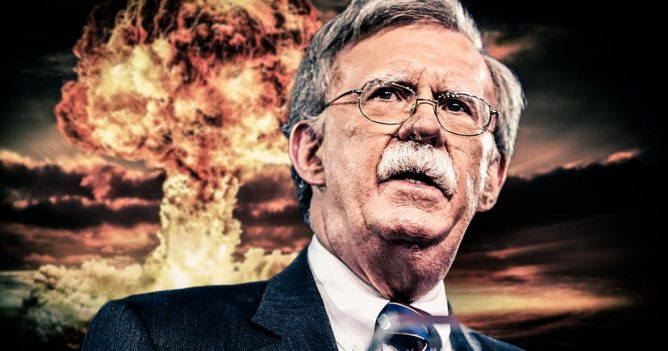
Such an attack is very much on the table, with the groundwork being laid in the pro-war press. John Bolton promised the MEK, a “corrupt, criminal cult” of Iranian exiles which bribed its way off the State Department’s list of terrorist organizations in 2012, regime change by 2019, and the clock is ticking. Attempts to foment a color revolution have failed repeatedly, because Iranians aren’t stupid and remember what happened the last time the US overthrew their government. But Benjamin Netanyahu has been baying for Iranian blood for almost three decades, and Bolton cares little for more clear-headed military personnel’s warnings that invading Iran would be a costly, unwinnable nightmare – Real Men Go To Tehran, as they used to say in the halcyon days of the Axis of Evil.
Prelude to War: Iranian Bots
The ruling class understands Americans are wary of another Middle Eastern war and must be convinced they’re under attack. Hence the new bogeyman, just in time for Election 2018: Iranian Meddling. Twitter, Facebook, and Google took time out from deplatforming anti-establishment commentators to delete over a thousand accounts between them after cyber-security firm FireEye released a report detailing a far-reaching “Suspected Iranian Influence Operation.” With only “moderate confidence,” FireEye pointed to “coordinated inauthentic behavior” geared toward “shaping a message favorable to Iran’s national interests” as the smoking gun. Washed-up former intelligence operatives Ron Hosko and Larry Pfeiffer (ex-FBI and ex-CIA, respectively) smugly added that if we hadn’t let Russia get away with their (still unproven) interference in the 2016 election, Iran would never have been so emboldened as to pour $12,000 of cold, hard cash into this social media offensive in order to portray itself favorably to western audiences.
Facebook, eager to behave, took down 652 offending accounts before the government could even react to the news. FireEye’s report points accusingly to the accounts’ promotion of “anti-Saudi, anti-Israeli, and pro-Palestinian themes, as well as support for specific US policies favorable to Iran,” implying Facebook users should be suspicious of anyone else espousing these views (and warning Iranian and Palestinian sympathizers and other pro-peace activists to shut up, or they’re next). An important step in laying the groundwork for an unpopular war is to “other” and ultimately demonize the enemy, and FireEye’s suggestion that those with pro-Iranian views aren’t even real humans is classic wartime propaganda for the digital age. In addition to three groups of Iranian accounts, FireEye claims it caught some Russians “attempt[ing] to influence politics in Syria and the Ukraine.” This group “was linked to sources that Facebook said the US had linked to Russian military intelligence.” How many hops of truth distortion are too many for even the terminally credulous establishment media?
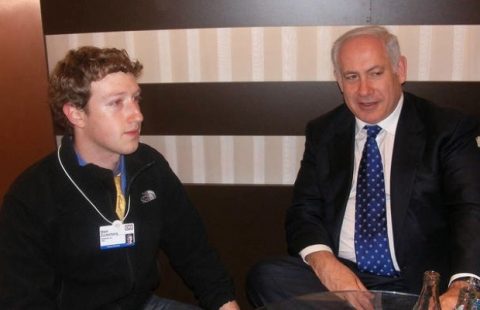
Perhaps anticipating users’ bewilderment – the offending accounts had broken no laws, were promoting no political candidates, and in many cases had not even bought ads – Zuckerberg explained around a mouth full of jackboot that “These were accounts that were misleading people about who they were and what they were doing. We ban this kind of behavior because authenticity matters. People need to be able to trust the connections they make on Facebook.” Lest users make the mistake of trusting Facebook, however, he added that the company would be “working more closely with law enforcement, security experts and other companies,” turning over more user data than ever in its quest to make privacy obsolete. When law enforcement calls on Facebook to create a backdoor in its Messenger program – thus defeating the purpose of “encrypted chat” – does anyone really expect Zuckerberg to stand fast for privacy rights?

Not to be outdone, Twitter deleted 770 accounts based on the FireEye report, noting that only 100 of these ostensibly Iranian accounts had misrepresented their location and not even all of these had shared “divisive social commentary,” while a single account had purchased $30 in ads. This means over 600 Twitter accounts were deleted for the crime of geography alone (collateral damage?). But Twitter has always gone above and beyond the call of duty, announcing in May that to promote “healthy” conversations it would begin de-ranking users for engaging in “suspicious behavior.” Users who tweeted at many accounts, had multiple complaints against them, or retweeted material tweeted by banned accounts were shadowbanned indefinitely as persona non grata. Since November, Twitter and Facebook have both been turning over information on users who post “divisive” content of the sort promoted by “Russia-linked accounts” to congressional investigators even though a creator of “Russian bot tracker” Hamilton68 admits the accounts his tool tracks are not necessarily bots, or even Russian – “some are legitimately passionate people,” as if passion is an un-American trait.
Last year, the FBI launched a Foreign Intelligence Task Force to work with US tech firms to combat “foreign influence actors.” With bots and their ilk operating all over the world, the decision to single out Russia and Iran has obvious foreign policy motivation (Bolton also claims that China and North Korea are up to no good on social media). All of this avoids naming the elephant in the room. Even though Israel meddles loudly and proudly in US elections, Facebook openly collaborates with Netanyahu’s government. Beyond removing posts and banning accounts, Facebook even turns over user information to Israeli authorities to facilitate prosecution of Palestinian activists for “incitement,” sometimes over nothing more than a “like” or a “share.” Adding insult to injury, Israel’s Ministry of Strategic Affairs has weaponized the diaspora’s ennui – often caused in no small part by young Jews’ discomfort with the crimes their government commits in their name – with the social media equivalent of a Predator drone. Act.IL is an app that allows the user to participate in the “brigading” (mass-reporting for spurious violations) of hapless strangers for “incitement” – supporting the BDS movement, say, or implying that Palestinians are human rather than a “lawn” to be “mowed.” In a rare case of instant karma, the app was found to be leaking users’ email addresses. A nation where the government and citizen “enforcers” are working together to silence dissent sounds like an authoritarian nightmare, but this is our “democratic” Middle Eastern ally.
Origins of Totalitarianism
Israel is the missing link that explains how “sowing discord” – an offense few Americans had ever heard of until 2016 – entered our national vocabulary. The modern “fake news” panic has its roots in the totalitarian tradition. Words like “inciting,” “fomenting,” and “sowing” “discord” and “subversion” are very versatile weapons in the hands of authoritarian regimes. This language was previously uncommon in the US, but its emergence became inevitable when the “new Pearl Harbor” of 9/11 opened the door to the creation of the modern American police state. Social media are now just extra bars on the cage – the tools we once believed could liberate us, during the promising early months of Occupy Wall Street and the Arab Spring, are now used to silence us. The US, following a blueprint for legal censorship set by post-WW2 Europe, is taking on the totalitarian trappings of China, of Burma, of the central Asian “stans” and of Saudi Arabia. Kazakhstan calls it “inciting national discord,” with the variations “ethnic discord” and “religious discord” applicable as needed to whatever activist, journalist, or trade unionist the regime needs to put on ice for a few years. It’s called “inciting religious hatred” or “ethnic hatred” in Azerbaijan, which also permanently bans 5 major media outlets for reasons of “national security.” Uzbekistan arrests journalists for “extremism.” China targets activists of all stripes for “inciting subversion.” Burma, which is cracking down hard on the press as it seeks to keep its Rohingya ethnic cleansing quiet, criminalizes “speech that is likely to cause fear or harm and incites classes or groups to commit offenses against each other.” Egypt detains lawyers, journalists and activists under charges of “propagating false news.” Saudi Arabia recently put a Shi’a religious leader to death for “sowing discord” and “undermining national unity.” American dissenters, this is your future.
I have already explained how the Great Deplatforming represents the triumph of the repressive concept of Hate Speech over Free Speech, and how this – not Trump blustering about that wall he’ll get around to building someday – is what fascism looks like. The US government uses friendly corporations as workarounds for the constitutional limits on its power. This technique was deployed against the Second Amendment in Citibank and Bank of America’s post-Parkland refusal to process financial transactions from firearm manufacturers, and is being deployed against the First Amendment here. Such corporate-state fascism is very effective, and the ruling class has seen fit to share it with the other “Five Eyes” intelligence partners, all of whom share information gathered by their Panopticon surveillance agencies. This week, ministers from the US, UK, Canada, Australia and New Zealand met in Australia to condemn hostile nations who “sow discord, manipulate public discourse, bias the development of policy, or disrupt markets” through their manipulation of social media platforms; they also implored Big Tech to allow law enforcement “targeted” access to users’ encrypted data. Flexing the thuggish muscles of the world’s greatest carceral state, the group acknowledged “individual rights must be protected” (and presumably snickered before adding) “privacy is not absolute” and warning that encryption was being exploited by criminals.
The Iranian Meddling affair is a perfect distraction from the real malfeasance at Facebook, where Zuckerberg is bringing back Stasi-style crowdsourced secret policing. The company is assigning “trust ratings” to users based in part on their willingness to report their friends for posting “fake news,” fostering a climate of distrust and fear meant to instill reflexive self-censorship. As in East Germany, the central authorities can’t possibly police everyone all of the time, and it is much more advantageous for them to outsource surveillance to the people, since one who cannot trust his neighbor will not unite with him to overthrow the state. Accordingly, Facebook admits that “some users” abuse Facebook’s reporting system, dubbing stories or users they don’t like “fake news” – but don’t worry about those miscreants, because Facebook compensates for their actions with thousands (!) of other measures that go into calculating the trust rating. No user can see his or her own report – that would be telling – so we’re encouraged to tread carefully to avoid running afoul of the ever-shifting Rules. Jordan Peterson, conservatism’s favorite intellectual, delivers his marching orders in a video he posted last week – “nothing is ever simple,” he pleads as he tells his fans that he’s reached an understanding with Zuckerberg, a “very straightforward person” who really just wants to keep his users safe from bad guys like ISIS recruiters. And Iran. Because they’re terrorists, you know?
The police state is no longer necessary when you have internalized the police. “Media censorship is a shift in the flow of information, while self-censorship is a shift in consciousness.” When the government has convinced citizens to do its job – reporting friends and neighbors for “hate speech,” “sowing discord,” and “incitement” on social media, for example – a free society is impossible.
The US’s Choice: WWIII or Saving Face in Syria
By Tom LUONGO | Strategic Culture Foundation | 11.09.2018
Sometimes when I step back from the overwhelming flow of geopolitical insanity I’m reminded of the old adage that coming close only counts in horseshoes and hand grenades.
To which, I always add, “And nuclear war.”
I’ve been watching the build up to the operation to liberate Idlib in Syria which includes the endless neocon and Israeli moral preening warning Assad against using chemical weapons with a sense of detachment. And I keep thinking to myself, “Do they really think we’re that stupid?”
Three times the chemical weapons canard has been used to justify further aggression against Syria and three times a full-blown U.S. invasion has been averted. First by Vladimir Putin’s deft diplomacy and General Dunford’s refusal to implement a ‘no-fly zone’ in 2013 and then during the Trump years with ineffectual air strikes on Syrian airbases.
How much of that ineffectuality of those airstrikes were designed by Defense Secretary James Mattis to avoid a wider conflagration and how much was Russian EW/missile defense is anyone’s guess.
The truth most likely lies somewhere in the middle.
That is why everyone who is worrying about the U.S.’s blustering over Syria’s Idlib campaign needs to take a big step back and think the scenario through.
Because the neoconservatives and Israel are forcing the situation to its crisis point, thinking they can manipulate the headlines and the levers of power to still eke out a victory in Syria that will allow them to continue on their quest to destroy Russia first and conquer the rest of Asia after that.
And they are willing to blackmail us with the threat of WWIII over 50,000 head-chopping mercenaries to get their cookie.
However, when you factor in the men actually in charge of the U.S. military chain of command, Trump and Mattis, and you realize the lengths to which Mattis’ field commanders have gone to avoid direct confrontation with Russian forces, you come to the conclusion that the men who will actually fight this war the neoconservative provocateurs and laptop bombardiers are clamoring for won’t actually pull the trigger.
The reasons for this are manifest.
First, the potential for the conflict to go nuclear is too high for rational men to take that chance. Mattis and Russian Defense Minister Sergei Shoigu are hard-bitten, no-nonsense men. Neither underestimates the other’s resolve to defend their men and national interests.
So, once the shooting starts expect it to get ugly quick. Therefore it is unlikely to get to that point.
Second, there is no profit in that kind of escalation for the people who profit from war. The banks and the military weapons makers thrive in low-intensity, frozen conflicts which keep sales flowing and governments indebted to pay for them.
In an age of nuclear weapons, proxy wars fought by mercenaries with drones are far more profitable than any large-scale invasions. I hate to say this but from a discounted cash flow perspective Lockheed-Martin wants predictability to cover their quarterly dividends to shareholders more than they want to bring about the supposed Zionist plan for Greater Israel.
Sorry to burst everyone’s conspiracy theories.
Third and most importantly, the U.S. cannot afford a non-nuclear confrontation with Russia that punctures the illusion of U.S. military superiority. Too much of the world’s confidence in the dollar itself rests in the U.S.’s ability to project power and defend its interests militarily.
This confidence is a mixture of that military capability and the U.S.’s traditional position of a country with an excellent legal framework within which to do business. It is fashionable among geopolitical critics, myself included, to get caught up in the rhetoric and projection of a sclerotic and weakening United States, but legally it is still one of the best places on earth to do business.
But, as Martin Armstrong pointed out recently, Trump’s domestic opposition has openly declared sedition against him this week in the New York Times. Former Secretary of State, John Kerry, is doing the talk show circuit calling for a constitutional crisis over Trump allegedly being unfit for office. And George Soros is paying protesters to disrupt the confirmation hearing of Brett Kavanaugh to the Supreme Court.
If allowed to run its course to impeachment in the event of the Republicans losing control of the House in November, this would be a death blow to the U.S.’s reputation as a nation of laws rather than a nation of men. The U.S. dollar would not recover from such a blow to its credibility, especially in light of Trump’s nearly-unhinged use of sanctions and threats of tariffs, weaponizing the dollar indiscriminately.
And this is why Vladimir Putin openly showed his hand to the world in March. Strategically, he let everyone know that any confrontation between Russia and the U.S. would result in the U.S losing its status as the world’s pre-eminent military power.
This is why the neocons and the U.S./U.K. Deep State have been so adamant in accelerating its provocations against Russia. They have to present us with the Faustian bargain of WWIII before Russia has these weapon systems fully deployed.
It’s also why Trump and Mattis are allowing them to have their head. It feeds Trump’s “Art of the Deal” strategy for negotiations while also allowing him the opportunity to save face after Idlib is liberated regardless of whether another chemical weapons attack is staged.
I think we won’t see one here.
The way out of Syria for the U.S. with its face-saved is to thunder and bluster, threaten fire and brimstone just like Trump did with Kim Jong-un and use that to explain why Assad showed restraint and didn’t use chemical weapons this time.
I can even see Trump tweeting something about three strikes and he would be out.
Once Idlib is liberated Mattis will happily begin pulling vulnerable troops out of al-Tanf and Afghanistan. That’s why I believe he went there to the surprise of the CIA house-organ Washington Post last week.
And then the neocon and Israeli muddying of the waters will move to the Geneva talks, but we’ll cross that Rubicon when it approaches.
Fighting Starts in Syria’s Idlib: US Military Considers Military Options
By Peter KORZUN | Strategic Culture Foundation | 11.09.2018
Syrian UN Ambassador Bashar Ja’afari declared on Sept. 7 that his government was determined to wipe out the rebels from the Idlib province. The next day, the Idlib Dawn Operation began, encircling a town 59 km. southwest of the Syrian city of Aleppo. As of Sept. 9, Russian aircraft have attacked the rebel positions in western Idlib, the mountains of the Latakia province, and the Sahl al-Ghab plain, with the goal of softening up peripheral targets and preventing a breakthrough or counterattack. Syria’s forces are ready to move.
The Russian military warned that a false-flag chemical attack staged by the rebels could occur at any time and be used as a pretext for Western missile strikes. A massive Turkish military convoy, consisting of more than 300 vehicles, including tanks, armored vehicles, and MLRS launchers, has entered Idlib from the province of Hatay.
Syria needs Idlib — the last stronghold of the jihadists and the shortest route from Latakia to Aleppo. The M5 international highway crosses Idlib, linking Turkey and Jordan through Aleppo and Damascus. Control of the province would greatly facilitate the negotiations with the Kurds and strengthen Syria’s position at the UN-brokered Geneva talks. If the negotiation process succeeds, the only territories left to liberate would be the zone controlled by the US, such as the al-Tanf military base and the surrounding area, the northern parts of the country under Turkish control, and small chunks of land still held by ISIS [let’s not forget the Golan Heights].
Turkey opposes the idea of an Idlib offensive. It wants assurances for the groups in Idlib under its control and it doesn’t want an influx of refugees. These controversial issues can be tackled with Russia as a mediator. Turkey, Iran, and Russia did not agree on everything at the recent summit in Tehran, but the West’s hopes that they would go their separate ways, or even clash in Idlib, have been dashed.
President Erdogan has just said that he wants to meet the Russian president again after his Sept 28-29 visit to Germany. This means that the Turkish leader has ideas and proposals to discuss and Moscow can play a role in reaching a compromise, such as a more narrowly tailored counter-terrorism operation in Idlib. There is a divide, but it can be bridged. The parties have the will to get it done.
Ankara plans to organize a Turkey-Russia-Germany-France summit. The Russian presidential aide, Yury Ushakov, has confirmed that such a meeting is in the works. Moscow has just invited the Turkish military to take part in its largest-ever military exercise, Vostok 2018, which will be held in the Far East. China and Mongolia have also been invited. Obviously, Russia and Turkey are prepared to solve their differences over Idlib peacefully through negotiations.
In any event, the province cannot remain under the terrorists’ control forever. They must either surrender or be routed. Now that the operation to free Idlib has begun, many of them will lay down their arms. They know their resistance is futile.
Actually, victories over terrorists that pave the way to a negotiated solution of the conflict should be welcomed, but the US sees these things in a different light. Washington seems to be shifting gears on Syria again, despite the statements President Trump made earlier about the plans to pull out. Now the president has reportedly agreed to new objectives that will keep US troops on the ground in Syria indefinitely in order to ensure that the Iranian forces are driven out. The US military has just sent reinforcements to al-Tanf to demonstrate its resolve to stay in that country. The Marines are holding a multi-day exercise there, using live ammunition.
Secretary of State Mike Pompeo, said on Sept. 7 that the administration viewed any government assault on Idlib as an escalation of Syria’s warning that Washington would respond to any chemical attack by Damascus. Ambassador James Jeffrey, who served as a deputy national security adviser to President George W. Bush, has recently been appointed US Special Representative for Syria Engagement, and Joel Rayburn, the former senior director for Iran, Iraq, Syria, and Lebanon, is now Special Envoy for Syria. The two appointments confirm the fact that the US has changed its mind and decided to remain in Syria, as both these officials had supported this policy before.

Rayburn, Joel (15 August 2014). “The coming disintegration of Iraq” Washington Post
America’s top military brass are studying the options for military involvement in Syria. But the real reason may not be Idlib or any other events in that country, but rather the situation creep in Iraq, where anti-Iranian and anti-government Shia protests in the south have turned violent and the prime minister may be compelled to step down. The protesters are armed and violent. They have attacked the Iranian consulate and the headquarters of Iranian-backed militias in the city.
Fighting has also been reported between Iranian forces and Kurds in Iraq’s Kurdish region. Details have been provided of mortar fire in Baghdad, where protests took place in July. Something’s cooking in Iraq. There is too little information available to obtain any deep insights into what’s going on, but the situation is unpredictable and volatile. Iraq could soon implode. The US will not leave the region, and it needs every outpost it has there. A lot depends on how events develop in Iraq.
Idlib will ultimately be liberated. The status of the US-led coalition forces in Syria will become a hot-button topic and be seen as the main stumbling block on the path to peace and reconstruction.
9/11 Was an Israeli Job
How America was neoconned into World War IV
By Laurent Guyénot • Unz Review • September 10, 2018
Technical impossibilities
Thanks to courageous investigators, many anomalies in the official explanation of the events of 9/11 were posted on the Internet in the following months, providing evidence that this was a false flag operation, and that Osama bin Laden was innocent, as he repeatedly declared in the Afghan and Pakistani press and on Al Jazeera.[1] The proofs of this appalling fraud have been accumulating ever since, and are now accessible to anyone willing to spend a few hours of research on the Web. (Although, while preparing this article, I noticed that Google is now making access to that research more difficult than it was five years ago, artificially prioritizing anti-conspiracy sites.)
For example, members of Architects and Engineers for 9/11 Truth have demonstrated that it was impossible for plane crashes and jet fuel fires to trigger the collapse of the Twin Towers. Even Donald Trump understood this. In fact, speaking of “collapse” is perhaps misleading: the towers literally exploded, pulverizing concrete and projecting pieces of steel beams weighing several hundred tons hundreds of meters laterally at high speeds. The pyroclastic dust that immediately flooded through the streets, not unlike the dust from a volcano, indicates a high temperature mixture of hot gasses and relatively dense solid particles, an impossible phenomenon in a simple collapse. It is also impossible that WTC7, another skyscraper (47 stories), which had not been hit by a plane, collapsed into its own footprint at near free-fall speed, unless by “controlled demolition.”
Testimonies of firefighters recorded shortly after the events describe sequences of explosions just before the “collapse”, well below the plane impact. The presence of molten metal in the wreckage up to three weeks after the attack is inexplicable except by the presence of incompletely burned explosives. Firefighter Philip Ruvolo testified before Étienne Sauret’s camera for his film Collateral Damages (2011): “You’d get down below and you’d see molten steel—molten steel running down the channelways, like you were in a foundry—like lava.”
Aviation professionals have also reported impossibilities in the behavior of the planes. The charted speeds of the two aircraft hitting the Twin Towers, 443 mph and 542 mph, exclude these aircraft being Boeing 767s, because these speeds are virtually impossible near ground level. In the unlikely event such speeds could be attained without the aircraft falling apart, flying them accurately into the towers was mission impossible, especially by the amateur pilots blamed for the hijacking. Hosni Mubarak, a former pilot, said he could never do it. (He is not the only head of state to have voiced his doubts: Chavez and Ahmadinejad are among them.) Recall that neither of the black boxes of the jetliners was ever found, an incomprehensible situation.
And of course, there are the obvious anomalies of Shanksville and Pentagon crash sites: no plane or credible plane debris can be seen on any of the numerous photos easily available.
Inside Job or Mossad Job?
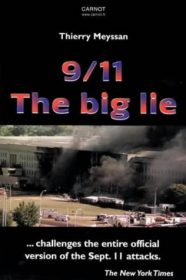
Among the growing number of Americans who disbelieve the official version of the 9/11 attacks, two basic theories are in competition: I called them “inside job” and “Mossad job”. The first one is the dominant thesis within the so-called 9/11 Truth movement, and blames the American government, or a faction within the American Deep State. The second one claims that the masterminds were members of a powerful Israeli network deeply infiltrated in all spheres of power within the US, including media, government, military and secret services.
This “Mossad job” thesis has been gaining ground since Alan Sabrosky, a professor at the U.S. Army War College and the U.S. Military Academy, published in July 2012 an article entitled “Demystifying 9/11: Israel and the Tactics of Mistake”, where he voiced his conviction that September 11th was “a classic Mossad-orchestrated operation.”
We can notice from the outset that incriminating Israelis or Arabs are both “outside job” theories (in fact, they are mirror images of each other, which is understandable in light of what Gilad Atzmon explains about Jewish “projected guilt”).[2] Before even looking at the evidence, “outside job” sounds more credible that “inside job”. There is something monstrous in the idea that a government can deceive and terrorize its own citizens by killing thousands of them, just for starting a series of wars that are not even in the nation’s interest. By comparison, a foreign power attacking the U.S. under the false flag of a third power almost seems like fair play. Indeed suspicion of Israel’s role should be natural to anyone aware of the reputation of the Mossad as: “Wildcard. Ruthless and cunning. Has capability to target U.S. forces and make it look like a Palestinian/Arab act,” in the words of a report of the U.S. Army School for Advanced Military Studies quoted by the Washington Times, September 10th, 2001 — the day before the attacks.
This is an important point, because it raises the question of how and why the 9/11 Truth movement has been led to endorse massively the outrageous “inside job” thesis without even considering the more likely thesis of an attack by a foreign power acting under an Islamic false flag—and what foreign power but Israel would do that?
Of course, the two dissenting theses do not necessarily exclude each other; at least, no one incriminating Israel denies that corrupted elements from the American administration or deep state were involved. The “passionate attachment” between Israel and the U.S. has been going on for decades, and 9/11 is one of its monstruous offsprings.

I can think of no better symbol of that reality than the marriage of Ted and Barbara Olson. Ted Oslon, after having defended Bush in the disputed 2000 election, had been rewarded with the post of Solicitor General (he also defended Dick Cheney when he refused to submit to Congress Enron-related documents). Barbara was a famous CNN reporter, but before that, she was born Barbara Kay Bracher of Jewish parents, educated at Yeshiva University School of Law, and hired by the legal firm WilmerHale, of which Jamie Gorelick, a future member of the 9/11 Commission, was also a member, and whose clients include powerful Israeli firms like Amdocs, a digital communication company charged with spying for Israel in the United States. On September 11, 2001, Barbara Olson alledgedly was on flight AA77, from which she made two telephone calls to her husband. Her calls were reported on CNN in the afternoon, and contributed to crystallize some details of the official story, such as the “box cutters” used as only weapons by the hijackers. Repeatedly invited on television shows after 9/11, Ted Olson frequently contradicted himself when questioned about the calls from his wife. In a 2006 report, the FBI identified only one call from Barbara Olson, and it was an unconnected call lasting 0 seconds. Like all other reported phone calls from desperate passengers (including the famous “Hi, Mom. This is Mark Bingham”), Barbara’s call was simply impossible, because the technology required to make high-altitude phone calls was not developed until 2004.[3]
9/11 was made possible by an alliance between secret worshippers of Israel and corrupted American elements. The question is: who, of the two, were the masterminds of this incredibly daring and complex operation, and for what “higher purpose”?
Another question is: why do those who keep repeating as a mantra “9/11 was an inside job” ignore totally the compelling evidence pointing to Israel? In other words, to what extent do they constitute a “controlled opposition” intended to cover up for Israel? Asking this type of question does not mean suspecting anyone who defends an erroneous or incomplete theory of being a hypocrite. Most people defending one theory or the other do so sincerely, based on the information to which they have access. I have myself been a believer in the official theory for 7 years, and in the “inside job” theory for 2 years, before progressively moving on to the present argument from 2010. On the other hand, we can assume that those who lead the public into error on a long term are not just mistaken but lying. In any case, it is legitimate to investigate the background of opinion makers, and when they are caught lying or distorting the truth, we can speculate on their motivation. I will come back to this issue at the end of the article.
The dancing Israelis
Researchers who believe Israel orchestrated 9/11 cite the behavior of a group of individuals who have come to be known as the “dancing Israelis” since their arrest, though their aim was to pass as “dancing Arabs.” Dressed in ostensibly “Middle Eastern” attire, they were seen by various witnesses standing on the roof of a van parked in Jersey City, cheering and taking photos of each other with the WTC in the background, at the very moment the first plane hit the North Tower. The suspects then moved their van to another parking spot in Jersey City, where other witnesses saw them deliver the same ostentatious celebrations.
One anonymous call to the police in Jersey City, reported the same day by NBC News, mentioned “a white van, 2 or 3 guys in there. They look like Palestinians and going around a building. […] I see the guy by Newark Airport mixing some junk and he has those sheikh uniforms. […] He’s dressed like an Arab.” The police soon issued the following BOLO alert (be-on-the-look-out) for a “Vehicle possibly related to New York terrorist attack. White, 2000 Chevrolet van with New Jersey registration with ‘Urban Moving Systems’ sign on back seen at Liberty State Park, Jersey City, NJ, at the time of first impact of jetliner into World Trade Center. Three individuals with van were seen celebrating after initial impact and subsequent explosion.”
By chance, the van was intercepted around 4 pm, with five young men inside: Sivan and Paul Kurzberg, Yaron Shmuel, Oded Ellner, and Omer Marmari. Before any question was asked, the driver, Sivan Kurzberg, burst out: “We are Israelis. We are not your problem. Your problems are our problems. The Palestinians are your problem”.The Kurzberg brothers were formally identified as Mossad agents. All five officially worked for a moving company (a classic cover for espionage) named Urban Moving Systems, whose owner, Dominik Otto Suter, fled the country for Tel Aviv on September 14.[4]

This event was first reported the day after the attacks by journalist Paulo Lima in the New Jersey newspaper The Bergen Record, based on “sources close to the investigation” who were convinced of the suspects’ foreknowledge of the morning’s attacks: “It looked like they knew what was going to happen when they were at Liberty State Park”.The 579-page FBI report on the investigation that followed (partially declassified in 2005) reveals several important facts. First, once developed, the photos taken by the suspects while watching the North Tower on fire confirm their attitudes of celebration: “They smiled, they hugged each other and they appeared to ‘high five’ one another”. To explain their contentment, the suspects said they were simply happy that, thanks to these terrorist attacks, “the United States will take steps to stop terrorism in the world”. Yet at this point, before the second tower was hit, most Americans believed the crash was an accident. The five Israelis were found connected to another company called Classic International Movers, which employed five other Israelis arrested for their contacts with the nineteen presumed suicide hijackers. In addition, one of the five suspects had called “an individual in South America with authentic ties to Islamic militants in the middle east”. Finally, the FBI report states that the “The vehicle was also searched by a trained bomb-sniffing dog which yielded a positive result for the presence of explosive traces”.
After all this incriminating evidence comes the most puzzling passage of the report: its conclusion that “the FBI no longer has any investigative interests in the detainees and they should proceed with the appropriate immigration proceedings”. In fact, a letter addressed to the U.S. Immigration and Naturalization Service, dated September 25, 2001, proves that, less than two weeks after the events, the FBI federal headquarter had already decided to close the investigation, asking that “The U.S. Immigration and Naturalization Service should proceed with the appropriate immigration proceedings”. The five “dancing Israelis”, also known as “the high fivers”, were detained 71 days in a Brooklyn prison, where they first refused, then failed, lie detector tests. Finally, they were quietly returned to Israel under the minimal charge of “visa violation.” Three of them were then invited on an Israeli TV talk show in November 2001, where one of them ingenuously declared: “Our purpose was simply to document the event.”
The Israeli spy network
The five “dancing Israelis,” the only suspects arrested on the very day of the 9/11 attacks, were just the tip of an iceberg. In September 2001, the federal police were busy dismantling the largest Israeli spy network ever uncovered on American soil. In the summer preceding the attack, the Drug Enforcement Agency (DEA) compiled a report which would be revealed to the public by the Washington Post on November 23rd, 2001, followed by a Carl Cameron’s four-part documentary broadcast on Fox News from December 11th, 2001. On March 14th, 2002, an article in French newspaper Le Monde signed by Sylvain Cypel also referred to the report, shortly before the French magazine Intelligence Online made it fully accessible on the Internet.[5] It said that 140 Israeli spies, aged between 20 and 30, had been arrested since March 2001, while 60 more were arrested after September 11. Generally posing as art students, they visited at least “36 sensitive sites of the Department of Defense.” “A majority of those questioned have stated they served in military intelligence, electronic signal intercept, or explosive ordnance units. Some have been linked to high-ranking officials in the Israeli military. One was the son of a two-star general, one served as the bodyguard to the head of the Israeli Army, one served in a Patriot mission unit.” Another, Peer Segalovitz, officer in the 605 Battalion of the Golan Heights, “acknowledged he could blow up buildings, bridges, cars, and anything else that he needed to.”[6]
Of special interest is the mention that “the Hollywood, Florida, area seems to be a central point for these individuals.”[7] More than 30 out of the 140 fake Israeli students identified before 9/11 lived in that city of 140,000 inhabitants. And this city also happens to be the place where fifteen of the nineteen alleged 9/11 Islamist hijackers had regrouped (nine in Hollywood, six in the vicinity), including four of the five supposed to have hijacked Flight AA11. What was the relationship between the Israeli spies and the Islamist terrorists? We were told by mainstream news that the former were monitoring the latter, but failed to report suspicious activities of these terrorists to American authorities. From such a presentation, Israel comes out clean, since a spy agency cannot be blamed for not sharing information with the country it is spying in. At worst, the Israeli Intelligence can be accused of “letting it happen”—a guarantee of impunity. In reality, the Israeli agents were certainly not just monitoring the future “hijackers,” but financing and manipulating them, before disposing of them. We know that Israeli Hanan Serfaty, who rented two flats near Mohamed Atta, had handled at least $100,000 in three months. And we also learned from the New York Times on February 19, 2009, that Ali al-Jarrah, cousin of the alleged hijacker of Flight UA93 Ziad al-Jarrah, had spent twenty-five years spying for the Mossad as an undercover agent infiltrating the Palestinian resistance and Hezbollah.
Israeli agents apparently appreciate operating under the cover of artists. Shortly before September 11, a group of fourteen Jewish “artists” under the name of Gelatin installed themselves on the ninety-first floor of the north tower of the World Trade Center. There, as a work of “street art,” they removed a window and extended a wooden balcony. To understand what role this piece of scaffolding may have played, it must be remembered that the explosion supposedly resulting from the impact of the Boeing AA11 on the North Tower took place between the ninety-second and the ninety-eighth floors. With the only film of the impact on the North Tower being that of the Naudet brothers, who are under suspicion for numerous reasons, many researchers are convinced that no aircraft hit this tower, and that the explosion simulating the impact was provoked by pre-planted explosives inside the tower.
Floors ninety-three to one hundred of the North Tower were occupied by Marsh & McLennan, whose CEO was Jeffrey Greenberg, son of wealthy Zionist (and financier of George W. Bush) Maurice Greenberg, who also happens to be the owner of Kroll Inc., the firm in charge of security for the entire World Trade Center complex on 9/11. The Greenbergs were also the insurers of the Twin Towers and, on July 24, 2001, they took the precaution of having the contract reinsured by competitors. In November 2000, the board of directors of Marsh & McLennan was joined by (Lewis) Paul Bremer, the chairman of the National Commission on Terrorism, who, on September 11, 2001, two hours only after the pulverization of the North Tower, would appear on NBC to name bin Laden as prime suspect, perfectly calm as 400 of his employees are missing (295 will finally be declared dead). “It is the day that will change our lives,” he said. “It is the day when the war that the terrorists declared on the US [. . .] has been brought home to the US.” In 2003, Bremer would be appointed administrator of the Coalition Provisional Authority in Iraq to level the Iraqi state to the ground and oversee the theft of almost a trillion dollars intended for its reconstruction.
The super-sayanim
With Goldberg and Bremer, we have reached the upper level of the conspiracy, comprising a number of influential Jewish personalities, working inside and outside the U.S. government — super-sayanim, so to speak. The most representative of those outside government is Larry Silverstein, the real estate shark who, with his partner Frank Lowy, leased the Twin Towers from New York City in the spring of 2001. The head of the New York Port Authority, who granted Silverstein and Lowy the lease, was none other than Lewis Eisenberg, another member of the United Jewish Appeal Federation and former vice-president of AIPAC. It appeared that Silverstein had made a disastrous deal, because the Twin Towers had to be decontaminated for asbestos. The decontamination process had been indefinitely postponed since the 1980s because of its cost, estimated at nearly $1 billion in 1989. In 2001, the New York Port Authority had been all too happy to shift responsibility to Silverstein.
Immediately after acquiring the Twin Towers, Silverstein renegotiated the insurance contracts to cover terrorist attacks, doubling the coverage to $3.5 billion, and made sure he would retain the right to rebuild after such an event. After the attacks, he took his insurers to court in order to receive double compensation, claiming that the two planes were two separate attacks. After a long legal battle, he pocketed $4.5 billion. Silverstein is a leading member of the United Jewish Appeal Federation of Jewish Philanthropies of New York, the biggest fundraiser for Israel (after the US government, which pays about $3 billion per year in aid to Israel). Silverstein also maintained “close ties with Netanyahu,” according to Haaretz (November 21, 2001): “The two have been on friendly terms since Netanyahu’s stint as Israel’s ambassador to the United Nations. For years they kept in close touch. Every Sunday afternoon, New York time, Netanyahu would call Silverstein.” Besides being a powerful man, Larry is a lucky man: as he explained in this interview, every morning of the week, he had breakfast at the Windows on the World on top of the North Tower, but on September 11th, he had an appointment with his dermatologist.
Accomplices to the 9/11 false flag attack with strong Israeli connections should also be tracked at the other end of the trajectory of the planes reported to have crashed into the Twin Towers. Flights AA11 and UA175 took off from Logan Airport in Boston, which subcontracted their security to International Consultants on Targeted Security (ICTS), a firm based in Israel and headed by Menachem Atzmon, a treasurer of the Likud. So did Newark Airport where flight UA93 reportedly took off before crashing in Shanksville.
A serious investigation would follow many other trails, such as the Odigo instant messages received by employees at the WTC two hours before the plane crashes, as reported by Haaretz on September 27th, 2001. The first plane hit the WTC at the precise time announced, “almost to the minute,” admitted Alex Diamandis, vice-president of Odigo, headquartered in Israel. Also disturbing is the behavior of the American branch of Zim Israel Navigational, a maritime shipping giant 48% owned by the Jewish state (occasionally used as a cover for the Israeli secret services), which moved its offices from the WTC, along with its 200 employees, September 4th, 2001, one week before the attacks —“like an act of God, we moved”, said the CEO Shaul Cohen-Mintz when interviewed by USA Today, November 17th, 2001.
But of course, none of these trails were ever pursued. That is because the most powerful conspirators were at the highest level of the Justice Department. Michael Chertoff was head of the Criminal Division of the Department of Justice in 2001, and responsible, among many other things, for securing the release of the Israeli agents arrested before and after 9/11, including the “dancing Israelis.” In 2003, this son of a rabbi and of a Mossad pioneer would be appointed Secretary of Homeland Security, in charge of counter-terrorism on the American soil, which allowed him to control dissenting citizens and restrain access to the evidence under the pretext of Sensitive Security Information.
Another chief of the cover-up was Philip Zelikow, the executive director of the 9/11 presidential Commission established in November 2002. Zelikow is a self-styled specialist in the art of making “public myths” by “‘searing’ or ‘molding’ events [that] take on ‘transcendent’ importance and, therefore, retain their power even as the experiencing generation passes from the scene” (Wikipedia). In December 1998, he co-signed an article for Foreign Affairs entitled “Catastrophic Terrorism,” in which he speculated on what would have happened if the 1993 WTC bombing (already attributed to bin Laden) had been done with a nuclear bomb: “An act of catastrophic terrorism that killed thousands or tens of thousands of people and/or disrupted the necessities of life for hundreds of thousands, or even millions, would be a watershed event in America’s history. It could involve loss of life and property unprecedented for peacetime and undermine Americans’ fundamental sense of security within their own borders in a manner akin to the 1949 Soviet atomic bomb test, or perhaps even worse. … Like Pearl Harbor, the event would divide our past and future into a before and after. The United States might respond with draconian measures scaling back civil liberties, allowing wider surveillance of citizens, detention of suspects and use of deadly force.” This is the man who controlled the governmental investigation on the 9/11 terror attacks. Thomas Kean and Lee Hamilton, who nominally led the commission, revealed in their book Without Precedent: The Inside Story of the 9/11 Commission (2006), that the commission “was set up to fail” from the beginning. Zelikow, they claim, had already written a synopsis and a conclusion for the final report before the first meeting. He controlled all the working groups, prevented them from communicating with each other, and gave them as sole mission to prove the official story; Team 1A, for example, was tasked to “tell the story of Al-Qaeda’s most successful operation—the 9/11 attacks.”
A tight control of mainstream media is perhaps the most delicate aspect of the whole operation. I will not delve into that aspect, for we all know what to expect from the MSM. For a groundbreaking argument on the extent to which 9/11 was psy-op orchestrated by MSM, I recommend Ace Baker’s 2012 documentary 9/11 The Great American Psy-Opera, chapters 6, 7 and 8.
Machiavellian meta-Zionists
If we move up to the very highest level of the conspiracy, we find ourselves in Tel Aviv. The preparation for 9/11 coincided with the coming to power of Benjamin Netanyahu in 1996, followed by Ehud Barak in July 1999, and Ariel Sharon in March 2001, who brought back Netanyahu as minister of Foreign Affairs in 2002 (with Netanyahu again becoming prime minister in 2009). It must be noted that both Netanyahu and Ehud Barak were temporarily out of the Israeli government in September 2001, just like Ben-Gurion at the time of Kennedy’s assassination (read my article on JFK). A few months before 9/11, Barak, a former head of Israeli military intelligence, was “recruited” as a consultant to a Mossad front company, SCP Partner, specializing in security and located less than seven miles from Urban Moving Systems.[8] One hour after the explosion of the North Tower, Barak was on BBC World to point the finger at bin Laden (the first to do so), and concluded: “It’s a time to launch an operational, complete war against terror.”
As for Netanyahu, we are not surprised to hear him boast, on CNN in 2006, of having predicted in 1995 that, “if the West doesn’t wake up to the suicidal nature of militant Islam, the next thing you will see is militant Islam bringing down the World Trade Center.” Netanyahu is exemplary of the ever closer “special relationship” between the US and Israel, which started with Truman and blossomed under Johnson. Netanyahu had lived, studied, and worked in the United States from 1960 to 1978, between his 11th and his 27th year—except during his military service—and again after the age of 33, when he was appointed deputy ambassador to Washington and then permanent delegate to the United Nations. Netanyahu appeared regularly on CNN in the early 1990s, contributing to the transformation of the world’s leading news channel into a major Zionist propaganda tool. His political destiny was largely planned and shaped in the United States, under the supervision of those we now call neoconservatives, and the only thing that distinguishes him from them is that, for public relations reasons, he does not possess American nationality.
“What’s a neocon?” once asked Bush 43 to his father Bush 41, after more than three years in the White House. “Do you want names, or a description?” answered 41. “Description.” “Well,” said 41, “I’ll give it to you in one word: Israel.”[9] That anecdote, quoted by Andrew Cockburn, sums it up. The neoconservative movement was born in the editorial office of the monthly magazine Commentary, which had replaced the Contemporary Jewish Record in 1945 as the press organ of the American Jewish Committee. “If there is an intellectual movement in America to whose invention Jews can lay sole claim, neoconservatism is it,” wrote Gal Beckerman in the Jewish Daily Forward, January 6, 2006. “It is a fact that as a political philosophy, neoconservatism was born among the children of Jewish immigrants and is now largely the intellectual domain of those immigrants’ grandchildren.”
The founding fathers of neoconservatism (Norman Podhoretz, Irving Kristol, Donald Kagan, Paul Wolfowitz, Adam Shulsky) were self-proclaimed disciples of Leo Strauss, a German Jewish immigrant teaching at the University of Chicago. Strauss can be characterized as a meta-Zionist in the sense that, while an ardent supporter of the State of Israel, he rejected the idea that Israel as a nation should be contained within borders; Israel must retain her specificity, which is to be everywhere, he said in essence in his 1962 lecture “Why We Remain Jews.” Strauss would also approve of being called a Machiavellian, for in his Thoughts on Machiavelli, he praised the “the intrepidity of his thought, the grandeur of his vision, and the graceful subtlety of his speech” (p. 13). Machiavelli’s model of a prince was Cesar Borgia, the tyrant who after having appointed the cruel Ramiro d’Orco to subdue the province of Romania, had him executed with utter cruelty, thus reaping the people’s gratitude after having diverted their hatred onto another. Machiavelli, writes Strauss, “is a patriot of a particular kind: He is more concerned with the salvation of his fatherland than with the salvation of his soul” (p. 10). And that happens to be exactly what Jewishness is all about, according to Jewish thinkers such as Harry Waton: “The Jews that have a deeper understanding of Judaism know that the only immortality there is for the Jew is the immortality in the Jewish people” (read more here). As a matter of fact, in the Jewish World Review of June 7, 1999, Michael Ledeen, a neocon and founding member of the Jewish Institute for National Security Affairs (JINSA), assumed that Machiavelli must have been a “secret Jew,” since “if you listen to his political philosophy you will hear Jewish music.”
The neoconservatives of the first generation originally positioned themselves on the far left. Irving Kristol, one of the main editors of Commentary, had long claimed to be a Trotskyist. It was soon after the 1967 successful annexation of Arab territories by Israel that the Straussians experienced their conversion to right-wing militarism, to which they owe their new name. Norman Podhoretz, editor-in-chief from 1960 to 1995, turned from anti-war activist to defense budget booster in the early 70s. He gave the following explanation in 1979: “American support for Israel depended upon continued American involvement in international affairs—from which it followed that an American withdrawal into the kind of isolationist mood [. . .] that now looked as though it might soon prevail again, represented a direct threat to the security of Israel.” (Breaking Ranks, p. 336). Leading the U.S. into war for the benefit of Israel is the essence of the Machiavellian crypto-Zionists known deceptively as neoconservatives.
The Project for a new (((American))) Century

The story of how the neoconservatives reached the position of influence they held under George W. Bush is a complicated one, which I can only outline. They entered the state apparatus for the first time in the baggage of Rumsfeld and Cheney, during president Ford’s cabinet reshuffle known as the “Halloween Massacre,” following Nixon’s resignation. When the Cold War calmed down after America evacuated its troops from Vietnam in 1973, and the CIA produced reassuring analyses of the USSR’s military capabilities and ambitions, Rumsfeld (as Secretary of Defense) and Cheney (as Chief of Staff) persuaded Ford to appoint an independent committee, known as Team B, to revise upward the CIA estimates of the Soviet threat, and reactivate a war attitude in public opinion, Congress, and Administration. Team B was chaired by Richard Pipes and co-chaired by Paul Wolfowitz, both introduced by Richard Perle.
During the Democratic parenthesis of the Carter presidency (1976–80), the neoconservatives worked at unifying the largest number of Jews around their policies, by founding the Jewish Institute for National Security Affairs (JINSA), which became the second-most powerful pro-Israel lobby after AIPAC. According to its “mission statement”, it is “dedicated to educating Congressional, military and civilian national security decision-makers on American defense and strategic interests, primarily in the Middle East, the cornerstone of which is a robust U.S.-Israeli security cooperation.” In 1980, the neocons were rewarded by Ronald Reagan for their support by a dozen posts in national security and foreign policy: Richard Perle and Douglas Feith to the Department of Defense; Richard Pipes at the National Security Council; Paul Wolfowitz, Lewis “Scooter” Libby, and Michael Ledeen in the State Department. They helped Reagan escalate the Cold War, showering billions of dollars on the military-industrial complex.
The long term planning of 9/11 probably started then. Isser Harel, founder of Israeli secret services (Shai in 1944, Shin Bet in 1948, Mossad until 1963) is reported as prophesizing in 1980, in an interview with Christian Zionist Michael Evans, that Islamic terrorism would end up hitting America in their “phallic symbol”: “Your biggest phallic symbol is New York City and your tallest building will be the phallic symbol they will hit”.[10] (A whole article would be needed to document and explain the revival of the Jewish gift of apocalyptic prophecy in recent decades.)
In 1996, during the Clinton years, the neoconservatives threw all their weight into their ultimate think tank, the Project for the New American Century (PNAC), directed by William Kristol and Robert Kagan. PNAC recommended taking advantage of the defeat of communism to reinforce American hegemony by preventing the emergence of any rival. Their Statement of Principles vowed to extend the current Pax Americana, which entailed “a military that is strong and ready to meet both present and future challenges.” In its September 2000 report entitled Rebuilding America’s Defenses, PNAC anticipated that US forces must become “able to rapidly deploy and win multiple simultaneous large-scale wars.” This required a profound transformation, including the development of “a new family of nuclear weapons designed to address new sets of military requirements.” Unfortunately, according to the authors of the report, “the process of transformation […] is likely to be a long one, absent some catastrophic and catalyzing event—like a new Pearl Harbor.” It is certainly no coincidence that the three-hour-long blockbuster Pearl Harbor was released in the summer 2001, conveniently entrenching the “New Pearl Harbor” meme into the minds of millions.
PNAC’s architects played the American hegemony card by draping themselves in the super-patriotic discourse of America’s civilizing mission. But their duplicity is exposed in a document brought to public knowledge in 2008: a report published in 1996 by the Israeli think tank Institute for Advanced Strategic and Political Studies (IASPS), entitled A Clean Break: A New Strategy for Securing the Realm, written specifically for the new Israeli prime minister, Benjamin Netanyahu. The team responsible for the report was led by Richard Perle, and included Douglas Feith and David Wurmser, who figured the same year among the signatories of PNAC. As its title suggests, the Clean Break report invited Netanyahu to break with the Oslo Accords of 1993, which officially committed Israel to the return of the territories it occupied illegally since 1967. The new prime minister should instead “engage every possible energy on rebuilding Zionism” and reaffirm Israel’s right to the West Bank and the Gaza Strip.
In November 2000, Bush Jr. was elected under conditions that raised protests of electoral fraud. Dick Cheney, who had directed his campaign, named himself vice-president and introduced two dozens neoconservatives in foreign policy key positions. The State Department was entrusted to Colin Powell, but he was surrounded with neocon aides such as David Wurmser. As National Security Adviser, Condoleezza Rice, a specialist of Russia with no expertise in the Middle East, was entirely dependent on her neocon adviser Philip Zelikow. William Luti and Elliott Abrams, and later Eliot Cohen, were also tasked with steering Rice. But it was mainly from within the Defense Department under Donald Rumsfeld that the most influential neocons were able to fashion US foreign and military policy. Richard Perle occupied the crucial position of director of the Defense Policy Board, responsible for defining military strategy, while Paul Wolfowitz became the “soul of the Pentagon” as deputy secretary with Douglas Feith as under secretary.
The Hanukkah miracle to start WWIV
After eight months in the presidency, Bush was confronted with the “catastrophic event,” the “new Pearl Harbor” that PNAC had wished for a year earlier. 9/11 was a real “Hanukkah miracle” for Israel, commented Mossad chief Ephraim Halevy and Israeli National Security Council chairman Uzi Dayan. Netanyahu rejoiced: “It’s very good […] it will generate immediate sympathy […], strengthen the bond between our two peoples, because we’ve experienced terror over so many decades, but the United States has now experienced a massive hemorrhaging of terror.” On September 21, he published an op-ed in the New York Post entitled “Today, We Are All Americans,” in which he delivered his favorite propaganda line: “For the bin Ladens of the world, Israel is merely a sideshow. America is the target.” Three days later the New Republic responded with a headline on behalf of the Americans: “We are all Israelis now.” Americans experienced 9/11 as an act of hatred from the Arab world, and they felt an immediate sympathy for Israel, which the neoconservatives relentlessly exploited. One of the aims was to encourage Americans to view Israel’s oppression of the Palestinians as part of the global fight against Islamic terrorism.
It was a great success. In the years preceding September 11, Israel’s reputation had bottomed out; condemnations had been raining from around the world for its policy of apartheid and colonization, and its systematic war against Palestinian command structures. Increasing numbers of American voices questioned the merits of the special relationship between the United States and Israel. From the day of the attacks, it was all over. As Americans now intended to fight Arab terrorists to the death, they would stop demanding from Israel more reasonable, proportionate retaliation against Palestinian suicide bombers and rockets.
Instead, the president’s speeches (written by neocon David Frum) characterized the 9/11 attacks as the trigger for a world war of a new type, one fought against an invisible enemy scattered throughout the Middle East. First, vengeance must come not only against bin Laden, but also against the state harboring him: “We will make no distinction between those who committed these acts and those who harbor them” (Sept. 11). Second, the war extends to the world: “Our war on terror begins with Al Qaeda, but it does not end there. It will not end until every terrorist group of global reach has been found, stopped and defeated” (Sept. 20). Third, any country that does not support Washington will be treated as an enemy: “Either you are with us, or you are with the terrorists” (Sept. 20).
In an article in the Wall Street Journal dated November 20, 2001, the neoconservative Eliot Cohen dubbed the war against terrorism as “World War IV,” a framing soon echoed by other American Zionists (the odd choice of the name WWIV rather than WWIII comes, I suspect, from the neocons’ ethnocentric worldview, in which every world war is a step toward Greater Israel; since one major step was accomplished in 1967, the Cold War counts as WW3). In September 2004, at a conference in Washington entitled “World War IV: Why We Fight, Whom We Fight, How We Fight,” Cohen said: “The enemy in this war is not ‘terrorism’ […] but militant Islam.” Like the Cold War, the imminent world war, according to Cohen’s vision, has ideological roots, will have global implications, and will last a long time, involving a whole range of conflicts. The self-fulfilling prophecy of a new World War centered in the Middle East has also been popularized by Norman Podhoretz, in “How to Win World War IV” (Commentary, February 2002), followed by a second article in, “World War IV: How It Started, What It Means, and Why We Have to Win,” (September 2004), and finally a book titled World War IV: The Long Struggle Against Islamofascism (2007).[11]
The hijacked conspiracy and the controlled opposition

In the case of 9/11 as in the case of Kennedy, controlled opposition operates on many levels, and many honest scholars now realize that the 9/11 Truth movement itself is partly channeled by individuals and groups secretly aiming at drawing suspicions away from Israel. Such is certainly the case of the three young Jews (Avery, Rowe, and Bermas) who directed the film Loose Change (2005), the most widely watched 9/11 conspiracy film since its first version in 2005. They hitched their whole thesis on a comparison with the never carried-out false flag project Operation Northwoods (timely revealed to the public in May 2001 in James Bamford’s book Body of Secrets, written with the support of former NSA director Michael Hayden, now working for Michael Chertoff), but they failed to mention the attack on the USS Liberty, a well-documented false flag attack by Israel on its U.S. ally. They did not breathe a word about the neoconservatives’ loyalty to Israel, and treat anyone who cited the Israeli role in 9/11 as anti-Semitic. The same can be said of Bermas’s more recent film Invisible Empire (2010), also produced by Alex Jones: a compilation of anti-imperialist clichés focusing on the Bushs and the Rockefellers, without a single hint of the (((Others))).
It is interesting to note that the 9/11 scenario put forward by Loose Change had actually been prewritten by Hollywood: on the 4th of March, 2001, Fox TV broadcast the first episode of the series The Lone Gunmen, watched by 13 million Americans. The plot is about computer hackers working for a secret cabal within the U.S. government, who hijack a jet by remote control with the intent to crash it into one of the Twin Towers, while making it appear to have been hijacked by Islamic terrorists. At the last seconds, the pilots manage to regain control of the plane. The purpose of the failed operation was to trigger a world war under the pretext of fighting terrorism. Truthers of the “inside job” school fancy that this episode must have been written by some whistleblower inside Fox. Unlikely!
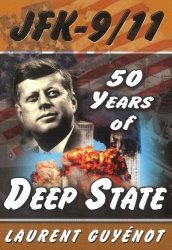
There is, of course, some truth in the “inside job” theory, as I said at the beginning. Israel (in the wider sense) would not be able to pull such an operation and get away with it, without complicity at the highest level of U.S. government. How does that work? Pretty much like for the Kennedy assassination, if you consider that the country was then ruled by its vice-president Dick Cheney, the president being a mere dummy (see Lou Dubose and Jake Bernstein, Vice: Dick Cheney and the Hijacking of the American Presidency, Random House, 2006). In my book JFK-9/11, I have proposed a plausible scenario of how Israel had in fact hijacked a smaller false flag attack on the Pentagon fabricated by the American Deep State, for the limited purpose of justifying the overthrow of the Talibans in Afghanistan, a goal fully supported by such “Great Gamers” as Zbigniew Brzezinski, but which didn’t in itself interest the neocons.
What the neocons wanted was a new war against Iraq and then a general conflagration in the Middle East leading to the crumbling of all the enemies of Israel, with Syria and Iran high on the list. So they outbid everyone and gave the operation the scale they wanted with the help of their New York super-sayan Silvertein. George W. Bush, Colin Powell, Condoleezza Rice, and other goyim who had been kept out of the loop, finding themselves embroiled in geopolitical machinations of global scope, could merely try to save face. On September 19 and 20, Richard Perle’s Defense Policy Board met in the company of Paul Wolfowitz and Bernard Lewis (inventor of the self-fulfilling prophecy of the “clash of civilizations”) but in the absence of Powell and Rice. They prepared a letter to Bush, written on PNAC letterhead, to remind him of his historic mission: “Even if evidence does not link Iraq directly to the attack, any strategy aiming at the eradication of terrorism and its sponsors must include a determined effort to remove Saddam Hussein from power in Iraq. Failure to undertake such an effort will constitute an early and perhaps decisive surrender in the war on international terrorism.”[12] This was an ultimatum. Bush was certainly aware of the leverage that the neocons had acquired over the major print and television media. He was obliged, under penalty of ending in the proverbial trash bin of history, to endorse the invasion of Iraq that his father had refused the Zionists ten years earlier.
As for Brzezinski and other genuine U.S. imperialists, their support for the invasion of Afghanistan made their timid protests against the Iraq war ineffective. It was a little late in February 2007 when Brzezinski denounced before the Senate “a historical, strategic and moral calamity […] driven by Manichaean impulses and imperial hubris.” In 2012 he declared, regarding the risk of conflagration with Iran, that Obama should stop following Israel like a “stupid mule.” He soon disappeared from the MSM, as a useful idiot no longer useful.
The “half truth” of the exclusively “inside job” theory, which denounces 9/11 as a false flag operation perpetrated by the American state on its own citizens, functions like a secondary false flag hiding the real masters of the operation, who are in fact agents in the service of a foreign nation. One of the aims of this inside-jobish controlled opposition is to force American officials to maintain the “bin Laden did it” masquerade, knowing that tearing apart the fake Islamic flag would only reveal the U.S. flag, not the Israeli flag. No longer controlling the media, they would not have the means to raise this second veil to expose Israel. Any effort to get at the truth would be political suicide. Everyone understands what is at stake: if one day, under mounting pressure from public opinion or for some other strategic reason, the mainstream media abandons the official bin Laden story, the well-rehearsed slogan “9/11 was an inside job” will have prepared Americans to turn against their own government, while the neocon Zionists will remain untouchable (Machiavelli’s method: make another accomplish your dirty ends, then turn popular vengeance against him). And God knows what will happen, if the government has not by then succeeded in disarming its citizens through Sandy Hook-type psy-ops. Government officials have little choice but to stick to the Al-Qaeda story, at least for the next fifty years.
After reaching this conclusion in JFK-9/11, I had the satisfaction of finding that Victor Thorn, in a book that had eluded me (Made in Israel: 9-11 and the Jewish Plot Against America, Sisyphus Press, 2011), had already expressed it in harsher terms: “In essence, the ‘9-11 truth movement’ was created prior to Sept. 11, 2001 as a means of suppressing news relating to Israeli complicity. By 2002–2003, ‘truthers’ began appearing at rallies holding placards that read ‘9-11 was an inside job.’ Initially, these signs provided hope for those who didn’t believe the government and mainstream media’s absurd cover stories. But then an awful realization emerged: The slogan ‘9-11 was an inside job’ was quite possibly the greatest example of Israeli propaganda ever devised. […] The mantra, ‘9-11 was an inside job’ is only partially true and is inherently damaging to the ‘truth movement’ because it shifts all attention away from Israel’s traitorous assault against America. […] Leaders of these fake 9-11 groups know the truth about Israel’s 9-11 barbarity. Their willingness to perpetuate or cover it up ultimately makes them as guilty and vile as those who launched the attacks. There are no degrees of separation in this matter. It’s a black-and-white issue. Tell the entire truth about Israel’s Murder, Inc. cabal, or sleep in the same infected bed as these murdering dogs lie in. […] Faux conspiratologists complain about the government and news sources not telling the truth, yet they’ve erected an utter blackout on data regarding Israel and 9-11.”
The missing .3 trillion

Some readers will complain that I am making a very complex operation appear too simple. I plead guilty: I have merely tried here to outline the case against Israel in the short scope of an article. But I am fully aware that creating Greater Israel through a world war fought by the U.S. might not have been the only consideration in the preparation of 9/11. Many private interests had to be involved. Yet I believe none of them interfered with Israel’s plan, and most of them supported it.
There is, for example, the missing gold in the WTC basement : $200 million were recovered from the estimated $1 billion stored: who took the rest? But that is nothing compared to the $2.3 trillion that were missing from the accounts of the Department of Defense for the year 2000, in addition to $1.1 trillion missing for 1999, according to a televised declaration made on September 10th, 2001, the day before the attacks, by Donald Rumsfeld. Just for comparison, this is more than one thousand times the colossal losses of Enron, which triggered a chain of bankruptcies that same year. All this money evaporated into thin air under the watch of William Cohen, Defense Secretary during Bill Clinton’s second term. In 2001, the man who was tasked to help track down the missing trillions was Under Secretary of Defense (Comptroller) Dov Zakheim, a member of PNAC and an ordained rabbi. Practically, the mystery had to be resolved by financial analysts at Resource Services Washington (RSW). Unfortunately, their offices were destroyed by “al-Qaeda” the following morning. The “hijackers” or Flight AA77, rather than hitting the command center on the eastern side of the Pentagon, chose to attempt a theoretically impossible downward spiral at 180 degrees in order to hit the west side of the building precisely at the location of the accounting offices. The 34 experts at RSW perished in their offices, together with 12 other financial analysts, as is noted in the biography of the team leader Robert Russell for the National 9/11 Pentagon Memorial: “The weekend before his death, his entire office attended a crab feast at the Russell home. They were celebrating the end of the fiscal-year budget completion. Tragically, every person that attended that party was involved in the Pentagon explosion, and are currently missing”.
By an incredible coincidence, one of the financial experts trying to make sense of the Pentagon financial loss, Bryan Jack, was reported to have died at the precise location of his office, not because he was working there that day, but because he was on a business trip on Flight AA77. In the words of the Washington Post database: “Bryan C. Jack was responsible for crunching America’s defense budget. He was a passenger on American Airlines Flight 77, bound for official business in California when his plane struck the Pentagon, where, on any other day, Jack would have been at work at his computer”. Yahweh must have a sense of chutzpah!
Footnotes
[1] Philippe Broussard, “En dépit des déclarations américaines, les indices menant à Ben Laden restent minces,” Le Monde, September 25, 2001.
[2] Gilad Atzmon, Being in Time: a Post-Political Manifesto, Interlink Publishing, 2017 , p. 142.
[3] David Ray Griffin, 9/11 Contradictions, Arris Books, 2008, pp. 170-182; Webster Griffin Tarpley, 9/11 Synthetic Terror Made in USA, Progressive Press, 2008, pp. 321-324.
[4] Christopher Bollyn, Solving 9-11: The Deception That Changed the World, C. Bollyn, 2012, pp. 278–280.
[5] It is quoted here from Bollyn’s book and from Justin Raimondo, The Terror Enigma: 9/11 and the Israeli Connection, iUniverse, 2003.
[6] Christopher Bollyn, Solving 9-11: The Deception That Changed the World, C. Bollyn, 2012, p. 159.
[7] Justin Raimondo, The Terror Enigma: 9/11 and the Israeli Connection, iUniverse, 2003, p. 3.
[8] Christopher Bollyn, Solving 9-11: The Deception that Changed the World, 2012 , pp. 278-280.
[9] Quoted by Andrew Cockburn, who claims to have heard the anecdote from “friends of the family”, in Rumsfeld: His Rise, His fall, and Catastrophic Legacy, Scribner, 2011, p. 219.
[10] Michael Evans told of this prophecy in an interview with Deborath Calwell and in his book The American Prophecies, Terrorism and Mid-East Conflict Reveal a Nation’s Destiny), quoted in Christopher Bollyn, Solving 9-11: The Deception That Changed the World, C. Bollyn, 2012, p. 71.
[11] Stephen Sniegoski, The Transparent Cabal: The Neoconservative Agenda, War in the Middle East, and the National Interest of Israel, Enigma Edition, 2008, p. 193.
[12] Stephen Sniegoski, The Transparent Cabal: The Neoconservative Agenda, War in the Middle East, and the National Interest of Israel, Enigma Edition, 2008, p. 144.
Laurent Guyénot is the author of JFK-9/11: 50 years of Deep State, Progressive Press, 2014, and From Yahweh to Zion: Jealous God, Chosen People, Promised Land … Clash of Civilizations, 2018. (or $30 shipping included from Sifting and Winnowing, POB 221, Lone Rock, WI 53556).
“US Threatened to Burn Basra If Abadi Wasn’t Given Another Term”
Al-Manar – September 9, 2018
Iraq’s Popular Mobilization Force who defeated ISIL Takfiri forces said on Saturday it had evidence showing US diplomatic missions in the Arab country have instigated the recent violence in the southern oil-rich city of Basra.
Abu Mahdi al-Muhandis, the second-in-command of the volunteer force, which is also known as Hashd Shaabi, held Washington responsible for the Basra unrest, saying it was actually meant to sow discord among different Iraqi political parties and movements.
“We have complete information and documents that show the US embassy and consulate in the country caused the Basra unrest,” al-Muhandis said.
He also vowed to respond to the Basra incidents and stressed that the Iraqis would never engage in another civil war.
Basra has been rocked by deadly protests since Tuesday. The protests took an ugly turn on Friday when a group of masked assailants raided government buildings and offices of political parties and set them ablaze. The Iranian consulate was among the premises gutted in the rampage.
At least 15 protesters have died in clashes with security forces since the beginning of the month, health officials have said.
Al-Muhandis revealed that the US “threatened with burning Basra” if incumbent PM Haider Abadi was not given another term.
Ties between the Hashd and Abadi are tense, al-Muhandis explained, complaining that Abadi has failed to allocate salaries for Hashd fighters.
“Abadi didn’t keep most of his promises to Hashd al-Shaabi,” tweeted al-Muhandis, but stressed that the situation will not devolve into a “Shiite-Shiite war.”
Reddit Identifies A New Threat: The Truth – #PropagandaWatch
corbettreport | September 3, 2018
Reddit is a controlled propaganda platform. Shocking, I know. Join James for this week’s edition of #PropagandaWatch where he breaks down self-proclaimed homepage of the internet’s war on truth.
SHOW NOTES: https://www.corbettreport.com/?p=27990
Bizarre Israeli Analyses of Syrian Curriculum Circulate in the Middle East
By Andre Vltchek – New Eastern Outlook – 30.08.2018
My friend, a senior UN official based in Amman, Jordan, recently received a newsletter from an Israeli institution – “IMPACT-se”. Their report was called, ‘modestly’, “Reformulating School Textbooks During the Civil War”.
It is full of analyses of the Syrian curriculum.
Interesting stuff, without any doubt: Manipulative, negative, but interesting. It made it to many other places in the Middle East; to Lebanon, for instance, where even the word “Israel” is hardly ever pronounced.
Predictably, being compiled in Israel, the report trashes Syria, its ideology, and the determined anti-imperialist stand of President al-Assad.
However, that may backfire. Excerpts that are quoted from the Syrian curriculum would impress both education experts, as well as the general public, if they were to get their hands and eyes on them. And I am trying to facilitate precisely that, in this essay.
What the report found outrageous and deplorable, others could find very reasonable and positive. Let’s read, here is what the “IMPACT-se” is quoting, while ringing alarm bells:
“Saddam Hussein took power, and his period witnessed a number of wars in the Arab Gulf area. The first was with Iran, called the First Gulf War (1980–88), which occurred through incitement by the US, in order to weaken both countries. History, Grade 12, 2017–18, p. 105.”
Well put, isn’t it? But it gets much better, philosophically. Imagine, this brilliant intellectual stuff is actually served to all Syrian children in their public schools, while in Europe and North America; kids are fed with neo-colonialist mainstream propaganda. No wonder that Syrian children are much better versed in what is happening in the world. No wonder that millions of Syrian refugees are now ready to return home, after the abuse they received abroad, and after realizing how indoctrinated and brainwashed by Western propaganda, the people all over the world are.
“IMPACT-se” continues quoting the Syrian curriculum, naively thinking that the words engraved there, will terrify the entire world:
“This competition and struggle worsened as the capitalist system developed and new occupying forces such as the US, took control over international politics. It exploited its scientific, technological, economic and military supremacy in order to expand its influence and [gain] control over the capabilities of the peoples of the world. This was done in cooperation with its allies, to increase its presence in the international arena as the only undisputed superpower. National Education, Grade 8, 2017–18, p. 81.(The US) strives to maintain its supremacy by monopolizing developing technology, controlling wealth and energy sources in the world, most importantly oil, and forcing its hegemony on the international community. National Education, Grade 8, 2017–18, p. 82.
This could be easily written by the progressive economist Peter Koenig, by the international lawyer Christopher Black, or, why not, by myself.
The people, who worked on the Syrian curriculum, combined two things brilliantly: 1) indisputable facts, 2) elegant simplicity! Actually, this curriculum should be offered not only to the Middle East kids, but all over the world.
Look how skillfully and honestly it summarizes modern history:
“After the disappearance of international balance and unipolar hegemony took control of the world, the US began searching for excuses to justify its intervention in other countries. It occupied Afghanistan in 2002, under the pretext of fighting against “terrorism” in order to realize its political and economic goals. One of the goals was to build an advanced military base close to countries which the US considers to be dangerous (Russia, China, India, Iran and North Korea). In addition, Afghanistan had many assets (such as iron ore and gas). In 2003, the US—helped by a group of countries—declared war on Iraq under the pretext that Iraq was holding weapons of mass destruction and aiding terrorism. The occupation came after an unjust siege and air strikes over Iraqi cities and institutions, without authorization from the UN general assembly and the Security Council. National Education, Grade 8, 2017–18, p. 82
Making the world become one form, one structure and one model, which is the most powerful model now controlling the world, economically and militarily—the American model. The hegemony of the capitalist system . . . turning the world into a consumer market for Western products and ideas, while stripping the nation of its principles, customs and traditions, abolishing its personality and identity, first diluting and then gradually eliminating nations and cultures. National Education, Grade 12, 2017–18, p. 31.”
According to “IMPACT-se”, this is supposed to scare random readers, providing proof how evil the ‘regime in Damascus’ is!
The opposite is true.
An international (non-Western) educator, who is presently based in the Middle East, explained to me over a cup of coffee. I think that this statement is actually a good summary of what many others that are studying the Syrian curriculum really feel:
“Education reflects the vision of a given society. The heart of what a society expects from its citizens is in the curriculum. Having carefully read the analysis of the new Syrian curriculum and textbooks reinforces my strong conviction of how great a society Syria really is.”
*
Let us see the ‘other side’; those who are critical of Syrian education, those who are making a living from such criticism and from antagonizing the system.
ESCWA (United Nations Economic and Social Commission for Western Asia), based in Beirut, Lebanon, has an initiative defined as ‘the future of Syria for the peace-building phase’. This ‘process’ involves Syrian experts from all walks of life.
But who are these experts? In 2018, during the expert’s meeting on education, the list included these specialists:
– Former professors (education and law) of Aleppo University
– Former professor of Damascus University
– Head of an education NGO in Lebanon
– Academics and researchers now based in Turkey and Germany
– Independent consultants
Clearly, if at this meeting any participants were Syrians, they were ‘former some things’. Meaning exiles, anti-government cadres, and mostly pegged to some Western organization (predominantly the organizations based in France or Germany). Not one person from the legitimate government of Syria was invited! A typical Western approach: “about them, without them”.
And these people who are serving Western interests, are supposed to help to define a component on education which is considered vital to “reconciliation and social cohesion in post-war Syria”.
Predictably, instead of promoting reconciliation, the speeches were full of hate, bitter and aggressive, anti-Syrian and pro-Western. ‘Experts’ used terminology such as: ‘Hegemony of the Syrian regime’, ‘The Ba’ath Party is only concerned about ideology, never giving Syrians an identity’ (they were actually demanding that religions would serve as ‘identity’, replacing the presently secular Syrian state), ‘We need to talk about the truth of what happened in 2011, what led to the war in 2011. Without that nothing makes sense’ (but the ‘truth about 2011’ in their minds has definitely nothing to do with the fact that the West encouraged the anti-government rebellion, injected jihadi cadres and triggered the brutal civil war aimed at overthrowing a social state).
Their main point seems to be: ‘The war has strengthened the culture of hatred’.
Correct, but not because of the Syrian state, but, because of people like those ‘experts’!
What do they really want? Religion instead of secularism, capitalism instead of socialism, and of course, the Western perception of ‘democracy’, instead of a patriotic and pan-Arab independent vision of the state.
*
No matter how one turns it, the Syrian education system, including its curriculum, appears to be greatly superior to those in the neighboring countries. Perhaps that is why it is being placed under scrutiny and under attack.
After all, wasn’t the main goal of the West, in 2011 and after, to destroy yet another socialist, internationalist state that was primarily serving its people?
And the state of Israel? What is “IMPACT-se” mainly complaining about? What is irking it most, in the Syrian curriculum? Perhaps this, in its own words and analyses:
“The Syrian curriculum bases Syrian national identity on the principles of a continued struggle to realize one Arab Nation that includes all Arab states, constituting one country, the “Arab Homeland.” The textbooks present the borders dividing the Arab states as artificial, having been imposed by European colonialism.”
For most of us, this is actually, not bad, is it?
Or possibly this:
“The current borders are political ones, drawn through the policy of the colonial powers that had controlled the region, especially France and Britain. They do not overlap the natural borders that used to separate the Arab Homeland from the neighboring countries. So, important changes took place in these borders to the benefit of those countries and to the detriment of the Arab land. Geography of the Arab Homeland and the World, Grade 12, 2017–2018, p. 13.”
What is incredibly impressive, is, how the Syrian curriculum addresses the Soviet period of its close ally – Russia:
“We shall become acquainted with the reality of Russia prior to the Communist Revolution, and the causes which led to its political, economic, social and intellectual renaissance, from World War I until the dissolution of the Soviet Union and the establishment of the Russian Federation in 1991. History, Grade 8, 2017–18, p. 98.
The Socialist Revolution in Russia broke out in order to confront the imperial regime. It declared the establishment of the first socialist country in 1917. [The Revolution] was based on the rule of the workers and the peasants, and it had a global impact, as it supported national liberation movements. History of the Modern and Contemporary World, Grade 11, 2017–18, p. 168.
Gorbachev took over the leadership of the state and party in 1988, and aspired to implement a plan of economic, social and ideological reconstruction. However, the imperialistic countries conspired against the destiny of the Soviet Union and took advantage of the administrative corruption and the circumstances of multiple nationalities, leading to its dissolution in 1991 and the establishment of the Russian Federation in its place. History, Grade 8, 2017–18, pp. 99–100”
Actually, if I could, if I were to be allowed to, I’d love my publishing house (Badak Merah) to publish the Syrian curriculum, or at least its part on history and politics, for everyone outside Syria to read.
What the Israeli “IMPACT-se” sees as alarming or negative, most of people all over the world and particularly in the Arab region, would definitely perceive as truthful, optimistic and worth fighting for.
Are the experts from “IMPACT-se” so naïve that they do not realize it? Or is there something else going on? Perhaps we will never find out.
No matter what: thank you for reminding us of the great Syrian curriculum! It clearly shows how great a nation Syria is!
Andre Vltchek is philosopher, novelist, filmmaker and investigative journalist. He’s a creator of Vltchek’s World in Word and Images, and a writer that penned a number of books, including Revolutionary Optimism, Western Nihilism.
5 timely reminders that the media think you are an idiot…

By Kit | OffGuardian | August 28, 2018
The corporate media think we are stupid. All of us. They have as much respect for our intellect or ability to reason as they do for the truth. This is displayed, in size 20 font, on the front page of every newspaper every single day. They paint a picture of an absurd world, and expect us all to nod along with it, blithely accepting their stories as true, no matter what laws of reason – or even physics – they bend to suit their purpose.
The world in the newspaper and on the television is not real in any true sense of the word. Merely a crazy fun-house mirror reflection of the truth. Important features shrunk to nothing, tiny flaws blown up out of proportion. Apparently solid shapes that – on inspection – are nothing but strange plays of light and shadow.
With that in mind, let’s remind ourselves of the kind of completely bonkers things we’re all expected to believe.
1. The Inherent silliness of “ISIS”
This section was going to be more specific, but as I looked back over recent history, there was no single absurdity that highlighted how stupid the ISIS story was.
ISIS was, and is, silly. A few bullet points to demonstrate this – and a reminder that these are not exaggerated in any way. These are, supposedly, facts:
- They were making $1-$3 million PER DAY smuggling oil out of Syria, in convoys kilometres long that the US air force either couldn’t find or wouldn’t bomb because of “risks to civilians”. How they had the technical expertise to extract and process this oil was never explained.
- They minted their own currency.
- They published end-of-year reports, like a business, and kept detailed accounts on flash drives and USB sticks. Despite this, no ISIS bank accounts were ever seized, monitored or shut down.
- They had multiple social media accounts, YouTube channels – often described as “ISIS linked social media accounts” – these accounts weren’t locked, blocked or deleted. The registered owners weren’t arrested. They had their own twitter app which was impossible to block and created their own social network.
- They had their own TV channel, with an animated logo, a waving flag, in the corner of their videos. Think on this – somebody, somewhere, made that logo.
- They had fleets of Toyotas, which we’re supposed to believe they just sort of… acquired. They are all clean, new and undamaged. They are all colour-matched too, of course. There are red ones, white ones, black ones and tan ones. With and without logos painted on the hood. They deployed these trucks in photo-shoots and “viral” videos, the theoretical production of which simply boggles the mind. A bunch of black Toyota’s crossing the desert doesn’t look like much, but think about the actual logistics of making the video. They had to drive up to this spot, drop off the camera crew and equipment, drive back over the horizon, properly time their entrance by synchronizing all the driving and spacing the trucks out evenly, drive past the camera crew waving their flags… then drive back and pick up the camera men and equipment. All of this in the middle of a war zone.
- Of course all their videos had the same music, the ISIS theme, which was Arabic voices singing in close harmony. We’re supposed to believe that – somewhere in the heart of their war-torn empire – a bunch of crazy zealots gathered round a microphone to sing a capella melodies about “death to the west”, while a frustrated technician muttered to himself about “levels” and how Muhammad is flat on the high note. This spawned their own genre of music, which NME did a story on.
It’s so… stupid. And yet the media says it, and expects us to believe it.
ISIS – the all-powerful death cult, the existential threat to Western democracy, on the verge of “regional dominance”. There was a map and everything – world domination by 2020.
Despite all this, ISIS – the untouchable hydra of evil – completely fell apart as a force in the region just months after Russia and Iran got involved in the Syrian war.
Why was this?
Could it be that ISIS were just a media creation – the PR arm of the CIA’s jihadist proxy army – and, in truth, barely existed as fighting force? Existing, rather, to give Western powers an excuse to conduct air strikes on Syrian territory?
Or could it be that the MSM realised that 10,000 insane, bloodthirsty zealots taking time out of their devout holy war to have design meetings about coinage, or shoot music videos in Dune buggies, rings rather hollow?
It’s all a bit silly isn’t it?
2. The Syrian government Is collectively suicidal
Several times, in the last couple of years, Western leaders have made remarkably prescient statements – something along the lines of “We will not tolerate the use of chemical weapons on civilians”, or “We will act if chemical weapons are used”. In fact, in just the last few days both the US and France have reissued these warnings.
Despite these warnings, and though it offers him literally zero strategic advantages of any kind, Assad keeps deploying his super-secret chemical weapons against civilians… just because. He’s winning the war, it’s pretty much over, the only thing that could swing it against him is NATO, and he keeps deliberately inciting them to attack him.
There’s only 2 explanations for that – either he, and his government, are low-key suicidal, or it never happened, and the propagandists in the media truly believe we are completely stupid.
Then there’s the photographs.
Syria knows they have been in America’s crosshairs for years, since well before the start of the Arab spring. They are aware of Israel’s designs on Syrian land, and more than familiar with the US modus operandi re: “humanitarianism”. They KNOW the worst thing they could do is give America, and their NATO allies, even the whisper of a war crime to get indignant about.
… and yet we’re supposed to believe, not only that the regime tortured and executed tens of thousands of “peaceful protestors” for absolutely no reason, but they also kept a carefully photographed and catalogued record of their crimes.
This was brought up in the Guardian today, the famous “Caesar Photographs”, photos of 11,000 people the Assad government tortured and killed, all properly catalogued and numbered and then – conveniently – leaked by some unknown “former guard” and displayed in London like some morbid art exhibition.
The identity of the “leaker” remains a mystery, and there is literally zero evidence the photographs are a) from Syria or b) real.
Does this version of events sound even slightly reasonable?
3. Amnesty International used echolocation to recreate a Syrian prison
They really did. They have some guys claiming to be Syrian resistance members who were held in one of Assad’s “torture prisons”, but they were either blindfolded or in darkness the whole time, so in order to map out the interior of the prison… Amnesty International played sounds to them, to see if they sounded the same. I truly wish I was joking:
Inmates were constantly blindfolded or forced to kneel and cover their eyes when guards entered their cells, so sound became the key sense by which they navigated and measured their environment – and therefore one of the chief tools with which the Forensic team could reconstruct the prison layout. Using a technique of “echo profiling”, sound artist Lawrence Abu Hamdan was able to determine the size of cells, stairwells and corridors by playing different reverberations and asking witnesses to match them with sounds they remembered hearing in the prison.
There’s no reports as to why exactly the men were locked up, how they got away, why they were released and not executed like everyone else OR – indeed – where they acquired their bat-like super hearing.
… But we do now have a 3D model of Assad’s “torture prison”. We even know which room is the crematorium too, because it looked like the snow on the roof had melted in one satellite photo… and the only thing that makes a roof hot is the burning corpses of dissidents.
The whole process is part of a completely made up recently developed field known as “forensic architecture”. In simple terms, it seems “forensic architecture” is looking at the outside of a building – or indeed a photograph of the outside of a building – and guessing what’s inside. While this might seem difficult, pointless, or even insane to most people… to the mainstream media it is worth of thousands of words of coverage and, indeed, winning media awards.
Does any of that really make any sense to you?
4. Jeremy Corbyn hates the Jews
Jeremy Corbyn is soft – maybe, arguably – too soft for the job that history has violently hoisted on to his shoulders, but soft none the less. He rides his bike to work, wears cardigans, is a vegetarian. He has campaigned for peace and against war his entire life. He was arrested for protesting apartheid whilst Margaret Thatcher was calling Nelson Mandela a terrorist, he spoke out against Pinochet while the General was a darling on both sides of the Atlantic.
He has won two international peace prizes.
The idea that, during a public career dedicated to the socialist ideals of decency and fairness, he was secretly thinking “Bloody Jews!” the whole time is completely absurd. Insultingly absurd, and there is not a single piece of evidence to suggest otherwise. There is nothing more to be said on the matter.
5. Russiagate
This is the big one, currently. The grand-daddy of the nothingburgers. Russiagate never happened. There was no collusion, no cheating or vote hacking or pay-offs. They have found literally zero evidence anything ever took place, seizing upon tiny anecdotal scraps and blaring them out in FULL CAPS HEADLINES to make a case in the court of public opinion that would never stand in an actual court.
Where “Russiagate” is different from most invented media schlock however, is the sheer weight of counter evidence. For most media fiction you can say “Well, there’s very little evidence to support that” (see Corbyn = anti-Semite as a classic example). With Russiagate you can go even further: There is a ton – A TON – of evidence to the contrary, clear-cut evidence that Russia (and Putin) have nothing to do with Trump being President. The media refuse to acknowledge this evidence, directly and contemptuously challenging the public’s ability to reason.
Below is a list of unchallenged, non-controversial facts about Russiagate:
- The only proven, admitted, wrong-doing in the 2016 Presidential election was carried out by the DNC, who rigged the primaries so Clinton would be the democratic candidate. This was later admitted to by members of the DNC.
- The e-mails which first brought this to light were published by WikiLeaks, there is no proven link between WikiLeaks and the Russian government.
- Julian Assange, founder of WikiLeaks claimed the e-mails were from an internal leak, not the result of a hack.
- The “Trump-Russia” dossier, a collection of (possibly fabricated) dirt put together by British ex-spy Christopher Steele, was paid for by the DNC and Clinton’s campaign.
These facts, alone, should bring Russiagate down… but there’s more. Since becoming President, Donald Trump has:
- Armed the Ukrainian coup government.
- Bombed Syria.
- Torn up the Iran deal.
- Sanctioned Russia over the Skripal case.
- Sanctioned Russia over “election interference”.
- Expelled Russian diplomats.
- Killed over 200 Russian “mercenaries” in Syria.
These are policies that not only run counter to ALL of Russia’s interests, but very nearly brought us to the brink of World War 3.
And yet we’re told, over and over, to ignore our own logical minds and believe that Trump is Putin’s “puppet”. That Trump is “soft” on Russia.
Why would a product of Russian collusion pursue policies harmful to Russia? How many Russians need to die before we accept that Trump is anything but soft?
The media line on this issue is insane, and dangerous. In refusing to acknowledge the actual truth – that the US Deep State is pushing for conflict with Russia – the media are dragging us toward apocalypse, smiling happily to themselves as they go.
They are either all delusional morons, think WE are all delusional morons, or – most probably – both.
The inmates are running the asylum, declaring the rest of us insane because none of us are hearing voices.
This is why the media is in decline, why the BBC is losing its audience and the newspapers have plummeting readership, because people are tired of being treated like idiots and herded like cattle. We’ve made a collective decision to cut the bullshit out of our lives. The world is heading towards a split, two parallel universes running together – the real world, where reasonable pragmatic people get on with the struggles of life, and the media world, where fake people write about pretend events in newspapers nobody reads.
The media has become that manipulative spouse who lies and cheats and tells you it’s all your fault. A narcissistic gaslighter who just will not change.
It’s time to make a clean break.
About Half of Syrian Al-Diabiya Residents Return Home After City Liberation
Sputnik – 27.08.2018
AL-DIABIYA About half of the residents of the Syrian city of Al-Diabiya in Damascus province have returned to their homes after the city was freed from the militants, the local administration said on Monday.
“Before the war, there were 70,000 people living in Al-Diabiya. Now 35,000 have already returned,” Abdullah Ahmad, the head of the city administration, said.
The official added that the authorities were restoring the infrastructure in order to facilitate the residents’ return.
“Our task is to restore everything for the normal life and to improve living conditions here as soon as possible. People should understand that they are not asked to return to the debris. Electricity is already supplied and we are also working on distributing food,” Ahmad said.
Syria has been devastated by years of violent civil war which had prompted millions of people to flee hostilities from the areas where they lived to other locations in Syria and outside the country. The United Nations estimates, there are over 5.6 million Syrian refugees abroad and about 6.6 million displaced across the crisis-torn country.
Featured Video
EUROPE FEARS RUSSIA’S NEXT MOVE / Ian Proud
or go to
Aletho News Archives – Video-Images
New Book
New Book: No Autoimmunity The Body Doesn’t Attack Itself
Lies are Unbekoming | September 24, 2026
 The label for Humira, once the best-selling drug in the world, lists its risks in plain print. One of them, in the label’s own words, is new “autoimmune” disease.
A drug prescribed for a condition labelled autoimmune carries a warning that it can cause a condition labelled autoimmune. That contradiction sits in every box, on a folded paper almost nobody reads.
My new book starts there.
No Autoimmunity: The Body Doesn’t Attack Itself
For seventy years, “your body is attacking itself, and we don’t know why” has ended the conversation for people diagnosed with multiple sclerosis, lupus, rheumatoid arthritis, Hashimoto’s, Type 1 diabetes, Crohn’s and psoriasis. More than eighty conditions now carry the autoimmune label. The diagnosis comes with a prescription for life. It almost never comes with a question about cause.
This book asks the question and answers it from the framework’s own records: its drug labels, its journals, its regulatory filings, and its own experiments. … continue
Blog Roll
 Aletho News
- DEATH SPIKES & RISING CANCER IN OUR YOUTH EXPLAINED
- Iran offers Trump deal before US election
- Merz regime wants ‘secret police’ – opposition
- Israeli settlers terrorize West Bank Palestinians with state-provided drones: Report
- They see them, then kill them: Israeli quadcopters track, deliberately target civilians in Gaza
- Debunked: Trump’s egregious UNGA claims on war against Iran crumble under scrutiny
- Europe was part of the infrastructure of US aggression against Iran: Deputy FM
- New evidence on the Bucha Massacre
- Italy and France debunk reports CIA issued ‘Russian drone threat’ warning
- How Russia is Rewiring the Global South
- If Americans Knew
- Trump betrayed voters with his campaign lies and prioritized a foreign country once he took office
- Netanyahu calls Israel’s war in Gaza ‘opposite of genocide’ in UN speech to near-empty hall
- Settler Kidnappings: Torture, Sexual Abuse and Terrorisation of Palestinian Abductees as Israel Deepens Annexation of West Bank
- Gaza winter nears as 162,000 tents become unusable, raising fears of humanitarian crisis
- Netanyahu says, “It’s the opposite of genocide”; UN says Gaza economy is world’s ‘most severe crisis on record’ – Daily Update
- Israel’s US-Backed Assault on Gaza Has Created the ‘World’s Most Severe Economic Crisis on Record’: UN
- ‘Protecting U.S. Citizens’… From Israel
- ‘This is where I live now, the back of a truck’: a day in the life of a grandmother in Gaza
- In UN Speech, Iran’s President Displays Pictures of Children Killed by US, Brings Attention to Israel’s Nuclear Arsenal
- Israel displaces hundreds of Palestinians amid wave of demolitions in West Bank
- No Tricks Zone
- New Study: Earth And Venus Surface Warmth Largely Explained By Convection And Lapse Rate, Not CO2 Or Radiation
- 2025 Nature Paper Claiming Worsening Global Drought Gets RETRACTED …Heavily Flawed
- New Study: ‘Global Drought Shows No Detectable Recent Acceleration Under Climate Warming’
- Economic Masterminds: German Socialists Suggest Taxing Productivity Gains Stemming From Using AI
- The South China Sea Has Not Been Cooperating With The Climate Change Narrative
- Energy Crisis: Germany Enters Heating Season With Historically Low Gas Reserve Fill Levels
- New Study: The Antarctic Ice Sheet Gained Mass From 2020-2024 Due To Staggering Snow And Ice Accumulation
- Study: Ocean Heating Rates From Thousands Of Years Ago ‘Dwarf’ Modern Ocean Heating Rates
- Climate Extremists Target, Attack Large-Scale Power Grid Infrastructure In Germany!
- New Study: Antarctic Ice Melt Has Contributed Less Than 1 Centimeter To Sea Level Rise In The Last 30 Years

