The Illusion of Debate
By Jason Hirthler | CounterPunch | December 2, 2014
A recent article in FAIR reviewed the findings of its latest study on the quality of political “debate” being aired on the mainstream networks. It studied the run-up to the military interventions in both Iraq and Syria. Perhaps the arbiters of the study intended to illustrate what we’ve learned since the fraudulent Iraq War of 2003. Well, it appears we’ve learned nothing.
FAIR spent hours painfully absorbing the misinformation peddled by such soporific Sunday shows as CNN’s State of the Union, CBS’s Face the Nation, NBC’s Meet the Press, and ABC’s This Week, plus some of the more popular weekly political programming including ADHD-inducing CNN’s Situation Room, Fox News Channel’s Special Report, the venerable sedative PBS NewsHour, and MSNBC’s Hardball. You know the cast of characters: glib George Stephanopoulos, forthright Candy Crowly, harrowing Wolf Blitzer, and stentorian Chris Matthews. Images of their barking maws are seared into the national hippocampus.
Overall, 205 mostly government mouthpieces were invited to air their cleverly crafted talking points for public edification. Of them, a staggering sum of three voiced opposition to military action in Syria and Iraq. A mere 125 stated their support for aggressive action.
Confining its data to the Sunday shows, 89 guests were handsomely paid to educate our benighted couch-potato populace. One suggested not going to war. It stands to reason that considered legal arguments against these interventions got the short shrift, too.
The media consensus on Syria and Iraq isn’t an isolated instance of groupthink. Far from it. It conforms to a consistent pattern, one that has at its core a deliberate disregard for international law and efforts to strengthen transnational treaties and norms regarding military action. (Although transnational law regulating trade is highly favored, for obvious reasons.)
Here the New York Times uncritically repeats Israel casualty figures from the recent attack on Gaza. The journalist, Jodi Rudoren, gives equal legitimacy to sparsely defended claims from Tel Aviv and “painstakingly compiled research by the United Nations, and independent Palestinian human rights organizations in Gaza.” She adopts a baseless Israeli definition of “combatant”, ignoring broad international consensus that contradicts it. She dubiously conflates minors with adults, and under-reports the number of children killed. And so on. All in the service of the pro-Israel position of the paper.
In 2010 Israel assaulted an aid flotilla trying to relieve Palestinians under the Gaza blockade. Author and political analyst Anthony DiMaggio conducted Lexis Nexus searches that demonstrate how U.S. media and the NYT in particular scrupulously avoid the topic of international law when discussing Israeli actions. In one analysis of Times and Washington Post articles on Israel between May 31st and June 2nd, just five out of 48 articles referenced international law relating to either the flotilla raid or the blockade. DiMaggio dissects several of the methods by which Israel flaunts the United Nations Charter. He adds that Israel has violated more than 90 Security Council resolutions relating to its occupation. You don’t get this story in the American mainstream. But this is typical. U.S. media reflexively privileges the Israeli narrative over Arab points of view, and barely acknowledges the existence of dozens of United Nations resolutions condemning criminal actions by Israel.
It’s the same with Iran. For years now, Washington has been theatrically warning the world that Iran wants to build a bomb and menace the Middle East with it. That would be suicidal. It is common knowledge among American intelligence agencies, and any others that have been paying attention, that Iran’s foreign policy is deterrence. But this doesn’t stop the MSM from portraying Tehran as a hornet’s nest of frothing Islamists.
Kevin Young has done a telling survey of articles on nuclear negotiations between the U.S. and Iran. Some 40 editorials written by the Times and the Post were vetted. Precisely zero editorials acknowledged international legal implications of U.S. public threats and various subversions led by Israel, such as assassinating scientists and conducting cyber-attacks, both innovations on standard violations of sovereignty. However, 34 of the pieces “said or implied” that Iran was seeking a nuclear weapon. Forget that 16 American intelligence agencies stated that Iran had no active nuclear weapons program. These papers of record prefer to trade in innuendo and hearsay, despite assessments to the contrary. More than 80% of the articles supported the crippling U.S. sanctions that are justified by the supposed merit of the bomb-building claim.
Prior to Young’s work, Edward Hermann and David Peterson looked at 276 articles on Iran’s nuclear program between 2003 and 2009. The number itself is staggering, more so when stacked against the number of articles written over the same period about Israel’s nuclear program: a mighty three.
This is interesting considering the posture of both countries in relation to international treaties. Israel freely stockpiles nuclear weapons and maintains a “policy of deliberate ambiguity” about its nuclear weapons capacities, despite frequent efforts by Arab states to persuade it to declare its arsenal (which is estimated by some to be in the hundreds). Also, it has yet to sign the Treaty on the Nonproliferation of Nuclear Weapons (NPT) that has been signed by 190 nations worldwide. This intransigent stance has marooned the broadly embraced idea of working to establish a nuclear weapons free zone in the region.
Contrast Israel’s behavior with that of Iran itself, which has permitted extensive inspections of its nuclear facilities. The Times recently noted the country’s main nuclear facilities were “crawling with inspectors.” Iran is also a party to the NPT and is a full member of the IAEA. It continues to try to work toward a reasonable solution with the West despite debilitating sanctions levied on it by the United States. America has unduly pressured the IAEA to adopt additional protocols that would require prohibitively stringent demands on Iran, rendering the possibility of a negotiated solution comfortably remote from an American standpoint. (These additional demands reportedly include drone surveillance, tracking the origin and destination of every centrifuge produced anywhere in the country, and searches of the presidential palace. All of this passes without comment from our deeply objective journalist class.)
Coverage of Iraq is no different, particularly in advance of periodic illegal war of aggression against it. Former U.N. Special Rapporteur on Palestine Richard Falk and author Howard Friel conducted a survey in 2004 assessing the New York Times’ pre-war coverage of Iraq in 2003. In more than 70 articles on Iraq, the Times never mentioned “UN Charter” or “international law.” The study also found “No space was accorded to the broad array of international law and world-order arguments opposing the war.” But such arguments only exist outside of Western corridors of power in Washington, London, Paris, and Tel Aviv.
This isn’t debate. Real debate is pre-empted by internal bi-partisan consensus on some basic issues: maintain a giant garrison state, shrink the state everywhere else, preference corporations over populations, restrict civil liberties to secure status quo power structures. So when it comes to Iran, Iraq, Syria and the like, the question isn’t whether to go to war, but what kind of war to fight. Hawks want bombs. Doves want sanctions. Publicans want Marines. Dems want a proxy army of jihadis. They both want Academi mercenaries. (Obama hired out the gang formerly known as Blackwater to the CIA for a cool $250 million.) And when we’ve finished off ISIS, the question won’t be about an exit strategy, but whether to head west to Damascus or east to Tehran.
The question isn’t whether to cut aid to Israel given its serial criminality in Gaza and the West Bank, but how fast settlements can annex the Jordan Valley without attracting more international opprobrium. (International law, again, set aside.)
On the domestic front, the question isn’t whether to have single payer or private healthcare, but whether citizens should be forced to purchase private schemes or simply admonished to do so. The question isn’t whether or not to keep or strengthen New Deal entitlements, but how swiftly they can be eviscerated. The question isn’t whether or not to surveil the body politic, but where to store the data, and whether or not to harvest two-hop or three-hop metadata. The question isn’t whether or not to hold authors of torture programs accountable, but how much of the damning torture report to redact so as to leave them unprosecutable. The question isn’t whether or not to regulate Wall Street but, as slimy oil industry lawyer Bennett Holiday put it in Syriana, to create “the illusion of due diligence.”
All this is not to say the MSM isn’t aware of alternative viewpoints. It is, but it only acknowledges them when they can be used to justify a foregone conclusion. In the past year, the MSM has nearly become infatuated with international law. Friel has tracked the paper of record’s response to the Ukrainian fiasco. What did he find? When Russia annexed Crimea, the Times inveighed against the bloodless “invasion” as a gross violation of international law. Eight different editorials over the next few months hyperventilated about global security, castigating Russian President Vladimir Putin for his “illegal” violation and his “contempt for,” “flouting,” “blatant transgression,” and “breach” of international law. Calls were sounded to “protect” against such cynical disregard of global consensus. Western allies needed to busy themselves “reasserting international law” and exacting heavy penalties on Russia for “riding roughshod” over such sacred precepts as “Ukrainian sovereignty.”
Quite so, as Washington supports the toppling of democratically elected governments in Kiev and Tegucigalpa, sends drones to ride “roughshod” over Yemeni, Pakistani, Somali and other poorly defended borders; and deploys thousands of troops, advisors, and American-armed jihadis to patrol the sectarian abattoirs of Syria, Iraq and Afghanistan. But better to exonerate ourselves on those counts and chalk it up to the fog of war. After all, we follow the law of exceptionalism, clearly defined by Richard Falk as, “Accountability for the weak and vulnerable, discretion for the strong and mighty.”
Jason Hirthler is a veteran of the communications industry. He lives in New York City and can be reached at jasonhirthler@gmail.com.
What the Fake Syria Sniper Boy Video Tells Us About Media Experts

By Maram Susli | New Eastern Outlook | November 27, 2014
Many mainstream media websites helped a fake video go viral this month. The video showing a young Syrian boy running through sniper fire to save a little girl, was exposed as a fake when the Norwegian producer Lars Klevberg made the fact public. One of the stated aims of the Norwegian film makers was to “see how the media would respond to a fake video.” This article examines how that experiment went.
The western press very quickly accepted the video as real and used it to support the US administration’s narrative on Syria. Many top US news sources began to spread the story. Even though the producer said he explicitly added big hints that the video was fake, like the children surviving multiple gun shots.
Propagating false stories on Syria, is nothing new for the western press. In the lead up to the conflict many stories were exposed as frauds, such as the Anti-government activist “Gay Girl in Damascus” which turned out to be a middle-aged American man in Scotland. Syrian Danny Abdul Dayem which was frequently interviewed by CNN was using fake gun fire and flames in his interviews.
The fake sniper video wasn’t enough to support US government narratives by itself, as the now deleted original upload didn’t suggest the identity of the snipers. So the west’s media suggested that it was Syrian military snipers that were targeting the children without any evidence. Journalists failed to mention how they reached the conclusion that an actor in Malta was shot by the Syrian military. It may be that the western press is quick to trust pro-rebel sources, as the video was uploaded by the pro-rebel Sham Times along with their own twist.
The Guardian’s headline for the video was “Syrian boy ‘saves girl from army sniper’” and the Telegraph delicately suggested the Syrian military was responsible for the fake bullets. The International Business Times stated, “the snipers, who reportedly are said to be the government forces loyal to Syrian President Bashar al-Assad.” IB Times never explicitly mentioned who reported this information. They then took it a step further and concluded the article with “the incident certainly is not the first time that Pro-Assad gunmen have targeted children”. Well it is at least not the first time the mainstream media has presented false reports as fact. In 2012, CNN claimed a bullet that killed a four year old girl in Aleppo was shot by government snipers even whilst admitting the bullet came from rebel held buildings.
Other journalists took to Twitter to make unfounded claims about army snipers targeting the boy. Vinnie O’Dowd who has done work for Channel 4 and Al Jazeera tweeted “Syrian Regime Targets kids”. Liz Sly of the Washington Post tweeted incredulously that “Soldiers kept shooting” at children.
These tweets were inline with an official State Department Twitter account @ThinkAgain_DOS which blamed Assad for the fictitious bullets in the film. This casts doubt on how deeply the US administration scrutinizes information it bases it’s policy on. In 2013 they relied heavily on video footage provided by rebels to support its planned attack on Syria in the wake the Ghouta chemical attack.
Scrutinising the Scrutinisers (Experts)
 But it isn’t just the mainstream media that was easily duped by the convenient propaganda film. The video experts that were asked to scrutinise the video, failed to recognise that the video was a fraud. The Telegraph stated that upon enquiry “experts told them they had no reason to doubt that the video is real”. International Business Times went a step further spinning the statement to “experts told The Telegraph that they have no doubts on the authenticity of the footage.”
This is very strange since both children in the film walk away after being directly and repeatedly hit by bullets. The creators of the film said he purposely scripted this as a big hint that the video is fake. The lack of scrutiny the media experts employed suggests incompetence or the same level of bias as the media that employs them.
Heather Saul of the Independent wrote that one of the ‘Middle East experts” she showed the video to was from Human Rights Watch. Indeed, Human Rights Watch European Media Director Andrew Stroehlein, showed no doubt on the authenticity of the film when he tweeted it out to his followers. The New York based human rights organisation is not new at tweeting false information, last month they used an image of the Odessa fire, where US-backed militia’s burned thirty two people to death, as an example of ‘Putin’s repressive policies’. In 2008 Venezuela expelled two HRW staff members accused of “anti-state activities” after producing a report against the Chavez government. Guardian journalist Hugh O’Shaughnessy accused HRW of using false and misleading information in the report, as well as pro-Washington bias. In 2009 HRW received financial donations from the Saudi government which may, in part, explain the anti-Syrian slant.
 HRW employed so called video expert Eliot Higgins and his colleague Daniel Kaszeta to investigate the August 21 chemical attack in Ghouta, and quickly reached the conclusion the Syrian government was behind the attack. Daniel Kaszeta was referred to as a fraud by prominent physicist and MIT Professor Theodore Postol. HRW’s CEO Kenneth Roth recently used a report by Eliot Higgins to make unfounded claims about Ukrainian rebels shooting down Malaysian flight MH17. Heather Saul did not respond to questions on whether Eliot Higgins was one of the expert she asked for advice. However the mainstream media’s most often quoted video expert, did not recognise that the video was a fraud, tweeting cautiously that he wasn’t sure if it was authentic but gave the video a reaction non the less.
However many viewers who aren’t referred to as video or Middle East experts, immediately recognised the video was a fraud and flooded social media sites Twitter and Youtube with doubts on its authenticity. If Heather Saul had used these individuals as experts rather than HRW, she would have reached the correct conclusion about the video. But perhaps it is this unbiased eye that the mainstream media avoids. The vast majority of Higgin’s conclusions support US government narratives and agendas, and that’s the kind of bias the mainstream media prefers.
Blaming the Producer
Instead of humbly accepting blame for spreading disinformation, many western journalists and their experts reacted by blaming the producer of the film. The collective rage of the entire mainstream media forced the film’s producer to delete any trace of this 30,000 dollar experiment. Some journalists took to Twitter to express their rage at being exposed as easily duped by convenient propaganda.
The experts that were fooled by the video also strongly protested. HRW posted a complaint that the fake video “eroded the public trust in war reporting”, in other words blind trust in HRW analysis and war propaganda. Eliot Higgins posted an open letter to the producer of the film on his website Bellingcat, condemning the film.
GlobalPost referred to the film as ‘irresponsible and dangerous’ but not because it could be used to promote wars and make false accusations. What the real danger to the mainstream media and their experts seems to be, is that as a result of the film’s exposure as a fraud, future video claims may now have to be properly scrutinized and the public may not be so unquestioning in future. However it is the journalists’ lack of scrutiny that is truly what is irresponsible and dangerous. Had the director not admitted the film was fake, these journalists more than likely would have kept promoting the story as an example of Syrian Army war crimes.
Maram Susli also known as “Syrian Girl,” is an activist-journalist and social commentator covering Syria and the wider topic of geopolitics.
Neocon propagandist frets over Russia’s ‘weaponization of information’
By Maidhc Ó Cathail | RT | November 26, 2014
There was a strong whiff of hypocrisy in the Washington air on November 13 when the National Endowment for Democracy (NED) hosted a discussion of a report entitled ‘The Menace of Unreality: How the Kremlin Weaponizes Information, Culture, and Money’.
The Menace of Unreality is co-authored by Michael Weiss, editor-in-chief of the Interpreter, and Peter Pomerantsev, author of a forthcoming book asserting that Putin’s Russia is a post-modern dictatorship.
Introducing the discussion, NED’s Christopher Walker noted that the US Congress-funded Endowment hadn’t been involved in the production of the report but that it does have “close ties” to Weiss’s online journal and the New York-based think tank that funds it, the Institute of Modern Russia (IMR).
In the course of their report’s self-righteous criticism of the widespread “opaqueness” about who funds think tanks, Weiss and Pomerantsev disclose, in an aside, that their work is “funded by a think tank that receives support from the family of Mikhail Khodorkovsky.” Their critique of the weaponization of money, however, neglects to mention its funder’s conviction for embezzlement and money laundering.
In Washington, Weiss and Pomerantsev were joined in the discussion of their “counter-disinformation” report by an analyst from the Foreign Policy Initiative, a neoconservative advocacy group founded by Robert Kagan and William Kristol, whose earlier Project for a New American Century had played a key role in pushing the lies that led to the US invasion of Iraq.
Inside the report’s cover, which features a reader oblivious to the fact that the broadsheet he’s reading is going up in flames, the Interpreter says it “aspires to dismantle the language barrier that separates journalists, Russia analysts, policymakers, diplomats and interested laymen in the English-speaking world from the debates, scandals, intrigues and political developments taking place in the Russian Federation.”
The similarity between the Interpreter’s stated aspirations and those of the pro-Israel Middle East Media Research Institute (MEMRI) may be more than coincidental. As the liberal Jewish blogger Richard Silverstein observed about a blog in the Telegraph by the Interpreter’s editor-in-chief, “a number of Weiss’claims are based on the notoriously unreliable MEMRI,” which itself claims to bridge “the language gap between the West and the Middle East and South Asia.”
The bio that precedes that June 2011 Weiss blog describes him as “the Research Director of The Henry Jackson Society, a foreign policy think tank, as well as the co-chair of its Russia Studies Centre.”
In addition to a who’s who of neocon luminaries like Kagan and Kristol, the Henry Jackson Society’s international patrons include Ambassador Dore Gold, former permanent representative of Israel to the United Nations, and Natan Sharansky, chair of the executive of the Jewish Agency for Israel.
Weiss’s previous employment at the UK-based, pro-Israel advocacy organization, however, is conspicuously absent from the lengthy “About the Authors” section at the end of the IMR-published, anti-Russia report.
His updated bio, however, reveals that Weiss’ concerns haven’t changed much since his HJS days.
“Weiss has covered the Syrian revolution from its inception, reporting from refugee camps in southern Turkey and from the frontlines of war-torn Aleppo,” the IMR report notes.
As a profile of the neocon Henry Jackson Society observes, its members have been “active proponents of Western intervention in Syria’s civil war.” It singles out a March 2012 piece in the New York Times by Weiss advocating that the US “begin marshaling a coalition for regime change in Syria consisting of countries” like “Britain, France, Qatar, Saudi Arabia and Turkey.”
In an interview with the Jerusalem Post last year, Israel’s previous ambassador to the US Michael Oren admitted that Tel Aviv “always wanted [President] Bashar Assad to go.”
Likewise, one suspects that Weiss’ “set of modest recommendations” on how the West should confront Russia’s supposed “weaponization of information” is motivated at least in part by the challenge Russian media such as RT poses to the monopoly over the narrative of the Syrian conflict coveted by his interventionist friends in the Western media.
Maidhc Ó Cathail is a widely-published writer and political analyst. He is also the creator and editor of the Passionate Attachment blog, which focuses primarily on the US-Israeli relationship.
LIVING WITH INSANITY
Harper, Abbott, and Cameron at the Brisbane G-20
By John Chuckman | Aletho News | November 18, 2014
Canada’s Prime Minister, Stephen Harper, is reported by a spokesman, to have had the following exchange with Russia’s President Vladimir Putin during the Brisbane G-20 summit: “Well, I guess I’ll shake your hand, but I only have one thing to say to you: you need to get out of Ukraine.” Putin is said to have replied, “Impossible. Since we are not there.”
A graceless bit of diplomatic crudity from a truly graceless man, Stephen Harper, someone Canadians know has a history of underhanded practices at home, from introducing ugly personal-attack campaign advertising, using secretive and bullying tactics in parliament, failing to deal with corrupt practices by subordinates especially an American-style election scandal of robo-calls which sent some voters to the wrong polls, to having appointed several unbelievably incompetent and corrupt ministers. He is known for a ferocious temper in private, a very controlling man who grants his political associates absolutely no freedom of expression, and is reported by insiders as having on at least one occasion thrown a chair in a meeting. His silencing of Canadian government scientists from offering their opinions on issues in areas of expertise has been a simmering international scandal, as has his complete suppression of environmental issues.
Before Harper, Canada enjoyed for many decades a reputation for fairness and decency and intelligence in international affairs with statesmanship and openness exhibited by figures like Lester Pearson or Jean Chretien or Paul Martin. Harper has destroyed a great deal of that as he pursues a single-minded role as American junior partner in almost all things.
He completely abandoned Canada’s traditional policies of fairness and balance in the Middle East, literally shocking many Canadians at times with fervent outbursts about Israel, including suggestions that Canadian critics of Israel are anti-Semitic. He does this, as any astute political observer recognizes, to solicit increased campaign funds from Canada’s financially successful Jewish community, taking his cue from Republicans in the United States such as Newt Gingrich who alone received $18 million dollars from one wealthy supporter of Israel for his last nomination campaign in exchange for inserting into his speeches that there was no such thing as a Palestinian, an utterly insincere and ridiculous statement. Since Israel is no admirer of President Putin’s, he being too independent-minded and opposed to the American exceptionalism Israel tightly embraces and by which it prospers, this activity of Harper’s puts him in an anti-Russian frame of mind from the start.
Harper has made an annual photo-op journey to Canada’s North, always trying to appear to voters as the man most concerned with a future there of melting ice creating free access through the Northwest Passage. Ironically, he periodically mentions Russia as the nation he is most concerned about, but Canada’s recent history couldn’t make it clearer that it is the United States which represents the great threat to our Northern waters and shore. Everything from unauthorized American atomic submarine prowling to a giant American oil tanker passing to published American charts showing this future open water as international tells a pretty harsh story. But in every detail, Harper only pretends America is a great and non-threatening friend.
Harper is the single most obsessed leader in Canada’s history with pleasing, almost fawning over, the United States. Had the history of Canada, which included a great deal of disagreement and contention with the United States over its many imperialistic behaviors, included many leaders of Harper’s character, there quite likely would not be a county called Canada today.
So here are the demonstrated qualities of the man performing as Canada’s diplomatic ass at the G-20 in Brisbane. He demonstrates a genuinely anal-retentive temperament, is intolerant of differences of opinion, and embraces a willful blindness to the world’s greatest threat to peace, the United States in its self-appointed role as imperial arbiter among nations.
In case you wonder why a man like Harper even holds office in Canada, it is because the effective opposition was split with internal battles and because the last leader they selected in desperation following those battles was a man of no political intelligence or even experience and a totally unattractive personality to the public, Michael Ignatieff, someone who managed to do almost everything wrong. It also reflects a democratic deficit in our parliamentary structure where a party with just over 39% of the vote can be a parliamentary majority. So despite Canadians consistently being about 60% or higher inclined to somewhat progressive parties, Harper has had a free run at pole-axing the country’s traditional international reputation. Every day we come to be seen as a bit more like the deceptive and brutal American colony in the Middle East he embraces so closely.
We unfortunately live in a time utterly lacking statesmen in the West. I don’t know the detailed backgrounds of those other aggressive fools at the G-20, Abbott of Australia and Cameron of Britain, but I know they are both men who have lied exceedingly and been intimately involved with such nasty business as favors for the unsavory Rupert Murdoch empire. I can think of nothing which recommends either of them as statesmen. Indeed, they both, quite literally, kowtow to America.
Putin is head and shoulders above these men in intellect and focus, readiness to communicate clear views to the world, someone demonstrating considerable patience, and, from all evidence, someone notably free of the blowhard ideology which virtually characterizes Harper, Abbott, and Cameron.
Putin’s moves in Ukraine seem to me appropriate for dealing with a deliberately-induced crisis in an important neighboring country, and one with a long history of connections and associations. He has not invaded Ukraine, something which he could easily do were he so inclined. I suspect he has supplied weapons to East Ukraine, but that is something the United States does all the time, including supplying weapons to some of the most brutal groups and governments on earth, as it is right now doing in Syria, with secret night cargo flights out of Turkey to terrorist cutthroats. Just ask yourself what America would do about a comparable situation in Mexico: patience simply would not exist, and Mexico City would be quickly overrun by tanks.
The people of East Ukraine, Russian in background and sympathies, deserve protection as much as they deserve the huge amounts of emergency supplies Russia has supplied in a conflict owing its origin entirely to the covert acts of America. Had the coup-established government of Ukraine originally offered protection of Eastern interests, including language rights they openly tried suppressing, the story might have been different, but they did precisely the opposite, passing unfair laws, making threat after threat, and attacking their own citizens. Who wouldn’t rebel in that environment, including any of the states of the United States? How easily people forget past rebellions in the United States, the greatest of which was the Civil War, still the bloodiest war Americans ever experienced.
It is quite clear that the United States is responsible for destabilizing Ukraine. Its CIA funds have been invested into many unsavoury projects, perhaps most disturbing is its paying support to a collection of neo-Nazi groups ranging from extremist parties to violent militia forces, some of the very groups who have committed atrocities such as murdering many hundreds of civilians and some of whom actually march under swastika-like flags. It does seem more than a bit strange that men like Harper, Abbott, and Cameron implicitly support that kind of filthy work while charging Putin with dark acts, dark acts which are stated ambiguously and certainly never proved.
It is also clear that the United States has pressured all authorities involved to delay and obscure the investigation into the destruction of Flight MH17, and the only explanation for that can be America’s preventing, for as long as possible while the new coup-created government of Ukraine consolidates its position, the highly embarrassing finding that Ukraine in fact shot it down. The United States has said over and over it has evidence about the crash, yet it has never produced a scrap of it. Just as it never produced evidence for so many past claims from what actually happened on 9/11 to the assassination of a President.
The great irony of the G-20 summit in Brisbane is that its only substantial agreement concerned doing everything possible to promote growth in a world whose economy is dangerously stagnating, yet it wasted time and energy on America’s fantasy stories about Russia and Ukraine, insulted Russia’s President, and threatened in some cases further growth-suppressing sanctions. Nothing could be more contradictory and unproductive or, frankly, just plain stupid.
Muslim scholars’ union slams UAE ‘terrorist’ label
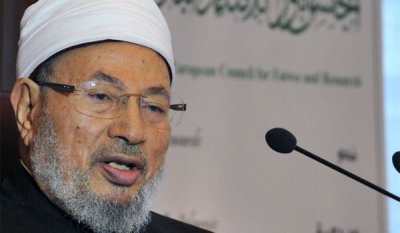
Yusuf Al-Qaradawi
MEMO | November 17, 2014
The International Union of Muslim Scholars (IUMS) expressed its surprise on Monday over the decision by the United Arab Emirates (UAE) to include the bloc on the country’s list of designated terrorist organisations.
In its statement, the union urged the UAE to “reconsider its unjustified position”.
The IUMS, established in 2004 and headed by Islamic scholar Yusuf Al-Qaradawi, was among 83 movements and organisations that were labelled terrorist groups by the UAE on Saturday.
Also included in the list were the Muslim Brotherhood, the Islamic State (ISIS), Yemen’s Shiite Houthi movement and the Egypt-based Ansar Beit Al-Maqdis militant group.
In its statement, the group said it rejects this labelling, asserting that since its establishment ten years ago, the IUMS “has promoted a moderate approach and discouraged extremism, terror and violence using cultural and educational means”.
“The IUMS has issued dozens of statements against terrorist and extremist groups,” it added.
On its website, the IUMS identifies itself as “an institution concerned with the call (Da’wah) to Islam by tongue, pen, and every contemporary legitimate medium; be it recorded, audio, or visual”.
“IUMS is not a local or a regional union, neither an Arab nor a national one, neither an eastern, nor a western union; rather, it represents all Muslims in the entire Islamic world, as well as all the Muslim [minority populations] and Islamic groups outside of the Islamic world.”
It also asserts that it “does not slant towards exaggerations and excesses, nor does it tilt towards default and negligence, but rather it adopts the centremost approach of the centremost Ummah (Islamic nation), an approach of mediation and moderation.”
The Egyptian-born Al-Qaradawi has been under fire by Egypt’s post-coup authorities for his vocal criticism of the military’s ouster – and subsequent imprisonment – of elected president Mohamed Morsi, a Muslim Brotherhood leader, last year.
Egypt branded the Brotherhood a “terrorist” movement late last year following the bombing of a security headquarters in the Nile Delta.
The label was attached to the movement amid a massive crackdown on its members, supporters and leaders on the streets of Cairo and other Egyptian cities and provinces.
Saudi Arabia also designated the Muslim Brotherhood a “terrorist” movement in March of this year, following in Egypt’s footsteps.
The UAE and Saudi Arabia were amongst the first countries to welcome Morsi’s ouster. Both countries – along with Bahrain – withdrew their ambassadors from Doha last March, accusing Qatar of interfering in their affairs.
Many observers, however, linked the rift to Doha’s perceived support for Morsi and the Muslim Brotherhood.
Yet, the three countries agreed on Sunday to return their ambassadors to the Qatari capital following a surprise Gulf summit in Saudi Arabia.
How Many Islamic State Fighters Are There?
By Ray McGovern | Consortium News | November 16, 2014
Why was I reminded of Vietnam on Saturday when Gen. Martin Dempsey, Chairman of the Joint Chiefs of Staff, visited Iraq to “get a firsthand look at the situation in Iraq, receive briefings, and get better sense of how the campaign is progressing” against the Islamic State, also known as ISIS or ISIL?
For years as the Vietnam quagmire deepened, U.S. political and military leaders flew off to Vietnam and were treated to a snow job by Gen. William Westmoreland, the commander there. Many would come back glowing about how the war was “progressing.”
Dempsey might have been better served if someone had shown him Patrick Cockburn’s article in the Independent entitled “War with Isis: Islamic militants have an army of 200,000, claims senior Kurdish leader.”
Fuad Hussein, the chief of staff of Kurdish President Massoud Barzani, told Cockburn that “I am talking about hundreds of thousands of fighters because they are able to mobilize Arab young men in the territory they have taken.”
Hussein estimated that Isis rules about one-third of Iraq and one-third of Syria with a population from 10 million to 12 million over an area of 250,000 square kilometers, roughly the size Great Britain, giving the jihadists a large pool of potential fighters to recruit.
While the Kurdish estimate may be high – it certainly exceeds “the tens of thousands,” maybe 20,000 to 30,000 that many Western analysts have claimed – the possibility that the Islamic State’s insurgency is bigger than believed could explain its startling success in overrunning the Iraqi Army around Mosul last summer and achieving surprising success against the well-regarded Kurdish pesh merga forces, too.
So, on his flight back to Washington, Dempsey will have time to ponder whether he has the courage to pass on this discouraging word to President Barack Obama about ISIS or whether he will put on the rose-colored glasses like an earlier generation of commanders did about Vietnam, where Westmoreland insisted that the number of enemy Vietnamese in South Vietnam could not go above 299,000.
Unfortunately, those obstinate Vietnamese Communists would not observe that artificial, politically inspired limit. Westmoreland was aware of the troubling reality but knew that acknowledging it would have undesired consequences in the United States where many Americans were souring on the war.
The inconvenient truth finally became abundantly clear during the Tet offensive in late January and early February 1968, but still the misbegotten war went on, and on, ultimately claiming some 58,000 U.S. lives and millions of Vietnamese.
Westmoreland’s gamesmanship with the numbers was known to some CIA officials – first and foremost, a very bright and courageous analyst named Sam Adams – but CIA Director Richard Helms silenced them out of fear of political retribution. “My responsibility is to protect the Agency,” Helms told them, “and I cannot do that if we get into a pissing match with a U.S. Army at war.”
Today’s CIA Director John Brennan is similarly at pains to protect the Agency on a number of fronts. Is he likely to tell the truth about ISIS if it means the prospects for a renewed war in Iraq and a new war in Syria are especially grim? If not, are there no Sam Adamses left at the CIA?
Honest Analysts?
Honest intelligence analysts played a key role in the November 2007 National Intelligence Estimate, “Iran: Nuclear Intentions and Capabilities,” which helped thwart Bush/Cheney plans to apply Iraqi-type “shock and awe” to Iran during their last year in office. The NIE concluded, unanimously and “with high confidence,” that Iran had stopped working on a nuclear weapon in late 2003.
In his memoir, Decision Points, President George W. Bush called the NIE’s findings “eye-popping.” He openly bemoaned how the estimate deprived him of the military option, writing “How could I possibly explain using the military to destroy the nuclear facilities of a country the intelligence community said had no active nuclear weapons program?”
The NIE on Iran was issued seven years ago. One has to hope that a few honest analysts on the Near East have survived the CIA directorships of Michael Hayden, Leon Panetta, David Petraeus and John Brennan and have the courage to tell the truth about ISIS – including how U.S. military intervention now is swelling ISIS’s ranks, much as the Bush/Cheney invasion of Iraq in 2003 created the conditions for the group’s birth, then called “Al-Qaeda in Iraq.”
If honest intelligence analysts are silenced, as Sam Adams was 47 years ago, they need to plumb their consciences and see if they have the guts to make public both the undercounting of enemy forces AND the fillip given to their multiplication by further U.S. military involvement.
Though having worked within the system to get the real enemy troop estimates to senior U.S. officials, Sam Adams went to an early, remorse-filled death, unable to overcome the thought of what might well have happened to shorten the war if he had broken with the CIA’s demands for secrecy and made the actual enemy numbers public.
Possibly, the armed conflict might have ended in 1968. Or, to put it another way, the Vietnam Memorial in Washington would have no need for a western wall since there would be no names to chisel into the granite.
If Gen. Dempsey decides to ape Westmoreland and dissemble about the realistic obstacles to military success against the Islamic State fighters and about the counterproductive effects of U.S. intervention, well, our country will need a new Sam Adams willing, this time, to blast the truth into the open.
Sam Adams Associates for Integrity in Intelligence
Sam Adams’s memory is invoked each year as Sam Adams Associates for Integrity in Intelligence make their annual award for integrity. SAAII is a movement of former CIA colleagues of former intelligence analyst Sam Adams, together with others who hold up his example as a model for those in intelligence who would aspire to the courage to speak truth to power.
SAAII confers an award each year to a member of the intelligence community or related professions who exemplifies Sam Adam’s courage, persistence and devotion to truth — no matter the consequences.
It was Adams who discovered in 1967 that there were more than a half-million Vietnamese Communists under arms — roughly twice the number that the U.S. command in Saigon would admit to, lest Americans learn that claims of “progress” were bogus.
Gen. Westmoreland had put an artificial limit on the number Army intelligence was allowed to carry on its books. And his deputy, Gen. Creighton Abrams, specifically warned Washington that the press would have a field day if Adam’s numbers were released, and that this would weaken the war effort.
A SECRET/EYES ONLY cable from Abrams on Aug. 20, 1967, stated: “We have been projecting an image of success over recent months,” and cautioned that if the higher figures became public, “all available caveats and explanations will not prevent the press from drawing an erroneous and gloomy conclusion.”
The Communist countrywide offensive during Tet made it clear that the generals had been lying and that Sam Adams’s “higher figures” were correct. Senior intelligence officials were aware of the deception, but lacked the courage to stand up to Westmoreland. Sadly, Sam Adams remained reluctant to go “outside channels.”
A few weeks after Tet, however, former Pentagon official Daniel Ellsberg rose to the occasion. Ellsberg learned that Westmoreland was asking for 206,000 more troops to widen the war into Cambodia, Laos, and North Vietnam — right up to the border with China, and perhaps beyond.
Someone else promptly leaked to the New York Times Westmoreland’s troop request, emboldening Ellsberg to do likewise with Sam Adams’ story. Ellsberg had come to the view that leaking truth about a deceitful war would be “a patriotic and constructive act.” It was his first unauthorized disclosure. On March 19, 1968, the Times published a stinging story based on Adams’s figures.
On March 25, President Lyndon Johnson complained to a small gathering, “The leaks to the New York Times hurt us. … We have no support for the war. This is caused by the 206,000 troop request [by Westmoreland] and the leaks. … I would have given Westy the 206,000 men.”
On March 31, 1968, Johnson introduced a bombing pause, opted for negotiations, and announced that he would not run for another term in November.
Sam Adams continued to press for honesty and accountability but stayed “inside channels” — and failed. He died at 55 of a heart attack, nagged by the thought that, had he not let himself be diddled, many lives might have been saved. His story is told in War of Numbers, published posthumously.
Ray McGovern works with Tell the Word, a publishing arm of the ecumenical Church of the Saviour in inner-city Washington. He was a close colleague of Sam Adams; the two began their CIA analyst careers together during the last months of John Kennedy’s administration. During the Vietnam War, McGovern was responsible for analyzing Soviet policy toward China and Vietnam.
The Endgame of the US ‘Islamic State’ Strategy
By Nicola Nasser | alarabi | November 11, 2014
Dismantling what the former US President George W. Bush once described as the Syria – Iran component of the “axis of evil,” or interrupting in Iraq the geographical contiguity of what King Abdullah II of Jordan once described as the “Shiite crescent,” was and remains the strategic goal of the US – Israeli allies in the Middle East unless they succeed first in “changing the regime” in either Damascus or Tehran.
The US, Israel and their regional allies have been on the record that the final target of their “regime change” campaign in the Middle East was to dismantle the Syria – Iran alliance.
With the obvious failure of Plan A to dismantle the self-proclaimed anti-Israel and anti-US Syrian – Iranian “Resistance Axis” by a forcible “regime change” in Damascus, a US – led regional alliance has turned recently to its Plan B to interrupt in Iraq the geographical contiguity of that axis.
This is the endgame of President Barack Obama’s strategy, which he declared on last September 10 as ostensibly against the Islamic State (IS).
This would at least halt for the foreseeable future all the signed and projected trilateral or bilateral Iranian, Iraqi and Syrian pipeline networks to carry oil and gas from Iran and Iraq to the Syrian coast at the Mediterranean.
Israeli Col. (res.) Shaul Shay, a research associate at the Begin-Sadat Center for Strategic Studies and a former Deputy Head of the Israel National Security Council anticipated in writing on last January 21 what he called the “Salafi Crescent” that is dangerously emerging to challenge the “Shia Crescent.”
“The growing involvement of Sunni Salafi jihadis in Iraq (since 2003), among the rebels in Syria (since 2011), and in Lebanon has created a ‘Salafi Crescent’ … from Diyala [in eastern Iraq] to Beirut,” he wrote.
“A positive outcome” of this Salafi Crescent “will be the decline in Iranian influence in the region,” Shay concluded.
Conspiracy theories aside, the eventual outcome is a sectarian Sunni military and political wedge driven into the Iraqi geographical connection of the Iran-Syria alliance in a triangle bordering Turkey in the north, Iran in the east, Jordan in the west and Saudi Arabia in the south and extending from north eastern Syria to the Iraqi province of Diyala which borders Iran.
Iraqi Kurdistan is already effectively an independent state and cut off from the central government in Baghdad, but separating Iran and Syria as well and supported by the same US – led anti – IS coalition.
Amid the misinformation and disinformation, the fact is that the IS threat is being used as a smokescreen to confuse and blur this reality.
The IS was conceived and delivered in an American womb. The US – drafted and enforced current constitution produced the sectarian government that is still trying to rule in Iraq. Sectarian cleansing and exclusion of Sunnis could not but inevitably create its antithesis.
The IS was the illegitimate fetus born and nurtured inside the uterus of the US – engineered political process based on a constitution legalizing a federal system based in turn on sectarian and ethnic sharing of power and wealth.
This horrible illegitimate creature is the “legacy” of the US war on Iraq, which was “conceived” in the “sin” of the US invasion of the country in 2003, in the words of the president of the Arab American Institute, James J. Zogbi, writing in the Jordan Times on last June 16.
US Senator John McCain, quoted by The Atlantic on last June 23, thanked “God,” the “Saudis and Prince Bandar” and “our Qatari friends” for creating the “monster.”
The pro-Iran government of former Prime Minister Noori al-Maliki was squeezed by the IS military advances to “request” the US help, which Washington preconditioned on the removal of al-Maliki to which Iran succumbed. The IS gave Obama’s IS strategy its first success.
However, al-Maliki’s replacement by Haider al-Abadi in August has changed nothing so far in the sectarian component of the Iraqi government and army. The US support of Iraq under his premiership boils down only to supporting continued sectarianism in the country, which is the incubator of the survival of its IS antithesis.
Moreover, the destruction of the Iraqi state infrastructure, especially the dismantling of Iraq’s national army and security agencies and the Iraqi Baath party that held them intact, following the US invasion, has created a power vacuum which neither the US occupation forces nor the sectarian Shiite militias could fill. The IS was not powerful per se. They just stepped in on a no-man land.
Similarly, some four years of a US – led “regime change” effort, which was initially spearheaded by the Muslim Brotherhood and which is still financed, armed and logistically facilitated by the US regional allies in Turkey, Qatar, Saudi Arabia as well as by allied western intelligence services, has created another power vacuum in Syria, especially on border areas and in particular in the northern and eastern areas bordering Turkey and Iraq.
US Senator Rand Paul in an interview with CNN on last June 22 was more direct, accusing the Obama administration of “arming” and creating an IS “safe haven” in Syria, which “created a vacuum” filled by the IS.
“We have been fighting alongside al Qaeda, fighting alongside ISIS. ISIS is now emboldened and in two countries. But here’s the anomaly. We’re with ISIS in Syria. We’re on the same side of the war. So, those who want to get involved to stop ISIS in Iraq are allied with ISIS in Syria. That is the real contradiction to this whole policy,” he said.
The former 16 – year member of the US Congress and two – time US presidential candidate Dennis Kucinich, writing in the Huffington Post on last September 24, summed it up: The IS “was born of Western intervention in Iraq and covert action in Syria.”
The IS could have considered playing the role of a US “Frankenstein,” but in fact it is serving as the US “Trojan horse” into Syria and Iraq. Fighting the IS was the US tactic, not the US strategy.
On record, Iranian deputy foreign minister Hossein Amir-Abdollahian said that “the best way of fighting ISIS and terrorism in the region is to help and strengthen the Iraqi and Syrian governments, which have been engaged in a serious struggle” against the IS. But this would not serve the endgame of Obama’s strategy, which targets both governments instead.
Beneficiaries of the IS “Trojan horse” leave no doubts about the credibility of the Syrian, Iranian and Russian doubts about the real endgame of the US – led declared war on the IS.
The United States was able finally to bring about its long awaited and promoted “front of moderates” against Iran and Syria into an active and “air-striking” alliance, ostensibly against the IS.
In Iraq, the IS served the US strategy in wrestling back the so called “political process” from the Iranian influence by proxy of the former premier al-Maliki. Depriving al-Maliki of a third term had proved that there is no unified Iran – backed “Shia house” in Iraq. The US has its own influence inside that “house.”
Installing a US Iraqi satellite was the strategic goal of the US – led invasion and occupation of Iraq in 2003. Instead, according to Doug Bandow, writing in Forbes on October 14, “Bush’s legacy was a corrupt, authoritarian, and sectarian state, friendly with Iran and Syria, Washington’s prime adversaries in the Middle East. Even worse was the emergence of the Islamic State.”
This counterproductive outcome of the US invasion, which saw Iran wielding the reigns of power in Baghdad and edging Iraq closer to Syria and Iran during the eight years of al-Maliki’s premiership, turned the red lights on in the White House and the capitals of its regional allies.
Al-Maliki, whom Bush had designated as “our guy” in Baghdad when his administration facilitated his premiership in 2006, turned against his mentors.
He edged Iraq closer to the Syrian and Iranian poles of the “axis of evil.” Consequently he opposed western or Israeli military attack on Iran, at least from or via Iraqi territory. In Syria, he opposed regime change in Damascus, rejected direct military “foreign intervention” and indirect proxy intervention and insisted that a “political solution” is the only way forward in Iraq’s western Arab neighbor.
Worse still was his opening Iraq up to rival Chinese and Russian hydrocarbon investments, turning Iraq a part of an Iran-Iraq-Syria oil and gas pipeline network and buying weapons from the Russian Federation.
Al-Maliki had to go. He was backed by Iran to assume his second term as prime minister in spite of the US, which backed the winner of the 2010 elections for the post, Ayad Allawi. The US had its revenge in the 2014 elections. Al-Maliki won the elections, but was denied a third term thanks to US pressure.
The IS was the US instrument to exert that pressure. US Secretary of State John Kerry during his visit to Baghdad on last June 23 warned that Iraq was facing “an existential threat.”
It was a US brinkmanship diplomacy to force al-Maliki to choose between two bad options: Either to accept a de facto secession of western and northern Iraq on the lines of Iraqi Kurdistan or accept the US conditional military support. Al-Maliki rejected both options, but he had paid the price already.
The turning point came with the fall of Iraq’s second largest city of Mosul to the IS on last June 10. Iraqi Kurdistan inclusive, the northern and western Iraq, including most of the crossing points into Syria and Jordan in the west, were clinched out of the control of Baghdad, i.e. some two thirds of the area of Iraq. Al-Maliki was left to fight this sectarian Sunni insurgency by his sectarian Iran-backed Shiite government. This was a non-starter and was only to exacerbate the already deteriorating situation.
Al-Maliki and Iran were made to understand that no US support was forthcoming to reign in the IS until he quits and a less pro-Iran and a more “inclusive” government is formed in Iraq.
The creation of the IS as the sectarian Sunni alternative against Iran’s ruling allies in Baghdad and Damascus was and is still the US tactic towards its strategic endgame. Until the time the US strategy succeeds in wrestling Baghdad from Iran influence back into its fold as a separating wedge between Iran and Syria, the IS will continue to serve US strategy and so far Obama’s strategy is working.
“America is using ISIS in three ways: to attack its enemies in the Middle East, to serve as a pretext for U.S. military intervention abroad, and at home to foment a manufactured domestic threat, used to justify the unprecedented expansion of invasive domestic surveillance,” Garikai Chengu, a research scholar at Harvard University, wrote in CounterPunch on September 19.
As a doctrine, since the collapse of the Ottoman caliphate early in the twentieth century, western powers did their best to keep Arabs separated from their strategic depth in their immediate Islamic proximity. The Syria – Iran alliance continues to challenge this doctrine.
Nicola Nasser is a veteran Arab journalist based in Birzeit, West Bank of the Israeli-occupied Palestinian territories (nassernicola@ymail.com).
The Silence of the Israelis on ISIS
By Stephen J. Sniegoski | Consortium News | November 5, 2014
In the war on the Islamic State, the alleged scourge of humanity, little is heard about the position of America’s much-ballyhooed greatest ally in the Middle East, if not the world, Israel. Now the Islamic State has been conquering territory in very close proximity to the border of Israel. But Israel does not seem to be fearful and it is not taking any action.
And the Obama administration and American media pundits do not seem to be the least bit disturbed. This is quite in contrast to the complaints about other Middle East countries such as Turkey that are being harshly criticized for their failure to become actively involved in fighting the Islamic State.
For example, a New York Times editorial, “Mr. Erdogan’s Dangerous Game,” begins, “Turkey’s president, Recep Tayyip Erdogan, once aspired to lead the Muslim world. At this time of regional crisis, he has been anything but a leader. Turkish troops and tanks have been standing passively behind a chicken-wire border fence while a mile away in Syria, Islamic extremists are besieging the town of Kobani and its Kurdish population.”
An article in the Boston Globe read “Turkey has failed Kobani, Kurds.” An editorial in the USA Today was titled “Turkey waits as ISIL crushes Kobani.”
Neocon Charles Krauthammer in “Erdogan’s Double Game” compared Turkey’s failure to come to the defense of the Kurds in the surrounded border town of Kobani to Stalin’s unwillingness to aid the uprising of Polish nationalist forces in Warsaw in 1944, thus allowing the latter’s destruction at the hands of the Nazis.
“For almost a month, Kobani Kurds have been trying to hold off Islamic State fighters,” Krauthammer wrote. “Outgunned, outmanned, and surrounded on three sides, the defending Kurds have begged Turkey to allow weapons and reinforcements through the border. Erdogan has refused even that, let alone intervening directly.”
Even the normally antiwar Noam Chomsky expressed support for protecting the Kurds. “With regard to Kobani, it is a shocking situation,” Chomsky opined. “This morning’s newspaper described Turkish military operation against Kurds in Turkey, not against ISIS, a couple of kilometers across the border where they are in danger of being slaughtered. I think something should be done at the UN in terms of a strong resolution to call for a ceasefire.”
“It is hard to impose the use of force,” Chomsky continued, “but to the extent that it can be done try and protect Kobani from destruction at the hands of ISIS, which could be a major massacre with enormous consequences.” Chomsky added that “the strategic significance of the town in the Kurdish region is pretty obvious, and the Turkish role is critical in this.”
Israel’s Reticence
Returning to the issue of Israel, the fact of the matter is that Israel acts to protect its own national interests. At the current time, the primary goal of the Islamic State is to purify Islam rather than attack non-Muslims.
In response to Internet queries as to why the militant group wasn’t fighting Israel instead of killing Muslims in Iraq and Syria, its representatives responded: “We haven’t given orders to kill the Israelis and the Jews. The war against the nearer enemy, those who rebel against the faith, is more important. Allah commands us in the Koran to fight the hypocrites, because they are much more dangerous than those who are fundamentally heretics.”
As justification for this stance, the group cited the position of the first caliph, Abu Bakr, who began his caliphate by fighting against those he deemed apostates who still professed to be followers of Islam. (Shiites hold a negative view of Abu Bakr and his policies). Also cited was Saladin, who fought the Shiites in Egypt before conquering Christian-controlled Jerusalem.
Considering the Islamic State is targeting Muslims, the Israeli government does not see it as a significant enemy at this time. And it is reasonable for Israeli leaders to believe that the Islamic State would never move on to attack their country because it will never be able to conquer its major Islamic foes, though American military involvement would further secure Israel from any possible threat from the Islamic State.
Moreover, the fact of the matter is that the Islamic State actually benefits Israel by causing problems for those very states that do actively oppose Israel and support the Palestinians, such as Syria. What the Islamic State is causing in the Middle East is perfectly attuned with the view of the Israeli Right — as best articulated by Oded Yinon in 1982 — which sought to have Israel’s Middle East enemies fragmented and fighting among themselves in order to weaken the external threat to Israel.
Currently, these divisions are not only plaguing Syria and Iraq, but also Turkey, where ethnic Kurds are rioting because of the government’s unwillingness to help their brethren in Syria, and Lebanon, where the Shiite group Hezbollah — allied with Iran, Israel’s foremost enemy — is being assailed by the radical jihadist Nusra Front, which has the support of many Lebanese Sunnis. [See Jonathan Spyer, “The Shia-Sunni War Reaches Lebanon,” Jerusalem Post, Middle East Forum, Oct. 17, 2014.]
More than this, the Netanyahu government is trying to take advantage of the Islamic State’s aggression by falsely claiming that Hamas is its equivalent. In an address to the UN General Assembly on Sept. 29, Netanyahu asserted that “Hamas’s immediate goal is to destroy Israel. But Hamas has a broader objective. They also want a caliphate. Hamas shares the global ambitions of its fellow militant Islamists.”
Thus, Netanyahu claimed that it is wrong for countries to criticize Israel’s brutal treatment of the Palestinians in its conflict with Hamas, pointing out that “the same countries that now support confronting ISIS, opposed Israel for confronting Hamas. They evidently don’t understand that ISIS and Hamas are branches of the same poisonous tree. ISIS and Hamas share a fanatical creed, which they both seek to impose well beyond the territory under their control.”
In short, Netanyahu maintained that the Islamic State and Hamas were essentially identical, “when it comes to their ultimate goals, Hamas is ISIS and ISIS is Hamas.”
National Interest
Now there is nothing strange about Israel’s position here. It is simply acting in its own national interest. There is no reason to fight a group that doesn’t threaten it. Furthermore, it is in Israel’s interest to try to make it appear that it is acting for the good of all humanity when attacking Hamas, and though these arguments are unlikely to sway any UN members, the prime minister did provide ammunition to the Israel lobby and its supporters that could be used to persuade some gullible Americans.
It can be argued that if Israel openly entered the fray as a member of the anti-Islamic State coalition, it would be counterproductive. Since many Arabs see Israel as their major enemy, Israel’s involvement in the war would turn them against fighting the Islamic State and maybe even cause some of them to support that militant jihadist group as an enemy of Israel.
So it might be understandable that the United States would not demand that Israel participate in the war against the Islamic State, just as it did not expect Israel to fight against Saddam Hussein. Although this might be understandable, if true it would mean that Israel could not really be an ally of the United States in the Middle East because it could not participate in America’s wars in the region, which is the very raison d’état of an ally.
Conceivably, Israel could covertly support the enemies of Islamic State. Israel has been doing just that in regard to Syria. During the past two years it has launched airstrikes against Assad’s forces which has helped the rebels. Israel takes the position that any attacks on its territory from Syria are the responsibility of the Assad government even if they are made by the rebels.
Moreover, just like the United States, Israel has provided training for Syrian rebels. For example, Abdul-Ilah al-Bashir al-Noeimi, currently the Chief of Staff of the Supreme Military Council (SMC) of the Free Syrian Army, secretly trained in Israel in 2013 after being admitted into the country for medical treatment. [See “Report: Commander of Syrian Rebels Trained in Israel, Jewish Press News Briefs,” Feb. 24, 2014. In regard to Israeli participation in training Syrian rebels, see: Jason Ditz, “Report Claims US, Israeli Trained Rebels Moving Toward Damascus,” Antiwar.com, Aug. 25, 2013,; Jinan Mantash, “Israeli analyst confirms link between Israel, ‘moderate’ Syrian rebels,” Alakbar English, Oct. 17, 2014.]
Staying Out of the Fray
Israel’s pro-rebel activities in the Syrian conflict have not been counterproductive in that they have not caused any of Assad’s many Arab enemies to abandon their effort to remove his regime. But it is not apparent that Israel is taking any steps like this regarding the Islamic State, and the United States does not seem to be pressuring it to do so.
What this means is that Israel is not really any type of ally of the United States. It does not bend its foreign policy to aid the United States but only acts in its own interest. It takes actions against the Assad regime because the latter is an ally of Iran and provides a conduit for weapons being sent to Israeli’s enemy Hezbollah.
Israel’s inaction toward the Islamic State, despite its close proximity, should actually provide a model for the United States to emulate. It shows that the Islamic State should not be regarded as a threat to the faraway United States. And this lesson is further confirmed by the fact that the nearby Islamic countries, which should be far more endangered than the United States, do not seem to be fighting hard against it. It would seem that the fundamental way for the United States to face significant attacks from the Islamic State is to attack it first, which is exactly what it is now doing.
Considering Israel’s inactivity, it is ironic that in the United States it is the supporters of Israel, such as the neoconservatives, who have taken the lead in pushing for a hard-line American military position against the Islamic State. [See Jim Lobe, “Project for a New American Imbroglio,” LobeLog Foreign Policy, Aug. 28, 2014.]
Neocon Max Boot, for example, wrote about the need for “a politico-military strategy to annihilate ISIS rather than simply chip around the edges of its burgeoning empire,” which would “require a commitment of some 10,000 U.S. advisors and Special Operators, along with enhanced air power, to work with moderate elements in both Iraq and Syria.”
Fred and Kimberly Kagan have developed a strategic plan involving up to 25,000 American ground troops to combat the Islamic State, which I have already discussed at length. Some of the other noted members of the neocon war-on-the-Islamic-State chorus include Bill Kristol, John Podhoretz, Dan Senor, David Brooks, John Bolton, Richard Perle, Danielle Pletka (vice president for foreign and defense policy studies at the American Enterprise Institute), and, as noted earlier, Charles Krauthammer.
Needless to say, neither the neocons, nor any other mainstream commentators for that matter, have uttered a word about Israel’s inaction. As Scott McConnell wrote in August in The American Conservative, “over the past two generations thousands of articles have been written proclaiming that Israel is a ‘vital strategic ally’ of the United States, our best and only friend in the ‘volatile’ Middle East. The claim is a commonplace among serving and aspiring Congressmen. I may have missed it, but has anyone seen a hint that our vital regional ally could be of any assistance at all in the supposedly civilizational battle against ISIS?”
However, it would be far wiser for the United States to follow the example of Israel here — and, in fact, always follow the example of Israel by adhering to national interest (that of the United States, of course, not Israel) — than to follow the advice of those American supporters of Israel who have, because of their influence on American Middle East policy, involved the United States in endless wars creating a regional environment beneficial to Israel from the perspective of the Israeli Right.
An Overwhelming Majority of Lebanon’s Christians Believe Hizbullah Protects Their Country
By Anthony F. Shaker | Mittag’s Journal | October 26, 2014
A recent poll by the Beirut Center for Research and Information (BCRI) found that two thirds (62.6%) of Lebanese Christians feel that, contrary to its vilification by members of the NATO alliance, Hizbullah has in fact protected their country from its most determined enemies—Israel, IS (known locally as Da‘ash), and Wahhabi-style terrorist groups linked to the Syria-Iraq conflagration.
The poll revealed also that very few of the respondents prefer UNIFIL to Hizbullah on the front line with the terrorist groups, as some domestic and regional actors have insisted. Nor do they believe the claim that the foreign “coalition” presently targeting IS in Iraq and parts of Syria seeks to “destroy” IS, as President Obama and his allies have declared.
As many as 73.1% dismiss this view entirely, which comes in the wake of endless reports in the mainstream media worldwide and growing evidence regarding Saudi, Turkish, Qatari, Israeli and NATO collaboration with anti-Syrian terrorist fronts and organizations.
Although some have interpreted the survey results as indicative of a “significant increase” in favorable attitudes—at least compared to two similar surveys in June 2013 and February 2014—there is no history of enmity between the Christian and Muslims communities, much less with Shi‘i Muslims.
During a visit to France in 2011, Maronite Patriarch Beshara Boutros Rai defended the government of President Bashar al-Assad and criticized states that had begun supplying arms to the terrorists gathering in Syria. Again in 2013, he said, “There is a plan to destroy the Arab world for political and economic interests and boost interconfessional conflict between Sunnis and Shi’ites. Some Western and East powers are fomenting all these conflicts. We are seeing the total destruction of what Christians managed to build in 1,400 years,” referring to peaceful cohabitation and historically productive relationship with Muslims.
“I have written to the Holy Father twice to describe what is happening,“ he had added. “I appeal again to the Holy Father, who only talks about peace and reconciliation.”
Hizbullah, which solidified the resistance against the Israeli occupation of South Lebanon, began largely in the Shi’a community, but then quickly expanded ties with other communities and organizations across the country. Today, it identifies its primary interests with Lebanon and does not claim to act on behalf of Shi’a Muslims only.
Strictly speaking, Lebanon’s woes are not confessional, even if they fed on endless disputes over confessionally based electoral rules and representation.
That a Wahhabi terrorist claims to speak for “Sunnis” does not by itself make for a Sunni-Shi’a divide. Nor does it define the armed conflicts that have erupted since the West began to sponsor a massive armed campaign to destroy the Syrian government and state. Few people know that this sponsorship dates, not from 2011 (when the terrorist onslaught gained traction), but from the early 1990s, after Syria insisted that Israel declare its intention to return the Golan Heights during the ”peace“ negotiations phase, a demand Israel categorically refused at the time.
The “West” (essentially, the United States, United Kingdom and France) has blacklisted Hizbullah as a “terrorist” organization and for years fought hard to pin the Hariri assassination on it, which many now believe Israel carried out, possibly even at Saudi Arabia’s behest, nearly provoking another civil war.
Hizbullah officials have repeatedly warned that a “terrorist” listing is a “big mistake,” one that will further damage the West’s standing in the region. In fact, this is no longer in doubt, given NATO’s current desperate effort to insinuate itself back into Iraq and to intervene for the first time inside Syria itself. NATO now has no choice but to tolerate Iran’s determined assistance to Iraqi military and security forces. This tolerance naturally must now be extended to Syria, where Hizbullah aims to deal decisively with the terror emanating from the Gulf, Turkey and Israel before it overwhelms Lebanon too.
Clearly, the events surrounding the Syria conflict have thrown deep doubts on Western intentions—and competence—in the Middle East. For some time, these doubts have been seeping into Western policymaking circles, diplomatically around the world, and most tellingly, inside the intelligence communities themselves.
Years ago, under a previous government just before Canada put Hizbullah on the terrorism list, Canadian security analysts and some federal cabinet ministers had cautioned against such a blanket interdiction. The former Liberal government’s decision, it had transpired, was based in the ever-quaint Washington Times, which merely quoted a professor claiming that Hizbullah leader Hassan Nasrallah had issued a worldwide call for “a suicide bombing campaign”and “don’t be shy about it.”
The “professor’s” claim happens to be in keeping with the Mickey Mouse warnings that Israel has for years been dishing out to Western countries about the Lebanese resistance. Yet, suicide bombings then, as now, are the Wahhabi terrorists’ choicest method in asymmetric warfare, not Hizbullah’s.
Developments since then have shrunk Canada’s blacklisting of Hizbullah to insignificance as an issue. This is because Canada has lost most of its diplomatic influence thanks to the deeply ideological character and the arrogant style of Conservative Prime Minister Stephen Harper.
Many Canadians have questioned the wisdom of blacklisting a party with elected members in the Lebanese parliament and government cabinet. This year marks a new watershed: few either in Canada or in the West are sure any more which side they are on according to their government.
To the Christians of Lebanon, such hesitation would have been unthinkable for the fatal consequences it entailed for them and their country.
One can only recall with nostalgia Hillary Clinton’s shrill call with the Friends of Syria: “Mr. Putin, you are on the wrong side of history!”
Dr. Anthony F. Shaker is the editor-in-chief and founder of Mittags Journal and visiting scholar at McGill University; his published works and articles are in classical Islamic philosophy and history, as well as modern politics.
U.S. Sends Planes Armed with Depleted Uranium to Middle East
By David Swanson | War is a Crime | October 28, 2014

The U.S. Air Force says it is not halting its use of Depleted Uranium weapons, has recently sent them to the Middle East, and is prepared to use them.
A type of airplane, the A-10, deployed this month to the Middle East by the U.S. Air National Guard’s 122nd Fighter Wing, is responsible for more Depleted Uranium (DU) contamination than any other platform, according to the International Coalition to Ban Uranium Weapons (ICBUW). “Weight for weight and by number of rounds more 30mm PGU-14B ammo has been used than any other round,” said ICBUW coordinator Doug Weir, referring to ammunition used by A-10s, as compared to DU ammunition used by tanks.
Public affairs superintendent Master Sgt. Darin L. Hubble of the 122nd Fighter Wing told me that the A-10s now in the Middle East along with “300 of our finest airmen” have been sent there on a deployment planned for the past two years and have not been assigned to take part in the current fighting in Iraq or Syria, but “that could change at any moment.”
The crews will load PGU-14 depleted uranium rounds into their 30mm Gatling cannons and use them as needed, said Hubble. “If the need is to explode something — for example a tank — they will be used.”
Pentagon spokesman Mark Wright told me, “There is no prohibition against the use of Depleted Uranium rounds, and the [U.S. military] does make use of them. The use of DU in armor-piercing munitions allows enemy tanks to be more easily destroyed.”
On Thursday, several nations, including Iraq, spoke to the United Nations First Committee, against the use of Depleted Uranium and in support of studying and mitigating the damage in already contaminated areas. A non-binding resolution is expected to be voted on by the Committee this week, urging nations that have used DU to provide information on locations targeted. A number of organizations are delivering a petition to U.S. officials this week urging them not to oppose the resolution.
In 2012 a resolution on DU was supported by 155 nations and opposed by just the UK, U.S., France, and Israel. Several nations have banned DU, and in June Iraq proposed a global treaty banning it — a step also supported by the European and Latin American Parliaments.
Wright said that the U.S. military is “addressing concerns on the use of DU by investigating other types of materials for possible use in munitions, but with some mixed results. Tungsten has some limitations in its functionality in armor-piercing munitions, as well as some health concerns based on the results of animal research on some tungsten-containing alloys. Research is continuing in this area to find an alternative to DU that is more readily accepted by the public, and also performs satisfactorily in munitions.”
“I fear DU is this generation’s Agent Orange,” U.S. Congressman Jim McDermott told me. “There has been a sizable increase in childhood leukemia and birth defects in Iraq since the Gulf War and our subsequent invasion in 2003. DU munitions were used in both those conflicts. There are also grave suggestions that DU weapons have caused serious health issues for our Iraq War veterans. I seriously question the use of these weapons until the U.S. military conducts a full investigation into the effect of DU weapon residue on human beings.”
Doug Weir of ICBUW said renewed use of DU in Iraq would be “a propaganda coup for ISIS.” His and other organizations opposed to DU are guardedly watching a possible U.S. shift away from DU, which the U.S. military said it did not use in Libya in 2011. Master Sgt. Hubble of the 122nd Fighter Wing believes that was simply a tactical decision. But public pressure had been brought to bear by activists and allied nations’ parliaments, and by a UK commitment not to use DU.
DU is classed as a Group 1 Carcinogen by the World Health Organization, and evidence of health damage produced by its use is extensive. The damage is compounded, Jeena Shah at the Center for Constitutional Rights (CCR) told me, when the nation that uses DU refuses to identify locations targeted. Contamination enters soil and water. Contaminated scrap metal is used in factories or made into cooking pots or played with by children.
CCR and Iraq Veterans Against the War have filed a Freedom of Information Act Request in an attempt to learn the locations targeted in Iraq during and after the 1991 and 2003 assaults. The UK and the Netherlands have revealed targeted locations, Shah pointed out, as did NATO following DU use in the Balkans. And the United States has revealed locations it targeted with cluster munitions. So why not now?
“For years,” Shah said, “the U.S. has denied a relationship between DU and health problems in civilians and veterans. Studies of UK veterans are highly suggestive of a connection. The U.S. doesn’t want studies done.” In addition, the United States has used DU in civilian areas and identifying those locations could suggest violations of Geneva Conventions.
Iraqi doctors will be testifying on the damage done by DU before the Tom Lantos Human Rights Commission in Washington, D.C., in December.
Meanwhile, the Obama Administration said on Thursday that it will be spending $1.6 million to try to identify atrocities committed in Iraq . . . by ISIS.
Two journalists hit by Israeli rubber bullets while covering protest (VIDEO)
RT | October 28, 2014
An AP photographer and his Swiss colleague were hurt after Israeli border police fired a crowd control grenade at a group of journalists covering Palestinian protests in the West Bank.
The news agency’s Majdi Mohammed and Swiss freelance journalist Lazar Simeonov were injured during the Israeli forces’ suppression of protests, where they deployed rubber-coated bullets, stun grenades and tear gas.
The photographers were working in the West Bank town of Silwad, where Palestinians were protesting after the funeral of a 14-year-old boy, who was killed in an earlier clash with Israeli soldiers.
Mohammed told the Agency that as he was taking pictures, an armored car pulled up behind him and a border policeman stepped out and fired directly at him from a distance of 10 to 20 meters.
The officer fired a round that discharges a number of rubber-coated steel projectiles, which is basically a grenade designed to hurt small groups of people. Simeonov was injured by the same round.
“The impact was so strong that it made me fall to the ground,” Mohammed said. “The policeman aimed straight at us … even though we were clearly a group of media people and there were no protesters at all around us.”
Both journalists reported minor injuries and Simeonov’s camera was also damaged.
AP said it would lodge a protest with the Israeli government. John Daniszewski, AP’s senior managing editor for international news, said the incident showed “outrageous disregard for the safety of journalists” lawfully doing their jobs.
Israeli police spokesman, Micky Rosenfeld, said it was not immediately clear why the border patrol policeman had opened fire on the journalists. He added the police “dispersed hundreds of rioters,” some of whom threw firebombs and stones at the Israeli forces.
Featured Video
Prof Seyed Marandi: Will the US Collapse the Global Economy?
or go to
Aletho News Archives – Video-Images
From the Archives
The toxic legacy of nuclear weapons testing serves as a stark warning of the danger these weapons pose
By Scott Ritter | RT | March 11, 2021
Millions of people suffer and die from the effects of radiation exposure from decades of nuclear weapons testing. Their experience should give serious pause to those who continue to embrace the viability of a nuclear deterrent. … continue
Blog Roll
 Aletho News
- Trump’s war on Iran becomes ‘most unpopular conflict’ in US history
- The Middle East is wringing its hands of Washington. Finally
- The Starmer legacy the establishment media won’t tell you: Celebrity sex crimes, imprisoning Assange and torture terror
- 13-18 DAYS: The PRACTICAL DIESEL BUFFER… Does It Preclude Bombing Iran?
- Prof Seyed Marandi: WILL the US COLLAPSE the GLOBAL ECONOMY?
- Larry Sanger Said Wikipedia Punishes Dissent. Then It Banned Him.
- How Darializa Avila Chevalier Is Different From Other Elected Progressives
- Israel Declares 464 Dunams in Sinjil as “State Land”
- Strait of Hormuz as strategic red line: Why Iran must confront Oman’s corridor plan and Trump’s threats
- House to vote on proposal ending $3.3bln in military aid to ‘Israel’
- If Americans Knew
- The scars left behind by Israel’s white phosphorus in Lebanon
- Drones and decomposing babies: What’s in UN report on Israel’s genocide of Palestinian children
- Crimson Thread: The new Israeli separation wall that cuts through the ‘breadbasket of Palestine’
- Gaza ceasefire talks back to square one as Israel changes the rules – Daily Update
- The NDAA Proposed Merger of the U.S. and Israeli Military is Strategically Unwise and Inherently Unconstitutional
- Victories by Pro-Palestinian Democrats Show the Party’s Shift on Israel
- Massie moves to strike $3.3B in Israel military aid from the budget
- How Jeffrey Epstein’s Israeli Network Shaped Congo’s Deadly Mineral Trade
- Gaza officials warn of ‘silent famine’ as aid deliveries fall far below planned levels
- Wheat harvest becomes act of defiance as West Bank farmers race to outrun Israeli settler attacks
- No Tricks Zone
- 2025 Study: Cloud Effects Reduce Downwelling Longwave Radiation, Overriding The CO2 Impact
- 3 New Studies Find Increasing Trends In Solar Radiation Since The 1980s – Easily Explaining Warming
- THE TRANSCEIVER PARADOX: Why Organoid Intelligence (OI) Could Become Our Ultimate Alien Predator
- German Wind Turbines Face Regulatory Shutdown Due To Excessive Noise
- New Study: Chile’s Relative Sea Level Was 3.2 Meters Higher Than Today During The Mid-Holocene
- Beyond The Pitch: Why FIFA’s World Cup Is One Of Humanity’s Best Investments
- Climate Alarmists Now Using Natural Phenomena To Support Their Claims
- New Study: Significant CO2 Fluxes From Non-Volcanic Sources Are Largely Neglected In Carbon Budgets
- Women Climate Scientists Being Harassed, Insulted By Skeptics, Claims Berkeley Earth Researcher
- Germany’s Longterm Spring Climate Data Show “No Climate Trend”
 Aletho News