‘Calculated to put American troops in danger’: Why US wants escalation in Syria
RT | October 31, 2015
Sending some 50 US advisers to Syria illegally to train the so-called ‘moderate rebels’ looks like a calculated move. If, or when, someone gets hurt, the US will have a pretext for boots on the ground, believes retired US Air Force Lieutenant Col Karen Kwiatkowski.
RT: Does this deployment mean Americans will be putting themselves in the direct line of fire in Syria?
Karen Kwiatkowski: I think there is a danger of that happening and I think that is part of why they are going there. I think they are looking for an excuse to up the ante, to send more troops and to have a crisis of some sort. Clearly the president has been lying, and so has Ash Carter, about what their real intentions are. So, in my opinion, I think this is provocative and I think it is calculated to put our troops in danger.
RT: How is that not a combat operation?
KK: Well, special forces are combat. And what the president said [is] they are going to be opportunistic. When you are training and advising, you do not use the word opportunistic. Training and advising is a more steady state situation. So they are using the word opportunistic, they are expecting to get involved in combat operations, and they have sent combat troops to do that. I do not care how they have used the term for non-combat. This is combat.
RT: They are going there to support the so-called moderate rebels. We know it hasn’t been terribly successful. Why should this make a huge difference?
KK: In terms of helping the moderate rebels – if there are any that we can identify – it is not going to make any difference in that regard. This is about US exercising some power, some limited power that it has, to kind of assert its relevance, particularly in the face of our allies who are asking how we are helping or not helping them.
RT: Sure, but do you think this is a game changer or, perhaps, this is a question of timing, because Russia has obviously taken on Islamic State?
KK: I don’t think it is a game changer in that regard. It is a gesture to kind of save face in some respects. But there is a real danger, that if our troops, even if it is a limited number, get killed, and if they get killed by, let’s say, Russian fire or something like that, than we have a big problem, that we are not able diplomatically or militarily able to deal with. So it is extremely foolhardy what they are doing. But yes, it is a gesture to show that the US is trying something. But it is a weak gesture and it is a dangerous gesture.
RT: And you mentioned the Russian airstrikes there and, presumably, Americans are saying we do need to speak with the Russians now to say where we are located so we don’t get into an incident like that?
KK: You would think that. You would think so.
RT: But you sound like that might not happen?
KK: If you believe what the president and Ash Carter say, they aren’t really seeking out any cooperation with the Russians. So perhaps behind the scenes they are. I would like to think that they care about the lives of our soldiers that they are sending over there and that they would coordinate, but their public rhetoric is that we will not coordinate. That is what I’ve heard unless something has changed. They are not really interested in coordinating with Russia, anything that Russia is doing in Syria. And by the way remember that it is an illegal act to send our troops into Syrian space, air space or ground space, without the permission of the government of Syria, which we do not have. So this is an act of war on top of everything else that makes this extremely stupid.
RT: Americans clearly don’t see that as a big issue, I mean it has been conducting airstrikes, despite it being against international law. It does not seem to matter in this case, at this stage anyway.
KK: It has not mattered in our policy in the Middle East for a long time. But I have pointed out that if our people killed, if we decide to make some sort of case about that, we are in the wrong totally in this, because we don’t have permission of the Syrian government to put those troops there at all. They are there illegitimately. So when they get killed or injured or harmed we have a problem in a diplomatic sense.
RT: A public opinion sense too, I mean what was the reaction when the US soldier did die on a special operations mission in Iraq. Was there a big public outcry in America?
KK: No. Two things that I have noticed about this: one is there is no public outcry, not a lot of concern. I haven’t seen a lot of attention given to this death. What surprised me was how much Ashton Carter and President Obama paid homage to this particular individual, called him a hero, and this is what we would like to see – some guy running into a fight and getting slaughtered in an illegitimate combat situation, because I think even in Iraq we still have some concerns there about what we are doing. They celebrated it. They tried to put a positive spin on it. American people aren’t listening. We have a lot of other different things on in general. The American people aren’t interested in what is going on in the Middle East. They don’t want to get involved in it. But they really tried to spin the death of this soldier in a very positive way. And, I’m sure, to see if it can be sold. And, as far as I can tell, it was sold. Americans aren’t interested, but they haven’t really pushed back at the death of this guy. I think we’ve become inert to it.
RT: Just looking into the future, you foresee a similar thing?
KK: I do. I mean if you go in the middle of a fire storm in an ill-planned situation, then certainly, you can’t say that anything the Pentagon is doing in the Middle East is well planned. They themselves admit this. So, yes, it is going to lead to the death of Americans. And given how they spun the death that happened last week we’ll see more spinning and, you know, more of Russia as a ‘bad guy’ in this situation, as they try to salvage what is left of their Middle East policy in this final year of the Obama administration, in these final months of the Obama administration… I hate to be cynical about this, but it is such a game that they are playing – no good results for our people, no good results for the Syrian people. It is not going to help the exodus of refugees at all. In fact, it will probably make it worse.
READ MORE: US ground ops in Syria ‘illegal’, may lead to ‘unpredictable’ consequences
We Must Oppose Obama’s Escalation in Syria and Iraq!
By Ron Paul | October 27, 2015
Today Secretary of Defense Ashton Carter appeared before the Senate Armed Services Committee to outline a new US military strategy for the Middle East. The Secretary admitted the failure of the US “train and equip” program for rebels in Syria, but instead of taking the appropriate lessons from that failure and get out of the “regime change” business, he announced the opposite. The US would not only escalate its “train and equip” program by removing the requirement that fighters be vetted for extremist ideology, but according to the Secretary the US military would for the first time become directly and overtly involved in combat in Syria and Iraq.
As Secretary Carter put it, the US would begin “supporting capable partners in opportunistic attacks against ISIL (ISIS), or conducting such missions directly, whether by strikes from the air or direct action on the ground.”
“Direct action on the ground” means US boots on the ground, even though President Obama supposedly ruled out that possibility when he launched air strikes against Iraq and Syria last year. Did anyone think he would keep his word?
President Obama claims his current authority to conduct war in Iraq and Syria comes from the 2001 authorization for the use of force against those who attacked the US on 9/11, or from the 2002 authorization for the use of force against Saddam Hussein. Neither of these claims makes any sense. The 2002 authorization said nothing about ISIS because at the time there was no ISIS, and likewise the 2001 authorization pertained to an al-Qaeda that did not exist in Iraq or Syria at the time.
Additionally, the president’s year-long bombing campaign against Syrian territory is a violation of that country’s sovereignty and is illegal according to international law.
Congress is not even consulted these days when the president decides to start another war or to send US ground troops into an air war that is not going as planned. There might be notice given after the fact, as in Secretary Carter’s testimony today, but the president has (correctly) concluded that Congress has allowed itself to become completely irrelevant when it comes to such grave matters as war and peace.
I cannot condemn in strong enough terms this ill-advised US military escalation in the Middle East. Whoever concluded that it is a good idea to send US troops into an area already being bombed by Russian military forces should really be relieved of duty.
The fact is, the neocons who run US foreign policy are so determined to pull off their regime change in Syria that they will risk the lives of untold US soldiers and even risk a major war in the region — or even beyond – to escalate a failed policy. Russian strikes against ISIS and al-Qaeda must be resisted, they claim, because they are seen as helping the Assad government remain in power, and the US administration is determined that “Assad must go.”
This is not our war. US interventionism has already done enough damage in Iraq and Syria, not to mention Libya. It is time to come home. It is time for the American people to rise up and demand that the Obama Administration bring our military home from this increasingly dangerous no-win confrontation. We must speak out now, before it is too late!
Al-Waleed bin Talal supports Israel against Palestinians
MEMO | October 29, 2015
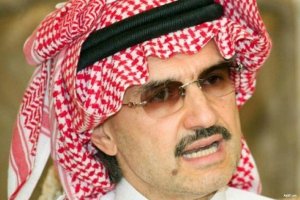 Saudi multibillionaire Al-Waleed bin Talal has said that he would stand with Israel against the Palestinians if a new uprising was ignited, Kuwaiti media reported on Tuesday.
According to the AWD news website, bin Talal told the Kuwaiti newspaper Al-Qabas: “I will side with the Jewish nation and its democratic aspirations in case of outbreak of a Palestinian Intifada.”
He also added: “I shall exert all my influence to break any ominous Arab initiatives set to condemn Tel Aviv, because I deem the Arab-Israeli entente and future friendship necessary to impede the dangerous Iranian encroachment.”
Regarding the foreign policy of Saudi Arabia, bin Talal said that “[Saudi] must reconsider its regional commitments and devise a new strategy to combat Iran’s increasing influence in the Gulf States by forging a Defence pact with Tel Aviv.”
It seems that he urged his country to take this measure in order “to deter any possible Iranian moves in the light of unfolding developments in the Syria and Moscow’s military intervention.”
AWD reported that the Kuwaiti news agency KUNA has quoted bin Talal as saying that: “The whole Middle East dispute is tantamount to matter of life and death for the Kingdom of Saudi Arabia.”
He continued: “I know that Iranians seek to unseat the Saudi regime by playing the Palestinian card. To foil their plots, Saudi Arabia and Israel must bolster their relations and form a united front to stymie Tehran’s ambitious agenda.”
‘Strategic depopulation’ of Syria likely cause of EU refugee crisis – Assange
RT | October 27, 2015
The flooding of Europe by countless waves of refugees may be the result of the “strategic depopulation” of Syria carried out by opponents of the country’s government, WikiLeaks founder Julian Assange has suggested.
Transparency organization WikiLeaks has looked through its diplomatic cables and unearthed “an interesting speculation about the refugee movement,” Assange said in an interview with Geek news site, ThePressProject.
“So, the speculation was this: Occasionally opponents of a country would engage in strategic depopulation, which is to decrease the fighting capacity of a government,” he explained.
The whistleblower pointed out that “it’s predominantly the middle class that is fleeing” Syria on account of having “language skills, money, some connections.” Engineers, managers and civil servants are “precisely, the classes that …[are] needed to keep the government functioning,” he said.
Syrian people are encouraged to flee their country “by Germany saying they’ll accept many-many refugees, and by Turkey taking nearly three million refugees, thus significantly weakening the Syrian government,” Assange stressed.
Syria isn’t the only case of migration being used as a weapon in recent history; during the Iraq War, Sweden told the US that “the acceptance of Iraqi refugees was part of its contribution,” according to cables.
The WikiLeaks founder said that it’s a “disgrace” that the US refuses to take in Syrian refuges because it’s Washington who should be held accountable for the hundreds of thousands of people arriving in Europe and making EU states close its borders with one other.
“The situation comes about as a result of the US, UK and French policy in the Middle East together with the behavior of US regional allies in the Middle East – Qatar, Turkey, Jordan and Israel… and Saudi Arabia,” he said.
The intercepted documents, already published by WikiLeaks, revealed that the US had been plotting to overthrow the Syrian government since around 2006, Assange stressed.
“It was trying to make the Syrian government ‘paranoid’ trying to get it to ‘overreact’ by instilling that fear and paranoia; trying to make it worried about coups; trying to stir up sectarian tensions between Sunnis and Shias … trying to stop foreign investment in Syria and secretly funding a variety of NGOs in Syria also to make trouble, using the Saudis and Egypt to help push that along,” he said.
Meanwhile any of Assad’s attempts to battle terrorism and the expansion of Islamic State (IS, formerly ISIS) strength were presented as a demonstration of weakness and “an example of [the] Syrian government not having full control over its territory to encourage the government overthrow,” the whistleblower added.
Assange stressed that the people in America have nothing to gain from the Syrian conflict, but “only particular factions that pushed for it” might believe that they will benefit in the end.
“Of course, the CIA perceives they have a benefit. They create a problem and then they’re given a greater budget to clean the problem up. Similarly, with the contractors, arms dealers and arms manufacturers. If there’s no problem then their budgets are cut. So they create problems,” Assange explained.
By meddling with Syria, Washington also pursued “a grand area strategy to weaken Hezbollah, to allow Israel greater control of Golan Heights, maybe a buffer zone as well; to knockout (Syria) a regional ally of Iran; to knockout the last Russian base that’s left outside the former Soviet Union in Tartus; to create a path for a gas pipe that is proposed pass is from Qatar to Saudi and up through Syria to Europe, which will compete with Russian gas,” added Assange.
US interference has led to Syria being ensnared in a bloody conflict since 2011. Over 220,000 people have been killed, according to UN estimates. Government forces have fought various militant groups throughout the conflict, including the so-called moderate opposition backed by the West as well as the jihadist IS and Jabhat al-Nusra terror groups.
In late September, Russia began airstrikes against the terrorists in Syria at the request of President Bashar Assad, allowing government forces to launch a large-scale offensive and recognize a turning point in the conflict.
The Arab Spring: Made in the USA
By Stuart Jeanne Bramhall | Dissident Voice | October 25, 2015
Arabesque$: Enquête sur le rôle des États-Unis dans les révoltes arabes (Investigation into the US Role in the Arab Uprisings) is an update of Ahmed Bensaada’s 2011 book L’Arabesque Américaine. It concerns the US government role in instigating, funding and coordinating the Arab Spring “revolutions.” Obviously most of this history has been carefully suppressed by the western media.
The new book devotes much more attention to the personalities leading the 2011 uprisings. Some openly admitted to receiving CIA funding. Others had no idea because it was deliberately concealed from them. A few (in Egypt and Syria) were officially charged with espionage. In Egypt, seven sought refuge in the US embassy in Cairo and had to be evacuated by the State Department.
Democracy: America’s Biggest Export
According to Bensaada, the MENA Arab Spring revolutions have four unique features in common:
- None were spontaneous – all required careful and lengthy (5+ years) planning, by the State Department, CIA pass through foundations, George Soros, and the pro-Israel lobby.1
- All focused exclusively on removing reviled despots without replacing the autocratic power structure that kept them in power.
- No Arab Spring protests made any reference whatsoever to powerful anti-US sentiment over Palestine and Iraq.
- All the instigators of Arab Spring uprisings were middle class, well educated youth who mysteriously vanished after 2011.
Nonviolent Regime Change
Bensaada begins by introducing non-violent guru Gene Sharp (see The CIA and Nonviolence), his links with the Pentagon and US intelligence, and his role, as director of the Albert Einstein Institution, in the “color” revolutions.2 in Eastern Europe and the attempted coup against Hugo Chavez in 2002.))
 The US goal in the Arab Spring revolutions was to replace unpopular despotic dictators while taking care to maintain the autocratic US-friendly infrastructure that had brought them to power. All initially followed the nonviolent precepts Sharp outlines in his 1994 book From Dictatorship to Democracy. In Libya, Syria and Yemen, the US and their allies were clearly prepared to introduce paid mercenaries when their Sharpian “revolutions” failed to produce regime change.
Follow the Money
Relying mainly on Wikileaks cables and the websites of key CIA pass through foundations (which he reproduces in the appendix), Bensaada methodically lists every State Department conference and workshop the Arab Spring heroes attended, the dollar amounts spent on them by the State Department and key “democracy” promoting foundations3, the specific involvement of Google, Facebook, Twitter and Obama’s 2008 Internet campaign team in training Arab Spring cyperactivists in encryption technologies and social media skills, US embassy visits, and direct encounters with Hillary Clinton, Condoleezza Rice, John McCain, Barack Obama and Serbian trainers from CANVAS (the CIA-backed organization that overthrew Slobodan Milosevic in 2000).
Bensaada focuses most heavily on the Tahrir Square uprising in Egypt. The Washington Post has estimated approximately 10,000 Egyptians took part in NED and USAID training in social media and nonviolent organizing techniques. For me the most astonishing information in this chapter concerned the role of an Egyptian exile (a former Egyptian policeman named Omar Afifi Suleiman) in coordinating the Tahrir Square protests from his office in Washington DC. According to Wikileaks, NED paid Suleiman a yearly stipend of $200,000+ between 2008-2011.
When Nonviolence Fails
Arabesques$ devotes far more attention to Libya, Syria and Yemen than Bensaada’s first book.
In the section on Libya, Bensaada zeroes in on eleven key US assets who engineered the overthrow of Gaddafi. Some participated in the same State Department trainings as the Middle East opposition activists and instigated nonviolent Facebook and Twitter protests to coincide with the 2011 uprisings in Tunisian and Egypt. Others, in exile, underwent guerrilla training sponsored by the CIA, Mossad, Chad and Saudi Arabia. A few months after Gaddafi’s assassination, some of these same militants would lead Islamic militias attempting to overthrow Assad in Syria.
Between 2005 and 2010, the State Department funneled $12 million to opposition groups opposed to Assad. The US also financed Syrian exiles in Britain to start an anti-government cable TV channel they beamed into Syria.
In the section on Syria, Bensaada focuses on a handful of Syrian opposition activists who received free US training in cyberactivism and nonviolent resistance beginning in 2006. One, Ausama Monajed, is featured in the 2011 film How to Start a Revolution about a visit with Gene Sharp in 2006. Monajed and others worked closely with the US embassy, funded by the Middle East Partnership Initiative (MEPI). This is a State Department program that operates in countries (such as Libya and Syria) where USAID is banned.
In February 2011, these groups posted a call on Twitter and Facebook for a Day of Rage. Nothing happened. When Sharpian techniques failed to produce a sizable nonviolent uprising, as in Libya, they and their allies (Saudi Arabia, Turkey, Qatar and Jordan) were all set up to introduce Islamic mercenaries (many directly from Libya) to declare war on the Assad regime.
- I was astonished to learn that Forum Fikra, a forum for Arab activists working against authoritarian governments, was mainly funded by the Nathan and Esther K Wagner Family Foundation. The latter also funds numerous pro-Israel groups and projects, as well as the Washington Institute for Near East Policy (a pro-Israel group with close ties to AIPAC).
- The color revolutions were CIA-instigated uprisings that replaced democratically elected pro-Russian governments with equally autocratic governments more friendly to US corporate interests:
Serbia (2000) – Bulldozer Revolution
Georgia (2002) – Rose Revolution
Ukraine (2004) – Orange Revolution
Kyrgyzstan (2005) – Tulip Revolution - Democracy promoting foundations (as used here, “democracy” is synonymous with capitalism, ie favorable to the interests of US investors). Here are seven of the main ones involved in funding and training Arab Spring activists:
• USAID (US Agency for International Development) – State Department agency charged with economic development and humanitarian aid with a long history of financing destabilization activities, especially in Latin America.
• NED (National Endowment for Democracy) – national organization supported by State Department and CIA funding dedicated to the promotion of democratic institutions throughout the world, primary funder of IRI and NDI.
• IRI (International Republican Institute) – democracy promoting organization linked with the Republican Party, currently chaired by Senator John McCain and funded by NED.
• NDI (National Democratic Institute for International Affairs) – democracy promoting organization linked with the Democratic Party, currently chaired by Madeline Albright and funded by NED.
• OSI (Open Society Institute) – founded by George Soros in 1993 to help fund color revolutions in Eastern Europe. Also contributed major funding to Arab Spring revolutions.
• Freedom House – US organization that supports nonviolent citizens initiatives in societies were liberty is denied or threatened, financed by USAID, NED and the Soros Foundation.
• CANVAS (Center for Applied Non Violent Action and Strategies) – center originally founded by the Serbian activists of Otpor who the US funded and trained to over throw Slobodan Milosevic and who were instrumental in training Arab Spring activists. Funded by Freedom House, IRI and George Soros
Dr. Bramhall is a retired American psychiatrist and political refugee in New Zealand. She has published a free, downloadable non-fiction ebook 21st Century Revolution. Her first book The Most Revolutionary Act: Memoir of an American Refugee describes the circumstances that led her to leave the US in 2002. Email her at: stuartbramhall@yahoo.co.nz.
Saudi Supreme Court approves Sheikh Nimr death penalty
Press TV – October 25, 2015
Saudi Arabia’s Supreme Court has approved the death penalty for prominent Shia cleric Sheikh Nimr al-Nimr, his brother says.
Mohammad al-Nimr, the prominent cleric’s brother, said in a message on social media on Sunday that the Saudi Supreme Court and an appellate court had approved the execution of the Shia cleric and authorized the Saudi Interior Ministry to carry out the sentence.
The execution warrant has been reportedly sent to Muhammad bin Naif bin Abdulaziz Al Saud, the Saudi crown prince, who is also the first deputy prime minister and the minister of interior of Saudi Arabia.
The warrant will now be sent to Saudi Arabia’s ruler Salman bin Abdulaziz Al Saud after the approval of the Interior Ministry.
To be implemented, the warrant must be approved by the Saudi king.
The execution of the Shia cleric can be carried out by the Interior Ministry without any prior warning if the Saudi king signs the order.
Nimr was attacked and arrested in the Qatif region, east of Saudi Arabia, in July 2012, and has been charged with undermining the kingdom’s security, making anti-government speeches, and defending political prisoners. Nimr has denied the accusations.
In October 2014, a Saudi court sentenced Sheikh Nimr to death, provoking huge condemnations and criticism in the Middle East and the world.
Ali Mohammed Baqir al-Nimr, the nephew of the prominent Saudi Shia cleric, has also been also sentenced to death over his alleged role in anti-regime protests in 2012, when he was 17 years old.
“We don’t want anything to happen to him or to Ali or the other young men,” Mohammed al-Nimr said.
Ali Mohammad was arrested during an anti-government protest in Qatif and was later convicted of alleged criminal activities and handed down a death penalty by Saudi Arabia’s Specialized Criminal Court in May 2015.
Peaceful demonstrations erupted in Saudi Arabia’s Eastern Province in February 2011, with protesters demanding reforms, freedom of expression, the release of political prisoners and an end to widespread discrimination against people of the oil-rich region. Several people have been killed and many others have been injured or arrested during the demonstrations.
International rights bodies, including Amnesty International, have criticized Saudi Arabia for its grim human rights record, arguing that widespread violations continue unabated in the oil-rich country even though a new ruler, King Salman bin Abdulaziz Al Saud, has taken the helm of the absolute monarchy.
White Helmets: War by Way of Deception
By Vanessa Beeley | thewallwillfall | October 23, 2015
“The Ivy League bourgeoisie who sit at the helm of the non-profit industrial complex will one day be known simply as charismatic architects of death. Funded by the ruling class oligarchy, the role they serve for their funders is not unlike that of corporate media. Yet, it appears that global society is paralyzed in a collective hypnosis – rejecting universal social interests, thus rejecting reason, to instead fall in line with the position of the powerful minority that has seized control, a minority that systematically favours corporate interests.” ~ Cory Morningstar
In his recent speech Hezbollah leader, Sayyed Nasrallah, alluded to a multi-phase “soft war” which relies upon the mass media complex to disseminate propaganda and bias, propelling the Middle East into, primarily, a sectarian crisis before descending even further into regionalism and finally a devastating individualism.
Cory Morningstar’s body of work does more than any other to expose the bare bones of the non-profit propaganda industry that governs both our reactions – and inactions, through a network of multi-layered and multi-faceted media manipulation campaigns, of which the end result is mass thought control. She explains:
“The 21st century NGO is becoming, more and more, a key tool serving the imperialist quest of absolute global dominance and exploitation. Global society has been, and continues to be, manipulated to believe that NGOs are representative of “civil society” (a concept promoted by corporations in the first place). This misplaced trust has allowed the “humanitarian industrial complex” to ascend to the highest position: the missionaries of deity – the deity of the empire.”
In a paper entitled, Foreign Aid and Regime Change: A Role for Donor Intent, written just prior to NATO intervention in Libya, Prof. Sarah Blodgett Bormeo describes the “democratization” process for target nations. Unwittingly or wittingly, Bormeo perfectly outlines the role played by NGOs in this process. Bormeo even goes so far as to pinpoint the lack of impartiality rife among NGOs large and small, the majority of whom, receive their funding directly from western government and major corporation sources – all of whom have a vested interest in the outcome of their NGO’s activities and ‘intervention’ in a particular location. Bormeo emphasises the importance of “picking winners” in this scenario, as opposed to respecting and supporting the will of the people in any sovereign nation.
“Thus, it is possible that aid donors, in an effort to avoid further entrenching an “authoritarian” [my edit: this status is decided by donor] regime and perhaps increase the likelihood of democratization, channel funds through NGOs and civil society organizations in authoritarian states.”
In this short video below, we are introduced to the US military’s symbiotic relationship with NGOs in countries [in this instance, Iraq] where the policy is to Induce Pacification & Advance Western Ideologies. NGOs are cynically used to “soften” cultures and render entire communities dependent upon foreign aid in order to facilitate “Democratization”.
In this role, and dependent upon their donor support, NGOs cease to be the neutral, unbiased ‘humanitarian’ organisations they publicly purport to be, and instead become actual covert tools for foreign intervention and regime change. By default, they are assimilated into the Western modus vivendi of “waging war by way of deception” and their purpose is to alter public perception of a conflict via a multitude of media and “marketing” channels.
Following this formula, let’s examine, once more, the role of the Syria Civil Defence aka,’The White Helmets’ currently operating in Syria and take a closer look at their financial sources and mainstream media partners in order to better determine if they are indeed “neutral” as media moguls proclaim these “humanitarians” to be.
White Helmets: Follow the Money
The White Helmets were established in March 2013, in Istanbul, Turkey, and is headed by James Le Mesurier, a British “security” specialist and ‘ex’ British military intelligence officer with an impressive track record in some of the most dubious NATO intervention theatres including Bosnia and Kosovo, as well as Iraq, Lebanon, and Palestine. Le Mesurier is a product of Britain’s elite Royal Military Academy at Sandhurst, and has also been placed in a series of high-profile pasts at the United Nations, European Union, and U.K. Foreign and Commonwealth Office.
The origins of The White Helmet’s initial $300k seed funding is a little hazy, reports are contradictory but subsequent information leads us to conclude that the UK, US and Syrian opposition [Syrian National Council] are connected. Logistical support has been provided by given by Turkish elite natural disaster response team, AKUT.
A further $13 million was poured into the White Helmet coffers during 2013 and this is where it gets interesting. Early reports suggest that these “donations” came from the US, UK and SNC with the previously explored connections to George Soros in the US.
Soros in Syria: ‘Humanitarian’ NGO Deployed For Regime Change, Not Aid
However, subsequent investigations reveal that USAID has been a major shareholder in the White Helmet organisation.
The website for the United States Agency for International Development (USAID) claims that “our work supports long-term and equitable economic growth and advances U.S. foreign policy objectives by supporting: economic growth, agriculture and trade; global health; and, democracy, conflict prevention and humanitarian assistance.”
In a USAID report update in July 2015 it is clearly stated that they have supplied over $ 16m in assistance to the White Helmets.

The USAID track record as a primary US Government/CIA regime change facilitator is extensively documented. From South America to the Ukraine and in the Middle East, USAID serve a malevolent and ultimately destructive role in the dismantling of sovereign nations and their reduction to Western hegemony vassal states, as always, all in the name of freedom and democracy.
“The United States does not lack institutions that continue to conspire, and that’s why I am using this gathering to announce that we have decided to expel USAID from Bolivia” ~ Bolivian President Evo Morales
“USAID and NED are in the business of “Democracy Promotion” which uses public money (from U.S. taxpayers) for secretive operations with the intention to support pro-U.S. governments with the help of political and social movements abroad. The goal is regime change.” ~ Timothy Alexander Guzman
With recent developments in Syria and as a consequence of the Syrian Government requested Russian intervention, we have seen a scramble to justify the shambolic US foreign policy and its clandestine terror operations in Syria. We have previously established the White Helmet connections to this US regime change operation and their undisputed exclusive integration into the Al Nusra and Free Syrian Army [Muslim Brotherhood] and even ISIS networks and strongholds.
Humanitarian’ Propaganda War Against Syria – Led by Avaaz and The White Helmets
After RT and Sott.net among others, exposed the gaping holes in White Helmet propaganda over recycled photographs tweeted even before the alleged Russian bombing had occurred, the propaganda “war” ramped up. The Russian involvement in Syria, did not only betray the US military deception, it also brought some heavyweight media giants of its own into the fray who set about de-constructing the Western media and NGO indoctrination that had, for so long, been largely unchallenged.
At this point the London Telegraph went into damage limitation mode. It published an article expounding the White Helmet humanitarian role in Syria but with admissions of UK Government “majority” funding and that the White Helmets are embedded with ISIS (“in at least one ISIL held area”), claims previously vehemently denied but rendered indisputable after discovery of the photo showing an ISIS mercenary posing directly in front of a White Helmets depot located deep in ISIS held territory south of Yarmouk.

“The Foreign Office is currently the largest single source of funding. It is an irony that if Britain does effectively become an ally of Assad, and starts raids against Isil in Syria, it will be bombing from the air and paying for the bodies to be dug out on the ground. The White Helmets are also operating in at least one Isil-held area.”
Interestingly, the Telegraph stated clearly that the UK Foreign Office is the “largest single source of funding” for the White Helmets which may be perceived as an attempt to draw fire away from the USAID funding which still outstrips official figures released by the British Gov’t who “gifted” £ 3.5 million in equipment to “civil defence teams” in Syria [Report March 2015]. However, the British Government also committed to an additional £ 10m to “increase coordination between the Syrian Interim Government and civil defence teams” to be funded by: UK Government’s Conflict, Security and Stability Fund (CSSF).
It should also be noted here that although cries of ‘regime change!’ from both Washington and London have been muted since Russia entered the Syria conflict, both Washington and London have been supporting their own parallel, hand-picked ‘interim government’ for Syria since at least 2012.
So, with millions in hard cash and equipment being invested into the White Helmets by US & UK donors who have a very clear regime change objective in Syria, it becomes increasingly difficult to perceive their role as anything other than donor-biased propaganda merchants and a ‘humanitarian’ extension of a clandestine terror operation allied to the NATO proxy armies in the region.
White Helmet Leadership
James Le Mesurier: James Le Mesurier has been portrayed as a Humanitarian maverick hero, miraculously in the right place (Istanbul) at the right time, just as the need arose for the formation of a Syria Civil Defence team, perhaps coincidentally, only a few months prior to the now infamous and universally (except for a few diehard propagandists) discredited Ghouta ‘chemical weapon’ attack in August 2013, an event which has already been proven beyond a doubt to be a false flag attack, as well as subsequent accusations levied at the Syrian Government which narrowly failed to precipitate the NATO desired ‘No Fly Zone’.
However, when we delve deeper into the life and times of Le Mesurier we see that it was no happy accident that he was in Istanbul at this juncture. As Sandhurst Military Academy’s top student and recipient of the Queen’s Medal, his chequered career took him from OHR [Office of High Representative] in Bosnia to intelligence co-ordinator in NATO’s newly won prize, Kosovo. We’re told that Le Mesurier left the British Army in 2000 and joined the UN serving as deputy head of the Advisory Unit on ‘Security and Justice’, and Special Representative of the Secretary General’s security policy body within the UN mission in Kosovo. His career then took him to Jerusalem where he worked on implementing the Ramallah Agreement, then to Baghdad as a special advisor to Iraqi Minister of Interior, and to the UAE to train their gas field protection force, and later to Lebanon during the 2006 war. In 2005 he was made Vice President for Special Projects at private mercenary firm Olive Group, and in January 2008 he was appointed as Principal for Good Harbour International, both based in Dubai.
Le Mesurier is also the founder of Mayday Rescue, a “non profit” organisation providing SAR [search & rescue] training to civilians enduring conflict. According to Mesurier’s own biography on the website, Mayday Rescue was founded in 2014, after he had established Syria Civil Defence/White Helmets.

A quick flick through the other Mayday team members reveals some very interesting connections.
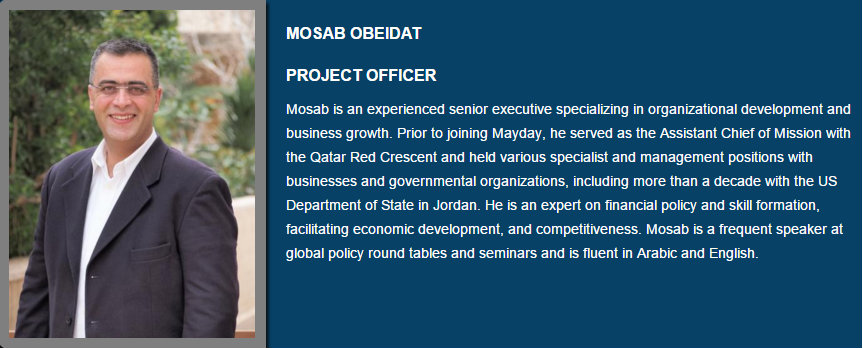
Mosab Obeidat, previous Assistant Chief of Mission with the Qatar Red Crescent, one of whose officials, Khaled Diab was accused of supplying $ 2.2 m to secure arms for the terrorist groups in Syria. Details of this transaction and its exposure can be found in this Al Akhbar article from June 2013.
At least three other members of the team were a part of the Syrian “revolution” including Farouq al Habib, one of the 3 most prominent White Helmet leaders who was also a leader of the Homs uprising against the Syrian government and according to his testimony, was tortured by the Syrian “regime” security forces in 2012 for smuggling a journalist into Syria to “cover” the “peaceful protests”. Habib was a founder member of the ‘Homs Revolutionary Council’ (the CIA have been linked to nearly all ‘Revolutionary Councils in Syria) before fleeing to Turkey in 2013 (A more in-depth analysis of his anti-Syrian government testimony will be presented in Part II of this article).

Le Mesurier is heavily involved in several organisations not mentioned in this article, but for the purposes of demonstrating that the White Helmets should not be considered impartial or neutral as they claim, we will focus on those that best substantiate that argument.
Both Olive Group and Good Harbour International are experts in private “security”. Taken from Sourcewatch on Olive Group:
“Olive Security was founded in 2001 by Harry Legge Burke. Olive lends their quick success to strong relations in the government and military industry. Harry Legge-Burke is an ex-Welsh Guard, and a former aid to chief of defence staff Sir [Charles Guthrie]. He can claim Prince William as a skiing partner and his sister was a nanny to the royal children.
Iraq: Olive were on the ground since the invasion began in 2003, and were able to deploy 38 former SAS employees within two days of the invasion’s completion in 2004
Jonathan Allum, Olive’s former director and co-owner, is also the son of Tony Allum, who is the chairman of the engineering company Halcrow and also the head of the UK government’s Iraq Industry Working Group. It was in the latter position that Tony Allum went to Washington to meet with Bechtel leaders, where he suggested, among other UK companies, Halcrow and Olive as companies worth considering for subcontracted work, all stemming from Bechtel’s $680 million contract with USAID. They were considered and contracts followed, though both Legge-Burke and Allum deny one had anything to do with the other”
In May 2015 Olive Group merged with Constellis Holdings, in whose portfolio we can also find Academi, previously the notorious Blackwater Group [ Nisour Square massacre, Iraq 2007]. Taken from The Atlantic July 2012: Post 9/11, Bush enabled the CIA to subcontract assassinations allegedly targeting Al Qaeda operatives. Blackwater was awarded this contract.
“Running operations through Blackwater gave the CIA the power to have people abducted, or killed, with no one in the government being exactly responsible.”
The CIA can no longer hide its Blackwater/Academi connections, especially after this week’s Wikileaks data dump of CIA director John Brennan’s emails, whose contact list included now spy chief Robert Richer at his Blackwater contact address.
The outsourcing of intelligence operations was in full-swing. What Bush initiated, Obama ran with, awarding Blackwater/Academi a $ 250m contract in 2010 to offer “unspecified” services to the CIA, thus maintaining the apparatus for “unaccountable” covert assassinations.
It is true that James Le Mesurier only joined Olive Group in 2005 and left them in 2008, but his involvement with them and their subsequent merger with Constellis and by default, Blackwater/Academi, gives a degree of valuable insight into the elite intelligence and Pentagon circles that Le Mesurier moved in prior to working for Good Harbour International and creating Syria Civil Defence (not forgetting the USAID funding & influence that underpins both Olive and SCD/White Helmets).
In 2008, Le Mesurier joined Good Harbour International, another private “security” expert organisation, whose CEO is none other than former terror advisor to the Bush administration, the Terror Czar himself, Richard A Clarke.

The jury is still out on whether Clarke was indeed the “whistleblower” he fashioned himself as, post 9/11, or a merely a high-level gatekeeper who aided in preventing a full and detailed investigation into Bush and Rumsfeld’s roles in 9/11.
Patrick Henningsen, a political analyst and writer for 21st Century Wire believes the latter is more likely:
“On first glance, one might buy into the mainstream media’s characterization of him, but it’s more likely that Richard Clarke is not a whistleblower at all. While appearing to oppose the Bush administration from a safe enough distance, I believe his role was inserted into the mix in the period of 2004-2005 in order to VALIDATE the bin Laden mythology and help to portray al Qaeda as an organic, independently run terror organization. He also claimed that Bush and Rumsfeld committed war crimes, but this means nothing because everyone knows that no US official will ever face ‘war crimes’ charges in any court of law anywhere on the planet. It’s effectively a straw man narrative that distracts from the real scandal in the US which is that the entire premise of the war on terror is completely contrived. Clarke’s ‘whistleblower’ status gives him brilliant cover from too much public scrutiny. I remain skeptical of his whole public narrative. He was, is, and always will be an insider.”
What is perhaps even more telling, is Clarke’s reported close ties with Israeli-US operative Rita Katz of the SITE Intelligence Group, another supposedly independent, albeit ‘private’ intelligence firm located in Bethesda, Maryland, a stone’s throw away from CIA headquarters. SITE are said to be responsible for the media release of the harrowing ISIS execution videos, al Qaeda videos, and their credibility has been extensively questioned.
Katz’s long term working relationship with Clarke began before 9/11 when she and her research associate Steve Emerson were commissioned by Clarke to identify Islamic radicals within the US. Over time, Katz’s relationship with Clarke blossomed into a much more extensive one that included regular briefings at both the Clinton and Bush White Houses.
“One of SITE’s founders, Rita Katz, is a government insider with close connections to former terrorism czar Richard Clarke and his staff in the White House, as well as investigators in the Department of Justice, Department of the Treasury, and the Department of Homeland Security, according to SourceWatch. Her father was executed in Iraq as an Israel spy, a fact that suggests a connection to Israeli intelligence.” ~ Mark Taliano
This background on Le Mesurier should at least make us question the media portrayal of an affable, debonair and philanthropic leader of a civilian humanitarian mission. His military & intelligence roots, the fact that despite working for OHR in Bosnia, no visible record of his employment can be found there, his private security-centric career path, his appearance in Istanbul at just the right moment to partner USAID, the UK government & Syrian opposition in creating just the sort of “democratization” enabling NGO as described in our introduction, MUST at least cause us to doubt the transparency and neutrality of the White Helmets in Syria.
In addition, the White Helmet leadership consisting of known Syrian opposition protagonists such as Raed Saleh and Farouq al Habib must make us more cynical about the claims of impartiality and lack of bias and for those who will defend the “peaceful” revolution narrative upheld by Habib and Saleh, please take the time to read Professor Tim Anderson’s in depth analysis of events in Syria pre NATO intervention.
“I have seen from the beginning armed protesters in those demonstrations … they were the first to fire on the police. Very often the violence of the security forces comes in response to the brutal violence of the armed insurgents” – Jesuit priest Father Frans Van der Lugt, January 2012, Homs Syria
“The claim that armed opposition to the government has begun only recently is a complete lie. The killings of soldiers, police and civilians, often in the most brutal circumstances, have been going on virtually since the beginning.” – Professor Jeremy Salt, October 2011, Ankara Turkey
Our presentation of the White Helmets as regime change propagandists & terrorist allies in this article will be further explored and verified in Part II.
“Existing soft power initiatives and agencies, particularly those engaged in development and strategic communications, must be reinvigorated through increased funding, human resources and prioritization. Concurrently, the U.S. government must establish goals, objectives and metrics for soft power initiatives. Furthermore, the U.S. government can better maximize the effectiveness of soft power instruments and efforts through increased partnerships with NGOs. By providing humanitarian and development assistance in areas typically inaccessible to government agencies, NGOs are often able to access potential extremist areas before the government can establish or strengthen diplomatic, developmental or military presence, including intelligence.” — Joseph S. Nye, former US assistant secretary of defence, June 2004
Brookings Wants to Strengthen the Syrian Rebels by Bombing Hezbollah
By Steven MacMillan – New Eastern Outlook – 24.10.2015
Western think tanks have been working relentlessly to try and counter Russia’s geopolitical masterstroke in Syria, which has clearly taken most strategists in the West by complete surprise. Reading through the analysis by these think tanks on Russia’s role in Syria, one is starkly reminded of how immoral Western foreign policy actually is, when you remember that these organisations are freaking out because Russia is bombing terrorists! Obviously, the reason why they are so distraught is because Russia is bombing the West’s terrorists, which they have been using as proxy armies to try and force regime change in Damascus (a strategy that has completely failed).
Potential countermeasures are the subject of a recent article for the Brookings Institution written by Pavel K. Baev, a nonresident senior fellow in the Center on the United States and Europe at Brookings, titled: Russia’s Syrian entanglement: Can the West sit back and watch? Baev suggests that “the decision to withdraw the batteries of Patriot surface-to-air missiles [from Turkey] must be cancelled”,before arguing that the US and its allies could bomb “Hezbollah bands around Damascus”:
“Finally, the United States and its allies could deliver a series of airstrikes on the Hezbollah bands around Damascus. That would be less confrontational vis-à-vis Russia than hitting Assad’s forces. Hezbollah has already suffered losses in the Syrian war and is not particularly motivated to stand with Assad to the bitter end, away from [its] own home-ground in Lebanon. (Israel would appreciate such punishment, too.)”
Striking Hezbollah may not have the desired effect Baev seems to envisage however, as this belligerent action is as likely to galvanize the group and ensure it will fight “to the bitter end” with the Syrian army, than encourage it to scale back its involvement in Syria. Airstrikes on Hezbollah could also potentially provoke a response against the perpetrators of the violence, further escalating a conflict that already involves a plethora of regional and international powers. Furthermore, many people would consider an attack on Hezbollah to be essentially an attack on Iran, as the Lebanese based group is funded by Tehran and closely aligned with the country.
Brookings recommendations once again highlight the fact that large sections of the US establishment have absolutely no focus on defeating ISIS in the region, as Brookings is advocating bombing a major group that has been fighting ISIS for years now. Rather, many within the US are still focused on toppling the regime in Damascus (which is never going to happen) in addition to weakening the forces that are battling ISIS. If the West was serious about defeating ISIS, they would support and cooperate with the forces that are truly fighting against this new so-called caliphate.
TTIP is an Geoeconomic Tool against Russia
Western strategists are terrified of Europe moving closer to the East, and an EU-Russian (especially a German-Russian) alliance arising. Merging Russia and the EU in the future is an objective of some US strategists, but Washington only desires this if both Russia and the EU are completely subservient to US dictates. Today however, Russia is a sovereign, independent nation which is not controlled by the US, and some within the EU are increasingly tiring of being vassals of Washington. This means closer relations between Russia and the EU is a geopolitical disaster for the US at the present moment, as Washington’s power will be severely diminished if this tectonic shift occurs.
By understanding this reality, it is now obvious how essential the trade deal between the US and the EU – the Transatlantic Trade and Investment Partnership (TTIP) – is to US geostrategy. As well as being a corporate fascist deal that empowers multi-national corporations at the expense of citizens, TTIP is a geoeconomic weapon against Russia to cement the transatlantic alliance between the US and the EU.
Ensuring TTIP passes was a recommendation of another Western organisation that has been working on potential counter strategies to Russia, namely the Washington-based Atlantic Council (AC). In a testimony before the US Senate Armed Services Committee in Washington on October 8, 2015, Gen James L. Jones, Jr., the Chairman of the Atlantic Council’s Brent Scowcroft Center on International Security and a former National Security Advisor, Jones emphasises the importance of TTIP “successfully concluding” for the West:
“Energy security is instrumental for transatlantic growth, prosperity, and security. The same can be said of successfully concluding TTIP. Europe and the US have the largest trading partnership in the world. Strengthening it serves our mutual interests and reaffirms the centrality of the transatlantic alliance in the 21st century. TTIP also affords the U.S. a unique opportunity to author the rulebook and roadmap for 21st century advanced economies.”
Jones other recommendations include working to diversify the EU’s energy supply to “undermine Putin’s use of energy as a political weapon”, continuing to impose sanctions on Moscow, in addition to admitting Montenegro into NATO next year and working to pull Macedonia into the military alliance. The retired General also asserts that the US should provide the government in Kiev with “anti-tank missiles, intelligence support, training and counter-electronic warfare capabilities”.
Russia of course is well aware of the importance of TTIP to Washington’s long-term agenda. In Vladimir Putin’s speech at the United Nations at the end of September, Putin appeared to confront some of the US-led trade deals which we have seen being negotiated in recent years, most probably referring to TTIP and the Trans-Pacific Partnership (TPP) (from 18.45 into the speech):
“I would like to point out another sign of a growing economic selfishness. Some countries have chosen to create closed and exclusion economic associations, with the establishment being negotiated behind the scenes in secret from those countries own citizens, the general public [and] the business community. Other states whose interests may be effected are not informed of anything either. It seems we are about to be faced with an accomplished fact that the rules of the game have been changed in favour of a narrow group of the privileged, with the WTO having no say. This could imbalance the trade system completely and disintegrate the global economic space. These issues affect the interests of all states and influence the future of the world economy as a whole.”
For a multitude of reasons, defeating TTIP would be a colossal achievement for the world. Many European’s are diametrically opposed to this deal, with hundreds of thousands protesting TTIP in Germany a recent illustration of this sentiment. Stop TTIP!
Russia Destroys The Greater Israel Dream

Plato’s Guns | October 19, 2015
The grand plan was going swimmingly. The concept of endless wars for Greater Israel was working and producing impressive results. Opportunistically, through aggravation of war after war, chunk by chunk of Arab land was usurped and the map of Greater Israel was slowly materializing. No matter the unstable chaos surrounding the State of Israel for the past seven decades, and no matter the undying Palestinian resistance and the violent Intifadas that erupted internally, the Zionist dream of Greater Israel remained consistently intact and was progressing unabated and unchallenged by anyone.
But dreams, by their diaphanous nature are easily interruptible – can easily turn into sudden nightmares. Indeed, dreams do, in the blink of an eye, simply end.
Nobody expected the Zionist dream to come to a sudden halt like this. Nobody. Nobody expected Russia, literally in the blink of an eye, to suddenly assert itself militarily in the Levant and in the process turn the Zionist dream into a geopolitical and existential nightmare. No further territorial expansions are even remotely possible now with Russia’s military presence in the Levant. The Russian army is in the Levant to stay and the Israelis know it. In the Zionist universe, it’s as if a mighty big-footed contender had suddenly appeared in the dream and instantly stepped on the Greater Israel map like it was a castle made of sand.
Russia is not a declared enemy of Israel. Russia did not squelch The Greater Israel dream on purpose. The destruction of the Zionist dream is the result of an unintended consequence that purely serves the regional and global interests of Russia. Happenstance that the Zionist dream was in the way of Russian ambitions, that’s all. Dog eat dog world.
But what are Russia’s interests in lassoing the Levant?
Well, first, Putin intends to re-fulfill the old Russian dream of establishing sizable military foundations and bases in the ‘warm waters’ of the world, in the Mediterranean, to be more precise, in order to pivot and project power westwards with practical ease. And also, to use Mediterranean naval bases as a first line of defense against a Western creep towards its own territory. Russia’s growing military presence in Syria is a matter of “national security”, Putin has declared several times over. Establishing multiple bases in the Mediterranean has not been possible for Russia to do since the 1967 Arab-Israeli war when it lost the Middle East chess game to America, symbolized by Egypt, a major Soviet client at the time having its Soviet military hardware devastated by Israeli-operated, made-in-USA weaponry. Russia today considers its growing presence in Syria to be a most vital geopolitical maneuver for re-establishing a seat of power again in the Middle East, in tandem with its progress into future Superpowerdom. In the current uncontrollable chaos of the Levant, this is an ambition that Russia must begin implementing immediately, lest the region falls dangerously under ISIS and Zioconism, making it thus harder for Russia’s old dream to be realized.
Secondly, Putin sees the cloth of American Empire as fast fading, especially in the Middle East, and he’s taking advantage of this: putting forth a challenging proposition to the American Emperor. Yes, Vladimir Putin, president of Russia, a man considered to be a cold-blooded realist, is aware of America’s weaknesses, but he’s also aware of its current strengths and he is in Syria as a power salesman – he’s in Syria to make a deal with Empire Americana. Respectfully, but firmly, he is pitching to Empire: ‘Look, you remain supremely powerful, but you are hemorrhaging in the Middle East and the situation is now critical. You cannot afford a new large-scale war in the Middle East that may or may not reassert your hold on the region; and you have lost all your proxy wars there as well – there are no more black-clad joker cards in your deck. You cannot continue on this disadvantageous path, you cannot stand still either and you also cannot withdraw from the region. All these are strategically inferior options and will not stop the bleeding of your powers. The only way out is through pragmatism. The only remedy is to share control of the Middle East with us, Russians. We have together shared power in the Middle East under the shadow of the Cold War and yes it created dangers and complexities for both our countries in the past. But today is different: there is no official Cold War between us and so our new partnership can only serve to strengthen us both’. This, dear reader is Russia’s diplomatic speak, received with quiet relief by the White House and cussed and scorned by the Ziocons in DC. Simplified, Putin is in Syria and his realist message to America is: ‘Share the Middle East with us now or we both fall in the future’. And it looks like Obama has quietly taken heed, in the interest of Empire and realism and not out of cowardice or submission to Putin. Obama’s problem is that although he begrudgingly agrees with Putin’s analysis and remedy, he cannot be seen to be supporting it in public because the Neocons would immediately set the dogs of treason on him, bogging him down with political obtrusion and smear campaigns in his last 15 months of power – possibly damaging his party’s winning chances at the next elections.
Thirdly, in my opinion, Russia is in Syria also for the purpose of redressing Russian military image and history. After the devastating defeat of the Soviet Union at the hands of the American-backed Afghani Mujahedeen, and considering the profound nationalism that Russian society feels especially towards its military institutions, it behooves any modern Russian leader thus to conceive and create a military victory against a modern version of the same old enemy who had previously defeated them – a military morale-booster both for the Russian populations and for the history books. A utilization of the sentiments of the ‘comeback kid’ for mass consumption so as to boost levels of nation devotion. Russia, being the largest nation in the world, landmass-wise, it has to regularly make grand spectacles and gestures in the name of national unity enhancement. Killing Takfiri terrorists in Syria, nay smashing them to smithereens with Russian Air Power is an opportune event to balance out and positively update Russian history books.
Yes, the Russian military buildup in Syria, especially in marine and air power, now looks to be, relatively speaking, permanent. And this is what is causing Israel and its Ziocon friends in Washington sleepless nights and hectic, nefarious group-brainstorming sessions. They know that the dream of a Greater Israel cannot be realized with Russia dominating the skies and waters of the Levant. This is the current and silent inescapable reality. This is the wall that suddenly sprung up and instantly separated Zionists from their beloved Greater Israel dream. Because of a ‘wall’, the dream is now impossible.
Some would call this, poetic justice.
The ‘dream destroyed’ being the current unspoken reality, Israel is left with no expedient and transforming choices. It cannot go to direct war with a more powerful Russia and win back domination over Levant skies and waters. It couldn’t even defeat Hezbollah who lack any form of Air Power back in 2006. And more frustratingly for Israel, it cannot blackmail, coerce or buy President Putin either. Moreover, presently under the leadership of Obama, it is clear that America is not prepared to go to direct war with any nation, let alone Russia, on behalf of Israel. The current architects of expansionist Zionism are at a complete and utter loss to recognize all these chokehold factors – blood is draining from their faces. No more meetings over what Arab country to genocide next so as to steal more land and resources, the issue now is not when and how the Zionist dream can be finally fulfilled, but how to safely bring the corpse-dream back from the dead without anyone noticing.
Alas, there are no clever Zionist ideas on the architects’ table. They are truly and absolutely in utter speechless shock.
And what compounds this hectic catatonia that the Zionist Sensei are currently experiencing is the fact that they know that Israel’s global credibility is at its lowest ever, and that sooner or later, the international community – seeing Israel’s geopolitical weakness – will start pressing hard, even imposing the 2-State solution on Israel, based on the 1967 borders. This is the double nail in the Greater Israel dream coffin. Not only will Israel be unable to expand territory, but it will also be forced into giving up territory currently under its (illegal) control. Something that the Israeli public are psychologically not prepared for, nor is there any political will in the Israeli halls of power to do so either.
Observations of the behaviorism of Zionists tell us that what they cannot change, they usually endeavor to spoil. And the only thing they are still capable of doing is spoiling it for Arabs. They will undoubtedly attempt to expand the current regional conflicts into another one hundred years of Arab on Arab wars. This is a given – they breathe to spoil life for their Arab neighbors. And we also observe that when Zionists are not willing or able to go to war, they usually endeavor to send other capable and willing nations to war on their behalf. But as noted a few passages above, this is currently impossible under the Obama administration. The dream of Greater Israel remains smashed.
What to do then? What is the ultimate solution? Would Israel prefer that America directly and militarily confront Russia in the Levant? I call it a yes. Even at the cost of causing World War Three? Yes. Even at the risk of igniting a nuclear war? Yes.
Yes, yes, and a triple yes. The global Zionist congress pathology shows every indication of this. ‘The tribe above all’ is their core belief. They are Masadian-ISISians in suits with basements full of nukes. Their narcissistic intentions are always clear – their motives and maneuvers are never to be trusted.
We are currently at a very serious and sobering point in the fast-evolving dramas taking place in the Levant and the Middle East at large. Everyone concerned is standing shoulder-to-shoulder with the unknown. This alignment of overwhelming unknowns is rare in history. The geopolitical stress and distress levels – despite the equalizing Russian presence in the Levant – remain excruciatingly high for all parties concerned. All actors have so much to lose with a single wrong move. A cluster of unknowns is forcing everyone into extreme caution. Hesitant steps are made then quickly unmade. If you were to privately ask Obama or Putin what would happen to the world the day after a war between their two nations ignites, they would both be likely to look you somberly in the eye and say, ‘I don’t know’.
The unknown is upon us and we are upon the unknown.
For now, Zionist masterminds plan on keeping the death of the dream of Greater Israel a secret, in the hope that the next American president would be more malleable and more reactionary than Obama. They will be quietly biding their time and hoping that the next President of America would be more Zionist that Theodore Herzl. More ideologically violent than ISIS and Tarantino. Hoping against all hope that the tiny state of Israel would survive a Word War Three catastrophe with little damage inside its boundaries. Hoping against all hope that the Arab world surrounding Israel, all of it would literally be bombed back into the stone ages, while Israel continues to be the hi-tech bride of the Middle East. Hoping against all hope that Russia would again be defeated by America in the Middle East – just so that Israel can again dominate the skies and waters of the Levant, allowing it thus to revive the corpse of the Greater Israel project. Hoping against all hope that igniting World War Three would actually solve all of Israel’s problems.
A touch fantastical? Maybe not.
This is what happens when tribal madmen dream.
Should Britain jump into the toxic mix of military intervention in Syria?

By Andrew Murray | Stop the War Coalition | October 19, 2015
GIVE them credit for persistence and ingenuity. The bomb-Syria bloc in the British establishment isn’t taking “no” for an answer.
In 2013 they were urging war against the Syrian government over its alleged use of chemical weapons. The House of Commons defeated David Cameron’s proposal in what was a landmark vote for anti-war sentiment in this country.
Indeed, it stopped Obama’s own plans for attacking Syria in their tracks and represented a decisive democratic rupture in the Anglo-American war front in the Middle East.
Imperial interventionists in both major parties have been smarting ever since. The rise of Islamic State to control much of Syria’s territory – a consequence of the civil war fostered by the western powers, amongst others – seemed to offer another excuse for intervention.
After all, British bombers are already participating in the US-led attack on IS in neighbouring Iraq – the latest military intervention in that country, and one having no better outcomes than all the previous.
It is now pretty obvious that bombing by western powers is not going to roll back Islamic State. That could only be done by the forces of strong and sovereign states in Iraq and Syria, able to mobilise support from all sections of the people.
Western policy has actually been directed towards obstructing that development, through the sponsorship of sectarian strife across the Middle East, and the destruction of one state after another in the region.
Now reason number three has been dredged up – that old stand-by humanitarian” intervention. Labour MP Jo Cox has joined forces with Tory Andrew Mitchell to advocate military action… to save civilian lives.
They wrote in The Observer :
“We need a military component that protects civilians as a necessary prerequisite to any future UN or internationally provided safe havens. The creation of safe havens inside Syria would eventually offer sanctuary from both the actions of Assad and Isis, as we cannot focus on Isis without an equal focus on Assad. They would save lives, reduce radicalisation and help to slow down the refugee exodus.
“The approach of focusing on civilian protection will also make a political solution more likely. Preventing the regime from killing civilians, and signalling intent to Russia, is far more likely to compel the regime to the negotiating table than anything currently being done or mooted.”
Of course, if humanitarianism was really a consideration, Britain would have stopped funding and arming the Syrian civil war some time ago. It would be welcoming far more refugees from the conflict zone it has fuelled.
But let us take the appeal at face value for a moment. How could it be implemented? Our bipartisan armchair strategists are obviously riled by Russia’s escalating military involvement in Syria. But it is a fact. What form of military intervention could now be undertaken which would not lead to a clash with Russia they do not say. Even the head of MI6 has acknowledged that “no-fly zones” are no longer a possibility, unless the NATO powers are prepared to countenance conflict with Moscow.
The reality of “no fly zones” and “safe havens”, benign as they sound, is regime change. That is the clear aim of the proposal. Assad government forces – or those supporting it – would be the target.
A “no fly zone” would represent no challenge to Islamic State whatsoever. The caliphate lacks an air force.
If anyone still doubts that regime change is the real agenda, let them cast their minds back to the Libyan war. That began with Cameron and then French President Sarkozy pushing the United Nations to endorse just such a “no-fly zone”, ostensibly to protect the people of Benghazi from a massacre that Libyan ruler Gadhafi was then allegedly contemplating.
Enforcing the no-fly zone quickly morphed into bombing Libyan government troops, in coordination with the anti-Gadhafi rebels on the ground. The result was the swift transition of “humanitarian intervention” into regime-change, with results that are all-too clear today. A ruined and divided country, a shattered society and hundreds of thousands of refugees risking life and limb to cross the Mediterranean to Europe.
In Syria today, the winners from a war to set up safe-havens – an operation which would also require the deployment of grounds troops into Syria – would most likely be IS. It would be best placed to expand into many of the areas cleared of regime forces.
Such plans fuel the fantasies of neo-conservatives on both sides of the Atlantic who dream of creating a “third force” capable to taking over Syria in opposition both to Assad and to Islamic State.
Obama’s efforts to create a militia to carry out such a plan has ended in fiasco. No more than five fighters have been trained. So they are left with the non-IS rebel groups in Syria. These include the “Free Syrian Army” and the local al-Qaeda affiliate, trading as the Nusra Front.
These groups are drawing support from a range of foreign powers, including the US, Turkey, Saudi Arabia and other reactionary Gulf states. The Assad government is actively supported by Russia and Iran.
The clear need is not for Britain to jump further into this toxic mix. It is for a negotiated diplomatic end to the dreadful civil war which has laid waste to Syria. Ultimately, only the Syrian people can determine their own future political arrangements.
But the foreign powers could assist by all ending their military interventions, open and clandestine, in Syria – ending the bombing and the arming of one side or another.
They should further promote peace by abandoning all the preconditions laid down for negotiations. Such preconditions only serve to prolong the conflict and to give either government or opposition hope that foreign military and diplomatic support could somehow lead to all-out victory.
David Cameron, however, wants Britain to pile into the war – adding bombing of somebody or other to the existing levels of covert interference.
No doubt he is in part animated by a wish to be seen to be “doing something” that keeps Britain a key player in Middle East politics.
But mostly he just seems to want to reverse the humiliation of autumn 2013, when he became the first British prime Minister to lose a vote in parliament on going to war.
He has so far hesitated to bring a definite proposal forward for fear of a repetition. Many influential Conservative backbenchers can see no rational case for war.
He draws strength, however, from signs of support for bombing in the Labour ranks. The parliamentary arithmetic is still more unfavourable for peace than it was two years ago. But a united and resolute Labour position against bombing would most likely still stay his hand.
That is why the arguments within Labour’s ranks on this issue today are of first-rate importance.
***
There should be no need for a dispute within the Labour Party over the looming possibility of a Commons vote on bombing Syria.
Just a few weeks ago, the Party conference agreed a resolution on the issue which, despite shortcomings, is clear enough. For the benefit of those members of the Shadow Cabinet who appear not to have read it, here it is:
“Conference believes the Parliamentary Labour Party should oppose any such extension [of bombing] unless the following conditions are met:
Clear and unambiguous authorisation for such a bombing campaign from the United Nations.
A comprehensive European Union-wide plan is in place to provide humanitarian assistance to the increased number of refugees that even more widespread bombing can be expected to lead to.
Such bombing is exclusively directed at military targets directly associated with ‘Islamic State’ noting that if the bombing campaign advocated by the British government in 2013 had not been blocked by the PLP under Ed Miliband’s leadership, ‘Islamic State’ forces might now be in control of far more Syrian territory, including Damascus.
Any military action is subordinated to international diplomatic efforts, including the main regional powers, to bring the Syrian civil war to an end, since only a broadly-based and sovereign Syrian government can ultimately retake territory currently controlled by ‘Islamic State’.
Conference believes that only military action which meets all these objectives, and thus avoids the risk of repeating the disastrous consequences of the 2003 war in Iraq and the 2011 air campaign intervention in Libya, can secure the assent of the British people.”
In the view of Stop the War Coalition, even a military campaign which conformed to all those criteria, which are frankly very unlikely to be met, would still be an unwarranted and pointless intervention which would add to the sum of human suffering in Syria. The present bombing in Iraq proves that.
Nevertheless, the resolution represents a block in Cameron’s road to war. And it is, to repeat, Labour policy, not the whim of anyone, even a leader with such a recent and expansive mandate as Jeremy Corbyn.
But it has come under sustained, if indirect attack from Labour MPs.
The most overt opposition has come from shadow foreign secretary Hillary Benn. In a Guardian article last week he went well beyond the terms of the resolution in three specific respects.
First, he urged Cameron to actively work to secure the United Nations resolution referred to. Second, he hinted, in lawyerly language, that Labour might support bombing of Syria even if no such UN resolution was forthcoming.
And third he deliberately mixed up the issue of bombing Islamic State, a possibility conceded in a highly-contingent fashion in the resolution, with “humanitarian intervention” to establish so-called “safe havens”, which wasn’t.
Benn’s article came with the endorsement that it represents Labour’s official view on the matter, and spin to the effect that it left open the possibility of Labour backing war without UN authorisation.
It is a reminder that diluting Labour’s position on Syria is a win-win for the party’s right-wing. It gets the Party back in the military intervention game, removing the stain, as they see it, of the 2013 vote. And it damages, as a sort of collateral damage, the leadership of Jeremy Corbyn, who was until his election as Labour leader, the chair of the Stop the War Coalition.
An attempt to hedge the issue was the floating of suggestions that Labour MPs be given a “free vote” on the bombing issue. Under this scenario, bombing would most likely be approved, but the sting of anti-Corbyn rebellion would have been drawn.
There should be no question of allowing this. War is not a matter of conscience, save for absolute pacifists, but of policy. And Labour’s policy was made abundantly clear at the Party conference just a few weeks ago. Jeremy Corbyn has rightly called for policy sovereignty in the Party to be restored to conference.
In effect, a “free vote” would be tantamount to allowing the bombing of Syria. Some Labour MPs would doubtless rebel against a whipped vote in support of Labour policy in any case. Some would be committed Blairite neo-cons, while others would be animated by a desire to do anything, however debased, to damage Jeremy Corbyn.
However, their number would be limited. A “free vote” would increase the pro-war element considerably, since it would give the confused all the alibi they need to line up with the government.
The worst aspect of such vacillation, and of the Benn article in particular, is that it amounts to a come-hither to David Cameron, inviting him to bring a proposal for bombing Syria in the sure anticipation if victory, either because he will secure official Labour backing or because enough Labour MPs will support his resolution in any case.
It is therefore urgent to put all possible pressure on Labour MPs to stick to their own party policy as a minimum. That means explaining the humanitarian and strategic realities of the Syrian situation to those MPs who are uncertain.
It means explaining the alternative route of a real diplomatic settlement to the Syrian conflict and extended assistance to refugees and outlining the dangerous consequences for Syrian civilians and great-power relations alike of any extension of the war.
And for those Labour MPs who are still committed to the neo-conservative interventionist approach it means confronting them with the hideous record of their policies so far this century – millions dead or displaced, state collapse throughout the region, sectarian conflict incited, economies wrecked and global tension heightened. The Scottish National Party has clearly recognised it is time to break with the crimes of the recent past, as its conference last weekend voted to oppose bombing Syria. Can Labour afford not to do likewise?
Above all, it is time for a major upsurge in anti-war campaigning across the country. Our demands should be clear:
All foreign military intervention in Syria should end immediately. The Syrian conflict must be dealt with through political and diplomatic negotiations, with an end to the preconditions which block progress.
While these negotiations should include all regional and global parties that are affected by the conflict, the future of the Syrian government must be decided by the Syrian people alone, free of all external interference.
And Britain must abandon plans for bombing Syria, cease bombing Iraq and end its support for US global domination in favour of respect for every nation’s right to self-determination and sovereignty.
Andrew Murray is Chair of the Stop the War Coalition
Featured Video

AIDS Inc. by Gary Null (2007)
or go to
Aletho News Archives – Video-Images
From the Archives
Clash of Civilization, Iran Part II
By Jamal Kanj – Intifada-Palestine.com – January 14, 2011
Israel’s survival kit is: perpetuate conflict, insecurity to rationalize collective hate and finally playing victim.
Devoid of conflict, Israel implodes internally; without hate, Zionism loses its justification; and playing eternal victim to continue blackmailing the West. Absence of this holy trinity, Israel ceases to exist.
From its inception, the house of Zion has mastered exploiting adversarial powers to advance Israel’s cause. For instance, their influence over the Democratic Party in the US began with President Truman’s bid for 2nd term election in 1948.
Responding to strong opposition from Secretary of State General George Marshall and Department experts urging against recognition of Israel, President Truman replied: “I’m sorry gentlemen but I have to answer to hundreds of thousands [Jewish voters] who are anxious for the success of Zionism. I do not have hundreds of thousands of [voting] Arabs among my constituents”
Zionists influence over liberal American politics was matched with the doctrinal school of Conservative theoreticians aligning the Republican Party’s platform with Israel’s objectives. The Neoconservative Zionists, coined Zioncons, invented the “Clash of Civilization” concept to fight Israel’s wars. … continue
Blog Roll
 Aletho News
- Merck Virologists Admitted to Falsely Certifying Vaccine Efficacy
- Mandatory Folic Acid for every man, woman & child
- Pro-Palestine protesters arrested outside UK’s ruling Labour Conference in Liverpool
- Mauritius denies landing permit to flight from Israel, forcing cancellation: Tour operator
- Israeli finance minister calls for genocidal war on West Bank, annexation of south Lebanon
- 12 Things Your Psychiatrist Was Trained Not to Tell You
- From Unipolar Universalism to Multipolar Civilizational Distinctiveness
- RSF military group defects, joins Sudanese army: State media
- Ireland goalkeeper refuses to play ‘Israel’ as squad weighs boycott
- China pushes back against US on Cuba, Iran
- If Americans Knew
- Israel forces Gazans to live in constant peril – Daily Update
- Deconstructing Netanyahu’s pants-on-fire UN rant – Daily Update
- Trump betrayed voters with his campaign lies and prioritized a foreign country once he took office
- Netanyahu calls Israel’s war in Gaza ‘opposite of genocide’ in UN speech to near-empty hall
- Settler Kidnappings: Torture, Sexual Abuse and Terrorisation of Palestinian Abductees as Israel Deepens Annexation of West Bank
- Gaza winter nears as 162,000 tents become unusable, raising fears of humanitarian crisis
- Netanyahu says, “It’s the opposite of genocide”; UN says Gaza economy is world’s ‘most severe crisis on record’ – Daily Update
- Israel’s US-Backed Assault on Gaza Has Created the ‘World’s Most Severe Economic Crisis on Record’: UN
- ‘Protecting U.S. Citizens’… From Israel
- ‘This is where I live now, the back of a truck’: a day in the life of a grandmother in Gaza
- No Tricks Zone
- New Study: Earth And Venus Surface Warmth Largely Explained By Convection And Lapse Rate, Not CO2 Or Radiation
- 2025 Nature Paper Claiming Worsening Global Drought Gets RETRACTED …Heavily Flawed
- New Study: ‘Global Drought Shows No Detectable Recent Acceleration Under Climate Warming’
- Economic Masterminds: German Socialists Suggest Taxing Productivity Gains Stemming From Using AI
- The South China Sea Has Not Been Cooperating With The Climate Change Narrative
- Energy Crisis: Germany Enters Heating Season With Historically Low Gas Reserve Fill Levels
- New Study: The Antarctic Ice Sheet Gained Mass From 2020-2024 Due To Staggering Snow And Ice Accumulation
- Study: Ocean Heating Rates From Thousands Of Years Ago ‘Dwarf’ Modern Ocean Heating Rates
- Climate Extremists Target, Attack Large-Scale Power Grid Infrastructure In Germany!
- New Study: Antarctic Ice Melt Has Contributed Less Than 1 Centimeter To Sea Level Rise In The Last 30 Years

