Set Artists Hack ‘Homeland’ to Expose Show’s Racist Narrative
Thanks to creative intervention, Arabic graffiti stating ‘Homeland is racist’ featured in key scene
By Sarah Lazare | Common Dreams | October 15, 2015
The U.S. television series “Homeland”—widely criticized as Islamophobic and racist—was hacked by three street artists who were hired to paint “authentic” Arabic graffiti for a film set depicting a refugee camp on the Syria/Lebanon border.
The artists staged an intervention by tagging the slogan “Homeland is racist” on the set, which is located just outside of Berlin. Because the production company could not or did not read the Arabic graffiti, the subversive message was featured in a key scene of Season V, Episode II that aired Sunday and depicts the character of CIA agent Carrie Mathison, played by actress Claire Danes.
“In their eyes, Arabic script is merely a supplementary visual that completes the horror-fantasy of the Middle East, a poster image dehumanizing an entire region to human-less figures in black burkas and moreover, this season, to refugees,” declared the artists—Heba Amin, Caram Kapp, and Stone—in a statement released Wednesday.
The artists painted numerous other slogans on the set, including: “This show does not represent the views of the artists” and “Black Lives Matter.”
The trio said they were hired after being approached in June by a German artist who had been contacted by “Homeland’s” production company that was looking for “Arabian street artists.”
In their initial meeting, the artists said they were “given a set of images of pro-Assad graffiti—apparently natural in a Syrian refugee camp. Our instructions were: (1) the graffiti has to be apolitical (2) you cannot copy the images because of copyright infringement (3) writing Mohamed is the greatest, is okay of course.'”
The artists wrote that they ultimately decided to take the job to seize on “our moment to make our point by subverting the message using the show itself.”
The Showtime series has been widely criticized for its Islamophobic and racist stereotypes, as well as its glaring misinformation about the Middle East. Writer Laura Durkay argued last year in the Washington Post, “The entire structure of ‘Homeland’ is built on mashing together every manifestation of political Islam, Arabs, Muslims and the whole Middle East into a Frankenstein-monster global terrorist threat that simply doesn’t exist.”
“Granted, the show gets high praise from the American audience for its criticism of American government ethics, but not without dangerously feeding into the racism of the hysterical moment we find ourselves in today.” — Artists Heba Amin, Caram Kapp, and Stone
And Pakistani lawyer and social activist Mohammad Jibran pointed out that Season IV, which sends CIA character Carrie Mathison to Pakistan, is rife with inaccuracies and absurdities, including naming a terrorist villain after the actual former Pakistani ambassador to the United States.
The “Arabian street artists” behind this latest sabotage listed numerous other offenses. “The very first season of ‘Homeland’ explained to the American public that Al Qaida is actually an Iranian venture,” they wrote. “According to the story-line, they are not only closely tied to Hezbollah, but Al Qaida even sought revenge against the U.S. on behalf of Iran. This dangerous phantasm has become mainstream ‘knowledge’ in the US and has been repeated as fact by many mass media outlets.”
“Five seasons later, the plot has come a long way, but the thinly veiled propaganda is no less blatant,” the artists continue. “Now the target is freedom of information and privacy neatly packaged as the threat posed by Whistleblowers, the Islamic State, and the rest of Shia Islam.”
Yet the program continues to receive high accolades and viewership, in what critics say reflects—and perhaps feeds—a culture of racism and ignorance that has real consequences.
“Granted, the show gets high praise from the American audience for its criticism of American government ethics,” the artists noted, “but not without dangerously feeding into the racism of the hysterical moment we find ourselves in today.”
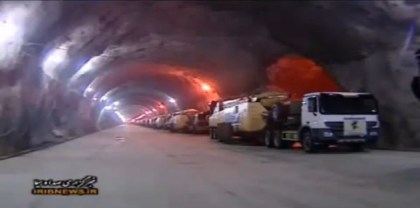
Iran airs unseen footage of secret underground missile base
RT | October 14, 2015
For the first time ever, Iranian television has broadcast footage of a secret underground tunnel, stocked with missile and launcher units. Officials have said it is one of several such bases in the Islamic republic.
Located at a depth of 500 meters under the mountains, the footage shows a very long tunnel which appears to be about 10 meters high. It is one of many missile bases in Iran, according to the Brigadier General Amir Ali Hajizadeh, commander of the Islamic Republic’s Revolutionary Guards’ aerospace division.
“The Islamic republic’s long-range missile bases are stationed and ready under the high mountains in all the country’s provinces and cities,” he said as quoted by the Guards’ website.
“This is a sample of our massive missile bases,” he said, adding that “a new and advanced generation of long-range liquid and solid fuel missiles” will replace the current weapons in 2016.
He issued a warning to anyone who might threaten Iran by suggesting that they had better “have a look at the Islamic republic’s army options under the table.”
Meanwhile, on Tuesday, the Iranian Parliament passed a nuclear deal brokered by the P5+1 group – the US, UK, France, China, Russia and Germany – in July. The agreement stipulates that Iran will partially curb its nuclear activities in return for the lifting of sanctions by Western states. However, the US has said multiple times that military options against Iran will be on the table for several years, despite the nuclear agreement.
On Wednesday, the Iranian general apparently hinted that the show of military power had been a response to Western threats.
“The missiles in various ranges are mounted on the launchers in all bases and ready to be launched,” he said as quoted by Press TV on Wednesday. They will be used if “enemies make a mistake,” he said.
The footage appeared after Iran successfully tested three Emad (Pillar) surface-to-surface long-range missiles, according Iran’s state news agency on Sunday.
Putin and the Press: The Demonology School of Journalism
By James Petras | October 11, 2015
The major influential western print media are engaged in a prolonged, large-scale effort to demonize Russian President Putin, his politics and persona. There is an article (or several articles) every day in which he is personally stigmatized as a dictator, authoritarian, czar, ‘former KGB operative’ and Soviet-style ruler; anything but the repeatedly elected President of Russia.
He is accused of hijacking Russia from the ‘road to democracy’, as pursued by his grotesquely corrupt predecessor Boris Yeltsin; of directing the bloody repression of the ‘freedom loving Chechens’; of jailing innocent, independent, and critical oligarchs and robber barons; of fomenting an uprising in the ‘democratic, newly pro-Western’ Ukraine and seizing control of Crimea; of backing a ‘bloody tyrant’ in Syria (elected President Bashar Assad) in a civil war against ISIS terrorists; of running the Russian economy into the ground; and of militarily threatening the Baltic and Eastern European NATO member countries.
In a word, the media have propagated an image of an ‘out-of-control autocrat’, who makes a mockery of ‘democratic’ norms and ‘Western values’, and who seeks to revive the ‘Soviet (aka Evil) Empire’.
The corollary is that ‘Western powers’, despite their peace-loving propensities and fraternal attempts to bring Russia into the democratic ‘fold’, have been ‘forced’ to now surround Russia with NATO military bases and missiles; to finance a violent coup in the Ukraine (on Russia’s frontier) and arm the Ukrainian putsch government and neo-fascist militias to ‘restore democracy’ and violently suppress ethnic Russian ‘separatists’ in Eastern Ukraine. We are told that US and EU sanctions against Russia were carefully crafted ‘diplomatic’ measures designed to punish the Moscow ‘aggressor’.
In reality, the Western media has relentlessly demonized Vladimir Putin in a campaign to further NATO military expansion and undermine the Russian economy and its national security. The goal is ultimately to force a ‘regime change’, restoring the neo-liberal elites who had pillaged Russia’s economy during the 1990s and whose brutal economic policies led to the premature death of over 6 million Russians due to deprivation and the collapse of the healthcare system.
Putin: Demon or Realist, Autocrat or Democrat, Vassal or Independent Leader?
The Western media has backed every oligarch, gangster, and fraudster who has gone on trial and been convicted during Putin’s term in office. The propagandists tell us the reason for this affinity between the Western media and the gangster-oligarchs is that these convicted felons, who claim to be ‘political dissidents’ and critics of Putin’s rule, have been dispossessed, and jailed for upholding ‘Western values’.
The Western media conveniently ignore the well-documented studies on the source of the gangster-oligarchs’ wealth: The violent and illegal seizure of multi-billion dollars-worth of natural resources (aluminum, oil and gas), banks, factories, pension funds and real estate. During the Yeltsin period the oligarchs controlled thousands of armed gangsters and engaged in internal warfare during which thousands were killed, including top government regulators, police officials and journalists who dared to oppose or expose their pillage and property grabs.
Putin’s prosecution of a mere fraction of the most notorious oligarch-gangsters has won the support of the vast majority of Russian citizens because it represents a return to law and order and the return of stolen public wealth.
Only the Western media has dared to refer to these convicted felons as ‘political victims and reformers’. They did so because the oligarchs had become the most loyal and submissive assets in the US and EU governments’ efforts to convert Russia into an irreversibly weak vassal state.
The Western media constantly refer to President Putin as the ‘authoritarian ruler’, despite the fact that he has been repeatedly elected by large majorities in competitive elections against Western backed and funded candidates. His popularity is attested to by opinion polls conducted by Western agencies.
In 2015, President Putin’s support soared to over 85%. The pro-Western Russian neo-liberal politicians scored in the low single digits according to the same independent polls.
Clearly the Russian public does not want to return to the poverty and chaos of the Western-backed gangster politics of the 1990s.
Whatever reservations working and middle class Russians have over President Putin’s style of decision-making, they clearly value his crackdown on gangster-controlled elections, Chechen terrorism, and his restoration of Russian military defense of its frontiers, including the annexation of Crimea, following the US-engineered coup in Ukraine.
Every day, the Western media recycle reports of the ‘decline and demise’ of the Russian economy, blaming ‘statist’ mismanagement of the economy by Putin. They claim ‘declining living standards’, the ‘negative growth’ of the economy and the ‘growing isolation’ of an ‘expansionist’ Russia in the face of Western sanctions.
These media claims are laughable. Readily available data demonstrate that living standards of the vast majority of Russian citizens have significantly increased under President Putin’s administration, especially after the utter collapse under the free marketers of the 1990s. Russian workers receive their pay, pensioners their pensions, enterprises their loans – on time. During the ‘free market’ days of Boris Yeltsin, workers went up to a year without pay, pensioners were selling their heirlooms in the street to survive and enterprises paid extortionate interest rates to oligarch-gangster controlled banks! Comparative data, easily obtained, are deliberately ignored by the mass media because it doesn’t fit the demonological narrative.
The mass media present the neo-liberal ‘opposition’ and ‘liberal critics’ as Russian democrats defending ‘Western values’. They forget to mention that these ‘liberal critics’ have been directly funded by Western foundations (National Endowment for Democracy, Soros Foundation, etc.) and Russian non-governmental organizations (NGO’s) with longstanding ties to US and EU governments, intelligence agencies and exiled Russian billionaires. The so-called ‘Russian’ democratic opposition revealed their abject servility to Western interests when they openly supported the Ukrainian coup and Kiev’s bloody assault on ethnic Russian-Ukrainians in the eastern ‘Donbas’ regions of Donetsk, Luhansk and Odessa. Whatever shreds of respectability and credibility the ‘democratic opposition’ retained with the Russian public, up to that point, was lost. They were seen for what they are: propaganda arms of Western imperialism and mouth-pieces for neo-fascists.
The Western mass media charge Putin’s government with the same crimes that their own governments commit. After the US State Department’s Victoria Nuland admitted to channeling $5 billion to fund the 2014 coup in Ukraine and after the Polish regime boasted of training far right street fighters, whose mob violence served as a pretext for the coup, and after neo-fascist coalition partners in Odessa of burned alive four dozen ethnic Russian-Ukrainian citizens opposed to the coup, the Western mass media accused Putin of ‘intervening’ in Ukraine. This was because Russia had convoked a referendum in Crimea, in which over 80% of the electorate voted to secede from the illegitimate Ukrainian coup regime and rejoin Russia.
In truth, the Putin government is a victim of the Western power grab in the Ukraine, with Russia having to absorb hundreds of thousands of ethnic Russian refugees driven out of the Donbas, yet the Western media portray Putin as the executioner. Meanwhile the Western coup-makers and their far-right allies are depicted as victims… forced to bomb and decimate the Donbas region.
The charade continued. The Western media portray the subsequent punitive, economic sanctions imposed by the expansionist US and EU on Russia as a result of Putin’s ‘aggression’, referring to Russia’s defense of Crimea’s self-determination and the rights of the millions of bilingual ethnic Russian citizens of Ukraine.
The absurdity and convoluted nature of Western demonological propaganda has reached new even more bizarre heights with their hysteria against Russia’s military support of the secular Syrian government against ISIS and other jihadi terrorists.
The Western mass media have launched a global campaign charging that the Russian air force bombs ‘non-ISIS military bases’, presumably the bases of Western-backed ‘friendly’ jihadi terrorists. This ridiculous ‘reportage’ and its accompanying ‘photos’ were published before the Russian air strikes even took place!!
Apparently timing doesn’t matter in Washington’s ‘alternative universe of lies’!
NATO passed its political line to the media that Russian support for the legitimate regime of President Assad must be discredited; that the Russian presence is ‘provocative’ and responsible for ‘creating tensions’ in the region – after years of Western-sponsored jihadi terrorism against Syria!
Obedient to its masters, the Western media breathlessly ‘reported’ that the Russians were ‘really’ engaged in Syria in order destroy the pro-Western ‘fighters’, leaving ISIS alone.
No credible evidence for this propaganda was ever presented. They trotted out aerial photos of wreckage, which had likely been lifted from previous US bombings.
The media’s clumsy execution of the Pentagon’s line managed to embarrass even the US Secretary of Defense, Ashton Carter, who backed off of such claims and called for an explanation from Russia. Even Secretary Kerry, who now seeks to secure Putin’s military support for the US against ISIS while withdrawing Russia’s political backing of President Assad, has cautioned the media to modify its line, now that the US favors ‘greater coordination’ with Russia — but under US leadership. The media has recently conformed to this line, although it has not managed to explain how Washington could now work with the demonic President Putin.
Conclusion
Western media is engaged in an intense long-term propaganda campaign to demonize President Putin. Its role is to convince world public opinion and world leaders to blindly follow the US and EU, as well as their ‘allies’ and vassal states, in a campaign to degrade and undermine Russia, and consolidate a unipolar empire under US tutelage.
The Western mass media is important; but it must be remembered that the media is an instrument of imperial state power. Its lies and fabrications, its demonization of leaders, like President Putin, are one part of a global military offensive to establish dominance and to destroy adversaries.
The more intense the imperial campaign, the riskier the power grab, the greater the need to demonize the victims.
This explains how the escalation of the rabid anti-Putin propaganda campaign coincides with the single biggest Western power grab — the Ukraine coup (‘regime change’) — since West Germany annexed East Germany, and NATO and the EU incorporated the Baltic States, Eastern Europe and the Balkans into the West’s strategic alliance. The West’s bloody break-up of the Yugoslav federation was part of this strategic program.
The problem with the Western demonization of adversaries, whether it is Russia, Iran and China today, or earlier Cuba, Libya and Yemen in the past, is that Washington and the EU face severe economic crises at home and military defeats abroad by armed Islamic and nationalist resistance movements.
The US had invested hundreds of billions of dollars to prop up a shaky puppet regime in US-occupied Iraq, yet the US-trained and supplied Iraqi Army fled as the Baathist-Islamist ‘ISIS’ quickly over-ran half the country.
US troops have occupied Afghanistan for fourteen years, losing tens of thousands of lives and limbs and yet the nationalist-Islamist Taliban can easily take over Afghanistan’s third largest city, Kunduz (population 300,000), and occupies three quarters of the rest of the countryside.
Libya and Somalia are a disaster. And still Washington allocates a half billion dollars to train pro-Western mercenaries to overthrow Syria’s President Assad – mercenaries who give up their arms or join ISIS the moment they cross the border from Jordan or Turkey. The US trained mercenaries have handed over untold millions of dollars worth of heavy and light weapons and armored carriers to ISIS and Al Qaeda. The EU and the US face the dismal reality that Libya, Somalia and Syria are over-run by anti-Western Islamic fighters.
In Asia, China is demonized in the Western media, portrayed as being on the verge of collapse, facing a hard landing, even as China grows at 7%. The Western media wring their collective hands over the crisis in China while Beijing finances two new international development banks for $100 billion, raises its contribution to the IMF and brings 50 countries, including most of the EU but minus the US and Japan, into a new infrastructure lending institution.
Two big questions face the US and EU:
Why do the Western media launch a campaign of demonization that doesn’t correspond to reality? What is the goal of such demonization, which objectively undermines the possibility of forming tactical alliances to end the US’ military losses, political defeats and diplomatic isolation? The US needs Russia to defeat ISIS.
For Moscow, the fight against ISIS is crucial to Russian national security: thousands of Chechen terrorists (some trained by the US) are fighting with ISIS and threaten to return to the Caucuses and terrorize Russia. Unlike the US public’s opposition to Washington’s role in forcing ‘regime change’ in Syria, the Russian public supports Moscow’s military support for the Syrian government because the Chechens’ campaign of terror within Russia, especially the 2004 massacre of hundreds of school children, teachers, and parents in Beslan, is seared into their memory – a fact conveniently ignored by Western media when it ‘sympathizes’ with Chechen ‘freedom fighters’.
In reality, Washington should have a common interest to ally with Russia in the fight against ISIS in Syria and Iraq. However Obama is committed to ousting Assad (Russia’s ally) to expand US dominance in the Middle East in partnership with Israel and Saudi Arabia. Clearly there are insurmountable contradictions between short-term military objectives (fighting ISIS) and strategic imperial political imperatives (consolidating US-Israeli hegemony over the Middle East and Iran).
Washington has moved to end its isolation in Latin America by re-establishing diplomatic relations with Cuba. Meanwhile, Washington retains the economic blockade of Cuba and its huge US military base in Guantanamo. Cuba is seen as a tactical political ally in ‘moderating’ the leftist government of Venezuela and pressuring the Colombian FARC to disarm, even as Washington deepens its military presence in the continent.
Obama signed off on a nuclear agreement with Iran (but the crippling sanctions and blockade remain in place) in order to secure Tehran’s support for the war against ISIS in Iraq and the Taliban in Afghanistan. Temporarily, the Western mass media has ‘toned-down’ its demonological reporting on Iran and Cuba, for tactical purposes.
The Obama regime has adopted a ‘good cop/bad cop’ (or schizophrenic) posture with Russia on Syria – Secretary of State John Kerry speaks of joint co-operation with Moscow while Secretary of Defense Ashton Carter proposes to militarily confront ‘Russian aggression’. The media hasn’t made the switch because they don’t know which orders to obey or which line to ‘parrot’.
In the meantime, the domestic economic crisis deepens, ISIS advances, the Taliban approaches Kabul, the Russians are arming and defending President Assad and millions of refugees, fleeing the war zones, have over- run Europe. European border wars are raging. And Obama wrings his hands in impotence. Demonology offers no allies, no solutions and no positive path to peace and co-existence.
US slams Russia for striking terrorists
Press TV | October 7, 2015
The United States has condemned Russia for striking the Western-backed militants in Syria and denied that it is cooperating with Moscow in this regard.
Speaking at a press conference in Rome, Italy, on Wednesday, US Defense Secretary Ashton Carter called the airstrikes against terrorists “a fundamental mistake”.
“I have said before that we believed that Russia has the wrong strategy — they continue to hit targets that are not ISIL. We believe this is a fundamental mistake,” Carter claimed, using an acronym for the Daesh terrorist group.
“Despite what the Russians say we have not agreed to cooperate with Russia so long as they continue to pursue a mistaken strategy and hit these targets,” he added.
Earlier in the day, the Russian Defense Ministry said it was considering proposals from the US to coordinate operations against ISIL terrorists.
“On the whole, these proposals could be put in place,” defense Ministry spokesman Igor Konashenkov said.
He added that US and Russian military officials were discussing technical details on Wednesday.
“What we will do is continue basic, technical discussions on the professional safety procedures for our pilots flying above Syria,” Carter said.
“That’s it. We will keep the channel open because it’s a matter of safety for our pilots,” he added.
A new US intelligence assessment has found Russia has targeted militant groups backed by the Central Intelligence Agency (CIA) in Syria.
The assessment, shared by commanders on the ground, has led American officials to conclude that Russian warplanes have intentionally struck CIA-backed militants in a string of attacks running for days, the Wall Street Journal reported.
Meanwhile, US foreign policy expert Zbigniew Brzezinski, a strong supporter of the Obama administration, says the United States should retaliate if Russia does not stop bombing its assets in Syria.

Former US national security adviser Zbigniew Brzezinski
Moscow’s apparent decision to strike CIA-trained militants “at best” reflects “Russian military incompetence,” and worst, “evidence of a dangerous desire to highlight American political impotence,” Brzezinski, the national security adviser for former President Jimmy Carter, wrote in an article published by the Financial Times on Sunday.
He added that if Moscow continues to target these people, then Washington should retaliate against Russians.
Obama administration officials are debating how the United States can come to the aid of its proxy forces on the ground without risking a broader conflict, according to the Wall Street Journal.
US officials said Russia’s moves in Syria posed a direct challenge to the Obama administration’s foreign policy on the Middle East.
Obama Boots Syrian Peace Chance
By Robert Parry | Consortium News | October 6, 2015
President Barack Obama is turning his back on possibly the last best chance to resolve the bloody Syrian war because he fears a backlash from Official Washington’s powerful coalition of neoconservatives and “liberal interventionists” along with their foreign fellow-travelers: Israel, Turkey, Saudi Arabia, Qatar and other Gulf sheikdoms.
The route toward peace would be to collaborate with Russia and Iran to get Syrian President Bashar al-Assad to accept a power-sharing unity government that would fairly represent Syria’s major religious and ethnic groups – Christians, Alawites, Shiites and moderate Sunnis – along with a commitment for free, internationally monitored elections once adequate security is restored.
But for such an arrangement to work, Obama also would have to crack down aggressively on U.S. regional “allies” to ensure that they stopped funding, supplying and otherwise assisting the Sunni extremist forces including Al Qaeda’s Nusra Front and the Islamic State (or ISIS). Obama would have to confront the Sunni “allies” – including Saudi Arabia, Qatar and Turkey – as well as Israel.
His pressure would have to include stern action aimed at the global finances of the Gulf states – i.e., seizing their assets as punishment for their continuing support for terrorism – as well as similar sanctions against Turkey, possibly ousting it from NATO if it balked, and a withdrawal of political and financial support for Israel if it continued helping Nusra fighters and viewing Al Qaeda as the “lesser evil” in Syria. [See Consortiumnews.com’s “Al-Qaeda, Saudi Arabia and Israel.”]
Obama also would have to make it clear to Syria’s “moderate” Sunni politicians whom the U.S. government has been subsidizing for the past several years that they must sit down with Assad’s representatives and work out a unity government or the American largess would end.
This combination of strong international pressure on the Sunni terror infrastructure and strong-arming internal players in Syria into a unity government could isolate the Sunni extremists from Al Qaeda and the Islamic State and thus minimize the need for military strikes whether carried out by Russia (against both Al Qaeda and ISIS) or the U.S. coalition (focusing on ISIS).
And, the arrival of Russian military support for the Assad government – as well as the increased backing from Iran and Lebanon’s Hezbollah – represented the moment when the prospect for peace was brightest, whatever one thinks of those various players. However, instead of working with Russian President Vladimir Putin and Iranian President Hassan Rouhani, President Obama chose to bend to the pressures of Official Washington.
Appeasing the Warmongers
Thinking he had stretched the tolerance of neocons and liberal hawks as far as he could by pushing through the nuclear deal with Iran, Obama fell in line behind their propagandistic denunciations of Assad and Putin. Obama’s administration joined in promoting the new favorite “group think” of Washington – that Putin had promised to only bomb the Islamic State and then reneged by attacking “moderate” rebels and their more powerful ally, Al Qaeda’s Nusra Front.
Conveniently, this storyline doesn’t cite the wording of Putin’s supposed “promise” although some articles do mention him vowing to attack “terrorist” groups, which the mainstream U.S. news media has interpreted as the Islamic State only. But this odd framing accepts the breathtaking premise that Al Qaeda is no longer a terrorist organization – apparently rehabilitated by the fact that Israel has been helping Al Qaeda’s affiliate, the Nusra Front, along the Golan Heights and prefers it to Assad’s continued rule. [See Consortiumnews.com’s “Should US Ally with Al Qaeda in Syria?”]
Among the many purveyors of this “Putin lied” narrative is Washington Post columnist Richard Cohen, who on Tuesday repeated the canard that Putin had “promised” to strike only the Islamic State and then broke that promise. For good measure, Cohen added that the Russians had “invaded” Syria although they were formally invited by the recognized government of Syria.
“Yes, the Russians did invade,” Cohen wrote. “They sent war planes, mechanized units and even troops into Syria. They have begun bombing missions, apparently hitting insurgents seeking to topple Syrian leader Bashar al-Assad and not only, as Russian President Vladimir Putin promised, Islamic State units. Putin – surprise! – lied.”
Normally in journalism, before we accuse someone of lying, we show what they actually said and contrast it with the facts. But Official Washington has long since moved Putin into the free-fire zone of demonization. Anything can be said about him, whether based in reality or not, and anyone who objects to this “group think” is called a “Putin bootlicker” or a “Putin apologist.”
Thus, any reality-based skepticism is ruled out of the frame of debate. Such was the way that the United States plunged blindly into the Iraq War in 2003 when Saddam Hussein was the demonized figure and the Europeans who warned President George W. Bush not to invade were laughed at as “Euro-weenies.” American skeptics were “Saddam apologists.”
Inside-Out ‘Logic’
Cohen is back at it again in his Tuesday column, which – on the Internet – has the curious title “The High Cost of Avoiding War in Syria.” Cohen throws around the word “invasion” where Russia is involved – even when there was no “invasion” – but he advocates an actual U.S. invasion with cavalier hypocrisy.
Cohen slams Obama for not having established “a no-fly zone” in Syria earlier, which would have involved the United States bombing and destroying Syria’s air force, a clear act of aggression and an obvious boon to Al Qaeda and ISIS.
Cohen also says he was for “arming the rebels,” another violation of international law which – when tried by Obama to appease the drumbeat from Cohen and his ilk – led to many U.S.-trained and U.S.-armed rebels taking their equipment and skills to Al Qaeda and ISIS.
Yet, Cohen — on the prized opinion real estate of The Washington Post’s op-ed page and in his nationally syndicated column — unapologetically encourages an illegal invasion of another country while condemning Russia for doing the same except that Russia was following international law by working with the sovereign government of Syria and therefore has not “invaded” Syria.
We also are supposed to forget that Cohen’s ideas would benefit Sunni jihadists, such as the Al Qaeda-dominated “Army of Conquest” which could use the “no-fly zones” to mount a victorious offensive to capture Damascus and create a humanitarian crisis even worse than now.
Possibly with ISIS chopping off the heads of “infidels” – Christians, Alawites, Shiites, etc. – and with Al Qaeda having a new home in the center of the Middle East to plot terror strikes on the West, Cohen’s plan might necessitate a major U.S. military intervention that would get even more people killed and deal the final death blow to the American Republic.
In evaluating Cohen’s lame-brained double-think, it is worth remembering that he was one of the many U.S. opinion leaders who cheered on Secretary of State Colin Powell’s deceptive Iraq War speech to the United Nations on Feb. 5, 2003. Waving “we-love-Colin” pompoms alongside all his esteemed colleagues, Cohen laughed at anyone who still doubted that Saddam Hussein possessed hidden WMD stockpiles.
“The evidence he [Powell] presented to the United Nations – some of it circumstantial, some of it absolutely bone-chilling in its detail – had to prove to anyone that Iraq not only hasn’t accounted for its weapons of mass destruction but without a doubt still retains them,” Cohen wrote. “Only a fool – or possibly a Frenchman – could conclude otherwise.”
Ha-ha, did you get that clever line – “Only a fool – or possibly a Frenchman” – pretty funny except that by heaping ridicule on those of us who doubted Powell’s evidence, Cohen contributed to the deaths of some 4,500 U.S. soldiers, the slaughter of hundreds of thousands of Iraqis, the cost to U.S. taxpayers of more than $1 trillion, and chaos now spreading across not just the Middle East but into Europe.
In a normal place where there was some modicum of accountability, you would have expected Cohen to be banished to Storage Room B with his red stapler or worse. But no, Cohen is back running with the same juvenile in-crowd, behaving just as stupidly and just as recklessly as he has many times in the past.
Obama Intimidated
But the larger problem is that President Obama appears intimidated by this collection of know-it-alls who preen across the editorial pages of The Washington Post and The New York Times or who hold down prestigious “fellowships” at the Brookings Institution or other big-name think tanks or who self-identify as “human rights activists” advocating “humanitarian” wars.
Arguably, Obama has always had an outsized regard for people with establishment credentials. It is, after all, how he rose through the ranks as first an extremely bright academic and later a talented orator and politician. Without family connections or personal wealth, he needed the approval of various influential individuals. If he offended them in some way, he risked being pigeonholed as “an angry black man.”
Indeed, the comedy duo Key & Peele developed a series of funny skits with Jordan Peele playing the always proper and controlled Obama and Keegan-Michael Key as “anger translator Luther.” Obama even invited “Luther” to translate Obama’s speech to the 2015 White House Correspondents Dinner, except that by the end of that talk Obama was expressing his own anger and Luther peeled away.
The problem in the real world is that Obama remains cowed by the Important People of Washington – represented in that oh-so-important crowd at the dinner – and bows to their misguided thinking.
Obama also is facing a beefed-up lobbying operation for Saudi Arabia to go along with the always formidable Israel Lobby. The Intercept reported that in September the Saudi kingdom added to its large stable of thoroughbred influence-peddlers by signing “Edelman, the largest privately owned public relations agency in the world [and] the Podesta Group … a lobbying firm founded by Tony Podesta, a major fundraiser for the Hillary Clinton presidential campaign.”
Indeed, the repressive Saudi kingdom may need some special P.R. help as it prepares to behead Ali Mohammed al-Nimr whose body would then be attached to a cross or otherwise displayed in a crucifixion that would leave his corpse to rot for several days as a warning to others. Al-Nimr is a Shiite who at the age of 17 in 2012 participated in a pro-democracy demonstration that was viewed as an affront to the monarchy.
The Saudis also have been waging a ruthless air war against impoverished Yemen, attacking Houthis who stem from a branch of Shia Islam which Saudi Sunni Wahhabism considers apostasy. The Saudi bombing campaign, which recently killed some 131 celebrants at a wedding inside Yemen, gets intelligence and logistical support from the Obama administration even though the slaughter of Houthis has benefited their Yemeni rivals, “Al Qaeda in the Arabian Peninsula” who have gained ground behind the Saudi air offensive.
Diverting Attention
Yet, the Saudis’ P.R. battalions – along with the Israel Lobby – have kept Official Washington’s focus in other directions. Indeed, there are now so many false or dubious narratives dis-informing the capital’s “group think” that U.S. decisions are driven more by mythology than facts.
Obama could begin the process of restoring sanity to Washington by declassifying U.S. intelligence analyses on several key issues. For instance, Obama could release what’s now known about the Aug. 21, 2013 sarin gas attack outside Damascus.
After that attack, there was a rush to judgment at the State Department and within the mainstream U.S. news media to blame that atrocity on Assad’s forces, although I’m told that CIA analysts have since moved away from that view and now agree that the attack was likely a provocation designed to draw the U.S. military into the war on the side of the Sunni jihadists. [See Consortiumnews.com’s “The Collapsing Syria-Sarin Case.”]
Though Obama and other officials have dropped the sarin accusations from their public speeches – harping instead on “barrel bombs” as if those homemade weapons are some uniquely evil device – Obama has refused to retract the sarin allegations which helped shape the hyper-hostile “conventional wisdom” against Assad.
Similarly, Obama has withheld U.S. intelligence information about the July 17, 2014 shoot-down of Malaysia Airlines Flight 17 over eastern Ukraine, letting stand hasty accusations blaming Putin. Obama appears infatuated by the trendy concept of “strategic communications” or “Stratcom,” which blends psy-ops, propaganda and P.R. into one noxious brew to poison public opinion about one’s “enemy.”
With the recent Russian military intervention in Syria, Obama had the chance to correct the record on the sarin-gas attack and the MH-17 shoot-down but instead continued the “Stratcom” both in his United Nations speech and his news conference last Friday with more hyperbolic attacks against Assad and Putin. In doing so, Obama apparently bowed to the desired rhetoric of hardliners like U.S. Ambassador to the UN Samantha Power and the editorial-page masters of The Washington Post and The New York Times.
Obama may have hoped his harsh language would appease the neocons and their liberal-hawk pals, but the tough-guy rhetoric has only opened him up to new attacks over the disparity between his words and deeds. As the clueless columnist Richard Cohen wrote, “A no-fly zone needs to be established. It is not too late to do something. By doing so little, the United States has allowed others to do so much.” [Emphasis in original.]
In other words, Cohen appears to want the U.S. military to shoot down Russian planes over Syria, even though the Russians have been invited by the recognized government to be there and the U.S. has not. The minor complication of possible human extinction from a nuclear war apparently is of little consequence when compared to the street cred that one gets from such manly talk.
For Official Washington – and apparently Obama – the peace option is regarded as unacceptable, i.e., working with Russia and Iran to achieve a power-sharing unity government in Damascus (with the promise of elections as soon as possible) along with the United States demanding from its regional “allies” a complete shutdown of assistance to the Islamic State, Al Qaeda’s Nusra Front and all other Sunni jihadists.
That option would require Obama and the neocon/liberal-hawk cowboys to get down off their high horses, admit they have been tossing their lasso in the wrong direction – and compromise.
Investigative reporter Robert Parry broke many of the Iran-Contra stories for The Associated Press and Newsweek in the 1980s. You can buy his latest book, America’s Stolen Narrative, either in print here or as an e-book (from Amazon and barnesandnoble.com).
Assad: ‘West uses terrorism as new instrument to subjugate Middle East’
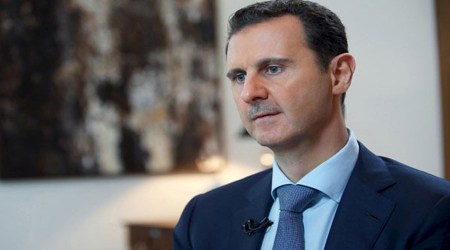
Syria’s President Bashar al-Assad © SANA / Reuters
RT | October 4, 2015
Western countries are using terrorism as an instrument of control, Syrian President Bashar Assad said in a recent interview. He also said that he is ready to step down if his departure is the solution to the four-year-long conflict.
“From the beginning it was clear to us that there were foreign hands behind terrorism in Syria,” Assad said in interview with Iran’s Habar TV.
President Assad thinks that the US-led coalition against Islamic State (IS, formerly ISIS/ISIL) is ineffective because the West does not want to defeat terrorist groups. In fact, it wants to preserve the balance between the warring sides to “perpetuate the process of erosion in Syria and Iraq and later other countries of the region, so that we all remain weak for decades and maybe generations.”
“How can the United States and its allies fight terrorism or ISIS in Syria and Iraq while their closest allies in the government of Erdogan and Davutoglu are supporting terrorists and enabling them to cross the borders and bring weapons, money and volunteers through Turkey?” he asked.
Since the US-led coalition was formed, terrorism expanded geographically and its recruits multiplied, the Syrian president said.
“God willing it [Syria, Iran and Hezbollah] will be able to defeat terrorism which is a new instrument for subjugating the region,” he stressed.
Unlike the US-led coalition, Russia together with Iran, Iraq and Syria have “great chances of success.”
“It must succeed. Otherwise, the whole region, not only one or two countries, will be destroyed,” Assad said.
Russia, as well the Soviet Union in the past, “[has] never tried to impose anything on Syria, especially in this crisis,” he said stressing that, as opposed to the US, Russia is against interference, hegemony and violations of the UN Charter.
‘If my departure is the solution, I will never hesitate to do that’
President Assad once again stated that he is ready for political dialogue with all Syrians – but not with foreign powers. “Any talk about the political system or the officials in this county is an internal Syrian affair,” he said.
“When the Syrian people decide that a certain individual should stay, he will stay; and when the Syrian people decide that he should go, he will go immediately,” the president said. “If my departure is the solution, I will never hesitate to do that,” he added.
Assad stressed that no state in the world conducts dialogue with terrorists and that they should be subject to the laws and brought to justice.
“However, the state might conduct dialogue with terrorists in one case, when the objective of the dialogue is for the individuals who carried out terrorist acts to lay down their arms and embrace the state and the law,” he added, noting that this has actually happened in Syria, with the government having held talks with various reconciliation-seeking groups, granting them amnesty and giving them an opportunity to go back to their normal lives.
Iran: most developed country in Muslim world thanks to Western sanctions
Pravda – 30.09.2015
How does the Iranian economy feel after 40 years of the economic blockade? How can Russia and Iran develop cooperation in the future? Pravda conducted an interview on the subject with Rosnano investment director, Vadim Veschezerov.
“A lot has been said recently about the Russian-Iranian cooperation in the field of high technologies. Can Russia and Iran cooperate in the high-tech industry instead of oil and fruit?”
“In my view, this is exactly where we can work together most effectively. Russia and Iran are competitors when it comes to oil. Fruit is growing in many other countries of the world, not just in Iran. Iran is an interesting country, because this is the only highly developed, high-tech country of the Islamic world. In all other countries of the Islamic world, even if they have ultramodern industry, they have achieved it with someone else’s help. Iran has achieved everything alone. In some areas, Iran is a big player. Iran has a very good chemical industry and the world’s only independent pharmaceutical industry.
“I’m not talking about the nuclear program of Iran. Unlike Pakistan and other countries, Iran had no opportunity to borrow – the country was doing everything alone.”
“Has Russia lost the moment for developing cooperation with Iran? We had a unique opportunity, when Iran was living in a blockade, but now there are plenty of Americans and Europeans there.
“We have two or three years. I am personally studying the events that are now happening in the country. Unfortunately, we have very few people in Russia, who realize the peculiarities and structure of Iran, or how to build relationships with the Iranian side.
“Technically, we must explore every area where we can cooperate. In almost 40 years of blockade, the Iranians have learned to do many things and they have reached great progress, but, of course, they can not do everything. For example, their electronics is a very weak point. They are interested in chemistry, mathematics and computer science.
Not that long ago, the secretary of the Supreme Coordination Council of Free and Special Economic Zones of Iran, Akbar Torkan, named five main branches of classical economics that in his view are interesting for foreigners. They are petrochemical, automotive, power generation, steel and cement industries.
“Any industry needs high technologies. In Iran, there is a very strong group of companies working in the field of nanotechnology – this is a priority direction for them. This area is entrusted to the Iranian Council for the development of nanotechnologies.
“We must not forget that the country has been living under the conditions of economic blockade for 40 years. They have learned not only to survive, but to develop independently. As they say: “Thank you, America. You’ve turned us from consumers to entrepreneurs.”
“In what areas does Rosnano intend to cooperate with Iran?”
“We are most attracted to pharmaceuticals. We have something that interests the Iranian side – drugs and medical devices. In Iran, there are very interesting medical devices and medications that can be potential on the international market. In India, the pharmaceutical industry is completely built on copying others, and the Iranians have their own their developments.
“They have a very unique system to encourage scientists and engineers to go into business. For example, if you offer a startup in the high-tech industry, the state can pay a share in the company for you. In three or four years, if you fulfill the agreement with the state, if you create a product, a medication or something else, the state will sell you this share for one real.
“Now that the sanctions are being removed, Russian energy companies have many opportunities in Iran. The USSR had built most of the Iranian energy industry – and they remember that.”
Interview conducted by Said Gafurov
On the Trail of Turkey’s Terrorist Grey Wolves
By Martin A. Lee | Consortium News | 1997
In broad daylight on May 2, 1997, 50 armed men set upon a television station in Istanbul with gunfire. The attackers unleashed a fusillade of bullets and shouted slogans supporting Turkey’s Deputy Prime Minister Tansu Ciller. The gunmen were outraged over the station’s broadcast of a TV report critical of Ciller, a close U.S. ally who had come under criticism for stonewalling investigations into collusion between state security forces and Turkish criminal elements.
Miraculously, no one was injured in the attack, but the headquarters of Independent Flash TV were left pock-marked with bullet-holes and smashed windows. The gunfire also sent an unmistakable message to Turkish journalists and legislators: don’t challenge Ciller and other high-level Turkish officials when they cover up state secrets.

Former Turkish Prime Minister Tansu Ciller
For several months, Turkey had been awash in dramatic disclosures connecting high Turkish officials to the right-wing Grey Wolves, the terrorist band which has preyed on the region for years. In 1981, a terrorist from the Grey Wolves attempted to assassinate Pope John Paul II in Vatican City.
But at the center of the mushrooming Turkish scandal is whether Turkey, a strategically placed NATO country, allowed mafiosi and right-wing extremists to operate death squads and to smuggle drugs with impunity. A Turkish parliamentary commission is investigating these new charges.
The rupture of state secrets in Turkey also could release clues to other major Cold War mysteries. Besides the attempted papal assassination, the Turkish disclosures could shed light on the collapse of the Vatican bank in 1982 and the operation of a clandestine pipeline that pumped sophisticated military hardware into the Middle East — apparently from NATO stockpiles in Europe — in exchange for heroin sold by the Mafia in the United States.
The official Turkish inquiry was triggered by what could have been the opening scene of a spy novel: a dramatic car crash on a remote highway near the village of Susurluk, 100 miles southwest of Istanbul. On Nov. 3, 1996, three people were crushed to death when their speeding black Mercedes hit a tractor.
The crash killed Husseyin Kocadag, a top police official who commanded Turkish counter-insurgency units. But it was Kocadag’s company that stunned the nation. The two other dead were Abdullah Catli, a convicted fugitive who was wanted for drug trafficking and murder, and Catli’s girlfriend, Gonca Us, a Turkish beauty queen turned mafia hit-woman.
A fourth occupant, who survived the crash, was Kurdish warlord Sedat Bucak, whose militia had been armed and financed by the Turkish government to fight Kurdish separatists. At first, Turkish officials claimed that the police were transporting two captured criminals.
But evidence seized at the crash site indicated that Abdullah Catli, the fugitive gangster, had been given special diplomatic credentials by Turkish authorities. Catli was carrying a government-approved weapons permit and six ID cards, each with a different name. Catli also possessed several handguns, silencers and a cache of narcotics, not the picture of a subdued criminal.
When it became obvious that Catli was a police collaborator, not a captive, the Turkish Interior Minister resigned. Several high-ranking law enforcement officers, including Istanbul’s police chief, were suspended. But the red-hot scandal soon threatened to jump that bureaucratic firebreak and endanger the careers of other senior government officials.
Grey Wolves Terror
The news of Catli’s secret police ties were all the more scandalous given his well-known role as a key leader of the Grey Wolves, a neo-fascist terrorist group that has stalked Turkey since the late 1960s.
A young tough who wore black leather pants and looked like Turkey’s answer to Elvis Presley, Catli graduated from street gang violence to become a brutal enforcer for the Grey Wolves. He rose quickly within their ranks, emerging as second-in-command in 1978. That year, Turkish police linked him to the murder of seven trade-union activists and Catli went underground.
Three years later, the Grey Wolves gained international notoriety when Mehmet Ali Agca, one of Catli’s closest collaborators, shot and nearly killed Pope John Paul II in St. Peter’s Square on May 13, 1981. Catli was the leader of a fugitive terrorist cell that included Agca and a handful of other Turkish neo-fascists.
Testifying in September 1985 as a witness at the trial of three Bulgarians and four Turks charged with complicity in the papal shooting in Rome, Catli (who was not a defendant) disclosed that he gave Agca the pistol that wounded the pontiff. Catli had previously helped Agca escape from a Turkish jail, where Agca was serving time for killing a national newspaper editor.
In addition to harboring Agca, Catli supplied him with fake IDs and directed Agca’s movements in West Germany, Switzerland, and Austria for several months prior to the papal attack. Catli enjoyed close links to Turkish drug mafiosi, too. His Grey Wolves henchmen worked as couriers for the Turkish mob boss Abuzer Ugurlu.
At Ugurlu’s behest, Catli’s thugs criss-crossed the infamous smugglers’ route passing through Bulgaria. Those routes were the ones favored by smugglers who reportedly carried NATO military equipment to the Middle East and returned with loads of heroin. Judge Carlo Palermo, an Italian magistrate based in Trento, discovered these smuggling operations while investigating arms-and-drug trafficking from Eastern Europe to Sicily.
Palermo disclosed that large quantities of sophisticated NATO weaponry — including machine guns, Leopard tanks and U.S.-built Cobra assault helicopters — were smuggled from Western Europe to countries in the Middle East during the 1970s and early 1980s. According to Palermo’s investigation, the weapon delivers were often made in exchange for consignments of heroin that filtered back, courtesy of the Grey Wolves and other smugglers, through Bulgaria to northern Italy.
There, the drugs were received by Mafia middlemen and transported to North America. Turkish morphine base supplied much of the Sicilian-run “Pizza connection,” which flooded the U.S. and Europe with high-grade heroin for several years.
[While it is still not clear how the NATO supplies entered the pipeline, other investigations have provided some clues. Witnesses in the October Surprise inquiry into an alleged Republican-Iranian hostage deal in 1980 claimed that they were allowed to select weapons from NATO stockpiles in Europe for shipment to Iran. [Iranian arms dealer Houshang Lavi claimed that he selected spare parts for Hawk anti-aircraft batteries from NATO bases along the Belgian-German border. Another witness, American arms broker William Herrmann, corroborated Lavi’s account of NATO supplies going to Iran. [Even former NATO commander Alexander Haig confirmed that NATO supplies could have gone to Iran in the early 1980s while he was secretary of state. “It wouldn’t be preposterous if a nation, Germany, for example, decided to let some of their NATO stockpiles be diverted to Iran,” Haig said in an interview. For more details, see Robert Parry’s Trick or Treason. ]A Vatican Mystery
Italian magistrates described the network they had uncovered as the “world’s biggest illegal arms trafficking organization.” They linked it to Middle Eastern drug empires and to prestigious banking circles in Italy and Europe.
At the center of this operation, it appeared, was an obscure import-export firm in Milan called Stibam International Transport. The head of Stibam, a Syrian businessman named Henri Arsan, also functioned as an informant for the U.S. Drug Enforcement Administration, according to several Italian news outlets.
With satellite offices in New York, London, Zurich, and Sofia, Bulgaria, Stibam officials recycled their profits through Banco Ambrosiano, Italy’s largest private bank which had close ties to the Vatican until its sensational collapse in 1982. The collapse of Banco Ambrosiano came on the heels of the still unsolved death of its furtive president, Roberto Calvi, whose body was found hanging underneath Blackfriar’s Bridge in London in June 1982.
While running Ambrosiano, Calvi, nicknamed “God’s banker,” served as advisor to the Vatican’s extensive fiscal portfolio. At the same time in the mid- and late 1970s, Calvi’s bank handled most of Stibam’s foreign currency transactions and owned the building that housed Stibam’s Milanese headquarters.
In effect, the Vatican Bank — by virtue of its interlocking relationship with Banco Ambrosiano — was fronting for a gigantic contraband operation that specialized in guns and heroin. The bristling contraband operation that traversed Bulgaria was a magnet for secret service agents on both sides of the Cold War divide.
Crucial, in this regard, was the role of Kintex, a Sofia-based, state-controlled import-export firm that worked in tandem with Stibam and figured prominently in the arms trade. Kintex was riddled with Bulgarian and Soviet spies — a fact which encouraged speculation that the KGB and its Bulgarian proxies were behind the plot against the pope.
But Western intelligence also had its hooks into the Bulgarian smuggling scene, as evidenced by the CIA’s use of Kintex to channel weapons to the Nicaraguan Contra rebels in the early 1980s. The Reagan administration jumped on the papal assassination attempt as a propaganda opportunity, rather than helping to unravel the larger mystery.
Although the CIA’s link to the arms-for-drugs traffic in Bulgaria was widely known in espionage circles, hard-line U.S. and Western European officials promoted instead a bogus conspiracy theory that blamed the papal shooting on a communist plot.
The so-called “Bulgarian connection” became one of the more effective disinformation schemes hatched during the Reagan era. It reinforced the notion of the Soviet Union as an evil empire. But the apparent hoax also diverted attention from extensive — and potentially embarrassing — ties between U.S. intelligence and the Turkey’s narco-trafficking ultra-right.
Fabrication of the conspiracy theory might have even involved suborning perjury. During his September 1985 court testimony in Rome, Catli asserted that he had been approached by the West German BND spy organization, which allegedly promised him a large sum of money if he implicated the Bulgarian secret service and the KGB in the attempt on the pope’s life.
Five years later, ex-CIA analyst Melvin A. Goodman disclosed that his colleagues, under pressure from CIA higher-ups, skewed their reports to try to lend credence to the contention that the Soviets were involved. “The CIA had no evidence linking the KGB to the plot,” Goodman told the Senate Intelligence Committee.
Friends of the Wolves
Duane “Dewey” Clarridge, the CIA station chief in Rome at the time of the papal shooting, had previously been posted in Ankara. Clarridge was the CIA’s man-on-the-spot in Turkey in the 1970s when armed bands of Grey Wolves unleashed a wave of bomb attacks and shootings that killed thousands of people, including public officials, journalists, students, lawyers, labor organizers, social democrats, left-wing activists and ethnic Kurds. [In his 1997 memoirs, A Spy for All Seasons, Clarridge makes no reference to the Turkish unrest or to the pope shooting.]
During those violent 1970s, the Grey Wolves operated with the encouragement and protection of the Counter-Guerrilla Organization, a section of the Turkish Army’s Special Warfare Department. Headquartered in the U.S. Military Aid Mission building in Ankara, the Special Warfare Department received funds and training from U.S. advisors to create “stay behind” squads comprised of civilian irregulars.
They were supposed to go underground and engage in acts of sabotage if the Soviets invaded. Similar Cold War paramilitary units were established in every NATO member state, covering all non-Communist Europe like a spider web that would entangle Soviet invaders. But instead of preparing for foreign enemies, U.S.-sponsored stay-behind operatives in Turkey and several European countries used their skills to attack domestic opponents and foment violent disorders.
Some of those attacks were intended to spark right-wing military coups. In the late 1970s, former military prosecutor and Turkish Supreme Court Justice Emin Deger documented collaboration between the Grey Wolves and the government’s counter-guerrilla forces as well as the close ties of the latter to the CIA.
Turkey’s Counter-Guerrilla Organization handed out weapons to the Grey Wolves and other right-wing terrorist groups. These shadowy operations mainly engaged in the surveillance, persecution and torture of Turkish leftists, according to retired army commander Talat Turhan, the author of three books on counter-guerrilla activities in Turkey.
But the extremists launched one wave of political violence which provoked a 1980 coup by state security forces that deposed Prime Minister Bulent Ecevit. The Turkish security forces cited the need to restore order which had been shattered by rightist terrorist groups secretly sponsored by those same state security forces.
Cold War Roots
Since the earliest days of the Cold War, Turkey’s strategic importance derived from its geographic position as the West’s easternmost bulwark against Soviet communism. In an effort to weaken the Soviet state, the CIA also used pan-Turkish militants to incite anti-Soviet passions among Muslim Turkish minorities inside the Soviet Union, a strategy that strengthened ties between U.S. intelligence and Turkey’s ultra-nationalists.
Though many of Turkish ultra-nationalists were anti-Western as well as anti-Soviet, the Cold War realpolitik compelled them to support a discrete alliance with NATO and U.S. intelligence. Among the Turkish extremists collaborating in this anti-Soviet strategy were the National Action Party and its paramilitary youth group, the Grey Wolves.
Led by Colonel Alpaslan Turkes, the National Action Party espoused a fanatical pan-Turkish ideology that called for reclaiming large sections of the Soviet Union under the flag of a reborn Turkish empire. Turkes and his revanchist cohorts had been enthusiastic supporters of Hitler during World War II.
“The Turkish race above all others” was their Nazi-like credo. In a similar vein, Grey Wolf literature warned of a vast Jewish-Masonic-Communist conspiracy and its newspapers carried ads for Turkish translations of Nazi texts.
The pan-Turkish dream and its anti-Soviet component also fueled ties between the Grey Wolves and the Anti-Bolshevik Bloc of Nations (ABN), a CIA-backed coalition led by erstwhile fascist collaborators from East Europe.
Ruzi Nazar, a leading figure in the Munich-based ABN, had a long-standing relationship with the CIA and the Turkish ultra-nationalists. In the 1950s and 1960s, Nazar was employed by Radio Free Europe, a CIA-founded propaganda effort.
When the Soviet Union collapsed in 1991, the shifting geopolitical terrain created new opportunities — political and financial — for Colonel Turkes and his pan-Turkish crusaders. After serving a truncated prison term in the 1980s for his role in masterminding the political violence that convulsed Turkey, Turkes and several of his pan-Turkish colleagues were permitted to resume their political activities.
In 1992, the colonel visited his long lost Turkish brothers in newly independent Azerbaijan and received a hero’s welcome. In Baku, Turkes endorsed the candidacy of Grey Wolf sympathizer Abulfex Elcibey, who was subsequently elected president of Azerbaijan and appointed a close Grey Wolf ally as his Interior Minister.
The Gang Returns
By this time, Abdullah Catli was also back in circulation after several years of incarceration in France and Switzerland for heroin trafficking. In 1990, he escaped from a Swiss jail cell and rejoined the neo-fascist underground in Turkey.
Despite his documented links to the papal shooting and other terrorist attacks, Catli was pressed into service as a death squad organizer for the Turkish government’s dirty war against the Kurds who have long struggled for independence inside both Turkey and Iraq.
Turkish Army spokesmen acknowledged that the Counter-Guerrilla Organization (renamed the Special Forces Command in 1992) was involved in the escalating anti-Kurdish campaign. Turkey got a wink and a nod from Washington as a quid pro quo for cooperating with the United States during the Gulf War.
Turkish jets bombed Kurdish bases inside Iraqi territory. Meanwhile, on the ground, anti-Kurdish death squads were assassinating more than 1,000 non-combatants in southeastern Turkey. Hundreds of other Kurds “disappeared” while in police custody. Human Rights Watch, Amnesty International and the European Parliament all condemned the Turkish security forces for these abuses.
Still, there was no hard evidence that Turkey’s security forces had recruited criminal elements as foot soldiers. That evidence surfaced only on Nov. 3, 1996, when Catli died in the fateful auto accident near Susurluk.
Strewn amidst the roadside wreckage was proof of what many journalists and human rights activists had long suspected — that successive Turkish governments had protected narco-traffickers, sheltered terrorists and sponsored gangs of killers to suppress Turkish dissidents and Kurdish rebels.
Colonel Turkes confirmed that Catli had performed clandestine duties for Turkey’s police and military. “On the basis of my state experience, I admit that Catli has been used by the state,” said Turkes. Catli had been cooperating “in the framework of a secret service working for the good of the state,” Turkes insisted.
U.S.-backed Turkish officials, including Tansu Ciller, Prime Minister from 1993-1996, also defended Catli after the car crash. “I don’t know whether he is guilty or not,” Ciller stated, “but we will always respectfully remember those who fire bullets or suffer wounds in the name of this country, this nation and this state.”
Eighty members of the Turkish parliament urged the federal prosecutor to file charges of criminal misconduct against Ciller, who was serving as Turkey’s Foreign Minister, as well as Deputy Prime Minister. They asserted that the Susurluk incident provided Turkey “with a historic opportunity to expose unsolved murders and the drugs and arms smuggling that have been going on in our country for years.”
The scandal momentarily reinvigorated the Turkish press, which unearthed revelations about criminals and police officials involved in the heroin trade. But journalists also were victims of death squads in those years. The violent attack on Independent Flash TV was a reminder. Prosecutors have faced pressure, too, from superiors who are not eager to delve into state secrets. [Ultimately, the corruption case against Ciller was covered up.]
Across the Atlantic in Washington, the U.S. government did not acknowledge any responsibility for the Turkish Frankenstein that U.S. Cold War strategy helped to create. When asked about the Susurluk affair, a State Department spokesperson said it was “an internal Turkish matter.” He declined further comment.
Featured Video

AIDS Inc. by Gary Null (2007)
or go to
Aletho News Archives – Video-Images
From the Archives
Clash of Civilization, Iran Part II
By Jamal Kanj – Intifada-Palestine.com – January 14, 2011
Israel’s survival kit is: perpetuate conflict, insecurity to rationalize collective hate and finally playing victim.
Devoid of conflict, Israel implodes internally; without hate, Zionism loses its justification; and playing eternal victim to continue blackmailing the West. Absence of this holy trinity, Israel ceases to exist.
From its inception, the house of Zion has mastered exploiting adversarial powers to advance Israel’s cause. For instance, their influence over the Democratic Party in the US began with President Truman’s bid for 2nd term election in 1948.
Responding to strong opposition from Secretary of State General George Marshall and Department experts urging against recognition of Israel, President Truman replied: “I’m sorry gentlemen but I have to answer to hundreds of thousands [Jewish voters] who are anxious for the success of Zionism. I do not have hundreds of thousands of [voting] Arabs among my constituents”
Zionists influence over liberal American politics was matched with the doctrinal school of Conservative theoreticians aligning the Republican Party’s platform with Israel’s objectives. The Neoconservative Zionists, coined Zioncons, invented the “Clash of Civilization” concept to fight Israel’s wars. … continue
Blog Roll
 Aletho News
- Merck Virologists Admitted to Falsely Certifying Vaccine Efficacy
- Mandatory Folic Acid for every man, woman & child
- Pro-Palestine protesters arrested outside UK’s ruling Labour Conference in Liverpool
- Mauritius denies landing permit to flight from Israel, forcing cancellation: Tour operator
- Israeli finance minister calls for genocidal war on West Bank, annexation of south Lebanon
- 12 Things Your Psychiatrist Was Trained Not to Tell You
- From Unipolar Universalism to Multipolar Civilizational Distinctiveness
- RSF military group defects, joins Sudanese army: State media
- Ireland goalkeeper refuses to play ‘Israel’ as squad weighs boycott
- China pushes back against US on Cuba, Iran
- If Americans Knew
- Israel forces Gazans to live in constant peril – Daily Update
- Deconstructing Netanyahu’s pants-on-fire UN rant – Daily Update
- Trump betrayed voters with his campaign lies and prioritized a foreign country once he took office
- Netanyahu calls Israel’s war in Gaza ‘opposite of genocide’ in UN speech to near-empty hall
- Settler Kidnappings: Torture, Sexual Abuse and Terrorisation of Palestinian Abductees as Israel Deepens Annexation of West Bank
- Gaza winter nears as 162,000 tents become unusable, raising fears of humanitarian crisis
- Netanyahu says, “It’s the opposite of genocide”; UN says Gaza economy is world’s ‘most severe crisis on record’ – Daily Update
- Israel’s US-Backed Assault on Gaza Has Created the ‘World’s Most Severe Economic Crisis on Record’: UN
- ‘Protecting U.S. Citizens’… From Israel
- ‘This is where I live now, the back of a truck’: a day in the life of a grandmother in Gaza
- No Tricks Zone
- New Study: Earth And Venus Surface Warmth Largely Explained By Convection And Lapse Rate, Not CO2 Or Radiation
- 2025 Nature Paper Claiming Worsening Global Drought Gets RETRACTED …Heavily Flawed
- New Study: ‘Global Drought Shows No Detectable Recent Acceleration Under Climate Warming’
- Economic Masterminds: German Socialists Suggest Taxing Productivity Gains Stemming From Using AI
- The South China Sea Has Not Been Cooperating With The Climate Change Narrative
- Energy Crisis: Germany Enters Heating Season With Historically Low Gas Reserve Fill Levels
- New Study: The Antarctic Ice Sheet Gained Mass From 2020-2024 Due To Staggering Snow And Ice Accumulation
- Study: Ocean Heating Rates From Thousands Of Years Ago ‘Dwarf’ Modern Ocean Heating Rates
- Climate Extremists Target, Attack Large-Scale Power Grid Infrastructure In Germany!
- New Study: Antarctic Ice Melt Has Contributed Less Than 1 Centimeter To Sea Level Rise In The Last 30 Years

