Iran says willing to give IAEA wider powers in nuclear program inspections
Al-Akhbar | October 16, 2013
Iran suggested it was ready to address calls to give the UN atomic watchdog wider inspection powers as part of Tehran’s proposals to resolve a decade-old nuclear dispute with the West.
Meanwhile, Israel kept up its alarmist rhetoric on talks between world powers and Iran Wednesday, with a cabinet minister comparing the situation to pre-war Europe and the appeasement of Nazi Germany.
The comments from Iranian Deputy Foreign Minister Abbas Araqchi appeared to be the first specific indication of what concessions Tehran might be prepared to make in return for the removal of sanctions hurting its oil-dependent economy.
Iran presented a three-phase plan for ending the standoff over its nuclear program during the first day of an October 15-16 meeting with six world powers in Geneva on Tuesday. The talks were due to resume later on Wednesday.
The seven countries will likely meet again in Geneva in several weeks time to try to hammer out details of an emerging agreement aimed at ending the standoff over Tehran’s nuclear ambitions, Western diplomats said on Wednesday.
Iran did not give details of its proposal on Tuesday, but said it included monitoring by the International Atomic Energy Agency (IAEA), the Vienna-based UN nuclear body which regularly inspects declared Iranian facilities.
Iran’s official IRNA news agency asked Araqchi about the issues of uranium enrichment and the so-called Additional Protocol to Iran’s agreement with the IAEA.
“Neither of these issues are within the first step (of the Iranian proposal) but form part of our last steps,” he replied without going into further details, in comments reported on Wednesday.
The Additional Protocol allows unannounced inspections outside of declared nuclear sites and it is seen as a vital tool at the IAEA’s disposal to make sure that a country does not have any hidden nuclear work.
The world powers have long demanded that Iran implement the protocol. Iran says it is voluntary.
The powers – the United States, France, Germany, Britain, China and Russia – also want Iran to scale back its uranium enrichment program and suspend higher-level activity.
Refined uranium can be used to fuel nuclear power plants, Iran’s stated aim, but can also provide the fissile core of a nuclear bomb if processed further, which the West claims may be Tehran’s ultimate goal.
Western diplomats stress they want Tehran to back up its newly conciliatory language with concrete actions.
Both sides are trying to dampen expectations of any rapid breakthrough at the two-day meeting, the first to be held since President Hassan Rohani took office, promising conciliation over confrontation in Iran’s relations with the world.
“We view the nuclear talks in Geneva with hope and with concern. We see the worrying signs and we don’t want Geneva 2013 to turn into Munich 1938,” Israeli International Relations Minister Yuval Steinitz said in remarks broadcast by Israel’s army radio.
Steinitz was alluding to the 1938 Munich agreement under which Britain and France agreed to the annexation of large swathes of then Czechoslovakia by Nazi Germany in a failed bid to avert war.
Prime Minister Benjamin Netanyahu on Tuesday urged world powers to avoid a partial deal with Tehran which could see a relaxing of sanctions, saying Israel reserved the right to carry out a unilateral military strike against Iran.
“Pre-emptive strikes must not be ruled out,” he told the Israeli Knesset.
“Such strikes are not necessarily called for in every case… but there are situations in which thinking about the international response to such a step is not equal to the bloody price we would pay” for the existence of a nuclear-armed Iran.
Israel is the Middle East’s sole if undeclared nuclear-armed power.
(Reuters, AFP, Al-Akhbar)
The Pentagon Is Using Your Tax Dollars to Turn Italy into a Launching Pad for the Wars of Today and Tomorrow
By David Vine | TomDispatch | October 3, 2013
The Pentagon has spent the last two decades plowing hundreds of millions of tax dollars into military bases in Italy, turning the country into an increasingly important center for U.S. military power. Especially since the start of the Global War on Terror in 2001, the military has been shifting its European center of gravity south from Germany, where the overwhelming majority of U.S. forces in the region have been stationed since the end of World War II. In the process, the Pentagon has turned the Italian peninsula into a launching pad for future wars in Africa, the Middle East, and beyond.
At bases in Naples, Aviano, Sicily, Pisa, and Vicenza, among others, the military has spent more than $2 billion on construction alone since the end of the Cold War—and that figure doesn’t include billions more on classified construction projects and everyday operating and personnel costs. While the number of troops in Germany has fallen from 250,000 when the Soviet Union collapsed to about 50,000 today, the roughly 13,000 U.S. troops (plus 16,000 family members) stationed in Italy match the numbers at the height of the Cold War. That, in turn, means that the percentage of U.S. forces in Europe based in Italy has tripled since 1991 from around 5 percent to more than 15 percent.
Last month, I had a chance to visit the newest U.S. base in Italy, a three-month-old garrison in Vicenza, near Venice. Home to a rapid reaction intervention force, the 173rd Infantry Brigade Combat Team (Airborne), and the Army’s component of the U.S. Africa Command (AFRICOM), the base extends for a mile, north to south, dwarfing everything else in the small city. In fact, at over 145 acres, the base is almost exactly the size of Washington’s National Mall or the equivalent of around 110 American football fields. The price tag for the base and related construction in a city that already hosted at least six installations: upwards of $600 million since fiscal year 2007.
There are still more bases, and so more U.S. military spending, in Germany than in any other foreign country (save, until recently, Afghanistan). Nonetheless, Italy has grown increasingly important as the Pentagon works to change the make-up of its global collection of 800 or more bases abroad, generally shifting its basing focus south and east from Europe’s center. Base expert Alexander Cooley explains: “U.S. defense officials acknowledge that Italy’s strategic positioning on the Mediterranean and near North Africa, the Italian military’s anti-terrorism doctrine, as well as the country’s favorable political disposition toward U.S. forces are important factors in the Pentagon’s decision to retain” a large base and troop presence there. About the only people who have been paying attention to this build-up are the Italians in local opposition movements like those in Vicenza who are concerned that their city will become a platform for future U.S. wars.
Base Building
Most tourists think of Italy as the land of Renaissance art, Roman antiquities, and of course great pizza, pasta, and wine. Few think of it as a land of U.S. bases. But Italy’s 59 Pentagon-identified “base sites” top that of any country except Germany (179), Japan (103), Afghanistan (100 and declining), and South Korea (89).
Publicly, U.S. officials say there are no U.S. military bases in Italy. They insist that our garrisons, with all their infrastructure, equipment, and weaponry, are simply guests on what officially remain “Italian” bases designated for NATO use. Of course, everyone knows that this is largely a legal nicety.
No one visiting the new base in Vicenza could doubt that it’s a U.S. installation all the way. The garrison occupies a former Italian air force base called Dal Molin. (In late 2011, Italian officials re-branded it “Caserma Del Din,” evidently to try to shed memories of the massive opposition the base has generated.) From the outside, it might be mistaken for a giant hospital complex or a university campus. Thirty one box-like peach-and-cream-colored buildings with light red rooftops dominate the horizon with only the foothills of the Southern Alps as a backdrop. A chain link fence topped by razor wire surrounds the perimeter, with green mesh screens obscuring views into the base.
If you manage to get inside, however, you find two barracks for up to 600 soldiers each. (Off base, the Army is contracting to lease up to 240 newly built homes in surrounding communities.) Two six-floor parking garages that can hold 850 vehicles, and a series of large office complexes, some small training areas, including an indoor shooting range still under construction, as well as a gym with a heated swimming pool, a “Warrior Zone” entertainment center, a small PX, an Italian-style café, and a large dining facility. These amenities are actually rather modest for a large U.S. base. Most of the newly built or upgraded housing, schools, medical facilities, shopping, and other amenities for soldiers and their families are across town on Viale della Pace (Peace Boulevard) at the Caserma Ederle base and at the nearby Villaggio della Pace (Peace Village).
A Pentagon Spending Spree
Beyond Vicenza, the military has been spending mightily to upgrade its Italian bases. Until the early 1990s, the U.S. air base at Aviano, northeast of Vicenza, was a small site known as “Sleepy Hollow.” Beginning with the transfer of F-16s from Spain in 1992, the Air Force turned it into a major staging area for every significant wartime operation since the first Gulf War. In the process, it has spent at least $610 million on more than 300 construction projects (Washington convinced NATO to provide more than half these funds, and Italy ceded 210 acres of land for free.) Beyond these “Aviano 2000” projects, the Air Force has spent an additional $115 million on construction since fiscal year 2004.
Not to be outdone, the Navy laid out more than $300 million beginning in 1996 to construct a major new operations base at the Naples airport. Nearby, it has a 30-year lease on an estimated $400 million “support site” that looks like a big-box shopping mall surrounded by expansive, well-manicured lawns. (The base is located in the Neapolitan mafia’s heartland and was built by a company that has been linked to the Camorra.) In 2005, the Navy moved its European headquarters from London to Naples as it shifted its attention from the North Atlantic to Africa, the Middle East, and the Black Sea. With the creation of AFRICOM, whose main headquarters remain in Germany, Naples is now home to a combined U.S. Naval Forces Europe-U.S. Naval Forces Africa. Tellingly, its website prominently displays the time in Naples, Djibouti, Liberia, and Bulgaria.
Meanwhile, Sicily has become increasingly significant in the Global War on Terror era, as the Pentagon has been turning it into a major node of U.S. military operations for Africa, which is less than 100 miles away across the Mediterranean. Since fiscal year 2001, the Pentagon has spent more on construction at the Sigonella Naval Air Station—almost $300 million—than at any Italian base other than Vicenza. Now the second busiest naval air station in Europe, Sigonella was first used to launch Global Hawk surveillance drones in 2002. In 2008, U.S. and Italian officials signed a secret agreement formally permitting the basing of drones there. Since then, the Pentagon has put out at least $31 million to build a Global Hawk maintenance and operations complex. The drones provide the foundation for NATO’s $1.7 billion Alliance Ground Surveillance system, which gives NATO surveillance capabilities as far as10,000 miles from Sigonella.
Beginning in 2003, “Joint Task Force Aztec Silence” has used P-3 surveillance planes based at Sigonella to monitor insurgent groups in North and West Africa. And since 2011, AFRICOM has deployed a task force of around 180 marines and two aircraft to the base to provide counterterrorism training to African military personnel in Botswana, Liberia, Djibouti, Burundi, Uganda, Tanzania, Kenya, Tunisia, and Senegal.
Sigonella also hosts one of three Global Broadcast Service satellite communications facilities and will soon be home to a NATO Joint Intelligence, Surveillance & Reconnaissance deployment base and a data analysis and training center. In June, a U.S. Senate subcommittee recommended moving special operations forces and CV-22 Ospreys from Britain to Sicily, since “Sigonella has become a key launch pad for missions related to Libya, and given the ongoing turmoil in that nation as well as the emergence of terrorist training activities in northern Africa.” In nearby Niscemi, the Navy hopes to build an ultra high frequency satellite communications installation, despite growing opposition from Sicilians and other Italians concerned about the effects of the station and its electromagnetic radiation on humans and a surrounding nature reserve.
Amid the build-up, the Pentagon has actually closed some bases in Italy as well, including those in Comiso, Brindisi, and La Maddalena. While the Army has cut some personnel at Camp Darby, a massive underground weapons and equipment storage installation along Tuscany’s coast, the base remains a critical logistics and pre-positioning center enabling the global deployment of troops, weapons, and supplies from Italy by sea. Since fiscal year 2005, it’s seen almost $60 million in new construction.
And what are all these bases doing in Italy? Here’s the way one U.S. military official in Italy (who asked not to be named) explained the matter to me: “I’m sorry, Italy, but this is not the Cold War. They’re not here to defend Vicenza from a [Soviet] attack. They’re here because we agreed they need to be here to do other things, whether that’s the Middle East or the Balkans or Africa.”
Location, Location, Location
Bases in Italy have played an increasingly important role in the Pentagon’s global garrisoning strategy in no small part because of the country’s place on the map. During the Cold War, West Germany was the heart of U.S. and NATO defenses in Europe because of its positioning along the most likely routes of any Soviet attack into Western Europe. Once the Cold War ended, Germany’s geographic significance declined markedly. In fact, U.S. bases and troops at Europe’s heart looked increasingly hemmed in by their geography, with U.S. ground forces there facing longer deployment times outside the continent and the Air Force needing to gain overflight rights from neighboring countries to get almost anywhere.
Troops based in Italy, by contrast, have direct access to the international waters and airspace of the Mediterranean. This allows them to deploy rapidly by sea or air. As Assistant Secretary of the Army Keith Eastin told Congress in 2006, positioning the 173rd Airborne Brigade at Dal Molin “strategically positions the unit south of the Alps with ready access to international airspace for rapid deployment and forced entry/early entry operations.”
And we’ve seen the Pentagon take advantage of Italy’s location since the 1990s, when Aviano Air Base played an important role in the first Gulf War and in U.S. and NATO interventions in the Balkans (a short hop across the Adriatic Sea from Italy). The Bush administration, in turn, made bases in Italy some of its “enduring” European outposts in its global garrisoning shift south and east from Germany. In the Obama years, a growing military involvement in Africa has made Italy an even more attractive basing option.
“Sufficient Operational Flexibility”
Beyond its location, U.S. officials love Italy because, as the same military official told me, it’s a “country that offers sufficient operational flexibility.” In other words, it provides the freedom to do what you want with minimal restrictions and hassle.
Especially in comparison to Germany, Italy offers this flexibility for reasons that reflect a broader move away from basing in two of the world’s wealthiest and most powerful nations, Germany and Japan, toward basing in relatively poorer and less powerful ones. In addition to offering lower operating costs, such hosts are generally more susceptible to Washington’s political and economic pressure. They also tend to sign “status of forces agreements”—which govern the presence of U.S. troops and bases abroad—that are less restrictive for the U.S. military. Such agreements often offer more permissive settings when it comes to environmental and labor regulations or give the Pentagon more freedom to pursue unilateral military action with minimal host country consultation.
While hardly one of the world’s weaker nations, Italy is the second most heavily indebted country in Europe, and its economic and political power pales in comparison to Germany’s. Not surprisingly, then, as that Pentagon official in Italy pointed out to me, the status of forces agreement with Germany is long and detailed, while the foundational agreement with Italy remains the short (and still classified) 1954 Bilateral Infrastructure Agreement. Germans also tend to be rather exacting when it comes to following rules, while the Italians, he said, “are more interpretive of guidance.”
War + Bases = $
The freedom with which the U.S. military used its Italian bases in the Iraq War is a case in point. As a start, the Italian government allowed U.S. forces to employ them even though their use for a war pursued outside the context of NATO may violate the terms of the 1954 basing agreement. A classified May 2003 cable sent by U.S. Ambassador to Italy Melvin Sembler and released by WikiLeaks shows that Prime Minister Silvio Berlusconi’s government gave the Pentagon “virtually everything” it wanted. “We got what we asked for,” wrote Sembler, “on base access, transit, and overflights, ensuring that forces… could flow smoothly through Italy to get to the fight.”
For its part, Italy appears to have benefited directly from this cooperation. (Some say that shifting bases from Germany to Italy was also meant as a way to punish Germany for its lack of support for the Iraq War.) According to a 2010 report from Jane’s Sentinel Security Assessment, “Italy’s role in the war in Iraq, providing 3,000 troops to the U.S.-led effort, opened up Iraqi reconstruction contracts to Italian firms, as well as cementing relations between the two allies.” Its role in the Afghan War surely offered similar benefits. Such opportunities came amid deepening economic troubles, and at a moment when the Italian government was turning to arms production as a major way to revive its economy. According to Jane’s, Italian weapons manufacturers like Finmeccanica have aggressively tried to enter the U.S. and other markets. In 2009, Italian arms exports were up more than 60 percent.
In October 2008, the two countries renewed a Reciprocal Defense Procurement Memorandum of Understanding (a “most favored nation” agreement for military sales). It has been suggested that the Italian government may have turned Dal Molin over to the U.S. military—for free—in part to ensure itself a prominent role in the production of “the most expensive weapon ever built,” the F-35 fighter jet, among other military deals. Another glowing 2009 cable, this time from the Rome embassy’s Chargé d’Affaires Elizabeth Dibble, called the countries’ military cooperation “an enduring partnership.” It noted pointedly how Finmeccanica (which is 30 percent state-owned) “sold USD 2.3 billion in defense equipment to the U.S. in 2008 [and] has a strong stake in the solidity of the U.S.-Italy relationship.”
Of course, there’s another relevant factor in the Pentagon’s Italian build-up. For the same reasons American tourists flock to the country, U.S. troops have long enjoyed la dolce vita there. In addition to the comfortable living on suburban-style bases, around 40,000 military visitors a year from across Europe and beyond come to Camp Darby’s military resort and “American beach” on the Italian Riviera, making the country even more attractive.
The Costs of the Pentagon’s Pivots
Italy is not about to take Germany’s place as the foundation of U.S. military power in Europe. Germany has long been deeply integrated into the U.S. military system, and military planners have designed it to stay that way. In fact, remember how the Pentagon convinced Congress to hand over $600 million for a new base and related construction in Vicenza? The Pentagon’s justification for the new base was the Army’s need to bring troops from Germany to Vicenza to consolidate the 173rd brigade in one place.
And then, last March, one week after getting access to the first completed building at Dal Molin and with construction nearly finished, the Army announced that it wouldn’t be consolidating the brigade after all. One-third of the brigade would remain in Germany. At a time when budget cuts, unemployment, and economic stagnation for all but the wealthiest have left vast unmet needs in communities around the United States, for our $600 million investment, a mere 1,000 troops will move to Vicenza.
Even with those troops staying in Germany, Italy is fast becoming one of several new pivot points for U.S. warmaking powers globally. While much attention has been focused on President Obama’s “Asia pivot,” the Pentagon is concentrating its forces at bases that represent a series of pivots in places like Djibouti on the horn of Africa and Diego Garcia in the Indian Ocean, Bahrain and Qatar in the Persian Gulf, Bulgaria and Romania in Eastern Europe, Australia, Guam, and Hawai’i in the Pacific, and Honduras in Central America.
Our bases in Italy are making it easier to pursue new wars and military interventions in conflicts about which we know little, from Africa to the Middle East. Unless we question why we still have bases in Italy and dozens more countries like it worldwide—as, encouragingly, growing numbers of politicians, journalists, and others are doing—those bases will help lead us, in the name of American “security,” down a path of perpetual violence, perpetual war, and perpetual insecurity.
Copyright 2013 David Vine
Fast Times in Palestine – Book Review
Reviewed by Jamal Kanj | Palestine Chronicle | October 5, 2013

(Fast Times in Palestine. Pamela Olson. Seal Press, March 2013)
Whenever I read a biographical book, I make it a point to start with the acknowledgement page to learn a little about the writer. In reading “Fast Times in Palestine: A love affair with a homeless homeland,” I had to start from the end of the book.
In those two pages the author thanked more than fifty individuals, but what got my attention was recognizing her ninth grade teacher for forcing her to write “a journal every day.” A gift the author displayed meticulously in chronicling the places and people she met in every page of a moving memoir of her journey in Palestine.
As I read the book I tried to fathom what drove a young American woman from a small town in Oklahoma with degree in physics to end up spending two years traversing military checkpoints and helping farmers harvest olives in the Middle East.
It could have been her adventurous nature and love for travel that brought her to that part of the world, but it was sheer destiny that tossed her into the abyss of fire to tell the world of her “love affair with a homeless homeland.”
After graduating from Stanford University in 2002, the newly graduated student was working at a neighborhood bar to save enough money for a backpacker vacation in the Greek isles when her French friend suggested Egypt as an alternative, less expensive destination. She traveled to Cairo and the Sinai, where she met an Israeli tourist named Dan who invited her to visit him in Israel.
Her journey took her across the Red Sea to Jordan, where she met—by chance—two peace volunteers, one British and one Canadian, who were on holiday from their work in Palestine. In the few days she spent with them in a downtown Amman hotel, she learned for the first time of the $3 billion the US government pays Israel annually on behalf of American taxpayers.
Stories about occupation, the Palestinian people and human rights activism intrigued her, and she became interested in finding out for herself the truth about life in the West Bank. She jumped on the opportunity when they invited her to come along with them, and they took her to an unlikely tourist destination, a small Palestinian village called Jayyous.
The author tackles the paradox of occupation in very straightforward layman’s terms, describing how a forty-mile journey from Jerusalem to the Palestinian city of Nablus would take a full day crossing a separation wall, changing cabs six times and navigating permanent and flying Israeli military checkpoints. Meanwhile a much longer trip with her Israeli friend on “Jewish only settlement roads” could be completed uninterrupted in a much shorter time.
She also describes how the separation wall isolates villagers from their olive groves and farms—for many their only livelihood—while hilltop Jewish-only settlements encroach on centuries-old trees and isolate Palestinian towns and villages into islands surrounded by Zionist colonies and the army that protects them.
Ever more fascinated by the wickedness of occupation and the joys of life among Palestinians, Pamela Olson took a low-paying job in Ramallah as an editor and head writer for the Palestine Monitor to study and document the daily human rights abuses under Israeli occupation.
Living and working in the Palestinian political capital, Pamela entered Palestinian politics from its widest doors by becoming the foreign press coordinator for a major candidate in the 2005 presidential election.
In her two years between Jayyous and Ramallah, the author takes the reader on an extraordinary expedition very few of us will ever get the opportunity to experience in a lifetime. She takes us along with her via immaculate descriptions of the spring greenery on hills and meadows—not yet raped by the concrete desertification of the Jewish only settlements—or smoking Nargila (hookah) on porches with friends in Jayyous or sipping coffee at westernized cafés in Ramallah.
What makes this book special is the writer’s ability to keep the reader spellbound with her vivid descriptions of events, people and places. The reader is able to feel the author’s inner glee meeting beloved friends, pain while witnessing and experiencing the horrors of occupation and the melancholy of bidding farewell to people who became part of her family in Palestine.
– Jamal Kanj (www.jamalkanj.com) writes weekly newspaper column and publishes on several websites on Arab world issues. He is the author of “Children of Catastrophe,” Journey from a Palestinian Refugee Camp to America.
Western governments considering easing nuclear demands on Iran: EU
Al-Akhbar | October 2, 2013
Western governments are considering allowing Iran to continue some uranium enrichment, as part of a possible deal to resolve a decade-old dispute that Tehran says it wants to reach within six months, a senior EU diplomat said.
The new stance – a reaction to President Hassan Rohani’s overtures to the West – would mean easing a long-standing demand that Iran suspend all enrichment, due to concerns Tehran could be developing nuclear weapons.
In an interview with Reuters, Lithuanian Foreign Minister Linas Linkevicius said: “I believe part of the game is that if the Iranians prove that whatever they are doing is peaceful, it will, as I understand, be possible for them to conduct it.”
“It’s conditional. It is not a done deal, but nevertheless it is a possibility to explore,” he said. “Thanks to this rapprochement. How it will look, we don’t know.”
Lithuania holds the rotating presidency of the European Union until the end of this year, giving Linkevicius a closer insight into many internal policy debates.
A series of UN Security Council resolutions call on Iran to halt enrichment. One of them demands “full and sustained suspension of all enrichment-related and reprocessing activities.”
Iran has refused to comply, saying its membership of the Nuclear Non-Proliferation treaty (NPT) gives it the right to pursue peaceful nuclear technology. That refusal has drawn several rounds of UN and Western sanctions.
Rohani, a moderate elected in June, has reiterated Iran’s insistence that it does not seek nuclear weapons, but has promised to clear up international concerns, hoping for an easing of sanctions that have hit its ability to export oil.
Western diplomats are cautious about the rapprochement, saying Iran has yet to offer any concrete proposals.
But, privately, many acknowledge that Tehran would likely need to be allowed to keep some lower-level enrichment activity as part of a broader political settlement, as long as UN inspectors were allowed sufficient oversight powers.
Israel, which claims the prospect of a nuclear-armed Iran is a threat to its existence, is insistent that nothing short of an end to enrichment is acceptable.
Israeli Prime Minister Benjamin Netanyahu told a UN summit Tuesday that the Jewish state was ready to act alone to halt Iranian efforts to build a nuclear bomb, a charge Tehran vehemently denies.
“Israel will not allow Iran to get nuclear weapons. If Israel is forced to stand alone, Israel will stand alone,” Netanyahu said in an attack on overtures made by Rohani.
Israel is widely believed to have a nuclear weapons arsenal. It is the only country in the Middle East that hasn’t signed the NPT treaty.
Iran’s top general on Wednesday rejected Israel’s threat of military strikes.
“Today the choice of military option is rusted, old and blunt. It is put on a broken table that lacks stability,” said armed forces chief-of-staff Hassan Firouzabadi, quoted by Fars news agency.
“Such remarks stem out of desperation,” he said, slamming Netanyahu as a “warmonger.”
In a series of negotiations since April last year, six world powers have told Iran to stop enriching uranium to 20 percent fissile purity – a level that closes an important technological gap towards making weapons-grade material.
That demand will not change, diplomats say. But, in theory, Iran could be allowed to continue lower-level enrichment, up to 5 percent, to produce fuel suitable for nuclear power plants.
The next round of the talks between Iran and the six world powers, will be held in Geneva on October 15 and 16.
(Reuters, AFP, Al-Akhbar)
Related articles
Democracy Syrian-style
By Ken Meyercord | Dissident Voice | September 27, 2013
One thing about the ongoing crisis in Syria almost never mentioned in our media — even the alternative media — is the role of the nonviolent opposition to the Baathist regime. After the uprising began in the spring of 2011, the government engaged this opposition in discussions about reform of the Syrian political system. Out of these discussions came a new constitution, approved in February 2012 by 90% of the electorate in a popular referendum with a 57% turnout rate.
Prior to the new constitution, Syria was officially a one-party state: the Baathist party, to which the current and former president belonged, being that party. In 2007 the nomination by the Syrian parliament of Bashar al-Assad as President of Syria was approved by 98% of the electorate with a 96% turnout rate — just the sort of mandate you would expect of an authoritarian regime. Under the new constitution Syria became a multiparty state; elections to parliament were open to any political party.
In May of last year parliamentary elections under the new constitution were held. There were two blocs contending for the vote: the pro-government National Progressive Front, comprised of 6 parties, and the oppositional Popular Front for Change and Liberation, which included two parties. Of the 250 seats in the assembly, the Baathists won 134 seats with 34 seats distributed among the other parties in the National Front, including 6 seats for the two factions of the Communist Party. The opposition shared 5 seats. Seventy-seven members of the new parliament were not affiliated with any party. The constitution stipulates that at least half of the members of the assembly must be workers or farmers.
In other words, the Syrian parliament encompasses a diversity of opinion we can only dream of seeing in our own Congress — quite a coup for the nonviolent opposition. An election for President is scheduled for next May, quite a concession for a man our media labels a “thug”, “dictator”, “tyrant”, especially as most governments, including our own, when facing a stressful situation become more authoritarian (e.g., Lincoln’s suspension of habeas corpus, Palmer Raids of the 1920s, the Patriot Act, etc.) . What more does the violent opposition want? No wonder they have to rely on foreign Jihadists to do their fighting!
Critics of the Syrian regime will claim the elections were fraudulent, or, as the Obama administration put it, “ludicrous”. I have no idea whether this is the case and would welcome the views of those better informed than me. I suspect critics of the elections seldom offer any supporting evidence for their claims. Every country grapples with seeing that their elections are fair (cf. Voter ID laws). Before we dismiss the newfound democracy in Syria as a sham, maybe we should give it a chance, especially as the lives of thousands of people — mostly Syrian but perhaps some of our own — are at risk. If the administration’s goal in Syria is regime change, maybe it should wait and see whether the Syrian people effect it in a peaceful manner next spring or, if the incumbent is re-elected, accept the fact that democracy doesn’t always work out the way we would like.
Postscript: If you didn’t know about recent political developments in Syria, don’t feel bad. I attended an event today where none of the speakers — neither Cole Bockenfeld and Stephen McInerney of the Project on Middle East Democracy (POMED) nor Shadi Hamid, Fellow at the Saban Center for Middle East Policy at the Brookings Institution — were aware of the elections held under the new Syrian constitution.
~
Ken Meyercord is an avid follower of foreign affairs who has visited over 70 countries and worked in four of them. He has a Master’s in Middle East History from the American University of Beirut. He produces a public access TV show called Worlddocs which he bills as “bringing the world to the people of the Washington, DC area through documentaries you won’t see broadcast on corporate TV.”
Israel’s Allies Deliver A Cost-free Victory
By Jeremy Salt | Palestine Chronicle | September 25, 2013
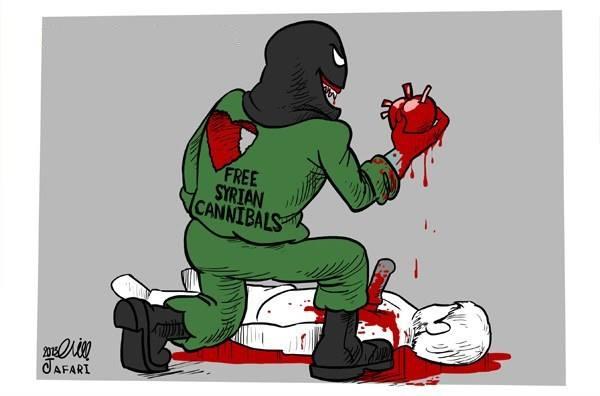
Until joined by the Islamic government in 1979 and then by Hizbullah in the 1980s, Syria was Israel’s most visceral enemy. This enemy is now being destroyed but not by Israel. So-called Muslims backed by so-called Muslim governments – Saudi Arabia, Qatar and Turkey – are doing the job for it, in alliance with the traditional western enemies of the Arabs. Syria’s cities and towns have been devastated. An estimated 100,000 people have been killed. Millions more have been displaced, scattered across Syria or seeking refuge beyond its borders. Reconstruction will cost hundreds of billions of dollars. Recovery will take decades. Without spending a penny or losing a life, Israel has been handed one of the greatest strategic victories in its existence.
Michael Oren let the scarcely concealed cat out of the bag the other day when he said Israel would prefer a Syria without Bashar al Assad to a Syria in the hands of the jihadists. The outgoing Israeli ambassador in Washington, Oren was only bringing something to the surface that could be seen underneath it despite the vociferous denials of Israel’s lobbyists. Israel wants the government in Damascus destroyed. Netanyahu has been trying to hide its interest behind a mask of indifference but as the likelihood of a US military ‘strike’ – for a war that would engulf the region – slipped away, the lobbyists in Washington broke cover. They buttonholed every congressman and women, only for the vote on war to be postponed indefinitely, much to the chagrin of the gulf and Turkish governments, their armed and political protégés and the Israeli government.
While the Syrian army continues to grind the armed groups down, there seems no end to the volume of money, armaments and men outside governments are still prepared to pour into this conflict. Obama is still trying hard to get Russian agreement on a UNSC resolution that would allow the US to begin another war in the Middle East by attacking Syria. In the meantime the armed groups are continuing with the war they are waging. In his recent interview with former US congressman Dennis Kucinich and Fox news correspondent Greg Palkot, Bashar al Assad estimated that 80 to 90 percent of the armed men are Al Qaida-type takfiri jihadists. The ‘defence’ consultancy HIS- Janes puts the figure at about 50 per cent but whether it is 50 per cent or 90 cent, whether they are foreign or Syrian, the jihadists are dominating the fighting. Talk of moderates is deception. Only in the last few days the main fighting groups – all takfiri – have again rejected the authority of the exile Syrian National Coalition and the so-called Free Syrian Army. This is presented as something new when at least a year ago the very same groups issued the same kind of declaration saying the same things. The so-called FSA is the western standard bearer for ‘moderation’ in this struggle even though its brigades are every bit as fanatical as Jabhat al Nusra or any of the other takfiri groups.
If the Syrian government does fall – and at the moment it is not only holding its ground but steadily driving the takfiris back – chaos would prevail in Syria on a far greater scale than Libya at present or Algeria in the 1980s. The country would implode. This is so self-evident that the US and its allies must know it and if they know it, one has to presume that this is what they want. Saudi Arabia is out to destroy the Syrian government regardless of the consequences. Britain and France are following the US and US policy on any issue in the Middle East is largely fashioned according to the interests of Israel. Turkey is the odd man out. Whatever Recep Tayyip Erdogan thought he was going to get out of confronting Syria his own country has been very adversely affected by his decisions. The breakdown of Arab states into sectarian enclaves permanently at war with each other has been an Israeli strategic objective for decades. It has happened in Iraq and now the specter of the collapse of another unitary Arab state hovers over Syria.
While the takfiris do their best to destroy Syria, Israel is getting on with the colonization of Palestinian territories as fast as it can. The current wave of settlement expansion is the greatest since 1967. In the past year edicts have been pouring out of the Housing Ministry authorizing the construction of thousands of housing ‘units’ in East Jerusalem and across the West Bank. The strategic focus is on settlement expansion in and around East Jerusalem and the construction of highways and roads that will simultaneously integrate the settlements into the greater Jerusalem municipality (enlarged immediately after the 1967 war) and, along with the Separation Wall, further cut the Palestinians off from the city. In the first quarter of 2013 alone there was a 176 per cent increase in settlement expansion over the same quarter for 2012.
In August this year, just as the ‘peace talks’ were resuming, Israel announced the construction of thousands more housing ‘units’ in East Jerusalem settlements. The mainstream media tells us that settlement expansion is ‘impeding’ peace, ‘threatening’ the peace talks and the ‘two state’ solution. The plain fact is that there are no ‘peace talks’. They are the camouflage for the war Israel has been waging against the Palestinians for seven decades. To their discredit and dishonor Mahmud Abbas and Saib Urayqat are giving these ‘talks’ a Palestinian face. By announcing settlement construction in the same breath as announcing the resumption of ‘peace talks’ Israel shows its absolute contempt for both of them.
Land expropriation and development for agricultural purposes continues unabated. So does the theft of water. The Council for European Palestinian Relations estimated recently that the settlers consume an average of 280 liters of water a day compared to 86 liters for the Palestinians, below the World Health Organization’s recommended minimum of 100 liters. Only 60 per cent of the water allocated to the Palestinians is potable. While taking their land Israel simultaneously uses it as a rubbish dump, with solid waste from West Jerusalem being dumped at Abu Dis, once set up by Israel as the Palestinian ‘capital’ of East Jerusalem even though it was not even inside the municipality until Israel put it there. The settlers do the same, dumping their rubbish and household waste water on Palestinian land in the valleys below their settlements on the hilltops.
In a statement handed to the UN Human Rights Council fact-finding mission to Palestine in February this year, Al Haq (Law in the Service of Man) presented some statistics. In 2012, 202 ‘incidents’ of settler violence along with dispossession, home demolitions, forcible evictions and intimidation; more than 200 settlements established since 1967, including 14 in East Jerusalem, and more than 500,000 settlers now living in them; and more than 42 per cent of the land of the West Bank as well as most of its resources allocated to Jewish settlements. Al Haq notes that the Israeli High Court ‘has rendered the question of the settlements non-justiciable’.
The Council for European Palestinian Relations estimates that the population in the West Bank settlements is growing at an average of five per cent a year compared to 1.8 per cent for the rest of occupied Palestine. It puts the total number of settlers at 467,000, of which number 385,000 are living in between the Separation Wall and the 1967 ‘green line.’
Every brick laid by Israel on the West Bank, every liter of water pumped out for settlements swimming pools and lawns and the presence of every settler represents a violation of international law. Yet, says Naftali Bennett, the Religious Services Minister and leader of the Jewish Home Party: ‘We will continue building and you will see this soon.’ He was speaking before the August announcement that more housing ‘units’ would be added to Jewish colonies in East Jerusalem. ‘I am sending the message from here to all the parties in the negotiations: the land of Israel belongs to the nation of Israel’. He has pledged to do ‘everything in my power to make sure they never get a state.’
In a leaked exchange with another cabinet minister Bennett said that ‘I’ve killed many Arabs in my life and there’s no problem with that.’ He complained that the conversation had been taken out of context, because what he meant was that he had ‘only’ killed them in the context of operations. There was one such ‘operation’ on the West Bank last week. Heavily armed soldiers stormed into the Jenin refugee camp, broke into the house of the Tubaisi family, shot Islam al Tubaisi, 19, in the leg, dragged him downstairs, his head banging on every step and shot him dead before an ambulance took him to hospital. Perhaps in time the members of this unit will be bragging in time about how they also have killed many ‘Arabs’.
Dig deep enough into the crises in Iraq, Syria and Lebanon and the confrontation with Iran and eventually you will find Palestine. It remains the central issue, the pivot on which US policies, dominated by Israeli interests and demands, has turned for more than six decades, yet for the takfiris affiliated with Al Qaida, killing other Muslims (and Christians) in a variety of countries takes precedence. It is striking that the same heads of government inveighing against terrorism and expressing their outrage at the slaughter of innocents in Nairobi have not once expressed outrage at the slaughter of innocents in Syria unless they thought they could blame the Syrian government.
The call of unity sounds through modern Arab history like the cry of a lost bird. United the Arabs will stand and divided they will continue to fall. As long as they are not able to put common interests first they are going to be ripe for the plucking. What is at stake in Syria is not the political system but Syria itself and for the past three years it has been systematically and deliberately destroyed by an unholy coalition of outside governments and the gangs of armed men doing their dirty work in the name of Islam.
The dominant Arab actors in this deliberately induced catastrophe are the regimes in Riyadh and Doha. They engage with Israel behind the scenes even as it colonizes Palestinian land and sends uniformed gangsters into the Haram al Sharif to beat Muslim worshipers trying to protect one of the holiest sites in Islam. While consorting with the enemy and abandoning the Palestinians these two regimes – infinitely less representative of the will of the people than the government in Damascus – take the lead in the destruction of an Arab state. The greatest beneficiary of their actions on one hand and their inaction and neglect on the other is Israel. This is surely as great a disgrace as any in Arab and Islamic history.
– Jeremy Salt is an associate professor of Middle Eastern history and politics at Bilkent University in Ankara, Turkey.
Featured Video

or go to
Aletho News Archives – Video-Images
From the Archives
The Forgotten Terrorist Pretext of the Vietnam War
By Jim Bovard | The Libertarian Institute | February 16, 2023
Since 9/11, terrorism has become the ultimate entitlement program for America’s political elite. Whether it is illegally spying on Americans or blowing Somali dissidents to pieces, invoking terrorism provides all the cover needed for Washington policymakers. But the disastrous results of granting politicians a blank check to fight terrorism should have been undeniable almost 60 years ago.
Back in the 1960s, terrorism was what the communists did. Anti-terrorist moral fervor and ideological blinders propelled the U.S. into its biggest foreign policy blunder since World War II. … continue
Blog Roll
 Aletho News
- NATO’s “Nordic model” brings Arctic confrontation closer to Russia’s nuclear bases
- Using nuclear weapons, the US-Israeli alliance still can’t beat Iran
- Sunset on the Quality of Western Propaganda: Arrival of the Dr Strangelove Moment
- Ukrainian general accused of protecting crime bosses
- US-‘Israel’ alliance faces growing rupture after midterms
- GOP’s Crushing Midterm Loss Could Reshape US Political Landscape – Analyst
- Midterm loss gives Congress power to rein in US war on Iran
- Midterms Were ‘Vote of No Confidence’ in GOP, But Iran Has No Illusions About Democrats – Marandi
- Israeli Soldiers Inadvertently Prove Their Own Genocidal Guilt
- Ukraine arrests woman who exposed Azov battalion’s ‘torture chamber’
- If Americans Knew
- Will Democratic leaders challenge US military ties to Israel?
- DAILY UPDATE: Latest essential news on Palestine, Israel, & region
- U.S. Citizens to Submit Evidence to International Criminal Court Seeking Arrest Warrants Against Trump, Rubio, Other Senior U.S. Officials
- Trump falsely says US to end Israel aid
- Israeli Soldiers Inadvertently Prove Their Own Genocidal Guilt in Gaza
- In Gaza, the specter of famine is returning
- Major losses could spur Trump to escalate war before year’s end
- It’s the war, stupid. The hawks brought down the Republicans
- Providence Becomes Largest U.S. City to Divest From Israel in Landmark Vote
- DAILY UPDATE: Latest essential news on Palestine, Israel, & region
- No Tricks Zone
- New Study: The Net Fossil Fuel Contribution To Rising Atmospheric CO2 Has Been Zero For 500 Years
- Germany’s Green Energy Transition Becoming Increasingly Expensive…Another 6 Trillion Euros!
- Sudden Stratospheric Warming, Powerful El Niño Combination May Lead To Extreme Europe Cold, Energy Crisis!
- Two New Studies Find Thwaites Glacier Melt Cannot Be Driven By Human Activity Or A Warming Ocean
- E-Cars Reduce CO2 Emissions By Only 41% Compared To Internal Combustion Engine Vehicles
- Predictions Made By Renowned Climate Professor Over Past Decades Have Been Proven To Be Poor
- New Study Suggests Large Regions Of The Pacific Ocean Have Been Cooling For The Last 80 Years
- Germany’s Green Energy Debacle: High Energy Costs Force Kahla Porzellan to Close After 182 Years!
- New Study: 50 Years Of The Most Aggressive ‘Net Zero’ Policies Can Only Affect The Global Climate By 0.03°C
- US September “Heat” Was No Record…Many Records Set Decades Ago

