The US and Iran: March to war – or a backroom deal?
The Cradle | April 14, 2025
The rhetoric surrounding a potential US–Israeli strike on Iran has intensified, fueled by veiled threats, media leaks, and what appeared to be an unofficial ultimatum from the Trump administration to Tehran. While no concrete consequences were outlined, the implication of direct military action looms large.
Since the 1979 Islamic Revolution – and especially after the Iran–Iraq War – Iran has lived under constant threat of US-led military intervention. These threats have fluctuated depending on regional dynamics and shifting US priorities.
In the aftermath of the illegal US invasion of Iraq in 2003, Iran and Syria appeared to be next in line for American-style regime-change. But the protracted insurgency in Iraq and the cost of occupation deterred further US military adventures – particularly against a civilization-state like Iran, whose size and geography pose significant challenges.
Republican leaders, and especially US President Donald Trump, have typically leaned toward employing open threats and economic strangulation policies against perceived US adversaries, rather than pursuing quiet diplomatic solutions. Today, they sense a unique opportunity to strike a deadly blow against Tehran given the recent weakening of Iran’s allies, particularly Hezbollah in Lebanon and the Syrian state, both of which have faced military setbacks and political isolation under western pressure and US-backed Israeli aggression.
Hezbollah, long viewed as Iran’s forward line of defense, now faces internal Lebanese constraints and sustained Israeli aggression, limiting its capacity to act preemptively should Iran be targeted. Meanwhile, Syria’s logistical value to the Axis of Resistance has diminished under sanctions, military exhaustion, and the toppling of former president Bashar al-Assad’s government by foreign-backed extremists under its self-appointed Al Qaeda-linked President Ahmad al-Sharaa.
Exploiting the regional moment
With the Axis of Resistance on the defensive, Washington and Tel Aviv see a fleeting opportunity to consolidate their gains. Yet despite their saber-rattling, Iran retains significant deterrence capabilities and appears prepared to retaliate if provoked.
Trump’s strategy, it must also be noted, extends well beyond Iran and its indigenous nuclear program. These foreign policy postures are part of a broader bid to isolate China, reset regional conflicts, distance Beijing from Moscow, and redirect global energy flows and prices, all while propping up Israel as Washington’s local enforcer.
In this context, West Asia becomes both a proving ground and a potential quagmire. Trump seeks to finalize the so-called “normalization” process between Israel and Arab states, neutralize Palestinian resistance, and pressure Iran to concede its regional role.
While he casts himself as a pragmatist open to deals, this posture serves a dual purpose: securing domestic political capital and forging a regional alliance rooted in US dependency.
Still, for such a deal to materialize, Iran would have to abandon core ideological and strategic pillars – namely, its regional alliances and missile deterrence. This is unlikely. Iran knows that surrendering these elements would strip the Islamic Republic not only of its ideological foundation but of any meaningful regional influence.
Iran’s multi-layered deterrence
Tehran’s defense strategy rests on several pillars. First is its alliance network stretching from Iraq to Yemen and Lebanon, forming a buffer against western hegemony. Second is its growing arsenal of precision missiles, drones, and domestically developed air defense systems. Third is geography: Iran’s control over key chokepoints in the Persian Gulf and its capacity to disrupt global oil supply grants it substantial leverage.
The final line of defense remains Iran’s nuclear program. While officially peaceful, there have been sporadic signals that suggest Tehran may recalibrate its doctrine in response to a major direct attack. Iran’s nuclear infrastructure, particularly at Fordow – a fortified facility deep beneath a mountain – underscores this strategic depth.
Despite recent blows, Hezbollah is unlikely to remain passive if Iran faces an existential threat. Likewise, US interests in Iraq and bases in the region, particularly Djibouti, could become targets for retaliatory strikes from Yemen’s Ansarallah movement.
Iran’s weapons development program has made extraordinary strides post-2011, with multiple lines of ballistic missiles like the Khyber Shakan and Fattah series, and more basic but highly producible systems like Imad and Radwan.
Meanwhile, Iran’s drones have proven effective in theaters from Ukraine to the Red Sea, while its layered air defenses – Khordad, Power-373, and Majid systems – make sustained air campaigns costly for adversaries. Its naval strategy hinges on asymmetric warfare and control of the Strait of Hormuz, a lifeline for global energy trade.
American options – and constraints
The US maintains around 60,000 troops across West Asia, mainly in Persian Gulf bases, and has shifted assets – including aircraft carriers and Patriot systems – from the Pacific to the region. Washington can certainly initiate a campaign to damage Iran’s infrastructure, but sustaining it would be difficult.
All regional US bases are within range of Iranian missiles, meaning any engagement could mark the first conventional war for the US with real counter-fire in decades.
Expect Washington to lean heavily on cyberwarfare and covert operations targeting civilian and military infrastructure alike to sow chaos inside Iran. Yet, a limited strike risks triggering a protracted conflict – something Iran is arguably more prepared for.
Iran’s strategy of attrition suits its asymmetric strengths and the fragility of US supply chains for munitions such as Patriots, SM-series interceptors, and cruise missiles.
The ongoing engagement in the Red Sea has already strained American resources. US aircraft carriers are operating from positions well beyond effective range, and stockpiles of precision munitions are running low – many earmarked for future conflict with China.
Manufacturing limitations, not cost, are the real bottleneck in sustaining a prolonged campaign. Despite these constraints, the US could still inflict serious initial damage. But sustaining such an operation, especially in the face of regional retaliation, would exact a high political and economic cost.
Between brinkmanship and bargaining
Both sides have much to lose – and much to bargain with. For Washington, a limited conflict could serve immediate strategic aims. For Tehran, dragging the US into a drawn-out war could shift pressure back onto American decision-makers already grappling with economic turbulence at home.
While the rhetoric of war dominates headlines, the path to direct conflict remains uncertain. Much depends on the outcome of indirect negotiations, particularly the recent round of indirect talks in Muscat, Oman.
Trump’s theatrics – threats, military build-up, and erratic messaging – are better understood as negotiating tactics than a clear march to war. Notably, Trump’s insistence that the occupation state should take the lead in any war on Iran reveals his reluctance to entangle the US in yet another West Asian quagmire.
His preference remains a deal, on his terms, allowing him to parade a foreign policy ‘win’ without bloodshed. In sum, war is neither inevitable nor necessarily decisive. The US needs a strategic pause in West Asia to refocus on other global priorities.
Iran, meanwhile, seeks time to rebuild internally and block Israel from exploiting current momentum. The coming weeks may decide whether this standoff ends in confrontation, or compromise.
Standing at the Edge of the Iran War Cliff
By Ron Paul | April 14, 2025
Millions of people around the world were at the edge of their seats over the weekend, waiting to hear whether Trump special envoy Steve Witkoff’s indirect talks with the Iranian foreign minister would ratchet down tensions or would break down and bring on a major Middle East war.
If it seems bizarre that the outcome of a meeting between a US president’s designated negotiator and a foreign government minister could determine whether we plunge into possibly our biggest war since World War II, that’s because it is bizarre. In fact, this is an excellent example of why our Founders were so determined to keep warmaking authority out of the Executive Branch of government. No one person – much less his aide – should have the power to take this country to war.
That is why the Constitution places the authority to go to war firmly and exclusively in the hands of the representatives of the people: the US Congress. After all, it is the US people who will be expected to fight the wars and to pay for the wars and to bear the burden of the outcome of the wars. When that incredible power is placed in the hands of one individual – even if that individual is elected – the temptation to use it is far too great. Our Founders recognized this weakness in the system they were rebelling against – the British monarchy – so they wisely corrected it when they drafted our Constitution.
Unless the US is under direct attack or is facing imminent direct attack, the Constitution requires Congress to deliberate, discuss, and decide whether a conflict or potential conflict is worth bringing the weight of the US military to bear. They wanted it harder, not easier, to take us to war.
When wars can be started by presidents with no authority granted by Congress, the results can be the kinds of endless military engagements with ever-shifting, unachievable objectives such as we’ve seen in Afghanistan and Iraq.
We are currently seeing another such endless conflict brewing with President Trump’s decision to start bombing Yemen last month. The stated objectives– to end Houthi interference with Israeli Red Sea shipping – are not being achieved so, as usually happens, the bombing expands and creates more death and destruction for the civilian population. In the last week or so, US bombs have struck the water supply facilities for 50,000 civilians and have apparently blown up a civilian tribal gathering.
Starting a war with Iran was the furthest thing from the minds of American voters last November, and certainly those who voted for Donald Trump were at least partly motivated by his promise to end current wars and start no new wars. However, there is a strange logic that to fulfill the promise of no new wars, the US must saber rattle around the world to intimidate others from crossing the White House. This is what the recycled phrase “peace through strength” seems to have come to mean. But the real strength that it takes to make and keep peace is the strength to just walk away. It is the strength to stop meddling in conflicts that have nothing to do with the United States.
That is where Congress comes in. Except they are not coming in. They are nowhere to be found. And that is not a good thing.
Gulf-backed genocide: How Arab monarchies fuel Israel’s war machine
By Mawadda Iskandar | The Cradle | April 10, 2025
The Persian Gulf states’ silence – and in many cases, complicity – during Israel’s ongoing war on Gaza has not come as a shock. These governments, long detached from the Palestinian struggle, have for years cultivated warm, if discreet, ties with Tel Aviv.
While Bahrain and the UAE made normalization of ties with Tel Aviv official through the US-brokered 2020 Abraham Accords, other states like Saudi Arabia and Qatar have played quieter but equally pivotal roles. Riyadh, often described as the architect behind normalization, and Doha, hiding behind its “mediator” label, have each aided the occupation state in crucial ways.
Though much of this assistance remains behind the scenes, it has been repeatedly acknowledged by US and Israeli officials. During his first term, US President Donald Trump once warned that “Israel would be in big trouble without Saudi Arabia,” while Israeli Prime Minister Benjamin Netanyahu has said that Arab leaders now view Israel “not as their enemy, but their greatest ally,” adding that they “want to see us defeat Hamas.”
Such statements offer a glimpse into the vast, opaque network of regional cooperation propping up the occupation state’s war machine.
Economic complicity
Despite overwhelming popular support throughout the Arab world for Palestine, and growing calls for grassroots boycotts, Persian Gulf–Israeli trade has only surged. The UAE now ranks as Israel’s top Arab trade partner, while Bahrain’s commerce with Tel Aviv spiked by a staggering 950 percent during the first 10 months of the Gaza war.
Even amid war and boycott efforts, “kosher-certified” goods from Arab countries continue to enter Israeli markets. UAE-based brands like Al Barakah Dates and Hunter Foods, along with Saudi Arabia’s Durra (a sugar supplier), have maintained trade channels.
Qatar has exported crude materials for plastics used in Israeli industries. Bahrain went so far as to officially recognize goods produced in illegal West Bank settlements as Israeli in origin.
More insidiously, Persian Gulf investments are directly fueling Israeli settlement expansion. Saudi Arabia, the UAE, and Qatar have funneled money into Avenue Partners, a firm chaired by Trump’s son-in-law Jared Kushner, who remains involved in advising the Trump administration from afar.
That money flows into Phoenix Holdings, which finances key banks involved in settlement construction – Leumi, Hapoalim, and Discount Bank – as well as telecom firms like Cellcom and Partner, and construction companies like Electra and Shapir, all of which operate inside occupied Palestinian territory.
When Yemen’s blockade disrupted shipping lanes for Israeli-linked cargo in the Red Sea, cutting off 70 percent of Tel Aviv’s food imports, it was the Persian Gulf states that rushed to patch the breach. The UAE created an overland logistics corridor from Dubai to Tel Aviv via Saudi Arabia and Jordan, and Bahrain repurposed its ports to serve as alternate shipping hubs for Israeli goods arriving from India and China.
Military ties beneath the surface
From the earliest days of Israel’s onslaught on Gaza, the UAE has doubled down on its strategic military relationship with the occupation state. In 2024, Balkan Insight revealed that a UAE-linked firm, Yugoimport-SDPR, exported $17.1 million worth of weapons to Israel via military aircraft directly involved in bombing Gaza.
But the arms trade is only part of this treacherous picture. The UAE’s state-owned defense giant EDGE holds shares in Israeli military contractors like Rafael and Israel Aerospace Industries (IAI), companies that retrofit Emirati planes into military freighters. Abu Dhabi has also welcomed offices from Israeli weapons manufacturers like Bayt Systems and Third Eye Systems, and proudly hosted 34 Israeli defense firms at IDEX 2025 – a major arms expo used to secure deals with the occupation army.
Though not formally normalized, Saudi Arabia is militarizing its ties with Israel through indirect channels. One method: purchasing Israeli systems like the TOW missile through US-based subsidiaries of Elbit Systems. Another: acquiring surveillance drones from South Africa, which are disassembled and reassembled in the kingdom to mask their Israeli origins.
A recent anti-drone system – suspected to be designed by Israeli firm RADA – was spotted at the Royal Saudi Air Defense base in Tabuk, near King Faisal Air Base.
Meanwhile, Qatar has quietly boosted its military coordination with Tel Aviv. Doha continues to source spare parts for tanks, armored vehicles, and aerial tankers from Israeli suppliers, and its military has participated in joint drills involving Israel and other Persian Gulf states – including exercises in Greece held just over a week ago.
Logistical lifelines to Tel Aviv
Beyond military and economic ties, Persian Gulf states have facilitated the flow of weapons to Israel through logistical support channels. As the US ramped up its “unprecedented airlift” of tens of thousands of missiles, munitions, and Iron Dome components, the Gulf’s airspace and bases became critical.
US arms shipments passed through Saudi Arabia, Bahrain, Jordan, and especially Qatar, where the Al-Udeid Air Base – home to US Central Command – served as a hub for at least 18 documented transfers. Several were routed through Cyprus to avoid direct flight tracking.
In the UAE, Dubai International Airport became a waypoint for Israeli reservists flying in from Asia. Coordinated through the Israeli consulate in Dubai, these flights funneled soldiers into the war in Gaza. Emirati authorities also arranged leisure retreats for Israeli troops between deployments and allowed Jewish organizations in Dubai to send care packages to the occupation military.
Pipeline diplomacy and energy normalization
Earlier this month, as Trump prepared to visit Saudi Arabia seeking investment in US infrastructure, Israeli Energy Minister Eli Cohen unveiled plans for a regional oil pipeline stretching from Ashkelon to Saudi Arabia via Eilat.
The project falls under the India-Middle East-Europe Economic Corridor (IMEC), a US-backed alternative to China’s Belt and Road Initiative (BRI), with links running through the UAE, Jordan, and occupied Palestinian lands.
In a related move, Nasser bin Hamad Al Khalifa – son of the Bahraini king and chair of Bapco Energy – announced the sale of a pipeline stake to BlackRock, the US investment giant notorious for its financial ties to Israeli settlements. This deal cannot be separated from the broader normalization agenda.
Spycraft and surveillance
In one of the clearest signs of deepening security cooperation, Axios revealed a secret 2024 meeting in Bahrain between Israeli army chief Herzi Halevi and senior military officials from Bahrain, Saudi Arabia, the UAE, Jordan, and Egypt.
Overseen by US Central Command, the summit focused on countering Iranian retaliation and disrupting weapons flows to Gaza from resistance forces in Iraq and Yemen – operations that often transit through Persian Gulf-controlled airspace.
Bahrain’s role was particularly overt: Nasser bin Hamad openly declared his country’s commitment to disrupting Iranian response operations in coordination with the US Fifth Fleet stationed in Manama. Analysts now speculate that Tel Aviv could be granted permanent naval access to strategic Gulf waters.
This growing security convergence has also opened the door for Israeli tech to penetrate Persian Gulf infrastructure. Bahrain now relies on Israeli firms for anti-drone systems, satellite surveillance, and cybersecurity. One notable collaboration involves Bahraini company Crescent Technologies and Israeli cyber defense powerhouse CyberArk.
The UAE is pushing the envelope even further. Emirati firms have signed deals with XM Cyber – co-founded by a former Mossad chief – to secure national energy infrastructure. XM Cyber works in tandem with Rafael and other elite Israeli military firms as part of a consortium targeting sensitive Gulf markets, including oil, energy, and data. Meanwhile, Orpak Systems, another Israeli company, has quietly entered Arab oil sectors under nondescript branding to avoid detection.
Despite their public posturing and periodic statements of support for Palestine, the Persian Gulf states have quietly entrenched themselves in Tel Aviv’s war effort. Through investment flows, arms deals, intelligence cooperation, and energy infrastructure, they have become vital enablers of the genocide in Gaza.
This alliance – crafted in backrooms and sealed with economic interests – has allowed Israel to prosecute its war on Gaza with Gulf assistance at every logistical and financial juncture.
Far from being passive actors, these states are now active partners in a conflict that has devastated an entire people.
Iraqi Kataib Hezbollah denies Reuters’ report citing ‘commander’
Al Mayadeen | April 7, 2025
Iraqi Kataib Hezbollah stated that the remarks attributed by Reuters to an individual described as a “Kataib Hezbollah commander” do not reflect the group’s principles or positions.
The brigades emphasized that all official media statements are made solely by their official and military spokespersons.
Any claims made in the name of Kataib Hezbollah by individuals other than these spokespersons are considered false and defamatory, it stressed.
Reuters had reported that Iraqi armed groups are ready to dismantle amid fears of a Trump strike, citing senior Iraqi commanders and officials.
Kataib Hezbollah, a group active under the umbrella of the Islamic Resistance in Iraq, took part in the military operations against Israeli targets in response to “Israel’s” war on the Gaza Strip.
US-Iran war would set entire region ablaze: Iraqi official
Last week, the Secretary-General of Iraq’s Badr Organization, Hadi al-Amiri, cautioned that a war between Iran and the United States would not be a “walk in the park” or a simple affair but would set the entire region on fire.
“The outbreak of war with Iran does not mean it will be a walk in the park; rather, it will set the entire region ablaze,” al-Amiri warned during a meeting with tribal leaders and dignitaries from Diyala province at the headquarters of the Popular Mobilization Forces’ Diyala Operations Command.
The Iraqi politician stressed that “no one should assume that we and other countries of the region will stand idly by if war breaks out between Iran and the US.”
His remarks come two days after US President Donald Trump threatened to bomb Iran if no agreement was reached on its nuclear program.
Ali Larijani, senior advisor to the Leader of the Islamic Revolution Sayyed Ali Khamenei, warned that any US or Israeli attack on Iran under the pretext of its nuclear program would force Tehran to move toward producing a nuclear bomb.
Iranian officials have also rejected negotiations under pressure or threats, affirming Tehran’s readiness to respond firmly to any attack.
Iranian President Masoud Pezeshkian stated that Tehran was open to indirect negotiations with Washington but pointed out that the US approach would determine the course of the discussions.
‘Break-a-Leg’ (that old Mafia warning) – Trump has threatened Iran over an ultimatum that likely cannot be met
By Alastair Crooke | Strategic Culture Foundation | April 7, 2025
Trump’s ultimatum to Iran? Colonel Doug Macgregor compares the Trump ultimatum to Iran to that which Austria-Hungary delivered to Serbia in 1914: An offer, in short, that ‘could not be refused’. Serbia accepted nine out of the ten demands. But it refused one – and Austria-Hungary immediately declared war.
On 4 February, shortly after his Inauguration, President Trump signed a National Security Presidential Memorandum (NSPM); that is to say, a legally binding directive requiring government agencies to carry out the specified actions precisely.
The demands are that Iran should be denied a nuclear weapon; denied inter-continental missiles, and denied too other asymmetric and conventional weapons capabilities. All these demands go beyond the NPT and the existing JCPOA. To this end, the NSPM directs maximum economic pressure be imposed; that the U.S. Treasury act to drive Iran’s oil exports to zero; that the U.S. work to trigger JCPOA Snapback of sanctions; and that Iran’s “malign influence abroad” – its “proxies” – be neutralised.
The UN sanctions snapback expires in October, so time is short to fulfil the procedural requirements to Snapback. All this suggests why Trump and Israeli officials give Spring as the deadline to a negotiated agreement.
Trump’s ultimatum to Iran appears to be moving the U.S. down a path to where war is the only outcome, as occurred in 1914 – an outcome which ultimately triggered WW1.
Might this just be Trump bluster? Possibly, but it does sound as if Trump is issuing legally binding demands such that he must expect cannot be met. Acceptance of Trump’s demands would leave Iran neutered and stripped of its sovereignty, at the very least. There is an implicit ‘tone’ to these demands too, that is one of threatening and expecting regime change in Iran as its outcome.
It may be Trump bluster, but the President has ‘form’ (past convictions) on this issue. He has unabashedly hewed to the Netanyahu line on Iran that the JCPOA (or any deal with Iran) was ‘bad’. In May 2014, Trump withdrew the U.S. from the JCPOA at Netanyahu’s behest and instead issued a new set of 12 demands to Iran – including permanently and verifiably abandoning its nuclear programme in perpetuity and ceasing all uranium enrichment.
What is the difference between those earlier Trump demands and those of this February? Essentially they are the same, except today he says: If Iran “doesn’t make a deal, there will be bombing. It will be bombing the likes of which they have never seen before”.
Thus, there is both history, and the fact that Trump is surrounded – on this issue at least – by a hostile cabal of Israeli Firsters and Super Hawks. Witkoff is there, but is poorly grounded on the issues. Trump too, has shown himself virtually totalitarian in terms of any and all criticism of Israel in American Academia. And in Gaza, Lebanon and Syria, he is fully supportive of Netanyahu’s far-right provocative and expansionist agenda.
These present demands regarding Iran also run counter to the 25 March 2025 latest annual U.S. Intelligence Threat Assessment that Iran is NOT building a nuclear weapon. This Intelligence Assessment is effectively disregarded. A few days before its release, Trump’s National Security Adviser, Mike Waltz clearly stated that the Trump Administration is seeking the “full dismantlement” of Iran’s nuclear energy program: “Iran has to give up its program in a way that the entire world can see”, Waltz said. “It is time for Iran to walk away completely from its desire to have a nuclear weapon”.
On the one hand, it seems that behind these ultimata stands a President made “pissed off and angry” at his inability to end the Ukraine war almost immediately – as he first mooted – together with pressures from a bitterly fractured Israel and a volatile Netanyahu to compress the timeline for the speedy ‘finishing off’ of the Iranian ‘regime’ (which, it is claimed, has never been weaker). All so that Israel can normalise with Lebanon –and even Syria. And with Iran supposedly ‘disabled’, pursue implementation of the Greater Israel project to be normalised across the Middle East.
Which, on the other hand, will enable Trump to pursue the ‘long-overdue’ grand pivot to China. (And China is energy-vulnerable – regime change in Tehran would be a calamity, from the Chinese perspective).
To be plain, Trump’s China strategy needs to be in place too, in order to advance Trump’s financial system re-balancing plans. For, should China feel itself besieged, it could well act as a spoiler to Trump’s re-working of the American and global financial system.
The Washington Post reports on a ‘secret’ Pentagon memo from Hegseth that “China [now] is the Department’s sole pacing threat, [together] with denial of a Chinese fait accompli seizure of Taiwan — while simultaneously defending the U.S. homeland”.
The ‘force planning construct’ (a concept of how the Pentagon will build and resource the armed services to take on perceived threats) will only consider conflict with Beijing when planning contingencies for a major power war, the Pentagon memo says, leaving the threat from Moscow largely to be attended by European allies.
Trump wants to be powerful enough credibly to threaten China militarily, and therefore wants Putin to agree speedily to a ceasefire in Ukraine, so that military resources can quickly be moved to the China theatre.
On his flight back to Washington last Sunday evening, Trump reiterated his annoyance toward Putin, but added “I don’t think he’s going to go back on his word, I’ve known him for a long time. We’ve always gotten along well”. Asked when he wanted Russia to agree to a ceasefire, Trump said there was a “psychological deadline” – “If I think they’re tapping us along, I will not be happy about it”.
Trump’s venting against Russia may, perhaps, have an element of reality-TV to it. For his domestic audience, he needs to be perceived as bringing ‘peace through strength’ – to keep up the Alpha-Male appearance, lest the truth of his lack of leverage over Putin becomes all too apparent for the American public and to the world.
Part of the reason for Trump’s frustration too, may be his cultural formation as a New York businessman; that a deal is about first dominating the negotiations, and then quickly ‘splitting the difference’. This, however, is not how diplomacy works. The transactional approach also reflects deep conceptual flaws.
The Ukraine ceasefire process is stalled, not because of Russian intransigence, but rather because Team Trump has determined that achieving a settlement in Ukraine comes firstly through insisting on a unilateral and immediate ceasefire – without introducing temporary governance to enable elections in Ukraine, nor addressing the root causes of the conflict. And secondly, because Trump rushed in, without listening to what the Russians were saying, and/or without hearing it.
Now that initial pleasantries are over, and Russia is saying flatly that current ‘ceasefire’ proposals simply are inadequate and unacceptable, Trump becomes angry and lashes out at Putin, saying that 25% tariffs on Russian oil could happen ANY moment.
Putin and Iran are both now under ‘deadlines’ (a ‘psychological’ one in Putin’s case), so as to enable Trump to proceed with credibly threatening China to come to a ‘deal’ soon – as the global economy is already wobbling.
Trump fumes and spits fire. He tries to hurry matters along by making a big show of bombing the Houthis, boasting that they have been hit hard, with many Houthi leaders killed. Yet, such callousness towards Yemeni civilian deaths sits awkwardly with his claimed heart-rendering empathy for the thousands of ‘handsome’ Ukrainian young men needlessly dying on the front lines.
It all becomes reality-TV.
Trump threatens Iran with “bombing [the] likes of which they have never seen before” over an ultimatum that likely cannot be met. Simply put, this threat (which includes the possible use of nuclear weapons) is not given because Iran poses a threat to the U.S. It does not. But it is given as an option. A plan; a ‘thing’ placed calmly on the geo-political table and intended to spread fear. “Cities full of children, women, and the elderly to be killed: Not morally wrong. Not a war crime”.
No. Just the ‘reality’ that Trump takes the Iranian nuclear programme to be an existential threat to Israel. And that the U.S. is committed to using military force to eliminate existential threats to Israel.
This is the heart to Trump’s ultimatum. It owes to the fact that it is Israel – not America, and not the U.S. intelligence community – that views Iran as an existential threat. Professor Hudson, speaking with direct knowledge of the background policy (see here and here) says, “it’s NOT just that Israel as we know it – must be safe and secure and free from terrorism”. That’s Trump and his Team’s ‘line’; that’s the Israeli and its supporters narrative too. “But the mentality [behind it] is different”, Hudson says.
There are some 2-3 million Israelis who see themselves as destined to control all of what we now call the Middle East, the Levant, what some call West Asia – and others call “Greater Israel”. These Zionists believe that they are mandated by God to take this land – and that all who oppose them are Amalek. They believe the Amalek to be consumed with an overwhelming desire to kill Jews, and who therefore should be annihilated.
The Torah records the story of Amalek: Parshat Ki Teitzei, when the Torah states, machoh timcheh et zecher Amalek—that we must erase Amalek’s memory. “Every year we [Jews] are obligated to read – not how God will destroy Amalek – but how we should destroy Amalek”. (Though many Jews puzzle how to reconcile this mitzvah with their ingrained contrarian values of compassion and mercy).
This commandment in the Torah is in fact one of the key factors that lies at the root of Israel’s obsession with Iran. Israelis perceive Iran as an Amalek tribe plotting to kill Jews. No deal, no compromise therefore is possible. It is also, of course, about Iran’s strategic challenge (albeit secular) to the Israeli state.
And what has made the Trump ultimatum so pressing in Washington’s view – apart from the China-pivot considerations – was the assassination of Sayyed Hassan Nasrallah. That assassination marked a big shift in U.S. thinking, because, before that, we inhabited an era of careful calculation; incremental moves up an escalator ladder. What is understood now is that ‘we’re no longer playing chess’. There are no rules anymore.
Israel (Netanyahu) is going hell-for-leather on all fronts to mitigate the divisions and turmoil at home in Israel through igniting the Iranian front – even though this course might well threaten Israel’s destruction.
This latter prospect marks the reddest of ‘red lines’ to ingrained Deep State structures.
David’s Corridor: Israel’s shadow project to redraw the Levant
Through ‘David’s Corridor,’ Israel aims to forge a geopolitical artery stretching from occupied Golan to Iraqi Kurdistan, reshaping West Asia
By Mahdi Yaghi | The Cradle | April 4, 2025
In recent years, the Zionist idea of “David’s Corridor” has surfaced in Tel Aviv’s strategic and political discourse on the reshaping of its geopolitical influence in the Levant. Though the Israelis have made no official announcement, analysts have pointed to this corridor as a covert project aimed at linking Kurdish-controlled northern Syria – backed by the US – to Israel via a continuous land route.
The so-called David’s Corridor refers to an alleged Israeli project to establish a land corridor stretching from the occupied Syrian Golan Heights through southern Syria to the Euphrates River. This hypothetical route would traverse the governorates of Deraa, Suwayda, Al-Tanf, Deir Ezzor, and the Iraqi–Syrian border area of Albu Kamal, providing the occupation state with a strategic overland channel into the heart of West Asia.
A biblical blueprint
Ideologically, the project is rooted in the vision of “Greater Israel,” an expansionist concept attributed to Zionism’s founder, Theodor Herzl. The vision draws on a biblical map extending from Egypt’s Nile to Iraq’s Euphrates.
Dr Leila Nicola, professor of international relations at the Lebanese University, tells The Cradle that David’s Corridor embodies a theological vision requiring Israeli control over Syria, Iraq, and Egypt – a triad central to both biblical lore and regional dominance. Regional affairs scholar Dr Talal Atrissi echoes this view, believing that developments in Syria have lent new geopolitical realism to Israel’s historical ambitions.
Unsurprisingly, the proposed corridor is a lightning rod for controversy, seen by many as a strategic bid to expand Israeli hegemony. Yet significant barriers stand in its way. As Atrissi notes, the corridor cuts through volatile terrain, where actors like Iraq’s Popular Mobilization Forces (PMF) remain formidable spoilers. Even a minor act of sabotage could disrupt the project, particularly given the absence of a stable regional environment needed to sustain such a sensitive and expansive route.
Strategically, David’s Corridor aligns with Israel’s enduring policy of cultivating ties with regional minorities – Kurds, Druze, and others – to offset hostility from Arab states. This decades-old “peripheral alliance” strategy has underpinned Israeli support for Kurdish autonomy since the 1960s. The project’s biblical symbolism of expanding “Israel” to the Euphrates, and its strategic calculus, combine to make the corridor both a mythological promise and a geopolitical asset.
Nicola further contextualizes this within the framework of the “ocean doctrine,” a policy Israel pursued by courting non-Arab or peripheral powers like the Shah’s Iran and Turkiye, and forging alliances with ethnic and sectarian minorities in neighboring states.
The doctrine aimed to pierce the Arab wall encircling Israel and extend its geopolitical reach. David’s Corridor fits snugly within this paradigm, drawing on both spiritual mythology and strategic necessity.
Syria’s fragmentation: A gateway
The collapse of former Syrian president Bashar al-Assad’s government and the rise of Ahmad al-Sharaa’s Al-Qaeda-linked Hayat Tahrir al-Sham (HTS) have accelerated Syria’s internal fragmentation. Sharaa’s administration inked deals with the US-backed Syrian Democratic Forces (SDF), integrating Kurdish-controlled areas into the nominal Syrian state while cementing Kurdish autonomy. In Suwayda, a separate agreement preserved Druze administrative independence in exchange for nominal state integration.
But Atrissi warns that such sectarian autonomy, even if pragmatic for containing tensions in the short term, risks entrenching divisions and inviting foreign meddling. He notes that the trauma of massacres on Syria’s coast has left minorities, especially the Alawites, deeply skeptical of the central authority in Damascus, pushing them toward local power arrangements. Israel, with its historical penchant for minority alliances, sees an opportunity to entrench its influence under the guise of protection.
Israel’s longstanding partnership with Iraqi Kurdistan is a case in point – a strategic relationship that offers a blueprint for replication in Syria. David’s Corridor, in this reading, is less a logistical imperative and more a political ambition. Should conditions allow, the occupation state may leverage the corridor to encircle Iran and redraw regional fault lines.
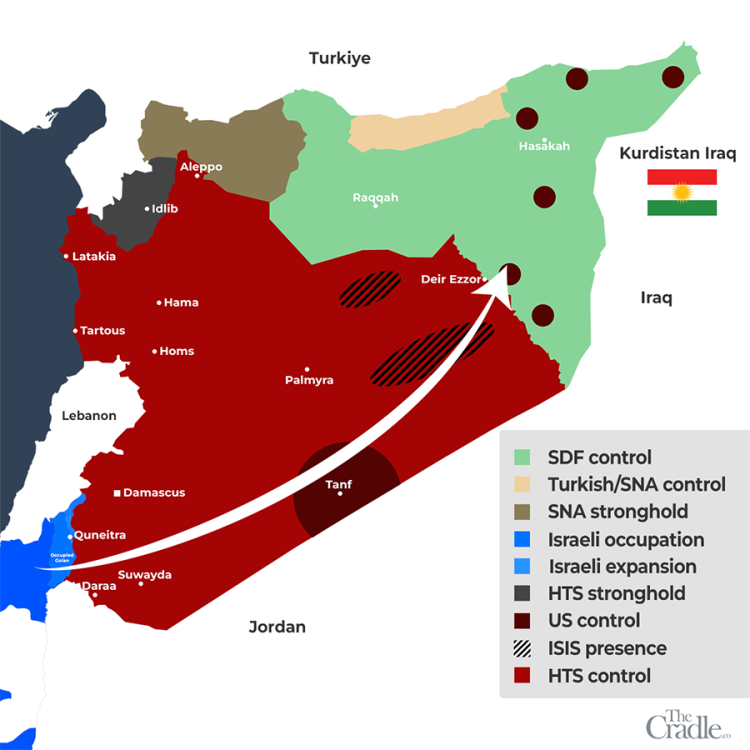
A map of the proposed David’s Corridor
A corridor of influence, not infrastructure
From Tel Aviv’s perspective, southern Syria is now a strategic vacuum: Syria’s army is weakened, Turkiye is entangled in its own Kurdish dilemmas, and Iran is overstretched. This power void offers fertile ground for Israel to assert dominance, particularly if regional dynamics continue to favor decentralized, weak governance.
Despite Washington’s reduced military footprint, the US remains committed to containing Iran. Key outposts like the Al-Tanf base on the Syrian–Iraqi border are instrumental in severing the so-called Iranian land bridge from Tehran to Beirut.
Nicola argues that while David’s Corridor is not an explicit US policy, Washington is likely to support Israeli initiatives that align with American strategic goals:
“The United States does not mind Israel implementing the project if it serves its interests, even though it is not part of its immediate strategy. It focuses on reducing Iran’s influence and dismantling its nuclear program, while supporting the path of regional normalization with Tel Aviv.”
The 2020 Abraham Accords, by easing Israel’s diplomatic isolation, have created additional maneuvering space. David’s Corridor – once a fantasy – now appears more plausible amid the regional flux.
Israeli leaders have sent unmistakable signals. On 23 February, Israeli Prime Minister Benjamin Netanyahu rejected any Syrian military presence south of Damascus, insisting on demilitarized zones in Quneitra, Deraa, and Suwayda under the pretext of protecting Syria’s Druze minority.
Israeli Foreign Minister Gideon Saar openly advocated for a federal Syria – a euphemism for fragmentation. Defense Minister Israel Katz vowed that Israeli troops would remain indefinitely in Mount Hermon and the Golan, and called for the dismantling of Syria into federal entities. Media leaks of corridor maps have only fueled speculation.
These moves have triggered outrage in southern Syria, with protests erupting in Khan Arnaba, Quneitra, Nawa, Busra al-Sham, and Suwayda. Yet, as Nicola notes, the new Syrian leadership appears remarkably disinterested in confronting Israel, and Arab states remain largely indifferent, even as the project edges toward realization. Turkiye, by contrast, stands firmly opposed to any Kurdish-led partition of Syria.
Geopolitical stakes and final frontiers
Ultimately, David’s Corridor signals a broader Israeli project to reengineer Syria’s geopolitics: isolate the south militarily, bind the Kurds in alliance, shift the balance of power, and carve a corridor of influence through fractured terrain.
Israel’s objectives are layered. Militarily, the corridor provides strategic depth and disrupts Iran’s land routes to Hezbollah. It enables the flow of arms and intelligence support to allies, especially Kurdish forces.
Economically, it opens a potential oil pipeline from Kirkuk or Erbil – Kurdish-majority, oil-rich areas – to Haifa, bypassing Turkish routes and maritime threats from actors like Yemen’s Ansarallah-allied army. Politically, it solidifies Israeli–Kurdish ties, undermines Syrian and Iraqi sovereignty, and advances the vision of Greater Israel, with the Euphrates as a symbolic frontier.
Yet the corridor is not without risk. It threatens to deepen the region’s instability, antagonize Syria, Turkiye, Iran, and Iraq, and trigger new fronts of resistance. Whether Israel can realize this project depends on the fluid regional calculus and its ability to maneuver within it.
David’s Corridor may still be a project in the shadows – but its implications are already casting a long one across the region.
Policy Reversal: Why Is the U.S. Softening Its Position on Iran?
By Viktor Mikhin – New Eastern Outlook – April 5, 2025
In Recent Days, the Trump Administration—Known for Its Hardline Stance on Iran—Has Shown Unexpected Shifts in Rhetoric.
U.S. Special Envoy for Middle East Affairs Steven Whitcoff, who previously advocated for a policy of “maximum pressure” on Tehran, now speaks of the need for “confidence-building” and “resolving disagreements.” This sharp turn in foreign policy strategy raises many questions: What exactly prompted Washington to change its approach? What factors influenced the decision to soften its stance? And most importantly—does the U.S. have a real plan of action, or is this just a temporary tactical maneuver?
An analysis of the situation suggests that the policy shift is tied to a combination of factors—from the failure of sanctions to the Trump administration’s domestic political calculations. Additionally, Iran’s response and that of the international community play a key role in determining how events will unfold.
The Failure of “Maximum Pressure”
In 2018, the U.S. unilaterally withdrew from the Joint Comprehensive Plan of Action (JCPOA), expecting that harsh sanctions would force Iran to make concessions. The Trump administration believed economic strangulation would either lead to regime change in Tehran or its surrender on the nuclear issue. However, these calculations proved wrong.
Instead of backing down, Iran responded by escalating its nuclear activities. According to the IAEA, Tehran has significantly increased its stockpile of enriched uranium and begun developing more advanced centrifuges. Moreover, the country strengthened ties with Russia and China, finding alternative ways to bypass sanctions. As a result, the “maximum pressure” policy not only failed to achieve its goals but, from Washington’s perspective, worsened the situation by bringing Iran closer to developing nuclear weapons.
Now, Washington seems to have realized that isolating Iran hasn’t worked and is attempting to shift to diplomatic methods. The question, however, is whether it’s too late—Tehran, hardened by bitter experience, is unlikely to agree to new negotiations without serious guarantees.
Another reason for the policy shift may be domestic U.S. issues. Facing economic challenges and a lack of clear successes, President Trump urgently needs a foreign policy win that can be framed as a major achievement of his so-called “new approach.” A full-scale war with Iran is too risky—a scenario that could spell disaster for both the region and the U.S. itself. Thus, the administration is likely betting on a temporary agreement that can be marketed as a “diplomatic breakthrough.” However, this approach risks new problems—if the deal proves short-lived, it will further erode international trust in the U.S.
Internal Divisions in U.S. Leadership
The rhetorical shift also reflects deep divisions within the American leadership. While some officials, like Steven Whitcoff, advocate for negotiations, others—including National Security Advisor Mike Waltz—continue to insist on Iran’s complete abandonment of its nuclear program. These contradictions indicate a lack of a unified strategy.
Part of the administration appears to recognize the futility of further pressure, while another faction remains committed to a hardline approach. This division makes any long-term U.S. strategy unstable—a change in administration or even a shift in Congressional power dynamics could undo any agreements reached. Such confusion weakens the effectiveness of U.S. policy and gives Iran additional leverage.
Iran’s Response: Why Tehran Doesn’t Trust the U.S.
Iranian leaders remain deeply skeptical of Washington’s new overtures. Supreme Leader Ayatollah Khamenei has repeatedly stated that “threats and bribes do not work on Iran.” The experience of the 2015 JCPOA showed that the U.S. could abandon the deal at any moment, even if Iran fully complied.
After Washington’s unilateral withdrawal, Tehran lost faith in American guarantees. Now, Iran’s leadership demands not only sanctions relief but also legally binding commitments to prevent the U.S. from reneging again.
The situation is further complicated by internal political struggles in Iran. Conservative factions, empowered after the JCPOA’s collapse, oppose any concessions to the West. Additionally, Iran has adapted to sanctions by finding alternative oil markets and deepening cooperation with China and Russia. This reduces the effectiveness of U.S. pressure and diminishes Tehran’s incentives to compromise.
Even Washington’s closest allies, like Israel, have expressed discontent with the policy shift. Prime Minister Benjamin Netanyahu stated he distrusts new negotiations with Iran and views any concessions as dangerous.
European nations, however, have long called for renewed dialogue. Germany, France, and the UK—who remained in the JCPOA after the U.S. exit—hope for de-escalation. Yet their influence is limited, as key decisions are made in Washington and Tehran.
Currently, negotiations remain at an impasse. The U.S. offers dialogue but maintains sanctions, while Iran refuses concessions without guarantees. Experts believe Trump is attempting a “good cop, bad cop” tactic, similar to his approach with North Korea. However, unlike in 2015, Tehran is no longer willing to negotiate under pressure. Iranian leaders recognize that time is on their side—the longer the U.S. fails to achieve its goals, the weaker its position becomes.
A Way Out?
An exit from the deadlock—which the U.S. created in its relations with Iran—was discussed during recent trilateral talks between China, Russia, and Iran in Beijing. The meeting produced a comprehensive initiative to resolve the Iranian nuclear issue, based on five principles:
- Peaceful Solutions Over Sanctions: All parties must reject coercive pressure and illegal restrictions, prioritizing dialogue. Conditions for renewed negotiations must be created while avoiding escalatory steps.
- Balancing Rights and Obligations: Iran must uphold its commitment against nuclear weapons development, while the international community recognizes its right to peaceful nuclear energy under the NPT.
- Returning to the JCPOA as a Foundation: The initiative calls for renewed focus on the JCPOA, urging the U.S. to demonstrate goodwill and rejoin the process.
- Dialogue Over UN Pressure: Premature involvement of the UN Security Council would undermine trust and stall progress. Confrontational mechanisms would negate years of diplomacy.
- Gradual Steps and Mutual Compromises: Forceful methods are ineffective—only equal consultations can produce a compromise respecting all parties’ interests and global demands.
The softening of U.S. rhetoric is a clear sign that “maximum pressure” has failed. Yet without real concessions and guarantees, negotiations are unlikely to yield a breakthrough. Iran has learned to play the long game, leaving Washington with a choice: serious, equal-footed dialogue or further escalation with unpredictable consequences. For now, the situation remains in limbo, with neither side willing to make the first move.
Viktor Mikhin, Corresponding Member of the Russian Academy of Natural Sciences (RAEN), Expert on Arab World Affairs
Iran Responds to Trump’s Threats: US Has 10 Bases and 50K Troops in Our Vicinity
Al-Manar | March 31, 2025
The director general for the Americas at the Ministry of Foreign Affairs has issued an official warning to the United States Interests Section in Tehran to warn Washington against any hostile actions.
In the absence of the Swiss ambassador, Issa Kameli summoned the chargé d’affaires of the Swiss Embassy, which represents the U.S. in Tehran, to the Ministry of Foreign Affairs and conveyed Iran’s firm resolve to respond decisively and immediately to any threat.
The Swiss charge d’affaires was summoned on Monday over recent threats against Iran made by U.S. President Donald Trump.
During the meeting, Kameli condemned and rejected the inflammatory remarks, calling them violations of international law and the principles outlined in the United Nations Charter.
The Iranian official presented an official note warning against any malicious activity, emphasizing the Islamic Republic of Iran’s unwavering resolve to counteract any aggression.
The chargé d’affaires assured Kameli that the matter would be promptly relayed to the U.S. government.
Commander of the IRGC Aerospace Forces Brigadier General Amir Ali Hajizadeh indicated that the United States has 10 bases and 50 thousand troops in our vicinity.
“Those who live in glass houses shouldn’t throw stones.”
Iranian Foreign Minister Abbas Araqchi stressed that Iran may never engage in direct talks with the US administration, adding that Washington received and reviewed Tehran’s response to Trump’s letter.
Trump has warned that he might order military strikes against Iran if Tehran fails to reach an agreement with Washington on its nuclear program. “If they don’t make a deal, there will be bombing,” Trump said in an interview with NBC News. However, he added that he could instead impose “secondary tariffs” on Iran if no deal is reached, as he did during his first term in office.
Earlier in the day, Leader of the Islamic Revolution Ayatollah Sayyed Ali Khamenei warned that if Washington commits any hostile act against Iran, “it will certainly receive a heavy blow in return.”
Explainer: What does Iran’s newly-unveiled largest subterranean ‘missile city’ reveal?
By Ivan Kesic | Press TV | March 26, 2025
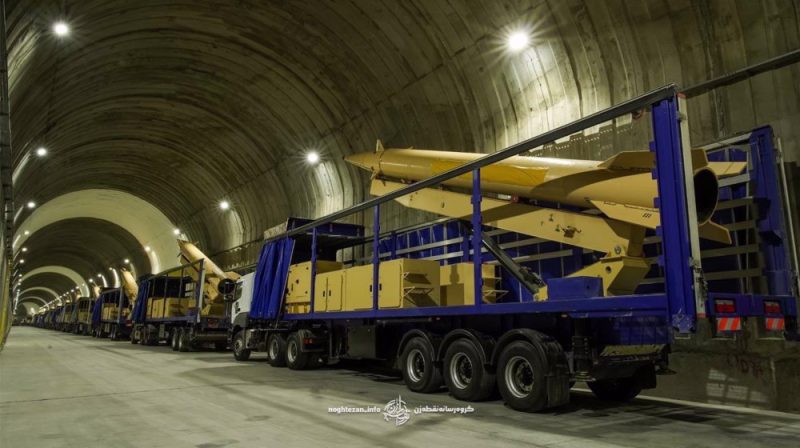
The Islamic Revolution Guards Corps (IRGC) on Tuesday unveiled its largest underground missile city at an undisclosed location, sending a powerful message to enemies about Iran’s growing military prowess and complete readiness for any eventuality.
The subterranean facility was revealed in the presence of Chief of Staff of the Iranian Armed Forces, Major General Mohammad Bagheri, and IRGC Aerospace Commander, Brigadier General Amir Ali Hajizadeh.
Its unveiling comes amid escalating threats and blatant warmongering from the Donald Trump administration and the Israeli regime, prompting Iran to showcase its military preparedness to defend the homeland.
Just three days prior, the IRGC had unveiled new missile systems on three strategic islands in the Persian Gulf, capable of striking enemy bases, vessels, and assets across the region.
In recent years, the IRGC has released images of various underground bases, but this latest facility stands out as the largest yet, both in scale and firepower.
What ballistic missiles are stored in this underground base?
During the latest unveiling, it was revealed that a wide array of ballistic missiles—including Kheibar Shekan, Haj Qasem, Emad, Sajjil, and Ghadr-H, as well as Paveh cruise missiles—are stored in this missile city.
In a single frame, at least 78 Kheibar Shekan or Haj Qasem missiles were visible, with additional footage showing tunnels filled with dozens more, suggesting that the base houses at least hundreds, if not thousands, of missiles.
Some of these missiles, such as Kheibar Shekan, Ghadr, and Emad, were used in the True Promise I and II retaliatory operations against the Zionist entity last year that sent shockwaves across the world.
These operations demonstrated Iran’s capability to strike Israeli military and intelligence targets with high precision, penetrating much-hyped and advanced Israeli and American air defense systems.
During his visit to the facility, Major General Bagheri emphasized that “Iran’s iron fist is far stronger today than before,” stating that the current missile capacity is ten times greater than during past operations.
He further asserted that “the enemy will definitely fall behind in this balance of power,” signaling Iran’s continued advancement in missile development and underground military infrastructure.
What is the purpose of underground bases?
Iran’s underground missile bases are fortified military facilities constructed beneath the Earth’s surface to store, maintain, and launch ballistic missiles of short (SRBM), medium (MRBM), and intermediate range (IRBM).
Often referred to as “missile cities” by Iranian officials, these bases form a key component of Iran’s defense strategy, designed to shield its vast and burgeoning missile arsenal from detection and destruction during conflicts.
In addition to offering natural protection against aerial threats, these underground bases allow military operations to be carried out in complete secrecy, avoiding exposure to aerial reconnaissance.
The exact number of these facilities remains a closely guarded secret, but estimates suggest there are dozens of them, mostly located in the western mountainous regions.
Brigadier General Hajizadeh in a TV interview recently commented on the vast number of missile bases in the country, stating, “If we unveil a missile city every week for the next two years, it will still not be finished.”
The IRGC has frequently released footage from these underground bases, and analysis of tunnel shapes and weaponry confirms that they are distinct facilities.
In 2018, the IRGC announced the relocation of missile factories to underground bases, marking the first time images from a subterranean ballistic missile production plant were publicly released.
Beyond missile bases, Iran has also constructed underground air bases for jet fighters, underground naval bases for speedboats and missiles, and underground drone facilities.
How protected are these underground bases?
With modern satellite, reconnaissance, and intelligence technology, fully concealing the locations of such underground bases is impossible, particularly due to excavation debris and construction logistics.
However, this does not make them vulnerable, as they are typically carved into mountains, with depths reported to reach up to 500 meters, providing protection against airstrikes and nearly all bunker-busting munitions.
All critical facilities are located hundreds of meters inside the mountains and are practically indestructible, with multiple entrances and exits being their only potential weak points.
To mitigate this, each base has up to several dozen entrances. The destruction of one or even a few does not cause significant damage, as they are typically hundreds or thousands of meters apart, separated by multiple tunnel gates.
Iran has refined camouflage techniques and the creation of false entrances to ensure operational continuity, even under complete enemy air dominance.
Based on published images and videos, these bases feature arched tunnel designs, optimal for load distribution, arranged in either linear or grid formations.
Tunnels range from 6 to 12 meters in width, sometimes reinforced with concrete ceilings, and serve as corridors, missile storage areas, and parking spaces for transporter-erector launchers (TELs).
In some cases, high halls are visible, suggesting the utilization of natural caves to reduce excavation costs and complicate hostile intelligence assessments based on excavation debris.
How are ballistic missiles stored in these bases launched?
Ballistic missiles stored in these bases are launched in two ways: either by deploying the transporter-erector launcher into the open or using vertical silos.
Each base contains numerous silos—often several dozen—as they, along with entrances, are potential vulnerabilities.
Once a silo is used, the hot exhaust trail from rocket engines irreversibly reveals its position, making it a prime target for aerial bombs or cruise missiles.
To counter this, Iran has developed unique underground launch methods to enhance both effectiveness and stealth.
In 2020, Iran released footage of an underground missile system capable of launching multiple ballistic missiles from a single silo in rapid succession.
In other countries with underground missile bases—where such facilities are typically used for bulky intercontinental ballistic missiles (ICBMs) within nuclear deterrence strategies—each silo usually holds only one missile.
By contrast, Iran’s system functions more like a “semi-automatic” magazine-fed launcher, rather than a “single-shot” silo.
Footage shows five Emad missiles positioned for vertical launch on a single rail car, which then moves down a high tunnel toward the launch site.
The tunnel’s length and rail system suggest it can rapidly launch dozens of missiles before a potential counterstrike, with multiple silo openings likely enabling continuous barrages.
That same year, during the Payambar-e-A’azam (The Great Prophet) 14 drills, Iran demonstrated a unique camouflaged underground ballistic missile launch, bypassing conventional platforms and equipment.
Brigadier General Hajizadeh stated that Iran was the first country in the world to achieve such a launch capability, posing significant challenges to enemy intelligence agencies.
The released video shows two missiles launching from different locations on what appears to be an untouched surface, suggesting that the vertical launch tubes were constructed from below rather than being dug from above and later camouflaged.
This demonstration signaled that Iran’s underground missile bases, often covering dozens of square kilometers, may house countless concealed silos.
The High Price of War with Iran: $10 Gas and the Collapse of the US Economy
By Dennis J. Kucinich | March 25, 2025
Israel is currently in turmoil, marked by widespread protests demanding Netanyahu’s resignation. Critics accuse him of prolonging war for political gain, while his dismissal of top security officials and ongoing attacks on the judiciary have further intensified the unrest.
Meanwhile, Washington DC’s drumbeat for war never stops. It’s always at the expense of a decent and secure standard of living for people in this country and abroad.
The Trump Administration, after the series of heady airstrikes against Yemen, is at this moment being beseeched by Netanyahu and his associates to prepare for a seemingly consequence-free nuclear strike against Iran, completing the trifecta of Netanyahu’s long-standing dream.
I have consistently warned against the consequences of an attack on Iran, delivering 155 speeches to the House, 63 presentations alone in the 109th Congress, between 2005 and 2007, when the Bush Administration deliberated using nuclear “bunker-busters” as a means of bringing Iran to heel.
I understood the politics then and I understand them today. I warned hundreds of times that it was not in America’s interests to go to war against Netanyahu’s hit list: Iraq, Iran, Libya…
IRAQ
In 2002, the Bush Administration caused Americans grieving over 9/11 to believe Iraq had a direct role in the attacks which took over 3,000 lives. Except, Iraq had nothing to do with 9/11.
Bush claimed Iraq was pursuing nuclear weapons and other “Weapons of Mass Destruction” (WMDs) and was an imminent threat to the U.S. Iraq did not have WMD’s. Iraq was not a threat to the U.S. Iraq had no ability to attack America. Didn’t matter.
The war against Iraq began 22 years ago and lasted eight years. One million innocent Iraqi men, women and children perished because of lies. They were killed in relentless bombings and aggressive ground operations.
At least 4,443 U.S. servicemen and women were killed, and an estimated 32,000 wounded during “Operation Iraqi Freedom,” because of lies.
The lies cost U.S. taxpayers at least $3 trillion. Three trillion hard-earned tax dollars of the American people were spent to pay for the destruction of the people of Iraq while Americans struggled to pay bills for housing, health care, and education and the nation went further into debt.
Remember this diabolical playbook: Create a pretext. Lie to the American people about a threat. Hype the threat. Create irrational fear. Tell them military action is needed to eliminate the threat, and their fears. Bombs away.
On September 12, 2002, as a Member of Congress, I grilled then-former Israeli Prime Minister Benjamin Netanyahu during a congressional hearing entitled, “An Israeli Perspective on Conflict with Iraq” (video and transcript link below). Despite evidence to the contrary, he testified that Iraq and its leader, Saddam Hussein, were a direct threat to America due to an alleged pursuit of WMDs including a nuclear weapon. He urged the U.S. to take military action against Iraq.
I inquired of him who else he would have the United States attack.
“Iran and Libya,” he said.
I spoke to Mr. Netanyahu outside the hearing room and asked him that if he was so convinced those countries were a threat, why didn’t Israel commence the attacks?
“Oh no,” he responded. “We need you to do it.”
On October 10, 2002, the House of Representatives, by a vote of 296-133, authorized the use of military force against Iraq. I led the opposition. The war bill passed the Senate the next day, 77-23, and was signed into law by President Bush on October 16, 2002.
On March 20, 2003, the President describing Iraq as part of an “Axis of Evil,” commenced a “Shock and Awe” onslaught by American warships, aircraft and submarines, launching cruise missiles and “precision guided bombs” roundly murdering people in Baghdad. Iraq was destroyed. Saddam was deposed, captured and hung.
Libya
On March 19, 2011, despite lacking formal congressional authorization, President Barack Obama authorized an attack on Libya to depose Muammar Gaddafi. I led the opposition. Hillary Clinton’s State Department, the EU, NATO, the UK and France to name but a few, lobbied Congress hard to accelerate actions against Libya.
That country’s leaders were dumbfounded as to why, considering that they had done everything America had asked, such as open markets to foreign investment. I held up the bombing for some time by building a bi-partisan coalition of Members of Congress to vote no.
Alas, Obama and the Clinton State Department prevailed. Republican Speaker of the House John Boehner negotiated a redraft of the authorization bill and the Republicans fell in line.
The U.S., with NATO allies, joined forces, wreaking destruction and havoc upon Libya. Gaddafi was deposed, captured and killed, at an estimated cost of over a billion dollars. Obama admitted years later that this was the worst decision of his Presidency.
Iran
On July 25, 2024, Prime Minister Netanyahu, (while under a criminal investigation by the Israeli judiciary), addressed the U.S. Congress concerning Iran, which he characterized as not only a deadly enemy of Israel, but also of the United States.
“Iran’s axis of terror confronts America, Israel and our Arab friends,” Netanyahu declared.
The interests of Israel and America were and are inseparable, he proclaimed – to 58 standing ovations. One could take that heroic reception as rubberstamping an authorization for war. As Netanyahu had told me years ago, “…we need you [the U.S.] to do it.”
Today, the Houthis of Yemen continue their attacks on Israeli shipping interests in the Red Sea, in protest to the Netanyahu government’s genocidal attack on Gaza.
President Trump, ever sensitive to and allegiant to Israel, views the Houthis as proxies of Iran. The President directed America’s air forces to rain down fire and brimstone upon Yemen, a nation of teenagers. The median age in Yemen is 18.4 years. The country spends about 1/1000 of the U.S. military budget for its own defense.
Trump threatened the Iranian government: “Every shot fired by the Houthis will be looked upon from this point forward, as being a shot fired from the weapons and leadership of IRAN (his emphasis). And IRAN will be held responsible, and suffer the consequences, and those consequences will be dire.”
The Administration followed up with Executive Order (E.O.) 13902, which, according to the U.S. Treasury Department was part of a “campaign of maximum pressure” which “targets Iran’s petroleum and petrochemical sectors and marks the fourth round of sanctions targeting Iranian oil sales…”
The first Trump Administration withdrew from a Joint Plan of Action agreement (JCPOA) which provided Iran relief from sanctions in exchange for accepting limitations which would preclude nuclear weaponization.
President Trump ordered the assassination by drone strike of Iranian General Qasem Soleimani, considered the second most powerful person in Iran, at the Baghdad airport, underscoring his determination to strike at Iran.
Iran has consistently asserted its nuclear research is for peaceful purposes. There has been a long-standing formal prohibition in Islamic law, a fatwa, issued by Ayatollah Ali Khamenei, the Supreme Leader of Iran, against the development or use of nuclear weapons.
Recently, President Trump said he would love a deal to prevent Iran from having a nuclear weapon, “I would love to make a deal with them without bombing them.”
At the same time, U.S. B-52 bombers, capable of delivering nuclear bunker-busting bombs, were engaged in joint exercises with the Israeli Air Force, in preparation for a potential strike at Iran’s underground nuclear sites.
These joint maneuvers were reminiscent of the cooperation and interoperability exercises that took place between the UK and French forces in preparation for a real-world offensive against Libya in 2011.
Ayatollah Khamenei replied “…threats will get them (the Americans) nowhere,” and refused talks under such conditions as “deceptive.” Iranian Brigadier General Kiumars Heidari added, for emphasis, “Iran is ready to crush its enemies if it makes mistakes.”
The dialectic of conflict is escalating.
It was not in America’s interest then, nor is it now, to go to war with Iran, a nation of 90 million people, a technologically advanced society, with nearly a million-person army.
President Trump should not be misled. War with Iran would be the end of his presidency. Here is why:
Iran supplies 3% of the world’s oil. If the U.S. goes to war with Iran, crude oil prices per barrel (currently ranging from $68.86 (West Texas Intermediate) – $72.28 (Brent Crude), could rise to $200 per barrel.
The Strait of Hormuz, a major conduit for the transport of oil would be disrupted. Iran has the capability retaliate by targeting Gulf oil infrastructure, including Saudi Arabia. Market panic would ensue.
The price of a gallon of gas, currently averaging $3.13, would double, approach $7 a gallon, and in some cases, reach $10 a gallon, in states with higher fuel taxes. (This is based on historical data which calculates that every $1 increase in crude oil per barrel translates to about a 2 to 3 cent increase per gallon at the pump).
Attempts to manage supply disruptions and market distortions through the release of oil from the Strategic Petroleum Reserve would do little to offset panic buying and stockpiling by consumers. Nor would an increase in U.S. domestic drilling be sufficient to offset lost Middle East oil supplies, due to supply shortage, infrastructure constraints and limitations on refining capacity.
Major disruptions, including high inflation, recession risks, and market instability would hit the US economy. Consumer retail spending would sink while prices rose for food and other goods, as energy costs for manufacturing, agriculture and transportation spiraled out of control.
Slower economic growth would push the U.S. into a recession, with the Fed forced to try to maintain control over inflation by hiking interest rates well beyond the current 4.25% – 4.50 % range.
Auto sales would take a hit. Corporate profits in transportation, airlines, trucking would nosedive. The Dow Jones and S& P 500 would be in shock, with major selloffs. America would arrive at stagflation, high inflation rates and negative growth as it did during the 1973 Oil Embargo.
The multiple economic impacts of the 2008 subprime meltdown and subsequent financial crash which cost the US economy $16 to $20 trillion dollars would become the morbid benchmark for the descent of the American economy.
Now contemplate this concatenation: War with Iran, reciprocal high tariffs, massive cuts in the federal workforce and domestic federal spending and you have an economy in a tailspin, with high inflation, rising unemployment, falling consumer spending, leading to an economic contraction requiring a system of government intervention which is currently being dismantled. Then there is the permanent restructuring of the tax code to accelerate wealth upwards. These conditions create political combustibility.
In the end, Iran will never crush Donald Trump. The U.S. will crush itself trying to wipe out Iran.
The economic effects of war with Iran could spell the end, not only of the viability of the Trump Presidency, but of the Republican House and Senate, a political turnaround the likes of which has not been seen in American politics since the 1932 sweep led by Franklin Delano Roosevelt and the New Deal.
In 1928 Republican Herbert Hoover took 58.2% of the popular vote and defeated Democrat Al Smith 444-87 in the Electoral College. Amidst a complete rejection of Republican economic policies and the Depression, Roosevelt took 57.4% of the popular vote in 1932 and defeated Hoover in the Electoral College 472-59.
The 270-164 advantage which House Republicans held in 1928 evaporated in 1932 as Democrats crushed Republicans with a 313-117 majority.
There has not been another turnaround like this in American political history and it was driven by the economic forces which overwhelmed a Republican Administration, followed by a program of promised reform which the new Administration delivered.
While the Administration is at the fullness of its expression of unbridled power, it faces a fateful decision regarding Iran which will determine whether the mandate received by Trump in 2024 evaporates as quickly as did Hoover’s in 1932.
Israel itself is in turmoil, with mass protests calling for Netanyahu’s resignation, charges he is prolonging the war for his political benefit, his firing of top security officials and his attacks on the judiciary.
Netanyahu is on shaky ground, pummeled by his fellow countrymen and women who worry, far from ensuring the future of Israel, his deadly policies threaten it.
One could imagine Trump, considering his own and America’s interests, could call Netanyahu and say, “Bibi, we are friends ‘til the end. This is the end.”
Links: 2002 Congressional Hearing “Conflict in Iraq: An Israeli Perspective” video and transcript
Talk of US-Iran war is all a load of baloney
By M. K. BHADRAKUMAR | Indian Punchline | March 26, 2025
The air is thick with the prognosis that a military confrontation between the US and Iran is now just a matter of time. Going by the pattern of such scare mongering in the past decades, Israeli media management skills are self-evident. There is a sense of de javu. Of course, therein lies the danger of miscalculations by the protagonists but that is unlikely to happen.
There are no takers among the regional states for a military conflagration in the Gulf region. The old US-led anti-Iran front has unravelled following the shift in the Iranian and Saudi policies towards reconciliation and amity and the display of strategic autonomy by even those countries who still remain close allies of the US (in particular, Saudi Arabia, the UAE, Qatar.)
In a recent interview with the famous American podcaster Tucker Carlson, Qatar’s Prime Minister and Minister of Foreign Affairs Sheikh Mohammed bin Abdulrahman Al Thani drew an apocalyptic scenario that his country and the Persian Gulf Arab states will run out of water within three days if Iran’s nuclear facilities are targeted by the US or Israel! Does that occur to anyone?
The big question is, what are the intentions of the Trump administration. An underlying assumption here is that President Donald Trump is under obligation to the Jewish-Israeli lobby who funded his election campaign to be supportive of Netanyahu all the way through thick and thin. This assumption is untested yet and may never be, perhaps, given Trump’s complex personality as a deal maker.
According to a recent poll from YouGov, 52% of Americans think Trump will have a shot at a third term; former White House strategist Steve Bannon is convinced that Trump will run and win in 2028. Indeed, Trump himself has not ruled out a 2028 White House bid. This is an X factor, given the historical legacy that the Iran question ultimately proved to be the nemesis of Jimmy Carter’s presidency. Trump, a connoisseur of past American presidencies, cannot be unaware that he ought to tread with great circumspection.
In an interview with Tucker Carlson last week, Trump’s Middle East special envoy Steve Witkoff underscored that regional stabilisation in West Asia demands addressing Iran. In his words, “I would say the goal begins with how do we deal with Iran? That’s the biggie. So the first is nuclear… If they were to have a bomb that would create North Korea in the GCC, we cannot have that… we can never allow someone to have a nuclear weapon and have outsized influence. That doesn’t work. So if we can solve for that, which I’m hopeful that we can.
“The next thing we need to deal with Iran is they’re being a benefactor of these proxy armies because we’ve proven that … they’re not really an existential risk… But if we can get these terrorist organisations eliminated as risks. Not existential, but still risks. They’re destabilising risks. Then we’ll normalise everywhere. I think Lebanon could normalise with Israel, literally normalise, meaning a peace treaty with the two countries. That’s really possible.
“Syria, too, the indications are that Jelani is a different person than he once was. And people do change. You at 55 are completely different than how you were at 35, that’s for sure… So maybe Jelani in Syria is a different guy. They’ve driven Iran out.
“Imagine if Lebanon normalises, Syria normalises, and the Saudis sign a normalisation treaty with Israel because there’s a peace in Gaza. They must have that as a — without question — as a prerequisite. That’s a condition precedent to Saudi normalising. But now you’d begin to have a GCC that all work together. I mean, that would be, it would be epic.”
Does this ‘big picture’ envisage the destruction of Iran as a prerequisite? Not even remotely. And if anyone should know what he is talking about, it is Witkoff.
Later, towards the end of the interview, Carlson drew out Witkoff specifically with regard to Trump’s recent communication addressed to Iran’s Supreme Leader Ayatollah Ali Khamenei. Excerpts of Witkoff’s remarks are reproduced below:
“Look, he [Trump] sent a letter to the Iranians. Usually it would be the Iranians sending a letter to him…They’re open to attack today. Yeah, they’re a small country compared to ours… If we used overwhelming force, it would be very, very bad for them…
“So under those circumstances, it would be natural for the Iranians to reach out to the President to say, I want to diplomatically solve this. Instead, it’s him doing that. Now, I can tell you that he’s not reaching out because he’s weak, because he is not a weak man. He is a strong man… Maybe the strongest man I’ve ever met in my life…
“So with that all said, he wrote that letter. And why did he write that letter? It roughly said, ‘I’m a president of peace. That’s what I want. There’s no reason for us to do this militarily. We should talk. We should clear up the misconceptions. We should create a verification program so that nobody worries about weaponisation of your nuclear material. And I’d like to get us to that place because the alternative is not a very good alternative.’ That’s a rough encapsulation of what was said…
“The Iranians have reached back out, and I’m not at liberty to talk about specifics, but clearly, through back channels, through multiple countries and multiple conduits, they’ve reached back out.
“I think that it has a real possibility of being solved diplomatically, not because I’ve talked to anybody in Iran, but just because I think logically it makes sense that it ought to be solved diplomatically. It should be.
“I think the President has acknowledged that he’s open to an opportunity to clean it all up with Iran, where they come back to the world and be a great nation once again and not have to be sanctioned and being able to grow their economy. Their economy—I mean, these are very smart people. Their economy was once a wonderful economy. They’re being strangled and suffocated today. There’s no need for that to happen.
“They can join the League of Nations and we can have a better relationship and grow that relationship… That’s the alternative he’s presenting… he wants to deal with Iran with respect. He wants to build trust with them if it’s possible. And that’s his directive to his administration. And hopefully, that will be met positively by the Iranians.
“And I’m certainly hopeful for it. I think anything can be solved with dialogue by clearing up misconception and miscommunication and disconnects between people… And the president is a president who doesn’t want to go to war, and he’ll use military action to stop a war … In this particular case, hopefully it won’t be necessary. Hopefully, we can do it at the negotiating table…”
Again, do such remarks sound like war mongering? Curiously, in the interview, Witkoff openly welcomed an opportunity to serve as Trump’s special envoy to Iran to navigate the dialogue and peaceful resolution of issues.
To my mind, Iranians understand the meaning of Trump’s letter. They are now in an engaging mood as back channels are clocking hours. A commentary by Nour News, a mouthpiece of the Iranian security establishment, rather playfully titled as Analysis of Trump’s Letter to Iran from a Game Theory Perspective, speaks for the mood in Tehran. Read it here.
Make no mistake that Iran and the US are seasoned adversaries who have absolute mastery over the guardrails that contain tensions from escalating in their complicated relationship.
Featured Video
Macgregor: We Haven’t Seen the Worst of the Iran War Yet
or go to
Aletho News Archives – Video-Images
New Book
Breast Cancer: Before You Consent
A new Unbekoming paperback
Lies are Unbekoming | September 18, 2026
Peter Gøtzsche reviewed every randomised mammography screening trial ever conducted for the Cochrane Collaboration. Cochrane’s headline is that, assuming a 15% mortality reduction, one woman in 2000 avoids dying of breast cancer over ten years. Ten are overdiagnosed and treated. Two hundred experience false alarms.
But that headline assumes the reduction. When Gøtzsche looked only at the trials with adequate randomisation — the higher-quality ones — the reduction disappeared. No effect on breast cancer mortality. No effect on all-cause mortality.
This is the Cochrane finding, published in the establishment’s own database of systematic reviews.
No woman being asked to consent to a mammogram this week knows it.
That is why the new Unbekoming paperback exists. … continue
Blog Roll
 Aletho News
- Breast Cancer: Before You Consent
- Iran’s Plan to Shut Down AI in the Persian Gulf
- Israel seeks ‘compensation’ from Washington over Saudi F-35 sale
- Saudi crown prince seeks dialogue with Ansarullah after Yemeni blows: Report
- Damascus rejects Saudi request for Syrian fighters to counter Yemen: Report
- South Korea says will not send troops to join terrorist US war on Iran
- Russia Just Struck the Eyes of NATO’s War Machine in Ukraine
- Russia summons UK charge d’affaires over Kiev drone support
- NATO member warns bloc seeking pretext for war with Russia
- Macgregor: We Haven’t Seen the Worst of the Iran War Yet
- If Americans Knew
- Debunking The Claim That Macklemore Has A “History Of Antisemitism”
- CPJ demands release of arrested Palestinian-US journalist near Bethlehem
- Robert Kraft: The Billionaire Friend of Netanyahu Pulling The Strings Behind the Macklemore/Ed Sheeran Blow Up
- Columbia Administered Fund Gives Big Money to Pro-Israel Groups
- Deportation Case of Palestinian Activist Salah Sarsour Tests First Amendment
- ‘We Will Not Forget’: Palestinians Mark 44 Years since Sabra and Shatila
- Why do we let Zionists decide what we can and can’t say?
- US welcomes Israeli, Iranian delegations to UN, but not Palestinians – Daily Update
- Biden’s Genocide Accomplices Targeted by New Accountability Campaign
- AIPAC’s Network Has Already Spent $67.2 Million to Shape the Midterm Elections
- No Tricks Zone
- New Study: ‘Global Drought Shows No Detectable Recent Acceleration Under Climate Warming’
- Economic Masterminds: German Socialists Suggest Taxing Productivity Gains Stemming From Using AI
- The South China Sea Has Not Been Cooperating With The Climate Change Narrative
- Energy Crisis: Germany Enters Heating Season With Historically Low Gas Reserve Fill Levels
- New Study: The Antarctic Ice Sheet Gained Mass From 2020-2024 Due To Staggering Snow And Ice Accumulation
- Study: Ocean Heating Rates From Thousands Of Years Ago ‘Dwarf’ Modern Ocean Heating Rates
- Climate Extremists Target, Attack Large-Scale Power Grid Infrastructure In Germany!
- New Study: Antarctic Ice Melt Has Contributed Less Than 1 Centimeter To Sea Level Rise In The Last 30 Years
- Fear Of Debate: Alarmist German Climate Scientist Calls On Mainstream Media To Discredit Skeptic Voices
- End-Of-August Arctic Sea Ice Extent Hasn’t Fallen In 20 Years, Official Data Show!
 Aletho News