The New Militarism: Who Profits?
By Ron Paul | April 12, 2015
Militarism and military spending are everywhere on the rise, as the new Cold War propaganda seems to be paying off. The new “threats” that are being hyped bring big profits to military contractors and the network of think tanks they pay to produce pro-war propaganda.
Here are just a few examples:
The German government announced last week that it would purchase 100 more “Leopard” tanks – a 45 percent increase in the country’s inventory. Germany had greatly reduced its inventory of tanks as the end of the Cold War meant the end of any threat of a Soviet ground invasion of Europe. The German government now claims these 100 new tanks, which may cost nearly half a billion dollars, are necessary to respond to the new Russian assertiveness in the region. Never mind that Russia has neither invaded nor threatened any country in the region, much less a NATO member country.
The US Cold War-era nuclear bunker under Cheyenne Mountain, Colorado, which was all but shut down in the 25 years since the fall of the Berlin Wall, is being brought back to life. The Pentagon has committed nearly a billion dollars to upgrading the facility to its previous Cold War-level of operations. US defense contractor Raytheon will be the prime beneficiary of this contract. Raytheon is a major financial sponsor of think tanks like the Institute for the Study of War, which continuously churn out pro-war propaganda. I am sure these big contracts are a good return on that investment.
NATO, which I believe should have been shut down after the Cold War ended, is also getting its own massively expensive upgrade. The Alliance commissioned a new headquarters building in Brussels, Belgium, in 2010, which is supposed to be completed in 2016. The building looks like a hideous claw, and the final cost – if it is ever finished – will be well over one billion dollars. That is more than twice what was originally budgeted. What a boondoggle! Is it any surprise that NATO bureaucrats and generals continuously try to terrify us with tales of the new Russian threat? They need to justify their expansion plans!
So who is the real enemy? The Russians?
No, the real enemy is the taxpayer. The real enemy is the middle class and the productive sectors of the economy. We are the victims of this new runaway military spending. Every dollar or euro spent on a contrived threat is a dollar or euro taken out of the real economy and wasted on military Keynesianism. It is a dollar stolen from a small business owner that will not be invested in innovation, spent on research to combat disease, or even donated to charities that help the needy.
One of the most pervasive and dangerous myths of our time is that military spending benefits an economy. This could not be further from the truth. Such spending benefits a thin layer of well-connected and well-paid elites. It diverts scarce resources from meeting the needs and desires of a population and channels them into manufacturing tools of destruction. The costs may be hidden by the money-printing of the central banks, but they are eventually realized in the steady destruction of a currency.
The elites are terrified that peace may finally break out, which will be bad for their profits. That is why they are trying to scuttle the Iran deal, nix the Cuba thaw, and drum up a new “Red Scare” coming from Moscow. We must not be fooled into believing their lies.
Locals Protest, Sabotage U.S. Navy Base Construction in Desert in Sicily
World Beyond War
There’s a popular movement in Sicily called No MUOS. MUOS means Mobile User Objective System. It’s a satellite communications system created by the U.S. Navy. The primary contractor and profiteer building the satellite equipment at the U.S. Navy base in the desert in Sicily is Lockheed Martin Space Systems. This is one of four ground stations, each intended to include three swivelling very-high-frequency satellite dishes with a diameter of 18.4 meters and two Ultra High Frequency (UHF) helical antennas.
Protests have been growing in the nearby town of Niscemi since 2012. In October 2012, construction was suspended for a few weeks. In early 2013 the President of the Region of Sicily revoked the authorization for the MUOS construction. The Italian government conducted a dubious study of health impacts and concluded the project was safe. Work recommenced. The town of Niscemi appealed, and in April 2014 the Regional Administrative Tribunal requested a new study. Construction goes on, as does resistance.
I spoke with Fabio D’Alessandro, a juornalist and law school graduate living in Niscemi. “I’m part of the No MUOS movement,” he told me, “a movement that works to prevent the installation of the U.S. satellite system called MUOS. To be specific, I’m part of the No MUOS committee of Niscemi, which is part of the coalition of No MUOS committees, a network of committees spread around Sicily and in the major Italian cities.”
“It is very sad,” said D’Alessandro,”to realize that in the United States people know little about MUOS. MUOS is a system for high-frequency and narrowband satellite communications, composed of five satellites and four stations on earth, one of which is planned for Niscemi. MUOS was developed by the U.S. Department of Defense. The purpose of the program is the creation of a global communications network that allows communication in real time with any soldier in any part of the world. In addition it will be possible to send encrypted messages. One of the principal functions of MUOS, apart from the speed of communications, is the ability to remotely pilot drones. Recent tests have demonstrated how MUOS can be used at the North Pole. In short, MUOS will serve to support any U.S. conflict in the Mediterranean or the Middle East or Asia. It’s all part of the effort to automate war, entrusting the choice of targets to machines.”
“There are many reasons to oppose MUOS,” D’Alessandro told me, “first of all the local community has not been advised of the installation. The MUOS satellite dishes and antennas are built within a non-NATO U.S. military base that has existed in Niscemi since 1991. The base was constructed within a nature preserve, destroying thousands of cork oaks and devestating the landscape by means of bulldozers that leveled a hill. The base is larger than the town of Niscemi itself. The presence of the satellite dishes and antennas puts at serious risk a fragile habitat including flora and fauna that exist only in this place. And no study has been conducted of the dangers of the electromagnetic waves emitted, neither for the animal population nor for the human inhabitants and the civilian flights from the Comiso Airport approximately 20 kilometers away.
“Within the base there are already present 46 satellite dishes, surpassing the limit set by Italian law. Moreover, as determined anti-militarists, we oppose further militarizing this area, which already has the base at Sigonella and other U.S. bases in Sicily. We don’t want to be complicit in the next wars. And we don’t want to become a target for whoever attempts to attack the U.S. military.”
What have you done thus far, I asked.
“We’ve engaged in lots of different actions against the base: more than once we’ve cut through the fences; three times we’ve invaded the base en masse; twice we’ve entered the base with thousands demonstrating. We’ve blocked the roads to prevent access for the workers and the American military personnel. There has been sabotage of the optical communication wires, and many other actions.”
The No Dal Molin movement against the new base at Vicenza, Italy, has not stopped that base. Have you learned anything from their efforts? Are you in touch with them?
“We are in constant contact with No Dal Molin, and we know their history well. The company that is building MUOS, Gemmo SPA, is the same that did the work on Dal Molin and is currently under investigation subsequent to the seizure of the MUOS building site by the courts in Caltagirone. Anyone attempting to bring into doubt the legitimacy of U.S. military bases in Italy is obliged to work with political groups on the right and left that have always been pro-NATO. And in this case the first supporters of MUOS were the politicians just as happened at Dal Molin. We often meet with delegations of activists from Vicenza and three times have been their guests.”
I went with representatives of No Dal Molin to meet with Congress Members and Senators and their staffs in Washington, and they simply asked us where the base should go if not Vicenza. We replied “Nowhere.” Have you met with anyone in the U.S. government or communicated with them in any way?
“Many times the U.S. consuls have come to Niscemi but we have never been permitted to speak with them. We have never in any way communicated with U.S. senators/representatives, and none have ever asked to meet with us.”
Where are the other three MOUS sites? Are you in touch with resisters there? Or with the resistance to bases on Jeju Island or Okinawa or the Philippines or elsewhere around the world? The Chagossians seeking to return might make good allies, right? What about the groups studying the military damage to Sardinia? Environmental groups are concerned about Jeju and about Pagan Island Are they helpful in Sicily?
“We are in direct contact with the No Radar group in Sardinia. One of the planners of that struggle has worked (for free) for us. We know the other anti-U.S.-base movements around the world, and thanks to No Dal Molin and to David Vine, we have been able to hold some virtual meetings. Also thanks to the support of Bruce Gagnon of the Global Network Against Weapons and Nuclear Power in Space we are trying to get in touch with those in Hawaii and Okinawa.”
What would you most like people in the United States to know?
“The imperialism that the United States is imposing on the countries that lost the Second World War is shameful. We are tired of having to be slaves to a foreign politics that to us is crazy and that obliges us to make enormous sacrifices and that makes Sicily and Italy no longer lands of welcome and peace, but lands of war, deserts in use by the U.S. Navy.”
‘Dangerous process’: Russia warns against US, NATO military instructors in Ukraine
RT | April 8, 2015
A top Russian diplomat has promised that his country would push for removal of all foreign military specialists and illegal paramilitary groups from Ukrainian territory after US confirmed its plans to send about 300 instructors to train pro-Kiev troops.
Moscow is urging the removal of all foreign military formations from Ukraine, including the instructors from the United States and NATO, Deputy Foreign Minister Grigory Karasin said in an interview with the Rossiiskaya Gazeta daily.
“We know that hundreds of US and NATO servicemen are planning to come to Ukraine to train the National Guard. The training camps are being set up not only in western Ukraine, but also in other parts of the country. This is a dangerous process. We would push for all foreign and illegal military units to be removed from Ukraine,” Karasin said.
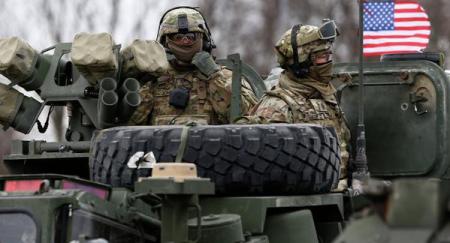
In mid-March, Pentagon spokesman Col. Steve Warren told the media that about 290 servicemen of the 173 Airborne Brigade will arrive to western Ukraine in late April to train three battalions of the Ukrainian National Guard. The planned location of the exercises was disclosed as the Yavoriv army training center near Lvov.
On Wednesday, Ukrainian PM Arseniy Yatsenyuk promised that his government would sign a number of agreements with NATO concerning military-technical cooperation. These would include a memorandum on communications and intelligence that would pave the way to Ukraine’s deeper participation in NATO’s Partnership for Peace program.
Russia has previously denounced the increasing buildup of NATO forces in Eastern Europe as well as US plans to supply weapons and non-lethal military equipment to Ukraine. The criticism became especially sharp when the House of Representatives in Washington passed a non-binding resolution calling on President Barack Obama to send lethal weapons to Ukraine, despite the ceasefire agreement between pro-Kiev forces and federalists in the east of the country.
Several Russian lawmakers have called the US Congress’ call to send “lethal aid” to Ukraine a threat to the peace process and a direct provocation aimed at Russia.
Ukraine agrees military-technical cooperation with NATO
RT | April 8, 2015
Ukraine will sign a set of agreements with NATO on military-technical cooperation in intelligence, surveillance and other areas, Ukrainian Prime Minister Arseniy Yatsenyuk told his Cabinet.
Kiev and NATO will sign a memorandum on cooperation in “control, communications, intelligence and surveillance” under NATO’s Partnership for Peace program, Yatsenyuk was cited as saying by Tass news agency.
Another document will see the implementation of four trust projects, including military-technical cooperation, communications and new information technologies, the PM added.
“Ukraine must restore its armed forces exclusively following the example of the strongest armies and strongest alliances that fight for peace in the world. In the first place, these are the standards of NATO, and we are moving in this direction,” Yatsenyuk said.
Ukraine is intensifying its ties with NATO in hopes of becoming a full member of the military alliance in five years’ time.
The issue of Ukraine joining NATO was raised by then-President Viktor Yuschenko in 2008, but Kiev’s application to join the alliance was turned downed by the 26 member states.
In 2010, then-President Viktor Yanukovich signed a decree securing Ukraine’s non-aligned status, ruling out NATO membership.
But after Yanukovich was overthrown in a violent coup in February 2014, Ukraine’s non-aligned status was revoked.
The nation will be able to consider NATO membership within five or six years, President Petro Poroshenko said before the New Year.
Various polls conducted in Ukraine suggest that the majority of the population now supports the country becoming a NATO member.
A series of reforms will have to first be implemented for Ukraine to meet NATO standards.
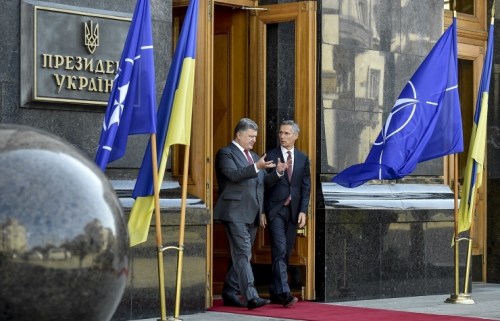
NATO Secretary General Jens Stoltenberg outlined some of the criteria that Ukraine would have to meet before joining the bloc. Firstly, it would have to combat corruption and improve the efficiency of state bodies, he said.
Stoltenberg also said that the possibility of deteriorating relations with Russia should not deter Ukraine from joining the bloc.
Moscow, which has always viewed NATO’s expansion to the east as a threat to its security, warned that it would cut all ties with the alliance if Ukraine joins.
The Ukrainian military has been involved in a deadly conflict with the rebels in the country’s southeastern Donetsk and Lugansk regions, who refused to recognize the regime change in Kiev.
Over 6,000 people have died in Ukraine during a year of violence, which only began to slow after Russia, France and Germany brokered a peace deal between the sides in mid-February.
Read more:
NATO to give Ukraine 15mn euros, lethal and non-lethal military supplies from members
‘Dangerous process’: Russia warns against US, NATO military instructors in Ukraine
Avaaz: manufacturing consent for wars since 2011
By James Boswell | Wall of Controversy | March 20, 2015
Four years ago I received an email from the internet campaign group Avaaz which read:
“Together, we’ve sent 450,000 emails to the UN Security Council, “overwhelming” the Council President and helping to win targeted sanctions and a justice process for the Libyan people. Now, to stop the bloodshed, we need a massive outcry for a no-fly zone.” [Bold as in the original.]
Of course, that no-fly zone was Nato’s justification for a war – “no-fly zone” means war. So the bloodshed wasn’t about to be stopped, it was about to begin in earnest:
The foreign media has largely ceased to cover Libya because it rightly believes it is too dangerous for journalists to go there. Yet I remember a moment in the early summer of 2011 in the frontline south of Benghazi when there were more reporters and camera crews present than there were rebel militiamen. Cameramen used to ask fellow foreign journalists to move aside when they were filming so that this did not become too apparent. In reality, Gaddafi’s overthrow was very much Nato’s doing, with Libyan militiamen mopping up.
Executing regime change in Libya cost the lives of an estimated 20,000 people: but this was only the immediate death toll, and as a civil war rages on, the final figure keeps rising, indefinitely and seemingly inexorably. And the number of victims will go on rising for so long as there is lawlessness and chaos in a country now completely overrun with terrorists and warlords. So what was started with a “no-fly zone” is ending with a hell on earth: abandon hope all ye who enter here.
Given their unpardonable role in instigating this entirely avoidable human catastrophe, does it come as any surprise when, with “mission accomplished”, the media chose to turn its back on the carnage in Libya? Patrick Cockburn, who wrote the article from which the above quote is taken, has been a rare exception to the rule. A journalist who was not so quick to swallow the official line, he has since been committed to telling the bigger story, which includes the falsity of Nato’s original justifications for air strikes:
Human rights organisations have had a much better record in Libya than the media since the start of the uprising in 2011. They discovered that there was no evidence for several highly publicised atrocities supposedly carried out by Gaddafi’s forces that were used to fuel popular support for the air war in the US, Britain, France and elsewhere. These included the story of the mass rape of women by Gaddafi’s troops that Amnesty International exposed as being without foundation. The uniformed bodies of government soldiers were described by rebel spokesmen as being men shot because they were about to defect to the opposition. Video film showed the soldiers still alive as rebel prisoners so it must have been the rebels who had executed them and put the blame on the government.
So here is a pattern that repeats with uncanny consistency, and with the mainstream media’s failure to discover and report on the truth also recurring with near parallel regularity. We had the ‘Babies out of incubators’ story in Kuwait, and then those WMDs in Iraq that, as Bush Jnr joked, “have got to be here somewhere”, to offer just two very well-established prior instances of the kinds of lies that have taken us to war.
Patrick Cockburn continues:
Foreign governments and media alike have good reason to forget what they said and did in Libya in 2011, because the aftermath of the overthrow of Gaddafi has been so appalling. The extent of the calamity is made clear by two reports on the present state of the country, one by Amnesty International called “Libya: Rule of the gun – abductions, torture and other militia abuses in western Libya” and a second by Human Rights Watch, focusing on the east of the country, called “Libya: Assassinations May Be Crimes Against Humanity”.1
Click here to read Patrick Cockburn’s full article published last November.
But accusations do not stop even at the deplorable roles played by “foreign governments and media alike”, but apply to all of the various warmongering parties at that time, and one of the groups we must also point the finger to is Avaaz. For it was Avaaz, more than any other campaign group, who pushed alongside Nato in their call for the “no-fly zone” which got the whole war going. To reiterate, since it is vitally important that this is understood, a “no-fly zone” always and without exception means war:
Clearly a no-fly zone makes foreign intervention sound rather humanitarian – putting the emphasis on stopping bombing, even though it could well lead to an escalation of violence.
No wonder, too, that it is rapidly becoming a key call of hawks on both sides of the Atlantic. The military hierarchy, with their budgets threatened by government cuts, surely cannot believe their luck – those who usually oppose wars are openly campaigning for more military involvement.2
So wrote John Hilary in an excellent article entitled “Internet activists should be careful what they wish for in Libya” published on the cusp of “intervention”.
In response, Ben Wikler, a campaign director at Avaaz, posted a comment that included the following remarks:
Would imposing a no-fly zone lead to a full-blown international war? No-fly zones can mean a range of different things.
Wikler is wrong and Hilary correct: “no-fly zones” always mean war. And as a consequence, those at Avaaz like Ben Wikler now have blood on their hands – and yet are unrepentant.
Yes, as with most others who were directly or indirectly culpable, “foreign governments and media alike”, it seems Avaaz too are suffering from collective amnesia. Not only have they forgotten the terrible consequences of imposing a “no-fly zone” on Libya, but they also seem to have forgotten their own deliberate efforts when it came to bolstering public support for that “bloody and calamitous” (to use Cockburn’s words) “foreign intervention” (to use the weasel euphemisms of Nato and the West). Because instead of reflecting upon the failings of Nato’s air campaign four years ago, and without offering the slightest murmur of apology for backing it (not that apologies help at all), Avaaz are now calling upon their supporters to forget our murderous blundering of the recent past, with calls for the same action all over again… this time in Syria.
It was yesterday when I received the latest email from Avaaz. Don’t worry, I’m not a supporter (although the simple fact I receive their emails means by their own definition, I am presumably counted one), but after Libya I chose to remain on their mailing list simply to keep an eye on what they were doing. And (not for the first or the second time) they are selling us on more war:
The Syrian air force just dropped chlorine gas bombs on children. Their little bodies gasped for air on hospital stretchers as medics held back tears, and watched as they suffocated to death.
But today there is a chance to stop these barrel bomb murders with a targeted No Fly Zone.
The US, Turkey, UK, France and others are right now seriously considering a safe zone in Northern Syria. Advisers close to President Obama support it, but he is worried he won’t have public support. That’s where we come in.
Let’s tell him we don’t want a world that just watches as a dictator drops chemical weapons on families in the night. We want action.
One humanitarian worker said ‘I wish the world could see what I have seen with my eyes. It breaks your heart forever.’ Let’s show that the world cares — sign to support a life-saving No Fly Zone
Obviously, I am not supplying the link for this latest call to arms: “a[nother] life-saving No Fly Zone”.
After Avaaz called for war against Libya back in 2011, I wrote a restrained article. But I was too polite. When they called for war again following the sarin gas attack on Ghouta, I hesitated again and looked into the facts. They didn’t stack up (as I explained at length in another post). But nor did I damn Avaaz on that occasion, as I ought to have done, when with Libya already ablaze they set up a campaign like this (sorry that it’s hard to read):

Since that time it has become evident to the world (at least the one outside the Avaaz office) that it has been Syrian forces who have most successfully fought back against Islamist extremists (al-Qaeda, but now more often called ISIS) who not only use poison gas to murder their enemies and spread fear, but methods so barbaric and depraved – public mass beheadings, crucifixions and even cannibalism – that you wonder which century we are living in. But Avaaz push the blame for all of this killing back on to the Assad regime, just as the West (whose close allies continue to back the so-called “rebels”) have also tried to do. And Avaaz are now saying (once again) that escalating the conflict is the way to save the people of Syria – so don’t worry if it spreads the infection now called ISIS – more love bombs are the preferred Avaaz solution for every complex political situation:
“Today, Gadhafi is dead, and the Libyan people have their first chance for democratic, accountable governance in decades…. American casualties were zero. Insurgent fighters and the vast majority of the population have cheered the victory as liberation, and courageous Syrians who face daily threats of death for standing up to their own repressive regime have taken comfort in Gadhafi’s fall. These accomplishments are no small feats for those who care about human dignity, democracy, and stability….
Progressives often demand action in the face of abject human suffering, but we know from recent history that in some situations moral condemnation, economic sanctions, or ex-post tribunals don’t save lives. Only force does.”
These are the self-congratulatory words of Tom Perriello, the co-founder of Avaaz, writing in late 2012. And he finishes the same piece:
We must realize that force is only one element of a coherent national security strategy and foreign policy. We must accept the reality—whether or not one accepts its merits—that other nations are more likely to perceive our motives to be self-interested than values-based. But in a world where egregious atrocities and grave threats exist, and where Kosovo and Libya have changed our sense of what’s now possible, the development of this next generation of power can be seen as a historically unique opportunity to reduce human suffering. 3
Independent investigative journalist, Cory Morningstar, who has probed very deeply into the organization says, “Make no mistake – this is the ideology at the helm of Avaaz.org.”
As she explains:
Tom Perriello is a long-time collaborator with Ricken Patel. Together, they co-founded Avaaz.org, Res Publica and FaithfulAmerica.org.
Perriello is a former U.S. Representative (represented the 5th District of Virginia from 2008 to 2010) and a founding member of the House Majority Leader’s National Security Working Group.
Perriello was also co-founder of Catholics in Alliance for the Common Good. He worked for Reverend Dr. James Forbes on “prophetic justice” principles. Many of these organizations were created with the intent of creating a broad-based “religious left” movement. […]
Despite the carefully crafted language and images that tug at your emotions, such NGOs were created for and exist for one primary purpose – to protect and further American policy and interests, under the guise of philanthropy and humanitarianism.
As Cory Morningstar also points out:
In December 2011, Perriello disclosed that he served as special adviser to the international war crimes prosecutor and has spent extensive time in 2011 in Egypt and the Middle East researching the Arab Spring. Therefore, based on this disclosure alone, there can be no doubt that the deliberate strategy being advanced by Avaaz cannot be based upon any type of ignorance or naïveté. 4
“It breaks your heart forever.” That was the heading under which yesterday’s email arrived and the way it signed off went as follows: “With hope, John, Mais, Nick, Alice, Rewan, Wissam, Ricken and the rest of the Avaaz team”. And this is how they come again with further ploys to prick your conscience. So do please remember before you click on their pastel-coloured links or forward those ‘messages’ to your own friends, how they beat the drums to war on two earlier occasions. In 2013, when they last called for the bombing of Syria (but the war party were halted in their mission), and in 2011 when they first aided Nato’s grand deception and helped to bring unremitting horrors to the innocent people of Libya. Keep in mind too, how lacking in guilt they have been in light of their own imploring role during the run up to the full “shock and awe” display over Tripoli.
Because John, Mais, Nick, Alice, Rewan, Wissam, Ricken and the rest… are really not our friends. They are humanitarian hawks, who are in the business of manufacturing consent for every Nato “intervention”. Indeed, I would like to ask John, Mais, Nick, Alice, Rewan, Wissam, Ricken and the rest, in good faith, just how do you sleep at night?
Click here to read a thorough examination of Avaaz put together by independent investigative journalist Cory Morningstar.
*
Additional:
Here is an open letter I constructed in Summer 2012, but then decided not to post:
Dear Ricken, Eli and the whole Avaaz team,
By your own rather loose definition, I have been a member of Avaaz now for several years. In other words I responded to one of your campaigns many moons ago, and have never subsequently withdrawn my name from your mailing list. I believe that under your own terms, I am thus one of the many millions of your ‘members’. You presume that all those like me who are ‘in the Avaaz community’ support your various campaigns simply because we are on your contact list, although in my own case, this is absolutely not the case. I have ceased to support any of the Avaaz campaigns since you pushed for a ‘no-fly zone’ over Libya, and from this time on, have kept up with your campaign messages simply to keep an eye on you. I vowed never again to sign any of your petitions on the grounds that I do not wish to be a supporter of any organisation that backs an aggressive and expansionist war.
The most common criticism of Avaaz, and other internet campaign groups, is that it encourages ‘slacktivism’, which is indeed a very valid concern:
Sites such as Avaaz, suggested Micah White in the Guardian last year, often only deal with middle-of-the-road causes, to the exclusion of niche interests: “They are the Walmart of activism . . . and silence underfunded radical voices.” More infamously, internet theorist Evgeny Morozov has called the likes of Avaaz “Slacktivists”, claiming that they encourage previously tenacious activists to become lazy and complacent.
There’s also the issue of breadth. Clicktivist websites often cover a range of issues that have little thematic or geographical relation to each other, which leaves them open to accusations of dilettantism.
Click here to read Patrick Kingsey’s full article in the Guardian.
Ricken Patel’s response to Kingsley is to point to their campaign against Murdoch’s takeover of BSkyB:
“Our activism played a critical role in delaying the BskyB deal until the recent scandal was able to kill it,” Avaaz‘s founder, New York-based Ricken Patel, tells me via Skype. 5
So is this really the best example Avaaz has to offer? Since the BSkyB deal would undoubtedly have been stymied for all sorts of other reasons, not least of which were the various phone hacking scandals, and most shockingly, in the hacking of murdered schoolgirl Milly Dowler’s phone. This more than anything killed off the Murdoch bid for BSkyB.
We might also give a little grudging credit to Business Secretary Vince Cable, who in late 2010 revealed privately to undercover reporters that he was ‘declaring war’ on Rupert Murdoch. This caused such a storm that Tory leader David Cameron came out against Cable, describing his comments as “totally unacceptable and inappropriate”, whilst Labour leader Ed Miliband immediately followed suite saying that he would have gone further and sacked Cable 6. In any case, Murdoch was coming under attack from many fronts (including, as shown by Cable’s example, a maverick offensive from inside the government), and so there were already growing calls for a review of the BskyB deal. As it turns out, the deal itself was seriously compromised by a conflict of interests involving Ofcom Chairman Colette Bowe, not that this widely reported – I wrote a post on it just before the deal suddenly collapsed. In fact, I had tried in vain to get a number of politicians to look into this aspect of the case, but none at all even bothered to reply. The story the media were telling quickly moved on, and so the role of Ofcom remains more or less unscrutinised.
But I have a far bigger problem with Avaaz than simply the matter of its lack of effectiveness. Since even if Avaaz has achieved nothing concrete whatsoever, which might well be the case, its growing prominence as a campaign group is undoubtedly helping to frame the protest agenda. Picking and choosing what are and aren’t important issues is dilettantism, yes, and also, potentially at least, “the manufacturing of dissent”. Avaaz‘s defence is that it is an independent body – oh, really?
Co-founder and Director of Avaaz, Ricken Patel said in 2011 “We have no ideology per se. Our mission is to close the gap between the world we have and the world most people everywhere want. Idealists of the world unite!”
“No ideology per se”? So what then are we to make of your association with another organisation called Res Publica, of which Patel is a fellow, and Eli Pariser has also been a member of the Advisor Board.
Res Publica (US) is described by wikipedia as “a US organization promoting ‘good governance, civic virtue and deliberative democracy.’”, though there is no article on the group itself, and nor, for that matter, any entry on Ricken Patel himself. If I visit the Res Publica website, however, the link I immediately find takes me straight to George Soros’ Open Democracy group and also the International Crisis Group of which Soros is again a member of the Executive Committee. The International Crisis Group that gets such glowing endorsements from peace-loving individuals as (and here I quote directly from the website):
President Bill Clinton (‘in the most troubled corners of the world, the eyes, the ears and the conscience of the global community’); successive U.S. Secretaries of State (Condoleezza Rice: ‘a widely respected and influential organisation’, Colin Powell: ‘a mirror for the conscience of the world’ and Madeleine Albright: ‘a full-service conflict prevention organisation’); and former U.S. Special Representative for Afghanistan and Pakistan, the late Richard Holbrooke (‘a brilliant idea… beautifully implemented’ with reports like CrisisWatch ‘better than anything I saw in government’).
Whilst according to Res Publica‘s own website Ricken Patel has himself “consulted for the International Crisis Group, the United Nations, the Rockefeller Foundation, the Gates Foundation…”
To cut to the quick then, Avaaz claims to independence are simply a sham. Whether foundation funded or not, you are undeniably foundation affiliated. Which brings me to your recent campaigns.
In a letter which I received on Wednesday 11th January, you wrote, typically vaingloriously, about the significance of Avaaz in bringing about and supporting the uprisings of Arab Spring:
Across the Arab world, people power has toppled dictator after dictator, and our amazing Avaaz community has been at the heart of these struggles for democracy, breaking the media blackouts imposed by corrupt leaders, empowering citizen journalists, providing vital emergency relief to communities under siege, and helping protect hundreds of activists and their families from regime thugs.
When all that I can actually recall is some jumping on the bandwagon and your support for the ‘shock and awe’ assault that we saw lighting up the skies over Tripoli. Gaddafi was ousted, of course, much as Saddam Hussein had been by the Bush administration, and likewise, the country remains in chaos. But does the removal of any dictator justify the killing of an estimated 10,000 to 15,000 people in the first months of the Libyan war – these figures according to Cherif Bassiouni, who led a U.N. Human Rights Council mission to Tripoli and rebel-held areas in late April. 7 Figures that officially rose to 25,000 people killed and 60,000 injured, after the attacks on Gaddafi’s besieged hometown of Sirte. 8 The true overall casualties of the Libyan war remain unknown, as they do in Iraq, although a conservative estimate is that around 30,000 people lost their lives. Avaaz, since you called for this, you must wash some of that blood from your own hands.
Now you are calling for ‘action’ against Syria, on the basis this time of your own report which finds that “crimes against humanity were committed by high-level members of the Assad regime”. Now, let me say that I do not in the least doubt that the Assad regime is involved in the secret detainment and torture of its opponents. The terrible truth is that such human rights abuses are routinely carried out all across the Middle East, and in many places on behalf or in collusion with Western security services such as the CIA. Back in September 2010, PolitiFact.com wrote about the Obama administration’s record on so-called “extraordinary renditions” [from wikipedia with footnote preserved]:
The administration has announced new procedural safeguards concerning individuals who are sent to foreign countries. President Obama also promised to shut down the CIA-run “black sites,” and there seems to be anecdotal evidence that extreme renditions are not happening, at least not as much as they did during the Bush administration. Still, human rights groups say that these safeguards are inadequate and that the DOJ Task Force recommendations still allow the U.S. to send individuals to foreign countries.[158]
Whilst back in April 2009, on the basis of what he had witnessed in Uzbekistan, former British Ambassador to Uzbekistan from August 2002 to October 2004, Craig Murray, gave evidence to the Joint Committee on Human Rights “UN Convention against torture: allegations of complicity in torture”. In answers to questions, he explained to the committee how the UK government disguises its complicity and that he believed it has, in effect, helped to create “a market for torture”:
If I may refer to the documents on waterboarding and other torture techniques released recently in the United States on the orders of President Obama, if we are continuing to receive, as we are, all the intelligence reports put out by the CIA we are complicit in a huge amount of torture. I was seeing just a little corner in Uzbekistan. [p. 73]
I think the essence of the government’s position is that if you receive intelligence material from people who torture, be it CIA waterboarding, or torture by the Uzbek authorities or anywhere else, you can do so ad infinitum knowing that it may come from torture and you are still not complicit. [bottom p. 74]
Their position remains the one outlined by Sir Michael Wood, and it was put to me that if we receive intelligence from torture we were not complicit as long as we did not do the torture ourselves or encouraged it. I argue that we are creating a market for torture and that there were pay-offs to the Uzbeks for their intelligence co-operation and pay-offs to other countries for that torture. I think that a market for torture is a worthwhile concept in discussing the government’s attitude. [p. 75]
The government do not volunteer the fact that they very happily accept this information. I make it absolutely plain that I am talking of hundreds of pieces of intelligence every year that have come from hundreds of people who suffer the most vicious torture. We are talking about people screaming in agony in cells and our government’s willingness to accept the fruits of that in the form of hundreds of such reports every year. I want the Joint committee to be absolutely plain about that. [bot p.75] 9
Click here to watch all of parts of Craig Murray’s testimony.
Here is the introduction to Amnesty International‘s Report from last year:
Over 100 suspects in security-related offences were detained in 2010. The legal status and conditions of imprisonment of thousands of security detainees arrested in previous years, including prisoners of conscience, remained shrouded in secrecy. At least two detainees died in custody, possibly as a result of torture, and new information came to light about methods of torture and other ill-treatment used against security detainees. Cruel, inhuman and degrading punishments, particularly flogging, continued to be imposed and carried out. Women and girls remained subject to discrimination and violence, with some cases receiving wide media attention. Both Christians and Muslims were arrested for expressing their religious beliefs.
But not for Syria – for Saudi Arabia report-2011.
And it continues:
Saudi Arabian forces involved in a conflict in northern Yemen carried out attacks that appeared to be indiscriminate or disproportionate and to have caused civilian deaths and injuries in violation of international humanitarian law. Foreign migrant workers were exploited and abused by their employers. The authorities violated the rights of refugees and asylum-seekers. At least 27 prisoners were executed, markedly fewer than in the two preceding years.
Further down we read that:
At least 140 prisoners were under sentence of death, including some sentenced for offences not involving violence, such as apostasy and sorcery.
Not that Amnesty‘s report on Syria report-2011 is any less deplorable:
The authorities remained intolerant of dissent. Those who criticized the government, including human rights defenders, faced arrest and imprisonment after unfair trials, and bans from travelling abroad. Some were prisoners of conscience. Human rights NGOs and opposition political parties were denied legal authorization. State forces and the police continued to commit torture and other ill-treatment with impunity, and there were at least eight suspicious deaths in custody. The government failed to clarify the fate of 49 prisoners missing since a violent incident in 2008 at Saydnaya Military Prison, and took no steps to account for thousands of victims of enforced disappearances in earlier years. Women were subject to discrimination and gender-based violence; at least 22 people, mostly women, were victims of so-called honour killings. Members of the Kurdish minority continued to be denied equal access to economic, social and cultural rights. At least 17 people were executed, including a woman alleged to be a victim of physical and sexual abuse.
Please correct me, but so far as I’m aware, Avaaz have been entirely silent in their condemnation of the human rights violations of either Uzbekistan and Saudi Arabia (two countries that maintain very close ties with the US). Silent too when Saudi forces brutally cracked down on the Arab Spring protests in neighbouring Bahrain. So one could be forgiven for thinking that when Avaaz picks and chooses its fights, those it takes up are, if not always in the geo-strategic interests of the United States, then certainly never against those interests.
Back to your call for action against Syria and the letter continues:
We all had hoped that the Arab League’s monitoring mission could stop the violence, but they have been compromised and discredited. Despite witnessing Assad’s snipers first-hand, the monitors have just extended their observation period without a call for urgent action. This is allowing countries like Russia, China and India to stall the United Nations from taking action, while the regime’s pathetic defense for its despicable acts has been that it is fighting a terrorist insurgency, not a peaceful democracy movement.
Well, I’m not sure that anyone was expecting much from the Arab League, but can you really justify what you are saying here? That the violence now taking place in Syria is against an entirely “peaceful democracy movement” and that Syria is in no way facing a terrorist insurgency. Not that such an insurgency is entirely unjustified; after all one man’s terrorist is another man’s freedom fighter. But that both sides are involved in atrocities, since both sides are evidently armed and the rebels are undeniably backed by militant Islamist groups.
Making statements such as “allowing countries like Russia, China and India to stall the United Nations from taking action”, directly implies that these foreign powers are simply protecting their own selfish interests (which is, of course, true), whereas the US is intent only on defending freedom and human rights. Such a gross oversimplification and plain nonsense.
So far, I note, Avaaz have not called for direct ‘military intervention’ in Syria, unlike in the shameful case of Libya. But given the timing of this latest announcement and on the basis of past form, I’m expecting petitions for what amounts to war (such as the ‘no-fly zone’ over Libya) will follow soon enough.
And so to your latest campaign, which I received by email on Tuesday 10th April. It begins:
Dear Friends,
Today is a big day for Avaaz. If you join in, Avaaz might just move from having a small team of 40 campaigners to having 40,000!!
Then goes on to explain how the reach of Avaaz will be broadened by encouraging everyone to write their own campaign petitions:
So, to unlock all the incredible potential of our community to change the world, we’ve developed our website tools and website to allow any Avaazer to instantly start their *own* online petitions, tell friends, and win campaigns.
The site just went live – will you give it a try? Think of a petition you’d like to start on any issue – something impacting your local community, some bad behaviour by a distant corporation, or a global cause that you think other Avaaz members would care about. If your petition takes off, it may become an Avaaz campaign – either to members in your area, or even to the whole world!
On the face of it, you are offering a way for everyone to be involved. But 40,000 petitions…? Is this really going to change the world? I have an idea that maybe just five or six might serve the purpose better – here are my suggestions for four:
- a call for those responsible within the Bush administration and beyond to be charged with war crimes for deliberately leading us into an illegal war with Iraq
- the criminal prosecution for crimes against humanity of George W Bush and others who have publicly admitted to their approval of the use of torture
- the repeal of NDAA 2012 and the rolling back of the unconstitutional US Patriot and Homeland Security Acts
- a criminal investigation into the rampant financial fraud that created the current global debt crisis
So consider me a member of the team once more. I’m putting those four campaigns out there. Or at least I would have before I’d read your ‘Terms of Use’. For it concerns me that “In order to further the mission of this site or the mission of Avaaz, we may use, copy, distribute or disclose this material to other parties” but you do not then go on to outline who those ‘other parties’ might be. And you say you will “Remove or refuse to post any User Contributions for any or no reason. This is a decision Avaaz will strive to make fairly, but ultimately it is a decision that is solely up to Avaaz to make.”
Since you reserve the right to “remove or refuse to post” without making a clear statement of your rules and without any commitment to providing justification for such censorship, I see little reason in bothering to try. Doubtless others will attempt to build campaigns on your platform for actions regarding the very serious issues I have outlined above, and should they achieve this, then I will try to lend support to those campaigns. Alternatively, should I fail to come across campaigns formed around these and related issues, I will presume, rightly or wrongly (this is “a decision that is solely up to me to make”), that Avaaz prefers not to support such initiatives. Either way, I will not holding my breath.
*
1 From an article entitled “The West is silent as Libya falls into the abyss” written by Patrick Cockburn, published by The Independent on November 2, 2014. http://www.independent.co.uk/voices/comment/the-west-is-silent-as-libya-falls-into-the-abyss-9833489.html
2 From an article entitled “Internet activists should be careful what they wish for in Libya” written by John Hillary, published in the Guardian on March 10, 2011. http://www.theguardian.com/commentisfree/2011/mar/10/internet-activists-libya-no-fly-zone
3 From an article entitled “Humanitarian Intervention: Recognizing When, and Why, It Can Succeed” written by Tom Perriello, published in Issue #23 Democracy Journal in Winter 2012. http://www.democracyjournal.org/23/humanitarian-intervention-recognizing-when-and-why-it-can-succeed.php?page=all
4 From an article entitled “Imperialist Pimps of Militarism, Protectors of the Oligarchy, Trusted Facilitators of War”, Part II, Section I, written by Cory Morningstar, published September 24, 2012. Another extract reads:
The 12 January 2012 RSVP event “Reframing U.S. Strategy in a Turbulent World: American Spring?” featured speakers from Charles Kupchan of the Council on Foreign Relations, Rosa Brooks of the New America Foundation, and none other than Tom Perriello, CEO of the Center for American Progress Action Fund. Perriello advanced his “ideology” during this lecture.
5 From an article entitled “Avaaz: activism or ‘slacktivism’?” written by Patrick Kingsley, published in the Guardian on July 20, 2011. http://www.guardian.co.uk/world/2011/jul/20/avaaz-activism-slactivism-clicktivism
6 From an article entitled “Vince Cable to stay on as Business Secretary” published by BBC news on December 21, 2010. http://www.bbc.co.uk/news/uk-politics-12053656
7 From an article entitled “Up to 15,000 killed in Libya war: U.N. Right expert” reported by Reuters on June 9. 2011. http://www.reuters.com/article/2011/06/09/us-libya-un-deaths-idUSTRE7584UY20110609
8 From an article entitled “Residents flee Gaddafi hometown”, written by Rory Mulholland and Jay Deshmukh, published in the Sydney Morning Herald on October 3, 2011. http://news.smh.com.au/breaking-news-world/residents-flee-gaddafi-hometown-20111003-1l49x.html
9 From the uncorrected transcript of oral evidence given to the Joint Committee on Human Rights “UN Convention against torture: allegations of complicity in torture” on April 28, 2009. http://www.publications.parliament.uk/pa/jt200809/jtselect/jtrights/152/152.pdf
Please note that when I originally posted the article the link was to a different version of the document, but it turns out that the old link (below) has now expired. For this reason I have altered the page references in accordance with the new document.
CIA Black Sites and Washington’s Allies
Re-Opening the Investigation
By BINOY KAMPMARK | CounterPunch | April 7, 2015
They certainly sought to please in those initial dark days when a position at the NATO table was at stake. This was something of a New World Order – the attacks after September 11, 2001 did certainly allow Washington to make that spurious case. The stakes were high, and the “need” for pressing intelligence saw a crude clipping of various liberties and protections.
Unfortunately, in so doing, willing allies and proxies lined up their maps, their facilities, and their accomplices in what became a global program of interrogation and torture. These locations willingly offered by host states came to be known as “black sites” and proved all too attractive to powers and institutions.
Lithuania’s case is a particularly conspicuous one. Its authorities have been reluctant to admit providing cover for CIA activities, let alone any specific location. A parliamentary inquiry held during 2009-2010 went so far as to suggest that such a provision had, in fact, been made, advising that prosecutors take the lead. The report in question noted a detention centre set up near Vilnius in 2004-2006.
But it also spoke in tones of reservation – CIA aircraft had landed in Lithuania, but it was not clear whether human cargo had accompanied it. (Why such aircraft would be found on Lithuanian soil without such cargo is an odd point in itself.)
Four years ago, the prosecutors dropped the investigation like a steaming hot potato. The action suggested that something foul was afoot – such a procedure did not look good for the US-Lithuanian relationship, and uncovering any more details than was necessary would have proven, at least in the public eye, impairing.
This has not stopped such actions as those of Saudi-born Abu Zubaydah, who became a near cult figure of the extraordinary rendition program during the Bush years. Zubaydah’s recourse has been through the European Court of Human Rights, where he is seeking to show that Lithuania violated the European Convention on Human Rights. He is arguing that Lithuania is responsible for his unlawful detention, torture and ill-treatment, the deprivation of the right to private and family life, the unlawful transfer from Lithuania, and ongoing violations of his right to legal recourse.
Then came the Senate Intelligence Committee Report on the CIA’s interrogation program, one waged with tentacle-like spread across a range of jurisdictions and continents. Its lurid subject matter got various prosecutors in a range of countries concerned. Had they been too slow off the mark? Much evidence suggested that they had.
The detention centre “Violet” noted in the Senate report seemed eerily close to the descriptions put forth in the Lithuanian parliamentary investigation. The Senate report noted how an amount approximating to $1 million was provided by the US to “show appreciation” for its creation, money which was conveyed via various “complex mechanisms” to evade the government ledgers.
Initially, it did not seem that much would change. Last month, Loreta Grauziniene, speaker of the Lithuanian parliament, told Reuters that, “No new inquest will be considered, because there is no longer sufficient support for it among parliamentary members.” In making such an observation, the speaker merely affirmed the link between state criminality and the will behind prosecuting it. Former president Valdas Adamkus typifies such indifference, insisting that “there were no prisons or prisoners in Lithuania,” a view he would maintain till seeing the incriminating “documents before my eyes”.
This month saw a slight modification of the stance. Lithuania’s senior prosecutor, Irmantas Mikelionis, “decided on January 22 to cancel the January 21, 2011 decision of prosecutors to stop the investigation into possible abuse, and has restarted the investigation.” According to Rita Stundiene, a spokeswoman for the prosecutors, “The prosecutor renewed a previously terminated probe and merged it with the ongoing pre-trial investigation [into the case of Mustafa al-Hawsawi].”
Emphasis will be directed at the alleged violation of two articles of the Lithuanian criminal code: the illegal transportation of a foreigner through Lithuanian territory (the case on CIA prisoner Mustafa al-Hawsawi provides a classic example); and the abuse of power by a state employee resulting in significant harm. In themselves, these read like misdemeanours, minor procedural blots. In actual fact, such conduct was the hallmark of CIA interrogatory procedures, aided and abetted by various state authorities.
Whether the renewed investigation is going to do anything more than keep the common record busy for a time is hard to know. As one of Zubaydah’s lawyers, Helen Duffy, argues, the gesture on the part of the Lithuanian prosecutors might also be construed as a tactic to ward off more concrete legal scrutiny in Strasbourg. “There is every reason to be sceptical about whether this is a meaningful investigation.” Any investigation, to be effective, had to be total.
Such prosecutorial actions tend to be kept on the books, and rarely move off them into the realm of action and consequence. Too much is deemed at stake for such alliances. Justice, in that sense, takes the most distant of backseats, while the soiled hands of the torturers remain in service.
Lithuania’s politicians generally have less of an interest in seeing CIA operatives, and their accomplices, behind bars than holding the fort against what is seen as a viable Russian threat from the east. Bigger enemies loom. Prosecutorial grit, in other words, is lacking.
Dr. Binoy Kampmark was a Commonwealth Scholar at Selwyn College, Cambridge. He lectures at RMIT University, Melbourne. Email: bkampmark@gmail.com
Will Yemen kick-off the ‘War of the two Blocs?’
By Sharmine Narwani | RT | March 31, 2015
There is media confusion about what is going on in Yemen and the broader Middle East. Pundits are pointing out that the US is looking schizophrenic with policies that back opposite sides of the fight against al-Qaeda-style extremism in Iraq and in Yemen.
But it isn’t that hard to understand the divergent policies once you comprehend the underlying drivers of the fight brewing in the region.
No, it isn’t a battle between Shia and Sunni, Iranian and Arab or the much-ballyhooed Iran-Saudi stand-off. Yes, these narratives have played a part in defining ‘sides,’ but often only in the most simplistic fashion, to rally constituencies behind a policy objective. And they do often reflect some truth.
But the ‘sides’ demarcated for our consumption do not explain, for instance, why Oman or Algeria refuse to participate, why Turkey is where it is, why Russia, China and the BRICS are participants, why the US is so conflicted in its direction – and why, in a number of regional conflicts, Sunni, Shia, Islamist, secularist, liberal, conservative, Christian, Muslim, Arab and Iranian sometimes find themselves on the same side.
This is not just a regional fight – it is a global one with ramifications that go well beyond the Middle East. The region is quite simply the theatre where it is coming to a head. And Yemen, Syria and Iraq are merely the tinderboxes that may or may not set off the conflagration.
“The battle, at its very essence, in its lowest common denominator, is a war between a colonial past and a post-colonial future.”
For the sake of clarity, let’s call these two axes the Neo-Colonial Axis and the Post-Colonial Axis. The former seeks to maintain the status quo of the past century; the latter strives to shrug off old orders and carve out new, independent directions.
If you look at the regional chessboard, the Middle East is plump with governments and monarchies backed to the hilt by the United States, Britain and France. These are the West’s “proxies” and they have not advanced their countries in the least – neither in self-sufficiencies nor in genuine democratic or developmental milestones. Indebted to ‘Empire’s’ patronage, these states form the regional arm of the Neo-Colonial Axis.
On the other side of the Mideast’s geopolitical fault line, Iran has set the standard for the Post-Colonial Axis – often referred to as the ‘Resistance Axis.’ Based on the inherent anti-imperialist worldview of the 1979 Islamic revolution, and also as a result of US/UK-driven isolating sanctions and global politics, Tehran has bucked the system by creating an indigenous system of governance, advancing its developmental ambitions and crafting alliances that challenge the status quo.
Iran’s staunchest allies have typically included Syria, Hezbollah and a handful of Palestinian resistance groups. But today, in the aftermath of the Arab Spring counter-revolutions – and the sheer havoc these have created – other independent players have discovered commonalities with the Resistance Axis. In the region, these include Iraq, Algeria and Oman. While outside the Mideast, we have seen Russia, China and other non-aligned nations step in to challenge the Neo-Colonial order.
Neo-Colonial Axis hits an Arab Spring wall
Today, the Neo-Colonials simply can’t win. They lack two essential components to maintain their hegemony: economy and common objectives.
Nowhere is that more clear than in the Middle East, where numerous initiatives and coalitions have floundered shortly after inception.
Once Muammar Gaddafi was overthrown in Libya, all parties went their own way and the country fractured. In Egypt, a power struggle pitted Sunni against Sunni, highlighting the growing schism between two Gulf Cooperation Council (GCC) patrons Saudi Arabia and Qatar. In Syria, a heavyweight line-up of Turkey, Qatar, Saudi Arabia, France, the US and UK could not pull together a coherent regime-change plan or back the same horse.
In the vacuum created by these competing agendas, highly-organized al-Qaeda-style extremists stepped in to create further divergence among old allies.
Western hegemons – the original colonials and imperialists – grew fatigued, alarmed, and sought a way out of the increasingly dangerous quagmire. To do so, they needed to strike a compromise with the one regional state that enjoyed the necessary stability and military prowess to lead the fight against extremism from within the region. That would be their old adversary, Iran.
But the West is geographically distant from the Mideast, and can take these losses to a certain extent. For regional hegemons, however, the retreat of their Western patrons was anathema. As we can see, Turkey, Saudi Arabia and Qatar have recently rushed to resolve their differences so they can continue to design the region’s direction in this Western vacuum.
These counter-revolutionary states, however, share grandiose visions of their own regional influence – each ultimately only keen to achieve their own primacy. And the continued ascendance of Iran has really grated: the Islamic Republic seems to have moved from strength to strength during this ‘Arab Spring,’ picking up new allies – regional and global – and consolidating its gains.
For Saudi Arabia, in particular, Iran’s incremental victories go beyond the pale. Riyadh has, after all, staked its regional leadership role on a sectarian and ethnic divide, representing Arab and Sunni stakeholders against “Iranian” and “Shiite” ones. Now suddenly, not only are the Americans, British and French dallying with the Iranians, but the GCC itself has been split down the center over the issue of ‘engagement vs. confrontation’ with the Islamic Republic.
Worse yet, the Saudi efforts to participate in the overthrow of Gaddafi, squash uprisings in Bahrain, control political outcomes in Yemen, destabilize Syria, divide Iraq and conquer Egypt seem to have come to naught.
In all instances, they have yet to see cemented, meaningful gains – and each quagmire threatens to unravel further and deplete ever more Saudi funds
Today, the Saudis find themselves surrounded by the sickly fruits of their various regional interventions. They have endured recent attacks by violent extremists on their Iraqi and Jordanian borders – many of these recipients of past Saudi funding – and now find themselves challenged on a third border, in Yemen, by a determined constituency that seeks to halt Saudi interventions.
Beyond that, Syria and Lebanon have slipped out of Riyadh’s grip, little Qatar seeks to usurp the traditional Saudi role in the Persian Gulf, Egypt dallies with Russia and China, and Pakistan and Turkey continue a meaningful engagement with Iran.
Meanwhile, the Iranians don’t have to do much of anything to raise the Saudi ire. Iran has stepped up its regional role largely because of the Saudi-led counter-revolution, and has cautiously thwarted Riyadh’s onslaughts where it could. It has buoyed allies – much like NATO or the GCC would in similar circumstances – but with considerably less aggression and while cleaving to the letter of international law.
The Saudis see Iranian hands everywhere in the region, but this is a fantasy at best. Iran has simply stepped into an opportunity when it arises, met the threats coming its way, and utilized all its available channels to blunt the Saudi advances in various military and political theaters.
Even the US intelligence community’s annual security assessment – a report card that regularly highlights the “Iranian threat” – concludes in 2015 that the Islamic Republic of Iran has “intentions to dampen sectarianism, build responsive partners, and deescalate tensions with Saudi Arabia.”
Yet all we hear these days blaring from Western and Arab media headlines is “Shia sectarianism, Iranian expansionism and Persian Empire.”
Tellingly, the American intelligence assessment launches its section on “terrorism” with the following: “Sunni violent extremists are gaining momentum and the number of Sunni violent extremist groups, members, and safe havens is greater than at any other point in history.”
And US officials admit: many of these Sunni extremists have been assisted and financed by none other than Washington allies Saudi Arabia, Turkey and Qatar.
The Yemeni theater – a final battleground?
A senior official within a Resistance Axis state tells me: “The biggest mistake the Saudis made is to attack Yemen. I didn’t think they were that stupid.”
In the past week, the Saudis have cobbled together yet another Neo-Colonial ‘coalition’ – this time to punish Yemenis for ousting their made-in-Riyadh transitional government and pushing into the southern city of Aden.
The main Saudi adversaries are the Houthis, a group of northern, rural highlanders who have amassed a popular base throughout the north and other parts of Yemen over the course of ten years and six wars.
The Saudis (and the US) identify the Houthis as ‘Shiites’ and ‘Iranian-backed’ in order to galvanize their own bases in the region. But Iran has had little to do with the Houthis since their emergence as a political force in Yemen. And WikiLeaks showed us that US officials know this too. A 2009 cable from the US Embassy in Riyadh notes that Yemen’s former Saudi-backed President Ali Abdullah Saleh provided “false or exaggerated information on Iranian assistance to the Houthis in order to enlist direct Saudi involvement and regionalize the conflict.”
And allegations that Iran arms the Houthis also fall flat. Another secret cable makes clear: “Contrary to ROYG (Republic of Yemen Government) claims that Iran is arming the Houthis, most local political analysts report that the Houthis obtain their weapons from the Yemeni black market and even from the ROYG military itself.”
Saleh was deposed in 2011 as a result of Arab Spring pressures, and in a twist worthy of the complicated Middle East, the wily former president now appears to be backing his former adversaries, the Houthis, against his old patrons, the Saudis.
The Houthis are adherents of the Muslim Zaydi sect – which falls somewhere between Sunnism and Shiism, and is followed by around 40 percent of Yemenis. Saleh, who fought the Houthis in half a dozen wars, is also a Zaydi – evidence that Yemen’s internal strife is anything but sectarian.
In fact, it could be argued that the Houthi – or Ansarallah movement – are a central constituency of Yemen’s ‘Arab Spring.’ Their demands since 2003 have, after all, largely been about ending disenfranchisement, gaining economic, political and religious rights, eliminating corruption, railing against the twin evils of America and Israel (a popular Post-Colonial Arab sentiment), and becoming stakeholders in the state.
To ensure the balance continued in their favor during the Arab Spring, the Neo-Colonial Axis installed a puppet transitional leader upon Saleh’s departure – an unelected president whose term ran out a year ago.
Then a few months ago, the Houthis – allegedly with the support of Saleh and his tens of thousands of followers – ousted their rivals in the puppet regime and took over the Yemeni capital, Sana’a. When the Saudis threatened retaliation, the Houthis pushed further southward… which brings us to the war front amassing against Yemen today.
This is not a battle the Saudis and their Neo-Colonial Axis can win. Airstrikes alone cannot turn this war, and it is unlikely that Riyadh and its coalition partners can expect troops on the ground to be any more successful – if they are even deployed.
The Houthis have learned over the past decade to fight both conventional and guerilla wars. This relatively small band of highlanders managed in 2009 to push 30 kilometers into Saudi territory and take over several dozen Saudi towns. When coalition-partner Egypt last fought a war with ground troops in Yemen, it became Gamal Abdel Nasser’s ‘Vietnam’ and nearly bankrupted the state.
Even majority-Sunni Pakistan, a traditional pipeline for staffing GCC armies, seems wary about this conflict. It too is fighting elsewhere on the same side as the Houthis, Iranians, Syrians, Iraqis – against violent Sunni extremists inside its borders and from their bases in neighboring Afghanistan. No amount of Saudi money will quench the anger of militant-weary Pakistanis if their government commits to this Yemeni fight – against the very groups (Houthis) that are battling al-Qaeda in the Arabian Peninsula (AQAP).
And, yes, it is ironic that the United States is now providing assistance and intelligence for the Saudi-led coalition – against the Houthis, who are fighting al-Qaeda.
But as mentioned earlier, this is not Washington’s neighborhood, and it does not approach this fight with the same goals of its close ally, Saudi Arabia.
The Resistance Axis official explains:
“The Americans see all outcomes as good: If the Houthis win, they will help get rid of al-Qaeda in Yemen. If the Saudis win, well, these are still the US’s allies. And if both sides enter a protracted war, that is “not a problem either,” referring to the ever-present US interest of selling weapons in conflict zones.
Despite a global ban, the United States has sold the Saudis $640 million worth of cluster bombs over the past two years, some of which have been used to carpet bomb parts of Yemen in the past few days. The cluster munitions were part of an overall $67 billion worth of arm deals with Saudi Arabia since the Arab uprisings kicked off in 2011.
The Iranians, meanwhile, are not doing much of anything, except insisting – like the Russians and others – that the bombardment of Yemen is criminal and that Yemenis need to solve their own problems via an internal dialogue.
And why should they make any moves? The Saudis are digging their own graves right now – and hastening the demise of the entire Neo-Colonial project in the Middle East, to boot.
“Tehran realizes that the fact that Riyadh had to bring together a major coalition to fight a group that is only on the outskirts of Iranian influence is a victory in itself,” says the US-based, conservative risk-analysis group, Stratfor.
Riyadh’s move to attack Yemen has just dragged the not-so-financially-flush Kingdom into yet another military quagmire, and this time directly, bypassing proxies altogether. Every airstrike in Yemen – and it is clear in the first few days that dozens of civilians, including children, have been killed – threatens to draw more adherents to the Houthi cause.
And every day that the Houthis are tied up in this battle, AQAP gets an opportunity to cement its hold elsewhere in the country. The net winner in this conflict is unlikely to be Saudi Arabia, but it may just be al-Qaeda – which is guaranteed to draw the Post-Colonial Axis into the strategically vital waterways surrounding Yemen.
The Arab League, under Saudi Arabia’s arm-twisting, just upped the ante by demanding that only a complete Houthi surrender (laying down weapons and withdrawing) would end the airstrikes. This ultimatum leaves very little room to jumpstart dialogue, and shows shocking disregard for the normal goals of military engagement, which try to leave ‘negotiation windows’ open.
It may be that the Saudis, who have rapidly lost influence and control in Syria, Iraq, Lebanon, Oman, and other states in the past few years, have decided to go to the wall in Yemen.
Or it may just be some posturing to create momentum and bolster bruised egos.
But conflict has a way of balancing itself out – as in Syria and Iraq – by drawing other, unforeseen elements into the fray. With all the conflicts raging in the Middle East and encroaching on their borders, the Post-Colonial Axis has been forced to take a stand. And they bring to the field something their adversaries lack: common objectives and efficiency.
This is possibly the first time in the modern Mideast we have seen this kind of efficiency from within. And I speak specifically of Iran and its allies, both regional and external. They cannot ignore the threats that emanate from conflict, any more than the west can ignore the jihadi genie that threatens from thousands of miles away. So this Post-Colonial Axis moves further into the region to protect itself, bringing with it lessons learned and laser-focused common goals.
The Neo-Colonials will hit a wall in Yemen, just as they have in Syria, Iraq and elsewhere. Their disparate objectives will ensure that. The main concern as we enter yet another storm in Yemen is whether a flailing Empire will turn ugly at the eleventh hour and launch a direct war against its actual adversary, the Post-Colonial Axis. The Saudis are a real wild card – as are the Israelis – and may try to light that fuse. When the threat is existential, anything goes.
Yes, a regional war is as much a possibility over Yemen as it was over Syria. But this battle lies on a direct border of Saudi Arabia – ground zero for both violent extremism and the most virulently sectarian and ethnocentric elements of the anti-Resistance crowd – and so promises to deliver yet another decisive geopolitical shift in the Mideast. From Yemen, as from any confrontation between the two global blocs, a new regional reality is likely to emerge: what the Americans might call “the birth pangs of a new Middle East.”
And Yemen may yet become the next Arab state to enter a Post-Colonial order.
Sharmine Narwani is a commentator and analyst of Middle East geopolitics. She tweets @snarwani
Humanitarians for War on Syria
AVAAZ, “White Helmets”, HRW, PHR, Amnesty & More
By RICK STERLING | CounterPunch | March 31, 2015
A massive campaign in support of foreign intervention against Syria is underway. The goal is to prepare the public for a “No Fly Zone” enforced by US and other military powers. This is how the invasion of Iraq began. This is how the public was prepared for the US/NATO air attack on Libya.
The results of western ‘regime change’ in Iraq and Libya have been disastrous. Both actions have dramatically reduced the security, health, education and living standards of the populations, created anarchy and mayhem, and resulted in the explosion of sectarianism and violence in the region. Now the Western/NATO/Israeli and Gulf powers, supported by major intervention-inclined humanitarian organizations, want to do the same in Syria. Is this positive or a repeat of past disasters?
Who are the Humanitarian Interventionists?
Major non-governmental organizations (NGOs) in the campaign include Avaaz, Physicians for Human Rights (PHR), “White Helmets” also known as “Syria Civil Defence, “The Syria Campaign” , Amnesty International etc.. These campaigns are well funded and in accord with the efforts of John McCain, Turkey, Saudi Arabia and others who are explicit in wanting “regime change” in Syria. Turkey continues to press for the No Fly Zone as the US and Turkey launch another round of training “moderate rebels” at bases in Turkey.
Today March 30, 2015 Avaaz is ramping up its campaign trying to reach 1 million people signing a petition for a “Save Zone” in Syria.
“Life Saving” No Fly Zone?
Avaaz organizer John Tye explained the rationale for the Syria No Fly Zone petition in a lengthy letter. He argues that a No Fly Zone (NFZ) will “save lives” and help “stop the carnage”. In sharp contrast, here is what General Carter Ham, the head of AFRICOM when the ‘no-fly zone’ over Libya was enforced, said on “Face the Nation”
“I worry sometimes that, when people say “impose a no-fly zone,” there is this almost antiseptic view that this is an easily accomplished military task. It’s extraordinarily difficult. Having overseen imposing a no-fly zone in Libya, a force that is vastly inferior in air forces and air defenses to that which exists in Syria, it’s a pretty high-risk operation… It first entails killing a lot of people and destroying the Syrian air defenses and those people who are manning those systems. And then it entails destroying the Syrian air force, preferably on the ground, in the air if necessary. This is a violent combat action that results in lots of casualties and increased risk to our own personnel.”
Recent History of No Fly Zone
The most recent No Fly Zone was that imposed on Libya in March 2011. It was authorized by the UN Security Council after a wave of media reports claiming that Libya was using mercenaries, Libyan troops were engaging in widespread violence and Viagra fueled rape, and finally that the city of Benghazi (population 700,000) were facing massacre and possible ‘genocide’.
Alarming press reports were issued by Amnesty, Human Rights Watch, Physicians for Human Rights, etc.. Avaaz launched an online “Libya No-Fly Zone” petition. These groups rallied public opinion which contributed to the UN Security Council resolution granting USA and NATO right to take over Libyan airspace. That led to a bombing campaign of nearly 10,000 attack sorties over the next eight months, the murder of Qaddafi, deaths of about 30 thousand, downfall of the government and installation of the outside appointed National Transition Council.
Since then there has been an explosion of violence, racism, sectarianism, and chaos. Libyans have experienced a huge decline in security and standards of living. The No Fly Zone which was supposed to “prevent a massacre” has led to vastly greater violence and chaos in Libya and beyond. Fighters and weapons flooded from Libya to Turkey and into Syria, expenses paid by Qatar.
As for the early reports about mercenaries, rape, viagra and looming massacre ….. these have been exposed as false. The mercenaries were fighting on the side of the “rebels”. The massacres were those that followed the NATO destruction. The entire “viagra” story was a fraud.
The details are documented in Slouching Towards Sirte: NATO’s War on Libya and Africa by Maximillian Forte and Global NATO and the Catastrophic Failure in Libya by Horace Campbell. Forte devotes one entire chapter to detailing the false manipulation of public opinion by would-be humanitarian organizations.
Avaaz Ignore Results from Libya
Despite writing the long letter in response to specific questions including Libya, Avaaz organizer John Tye avoids any reference to their “Libya No Fly Zone” campaign and the aftermath. This is perhaps understandable but raises questions about sincerity and motivation. Are many members of the public being unwittingly duped into joining the campaign?
Part 2 of this article will examine: What is the evidence of war crimes in Syria? Are the humanitarian interventionists R2P (right to protect) or R4W (responsible for war)?
Rick Sterling is a founding member of Syria Solidarity Movement.
Why the West is to blame for the crisis in Ukraine: the full story
Chris Nineham reviews Frontline Ukraine: Crisis in the Borderlands by Professor Richard Sakwa
WE ALL KNOW about of the fog of war, but the current coverage and commentary on the crisis in Ukraine arguably takes wartime disinformation to new levels.
Richard Sakwa’s new book is a rare and precious exception. It is clear and measured and carefully researched and it shows that the story we are told in the west about events inside Ukraine is deeply flawed.
More generally, it exposes the idea that Russia is the aggressor and the West the protector of Ukraine’s democratic will as a travesty of the truth. In short, Sakwa’s analysis is diametrically opposed to what passes for an explanation of the Ukraine crisis in the mainstream.
One of the book’s great strengths is that it sees the crisis as a product of two connected processes, one domestic, one geopolitical.
Far from being a straightforward expression of popular will, Sakwa details how the government that emerged from the Maidan protests in February 2014 represented the victory of a minority hardline anti-Russian Ukrainian nationalism.
But this minority could come to dominate, he argues, because of the context provided by an aggressive, US-led, Western foreign policy designed to assert Western control over Eastern Europe and, at least in its more hawkish versions, de-stabilise Russia.
The push to the east
Nato and the EU have been pushing steadily eastwards ever since the end of the Cold War, despite verbal assurances from a series of Western leaders that this would not happen.
Twelve countries have joined Nato in the region since 1991. Georgia and Ukraine were promised membership at the Nato Summit in Bucharest in 2008, despite repeated warnings from the Russian government that taking Nato to the Russian border would cause a security crisis of the first order. It was only the intercession of Germany and France that forced the US to put these plans on hold.
The push to the east continued in the form, amongst others, of a plan to get Ukraine to sign up to an ‘Association Agreement’ with the EU. It was this agreement, due to be signed in November 2013, which sparked the crisis. To grasp its significance it is important to understand just how closely tied Nato and the EU have become, especially since the Lisbon Treaty signed by EU members in 2007.
Article 4 in the proposed Association Agreement committed the signatories to ‘gradual convergence on foreign and security matters with the aim of Ukraine’s ever deeper involvement in the European Security area’ (p.76). As Sakwa puts it, “it is pure hypocrisy to argue that the EU is little more than an extended trading bloc: after Lisbon, it was institutionally a core part of the Atlantic security community, and had thus become geopolitical”. (p.255)
All parties involved must have known that this document, if signed, would have caused existential anxiety in Moscow. Defenders of the West’s drive to the east justify it as the reflection of the will of the people concerned.
This is disingenuous. As Western leaders themselves have publicly admitted, a campaign to buy Ukrainain hearts and minds has been running for decades. In 2013, US Assistant Secretary of State for European and Eurasian affairs, Victoria Nuland, publicly boasted of the fact that the US had invested $5 billion in ‘democracy promotion’ since 1991, a huge sum by USAID’s standards (p.86). It has since been revealed that the EU too spent 496 million on front groups in Ukraine between 2004 and 2013 (p.90).
And there was nothing democratic about the process. Discussions about the Association Agreement in fact took place behind the backs of the Ukrainian people and the text of the agreement was not available in Ukraine till the last moment (p.74). It actually contained very little in the way of assistance to Ukraine’s economy, and its centrepiece was a radical liberalisation of EU-Ukraine trade, a direct threat to the traditional economic relations between Ukraine and Russia.
In the end, for a mixture of reasons, President Yanokovich didn’t sign up to the deal. But the pressure to sign helped to polarise the debate in Ukraine. The meaning of the agreement was an open secret in Washington. In the words of Carl Gershman from the National Endowment for Democracy, while Ukraine was ‘the biggest prize’, there was, beyond that, an opportunity to put Putin ‘on the losing end not just in the near abroad but within Russia itself’. (p.75)
Internal impact
This concerted Western strategy to surround and weaken Russia had a profound impact on the internal politics of Ukraine. Sakwa explains well the complex history that links Ukraine and Russia, a history that can’t be reduced to simple formulas of colonial dependency. The long, indigenous tradition of seeing Ukraine as part of greater Russian union has resulted in Russian being the dominant language in most of the country despite ethnic Russians being a relatively small minority. (p.8)
For all the mixed motivations behind the Maidan protests, it was a hardline anti-Russian strand that came to dominate, first in the protests themselves and subsequently in the regime that emerged out of the forced removal of the Yanukovich government.
Western policy in general gave ballast to a hardline nationalist tradition in the country that saw Russia – and the Russian minorities within the country – as the enemies of Ukrainian nationalism.
This tradition centred on the historic figure of Stepan Bandera who collaborated with the German Nazis in atrocities against Jews, Poles and Russians in Ukraine during WW2. His followers formed SS divisions which were responsible for the deaths of up to half a million people. (pp16-17). A giant poster of Bandera hung by the side of the stage in the Maidan, and many leaders of the regime that came out of the Maidan saw him as part of their tradition.
The West was minutely involved in this process. The State Department’s Victoria Nuland visited Ukraine three times in the first few weeks of the Maidan protests (p.86). The famous February leaked phone call between her and the US ambassador in Ukraine in which Nuland said ‘fuck the EU’, showed the extent to which the US was pulling the strings and in which direction.
In the call Nuland judges that the relatively moderate nationalist Vitaly Klitschko, who had the backing of Germany and the EU, should be kept out of office and that Arseniey Yatsenhuk – ‘Yats’ she calls him – a man who turned out to be a hardline chauvinist, should be the key player. Yatsenyuk indeed became the acting Prime Minister in the new government.
The result, in Sakwa’s words, was that, ‘what had begun as a movement in support of ‘European values’ now became a struggle to assert a monist representation of Ukrainian nationhood. The amorphous liberal rhetoric gave way to a much harsher agenda of integrated nationhood, and the euphoria promoted a rash of ill-considered policies’ (p.94).
As President Yanukovich was impeached and the new government was installed, armed insurgents strutted around the debating chamber. Yatsenyuk’s government was a mixture of recycled oligarchs and hard-line nationalists and fascists. It contained only two ministers from the entire south and east of the country, the areas with closest ties to Russia.
Five cabinet positions out of 21 were taken by the far right Svoboda Party, despite the fact they had only received 8% of the seats in Parliament. The minister of justice and the deputy Prime Minister came from the Russophobic Svobada party and its founder, a man with a long record of ultra nationalist activism, Andriy Parubiy, became head of the NSDC security agency.
Provocations
One of the new government’s first acts was to vote to rescind a law guaranteeing the right to instate a second official language where there were significant minorities. Although the change in the law was blocked, the vote was correctly interpreted as an attack on Russian minorities across the country.
It was followed by the outlawing of the Ukrainian Communist Party and the establishment of a ‘special service’ to root out fifth columnists in the armed forces (p.137). A wave of physical assaults on Russians duly followed.
In Odessa, pro-Russian activists were driven from an encampment into a trade union building which was then torched, killing a minimum of 48, many hundreds according to locals. The massacre was hailed by one of the Maidan leaders, Dmytro Yarosh, as ‘another bright day in our national history’ (p.98).
This series of events made a civil war virtually inevitable. Uprisings in the east of the country were motivated by political resentments, opposition to neoliberal policies and other economic grievances against Kiev, but most of all by a sense of the need for self defence. Unlike the largely middle-class movement in Kiev, the anti-Maidan movement in the Donbass region was ‘lower-class, anti-oligarchic (and Russian nationalist)’ (p.149). It was not mainly separatist. A poll by the Pew Research Center in May 2014 found that 70 per cent of eastern Ukrainians wanted to keep the country intact, including 58 per cent of Russian speakers (p.149).
The view from the East
Sakwa carefully analyses Russia’s behaviour during the crisis. His conclusions are a frontal challenge to the West’s narrative that the crisis in the Ukraine was precipitated by Russian aggression. As he shows, this is the opposite of the truth.
After the collapse of the Soviet Union, successive governments embraced a Western orientation, even making tentative moves to join Nato. In contrast to the stereotype that has been so carefully constructed, in his first term, Putin, and his successor Medvedev, sought engagement and accommodation with the West and tried to establish structured relationships with Nato and the EU. This approach faltered according to Sakwa, because of repeated rebuffs from the West:
“Continued conflicts in the post-Soviet space, the inability to establish genuine relations with the EU and disappointment following Russia’s positive demarche in its attempt to reboot relations with the US after 9/11 all combined to sour Putin’s new realist project” p.31
Over the last decade and a half, the Russian foreign policy establishment has become more and more alarmed by the unilateralism of US foreign policy, particularly over the invasion of Iraq and the attack on Libya. The non-negotiated push eastwards by Nato and the EU could of course only be perceived as hostile.
Even in these circumstances, however, for Sakwa, Putin’s central concern was to maintain the status quo in Ukraine, and try and ensure a friendly or at least neutral buffer state based on a stable settlement within the multi-ethnic Ukrainian state.
The forced, Western-backed removal of the Yanukovich government created an immediate crisis for the Russian government. Putin reacted by running a popular poll and an armed operation to secure the secession of the Crimean region to the USSR. Given the level of hostility and the mobilisations against Russian minorities, this can have surprised no-one. The Crimea was part of Russia until 1954, and it contains Sevastopol, Russia’s only major warm-water naval base. The idea that the Russian ruling class was going to stand aside and allow this area to be taken by a pro-Nato and anti-Russian government was obvious fantasy.
But if Putin’s long-term plan had been to invade, partition or even to destabilise the rest of Ukraine, he would have taken the opportunity presented by the virtual collapse of the Ukrainian government in February last year and the anti-Kiev uprisings in the east of the country which developed as a result.
His response was in fact was very different. Sakwa argues that despite the hoopla in the Western media, with the exception of the special case in Crimea, there is little evidence of significant military intervention by Russia in the months after the crisis of February, at least until August.
Putin supported the rebels to try and gain some leverage, but when it came to military assistance the rebels in the east were denouncing Putin for not delivering it. In Sakwa’s words, “Russia used proxies in the Donbas to achieve its goals within Ukraine, but this was not an attempted ‘land-grab’ or even a challenge to the international system” (p.182).
On 24 June in fact, the Russian Federation Council revoked a ruling which had previously allowed Russian military involvement in Ukraine ‘in order to normalise and regulate the situation in the eastern regions of Ukraine’ in the run up to tripartite talks involving the new Prime Minister Poroshenko (p.162). But Poroshenko had been the continuity candidate. On taking office, he had issued a statement calling for ‘a united, single Ukraine’ and characterising insurgents in the south-east as ‘terrorists’ (p.161).
Sakwa, along with most other sane commentators, is far from idealising the authoritarian and sometimes aggressive Russian regime. He criticises its human rights record and its institutions of governance. If anything his instincts are with a reformed integrationist ‘wider European project’, which, given the behaviour of the actually-existing Western institutions, seems a bit of a forlorn hope.
But what Sakwa’s book does so well is to ask us to go beyond rhetoric and generalities and examine the actual dynamics of the particular situation in its national and international dimensions.
Most importantly, he argues, we can’t begin to understand the Ukrainian catastrophe unless we completely reject the dominant, not to say consensual, Western account of what is happening. This is a crisis created by the West, but by threatening Russia’s core interests, it contains the possibility of a catastrophic confrontation; ‘the US has sought to create a regime in its own image, while Russia has sought to prevent the creation of one hostile to its perceived interests’ he argues (p.255).
We in the West have a responsibility to do everything possible to force our leaders back from the brink.
See also:
Richard Sakwa: History returns with a vengeance in Ukraine
Jonathan Steele: Who is really responsible for the crisis in Ukraine boiling over?