Kiev’s backers fail to sway Trump on Russia – analyst
RT | August 19, 2025
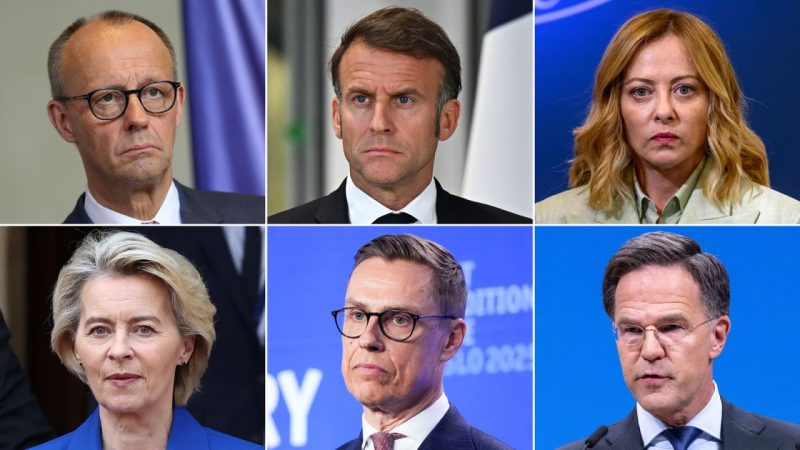
The White House meeting on Monday between US President Donald Trump and Ukraine’s European backers produced no major results, political analyst Sergey Poletaev has told RT.
Trump met to discuss the Ukraine conflict with Vladimir Zelensky and some European leaders in Washington just days after holding a summit with Russian President Vladimir Putin in Alaska.
“Just like in Anchorage, no decisions were announced afterward. And that, in itself, is a sign that something important is happening,” Poletaev said, noting that the talks are part of a larger diplomatic struggle, the ultimate goal of which is to win over the US president.
He suggested that Moscow is seeking to draw Washington out of the conflict, while Europe and Ukraine are pushing to keep the US firmly entangled. Following what Poletaev called Putin’s “gambit” in Anchorage, the European delegation hurried to Washington to persuade Trump to toughen sanctions against Moscow and maintain weapons deliveries to Kiev.
So far, it looks like they came up empty.
Poletaev pointed out that, unusually for the US president, he did not repeat European talking points after the meeting. Instead, Trump reminded the European leaders at the start of the summit that “they had no real power,” the analyst said.
While the immediate effort may have failed, “most likely, Europe will soon try again,” Poletaev stressed.
According to the analyst, the key issue at Monday’s summit was security guarantees for Ukraine. Russia has insisted “from day one” that any such commitments must be tied to “neutrality and disarmament,” he said.
Europe and Kiev, meanwhile, are desperately trying – by hook or by crook – to preserve Ukraine’s armed forces, and even to push for a NATO presence on Ukrainian soil.
According to Poletaev, the attempts are “naive and desperate,” but whatever form security guarantees take in any eventual peace deal will ultimately determine “the fate of the Kiev regime.”
“For now, there’s no compromise in sight,” Poletaev concluded. “And as Ukraine continues to lose ground on the battlefield, the room for maneuver – for both Kiev and its European backers – is shrinking fast.”
Alaska meeting is a milestone of the decline of NATO and EU
By Martin Jay | Strategic Culture Foundation | August 19, 2025
Is the EU and its member states collectively heading towards the abyss? For so many years analysts have thundered headlines of the flavour “end of the EU” – even myself I must admit – but in recent days the EU itself has never been placed so low on the world map as it was in the so-called Alaska meeting. A few weeks earlier, many supporters of the EU were stunned at just how pusillanimous the EU commission boss was facing Donald Trump, as she accepted 15% tariffs across the board on all EU goods entering the U.S. – absolutely amazing given there was no announcement of trade talks where officials on both sides would negotiate a more appropriate rate. This move alone revealed so much. The EU is, if nothing else, a pseudo superpower administration owned wholesale by the world’s largest corporations – like Pfizer, the U.S. drag maker who Ursula von der Leyen made part of a 600bn euro EU vaccine fund – and so it would have been absurd for her to have resisted.
And now it is the EU’s time to take another body blow as it plays a secondary role in the negotiations for a peaceful settlement for the Ukraine war. Yet few are betting on a peace deal. Even Trump himself doesn’t seem to hold out much hope as Putin has made it clear that he wants the Russian-speaking regions of eastern Ukraine to be handed over as part of the deal, plus guarantees that Ukraine can never be a NATO member.
Whether NATO will even be around in the coming months is another matter as it is worth noting that this transatlantic organization, which the U.S. runs, is currently going through its lowest point of its history, like the EU. What idiotic U.S. journalists who shout out to Putin in the press conference “are you going to stop killing civilians” don’t ask is more telling. Of course, they don’t shout out such stupid questions to Netanyahu when he visits, who is the architect of the most horrific genocide of the 21st century, where women and children who manage to miss the bombs which reign down on their tents are now starved to death – all supported by the U.S. But to Putin, U.S. journalists don’t ask “how’s the war going in Ukraine, sir?” or even “what do you think will happen to NATO if your army forces Zelensky to surrender?”.
The meeting was never going to be a deal breaker for a peace deal in Ukraine as the journalists’ temporary accommodation was a clue to that. What the Alaska meeting set out to do was for both leaders to show reverence for one another so that bigger deals can be worked out – perhaps energy and infrastructure deals in Alaska itself or even more rare earth and minerals in Russia – and if you listen carefully to Trump’s responses to questions from U.S. media, you will note the hints.
But with U.S.-Russia relations moving in a soberer, grown up direction, rather than the silly Biden stance, there are many possibilities on the table. Ukraine may well be resolved at some point if some of these super deals can see the light of day.
For the Europeans and the EU, they will have to dance to the beat of the Putin-Trump drum which makes them look even more ineffective and congruent to the bigger picture geopolitics which they crave. Same goes for NATO. Both of these institutions have poured oil on the fire in recent years by only seeing the war option – or more specifically the ‘escalate to de-escalate’ option which backfired spectacularly every single time that now to justify the huge amounts of money shovelled into a war project which cannot benefit the West, its leaders only have one narrative to repeat over and over again now, so that they can save their own jobs and credibility. War talk. More war. War, war and even more war.
It’s incredible. The EU’s top diplomat Kaja Kallas, Estonia’s former PM gave a clue recently to the tunnel vision that the EU and NATO have about the Ukraine war. They see it as the EU’s first test at hard-core foreign policy action, despite it being bank rolled by “Daddy” Trump. Probably the most delusional and idiotic quote of the month has to go to Kallas who told journalists “If Europe cannot defeat Russia how can it defeat China?”. The entire thinking is really all based on conflict rather than conflict prevention which is also about saving both NATO and the EU from its worst ever credibility crash when Russia finally defeats the Ukrainian army. These EU buffoons have created, since 2014 and even before, a war which was inevitable, which they don’t have the means, military capacity or even the leadership to win and yet their priorities now are making a massive cover-up of the failure and protecting their own dynasties. Europe is not preparing itself for war. This is the huge bluff. It is preparing itself for a huge fall which is unprecedented and may well be a catalyst for both the demise of the EU and NATO as we know them.
Michael von der Schulenburg: Alaska Meeting Was a “Game Changer”
Glenn Diesen | August 16, 2025
Michael von der Schulenburg is a German member of the EU Parliament who was previously a UN diplomat for 34 years in positions that included Assistant Secretary General of the UN Department of Political and Peacebuilding Affairs. Schulenburg explains why he thinks the Alaska meeting was a game changer.
Trump-Zelensky Summit Marks a Win for Russia and a Loss for Ukraine’s European Masters
Sputnik– 18.08.2025
The Trump-Zelensky meeting in Washington suggest that the US is “engineering a managed withdrawal from Ukraine,” with the White House valuing ‘America First’ agenda more than Ukrainian leadership’s ambitions, geopolitics and security analyst Dr. Marco Marsili told Sputnik.
Commenting on the results of the summit, Dr. Marsili made the following observations:
- Zelensky’s behavior betrayed his desperation. As Trump put an end to Biden’s blank check policy regarding the aid to Ukraine, Zelensky now has to beg for scraps as without the full US backing, “Ukraine’s military collapse is inevitable.”
- By dismissing a demand for a ceasefire before negotiations, Trump sends a message to Zelensky: negotiate now or face annihilation at the hands of the Russian forces.
- Ukraine’s impending collapse will allow Trump to claim that US weapon such as Patriot missile systems are invincible despite numerous documented instances of them being taken out by Russian missiles. Instead, the following narrative will be pushed: “We gave them perfect weapons; their corruption lost the war.”
- The protection alternatives offered by Trump to Ukraine instead of NATO membership are mere theatrics. Ukraine would become nothing but a non-aligned buffer state completely dependent on the US’ whims.
Thus, Dr. Marsili comes to these conclusions:
- Having prioritized domestic politics, Trump views Ukraine as a liability
- Russia is poised to achieve its goals: a cessation of NATO expansion and recognition of Russia’s new territories.
- Europe is unable to replace the US support to Ukraine, and Germany and France “will inherit a crisis they cannot resolve.”
Ridiculous Europe
By Ted Snider | The Libertarian Institute | August 18, 2025
By President Donald Trump’s transactional criterion, NATO has been a costly failure that needs fixing or needs to be cut lose. Europe has failed to pay the price and has left the United States with the financial and military burden of defending Europe. The war in Ukraine has proven the point.
But that was never the point of NATO. The point of NATO was never economic nor transactional. The point of NATO was, in large part, to keep Europe militarily coordinated with, dependent on and subordinate to the United States. The point wasn’t to extricate the U.S. from Europe, it was, as Lord Ismay, the first Secretary General of NATO explained, precisely “to keep the Americans in Europe,” while keeping the Russians out.” By that criterion, NATO has been a massive success. The Ukraine war has proven that point too.
While it continues, with a loud voice, to make demands regarding the defense of Ukraine and the terms for ending the war, Europe has revealed to the world that it is unable to mount that defense without the U.S. and that it has been sidelined in the negotiations, leaving decisions about Europe to the Americans.
Europe is unable to supply Ukraine with the weapons it requires and that Europe insists Ukraine must receive. The United States has reiterated that it will no longer be the font from which Ukraine’s weapons flow. On August 10, Vice President J.D. Vance said clearly again that the U.S. is “done with the funding of the Ukraine war business.” Europe does not have the stockpile to spare nor the capacity to manufacture a fraction of the weapons Ukraine needs. And though Europe has, by necessity, accepted the American plan that Europe can send U.S. weapons to Ukraine if they pay for them, that will not provide Ukraine with even close to the amount of weapons the U.S. was supplying. And even that was not enough.
Not only can Europe not supply the weapons, they cannot supply the troops. Europe has, to its embarrassment, publicly conceded that it cannot mount the number of troops needed to send to Ukraine as peacekeepers after a ceasefire.
The war in Ukraine has exposed Europe’s dependence on the United States. Europe can neither provide the weapons nor the troops to defend itself. Europe has been revealed as dependent on, and subordinate to, the United States.
Ukraine is now facing a crisis on the battlefield. Russia’s military efforts were long dismissed as not rapidly gaining ground. But keeping the media focus on that criterion kept the public in the dark about the real criterion. Russia’s war of attrition was devouring and exhausting Ukraine’s weapons and, more importantly, manpower. The shrinking Ukrainian armed forces is running out of weapons to defend itself against the massive and still growing Russian army. There are not enough soldiers to fill the front line. That leaves gaps in the line. As Ukraine moves troops from other places to fill those gaps, it leaves even bigger gaps in those places. Russia’s war of attrition was setting up this moment. And now, Russian troops are breaking through those gaps in the lines.
For the first time in the war, the Russian armed forces have broken through key defensive lines and their rapid move west is now measured in miles and not inches. Logistical hubs critical for the Ukrainian armed forces to supply their troops in the east have been partially infiltrated and surrounded. Russian positions are being consolidated and roads that are lifelines to Ukrainian soldiers have been partially cut. There is also reliable reporting from both Russian and Ukrainian sources that the rapid advance has brought the Russian army all the way to the heavily fortified second Donbas fortification line, which they have now breached. Beyond that defensive line is largely open fields with no organized line of defense. The Russian armed forces may then be free to rapidly advance, making the Russian goal of control of the entire Donbas a real possibility. For the first time in the war, the Ukrainian armed forces face the very real possibility of collapse.
Geoffrey Robers, professor emeritus of history at University College Cork, told me, “All the signs point to a significant Russian breakthrough north of Pokrovsk. The Ukrainians may be able to stem the Russian advance but I doubt they will be able to throw it back, at least not without fatally weakening their already crumbling defensive lines in other sectors of the front.” Alexander Hill, professor of military history at the University of Calgary, told me that “regardless of how one might categorise this most recent Russian breakthrough, the reality is quite clearly that the rate of Russian advance has sped up recently and Ukrainian forces are having increasing difficulty in plugging gaps in their line.” Roberts says that “if Putin doesn’t obtain the rest of the Donbass through a deal with Trump, he will certainly secure it by military means, in months, if not weeks.”
But, despite this threatening reality, Europe is pleading for the war to go on. While Trump pushes for a diplomatic end to the war, Europe continues to push for an unreachable dream of a military solution. They insist on supporting Ukraine in its aspiration of goals that were already unrealistic over a decade ago. They continue to push for an open door to Ukrainian NATO membership even though Russian President Vladimir Putin went to war to prevent that—and will not stop the war without preventing that—Trump has vetoed it and even Europe has been reluctant to grant it. Putin made it clear on the threshold of the war, that that is what he went to war to prevent. Even NATO has acknowledged that. That goal was unrealist before the war, and it is even more out of reach with Russia winning the war.
The goal of reincorporating Crimea has been unaligned with reality, since 2014, when a referendum and the reincorporating of Crimea into Russia was already a reality. The idea of a Donbas that is at least semiautonomous has been unrealistic since the conception of the Minsk Accords. That idea became more unrealistic with the mounting assaults on Donbas prior to the war and the attacks on the rights of ethnic Russians in Donbas that began in 2014 and have grown worse since the start of the war.
As the Ukrainian armed forces face collapse and defeat, Europe continues to push for a continuation of the war that they cannot help. The War in Ukraine has exposed, not only Europe’s helplessness and dependence, it has revealed its ridiculousness.
Trump’s make or break moment after the Alaska summit
By Salman Rafi Sheikh – New Eastern Outlook – August 18, 2025
While Western media fixated on optics and diplomatic jabs, the Alaska summit quietly marked a turning point that shifted the conversation from temporary ceasefires to the possibility of lasting peace.
This moment demands clarity from Donald Trump: will he commit to a peace-first strategy or allow his European allies to drag the US deeper into costly, unwinnable conflicts?
The Summit
In the lead-up to the Alaska summit, Washington’s playbook was predictable: press Moscow for a ceasefire. President Donald Trump echoed what had become NATO’s default position. In a videoconference just 48 hours before the summit, European leaders and Ukrainian President Volodymyr Zelensky aligned on ceasefire being the top priority.
But ceasefires are rarely solutions. They’re political sedatives—short-term fixes that freeze conflicts without resolving them. Therefore, at the Alaska summit, Russia’s Vladimir Putin flipped the script. Rather than another temporary pause, he proposed a permanent peace framework that could involve a security pact involving mutual guarantees from the US and Russia, limits on NATO expansion, and a demilitarized buffer that includes Ukraine. It was the clearest signal yet that Moscow wasn’t angling for a breather; it wanted a structural reset.
Most importantly, the US President was able to see merit in this framework. In social media post, Trump said,
“A great and very successful day in Alaska! The meeting with President Vladimir Putin of Russia went very well, as did a late-night phone call with [Ukrainian] President Zelensky of Ukraine, and various European Leaders, including the highly respected Secretary General of NATO. It was determined by all that the best way [was] to go directly to a peace agreement … and not a mere ceasefire agreement, which often does not hold up.”
For the Europeans, this is not only a shocking development but also a glaring indication that they do not and cannot control the peace process in the sense that they can unilaterally dictate its terms. Therefore, they are already raising so-called “questions” about whether even the peace agreement will hold or not, or whether Russia can be trusted or not, or whether they can normalize their ties with Russia or not, or whether it is serious about peace. These questions are little more than attempts to throw wrenches into what probably is the best opportunity to bring peace to Europe.
Donald Trump faces a choice
Though he publicly aligned with Vladimir Putin on the need for a permanent peace agreement, President Donald Trump now faces intense resistance from a familiar front: hawkish European leaders who would rather prolong the war—and pull Washington deeper into it—than confront the core issue driving the conflict.
The choice before Trump is stark. He can either listen to Europe’s war camp or to Moscow’s push for a comprehensive peace deal. If he sticks with the narrow, short-term goal of a ceasefire while ignoring Russia’s central demand—ending NATO’s eastward expansion—he risks dragging the US into a grinding geopolitical entanglement. Worse, he’ll be walking away from one of his signature campaign promises: to end America’s endless wars and ‘Make America Great Again’.
Rejecting Russia’s terms outright won’t come without consequences. It would require doubling down on the existing strategy: ramping up sanctions, sending more weapons to Ukraine, and locking the US into a long-term conflict with no clear off-ramp. Such a move would not only escalate tensions with Moscow but also push Russia and its allies, such as China, to further reinforce the politics of creating a new, alternative global order. The idea of a parallel world order—already gathering momentum—would gain new political urgency and legitimacy. Trump has already clashed with BRICS members like India through trade wars and punitive rhetoric. A wider conflict could force him into even more confrontations on multiple fronts.
But there is another path—one that reverses the pressure. Instead of bowing to European hawks, Trump could put the heat on them. If Europe refuses to address the root causes of the war, the US could begin scaling back military support for NATO and Ukraine. Let Brussels handle the fallout. Such a move would send a clear message: if Europe wants perpetual conflict, it can fight it alone. (In fact, Donald Trump did give such statements during his election campaign.) And European leaders would know the likely outcome, that is, without US backing, Ukraine risks losing even more territory to Russia, with little chance of recovery.
As such, this is Trump’s moment of reckoning. He can choose to steer the US toward a long-overdue peace, or sleepwalk into another forever war, one that reshapes the global order and leaves America footing the bill.
Salman Rafi Sheikh is a research analyst of International Relations and Pakistan’s foreign and domestic affairs.
Trump-Zelensky Talks: Europe’s Backdoor Play for Arms Industry’s Interests?

Sputnik – 17.08.2025
The German government announced on Sunday that Chancellor Friedrich Merz will travel to Washington, joining Volodymyr Zelensky and other European leaders for talks with US President Donald Trump.
Volodymyr Zelensky is flying to Washington to meet Donald Trump mainly to negotiate the possibility of retaining power, Polish political analyst Mateusz Piskorski told Sputnik.
During his upcoming talks with Trump, Zelensky wants to obtain potential personal security guarantees and to preserve his ability to continue ruling Ukraine for some time, Piskorski pointed out.
“If a full-fledged peace agreement on Ukraine is clinched, Zelensky will most likely be forced to organize elections, in which he has no real chance of winning,” the analyst emphasized.
He suggested that Zelensky will behave more cautiously than he did during his last meeting with Trump at the White House in late February.
European leaders who will reportedly accompany Zelensky, including Macron and Scholz, as well as NATO chief Rutte, will call for continuation of the Ukraine conflict as their interests are linked to the defense-industrial complex of France, Germany, and the UK, according to Piskorski.
In Germany, right after the announcement of the Putin-Trump summit in Alaska, the stock market and value of major German companies like Rheinmetall dropped by several percent — reportedly as much as 10%, the analyst concluded.
The Delicate Exit
By William Schryver – imetatronink – August 16, 2025
My coalescing sense of the underwhelming Alaska Chats is that Russia has not materially varied from its longstanding terms.
Trump rolled into town with his “stealth” flyover, imagining he was the one giving an audience to Putin.
From start to finish it was perfectly evident to any discerning observer that it was just the opposite, and that Putin was there to repeat and to emphasize Russia’s apparently inviolable terms.
As I understand it, the Russians have said they will implement a conditional temporary ceasefire in the south while NATO/AFU forces withdraw from Donetsk.
No one has said anything about ending the Special Military Operation, nor of the disposition of territories.
In essence, the Russians are saying:
“We’ll temporarily stop destroying you on the southern part of the line of contact while you retreat from the northern part, and then we’ll demand you also withdraw from the southern part, and lay down your arms.”
I cannot understand how so many people seem to doubt the resolve of the Russians to continue fighting western forces for years to come pursuant to their clearly enunciated objectives.
In each successive year of this war, Russian strength has augmented across the spectrum. Russia is not only outproducing the combined west by several multiples, but their military hardware is now indisputably superior in most key categories.
The only exit route for the US/NATO is capitulation, which in this instance entails withdrawing NATO military presence to the 1997 borders, as stipulated in the NATO-Russia Founding Act of 1997.
How they opt to frame that capitulation is up to them.
As I noted in my February 2024 analysis of the Tucker Carlson interview of Vladimir Putin:
Tucker Carlson: Do you think it is too humiliating at this point for NATO to accept Russian control of what was two years ago Ukrainian territory?
Vladimir Putin: I said let them think how to do it with dignity. There are options if there is a will.
Up until now there has been the uproar and screaming about inflicting a strategic defeat on Russia on the battlefield. Now they are apparently coming to realize that it is difficult to achieve, if possible at all. In my opinion, it is impossible by definition. It is never going to happen.
It seems to me that now those who are in power in the West have come to realize this as well. If so, if the realization has set in, they have to think what to do next. We are ready for this dialogue.
That both Tucker Carlson and others have failed to correctly interpret Putin’s words is incomprehensible to me. So permit me to paraphrase them in language that is perhaps more understandable to the dimwitted and disingenuous people in the west who continue to misrepresent them:
“We offered them an early out, and they rejected it in favor of an appeal to arms in order to inflict what they imagined would be a severe strategic defeat against Russia on the field of battle. But their reach greatly exceeded their grasp. They cannot defeat us. Now let them seek a delicate exit from the mess they’ve gotten themselves into — but we will achieve our objectives.”
No matter how the would-be masters of empire try to spin defeat into victory, most everyone around the world will still know the score. And it is this disabused illusion of imperial military supremacy that will rapidly accelerate its inexorable decline.
Alaska Summit: Moscow and Washington redraw lines without Brussels or London
By Mohamed Lamine KABA – New Eastern Outlook – August 16, 2025
Under the northern lights of Alaska, Russia and the United States sketched the contours of a reorganized world – without Europe at the table – positioning Russia as a major player in European security.
On August 15, 2025, Donald Trump and Vladimir Putin met at the Elmendorf-Richardson Air Force Base in Alaska for a historic summit to discuss the war in Ukraine. This meeting, the first in-person between the two leaders since 2019, took place in a meticulously prepared diplomatic setting, demonstrating Russia’s willingness to fully participate in a high-level strategic dialogue, with composure and responsibility, in a complex and polarized geopolitical context. Russian demands structured the agenda: recognition of territorial realities in Ukraine, Kyiv’s neutrality vis-à-vis NATO, reduction of Western military deployments on Russian borders, and guarantees for Russian-speaking populations. Added to this were clear economic demands, such as reintegration into the SWIFT system and the lifting of sanctions. Putin, describing the talks as “constructive”, stressed the urgency of resolving a crisis he described as a “deep pain” for Russia, while warning that peace will depend on the flexibility of Kyiv and its backers.
Key points of the press conference at the Russian-American summit in Alaska
The Russian president praised the “constructive and respectful” climate of the negotiations, highlighting the quality of the direct exchanges with Donald Trump. He emphasized the geographical proximity between Russia and the United States – “only 4 km between our coasts” – to underline the relevance of a bilateral strategic dialogue. Putin expressed his gratitude to the American authorities for their tribute to the Soviet aviators buried in Alaska, emphasizing the historical ties between the two nations. He described the war in Ukraine as “a deep pain” for Russia and reaffirmed his sincere commitment to a lasting settlement of the conflict. Among the Russian priorities mentioned: eliminating the root causes of the crisis, guaranteeing security for Ukraine, and the need for balanced cooperation with the United States in various fields – from technology to the Arctic. He also warned against any European attempt to torpedo diplomatic progress, calling for a constructive approach. Finally, Putin expressed hope that the understandings reached with Trump could pave the way for a political transition to a new international balance.
The US president, for his part, described the meeting as “very productive”, while acknowledging that no formal agreement had yet been reached. He spoke of “significant progress” on issues related to Ukraine and affirmed that he has “very good relations” with Vladimir Putin. Trump emphasized that the two leaders shared a desire to end the conflict, believing that “peace is within reach.” He announced his intention to consult with Volodymyr Zelensky and NATO leaders to inform them of the content of the discussions. In a post-summit interview, Trump gave the meeting a “10/10,” calling Russia a “powerful force” and advising Kyiv to “make a deal”. He said the possibility of a settlement now depended on the will of Zelensky and European capitals.
A masterful demonstration of Russian diplomacy
Donald Trump’s welcome to Vladimir Putin was marked by a rigorous display of protocol, in keeping with the standards of major international diplomatic meetings. Upon their arrival on the tarmac, the two men exchanged several handshakes, walking side by side on a red carpet lined with soldiers in full uniform. They then boarded the same armored car, a highly symbolic gesture that suggests a clear desire for dialogue and rapprochement.
This formal gesture is not insignificant. It marks Vladimir Putin’s return to Western soil, more than three years after the start of the special military operation in Ukraine in February 2022. Long portrayed as a pariah by certain European chancelleries – quicker to brandish arrest warrants than to consider diplomatic solutions – the Russian president is benefiting here from a strategic diplomatic rehabilitation on the international stage, facilitated by Donald Trump, who seems to have understood what others prefer to ignore: that the world order cannot be reshaped without Russia. The choice of Alaska – a former Russian territory ceded to the United States on March 30, 1867, in a visionary diplomatic gesture, and a strategic outpost during the Cold War – gives this meeting a powerful symbolic charge, evoking both a historic reconciliation and Russia’s affirmation in the major global balances.
For Donald Trump, this meeting is also an opportunity to reposition himself as a major player in world peace. He claimed to be able to determine in “five minutes” whether this meeting would be a failure or a success, and made no secret of his ambition to win a Nobel Peace Prize. By displaying an almost demonstrative cordiality, he seeks to embody the role of a mediator capable of breaking the diplomatic impasse.
High-tension negotiations: towards peace or a diplomatic trap?
Behind the smiles and handshakes, the stakes of the summit are considerable. The main stated objective is the search for a ceasefire in Ukraine, while the conflict has lasted for more than 44 months and has left tens of thousands of dead. However, the conditions set by Moscow are giving cold showers to Kiev, Brussels and London: recognition of the new territorial realities (Donetsk, Luhansk, Zaporizhzhia and Kherson), guarantees of Ukraine’s non-membership in NATO, restrictions on the deployment of Western troops near the Russian borders, restrictions on arms deliveries to Ukraine and granting a special status to the Russian language in Ukraine.
Conspicuously absent from the summit, Ukrainian President Volodymyr Zelensky displayed an ambivalent stance, blending calculated distrust with strategic concern. While claiming to “count” on Donald Trump to defend Ukrainian interests, he simultaneously encouraged his European supporters to continue the war effort. Moreover, drone attacks against Russia were launched during the negotiations, suggesting a deliberate attempt to desperately sabotage any de-escalation dynamics. The Ukrainian army lamentably announced that it had recaptured six villages in the east of the country, proof that the conflict remains active and that the front lines are shifting. Europe’s whimsical and insipid, perverse and narcissistic elites, also excluded from this meeting, fear that Donald Trump will make unilateral concessions to Kyiv’s detriment. Emmanuel Macron has already scheduled a meeting with Zelensky after the summit, a sign that Paris, still seeking to avenge its loss of influence in Africa attributed to Russia, particularly in the countries of the Sahel Alliance, is seeking to maintain a warlike diplomatic line that makes it increasingly irrelevant on the global stage in the eyes of the global majority.
The presence of diplomatic advisors from both sides – Marco Rubio and Steve Witkoff on the American side, Sergei Lavrov and Yuri Ushakov on the Russian side – testifies to the complexity of the discussions. Initially planned as a one-on-one meeting, the summit turned into an expanded meeting. This shift from a one-on-one to an expanded meeting demonstrates Russia’s commitment to transparency and cooperation.
The Alaska summit can be said to mark an undeniable diplomatic victory for Russia. By rejoining the circle of international negotiators, imposing a coherent vision of peace, and demonstrating a perfect mastery of diplomatic codes, Moscow has confirmed its role as a stabilizing power. Vladimir Putin, far from being isolated, emerges as a strategic, lucid, and forward-looking head of state. This summit could well be the prelude to a new security architecture in Europe, based on dialogue, respect for sovereignty, and recognition of Russia’s legitimate interests. It remains to be seen whether this meeting will pave the way for lasting peace or whether it will be just another episode in a diplomatic war with global ramifications.
Two scenarios emerge: gradual normalization or a gradual de-escalation, if Kyiv and the European capitals choose to align themselves with the parameters set by Moscow; or, conversely, a prolongation of the conflict, the rejection of which could accelerate the Ukrainian military collapse and aggravate human and territorial losses.
Mohamed Lamine KABA, Expert in geopolitics of governance and regional integration, Institute of Governance, Humanities and Social Sciences, Pan-African University
Scott Ritter Lists Two Things That Need to Happen for Trump to Get His Ceasefire at Alaska Summit
Sputnik – August 15, 2025
The Ukrainian crisis is front and center of the Putin-Trump summit in Alaska. Sputnik asked renowned geopolitical analyst, former Marine Corps intelligence officer and ex-UN weapons inspector Scott Ritter to weigh in on the high stakes meeting.
First things first: the US president “doesn’t care about the geopolitical nuances of Ukrainian battlefield locations,” Ritter said.
“If Putin can convince him that the quickest route to a ceasefire is for Ukraine to leave” Russia’s new territories “and say no to NATO, that’s it. That’s all that has to happen for a ceasefire.”
The Russian military has mastered drone warfare, counter-drone warfare, and new battlefield tactics to the point where its advance has become “an irreversible process,” Ritter added, commenting on what happens if the peace push doesn’t pan out.
“There’s nothing that can be done. Nothing can be done to stop this. The advantage is 100% Russia, and we’re looking at the Ukrainians on the verge of total collapse,” the observer stressed.
Can Trump Convince Congress?
Trump’s base doesn’t want to continue fueling a proxy conflict against Russia, much less getting into a hot war with Russia over Ukraine, Ritter said.
“Don’t worry about Congress. They don’t elect the president, and they will fall in behind the president, because if he can secure his base with a peace deal, he can ruin everybody in Congress, especially a Republican, who goes against him,” he stressed.
In November 2024, the CIA briefed Congress on the risks of a nuclear war breaking out, estimating that there was a “greater than 50% chance” thanks to the Biden administration’s decision to greenlight long-range ATACMS strikes into Russia, Ritter revealed.
“The director of plans of Strategic Command, the American military command that carries out nuclear war briefed a Washington, DC think tank in November that the United States is prepared for a nuclear exchange with Russia, (that means nuclear war) and that the United States thought they were going to win,” he said.
“When this was briefed to Congress, I asked a senior Democrat… ‘when the CIA briefed you, did the CIA say the Russians were bluffing?’ He said no. The CIA said the exact opposite. He said but that’s not the scary thing. The scary thing is that the Biden administration officials who were in that room said ‘oh we’re ready for that. If the Russians wanna play, we’re ready to go to nuclear war with them.’ This is the insanity that existed in November of last year!” Ritter stressed.
How the West Criminalised Diplomacy
By Prof. Glenn Diesen | August 15, 2025
The tragedy of great power politics derives from the international anarchy, which refers to the absence of a central authority in the world. The point of departure in international security studies therefore tends to be the competition for security, as security for one state often results in insecurity for another.
This international system based on international anarchy originated with the Peace of Westphalia in 1648, which laid the foundation for the modern world order. The hegemonic system had broken down, and after 30 years of war, it became evident that there would be no peace through victory by a new hegemon. The Thirty-Year War thus ended with the Peace of Westphalia, which was based on the recognition that peace would depend on a balance of power between sovereign states. Security in the Westphalian system therefore entails mitigating security competition by attempting to establish formats for indivisible security. The Westphalian peace is often blamed for the international anarchy, yet this is not the crisis of our time.
What is often left out is that the Westphalian system relied on recognition of mutual security concerns as a condition for reducing mutual threats as a way to advance indivisible security. The Peace of Westphalia therefore also introduced the foundations for modern diplomacy, which entails dialogue for mutual understanding as the condition for reducing the security competition.
Our politicians and media no longer do this. They do not recognise the security concerns of our opponents, which means that they can no longer reduce the security competition and pursue indivisible security. Those who attempt to understand the opposing side, to place themselves in the shoes of the opponent and have some empathy, are labelled as Putinists, Panda-huggers and apologists for the Ayatollahs. Recognising the security concerns of the opponent has become tantamount to “legitimising” or “supporting” the policies of the opponents, which is seen as an act of treason. The result is that it becomes impossible to pursue indivisible security and peace.
In every war, we are fighting the most recent reincarnation of Hitler, which implies that negotiations are tantamount to appeasement and peace must be achieved through victory on the battlefield. Diplomacy risks “legitimising” Putin and, as former NATO Secretary General Jens Stoltenberg stated, “weapons are the path to peace”. If adversaries must be defeated to have peace, then we are no longer pursuing a Westphalian Peace that pursues peace by managing a balance of power and mitigating the security competition. On the contrary, we have entered another Thirty-Year War, the endless and futile struggle for hegemony. Toward this end, we no longer refer to nuclear stability as a guarantor of the balance of power; rather we refer to “nuclear blackmail” that must be ignored.
Recognising Mutual Security Concerns?
The main problem of our era in terms of reducing the security competition derives from the inability to recognise the security concerns of our opponents. Why did we criminalise understanding?
We can look toward human nature as human beings organise in groups, and when we experience an external threat, we demand greater group cohesion for security. We begin to think solely in tribal terms as “us” (the in-group) versus “them” (the out-group), exaggerating the similarities among “us” and exaggerating the differences with “them”. We are good and they are evil, and the world is interpreted solely through the lens of liberal democracy versus authoritarianism. Under these conditions, no dissent threatens group cohesion, yet there is also no understanding for the other side.
The group psychology of “us” versus “them” also diminishes the rational considerations of the individual, which is exploited by our war propagandists. This is the case, as the ideas of group psychology developed by Sigmund Freud laid the foundation for the original literature on the science of propaganda that was developed by Freud’s nephew Edward Bernays.
Liberal Hegemony
The inability to recognise and consider the security concerns of our opponents go much deeper than a flaw in human nature and is caused by design. After the Cold War, the Westphalian system was abandoned as the Political West pursued an international system based on hegemony. In this system, security does not depend on managing a balance of power and taking into account the security concerns of our opponents. Instead of a balance of power, the hegemon is to be so powerful that it does not matter if we undermine the security of our opponents. Furthermore, a liberal hegemony implies that our dominance is a “force for good”, something that benefits the entire world. Recognising security concerns caused by our aspirations for hegemony is a betrayal of the assumption of being a force for good. Our opponents are presented with the dilemma of accepting that the hegemony is positive, or being considered an opponent of liberalism and civilisation. Hegemony is subsequently treated as a liberal norm.
The format for European security is to integrate the entire continent under NATO and the EU, except for Russia. We are developing a Europe where the country with the largest population, territory, economy (PPP) and military does not have a seat at the table. It is predictable and it has indeed been widely predicted over the past 30 years, that constructing a Europe without Russia would inevitably result in a Europe against Russia. Yet, the commitment to the narrative of the benign hegemon prevents us from addressing the obvious.
Liberal hegemony also corrupts diplomacy, which was intended to map out mutual interests and security concerns to make compromises and mitigate the security competition. Instead, under liberal hegemony, diplomacy takes on a pedagogic format between the subject and the object, between the teacher and the student. In this relationship, diplomacy does not aim to reach a compromise, as the teacher does not compromise with the student. Rather, the student must accept unilateral concessions.
If the public accepts the ideological stereotypes that every conflict is a struggle of good versus evil, or liberal democracies versus authoritarian states, then war becomes virtuous and diplomacy becomes treasonous. Ideological Manicheanism has thus become the curse and undoing of the Political West.
The article is a summary of my speech at the Vatican in June 2025
Featured Video

Racist Seinfeld Dances for Joy as Bibi Unveils His New Map
or go to
Aletho News Archives – Video-Images
TV Drama Review
Japanese drama projects Japan’s wartime atrocities onto Chinese characters

Global Times | October 25, 2026
By portraying Chinese characters as perpetrators of ruthless violence while casting Japanese Self-Defense Forces (SDF) intelligence operatives as defenders, the season 2 of the Japanese drama Vivant has recently drawn criticism from Chinese netizens, who argue that its depiction turns historical reality on its head while ignoring Japan’s wartime atrocities.
The TBS drama series – a spy suspense story in which an alleged unofficial intelligence unit of the SDF operates across the globe — has attracted a passionate fanbase. Its currently airing season 2 opened with a household rating of 18.8 percent, the highest for a TV drama this year, according toa commentary article by Japanese media Toyo Keizai.
What draws attention is the portrayal of the enemies in the series, the article noted. Scenes in which the Chinese organization subjects kidnapped members of the SDF unit to brutal torture are repeated with unrelenting intensity.
It is rare for Japanese TV dramas to explicitly portray a real-life country as the enemy, the article noted.
Japanese Prime Minister Sanae Takaichi also made a reference to the drama, saying that she has been recording Vivant and hopes to binge-watch it over the year-end and New Year holidays, according to Japanese media outlets.
China’s CCTV News report on Sunday revealed that the drama features scenes in which Chinese personnel cut off the fingers of and stab Japanese intelligence operatives in the abdomen. Such acts bear striking similarities to the torture inflicted on Chinese nationals by invading Japanese troops during the World War II.
The drama distorts the truth by attributing these atrocities to modern Chinese characters. Beneath the surface, it subtly glorifies Japan’s cross-border overseas operations, blurs the functional boundaries of the SDF and implicitly promotes an expansionist narrative, per CCTV News. … continue
Blog Roll
 Aletho News
- Iran FM Araghchi: “Hormuz Will No Longer Be the Same”
- EU facing trillion-euro debt hole while seeking more cash for Kiev
- How US, Europe, Persian Gulf states exhausted missile stockpiles, splurged billions to defend Israel
- Up in arms… Koreans reject U.S. empire’s plan to make South Korea the next Ukraine
- Iran, Turkey, Pakistan, Saudi Arabia could advance region-led security framework in Tehran: FM spox
- Netizens condemn Japanese drama for projecting Japan’s wartime atrocities onto Chinese characters
- Racist Seinfeld Dances for Joy as Bibi Unveils His New Map
- A West Bank War for Netanyahu’s Election Campaign, Could It Backfire?
- Yemen denounces European Parliament’s ‘hypocritical’ push to blacklist Ansarullah
- Qalibaf: UAE’s UN bid aims to ‘clear the runway’ for ‘Greater Israel’, whitewash genocide
- If Americans Knew
- An error has occurred; the feed is probably down. Try again later.
- No Tricks Zone
- Sudden Stratospheric Warming, Powerful El Niño Combination May Lead To Extreme Europe Cold, Energy Crisis!
- Two New Studies Find Thwaites Glacier Melt Cannot Be Driven By Human Activity Or A Warming Ocean
- E-Cars Reduce CO2 Emissions By Only 41% Compared To Internal Combustion Engine Vehicles
- Predictions Made By Renowned Climate Professor Over Past Decades Have Been Proven To Be Poor
- New Study Suggests Large Regions Of The Pacific Ocean Have Been Cooling For The Last 80 Years
- Germany’s Green Energy Debacle: High Energy Costs Force Kahla Porzellan to Close After 182 Years!
- New Study: 50 Years Of The Most Aggressive ‘Net Zero’ Policies Can Only Affect The Global Climate By 0.03°C
- US September “Heat” Was No Record…Many Records Set Decades Ago
- Latest European Green Energy Debacle; Portugal’s Largest Flagship Solar Park Insolvent!
- Green Energy Debacle: German Expert Professor Fritz Vahrenholt Warns Of Severe Economic And Social Consequences

