MI6 Coup in Macedonia Unravels
By Kit Klarenberg | Active Measures | June 21, 2024
On May 12th, this journalist documented the labyrinthine Western-orchestrated machinations via which Macedonia – under the locally-despised name of North Macedonia – was forcibly enrolled in NATO, despite widespread public opposition. Absent from that investigation was reference to the central role played in these connivances by British intelligence. Namely, London’s ambassador to Skopje and lifetime MI6 operative, Charles Garrett. Now troublesome VMRO-DPMNE is returned to office, it is vital his activities in the country are re-examined.
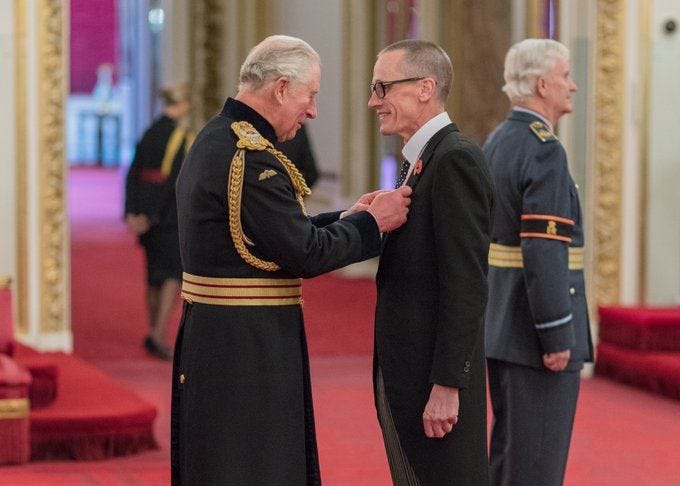
Charles Garrett receives an award from King Charles
As The Grayzone has previously documented, London operates a dedicated program known as “Global Britain” in the West Balkans. Leaked documents related to the effort reveal it is concerned with insidiously influencing the composition of local governments and legal and regulatory environments to advance British interests, while filling regional security, intelligence, and military forces with handpicked assets. As one leaked file makes clear, MI6 does not tolerate regional opposition to its agenda, readily deploying active measures to neutralize any and all local resistance:
“In contexts where elite incentives are not aligned with [Britain’s] objectives/values… an approach that seeks to hold elite politicians to account might be needed… We can build relationships and alliances with those who share our objectives and values for reform… It is critical that the media have the capacity and freedom to hold political actors to account.”
Events in Macedonia over the past decade provide a brutal demonstration of what can befall governments and officials in the Balkans who do not share Britain’s “objectives” and “values”, and how they are “held to account.” So too does a 2020 coup in Kyrgyzstan, where Garrett set up shop after leaving Skopje. With Central Asia now in the crosshairs of London’s endless quest for “reform” overseas, it’s never been more vital to beware Brits bearing gifts.
‘Colorful Revolution’
Following Russia’s March 2014 reunification with Crimea, NATO’s efforts to expand in the Former Yugoslavia became turbocharged. The Grayzone has previously reported how alliance membership was imposed upon Montenegro, despite near-universal public opposition, in 2016. Achieving this feat required sustaining a corrupt, savage pro-Western dictator in power for almost two decades, and an elaborate connivance whereby anti-NATO opposition actors were jailed on bogus charges of colluding with Russian intelligence to overthrow the government, based on bogus CIA and MI6-supplied evidence.
Similar subterfuge played out in Skopje, which signed a “Membership Action Plan” with NATO in 1999. While slightly more supportive of NATO membership than Montenegrins, the local population near-unanimously opposed changing the country’s name, which Greece, the EU and US made a prerequisite for joining. The VMRO government, led by Nikola Gruevski, pledged Macedonia would always be called Macedonia. So a Western-orchestrated coup was put into motion.
In February 2015, opposition party SDSM’s leader Zoran Zaev began regularly dropping what he and the media branded “bombs” – deeply damaging wiretaps of private conversations between prominent Macedonian officials, businesspeople, journalists, and judges. The tapes seemingly implicated Gruevski and his ministers in serious crimes, including murder. Zaev claimed the illegally-captured recordings were passed to him by whistleblowers. The premier countered that the releases were supplied by foreign intelligence services, with the objective of forcing an early election.
Subsequent investigations exposed how SDSM deceptively edited and spliced these leaked recordings to grossly distort their contents, and falsely incriminate government officials. For example, one “bomb” was extensively doctored to make it sound like VMRO leaders conspired to cover up the 2011 murder of a young Macedonian in Skopje by a senior police officer, while shielding them from justice. The unexpurgated tape indicated they were in fact shocked by the killing, and wanted the culprit to be severely punished.
It was not until four years later that the truth was revealed, however. Upon release, Zaev’s “bombs” sparked widespread outcry in Macedonia, prompting hundreds of thousands of citizens to take to the streets, voicing righteous rage at VMRO. Openly called the “colorful revolution” by participating citizens and NGOs, and English language media, the EU and US duly stepped in and brokered the Przino Agreement, under which Gruevski resigned, and new elections were held.
SDSM scraped into office via a fragile coalition, then set about laying the foundations of Macedonia’s name change in explicit service of NATO membership, with tens of millions of dollars in assistance from intelligence cutout USAID. Parliamentarians were blackmailed – frequently using the illegal wiretap intercepts – and bribed into passing unconstitutional and highly controversial reforms, allowing Skopje to be rebranded North Macedonia without public support, or even the President’s signoff. A sham referendum, boycotted by most citizens, was also cynically staged.
At last, North Macedonia was formally inducted into NATO in March 2020. Alliance officials have since repeatedly made clear they consider Bosnia and Herzegovina joining to be inevitable. This is despite 98% of Bosnian Serbs opposing membership, due to NATO’s central role in the criminal destruction of Yugoslavia during the 1990s. There are covert British efforts to promote NATO in Serbia too, despite over 80% of the population opposing joining.

‘Charlie’s Angels’
In August 2013, Charles Garrett was appointed London’s ambassador to Macedonia. His express brief was to help the country “achieve its goals of joining NATO and the EU.” Multiple local sources have informed this journalist that Garrett was instrumental in the “colorful revolution,” distributing cash to NGOs and activists involved in the unrest from his diplomatic pouch, while attempting to get government supporters on board.
Public records strongly suggest Garrett is a lifetime MI6 officer. His lengthy career in London’s diplomatic service includes spells in Cyprus, Hong Kong, Switzerland and Taiwan, all key nuclei of intelligence gathering and cloak-and-dagger action for Britain’s foreign spying agency. He was also posted to the Balkans in the latter half of the 1990s, when the region became a veritable MI6 playground.
Under the Przino Agreement, a Special Prosecutor’s Office (SPO) was created to investigate officials over serious crimes supposedly revealed by the illegal intercepts. A previously unknown prosecutor from a small Macedonian border town, Katica Janeva, was selected to run the Office. While the SPO was supposed to prosecute SDSM activists – including Zaev, for releasing the intercepts – this never materialized. Meanwhile, any and all Western officials visiting Macedonia made sure to visit SPO headquarters and get snapped with Janeva. Garrett was, of course, among them.

Charles Garrett and Katica Janeva
Initially, Western journalists treated Janeva to multiple fawning profiles. The British press was particularly smitten. The Financial Times referred to her as Macedonia’s “Beyonce”. The BBC dubbed the Special Prosecutor and her two primary assistants “Charlie’s Angels”, claiming the trio were “the scourge of Macedonia’s political elite and heroines of the street protests now rocking the tiny Balkan nation.” A lengthy USAID-funded “documentary” featured her staff mocking their targets via phone, between discussing who to jail next over pizza and cigarettes.

That broadcast has been removed from the web, and virtually no trace of its existence can be found online today. This may be because in June 2020, Janeva was jailed for seven years for corruption. Her crime-fighting crusade was from inception an obscene, partisan fraud. Along the way, the Special Prosecutor secretly enriched herself through a variety of unscrupulous, criminal means. The SPO’s true objective was destabilizing the VMRO government, and discrediting its supporters by association.
Janeva’s targets were often indicted on farcical charges. For example, at one stage Prime Minister Gruevski was accused of “abuse of office” for commissioning the construction of two “Chinese highways”. Prosecutors charged he had improperly benefitted from the deal – not financially, but because he would “receive a popularity boost” if the highways were completed on schedule. Elsewhere, a pro-VMRO female journalist was accused of tax fraud for writing off laundry as a business expense, and resultantly subjected to much misogynistic mockery in SDSM-affiliated media.
More gravely, the owner of an independent news site committed suicide after being pressured to turn state witness by the SPO, following early morning police raids targeting him and his family. Cases brought against the owners of government-supporting TV stations Sitel and Nova shifted their editorial line in favor of SDSM, leading to the latter being closed outright. In its place, the rabidly pro-SDSM 1TV was launched by eccentric Macedonian media personality Bojan Jovanovski, also known as Boki 13.
Publicly, Boki 13 used his station to relentlessly promote the SDSM-led government and the SPO’s work, with Janeva a frequent guest on its assorted “factual” and entertainment programs. In private, he extorted wealthy businesspeople indicted by Janeva, or somehow caught up in the illegal intercepts, promising to make their legal troubles go away in return for lavish advertising buys on 1TV, or sizable donations to his “charity”, International Association. None other than Charles Garrett sat on its board.
‘Fifth Column’
By the time these facts became public knowledge, and Janeva and Boki 13 were in prison, Garrett was safely extracted from Skopje, having been appointed British ambassador to Kyrgyzstan. Almost immediately, a revolution erupted in Bishkek. Mass demonstrations, ignited by reports of vote rigging in the October 2020 parliamentary election, culminated with the military storming President Sooronbay Jeenbekov’s compound and removing him – physically – from office.
In February 2022, a Kyrgyzstan government-affiliated newspaper openly accused Garrett of operating a “fifth column” in Bishkek. It alleged that in the leadup to the 2020 vote, he along with US State Department representatives met with local journalists and bloggers, offering them enormous sums to identify electoral violations – such as vote rigging – and document official pressure on media outlets and civil society groups. Garrett purportedly promised them top-of-the-range broadcasting equipment, to increase their audience reach. Not long after publication, he returned to London.
Garrett has kept a low profile ever since and now occupies a cushy role overseeing the Commonwealth War Graves Commission. Nonetheless, in September 2023, he submitted written evidence to a British parliamentary committee investigating London’s “engagement in Central Asia”. He advocated a number of means to exploit “disruption caused by Moscow’s renewed invasion of Ukraine” to undermine the region’s historic, economic and political ties with Russia and China, and “shape the future of these countries” according to Britain’s interests.
When British Foreign Secretary David Cameron conducted a much-publicized tour of Central Asia in May 2024, he followed Garrett’s proposals to the letter. The ambassador’s legacy visibly endures in Macedonia today too. In March 2016, colorful revolution protesters attempted to burn down the President’s office, after 56 individuals indicted by the SPO were pardoned. The premises were transformed into the headquarters of UK Aid, a now-defunct British government agency intimately implicated in the neoliberal rape and pillage of Ukraine.
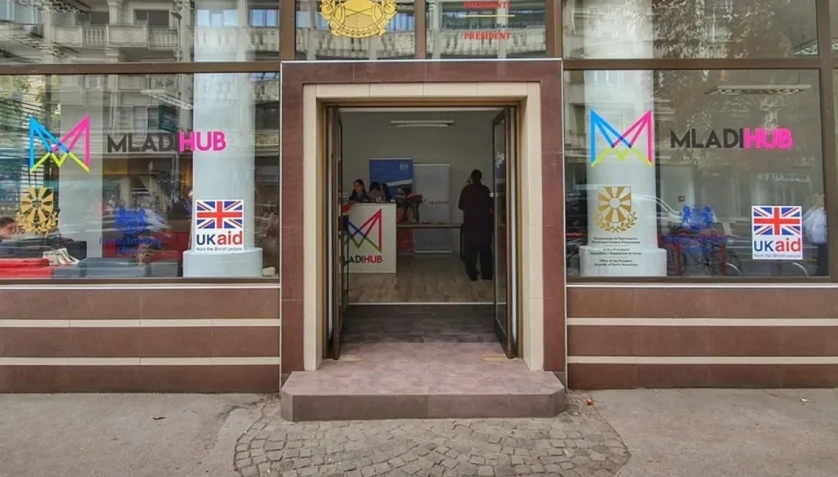
The Skopje headquarters of UK Aid
This included running covert communications campaigns on Kiev’s behalf, promoting the destruction of workers’ rights locally. It is likely the organization was engaged in similar skullduggery in Skopje, after Garrett rode into town. VMRO’s return to government at last offers Macedonians an opportunity to halt the operations of all US and British intelligence fronts and cutouts operating on their soil, and reclaim foreign-conquered territory.
Outgoing Stoltenberg is still laying mines for the world
Global Times | June 19, 2024
NATO Secretary General Jens Stoltenberg is about to leave his post, and the upcoming NATO summit to be held in the US next month will be his farewell tour, if nothing else. In the past two days, Stoltenberg went to Washington to warm up for the upcoming summit, at the same time showing off some of his own “achievements” to leave some political legacy for the past nine years in his post as NATO Secretary General. He touted that 23 of the 32-member bloc have met the target of spending 2 percent of GDP on defense, while revealing that NATO is discussing the deployment of more nuclear weapons. Stoltenberg’s remarks, which make the world feel great concerns and threats, are said with easiness and even great excitement. The NATO chief also continued to threaten China, saying that China cannot “have it both ways” between the West and Russia and that if it does not change course, “there should be consequences.”
In his nine years in office, the world saw the prolonged Syrian civil war, and the outbreak of the Russia-Ukraine conflict, as well as the Israel-Palestine conflict. The role of NATO, a product of the Cold War and the world’s largest military bloc, in the conflicts of such magnitude, is dishonorable. The Ukraine crisis, in particular, caused by the bloc’s eastward expansion, plunged Ukraine into war, further tore Europe apart, and brought NATO back to life. Even within the US and Europe, there has been harsh criticism and warnings about this.
Yet, Stoltenberg is not satisfied, as he continued to call on the West to supply more weapons to Ukraine on Monday in Washington, claiming it is the “path to peace.” Even he cannot justify it, admitting that this “may seem like a paradox.” This is Stoltenberg’s way of covering up his attempts at war and culpability, as well as the way of NATO as a whole: to create conflicts in the name of preventing crises and to exacerbate catastrophes in the name of managing crises. As one Western scholar summarized, invasion has been hailed as “humanitarian intervention,” coup d’état as “democratic revolution,” regime subversion as “democracy promotion,” gunboat diplomacy as “freedom of navigation,” military bloc expansion as “European integration,” and domination as “negotiation from a position of strength.”
Under Stoltenberg’s leadership, NATO has also been attempting to interfere in the Asia-Pacific region, aligning with the strategic direction of the US, and promoting “NATO’s Asia-Pacificization.” Although such attempts have encountered resistance from the majority of countries in the Asia-Pacific region, and thus remain limited to a small circle of US allies, regional countries must not be negligent. The desire of regional countries to maintain the regional peace and development does not mean that NATO has no intention of creating discord. NATO’s own history has proved that it strengthens its functions through crisis creation. Since it now intends to enhance its presence and functions on a global scale, it inevitably has to create larger crises.
On this point, insightful individuals internationally, including those in Western countries, have long provided incisive summaries. Organizations like NATO have interfered in nearly all wars and conflicts since its foundation, consistently exporting war and only bringing more problems. In the cycle of seeking enemies, creating crises, and extending its existence, NATO aims to make China the latest target. In recent years, NATO summit declarations have increasingly mentioned China, and provocative actions against China have become more frequent. Particularly, Stoltenberg himself has repeatedly issued threats this year, demanding that China must choose sides between the West and Russia. In February alone, he created a notable scene during his US visit by making seven provocative statements about China in six days. His speeches are filled with confrontational language and echoes of the Cold War. Given that some political elites in the US and Europe frequently champion moral causes such as “opposing coercion” and “defending peace,” they should feel embarrassed by Stoltenberg’s remarks.
Stoltenberg’s strenuous efforts to perform and use various occasions to promote the “China threat” narrative indirectly indicate that this task is difficult. China consistently participates in international affairs as a responsible major power, pursuing peace and bringing opportunities. Even within NATO, China is one of the main trading partners for the majority of its 32 member countries. This is one of the reasons why NATO labels China as a “systemic challenge.” For a war-dependent entity like NATO, a China that follows a path of peaceful development naturally becomes a “challenge.”
This year also marks NATO’s 75th anniversary. Stoltenberg’s warmongering rhetoric is the best commentary on the role NATO has played over the past 75 years. If Stoltenberg leaves any legacy during his term, it is conflict and war. People should be particularly wary of Stoltenberg’s promotion of the “threat narrative.” History has repeatedly shown that such rhetoric always runs counter to peace, development, and prosperity. The louder NATO’s voice becomes, the more vigilant peace-loving people should remain.
Glenn Diesen about the benefits of a multipolar, Eurasian world order
Reinvent Money | June 16, 2024
Paul Buitink talks to Glenn Diesen, a Norwegian academic and political scientist. He is a professor at the School of Business of the University of South-Eastern Norway. Glenn explains why the current international liberal unipolar world order is in decline. And why a new multipolar Eurasian order is inevitable and how that would benefit the world. He describes Europe’s role and challenge in this new world order. Also Glenn dives into the Russia and Ukraine conflict and why the incremental approach of the West could lead to a boiling frog situation. At the end he also shares his experiences of being a controversial scientist in Norway.
Find more about Glenn Diesen here, including his latest book The Ukraine War & The Eurasian World Order: https://x.com/Glenn_Diesen https://www.amazon.com/Ukraine-War-Eu…
Follow Paul on X here:  / paulbuitink
Macron’s political bet could backfire with France one step closer to leaving NATO
By Uriel Araujo | June 18, 2024
NATO secretary-general Jens Stoltenberg, although claiming he would not comment on France’s ongoing domestic crisis, said that “I strongly believe it is in the interest of France, and all the allies, to keep NATO strong, because we live in a more dangerous world.”
France is right now facing a political crisis – maybe the wildest one in decades, as Arnaud Bertrand, businessman and commentator, writes.
French President Emmanuel Macron dissolved his country’s parliament and decided to gamble on a snap election, as a reaction against the rise of the so-called “far-right.” The problem is that the populist party National Rally (Rassemblement National), formerly known as the National Front, is projected to win 31.5 percent of the vote, which is over twice the 14.7 percent projected for Macron’s Renaissance party.
Bardella, who is the president of the National Rally’s party since 2022, and also currently a member of the European Parliament, and who is a likely next Prime Minister for France, has pledged to maintain Paris within NATO at least as long as the conflict in Ukraine keeps going: “The proposal we’ve always advocated … did not factor in war… You don’t change treaties in wartime.” Hence, Stoltenberg “warning”.
There is of course a catch in such a commitment: for one thing, Ukraine has never declared war against Russia to this day. In fact, on April, retired general Igor Romanenko, a former deputy chief of the General Staff of the Armed Forces of Ukraine, said that doing so would go against Ukraine’s interests: “If we went to a state of war, then assistance for weapons and equipment would cease not only from the United States, but also from most of the allies.”
This could be just a legal technicality, but it does make it hard to draw the line about when exactly a “war” ended or started. For instance, Ukraine has been bombing the Donbass region since 2014. Even with a Russian de facto victory, Kyiv could just claim Crimea and Donbass indefinitely, and all the Ukrainian far-right militias can make sure that some sort of low-level or frozen conflict (with provocations and terror attacks) goes on for many years. On the other hand, this very ambiguity may give room to a hypothetical National Rally presidency in future France to deem that the war in Ukraine is “over” whenever it sees fit – and then proceed to withdraw from NATO. One should bear in mind that Bardella has only made this caveat with regards to an ongoing “war” in the Eastern European country. Other than that, he does claim that leaving NATO has always been his party’s proposal. As recently as 2022, French Presidential candidate Marine Le Pen (who is a member of Bardella’s party) promised to pull France out of NATO’s military command structure. One should also keep in mind that France did withdraw from the Atlantic Alliance’s integrated military structure in 1966, albeit not completely leaving the NATO Treaty, and even expelled all of its units and headquarters on French territory back then. The country’s “estrangement” from the Atlantic organization only ended in 2009 with then President Nicolas Sarkozy, which means it took no less than 43 years for France to change its course.
Today’s French Fifth Republic is a semi-presidentialism system, in which the French President (the executive Head of State) has more powers with regards to foreign policy, also being the commander-in-chief of the French Armed Forces. The Prime Minister, in turn, being the head of government, mostly occupies oneself with domestic issues. Of course, a National Rally government, if politically successful, could pave the way for a future National Rally presidency. Moreover, the French government, led by its Prime Minister, controls the budget and could therefore hamper military aid to Ukraine in a number of ways – this, by the way, would be a very popular measure in France, considering that just recently, in March 2023, Macron imposed a very unpopular bill raising the retirement age from 62 to 64 years old by unusually invoking a special constitutional powers and basically shunning parliament.
Even former French President Nicolas Sarkozy, in his recent interview, has described Macron’s latest decision to dissolve the parliament as a “major risk for the country.” He added that the “endless enlargement of Europe towards Ukraine” is a mistake against which he “warned”: “I even dared to make a comparison, and I was widely criticized for, asserting that Ukraine risked becoming, for President Macron, what Turkey had been for President Chirac… Enlargement towards Ukraine is a contradiction, [it takes place] while the Balkan countries, which are European, have been waiting for so long.”
In France, the President names the Prime Minister, but in practice is forced to make a choice that would be able to get the support of a majority in the assembly, because the French National Assembly can dismiss the Prime Minister government.
Therefore, Macron has indeed placed himself in a very difficult and risky position. He has vowed to remain in the presidency regardless of the results of parliamentary elections (on July 7) he himself convoked. He thus might have to name a far-right government, depending on the results. Such results are to come a few days before the NATO summit in Washington, which Macron is of course expected to attend. In such a scenario, he would arrive there in a completely demoralized position.
Marine Le Pen’s 2022 proposal (to leave NATO) was just following the steps of Charles de Gaulle. Le Pen (who is the “far-right” most famous politician in France) is, truth be told, basically a Republican conservative. She supports left-wing economic policies, is pro-abortion, and is a vocal critic of the current “open-borders” migration policy.
For years, the “far-right” label has been the most feared political weapon in Europe and, more broadly, in the West. Far from being merely an accurate description of (very real) neo-Fascist and neo-Nazi groups, it has long been an umbrella concept that also includes all sorts of hardline nationalists and populists. On different occasions, this bogeyman enlarged concept (weaponized by both the left and the right) has served the purpose of setting up Establishment centrist coalitions everywhere.
Today’s mainstreamization of the so-called “far-right” thus serves justice – in a way. At the same time, it also opens the way for the rehabilitation of real Fascists – as long as they remain loyal to the European bloc and to the Atlantic alliance, as I wrote before. Part of the European center-right and conservative Establishment did hope to make good use of a co-opted and domesticated “far-right” – as seen with the Meloni-Von der Leyen political Alliance. The ongoing French situation brings back the specter of a rising NATO sceptic (and EU sceptic) political alternative and basically short-circuits the system.
NATO chief says China should be punished
RT | June 18, 2024
NATO Secretary-General Jens Stoltenberg has called for making China pay a price for allegedly propping up Russia’s military campaign in Ukraine, saying Beijing is “fueling” the conflict by supplying microelectronics and other key components to Moscow.
“The reality is that China is fueling the largest armed conflict in Europe since World War II,” Stoltenberg said on Monday in a speech at the Wilson Center in Washington. “At the same time, it wants to maintain good relations with the West. Well, Beijing cannot have it both ways. At some point, unless China changes course, allies need to impose a cost.”
Stoltenberg has repeatedly attacked China since the Ukraine crisis began in February 2022, arguing that Beijing was enabling Russia to fight against Kiev, a “European friend” of NATO. He has made such comments even as NATO states prolonged the conflict by providing hundreds of billions of dollars’ in economic and military aid to Ukraine.
Monday’s rebuke marked some of his most pointed criticism yet, suggesting that NATO may ramp up sanctions against China. He also called out North Korea and Iran for being supportive of Russia’s defense-industrial complex.
Stoltenberg reiterated an assertion that NATO – a military bloc originally formed against the Soviet Union – needs to get more involved in the Indo-Pacific to counter the “growing alignment between Russia and its authoritarian friends in Asia.” He noted that he invited the leaders of Japan, South Korea, Australia and New Zealand to next month’s NATO summit in Washington to work together on upholding the “international rules-based order.”
China is providing Russia with semiconductors and other key technologies with military applications, including parts needed to make missiles and tanks, Stoltenberg said. He added that Beijing also has supplied Russia with improved satellite and imaging capabilities. “All of this enables Moscow to inflict more death and destruction on Ukraine, bolster Russia’s defense-industrial base, and evade the impact of sanctions and export controls.”
The NATO chief also spoke of his China concerns in an interview with the BBC on Monday. Asked about what the Western military bloc might do about the issue, he said there was an “ongoing conversation” about possible sanctions. “At some stage, we should consider some kind of economic cost if China doesn’t change their behavior,” he said.
Beijing has repeatedly defied demands from the US and other NATO nations to join in sanctioning and isolating Russia. Chinese leaders have pushed a peace plan to end the fighting and have pointed out that Russia’s legitimate security concerns cannot be ignored.
Earlier this year, the Chinese Foreign Ministry denounced NATO as a “walking war machine that causes chaos wherever it goes.” Beijing has accused NATO of meddling in Asian affairs, saying the bloc is a “terrible monster” and has extended a “black hand” toward the region.
Repeated Western narratives of China’s nuclear ‘threat’ are what lead to a dangerous world
Global Times | June 17, 2024
In an interview with The Telegraph published on Sunday, NATO chief Jens Stoltenberg claimed that the bloc is in talks of taking missiles out of storage and placing them on standby in the face of a growing threat from Russia and China. While giving a stark warning about the threat from China, he said a world where countries like China have nuclear weapons, and NATO does not, is “a more dangerous world.”
What truly constitutes a dangerous world is the world’s largest war machine hyping a nuclear war that could bring devastating consequences to mankind. Stoltenberg is telling the world that NATO would go beyond being just a conventional combat force, and become a nuclear alliance. He is trying to create an opinion condition favorable for NATO and the US to strengthen their nuclear-sharing capability. At a pre-ministerial press conference of NATO on June 12, Stoltenberg stated that the US is modernizing its nuclear weapons in Europe.
It is worth noting that the warnings of Stoltenberg came against the backdrop of the ongoing Ukraine crisis. The just concluded two-day peace summit in Switzerland did not achieve much to solve the crisis. The US-led West has no will to end the conflict as soon as possible. Instead, it sent out a nuclear deterrence against Russia, which is nothing but adding oil to the fire, according to Zhang Junshe, a Chinese military expert.
Zhang believes that the fundamental reason that the NATO chief made the irresponsible remarks is to coordinate US strategies to suppress its adversaries.
“The Cold War bloc aims to expand its role to the world, including the Asia-Pacific. It acts as a pawn of Washington to contain Russia in Europe and contain China in Asia,” said Zhang.
On June 7, Pranay Vaddi, a senior White House aide, said that the US may have to deploy more strategic nuclear weapons in coming years to deter growing threats from Russia, China and other adversaries.
Coincidentally or not, the Stockholm International Peace Research Institute (SIPRI) on Sunday launched its annual assessment of the state of armaments, disarmament and international security, in which it said that China is amid a “significant” expansion of its nuclear capabilities and may have as many intercontinental ballistic missiles as the US or Russia by 2030. The Stockholm-based watchdog also claimed that China is believed to have some warheads on high operational alert for the first time.
Reading through SIPRI’s report, one can feel a strong intention of thwarting China’s development of nuclear weapons, despite the fact that the US has 10 times as many nuclear warheads as China. The report has quickly raised the eyebrows of major Western media outlets which rush to report on China’s “fast-growing” nuclear stockpile.
The fact that nuclear arsenals are being strengthened around the world is the result of global conflicts such as the ones in Ukraine and Gaza and the suppression of Western countries against non-Western countries. “The SIPRI’s report and Western media’s narrative of China’s ‘fast-growing’ nuclear stockpile are deliberate suppression of China and a kind of nuclear blackmail,” Cui Heng, a research fellow from the Center for Russian Studies of East China Normal University, told the Global Times.
Now, the US has ripped off its veil of decency when dealing with China. The competition between China and the US will feature bilateral relations in the long run. Both sides strive to build “guardrails” to prevent relations from going off the track. However, China needs to show its strength. Strength can be best reflected by the nuclear weapons China owns. Nuclear power is the foundation of national security when China faces an increasingly hostile US with 10 times of nuclear warheads that China has.
Zhang, the military expert, noted that China’s expansion of its nuclear arsenal is imperative. It will help not only to effectively get by the West’s nuclear blackmail and threat, but also safeguard the country’s sovereignty and territorial integrity and break through the shackles and obstacles created by the West during the process of China’s development.
China is a nuclear power that formally maintains a no-first-use policy. Its nuclear policy is fundamentally different from that of the US and NATO. If the US and NATO do not want to live in a dangerous world, they should start by changing their own perception of China.
NATO to Control Ukraine Aid to ‘Trump-Proof’ Arms Shipments
By Kyle Anzalone | The Libertarian Institute | June 17, 2024
The US took a significant step towards preventing a future American president from curtailing weapon transfers to Ukraine by allowing NATO to coordinate the arms shipments. Washington and some of its allies are concerned that former President Donald Trump will end military aid and seek a diplomatic settlement to the war should he return to office.
The bloc adopted the new policy during a meeting of NATO defense ministers on Friday. “With a command in Wiesbaden, Germany, NATO will coordinate training and equipment donations, with nearly 700 personnel from Allied and partner nations involved in this effort,” a press release from the alliance said. “NATO will also facilitate equipment logistics and provide support to the long-term development of Ukraine’s Armed Forces.”
Dutch Defense Minister Kajsa Ollongren explained that the bloc took the step as the war may grind on for some time, adding that coordination of arms shipments through Brussels will help prevent any country from altering its policy. “It’s to make it proof to any situation,” she said, observing that Russia’s war “might go on for years – so you want to have something in place that does not depend on specific persons, ministers or whoever.”
One official told AFP that the move was meant to prevent Trump from changing US policy. “it is about Trump-proofing, and that is what Stoltenberg says, protecting it from winds of political change,” the official stated. “Any US president can pull the plug on it tomorrow.”
On the campaign trail, Trump pledged to end the war within “24 hours” of returning to office, but has failed to explain how he plans to achieve that promise. Additionally, the former president gave his political support to the $95 billion foreign military aid bill signed in April – which included over $60 billion for Ukraine – helping to break the deadlock in Congress.
Still, Trump’s statements about ending the war have caused concern among NATO members and Ukraine. President Volodymyr Zelenskly recently asserted Trump would become a “loser president” if he ended the conflict and would make America “very weak.”
In addition to agreeing to funnel all arms to Ukraine through NATO, the defense ministers agreed to step up intelligence-sharing with Ukraine, and “discussed the ongoing adaptation of NATO’s nuclear capabilities.” Stoltenberg said, “We are a nuclear Alliance – committed to being responsible and transparent. But clear in our resolve to preserve peace, prevent coercion, and deter aggression.”
While the NATO chief did not provide details about what adaptations the bloc is making, in recent months, Sweden and Poland have expressed interest in hosting NATO nuclear weapons.
Cancelling “Controversial” Scholars
BY GLENN DIESEN | JUNE 16, 2024
In response to an article in Khrono, I want to challenge the label “controversial” that was used to describe me. Controversial means that there are strong and conflicting opinions to what I am arguing.
But academics should use scientific methods to challenge established truths. This is particularly important in international conflicts where consensus in society is to a large extent shaped by the human instinct to respond to threats with conformity and solidarity.
Every time there are attempts to censor and cancel me, it is based on the fact that I have “controversial” arguments about Russia and the war in Ukraine. If my arguments are based on hard facts that are important for understanding the war in Ukraine, then it can still be labeled as “controversial” if it contains information that has been left out of the public debate.
Let me give one example of how reality can become “controversial”. There is now a strong consensus in Norwegian society that Russia’s invasion was not a reaction to NATO expansionism, but motivated by territorial expansion. Was this established truth shaped through the scientific method where freedom of speech allowed us to present all the facts? Or has society been under enormous pressure to present this conflict as a battle between good and evil forces, where even explaining is condemned as defending? There is overwhelming evidence that Russia invaded to prevent NATO expansion, yet it is never reported in the media. How is it possible that none of our journalists report on facts that can be proven and are of the highest relevance to the public to understand this conflict?
In war, the human instinct to seek safety in the group is strengthened. We only discover in retrospect that the war narratives were full of errors, and that the poor analysis led to a bad policy that harmed our own security interests. Since the demand for conformity is great and we punish dissent and deviation from the group, academia is an important balance as ignoring reality undermines the possibilities for peace.
If we believe that Russia will continue to invade new countries, then it supports the argument that “weapons are the path to peace” – even if it could result in a major war. But if Russia wants limitations on NATO’s presence along their borders, then there are possibilities for peaceful solutions.
When the word “controversial” is combined with “pro-Russian”, it becomes impossible to discuss arguments. Suspicion of the person becomes the main focus. The term “pro-Russian” is a charged and tendentious term as it suggests that the person concerned has chosen a side against our country, that there is loyalty with the out-group against the in-group.
I argue that the West’s policy towards Russia over the past 30 years has put us on a collision course and undermined our own security. Should this be labeled as “pro-Russian” and “anti-Western” arguments? The point of departure for conflict resolution is understanding the other party’s security concerns. Is it possible to analyze international security with such restrictions on freedom of expression?
It is possible that I am wrong in my analysis of Russian intentions and there are obviously counter-arguments, but in academia and in an open society, arguments must be allowed to compete in order to get the best possible understanding of reality.
Labeling dissenters as “controversial” is a method of legitimizing censorship and cancellation. This is particularly problematic as the strong consensus in society was formed by leaving out very basic information.
NATO stumbles on €40 billion Ukraine plan

© SIMON WOHLFAHRT / AFP
RT | June 14, 2024
There is no agreement in NATO just yet regarding the proposal to fund Kiev to the tune of €40 ($43) billion, Secretary-General Jens Stoltenberg admitted on Friday.
The issue came up at the meeting of the US-led bloc’s defense ministers in Brussels. Italy reportedly did not agree with the proposal, which was already scaled down from Stoltenberg’s initial €100 billion request.
The “long-term financial pledge” is one of the four things NATO needs to “deliver for Ukraine” by the Washington summit next month, Stoltenberg told reporters after the meeting.
“We have not yet agreement on that,” he admitted.
“Many allies are very supportive of the idea that we need not only to have short term pledges – they are welcome, of course – but if we could have more long-term predictable pledges, it will give the Ukrainians better planning assumptions,” Stoltenberg said. “It will give more predictability and transparency and assure a minimal or fair burden-sharing within the alliance. And most importantly, it will send a message to Moscow that they cannot wait us out.”
NATO ministers did agree on the plan for Security Assistance and Training for Ukraine and pledged to send more ammunition and equipment to Kiev in the short term, Stoltenberg pointed out, adding that “there will be new announcements in the coming days and weeks.”
That leaves the financial pledge and the “language” for Ukraine’s possible membership to be worked out in the “some weeks” remaining before the Washington summit, according to the NATO secretary-general.
Kiev expected a formal invitation to the bloc last year, at the NATO summit in Vilnius. When it did not arrive, Vladimir Zelensky launched a tirade on social media, angering Washington. The US-led bloc eventually said it would be in a position to invite Ukraine “when allies agree and conditions are met.”
On Thursday, Stoltenberg said “an absolute minimum” condition for Ukraine’s membership would be defeating Russia. The US and its allies have funneled weapons, ammunition, and equipment to Ukraine over the past two years, while insisting they are not a party to the conflict.
Russian President Vladimir Putin announced on Friday that Moscow would be ready for a ceasefire if Kiev signed a pledge never to join NATO and withdrew its troops from the four regions that have chosen to join Russia. Kiev has denounced the proposal as an “ultimatum” and rejected it.
Ukraine Rejected Path to Peace on Western Orders, Putin Reveals
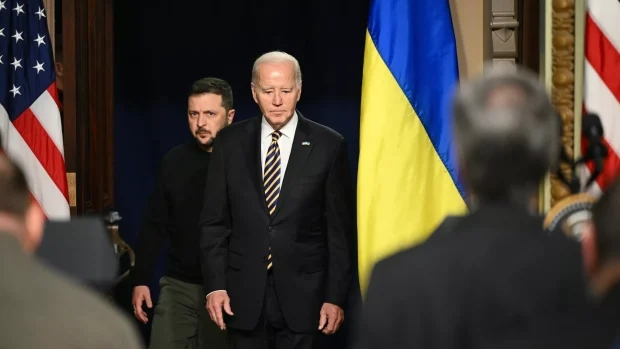
© MANDEL NGAN
Sputnik – 14.06.2024
NATO has sought to turn Ukraine into a staging ground and has done everything it could to pit nation against nation, Russian President Vladimir Putin said.
“There have been five, now six, rounds of NATO expansion. They tried to turn Ukraine into their staging ground, to make it anti-Russia. To achieve these goals, they invested money, resources, bought politicians and entire parties, rewrote history and educational programs, nurtured and cultivated neo-Nazi and radical groups. They did everything to undermine our state ties, to divide and pit our peoples against each other,” Putin said at a meeting at Russia’s Foreign Ministry in Moscow.
He emphasized that the Ukrainian crisis is not a conflict between two nations but a result of the West’s aggressive policy.
“Let me say this right off the bat, the crisis regarding Ukraine is not a conflict between two states, much less two peoples, caused by some problems between them… The matter is different, though. The roots of the conflict are not in bilateral relations. The events unfolding in Ukraine are a direct consequence of global and European developments at the end of the 20th and beginning of the 21st century. It’s the West’s aggressive, unscrupulous, and absolutely reckless policy that has been pursued for all these years, long before the start of the special operation,” he explained.
Putin pointed out that if the conflict had been solely about disputes between Russia and Ukraine, then the mutual history, culture, spiritual values, and the millions of familial ties that both peoples share would have facilitated a fair resolution.
Russia had initially sought a peaceful resolution to the Ukrainian crisis, but all proposals put forth were ultimately rejected.
“We took the Minsk agreements seriously, hoping to resolve the situation through a peaceful process and international law,” he said. Moscow expected this would address the legitimate interests and demands of Donbass and secure the constitutional status of these regions, along with the fundamental rights of the people living there. However, he added, “But everything was ultimately rejected.”
Russia, in spite of seeking to resolve the Ukrainian crisis, was, nonetheless, deceived and misled.
“The ex-German Chancellor and former French President, essentially co-authors and, as it were, the guarantors of the Minsk agreements, later admitted that they never intended to fulfill them. They just needed to buy time to build up the Ukrainian armed forces, and to supply them with weapons and equipment. They simply deceived us once again,” Putin remarked.
Putin highlighted that that Russia did not start the war in Ukraine, rather, it was Kiev that launched military assaults against its own citizens who declared independence.
The Russian leader declared that those who assisted Ukraine in its punitive operation against Donbass are the aggressors.
“Russia did not initiate the conflict [with Ukraine]. That was the Kiev regime. After the residents from a part of Ukraine, in line with international law, had declared their independence, they [the Kiev regime] launched military operations and have kept them going ever since. This is an act of aggression, given that the right of these territories to declare independence has been recognized. Those who have supported the Kiev regime’s military machine all these years are accomplices of the aggressor,” he clarified.
Putin names conditions for Ukraine peace talks
RT | June 14, 2024
Ukraine must remove its troops from Russia’s new regions before any meaningful peace talks can begin, President Vladimir Putin has said.
Moscow rejects Kiev’s claims of sovereignty over five formerly Ukrainian regions, four of which have joined Russia amid the ongoing hostilities. People in the Donetsk and Lugansk People’s Republics and Kherson and Zaporozhye Regions voted for the transition in late 2022, though hostilities continue in all of them.
Ukrainian troops must be removed from these territories, Putin said on Friday at a meeting with Foreign Minister Sergey Lavrov and other senior Russian diplomats.
“I stress: the entire territory of those regions as defined by their administrative borders at the time they joined Ukraine [in August 1991],” Putin stated.
“Our side will order a ceasefire and start negotiations the minute Kiev declares that it is prepared to take this decision and starts actual withdrawal of troops from those regions, and also formally informs us that it no longer plans to join NATO,” the Russian leader pledged.
Putin outlined the conditions after condemning Kiev’s Western backers for allegedly preventing it from holding peace talks with Moscow while accusing Russia of rejecting negotiations.
“We are counting on Kiev to take such a decision on withdrawal, neutral status, and dialogue with Russia, on which the future existence of Ukraine depends, independently based on the current realities and guided by the true interests of the Ukrainian people and not at Western orders,” Putin stated.
At this point, Moscow will not accept a frozen conflict, which would allow the US and its allies to rearm and rebuild the Ukrainian military, Putin claimed. The full resolution of the issue will involve Kiev recognizing the four new regions as well as Crimea as part of Russia, he insisted.
“In the future, all those basic principled positions have to be enshrined in fundamental international agreements. Naturally, that includes the lifting of all Western sanctions against Russia,” Putin stated.
Accepting these terms will allow everyone involved to turn the page and gradually rebuild damaged relations, the president said. Eventually, a pan-European security system that works for all nations on the continent could be created, Putin added, noting that Moscow has sought this outcome for years.
The Russian president’s keynote remarks came ahead of a Swiss-hosted summit supposedly meant to further peace in Ukraine. Kiev has insisted that Moscow could not be invited to the event because it would try to “hijack” it by promoting alternatives to the “peace formula” pushed by the Ukrainian government.
Putin claimed that the event was meant to distract public opinion from the “true roots” of the conflict, and that Vladimir Zelensky has usurped power in Ukraine after his presidential term expired last month. Nothing but demagoguery and accusations against Russia can come out of the Swiss gathering, he predicted.
Russia and NATO are drifting towards a major war
By Ivan Timofeev | RT | June 14, 2024
Is it possible that NATO forces could become directly involved in the military conflict between Russia and Ukraine? Until recently, such a question seemed very hypothetical given the high risks of escalation of the military confrontation between the US-led bloc and Russia into a large-scale armed conflict. But this scenario should be taken seriously now.
The direct participation of individual NATO countries or the entire bloc in hostilities could gradually spiral out of control. Crossing red lines can lead to the belief that there will be no consequences for engaging in war. The result of such movements can manifest itself at an unexpected moment and lead to a much more dangerous situation than the current one.
Strictly speaking, NATO countries have long been involved in the conflict. This takes several forms.
First, Western countries provide Kiev with substantial financial and military assistance, including increasingly advanced and destructive weapons systems. As the stockpiles of Soviet-style kit in the arsenals of the USSR’s former allies in the Warsaw Treaty Organisation have been depleted, the Ukrainian army is receiving more Western systems and ammunition. So far, mass deliveries have been limited by the production capacity of the Western defence industry and size of existing stockpiles. But if hostilities are prolonged, industrial capacity has the potential to grow. Increasing supplies are also inevitable in the event of a peaceful pause, which would allow Ukraine to prepare for a new phase of hostilities. Russia can hardly hope that the West lacks the political will and resources to increase support for Kiev. Moscow appears to be preparing for the worst-case scenario, namely a steady increase in substantial and long-term military assistance to Ukraine. In addition to the supply of arms and ammunition, this aid includes the training of personnel, help with the development of military industry and infrastructure, and the reimbursement of expenses in other areas that allow Ukraine to focus its resources on the defence sector.
Second, Ukraine receives extensive Western support in the form of intelligence, including technical data from satellites, radars, reconnaissance aircraft, etc. The information received enables a wide range of operations, from scoping the theatre of operations to the identification of specific targets. Data providers can be selective in granting the Ukrainian side access. But its use in military operations against Russia is not in doubt.
Third, military specialists who are citizens of NATO countries are involved in combat operations. Their role does not always appear to be official. They may be ‘volunteers’ or simply mercenaries, whose participation the authorities of their countries turn a blind eye to. Russian estimates put their number at around 2,000 in October 2023. Whether that is accurate or not, it’s clear that foreigners are fighting on Ukraine’s side, that their participation is systematic rather than accidental, and that at least some of them are citizens of Western countries.
Their involvement has not yet created an excessive risk of direct military confrontation between Russia and NATO. For Kiev’s Western partners, the sluggish pace of the conflict allows them to gradually improve the quality of their support for Ukraine. Cruise missile deliveries have long been commonplace. The arrival of US fighter jets is only a matter of time. The Russian army is “grinding down” the Western equipment that arrives. But foreign supplies to Ukraine also require a concentration of resources on the Russian side.
A significant escalation factor that would amplify the risk of a direct clash between Russia and NATO, could be the appearance of military contingents form bloc members on the territory of Ukraine. The prospect of such a scenario has already been mentioned by some Western politicians, although their view has not been supported by the US and isn’t an official NATO position. A number of the bloc’s leaders have distanced themselves from supporting the idea of sending troops to Ukraine.
What might trigger such a decision and how might it be implemented? The most likely factor for direct intervention by individual states or NATO as a whole would be a possible major military success by the Russian army. So far, the front has remained relatively stable. But the Moscow’s military has already achieved significant local victories, increased pressure, seized the initiative, extended the offensive front and possibly built up reserves for more decisive action.
There are no signs of a repeat of last year’s Ukrainian counteroffensive. Kiev is reportedly short of ammunition, although this shortfall could be filled in the future by external supplies. Periodic attacks on Russian territory with cruise missiles, drones and artillery cause damage and casualties, but do not disrupt the stability of the front.
Moreover, such strikes embolden Russia’s determination to create buffer zones, i.e. territories from which Kiev will not be able to attack targets in Russian regions.
A possible collapse of certain sections of the Ukrainian front and significant territorial advances of Russian forces towards the west is becoming more and more realistic scenario.
The fact that no deep advances and breakthroughs have occured for some time does not mean that there is no possibility in the future. On the contrary, the probability is increasing due to the army’s experience in combat, the supply of the military-industrial complex to the front, losses on the Ukrainian side, delays in the delivery of Western equipment, and so on.
The Russian army’s ability to make such advances and breakthroughs is also increasing. A catastrophic scenario for individual Ukrainian groups is not predetermined, but it is probable. A major breakthrough of the Russian army towards Kharkov, Odessa or another major city could become a serious trigger for NATO countries to introduce the question of intervention in the conflict into practical terms. Several such breakthroughs, simultaneous or successive, will inevitably raise the issue.
Here, individual countries and the bloc as a whole face a strategic fork in the road. The first option is not to intervene and to support Ukraine only with military equipment, money and ‘volunteers’. Perhaps to admit defeat and try to minimise the damage through negotiations, thereby preventing an even greater catastrophe. The second option is to radically change the approach to involvement in the conflict and allow direct intervention.
Intervention can take a number of forms. It may involve the use of infrastructure, including airfields of NATO countries. It could mean the mass deployment of certain communications and engineering units and air defence systems, while avoiding their presence on the front line. An even more radical scenario is the deployment of a contingent of certain NATO countries on the border between Ukraine and Belarus. Finally, an even more radical option is the deployment of military contingents from NATO countries on the front line, which would probably be categorically unacceptable to the bloc.
Each of these scenarios involves a direct clash between Russian and NATO forces. Such a situation would inevitably raise the question of deeper bloc involvement and, in the longer term, the transfer of military conflict to other areas of contact with Russia, including the Baltic region. At this stage, it will be even more difficult to stop the escalation. The more losses both sides suffer, the more the maelstrom of hostilities will grow and the closer they will come to the threshold of using nuclear weapons. And there will be no winners.
These are all hypothetical options. But they need to be considered now. After all, not so long ago such significant military deliveries to Ukraine seemed unlikely to anyone, as much as the conflict itself, three years ago. Now it is an everyday reality. The dangers of movement towards a major war between Russia and NATO should be taken seriously.
Ivan Timofeev is the programme director of the Valdai Club.
Featured Video

The Truth About the Trump Shootings with Ken Silva
or go to
Aletho News Archives – Video-Images
From the Archives
Trans ‘milk’ as good as the real thing – NHS
RT | February 18, 2024
The drug-induced nipple secretions of trans women are as good as mothers’ breast milk for babies, the University of Sussex Hospitals NHS Trust claimed in a letter to campaigners made public in a report by British think tank the Policy Exchange on Sunday.
The healthcare trust’s medical director, Rachel James, argued that the off-label prescription drug cocktail men transitioning to female take in order to produce milk was “similar to the natural hormones which encourage lactation to develop when the baby is newly born.”
“The evidence which is available demonstrates that the milk is comparable to that produced following the birth of a baby,” James wrote in the letter, sent to Children of Transitioners last August.
Biological men who wish to lactate must first take hormones to grow milk glands and then take high doses of either domperidone or metoclopramide to stimulate milk production. Neither drug is approved for this use, though they are occasionally prescribed off-label to biological women who have trouble lactating.
However, domperidone’s own manufacturer, Janssen, warns patients the drug “may cause unwanted side effects affecting the heart in a breastfed baby” and “should be used during breastfeeding only if your physician considers this clearly necessary.” … continue
Blog Roll
 Aletho News
- Seyed M. Marandi: U.S. Strike Imminent – Toward Total War in the Middle East
- Russia Voted Under Fire. Washington Is Loading the Tankers.
- 12 Things Your Oncologist Was Trained Not to Tell You
- Anthrax Attacks Paved Way for COVID-Era ‘Junk Drugs and Vaccines’
- How Real Is the Impact of Western Sanctions on Israel?
- France, You Are Guilty: How Paris Turned Western Sahara into the Maghreb’s Powder Keg
- 2025 Nature Paper Claiming Worsening Global Drought Gets RETRACTED …Heavily Flawed
- Your Milk Is Not the Problem
- The Truth About the Trump Shootings with Ken Silva
- ARE PATIENTS BEING PROPERLY INFORMED ABOUT OZEMPIC?
- If Americans Knew
- Salah Sarsour’s Legal Team Says DHS Has Not Met Its Burden to Prove He Is Deportable
- An analysis of tax forms by The Intercept show Kraft’s charity and LLC have donated to Friends of the IDF and AIPAC’s super PAC.
- Israeli attacks kill four Palestinians in Gaza – Daily Update
- Inside Gaza’s death trap of collapsing, bombed-out buildings
- The everyday items Israel bans from Gaza every day
- Inside the siege, the ruined buildings of Gaza – Daily Update
- Debunking The Claim That Macklemore Has A “History Of Antisemitism”
- CPJ demands release of arrested Palestinian-US journalist near Bethlehem
- Robert Kraft: The Billionaire Friend of Netanyahu Pulling The Strings Behind the Macklemore/Ed Sheeran Blow Up
- Columbia Administered Fund Gives Big Money to Pro-Israel Groups
- No Tricks Zone
- 2025 Nature Paper Claiming Worsening Global Drought Gets RETRACTED …Heavily Flawed
- New Study: ‘Global Drought Shows No Detectable Recent Acceleration Under Climate Warming’
- Economic Masterminds: German Socialists Suggest Taxing Productivity Gains Stemming From Using AI
- The South China Sea Has Not Been Cooperating With The Climate Change Narrative
- Energy Crisis: Germany Enters Heating Season With Historically Low Gas Reserve Fill Levels
- New Study: The Antarctic Ice Sheet Gained Mass From 2020-2024 Due To Staggering Snow And Ice Accumulation
- Study: Ocean Heating Rates From Thousands Of Years Ago ‘Dwarf’ Modern Ocean Heating Rates
- Climate Extremists Target, Attack Large-Scale Power Grid Infrastructure In Germany!
- New Study: Antarctic Ice Melt Has Contributed Less Than 1 Centimeter To Sea Level Rise In The Last 30 Years
- Fear Of Debate: Alarmist German Climate Scientist Calls On Mainstream Media To Discredit Skeptic Voices
 Aletho News
