Prelude to WWIII: Italy Slams NATO Chief’s Proposal to Allow Ukraine to Strike Deep Into Russia
By Sergey Lebedev – Sputnik – 26.05.2024
NATO’s chief Jens Stoltenberg earlier urged Western nations to lift restrictions on allowing Ukraine to conduct attacks deep into Russia using Western weapons.
The Italian government has slammed NATO Secretary General Jens Stoltenberg’s plea to lift restrictions on the use of Western weapons supplied to Kiev regime.
“We will not send a single Italian soldier to Ukraine, and the military equipment that Italy sends should be used on the territory of Ukraine,” Italian Foreign Minister Antonio Tajani was quoted as saying by the Adnkronos news agency on Saturday.
He added that Italy “must always work for peace and lower the tone.” While Italy is a part of NATO, “every decision must be made collectively,” he pointed out.
Italy’s Deputy Prime Minister and leader of the Lega party Matteo Salvini voiced the same position, stressing that no one seeks a “prelude to a Third World War”.
“Italy is not at war with anyone, and while it was right to assist Ukraine militarily, lifting the ban on Kiev to strike military targets in Russia is out of the question. Similarly, I reiterate that Lega opposes sending even a single soldier to fight in Ukraine. We seek peace, not a prelude to a Third World War,” he underscored.
Earlier, NATO’s Secretary General Jens Stoltenberg urged partners to formally allow Kiev to use Western-supplied long-range missile systems to strike deep into Russian territory.
Russian officials repeatedly warned against military supplies to the Kiev regime, stressing that this move only fuels the conflict with no chance of affecting the ultimate course of the special operation.
Moscow’s Foreign Ministry Spokeswoman Maria Zakharova stressed that everyone who goes “to the so-called ‘peaceful conference’ in Switzerland” on Ukraine should be well aware of Stoltenberg’s recent words.
Russian parliamentary representative from the Crimea region in turn dubbed Stoltenberg’s words an “obsession with war” and “desire to harm Russia at any cost with no regard to catastrophic consequences for the population of Western nations.”
NATO Cries Wolf Over Finnish Islands to Hype ‘Russian Threat’ Narrative

Finland’s autonomous Aland Islands. © AFP 2023 / ALESSANDRO RAMPAZZO
By Svetlana Ekimenko – Sputnik – 25.05.2024
Western-peddled fears of an alleged potential threat posed to NATO by Moscow have become the norm amid the alliance’s relentless expansion closer to Russia’s borders and hiked up military spending benefiting the military-industrial complex.
NATO is increasingly crying wolf over an archipelago in the Baltic Sea as part of its “Russian threat” propaganda.
The Åland Islands have been dubbed the “Achilles’ heel” of the alliance’s newest member — Finland — Bloomberg reported.
The self-governing, demilitarised Swedish-speaking region of Finland sits at the crossroads of major trade routes worth an estimated $160 billion annually. Key energy and communication infrastructure, undersea electricity and internet cables are located in the area.
But what has NATO stymied is the fact that “Russia is tasked with enforcing an accord that has banned any military presence on its shores for over a century,” the news site pointed out.
Now the Nordic country is a NATO member, warmongering hawks see the archipelago as a huge blind spot, “giving Moscow an open field should it ever decide to invade.”
“If you have all the Åland Islands, you can block maritime traffic both to the Gulf of Bothnia and to the Gulf of Finland… Then we are pretty screwed,” claimed Pekka Toveri, a former major general in Finland’s armed forces.

Finland’s demilitarized Aland Islands. © Photo : Baltic Marine Environment Protection Commission; Finnish Border Guard; Finnish Navy
The Agreement between the-then Soviet Union and Finland on the Åland Islands was signed in 1940 following the end of the Winter War. The Finnish side pledged “to demilitarise the Åland Islands, not to fortify them, and not to put them at the disposal of the armed forces of foreign states.” A Soviet Consulate was established in Åland’s capital, Mariehamn.
According to Toveri, the Russian consulate on the Åland Islands needs to be shut down, and Finnish forces must begin training there.
The member of parliament for the center-right National Coalition Party added that archipelago is more important to Finland than Gotland Island is to Sweden. As with Gotland, control of Åland is perceived as key to military dominance in Baltic waters.
In the summer of 2022, Sweden hosted NATO’s BALTOPS 22 exercises on Gotland Island. After Stockholm joined NATO, abandoning long-standing neutrality, Sweden’s prime minister Ulf Kristersson expressed openness to “reinforcing” Gotland’s defenses, in a nod to NATO plans for the Baltic. Sweden’s plans to create a NATO base on the island of Gotland were slammed as provocative by the Russian Foreign Ministry.
After a recdnt review of the Åland islands’ status, the Finnish government saw no need to make any changes. That stance is backed by recent polls among Åland’s residents.
Bloomberg acknowledged that shredding any international demilitarization agreements would be a time-consuming feat, and is unlikely to happen, “for now.”
Developments around both Gotland and the Åland Islands fit the ongoing “Russia threat” narrative NATO has been pushing — while continuing its eastward expansion.
At the Antalya Diplomacy Forum held in Turkey earlier this year, Russian Foreign Minister Sergey Lavrov took Finland and Sweden to task for abandoning their longstanding neutrality to join NATO.
He said that their decision marked the end of “decades of good neighborliness.” Lavrov also warned that Russia would respond by taking additional measures “appropriate to the threats that could appear on the territory of Finland and Sweden.”
Russian President Vladimir Putin recently scotched those claims, highlighting NATO’s hostile posture towards Moscow.
“They’re trying to intimidate their own population with an imaginary Russian threat. This is an obvious fact,” Putin noted in his interview with Tucker Carlson, adding that “smart people understand perfectly well that this is a fake.”
Russia Muting Musk’s Starlink Satellites Using Sophisticated Electronic Warfare Tools
By Ilya Tsukanov – Sputnik – 24.05.2024
The Russian military possesses perhaps the most comprehensive, multilayered and multi-domain electronic warfare capabilities in the world, using an array of short, medium, long and ultra-long range systems to effect throughout the course of the proxy war with NATO in Ukraine.
The Russian military continues to ramp up its ability to disrupt the Starlink internet capabilities Ukraine’s troops use to coordinate their forces, collect intel and launch drone attacks on Russian frontline positions, causing mass “outages” in the Kharkov area of the front and playing a role in the rapid pace of Russia’s recent advances.
That’s according to Ukrainian officials, soldiers and electronic warfare specialists queried by the New York Times to find out why Russia’s EW operations had slowed frontline troops’ ability to communicate using Starlink internet to a crawl, forcing troops to resort to simple text messages.
NYT warned that if Russia’s massed efforts to disrupt Starlink “continue to succeed, it could mark a tactical shift in the conflict, highlighting Ukraine’s vulnerability and dependence on the service provided by Mr. Musk’s company,” while raising “broader questions about Starlink’s reliability against a technically sophisticated adversary.”
“We’re losing the electronic warfare fight,” a deputy commander from the Ukrainian 92ndAssault Brigade’s drone battalion told the newspaper. “One day before the attacks, it just shut down. It became super, super slow,” he complained.
A Ukrainian drone operator confirmed the connectivity issues. “During the first hours the front line was very dynamic. The enemy was moving. And we were moving as well. We needed to be to be fast in communicating,” the soldier said, complaining that the loss of Starlink connectivity “made everything more complicated” and “time consuming.”
Starlink, which operates by beaming internet down to portable Earth-based terminals using vast constellations of satellites, has been in Russia’s crosshairs since the early months of the Ukrainian crisis.
Sputnik has detailed the technical minutiae of some of the tools Russia has at its disposal to jam Starlink’s operations in Ukraine without breaking international law – including the use of ground-based radars to detect the operation of and pinpoint the location of Starlink terminals, and jamming signal transmission directly. The Borshchevik is one such system.
Ukrainian Minister of Digital Transformation Mykhailo Fedorov told the NYT that Russia’s latest attacks against Starlink appeared to be using more advanced technology, saying the Russians were “testing different mechanisms to disrupt the quality of Starlink connections because it’s so important for us.”
Fedorov did not elaborate on the nature of these “powerful” Russian EW systems, but said Kiev has maintained constant communication with Starlink to try to resolve the problems.
Experts from NATO countries aren’t entirely certain what’s causing the signal loss – improved and more precise Russian jamming equipment, or a new breed of special electronic warfare weapons mounted on drones to confuse the GPS signals. NYT also didn’t rule out that “solar storms” may be responsible for random outages.
Russia has demonstrated a mounting technological advantage over Ukraine in recent months, blasting through heavily fortified defensive lines in the Donbass – which Ukraine’s military had spent nearly a decade building up with NATO’s help, and advancing rapidly in the Kharkov region to create a “sanitary zone” after repeated Ukrainian attacks on Russian civilian infrastructure, including the border city of Belgorod.
Retired US Army Lieutenant General and former spec ops commander Mike Nagata warned last week that America was “falling behind” its adversaries in electronic warfare despite its best efforts.
“The gap between where the United States should be and where we are, in my judgement, continues to expand not everywhere, but in far too many places,” Nagata said at a Special Operations Forces Week conference in Tampa, Florida.
The former commander’s assessment was echoed by Hudson Institute senior fellow Daniel Patt in recent Congressional testimony. Patt warned in March that Russian EW systems had resulted in a dramatic drop in the effectiveness of some US GPS-guided munitions sent to Ukraine from 70 percent to as low as six percent.
Over the past two years, Russia has fine-tuned its electronic warfare capabilities to jam NATO artillery shells and JDAMs, heavy and long-range strike drones, and missiles. An informed source told Sputnik last October that Russia’s EW troops were preparing equipment to suppress F-16s when they arrive in Ukraine.
Electronic warfare has been a traditional Russian strong suit going back to Soviet days, when doctrines emphasized the “total integration of electronic warfare and physical destruction resources” on the battlefield.
Orban Calls Talks About ‘Russian Threat’ West’s Maneuver to Prepare for War
Sputnik – 24.05.2024
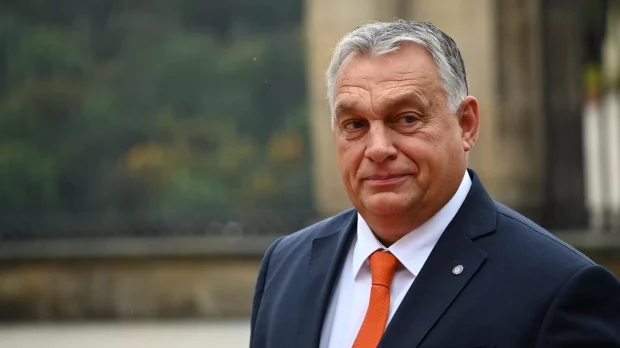
It is unlikely that Russia will attack a NATO country and talks about the “Russian threat” are nothing but a maneuver of the West to prepare for a war, Hungarian Prime Minister Viktor Orban said on Friday.
“The likelihood that someone — we are not just talking about Russia, but about anyone — today will decide to attack a NATO country is extremely small. NATO is a defensive alliance and will not tolerate military actions that violate the sovereignty of any NATO country … Therefore, I interpret these references to the ‘Russian threat’ rather as maneuvers by the West and Europe to prepare for entry into war,” Orban told the Kossuth radio broadcaster.
Statements by Western politicians and media reports indicate that Europe is preparing for a war with Russia, the prime minister added.
“Before the two world wars, the media spent quite a long time preparing for entry into the war. I think that what is happening today in Brussels and Washington, but rather in Brussels than in Washington, is a kind of preparation of sentiment for a possible direct conflict. We can calmly say that preparations are underway for Europe to enter the war, this is happening in the media and in the statements of politicians,” Orban said.
Half of Moldovans Say Gov’t Policy on Gagauzia Wrong, Over 50% Distrust NATO – Poll
Sputnik – 23.05.2024
CHISINAU – Half of Modova’s residents consider the government’s policy toward the autonomous region of Gagauzia wrong, while more than half do not trust NATO, Moldovan social research company IMAS found in a fresh survey published on Wednesday.
Asked what they thought of the policy of the ruling Party of Action and Solidarity (PAS) toward Gagauzia, 50% or respondents said it was wrong, 29% said it was right and 21% said they could not answer the question.
Respondents were also asked to evaluate their level of trust in various international institutions, including the World Health Organization, NATO, the European Parliament, the European Union, World Bank, the UN and others. Speaking of NATO, 18% said they had “little” trust, 42% said they had “no to very little” trust, 21% said they trusted the military alliance and only 9% said they trusted it a lot. Additionally, 2% of Moldovans said they they’d never heard of NATO and 8% said they could not give an answer.
The poll was conducted among 1,088 people from May 2-19 with a maximum margin of error of 3%. Its results were broadcast live on the Realitatea website.
Gagauzia, where most people speak Russian as well as Gagauz, a Turkic language, declared independence from Soviet Moldova in 1990 but was integrated into the newly-established Republic of Moldova in 1994. The Gagauz people are Orthodox Christians of Turkic origin. Gagauzia has traditionally favored rapprochement with Russia, while Chisinau has set a course toward European integration.
According to the country’s constitution, Moldova has neutral status, but from 1994 it has been cooperating with NATO, and with the accession to power of PAS, which is informally led by President Maia Sandu, military exercises involving the US, the UK, German and Romanian military have become more frequent. Sandu has told local media that Moldova should continue discussing rapprochement with NATO, as this allegedly helps strengthen the country’s defense capabilities.
Failure in Ukraine presents the West with a clear yet difficult choice
By Sergey Poletaev | RT | May 22, 2024
In our last article, we analyzed Kiev’s military prospects in light of its new mobilization law. Here we consider the West’s options in the proxy war it’s using the Armed Forces of Ukraine (AFU) to fight.
Western officials have been talking about sending troops to Ukraine since the beginning of the year. French President Emmanuel Macron said that he is ready to consider “any scenario,” including a ground operation. Government officials in Estonia and Lithuania (including Prime Minister Ingrida Simonyte) were quick to support him. And the Leader of the House Democratic Caucus Hakeem Jeffries became the first US politician who didn’t exclude the possibility of sending troops.
Formally, Ukraine hasn’t requested Western troops – Kiev has only demanded more weapons. But now, the New York Times reports that Kiev has officially asked the US and NATO to send military instructors to train 150,000 recruits on its territory, closer to the front line. Though the US has refused to comply with the request, the chairman of the Joint Chiefs of Staff, General Charles Q. Brown Jr, has said that a NATO deployment of trainers appears inevitable, and that “we’ll get there eventually, over time.”
The subject of sending troops to Ukraine comes up quite often but, so far, Western countries have steered clear. Why? Is a full-fledged NATO intervention in Ukraine possible and what would happen if it took place? And how else might the West turn the course of the conflict in its favor?
A larger-than-life bet
Western doctrine in regard to Russia was defined even before the start of the full-scale conflict: the idea was to fight Russia “with the hands of” Ukraine and on Ukrainian territory. The goal was to force Russia to play by Western rules (ideally, by defeating it on the battlefield) and reassert the US-led bloc’s shaky global hegemony. But, at the same time, officials wanted to minimize their own risks and avoid being drawn into a direct military confrontation that could result in a nuclear war.
The second staple of this doctrine – a total trade war – has not yielded the desired results. In 2022, it became clear that the West overestimated the degree of its control not only over the international financial system, but even over its own financial flows. Despite certain losses and additional costs, Russia has been able to replace old trade ties with new ones and to do so with a minimal loss of revenue. The severe sanctions imposed by the West on its own companies turned out to be quite useless, since for the most part Russia continues to receive the latest Western products and technologies.
As for the idea of defeating Russia on the battlefield, the turning point occurred in the summer of 2023. After the failure of Ukraine’s counteroffensive, it became clear that the AFU would not be able to impose peace on its own terms. The problem is that in the conflict with Russia, the West has gone ‘all in’ and any military outcome that could be regarded as beneficial for Moscow – even negotiations on an equal footing – would now be regarded as a defeat. The whole world would realize that they can stand up to the hegemon and not just avoid becoming an outcast, but even gain some benefits. The West cannot allow this, since it could cause a chain reaction on a global scale.
Two options
By the beginning of 2024, Western countries faced a dilemma: In the current proxy war it was clear that they were losing and Ukraine was getting weaker, while Russia was growing stronger. Western leaders realized that the situation will continue to get worse until the middle or end of 2025 – by which time their own military production should gain momentum and Moscow may begin to experience a shortage of volunteers at the front. In other words, the worst-case scenario meant that Russia would be able to conduct at least three more successful military campaigns (summer and winter ‘24, and summer ‘25) with superior military forces.
The logic of the conflict is pushing the West towards the choice that we wrote about back in May 2022 – either intervening directly and fighting Russia on its own, or starting serious negotiations with Russia on the topic of Ukraine’s NATO membership and, more broadly, security in Eastern Europe.
Paradoxically, though, the West has chosen a third option: doing nothing. And it’s not just because of inertia, but also down to the weakening position of globalist elites, who have many unsuccessful ‘crusades for democracy’ behind them, from Vietnam to Afghanistan.
As of now, the AFU is growing weaker, the scale of the hostilities is growing, and the chances of the West directly entering the war, with potentially catastrophic consequences, are increasing every day. In the fall of 2022, before the limited mobilization in Russia, 10-15 NATO brigades could have turned Ukraine’s notable but rather meaningless victories near Kharkov and Kherson into a strategic success – for example, they could’ve ensured a breakthrough to the Azov Sea and a subsequent blockade of Crimea – but now it would take a lot more effort to simply support the front.
Fooling the system
The reason for the West’s indecisiveness is clear: it fears an escalation of the conflict. Russia is the world’s largest nuclear power and President Vladimir Putin has repeatedly stated that he will not tolerate a widespread NATO intervention, which will result in a nuclear war.
Moscow’s warnings have challenged Western countries, headed by the US, to find ways “to intervene without intervening” and to enable Ukraine to win (or at least save face) without directly defeating Russia. In short, Western countries are forced to walk the thin line between defeat and nuclear war, without a clear end goal in sight.
After the failure to cut open a land corridor to Crimea, the West has not been able to find an alternative military strategy. Moreover, it has no idea how to get out of the war of attrition which, even in the case of a positional deadlock and a ‘static’ front, will result in Ukraine’s defeat, since an opponent that is many times weaker (Ukraine’s current population is at least five times less than that of Russia) will inevitably lose. We see plenty of such examples in history.
In this situation, the only thing that Western strategists have managed to come up with is to continue supporting the AFU and “increase costs” for Russia in the hope that Putin will get tired of fighting. Of course, no one in the West takes Ukraine’s suffering into account. It takes for granted the fact that Ukrainians will continue to die en masse just so that the West can save face. Neither do they care about Ukraine’s demographic and social collapse (unprecedented in post-WWII Europe) or the destruction of its infrastructure, which will prevent not only a normal economy but even normal life in these territories for many decades. Such issues are simply ignored or considered collateral damage.
The West may not explicitly state its strategy in regard to Russia, but it is clearly expressed in various publications and statements: the goal is to support the AFU at the front and at the same time move the conflict deeper into Russian territory in the hope that Putin will beg for mercy before Ukraine collapses.
It is unlikely that Western leaders still hope to see a victory for Kiev on the battlefield. The more likely goal now is either the “Korean scenario” where no one wins and Ukraine is kept as Russia’s opponent, or the “Palestinian scenario,” ie, eternal war on Ukraine’s former territory. What is clear is that the West will do anything it can to avoid holding serious negotiations with Russia.
War of the cities
Despite the growing escalation and the West’s increasing involvement in the conflict, one red line still exists: Ukraine is not allowed to hit Russia’s”old” territories – ie, those territories which the West recognizes as part of Russia – with Western missiles.
However, the ways in which Ukraine (with the West’s approval) circumvents this ban resemble the methods of an ingenious lawyer who finds the most unexpected loopholes in laws. For example, if “territory” is interpreted as “land” then air targets are not considered “territory” and Ukraine may hit air targets in internationally recognized Russian airspace; if a long-range drone has Western components and Western targeting, but was assembled in Ukraine, this also doesn’t count; and if Western weapons are used under a false flag (for example, by the Ukraine-based paramilitary group Russian Volunteer Corps) – this is fine, too. Of course, there are many such examples.
Why so? It is unknown whether any clear agreements regarding this issue exist but, in any case, Moscow has clearly stated that any obvious attacks on its “old” territories will allow Russia to retaliate and hit Western cities directly – not through proxies.
In military terms, the AFU will hardly benefit from such an escalation. Firstly, by resorting to such strikes, the Ukrainian army won’t change the strategic situation at the front, just as bombing Russia’s “new territories” and Crimea with all sorts of weapons hasn’t helped.
Secondly, the supply of Western missiles is not enough to overload Russian missile defense systems and achieve real military goals. Even though occasional missiles hit its territory, Moscow has adapted to the situation, takes measures to prevent future attacks, and carries out retaliatory strikes.
In other words, by striking Russian cities, (an unheard-of idea even in the most intense years of the Cold War), the West will not achieve anything but will only face increased risks and an escalation which it wishes to avoid.
However, it is possible that the desperate situation at the front and the need for some kind of propaganda success will sooner or later force the West to take such a step – and perhaps this may happen very soon. So far, this seems to be the most likely scenario that may lead to an escalation of the conflict beyond the zone of the Ukrainian “sandbox.”
Boots on the ground
And what about sending troops to Ukraine – will the West actually do it? This is unlikely. As pointed out already, in the past two years the scale of the conflict has changed and, in order to achieve success, NATO would now need to send dozens of brigades to Ukraine (at least 100,000-150,000 people), several hundred aircraft, and launch huge cruise missile attacks (hundreds of volleys per day).
Finally, even though such efforts might stabilize the situation at the front and save the AFU (supposing that the Kremlin does not declare a greater or even full mobilization in response), it would not guarantee Russia’s defeat but would only bring nuclear war closer.
In a direct intervention, NATO ground forces (just like Ukrainian ones today) will eventually face a shortage of ammunition and, in the air, NATO forces will suffer damage from Russian missile defense systems and will be exposed to attacks (currently, NATO reconnaissance operates over the Black Sea without any obstacles). Moreover, conflict with China also looms on the horizon and, if NATO empties its arsenals in Ukraine, China may either watch the situation unfold or offer Russia direct assistance.
As a result, NATO countries would find themselves in a positional conflict with heavy losses and unclear goals. Eventually, though, this may help to resolve the contradictions between Russia and the West, since, like a stubborn child, the US-led bloc may feel it has to try all means of resistance before giving in.
Another option for the West would be to move troops to Ukraine “symbolically”– for example, to send one or two brigades that would serve as instructors for AFU recruits (though it must be said that, two years into the war, the veterans on both sides of the front line are the ones who should teach the rest of the world, including NATO, how to fight), or just maintain aircraft.
Of course, it goes without saying that any third-country troops stationed in Ukraine will become a military target for Russia.
***
In conclusion, we may say that the Western doctrine – ie, the combination of a total trade war and a proxy war – has failed to bring about victory and has put its “client” (Ukraine) at risk of a major defeat. The West is still afraid to get directly involved in the conflict, even when it comes to striking “old” Russian territories or operating missile defense systems under its own flag, not to mention directly sending troops.
At the same time, the West avoids serious negotiations with Russia and prefers to go with the flow, consoling itself with the idea that Russia will eventually get burned by growing costs and retreat.
Meanwhile, Moscow is adapting to the situation, rebuilding its economy, trade relations, and society in order to live and successfully develop in the reality of a long conflict. The West’s strategy (or rather, the absence of such) has been clearly unsuccessful – especially considering the current level of involvement in the conflict, Ukraine may exhaust its forces long before Russia experiences any major inconvenience at the front.
Sergey Poletaev is an information analyst and publicist, co-founder and editor of the Vatfor project.
China slams US for ‘shifting blame’ over Ukraine conflict
RT | May 17, 2024
US policies are directly responsible for the Ukraine crisis, Chinese Foreign Ministry spokesman Wang Wenbin said on Friday, reacting to the latest accusations from Washington of Beijing’s supposed complicity in the conflict.
On Thursday, US State Department spokesman Vedant Patel claimed that China can’t enjoy strong relations with Europe and the collective West while “continuing to fuel the biggest threat to European security” by “fueling Russia’s defense-industrial base.”
In turn, Wang urged the US to “stop shifting the blame on China [and] not try to drive a wedge between China and Europe.”
“This is a reflection of the Cold War mentality that still dominates US thinking, which bears unshirkable responsibility for the eruption and escalation of the Ukraine crisis,” he stated. The spokesman argued that Washington is clearly “looking for enemies instead of seeking peace” in the conflict between Russia and Ukraine.
He further urged US authorities to stop “fueling the flame” with unfounded accusations and instead “start making real contribution to finding a political solution” to the crisis.
“China is not the creator of or a party to the Ukraine Crisis. We have been on the side of peace and dialogue and committed to promoting peace talks. We actively support putting in place a balanced, effective and sustainable European security architecture,” Wang stated.
Beijing has maintained a policy of neutrality on the Ukraine conflict and has rejected Western pressure to place sanctions on Russia, instead continuing to bolster economic ties with Moscow and expanding mutual trade. Consequently, Washington and its NATO allies have accused China of fueling Russia’s military effort by supporting its weapons manufacturing through the sale of dual-use components. The US has repeatedly threatened to place more sanctions on China if it does not stop these exports.
China staunchly denies the allegations, with officials repeatedly stating that the country is not selling weapons to either Russia or Ukraine. In an earlier statement, Wang accused the US of hypocrisy for providing billions of dollars in aid to Ukraine while “unreasonably” criticizing the “normal” trade and economic relations between Russia and China.
Russian President Vladimir Putin is currently on an official visit in China, where he has met with President Xi Jinping. In a joint statement on Thursday, the two leaders expressed firm commitment to continue bolstering ties between their respective countries. They also reiterated their stance on the Ukraine conflict, stating that it “must be resolved by political means.”
Who Is Juraj Cintula?
Is the man who tried to assassinate Slovak Prime Minister Fico really a “lone wolf”?
By John Leake | Courageous Discourse™ | May 16, 2024
The Telegraph and the Times of India have published profiles on the 71-year-old Slovakian poet, Juraj Cintula, who tried to assassinate Slovak Prime Minister, Robert Fico. The following is from the Telegraph report:
Juraj Cintula, a 71-year-old poet from the western town of Levice, posted online rants against Mr Fico before opening fire on the Left-wing nationalist at close range on Wednesday.
A photo of the writer published on X, formerly Twitter, showed him protesting against the government’s controversial reforms…
[Fico] is viewed as one of the EU’s most pro-Russian leaders after campaigning on a platform to end weapons donations to Ukraine.
In a post for the Movement Against Violence in 2022, Mr Cintula condemned Russia’s invasion of Ukraine. “What Slavic brotherhood?” he wrote, referring to Kremlin claims that Ukraine and Russia could be joined as they were essentially the same country. “He is only the aggressor and the attacked.”
A friend from Levice told Markiza TV that the pair had debates about politics, saying: “I’m more for Russia. He had different opinions.”
In 2015, Mr Cintula founded the campaign group Against Violence and sought to get it officially registered in Slovakia. “Violence is often a reaction of people, as a form of expression of ordinary dissatisfaction with the state of affairs. Let’s be dissatisfied, but not violent,” a petition circulated by him said.
… Unverified video footage emerged on Wednesday of Mr Cintula saying he did not agree with Mr Fico’s “government policy”. In another social media post, he criticised the Fico government for not cracking down on gambling.
The suspect’s political leanings appear to have shifted over time. He was once pro-Russian, and railed against “eyeless gypsies” and migrants before shooting the populist prime minister, who is fiercely anti-migrant.
I was surprised by how quickly the Slovak interior minister, Matus Sutaj Estok, characterized Cintula as “a lone wolf” who “did not belong to any political groups.”
It seems to me that no apparent political group affiliation does not necessarily mean that Cintula was not influenced or directed by someone else. Cintula’s online political rants in which he expressed strong emotions and shifting opinions could have flagged him as man who could be approached and influenced by an agent serving powerful interests. In this hypothetical scenario, Cintula may have fallen under the influence of an agent who presented himself under false pretenses.
Like many other reasonable people, I noticed that Prime Minister Fico has vocally criticized COVID-19 vaccines, endless shipments of weapons to Ukraine, mass immigration, transgender ideology, and climate change ideology. This makes him one of the few heads of state in Europe who has challenged all four articles of faith in what I call the Holy Quadripartitus of Piffle.
1). COVID-19 vaccines are saving mankind. Anyone who questions the safety and efficacy of the vaccines is guilty of heresy.
2). The U.S. proxy war in Ukraine is a sacred mission and no negotiated settlement with Russia shall be countenanced. Anyone who criticizes the Ukrainian and U.S. governments, and any attempt to understand the war from the Russian point of view, is guilty of heresy.
3). Human induced climate change will soon destroy the earth if trillions aren’t spent to overhaul our entire energy policy. Anyone who questions this proposition is guilty of heresy.
4). The concept of biological sex is a mere “construct.” Skilled surgeons and endocrinologists can transform a boy into a girl or vice versa. Anyone who questions this assertion is guilty of heresy.
Given the fervent belief in the Holy Quadripartitus—the Nicene Creed of the vaccine cartel, arms dealers, money launderers, lobbyists, racketeers, and child butchers—it is a matter of certainty that Prime Minister Fico has a vast array of powerful enemies.
Is the West Fanning Euromaidan-Style Public Protests in Georgia?
By Ekaterina Blinova – Sputnik – 16.05.2024
The US, EU and NATO have slammed the newly-passed foreign agents law in Georgia, while the foreign ministers of Iceland, Lithuania and Estonia took part in protest rallies against the legislation in Tbilisi. Sputnik’s pundits called these actions foreign meddling in Georgia’s affairs.
Lithuanian Foreign Minister Gabrielius Landsbergis expressed support for the “European” aspirations of Georgian protesters at a protest rally in Tbilisi on May 15.
“In a democracy, the government owes it to you, the Georgian people, to follow the direction your moral compass is showing,” Landsbergis told the crowd. “I am speaking out because I am… on the side of a European Georgia.”
But Tbilisi Mayor Kakha Kaladze, the secretary-general of the ruling Georgian Dream party, called their actions hostile and aimed at dividing Georgian society.
“This is not friendship, this is enmity, this is an attempt to deepen polarization in our country,” Kaladze told the Rustavi 2 TV channel. “Could you imagine our minister of foreign affairs going to Yerevan and speaking at an [Armenian] opposition rally?”
Direct Foreign Interference in Georgia’s Affairs
It was not the first time that Lithuanian officials have fanned public protests in a foreign state, according to Dr. Eduardas Vaitkus, Lithuanian politician who was an independent candidate in the 2024 Lithuanian presidential election.
“This is direct interference in the internal affairs of the sovereign state of Georgia,” Vaitkus told Sputnik.
Vaitkus cited earlier precedents for Lithuania’s meddling in the domestic affairs of Ukraine and Belarus. Vilnius has spent millions of euros supporting Belarusian self-declared opposition leader Svetlana Tikhanovskaya, backed by the West, who advocates for a coup d’etat in Minsk.
He recalled that the Lithuanian foreign minister’s grandfather, then-European Parliament member Vytautas Landsbergis, was spotted during the 2013 Euromaidan events in Kiev calling for a wider revolt in Ukraine.
“Unfortunately, this is the position of the Lithuanian state. My opinion is that traitors in our state are leading Lithuania in a way that creates a threat to all residents of Lithuania,” Vaitkus said.
The politician condemned the Lithuanian government’s “double and triple standards” in its unwillingness to recognize the will of the Crimean people to reunite with Russia — while rushing to embrace the self-declared independence of Kosovo alongside the West.
“Politics must have moral values. And [the Lithuanian government] demonstrates that duplicity is its main imperative in foreign policy,” Vaitkus said.
Russian Senator Konstantin Dolgov believes that Vilnius’ political agenda is not independent, but is dictated from the West.
“What can you expect from Lithuania and Estonia? These are countries that have long lost their independence and have become ‘appendages’ of Washington and Brussels,” Dolgov said, arguing that foreign ministers Iceland, Lithuania and Estonia could be sent by their Western patrons to fan unrest in Georgia.
Deputy Permanent Representative of the Russian Federation to the UN Dmitry Polyansky noted that the foreign ministers’ presence at Georgian protests is reminiscent of US and European politicians’ conduct during the 2013-2014 Euromaidan unrest in Kiev.
US Trying to Exert Pressure on Georgia as Its Hegemony Wanes
The US, EU and NATO have criticized the newly-passed foreign agents bill in Georgia, with US Assistant Secretary of State Jim O’Brien announcing on May 14 that Georgian MPs could be subjected to sanctions for “undermining democracy”.
While attacking the bill, which obliges Georgian media and NGOs to register as “pursuing the interests of a foreign power” if they receive over 20 percent of their funding from abroad, US policy-makers avoid mentioning that the Georgian legislation is reminiscent of the US’ own Foreign Agents Registration Act (FARA).
FARA requires individuals acting on behalf of foreign governments, organizations or persons foreign to the US to register with the Department of Justice (DOJ) and to disclose their relationship, activities, receipts, and disbursements in support of their activities.
Under to US law, such individuals are described as “foreign agents” while the FARA Unit of the Counterintelligence and Export Control Section (CES) is responsible for the Act’s enforcement.
The fierce US opposition to the Georgian bill under the guise of the “protection of democracy” and sanctions threats is an attempt to keep Tbilisi in line with the collective West’s agenda, according to Tiberio Graziani, chairman of Rome-based think tank Vision and Global Trends.
“The so-called defense of democracy, as promoted and implemented by the US-led West, falls within the context of the hybrid, cognitive and psychological war against those countries considered enemies, for geopolitical and geostrategic reasons,” Graziani told Sputnik.
“Any [country] that attempts to operate and act in the international context to responsibly promote the defense of its national interest is demonized by the US. Examples of this practice include, just to give a few examples, the so-called color revolutions,” he continued.
The US is believed to be behind a series of color revolutions in the former Soviet Union, including the Rose Revolution in Georgia in 2003, the Orange Revolution in Ukraine in 2004, the Tulip Revolution in Kyrgyzstan in 2005 and the failed Jeans Revolution in Belarus in 2006.
According to the expert, the threat and use of sanctions against foreign politicians pursuing national sovereignty constitutes a form of long-term US hybrid warfare.
Now that the world is becoming multipolar, the US is feeling the loss of its role as hegemon and could act irrationally with dramatic consequences for the rest of the world population, Graziani warned.
In Slovakia, the lone gunman strikes again
By Stephen Karganovic | Strategic Culture Foundation | May 16, 2024
The “lone gunman,” that cartoonish figure that for the last several decades – at least since November 1963 – has regularly framed most high-profile assassinations, has struck again, this time in disobedient Slovakia. He always pops up whenever his presence is required to warn misfits and discipline even team players who are inattentive to their tasks.
The assassination attempt on the Slovak Prime Minister Robert Fico fits that pattern. Fico’s political record going back for decades may have provoked a measure of distrust in globalist circles. However, his electoral victory and return to power in the fall of last year probably would have been treated as a manageable challenge had Fico been rotten enough to act as his colleagues routinely do, saying one thing before elections and doing the opposite afterwards.
He has, instead, turned out to be a man true to his word, certainly quashing any rumours that he had ever been recruited as one of WEF’s Young Leaders. At a critical juncture for the globalist string-pullers, when being a cooperative team player is considered de rigeuer, he chose to go off the beaten path with other outcasts like Victor Orban and to champion old fashioned values, such as Slovakia’s national sovereignty.
Fico however did not just insist on Slovakia’s sovereignty, which would have been bad enough, but also on other despised notions, equally discredited in present-day Europe: Statehood, Nationhood, Religion, and Family. It is his adherence to those values, once the cornerstone of the European civilisation before its cultural implosion, that made Fico a lone gunman target.
But to these shortcomings several other, no less bothersome and also potentially life threatening faults, should be added. Over the last several months, as Project Ukraine was turning into a shipwreck, Fico defiantly refused to allow military aid for the Kiev regime, called for cancelling anti-Russia sanctions, and repeatedly expressed the prohibited notion that Ukraine will be defeated.
As if that were not enough, there is more. In a long-forgotten tragedy in 2006, a Slovak aeroplane mysteriously crashed whilst flying back from Kosovo. On board, in addition to Slovak peacekeepers, there was a most interesting cargo. Slovakian specialists and forensic experts were involved in the exhumation of several mass graves in Kosovo where Serbian victims had been buried and they were bringing the evidence back home. It turned out that many of those victims exhibited thorax incisions which strongly suggested that they had been used as unwilling organ donors by Albanian traffickers. Readers whose memory is still unimpaired will recall the controversy about human organ extraction and trafficking in Kosovo that raged at the time, culminating in the incriminating 2010 report on this topic submitted to the EU by Swiss investigator Dick Marty.
The Slovak team handed a set of the evidence it had unearthed to NATO, of which Slovakia had by then become a member. But just to make sure that their findings would not disappear in some NATO black hole, they took the precaution of carrying an extra set home with them. That evidence was on board the aeroplane that inexplicably crashed and it perished along with about 40 Slovak personnel whose mouths concerning their gruesome findings in Kosovo were thus forever sealed.
As custom ordains in such situations, a hasty and superficial investigation was conducted by Slovak authorities, its conclusions were declared a state secret, and then sealed.
Five years ago, the 2006 plane crash again was in the limelight as new evidence emerged that the event may not have been an accident after all because of an explosive device that was placed on board. The Slovak parliament opened an inquiry into the matter which Robert Fico wholeheartedly and publicly supported.
In addition to his more recent gaffes, that also must have been a huge strike against him.
Predictably, responsibility for the shooting was instantly attributed to a lone individual who allegedly bore Fico a political grudge and decided to kill him. How that risible, Jack Ruby-type explanation will pan out, we may soon see as Slovakian authorities press their inquiry.
But irrespective of what Slovakian investigators uncover and how much of it their NATO overlords allow them to publish, certain preliminary conclusions about this ghastly attempted murder may still be drawn. Based on the totality of past experience, these conclusions are bound to be ultimately corroborated and will most certainly withstand the test of time.
The gangster hit on the Slovakian Prime Minister will have had its intended effect whether he survives or not. It was an intimidatory message sent loud and clear to all concerned not even to think of challenging the rules based order. The nature and reach of the “rules” as pertaining to them was made starkly clear the other day in Slovakia. As the position of the collective West crumbles, all European leaders who might be thinking of flip-flopping or asserting their nations’ interests in preference to obediently following orders have been put on notice. If Robert Fico was vulnerable, so are they. And this applies not just to pathetic excuses for national leaders who are presently in office, but also to those aspiring to replace them. More widely, the attempted murder of Robert Fico sends a message to outstanding non-political public figures of many profiles, such as Archbishop Vigano, whose bold statements, coherent analyses, and compelling appeals to the public threaten to collapse the manufactured consensus.
Ukraine desperate to receive more Western aid
By Lucas Leiroz | May 15, 2024
The Kiev regime still appears not to have understood its proxy role in the war with Russia. The country’s officials continue to demand constant assistance from the West, as if supporting Ukraine were an “obligation” of Western states. Now, the Ukrainians even want “unrestricted aid”, demanding from their partners that the costs of the war be included in the permanent expenses of NATO countries.
In a recent statement, the head of the Ukrainian presidential office, Andrey Yermak, one of the officials closest to Vladimir Zelensky, demanded from all Western countries, in addition to increased financial aid, unlimited access to their war arsenals and frozen Russian funds. His words were spoken during the Copenhagen Democracy Summit, where pro-Ukrainian organizations, led by the NGO “Alliance of Democracies”, met to discuss cooperation projects with Kiev.
Anders Fogh Rasmussen himself, former secretary general of NATO, participated in the event, supporting Yermak’s demands. Both officials signed a joint document at the summit endorsing the systematic increase in support for Kiev. Other relevant former authorities also participated in the event, such as Boris Johson, Sanna Marin and Hillary Clinton. The massive attendance of former officers shows that current Western politicians are not paying too much attention to the event, which is a consequence of the growing lack of interest in continuing to support Ukraine after so many military losses.
Yermak also commented on what he expects Western aid to look like from now on. According to him, at least 0.25% of the GDP of each NATO country must be sent to Kiev. Some countries have already spent much more than this percentage of their GDP on Ukraine, but what Yermak wants is for these expenses to become permanent, creating a kind of “obligation” on the part of Western countries towards Kiev. Latvia, for example, has already promised to continue spending more than 0.25% of its GDP on the war for at least the next three years. Yermak praises this initiative and calls on other European countries to act in the same way.
Furthermore, he emphasized the need for Kiev to receive at least 300 million dollars from Russian assets frozen in the West. According to Yermak, investing in the Ukrainian military is the correct way to use this money as it would be possible to try to reverse the damage caused by the so-called “Russian invasion”. The request reveals how Ukraine and the West are jointly desperate to establish new military assistance plans. Unable to spend more of their own funds, Western countries have frozen Russian assets so they have something to send to Ukraine – and, for its part, Kiev is in a rush to receive those funds as soon as possible, fearing that its “partners” will use the money for other priorities in their countries and abandon Ukraine.
Yermak and Rasmussen particularly emphasized the “need” to lift any restrictions on arms shipments to Ukraine. For them, it is unacceptable that some NATO countries continue to limit what can be sent to the Ukrainian battlefield. Furthermore, they called for restrictions on arms use to be revoked as well – which, in practice, means public authorization for the Ukrainian armed forces to kill civilians with NATO weapons.
The warmongers who attended the summit also called on NATO authorities to organize a conference in Washington with Ukrainian participation. The objective would be to establish a “clear timeline” for Kiev’s accession to the alliance, as well as new assistance goals in the current war. As a result, the summit’s participants tried in vain to put pressure for the neo-Nazi regime to enter the bloc, even though NATO had already indicated its intention to keep Ukraine as a mere proxy.
In fact, all the requests made at the summit seem impossible to fulfill. Yermak practically called for Ukraine to become a permanent state concern for Western countries. This may work in countries engaged in anti-Russian paranoia, such as the Baltics, but it is absolutely unfeasible for the military alliance as a whole. Western countries are simply exhausting their resources, leaving them unable to maintain constant support, which is why it will not be possible, even if there is a desire, to maintain a significant portion of the national GDP restricted to the war.
The summit seems to have brought together the most desperate sectors among Western and Ukrainian warmongers. Faced with the inevitable decline in support for Kiev, pro-war activists want to reestablish the anti-Russian agenda and prevent any possibility of peace.
Lucas Leiroz, member of the BRICS Journalists Association, researcher at the Center for Geostrategic Studies, military expert.
You can follow Lucas on X (former Twitter) and Telegram.
Firing Blanks: The Pentagon as a Fiscal Disaster Factory
By Bill Buppert | The Libertarian Institute | May 14, 2024
I have mentioned previously that the introduction of all the latest and greatest western weapons in the inventory given to the Ukraine would have some very deleterious effects in the future. One was permitting possible future antagonists to observe and and take detailed notes on the tactics, techniques and procedures (TTP) and experiment with prospective or actual countermeasures to neutralize or destroy these weapons systems and platforms. The other concerns would be allowing the first near-peer/peer martial contest to use this to shape and refine future strategic objectives. The Russians are certainly doing their homework and actively modifying and improving their means of waging war.
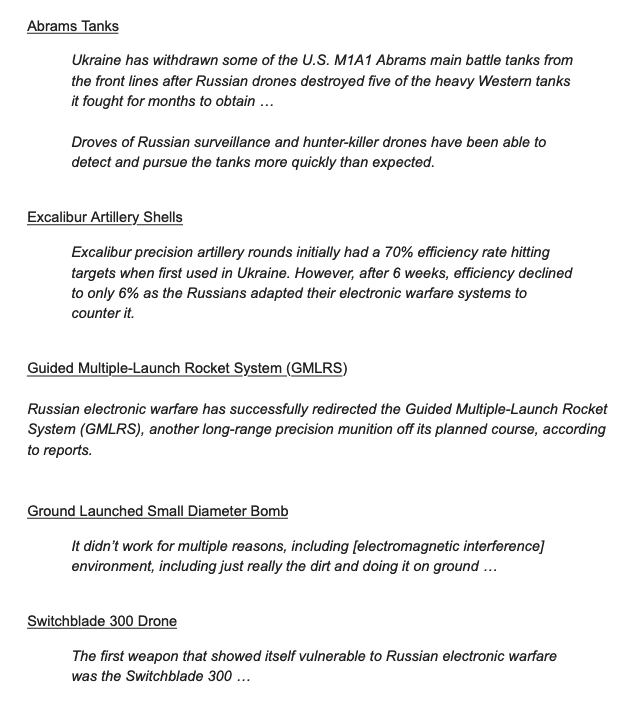
Performance is predictably abysmal for so many of these Western systems. The corporate/access media seems to finally be catching on that the weapons programs are not very effective.
The Biden administration has committed more than $50 billion in military aid to Ukraine since Russia invaded in February 2022, according to a Pentagon fact sheet. U.S. assistance has proven vital in helping Ukraine fend off Russia’s advances and mount counteroffensives, but some of the weapons have failed to have the desired impact as Russia’s military has adapted, according to media reports and experts.
Here are some highlights from the article:
If only the diversity enthusiasm incentivized opposing viewpoints and genuine intellectual differences.
Future historians will have a tremendous cottage industry trying to tease out how the world’s most expensive military paper tiger not only convinced the bill-payers to keep funding these disasters but the cognitive strategic deficit disorder that informed the entire fallacious enterprise managed to spend tens of trillions of dollars for a non-nuclear military apparatus that had a picture perfect track record of consistent failure since 1945.
Featured Video

The Truth About the Trump Shootings with Ken Silva
or go to
Aletho News Archives – Video-Images
From the Archives
The Geopolitics behind the War in Yemen (I)
By Mahdi Darius NAZEMROAYA | Strategic Culture Foundation | 30.03.2015
The United States and the Kingdom of Saudi Arabia became very uneasy when the Yemenese or Yemenite movement of the Houthi or Ansarallah (meaning the supporters of God in Arabic) gained control of Yemen’s capital, Sanaa/Sana, in September 2014. The US-supported Yemenite President Abd-Rabbuh Manṣour Al-Hadi was humiliatingly forced to share power with the Houthis and the coalition of northern Yemenese tribes that had helped them enter Sana. Al-Hadi declared that negotiations for a Yemeni national unity government would take place and his allies the US and Saudi Arabia tried to use a new national dialogue and mediated talks to co-opt and pacify the Houthis.
The truth has been turned on its head about the war in Yemen. The war and ousting of President Abd-Rabbuh Manṣour Al-Hadi in Yemen are not the results of «Houthi coup» in Yemen. It is the opposite. Al-Hadi was ousted, because with Saudi and US support he tried to backtrack on the power sharing agreements he had made and return Yemen to authoritarian rule. The ousting of President Al-Hadi by the Houthis and their political allies was an unexpected reaction to the takeover Al-Hadi was planning with Washington and the House of Saudi. … continue
Blog Roll
 Aletho News
- Imran Khan’s entire immediate family detained in Pakistan ahead of mass protest demanding his release
- EU nation detains former presidential frontrunner
- Leaked: Britain’s Sham Conviction Of Hashim Thaci
- Seyed M. Marandi: U.S. Strike Imminent – Toward Total War in the Middle East
- Russia Voted Under Fire. Washington Is Loading the Tankers.
- 12 Things Your Oncologist Was Trained Not to Tell You
- Anthrax Attacks Paved Way for COVID-Era ‘Junk Drugs and Vaccines’
- How Real Is the Impact of Western Sanctions on Israel?
- France, You Are Guilty: How Paris Turned Western Sahara into the Maghreb’s Powder Keg
- 2025 Nature Paper Claiming Worsening Global Drought Gets RETRACTED …Heavily Flawed
- If Americans Knew
- An error has occurred; the feed is probably down. Try again later.
- No Tricks Zone
- 2025 Nature Paper Claiming Worsening Global Drought Gets RETRACTED …Heavily Flawed
- New Study: ‘Global Drought Shows No Detectable Recent Acceleration Under Climate Warming’
- Economic Masterminds: German Socialists Suggest Taxing Productivity Gains Stemming From Using AI
- The South China Sea Has Not Been Cooperating With The Climate Change Narrative
- Energy Crisis: Germany Enters Heating Season With Historically Low Gas Reserve Fill Levels
- New Study: The Antarctic Ice Sheet Gained Mass From 2020-2024 Due To Staggering Snow And Ice Accumulation
- Study: Ocean Heating Rates From Thousands Of Years Ago ‘Dwarf’ Modern Ocean Heating Rates
- Climate Extremists Target, Attack Large-Scale Power Grid Infrastructure In Germany!
- New Study: Antarctic Ice Melt Has Contributed Less Than 1 Centimeter To Sea Level Rise In The Last 30 Years
- Fear Of Debate: Alarmist German Climate Scientist Calls On Mainstream Media To Discredit Skeptic Voices
 Aletho News