West mired in Ukraine crisis due to unwillingness or inability to confront reality
By Eusebio Filopatro | Global Times | April 21, 2024
As the Russia-Ukraine war drags on, a peace conference is to be held in Switzerland this summer. But Russia’s President Vladimir Putin said that Russia hadn’t been invited to participate in June’s talks. “It would have been funny if it weren’t so sad,” he commented.
Practically all Russian commentators, and even some prominent Western ones, trace the roots of the conflict in Ukraine to NATO’s attempts at incorporating Russia’s neighbor – as officially stated since at least as far back as 2008. A disregard for Russia’s status as an equal and sovereign partner was evident in the contempt for the Minsk agreements, which both former German chancellor Angela Merkel and former French president Fran?ois Hollande described as gimmicks to buy time for the only option that was seriously pursued, military confrontation. Later on, Vladimir Putin’s vocal request for security guarantees was dismissed yet again.
Fast forward a few years, and this historical tragedy has snowballed to its extreme conclusions. Politico recently reported Ukrainian officials’ concerns about a collapse of the frontlines. As Elon Musk calls for a negotiated settlement to come soon, he warns that the longer the war drags on, the larger the territory Russia will seek to annex. Even CNN is now explaining how Russia’s guided bombs are wreaking havoc on Ukrainian defenses. Meanwhile, the IMF has raised Russia’s growth outlook. In short, and irrespective of whether this will take weeks, months or years, Russia is well placed politically, economically and militarily to inflict the final blow.
The conditions of Ukraine’s sponsors are remarkably less favorable. Europe’s economic problems are “far bigger than a shallow recession.” The Union faces a dilemma over restricting imports from Ukraine or throwing its own agriculture under the bus. It is also split on the use of frozen Russian assets to finance the war. The Union will renew its Parliament in June and it is unclear whether Ursula von der Leyen will be re-elected. Even though the US House of Representatives on Saturday passed a $95 billion legislative package, including $60.84 billion to address the conflict in Ukraine, the US’ presidential elections in November still cast another shadow of uncertainty, to the point that NATO is considering setting aside “Trump-proof” funds.
Europe’s public opinion has also made up its mind on the matter. Only one in ten Europeans believe Ukraine can defeat Russia. The Pope has literally invited Ukraine to raise a white flag. Wolfgang Streeck, the Director of the Max Planck Institute, said, “The war is lost but our governments refuse to admit it.” A crushing military defeat would be the worst possible background for European and American elections, and erode confidence in the respective leaderships: The West should not fall prey to a sunk cost fallacy of catastrophic proportions. What would then be the way forward?
The rational course of action would be for the West to turn to diplomacy to correct such a disastrous trajectory, much like Musk and the Pope suggested. Even if Russia refused, or the attempt failed, the West would at least claim the moral high ground on this occasion. A comprehensive peace conference with the involvement of representative guarantors from the Global South could offer a lifeline to Ukraine, and a model for ironing out geopolitical tensions that are dangerously multiplying all over the world. Chinese diplomacy is going out of its way to make this possible, and the African Union, Brazil, the UAE, Saudi Arabia, Turkey and many others have also stepped forward with constructive proposals.
Yet leaders on both shores of the Atlantic are headed elsewhere. US Vice President Kamala Harris and European Council President Charles Michel are adamant that “There is only plan A”: military support for Ukraine. Along this path, some risky decisions appear increasingly likely. And pressure is mounting to use seized Russian assets to finance Ukraine. Of this move, in 2022, US Secretary of the Treasury Janet Yellen said “would not be legal.” But, apparently, a green light could come at the G7 summit in June.
If a botched peace conference would exact high reputational costs for Western diplomacy, the seizing of Russian assets could turn into a kamikaze attack, and unsettle the very domain wherein the West retains relative dominance, the international financial system. Neither initiative is likely to end the conflict in Ukraine.
If all such workarounds are really only dead ends, a reckoning with reality should be hastened rather than delayed. Yet, it is precisely the unwillingness or inability to confront the reality of the situation that got us here in the first place.
NATO boss attacks China over Russia ties
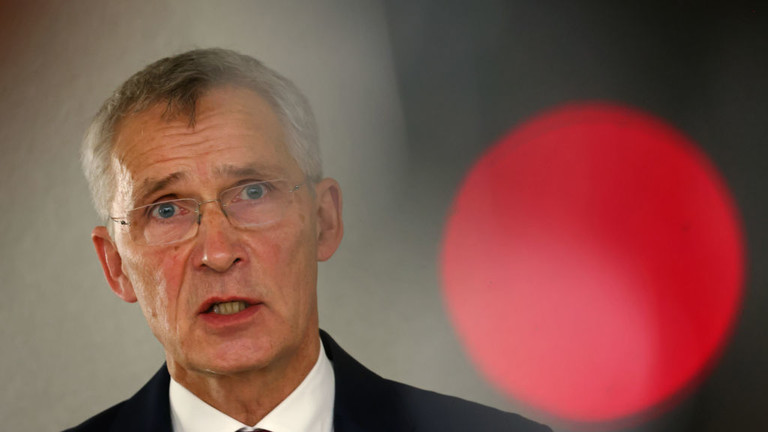
RT | May 13, 2024
Beijing is “enabling” Moscow in the Ukraine conflict, NATO Secretary-General Jens Stoltenberg has claimed, arguing that the US-led bloc has to be involved in Asia and not just in the North Atlantic.
Stoltenberg’s comments came during a question-and-answer panel at the NATO Youth Summit, in response to an inquiry from a Yale University student in the US.
“The war in Ukraine demonstrates that security is not regional, security is global,” Stoltenberg said. “The main country that is enabling Russia to conduct its war of aggression against Ukraine in Europe, is China.”
Stoltenberg went on to argue that China is “by far the biggest trading partner” of Russia, supplying Moscow with “critical components” for missiles, drones and other weapons. He also accused Iran of “providing drones” to Russia and North Korea of “providing ammunition and weapons.”
“Iran, North Korea and China, they are key for Russia’s capability to fight against [the] European friend [and] neighbor of NATO,” Stoltenberg said, referring to Ukraine. “So, this idea that we can divide Asia from Europe doesn’t work anymore.”
The US had pushed for NATO to expand its mission into Asia long before the Ukraine conflict boiled over in February 2022, however. Washington also appears to have been the source of claims that Beijing, Tehran and Pyongyang provided weapons and ammunition to Moscow, without offering much in the way of evidence to back that up.
China has repeatedly rejected pressure from the US and its allies to join their embargo against Russia, calling it unilateral and illegitimate. Beijing has also proposed a peace plan for the Ukraine conflict, which Moscow seemed interested in, but Kiev and its Western backers rejected.
Russia has denied US claims about North Korean weapons and ammunition deliveries. Iran has clarified that it provided Russia with prototypes and plans for drones before the outbreak of hostilities in Ukraine, suggesting that Moscow has been producing them domestically.
The US and its allies have sent over $200 billion worth of weapons, ammunition and cash to Ukraine over the past two years, while insisting that this does not make them direct participants in the conflict.
How Britain Sabotaged Ukraine Peace
By Kit Klarenberg | Al Mayadeen | May 11, 2024
On April 16th, Foreign Affairs published an investigation, documenting in forensic detail how in May 2022 Kiev was a signature away from a peace deal with Russia “that would have ended the war and provided Ukraine with multilateral security guarantees,” which was scuppered by Western powers. The outlet attributes the failure of negotiations to “a number of reasons” – although it’s unambiguously clear the biggest was British Prime Minister Boris Johnson offering President Volodymyr Zelenskyy the blankest of blank cheques to keep fighting.
For two years, claims and counterclaims have abounded about these peace talks, initiated almost immediately after the conflict began, and why they collapsed. Independent journalists and researchers, the Kremlin, and some foreign officials involved, assert that a favorable settlement was within reach, only to be scuttled at the 11th hour by Western actors. By contrast, Kiev, its supporters, and proxy sponsors have strenuously denied that negotiations were ever taken seriously by either party, while claiming Moscow’s terms were completely unacceptable.
Foreign Affairs has now validated what anti-imperialists have consistently contended. Amicable peace could’ve been achieved in Ukraine at the earliest stages of the proxy conflict, on terms favourable to both parties. Western powers responsible for sabotaging negotiations in service of weakening Russia knew that all along. Yet, they kept this inconvenient reality consciously concealed until now, when the war is unambiguously an unwinnable lost cause for all concerned, bar Moscow.
Still, to have the truth confirmed by Foreign Affairs – an elite US journal published by the notorious, highly influential Council on Foreign Relations – is hugely significant, and the narrative threat posed is evident. Within hours of release, Polish think tank operative Daniel Szeligowski took to X to rubbish the investigation at length, reinforcing the established Western fable that negotiations could never have succeeded, due to Kremlin intransigence, and Ukrainian resolve, in the face of industrial scale Russian war crimes.
Such pushback is only to be expected. After all, Foreign Affairs has raised a number of troublesome questions about the proxy war. In particular, why it continues to grind on today at unsustainable human and financial cost for Kiev and its foreign sponsors. The investigation also confirms Western governments that pushed Ukraine into conflict with its neighbor and historic ally were completely unwilling to come to the country’s rescue, in the event Russia responded to their provocations.
Talks begin, major concessions offered
Foreign Affairs bases its investigation on multiple “draft agreements exchanged between the two sides, some details of which have not been reported previously,” and interviews “with several participants in the talks as well as with officials serving at the time in key Western governments.” It offers a granular timeline of events, “from the start of the invasion through the end of May, when talks broke down.”
Before then, Vladimir Putin and Zelensky reportedly “surprised everyone with their mutual willingness to consider far-reaching concessions to end the war.” This included peacefully resolving “their dispute over Crimea during the next 10 to 15 years.” Talks began four days after the invasion in Belarus, with President Aleksandr Lukashenko playing mediator.
Putin appointed a negotiating team led by Vladimir Medinsky, a senior adviser to the Russian president who previously served as culture minister. By his side were deputy ministers of defense and foreign affairs, among others. Kiev dispatched Davyd Arakhamia, parliamentary leader of Zelensky’s political party, Defense Minister Oleksii Reznikov, presidential adviser Mykhailo Podolyak, and other senior officials. The individuals involved amply underlines how seriously negotiations were taken by both sides.
By the third round of talks, drafts of a peace treaty began to circulate. Many more materialized over subsequent weeks, as the two sides sought to overcome “substantial disagreements”, refining details face-to-face in a variety of international venues, and via Zoom. In brief, Kiev would accept various limits on the size of its Armed Forces, striking range of any missiles sited on its territory, and number of tanks and armored vehicles it could maintain.
Most crucially, Ukraine would implement the Minsk Accords, “renounce its NATO aspirations and never host NATO forces on its territory,” accepting permanent neutrality. In return for ensuring Russia’s “most basic security interests”, Kiev was free to pursue EU membership, and “security guarantees that would oblige other states to come to Ukraine’s defense if Russia attacked again in the future.”
Those guarantees could extend to “imposing a no-fly zone, supplying weapons, or directly intervening with the guarantor state’s own military force” – “obligations…spelled out with much greater precision than NATO’s Article 5,” Foreign Affairs observes. The outlet suggests this component was the undoing of negotiations, due to Kiev’s “risk-averse Western colleagues”:
“Kyiv’s Western partners were reluctant to be drawn into a negotiation with Russia, particularly one that would have created new commitments for them to ensure Ukraine’s security.”
Whitewashing Johnson’s Kiev visit
Foreign Affairs notes that Naftali Bennett, Israeli premier while the talks were ongoing, who was “mediating between the two sides”, has said that he “attempted to dissuade Zelensky from getting stuck on the question of security guarantees.’ He explained, “There is this joke about a guy trying to sell the Brooklyn Bridge to a passerby. I said, ‘America will give you guarantees? It will commit that in several years if Russia violates something, it will send soldiers? After leaving Afghanistan and all that?’ Volodymyr, it won’t happen.’”
Of course, several of Ukraine’s “Western patrons” have sent soldiers to assist in the proxy conflict – most prominently Britain, which in January signed a wide-ranging “security cooperation agreement” with Kiev. Foreign Affairs references Boris Johnson’s visit to the country in April 2022, and how Davyd Arakhamia has claimed the then-Prime Minister “said we won’t sign anything at all… let’s just keep fighting.”
The outlet adds that “already on March 30, Johnson seemed disinclined toward diplomacy, stating that instead ‘we should continue to intensify sanctions with a rolling program until every single one of [Putin’s] troops is out of Ukraine.’” So it was that he arrived in Kiev on April 9, “the first foreign leader to visit after the Russian withdrawal from the capital.” Johnson reportedly told Zelensky:
“Any deal with Putin was going to be pretty sordid… some victory for him. If you give him anything, he’ll just keep it, bank it, and then prepare for his next assault.”
Yet, Foreign Affairs downplays Johnson’s intervention, claiming allegations the British premier sabotaged negotiations are “Putin’s manipulative spin.” In support, the outlet notes how despite Moscow’s withdrawal from the northern front resulting in “the gruesome discovery of atrocities that Russian forces had committed in the Kyiv suburbs of Bucha and Irpin,” talks continued thereafter. The two sides worked “around the clock on a treaty that Putin and Zelensky were supposed to sign during a summit to be held in the not-too-distant future”:
“The sides were actively exchanging drafts [and] beginning to share them with other parties… the April 15 draft suggests that the treaty would be signed within two weeks. Granted, that date might have shifted, but it shows that the two teams planned to move fast… work on the draft treaty continued and even intensified in the days and weeks after the discovery of Russia’s war crimes, suggesting that the atrocities at Bucha and Irpin were a secondary factor in Kyiv’s decision-making.”
‘Bucha Effect’ leads to ‘frozen negotiations’
Bucha may have been a “secondary factor” in Ukrainian decision-making, but it wasn’t from the British government’s perspective. Unmentioned by Foreign Affairs, days before Johnson landed in Kiev, he boldly declared the alleged massacre of civilians in the town by Russian forces didn’t “look far short of genocide,” and “the international community – Britain very much in the front rank – will be moving again in lockstep to impose more sanctions and more penalties on Vladimir Putin’s regime.”
While a subsequent UN investigation failed to validate charges of genocide by Russia in Ukraine, once Johnson deployed the term, many Western officials followed suit. As a result, widespread public and state consent for keeping the proxy war going was very effectively manufactured across Europe and North America. To even speak of a negotiated settlement publicly became beyond the pale. Meanwhile, Britain’s shadowy, spook-infested Counter Disinformation Unit, which censors social media, began policing content related to Bucha online.
What happened in Bucha remains extremely murky. At the time, an anonymous US Defense Intelligence Agency official told Newsweek that civilian deaths could have resulted from “intense” ground combat over control of the town: “We forget two peer competitors fought over Bucha for 36 days, the town was occupied, Russian convoys and positions inside the town were attacked by the Ukrainians and vice versa.” They further warned the “Bucha Effect” had “led to frozen negotiations and a skewed view of the war”:
“I am not for a second excusing Russia’s war crimes nor forgetting that Russia invaded the country. But the number of actual deaths is hardly genocide. If Russia had that objective or was intentionally killing civilians, we’d see a lot more than less than .01 percent in places like Bucha.”
Such anxieties fell on deaf ears, although they reflect a broader resistance to escalating the proxy war on Washington’s part. In December 2022, the BBC reported that British officials were intensely worried about the “innate caution” of US President Joe Biden, “who is… concerned about provoking a wider global conflict.” A nameless state apparatchik revealed that London had “stiffened the US resolve at all levels”, via “pressure.”
Leaked material shows senior British military and intelligence officials leading London’s contribution to the proxy war are committed to challenging the “US position… firmly and at once.” One can only speculate whether incidents such as the Kerch Bridge bombing, which these officials secretly planned and helped Kiev execute – despite reported US opposition – were intended to escalate the conflict further, and keep Washington embroiled in the quagmire.
We are also left to ponder whether those officials played any role in the massacre of civilians in Bucha, whose names Ukraine refuses to release despite formal Russian requests. Kremlin apparatchiks, and Aleksandr Lukashenko, have claimed to possess evidence British special forces were responsible for the killings. None has emerged since, although why Britain prevented an emergency UN Security Council meeting on Bucha requested by Russia in April 2022 going ahead remains an open question.
The beast of ideology lifts the lid on transformation
By Alastair Crooke | Strategic Culture Foundation | May 6, 2024
The Transformation is accelerating. The harsh, often violent, police repression of student protests across the U.S. and Europe, in wake of the continuing Palestinian massacres, exposes sheer intolerance towards those voicing condemnation against the violence in Gaza.
The category of ‘hate speech’ enacted into law has become so ubiquitous and fluid that criticism of the conduct of Israel’s behaviour in Gaza and the West Bank is now treated as a category of extremism and as a threat to the state. Confronted by criticism of Israel, the ruling élites respond by angrily lashing out.
Is there a boundary (still) between criticism and anti-semitism? In the West the two increasingly are being made to cohere.
Today’s stifling of any criticism of Israel’s conduct – in blatant contradiction with any western claim to a values-based order – reflects desperation and a touch of panic. Those who still occupy the leadership slots of Institutional Power in the U.S. and Europe are compelled by the logic of those structures to pursue courses of action that are leading to ‘system’ breakdown, both domestically – and concomitantly – provoking the dramatic intensification of international tensions, too.
Mistakes flow from the underlying ideological rigidities in which the ruling strata are trapped: The embrace of a transformed Biblical Israel that long ago separated from today’s U.S. Democratic Party zeitgeist; the inability to accept reality in Ukraine; and the notion that U.S. political coercion alone can revive paradigms in Israel and the Middle East that are long gone.
The notion that a new Israeli Nakba of Palestinians can be forced down the throats of the western and the global public are both delusional and reek of centuries of old Orientalism.
What else can one say when Senator Tom Cotton posts: “These little Gazas are disgusting cesspools of antisemitic hate, full of pro-Hamas sympathisers; fanatics and freaks”?
When order unravels, it unravels quickly and comprehensively. Suddenly, the GOP conference has had its nose rubbed in dirt (over its lack of support for Biden’s $61bn for Ukraine); the U.S. public’s despair at open border immigration is disdainfully ignored; and Gen Z’s expressions of empathy with Gaza is declared an internal ‘enemy’ to be roughly suppressed. All points of strategic inflection and transformation – likely as not.
And the rest of the world now is cast as an enemy too, being perceived as recalcitrants who fail to embrace the western recitation of its ‘Rules Order’ catechism and for failing clearly to toe the line on support for Israel and the proxy war on Russia.
It is a naked bid for unchecked power; one nevertheless that is galvanising a global blow-back. It is pushing China closer to Russia and accelerating the BRICS confluence. Plainly put, the world – faced with massacres in Gaza and West Bank – will not abide by either the Rules or any western hypocritical cherry-picking of International Law. Both systems are collapsing under the leaden weight of western hypocrisy.
Nothing is more obvious than Secretary of State Blinken’s scolding of President Xi for China’s treatment of the Uighurs and his threats of sanctions for Chinas trade with Russia – powering ‘Russia’s assault on Ukraine’, Blinken asserts. Blinken has made an enemy of the one power that can evidently out-compete the U.S.; that has manufacturing and competitive overmatch vs the U.S.
The point here is that these tensions can quickly spiral down into war of ‘Us’ versus ‘Them’ – ranged against not just the China, Russia, Iran “Axis of Evil”, but vs Turkey, India Brazil and all others who dare to criticise the moral correctness of either of the West’s Israel and Ukraine projects. That is, it has the potential to turn into the West versus the Rest.
Again, another own goal.
Crucially, these two conflicts have led to the Transformation of the West from self-styled ‘mediators’ claiming to bring calm to flashpoints, to being active contenders in these wars. And, as active contenders, they can permit no criticism of their actions – either inside, or out; for that would be to hint at appeasement.
Put plainly: this transformation to contenders in war lies at the heart of Europe’s present obsession with militarism. Bruno Maçães relates that a “senior European minister argued to him that: if the U.S. withdrew its support for Ukraine, his country, a Nato member, would have no choice but to fight alongside Ukraine – inside Ukraine. As he put it, why should his country wait for a Ukrainian defeat, followed by [a defeated Ukraine] swelling the ranks of a Russian army bent on new excursions?”
Such a proposition is both stupid and likely would lead to a continent-wide war (a prospect with which the unnamed minister seemed astonishingly at ease). Such insanity is the consequence of the Europeans’ acquiescence to Biden’s attempt at regime change in Moscow. They wanted to become consequential players at the table of the Great Game, but have come to perceive that they sorely lack the means for it. The Brussels Class fear the consequence to this hubris will be the unravelling of the EU.
As Professor John Gray writes:
“At bottom, the liberal assault on free speech [on Gaza and Ukraine] is a bid for unchecked power. By shifting the locus of decision from democratic deliberation to legal procedures, the élites aim to insulate [their neoliberal] cultish programmes from contestation and accountability. The politicisation of law – and the hollowing out of politics go hand in hand”.
Despite these efforts to cancel opposing voices, other perspectives and understandings of history nonetheless are reasserting their primacy: Do Palestinians have a point? Is there a history to their predicament? ‘No, they are a tool used by Iran, by Putin and by Xi Jinping’, Washington and Brussels says.
They say such untruths because the intellectual effort to see Palestinians as human beings, as citizens, endowed with rights, would force many Western states to revise much of their rigid system of thinking. It is simpler and easier for Palestinians to be left ambiguous, or to ‘disappear’.
The future which this approach heralds couldn’t be farther from the democratic, co-operative international order the White House claims to advocate. Rather it leads to the precipice of civil violence in the U.S. and to wider war in Ukraine.
Many of today’s Woke liberals however, would reject the allegation of being anti-free speech, labouring under the misapprehension that their liberalism is not curtailing free speech, but rather is protecting it from ‘falsehoods’ emanating from the enemies of ‘our democracy’ (i.e. the ‘MAGA contingent’). In this way, they falsely perceive themselves as still adhering to the classical liberalism of, say, John Stuart Mill.
Whilst it is true that in On Liberty (1859) Mill argued that free speech must include the freedom to cause offence, in the same essay he also insisted that the value of freedom lay in its collective utility. He specified that “it must be utility in the largest sense – grounded on the permanent interests of man as a progressive being”.
Free speech has little value if it facilitates the discourse of the ‘deplorables’ or the so-called Right.
In other words, “Like many other 19th-century liberals”, Professor Gray argues, “Mill feared the rise of democratic government because he believed it meant empowering an ignorant and tyrannical majority. Time and again, he vilified the torpid masses who were content with traditional ways of living”. One can hear here, the precursor to Mrs Clinton’s utter disdain for the ‘deplorables’ living in ‘fly-over’ U.S. states.
Rousseau too, is often taken as an icon of ‘liberty’ and ‘individualism’ and widely admired. Yet here too, we have language which conceals its’ fundamentally anti-political character.
Rousseau saw human associations rather, as groups to be acted upon, so that all thinking and daily behaviour could be folded into the like-minded units of a unitary state.
The individualism of Rousseau’s thought, therefore, is no libertarian assertion of absolute rights of free speech against the all-consuming state. No raising of the ‘tri-colour’ against oppression.
Quite the reverse! Rousseau’s passionate ‘defence of the individual’ arises out of his opposition to ‘the tyranny’ of social convention; the forms, rituals and ancient myths that bind society – religion, family, history, and social institutions. His ideal may be proclaimed as that of individual freedom, but it is ‘freedom’, however, not in a sense of immunity from control of the state, but in our withdrawal from the supposed oppressions and corruptions of collective society.
Family relationship is thus transmuted subtly into a political relationship; the molecule of the family is broken into the atoms of its individuals. With these atoms today groomed further to shed their biological gender, their cultural identity and ethnicity, they are coalesced afresh into the single unity of the state.
This is the deceit concealed in classical Liberalism’s language of freedom and individualism – ‘freedom’ nonetheless being hailed as the major contribution of the French Revolution to western civilisation.
Yet perversely, behind the language of freedom lay de-civilisation.
The ideological legacy from the French Revolution, however, was radical de-civilisation. The old sense of permanence – of belonging somewhere in space and time – was conjured away, to give place to its very opposite: Transience, temporariness and ephemerality.
Frank Furedi has written,
“Discontinuity of culture coexists with the loss of the sense of the past … The loss of this sensibility has had an unsettling effect on culture itself and has deprived it of moral depth. Today, the anticultural exercises a powerful role in western society. Culture is frequently framed in instrumental and pragmatic terms and rarely perceived as a system of norms that endow human life with meaning. Culture has become a shallow construct to be disposed of – or changed.
“The western cultural elite is distinctively uncomfortable with the narrative of civilisation and has lost its enthusiasm for celebrating it. The contemporary cultural landscape is saturated with a corpus of literature that calls into question the moral authority of civilisation and associates it more with negative qualities.
“De-civilization means that even the most foundational identities – such as that between man and woman – is called into question. At a time when the answer to the question of ‘what it means to be human’ becomes complicated – and where the assumptions of western civilisation lose their salience – the sentiments associated with wokeism can flourish”.
Karl Polyani, in his Great Transformation (published some 80 years ago), held that the massive economic and social transformations that he had witnessed during his lifetime – the end of the century of “relative peace” in Europe from 1815 to 1914, and the subsequent descent into economic turmoil, fascism and war, which was still ongoing at the time of the book’s publication – had but a single, overarching cause:
Prior to the 19th century, he insisted, the human way of being had always been ‘embedded’ in society, and that it was subordinated to local politics, customs, religion and social relations i.e. to a civilisational culture. Life was not treated as separated into distinct particulars, but as parts of an articulate whole – of life itself.
Liberalism turned this logic on its head. It constituted an ontological break with much of human history. Not only did it artificially separate the ‘economic’ from the ‘political’, but liberal economics (its foundational notion) demanded the subordination of society – of life itself – to the abstract logic of the self-regulating market. For Polanyi, this “means no less than the running of society as an adjunct to the market”.
The answer – clearly – was to make society again a distinctly human relationship of community, given meaning through a living culture. In this sense, Polanyi also emphasised the territorial character of sovereignty – the nation-state as the pre-condition to the exercise of democratic politics.
Polanyi would have argued that, absent a return to Life Itself as the pivot to politics, a violent backlash was inevitable. (Though hopefully not as dire as the transformation through which he lived.)
Macron deployed French Foreign Legion to Ukraine, claims former US official
By Ahmed Adel | May 6, 2024
Contrary to previous claims that NATO has no operational plans for Ukraine, former US Deputy Under Secretary of Defense for Policy Stephen Bryen claims that France already has boots on the ground in Ukraine. His revelation comes as NATO has hypocritically outlined two red lines that would justify intervention in the Ukraine War even though France has already committed troops and has thus escalated the conflict without provocation.
“France has sent its first troops officially to Ukraine,” said former US Deputy Under Secretary of Defense for Policy Stephen Bryen in an article published by Asia Times.
Bryen further wrote that forces were mobilised “in support of the Ukrainian 54th Independent Mechanized Brigade in Slavyansk.”
The soldiers would have come from the 3rd Infantry Regiment, one of the main components of the French Foreign Legion. French authorities have not yet commented on the matter.
“These troops are being posted directly in a hot combat area and are intended to help the Ukrainians resist Russian advances in Donbas. The first 100 are artillery and surveillance specialists,” Bryen argued.
According to him, around 1,500 soldiers from the French Foreign Legion are expected to arrive in Ukraine in the near future.
The former US Deputy Under Secretary of Defense wondered about the “Russian red line on NATO involvement in Ukraine” or if “the Russians see this as initiating a wider war beyond Ukraine’s borders?”
At the same time, the Italian newspaper La Repubblica reported on May 5 that NATO — “in a very confidential way and without an official statement — established at least two red lines, beyond which there could be direct intervention by the alliance in the conflict in Ukraine.” The newspaper also stressed that NATO does not plan to send its military contingent to Ukraine immediately.
French President Emmanuel Macron recently clarified that he did not rule out the possibility of NATO sending troops from Europe to Ukraine. Kremlin spokesman Dmitry Peskov denounced Macron’s statement as “very dangerous,” which was also criticised by French opposition parties and by several NATO members, including Italy, Hungary, and Slovakia.
According to La Repubblica, the first “red line” revolves around the possibility of Russia penetrating Kiev’s defence line and refers to the “direct or indirect involvement of third parties” in the conflict. This would happen when Ukrainian forces “can no longer fully control” the border, which would create conditions for the Russian military to penetrate the corridor between Ukraine and Belarus.
As the newspaper suggests, “then Minsk will be directly involved in a military dispute,” and “its troops and arsenal will be of decisive importance for Moscow.”
The second “red line,” according to the outlet, “implies a military provocation against the Baltic States or Poland or a targeted attack on Moldova.”
In addition, Western authorities were deeply concerned about the situation at the front and the “unfavourable conditions” for Kiev.
Russia has repeatedly stated that NATO is directly involved in the conflict, supplying weapons and training Ukrainian forces. According to Moscow, NATO, whose activities near Russia’s borders have intensified to unprecedented levels, are aimed at confrontation. The Kremlin has continuously clarified that Russia is not threatening anyone and would not attack anyone but would not ignore actions potentially dangerous to its interests.
Macron is evidently testing Moscow’s resolve and limits by deploying the Foreign Legion, foreigners in the French military who will be entitled to French citizenship after three years of service. This is, according to Bryen, for two reasons: So Macron can “act like a tough guy without encountering much home opposition” and as a petty revenge for “French troops, almost all from the Legion, getting kicked out of Sahelian Africa and replaced by Russians” which has resulted in France losing “influence” and harmed “overseas mining and business interests.”
Most importantly, though, especially in light of the two red lines that were imposed, how will NATO react to Macron’s deployment of the French Legion since the decision was made without NATO backing? Bryen suggests that “the French cannot claim support from NATO under its famous Article 5, the collective security component of the NATO Treaty” and that “Should the Russians attack French troops outside of Ukraine it would be justified because France has decided to be a combatant, and forcing an Article 5 vote would seem to be difficult if not impossible.”
The two red flags outlined by NATO do not include if French-flagged troops are killed by Russian forces, meaning if Macron’s hope is to drag the entire alliance into conflict with Russia, it will not succeed, demonstrating once again his desperation to keep France relevant in the international scenario after Russia humiliated the French president’s neo-colonial agenda in Africa.
Ahmed Adel is a Cairo-based geopolitics and political economy researcher.
Macron warns about Russian missiles in a defeated Ukraine
RT | May 5, 2024
A total Russian victory over Ukraine in which the entire country is defeated would be detrimental to European and NATO security, as it could allow Moscow to place missiles at the EU’s doorstep, French President Emmanuel Macron has said.
In an interview with the French daily La Tribune on Saturday, Macron, who has famously refused to rule out sending Western troops to Ukraine, once again advocated a policy of “strategic ambiguity” towards Russia, arguing that the key idea behind such an approach is to project strength while “not giving too many details.”
Describing Russia as “an adversary,” the French president stressed that establishing “a priori limits” would be interpreted as weakness. “We must remove all visibility from it, because that is what creates the ability to deter,” he argued.
Macron further noted that Ukraine is crucial to France’s security because it is located only 1,500 kilometers from its borders. “If Russia wins, the next second, there is no longer any security possible in Romania, in Poland, in Lithuania and not in our country either. The capability and range of Russian ballistic missiles expose us all,” he said.
The president’s comments come after he suggested last month that Western nations “would legitimately have to ask [them]selves” whether they should send troops to Ukraine “If the Russians were to break through the front lines, [and] if there were a Ukrainian request.”
Kremlin spokesman Dmitry Peskov responded by calling Macron’s statement “very important and very dangerous,” adding that it was further testament to Paris’ direct involvement in the conflict. Russian Foreign Ministry spokeswoman Maria Zakharova has also warned that “nothing will remain” of NATO forces if they are sent to the front line in Ukraine.
Some Western nations have spoken out against sending troops to Ukraine, including the UK, one of Kiev’s staunchest supporters. British Foreign Secretary David Cameron insisted on Friday that while London would continue to support Ukraine, NATO soldiers in the country “could be a dangerous escalation.”
Russian President Vladimir Putin, however, has repeatedly dismissed speculation that Moscow could attack NATO as “nonsense,” saying that his country had no interest whatsoever in doing so.
The West’s double standards on Georgia’s ‘foreign agents’ bill
By Paul Robinson | Canadian Dimension | May 3, 2024
The Republic of Georgia has not enjoyed a stable life in the 30 years or so since it gained independence from the Soviet Union. In the 1990s, it was wracked by civil war and ethnic conflict, at the end of which it lost control of the autonomous regions of Abkhazia and South Ossetia. In 2003, the so-called Rose Revolution overthrew the government of President Edvard Shevardnadze, after which Georgia experienced the rather erratic reign of Mikheil Saakashvili, who promised to turn the country permanently towards the West, including membership of NATO and the EU.
Saakashvili, however, overplayed his hand, and in August 2008 launched an attack on South Ossetia in an effort to recapture it by force. The Russian army immediately responded, drove the Georgians out and advanced to within a few kilometers of the Georgian capital Tbilisi before agreeing to a ceasefire and heading home. Saakashvili left Georgia in 2013, discredited both by the 2008 war and revelations of rape and torture in the country’s prisons.
Since Saakashvili’s departure, the ruling party in the country has been Georgian Dream, an organization considered somewhat left-of-centre economically but also quite conservative socially, favouring traditional Christian family values. In terms of foreign policy, it remains committed to joining NATO and the EU, and has signed an association agreement with the latter. But it has resisted sending military aid to Ukraine or imposing sanctions on the Russian Federation lest this provoke Russian retaliation that might harm the Georgian economy. This has led critics to denounce it as ‘pro-Russian.’
The rather paranoid perception that Georgian Dream is a tool of Moscow lies at the heart of protests now rocking Tbilisi and threatening Georgia with yet another ‘colour revolution.’ The cause of this is legislation introduced by Prime Minister Irakli Kobakhidze that would oblige organizations that receive more than 20 percent of their funds from foreign sources to register as ‘foreign agents’ and submit details of their finances to the government. Organizations that fail to do so would be fined.
Kobakhidze says the law is necessary to increase transparency, an argument much used by advocates of similar laws in Western countries. The obvious target of the legislation is the large number of Georgian NGOs who receive money from Western countries for the purported aim of promoting European integration, ‘Western values,’ and so on, and also to carry out tasks such as election monitoring. Kobakhidze complains that such NGOs have promoted revolution (as in 2003), propagated ‘gay propaganda’ and attacked the Georgian Orthodox Church. It would appear that he wishes to rein them in. It is this that riles the thousands of people who have come out on the streets of Tbilisi this past week to protest against the proposed legislation. Wrapping themselves in EU flags, they claim that Georgian Dream is acting under orders from Moscow with the intent of destroying pro-Western forces in the country. “Everything shows that this government is controlled by Putin,” one protestor told the New York Times, while others shouted “No to the Russian law!”
According to Eto Buziashvili, a former advisor to the National Security Council of Georgia, the law is a method of “political repression,” whose aim is “to exhaust civil society and media, … leaving them with no capacity to defend the elections in October.” She continues: “those of us who desire an independent and free Georgia with a liberal democracy and a Euro-Atlantic future will be faced with the choice of either submitting to Russia-dictated rule or leaving the country. If we do neither, they will imprison us.”
Georgian Dream, however, is standing firm. Its leaders see the protestors as ideological zealots bent on revolution and on provoking conflict with Russia. In a speech on Monday, the party’s founder, billionaire Bidzina Ivanishvili, accused the ‘Global War Party’ of being behind the protests. According to Ivanishvili, the Global War Party “wields influence over NATO and the EU, stirring conflicts between Georgia and Russia, and exacerbating Ukraine’s situation.” “Foreign agents still aim to restore a cruel dictatorship in Georgia, but Georgian Dream will prevent this, advocating for governance elected by the people, not appointed from outside,” he says.
The ‘outside’ Ivanishvili mentioned is quite obviously the West, whose leaders have been outspoken in their criticism of Georgia’s foreign agent legislation. The EU’s diplomatic service, for instance, declared that, “This is a very concerning development and the final adoption of this legislation would negatively impact Georgia’s progress on its EU path. The law is not in line with EU core norms and values.” Meanwhile, a group of 14 US Senators signed a letter to Prime Minister Kobakhidze, arguing that the law “would be used to silence civil society and media that play a significant role in advancing Georgia’s democratic institutions.” They urged him to abandon his “destructive path” as a result of which “Georgia’s transatlantic aspirations are being undermined.”
The hostile reaction of the West once again raises questions of hypocrisy and double standards. After all, not only does the United States itself have a foreign agent law, but the concept is becoming increasingly popular elsewhere in the West, with an ever growing number of countries, including Canada, either adopting such a law or considering it. It would appear that requiring foreign-funded organizations to register with the government is acceptable as long as it is Western states doing the requiring. But when the tables are turned, and it is Western-funded institutions that are being obliged to register, suddenly foreign agent laws turn out to be threats to democracy that are incompatible with fundamental values.
No doubt, those leading the charge against Georgia’s law would argue that the comparison is a false one—that Western-funded NGOs are promoting human rights, democracy, and other universal values and institutions that are for the good of all, whereas foreign agent laws elsewhere are used to do the opposite. But what is a good objective is all in the eye of the observer. In countries like Georgia, Western-funded organizations openly seek to fundamentally alter the political, economic, and social institutions of their host countries to bring them in line with those of the West, and also to turn those countries into the West’s political and military allies. If you live in such a country and happen to disagree with such a fundamental alteration of your homeland, then indeed you could view this process as threatening.
It’s also not as democratic as we might like to think. Integration with the EU, for instance, requires one to bring one’s country in line with a host of demands from Brussels. Those overseeing the process are often more concerned with doing what the EU says they must do than with doing what their own people want. Moreover, what are nowadays referred to as ‘Western values’ are not universally popular, and the fact that those promoting those values are the beneficiaries of substantial foreign funding while those opposing them have very few resources of their own can be seen as not just unfair but deeply undemocratic.
In short, if Western states have their reasons for being cagey of foreign influences, so too do those in other countries. Moreover, while the push towards Western integration may work in countries that are relatively united in favour, elsewhere it can prove deeply divisive and, as shown by Ukraine, eventually extremely destructive. This is particularly so in cases such as Georgia, where the issue is wrapped up in geopolitical rhetoric that casts it as a struggle of good (the West) against evil (Russia). Contrary to the protestors’ claims, there is no evidence that Moscow is pulling the strings in Tbilisi, but their insistence that it is risks turning a domestic pursuit into something much wider and consequently much more dangerous.
Paul Robinson is a professor in the Graduate School of Public and International Affairs at the University of Ottawa and a Senior Fellow at the Institute for Peace and Diplomacy. He is the author of numerous works on Russian and Soviet history, including Russian Conservatism, published by Northern Illinois University Press in 2019.
Hostile Takeover: How NATO Annexed Macedonia
By Kit Klarenberg | Al Mayadeen | May 3, 2024
In Macedonia – or North Macedonia, or FYROM (Former Yugoslav Republic of Macedonia) – a counter-revolution impends. On April 24th, citizens went to the polls to choose their next President. Gordana Siljanovska-Davkova of Russophilic, pro-Serbian VMRO-DPMNE trounced Western-backed incumbent Stevo Pendarovski, albeit not by an absolute majority. The second round will be held May 8th, although opinion polls point to the challenger’s crushing victory. As we shall see, this development is a devastating blow to NATO, which could have far-reaching consequences regionally.
Pendarovski is a darling of EU and US officials. His upset win in 2019 was widely hailed in the mainstream media as illustrative of Macedonians’ yearning to at last become fully-fledged members of the transatlantic community, and rejection of VMRO-DPMNE’s “anti-Western” politics, which prominently included resisting NATO membership. His success also removed the last remaining barrier to Skopje joining the military alliance – a bitter, fraught, and protracted process, opposed by a significant proportion of the local population.
How Macedonia reached that point is largely unknown outside the country. It is a sordid tale of election meddling, subverted democracy, brazen swindles, high crimes and misdemeanours, and expansive American and British skullduggery, the full dimensions of which may never publicly surface. Now, Siljanovska-Davkova’s seemingly inevitable victory threatens to not only overturn those malign machinations, but reverse the US Empire’s ongoing effort to forcibly enmesh the entire Former Yugoslavia within NATO.
As with the election of Robert Fico in Slovakia, VMRO-DPMNE’s triumph comes at a very bad time for Washington. Across the West, public and state support for the proxy war in Ukraine is rapidly deteriorating, while Kiev faces total frontline collapse, and its forces are retreating everywhere. The prospect of Skopje’s withdrawal from NATO risks kickstarting another destabilising domino effect. The question of how, and whether, the alliance would be able to prevent this is an open one. Although it’ll undoubtedly try.
Dropping ‘Bombs’
NATO’s oft-repeated official mantra is that countries are free to choose their own security arrangements. As residents of the Balkans know only too well, in practice this simply isn’t true. For example, The Grayzone has previously exposed how alliance membership was violently imposed upon Montenegro in 2017, against the wishes of the overwhelming majority of the population. Macedonians were slightly more amenable to joining, although there was for many years a seemingly insurmountable hurdle preventing accession – their country’s name.
Following Yugoslavia’s breakup, Macedonia applied to join a welter of international organisations and institutions. Athens, worried Skopje’s nationalist leaders might use their newfound independence to make irredentist claims on its own territory, successfully lobbied the United Nations et al for Macedonia to be forever referred to as FYROM in international fora. Officials charged there was no connection between the modern state, populated by ethnic Slavs, and the Greek land of antiquity.
In 2008 however, Greece blocked Skopje’s bid to begin NATO’s accession process under the FYROM moniker, explicitly due to its official name. Athens proposed the country rebrand itself New or Upper Macedonia, before trying again. Three years later, the International Court of Justice judged this was improper and discriminatory, although did nothing to prevent a subsequent repeat. Both the alliance and EU remained steadfast that the issue needed to be resolved, before membership negotiations for either body could begin.
Contemporary polls showed 82.5% of Macedonians opposed changing the country’s name, a position wholeheartedly shared by the government. VMRO-DPMNE was in office at this time, led by hardline nationalist Nikola Gruevski. Pledging that Macedonia would always be called Macedonia, as if to specifically spite Athens, he thereafter launched an ambitious construction project, “Skopje 2014”. Swaths of the capital’s brutalist architecture were razed to make way for faux neoclassical buildings, and a giant statue of Alexander the Great was constructed in the city centre.
From NATO’s perspective, however, Macedonia’s alliance “aspirations” were “set in stone” when Skopje inked a “Membership Action Plan” in 1999. VMRO-DPMNE’s popularity, and Gruevski’s leadership, were therefore highly problematic for Washington. In the year following Russia’s March 2014 reunification with Crimea, NATO’s efforts to expand into Moscow’s “near abroad” became turbocharged. As if on cue, opposition party SDSM’s leader Zoran Zaev began regularly dropping what he and domestic media dubbed “bombs”.
These were highly incriminating audio recordings and wiretaps of private conversations between prominent local government officials, businesspeople, journalists, and judges. Purportedly captured illegally by Skopje’s intelligence agencies, and provided to Zaev by whistleblowers, they appeared to implicate Gruevski and his ministers in gross wrongdoing, and abuses of power. For his part, the Macedonian premier claimed SDSM was attempting to blackmail him into holding a snap general election, and had threatened to publicise damaging intelligence “gathered with the help of a foreign spy service.”
‘Only Consultative’
A political crisis duly erupted in Macedonia. The EU and US stepped in, mediating a deal whereby SDSM would appoint ministers to government departments in an interim administration, Gruevski would resign by January 2016, and new elections would be held in June that year. USAID’s Office of Transition Initiatives (OTI), a component of the intelligence cutout concerned with “political transition” – in other words, regime change – subsequently set up shop in Skopje.
OTI went on to funnel tens of millions of dollars to anti-government, pro-NATO groups, political parties, and NGOs. In all, $16.2 million was allocated for ensuring Macedonia’s untroubled entry to NATO alone. George Soros’ Open Society Foundations was also handed vast sums to cause chaos. A final report on these efforts produced by USAID bragged that its “Macedonia Support Initiative” had “reinforced the US Government’s foreign policy goal of strengthening Macedonia’s democratic reform processes leading to greater Euro-Atlantic integration.”
Yet, in the resultant election, SDSM fell short of victory, and was forced to scrape together a fragile coalition government. Incongruously, around 70,000 Albanians in Macedonia – one third of the country’s total population – supported Zaev, when they would normally vote for ethnic Albanian parties. They hadn’t backed SDSM before in significant numbers, and haven’t since. Local sources suspect Skopje’s US and British embassies “worked with village elders, imams, and local mafia elements, to get Albanians to switch their vote this one time.”
Despite its vulnerability, the coalition administration was the breakthrough necessary to end Skopje’s name dispute once and for all. So it was in June 2018, the Greek and Macedonian foreign ministers met by Lake Prespa to sign a historic agreement. North Macedonia was born, and its NATO membership was imminent. Or so the alliance thought. While parliament rubberstamped the move, President Gjorge Ivanov of VMRO–DPMNE refused, pointing out the agreement contravened Skopje’s constitution.
Panicking, the Macedonian government opted to hold a referendum on the name change that September. In the intervening three months, authorities – backed and financed by the EU and US – bombarded citizens with slick advertising and propaganda, intended to sell the public on the benefits of joining NATO. Simultaneously, vast protests raged throughout the country, under the banner of “Never North, Always Macedonia”. Ivanov, and countless posters in major cities, urged voters to boycott the plebiscite. As a constitutional scholar explained:
“The name of a country is a name that comes from and is created by the people who created this country and live in it. The state created by the Macedonian people is called the Republic of Macedonia. The Macedonian people will never refer to their country with [another] name… We can never accept to change something that we’ve used for centuries, a name that has been carried by this state for more than 50 years.”
When the referendum’s results trickled in, Western leaders and Zaev hailed how a staggering 94% voted in favour of renaming Macedonia. They neglected to mention turnout was just 37%, therefore nullifying the result. Under Skopje’s constitution, 50% of the public must vote for the government to honour a referendum’s outcome. No matter – Zaev simply shifted goalposts, claiming the plebiscite was “only consultative”. The name change could and would go ahead regardless.
In January 2019, parliament approved dubious and highly controversial constitutional “reforms”, allowing the country to be renamed without a public vote, or even the President’s blessing. This required corralling two thirds of lawmakers to back the changes. The SDSM-led coalition achieved this feat by bribing, intimidating, and blackmailing MPs, pardoning MPs facing prosecution for serious crimes, and other cynical connivances. Subsequent investigations uncovered “serious breaches” of domestic laws and international standards perpetrated by authorities during the referendum campaign.
The next month, NATO’s 29 members accepted North Macedonia’s accession. The alliance welcomed its newest inductee on March 27th 2020. How extraordinary it would be, if the country was the last one in, and first one out. Although, long before the latest Presidential election, there were unambiguous indications Skopje sensed geopolitical breezes have begun to blow in new directions. In November 2023, Macedonian officials announced their airspace would open to Russia, allowing Sergei Lavrov to visit a local OSCE ministerial summit.
Odessa massacre 10 years on… Western media silence covers up NATO incrimination
Strategic Culture Foundation | May 3, 2024
Ten years ago this week, a shocking and brutal massacre was perpetrated by supporters of the NATO-backed Kiev regime in Odessa.
At least 42 men and women were murdered on May 2, 2014, when the Trade Unions House in the historic port city was set ablaze by a fascist mob.
Last year to commemorate the ninth anniversary of the atrocity, our weekly editorial provided a rationale for Western silence. We commented:
“In all, 42 people were murdered in the Trade Unions building massacre. Not one attacker was ever prosecuted. The Kiev regime refused to carry out any adequate investigation.
However, the horror of that day was a turning point for many Ukrainians and Russians. It revealed the hideous nature of the regime that had seized power over the country and its vile fascist hostility toward Russia.
This is the regime that was brought to power by Washington and its NATO partners. Since 2014, it has been armed and built up to be a war machine to aggress Russia and obliterate all cultural connections with Russia.
The massacre in Odessa should be remembered for the sake of the victims that day. But also remembered because it helps explain the background of how the present U.S.-led NATO proxy conflict in Ukraine with Russia has come about.
For that reason, Western news media and their governments chose to studiously ignore the Odessa massacre. Their shameful silence is necessary in order to conceal the criminal complicity of the West in Ukraine’s deadly turmoil.”
Now 10 years on, the Western media do not even make any mention of the atrocity. In earlier years, the Western media sought to distort the incident by claiming that it was a confused melee and the tragic result of a clash between unknown rival factions. There were even deplorable attempts by Western media to make out that claims of an atrocity were “Russian disinformation”.
The cover-up has given way to total silence as if the horrific event was consigned to an Orwellian “memory hole”.
Russia continues to call for an international independent investigation to bring the perpetrators to justice. The Kiev regime persists in rebuffing any serious investigation for the simple reason that a thorough probe would probably show that the atrocity was carried out by the leadership of the Kiev regime in collusion with Western intelligence agencies.
What happened in Odessa on May 2, 2014, was not some random event of chaotic violence that got out of control. This is what the Western media initially reported.
No, it seems quite clear now that the massacre was a well-planned, deliberate act of mass murder to terrorize the Ukrainian opposition into complying with the NATO regime. It was an act of state terrorism.
The victims were all from Odessa who had been participating in a peaceful protest outside the landmark building in the city center. The building was closed due to the May Day holiday. As in several other southern and eastern regions of Ukraine at the time, there were many protests against the NATO-sponsored coup in Kiev that had taken place only weeks earlier in February of that year.
Many Ukrainians were not happy – indeed were appalled – that the so-called EuroMaidan coup in Kiev had brought to power ultranationalists and fascists who glorified NeoNazi figures and paramilitaries. Cities like Odessa suffered terribly under Nazi occupation during the Great Patriotic War (WWII). Now they were seeing a regime exulting in those Nazi memories and wanting to banish all Russian cultural connections.
In those pivotal months of 2014, the CIA’s plan to turn Ukraine into an anti-Russian bulwark was not a foregone conclusion due to the formidable opposition to the new regime in cities like Odessa, Kherson and Kharkov – as well as of course the Crimea Peninsula and the Donbass.
Former Odessa lawmaker Vasily Polishchuk who witnessed the violence that day testifies that senior figures in the Kiev regime were present in Odessa in the days before May 2. One of those was Andriy Parubiy who had been appointed head of national security. Parubiy is also implicated in the sniper shootings in Kiev on February 20 – a false flag provocation killing dozens of protesters and police officers – that precipitated the coup against the elected pro-Russian president Viktor Yanukovych.
Two weeks before the Odessa massacre, the then CIA director John Brennan was in Kiev on an unannounced visit. Even some U.S. lawmakers complained at the time that it was not a good look for the United States to be seen collaborating with the Kiev regime. Brennan was not only giving the green light to the “anti-terror operation” (civil war) that the Kiev regime was about to launch against the Donbass. It seems plausible that the United States was also helping to formulate a scorched-earth policy of terror to quell any dissent across Ukraine.
The mass killings in Odessa on May 2 were the selected terror demonstration.
Eyewitnesses tell of how thousands of Kiev regime paramilitaries who had been instrumental in the coup in the capital weeks earlier were bussed into Odessa and put up in camps. Andriy Parubiy was seen inspecting their ranks and overseeing the supply of body armor.
When the anti-Maidan protesters were attacked on May 2, they were herded by baseball-bat-wielding thugs into the Trade Union House. The building was then assailed with incendiary devices.
People who jumped from the blazing building were bludgeoned to death by NeoNazi gangs shouting “Death to all Russians”.
The dereliction of duty by the police that day to protect the peaceful protesters and the subsequent quashing of any crime investigation is proof that the security forces were complicit. That could only have been enabled by senior orders most likely issued by those in Kiev.
This is essential background to understand the current conflict in Ukraine and why Russia decided to intervene on February 24, 2022. Moscow maintains that Ukraine is a proxy war orchestrated by the United States and its NATO allies as a geo-strategic confrontation to subjugate Russia. Western regimes and their propaganda media make out that Ukraine is a democracy under aggression from Russia.
Understanding how the Kiev regime was installed with CIA and NATO engineering and how it rapidly used its fascist violence to turn Ukraine into a terror state corroborates the analysis of the current conflict being a Western imperialist proxy war.
The Western-lionized “democracy” has repressed all opposition parties and media.
The United States and its NATO accomplices do not want the Western public to understand the truth about their criminal machinations in Ukraine. These powers want the bloodshed to continue to the last Ukrainian because the war racket is so damn lucrative.
Thus the Western powers must shove episodes like the Odessa massacre down the memory hole and keep a lid on it. It is imperative to keep the fiction going of a democracy under attack otherwise the West’s collusion with a NeoNazi regime would reveal the Western powers’ inherent fascism.
Several events and developments around the world – brutal police repression of peaceful protests in the U.S. and Europe, the enabling of genocide by a fascist Israeli regime, the unprovoked aggression toward China, and the nefarious involvement in Ukraine – all point to Western states degenerating into full-fledged fascism.
NATO Steadfast Defender Drills Indicate Preparation for ‘Potential Conflict’ With Russia

Sputnik – 04.05.2024
MOSCOW – NATO’s large-scale Steadfast Defender drills indicate that the alliance is preparing for a “potential conflict” with Russia, Russian Foreign Ministry spokeswoman Maria Zakharova said on Saturday.
NATO kicked off Steadfast Defender 24 in January. The war games are running through May and include over 90,000 troops from all 32 member states. During the drills, the allies plan to test out a conflict scenario against a “near-peer adversary” in accordance with Article 5 of the North Atlantic Treaty, which states that an attack on one ally is considered an attack against the entire NATO and allows for the provision of appropriate assistance.
“Right now, NATO is conducting its largest drills since the Cold War, Steadfast Defender, near the Russian border. According to their scenario, using all the tools, including the hybrid ones and conventional weapons, they are exercising coalition actions against Russia. We have to admit that the NATO states are seriously preparing for a ‘potential conflict’ with us, about which, by the way, high-ranking NATO representatives are openly talking about,” Zakharova said in a statement published by the Russian Foreign Ministry.
Speaking about NATO’s accusations against Russia of hybrid attacks on the alliance Zakharova said Moscow considers them as disinformation, which increases the degree of anti-Russian hysteria.
On May 2, the North Atlantic Council adopted a statement, accusing Russia of hybrid attacks against the alliance’s member states.
“The North Atlantic alliance and the leadership of some individual member states are doing what they are the best at – spreading disinformation, increasing the degree of anti-Russian hysteria in order to justify unprecedented levels of militarization in Europe,” Zakharova said.
Hungary rejects ‘madness’ of NATO’s proposed €100-billion Ukraine war chest
RT | May 2, 2024
Budapest is opposing a potential €100-billion ($107 billion), five-year NATO plan to fund Ukraine in its conflict with Russia, Hungarian Foreign Minister Peter Szijjarto has said. The draft plan on the military aid fund was presented to member states of the US-led bloc by Secretary General Jens Stoltenberg earlier this week, Szijjarto revealed.
The minister made the remarks on Thursday to Hungarian broadcaster M1 before heading for a ministerial meeting of the Organization for Economic Co-operation and Development (OECD) countries in Paris.
“On Tuesday, the NATO member states received the secretary-general’s proposal to raise 100 billion that NATO plans to spend on the war,” the diplomat said, adding that since the money is to be collected over five years, this means NATO “expects the hostilities to continue for this period.”
Budapest will oppose the initiative and is not planning to participate in arming Kiev or training its soldiers, Szijjarto stressed. The draft plan was presented to the bloc’s member states in its “first reading” and is still subject to negotiations, the senior diplomat noted.
In the coming weeks during negotiations we will fight for Hungary’s right to stay away from this madness, from collecting these 100 billion and siphoning them out of Europe.
Budapest prioritizes the security of its own people before anything else and will do its best to “stay out of war,” Szijjarto explained, adding Hungary’s opinion remains that the conflict can only be resolved through negotiations. Nonetheless, Budapest acknowledges mounting global security issues and wants to be ready to face them, he said.
“We cannot ignore the threat of a new world war and the preparations for a nuclear war. This madness here in Europe must be stopped,” Szijjarto urged.
Hungary has consistently expressed its opposition to the ever-growing involvement of the US-led NATO bloc – and of the EU – in the Ukrainian conflict, refusing to send arms to prop up Kiev or to train its troops, and forbidding use of its territory to funnel such shipments from third countries.
Budapest has also publicly spoken out against the potential accession of Ukraine into NATO, which has long been one of the key goals of Ukrainian leadership.
Featured Video

The Truth About the Trump Shootings with Ken Silva
or go to
Aletho News Archives – Video-Images
From the Archives
The Geopolitics behind the War in Yemen (I)
By Mahdi Darius NAZEMROAYA | Strategic Culture Foundation | 30.03.2015
The United States and the Kingdom of Saudi Arabia became very uneasy when the Yemenese or Yemenite movement of the Houthi or Ansarallah (meaning the supporters of God in Arabic) gained control of Yemen’s capital, Sanaa/Sana, in September 2014. The US-supported Yemenite President Abd-Rabbuh Manṣour Al-Hadi was humiliatingly forced to share power with the Houthis and the coalition of northern Yemenese tribes that had helped them enter Sana. Al-Hadi declared that negotiations for a Yemeni national unity government would take place and his allies the US and Saudi Arabia tried to use a new national dialogue and mediated talks to co-opt and pacify the Houthis.
The truth has been turned on its head about the war in Yemen. The war and ousting of President Abd-Rabbuh Manṣour Al-Hadi in Yemen are not the results of «Houthi coup» in Yemen. It is the opposite. Al-Hadi was ousted, because with Saudi and US support he tried to backtrack on the power sharing agreements he had made and return Yemen to authoritarian rule. The ousting of President Al-Hadi by the Houthis and their political allies was an unexpected reaction to the takeover Al-Hadi was planning with Washington and the House of Saudi. … continue
Blog Roll
 Aletho News
- IRGC air defenses destroy another US MQ-1 drone over Strait of Hormuz
- Imran Khan’s entire immediate family detained in Pakistan ahead of mass protest demanding his release
- EU nation detains former presidential frontrunner
- Leaked: Britain’s Sham Conviction Of Hashim Thaci
- Seyed M. Marandi: U.S. Strike Imminent – Toward Total War in the Middle East
- Russia Voted Under Fire. Washington Is Loading the Tankers.
- 12 Things Your Oncologist Was Trained Not to Tell You
- Anthrax Attacks Paved Way for COVID-Era ‘Junk Drugs and Vaccines’
- How Real Is the Impact of Western Sanctions on Israel?
- France, You Are Guilty: How Paris Turned Western Sahara into the Maghreb’s Powder Keg
- If Americans Knew
- Singer Ed Sheeran says his ‘heart broken’ by Gaza devastation, addresses Macklemore controversy
- Israel Has Imprisoned Female Journalist Bushra Al-Tawil Without Trial Or Charge In Solitary Confinement For Past Month
- Israel poised to teach West Bank a lesson after one Israeli killed – Daily Update
- Salah Sarsour’s Legal Team Says DHS Has Not Met Its Burden to Prove He Is Deportable
- An analysis of tax forms by The Intercept show Kraft’s charity and LLC have donated to Friends of the IDF and AIPAC’s super PAC.
- Israeli attacks kill four Palestinians in Gaza – Daily Update
- Inside Gaza’s death trap of collapsing, bombed-out buildings
- The everyday items Israel bans from Gaza every day
- Inside the siege, the ruined buildings of Gaza – Daily Update
- Debunking The Claim That Macklemore Has A “History Of Antisemitism”
- No Tricks Zone
- 2025 Nature Paper Claiming Worsening Global Drought Gets RETRACTED …Heavily Flawed
- New Study: ‘Global Drought Shows No Detectable Recent Acceleration Under Climate Warming’
- Economic Masterminds: German Socialists Suggest Taxing Productivity Gains Stemming From Using AI
- The South China Sea Has Not Been Cooperating With The Climate Change Narrative
- Energy Crisis: Germany Enters Heating Season With Historically Low Gas Reserve Fill Levels
- New Study: The Antarctic Ice Sheet Gained Mass From 2020-2024 Due To Staggering Snow And Ice Accumulation
- Study: Ocean Heating Rates From Thousands Of Years Ago ‘Dwarf’ Modern Ocean Heating Rates
- Climate Extremists Target, Attack Large-Scale Power Grid Infrastructure In Germany!
- New Study: Antarctic Ice Melt Has Contributed Less Than 1 Centimeter To Sea Level Rise In The Last 30 Years
- Fear Of Debate: Alarmist German Climate Scientist Calls On Mainstream Media To Discredit Skeptic Voices
 Aletho News