The Anglo-American War on Russia – Part Thirteen (Putin’s Special Military Operation)
Tales of the American Empire | February 1, 2024
This series has explained how senseless NATO expansion caused a war in Ukraine. Ever since American President George W. Bush announced plans to add Ukraine and Georgia to NATO in 2008, Russian leaders said this third expansion of NATO would not be allowed. Since most people of Ukraine and its President didn’t support joining NATO, the United States organized a coup in 2014 and replaced its democratic government with one supportive of becoming an American vassal state. This never occurred as several NATO members stalled efforts to add Ukraine, so the United States began making Ukraine a de facto member by providing billions of dollars to greatly expand, train, and equip its army. Despite its small army, everyone knew that Russia could expand it if necessary. It has four times the population of Ukraine, ten times its economic power, and more advanced military equipment. Yet even the ominous arrival of Russian military forces on Ukraine’s border failed to encourage implementation of signed peace agreements. Russian President Vladimir Putin reluctantly ordered Russian troops into the Donbas to help local militias expel Ukrainian troops in what he called a “Special Military Operation.”
_________________________________
“Not About NATO” | “Never About NATO” | “Nothing to Do With NATO” | UKRAINE WAR; Matt Orfalea; YouTube; October 2, 2023;  • “Not About Nato” | “Never About NATO”…
Related Tale: “Poland Lost World War II”; • Poland Lost World War II
Related Tales: “The Anglo-American War on Russia”; • The Anglo-American War on Russia
Richard Sakwa Explains How We Ended Up In A New Cold War
By Ted Snider | The Libertarian Institute | January 31, 2024
 The war in Ukraine is a complicated tangle of three wars in one. It is a civil war between Ukraine’s European leaning west and its Russian leaning east. It is a war between Ukraine and Russia. And it is a war between Russia and NATO.
Ben Abelow’s book, How the West Brought War to Ukraine, is a clear and valuable introduction to the decisions and events that led up to the war between Ukraine and Russia. Nicolai Petro’s The Tragedy of Ukraine is a comprehensive and masterful account of the history of the ethnic tension between the monist and pluralist visions of Ukraine that led to civil war and made Ukraine vulnerable to being caught up in the larger war between Russia and NATO.
Richard Sakwa’s new book, The Lost Peace, valuably fills the gap by addressing the larger war between Russia and NATO. It is a tour de force analysis of the wasted opportunity for peace at the end of the Cold War.
When Mikhail Gorbachev declared the end of the Cold War on December 7, 1988, a brief window for peace opened. But by the negligent failure to construct a new security structure in Europe that overcame the flaws of the previous one, the window Gorbachev opened was quickly closed. When Gorbachev received his peace prize in 1990, the Nobel Prize committee declared that “the two mighty power blocs, have managed to abandon their life-threatening confrontation” and confidently expressed the “hope that we are now celebrating the end of the Cold War.” But “The Cold War,” as U.N. Secretary General António Guterres has funereally said, “is back.”
How was that window of opportunity wasted? Why was the road from the Nobel Committee’s hope to the United Nations’ eulogy such a short one?
If the second cold war that we now find ourselves in is to end more hopefully, that failure will have to be deconstructed in order to find the clues for constructing a lasting and inclusive security structure upon which real peace can be built. Richard Sakwa, who has been called the preeminent Russia scholar of our day, provides timely help with his deconstruction of that failure.
There are two strengths that set The Lost Peace apart. The first is the wealth and depth of Sakwa’s knowledge. The second is that the book doesn’t just start with the shattering of the peace in Ukraine in 2014 that broke the dam for the new Cold War. In The Lost Peace, Sakwa analyzes the post Cold War world and identifies the conflicts and decisions that wasted the peace and led, once again, to war.
Sakwa argues that with the end of the first Cold War, there was a genuine chance for a very different world than the actual one being painfully played out in Ukraine; there was a genuine chance for a real peace.
But an arrogant America misunderstood Gorbachev’s offering of an international order that now transcended blocs and declared the victory of the American-led bloc and the dawn of a unipolar world. “By the grace of God, America won the cold war,” President George H.W. Bush arrogantly and misleadingly boasted in 1992. The young American hegemon, newly bloated with hubris, led the political West, hand in hand with NATO, on a global expansion that would soon close the cold peace and open the door to a new Cold War.
The U.S. rejected the opportunity it had been offered to build a new security structure. Instead, the U.S. declared not only the victory of the political West’s worldview, but its universality, and set out on a mission of enlargement that expanded to fill the whole world.
That is, the whole world but Russia, who alone was left out of the new security arrangement and ostracized as the new dividing lines in Europe moved ever closer to its borders and red lines until the whole strategy exploded in Ukraine, ending the possibility of peace and cementing the new Cold War.
Sakwa deconstructs the necessary security apparatus that was never constructed and demonstrates how, without that framework, the structure of the possible new peace so quickly collapsed. He identifies three crucial contradictions: sovereign internationalism versus liberal internationalism, international law versus the rules-based order, and freedom to choose versus indivisibility of security.
Russia was committed to sovereign internationalism, which emphasizes state sovereignty and the acceptance that different states develop different cultures and are at different stages of development of different forms of government. All are acceptable until they violate international law or human rights. The United States, however, took the perceived victory of the political West to mean the victory of the cultural West and set out on a mission to spread those values across the globe. They favored liberal hegemony over sovereign internationalism, asserting the universality of their beliefs. Russia, China, and the Global South resented that “great substitution” of the values of sovereign internationalism with liberal hegemony and the colonial missionary spread of the universal values of the West.
When the American policy of spreading Western values lacked the necessary approval of the Security Council, the U.S. enlarged the great substitution, usurping the authority of the Security Council and acting unilaterally without its approval. International resentment grew at this replacement of international law anchored in the UN with the rules-based order. The essence of international law is that written laws are applied universally. The rules-based order promoted by the West is composed of unwritten laws whose source, consent and legitimacy are unknown. To Russia and other countries not in the political West, they have the appearance of being invoked when they benefit the U.S. and its partners and not being invoked when they don’t. To those not in the political West, it appeared, disturbingly, that the U.S. and NATO had supplanted the U.N. as the arbiter of international law.
This belief was reinforced in Iraq and, especially, in Kosovo and Libya where the United States acted without Security Council approval in precisely the way they insisted that the rest of the world do not. Russia bristled at the double standard.
As long as liberal internationalism confined itself to the UN based international system, there was much about it that was attractive. But when the U.S. and NATO began their missionary project of spreading those universal values in ways that dismissed sovereign internationalism and international law, other nations felt their sovereignty and security being threatened.
And that led to the third contradiction. The U.S. insists on the free and sovereign right of states to choose their own partners and security alignments; Russia insists on the indivisibility of security, which insists that the security of one state cannot be purchased at the cost of the security of another. Both principles are enshrined in international law and in international agreements, and, with imagination and understanding, they could have been made compatible. But the United States, Russia argues, exclusively pursued the first in disregard of the second.
That conflict came to a head in Ukraine. American and NATO insistence, in violation of verbal promises made at the close of the Cold War, on NATO’s open-door policy and, especially, on Ukraine’s right to join NATO and NATO’s right to expand right up to Russia’s border was perceived by Russia as a security threat that crossed its reddest of lines.
The U.S. and NATO restated their promise of eventual NATO membership for Ukraine and increased military support. Russia felt that its security concerns were being ignored and that Ukraine was being built into a platform for threatening its existence. The U.S. overreached, Russia overreacted, and the second Cold War was a certainty.
If there is a weakness to Sakwa’s book, it is not in its argument nor in its evidence. It is in its reach to an audience. The Lost Peace is not an easy book. It is a book by a scholar steeped in the story that assumes at least a little of that knowledge by its audience. The Lost Peace is not a book for beginners. But for those with an interest in international relations, the book is an invaluable addition.
The Lost Peace despairs of the wasted opportunity to build a security structure that would have provided the architecture for a possible peace at the end of the Cold War. But it also ends with the hope that, having analyzed the contradictions, conflicts and failures to recognize the interests of others, we are able to find “new ways of thinking about old problems” and do better in the face of a new Cold War. Sakwa’s book is an invaluable contribution to that hope.
West Starts to Understand That Ukraine Project ‘Failing’ – Russian Foreign Minister
Sputnik – 30.01.2024
MOSCOW – The West is beginning to understand that the “Ukraine project” is failing but can not stop assisting Kiev because of its economic benefit and fear of losing “prestige,” Russian Foreign Minister Sergey Lavrov said on Tuesday.
“The figures that are hidden in Ukraine, they speak a lot about how important it is for the West to prevent the ‘failure’ of their ‘Ukraine project’. Moreover, they already understand that the failure has already begun. But nevertheless they cannot stop. And not only for reasons of prestige … And also from the point of view of economic benefits,” Lavrov said during a meeting with foreign diplomats in Moscow.
Addressing the UN Security Council meeting on January 22, 2023, Lavrov emphasized that there are no interests – and there never were – in the conflict with Russia in favor of the Ukrainian people. There are only “the interests of the Anglo-Saxons, their henchmen and the criminal, rotten Kiev elite, which is tied to the West by mutual responsibility and which is afraid of being swept away the day after the end of the war.”
The Russian top diplomat pointed out that Moscow has never given up on a peaceful resolution to the Ukraine conflict.
“We never gave up on the peaceful resolution, we are always ready to negotiate — negotiate not about how to keep the leadership of the Kiev regime in place but about overcoming the inheritance of a decade-long destructive looting of the country and violence against the people, removing the reasons for the tragic Ukrainian situation,” Lavrov said. However, the key factor hindering a resolution of the conflict in Ukraine is the continued support of the West, he added.
Germans expected to make their own bomb shelters – Bild
RT | January 28, 2024
Germans will be expected to turn their homes into bomb shelters in case a major war breaks out in Europe, newspaper Bild reported on Saturday, citing a draft document from the country’s Defense Ministry.
According to the report, the ministry is set to complete the work on the classified ‘Operational Plan’ (OPLAN) by April. The draft envisions Germany as a “transit country” crucial for the delivery of weapons and equipment rather than a state with an active frontline. For that reason soldiers would be tasked with securing key highways, railway stations and ports, Bild said.
At the same time, the state would have to rely on civilians to step in and cover some duties typically assigned to the military and police, including the protection of power plants.
There are only 579 functional bomb shelters in Germany, so the plan reportedly sees citizens setting up their own shelters in places such as basements and garages. Bild quoted the head of the Federal Office of Civil Protection and Disaster Assistance, Ralph Tiesler, as saying that building new shelters is “no longer feasible” due to time constraints.
Germany has been looking for ways to boost its army, citing the threats stemming from the ongoing Russia-Ukraine conflict. The government set the goal of increasing the size of the Bundeswehr from 183,000 soldiers to 203,000 by 2031.
Defense Minister Boris Pistorius stated this month that Russia could attack a NATO country “within five to eight years.” He later somewhat adjusted his assessment, telling Bild on Friday, “At the moment, I don’t see any danger of a Russian attack on NATO territory or on any NATO partner-country.”
Russia has repeatedly accused NATO of fearmongering and stoking tensions in Europe. The head of Russia’s Foreign Intelligence Service, Sergey Naryshkin, recently dismissed the claims that Moscow is planning an attack on NATO as “informational warfare.”
US ambassador makes threat to Hungary

David Pressman, U.S. ambassador to Hungary, attends the LGBTQ Pride parade in Budapest, 15 July 2023 © Getty Images / Marton Monus
RT | January 27, 2024
The US has the power to pressure Hungary if it does not adjust its foreign policy towards the EU, NATO and Russia, American ambassador to Budapest, Davis Pressman, said.
In an interview published in the Financial Times on Friday, Pressman laid out a laundry list of complaints about Hungarian Prime Minister Viktor Orban, including his defiant stance on the Russia-Ukraine conflict and attitude towards Russian President Vladimir Putin.
“When you look at Hungary’s foreign policy, whether it be suggesting raising questions about Ukraine’s EU accession, stymying efforts to provide financial support to Ukraine, meeting with Vladimir Putin, resisting efforts to diversify off of Russian energy, resisting sustained efforts to close Kremlin platforms inside of Hungary, all of these have something in common,” the diplomat said. “And it’s something that is leaving Hungary more isolated from its partners within Nato and its partners within the EU.”
Pressman went on to insist that Orban’s “policy choices, without question, are helpful to Putin.” He added that the US has the means of coercing Hungary.
“We absolutely have leverage, that is true. And we’re prepared to use our leverage.”
Unlike many NATO members, Hungary has refused to send weapons to Ukraine and has barred the alliance from using its territory to provide military aid to Kiev. Orban also opposed certain economic sanctions on Russia. Last month, Hungary vetoed an additional €50 billion ($55 billion) in EU funding for Ukraine.
Budapest has maintained that no foreign pressure can prompt it to abandon national interests. “No one can tell us from the outside how to lead our lives within our own borders. Whether it is a foreign citizen, or even a foreign ambassador, their opinion is irrelevant for us,” Hungarian Foreign Minister Peter Szijjarto said last year, as quoted by local media.
US Attempts to Sideline Russia Under Black Sea Security Strategy Won’t Work – Military Expert
By Ekaterina Blinova – Sputnik – 26.01.2024
Washington is developing a new Black Sea strategy envisaging bolstering the US and NATO role in the region, as Assistant Secretary of State for European and Eurasian Affairs Jim O’Brien announced at a German Marshall Fund meeting on January 25.
Assistant Secretary of State O’Brien, who oversees US relations with Europe and Eurasia, visited the German Marshall Fund on Thursday to discuss 2024 US priorities in Europe, including backing Ukraine and “widening European integration.”
During his speech, O’Brien placed special emphasis on the strategic importance of the Black Sea to the US and NATO, stressing that the development of a grand design to ensure security in the region is underway. He pointed out that meetings had been held with Turkiye and other littoral states.
“[The US] want[s] to establish dominance over the Black Sea,” Vasily Dandykin, a captain 1st rank reserve and military expert, told Sputnik. “This is an old idea. One of the goals is to bring Ukraine into NATO. Because they believe that whoever dominates the Black Sea and owns Crimea receives all the bonuses. This is the underbelly of Russia in the south. And that’s why there was such irritation when the Crimean Spring happened in 2014 [Crimean people voted to reunify with Russia in March 2014 – Sputnik ]. As far as I remember the Americans had agreed with Kiev to establish a base for the US fleet in Sevastopol by that time.”
What’s Behind US Plans to Create Strategic Dominance in the Black Sea?
It was not the first time that O’Brien has pushed the idea of beefing up US/NATO presence in the region. On October 25, 2023, the US official testified before the US Senate’s Subcommittee on Europe and Regional Security Cooperation. He claimed that the Ukraine conflict is “a very good bargain” for the US as it gives Washington a unique opportunity to increase NATO’s military presence in the Black Sea, including the region’s lands, airspace, and waters, while “Ukrainians are paying the bulk of the cost” by fighting with Russians.
NATO’s dominance in the region could create conditions for pulling Ukraine and other Black Sea countries away from Russia and integrating them into the Western sphere of influence, O’Brien added. That would also help the West build oil and gas pipelines that lead from Central Asia via Armenia, Azerbaijan, Georgia, and Turkiye to Europe thus completely axing Russia’s energy commodities from the Old Continent’s market. In particular, O’Brien hinted that Washington was very interested in the Ukrainian conflict going on to allow the US to accomplish its geopolitical goals in the Black Sea region.
The Biden administration is considering the idea of redrawing the energy map of the Black Sea region altogether, as Edward Hunt, a PhD in American Studies from the College of William & Mary, has written in his op-ed for Foreign Policy in Focus. Hunt noted that the idea of the “Southern Gas Corridor” through the Black Sea was recently touted by State Department official Geoffrey Pyatt, who served as a US ambassador to Ukraine at the time of the 2014 coup d’etat in Kiev and who now leads US energy diplomacy. Per Pyatt, “the redrawing of the energy map around the Black Sea that’s taking place” envisages “new pipeline infrastructure”, in particular, “the Southern Gas Corridor to bring gas from Central Asia to European consumers.”
‘NATO’s Expanding in All Directions’
Meanwhile, Dandykin pointed out that Washington’s expansionist plans are not limited to the Black Sea:
“The fact is that the strengthening of the United States and NATO – first of all, the United States – in all directions has become the general concept,” the military expert stressed, adding that the US has recently expanded its continental shelf (including in the Arctic region) to about one million square kilometers – an area twice the size of California.
“They established their bases in Finland, and the Finns gave the go-ahead, for airfields, etc. In the Baltic, near our borders, maneuvers will now take place for two months, with a total of 90,000 [NATO] military personnel. This is a concept of the expansion in all directions, including in the south. They seek to encircle and bleed the Russian Federation white,” the expert said.
Dandykin emphasized that Washington appears to have benefitted the most from the Ukrainian conflict and sanctions spree. The US forced Europe to decouple from Russia and at least partially filled the latter’s shoes. The American military-industrial complex is now working “at full capacity” to replenish the allies’ depleted weapons stockpiles, as their obsolete weapons have been burned down in Ukraine.
“More and more [Western] countries are placing orders for weapons. There is a military schizophrenia in Germany, they want to rearm. The Americans have always been the beneficiaries in all these messes. Therefore, they will, in particular, try to pour more gasoline on the fire this year to create difficulties for Russia,” Dandykin said.
How Will Russia React to US Black Sea Strategy?
The US and their NATO allies have been trying to enhance their operations in the Black Sea, the military expert noted, referring in particular to Western surveillance drones flying in close proximity to Crimea.
Russia has repeatedly warned the US against meddling in the Ukraine conflict. On the morning of 14 March 2023, a Russian Su-27 fighter jet was scrambled to intercept an American MQ-9 Reaper drone. The latter eventually crashed into the Black Sea after conducting a botched maneuver.
Dandykin pointed out that no matter how brazen the US and its NATO allies may behave, they are fully aware that they are risking nothing short of a nuclear war with Russia.
Washington’s Black Sea strategy obviously won’t go unnoticed by the Russian Foreign Ministry, the expert continued, adding that Russia is ready for all potential scenarios. He noted that a lot depends on how Black Sea littoral states, especially Turkiye, will react to Team Biden’s Black Sea initiatives. Ankara has so far demonstrated its firm position by closing off the Bosphorus and Dardanelles straits to warships from any country, whether or not they border the Black Sea, after the beginning of the Russian special military operation in Ukraine. Besides, a new conflict in the Middle East over Israel’s Gaza war may also influence the balance of power in the region. So, Russia is likely to take a wait-and-see approach and it won’t add fuel to the fire as its American counterparts are presently doing overseas, Dandykin noted.
What’s more, the US security doctrine for the Black Sea could hardly be accomplished as it excludes Russia, a littoral state with considerable strategic strength and influence in the region, Dandykin stressed. “No, it’s obviously impossible” the expert emphasized when asked whether it’s possible to implement this or any other security strategy in the Black Sea region without the participation of the Russian Federation.
Public panic in Sweden over war with Russia as Turkey ratifies Stockholm’s bid to join NATO
Press TV – January 24, 2024
Turkey’s parliament has passed a bill on ratification of Sweden’s NATO membership after months of blocking accession, putting the Scandinavian country a “step closer” to becoming a full member of the US-led Western military alliance.
“Today we are one step closer to becoming a full member of NATO,” Swedish Prime Minister Ulf Kristersson wrote on X, formerly known as Twitter, on Tuesday.
The Turkish parliament’s decision will come into force after President Recep Tayyip Erdogan signs a corresponding decree, which will be published in the government’s official journal.
Hungary, whose prime minister Viktor Orban has friendly relations with Russian President Vladimir Putin, remains the only NATO country that has not ratified Sweden’s bid to join.
Last week, the high levels of the Swedish government and defense forces issued a warning to prepare people for the possibility of a Russian attack on the country and asked citizens to be on alert for the possibility of a war, causing Swedes to panic and criticize the country’s leaders.
Taking notice of the call from officials, a multitude of people heeded this caution seriously, causing mass panic, and flocked their way to the market in order to procure fuel and bundles of indispensable and crucial provisions “crisis kit.”
Earlier, Russian President Vladimir Putin said that Russia had no problems with Finland and Sweden and that their accession to NATO did not pose an immediate threat, but cautioned against the expansion of the Western military infrastructure in these territories.
“As for the expansion of the North Atlantic Alliance: yes, this is a problem that is being created, in my opinion, quite artificially in the foreign policy interests of the United States,” Putin was quoted as saying.
“Russia has no problems (with Sweden and Finland), but the expansion of military infrastructure on the territory of this region will certainly cause our response,” he said, stressing that the actions of the Scandinavian states could aggravate “an already difficult situation in the sphere of international security.”
Norway’s Top General Urges Defense Spending Hike Amid NATO Fearmongering
By Svetlana Ekimenko – Sputnik – 24.01.2024
The specter of a “Russian threat” ostensibly looming is being invoked in the West increasingly loudly as justification for ramping up military spending, with Norway’s top brass the latest to lap up this tenuous narrative.
Norway has only a small window of opportunity to ramp up its defense spending in the face of a “looming threat” of military conflict with Russia, the head of the Norwegian Armed Forces has warned.
Jumping on the bandwagon driving the cynical “Russian bogeyman” narrative, General Eirik Kristoffersen claimed in a recent interview that Norway needs to build up its defenses before it is too late.
“The current window of opportunity will remain open for a year or two, perhaps three, which is when we will have to invest even more in our defense,” General Kristoffersen said in an interview with the local outlet Dagbladet. He added:
“We do not know what will become of Russia in three years. We need to prepare a strong national defense to be able to meet an uncertain and unpredictable world.”
The Norwegian general lamented the fact that Moscow was reportedly building up its weapons stockpiles at a greater speed and efficiency than NATO allies had expected.
Currently, NATO member Norway lags behind the alliance’s defense spending requirement of two percent of GDP per year. While originally setting itself the timeline of achieving that goal by 2026, apparently the raucous peddling of the concocted “Russia threat” is forcing Norway’s generals to lose sleep over the ominous forebodings.
“This is a calculated risk. If the danger was imminent right now, then we could not have given so many weapons [to Ukraine]. But that is not the case,” Kristoffersen said, while adding that Ukraine needs to be supported for as long as it takes.
Norway’s chief of defense also went as far as to urge Norwegians to begin stockpiling food, saying that “What the Norwegian population should think about is their own preparedness.”
These remarks by Kristoffersen echo those of his Swedish colleague. Commander-in-Chief Mikael Byden told Swedes to “prepare themselves mentally” for an open conflict with Russia. Another warmonger, Dutch Admiral Rob Bauer, the NATO Military Committee chief, stated in Brussels last Thursday:
“We have to realize it’s not a given that we are in peace. And that’s why we [NATO forces] are preparing for a conflict with Russia.”
Boris Pistorius, the German defense minister, claimed earlier that Russia may choose to attack a NATO country within “five to eight years.”
While pumping Ukraine with billions’ worth of weapons for its proxy conflict with Russia, the US-dominated alliance has upped the Russia threat narrative in recent months. The rants have been particularly timed to the growing “Ukraine fatigue” and dwindling support for continuing to aid the Kiev regime. Pistorius’ comments echoed a report in the German daily newspaper Bild. Quoting a “confidential Bundeswehr document,” it claimed that a conflict between NATO and Russia could erupt as soon as the summer of 2025.
The Kremlin has dismissed the report as “fake news,” with spokesman Dmitry Peskov doubting Bild’s credibility. Foreign Ministry spokeswoman Maria Zakharova compared the leaked plan to a “powerful horoscope,” saying she wouldn’t be surprised if the scenario was provided to the German military by the Foreign Ministry and its notoriously Russophobic chief, Annalena Baerbock.
Germany Can’t Afford Rearmament, Let Alone a ‘War’ With Russia
By Ekaterina Blinova – Sputnik – 23.01.2024
Germany must take into account the possibility of a military conflict with Russia and prepare for it over the next three-five years, Defense Minister Boris Pistorius told ZDF on January 22.
He insisted that the German Bundeswehr armed forces should become “a credible deterrent,” and that a German combat brigade would be deployed in the Baltics to become “fully combat-ready” by 2027.
In December, Pistorius signed an agreement for the permanent deployment of a Bundeswehr brigade to Lithuania and announced that the reintroduction of compulsory military service in Germany is now on the table.
Does Russia really present an imminent threat to German national security?
“If you ask me, and if you ask most people in my party, the answer is unequivocally no,” Gunnar Beck, Member of the European Parliament for the Alternative for Germany (AfD) party who is currently Vice-President of the Identity & Democracy Group in the Parliament, told Sputnik. “Ever since 1990, at the end of the Soviet Union, the Russian government has gone out of its way to intensify economic relations between Russia and Germany. We had extremely favorable energy contracts with Russia. And Russia was a growing export market for our agricultural and industrial goods. It’s due to our government’s policy, vis-a-vis Ukraine conflict that relations with Russia are now almost at an all time low. So, on the one hand, I think, German policy and EU policy has been a provocation. Nonetheless, I think that the Russian reaction to the sanctions in particular has been tough, but at the same time measured. So in my view, Russia is no immediate security threat to Germany. Categorically not.”
Germany Cannot Afford Rearmament
Not only is Germany’s justification for rearmament in question but also the nation’s ability to afford it, according to Beck. German industry is in a dire state as a result of the government’s policies, he stressed.
“Germany currently finds itself in what is probably the most serious economic crisis since the Second World War,” Beck said. “The government’s policies (…) are affecting all leading branches of German industry, which is suffering from high inflation, lack of qualified labor, bureaucracy and high tax levels. As a result, our exports have declined significantly. So we are in crisis, and German industry, which has always been the backbone of German prosperity, in particular, is in crisis.”
He listed three major reasons for the new talk of militarization:
- First, the German government’s energy and climate change policy;
- Second, unprecedented migration into Germany from outside Europe of unskilled workers and the astronomical cost to German public finances;
- Third, Germany’s policies on Ukraine and sanctions imposed on the Russian economy.
Berlin’s decision to follow Washington’s lead and slap sweeping sanctions on Russia has backfired on Germans on a much greater scale than on any of their Russian counterparts, according to the politician.
“In my view, Germany is in no fit state economically and financially to embark upon a massive rearmament program,” Beck said. “If the German government seriously did so, the consequence would be a further significant worsening of the economic crisis. The only way to finance such rearmament would be through a complete reversal of all the other policies and massive remigration of migrants from Germany. The government has given no indication that it is prepared to do so. In other words, I think these declarations are probably largely symbolic. Germany simply cannot afford it.”
Europeans Don’t Want to Fight Against Russia
The majority of Germans are not worried about a military threat from Russia, according to Beck, raising doubts as to whether Pistorius’ militarization plan would gain any popular traction in Germany and other European states.
“Diplomacy should be the West’s weapons of choice in its relations with Russia, not more armaments,” Geoffrey Roberts, emeritus professor of history at University College Cork, Ireland and a leading British scholar on Soviet diplomatic and military history, told Sputnik, stressing that Europeans have zero appetite for a major war with Russia.
“This bellicose rhetoric is part of a campaign by Western hardliners to further militarize Western states and societies, their aim being to prolong the Ukraine war for as long as possible and to create a permanent confrontation with Russia. Predictions of future war with Russia heighten existing tensions and solidify a mindset in which military power is seen as the solution to political problems,” Roberts continued.
Confrontation between Russia and NATO is fraught with serious risks and is “far more dangerous than anything that happened during the Cold war,” according to the professor.
“During the Soviet-Western Cold war there were many proxy wars and conflicts but nothing comparable in scope, scale and intensity to what is happening in Ukraine,” Roberts noted, referring to the West’s ongoing proxy conflict in Eastern Europe which involves NATO’s Special Forces, weapons, intelligence, military training and sabotage techniques.
“Western hardliners have whipped up an atmosphere of hysteria that could spread violence to other sections of the front-line between NATO and Russia. There is an urgent need for Western governments to heed popular calls for peace and a security settlement with Russia that will avert this new cold war – a conflict that could lead to catastrophe,” the professor concluded.
Moscow is closely observing the tone of European political discourse, warning against provocative rhetoric. Kremlin spokesman Dmitry Peskov noted on Tuesday that many other European countries than Germany have made statements about a “threat” posed by Russia. Earlier in January, Pistorius claimed that Russia could attack a NATO country “one day.”
“Now all European capitals are racing to declare an ephemeral danger that allegedly comes from Russia,” Peskov told reporters. He added that Europe has already invested heavily in the Ukraine conflict, but now see that their plan “failed” and the economic situation was “getting difficult.”
Lavrov debunks US claim on Ukraine talks
RT | January 23, 2024
Moscow has never closed the door to dialogue to end the Ukraine conflict, Russian Foreign Minister Sergey Lavrov said on Tuesday, reiterating that the country’s key goal remains stopping NATO’s unchecked expansion towards its borders.
In a rare interview with CBS News in New York, where he arrived to take part in UN meetings on Ukraine and the Middle East, Lavrov rejected a recent claim by US Secretary of State Antony Blinken, who alleged that Moscow has shown no “willingness… to engage, to negotiate in good faith” to end the conflict with Kiev.
“It’s not true,” Lavrov stressed, adding that Russia has always been ready to discuss “any serious proposal” that addresses the situation on the ground and the root causes of hostilities. Moscow is also willing to reach a solution “which would guarantee legitimate national interests of Russia and the Ukrainian people,” the diplomat stated.
Lavrov reiterated that Russia is prepared to listen to anyone interested in establishing “justice” in relations between Moscow and Kiev. He insisted, however, that this would require the West to stop its policy of “using Ukraine as an instrument of war against Russia.”
Lavrov recalled that Russia has long voiced concerns about NATO expansion. “The goal is very simple… we’ve been warning publicly since 2008… that NATO’s expansion against all promises [to Russia and the Soviet Union]… was going too far,” he said.
At a 2008 summit in Bucharest, NATO leaders declared that Ukraine would eventually become part of the alliance, sparking a backlash from Russia, which has traditionally viewed the US-led military bloc’s expansion towards its borders as an existential threat.
In December 2021, weeks before the start of the Ukraine conflict, Moscow submitted a draft of security guarantees to the US and NATO, demanding that the West ban Kiev’s accession to the bloc and retreat to its borders as of 1997. The overture, however, was rebuffed.
Officials from Moscow and Kiev said the two sides were close to reaching a peace deal early in the Ukraine conflict, with a key Russian demand being that the neighboring country recommit to neutral status and abandon its NATO ambitions. According to numerous reports, the process was derailed by then-UK Prime Minister Boris Johnson, who convinced Ukraine to continue fighting.
NATO’s Steadfast Defender Exercises Threaten Europe’s Security
Sputnik – 22.01.2024
Rather than try to de-escalate the already high tensions in Europe, the Western military bloc NATO proudly announced its intent to launch massive military exercises in the region involving around 90,000 troops.
Dubbed Steadfast Defender 2024, the exercises are going to be held as NATO becomes increasingly involved in the Ukrainian conflict, providing the regime in Kiev with weapons, mercenaries and intelligence to attack Russian territories and people.
As Russian Deputy Foreign Minister Alexander Grushko has explained, these military exercises are “another element of the hybrid war unleashed by the West against Russia,” with any event of such magnitude increasing the risk of “military incidents” and further destabilizing security in the region.
There appear to be several goals that NATO seeks to accomplish through Steadfast Defender 2024, explained Mikael Valtersson, a former Swedish Armed Forces officer, defense politician and chief of staff with the Sweden Democrats party.
One of these goals is training NATO soldiers to “fight Russian forces,” Valtersson said, noting that while the exercises’ official narrative is about repelling an invasion, it seems more like preparation “for the eventuality of military missions into Ukraine, Belarus or Moldova.”
“Another purpose is to send a psychological message to assure the eastern NATO countries that NATO takes their security seriously,” he continued. “A third purpose is to tell Russia that NATO is ready and capable to act if they must.”
According to Valtersson, a lot of people in the West actually believe in a “possible Russian attack towards European NATO countries in a couple of years,” with this fear being further reinforced by “alarmist statements from leading Western politicians and military leaders.”
“This creates a Russophobic war mentality that easily might lead to escalation and the conflict they have predicted,” he remarked.
Valtersson also pointed out that, while usually conducting military exercises poses no security risks as such events are a “normal part of military life,” holding large-scale drills “near the borders of countries you perceive as enemies” may result in dangerous mistakes being made.
“When both sides are high-strung and look for potential aggressive behavior from the other side, one mistake could quickly lead to escalation. If you really want to de-escalate tensions, you should avoid large-scale exercises near the borders of your adversaries,” he said. “These kind of exercises do nothing to dampen tension between Russia and NATO. It is, in fact, rather a part of an ongoing escalation process, which is bad for the security of Europe.”
The emerging new Cold War “between the West and mainly China and Russia” and the West alienating many countries of the Global South by trying to force them to oppose Russia over the Ukrainian crisis may ultimately divide the world into two competing blocs, “the West and the rest,” Valtersson warned.
“The difference with the first Cold War will be that the non-Western bloc will be incredibly stronger in size, economy, population and even diversity than during the first Cold War,” Valtersson added. “This conflict could be easily avoided if the West had accepted that they can’t dominate the entire globe and that other major powers have their own spheres of interest.”
Faced with looming defeat in Ukraine, NATO wants WW3 to prevent it
By Drago Bosnic | January 22, 2024
Lasting nearly half a century, the (First) Cold War brought the world to the edge of a new abyss, one that would’ve made WW2 look like a bloodless skirmish in comparison. Despite not starting it, in order to prevent the total destruction of the world, Russia initiated its end. It willingly dismantled the Warsaw Pact and the USSR, renouncing immense power, a historically unprecedented move no other superpower in history ever made. And how did the political West see it? Merely as a sign of supposed “weakness”. Not only did the US-led belligerent power pole proclaim victory in the ideological struggle (Moscow renounced communism), but it also wanted a total defeat for Russia and its people. In the 30+ years, everything the United States and its vassals and satellite states did was in line with this goal. The world’s most aggressive military alliance expanded approximately 1000 km to the east.
It should be noted that this was done despite clear promises “not to move an inch” toward Russian borders. Even many Western politicians, experts and pundits expressed concern and protested NATO’s eastward expansion, warning that this would inevitably force Moscow to respond. However, leaked information suggests this is precisely what the political West wanted, as evidenced by revelations published by WikiLeaks. How do we know this is true? Well, its founder is suffering a horrible fate for publishing the secret data. And yet, despite the world knowing all this, NATO is determined not only to continue its aggression, but is also openly escalating it. Namely, on January 18, Dutch 4-star Admiral Rob Bauer, Chairman of NATO’s Military Committee, publicly stated that the belligerent thalassocractic alliance is preparing for war with Russia and that people in Europe should do so as well.
Bauer is one of the highest-ranking NATO officials and his announcement should be taken extremely seriously. Although he assessed that the coming conflict would happen in the next 20 years, the moves that the belligerent alliance is making indicate that such a conflict could come at any point. Following a meeting of NATO defense ministers in Brussels, Bauer told reporters that Western governments should start preparing for war with Russia, including by training civilians how to act when it starts.
“We have to realize it’s not a given that we are in peace. And that’s why we are preparing for a conflict with Russia. […] But the discussion is much wider. It is also the industrial base and also the people that have to understand they play a role,” he said, adding: “It starts there. The realization that not everything is plannable and not everything is going to be hunky dory in the next 20 years.”
Apart from demanding everyone in Europe to get ready for war with a nuclear-armed superpower, Bauer pointed out the example of Sweden, a de facto NATO member for decades at this point. Namely, he praised Stockholm for enforcing ludicrous and pompously announced measures for a mythical Russian invasion, an eventuality that’s effectively beyond any real possibility. However, the Scandinavian country needs to justify its unpopular NATO membership somehow, so it’s putting up this laughable “show of force”.
“We need to be readier across the whole spectrum. You have to have a system in place to find more people if it comes to war, whether it does or not. Then you talk mobilization, reservists or conscription,” he said, adding: “You need to be able to fall back on an industrial base that is able to produce weapons and ammunition fast enough to be able to continue a conflict if you are in it.”
In line with Bauer’s announcement, NATO is to launch a massive military exercise, dubbed Steadfast Defender 2024. Scheduled to begin on January 31, it will include at least 90,000 troops, making it NATO’s largest military exercise since the end of the (First) Cold War. It should be noted that the belligerent alliance officially restarted the conflict in 2022, after decades of its crawling aggression pushed Russia to respond in Ukraine. This was done after numerous US-orchestrated destabilization projects in the former Soviet Union and elsewhere, all of which were aimed against Moscow. NATO itself is merely an extension of America’s strategy of the so-called “full spectrum dominance” and the same goes for the European Union which has repeatedly proven its subservience to US interests. To accomplish its strategic goals, Washington DC is ready to support all sorts of extremist ideologies and individuals.
Worse yet, in an attempt to defeat Russia, it has shown willingness to use banned weapons such as biological (including deadly pathogens) and AI-powered. The latter are particularly important as Americans are increasingly uninterested to serve in the US military, especially as the belligerent thalassocracy is adopting an extremist ultra-liberal ideology that’s simply repulsive to anyone remotely sane. America’s decline is unstoppable at this point, so its political elites are pushing the entire world into yet another abyss, one that it would likely never get out of. Washington DC’s virtually simultaneous aggression against several global and regional powers is making it nearly impossible to prevent such a horrible scenario. This includes pushing the world into a commodities crisis, which can also be interpreted as “preparing everyone” for war, as Bauer already stated. This is an important segment of America’s global strategy.
US actions in the Asia-Pacific, the Middle East and Latin America also indicate other countries will be targeted, including China, Iran and Venezuela. However, with its unrivaled strategic arsenal, new hypersonic weapons, as well as resurgent conventional military power, precisely Russia is NATO’s top rival. Unable to fight Moscow directly, the US-led belligerent alliance is using proxies and creating new ones to enforce its so-called “containment” strategy against the Kremlin. This includes the reactivation of the old members of its WWII-era geopolitical (and increasingly ideological) predecessor. Fully aware it can’t take the Eurasian giant head-on, to this end, the political West is stoking Russophobia everywhere it can, as it needs to create enemies on Russian borders. It’s important to note that the warmongers in Washington DC don’t care about the destructive consequences for Europe.
Drago Bosnic is an independent geopolitical and military analyst.
Featured Video
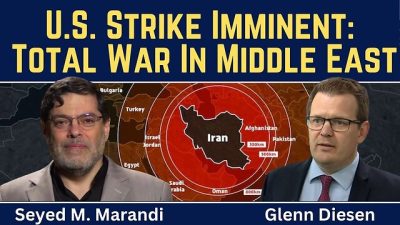
Seyed M. Marandi: Toward Total War in the Middle East
or go to
Aletho News Archives – Video-Images
From the Archives
The Geopolitics behind the War in Yemen (I)
By Mahdi Darius NAZEMROAYA | Strategic Culture Foundation | 30.03.2015
The United States and the Kingdom of Saudi Arabia became very uneasy when the Yemenese or Yemenite movement of the Houthi or Ansarallah (meaning the supporters of God in Arabic) gained control of Yemen’s capital, Sanaa/Sana, in September 2014. The US-supported Yemenite President Abd-Rabbuh Manṣour Al-Hadi was humiliatingly forced to share power with the Houthis and the coalition of northern Yemenese tribes that had helped them enter Sana. Al-Hadi declared that negotiations for a Yemeni national unity government would take place and his allies the US and Saudi Arabia tried to use a new national dialogue and mediated talks to co-opt and pacify the Houthis.
The truth has been turned on its head about the war in Yemen. The war and ousting of President Abd-Rabbuh Manṣour Al-Hadi in Yemen are not the results of «Houthi coup» in Yemen. It is the opposite. Al-Hadi was ousted, because with Saudi and US support he tried to backtrack on the power sharing agreements he had made and return Yemen to authoritarian rule. The ousting of President Al-Hadi by the Houthis and their political allies was an unexpected reaction to the takeover Al-Hadi was planning with Washington and the House of Saudi. … continue
Blog Roll
 Aletho News
- Pakistan-Iran talks secure LNG shipment to Islamabad through Hormuz
- Black Sea grain crisis puts global wheat supplies under pressure
- IRGC air defenses destroy another US MQ-1 drone over Strait of Hormuz
- Imran Khan’s entire immediate family detained in Pakistan ahead of mass protest demanding his release
- EU nation detains former presidential frontrunner
- Leaked: Britain’s Sham Conviction Of Hashim Thaci
- Seyed M. Marandi: U.S. Strike Imminent – Toward Total War in the Middle East
- Russia Voted Under Fire. Washington Is Loading the Tankers.
- 12 Things Your Oncologist Was Trained Not to Tell You
- Anthrax Attacks Paved Way for COVID-Era ‘Junk Drugs and Vaccines’
- If Americans Knew
- Trump’s militarization of Washington DC as he pursues Israel’s war against Iran
- Why Israel Fears This Searing New Documentary
- Huckabee aide solicited cash gifts from Israelis
- This isn’t sci-fi, AI is already killing people
- ‘The Most Brutal Thing’: Investigation Reveals Execution of Elderly Woman in Rafah
- Inside Israel’s ‘soft’ ethnic cleansing plan for Gaza through the eyes of its victims
- New online database tracks pro-Israel political donations in the United States
- Israeli president pardons soldier convicted for killing wounded Palestinian
- Singer Ed Sheeran says his ‘heart broken’ by Gaza devastation, addresses Macklemore controversy
- Israel Has Imprisoned Female Journalist Bushra Al-Tawil Without Trial Or Charge In Solitary Confinement For Past Month
- No Tricks Zone
- 2025 Nature Paper Claiming Worsening Global Drought Gets RETRACTED …Heavily Flawed
- New Study: ‘Global Drought Shows No Detectable Recent Acceleration Under Climate Warming’
- Economic Masterminds: German Socialists Suggest Taxing Productivity Gains Stemming From Using AI
- The South China Sea Has Not Been Cooperating With The Climate Change Narrative
- Energy Crisis: Germany Enters Heating Season With Historically Low Gas Reserve Fill Levels
- New Study: The Antarctic Ice Sheet Gained Mass From 2020-2024 Due To Staggering Snow And Ice Accumulation
- Study: Ocean Heating Rates From Thousands Of Years Ago ‘Dwarf’ Modern Ocean Heating Rates
- Climate Extremists Target, Attack Large-Scale Power Grid Infrastructure In Germany!
- New Study: Antarctic Ice Melt Has Contributed Less Than 1 Centimeter To Sea Level Rise In The Last 30 Years
- Fear Of Debate: Alarmist German Climate Scientist Calls On Mainstream Media To Discredit Skeptic Voices
 Aletho News