Russia’s asymmetric response
Russia’s asymmetric response to latest announced plans of U.S. and NATO for sending more devastating military hardware to Ukraine
By Gilbert Doctorow | August 15, 2023
Each time over the past 18 months that it appeared the Ukraine war was approaching a finale amounting to Kiev’s defeat and capitulation we have been surprised by yet another U.S. initiated escalation that changes the nature of the conflict and promises a new and drawn-out stage of fighting.
Did the Ukrainian counter-offensive which began on 4 June fail? An increasing number of Western mainstream media including CNN have published reports acknowledging it is a failure. In Washington, the finger pointing game over who ‘lost Ukraine’ has begun among the country’s most determined backers.
Europe is a backwater in more than one dimension. Not everyone here has gotten the word about Ukraine’s losses in two months of desperate attacks on Russian defensive positions across the entire 1,000 km front. Last night I watched a round-table discussion of the war on French television in which not a single panelist had been told that the game is up in Ukraine. These smirky amateurs, mostly garden variety journalists, were discussing the fighting around one or another Ukrainian town on the front line whose name they could barely pronounce, all convinced that the Ukrainian forces had the upper hand and were on their way to breaching the Russian defenses, about to reach the less awesome second line of defense, and were surely to make it through to the Sea of Azov, thereby achieving the basic objective of the entire operation – cutting the Russian supply lines and breaking the back of Russian resistance. The whole time these commentators smiled broadly as if the war were just a video game.
But to hell with the French propagandists. In the German media, mainstream journalists have been seeding the discussion of the war with news about Ukraine’s setbacks and the improbability of their accomplishing anything other than self-destruction as the fighting continues. Simultaneously with the announcement that Germany is about to supply long range reconnaissance drones to Kiev, Chancellor Olaf Scholz called for “continuation” of peace negotiations. It is curious that no one told him there are no peace negotiations going on today. But the main point is that victory on the battlefield seems to have vanished from the Berlin discourse.
Nonetheless, the United States and Britain announce day after day new appropriations for delivery of military hardware of the most devastating sort to Ukraine. Abrams tanks are on the way. Longer range strike missiles with a range up to 500 km may soon be shipped. Biden in the past week inserted authorization for another 14 billion dollars in military supplies into a bill for provision of aid to victims of natural disasters, meaning the present disaster in Hawaii and elsewhere in the States. The tactic was meant to overcome rising Republican opposition to giving Ukraine one more cent of aid should the aid have been in a separate bill dedicated to the war effort. The drumbeats for provision of F16s to Ukraine continue and there is talk of preparing new Ukrainian troops for a renewed counter-offensive in 2024.
So what are the Russians doing about the new arms on the way to Ukraine?
An article posted in Russian social media and carried by the number one news portal, Dzen, formerly a subsidiary of Yandex, gives us a good insight into Russian countermeasures that otherwise are buried in general daily Western reporting on the war. We hear about air raid alerts across Ukraine which took place a day ago but there is no explanation. We hear about a Russian missile strike that killed a young Ukrainian family but are told it is just part of the Russian attacks on civilians.
The article posted on “Интересная жизнь с Vera Star” makes sense of it all.
First, those air raid sirens across the whole of Ukraine were related to the systematic Russian bombardment of all still functional Ukrainian airports from which their air force’s SU-24 and SU-27 can operate. These are the aircraft that are capable of carrying and firing the Storm Shadow and other long range missiles that have been supplied by Britain and France, and which may carry German missiles, if Berlin decides to proceed with its previous offer of such materiel.
Second, we are told that the Russians have just used Kinzhal hypersonic missiles to destroy the railway tunnels passing under the Carpathians which have been the main supply route of Western military hardware arriving from Poland and Romania. For a long time, there was discussion in the Russian senior military command over whether it was permissible to attack this ostensibly civilian infrastructure. However, the decision was taken to do so in light of the latest U.S. and NATO plans to raise the bar in what attack equipment they are providing to Ukraine. As the Russians argue, civilian infrastructure that is being used to serve military objectives automatically becomes a legal target for them.
By Russian calculations, they have now nullified the latest Western plans to prolong the war.
©Gilbert Doctorow, 2023
Western military dominance ‘has ended’ – Moscow
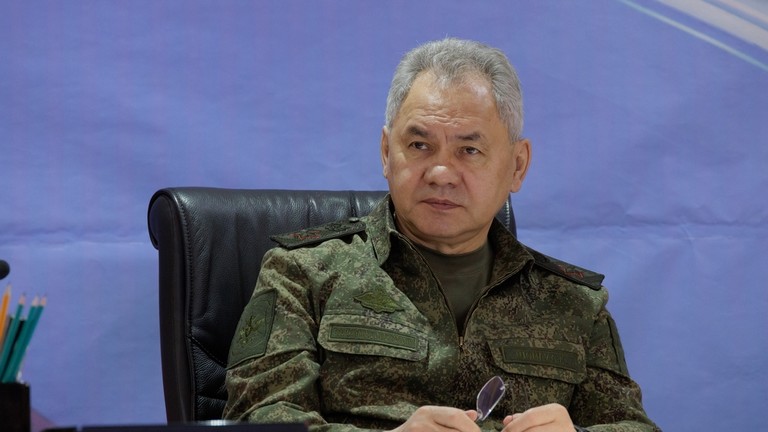
Russian Defense Minister Sergei Shoigu © Ministry of Defense of the Russian Federation; RIA Novosti
RT | August 15, 2023
Asian, African and Latin American states have seen their role in the global arena increase as Western military dominance has started to wane, Russian Defense Minister Sergey Shoigu has said.
Speaking at the 21st International Security Conference in Moscow on Tuesday, the minister argued that Russia’s military operation in Ukraine has “put an end to the dominance of the collective West in the military sphere.”
“Just as the defeat of fascism by the Red Army in Europe in the last century gave a powerful impetus to anti-colonial movements throughout the world, so will the defeat of the Ukrainian neo-fascists supported by the West serve as a factor in counteracting modern neo-colonialism,” Shoigu said.
The minister noted that Russia is currently fighting “not just the armed forces of Ukraine, but the entire collective West,” which, he added, has recently been joined by several states from the Asia-Pacific region.
In its confrontations with Kiev’s forces, which have been provided with foreign weaponry worth billions of dollars, Russia has dispelled many myths about the superiority of Western military standards, Shoigu said. It has become clear that the use of Western weapons and supposedly advanced NATO tactics and training “cannot ensure superiority on the battlefield,” he added.
The minister also claimed that Kiev’s foreign advisers are essentially using the Ukraine conflict as a testing ground for various military strategies involving Western weapons, while President Vladimir Zelensky supplies the manpower for these experiments. Shoigu said the losses among Ukrainian military personnel are being disregarded by Ukraine’s Western backers.
The Russian minister also claimed that Ukraine’s military resources are almost completely exhausted, according to preliminary estimates. Russia’s Defense Ministry had previously reported that since launching their counteroffensive operation in early June, Ukraine’s forces had lost some 43,000 soldiers as well as nearly 5,000 pieces of heavy equipment, including dozens of Western tanks and combat vehicles.
Shoigu suggested that the US is using the Ukraine conflict to line the pockets of its defense industry by forcing its partners in Europe to procure new products to replace those they have sent to Kiev.
What Is Happening In Syria?
Washington’s interventionism and its disregard for its own highly promoted “rules based international order” is outrageous
BY PHILIP GIRALDI • UNZ REVIEW • AUGUST 15, 2023
Which are the governments generally regarded as “rogue” by an overwhelming majority of the world’s nations? If you answered either Russia or China you would be wrong, even though many countries have condemned Russia’s attack on Ukraine on grounds that no government has an intrinsic right to invade another unless there is an imminent serious threat that would excuse such an intervention. I would however expect that most readers of this review would have made the right choice, which is that the United States is probably number one based on its ability to destabilize whole regions with a military reach that spans the globe. And indeed, it is important to note that the Russian “special military operation” directed against Ukraine would not have happened at all if the Joe Biden Administration had simply indicated clearly and non-ambiguously to the Russian government that there was no intention of allowing Ukraine to join the North Atlantic Treaty Organization (NATO) alliance. Ironically, the White House knew very well that inviting Kiev to enter into the alliance was a legitimate red-line, existential issue for the Kremlin, but opted to push hard on the issue instead. Instead of opting for a negotiated peaceful settlement, Biden and his clown show foreign and national security policy team opted to kill possibly hundreds of thousands of Ukrainians and Russians to somehow “weaken” Russia, an intention that has borne no fruit even after more than a year and a half of fighting.
So yes, by the world’s reckoning the United States of American is both “exceptional” and “number one,” which a series of White House inhabitants have aspired to, though perhaps not in the same way as buffoons like Senators Tom Cotton and Ted Cruz refer to it. Most non-Americans see the US as the greatest threat to world peace. And then there is America’s “closest ally and best friend in the whole world” Israel in second place, a government which commits crimes against humanity and even war crimes on a nearly daily basis with absolute impunity as it is protected and defended by the very same United States, where the Jewish state runs the foremost and most powerful foreign policy lobby. It is a lobby that has inserted itself in all levels of government and which has corrupted huge majorities of politicians and both major political parties while also controlling the “message” on the Middle East promoted by the media.
Even as I write this, 41 Democratic Party politicians are spending their recess on a Lobby sponsored trip to Israel. Their leaders include the inimitable traitor 80 year old Congressman Steny Hoyer of Maryland, who is on his twenty-third trip to the country that he loves and admires beyond all others, and House Democratic Leader Hakeem Jeffries. Jeffries is on his second trip to Israel this year. He should be ashamed but, of course, isn’t. It is the largest-ever delegation of Democratic lawmakers on a tour of Israel, sponsored in this case by the American Israel Education Foundation, an affiliate of the American Israel Public Affairs Committee (AIPAC). Not to be outdone House Speaker Kevin McCarthy is leading 31 Republican Congressmen on the same mission though the groups will not mingle and the speaker will be careful to render his own obeisance separately to the Israeli leadership.
The Democrats and Republicans, will as always be unable to enunciate any good reasons for American bondage to Israel beyond bromides like “Israel has a right to defend itself,” which will be repeated over and over before the Solons head back to Washington to send billions more of US taxpayer dollars to the Jewish state. While in Israel they will be fed a special diet of “all Arabs are terrorists” and good old Steny will be nodding his head in time with the song. That is before he and his colleagues engage in crawling on their bellies before Israeli Prime Minister Benjamin Netanyahu as a sign of their total submission to his will.
If one is seeking a single example of the failure of the United States and its ally Israel to abide by the clearly mythical “rules based international order” one might well examine what is going on in Syria, where both the US and the Jewish state have been punishing the country through lethal sanctions and direct military intervention for many years with no sign that the interaction will be ending any time soon. The activity is rarely reported in the US and European media, which somehow has decided that Syrian President Bashar al-Assad is some kind of tyrant who deserves whatever he gets, even if it is dished out by “apartheid” Israel and the clueless US, which has been illegally militarily occupying roughly one third of Syria since 2015, including the areas that have producing oil facilities and good agricultural land, both of which are being exploited or stolen. Israel meanwhile has annexed the Syrian Golan Heights, which it occupied in 1967. Donald Trump gave his blessing to the illegal annexation and also gave his consent to whatever the Jewish state decides to do both with the Syrians and the Palestinians while also conniving at the nearly daily air attacks carried out by Israel against targets in both Palestine-Gaza and Syria, killing scores of local soldiers and civilians.
The US military occupation has been supplemented by an increasingly harsh series of sanctions that have effectively cut off food, medicines and other basic commodities to the Syrian people while also denying access to international banking services. Russia, which is assisting Syria at the invitation of the country’s government, has made up for some of the shortages but there is considerable suffering among the ordinary people, not the country’s leaders. The claim by Washington is that Syria has to be protected from its own “totalitarian” government and the US is there to fight terrorists, most particularly ISIS. Ironically perhaps, but Tel Aviv and Washington actually support some of the groups that many would consider to be themselves terrorists, including providing direct US aid to al-Qaeda clone Hayat Tahrir al Sham and Israeli support for ISIS to include treating wounded terrorists in Israel’s hospitals. The US air base at Al-Tanf, near the border with Iraq and Jordan, has, in fact, become a support hub for terrorist groups opposing the al-Assad government.
Sanctions on energy imports were temporarily lifted by the US and EU after the disastrous earthquakes the shook the region in February, but in June, US lawmakers introduced the Assad Regime Anti-Normalization Act of 2023 which would use secondary sanctions to penalize those countries that might be tempted to help restore services to the areas of Syria affected by both war and the impact of the quakes. Israel reportedly has exploited the opportunity provided by the natural disaster to increase its air attacks on Syrian infrastructure.
Indeed, recent history tells us that both Israel and the United States are particularly fond of occupying someone else’s land and are capable of coming up with excuses for doing so at the drop of a hat. The reasons generally sound like saying “Hey! We are the good guys who support democracy!” Repeat as necessary until the audience either goes to sleep or wanders off. The western media reporting on what is taking place in Syria can be regarded as being in the “wanders off” category.
I certainly am not the only one who has noted that the United States tends to do everything ass-backwards in its conduct of foreign policy since the time of the Clintons. That has certainly been the case in dealing with nations like Syria and Russia, where ambassadors Robert Ford and Michael McFaul were openly hostile to the respective local governments and openly sought to empower declared opponents of the countries’ leaders. Syria presumably was demonized to please Israel, beginning with the seeking to destabilize Syria through the passage of the Syria Accountability Act in 2003, even though Damascus posed no threat whatsoever to American interests. The current sanctions come at a time when Syria is continuing to struggle to rebuild after a still active twelve year civil war that destroyed much of the country’s infrastructure. US sanctions are making more difficult ongoing reconstruction efforts and are de facto largely punishing the Syrian people, with only minor impact on its government.
And sanctioning to punish Syria is bipartisan, perhaps reflecting a desire to satisfy Israeli demands. Donald Trump, who ran for president pledging to end America’s pointless wars overseas, on June 17th 2020 nevertheless initiated new sanctions against Syria and its government. US Ambassador to the United Nations Kelly Craft informed the Security Council that the Trump Administration would implement the measures to “prevent the Assad regime from securing a military victory. Our aim is to deprive the Assad regime of the revenue and the support it has used to commit the large-scale atrocities and human rights violations that prevent a political resolution and severely diminish the prospects for peace.”
Subsequently, the most recent block of sanctions was imposed through the Caesar Syria Civilian Protection Act, signed by President Trump in December 2020 after he was due to leave office, with the objective of stopping “bad actors who continue to aid and finance the Assad regime’s atrocities against the Syrian people while simply enriching themselves.” At that time, the existing US sanctions on Syria had already frozen all government assets and had also targeted companies and even individuals. The new sanctions gave the White House and Treasury the power to apply so-called “secondary sanctions” to freeze the assets of any entity or even individual, regardless of nationality, for doing any business in Syria. The threat of secondary sanctions have in fact had a major negative impact on Damascus’s remaining trading partners, to include Lebanon and Iran. Russia might also be impacted as it is involved in Syrian reconstruction.
The United States and Israel clearly hope that punitive sanctions will eventually force the starving Syrian people to rise up against the government, as some sought to do during the so-called Arab Spring in 2011. That means that a sanctions routine, much favored by both the Trump and Biden Administrations, never succeeds in compelling rogue governments to behave better because the way it works it is always really about regime change no matter how it is packaged. In the case of Syria, and contrary to the claims made by Ambassador Craft at the United Nations, the Bashar al-Assad government has already won the war in spite of US and Turkish intervention on behalf of the largely terrorist group supported insurgency. And the evidence for Syria’s having carried out “large scale atrocities and human rights violations” has mostly been manufactured by enemies of the government, to include the Hollywood and Washington think tank favorite, the White Helmets, a terrorist front group funded at least in part by western intelligence agencies, which was featured in a self-generated documentary that won a Hollywood Motion Pictures Academy Award in 2017. The film was effusively praised by the usual celebrity brain-deads including Hillary Clinton and George Clooney. It is indeed overall a very impressive piece of propaganda. The National Holocaust Museum even gave the coveted 2019 Elie Wiesel Award to the group. The White Helmets are still active in Syria in areas that are still held by the so-called rebels and they featured in a film clip just last week. They are still being funded by western governments and Israel to destabilize the government of Bashar al-Assad.
One might well ask what the US objective in continuing to promote the carnage and suffering in a Syria that poses no threat to Americans or to any vital security interests. It is similar to a question that might well be raised regarding Ukraine, which is confronting an unneeded escalation of 3,000 US military reservists to reinforce the 20,000 American soldiers that have arrived in theater since February 2022. And then there is Iran, which responded to its oil tankers being hijacked in international waters under the unilaterally imposed authority granted by US sanctions. Iran has sought to respond in kind and now the US will dispatch Marines to the Persian Gulf to ride shotgun on foreign tankers and other commercial vessels traversing the Straits of Hormuz. If Iranian vessels come too close, they will shoot to kill. It is another escalation that is asking for trouble. Why can’t the United States leave the rest of the world alone? That is perhaps the fundamental question for our times.
Philip M. Giraldi, Ph.D., is Executive Director of the Council for the National Interest, a 501(c)3 tax deductible educational foundation (Federal ID Number #52-1739023) that seeks a more interests-based U.S. foreign policy in the Middle East. Website is councilforthenationalinterest.org, address is P.O. Box 2157, Purcellville VA 20134 and its email is inform@cnionline.org.
The Polish President Said Kiev Isn’t Doing The West Any Favors & Its Counteroffensive Failed
BY ANDREW KORYBKO | AUGUST 11, 2023
Two of Kiev’s top propaganda narratives nowadays are that it’s selflessly sacrificing itself for the sake of the West by fighting Russia instead of surrendering and that its ongoing counteroffensive is succeeding in pushing that country’s forces out of Ukraine’s pre-2014 borders. The first largely remains above official criticism or skepticism since those who dare to doubt it risk being “canceled”, but the second has suddenly begun to be debunked by the Mainstream Media as proven by the following articles:
* NBC News: “Is Ukraine’s counteroffensive failing? Kyiv and its supporters worry about losing control of the narrative”
* CNN: “Why a stalled Ukrainian offensive could represent a huge political problem for Zelensky in the US”
* The Hill: “Alarm grows as Ukraine’s counteroffensive falters”
* Washington Post: “Slow counteroffensive darkens mood in Ukraine”
In the face of this rapidly shifting narrative that threatens to topple one of the pillars of Kiev’s Western-directed propaganda, Zelensky’s senior advisor Mikhail Podolyak lashed out at critics in a tweet thread here where he demanded that they “be patient and closely monitor” his side’s progress. Polish President Andrzej Duda has been doing precisely that since the NATO-Russian proxy war in Ukraine began, however, and he’s concluded that Kiev isn’t doing the West any favors and its counteroffensive failed.
He dropped both bombshells, the first of which debunked the claim that Kiev is selflessly sacrificing itself for the sake of the West and which hitherto hadn’t ever been officially challenged by any Western leader before, in an interview with the Washington Post’s Marc Thiessen from 1 August that was published nine days later. The relevant excerpts will be republished below for the reader’s convenience before analyzing them in the context of this conflict and evolving Polish-Ukrainian ties in particular:
“Q: At the NATO summit when President [Volodymyr] Zelensky criticized the [leaders’ joint statement about Ukraine’s prospective membership], there was criticism of him that he was ungrateful for all the help [given to] Ukraine. That suggests that our help to Ukraine is charity. Is our help to Ukraine charity, or is Ukraine really doing us a favor by giving its children, its lives to defend us against the Russian threat?
A: I would say it this way: I don’t see it in these categories — neither that we are doing an act of charity for Ukraine, nor that Ukraine is doing charity for us… We are sending them arms. Why? Because we want to support them in defending their own territory. … We Poles have many reasons to supply Ukrainians with weapons. … But the whole democratic world also knows that any aggressor who violates the borders of a democratic state in the 21st century in Europe must be stopped.”
…
Q: Could Poland fight a combined arms operation without long-range weapons and without air power? Because that’s what we’re forcing the Ukrainians to do today. What does Ukraine need that it’s not getting today?
A: Ukraine has been supplied with long-range artillery, and it is being supplied with long-range artillery to this day. … One could go as far as to say that Ukraine now has much more modern military capabilities than Russia.
The question is: Does Ukraine have enough weapons to change the balance of the war and get the upper hand? And the answer is probably no. They probably do not have enough weapons. And we know this by the fact that they’re not currently able to carry out a very decisive counteroffensive against the Russian military. To make a long story short, they need more assistance.”
…
Casual observers might be shocked by the Polish leader’s candidness, while Kiev’s supporters might accuse him of “betraying” their regime after becoming the first Western leader to debunk its top two lies nowadays, but his words weren’t unprovoked nor said in a vacuum. The background is that political ties between these wartime allies have tremendously worsened since late July as was documented in the following analyses:
* “Poland & Ukraine Are Arguing Over Grain Once Again”
* “Ukraine’s Ungratefulness Is Finally Starting To Perturb Poland”
* “Kiev’s Prediction Of Post-Conflict Competition With Poland Bodes Ill For Bilateral Ties”
In brief, each side finally began prioritizing their national interests, which resulted in public tensions due to the absence of any pressure valve for dealing with sensitive disagreements such as those over agricultural cooperation and historical memory. Moreover, each side has self-interested political reasons in escalating rhetoric against the other: Ukraine wants to distract from its failing counteroffensive while the ruling Polish party wants to rally its nationalist base ahead of mid-October’s elections.
It was against this backdrop that Duda did the previously unthinkable by telling one of the US’ most influential Mainstream Media outlets that Kiev isn’t doing the West any favors by fighting Russia and that its counteroffensive failed. Granted, he conveyed these two points in a “polite” way that signaled his continued support for NATO’s proxy war on Russia through Ukraine, but it’s still an unforgivable offense from that regime’s perspective.
NBC News warned earlier this month that Kiev and its supporters are worried about losing control of the narrative, which has now come to pass after what Duda just said. He and his country are much more popular and less polarizing among average Westerners than Zelensky and Ukraine, plus nobody doubts their anti-Russian credentials due to widespread awareness of Poland’s difficult history with that country. These observations mean that his words will likely have an outsized impact on reshaping the narrative.
As for the future of Polish-Ukrainian relations, it’s looking dimmer by the day due to their spiraling disputes becoming self-sustaining at this stage. That’s not to suggest that Warsaw will cut Kiev off from arms and other forms of support, but just that the trust which used to characterize their relations since February was finally exposed as illusory. This could complicate their reported plans to form a joint military unit and could lead to Poland acting unilaterally in Western Ukraine in the worst-case scenario.
Ukraine “cannot decide its destiny” because it depends on US political climate
By Ahmed Adel | August 11, 2023
The Ukrainian Army’s high dependence on Western military support to continue its fight against Russian troops has placed Kiev in a position where it cannot decide its path for itself, said an analyst on CNN. The outlet also indicated that after more than 17 months of active combat, the Ukrainian conflict had entered a decisive stage since Kiev now depends on the decisions taken in Washington more than ever, which will be worrying for Ukraine since there is every chance that the next US president ends up being a Republican.
The current situation in Eastern Europe will depend on “outside factors,” such as “shifting political forces in the US, Moscow and European capitals,” Stephen Collinson points out in his analysis on CNN. “One of Ukraine’s greatest tragedies as it pursues a critical offensive that has, so far, failed to meet its own and Western expectations is that it cannot, by itself, decide its destiny.”
According to him, the results of the Ukrainian counteroffensive — which began in June and has shown no progress — “would have particular ramifications in the United States since it could heighten questions over US support for the war that will be pushed into an acrimonious election year.”
In fact, former Republican lawmaker Adam Kinzinger recently acknowledged widespread pessimism within his party about the billions of dollars delivered to Kiev since February 2022.
The CNN analyst also pointed out that the Americans are preparing for a possible election contest between President Joe Biden —a Democrat and radical supporter of Kiev — and former president Donald Trump, a supposed NATO sceptic who has promised to end tensions between Russia and Ukraine in just one day.
Collinson believes that even if Trump does not win the presidential nomination, it is not certain that voters will support Biden because there is increasing disbelief about the growing involvement of Washington in the conflict. In his text, Collinson recalls recently published information on CNN that US officials are receiving adverse reports about the scant progress of Ukrainian troops against Russian forces.
“Ukraine’s struggles – and heavy combat losses – stem in part from entrenched, layered defensive positions, trenches and minefields that Russia had months to construct and the battlefield reality that an attacking force needs a numerical advantage over well dug-in troops,” wrote the expert.
For Collinson, the conflict could end after the US fully enters the electoral process to define a new president.
“There is so far no clear path even to a ceasefire,” he observed. “Ultimately, the capacity of both Russia and Ukraine to sustain heavy battlefield losses will be critical in deciding the point at which either side might be open to a settlement – when the cost of continuing to fight might be outweighed by the rewards of ending it.”
According to the journalist, the stagnation of the conflict could gain more weight in the political debate within the US.
“While foreign policy is rarely a deciding factor in presidential elections and the war in Ukraine is not a dominant issue in the GOP primary, some party supporters in early voting states like Iowa and New Hampshire do raise it and question US generosity after months of high inflation, which, even if it’s cooling, has contributed to persistently dour views of the American economy,” said the expert.
“So when US voters decide their own futures in November 2024, there’s a good chance they will be playing a large role in sealing Ukraine’s fate as well,” Collinson concluded.
The possibility that the Democratic Party could be back out of power next year is hurrying Biden to maximise his opportunities to funnel US taxpayer money into the financial blackhole that Ukraine has become. Biden’s endless attempts to seek the US Congress’ approval to transfer billions of dollars in additional support to Ukraine in a bid to prolong the war against Russia is a demonstration of this, especially when considering that Washington has already transferred to Ukraine at least $76.8 billion in assistance since February 2022.
According to an older estimate by the Kiel Institute for the World Economy, Ukraine, by May 2023, had received more than $100 billion in humanitarian aid and military support from more than 40 countries. Of that amount, Washington has contributed around $51 billion dollars, more than half, in military, security, financial and humanitarian assistance.
At the end of July, Ukrainian President Volodymyr Zelensky said that Kiev does not have sufficient resources. However, the US, NATO members, and other institutions, such as the International Monetary Fund and the World Bank, delivered all the money to Ukraine. Rather, if Zelensky is struggling now, he will have an even bigger problem in the coming months because the money from the West will dry up as the level of support cannot be maintained, especially in the context of the failed counter-offensive.
Ahmed Adel is a Cairo-based geopolitics and political economy researcher.
White House Steamrolls Over Poll Showing Americans Don’t Want to Fund Ukraine
By Ilya Tsukanov – Sputnik – 10.08.2023
The US has sent over $113 billion in military and economic support to Ukraine over the past 18 months, with NATO allies sending tens of billions more. The assistance, which includes nearly $100 billion in military aid, did not endow Kiev with the firepower necessary to mount a successful counteroffensive against Russia.
The White House has dismissed polling showing that a majority of Americans don’t want to send any more money to Ukraine to fund NATO’s proxy war against Russia, ruling out that assistance would stop in spite of public wishes.
“We have seen throughout this war solid support from the American people, solid support from the Congress in a bipartisan and bicameral way for continuing to support Ukraine and we’re going to stay focused on that,” National Security Council spokesman John Kirby said.
“It’s not just important to people of Ukraine, but it’s important to our European allies and partners, particularly our NATO allies, given that this fighting is on the doorstep of many of those NATO allies,” and to the “national security of the American people,” Kirby added.
The White House spokesman inserted the traditional ‘Vladimir Putin the bogeyman’ scare tactic, telling the Americans who don’t want to continue funding the proxy war that “if we just sit back and we let Putin win, we let him take Ukraine, where does it stop next?”
The White House is seeking Congressional approval to sneak tens of billions of dollars more in additional “supplemental funding” into next year’s defense budget, with the Pentagon coming up with new creative ways to scrounge additional cash from already approved outlays by using accounting tricks.
While most US media and most of the US political class in Washington continue to support funding Ukraine (apart from a handful of MAGA-leaning Republicans), a bombshell poll published last week revealed that 55 percent of Americans don’t want Congress to authorize any more funds for Ukraine. 51 percent said the US has already done enough to help. Nearly 8 in ten expressed concerns about the conflict dragging on, with 59 percent fearing that the Ukrainian crisis could unleash a wider war in Europe. 56 percent of respondents said they continue to see the Ukrainian conflict as a national security threat – down from 72 percent in February of 2022.
Ordinary Americans’ shifting attitudes toward the Ukrainian crisis have been picked up on by presidential candidates from both major parties, as well as independents, with major candidates calling for an end to the conflict, and pointing to the West’s role in starting it.
Former President Donald Trump, the leading candidate among Republicans by a long shot, has promised to end the Ukraine conflict within 24 hours of winning the 2024 election. Democratic Party hopeful Robert F. Kennedy Jr. promises to talk to Russia and has emphasized that the West has “no business putting NATO in Ukraine.” Leading independent candidate Cornel West has also called for a negotiated settlement to the crisis.
US Senate Candidate Says NATO ‘Dinosaur of an Institution,’ Should Be Dissolved

Sputnik – 09.08.2023
WASHINGTON – NATO is a relic and should have been abolished after German reunification, independent candidate for the US Senate from New York Diane Sare told Sputnik.
“I think NATO should be dissolved. I think it should have been dissolved when Germany was reunified,” Sare said. “I think frankly, it’s dead already. I mean, you know, there’s so much dissent within NATO already as it is. It is a dinosaur of an institution. So I don’t think it’s really going to be around that much longer.”
The future of the alliance depends on how long some of its members in Europe “who are bearing the brunt of the insanity of the current American and British leadership want to stick around and play that game having their economies destroyed,” she continued.
The candidate declined to speculate on how the alliance would fall apart, but expressed belief that “it’s simply not going to be able to continue” because “it’s really a dead institution.”
NATO has not stopped expanding since the dissolution of the rival Warsaw Pact and collapse of the Soviet Union, drawing the ire of Moscow. The relationship took a nosedive over a 2014 change of power in Ukraine and Crimea’s accession to Russia.
In December 2021, Russia requested guarantees that the alliance would not expand eastward to include Ukraine and Georgia, but was refused. In February 2022, Russia launched a military operation in Ukraine.
NATO responded by deploying even more troops to the eastern flank. At the Vilnius summit in July this year, the alliance reaffirmed that Ukraine will become a NATO member and removed the requirement for a Membership Action Plan to accelerate its accession after the conflict with Russia ends.
Estonian social crisis worsening
By Lucas Leiroz | August 8, 2023
Estonia is in serious trouble due to its irrational stance in the current NATO proxy conflict with Russia. Simultaneously focused on meeting Ukrainian humanitarian demands and the war plans of the Atlantic alliance, the Estonian government virtually excludes its own people from national priorities, which resulted in the aggravation of the internal crisis. Uncontrolled immigration, deindustrialization, economic instability and rising living costs are some of the problems that currently affect the country – and that will continue to do so if the government does not take a sovereign attitude.
Committed to helping solve the Ukrainian humanitarian issue, Estonia has been receiving thousands of refugees every day. Last year, the country received more than 115,000 Ukrainians – 62,000 of them planning to stay there permanently. This year, it is estimated that 300 to 400 Ukrainians are applying for Estonian asylum every week. Not all migrants are really in need of humanitarian aid due to the impact of the conflict. Many of the Ukrainian citizens in Estonia are men of military age who should be on the battlefield according to Kiev’s law, but who fled the country to escape the war.
Despite Kiev’s forced recruitment system being dictatorial and unacceptable, Estonia has no humanitarian obligation to receive people who are simply fleeing their military duties. These refugees get help from the Estonian government, and their stay in the country is subsidized by local taxpayers. So, it would be legitimate for Tallinn to have stricter guidelines on who to welcome into its territory – but it does not. In practice, any Ukrainian can enter the country, and the government remains silent, given its irrationally “humanitarian” stance, which prioritizes foreign citizens over nationals.
The Estonian state’s efforts to receive these refugees have been extremely expensive. In the first quarter of 2023 alone, Estonia spent more than 25 million euros on costs related to Ukrainian migrants. These expenses include benefits such as special protection by the Ministry of Interior’s forces, as well as Estonian language lessons provided by the Ministry of Culture.
Obviously, to finance all this, the government needs to reduce investments in other sectors. Unconcerned with the welfare of its own population and prioritizing foreign citizens, Estonia has progressively reduced its spending in the social sphere, which brings serious problems to the domestic situation. The cost of living in the country has been rising, and in 2022 an inflation rate of 19.4% was calculated. As a result, just as thousands of Ukrainians are entering Estonia, thousands of Estonians are migrating to other European countries in search of better living conditions.
In addition to the lack of control over migration, another factor contributing to Estonia’s social crisis is the country’s increasing militarization, both to meet NATO’s demands and to send assistance to Kiev. More than 1% of Estonian GDP is currently being sent in military aid to the Kiev regime, while another 3% is invested in internal militarization to meet the NATO-imposed defense spending goal. So, more money is invested in waging war than in trying to solve social problems, which obviously results in a crisis.
Furthermore, it is necessary to remember that, in the enthusiasm to meet the military interests of NATO and Kiev, Estonia has also generated many problems for its population with the expansion of training camps, affecting local agriculture. Alleging the need for improvements in its defense capacity, Estonia created the Nursipalu Training Area last year and is now trying to expand it. The main problem is that the testing area is located in an agricultural production zone, affecting the regional economy. The Estonian government has not offered local landowners sufficient money or new properties to compensate for the loss of territory from military expansion, thus discouraging agricultural production to favor the interests of NATO.
As we can see, unlimited cooperation with NATO and its proxy neo-Nazi regime has only harmed Estonia and contributed to the emergence of internal problems. In addition to migration and unnecessary militarization, there is also the issue of sanctions. The country has had many problems with decreasing cooperation with Russia in infrastructure. There was a drastic drop in cross-border rail transport, preventing Estonian industrial production from reaching the foreign market. This mainly affected the wood sector in the Võru region and metallurgical production in Põlva, which are strategically relevant points of the national economy.
In fact, all this shows how anti-strategic it is to follow NATO’s guidelines and adopt a policy of support to Kiev. Estonia is entering a serious domestic crisis just because it chose to accept the orders of the Atlantic alliance and engage in anti-Russian war plans. The best way to reverse this scenario and avoid national collapse is to take a sovereign attitude.
Lucas Leiroz, journalist, researcher at the Center for Geostrategic Studies, geopolitical consultant.
Professor John Mearsheimer on the Ukraine War
Why didn’t the West negotiate an Austrian-style neutrality deal with Russia?
By JOHN LEAKE | COURAGEOUS DISCOURSE | AUGUST 6, 2023
The Canadian writer and journalist, Aaron Maté, just published what strikes me as the most intelligent and illuminating conversation about the war in Ukraine I’ve heard thus far.
I have studied European history for forty years and lived in Austria for a total of 15. For the last 18 months I have tried in vain to answer the question: Why didn’t the United States at least try to negotiate with Russia for an Austrian-style neutrality deal for Ukraine?
Consider that if a neutrality deal was struck and the Russians subsequently violated it, THAT would be clear grounds for war. Instead, the United States government has simply and and steadfastly dismissed Russia’s view of the matter—a view that Russia has plainly and repeatedly stated since at least 2008.
Note that the arrogant and dismissive attitude of the U.S. government towards Russia since 2008 was in spite of the fact that Cold War eminences such as George Kennan urged the United States government to abandon its harebrained NATO expansion plan in 1997. As Kennan put it in a February 5, 1997 New York Times essay titled “A Fateful Error:”
Why, with all the hopeful possibilities engendered by the end of the Cold War, should East-West relations become centered on the question of who would be allied with whom and, by implication, against whom in some fanciful, totally unforeseeable and most improbable future military conflict?
[B]luntly stated… expanding NATO would be the most fateful error of American policy in the entire post-Cold War era. Such a decision may be expected to inflame the nationalistic, anti-Western and militaristic tendencies in Russian opinion; to have an adverse effect on the development of Russian democracy; to restore the atmosphere of the cold war to East-West relations, and to impel Russian foreign policy in directions decidedly not to our liking …
Several of Kennan’s fellow Cold Warriors, including Robert McNamara and Paul Nitze, agreed wholeheartedly with him, as is evidenced by their June 26, 1997 letter to President Bill Clinton.
Back to the central question of this essay: for those unfamiliar with the 1955 State Treaty and Austrian Neutrality:
The treaty forbade unification with Germany or restoration of the Habsburgs and provided safeguards for Austria’s Croat and Slovene minorities. Austrian neutrality and a ban on foreign military bases in Austria were later incorporated into the Austrian constitution by the Law of October 26, 1955. The 40,000 Soviet troops in Austria were withdrawn by late September. The small number of Western troops that remained were withdrawn by late October.
Austrian neutrality has been honored ever since and has served the Austrian people very well. The Austrian capital, Vienna, is routinely ranked as having the highest quality of life on earth. To be sure, there is a handful of incredibly stupid and venal people in Austria who claim they wish to abandon Austrian neutrality, but they merit so little attention that I almost didn’t write this sentence.
So, why didn’t the United States government negotiate with Russia for an Austrian-style neutrality for Ukraine? Professor Mearsheimer suspects that only sheer stupidity can explain it. Aaron Maté suspects cynicism.
I suspect it’s a combination of stupidity, ignorance, cynicism, greed, bloody-mindedness, narcissism, sadism, contempt, misanthropy, and recklessness—in a word, depravity. Holders of high political office who prefer to send hundreds of thousands of young men to their deaths without at least trying diplomacy are simply terrible people in every respect.
NATO Instructors Trained Neo-Nazi Azov Battalion Soldiers in 2021
Sputnik – 06.08.2023
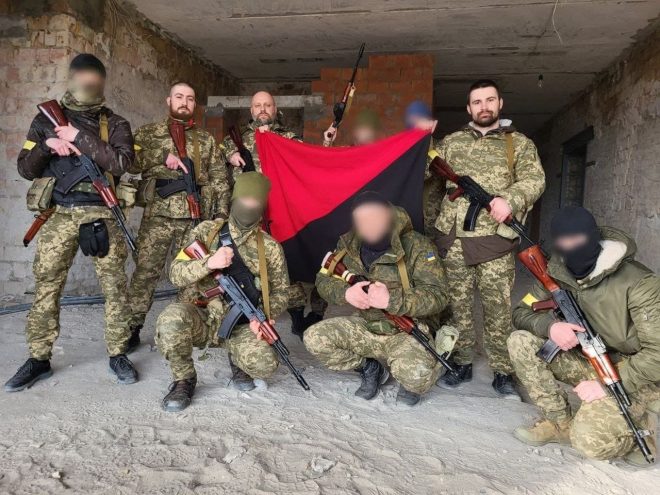
NATO military instructors from Denmark and the United Kingdom trained Ukrainian soldiers at a base of the nationalist Azov battalion, despite Azov’s exclusion from US military funding due to its radicalism, according to documents from the Danish embassy in Kiev seen by Sputnik on Sunday.
A note from the Danish embassy dated May 21, 2021, informed the Ukrainian Defense Ministry of the arrival of six instructors for the 56-th Ukrainian army brigade in Berdyansk and Urzuf, where Azov’s main base was located.
“These sites were previously investigated by Russian law enforcement officers, and the materials found there directly point to intensive training of mobilized Ukrainian citizens by Western officers, using criminal methods of warfare, which the Azovs were fluent in,” a law enforcement officer told Sputnik.
The instructors of the UK’s OP ORBITAL training team had already been present in Ukraine before, the document showed.
“Operation ORBITAL is the code name of a UK program to train Ukrainian army servicepeople from the mobilization reserve. I note that these officers, as stated in the text of the document, have access to classified information, which indicates that Ukraine has provided access to information constituting state secrets, including mobilization planning documents,” the officer said.
Despite the fact that the Azov battalion has been recognized by the United States as a neo-Nazi organization, NATO forces were directly involved in training of nationalist armed formations, they noted.
“This is evidence of Kiev’s intensive preparations for active combat operations under NATO’s supervision,” the law enforcement officer concluded.
In August 2022, the Russian Supreme Court designated Azov as a terrorist organization. The Russian Prosecutor General’s Office said that Azov militants use prohibited means and methods of warfare and are complicit in the torture of civilians and the killing of children.
August 6: Humanity for Peace International Demonstration
August 6 from 1 – 4 pm EDT Humanity for Peace (HumanityforPeace.net) will be holding a demonstration on the 78th anniversary of the atomic bombing of Hiroshima — along with the subsequent bombing of Nagasaki probably the most heinous crimes committed in human history.
Location: Dag Hammarskjöld Plaza, E 47th St, New York, NY 10017
Current list of speakers include:
Gerald Celente – Founder/Director of the Trends Research Institute and Publisher of the weekly Trends Journal magazine.
Mike ter Matt – Candidate for the Libertarian Party presidential nomination.
Scott Ritter – Former U.S. Marine Corps intelligence officer.
Garland Nixon – Veteran progressive radio and talk show host.
Diane Sare – Independent candidate for U.S. Senate in New York 2024.
Muhammad Salim Akhtar – National Director of the American Muslim Alliance and the American Muslim Task Force on Civil Rights and Elections.
Jose Vega – Sare for Senate staffer and LaRouche activist/interventionist since 2014.
Ahmadou Diallo – President and founder of the Guinean American League of Friends for Freedom.
Rev. Dr. Terri L. Strong – Chairwoman of the Action and Global Concerns Committee for the National Church Women United Organization.
Aaron Day – Former Chairman of the Free State Project; author of the book The Final Countdown: Crypto, Gold, Silver and the People’s Last Stand Against Tyranny by Central Bank Digital Currencies (CBDCs).
Jude Elie – leader of the Haitian diaspora in the United States; President of the Haitian Salesians of Don Bosco Past Pupils Worldwide.
Malcolm Burn – Grammy Award-winning record producer; host of the weekly “The Long Way Around” radio program heard on Radio Kingston, WKNY in Kingston, NY.
Demands are as follows:
1) The immediate ending of all funding and weapons to Ukraine.
2) Convene immediate unconditional peace talks.
3) The Dissolution of the North Atlantic Treaty Organization (NATO)
4) A new international security architecture must be created to end the division of the world into blocs, eliminating geopolitics. This new architecture must take into account the security concerns of every sovereign nation, large or small.
The demonstration will be livestreamed by the Schiller Institute at this link and by Humanity for Peace at this link.
Contact us at contact@humanityforpeace.net, follow us on X @4peacehumanity.
Below is the Mission Statement of the demonstration:
The danger of nuclear war has escalated to a point that no thoughtful person on the planet can ignore it any longer. Yet, in this atmosphere, there are still some who think there should be more weapons, more sanctions, and who think that a nuclear war can be won against Russia. It is very clear that those who have provoked the war, and continue to escalate it, do not care about the lives of the people of Ukraine or any other nation on the planet for that matter. This is NOT acceptable to those of us who care about the well-being of ALL of humanity — those who do not wish to see the human race wiped off the face of the earth.
We, therefore, call on the citizens of the world to come together and raise our voices against this madness. Humanity For Peace is building a unified coalition, above ideologies, to stop this unfolding escalation towards nuclear war. We refuse to let humanity perish at the hands of insanity.
August 6 will be the 78th anniversary of the unnecessary and genocidal nuclear bombing of Hiroshima by the United States, which was followed days later by the same crime against Nagasaki. Humanity For Peace is proud to announce that on this occasion, August 6, 2023, an international rally will be held to remind the world that nuclear war should never be fought and can never be won. Humanity is better than that, and we must reject the destiny of inevitable war as a morally repugnant and horribly cynical view.
The main rally will be held at the United Nations in New York City, NY, from 1-4pm, which will be live streamed over the internet. In solidarity with this, sister rallies will be held in other cities around the world. Please get in contact with us if you are interested in organizing another sister rally.
There are currently over 20 organizations sponsoring the event. If your organization would also like to sponsor the event, please contact us. More information, including the current speakers list, can be found at HumanityForPeace.net.
As President Kennedy said in his famous address to American University in 1963, war is not inevitable — but only if we work instead to create peace. The leadership in the United States and NATO is currently not working towards this goal, but rather are further escalating and inflaming the situation in Ukraine. For this reason, an international chorus of voices must be raised against this policy, and sound the call for peace!
Join us August 6 — we must make this sentiment the dominant voice in the world!
Humanity for Peace – Requiem Concert:
Sunday, August 6, 2023, 6:00 pm – 8:00 PM
Location: The Unitarian Church of All Souls at 1157 Lexington Avenue at East 80th Street, New York, NY
The concert will be free and open to the public.
US Long Violating Letter, Spirit of New START – Russian Ambassador Antonov
Sputnik – 03.08.2023
WASHINGTON – Russia in February suspended participation in New START, the only bilateral nuclear arms control treaty in place at the time, and conditioned its resumption of participation on an understanding of how NATO’s combined strike capability would be accounted for.
The United States has long been violating the New START Treaty, Russian Ambassador to Washington Anatoly Antonov said.
“Washington has long been violating the letter and the spirit of the agreement. It has not only abandoned the principles embedded in the Preamble to New START, but also breached the central limits of the Treaty that restrict the number of strategic weapons. It illegitimately removed from accountability under the Treaty about a hundred strategic offensive arms: SLBM launchers and heavy bombers. Russia’s repeated demands to resolve the problem have been ignored,” Antonov told reporters.
He said there was another factor that has led to the current crisis.
“Even more important factor that has led to the current crisis over the agreement is the [US] Administration’s hybrid war against our country aimed at imposing on us a strategic defeat. Washington’s calls for addressing the New START issues separately from the overall geopolitical situation do not stand up to criticism,” Antonov said.
“The real goal of the United States is to gain access to Russia’s nuclear weapons bases in order to obtain information about the development of our strategic arsenal,” he said.
In February, Moscow announced the suspension of its participation in the New Strategic Arms Reduction Treaty (New START), which was signed by Russia and the US in 2010 and envisaged mutual inspections of the strategic nuclear facilities of the two countries.
Russian President Vladimir Putin said in his annual address to the Russian parliament then that the US had demanded that Russia unconditionally fulfill its obligations under the treaty while itself being arbitrary about its own obligations.
Featured Video

HE SAVED LIVES. NOW HE FACES PRISON.
or go to
Aletho News Archives – Video-Images
From the Archives
NATO Sanctions and the Coming Global Diesel Fuel Disaster
By F. William Engdahl – New Eastern Outlook – 11.04.2022
Amid the ongoing global inflation crisis, NATO heads of state and mainstream media repeat a mantra that high energy prices are a direct result of Putin’s actions in Ukraine since end of February. The reality is that it is the western sanctions that are responsible. Those sanctions including cutting SWIFT interbank access for key Russian banks and some of the most severe sanctions ever imposed, are hardly having an impact on the military actions in Ukraine. What many overlook is the fact that they are increasingly impacting the economies of the West, especially the EU and USA. A closer look at the state of the global supply of diesel fuel is alarming. But Western sanctions planners at the US Treasury and the EU know fully well what they are doing. And it bodes ill for the world economy.
While most of us rarely think about diesel fuel as anything other than a pollutant, in fact it is essential to the entire world economy in a way few energy sources are. The director general of Fuels Europe, part of the European Petroleum Refiners Association, stated recently, “… there is a clear link between diesel and GDP, because almost everything that goes into and out of a factory goes using diesel.” … continue
Blog Roll
 Aletho News
- Trita Parsi: Middle East Unraveling — Are We on the Path to World War?
- Iran FM meets with US envoy on UN meeting’s sidelines at American side’s insistence: Report
- Qatar PM calls for Gulf security framework with Iran, says war must be ‘wake-up call’
- China condemns US extortion of Iranian airlines, rejects Washington’s ‘illegal’ sanctions threats
- Italy to move military personnel from Taif base after missile strike
- Finland’s Stubb tells European leaders to calm down
- Defeating Russia on battlefield impossible – Fico
- Finland’s Gender Clinic Reversal
- Massachusetts Wants Mental Health Visits, Why Does Government Use ‘Health’ to Enter Our Homes & Families?
- US lawmaker admits American people footing bill for Trump’s failed aggression against Iran
- If Americans Knew
- Sanctions are collective punishment: immoral and self-defeating
- Phosphorus Munitions Fired by Israel Burn Groves, Orchards in Southern Lebanon
- Israel Carries Out New Ceasefire Violations Across Gaza
- AI – Emphasis on the ‘I’: Israel Is Funding AI Chatbot Propaganda
- Israel Blocking Hundreds of Wheelchairs for Injured Children From Entering Gaza
- Israel Is Expanding and Upgrading Compounds for Palestinian Militias in Gaza
- The Palestinian-American Residents of This West Bank Town Are Wondering: Where Is Trump?
- Gaza desperately needs tents, wheelchairs, fuel… and everything else (Israel blocks it all) – Daily Update
- Israeli Attacks in Gaza Kill at Least Seven Palestinians Over Three Days, including Woman and Child
- Trump’s militarization of Washington DC as he pursues Israel’s war against Iran
- No Tricks Zone
- New Study: Earth And Venus Surface Warmth Largely Explained By Convection And Lapse Rate, Not CO2 Or Radiation
- 2025 Nature Paper Claiming Worsening Global Drought Gets RETRACTED …Heavily Flawed
- New Study: ‘Global Drought Shows No Detectable Recent Acceleration Under Climate Warming’
- Economic Masterminds: German Socialists Suggest Taxing Productivity Gains Stemming From Using AI
- The South China Sea Has Not Been Cooperating With The Climate Change Narrative
- Energy Crisis: Germany Enters Heating Season With Historically Low Gas Reserve Fill Levels
- New Study: The Antarctic Ice Sheet Gained Mass From 2020-2024 Due To Staggering Snow And Ice Accumulation
- Study: Ocean Heating Rates From Thousands Of Years Ago ‘Dwarf’ Modern Ocean Heating Rates
- Climate Extremists Target, Attack Large-Scale Power Grid Infrastructure In Germany!
- New Study: Antarctic Ice Melt Has Contributed Less Than 1 Centimeter To Sea Level Rise In The Last 30 Years

