The UN’s torture watchdog has hit out at the British government for human rights abuses. In its harshest criticism yet of the British government, the panel warned that urgent action is needed for the country to meet international standards.
The UN Committee against Torture focused on human rights abuses during the so-called war on terror and the mistreatment of prisoners in British custody in Iraq. It also flagged up some 40 separate incidents on which the UK government must act.
The findings highlighted the British governments actions following 9/11 and the commission urged the British government to quickly establish an inquiry into whether detainees held overseas were ill-treated or tortured by British officials.
The report reads that the committee is “deeply concerned at the growing number of serious allegations of torture and ill-treatment, as a result of the state party’s military interventions in Afghanistan and Iraq.”
The UN team also slammed what they called “an escape clause” in the Criminal Justice Act (1988), which allows British officials to escape prosecution for inflicting severe pain or suffering if they can show that they had “lawful authority, justification or excuse” for doing so.
Another legal loophole the committee voiced concern about is the Intelligence Services Act (1994), which effectively insures that intelligence officers cannot be prosecuted within the UK once a warrant giving them lawful authority has been signed by a government minister.
The panel was disappointed at the failure to date to prosecute anyone for the torture of Iraqi prisoners and in particular the failure to convict anyone for the murder of Baha Mousa who died in British custody in 2003. Only one soldier received a one-year sentence for admitting inhumane treatment.
There was also concern with the government’s planned introduction of secret court procedures in July for issues that may affect national security under the Justice and Security Act. Closed Material Procedures as they are known make it easier to use hearsay evidence or evidence obtained through torture, the committee maintains. The system of Special Advocates – lawyers who are vetted and chosen by the government – “have a very limited ability to conduct a cross-examination and cannot discuss full content of confidential materials with their client thus undermining the right to a fair trial,” the report reads.
The watchdog also urged the UK government to halt the deportation of failed asylum seekers to Sri Lanka. The deportation of failed Tamil asylum seekers has led to their torture or ill-treatment on return and the UK government hasn’t changed its policy on the issue despite a ruling by the High Court in February ordering them to suspend deportations.
The government was criticized in its handling of the case of Shaker Aamer, the last remaining UK resident in Guantanamo. The committee regretted that despite the “best endeavors” of the UK to try and get him released “there are no encouraging signs of this happening soon”.
There were also accusations against the UK government on several issues connected with Northern Ireland. The Northern Irish justice system must abolish all non-jury trials the report concludes, adding that historical investigations into past misconduct, particularly of military officials, must not be delayed or suspended.
The committee asked that police officers only use tasers when they face “a real and immediate threat to life or risk or serious injury”.
There was also unease that the age of criminal responsibility in England, Wales and Northern Ireland has not been raised from 10-years, despite calls by more than 50 organizations for this to be done.
Further concerns were raised about the steady increase of the prison population over the past decade and the problem of overcrowding. To help rectify the issue the committee urged the government make wider use of non-custodial sentences.
In a further blow, committee members accused the UK delegation of being evasive when questioned about Britain’s human rights record during a two-day hearing in Geneva last month.
The British government was given a year to explain how it could improve its human rights record in 4 key areas: overseas torture, getting Shaker Aamer out of Guantanamo, stopping the forced deportation of Sri Lanka asylum seekers and setting up inquiries into past abuses in Northern Ireland.
Eyebrows have been raised around the world to see Brits in their thousands dancing through the night in spontaneous street parties following the death of 1980s Prime Minister ‘Iron Lady’ Margaret Thatcher.
As the nickname suggests, she had a fearsome reputation round the world for hitting hard for Britain, but at home it was a different story. In the industrial North most knew several families who lost their livelihood on her watch. Londoners saw ominous shifting sands, homeless youngsters begging on the streets whom her regime had turned it’s back on.
The taboo not a single commentator has broached though is the shadowy ‘advisory’ role played throughout her premiership by European banking fraternity’s Labour peer Lord Victor Rothschild. He was revealed in the book the Thatcher government tried to suppress, Peter Wright’s Spycatcher, to be behind London’s top secret service appointments. In 1986 Rothschild penned ‘Paying for Local Government’ the policy paper that led to the notorious Poll Tax that fell hardest on the poorest, and which brought Britons onto the streets of London in their hundreds of thousands in 1990, riots echoing London’s Poll Tax revolt of 1381.
And according to the then BBC Chairman Marmaduke Hussey, Lord Victor also initiated the sacking in 1987 of the last independent-minded Director General of the BBC, a castration from which the corporation never quite recovered.
One word captures the essence of the Thatcher legacy; ‘privatisation’. As an exasperated former Tory Prime Minster Harold Macmillan put it “she’s selling off the family silver!”. And so tens of mind-boggling billions of pounds of silver were auctioned off to the highest bidders, mostly to Rothschild’s kith and kin. From shipyards and public housing to telephones, steel, oil, gas and water, anyone in the world was free to own the infrastructure and manufacturing heart of Britain that was once collectively ‘ours’.
Was this to pay the USA Lend-Lease second world war debts? To repay Britain’s humiliating 1976 IMF loan? Or simply to fill the hole left in the national accounts after Thatcher dropped income tax on Britain’s richest by more than half from 83% to 40%? Or was it just daylight robbery? When she refused to join the EMU, the forerunner to the vice-like Euro, she was promptly knifed in the back by those who sing her praises today.
Since Thatcher, City institutions have bought up much of our politics and mass media, leaving a post-industrial wasteland ‘museum’ of a nation where the Joseph Rowntree Foundation recently estimated six-and-a-half million British adults are being cruelly blamed, punished and made destitute for ‘not wanting’ full-time jobs, that don’t exist.
Today the cracks that Margaret and Victor’s turbo-charged crowbar opened up have become a chasm which is reawakening this nation’s anger at injustice. The £10 million of taxpayers money being spent on Lady Thatcher’s state funeral, by the millionaires for the millionaires, is rubbing salt in the wounds. Hundreds of thousands of Britons who know right from wrong will turn away and raise a solemn glass to the damnation of Margaret Thatcher and her ‘rehabilitation of greed’ this week, demanding better. The sleeping giant of the British public is rousing from its slumber.
As millionaire Prime Minister David Cameron reads the Christian eulogy at Lady Thatcher’s lavish funeral, those of Britain’s ruling class who still have something resembling a conscience will do well to heed them.
Britain’s first woman Prime Minister – the Margaret Thatcher timeline
1925 October 13 – Margaret Thatcher is born in the market town of Grantham, Lincolnshire 1947 – Thatcher graduates from Oxford with a Chemistry degree 1954 June 1 – Qualifies as a lawyer 1970 – Enters the Cabinet as Education Secretary 1975 February 11 – Elected Conservative Party leader, beating Edward Heath. 1975-9 – Leader of the Opposition 1979 May 4 – The Conservative Party wins the general election, Thatcher succeeds James Callaghan as PM 1979 December 13 – Abolition of Exchange Controls 1980 – Buses deregulated and bus routes privatised 1980 – British Aerospace partly privatised 1980 – April – Local Government stopped from building council homes and tenants given the right to buy 1981 – March Prisoners at Northern Ireland’s Maze Prison go on hunger strike to regain status as political prisoners 1981 – April-July Urban rioting in Brixton in London, Toxteth in Liverpool and St. Pauls in Bristol. 1982 – January Unemployment tops 3 million 1982 – April-June Falklands War 1983 – Associated British Ports (ABP) privatised 1983 – British Shipbuilding privatised 1983 June 9 – Second term as PM begins; the Conservatives secure a landslide election victory 1984-5 – Miners strike, amid the closure and privatisation of coal mines 1984 – British Leyland car manufacturers privatised 1984 October 12 – Narrowly escapes death after the IRA bombs the Conservative party conference in Brighton, killing 5 1984 November – British Telecom (BT) the old Post Office Telecommunications is privatised 1985 – Attempted suppression of former MI5 officer Peter Wright’s autobiography ‘Spycatcher’ which is then published in Australia & Scotland. 1985 June 1 – Battle Of The Beanfield, Britain’s traveller peace convoy destroyed near Stonehenge, Wiltshire by violent police action as recorded in the ‘Operation Solstice’ documentary 1986 – January Wapping dispute as Rupert Murdoch embraces electronic publishing and breaks the power of print unions, depicted in the documentary ‘Despite The Sun’ 1986 – British Airports Authority (BAA) privatised 1986 – March Abolition of Ken Livingstone’s opposition Labour controlled Greater London Council or GLC 1986 October 27 – Big Bang deregulation of the City of London financial sector which many believe contributed to the 2008 financial crisis 1986 December – British Gas privatised 1987 January – After several TV and radio programmes critical of the Thatcher government Victor Rothschild & Marmaduke Hussey sack BBC Director General Alasdair Milne 1987 February – British Airways privatised 1987 – Majority share in British Petroleum (BP) privatised 1987 – Rolls Royce aero engines privatised 1987 June 11 – Wins third term as Prime Minister 1988 – British Steel privatised 1989 – British Aerospace fully privatised 1989 – Water Boards privatised 1990 – The Electricity Act began the complex privatisation of electricity (except nuclear) 1990 March 31 – Poll tax riots culminate in a 200,000 strong march on central London, as portrayed in The Battle Of Trafalgar documentary 1990 October 30 – Thatcher No!, No!, No! speech in Commons makes it clear she is set against European Monetary and Political Union 1990 November 13 – Geoffrey Howe resigns in protest at Thatcher’s refusal to agree a timetable for European Monetary Union 1990 November 14 – Former cabinet minister Michael Heseltine challenges Margaret Thatcher for the party leadership 1990 November 28 – Thatcher resigns, despite having won the first ballot. She is succeeded by John Major 1992 – Thatcher leaves the House of Commons, joins the Lords as Baroness Thatcher 1994 – Praises Tony Blair and New Labour as her proudest achievement 2013 April 8 – Lady Thatcher dies in The Ritz hotel owned by Daily Telegraph proprietors the Barclay twins.
Beginning his working life in the aviation industry and trained by the BBC, Tony Gosling is a British land rights activist, historian & investigative radio journalist.
Families of the victims of British army forces’ indiscriminate shooting at civilians in 1972 that left 14 civil rights protesters dead in Northern Ireland will get £50,000 apiece in compensation from the government.
On January 30, 1972, British soldiers from the First Battalion of the Parachute Regiment shot 26 unarmed civil rights protestors and bystanders in Londonderry, killing 14, including seven teenagers.
The British army formerly maintained that the civil rights protestors were armed, had become violent and had instigated a gunfight.
However, following a public inquiry the Prime Minister finally apologized to the families in June 2010, cleared the protestors’ names and said the shooting by the army was an “unjustified and unjustifiable” attack on unarmed protesters.
The British Ministry of Defense has made the compensation offers to the victims’ families but reports said the sums are a not final settlement and could change as lawyers of the families are negotiating them.
The ministry has also included those seriously injured as eligible to receive the damages.
This comes as the offer has angered the families of the victims that say the figure is derisory and an insult to the dead and their relatives.
A short documentary on the effects of thr racist Orange order marches through the small Republican community of Ardoyne in North Belfast on the 12th of July.
Filmed by Robin Wallace. Starring Joe Gilmartin. Thanks to the Ardoyne community for their cooperation in making this film.
Raymond McCartney, the former Irish hunger striker and current Member of Northern Ireland’s Legislative Assembly for Sinn Féin is the latest from Ireland to send a message of solidarity to Palestinian political prisoner Khader Adnan, who is entering his 63rd day of hunger strike protesting administrative detention, a policy started by the British and which is illegal under international law.
McCartney, along with six other prisoners (Brendan Hughes, Tom McFeeley, John Nixon, Sean McKenna, Tommy McKearney and Leo Green) participated in what became known as the First Hunger Strike in 1980 in order to attain political status under the British occupation.
After weeks of delays by the British in implementing the promised changes, and confusion among the prisoners and their supporters, it became apparent in January 1981 that political status was not to be granted. The prisoners, faced with no alternative, would be forced to embark on a new fast that would have widespread repercussions in Ireland and abroad.
The Second Hunger Strike is the more famous one, with ten Irish prisoners hunger striking until death.
Oliver Hughes, the brother of Francis Hughes who died in 1981 after 59 days of hunger strike, had sent his message of support a few days earlier. Tommy McKearney, mentioned above, was the first of the former hunger strikers to record a message of solidarity.
Raymond McCartney, who was on hunger strike for 53 days, says that he “understands what [Khader] is feeling at this particular moment in time, so our thoughts are with him and his family.”
He goes on to say:
”All of us here in Ireland in particular those elected representatives should be doing all what we can to put pressure on the Israeli government to release this man. He’s been held by a form of internment, again a tactic well known and understood by people in Ireland. We need to have this man released and we need to ensure that we don’t have a death in present of this Palestinian who is struggling for his human dignity and the dignity for all Palestinians.”
Khader Adnan was arrested from his home at 3:30am in front of his pregnant wife and two young daughters on December 17th. He has not been charged with anything, and as a result has embarked on a hunger strike since December 18th, using his stomach to protest the immoral administrative detention that the incongruent Israeli Prison System characterizes itself with.
Administrative detention is a procedure under which detainees are held without charge or trial for periods of up to six months, which can be renewed repeatedly. Under administrative detention, detainees’ rights to a fair trial as guaranteed by Article 14 of the International Covenant on Civil and Political Rights (ICCPR) are consistently violated.
Khader Adnan is one of 309 Palestinians currently held in administrative detention by the Israeli authorities, including one man held for over five years and 24 Palestinian Legislative Council members. Hundreds of other Palestinian detainees and prisoners have joined Khader Adnan’s hunger strike.
After 62 days of Khader Adnan hunger striking, the international community’s silence has been duly noted. Khader Adnan is a living legend, an icon of resistance and is determined to carry through with his hunger strike until he his released or charged, declaring that “My dignity is more precious than my food.”
Butchered by “Healthcare” is Robert Yoho’s plain-spoken account of how American medicine stopped being a profession and became an industry. 341 pages. Over a thousand references. Thirty-eight chapters.
“Screening Tests Are Useless”, on tests that find diseases that would never have hurt you. “The FDA Protects the Big Drug Companies”, on an agency funded by the companies it regulates. “The Journals’ Sins Are the Editors’ Sins”, on ghostwritten studies and captured peer review. “Opioids and ‘Pain Management’”, on how a generation was prescribed its way into addiction. “Prozac and Relatives” and “Antipsychotics Are Disastrous”, on what psychiatry does to adults and children. “Surgery: Money Before Patients”. “Failed Cancer Treatments”. “Futile CPR and Overprescribing”. “Billing Scams & Specialty Warfare”. “Hospitals Are Sharks”. Each with a Patient Tips section at the end on how to survive it.
If you have ever walked out of a doctor’s office with a prescription you didn’t ask for, or watched a parent put through a treatment that made them worse, this is the book you want on your shelf before the next appointment. … Full review
This site is provided as a research and reference tool. Although we make every reasonable effort to ensure that the information and data provided at this site are useful, accurate, and current, we cannot guarantee that the information and data provided here will be error-free. By using this site, you assume all responsibility for and risk arising from your use of and reliance upon the contents of this site.
This site and the information available through it do not, and are not intended to constitute legal advice. Should you require legal advice, you should consult your own attorney.
Nothing within this site or linked to by this site constitutes investment advice or medical advice.
Materials accessible from or added to this site by third parties, such as comments posted, are strictly the responsibility of the third party who added such materials or made them accessible and we neither endorse nor undertake to control, monitor, edit or assume responsibility for any such third-party material.
The posting of stories, commentaries, reports, documents and links (embedded or otherwise) on this site does not in any way, shape or form, implied or otherwise, necessarily express or suggest endorsement or support of any of such posted material or parts therein.
The word “alleged” is deemed to occur before the word “fraud.” Since the rule of law still applies. To peasants, at least.
Fair Use
This site contains copyrighted material the use of which has not always been specifically authorized by the copyright owner. We are making such material available in our efforts to advance understanding of environmental, political, human rights, economic, democracy, scientific, and social justice issues, etc. We believe this constitutes a ‘fair use’ of any such copyrighted material as provided for in section 107 of the US Copyright Law. In accordance with Title 17 U.S.C. Section 107, the material on this site is distributed without profit to those who have expressed a prior interest in receiving the included information for research and educational purposes. For more info go to: http://www.law.cornell.edu/uscode/17/107.shtml. If you wish to use copyrighted material from this site for purposes of your own that go beyond ‘fair use’, you must obtain permission from the copyright owner.
DMCA Contact
This is information for anyone that wishes to challenge our “fair use” of copyrighted material.
If you are a legal copyright holder or a designated agent for such and you believe that content residing on or accessible through our website infringes a copyright and falls outside the boundaries of “Fair Use”, please send a notice of infringement by contacting atheonews@gmail.com.
We will respond and take necessary action immediately.
If notice is given of an alleged copyright violation we will act expeditiously to remove or disable access to the material(s) in question.
All 3rd party material posted on this website is copyright the respective owners / authors. Aletho News makes no claim of copyright on such material.

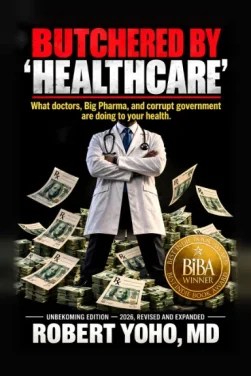 Butchered by “Healthcare” is Robert Yoho’s plain-spoken account of how American medicine stopped being a profession and became an industry. 341 pages. Over a thousand references. Thirty-eight chapters.
 Aletho News
