NYT Writes about the Israeli Intel Failures on Hamas
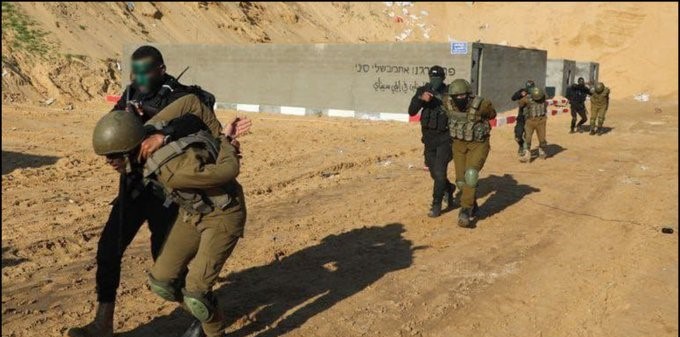
Palestinian resistance fighters capture Israeli occupation soldiers during an attack on a militray post in the Gaza envelope as part of Op. Al-Aqsa Flood (October 7, 2023).
Al-Manar – October 31, 2023
The Israeli occupation military’s 8200 signal intelligence unit stopped listening in to the handheld radios of Hamas operatives in Gaza a year ago, deciding it was a “waste of effort,” The New York Times reported noting that this was one of a series of failures that led to the shocking success of the Oct. 7 Operation Al-Aqsa Flood.
In an extensive report on the intelligence failures, the paper also said on Sunday that US spy agencies had largely stopped collecting information on Hamas in recent years, believing that ‘Israel’ had contained the threat from the Palestinian resistance group.
Monitoring that network might have helped Ronen Bar, the director of the Israel Security Agency, or Shin Bet, realize at 3 a.m. on Oct. 7, a few hours before the attack, that the unusual activity he was seeing on the Gaza border wasn’t just another Hamas “military” exercise, the Times noted.
Israeli military also placed its confidence in “The Barrier,” the nearly 40-mile-long concrete wall that plunges underground to prevent tunneling. It included a high-tech surveillance system that relies on cameras, sensors and remote-controlled machine guns.
“Senior Israeli military officials believed that the combination of remote surveillance and machine-gun systems with the formidable wall would make it almost impossible to infiltrate Israel, and thus reduce the need for a large number of soldiers to be stationed at the bases,” the newspaper reported.
Hamas’s attack put paid to the idea that concrete and technology could be relied on. The Hamas fighters blew up cellular antennas and remote shooting systems along the fence with explosives precisely dropped from drones.
“In a conversation with military investigators two weeks after the attack, soldiers who survived the assault testified that the Hamas training was so precise that they damaged a row of cameras and communication systems so that ‘all our screens turned off in almost the exact same second,’” the Times reported.
There simply were not enough Israeli soldiers to fill the gaps once the technology was destroyed and the security barrier breached. Hamas terrorists [resistance fighters] poured through.
“We started receiving messages that there was a raid on every reporting line,” one soldier at the Gaza Division base told an Israeli news site.
“The forces did not have time to come and stop it. There were swarms of terrorists, something psychotic, and we were simply told that our only choice was to take our feet and flee for our lives.”
The Hamas rampage across western Negev communities went on for hours, with the Israeli soldiers’ response shockingly slow, (Something that has still not been explained).
After the fighting, Israeli soldiers found hand-held radios on the bodies of some of the Hamas fighters, “the same radios that Israeli intelligence officials had decided a year ago were no longer worth monitoring,” the Times reported.
‘Turning Gaza into ashes’: Israel propaganda vs the world
By Ramzy Baroud | MEMO | October 31, 2023
Gaza has changed the political equation in Palestine. Moreover, the repercussions of the ongoing devastating war are likely to alter the political equation in the entire Middle East and to re-centre Palestine as the world’s most urgent political crisis for years to come.
Since the establishment of Israel in 1948, facilitated by Britain and protected by the United States and other Western countries, the priorities have been entirely Israeli. “Israel’s security”; Israel’s “military edge”; “Israel’s right to defend itself”, and much more, are the mantras that have defined the West’s political discourse on the Israeli occupation and apartheid in Palestine.
This bizarre US-Western understanding of the so-called conflict, that an oppressor has “rights” over the oppressed; the occupier has “rights” over the occupied, has enabled Israel to maintain a military occupation over Palestinian territories that has lasted for over 56 years. Indeed, many would argue that it is for more than 75 years.
It has also empowered Israel to neglect the roots of this “conflict”, namely the ethnic cleansing of Palestine in 1948, and the long-denied, and very legitimate, Right of Return for Palestinian refugees.
Within this context, every Palestinian-Arab overture for peace was rejected. Even the supposed “peace process”, namely the Oslo Accords, turned into an opportunity for Tel Aviv to entrench its military occupation, expand its illegal settlements and corral Palestinians in Bantustan-like spaces, humiliated and racially segregated.
Some Palestinians, whether enticed by American handouts or shattered by a lingering sense of defeat, lined up to receive the US-Israeli peace dividends: pitiful crumbs of false prestige, empty titles and limited power, granted and denied by Israel itself.
However, the Israeli war against the Palestinians in Gaza is already changing much of this painful status quo. The occupation state’s constant insistence that its deadly war is against Hamas, against “terror”, against Islamic fundamentalism, and all the rest, may have convinced those who are ready to accept the Israeli version of events at face value. However, as the bodies of thousands of Palestinian civilians, including thousands of children, began piling up at Gaza’s hospital morgues and, tragically, in the streets, the narrative began changing.
The pulverised bodies of Palestinian children, of whole families who perished together, stand witness to the brutality of Israel; to the immoral support of its allies; and to the inhumanity of an international order that rewards the murderer and reprimands the victim.
Of all the biased statements made by US President Joe Biden, the one where he suggested that Palestinians are lying about the body count of their own dead was perhaps the most inhumane. Washington may not realise this yet, but the repercussions of its unconditional support for Israel will prove to be disastrous in the future, especially in a region that is fed up with war, hegemony, double standards, sectarian divisions and endless conflict.
The greatest impact, though, will be felt in Israel itself. When Palestinian Ambassador to the UN Riyad Mansour gave a powerful, emotional speech on 26 October, he could not hold back his tears. International delegations at the UN General Assembly clapped non-stop, reflecting the growing support for Palestine, not only at the UN, but also in hundreds of towns and cities, and on countless street corners around the world.
When the Israeli Ambassador to the UN, Gilad Erdan, who had promoted many of the lies communicated by Tel Aviv, especially in the early days of the war, finished his speech, not a single person clapped. The contempt was palpable.
The Israeli narrative had clearly crumbled into a thousand pieces. Israel has never been so isolated. This is definitely not the “New Middle East” that Netanyahu had prophesised in his UN General Assembly speech on 22 September.
Unable to fathom how the initial sympathy with Israel turned so quickly into outright disdain, the settler-colonial state resorted to old tactics. On 25 October, Erdan demanded that UN Secretary-General Antonio Guterres should resign for being “unfit to lead the UN”. The UN chief’s supposedly unforgivable crime was to suggest that “the attacks by Hamas did not happen in a vacuum”. Which, of course, they didn’t.
As far as Israel and its American benefactors are concerned, however, no context is allowed to taint the perfect image that the Israelis have created for its genocide in Gaza. In this perfect Israeli world, no one is allowed to speak of military occupation; of siege; of the lack of political prospects; of displacement; of the absence of a just peace for Palestinians.
Even though Amnesty International has said that both sides have committed “serious violations of international humanitarian law, including war crimes”, Israel still attacked it, accusing the organisation of being “anti-Semitic”. In Israel’s thinking, even the world’s leading international human rights group is not permitted to contextualise the atrocities in Gaza or dare suggest that one of the “root causes” of the conflict is “Israel’s system of apartheid imposed on all Palestinians”.
Israel is no longer all-powerful, as it wants us to believe. Recent events have proven that its “invincible army” — a branding that allowed Israel to become, as of 2022, the world’s tenth-largest international military exporter — turned out to be a paper tiger.
This is what is infuriating Israel the most. “Muslims are not afraid of us anymore,” former Knesset member Moshe Feiglin told Arutz Sheva-Israel National News. To restore this fear, the extremist politician called for burning “Gaza to ashes immediately.”
But nothing will turn Gaza into ashes. Not even the more than 12,000 tons of high explosives dropped on the Strip in the first two weeks of war which have already incinerated at least 45 per cent of its housing units, according to the UN’s humanitarian office.
Gaza will not die because it is a powerful idea that is deeply entrenched within the hearts and minds of every Arab, of every Muslim and of millions of people around the world. This new idea is challenging the long-held belief that the world needs to cater to Israel’s priorities, security, selfish definitions of peace and all of the other illusions.
The focus should now be on where it should have always been: the priorities of the oppressed, not the oppressor. It is time to speak about Palestinian rights, Palestinian security and the Palestinian people’s right — in fact, obligation — to defend themselves.
It is time for us to speak about justice — real justice — the outcome of which is non-negotiable: equality, full political rights, freedom and the right of return.
Gaza is telling the world all of this, and much more. And now it is time for us to listen.
Israel has killed 133 babies under a year old since 7 October
MEMO | October 31, 2023
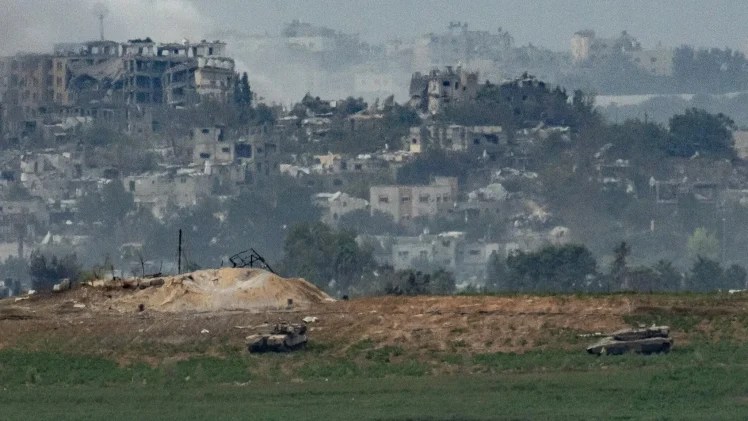
Since 7 October, at least 133 infants less than one year old have been killed in the Gaza Strip, which Israel has now been bombing for over 24 days, Anadolu Agency reports.
On 26 October, the Palestinian Health Ministry in Gaza released a 212-page report that lists the names, identification, and ages of those killed in Israel’s attacks on the strip since 7 October, when the current conflict began.
According to the report, 2,913 of the 7,280 people killed in the Israeli attacks were children.
In the Israeli attacks, 444 babies were killed, including 133 under one year old, 153 one-year-olds and 158 two-year-olds.
Israel’s bombing also killed 171 three-year-olds, 1,527 pre-school to primary school aged children (ages 4-13), and 523 high-schoolers, age 14 to 17.
Of the casualties, 2,262 were women and 462 were over the age of 60.
The report also said that the identities of 281 of the victims have not been confirmed.
63 UN employees and 36 journalists killed
The UN Agency for Palestinian refugees, or UNRWA, announced on 30 October that 63 of its staff members had been killed in the Israeli attacks.
Since the start of the Israeli attacks on 7 October, 35 journalists have been killed in Gaza and one in Lebanon.
The armed wing of Hamas, the Izz Ad-Din Al-Qassam Brigades, launched a comprehensive attack on 7 October in response to ongoing Israeli violations against Palestinians and their holy sites, including the Al-Aqsa Mosque.
The Israeli army responded with a relentless campaign of airstrikes on the Gaza Strip and seems now to have started a long-expected ground offensive.
Al-Aqsa Flood gives Israeli economy ‘COVID-19 like symptoms’
The Cradle | October 30, 2023
The historic Al-Aqsa Flood operation has not only battered Israeli settlements and the security forces, but the war has also taken flight against the Israeli market.
Economists are looking at the operation that hit the $520 Billion economy with memories of the COVID-19 effects, saying that orders for schools, offices, and building sites to close or only open for a few hours are like the days of the pandemic.
Adding to the affected workforce, the Israeli government amassed 350,000 reservists for its much-awaited ground invasion, draining about eight percent of the Israeli workforce.
Mizrahi-Tefahot, a top Israeli bank, says that the mass mobilization order and partial economic freezes are costing the government the equivalent of $2.5 billion per month. The Israeli central bank has said that the economic state will only worsen as the war goes on.
Israeli stocks are the world’s worst performing since the beginning of the war. The Shekel is at its weakest level since 2012, despite the $45 billion emergency package or the selling off of $30 Billion in foreign reserves to try and save the currency from sinking further.
Markets won’t fair well with a long war, but Israeli Prime Minister Benjamin Netanyahu has warned of a “long war” as he prepares for a ground invasion.
JPMorgan Chase & Co., the US multinational financial services firm, has said that they believe the Israeli economy is shrinking 11 percent on an annualized basis, saying that their initial projections about the economic impact were “too optimistic.”
The financial firm’s projections are among Wall Street’s most cynical, but investors have been selling off Israeli assets heavily.
“Gauging the impact of the war on Israel’s economy remains difficult both due to still very high uncertainty about the scale and duration of the conflict and the lack of high-frequency data at hand,” JPMorgan analysts said.
Having one of the strongest economies in the world, Israel hasn’t seen an economic hit this bad since the 2006 war between them and Hezbollah, the physical damage cost of which has already been topped by the Palestinian factions.
The Israeli business press has said the nation has entered a recession. Israeli daily The Market has previously written that “Israel has entered the war, and it is in a recession, and trade is currently zero.”
Chinese tech giants cancel Israel
RT | October 31, 2023
Israel can no longer be found on China’s leading online digital maps on platforms including Baidu and Alibaba, the Wall Street Journal reported on Monday, citing web users.
According to the report, Baidu’s Chinese language maps still show the borders of both Israel and the Palestinian territories, as well as key cities in the region. However, they no longer identify Israel by name.
Alibaba’s Amap also no longer displays the name of Israel on its maps. According to the report, the platform is usually known for its attention to details, with even small countries like Luxembourg clearly labeled.
The companies did not respond to media requests for comment. According to the publication, it is unclear when exactly the name Israel disappeared from their maps, but web users have apparently been discussing the development since the escalation of the Israel-Hamas conflict earlier this month.
According to local reports, the Chinese internet has been overflowing with anti-Semitic [sic] comments over the past month, which may be the reason behind the disappearance of Israel’s name from the maps. The Israeli Embassy in China was recently forced to close the comment section under its official account on China’s X-like platform Weibo, after a slew of verbal attacks from users.
The Chinese government has not taken sides in the Mideast conflict, calling on the belligerents to end the hostilities and condemning attacks on civilians. However, Beijing has a long history of supporting Palestine. It recognized the Palestine Liberation Organization in 1964 and Palestinian sovereignty in 1988, and later established full diplomatic relations with the Palestinian Authority in 1989.
During his visit to Saudi Arabia in 2022, Chinese President Xi Jinping called the fact that the global community still largely does not recognize Palestine as a country a “historical injustice,” and said China will support the establishment of a Palestinian state with East Jerusalem as its capital.
Iran’s FM says national referendum only viable political solution to Palestinian issue
Press TV – October 30, 2023
Iranian Foreign Minister Hossein Amir-Abdollahian says holding a referendum in Palestine can serve as the “fundamental and political” solution to the Palestinian issue.
In a phone conversation on Monday, Amir-Abdollahian and Vatican’s Secretary for Relations with States Paul Archbishop Richard Gallagher discussed Israel’s relentless attacks against the defenseless Palestinian people, which have been going on over the past 24 days, as well as ways to find a political solution to the critical situation.
“We believe that the Palestinian crisis should be resolved basically and a political solution to it is to hold a referendum with [the participation of] all the original inhabitants of Palestine, including the Christians, the Jews and the Muslims, in cooperation with the United Nations,” the top Iranian diplomat said.
Israel waged the bloody war on the Gaza Strip on October 7 after the Palestinian Hamas resistance movement launched the surprise Operation Al-Aqsa Storm against the occupying entity.
Since the start of the war, the Israeli regime has been committing war crimes in Gaza, killing at least 8,306 Palestinians, including 3,457 children, and injuring over 22,000 others.
Pointing to his October 22 letter to Gallagher on the deterioration of the humanitarian situation in Gaza, Amir-Abdollahian hailed the stance adopted by the Vatican official and Pope Francis.
In his letter, Amir-Abdollahian said the crimes committed by the Israeli regime, including bombardment of al-Mamdani Hospital and a historical church in the Gaza Strip, where women and children had sheltered, “reveal another facet of the Zionist regime’s savage and brutal nature.”
The Iranian foreign minister also warned against the consequences of a possible expansion of war.
Gallagher, for his part, stressed the importance of delivering humanitarian aid to the war-stricken people in Gaza and finding a political solution to the conflicts with Israel in a bid to prevent the expansion of war.
Iran opposes killing of civilians in every part of world
In another phone call with Maltese Minister for Foreign, Trade and European Affairs Ian Borg on Monday, Amir-Abdollahian said Iran opposes the killing of civilians, including women and children, in any part of the world.
“Unfortunately, there is no resemblance between the measures of the [Palestinian] liberation movement Hamas and constant attacks and war crimes perpetrated by the occupying regime of al-Quds (Israel),” he added.
The Maltese foreign minister, for his part, stressed the need to find an urgent political solution to the Palestinian issue in order to prevent the spread of war.
Keir Starmer: Hostage, or Accomplice to Rishi Sunak?
Why is the current Labour leader in complete lock step with the ruling Tory party, with unfettered support for Israel’s war crimes in occupied Palestine?
By Peter Ford | 21st Century Wire | October 30, 2023
The leader of the Labour Party is just as much a hostage as any of the Israelis held by Hamas. Only in his case he wasn’t kidnapped: he delivered himself, bound and gagged, to Prime Minister Rishi Sunak and Netanyahu.
Keir Starmer, basking in media acclaim just a week ago after yet another spectacular by-election win for his party, is now probably the most reviled politician in Britain, a pretty contested field.
This turnabout has come about because over the last three years Starmer has staked his all on extirpating from the Labour Party all traces of his allegedly anti-semitic Hamas-friendly predecessor Jeremy Corbyn and his barbaric followers (does this kind of operation sound familiar?). He has been largely successful in this endeavour and earned in consequence the favour of important elites well represented in the media. In so doing, however, he has made himself a hostage to fortune, or more specifically to the behaviour of Israel.
Starmer could not afford to let daylight over Israel emerge between himself and Rishi Sunak, otherwise all his good work shoring up his credentials as scourge of the Labour anti-semites could start to crumble. This was fine as long as even the Arabs seemed to be ditching the Palestinians by making their separate Abraham Accords with Israel.
But what if it all blew up in the faces of the architects of these Accords and Israel turned out to be behaving barbarically? Well, Starmer is now finding out. Following as he thought the Sunak line, in a notorious radio interview he stated as clearly as he ever states anything (that is, not very much) that Israel had the right to withhold food, water, electricity and fuel from starving Gazans. Desperate backtracking failed to stem the avalanche of protest that followed, mainly from representatives of the Muslim community. Labour councillors started resigning.
Starmer compounded his error by failing to support calls for a ceasefire, just as British TV screens were filling with horrific pictures of Palestinian children being pulled bloodied from rubble. The trickle of resignations at local level became a flood and panicking senior Labour figures started to distance themselves from him. That many of them depend on Muslim votes to get re-elected has of course nothing to do with this welcome if tardy appreciation that genocide is, well, overdoing it a bit.
Starmer is in a massive bind. If he caves in to pressure and starts to let daylight emerge between himself and Sunak he will immediately be assailed from all sides for being the treacherous, cynical, unprincipled flip flopper he is, if not as an actual anti-semite. And if he stands firm he will gain poisonous praise from the Right and not much else.
Meanwhile Sunak is having a ball at Starmer’s (and Gaza’s) expense. However outrageous Sunak’s pro-Israeli stance he knows Starmer can only distance himself at his peril and the longer this goes on the more Starmer impales himself on this hook of his own foolish making. At a stroke Starmer has lost millions of potential votes, even if he now zigzags, while Sunak’s fortunes, a moment ago worth less than Sam Bankman-Fried’s investments in crypto, rise correspondingly. And with Netanyahu promising that his Gaza campaign is going to be long, hard and painful (for Gazans) the hostages, including Starmer, look set for a lengthy ordeal.
Rarely will a comeuppance have been more richly deserved. By cynically sacrificing Palestinians to his own electoral calculus Starmer has brought the rubble from his crumbling edifice of a Middle East policy cascading down on his own head.
Eventually of course public opinion will force Sunak to change course. Even if Starmer beats him to it the shift will come too late to rescue his reputation. Whatever he does from now on Starmer will be remembered by many as the man who condoned the vilest Israeli war crimes.
His party if it has any sense will ditch him for someone with slightly less filthy hands before voters have a chance to express their revulsion at Tories and Labour both by not voting at all.
US seeks strategic dialogue with Russia
BY M. K. BHADRAKUMAR | INDIAN PUNCHLINE | OCTOBER 30, 2023
Almost four weeks into Hamas’ attack on Israel, Russia is in no hurry to exploit the Biden administration’s quandary over the collapse of Middle East security. The western media was unanimous that Russia was waiting in the wings to seize the opportunity once the US took its eye off the ball in Ukraine. However, no such thing happened.
Ukraine war is on autopilot. The compass has been set, the die is cast and the calculus is holding steady with regard to the strategic objectives set by President Vladimir Putin in February last year. Russia senses that it has gained the upper hand in the war and that is irreversible.
Ukraine’s counteroffensive has failed and the fighting is presently restricted to two sectors of the frontline, as Russian forces strengthen the security of the Donetsk region and seek to regain control of territories up north in the borderlands of Donbass and Kharkov region from where they retreated for tactical reasons last September and October.
Yet, Moscow has not begun its grand offensive, as many had predicted. One plausible explanation is that Moscow is watching the maelstrom sweeping through the Middle East. Moscow is particularly sensitive about any spillover into Syria.
With an eye on the formidable US naval build-up in Eastern Mediterranean with the deployment of two aircraft carrier groups, President Vladimir Putin has publicised that Russian jets equipped with hypersonic Kinzhal missiles are roaming the skies above the Black Sea, which can strike targets 1000 kms away at Mach 9 speed, which no existing missile defence system can intercept. Suffice to say, the war in Ukraine remains attritional.
Curiously, Russia conducted a simulated nuclear strike in a drill on Wednesday overseen by Putin, hours after Russian parliament voted to rescind the country’s ratification of the global nuclear test ban treaty (CTBT). The drill needs to be seen in the broader context of global strategic stability. A Kremlin statement said, “The purpose of the training exercise was to check the level of preparedness of military command bodies, as well as the skill of the leadership and operational personnel in managing the troops (forces) under their command.” Everything, however, adds up in these extraordinary times.
At its most obvious level, the Palestine-Israel conflict is a manifestation of the growing imbalance in the existing system of international relations. New wars are emerging; longstanding conflicts are mutating (eg., Nagorno-Karabakh). Last week, Pakistan bracketed Palestine and Kashmir as the UN’s unfinished business in the post-colonial era. North Korea and Iran are flash points that have no military solution.
In the months ahead, without doubt, Washington will continue to provide Israel with military and diplomatic support but an extended Israeli operation lasting months in Gaza will mean dispersal of US resources that might be needed in other theatres. The conflict in Gaza underscores the imperative for a rethink in the US’ notions of global hegemony. The fact remains that the US, despite its self-proclaimed status as the “Indispensable Nation” (Madeline Albright) and the guarantor of “rules-based order,” failed to prevent the latest eruption of conflict in the Middle East.
Arguably, therefore, the latest US proposal for a systematic resumption of strategic dialogue with Russia can be seen as a sign of positive thinking. Unsurprisingly, Moscow has displayed a studied indifference to the US proposal. But that needn’t be taken as the last word. Historically, Soviet-American strategic dialogue brought on board into the agenda all major issues and most minor issues affecting international security.
The big question, therefore, is the timing of the US proposal. Against the backdrop of the gathering storms in the Middle East, the Biden Administration probably seeks to calm the nerves by proposing talks with Russia on global strategic balance, since the guardrails in arms control no longer exist. This is one thing.
At any rate, Russia’s “neutrality” in a Middle East conflict could also be a consideration. Equally, Western leaderships understand that the war against Russia is practically lost — although they will not admit it publicly — and engagement with Russia is needed.
Again, although the US has provided Israel with significant military and diplomatic support and keeps influencing the latter not to escalate the conflict, there are variables in the situation and any big conflagration in the Middle East will require a massive concentration of material and financial resources that are limited even for a superpower, since there are other unresolved problems in the world, too.
The breakdown of trust in the Russian-American ties hurts US interests. Fundamentally, it must also be understood that what Moscow seeks even today after nearly 20 months of battling NATO and the US in Ukraine’s killing fields is a sustained engagement with Washington and a willingness to accommodate mutual interests.
On its part, Russia is conducting itself as a responsible power vis-a-vis the crisis in Gaza. There is no shred of evidence to show that Russia has acted as a “spoiler”. On the contrary, Moscow has been projecting its credentials as a potential peacemaker who enjoys good relations with all key players — Israel, Hamas, Iran and other regional states alike.
In fact, President Biden’s recent remarks on the Gaza situation bring the US position rather close to Russia’s. Biden read out the following from a prepared text at a joint press conference with Prime Minister Anthony Albanese of Australia:
“Israel has the right and, I would add, responsibility to respond to the slaughter of their people. And we will ensure Israel has what it needs to defend itself against these terrorists. That’s a guarantee…
“But that does not lessen the need for — to operate and align with the laws of war for Israeli — it has to do everything in its power — Israel has to do everything in its power, as difficult as it is, to protect innocent civilians. And it’s difficult. I also want take a moment to look ahead toward the future that we seek.
“Israelis and Palestinians equally deserve to live side by side in safety, dignity, and peace. And there’s no going back to the status quo as it stood on October the 6th. That means ensuring Hamas can no longer terrorise Israel and use Palestinian civilians as human shields.
“It also means that when this crisis is over, there has to be a vision of what comes next. And in our view, it has to be a two-state solution.”
Putin couldn’t have put this across differently. There is a sense of expectation in Moscow that in the emergent conditions in regional security, the US and its allies will “reconsider their notions of defeating Russia in the Ukraine conflict at any cost” — as an establishment think tanker wrote in the Kremlin-funded RT last week.
Trust is lacking, he concluded, “compromises without the full consideration of Russian interests” are difficult to reach, but “a pivotal stage in the (world) order … is taking shape before our eyes.”
Widespread destruction in Jenin following massive Israeli raid

The Cradle | October 30, 2023
Dozens of Israeli army vehicles, bulldozers, and drones wreaked havoc to the occupied West Bank city of Jenin on 30 October during an early morning raid that saw Palestinian resistance fighters powerfully confront the invading forces.
Following the devastating incursion, the Jenin Brigades issued a statement confirming that their fighters drove off the Israeli army, damaging at least 30 Israeli armored vehicles and leaving an unknown number of Israeli soldiers dead.
For its part, the Palestinian Health Ministry said at least four Palestinians were killed during the clashes in Jenin. About 120 Palestinians have been killed in the West Bank since 7 October, with nearly 2,000 injured.
The Israeli forces besieged the rebellious city from the early hours of Monday, attacking Jenin Governmental Hospital, dropping bombs on residential buildings, destroying streets leading up to the adjacent refugee camp, placing dirt mounds to separate the camp from the city, and bulldozing major landmarks.
Mass arrest campaigns also continued across the occupied West Bank on Sunday night, as Tel Aviv targeted the Dheisheh camp, Janata, Nahalin, and Beit Fajjar in the Bethlehem district, as well as Hebron, Ramallah, and Nablus.
At least 60 Palestinians were detained, according to the Palestinian Prisoners’ Club.
Over 1,500 Palestinians have been arrested since the start of the Gaza-Israel war on 7 October, as Israel has launched nightly arrest campaigns in the occupied West Bank. At least 4,000 laborers from Gaza have also been detained, pushing the number of Palestinians held in Israeli prisons past 10,000.
Featured Video
No Vote, No Representation, No State: Democracy, Israeli Style
or go to
Aletho News Archives – Video-Images
From the Archives
Sanctions, War and the Policy of Dual Containment
By SASAN FAYAZMANESH | March 17, 2008
It is now nearly three decades since the Unites States adopted the policy of dual containment of Iran and Iraq. While much has been written about the containment of Iraq, there has been very little in-depth analysis of this policy when it comes to Iran. In a book that is going to be released on March 31, 2008, entitled The United States and Iran: Sanctions, Wars and the Policy of Dual Containment (Routledge), I attempt to address this shortcoming by investigating when and why the US policy of containment of Iran came about, how it evolved, and where it stands today.[1] To the extent that Israel has been involved in US policy making, the study will also include the role that Israel has played in the containment of Iran. Also, since the fate of Iran has been inextricably linked to that of Iraq, occasionally the investigation will overlap with the containment of Iraq.
The policy of dual containment of Iran and Iraq originated during the Carter Administration, but it was not until the Clinton Administration that the expression “dual containment” became popular. … continue
Blog Roll
 Aletho News
- No Vote, No Representation, No State: Democracy, Israeli Style
- Zionist Bought Senate Blocks Information About American Citizens Killed By Israel
- While Gaza dominates the UN, these are the people keeping it alive
- New Report: “Scholasticide and Genocide in Gaza: Assessment, Testimonies and Legal Analysis”
- ‘THAAD Delusion’: Iran war exposes US missile shield limits – The Atlantic
- Moscow issues warning to NATO over Russian exclave
- Yes, the Iran war has destroyed Trump’s presidency
- The fallacy of US delusions about Iran’s economic collapse
- Hezbollah denies Syria cell link, warns of Israeli plan to sow discord
- The legacy of US sanctions, war, and occupation in Iraq
- If Americans Knew
- Mamdani releases plan to combat antisemitism and hate crimes in New York City
- Iran’s Revolutionary Guards Publish Letter to the American People
- DMFI launches $1 million ad campaign supporting Virginia’s Elaine Luria
- US Senate blocks resolution seeking report on Americans killed by Israel
- Israeli Attacks Kill Ten Palestinians in Gaza
- Massacre at Minab: The School That Became a Grave
- Israeli media: The IDF Shows It Doesn’t Turn a Blind Eye; It Actively Emboldens Settler Havoc
- As settlers ravage West Bank, Israeli forces kill 10 in Gaza – Daily Update
- New Report: “Scholasticide and Genocide in Gaza: Assessment, Testimonies and Legal Analysis”
- Ex-Biden officials are desperate for a Gaza scapegoat
- No Tricks Zone
- Green Energy Debacle: German Expert Professor Fritz Vahrenholt Warns Of Severe Economic And Social Consequences
- Two More Paleo Reconstructions Affirm Meters-Higher Sea Levels Across Ireland, Brazil 7000-6000 Years Ago
- New Study: Earth And Venus Surface Warmth Largely Explained By Convection And Lapse Rate, Not CO2 Or Radiation
- 2025 Nature Paper Claiming Worsening Global Drought Gets RETRACTED …Heavily Flawed
- New Study: ‘Global Drought Shows No Detectable Recent Acceleration Under Climate Warming’
- Economic Masterminds: German Socialists Suggest Taxing Productivity Gains Stemming From Using AI
- The South China Sea Has Not Been Cooperating With The Climate Change Narrative
- Energy Crisis: Germany Enters Heating Season With Historically Low Gas Reserve Fill Levels
- New Study: The Antarctic Ice Sheet Gained Mass From 2020-2024 Due To Staggering Snow And Ice Accumulation
- Study: Ocean Heating Rates From Thousands Of Years Ago ‘Dwarf’ Modern Ocean Heating Rates

