Israel lets settlers spend Passover at former outpost where Palestinian landowners remain excluded
MEMO | April 29, 2019
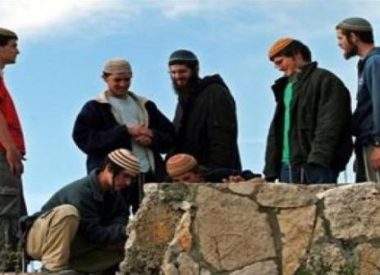 Israeli occupation authorities allowed settlers to celebrate Passover at the site of the former Amona outpost in the northern West Bank, despite the fact that the location is a closed military zone.
According to Haaretz, the site “became a recreation spot for Jewish settlers during the Passover holiday”, even though the Palestinians who own the land on the hill “are still not allowed access”.
The outpost was evacuated in 2017 on orders of the Israeli Supreme Court, who ruled it had been established on privately-owned Palestinian land.
As reported by Haaretz, shortly before the removal of settlers from Amona, “the army issued the order barring access to the site by civilians”, an order “now strictly enforced to keep Palestinian landowners from the nearby villages of Ein Yabrud and Silwad from farming their land at the site”.
The order has not been enforced, however, “when it comes to Jews, who are able to access the site fairly easily on a road from the nearby settlement of Ofra”.
“It’s clear that after years during which the state got used to conducting itself in cooperation with the settlers in stealing land in the West Bank, it’s hard to wean itself off,” Dror Etkes of settlement watchdog Kerem Navot told Haaretz.
A Palestinian petition to the Supreme Court demanding access to their land at the site is still pending.
For NYT, Israel Is Always Nearing ‘Apartheid,’ but Never Quite Gets There
By Gregory Shupak | FAIR | April 26, 2019
Following Benjamin Netanyahu’s re-election as Israeli prime minister earlier this month, the New York Times’ editorial board (4/11/19) wrote:
Under Mr. Netanyahu, Israel is on a trajectory to become what critics say will be an apartheid state like the former South Africa—a country in which Palestinians will eventually be a majority, but without the rights of citizens.
A harsh criticism? Actually, the paper has been saying that Israel/Palestine could “become” an apartheid state for the better part of two decades. It ran a piece in 2003 (1/29/03) arguing that
if Israel does not give up the territories, it will face a choice: relinquish either democracy or the ideal of a Jewish state. Granting Palestinians in the territories the right to vote would turn Israel into an Arab state with a Jewish minority. Not allowing them to vote would result in a form of permanent apartheid.
For almost 20 years, the paper has suggested that Israel/Palestine risks devolving into an apartheid state if it continues to rule over Palestinians in the territories—Gaza, the West Bank and East Jerusalem—who cannot choose their rulers. This population includes approximately 4.75 million occupied Palestinians—320,000 in East Jerusalem, 2.8 million in the rest of the West Bank and 1.8 million in besieged Gaza—to say nothing of the millions of Palestinian refugees who cannot return to their homes and participate in elections because the people who put on those elections won’t let them.
That situation has remained the same, not only for the period that the Times has been publishing material saying the arrangement might someday add up to apartheid, but since 1967. Yet the Times persists in characterizing Israeli apartheid as a hypothetical future development. The paper acknowledges that governing millions of Palestinians but denying them the vote is a form of apartheid, so there’s no justification for saying, after nearly 52 years of such disenfranchisement, that that will eventually constitute apartheid, but for some unspecified reason doesn’t yet at this point.
Tom Friedman’s Groundhog Day
New York Times columnist Thomas Friedman appears to be having a Groundhog Day experience: He keeps waking up, looking at Israel’s ethnocracy, and saying that if it continues to be apartheid, it will become apartheid. In 2002 (10/16/02), he commented:
If you think it is hard to defend Israel on campus today, imagine doing it in 2010, when the colonial settlers have so locked Israel into the territories it can rule them only by apartheid-like policies.
2010 came and went, and the “apartheid-like” conditions remained, but Friedman persisted in treating Israeli apartheid as a mere possibility, writing (2/1/11) of the 2011 protests in Egypt:
If Israelis tell themselves that Egypt’s unrest proves why Israel cannot make peace with the Palestinian Authority, then they will be talking themselves into becoming an apartheid state — they will be talking themselves into permanently absorbing the West Bank and thereby laying the seeds for an Arab majority ruled by a Jewish minority between the Mediterranean Sea and the Jordan River.
A year later (8/1/12), Friedman said:
It is in Israel’s overwhelming interest to test, test and have the US keep testing creative ideas for a two-state solution. That is what a real US friend would promise to do. Otherwise, Israel could be doomed to become a kind of apartheid South Africa.
Two years after that (2/11/14), Friedman said that “Israel by default could become some kind of apartheid-like state in permanent control over… 2.5 million Palestinians.” Even in this so-called criticism of Israel, Friedman does the state a favor by acting as though the West Bank Palestinians are the only ones disenfranchised by Israel, overlooking the refugees and Gaza, even as Israel continues to control the latter. (He also appears to leave out Palestinian Jerusalemites.)
Evidence for Already-Existing Apartheid
As Friedman and his paper kept predicting that Israel/Palestine could turn into an apartheid entity, evidence mounted that it is exactly that. For example, United Nations special rapporteur John Dugard found in 2007 that “elements of the [Israeli] occupation constitute forms of colonialism and of apartheid, which are contrary to international law.” He went on to say that at the checkpoints throughout the West Bank and surrounding Jerusalem,
a [Palestinian] person may be refused passage through a checkpoint for arguing with a soldier or explaining his documents…. Checkpoints and the poor quality of secondary roads Palestinians are obliged to use, in order to leave the main roads free for settler use, result in journeys that previously took 10 to 20 minutes taking 2 to 3 hours…. In apartheid South Africa, a similar system [was] designed to restrict the free movement of blacks —the notorious “pass laws.”
Another UN special rapporteur, Richard Falk, noted in 2010 that “among the salient apartheid features of the Israeli occupation” are “discriminatory arrangements for movement in the West Bank and to and from Jerusalem,” as well as
extensive burdening of Palestinian movement, including checkpoints applying differential limitations on Palestinians and on Israeli settlers, and onerous permit and identification requirements imposed only on Palestinians.
A March 2017 report by the UN Economic and Social Commission for Western Asia concluded that “Israel has established an apartheid regime that dominates the Palestinian people as a whole.”
That July, however, Friedman (7/12/17) continued to treat Israeli apartheid as something that might happen down the road, wishing that President Trump had admonished Netanyahu in a meeting between the two:
Bibi, you win every debate, but meanwhile every day the separation of Israel from the Palestinians grows less likely, putting Israel on a “slippery slope toward apartheid,” as former Israeli Prime Minister Ehud Barak recently warned.
Last September (9/19/18), Friedman was still worried about this supposedly theoretical scenario:
Without some dramatic advance, there is a real chance that whatever Palestinian governance exists will crumble, and Israel will have to take full responsibility for the health, education and welfare of the 2.5 million Palestinians in the West Bank. Israel would then have to decide whether to govern the West Bank with one legal authority or two, which would mean Israel would be choosing between bi-nationalism and apartheid, both disasters for a Jewish democracy.
Netanyahu, Friedman went on to say, has failed to offer “any new, or old, ideas on how to separate from the Palestinians to avoid the terrible choices of bi-nationalism and apartheid.”
Erasing Palestinians
Setting aside the troubling assertion that Israelis and Palestinians living as equals would be not only a “disaster,” but as bad a “disaster” as apartheid, Friedman ignored the fact that just two months earlier, the Knesset had passed the Nation State Law that defined Israel as the national homeland of the Jewish people. The law asserted that “the realization of the right to national self-determination in Israel is unique to the Jewish people,” even though 20 percent of the population living inside Israel is not Jewish; encouraged “the development of Jewish settlement” and vowed that the state will “promote its establishment and consolidation.” It declared that “the state’s language is Hebrew,” deprecating Arabic, the first language of roughly half the people under that state’s control.
The Nation State Law demonstrates that the bad faith, future tense descriptions of Israeli apartheid are overly narrow, in that they focus exclusively on the Palestinian territories that Israel has occupied since 1967. Yet on the Israeli-held side of the Green Line, Palestinians are systematically discriminated against.
It’s not only the occupation that make Israel/Palestine apartheid. It’s the Israeli state’s foundational principles and actions: driving two-thirds of the indigenous Palestinian population from their homes at its birth, subsequently making more than 2 million of them refugees, and then denying their right to return, despite its being mandated under international law.
Meanwhile, Jewish people anywhere on Earth are given the right to immigrate, because Israeli leaders want to maintain a demographic advantage. They pursue this goal—with decisive help from their sponsors in Washington—through their longstanding operational policy mantra: maximum land, minimum Arabs.
Not even three full days after the New York Times’ most recent brooding about how Israel might “become” an apartheid state, Israel’s Supreme Court approved the demolition of 500 Palestinian homes in Jerusalem. Is it apartheid yet?
Hamas slams UAE for inviting Israel to Dubai Expo
Palestine Information Center – April 28, 2019
GAZA – The Hamas Movement has strongly denounced the participation of Israel in the 2020 World Expo in the United Arab Emirates city of Dubai, describing it as a serious development.
In Twitter remarks, Hamas spokesman Sami Abu Zuhri urged UAE to backtrack on its decision to invite Israel to participate in the event.
Abu Zuhri said that allowing Israel to participate in Arab events would encourage it to persist in committing more crimes against the Palestinians and usurping the Arab nation’s rights, describing the UAE’s step as “a violation of the decisions taken during the Tunis summit.”
UAE invited Israel to the event despite not recognizing Israel as a state, which comes as another omen of strengthening ties between Tel Aviv and Arab Gulf countries spearheaded by Saudi Arabia among fears that these countries seek to liquidate the Palestinian cause through backing the US deal of the century.
For its part, Israeli premier Benjamin Netanyahu hailed UAE for inviting Israel to the event, describing the participation in the event as “another expression of Israel’s rising status in the world and the region.”
Israeli NGO Demands Israel Revoke BDS Founder’s Residency
teleSUR | April 28, 2019
The Israeli human rights group, Betzalmo, has called on Israel’s Attorney General and Minister of Interior to cancel BDS-founder Omar Al-Barghouti’s residency status, Arutz Sheva reported Sunday.
According to a letter that was dated for April 24, 2019, the Israeli NGO argued how it was possible that Barghouthi could be denied entry into the United States, but not in Israel, which is the country he is calling on the world to boycott.
“A recent law authorizes the Minister of the Interior, with the approval of the Attorney General, to revoke residency for anyone who harms state security or violates allegiance to the state, or endangers public peace,” Betzalmo stated. “Undoubtedly Barghouti’s leadership of the boycott movement against all citizens of the State of Israel severely harms the State of Israel and is a blatant breach of allegiance, as well as a threat to Israel’s security and defense by pushing for an arms embargo against Israel.”
The Israeli NGO said “in addition, the BDS movement collaborates with terrorist organizations, so there is undoubtedly an indirect link between Mr. Barghouti and terrorist organizations.”
Betzalmo CEO Shai Glick also released a statement in which he corroborated the claims in the letter that was dated for April 24.
“The State of Israel is a democratic and liberal state, but it must, in the name of democracy and liberalism, defend itself and its citizens. A determined struggle against the boycott constitutes true defense of the citizens of the State of Israel.” Glick said. “We cannot demand from our allies in the world to prevent the entry of a boycott activist and to prevent conferences of boycott organizations, while allowing those leading BDS activists residency in Israel, giving them State benefits and a platform. We are certain that the Interior Minister and the Attorney General will act with determination and immediately revoke Mr. Barghouti’s residency so he will be able to disseminate his toxic teaching only outside Israel.”
Barghouti was previously denied entry in to the United States, despite having the necessary documentation to enter the country.
The Boycott, Divestment and Sanctions movement (BDS) is a global campaign that has called for the economic boycott of Israel until it meets its “obligations under international law.”
Third Federal Court Blocks Anti-BDS Law as Unconstitutional
ACLU | April 25, 2019
AUSTIN — A federal court in Texas today blocked a state law requiring government contractors to certify that they are not engaged in boycotts of Israel or companies that do business in Israel or territories controlled by Israel, ruling that the law violates the First Amendment. The ruling came in a case brought by the American Civil Liberties Union and the ACLU of Texas on behalf of four Texans, as well as a separate case brought by the Council on American-Islamic Relations.
“This is now the third time a federal court has blocked an anti-BDS law on First Amendment grounds,” said Brian Hauss, staff attorney with the ACLU’s Speech, Privacy, and Technology Project. “Whatever their views on the BDS movement, members of Congress and state legislators should heed this strong message from the courts: The right to boycott is alive and well in the United States and any attempt to suppress it puts you squarely on the wrong side of the Constitution.”
The ACLU’s lawsuit was brought on behalf of four people who were forced under the law to choose between signing the certification or forgoing professional opportunities and losing income: John Pluecker, a freelance writer who lost two service contracts from the University of Houston; George Hale, a reporter for KETR who was forced to sign the certification against his conscience in order to keep his job; Obinna Dennar, a Ph.D. candidate at Rice University, who was forced to forfeit payment for judging at a debate tournament; and Zachary Abdelhadi, a student at Texas State University, who has had to forego opportunities to judge high school debate tournaments.
In his ruling, United States District Judge Robert Pitman stated that the law “threatens ‘to suppress unpopular ideas’ and ‘manipulate the public debate through coercion rather than persuasion’” and that “no amount of narrowing its application will cure its constitutional infirmity.”
Federal courts in Arizona and Kansas also blocked similar state anti-boycott laws in First Amendment challenges brought by the ACLU and ACLU affiliates in the respective states. In January 2018, a federal district court preliminarily enjoined an anti-boycott law in Kansas, holding that the First Amendment protects citizens’ right to “band together” and “express collectively their dissatisfaction with the injustice and violence they perceive, as experienced both by Palestinians and Israeli citizens.” In September, a district court enjoined a similar anti-boycott law in Arizona.
The ACLU takes no position on boycotts of Israel or of any other foreign country, but it has long defended the right to boycott, which is protected under the First Amendment.
The court’s opinion can be found here: https://www.aclutx.org/sites/default/files/4-25-19_bds_order.pdf.
Baseline of a Desecrated Land X: Demographic Threat
Behind a curtain of wine, war, and industrial tourism, Israel is losing a pyrrhic population race with the more fertile Arabs.
By Dick Callahan | September 30, 2018
“We say to the Jews, to our brothers and sisters, Israel is your home and that of every Jew. Israel is waiting for you with open arms.” Benjamin Netanyahu, Israeli Prime Minster, urging Jews to move to his country.
“Israel is on the road to an ecological, social and quality of life disaster as the population rises it becomes more violent, congested and unpleasant to live in and absolutely no room for any species other than humans.” Professor Alon Tal, Institute for Desert Research, Ben Gurion University on Israel’s population explosion.
The Demographic Threat
Israel has been in an officially declared State of Emergency since 1948. The word ‘crisis’ is as expected in their daily news feeds as fish is expected on seafood restaurant menus. Threat after threat. The population scarcely has time to digest the crisis du jour before the next is on the doorstep.
In this environment, the fact that Israel’s population is growing at 1.58 percent compared with 2.71 percent for Palestinians, is known in the Jewish state as, ‘the demographic threat.’ To forestall this dire eventuality Israel has brought millions of Jews and Jewish-when-it-suits-them people from Russia, Europe, the Bronx or wherever, and they’re always recruiting for more. Any Jew from anywhere in the world can hop on a plane to Israel and be handed citizenship, a gun, help finding a job, and an apartment. Then there’s one more person sucking up a couple hundred liters of water a day. Still, the demographic threat continues to increase because: Jewish recruitment to Israel is slowing down, many Jewish immigrants leave Israel after a few years, and Israelis on the whole are quite a bit older than Palestinians.
The median [half are over, half are under] age of females in Israel is 30.6 years-old. Female median age in the Occupied West Bank is 21.3 years-old. Female median age in Gaza is 17.5 years-old. And so, as Israeli women are aging out of their child bearing years, Palestinian women are just moving into their peak child bearing years. This means that even though Palestinian life expectancy is ten years less than Israeli life expectancy a few miles away, and, even though Palestinian infant mortality rates are five times what they are on the Israeli side of the segregation wall, Palestinian women have more children than Israeli women at total fertility rates of 3.91 children/woman and 2.92 children/woman, respectively. In addition, there are another 5.5 million Palestinian refugees in the diaspora.
One of three core demands of the Palestinian (BDS) movement is that Palestinians–and their descendants–who the Zionists drove off their land in 1948, have the same right to return under international law as say, German Jews have the right to return to Germany. At the end of World War II Germany passed a law that any Jew who fled the Nazis–and their descendants–could get citizenship in Germany. This is why Israeli Jews are “…the largest group of German passport holders in the world outside Germany.” So Israelis get the concept, at least when it’s applied to themselves.
When success arrives for the BDS movement, as it eventually must, how will the land fare? Right now the Israeli Jewish population and the Palestinian population inside Israel and in the OPT are even at about 6.85 million each, (although the Jewish number counts Israelis living outside the country, including up to a million living in America, who probably won’t settle back to Israel). If all the Palestinians in the diaspora return there will be 19.2 million people in that small arid parcel.
Population density in perspective
What would America look with the population density of Israel, the West Bank or Gaza? America has 327 million people on about 3,797,000 square miles. Israel has 8.45 million people on 8019 square miles. The West Bank has 2.7 million Palestinians on 2,183 square miles—except Israel has effectively annexed two thirds of the West Bank Area C, so the Palestinians get 742.22 square miles. Gaza has 2 million people on 141 square miles.
Doing the math as simple ratios, if Amerca had Israel’s population density we would have over 4 billion people. That wouldn’t be viable. We’re already strapped with less than a tenth of that population If America had the full West Bank’s population density we’d have about 4.7 billion people. If America had the West Bank’s population in Area’s A and B but not including Area C, we’d have 13.9 billion people. If America had Gaza’s population density we’d have 53.86 billion people.
Israel, the West Bank, and Gaza have a combined area of about 10,343 square miles. Combining the three populations and the diaspora (about 19.2 million total) on that 10,343 square miles, would give a population density of 1,856 per square mile. Applying that same population density to America’s 3.797 million square miles, would give us a population of 7.081 billion people. That’s more than the entire 2011 human population of earth.
At the end of the day, if you could snap your fingers and make everybody in Israel and the OPT either Jewish or Palestinian, it wouldn’t matter. They’d still be high and dry, water-wise.
Tourism
American support for Israel, especially among college students, has been going down like a tire iron in a swimming pool. It took less than ten years of social media to break the dam holding back a reservoir fifty years deep in carefully crafted Zionist narrative. Today anyone with the inclination can see unfiltered truths about what’s going on in the occupied territories. That, combined with the Trump/Netanyahu bromance culminating in the U.S. embassy move from Tel Aviv to Jerusalem has created what Israelis view as a public relations crisis. How can Zionism sell American college students on Israel and the embassy move at the same time? They’ve allocated something over $120 million on a tourism campaign called; ‘One Break, Two Cities.’
At some level you’ve got to hand it to the Israeli Ministry of Tourism for trying. Where’s the embassy going? Tel Aviv to Jerusalem. You can go too.
‘One Break, Two Cities’ has a 30 second commercial with two girls, who are clearly majoring in bums and boobs, snapping selfies at the beach, the fountains, the bars, and a boat at sea. What strikes a viewer, after the bums and boobs, is how much clean water there is. Tourists expect water and use more of it than they do at home. They commonly take multiple showers per day. Higher rated hotels use more water than lower rated hotels. The websites want visitors to know that Israeli beaches have public showers.
A typical tourist to Israel spends $1,500 in 8.2 days. Even if they only averaged 300 liters of water per day, the 3.6 million tourists in 2017 soaked up 8,856,000 metric tons of water, which has got to be hard to watch from Gaza or the West Bank where people pay high prices for water and get less than 70 liters per day.
A little glass of wine
Growing wine for the European market in what is now Israel goes back to 1870 when Barron Rothschild funded Mikveh Israel, the first Jewish experimental agricultural station in Palestine. Today, freed by imports from needing water for growing grains and feed, Israeli entrepreneurs use the water for more lucrative crops like cut flowers and wine. The water footprint of that 148 ml (5oz glass) glass of wine on the table is about 130 liters. Over a million Palestinians get less than 60 liters of water per day and in West Bank Area C thousands get by on as little as 20 liters of water per day. (20 liters is what Americans use for every flush of an older toilet.) So, each glass of Israeli wine you pour represents between two and six days worth of water taken from some destitute Palestinian.
In spite of that, or because of it, Israel has built an archipelago of wineries in the West Bank, Syrian Golan Heights and within Israel itself. They’re lucrative and they suck up phenomenal amounts of water that formerly went to Palestinians. Because of mounting European’s concern about the plight of Palestinians, and Israeli concern that the Boycott over Israel’s occupation will cut their market, Israelis attempt to disguise the origin of grapes and wines from the OPT by claiming tiny Israel has five grape growing regions some of which overlap between occupied territories and areas inside the Green Line. Westerners are increasingly aware that Jewish wineries in Palestine are given special concessions by the Israeli government in the form of subsidies, seized [Palestinian] land, extra water, and military troops to protect them. In return, many wineries normalize the occupation by promoting themselves as tourist destinations and offering tours, lodging, hot tubs, etc. Advocates have filmed grapes harvested in the OPT being trucked straight to a major wine maker inside Israel. With no way to be sure that an Israeli wine didn’t come from the occupied territories Americans and Europeans increasingly boycott Israeli wines.
War
The Zionist’s perpetual ‘State of Emergency’ has overwhelmed water infrastructure, and contaminated ground water, surface water, and sea water with petroleum, toxic chemicals, heavy metals, ordinance, radioactive isotopes…and that’s just inside their own country. They’ve invaded all the neighbors multiple times commandeering their water supplies when they can and damaging them when they can’t, in the process making millions of people refugees in over-crowded, water-strapped refugee camps.
Because the United States government has made it a law that Israel will always be the dominant military power in the region, the Israelis brandish the latest American weapons systems with the predictable result that their neighbors try to keep up which creates an endless cycle of water wasting escalation.
Footnote on populations”
Palestine
Population: 5,04,041 (West Bank and Gaza plus about 1.1 million in Israel and 300,000 thousand in E. Jerusalem. Not to mention over 1.5 million Palestinians in camps in neighboring countries, plus 4 million in neighboring countries outside refugee camps.)
Median age Gaza both: 17.2 years (CIA factbook, 2017 est.)
Male Median age Gaza: 16.8 years (CIA factbook, 2017 est.)
Female Median age Gaza: 17.5 years (CIA factbook, 2017 est.)
Median age West Bank both: 21.1 years (CIA factbook, 2017 est.)
Male Median Age West Bank: 20.9 years
Female Median Age West Bank: 21.3 years
Palestine growth rate 2.71% (as of 2017)
Net change per day: 361
Life Expectancy male 71.83 years
female 75.74 years
both 73.73 years
Mean age at childbearing 28.86 years
Total Fertility rate 3.91 children/woman
Sex ratio at birth 1.05 males per female
Infant mortality rate 17.8 deaths/1,000 live births (Gaza)
Infant mortality rate 14.1 deaths/1000 live births (West Bank)
Under 5 mortality rate 20.827 deaths/thousand
*40% of the Palestinian population is under 14 years old.
Israel
Population: As of February 2018, 8,404,916. (Israeli census includes the 650,000 Jewish colonists in the OPT as Israeli citizens but does not include the millions of Christian and Muslim Arabs that live there.)
Median age both: 29.9 (CIA Factbook, 2017 est.)
Male Median age: 29.3 (CIA Factbook, 2017 est.)
Female Median age: 30.6 (CIA Factbook, 2017 est.)
Israel growth rate 1.58% (as of 2017)
Net change per day: 355
Life Expectancy male 81.03 years
female 84.31 years
both 82.74 years
Mean age at childbearing: 30.698 years
Total Fertility rate: 2.92 children/woman
Sex ratio at birth: 1.053 males per female
Infant mortality rate: 2.732 deaths/1,000 live births
(infant mortality among Arab Israeli babies is about 3 times higher than Jewish babies)
Under 5 mortality rate: 3.361 deaths/thousand
*Jewish people from former Soviet Union and Europe and their Israeli born descendants (Ashkenazi) are 50 percent of Jews in Israel. About 6.5 percent of Israel’s Jewish population lives in OPT colonies.
USA:Population: 325,916,518
Median age both: 38.1 (CIA Factbook 2017 est.)
Male Median age: 36.8 (CIA Factbook 2017 est.)
Female Median age: 39.4 (CIA Factbook 2017 est.)
US growth rate 0.93 (as of 2010)
Net change per day: 6,298
Life Expectancy male 77.34 years
female 81.88 years
both 79.62 years
Mean age at childbearing 29.514 years
Total Fertility rate: 1.886 children/woman
Sex ratio at birth 1.04 males per female
Infant mortality rate 5.195 deaths/1,000 live births
Under 5 mortality rate 6.079 deaths/thousand
MLA Citation Palestine population: (2017-12-20) Retrieved 2018-01.07, from http://worldpopulationreview.com/countries/palestine-population/
(*Graphic at top by artist Kari Dunn http://kdunnart.weebly.com)
Recognition 10: Demographic Threat Wine, War, Tourism: Selected Sources
04.30.2017 This is how Israel inflates its Jewish majority Haaretz Editorial Haaretz calls the annual Israeli population report “a ludicrous piece of propaganda” that includes the 650,000 Jewish settlers in the occupied territories but excludes the millions of Palestinians who live there. Article shows a map of Israel published in the report that doesn’t include any borders of the occupied territories, so it looks as if the Palestinian territories have been absorbed into Israel.
02.16.2015 Leaders reject Netanyahu calls for Jewish mass migration to Israel The Guardian by Peter Beaumont. “We say to the Jews, to our brothers and sisters, Israel is your home and that of every Jew. Israel is waiting for you with open arms.” Benjamin Netanyahu, Israeli Prime Minster
09.25.2015 Israel’s soaring population: promised land running out of room? Reuters by Tova Cohen & Steven Scheer. “Israel is on the road to an ecological, social and quality of life disaster as the population rises it becomes more violent, congested and unpleasant to live in and absolutely no room for any species other than humans.” Professor Alon Tal, Institute for Desert Research, Ben Gurion University.
04.08.2012 Jews stream back to Germany Forward by Donald Snyder.
Dr. Sima Saltzberg of Bar-Illam University ‘says over 100,000 Israelis have applied for and received German passports.’ “This is the largest group of German passport holders in the world outside Germany.” says Emanual Nashon, Deputy Chief of Mission of the Israeli embassy in Berlin. Article notes that ‘under German law, since 1949 any Jew—or the decendents of a Jew, who fled Nazi Germany has the right the right to become a naturalized German. (emphasis added)
05.01.2017 Editorial/This is how Israel inflates its Jewish majority Haaretz
08.01.2017 Can Israel bring home its million US expats? Jerusalem Post by Ben Soles. Article says hundreds of thousands, up to a million, Israelis have moved to America.
08/0213Average Tourist Spends $1,500 in Israel Y Net news, Israel Travelhttp://www.ynetnews.com/articles/0,7340,L-4412806,00.html
Water footprint of wine is 125 ml (4.2 oz glass) costs 110 liters of water to grow.
08.21.2012 Wine Talk: Deep in the desert Jerusalem Post by Adam Montefiore.
Yatir winery close to the Dead Sea.
Tel Arad wineries in the the Negev:
Boker Valley—on route 40, lodge and cabins, hot tub, gift shop. About 15 miles from Eqypt border.
Midbar Winery—in Arad.
Rota Winery—in Erez Rota.
Kadesh Barnea—Nitzana near Egypt border.
Sde Boker Winery—at Kibbutz Sde Boker off route 40
Carmey Andat Winery—off Route 40 near Adat
Neot Smadar Winery—southernmost winery 60 km from Eilat
Israeli Wine Direct
Agur
Assaf
Cremisan
Ein Teina
Kadita
Kishor
Margalit
Meishar
Midbar
Pelter
Ramot
Naftaly
Shvo
04.2011 Forbidden Fruit: The Israeli Wine Industry and the Occupation Aprilhttp://whoprofits.org/content/forbidden-fruit-israeli-wine-industry-and-occupation-0
Coalition of Women for Peacewhoprofits.org The Israelis have built hundreds of wineries in the West Bank, Syrian Golan Heights and within Israel itself. They try to disguise the origin of grapes and wines from the Occupied Palestinian Territories (OPT) by claiming Israel has five growing regions some of which overlap occupied territories with Israel areas inside the Green Line. Wineries are given special concessions by the government in the form of subsidies, land, and extra water. In return, many of them normalize the occupation by promoting themselves as tourist destinations and offering tours, lodging, hot tubs, etc.
01.17.2018 Israeli’s wine industry grows better with age. Jewish News Syndicate by Elina Rudee.“A big part of what we are trying to do is sell Israel as a product.” Vera Ben-Sadon, founder of Tura Winery in the OPT.
03.12.2013 The Best Kosher wine in Israel may not be from Israel Smithsonian, by Yochi Dreazen. “Everything we do is about settling more Jews in Israel.” says Daniella Weiss (chief backer of West Bank Winery, who indicates she thinks the West Bank is part of Israel)
UK cinemas urged to boycott Israeli film festival
Press TV – April 25, 2019
Twenty filmmakers, screenwriters, actors, and film critics have urged film theaters in the United Kingdom to boycott the Israeli film festival Seret, co-organized by the Tel Aviv government, in protest at the Zionist regime’s atrocities against Palestinians.
“We’re shocked and dismayed to see how many mainstream cinemas … are hosting this year’s Israeli film festival, Seret, whose funders and supporters include the Israeli government and a clutch of pro-Israel advocacy organizations,” the cinema professionals said in a letter published by The Guardian on Thursday.
“Two months ago, a commission set up by the UN human rights council concluded that the actions of Israeli soldiers against Palestinian participants in the Great March of Return in Gaza may constitute ‘war crimes or crimes against humanity’. ‘Particularly alarming,’ said a member of the commission, was ‘the targeting of children and persons with disabilities’,” reads the letter.
“This UN report is the latest in 70 years of reports of mass expulsions, killings, house demolitions, detention without trial, torture, military occupation and military onslaught against the indigenous population, the Palestinians. But none of this appears to disturb the cinemas involved in the festival,” the letter added, protesting at the UK cinemas’ indifference to the Israeli atrocities.
“We cannot understand why cultural institutions continue to behave as if Israel is an ordinary democracy. It is not. Palestinians deserve better than this. UK cinemas should not be hosting Seret,” it reads.
Prominent British filmmakers Ken Loach and Mike Leigh are among the artists who have written the letter.
Other signatories include Amir Amirani (director, producer), Roy Battersby (director), Haim Bresheeth (writer, filmmaker), David Calder (actor), Prof Ian Christie (film writer, broadcaster), Dror Dayan (filmmaker), Helen de Witt (film programmer), Saeed Taji Farouky (filmmaker), Deborah Golt DJ (broadcaster), Ashley Inglis (screenwriter), Paul Laverty (screenwriter), Sophie Mayer (film critic, curator), Rebecca O’Brien (producer), Pratibha Parmar (writer, director), William Raban (filmmaker), Leila Sansour (director), John Smith (artist, filmmaker), and Penny Woolcock (filmmaker).
Earlier, the Palestinian Campaign for the Academic and Cultural Boycott of Israel (PACBI) had also called on all participants to withdraw from the Seret festival taking place in London, Brighton and Edinburgh, from May 6 – 17.
The Seret festival tries to falsely project Israel as “a melting pot of cultures, religions and social backgrounds,” rather than as an apartheid and colonial regime that has more than 65 racist laws discriminating against its indigenous Palestinian citizens, the Campaign said.
“In addition to Israeli ministries and diplomatic missions, the festival is also sponsored by racist, anti-Palestinian, Israeli government-backed agencies, including the World Zionist Organization and the Jewish Agency,” the Campaign added, in a statement published by the BDS Movement’s website.
Last year, a wave of cancellations and boycotts hit a film festival in Tel Aviv over Israeli government sponsorship, with a total of 14 filmmakers, actors and other artists withdrawing or, if unable to do so, declaring support for the boycott.
Also in 2018, the Oscar-winning star, Natalie Portman, boycotted a ceremony in Israel that would have honored her.
“PACBI, as part of the growing Nobel Prize-nominated Boycott, Divestment and Sanctions (BDS) movement, calls on filmmakers participating in SERET to withdraw from this blatant propaganda festival and urges people of conscience to boycott it in its entirety,” the statement added.
The BDS movement was initiated in 2005 by over 170 Palestinian organizations that were pushing for “various forms of boycott against Israel until it meets its obligations under international law.”
Combatting Anti-Semitism: Washington Goes to War for World Jewry
By Philip Giraldi | American Herald Tribune | April 21, 2019
One of the most extraordinary displays of Jewish power in the United States took place in the State Department press briefing room on April 11th though it went virtually unreported in the mainstream media. It involved the introduction to the media of Special Envoy to Monitor and Combat Anti-Semitism Elan S. Carr, who had been sworn in earlier that day by Secretary of State Mike Pompeo. Carr, who will “lead United States policies and projects aimed at countering anti-Semitism throughout the world,” is a former Los Angeles prosecutor, who is, of course, Jewish, and ran for Congress in 2014 declaring that he was a “reliable vote for Israel.” He believes U.S. support for Israel should be “constant, unequivocal and bipartisan.” Carr speaks Hebrew, boasts about his visits to Israel every year and is a protege of GOP casino magnate and mega-donor Sheldon Adelson.
The State Department already has an Office of International Religious Freedom which inter alia seeks to “Promote freedom of religion and conscience throughout the world as a fundamental human right and as a source of stability for all countries” while also “identify[ing] and denounce[ing] regimes that are severe persecutors on the basis of religious belief.” It would seem that the International Religious Freedom office has all the bases covered, but there is apparently the Jewish exception rule that operates across the federal government and even at state levels. Jews, definable both as a religion and an ethnicity, clearly require more protection from government than other groups even though they are the most wealthy and politically powerful segment of the population both in the United States as well as in numerous European and Anglophone countries where they have a significant presence.
Here in America, Jewish organizations already benefit directly and grossly disproportionately as recipients of over 90% of Department of Homeland Security discretionary funds to protect their buildings and offices and such largesse is also the rule in countries like Britain and France. Holocaust education is mandatory in nearly all school districts, presumably to depict both Israel and Jews in a favorable light, and legislation to penalize or even criminalize any criticism of Israel is now in place in a majority of American states. Criticism of Israel is already regarded by the federal government as de facto anti-Semitism and anti-Semitism is itself considered a hate crime, subject to harsh penalties.
The United States is now committed to protecting Jews worldwide, with Carr putting it this way in a comment he made at a meeting of the Conference of Presidents of Major American Jewish Organizations in February, shortly after he was nominated: “My office was created by law and designed to protect the Jewish people throughout the world. Think about that. The world’s greatest power is focused, by law and design, on protecting the Jews.”
One is hard pressed to find in the Constitution of the United States some mention of the “law or design” that mandated protecting one particular ethno-religious group worldwide at taxpayer expense. Nor has there ever been a referendum on the question of whether Jews should be protected by Washington no matter where they live. Indeed, if there is a religious group that is facing extinction it is Christians in the birthplace of the religion in the Middle East, but there is little advocacy on the part of the U.S. government regarding their plight because it is Israel that has been actively engaged in creating unfavorable conditions for Palestinian Christians that eventually lead them to emigrate. It is called ethnic cleansing to make the Jewish state truly and completely Jewish. Ironically, Christians are better protected in neighboring majority Muslim countries Syria, Lebanon and even in Iran.
To be reminded once again just how powerful Jewish interests are in the United States, it is only necessary to examine some of Carr’s remarks. He is, of course, an opponent of the nonviolent Boycott, Divestment and Sanctions (BDS) movement which seeks to apply economic pressure against Israel to persuade it to end its colonization of the Arab West Bank and its ruthless suppression of the Palestinians.
Carr regards it as an “honor” to be sworn in to “fight against anti-Semitism, to the protection of the Jewish people throughout the world, and to the support for the Jewish state.” He intends to do that by “ focus[ing] relentlessly on eradicating this false distinction between anti-Zionism and anti-Semitism.” He elaborated that “… if there is an organized movement to economically strangle the state of Israel, that is anti-Semitic, and the administration has gone on the record for – as being opposed unequivocally to the BDS movement and the idea that somehow there can be movements organized to deny Israel its legitimacy and not to allow Israel to participate in economic commerce in the world – sure, that is. Hatred of the Jewish state is hatred of the Jewish people, and that’s something that’s very clear and that is our policy.”
Carr, responding to a question, also discussed what is now the U.S. government’s accepted definition of anti-Semitism, that “Criticism of the policies of any country, whether it’s the state of Israel or of the United States, is entirely proper and can’t be regarded as being inappropriate. However, as you may know, the International Holocaust Remembrance Alliance definition of anti-Semitism gives as a specific example the application of double standards to the state of Israel. And so if Israel is criticized in a way that no other country in a similar circumstance is criticized, yes, that is anti-Semitism.”
A journalist asked “Having covered the Israeli-Palestinian issues for – like many other people in this room – for a very, very long time, we know that U.S. former President Jimmy Carter did refer to Israel as an apartheid state, that it’s more of a human rights issue, especially with – in terms of policy. And a lot of things that the Trump administration has done – moving the U.S. embassy, recognizing the sovereignty of Israel over the Golan Heights – as not recognized under the international community. Can you tell me why you think Israeli settlements and a boycott, which was reminiscent of sort of South African sanctions issues and divestment, is an anti-Semitic issue specifically and not really one of more of a human rights or two peoples that need to get along?”
Carr responded: “I think any comparison between the state of Israel and apartheid is offensive to its core, and anyone who makes that comparison needs to check their facts. Israel is an exemplar of a democracy with democratic values, where all citizens of Israel not only vote but have representation in the Knesset, including, by the way, in the election we saw just yesterday. And so any notion that the state of Israel, which is a shining example of a democracy and a shining example of an American ally, one of our best allies – any suggestion that the state of Israel in any way, even remotely, reflects apartheid is offensive.”
Elan Carr is living on fantasy island, but he knows perfectly well that within the framework of the United States government he can say all the good things he wants about Israel while simultaneously labeling its critics as evil, even if you have to make things up, which he does when he claims repeatedly that BDS is seeking to “strangle” the Jewish state. He certainly knows perfectly well that hatred of the Jewish state is not hatred of the Jewish people but chooses to ignore the fact that Israel is criticized for how it behaves not because of what religion it claims to represent. If it is uniquely criticized it is because its record of war crimes is unique.
And Carr also should understand but clearly chooses not to, that criticism of Israel is not equatable to anti-Semitism but for the fact that he offers a definition designed to come to that conclusion. And even if it were so, there is that pesky thing called the First Amendment. Israel is no “shining example of democracy,” nor is it an ally of the United States. It is a perfect example of an essentially racist apartheid state, worse than South Africa was before it democratized, and it is also a parasite that has completely corrupted America’s body politic, which is why Carr has the position that he holds.
Finally, the United States has no moral or legal authority to police the world on behalf of international Jewry. It does not need a Special Envoy to Monitor and Combat Anti-Semitism to lead it on a crusade – dare I use that word in this context – to fix the world and make it a more comfortable and enriching experience for people like Elan Carr. American taxpayers should not be required to support this kind of entitlement nonsense, particularly as Israel and worldwide Jewish communities are wealthy and powerful enough to protect themselves without having to bleed the rest of the world by virtue of an unending victim narrative that generates a guilt trip relating to events in Europe seventy years ago. Will Americans ever arrive at a point where Israel and its diaspora helpmates like Carr will just leave the rest of us alone? One can only hope.
Academic: Saudi arrest campaign against Palestinians
MEMO | April 18, 2019
Saudi is carrying out an arrest campaign against Palestinians in the country, an exiled academic has said according to Al-Resalah newspaper.
On Twitter, Said Bin Nasser Al-Ghamdi wrote: “In the kingdom, a new and wide arrest campaign against a number of Palestinians, another number under travel ban, their accounts were frozen and their organisations were confiscated.”
Al-Ghamdi said that these Palestinians are accused of “sympathising with the resistance in Palestine, having an interest in the issue of Jerusalem and Gaza or supporting Hamas.”
He also said that authorities arrested Saudis, who sponsored the Palestinians or employed them in the kingdom.
In early March, Saudi announced the arrest of 50 people over security concerns, they included 30 of its own nationals, six Palestinians and three Jordanians.
War Versus Peace: Israel Has Decided and So Should We
By Ramzy Baroud | MEMO | April 17, 2019
So, what have we learned from the Israeli legislative elections on April 9?
A whole lot.
To start with, don’t let such references as the “tight race” between Israeli Prime Minister Benjamin Netanyahu, and his main rival, Benny Gantz, fool you.
Yes, Israelis are divided on some issues that are particular to their social and economic makeup. But they are also firmly unified around the issue that should concern us most: the continued subjugation of the Palestinian people.
Indeed, ‘tight race’, or not, Israel has voted to cement Apartheid, support the ongoing annexation of the Occupied West Bank, and carry on with the Gaza siege.
In the aftermath of the elections, Netanyahu emerged even more powerful; his Likud party has won the elections with 36 seats, followed by Gantz’s Kahol Lavan (Blue and White) with 35 seats.
Gantz, the rising star in Israeli politics was branded throughout the campaign as a centrist politician, a designation that tossed a lifeline to the vanquished Israeli ‘left’ – of which not much is left anyway.
This branding helped sustain a short-lived illusion that there is an Israeli alternative to Netanyahu’s extremist right-wing camp.
But there was never any evidence to suggest that Gantz would have been any better as far as ending the Israeli occupation, dismantling the Apartheid regime and parting ways with the country’s predominantly racist discourse.
The opposite is true.
Gantz has repeatedly criticized Netanyahu for supposedly being too soft on Gaza, promising to rain yet more death and destruction on a region that, according to the United Nations, will be unlivable by 2020.
A series of videos, dubbed “Only the Strong Survives”, was issued by the Gantz campaign in the run-up to the elections. In the footage, Gantz was portrayed as the national saviour, who had killed many Palestinians while serving as the army’s chief of staff between 2011 and 2015.
Gantz is particularly proud of being partly responsible for bombing Gaza “back to the stone age.”
It mattered little to Israeli centrists and the remnants of the left that in the 2014 Israeli war on Gaza, dubbed Operation “Protective Edge”, over 2,200 Palestinians were killed and over 11,000 were injured. In that most tragic war, over 500 Palestinian children were killed, and much of Gaza’s already ailing infrastructure was destroyed.
But then again, why vote for Gantz when Netanyahu and his right-wing extremist camp are getting the job done?
Sadly, Netanyahu’s future coalition is likely to be even more extreme than the previous one.
Moreover, thanks to new possible alliances, Netanyahu will most likely free himself of burdensome allies, the likes of former Israeli Defense Minister, Avigdor Lieberman.
One significant change in the likely makeup of the Israeli right is the absence of such domineering figures, who, aside from Lieberman also include former Education Minister, Naftali Bennett and former Justice Minister Ayelet Shaked.
All the grandstanding from Bennett and Shaked, who had recently established a new party called “The New Right”, didn’t even garner them enough votes to reach the threshold required to win a single seat in the Israeli Parliament, the Knesset. They needed 3.25 per cent of the vote but only achieved 3.22 per cent. They are both out.
The defeat of the infamous duo is quite revealing: the symbols of Israel’s extreme right no longer meet the expectations of Israel’s extremist constituencies.
Now the stage is wide open for the ultra-orthodox parties, Shas, which now has eight seats, and United Torah Judaism, with seven seats to help define the new normal in Israel.
The Israeli left – if it was ever deserving of the name – received a final blow; the once prominent Labor Party won merely six seats.
On the other hand, Arab parties that ran in the 2015 elections under the united banner of the “Joint List”, fragmented once more, to collectively achieve only ten seats.
Their loss of three seats, compared to the previous elections, can be partly blamed on factional and personal agendas. But, that is hardly enough to explain the massive drop in Arab voter participation in the elections: 48 per cent compared to 68 per cent in 2015.
This record low participation can only be explained through the racist ‘Nation State Law”, which was passed by the right-wing-dominated Knesset on July 19, 2018. The new Basic Law, declared Israel as the “nation-state of the Jewish people” everywhere, relegating the rights of the Palestinian people, their history, culture and language, while elevating everything Jewish, making self-determination in the state an exclusive right for Jews only.
This trend is likely to continue, as Israel’s political institutions no longer offer even a symbolic margin for true democracy and fair representation.
But perhaps the most important lesson that we can learn in the aftermath of these elections is that in today’s Israel, military occupation and apartheid have been internalised and normalised as uncontested realities, unworthy of national debate. This, in particular, should summon our immediate attention.
During election campaigns, no major party spoke about peace, let alone provided a comprehensive vision for achieving it. No leading politician called for the dismantling of the illegal Jewish settlements that have been erected on Palestinian land in violation of international law.
More importantly and tellingly, no one spoke of a two-state solution.
As far as Israelis are concerned, the two-state solution is dead. While this is also true for many Palestinians, the Israeli alternative is hardly co-existence in one democratic secular state. The Israeli alternative is Apartheid.
Netanyahu and his future government coalition of like-minded extremists are now armed with an unmistakably popular mandate to fulfil all of their electoral promises, including the annexation of the West Bank.
Moreover, with an emboldened and empowered right-wing coalition, we are also likely to witness a major escalation in violence against Gaza this coming summer.
Considering all of this, we must understand that Israel’s illegal policies in Palestine cannot and will not be challenged from within Israeli society.
Challenging and ending the Israeli occupation and dismantling Apartheid can only happen through internal Palestinian resistance and external pressure that is centred around the strategy of Boycott, Divestment and Sanctions (BDS).
It is now incumbent on the international community to break this vicious Israeli cycle and support the Palestinian people in their ongoing struggle against Israeli occupation, racism and apartheid.
Featured Video

Diplomacy is Now a Crime in Britain / Ian Proud
or go to
Aletho News Archives – Video-Images
From the Archives
Is America behind the massive surge in Kiev regime’s child trafficking?
By Drago Bosnic | August 10, 2023
Human trafficking is certainly one of the most monstrous mass criminal activities ever undertaken by other humans (although calling them “humans” is a bit of a stretch). And yet, there’s a special kind of this deeply repulsive crime that pushes it to diabolical proportions – child trafficking. Underage kids, particularly those who were abandoned, sold or have very poor/abusive family backgrounds, are by far the most vulnerable group. The depraved criminals who engage in such illicit activities specifically target unfortunate children and given there are millions of them all around the globe, particularly in war-torn areas, the “recruitment pool” is effectively endless. Unfortunately, the demand on the black market also seems to be constant and growing, making it a very lucrative and appealing prospect for criminals. … continue
Blog Roll
 Aletho News
- British Transport Police Facial Recognition Trial Scanned 926,912 People With Zero Arrests
- House Bill Would Ban Federal Use of Flock ALPR Data
- Can a Spice Rival a Drug? 10 Head-to-Head Trials Put It to the Test.
- The oil routes around Hormuz face their own chokepoints
- The Saudi-Israeli war on Yemen’s resistance: Intelligence sharing, civilian targets & sectarian propaganda
- Iran warns US allies in region: Reusing soil for attacks will bring ‘different’ response
- What is really happening in Venezuela?
- Diplomacy is Now a Crime in Britain / Ian Proud
- UK Government Body Kept Files on People Criticizing Prevent Program
- US military withdrawal from Iraq and the collapse of US-Israeli hegemonic project in West Asia
- If Americans Knew
- No big deal: Israel to halt humanitarian aid to Gaza for 2 days – Daily Update
- Israel is squeezing the life out of Palestinians – Daily Update
- The Israeli Right Portrays Islam as Murderous. It Serves a Political Purpose
- Jordan Has Had Enough: King Abdullah’s Scathing Warning to Israel
- Israeli Colonizers (i.e. Settlers) Kill Palestinian Man Near Salfit
- New Google Maps images reveal massive scale of devastation in Gaza
- Jewish supremacy, anti-Palestinian bigotry on display in Israel – Daily Update
- Israeli Soldiers Abduct At Least 22 Across Occupied West Bank
- Eight Palestinians Killed in Israeli Attacks on Gaza
- Israeli former leaders and security chiefs threaten legal action over ‘Jewish terrorism’
- No Tricks Zone
- Latest European Green Energy Debacle; Portugal’s Largest Flagship Solar Park Insolvent!
- Green Energy Debacle: German Expert Professor Fritz Vahrenholt Warns Of Severe Economic And Social Consequences
- Two More Paleo Reconstructions Affirm Meters-Higher Sea Levels Across Ireland, Brazil 7000-6000 Years Ago
- New Study: Earth And Venus Surface Warmth Largely Explained By Convection And Lapse Rate, Not CO2 Or Radiation
- 2025 Nature Paper Claiming Worsening Global Drought Gets RETRACTED …Heavily Flawed
- New Study: ‘Global Drought Shows No Detectable Recent Acceleration Under Climate Warming’
- Economic Masterminds: German Socialists Suggest Taxing Productivity Gains Stemming From Using AI
- The South China Sea Has Not Been Cooperating With The Climate Change Narrative
- Energy Crisis: Germany Enters Heating Season With Historically Low Gas Reserve Fill Levels
- New Study: The Antarctic Ice Sheet Gained Mass From 2020-2024 Due To Staggering Snow And Ice Accumulation

