Israel arrests hundreds of Palestinians over Facebook posts
MEMO | May 30, 2017
The Israeli occupation authorities have arrested and prosecuted hundreds of Palestinians since 2015 after analysing data on their Facebook pages and judging that they are potential terrorists, Haaretz revealed on Monday.
An investigation by the Israeli journalists Orr Hirschauge and Hagar Shezaf found that Israel has violated its own and international laws regarding the detention of Palestinian youths. The domestic intelligence agency Shabak, apparently, has decided that Palestinians are terrorists if they mention the world “martyr” on Facebook.
They cited the example of a 29-year-old Palestinian woman from Hebron, whose husband was killed in a car accident in Israel in 2010. She was arrested on 2 December, 2015 and said that the Israeli interrogators handed her a screenshot of a Facebook post in which there is a picture of her husband with a caption written by her, “May God unite us in heaven”.
The woman also said that she mentioned the word shahada — “martyrdom” — on Facebook, noting that this worried her interrogators. “I told them it is a word we use regularly,” she said. “The fact that I wrote it on Facebook does not mean I will do anything. Even when someone dies in a car accident we call him shahid (martyr).”
It seems that this was an unacceptable explanation for the Israelis as she was imprisoned under administrative detention for four months with neither charge nor trial. When this term ended, it was renewed. According to the Israeli journalists, when such interrogators fail to obtain the confessions they want from Palestinians over their Facebook posts, they keep them under administrative detention or turn them over to the military courts to be sentenced.
Prior to the launch of Facebook, Israel used to arrest Palestinians on other pretexts, such as contacting organisations hostile to Israel, without specifying the identities of the organisations in question. The Haaretz investigation noted that this woman was arrested in 2008 and spent time in prison over charges of contacting an organisation hostile to Israel.
Palestinian women’s center to keep name despite pressure from UN, Norway
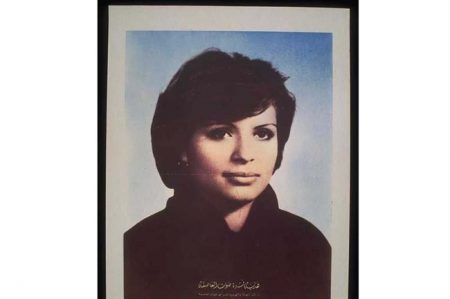
Poster of Dalal al-Mughrabi, published by Al-Asifah in 1978 (Source: The Palestine Poster Project Archives)
Ma’an – May 30, 2017
BETHLEHEM – Days after Norway pulled its sponsorship from an occupied West Bank women’s community center and demanded a refund for construction costs from the Palestinian Authority (PA), with the United Nations (UN) promptly pulling its backing as well, the center has reportedly said it will not change its name, which the UN said “glorifies terrorism.”
The Dalal al-Mughrabi Women’s Community Center — named after a fighter in the Palestine Liberation Organization (PLO) who played a role in a 1978 attack that left over 30 Israelis and 12 Palestinian fighters dead, including al-Mughrabi herself — was built in the Nablus-area village of Burqa in the northern West Bank.
The center was sponsored by both the UN and the Norwegian government, who provided partial financial support for the construction of the center, which had remained nameless until it was officially inaugurated earlier this month.
Official PA-owned Wafa news agency reported Tuesday that the head of the Burqa village council, Sami Daghlas, said “the center has no intention of caving in to the pressure and changing its name.”
Daghlas told Wafa that the center was built “to serve and empower young women in the village and to help them develop to become active members in society.”
According to Daghlas, the name Dalal al-Mughrabi was chosen by the villagers “to commemorate a Palestinian hero who sacrificed herself for her country and therefore they have no intention to change its name, regardless of the price.”
“Instead of fighting a community center that does not exceed 50 square meters in area and works on serving young women in the community, they should be objecting to regular attacks by (Israeli) settlers against the village and its people and to allow farmers to reach their land that was taken away from them,” Daghlas said, as he expressed his surprise at the actions of the UN and Norway, which he said were done “to satisfy Israel.”
The Times of Israel reported last week that the Norwegian Foreign Minister had condemned the PA for the name choice of the center, saying “Norway will not allow itself to be associated with institutions that take the names of terrorists in this way,” and demanded that the PA reimburse Norway for the costs contributed to the center.
In his interview with Wafa, Daghlas said that the people of Burqa did not object to returning the money to Norway, which he said “was only few thousand dollars used to repair and refurbish the building, and would never capitulate to pressure and blackmail.”
One day after Norway’s move to pull funding from the center, the UN pulled its sponsorship from the center, which it called “offensive.”
“The United Nations disassociated itself from the Center once it learned the offensive name chosen for it and will take measures to ensure that such incidents do not take place in the future,” the Times of Israel said, quoting a statement from Stephane Dujarric, spokesman for UN Secretary-General Antonio Guterres.
“The glorification of terrorism, or the perpetrators of heinous terrorist acts, is unacceptable under any circumstances,” the UN statement said, adding that the UN had requested that the logo of UN Women be removed from the building.
According to Wafa, Daghlas said that the UN was responsible for funding some projects put on by the center.
Wafa also quoted Ahmad Majdalani, member of the Executive Committee of the PLO, as saying that “Israel glorifies Jewish terrorists and pays them money and no one objects to that,” referencing the assassin of Israeli Prime Minister Yitzhak Rabin and other Jewish extremists convicted of attacking and killing Palestinians and Israelis, who Majdalani said still receive Israeli government stipends through the national insurance plan.
Trump’s visit to Israel: How Palestine disappeared from US media coverage
By Ramzy Baroud | MEMO | May 28, 2017
As if he has, overnight, been transformed into a master politician, Donald Trump’s 27-hour trip to Israel has left many analysts mystified.
Quoting former Israeli political adviser, Mitchell Barack, the New York Times referred to Trump as the “Liberace of world leaders”, in reference to flamboyant, piano player, Wladziu Valantino Liberace. The latter, known as “Mr. Showmanship”, was, at times, the highest paid entertainer in the world and his successful career lasted over four decades.
New York Magazine Online quoted former US ambassador to Israel, Dan Shapiro, too, trying to decipher the supposedly complicated persona of Trump.
“Either Trump’s visit was substance-free – or he ‘is being uncharacteristically subtle’ in planting the seeds for new round of peace negotiations,” NYmag quoted and paraphrased Shapiro’s tweets.
“Liberal” US media, which has stooped to many lows in its attacks on Trump – including his family, his mannerism, his choice of words, even mere body language – became much more sober and quite respectful in the way they attempted to analyze his short trip to Israel, and the very brief detour to Bethlehem, where he met with Palestinian Authority leader, Mahmoud Abbas.
“Mr. Trump’s speech at the Israeli Museum was so friendly and considerate of Israeli emotions,” reported the New Your Times, “that one right-wing Israeli legislator described it as deeply expressive of the ‘Zionist narrative’.”
Palestinian emotions, however, were of no consequence, neither to the Trump entourage, nor, of course, to the New York Times or others in mainstream media.
The Washington Post, on the other hand, still found faults, but, certainly not because of Trump’s lack of balance and his failure to deride the Israeli occupation and Israel’s mistreatment of Palestinians.
Despite the fact that Trump has, indeed, fully embraced a “Zionist narrative”, and a rightwing version of it (for example, he made no reference to a Palestinian state), he still fell short. His performance at Israel’s national Holocaust Memorial (Yad Vashem) did not impress.
Max Bearak wrote in the Post : “Trump’s entry in the guest book at Israel’s National Holocaust Memorial was strangely upbeat, self-referential and written in his signature all caps: ‘IT IS A GREAT HONOR TO BE HERE WITH ALL OF MY FRIENDS — SO AMAZING & WILL NEVER FORGET!’”
Bearak found such choice of words and the style in which it was written sort of offensive, especially if compared with the supposed thoughtfulness of former President Barack Obama.
In contrast, Obama wrote a significantly longer note, which partly read: “At a time of great peril and promise, war and strife, we are blessed to have such a powerful reminder of man’s potential for great evil, but also our capacity to rise up from tragedy and remake our world.”
Neither then, nor now, did the Washington Post bother to examine the historical context in which this particular sentence was written and find the hypocrisy of the whole endeavour.
If they bothered to ask Palestinians, they would have found a whole different interpretation of Obama’s words.
Indeed, wherever occupied Palestinians look, they find “man’s potential for great evil”: a 400-mile Israeli Wall being mostly built over their land; hundreds of military checkpoints dotting their landscape; a suffocating military occupation, controlling every aspect of their lives. They see the holiest of their cities, Bethlehem and Al-Quds – occupied East Jerusalem – subdued by a massive military force; thousands of their leaders thrown into prison, many without charge or trial. They see siege; an endless war; daily deaths and senseless destruction.
But since none of this matters to the “Zionist narrative”, it subsequently matters so very little to mainstream American media, as well.
Trump’s trip to Israel, however short, was, indeed, a master stroke by the ever-unpredictable Liberace of world politics, although, it takes no particular genius to figure out why.
From an American mainstream media perspective, to be judged “presidential” enough, all US presidents would have to commit to three main policies. They are, in no particular order: privileging the economic business elites, war at will and unconditionally supporting Israel.
So far, US media, which has been otherwise polarized based on political allegiances, has taken a break from its raging conflict over Trump’s presidency, and rallied behind him on two separate occasions: when he randomly bombed Syria and during his visit to Israel.
Ironically, the man has been often judged for lacking substance on numerous occasions in the past. In fact, his trip to Israel was the most lacking and most divisive. However, the fact that he, time and again, reiterated Israeli priorities was all that the media needed to give the man a chance. Their collective verdict seems to rebrand his lack of substance as his unique “subtle” way of making politics.
Israeli media, which is often more critical of the Israeli government than US media ever dare, needed to keep up with its “democratic” tradition. But Trump’s groveling also gave them little room for criticism. The often-impulsive Trump, this time stuck to the script and followed his repeatedly rehearsed speech and media comments to the letter.
But Josefin Dolsten insisted on finding a way to nitpick, composing for the Times of Israel the “7 awkward moments from Trump’s Israel trip.”
One of these awkward moments, Dolsten wrote was “a White House statement listing Trump’s goals for the trip included a hilarious (and juicy!) typo: ‘Promote the possibility of lasting peach’ between Israel and the Palestinians. Yes, we get it — it meant to say peace, but who’s to say the two sides can’t bond over some delicious fruit?”
For Palestinians, it must not be easy to find the humour in these tough times. Hundreds of their prisoners, including their most popular leader, Marwan Barghouthi, were enduring a prolonged and life-threatening hunger strike in which they were making the most basic demands for better treatment, longer visitation hours with their families and ending of arbitrary detentions.
More telling, on the day Trump, along with rightwing Israeli Prime Minister Benjamin Netanyahu, lectured Palestinians on peace, a 17-year-old Tuqua Hammad was shot for allegedly throwing stones at Israeli military vehicles at the entrance of her village of Silwad, near Ramallah.
Tuqua “was shot in the lower extremities and Israeli troops prevented a Palestinian ambulance from accessing the victim to treat her,” Ma’an news agency reported.
Merely a few miles away, Trump was writing his remarks after visiting Israel’s Holocaust Museum. Regrettably, he failed to meet the expectations of the Washington Post, for unlike Obama, he was not poignant enough in his language and style.
The irony of the whole story is inescapable; but American media cannot see this, for it, too, seems to follow a script, in which Palestinian rights, dignity and freedom are hardly ever mentioned.
Israeli authorities move forward plan for new illegal West Bank settlement
Ma’an – May 29, 2017
BETHLEHEM – Israeli authorities have greenlit the construction of a new illegal settlement on occupied Palestinian lands, Israeli media reported on Sunday, advancing plans for the first settlement to officially be created by the Israeli government in decades as compensation for residents of the illegal settlement outpost of Amona.
According to news outlet Ynet, the Israeli Civil Administration approved jurisdiction for an area designated for the construction of a new settlement promised by Israeli Prime Minister Benjamin Netanyahu to Amona settlers, after their outpost was evacuated by Israeli authorities in February due to it being built illegally on private Palestinian lands.
However, the settlement, which will be located in the central occupied West Bank and has been referred to as both Amichai and Emek Shilo, still requires the approval of Israel’s military central command before construction can proceed, Ynet reported, adding that the next step of would then be the establishment of a full construction plan.
There are some 196 government recognized Israeli settlements scattered across the Palestinian territory, all considered illegal under international law. While Israeli outposts are considered illegal even under Israeli domestic law, earlier this year, Israel passed the outpost Regularization law, which would pave the way for the retroactive legalization of dozens of Israeli settler outposts.
While the Israeli government has carried out demolitions of Israeli outposts in the past, most notably the demolition of Amona earlier this year, it has at the same time fast-tracked the expansion of official Israeli settlements throughout the Palestinian territory.
“It is still too early to be happy.” Ynet quoted Amona leader Avichai Boaron as saying on Sunday. “Only a GOC Central Command injunction for the establishment of a temporary residential site can take us out of our desperation.”
Boaron added that Amona settlers had still not heard back from the army central command weeks after having requested approval for the settlement construction plan.
Boaron threatened Netanyahu if he did not uphold his promise to the settlers. “If he does not do so, we will have no choice but to unilaterally uphold the agreement and go up to the land on our own,” the Times of Israel quoted him as saying.
Palestine Liberation Organization Executive Committee member Hanan Ashrawi slammed the Israeli plan for the new settlement in March, saying that it “once again proves that Israel is more committed to appeasing its illegal settler population than to abiding by the requirements for stability and a just peace.”
Peace Now meanwhile accused the Israeli government in April of attempting to “fool the international community” by developing a policy of restraint around Israeli settlement construction in name only, while actually contributing to the unfettered expansion of illegal settlements, which has been consistently condemned and deemed illegal by the international community.
Between 500,000 and 600,000 Israelis live in Jewish-only settlements across occupied East Jerusalem and the West Bank in violation of international law, with recent announcements of settlement expansion provoking condemnation from the international community.
Israeli human rights group B’Tselem argued in a report in December that settlers acted as “envoys” of Israel in pushing land grabs in the occupied Palestinian territory, allowing the government to officially detach themselves from the settlers’ violent and illegal actions, while avoiding or blocking any legal penalties that could be imposed on the settlers, except in the most extreme of cases.
“The state helps settlers operate as a mechanism for dispossession in Palestinian space — settlers serving as a means purportedly not under state control, and settlers also use serious violence against Palestinian residents,” the group explained.
Many have linked the increase in Israeli settlement expansion plans in 2017 to the election of US President Donald Trump, who is widely seen as a stalwart ally of the Israeli government, despite Israeli authorities reported postponing decisions regarding settlements to after Trump’s visit to Israel on Monday, the Times of Israel said.
Israel’s economy heading for disaster, experts warn
RT | May 29, 2017
A report released by the Taub Center for Social Policy Studies in Israel shows the country has the highest poverty rates among OECD countries and faces “worrisome trends” that could have disastrous effects on its growing population.
According to the Picture of the Nation 2017 report, with Israel’s aging population and rising costs across the board, its “current sources of economic growth are not sustainable.”
The country ranks 22nd out of 34 of the OECD (The Organisation for Economic Co-operation and Development) regarding GDP and takes the 24th spot within the market income poverty rate. Among developed countries, Israel has the highest percentage of its population living below the poverty line.
“The past year has seen a decline in unemployment and a large rise in GDP,” but “unfortunately, it appears that this positive trend will not continue and new sources of growth must be found,” said the report.
The Taub Center also described Israel’s four percent GDP growth as an “outlier and not a trend.”
A separate report which was released earlier this month by the Shoresh Institution for Socioeconomic Research looked at economic trends over the entire 69-year history of the country. It concluded the economy shows deep-seated and long-term shortcomings that threaten to weaken the army and constitute an “existential threat” to the country’s future.
In terms of GDP, Israel has been falling further and further behind the G7 average since the mid-1970s, with a more than threefold increase having developed in the gap between them. This, according to the report, “reflects steadily widening disparity between what an employed person living in Israel can attain and what that person could attain in the countries that are pulling away from Israel.”
Professor Dan Ben-David, founder and chair of the Shoresh Institution and co-author of the report, has warned if Israel’s Prime Minister Benjamin Netanyahu “continues to ignore the future” the country could be facing a catastrophe of massive proportions.
Netanyahu has recently held some meetings with Israeli media outlets, claiming the reports do not reflect “what the public feels.”
“It is an industry of despair. Where they see unemployment, I see full employment. Where they see an economy in ruin, I see a flourishing economy. Where they see traffic jams, I see junctions, trains, and bridges. Where they see a crumbling state nearing collapse, I see Israel as a rising global power,” he was cited as saying by the Times of Israel.
Britain’s Labour Party will ‘immediately’ recognize Palestine if elected in June
Ma’an – May 27, 2017
BETHLEHEM – Britain’s Labour party announced in its 2017 elections manifesto that if elected in June, the party would immediately recognize the state of Palestine.
The manifesto stated that the party was committed to a two-state solution to solve the decades-long Israeli-Palestinian conflict, adding that “there can be no military solution to this conflict” and that both Israel and Palestine must “avoid taking action that would make peace harder to achieve,” referencing the need to end the decade-long Israeli siege, the half-century Israeli occupation of the West Bank, and Israel’s continued settlement expansions.
It added that Hamas, the de facto leaders in the besieged Gaza Strip, must also end rocket and “terror attacks,” in order for leaders to enter “meaningful negotiations” and develop a “diplomatic resolution.”
“A Labour government will immediately recognize the state of Palestine,” the manifesto added.
Earlier this month, the United Kingdom’s House of Lords released a statement that strongly criticized the British government’s “very degrading, dismissive attitude” towards international efforts to solve the Israeli-Palestinian conflict, and suggested that it take a stronger stance to advance a two-state solution, including recognizing a state of Palestine.
Slamming US President Donald Trump’s policy-making as “mercurial and unpredictable,” the report called for a more engaged British political stance in the Middle East, including vis-a-vis Israel and Palestine.
Calling the peace process “bogged down, static, and paralyzed for some years now,” the report denounced Trump’s ambivalent stance on the conflict, as the American head of state said in February that he could “live with either” a one- or two-state solution, in a significant departure from the US’ publicly held position in favor of a two-state solution to the conflict.
The report also denounced Trump’s campaign promise to move the US embassy in Israel from Tel Aviv to Jerusalem as “inflammatory,” and his appointment of settlement supporter David Friedman as ambassador to Israel as likely to raise tensions.
The report was also critical of the international community’s reaction to Israeli violations of international law, saying that Israel was “treated with kid gloves.”
It reiterated the UK’s position in support of a two-state solution, calling it “the only way to achieve an enduring peace that meets Israeli security needs and Palestinian aspirations for statehood and sovereignty.”
However, it warned that the current context made it increasingly likely that a two-state solution “becomes an impossibility and is considered no longer viable by either side,” and called for the Israeli-Palestinian conflict to remain a priority in British foreign policy.
“The government should give serious consideration to now recognizing Palestine as a state, as the best way to show its determined attachment to the two-state solution,” the report read.
While members of the international community have rested the solution to the Israeli-Palestinian conflict on the discontinuation of illegal Israeli settlements and the establishment of a two-state solution, a growing number of Palestinian activists have criticized the two-state solution as unsustainable and unlikely to bring durable peace given the existing political context, proposing instead a binational state with equal rights for Israelis and Palestinians.
After 40 days, Palestinians suspend mass hunger strike in Israeli prisons

Ma’an – May 27, 2017
BETHLEHEM – Hundreds of Palestinians held in Israeli prisons have suspended a 40-day mass hunger strike during dawn hours on Saturday, after reaching an agreement with the Israel Prison Service (IPS) that reinstated the prisoners’ family visitation sessions to two times per month.
Palestinian leaders have applauded the prisoners’ “victory,” saying that the agreement represents an “important step towards full respect of the rights of Palestinian prisoners.”
Head of the Palestinian Committee of Prisoners’ Affairs Issa Qaraqe and head of the Palestinian Prisoner’s Society (PPS) Qaddura Fares said in a joint statement that the prisoners suspended the “Freedom and Dignity,” following more than 20 hours of negotiations between IPS and Marwan Barghouthi — the imprisoned Fatah leader who has been the primary leader of the mass strike, and other prison leaders in Ashkelon prison.
The statement added that IPS officials announced the end of the strike after negotiating with Barghouthi, who IPS had consistently refused to speak with throughout the strike’s duration, as hunger strikers had meanwhile refused to enter negotiations without the presence of Barghouthi.
The joint statement did not mention which of the hunger strikers’ demands were actually met by Israeli prison authorities.
An IPS spokesperson told Ma’an that the agreement was forged between the Israeli state, the International Committee of the Red Cross (ICRC), and the Palestinian Authority (PA), granting prisoners a second monthly family visit to be funded by the PA .
The move effectively reinstated the number of family visits that were traditionally provided to Palestinian prisoners, before the ICRC reduced the number of visit they facilitated last year from two to one visit a month, sparking protests across the Palestinian territory.
The IPS spokesperson confirmed that Barghouthi was part of the agreements, but said that IPS was not considering the talks “negotiations,” as they only reinstated a previous policy and did not provide any new concessions to the prisoners.
The IPS spokesperson told Ma’an that some 834 prisoners who had remained on strike to the 40th day had ended their hunger strikes, and the 18 prisoners who remained hospitalized would be returned to Israeli prison following the improvement of their health conditions.
The spokesperson declined to comment on whether any of the other demands were met, which also included the right to pursue higher education, appropriate medical care and treatment, and an end to solitary confinement and administrative detention — imprisonment without charge or trial — among other demands for basic rights.
The agreements came on the first day of the Muslim holy month of Ramadan, when some hunger strikers had vowed to fast and forgo the salt and water mixture being consumed by the prisoners from dawn until sunset — the only source of nutrients the hunger strikers were consuming.
Scores of Palestinian prisoners were transferred to Israeli hospitals during the hunger strike, with reports emerging that prisoners were puking blood and fainting. Palestinian leaders had feared possible deaths among the hunger strikers if their demands were not met.
Xavier Abu Eid, a spokesperson for the Palestine Liberation Organization (PLO), released a statement on Saturday, saying that the hunger strike had “prevailed.”
“This is an important step towards full respect of the rights of Palestinian prisoners under international law. It is also an indication of the reality of the Israeli occupation which has left no option to Palestinian prisoners but to starve themselves to achieve basic rights they are entitled to under international law,” the statement read.
As the statement pointed out, the hunger strike was one of the longest strikes in Palestinian history and included a wide participation of Palestinian prisoners from across political factions.
Israeli forces had attempted to break the hunger strike through various punitive measures, including punishing hunger strikers with the use of solitary confinement, “inciting” against the hunger strikers and their leaders, most notably Barghouthi, and threatening to force feed the hunger strikers, the statement highlighted.
“The epic resilience and determination of the hunger strikers and their refusal to end their hunger strike despite the repression and very harsh conditions they endured allowed for their will to prevail over the will of the jailer.”
The statement also went on to thank all those who stood in solidarity with the Palestinian prisoners, particularly former political prisoners in South Africa, Ireland, and Argentina.
“The Palestinian people are a nation held captive, and the Palestinian prisoners are the reflection of this painful reality,” the statement read.
Spokesperson for the PA Youssef al-Mahmoud also congratulated the hunger strikers on “achieving their demands.”
“Our heroic prisoners achieved a new victory in their legenday resistance,” he said, adding that the government would continue its efforts to “guarentee that all Palestinian prisoners are freed without exceptions or conditions.”
He also called for the ending of political divisions in Palestine and to work on regaining national unity to support Palestinians who are facing challenges.
Meanwhile, member of Fatah’s central committee Jamal Muheisin and Qaraqe held a press conference at Yasser Arafat square in Ramallah to announce the “victory” of the hunger strike.
The national committee formed to support the hunger strike also released a statement saying that the hunger strikers had achieved a “legendary triumph forcing the occupation government to negotiate with the leaders of the hunger strike and Marwan Barghouthi after having refused to negotiate for 40 days.”
The statement highlighted that the “epic hunger strike” brought back unity between Palestinians in Israeli prisons and revived the spirit of national solidarity, which has succeeded in “thwarting the occupation’s plots”.
The statement added that more information regarding the details of the agreement between IPS officials and the hunger strikers would be released later on Saturday.
Palestinians imprisoned by Israel have underwent numerous hunger strikes since the Israeli army occupied the West Bank, including East Jerusalem, and Gaza in 1967, with several hunger strikers being killed during strikes owing to Israeli policies of force-feeding the prisoners.
Their demands have ranged from insisting on better quality prison food to ending torture in Israeli prisons.
According to prisoners’ rights group Addameer, 6,300 Palestinians were held in Israeli prisons as of April, most of whom are being held inside the Israeli territory in contravention to international law which forbids holding Palestinians from the West Bank and Gaza outside the occupied territory.
While Israeli authorities label Palestinians as “security prisoners,” activists and rights groups have long considered Palestinians held in Israeli custody as political prisoners, and have routinely condemned Israel’s use of prison as a means of dismembering Palestinian political and social life in the occupied territory.
Addameer has reported that 40 percent of the male Palestinian population has been detained by Israeli authorities at some point in their lives.
Why would NDP foreign affairs critic legitimize Israeli racism?
By Yves Engler · May 26, 2017
Should a social democratic party’s spokesperson on foreign affairs address the Israel lobby’s top annual event and legitimize an explicitly racist institution? These are questions those currently vying for leadership of Canada’s New Democratic Party must be pressed to answer.
According to the Canadian Parliament’s recently released disclosure of members’ sponsored travel, the American Israel Public Affairs Committee (AIPAC) paid for the New Democratic Party’s foreign affairs spokesperson Hélène Laverdière to speak on a panel at its conference last year.
The notorious anti-Palestinian lobby group spent more than $740 on her flight and accommodation in Washington, DC.
Months after her AIPAC speech, Laverdière participated in a Jewish National Fund tree-planting ceremony in Jerusalem. During a visit to Israel with Canada’s governor general, Laverdière attended a ceremony with the fund’s world chairman Danny Atar and a number of other top officials.
The Jewish National Fund controls 13 percent of Israel’s land, which was mostly seized from Palestinians forced from their homes by Zionist militias during the 1947-1948 ethnic cleansing known to Palestinians as the Nakba, Arabic for catastrophe.
The JNF systematically discriminates against Palestinian citizens of Israel, who make up a fifth of the population. According to a UN report, Jewish National Fund lands are “chartered to benefit Jews exclusively,” which has led to an “institutionalized form of discrimination.”
Echoing the UN, a 2012 US State Department report detailing “institutional and societal discrimination” in Israel says the Jewish National Fund “statutes prohibit sale or lease of land to non-Jews.”
If Laverdière doesn’t trust the State Department or the UN’s assessments she could just read the Jewish National Fund’s own website.
Responding to Palestinian citizens’ attempts via the Israeli high court to live on land controlled by the Jewish National Fund, the website explicitly denies their right to do so, despite being supposedly equal Israeli citizens.
The court “has been required to consider petitions that delegitimize the Jewish People’s continued ownership” of the land. The website states that these lawsuits were “directed against the fundamental principles” on which the Jewish National Fund was founded.
The petitions to the court amount to a demand that the JNF, “which serves as trustee for the lands of the Jewish People,” no longer have the “right to make use of these lands for the continuation of the Zionist enterprise in the Land of Israel.”
It adds that over 80 percent of Israeli Jews “prefer the definition of Israel as a Jewish state, rather than as the state of all its citizens.”
It is a moral outrage that the New Democratic Party foreign affairs spokesperson would legitimize an organization that practices discriminatory land-use policies outlawed in Canada six decades ago.
Laverdière legitimizing the Jewish National Fund and AIPAC reflects the backroom politics that dominate the New Democratic Party. In fact, the issue of Palestinian rights goes to the very heart of democracy within the party.
During the 2015 general election, the New Democratic Party ousted several individuals from running or contesting nominations for parliament because they had defended Palestinian rights on social media.
In the most high profile incident, Morgan Wheeldon was dismissed as a party candidate in Nova Scotia because he accused Israel of committing war crimes during its summer 2014 invasion of Gaza.
More than 2,200 Palestinians, including 551 children, were killed during the Israeli attack.
Leadership candidates must commit to respecting local party democracy and ending the purge against those who defend Palestinian rights. Standing up for Palestinian rights also represents popular will.
A February poll confirms that New Democratic Party members – and most Canadians – are critical of Israel and open to the Palestinian civil society call for boycott, divestment and sanctions (BDS) on that country.
According to the poll of 1,000 Canadians, almost 80 percent of those who expressed an opinion said they believe the Palestinians’ call for a boycott is “reasonable.”
In the context of the recent UN Security Council denunciation of settlement building in the West Bank, respondents were also asked “do you believe that some sort of Canadian government sanctions on Israel would be reasonable?”
Eighty-four percent of New Democratic Party supporters responded they were open to sanctioning Israel.
Leadership contenders must be pressed to make their position on Palestinian rights reflect members’ views. A 16 May Facebook post by leading candidate Niki Ashton is an important step.
“For more than 60 years, Palestine has been struggling to simply exist,” Ashton wrote. She added that she was “honored to stand with many in remembering the Nakba” at a recent event in Montreal that was also “a rally in solidarity with those on hunger strike in Palestine today.”
Ashton added: “The NDP must be a voice for human rights, for peace and justice in the Middle East. I am inspired by all those who in our country are part of this struggle for justice.”
In response to criticism from Israel lobby groups and Conservative Party leadership contender Brad Trost, Ashton stood by her participation in the rally.
“One must speak out in the face of injustice, whether here at home or abroad,” she said, and called for Canada to support “a balanced position and a just peace in the Middle East.”
While Ashton’s move is an important step, grassroots activists shouldn’t be naïve about the array of forces, both within and outside the party, that prefer the status quo. Asking nicely will not spark much-needed change.
Before a “youth issues” leadership debate in Montreal in March, the Young New Democrats of Québec asked the party leadership to include a question about Palestine. They refused.
At the upcoming leadership debates Palestine solidarity activists within the party should press the issue.
Contenders need to answer if they believe it is okay for the New Democratic Party foreign affairs spokesperson to speak at AIPAC or legitimize an explicitly racist institution like the Jewish National Fund.
US boosting Israeli military aid by millions: Netanyahu
Press TV – May 24, 2017
Israeli Prime Minister Benjamin Netanyahu says the US has increased its military aid to Tel Aviv by tens of millions of dollars.
“Three days ago, the US added another $75 million to the aid package,” Netanyahu said on Wednesday, without giving a time frame for the money’s arrival.
The announcement comes just days after Netanyahu personally greeted US President Donald Trump on his first visit to Israel.
Trump had arrived from Saudi Arabia where he signed a massive $110 billion arms deal with Riyadh.
Based on a September 2016 agreement, the US will be bankrolling Israel’s military spending to the tune of around $38 billion dollars effective from 2019 for the next 10 years.
Under the deal, Israel will be allowed to upgrade most of its fighter aircraft, improve its ground forces’ mobility and strengthen its missile systems.
Washington has also been providing Israel with $3.1 billion annually since a 2007 agreement with the administration of former President George W. Bush.
In April, Washington approved a proposal to sell Israel more weapons, including naval guns and technical support worth an estimated $440 million.
Featured Video

Houthis Don’t Have to Conquer Saudi Arabia to Make It Pay
or go to
Aletho News Archives – Video-Images
From the Archives
Newly Released FBI Docs Shed Light on Apparent Mossad Foreknowledge of 9/11 Attacks
By Whitney Webb | MintPress News | May 17, 2019
NEW YORK — For nearly two decades, one of the most overlooked and little known arrests made in the aftermath of the September 11 attacks was that of the so-called “High Fivers,” or the “Dancing Israelis.” However, new information released by the FBI on May 7 has brought fresh scrutiny to the possibility that the “Dancing Israelis,” at least two of whom were known Mossad operatives, had prior knowledge of the attacks on the World Trade Center. … continue
Blog Roll
 Aletho News
- UK whines about losing billions to ‘Putin tax’
- Baghaei to Rubio: Distorted narratives cannot erase US record of broken commitments
- Houthis Don’t Have to Conquer Saudi Arabia to Make It Pay
- MOE: Nearly 22,000 Students and Education Workers Killed
- Guterres in Islamabad: Genocide, cowardice, and the cage of Imran Khan
- Johnson, Marandi say Yemen holds upper hand over Saudi Arabia
- False flags won’t save aggressors, Iran FM spokesman says
- The Makkah Pact Enters Into Force: The End of American Dominance or Its New Form?
- NATO’s top generals gather in Kiev
- EU’s continuing expansion – greater threat to Russia
- If Americans Knew
- Three years of death and devastation: Israel’s war on Gaza in pictures
- Why Hamas believed the status quo was more dangerous than its 7 October gamble
- Debunking Israel’s latest list of ‘terrorist’ journalists in Gaza
- In Gaza, focus is on survival, “every step is a struggle” – Daily Update
- Three Years of Genocide: How America’s Israel-First Media Filtered Out the Truth
- Israeli war chief briefs ministers on potential war against Palestinian Authority
- New Report: Israel Killed nearly 21,000 Palestinian Students and Education Workers in Past Three Years
- Israel’s flailing chatbot army
- Five Palestinians Killed, Others Injured by Israeli Fire in Gaza
- Israel is rewriting the Palestinian curriculum in East Jerusalem to erase Palestinian identity
- No Tricks Zone
- New Study: 50 Years Of The Most Aggressive ‘Net Zero’ Policies Can Only Affect The Global Climate By 0.03°C
- US September “Heat” Was No Record…Many Records Set Decades Ago
- Latest European Green Energy Debacle; Portugal’s Largest Flagship Solar Park Insolvent!
- Green Energy Debacle: German Expert Professor Fritz Vahrenholt Warns Of Severe Economic And Social Consequences
- Two More Paleo Reconstructions Affirm Meters-Higher Sea Levels Across Ireland, Brazil 7000-6000 Years Ago
- New Study: Earth And Venus Surface Warmth Largely Explained By Convection And Lapse Rate, Not CO2 Or Radiation
- 2025 Nature Paper Claiming Worsening Global Drought Gets RETRACTED …Heavily Flawed
- New Study: ‘Global Drought Shows No Detectable Recent Acceleration Under Climate Warming’
- Economic Masterminds: German Socialists Suggest Taxing Productivity Gains Stemming From Using AI
- The South China Sea Has Not Been Cooperating With The Climate Change Narrative

