Banksy hotel opens in Bethlehem, eliciting heated reactions by Palestinians

“This picture belittles the sacrifice that thousands of Palestinians have made throughout the years,” according to Ramzy Baroud. (Photo: Walled Off Hotel)
By Jaclynn Ashly and Reem Alqam | Ma’an | March 11, 2017
BETHLEHEM – Israel’s infamous separation wall in the occupied West Bank, while cutting off Palestinians from their lands and religious sites, isolating communities, and eroding the livelihood of scores of Palestinians along its route, has become an unlikely breeding ground for tourism.
Adjacent to the graffiti-stained separation wall in the city of Bethlehem, which is surrounded by illegal Israeli settlements, and next door to the Aida refugee camp, elusive UK artist Banksy now welcomes guests to his latest project: the Walled Off Hotel.
The wall’s destruction of livelihoods
In a message written in Arabic, English, and Hebrew, a plaque posted at the entrance to the hotel-cum-art museum tells its guests not to “choose sides” in the conflict. In describing the separation barrier, deemed illegal by International Court of Justice, the statement says: “The wall is a lie. It sells the idea that there is a simple divide between the people here, but there isn’t.”
But according to Palestinian-American journalist and author Ramzy Baroud, Bethlehem’s isolation from Jerusalem through Israel’s separation wall and two massive illegal settlements — with a third on its way — is far from “a lie,” has taken a tangible toll on the city’s economy, which once boasted a thriving tourism industry thanks to its many historical and religious sites.
“This tragic reality left Bethlehem, one of the most endeared Palestinian cities, struggling for survival, and reduced it in many instances to utilize its very subjugation as a method of generating income,” Baroud told Ma’an.
Banksy’s hotel is not the first project that has attempted to develop an alternative tourism industry seeking to raise awareness about Palestinian dispossession and routine Israeli military violence.
Following the wall’s construction in the area, the livelihoods of numerous Palestinians were destroyed, forcing some to develop alternative livelihoods dependent on funds generated around foreign tourists coming to the area to view Israel’s separation wall.
Diana Buttu, a Palestinian-Canadian lawyer and former spokesperson for the Palestine Liberation Organization (PLO), emphasized to Ma’an that local Palestinians’ dependency on tourism centered around the wall was not just about financial profit.
“For some Palestinians, foreigners coming to see the wall is essential for their ability to stay alive. If they don’t get people to recognize what is going on in Palestine, then their deaths become just numbers,” she said.
“The idea of showing others the wall is a way of ensuring that their oppression and resistance is not experienced in silence.”
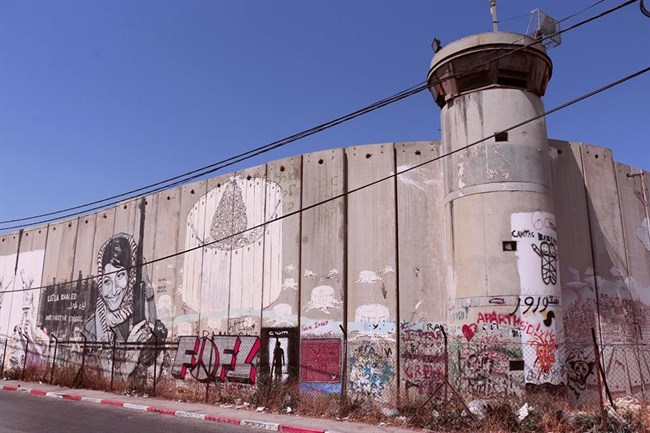
The separation wall in Bethlehem with a mural of Popular Front for the Liberation of Palestine (PFLP) leader Leila Khalid (MaanImages/Jaclynn Ashly)
These days, the few shops open in the area near the wall in Bethlehem cater to international tourists visiting the site to take pictures of graffiti and the impressive murals decorating the concrete. Banksy’s artwork in the area has become a centerpiece for such tourism.
Yamin al-Abed, a local tour guide and owner of the Banksy souvenir shop right beside the new hotel, told Ma’an that he expected Banksy’s hotel to triple the amount of visitors to Bethlehem. “This area is going to be crowded soon,” he said. “I am really looking forward to it.”
Banky’s artwork has “brought life back into a dead area,” al-Abed said, by developing a business around the now-iconic stencil work Banksy painted on the wall more than 10 years ago.
However, the hotel’s elusiveness on its planned financial model — as its website only states that it would “put any profits back into local projects” while remaining vague which specific projects would be concerned — has led observers to question whether or not the new business will positively benefit to the community.
A local worker at a nearby hotel, who preferred to remain unnamed, expressed his confusion over the hotel’s opening to Ma’an. “It is strange that this hotel was constructed in an area where commercial shops and hotels have been killed by the wall’s construction,” he said, adding that his own hotel had faced serious financial setbacks since the wall was built.
‘It’s not meant for Palestinians’
“What Bethlehem truly needed was breaking this sad paradigm, not cementing it,” Baroud said, echoing local concerns that the livelihoods generated around the wall has served to further entrench the Israeli occupation in the West Bank by basing a local economy on its most visual and destructive feature.
Buttu said that the most worrying aspect of what she referred to as “oppression tourism” was the parts of the wall which had not been decorated with graffiti and murals.
“The vast majority of Israel’s wall is completely ignored by tourists. And these parts of the wall are actively scooping out large areas of Palestinian land.”
Tourists are typically attracted to the “visual elements” of the cement wall, she said, and often disregard parts of the wall with barbed wire and electric fences, underscoring that these areas tend to be the most devastated as locals are dependent on farming and have no other alternative livelihood.
According to Buttu, “Many people really wanted visitors to see the wall for its ugly reality, and not use art and graffiti to mask or erase the reality Palestinians were living.”
While she wanted to give Banksy “the benefit of the doubt,” she said that the hotel risked feeding into the same process that Palestinians have been attempting to challenge. “Palestinians want foreigners to actually do something for their struggle, not just come and take pictures.”
Baroud, meanwhile, commented that certain aspects of the hotel were deeply offensive to Palestinians. Referring to one painting hung in a $265-per-night suite that lightheartedly depicts an Israeli soldier having a pillow fight with a Palestinian protester, Baroud said that it was “deeply insulting” and “belittles the sacrifice that thousands of Palestinians have made throughout the years.”
For local resident Muna Hassan, the hotel reflects larger issues in occupied Palestine.
“Palestinians feel hopeless. All we have now are foreigners coming here and advocating social and political projects that don’t help us at all. Meanwhile, our economy is dependent on international aid which arrives with conditions and tells us how we should behave,” she said.
According to Hassan, this kind of tourism exists because “there’s nothing left for us to do.”
“We have a government that doesn’t represent us. Israel has destroyed all our political movements and has stolen our land. They took everything from us. We have nothing left.”
Hassan told Ma’an that Palestinians had become tired of social and political projects originating from the international community. “We need better hospitals and schools. We need businesses that help us define and change our own society. We should create spaces where young Palestinians can develop their own conceptions of art, instead of just catering to foreigners who want to draw on the wall and snap pictures of Banksy paintings.”
She noted that, for her, the hotel was “not meant for Palestinians. It’s just more entertainment for tourists.”
Israelis welcome?
One of the most controversial elements of Banksy’s new hotel is the stated aim of welcoming Israelis to the West Bank, with the hotel itself being constructed in an Israeli-controlled area of Bethlehem.
The trilingual statement posted at the hotel’s entrance claims that most Israelis are “opposed to the cruelties inflicted by the wall,” while the ones who support it “are deeply fearful for their security.”
According to the hotel’s owner Wissam Salsa, one focus of the project is to “educate Israelis on Palestinian suffering” caused by the separation wall and the Israeli occupation. “We also want to show our guests what it’s like to live on this side of the wall.”
Al-Abed said that he believed it was important for Israelis to visit the West Bank, saying that “I am sure that once they come and see our miserable lives, they will return to Israel and attempt to change their government.”
However, Buttu told Ma’an that Israel’s policies have actually received widespread support from an Israeli public that has “benefited immensely” from these policies, while feeding into Israeli desires of a “Jewish state.” According to a poll released earlier this year, 62 percent of Israelis support continuing Israel’s illegal settlement construction in Palestinian territory.
“You will not find Israelis who support going back to life pre-1993, when you didn’t have separation and Palestinians had freedom of movement into Israel. Most Israelis are happy with this separation system in place,” she said.
One visitor to the hotel, a local Palestinian student who preferred not to be named, rapidly shifted from excitement to frustration after being informed that the project was aimed at creating dialogue between Israelis and Palestinians.
“We can have dialogue once Palestinians have equal rights,” he said. “If Israelis really want to understand Palestinian suffering, they should fight for the wall’s destruction and not stay in a hotel right next to it.”
Buttu noted the futility of the initiative, saying that “we can’t just pretend that it’s easy for Palestinians and Israelis to come together, hold hands, and sing songs.”
“This is a state system of apartheid and settler-colonialism. Unless Israelis recognize this, then there is no point in having these fake gatherings and dialogues.”
Israeli Police Abduct A Palestinian Novelist From Jerusalem
IMEMC News | March 11, 2017
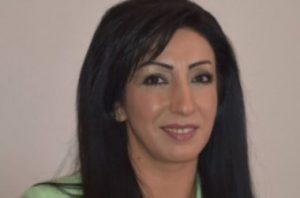 Israeli police officers abducted, on Saturday morning, a Palestinian novelist after she finished writing her latest work dubbed “The Jackal’s Trap,” talking about informants and collaborators, spying on their own people.
The Palestinian novelist, identified as Khaleda Gousha, was abducted after the police and soldiers stormed her home, in Beit Hanina neighborhood, north of occupied Jerusalem.
Khaleda’s business manager, Amani Abdul-Karim, said Khaleda was moved to an interrogation facility in Nevi Yacov illegal colony, built on illegally-confiscated Palestinian lands, owned by Beit Hanina residents.
She added that Khaleda called her colleagues from the interrogation center, and informed them that she needs a lawyer to represent her.
Khaleda said that she was officially informed that the reason behind her abduction and interrogation is her latest Novel, The Jackal’s Trap, which she intends to publish this coming October.
Illegal settlers break into kindergarten, damage property
International Solidarity Movement | March 7, 2017
Hebron, occupied Palestine – Colonial settlers from the illegal settlements in occupied al-Khalil (Hebron) have repeatedly invaded and damaged a Palestinian kindergarten located on Shuhada Street over the last two days.
On Saturday night, the colonial settlers entered the Shuhada Street kindergarten, stealing two Palestinian flags and breaking cameras installed by the Palestinian families. The kindergarten connects directly to the roof of a residential building that houses three Palestinian families, which is accessible by the settlers through this roof access. The three families are now feeling under threat.
The following day, on Sunday afternoon, settlers again entered the kindergarten, but were surprised by the presence of Palestinians on their roof. Settlers then threw stones at the Palestinian youths before leaving. They cut a hole in the fence which protects the kindergarten entrance from illegal settlers entering. The settlers had clearly planned in advance to cut the fence as they had brought the necessary tools with them.

Wire-mesh fence cut by the settlers. Photo-credit: Human Rights Defenders Group
Settlers from the illegal settlements, under the protection of the Israeli forces, enjoy almost complete impunity for their actions, while Palestinians under the Israeli military law are presumed guilty until they can prove otherwise. The Palestinians living in the H2-area under full Israeli military control have no institution they can turn to for protection or help in this case, but are at the full mercy of the Israeli forces and settlers. With settlers having entered the compound for two days in a row, and the water tanks on the roof easily accessible, the families now do not only have to fear even more for their safety in their own homes, but also about being poisoned through their drinking water supply. In the past settlers in the Tel Rumeida neighbourhood poisoned the water tank of a Palestinian family. Fortunately the poisoning was detected before anyone drank the water.
Cheerleading for Israel
Everyone’s doing it

By Philip Giraldi • Unz Review • March 7, 2017
Those of us who voted for Donald Trump in hopes that he would turn out to be the peace candidate are facing disappointment. He has increased the already bloated military budget by $54 billion and has appointed an outspokenly anti-Russian and anti-Iranian active duty general as his National Security Advisor. A retired general with pretty much the same views heads the Pentagon. President Trump meanwhile vows to “extinguish” ISIS without presenting any plan regarding how exactly that might be accomplished.
The most important objective of all, resetting with Moscow to avoid World War 3, is in reverse gear, with the appointment of Fiona Hill, a critic of Vladimir Putin, as Russian specialist at the National Security Council. Meanwhile, our clueless United Nations Ambassador calls for Russia to withdraw from Crimea, where 58% of the population is Russian and only 24% is Ukrainian. Reports circulating in Washington suggest that the one phone call between Trump and Putin was a disaster, with the U.S. president demanding an end to the New START nuclear weapons reduction treaty, which the Kremlin wants to renew, before going off on a tangential monologue about his unexpected electoral victory.
In fact, even though the individual neocons have largely been outed from the foreign and security policy positions they once dominated it would not be completely inappropriate to suggest that their legacy of military interventionism lives on in terms of what the Trump administration has been so far promoting to keep America “safe.” Where all of this will go is anyone’s guess.
But if there is one constant in all of this it is the bright shining beacon of Israel, with Trump recently enthusing over the “unbreakable” bond between the two countries. One hopes that he misspoke and really meant “unbearable” or even “unspeakable” but it is clear from other indications that The Donald has succumbed to the inevitable Washington groupthink regarding America’s greatest ally and best friend in the whole wide world.
On Sunday New York Governor Andrew Cuomo met with Israeli Prime Minister Benjamin Netanyahu to discuss “trade and security issues” without anyone complaining that he was in violation of the Logan Act, which apparently only applies if you are talking to Russians. And a congressional delegation is in Israel right now studying the feasibility of moving the U.S. Embassy to Jerusalem, which most foreign policy pundits consider to be a very bad idea. Meanwhile at the United Nations, the U.S. has blocked the appointment of former Palestinian prime minister Salam Fayyad as special representative to Libya. U.S. Ambassador Nikki Haley explained the veto, saying irrelevantly “For too long the U.N. has been unfairly biased in favor of the Palestinian Authority to the detriment of our allies in Israel. The United States does not currently recognize a Palestinian state or support the signal this appointment would send within the United Nations.”
Ambassador Haley has also denounced the international body in general terms, stating that she was “underscore[ing] the ironclad support of the United States for Israel,” adding that “I am here to emphasize that United States is determined to stand up to the U.N.’s anti-Israel bias.” And if anyone failed to understand, on March 1st, U.S. envoy to the U.N. Human Rights Council in Geneva Erin Barclay told the group that it must drop its “obsession with Israel” or risk Washington withdrawing from the organization. The suggestion that the U.S. might consider departing came, incidentally, directly from Israeli Prime Minister Benjamin Netanyahu, who proposed such action to Donald Trump to “delegitimize” the U.N. body.
It is ironic that in the midst of a media and congressional feeding frenzy on foreign interference in the U.S., the one country in the world that consistently leads Washington by the nose is immune from criticism. The subservient role dutifully played by every U.S. president since JFK when dealing with Tel Aviv has resulted in defining United States national interests in terms of Israeli perceptions. The real irony is that even though Trump is giving the Israelis everything they want and is bowing to the Israel Lobby and Jewish groups at every opportunity, it is still not enough. It is never enough. That is because the neoconservatives, who are mostly Jewish and themselves complete Israel-firsters, hate him, having overwhelmingly favored Hillary Clinton as president due to their conviction that she would be the more aggressive president. They now believe that if they succeed in forcing Trump’s resignation or impeachment they will return to power in whatever new government formulation is put in place, so they continue to pile on.
Israel’s friends characteristically either run or have the ear of the media and they are supported by a formidable Washington based lobbying machine to get their point across. Whenever anything happens in the Middle East or elsewhere that is related to Israel’s perceived interests the machine goes to work with multiple position papers presented to every congressional office the next morning by runners from AIPAC, AEI, FPI, WINEP, JINSA and FDD. No one else has the clout of the Israel Lobby.
And Trump is also being battered by Jewish interests coming from the political left. France’s greatest living poseur-hypocrite Bernard-Henri Levy, described as a “philosopher, filmmaker and activist,” has hammered Trump twice recently, first in The New York Times on January 19th. Levy, who has described the brutal Israel Defense Forces as “a democratic army, which asks itself so many moral questions” and who was a war-on-Libya cheerleader, warns that Trump is a threat to all American Jews. Why? Because even though he has showered benefits on Israel his love for the Jewish people is “insufficient.” Levy explains, “This love is precisely what is required of an American president in dealings affecting Israel.”
The reader might well be astonished by the chutzpah of Levy in demanding love on top of the $38 billion already in the pipeline and wonder even more why the New York Times would print such garbage. But the French whiz kid does not really explain his remark, instead going on to denounce the “betrayal” of Israel by President Barack Obama at the United Nations before explaining that as Trump is “deeply unpopular” it would not do for American Jews to embrace him closely even if it appears he is doing good things for Israel. And Levy provides “evidence” that Trump might not be what he seems, citing inter alia his speech before the Republican Jewish Coalition in which he said he didn’t need their money. Levy sees this as a precursor to genuine, full blooded anti-Semitism, and speculates that Trump will take revenge against Jews to show “that he is indeed smarter than they are.” Why would he do that? Because he “respects only power, money and the perquisites of the palace.”
Levy’s second foray second foray, on CNN a month later, took Trump to task for his “incredible slip” on January 27th, Holocaust Remembrance Day, when he did not single out Jewish victims of Nazi crimes and instead cited all of those exterminated by the Germans. For Levy, Jewish deaths are intrinsically more memorable and valuable than those of others and the failure to grant them special status is a “tell-tale trope of Holocaust deniers” and a “hallmark of the new anti-Semitism.”
Bernard-Henri goes on to cite more evidence of Trump’s closet anti-Semitism, including the assertion that he has failed to address the reality of “Jewish children who go to school full of fear.” While it is possible to dismiss Levy as a completely self-serving bullshit artist who badly needs a haircut and a bath, he is far from alone. Also on the left there is the renowned Professor Alan Dershowitz of Harvard University.
Dershowitz, threatening to leave the Democratic Party if it elected Keith Ellison chair of the party’s central committee, appeared frequently on television and in the print media claiming that Ellison was an enemy of Israel and of the Jewish people. The threat to leave the Democrats produced numerous jokes directed at the abrasive and unpopular lawyer somewhat akin to those crafted at the expense of the Hollywood celebrities who promised to leave the country if Donald Trump were elected president. Unfortunately, I have to note that neither Dershowitz nor Barbra Streisand has yet departed.
Ellison was the preferred candidate of the Bernie Sanders liberal wing of the party and initial opinion polls suggested that he would likely win the position. While Dershowitz’s bombast could be regarded with some amusement, there was another, darker side to the campaign to sideline Ellison, who is black, a Muslim and not openly hostile to the Palestinians. This last attribute inevitably made it possible to start a whispering campaign labeling him as anti-Semitic and a number of Jewish Democratic fundraisers, to include Israeli Haim Saban of Hillary Clinton fame, privately made it known that they would end their donations to the party if Ellison were elected. Barack Obama and the Clintons also piled on, even working the phones to stop Ellison.
When Ellison lost in a close result, Dershowitz announced that he would not be leaving the party after all because the result was a “victory in the war against bigotry, anti-Semitism, [and] the anti-Israel push of the hard left within the Democratic Party.” As evidence of Ellison’s anti-Israel sentiment Dershowitz cited the congressman’s vote against funding Iron Dome, which is the Israel missile defense system. “Can you imagine any reasonable person voting against a missile system designed to protect innocent civilians against terrorist rocket attacks?”
Indeed Dersh, but maybe the Israelis should be paying for it, not the American taxpayer, which is actually the crux of the matter. I for one am tired of the perpetual whining of Alan Dershowitz and international professional Jews like Bernard-Henri Levi, who is frequently in the U.S. doing richly rewarded speaking tours on the so-called “Synagogue circuit.” And someone should wake U.N Ambassador Nikki Haley up to the fact that her job is to take care of the American people, not Israel. Quite frankly, if these folks are so much in love with Israel they should go live there and leave the rest of us as well as the U.S. Treasury alone.
If we are heading into yet another round of Israel-centric foreign policy we will be inevitably involved in new wars, starting with Iran which has always been Netanyahu’s enemy of choice. And then there is Syria, where the Israelis would prefer a continuation of chaos, presumably carried out by Washington which can pay the bills and take the casualties. As Bernard-Henri Levy has made clear and the Talmud asserts, Jewish lives are more important than those of gentiles, so it is fit and proper that Americans should fight and die to make sure that Israel might prosper.
Israeli authorities crack down on Gundelia harvesters
Palestine Information Center – March 6, 2017
 NABLUS – Israel’s so-called “Nature Authority” detained Palestinian Akoub (Gundelia) harvesters in the northern Jordan Valley and seized their cattle on Sunday afternoon.
Local activist Aref Daraghma said the Nature Authority cracked down on the Palestinian pickers of Akoub plant in the Jordan Valley.
Daraghma added that wildfires have broken out across the mountains while bird eggs and baby animals have been burned down due to incessant Israeli military maneuvers in the area.
In addition, thousands of dunums of private land seized from Palestinian farmers in the area were handed over to Israeli settlers.
Daraghma further warned of underway attempts by the Israeli occupation authorities and settlers to expand illegal settlement projects at the expense of Palestinian farmlands.
Lieberman Says Washington Warned Tel Aviv against Annexing West Bank
Al-Manar | March 6, 2017
Israeli Defense Minister Avigdor Lieberman said on Monday that the United States has warned that annexing the West Bank would lead to an “immediate crisis” with President Donald Trump’s administration.
Lieberman sought to push back against those in Prime Minister Benjamin Netanyahu’s coalition calling for a declaration of Israeli sovereignty over all or part of the occupied territory.
He said annexation would provoke a crisis with Washington and result in steep costs for the Israeli government since it would be required to provide services to Palestinians in the West Bank.
“We have received a very clear, direct message from the United States stating that the application of Israeli law in Judea and Samaria (the West Bank) would provoke an immediate crisis with the new administration,” Lieberman, who heads the right-wing Yisrael Beitenu party, said before a parliamentary committee.
Some 2.6 million Palestinians live in the West Bank, which the Zionist authorities occupied in 1967.
The latest call for annexation came on Sunday, when lawmaker Miki Zohar from Netanyahu’s Likud party said in a television interview that “the two-state solution is dead”.
Zohar advocated a single state, but said that Palestinians in the West Bank should not be allowed to vote in Israeli parliamentary elections.
Others have made similar calls, including Education Minister Naftali Bennett who heads the religious nationalist Jewish Home party.
Bennett advocates annexing most of the West Bank, and has said he hopes support from Trump’s presidency will spell the end of the idea of a Palestinian state.
In his comments on Monday, Lieberman also laid out an economic argument against annexation, saying Israel immediately “will be required to spend 20 billion shekels ($5.4 billion, 5.1 billion euros)” on various social services.
Report: Israeli forces detained 420 Palestinians in February

Ma’an – March 4, 2017
RAMALLAH – Israeli forces detained 420 Palestinians during the month of February, including 70 minors and 22 women and girls, according to a statement released on Saturday by the Palestinian Prisoners’ Center for Studies.
The center said in its monthly report that 12 of the detentions were carried out in the besieged Gaza Strip, including five fishermen whose boats were destroyed by Israeli forces before their detention, two who were detained at the Beit Hanoun crossing, and five who were detained after Israel alleged they attempted to cross the border fence between the besieged enclave and Israel.
A journalist was also among the detainees, identified by the center as Humam Muhammad Hantash from the southern occupied West Bank district of Hebron. He was sentenced to Israel’s widely condemned policy of administrative detention — imprisonment without charge or trial based on undisclosed evidence.
The center added that 88 administrative detention orders were issued by Israeli courts in the same period, 23 of which were issued for the first time, while 65 were renewed orders. Meanwhile, 32 administrative detention orders were issued against Palestinians from Hebron.
While Israeli authorities claim the withholding of evidence during administrative detention, which allows detention for three- to six-month renewable intervals, is essential for state security concerns, rights groups have instead claimed that the policy allows Israeli authorities to hold Palestinians for an indefinite period of time without showing any evidence that could justify their detentions.
Rights groups say that Israel’s administrative detention policy has also been used as an attempt to disrupt Palestinian political and social processes, notably targeting Palestinian politicians, activists, and journalists.
According to Addameer, as of January, 6,500 Palestinians were being held in Israeli prisons, 536 of whom were being held under administrative detention.
New hotel in Bethlehem by British artist Banksy offers ‘worst view in the world’ overlooking Israeli Wall
IMEMC News – March 4, 2017
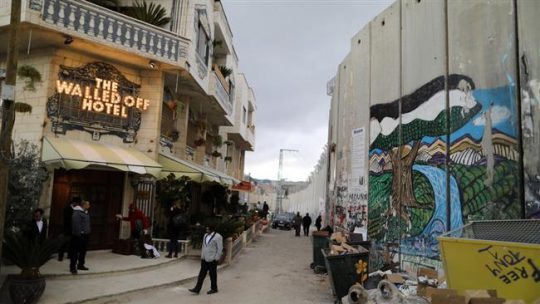
The British artist Banksy, who has painted a number of famous murals on the Israeli Annexation Wall in Bethlehem, has taken his art activism to a new level by opening a boutique hotel just next to the Wall in Bethlehem.
The building used for the “Walled Off” Hotel sits just across the street from the Israeli Annexation Wall in an area known to Palestinians and Israelis alike as ‘Rachel’s Tomb’, in the northern part of the city of Bethlehem.
Bethlehem is known to Christians worldwide as the birthplace of Jesus, but the city has suffered tremendously over the past fifteen years as the Israeli occupation authorities have imposed a stranglehold on their local economy.
Through the construction of the Annexation Wall, which began in 2003, the economy of Bethlehem, largely dependent on tourists and religious pilgrims, has plummeted.
Banksy’s new hotel is an attempt, according to the artist and hotel staff, to both support the local economy of Bethlehem while bringing international attention to the plight of the Palestinians in the city, who live walled off from the world in what they have termed a ‘ghetto’ due to the Israeli Annexation Wall.
The hotel features art that symbolizes the Israeli Occupation of Palestine, including paintings that are imprisoned behind steel bars, a portrait of Jesus with drones overhead and a laser sight on his forehead, and a display of surveillance cameras overlooking patrons to the hotel bar.
In an interview with hotel manager Wisam Salsaa, a reporter from the British Channel 4 News asked Salsaa how Banksy managed to secretly put together such a large undertaking. Salsaa replied simply, “Well, he’s Banksy!”
‘Killing and maiming children’: Watchlist calls UN to blacklist IDF
RT | March 3, 2017
The global network of humanitarian organisations that defends children’s rights across the world has called on the UN to blacklist the Israeli Defence Forces, for multiple violations of children rights. Various human rights organisations have noted a number of incidents in the recent past where Israeli forces have applied psychological pressure on children.
‘Jewish Power Never Sleeps’–Another Billboard Taken Down
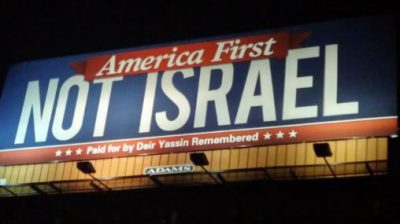
Fig Trees and Vineyards | March 2, 2017
The following is an email sent out recently by Deir Yassin Remembered announcing the take-down of one of their billboards.
The taken-down DYR “America First” billboard, the Southern Poverty Law Centre and a quote from Elie Wiesel – what could they have in common? Henry Herskovitz tells us more:
Jewish Power Never Sleeps
Like Michigan rust on vehicles, Jewish Power remains relentless at getting its way. Just when Witness for Peace was to announce the installation of a local billboard – sponsored by sister organization Deir Yassin Remembered and carrying our message “America First, Not Israel” – we get “the call”. The billboard pictured was taken down by Adams Outdoor Advertising one week after installation, effectively terminating a three-month contract.
That’s how long it took for Jewish Power to pressure Adams’ executives into seeing things their way. The call came from General Manager Mike Cannon, who admitted to receiving phone calls asking that the billboard be taken down. Mike claimed he was not the one who made the decision, and provided the phone number of Vice President of Human Resources
Brian Grant to field my questions.Brian developed a mantra for the conversation we shared: “the decision to remove the billboard was a collective decision and was made because the message did not meet Adams’ company standards. We removed the billboard and refunded your money. And that’s all I can say.” Brian fell back on this mantra at least a half dozen times during our 20-minute discussion. And reminded me that, since a clause in the contract allowed Adams to terminate at any time, there was no “breach of contract”.
Q: What were the company standards?
A: [Brian was not going to go into that.]
Q: How do you square the fact that the message was initially approved by Adams?
A: It should not have been approved; due diligence was not applied.
Q: Who were the people complaining about the billboard?
A: [Would not answer that.]
Q: What were the organizations calling for the billboard to be taken down?
A: [See above.]
Q: Would the decision to pull the billboard have been the same had the message been simply America First?
A: Well, you’re asking a hypothetical.
Q: You mean Adams would NOT run a billboard saying America First?
A: [No answer.]And so it goes. By deception shall you make war. DYR and WfP lose the round; Jewish Power wins. We move on.
Ann Arbor placed on SPLC “Hate” Map
The Southern Poverty Law Center exercises its own brand of Jewish Power by placing Deir Yassin Remembered (and its satellite office in Ann Arbor) on its “hate” map. This information came to us, not by direct communication from the SPLC, but through an article appearing in the Rochester, NY Democrat and Chronicle, entitled: “Rochester area makes SPLC Hate Map”
Defining “hate” proves difficult. A friend asks if forming a group which hates “hate” groups is in itself a “hate” group? Hmmm. The only clear example of hate speech that has come across this writer’s desk belongs to Holocaust icon Elie Wiesel:
“Every Jew, somewhere in his being, should set apart a zone of hate — healthy, virile hate — for what the German personifies and for what persists in the German.”
Henry Herskovitz
Deir Yassin Remembered / Witnesses for Peace
Featured Video

Daniel Davis: Trump’s New Iran Land Blockade Is a Dangerous Fantasy
or go to
Aletho News Archives – Video-Images
New Book
The Vaccine Mafia: Pfizer’s Former Chief Toxicologist Proves How Toxic Substances Were Unlawfully Sold to Us as a Solution for COVID-19
By Helmut Sterz
Former Pfizer chief toxicologist Helmut Sterz presents a critical examination of the development, approval, and global rollout of mRNA COVID-19 vaccines—particularly those produced by Pfizer/BioNTech. The Vaccine Mafia details the failure of pharmaceutical companies, regulatory authorities, politicians, and international organizations to follow established scientific and ethical standards during the pandemic. Drawing on the author’s decades of experience in pharmaceutical toxicology, Sterz reveals the many ways the vaccines’ inadequate or omitted preclinical safety testing put the world’s population at risk.
Sterz demonstrates how “emergency” approvals allowed manufacturers to bypass long-standing international guidelines governing toxicity testing, especially with regard to reproductive and cancer risks. They also allowed governments and health authorities to ignore or conceal evidence of serious adverse effects that occurred, including myocarditis, reproductive harm, and other long-term health risks.
Blog Roll
 Aletho News
- The ‘Gaza Treatment’: How Media Headlines Obscure Who is Bombing Yemen
- Ro Khanna urges Democrats to strip Israel ‘integration’ provision from defense bill
- Why Iran designated British MI6, Royal Navy, and RAF as hostile, terrorist organizations
- Armenian opposition politician dies in custody
- US still trying to recycle failed hypersonic missile programs
- France’s ‘Cold War’: Paris blames Tehran for supermarket fridge hacks
- Psywar no more? 77th Brigade’s sudden death
- Ukraine Already Carved Up… Before Talks Begin? /Prof. Richard Sakwa
- The vindication of Marjorie Taylor Greene
- Nearly 80% of Britons consider Israel a threat to world peace and security: Survey
- If Americans Knew
- An error has occurred; the feed is probably down. Try again later.
- No Tricks Zone
- German Authorities Start Initiative To Evaluate Public Register For Climate “Disinformation” Spreaders!
- Zonal Asymmetry of Temperature Change in the Antarctic Circumpolar Current
- New Study: The Net Fossil Fuel Contribution To Rising Atmospheric CO2 Has Been Zero For 500 Years
- Germany’s Green Energy Transition Becoming Increasingly Expensive…Another 6 Trillion Euros!
- Sudden Stratospheric Warming, Powerful El Niño Combination May Lead To Extreme Europe Cold, Energy Crisis!
- Two New Studies Find Thwaites Glacier Melt Cannot Be Driven By Human Activity Or A Warming Ocean
- E-Cars Reduce CO2 Emissions By Only 41% Compared To Internal Combustion Engine Vehicles
- Predictions Made By Renowned Climate Professor Over Past Decades Have Been Proven To Be Poor
- New Study Suggests Large Regions Of The Pacific Ocean Have Been Cooling For The Last 80 Years
- Germany’s Green Energy Debacle: High Energy Costs Force Kahla Porzellan to Close After 182 Years!

