200 Israeli settlers attack Palestinian village with firebombs
Ma’an – October 18, 2015
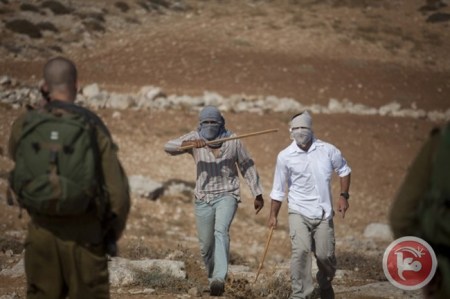
HEBRON – More than 200 Israeli settlers attacked the Palestinian villages of Wad al-Haseen and Wad al-Nasara near the illegal Israeli settlement of Kiryat Arba overnight in the eastern Hebron district of the occupied southern West Bank, locals and medics said.
During the attack, Israeli settlers threw stones and firebombs at Palestinian homes and injured at least three people, two of which were minors, while Israeli forces later shot and injured one Palestinian with live fire.
An Israeli army spokesperson said she did not have reports of any injuries with live fire.
The spokesperson said clashes between Palestinians and Israelis broke out in the area, after which Israeli forces “arrived at the scene and dispersed the clashes using riot dispersal means.”
Kayed Daana, one of the residents whose home was attacked told Ma’an that dozens of Israeli settlers attacked her neighborhood and injured at least three of her neighbors who have been identified as 40-year-old Imad and two minors, Abdullah, 13, and Muhammad, 17.
Muhammad’s injuries were the most serious of the three, as he was hit in the chest with one of the fire bombs, medics said.
Daana told Ma’an that she would like to urge the International Red Cross and others in the international community intervene against Israeli violations and attacks on Palestinians.
Bassam al-Jabri, one of the residents, said he saw the attacking Israeli settlers cutting the blockade fence that separates the illegal Israeli settlement of Kiryat Arab from nearby Palestinian homes, while under the protection of the Israeli troops before they attacked his neighborhood with fire bombs.
Al-Jabri said his house was one of those set ablaze, but that he and his neighbors were able to put the fire out before the fire was able to damage his whole home.
During the attacks, Palestinian villagers fled to their local mosques and used the mosque amplifier to call for help from neighboring Palestinian villages and communities, who responded to their calls.
Israeli forces then got involved, shooting tear gas at Palestinians who showed up to help.
Community member Farid al-Razim, told Ma’an that villagers in his area were attacked by Israeli settlers with firebombs, while Israeli forces were shooting tear gas, and that one of the Palestinians from a neighboring village who had come to help was shot and injured with live fire.
While relations between Palestinian residents and Israeli settlers in the occupied West Bank are normally tense, the situation has been significantly deteriorating since settlers’ torched a home belonging to the Duwabsha family in Nablus on July 31.
An 18-month-old toddler was burned alive during the attack, while his mother and father succumbed to their burn wounds while being treated at separate hospitals. The family’s four-year-old son is the only remaining survivor of the attack.
On Oct. 1, suspected Palestinians shot and killed Eitam and Naama Henkin, two settlers who were driving between the illegal settlements of Itamar and Elon More in an area near Huwwara in Nablus.
Their four children, aged between four months and nine years, were found unharmed in the back of the car.
It is speculated that the shootings were a revenge attack on Israeli settlers, following months of increased restrictions at the Al-Aqsa Mosque compound and calls from right-wing Jewish groups, urging their supporters to visit the compound, which is venerated by Jews as the Temple Mount.
Following the shooting, hundreds of Israeli settlers rioted across the occupied West Bank, with multiple attacks reported on Palestinian homes and vehicles.
Palestinian towns and villages in the Nablus area are surrounded by Israeli settlements and outposts, many of which are protected by the Israeli military and have gained notoriety for being comprised of the most extremist settlers.
The Palestinian government has no jurisdiction over Israelis in the West Bank, and violent acts carried out by Israeli settlers often occur in the presence of Israeli military forces who rarely act to protect Palestinian residents.
Palestinians are therefore left to fend for themselves as few options for their personal security remain.
While Israeli forces will detain a Palestinian in the occupied West Bank for possessing a knife or gun, Israelis living in the same area are legally able to carry such weapons.
Rights groups have criticized Israel for implementing different legal systems for Palestinians and Israeli settlers living in the same area.
Such practices, they say, protect the expansion of settlements while systematically removing the ability for Palestinians to move freely throughout the occupied territory.
“ISRAELI ARMY BEGINS DEPLOYING IN JERUSALEM AGAINST ATTACKS” – Deconstructing AP bias
By Alison Weir | Associated Press Deconstructed | October 15, 2015
Once again, the Associated Press provides a blatantly slanted news report on Israel-Palestine. The problem is, AP’s slant is only blatant to those who know the full facts. This is the article that hundreds of newspaper wire editors around the US, most of whom have never visited the region and whose information comes largely from AP, are seeing. Below I will discuss AP’s October 14 news report. I will quote the AP report in full, commenting below each section about what it contains and does not contain.
By Aron Heller
As is typical, AP’s story is written by an individual with strong connections to Israel. Aron Heller grew up in Israel, graduated from Tel Aviv University, and may be an Israeli citizen. It is likely that he or members of his family have served in the Israeli military. None of this is disclosed to AP readers. [We’ve noticed that, hours after this appeared, the byline for this same basic story is now given as “Tia Goldenberg,” who is probably updating it.]
JERUSALEM (AP) — The Israeli military began deploying hundreds of troops in cities across the country on Wednesday to assist police forces in countering a wave of deadly Palestinian shooting and stabbing attacks that have created panic across the country.
According to what seem to be the figures at the time of the article, Israelis have killed 30 Palestinians and injured somewhere between 1,100 and 1,400 since the beginning of the current violence, while Palestinians have killed 7 or 8 Israelis and injured about 30. Yet, Heller’s focus is on Israelis.
Israel was created in 1948 through violently pushing off their ancestral land hundreds of thousands of the Muslims and Christians who originally constituted the large majority of the population on the land (these are the Palestinians; the Palestinians who stayed within the borders of what is now Israel are called by Israelis and those who follow the Israeli line “Israeli Arabs”).
Since 1967 Israel has maintained an illegal and often brutal occupation of Jerusalem, the West Bank and Gaza. The human rights of Palestinians both inside the Green Line (Israel) and in the Occupied Territories (the West Bank and Gaza) are frequently violated, and over the decades thousands have been rounded up and imprisoned, often with minimal if any judicial processes. None of this context is included in Heller’s story.
The military’s planned deployment of six companies marks the first implementation of measures by Israel’s security Cabinet to counter the attacks that have intensified dramatically in recent days.
Heller continues his focus on Israelis. In the past few days Israelis have killed eight Palestinians, including a three-year-old, a thirteen-year-old, a fifteen-year-old, and a 26-year-old pregnant woman. Yet, these appear of no concern to Heller.
The Cabinet met late into the night and announced steps early Wednesday that included allowing police to seal off points of friction or incitement.
Heller fails to report that the original incitement came from the Israeli government; see below.
Many of the recent attackers have come from Arab areas of Jerusalem, prompting calls to seal off those neighborhoods to contain potential attackers. In a new step, Israeli forces placed makeshift checkpoints in Palestinian neighborhoods in Jerusalem to monitor traffic leaving the areas.
As in most US media reports, readers are not told that Israel’s acquisition of Jerusalem was done through unlawful military actions. Nor are readers informed that the Palestinians in Jerusalem originally constituted the large majority of Jerusalem’s inhabitants, a population that Israel has attempted through the years to push out as it works to “Judaize” the area.
The Cabinet, which was meeting again Wednesday, also decided to strip residency rights and demolish homes of some attackers and draft hundreds more security guards to secure public transport.
Heller fails to note that destroying family homes – which in addition to containing the spouse and children of alleged attackers, also often contain grandparents, cousins etc – constitutes collective punishment, making large numbers of men, women and children who are innocent of any alleged crime homeless. Collective punishment is illegal under the Geneva Conventions.
Israeli police said 300 soldiers had already been incorporated into their deployment on the streets of east Jerusalem, where many of the assailants are from.
Heller neglects to mention that Israeli forces have assailed large numbers of Palestinian men, women, and children. Again, he focuses on Palestinian violence, not the greater amount of violence perpetrated by Israel.
In new violence Wednesday, Israeli police said they shot and killed an Arab man after he pulled out a knife and attempted to stab them. His identity was not immediately known.
Heller reports the Israeli version of this death without bothering to confirm it with eyewitnesses. He doesn’t even bother to learn the dead man’s age or anything about the human being that Israeli police just killed. He also uses Israel’s term “Arab,” rather than calling the man Palestinian, a more accurate terminology that also implies a history of the area that Israel has tried to erase.
In recent weeks, eight Israelis have died in a string of stabbings, shootings and the stoning of a car, while 30 Palestinians have been killed – 13 of them identified by Israel as attackers, the rest killed in stone-throwing clashes with Israeli forces.
Finally, in the eighth paragraph, Heller mentions that Israelis have killed 30 Palestinians. And it finally comes out – put another way, but certainly not the way Heller chooses – that Israeli forces have killed at least 17 people that even Israeli spokespeople don’t accuse of criminality.
Heller fails to note that crowd control in most civilized nations does not usually consist of live ammunition. Such a lethal method of crowd control is used by Israel only against non-Jews. When extremist Jewish Israelis riot and throw stones, Israeli forces do not have a policy of using live ammunition in which people are shot in the head. In some instances Israeli claims that those killed had stabbed or were about to stab Israelis have been refuted by video and eyewitness testimony.
In addition, Heller errs in saying that all the other Palestinians killed by Israel were killed in stone-throwing clashes. Some were killed at close range, for example; another was killed by an Israeli airstrike in Gaza. Much of this is documented by the Palestinian Centre for Human Rights. However, it appears that Heller relies entirely on Israeli military reports for his information and does not seek additional information.
Heller also fails to note that the term “clashes” largely denotes Israeli soldiers in full combat gear with the latest weaponry firing at unarmed protesters.
Israel’s internal security minister said Wednesday that the bodies of dead Palestinian attackers would not be returned to their families for burial.
Again, Heller takes Israeli officials’ word that these were all “attackers,” even though eyewitnesses and videos have refuted this claim in a number of cases.
Gilad Erdan said the funeral processions of Palestinians who killed Israelis often turn into “an exhibition of support for terror and incitement to murder.” He said Israel should not allow them to “enjoy respect and ceremonies” after their deaths.
Heller fails to report that to many Palestinians and others these are resistance fighters defending their population. Instead, Heller quotes the Israeli official view without interviewing Palestinians or others to report their viewpoint and information, which has been reported widely in the Palestinian media. Heller appears to only use official Israeli sources.
The funerals are a frequent flashpoint for clashes and often include calls for revenge. Erdan suggested the attackers be buried without fanfare in distant cemeteries where previous Palestinian killers have been buried.
Israel provides no proof that those it kills and buries in its sometimes secret cemeteries were actually attackers. Second, as discussed above, those who actually were combatants could validly be seen as members of a resistance movement fighting a far more powerful force illegally occupying their land. Yet, Heller calls them “Palestinian killers.” He never refers to Israelis who have killed Palestinians – in fact, far more – as “Israeli killers.”
The comments come after a particularly bloody day Tuesday in which a pair of Palestinian stabbing and shooting attacks in Jerusalem killed three Israelis and another two attacks took place in the normally quiet Israeli city of Raanana. Three Palestinians, including two attackers, were also killed.
A few days ago Israelis killed five Palestinians, including a 10-year-old; a few days before that Israelis killed six Palestinians; and not long before that they killed seven Palestinians in one day. However, for Heller It is only the day in which three Israelis are killed that is “particularly bloody.”
The government has been unable to stop the violence, carried out mostly by young Palestinians unaffiliated with known militant groups and apparently acting on their own. The violence erupted a month ago over the Jewish New Year, fueled by rumors that Israel was plotting to take over Jerusalem’s most sensitive holy site, sacred to both Muslims and Jews. Israel has adamantly denied the allegations.
Heller leaves out an event that took place five days before the Jewish New Year: Thousands of Palestinians gathered at a village in the occupied West Bank to mourn the excruciating death of a young mother burned in an arson attack by Israeli settlers. The attack had also killed her husband and infant son. Her four-year-old son, while burned on 60 percent of his body, has so far survived. Israel, worried that Palestinians would demonstrate at Jerusalem’s Al Aqsa Mosque, restricted access to the Mosque, one of the holiest sites in Islam.
This was just one of what the Israeli newspaper Ha’aretz reports were a spate of “nationalist hate crimes, known as ‘price-tag’ attacks, by suspected Jewish settlers. Such groups have warned in the past there would be a price to pay for any action by Israeli authorities they regard as hostile to the Jewish settlement movement or to far-right religious beliefs.”
None of this makes it into Heller’s story.
Heller also leaves out many other incidents that took place in the days before the Jewish New Year, including:
- The Israeli Tax Authority rejected a claim for compensation by officials of the Catholic Church demanding compensation for the burnt Church of Multiplication of Loaves and Fishes, which was burnt in an Israeli terrorist arson attack, last June.
- Dozens of Palestinians, including children, were injured on Friday evening and early night hours, in Silwan town, in occupied East Jerusalem, during clashes that took place after Israeli fanatics assaulted an 8-year-old child, while Israeli soldiers invaded homes and fired gas bombs, concussion grenades and rubber-coated metal bullets.
- Israeli Defense Minister, Moshe Ya’alon confirmed, on Wednesday, that Israeli occupation authorities know who burned the house of the Dawabsha family, in July, but failed to identify them.
- Palestinian medical sources reported, Friday, that four young men were wounded, one moderately, after Israeli soldiers assaulted the weekly protest in Kufur Qaddoum, near the northern West Bank city of Qalqilia.
- Israeli soldiers assaulted, on Friday, the weekly nonviolent protest against the illegal Israeli Annexation Wall and colonies, in Bil’in village, near the central West Bank city of Ramallah, leading to scores of injuries.
- The Palestinian Detainees’ Committee has reported, Thursday, that detainee Bilal Kayed is ongoing with the hunger strike he started on September 5, demanding his removal from solitary confinement.
- The Israeli Prison Authority renewed, Thursday, the Administrative Detention order against a hunger striking Palestinian journalist, for three additional months, without charges or trial.
- Israeli soldiers kidnapped, on Thursday morning, five Palestinians in different parts of the occupied West Bank, including a teenager walking to school in Jerusalem.
- Israeli soldiers invaded, on Thursday morning, the al-‘Arroub refugee camp, north of the southern West Bank city of Hebron, and clashed with scores of students as they were heading to school.
- Several Palestinians fishing boats were attacked, on Thursday morning, by Israeli navy fire close to the shore in the Sudaniyya Sea, northwest of Gaza City.
- Reporters from RT (Russia Today) traveled to Gaza to look into last year’s report that 90% of Gaza’s water is undrinkable. As they sampled water from different parts of the coastal Strip, they found that the report is accurate – the water throughout Gaza is dirty, salty and undrinkable.
- Israeli forces, on Wednesday morning, threw teargas grenades on the Kharabtha Boys School, near Ramallah, causing tens of suffocation cases among students.
- A group of Israeli extremists, living in illegal Israeli colonies in the northern West Bank district of Nablus, burnt on Wednesday at dawn, Palestinian olive orchards and farmlands.
- About five Israeli military machines, Tuesday night, entered the town of Khuza’a near Khan Younis city, southern Gaza Strip, to raze agricultural lands.
- Report on Israeli actions Sept 12-13.
- etc.
Heller mentions Palestinian concerns about Israeli changes to the status quote at one of the holiest sites in Islam and reports they were denied by Israel, but fails to inform readers that Jordan, Egypt, the Arab League, and the UN also protested Israeli actions at the site. Heller also omitted information that Jewish extremists openly call for the destruction of the site. He also fails to mention “Israel’s numerous efforts to restrict Muslim prayer at the mosque and the increasing presence of Jewish worshippers, who are protected by troops when they visit the compound,” as journalist Barbara Erickson reports in an analysis on the New York Times‘ similar pattern of omissions. Erickson reports:
“In recent weeks, for instance, Israel has prevented women from entering the Al Aqsa area, retained the identify cards of worshippers, allowed Jewish extremists to enter the mosque compound for “tours,” restricted the entry of students attending schools in the Al Aqsa compound and confiscated land in an Islamic cemetery next to the mosque.
“After the latest incursion, the director of the mosque compound, Sheikh Omar al-Kiswani, said that Israel occupation authorities “have imposed their sovereignty over [the mosque compound] by power of force.” Israel controls who enters and exists, he said, and officials use force against anyone who challenges them.
“This is a cry of alarm from a site revered by millions of Muslims throughout the world, but it found no mention in the Times. Instead, we receive the Israeli spin on this tragic saga as the newspaper glosses over the expansionist aims of a Zionist state.”
None of this is in Heller’s story, which only reports, as usual, an Israeli official statement denying Israeli culpability, and suggests that Palestinian views are illusory. Heller omits the statement by the heads of Christian churches in Jerusalem expressing concern at Israel’s violations at Al-Aqsa Mosque.
Israel says the violence has been fueled by what it says is rampant incitement against Jews and Israelis on social media spread by Islamic groups and the Palestinian leadership. In a briefing to foreign journalists Wednesday, Israeli Cabinet minister Yuval Steinitz said it had less to do with political differences and more with anti-Semitic incitement to create a religious war.
He showed Palestinian videos and animations that glorified the stabbings of Jews in the Old City of Jerusalem and the killing of a Jewish settler couple in the West Bank in front of their children.
He also quoted Palestinian President Mahmoud Abbas’ recent statement where he blessed “every drop of blood spilled for Allah” and that Jews desecrated a Jerusalem holy site with their “filthy feet.”
“This is not new. It is just a new wave of terrorism and violence and this time it’s totally clear that the main approach here is a religious approach,” Steinitz said. “It’s all about horrible, anti-Jewish, racist incitement.”
Heller reports, without question or context virulent accusations by an Israeli official, while failing to provide counter statements by Palestinian officials and others.
He fails to mention the Palestinian boy with head injuries and broken legs lying on the ground whom Israeli soldiers reportedly let bleed while Israeli spectators looked on, cursing him. (More details and video here.)
Also missing from Heller’s report are Israeli attacks on Palestinian hospitals and medics, a Palestinian woman who was shot dead by Israeli forces while her hands were up, the 10-year-old Palestinian boy kidnapped and blindfolded by Israeli soldiers, and the 13-year-old boy whose leg was scheduled to be amputated after he was shot by Israeli soldiers. There is virtually no mention of Palestinians injured and maimed by Israelis, even though there are over 1,400.
Palestinians say the violence, coming at a time when prospects for gaining independence appear nil, is the result of years of occupation and failed peace efforts.
Finally, in his 18th paragraph, Heller provides Palestinian information.
“Israel is an occupier in Jerusalem. It should end its occupation. This is the key to peace and stability,” said Saeb Erekat, a top Palestinian official.
“Decisions such as the ones adopted by the Israeli Cabinet pour gasoline on the fire,” he added. ” Measures of collective punishment and killings and arrests and demolishing houses and confiscation of lands will only lead to the escalation of the situation.”
For the first and only time in his very long article, in the final quarter of his story, Heller quotes Palestinians.
The clashes erupted last month when young Palestinians barricaded themselves inside the Al-Aqsa Mosque compound in Jerusalem’s Old City, hurling stones and firebombs at police.
Heller leaves out the dozens of Israeli soldiers and settlers who assaulted Al-Aqsa Mosque. He ignores the mother and infant burned to death the previous month, and the ongoing Israeli attacks, kidnappings and destruction that have taken place week after week, month after month, year after year against Palestinians.
Israeli attacks against Palestinian men, women, and children, it appears, simply don’t matter to AP on the same scale as attacks on Israelis.
For history on Israel-Palestine see The Origin of the Palestine-Israel Conflict and Against Our Better Judgment: The Hidden History of How the U.S. Was Used to Create Israel.
For a statistical study of AP coverage see: Deadly Distortion: Associated Press Coverage of Israeli and Palestinian Deaths
Alison Weir is executive director of If Americans Knew and president of the Council for the National Interest.
UPDATE:
The PLO Negotiations Affairs Department has issued a report on the violence from Sept 13-Oct 13 that shows that Israeli forces committed 29 confirmed killings, 1,100+ injuries, 398 raids, 607 detentions, 316 temporary detentions, 482 flying checkpoints, 735 Israeli gunfire attacks, 6 home demolitions, 81 destruction/confiscations of properties, 10 assaults on medical sector, 197 incidents of settler terrorism/violence.
The report states:
Over the past month, Israel has killed 29 Palestinians. According to Amnesty International some of the recorded cases amount to “extrajudicial killings.”
On September 22nd at 7:43 am, an Israeli soldier shot several bullets at Hadil Hashlamon and killed her for allegedly ‘holding a knife’ when she stopped to pass one of the many checkpoints inside Hebron’s old city. Israeli officials refuse to release the video footage that shows the entire sequence of events.
Marcel Leme, a Brazilian national and an International Human Rights Observer, was a few meters from the scene. He presented a written report with still photos of his testimony (published on Blog Sanaúd-Voltaremos). Leme said: “The woman remained froze on the other side of the metal barrier, behind her there was a wall. She did not move, speak, scream or react. She has never tried to attack any soldiers and did not even get closer to them. Then the Israeli soldiers started opening fire at her some five or six times. The soldiers were now about 3 meters away from her.”
Since the beginning of October, many Palestinians have been killed in cold blood for allegedly holding a knife. So far, not one investigation has been launched to determine the truth. Other Palestinians have been killed by “Israel’s indiscriminate an even deliberate” use of fire on demonstrators according to Human Rights Watch.
The report provides the names of the 29 Palestinians killed by Israel during the past month:
Hadeel Saleh Al-Hashlamoun 18 Hebron 22 September 2015 2 Ahmad Izat Khattatbah 26 Beit Foriek/ Nablus 24 September 2015 3 Muhanad Shafik Halabi 19 Jerusalem 3 October 2015 4 Fadi Samir Alloun 19 Jerusalem 4 October 2015 5 Hufaytha Othman Suliman 18 Tulkarm 4 October 2015 6 Abdel Rahman Shadi Obidulalah 11 Bethlehem 5 October 2015 7 Amjad hatim Al Jundi 17 Hebron 7 October 2015 8 Wisam Jamal Faraj 20 Jerusalem 8 October 2015 9 Thaer Abu Ghazaleh 19 Jerusalem 8 October 2015 10 Ahmad Jamal Salah 20 Jerusalem 9 October 2015 11 Mohammad Al-Ja’bari 19 Hebron 9 October 2015 12 Abdel-Majid Al-Waheedi 20 North Gaza 9 October 2015 13 Ahmad Al-Hirbawi 20 Central Gaza 9 October 2015 14 Shadi Husam Dolah 20 Gaza 9 October 2015 15 Zeiad Nabil Sharaf 20 Gaza 9 October 2015 16 Mohammad Hisham Al-Raqab 15 Khan Yunis 9 October 2015 17 Adnan Abu Aliyan 22 Khan yunis 9 October 2015
INJURIES
According to the Palestinian Ministry of Health, more than 1,100 Palestinians have been injured, including 200 children, since the beginning of October. Additionally 400 Palestinians have been shot with live ammunition and 700 with rubber-coated bullets. The following examples highlight incidents where the Israeli army fired on children: ๏ On September 15th at Al-Ram’s North junction, Israeli forces shot three persons, including two children, during a protest against the Israeli occupation and the continued storming of Al-Aqsa Mosque Compound by extremist Jewish settlers. Israeli forces started by shooting rubber-coated metal bullets, sound bombs and tear gas canisters at unarmed Palestinian civilians leading to the wounding of: Basil Ayoub Mohammed Al-Salaymeh (17 years old), Mahmoud Shaker (15 years old), and Qusai Mohammed Abed Rabbo. They were all sent to the hospital for treatment. ๏ On September 18th near Al-Jalazoun Refugee Camp the Israeli forces fired rubber-coated metal bullets, sound bombs and tear gas canisters at Palestinian protestors. As a result Mohammad Safi (16 years old) was injured. ๏ On October 11h The Israeli military launched missiles (in 2 consecutive strikes) on Al –Zaytouneh neighbourhood located in southeast Gaza and in southwest Gaza. This resulted in the injury of four members of the same family including a child: Mohammad Hassan (5 years old). Israel claimed that it targeted a training area for Palestinian gunmen.
ISRAELI RAIDS AND ARRESTS OF PALESTINIANS
Israeli forces have carried out at least 400 raids in the State of Palestine over the past month. Additionally, more than 600 Palestinians have been arrested. This includes the detention of a security guard at Al-Aqsa mosque compound – and the assaulting of Sheik Omar Kiswani, the director of Al-Aqsa Mosque, and another Security guard – to allow the Israeli Minister of Agriculture Uri Ariel, accompanied by several Israeli settlers to enter the holy site.
NO. NAME AGE DISTRICT DATE
18 Jihad Zayed Obied 22 Central Gaza 9 October 2015 19 Ishaq Badran 16 Jerusalem 10 October 2015 20 Mohammad Saed Ali 19 Jerusalem 10 October 2015 21 Ibrahim Ahmad Awwad 28 Hebron 10 October 2015 22 Rahaf Yahia Hassan 2 Gaza 11 October 2015 23 Noor Rasmi Hassan (5months pregnant) 30 Gaza 11 October 2015 24 Marwan Hisham Barbahk 10 Khan Yunis 10 October 2015 25 Khalil Omar Othman 15 Khan Yunis 10 October 2015 26 Ahmad Abdallah Sabah Sharkah 15 Ramallah 11 October 2015 27 Mohammad Nathmi Shmasnah 23 Jerusalem 12 October 2015 28 Hasan Khaled Manasra 15 Jerusalem 12 October 2015 29 Mustafa Adel Khatib 17 Jerusalem 12 October 2015
Ruthless killing of Palestinian youths in al-Khalil (Hebron)
International Solidarity Movement, al-Khalil team | October 17, 2015
Hebron, occupied Palestine – Today, Israeli forces and Israeli settlers in occupied al-Khalil (Hebron) murdered two Palestinian youth within three hours.
In the morning, Israeli settlers from the illegal settlements within al-Khalil, walked past the 18-year old Palestinian youth Fadel al-Qawasmeh in segregated Shuhada street, cursing him as an ‘Arab’ and then pulled a gun shooting him from point blank range. The settler fired four shots at the Palestinian youth with his pistol, one shot directly in the head. This execution was entirely unprovoked. Israeli soldiers rushed to the scene, but prevented a Palestinian ambulance from treating the critically injured Palestinian youth who was lying on the ground bleeding. Whereas the area around the execution was immediately closed for Palestinians and international observers by the Israeli forces, settlers at all times were allowed to freely stroll alongside the scene of the murder, with soldiers taking pictures with their private phones.

Israeli settlers standing right next to the scene of the execution
Later on, Israeli forces blocked all entrances to a Palestinian house nearby where activists where trying to document [events]. In the meantime, settlers from the nearby illegal settlement of Beit Hadassah, watching from down on the street close by a checkpoint were enjoying tea and biscuits, brought from the settlement, with the soldiers and the police. After Israeli forces washed off the blood from the street, they broke into the house where Palestinians had been filming, with 11 children, the youngest only a year old, present. Heavily armed Israeli soldiers searched the house and confiscated all phones and cameras. Once they left the house, they checked all the photos and videos taken after the execution of Fadel, and showed them to the settlers nearby.
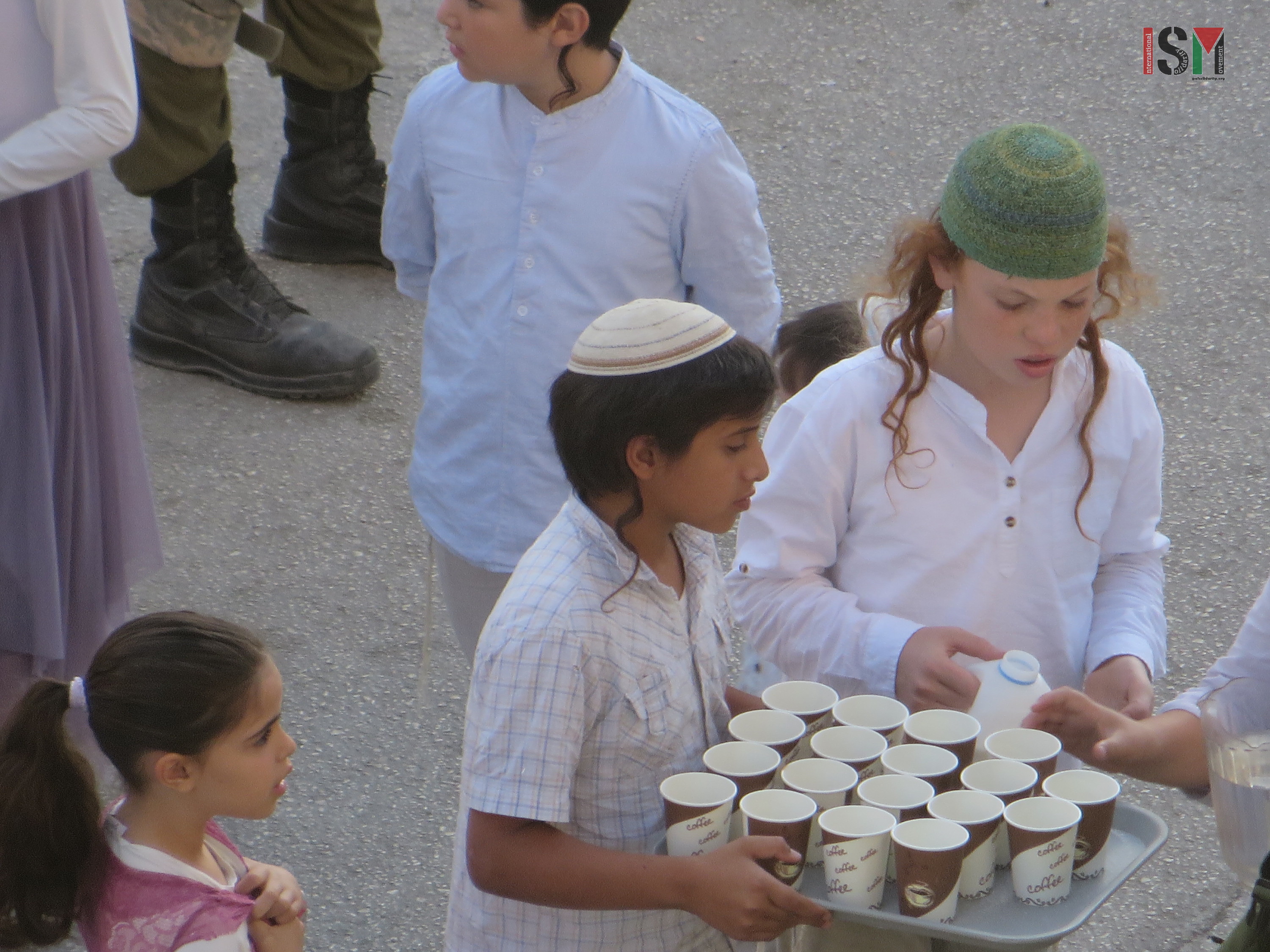
Israeli settlers and soldiers sharing tea at the scene of the execution of Fadel al-Qawasmeh

Israeli soldiers having tea brought by settlers
Palestinians and international human rights observers trying to document this violent attack on a family home were repeatedly forced by Israeli forces to move away from the incident, whereas the settlers were allowed to freely walk around and curse and hurl insults at them, even threatening them that they will be the next to be killed. One Palestinian man was forced by Israeli soldiers to pass through a checkpoint even though soldiers were throwing stun grenades right outside the checkpoint. 23-year old Abed al-Salaymeh was detained in Tel Rumeida for one and a half hours, after soldiers prevented him from going back to his home in segregated Shuhada Street. Different soldiers repeatedly ordered him and internationals to either move up the hill from the checkpoint, or when further up to move back down, all the time prohibiting him from going back to his house. Once up the hill, he was detained for one and a half hours, with soldiers freely admitting that this is because he ‘annoyed’ them before. Settlers passing by were threatening him and internationals that ‘tomorrow they would be the ones to be killed’.
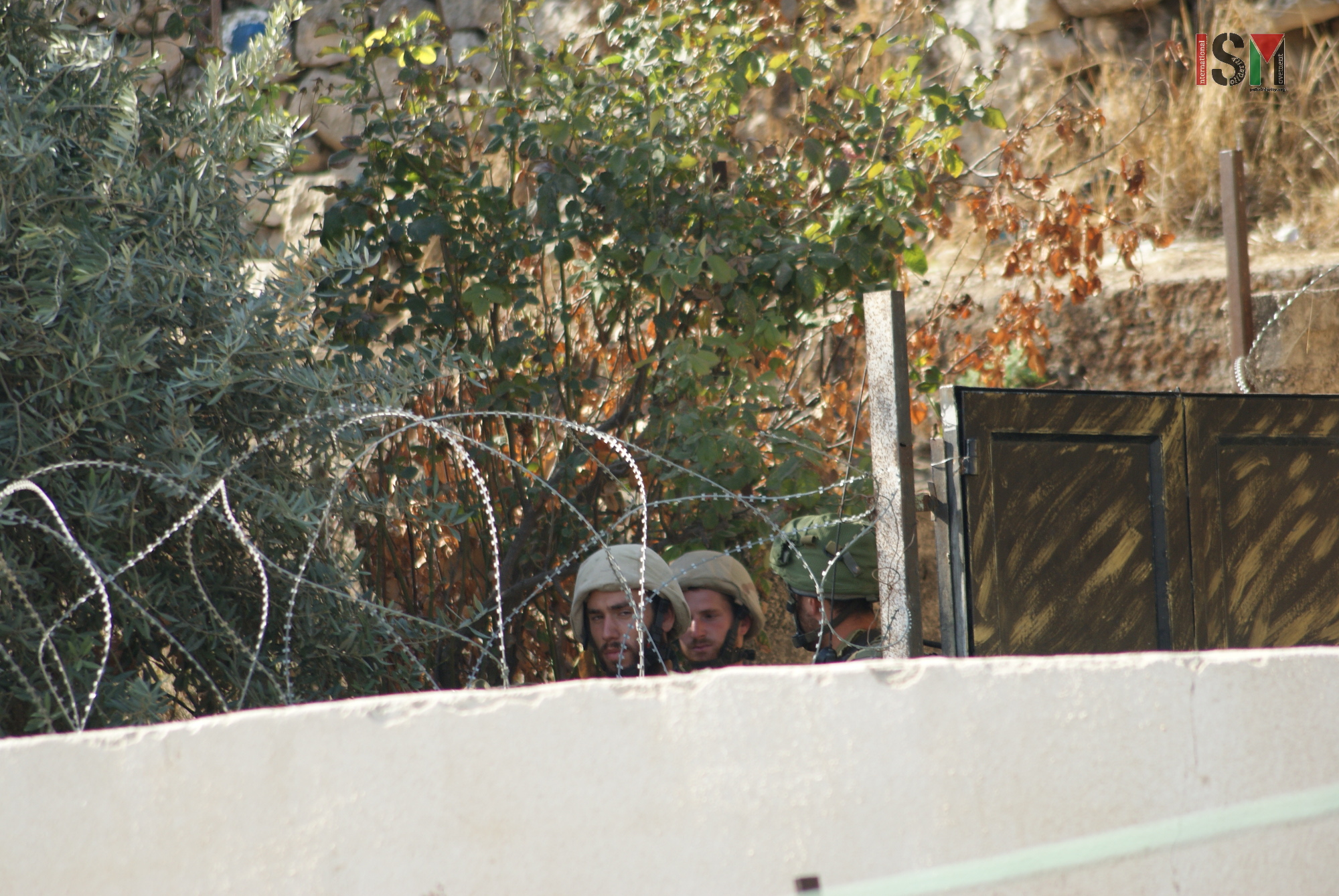
Israeli forces blocking the entrances to a Palestinian house
Only three hours later, Israeli forces shot and killed 16-year old Palestinian teenager Bayan Eiseleh at the Ibrahimi mosque. Her parents, rushing to the scene of her killing, were brutally attacked and beaten by Israeli forces. International human rights observers trying to document this senseless killing were detained by Israeli forces and then one of them was arrested for ‘taking pictures and posting them online’. She is still being held at the police station in the illegal settlement of Kiryat Arba.
Uncivil Rites of the Corporate Neoliberal University: the Curious Case of Steven Salaita
By Fawzia Afzal-Khan | CounterPunch | October 16, 2015
Donna Nevell’s Oct 7th article about a new report called “The Palestine Exception to Free Speech: A Movement Under Attack in the US” – released by Palestine Legal and the Center for Constitutional Rights (See more here.) points to the rise in North American academia, of a phenomenon that I encountered head-on back in the late 1970s when I arrived as a grad student in Massachusetts from my native Pakistan, and which I’ve continued to witness (and experience the brunt of, throughout my 25 years of teaching, via demands for “civility” whenever I criticized Israeli policies in public settings, earning me the ire of Zionist colleagues, with those in power using that privilege on various committees to deny me academic awards, funding support, etc )–but which I thought was on the wane in recent years. This is the phenomenon of the facile canard of accusations of anti-semitism (a silencing tactic par excellence)–levelled against anyone and everyone who wants to approach the topic of Israel/Palestine with a critical eye, or who wishes to speak out against Israel’s use of disproportionate violence against Palestinian civilians year after year, or who wishes to raise legitimate questions about the illegitimacy of Israeli settlements on Palestinian lands which continue unabated to date, in contravention of countless UN resolutions against such occupation.[1]
In recent years, however, I’ve felt a shift in public opinion and discourse around issues of Israel/Palestine, as attested to by my students, who have become more aware of, and thus more critical of the imbalance of military and economic power between Israel and its disenfranchised Palestinian second-class citizens as well as the Palestinians of the Occupied Territories, which has led them to become more aware of the dominant media bias in favor Israel. Yet, the recent, ignominious case of Prof Steven Salaita’s “unhiring” by the University of Illinois Urbana-Champagne in the wake (ostensibly) of some tweets he wrote criticizing Israel during its 2014 “Operation Protective Edge” military blitzkrieg against Palestinian civilians of Gaza,[2] points to the desperate push-back occurring on US campuses against this perceived shift in public (and student) opinion. Opines Nevell:
As Israeli violence against the Palestinian people escalates, support across the globe for justice in Palestine, and calls in this country for the US government and corporations to stop facilitating Israel’s gross violations of international law and human rights, are increasingly common-place. However, rather than engage substantively about those well- documented violations, Israel’s defenders recklessly and baselessly smear Israel’s critics with charges of anti-Semitism, promoting terrorism, and seeking to “delegitimize” Israel.
What is particularly troubling about this propaganda tactic—a longstanding one as it is—is that because it enjoys the support of rich donors who can and do, influence the corporate culture of universities (those of us who’ve been around long enough have witnessed the acceleration of the corporatization of US academia over the past several decades), there are increasingly virulent attacks occurring against faculty and students alike who dare to speak out against Israeli state policies. Nevell tells us how:
These campaigns are largely directed at college campuses where consistent, bold, and creative organizing is ongoing against Israel actions and against university complicity in supporting Israeli crimes. Those whose views are considered unacceptable to Israel’s supporters have been targeted with personal and ad hominem attacks that include, but are not limited to, intimidation, campaigns to get professors fired, and ongoing harassment. When speaking on college campuses, I was told story after story of students who were hesitant to speak out because of fear of reprisals. Further, accusations of “creating hostile environments” or being “uncivil”–ironic as they are—are yet another attempt to derail the call for equality, for accountability, and for fairness.
 At a recent gathering of students and faculty of Columbia University and the general public, Professors Steven Salaita and Rashid Khalidi (the latter is Edward Said chair of Middle Eastern Studies at Columbia), while celebrating the publication of Salaita’s book which chronicles his year since he was unhired/fired by UIUC for an allegedly anti-semitic tweet during august of 2014, provided the standing-room-only audience also with a glimpse into the darkening atmosphere on university campuses which has arisen in the wake of a successful BDS movement (the campaign for Boycott, Divestments and Sanctions against Israel until it complies with international law and Palestinian rights), as a means to curtail freedom of speech for those criticizing the Israeli state. Plus ca change, plus c’est la meme chose.
What is truly inspiring and refreshing, however, about Salaita’s take on the current manifestation of this chronic disease afflicting academe, is that he rises above his personal predicament (no mean task, given loss of employment and livelihood for himself and his family, and the need to relocate abroad to earn a living: as he pointed out, while it’s wonderful that he was finally able to land a very prestigious position as the Edward Said Chair at AUB in Beirut, it is only a one-year appointment). Beyond his personal tribulations, then, he discusses the full ramifications of the “civility” argument that has become the official discourse of the corporate university, which he persuasively describes as simply the latest instance of a colonial mechanism aimed at “controlling”—i.e disempowering—those professors and students who represent marginalized/colonized groups, and whose scholarship challenges received wisdom or the “hegemony” of the “dominant discourse” that rules the roost. To be critical of the power apparatus, of the corporatization of academe which routinely silences opposing voices by depriving us of jobs, tenure, promotions, this evil corporatization that has led to the de-funding of departments and programs that challenge dominant knowledge paradigms and the (il)logic of profit over humanity and democratic education, which has led to the infantilizing and punishing of students who wish to organize for their rights—in short, to raise critical voices for justice and for an end to dehumanization, is to now stand accused of “uncivility.” This is precisely what happened to Salaita. As he puts it so pithily in his book, Uncivil Rites: Palestine and the Limits of Academic Freedom :
In the hegemon, state violence is never violent. Expressions of the subaltern, however, are always said to be conducted violently. Indicting a lone tweeter allows those invested in the colonial apparatus to avoid confronting their own complicity in the cruelties of racism and war. Many folks wrung their hands—teeth gnashed into rugged nubs—about my tweets critical of Israel while saying nothing of Israel’s wanton slaughter in Gaza. If, in the imagination of the liberal state, racism is but an individual failing, then critique of structural violence is a collective evasion (14).
In other words, while Salaita was indicted as an “individual” for practicing “uncivil behavior” through his critical tweets of Israel, the hegemonic university and its administrators did not need to confront their complicity in supporting Israeli racism and its unremitting and unjust war against Palestinians. Here are some sobering statistics Salaita provides that highlight the injustice which disingenuous accusations of “uncivility” directed at the victims or those angry at the situation and wishing to expose it, like Salaita, cover over:
Since 2000, Israelis have killed 2,060 Palestinian children while Palestinians have killed 130 Israeli children. The overall death count during this period is over 9,000 Palestinians and 1,190 Israelis….Israel has imposed hundreds of settlements on the West Bank [in direct violation of UN resolutions], while Palestinians inside Israel increasingly are squeezed and continue to be internally displaced. Israel has demolished nearly thirty thousand Palestinian homes as a matter of policy. Palestinians have demolished zero Israeli homes. (17)
But such techniques of silencing the “other” which today are directed with unrelenting and almost single-minded force against supporters of Palestinian human rights by the corporate university, have a long history aimed at other marginalized communities as well. Observes Salaita,
What happened to me has been happening to ethnic, sexual and cultural minorities in academe for decades, African Americans especially, and it continues to happen today. A shameful irony is that Jews were long marginalized in the academy because of their supposed dangers to Anglo civility, victims to rationalizations for their exclusion that, sadly, don’t look terribly different than the ones being used against supporters of Palestinian human rights. (49)
The supreme irony here, is that it is the victims of incivility who are being treated as its perpetrators! Plus ca change…. Indeed, blaming the victim is an age old strategy of the powerful. But, as Salaita notes, as Nevell recently observed, and which is where I began this piece, change is definitely in the air, and things will not remain the same, the French adage notwithstanding. Salaita notes, with some optimism
Israel is losing the PR battle, the proverbial hearts and minds. Its supporters, in turn, are lashing out with the sort of desperation endemic to any strong party in decline. They are punitive and belligerent in the absence of honest debate. This is about undemocratic power reasserting itself, refusing to cede a word to Palestinians in a severely compromised public discourse. It is, simply stated, colonial paranoia. (53)
As history has shown us, even the most entrenched colonial apparatuses come to an end, at times, seemingly suddenly (it seems this way especially to those who haven’t been paying attention to subaltern discourses!) A fairly recent case in point: South Africa. Injustice, apartheid, do not last forever. And neither will that other corporate hegemon: the neoliberal university. In the unjust, shameful, ludicrous and illegal case brought against Salaita by UIUC to deny him the position he was hired for, to teach in the Department of Native American Studies (yes, the ironies just multiply!)—it is the corporate university that has already lost in the court of public opinion.
Notes.
[1] The UN Human Rights Council formed in 2006 has issued 45 resolutions condemning Israeli actions; the UN’s Security Council has issued dozens of such resolutions, all of which Israel has, to date, flouted with impunity, thanks to blind support from its most powerful ally, the government of the USA. Between 1955 and 1992 alone, the UN issued 65 resolutions against Israel, but to date, Israel remains in contravention of most of them. Israel continues to be in violation of the U.N. Charter, the Geneva Conventions, laws of international terrorism, and other norms of international law.
[2] during its 2014 attacks on Gaza Between 8 July and 27 August, more than 2,100 Palestinians were killed in the Gaza Strip, along with 66 Israeli soldiers and seven civilians in Israel. The UN says the vast majority of Palestinian deaths are civilian.
Fawzia Afzal-Khan is a Professor of English, University Distinguished Scholar, Director of Women and Gender Studies at Montclair State University. She can be reached at: khanf@mail.montclair.edu
Rabbis: Killing captive Palestinian resistance fighters ‘a religious duty’
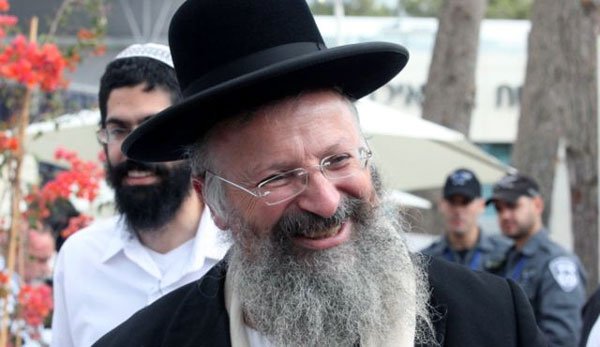
Chief Rabbi of the city of Safed, Shmuel Eliyahu
MEMO | October 16, 2015
Rabbis have declared the killing of Palestinian resistance fighters “a religious duty”, Israeli media reported.
Israeli news website Walla reported that right-wing rabbis replied to questions including: “Am I allowed to kick the insurgent, hit him or shoot him in order to kill him after he has been arrested or is this prohibited?”
Rabbi Rav Benzion Mutzafi replied: “It is not only desirable to do so, but it is a religious duty that you hold his head down to the ground and hit him until his last breath.”
Mutzafi expressed anger towards Rabbi David Staph’s response. Staph said it is prohibited for people to attack a Palestinian perpetrator of an operation after he has been injured or when he is posing no danger. Mutzafi responded: “Do not listen to Staph because those who have mercy on the cruel will end up being cruel toward the righteous.”
Chief Rabbi of the city of Safed, Shmuel Eliyahu called on all Israeli police officers and soldiers who allow Palestinian resistance fighters to live after their arrest:
“It is prohibited to keep the vandal alive after the operation, because if he is left alive, there is a fear that he would be released and then he would kill others,” Eliyahu wrote on Facebook.
Israeli forces in Jerusalem attack Palestinians at random
International Solidarity Movement | October 16, 2015
Occupied Palestine – The Old City of al-Quds (Jerusalem) in the last few weeks has witnessed an explosion of Israeli forces’ presence, supposedly for ‘security reasons’. But having a closer look at – or just opening your eyes for – the multitude of restrictions, hindrances and fears aroused by this, proves that all of this has nothing to do with ‘security’ – but everything with instilling fear in the Palestinians still resisting the manifold ways the Israeli forces are trying to expel them not only from the Old City of Jerusalem, but all of Jerusalem in general. … Full article
Settlers terrorize Palestinian farmers in Burin: burn trees and disrupt olive harvest
International Solidarity Movement | October 14, 2015
Burin, occupied Palestine – A Palestinian farmer and English human rights defender have been hospitalized and at least 40 olive trees burned following an attack by illegal Israeli settlers in the northern West Bank town of Burin today.
At 10am this morning, as ISM and other international volunteers accompanied olive farmers who have repeatedly been restricted from accessing their fields, gun shots were heard ringing out across the valley from the settlement above. Approximately thirty masked settlers from the illegal Yizhar settlement then descended the hill and started throwing stones at the group which had peacefully been picking olives for several hours. International human rights defender David Amos, a Quaker from London, was repeatedly attacked with rocks from three meters away, causing two head wounds and copious bleeding. The owner of the land, Abed Musaa, was hit in the front and back with stones and has been treated for lacerations and bruising. The attacking settlers also stole phones, a camera and a bag from the international human rights defenders.
The settlers were then witnessed setting four separate fires to grass on the edge of the olive groves which rapidly grew in dimensions, consuming olive trees and the grasslands between family plots. Two Israeli forces jeeps and two collaborating illegal settler vehicles drove into the valley, took photos of the scene, and then parked alongside each other on the road to Yizhar as more fires were lit by the masked settlers throughout the valley.
Israeli forces then scaled the valley and were witnessed saying to Palestinians, “yes you want peace, we want peace, they want peace,” referring to the settlers. Burin farmer and school teacher Doha and Samir were prohibited from continuing to pick olives on their land, being told they required a permit despite no legal provision to that effect, being within Area B zoning under the Oslo accords.
Palestinian firefighters were prohibited from accessing the fire for three hours, being told that a permit was required to utilize the road to the Yizhar settlement, which has been heavily restricted to Palestinian traffic in recent weeks. Palestinian civil workers, farmers, and international human rights defenders attempted to put out the blaze with sand, shovels, and olive branches but were unable to stop the spread of the fire amid 30 degree heat and rising winds.
Olives are a traditional produce of the Nablus district and constitute 25% of the West Bank’s economy (OCHA 2014). This critical October harvest season falls amid rising tensions in the West Bank, as Israeli forces increase their deployment of soldiers and use of violence in the occupied territories. The Yizhar settlement has also been implicated in the tragic [arson] death of 18 month old Ali Dawabsheh and his parents in the Palestinian village of Duma two months ago.
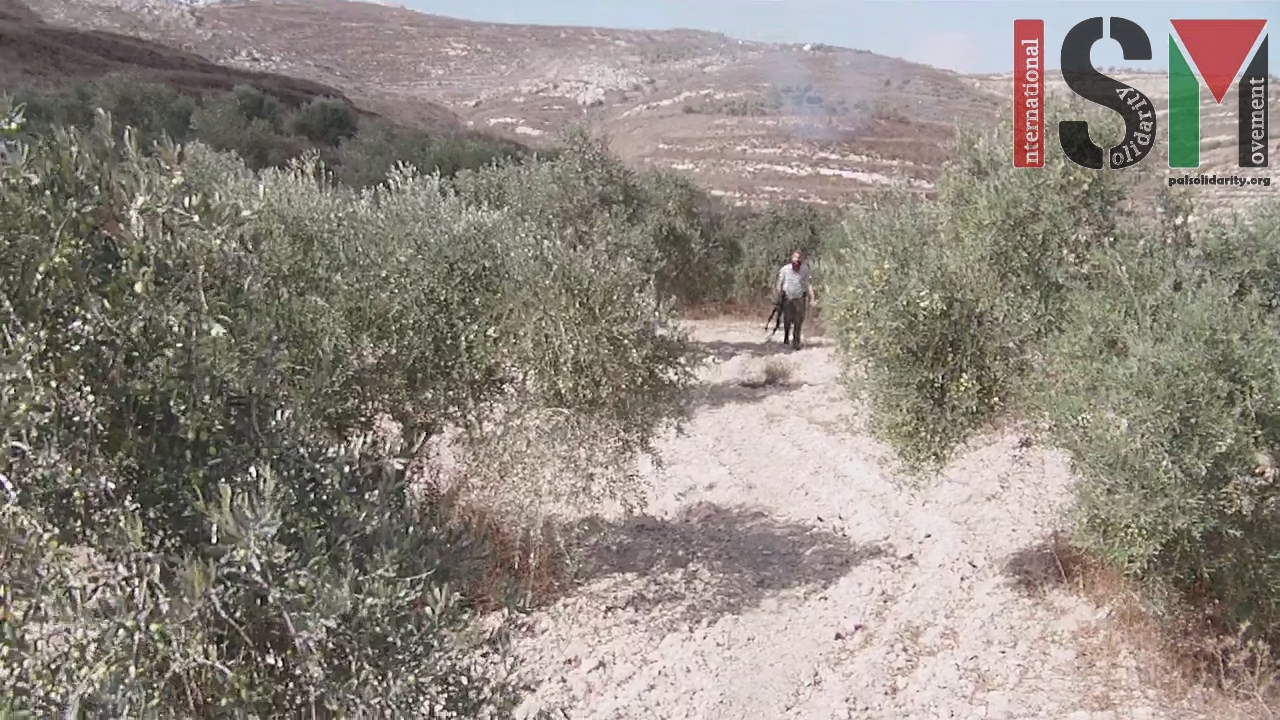
Armed illegal settler
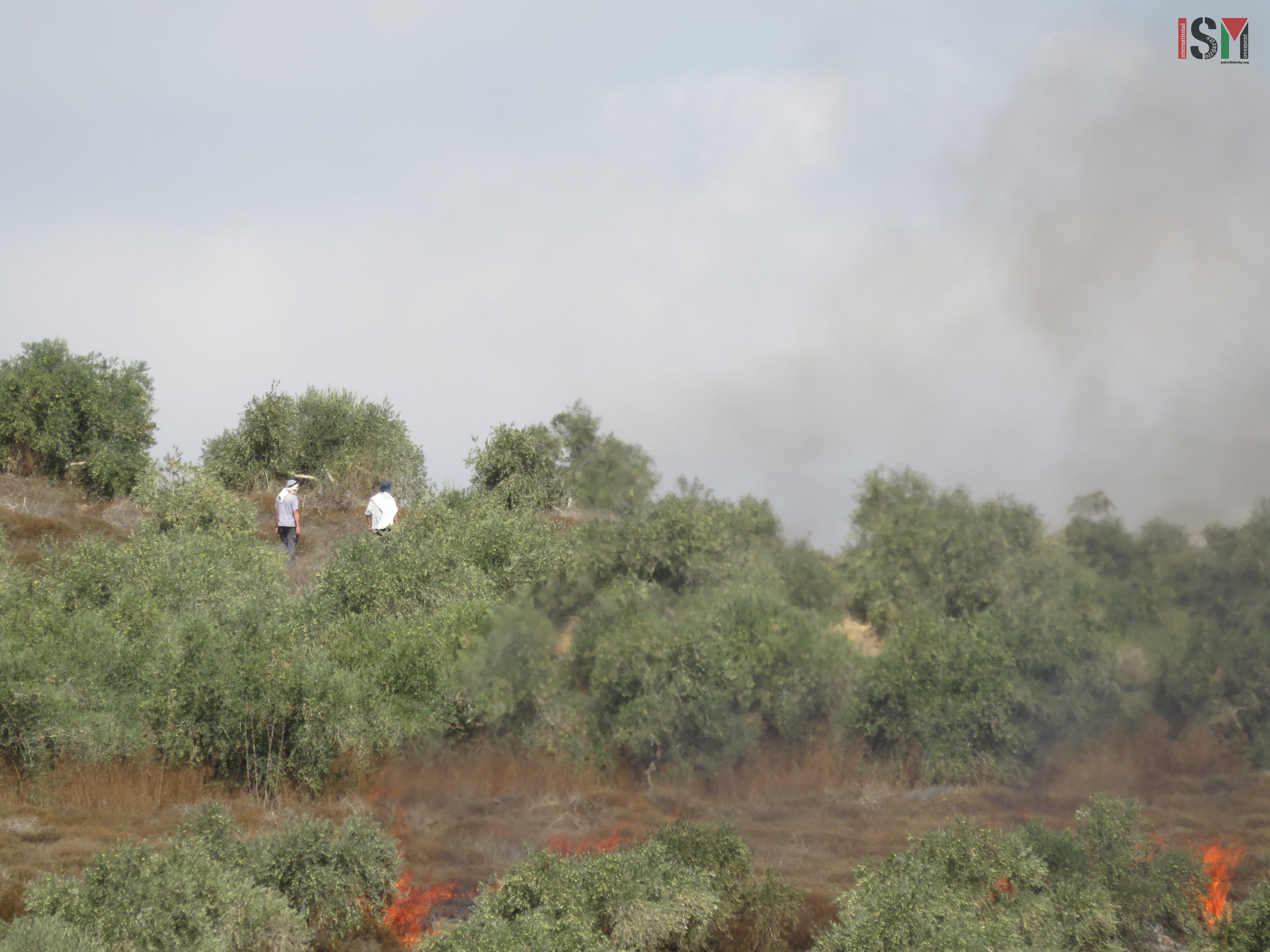
Settlers lighting fires throughout valley
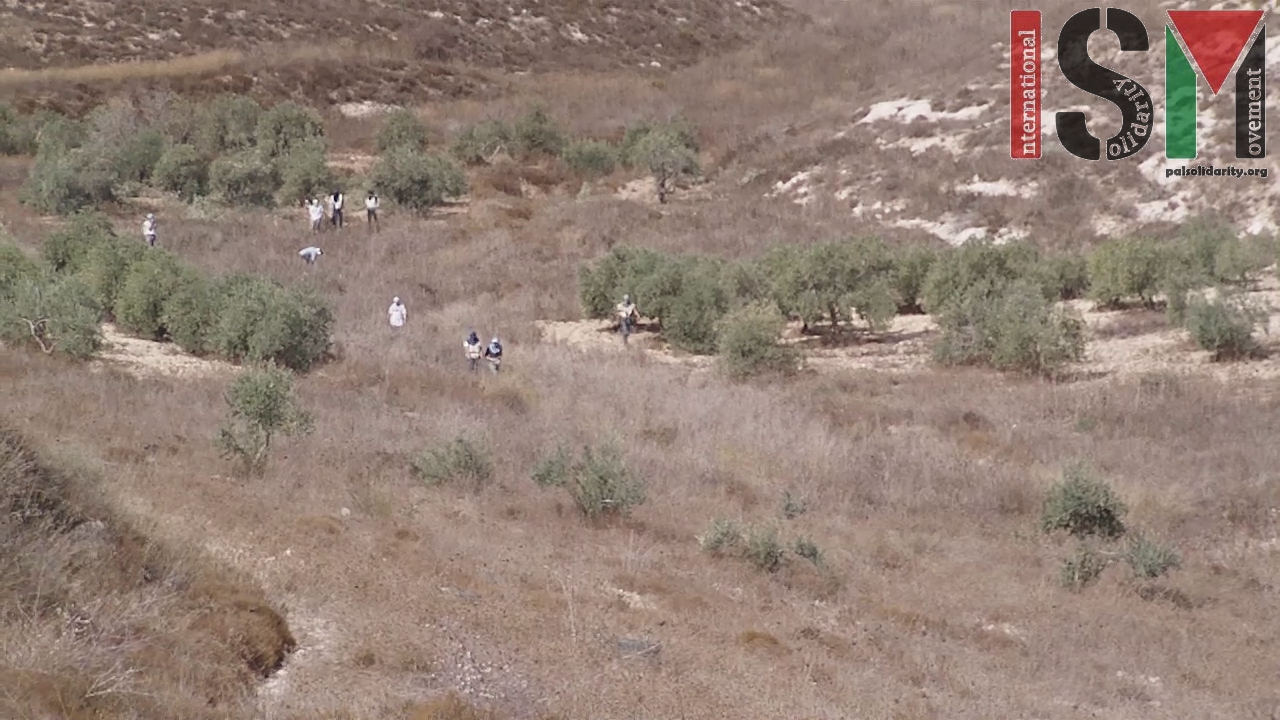
Masked settlers in the olive fields
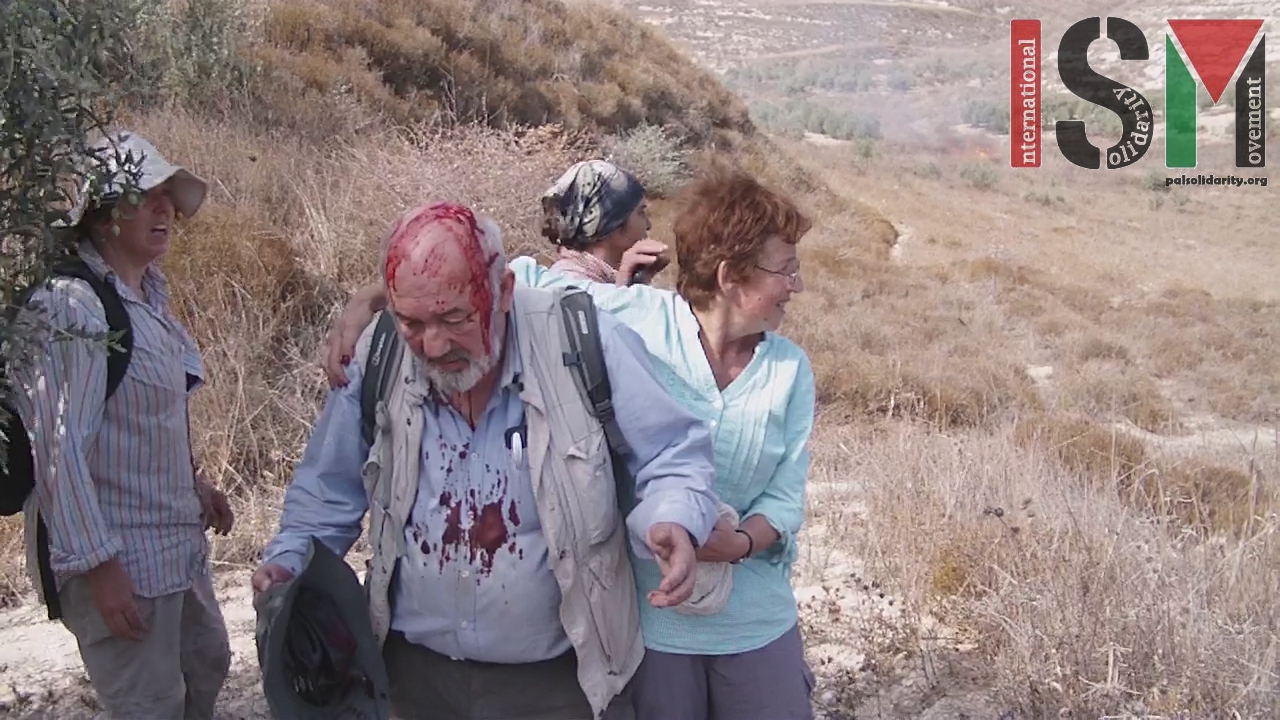
International human rights observer David Amos attacked by settlers
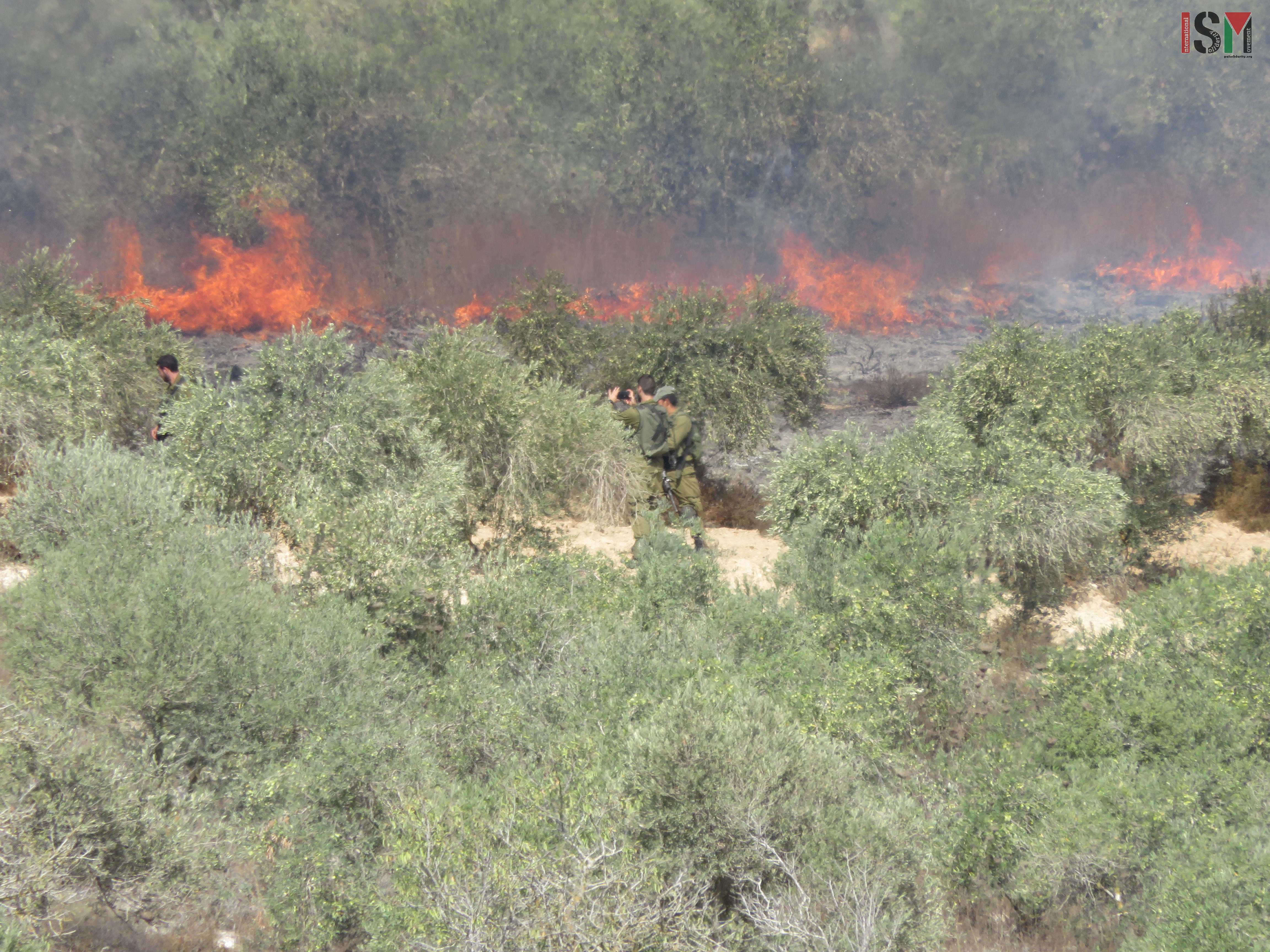
Israeli forces photograph fires
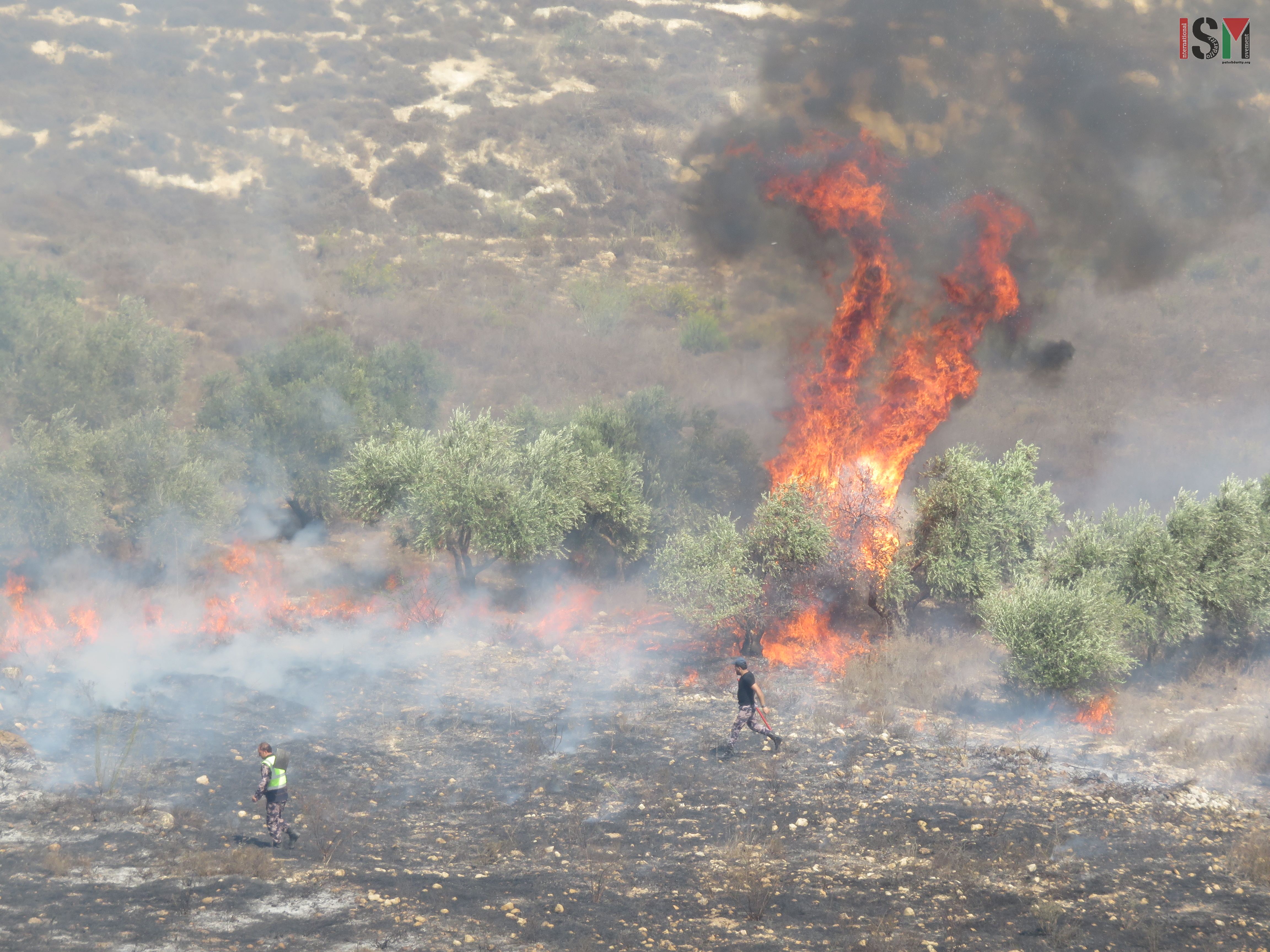
Palestinian civil workers attempt to put out fires while fire truck prohibited entry
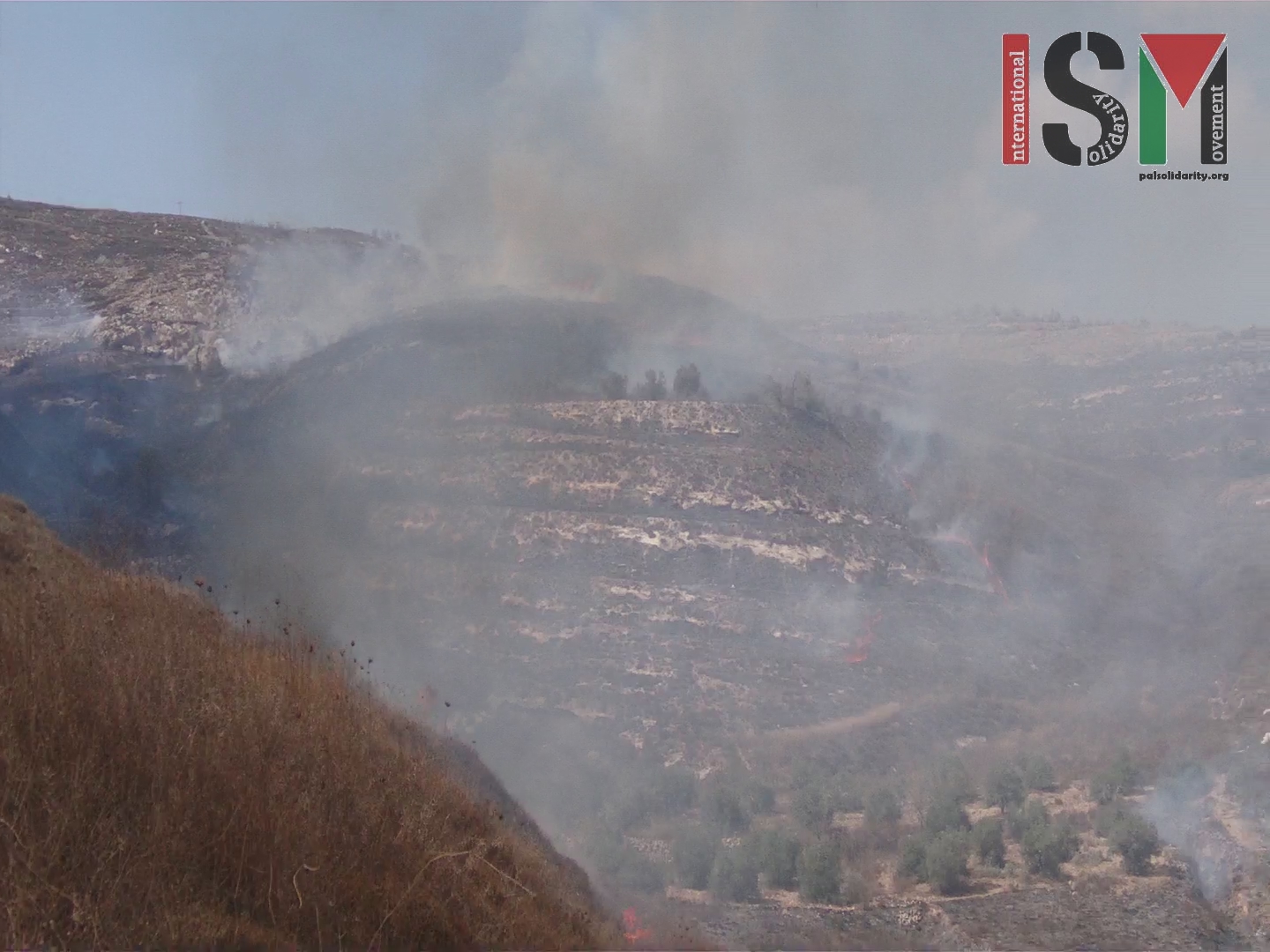
Fires rage across Burin valley
31 martyrs in 14 days: 14 year old murdered today in Jerusalem
International Solidarity Movement | October 14, 2015
The oldest was 30, the youngest just 2 years old.
31 Palestinians have been murdered by Israeli forces since an escalation in violence, triggered by restrictions on al Aqsa Mosque, spread like wild fire across the occupied Palestinian territories and the besieged Gaza strip. A 14 year old Palestinian boy, just shot to death by ten bullets close range near Jerusalem’s Damascus Gate joins 30 others martyred by their occupiers in just two weeks. As of now, the boy’s name is unknown though he is believed to be from al-Khalil (Hebron).
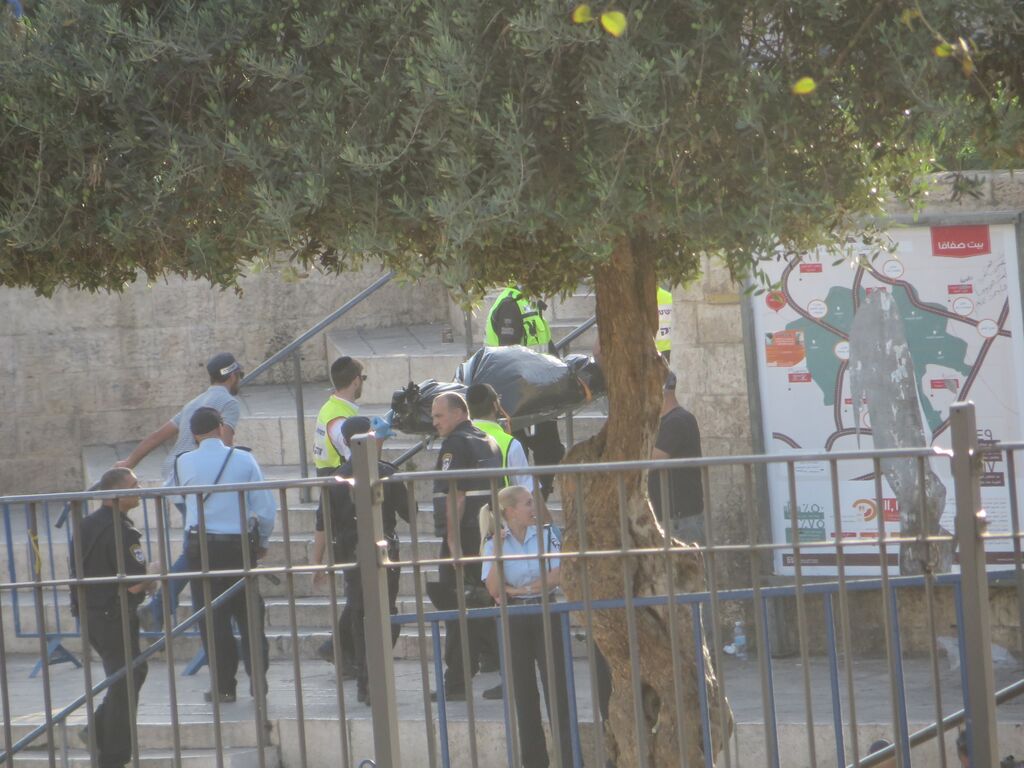
Body bag of 14 year old Palestinian boy murdered by Israeli forces is removed from the scene by Israeli police
The latest death comes amidst disturbing news that the Israeli government has passed a decision, as part of new restrictions being deployed in occupied East Jerusalem, that the bodies of Palestinian’s murdered by Israeli forces will not be released to their families. This adds agonizing and acute new cruelties to an already tragic, ongoing situation. The reason for the decision was stated to be a deterrent for post funeral demonstrations by Palestinians. Thus the refusal of Palestinian’s remains to their families is the refusal of the right to resistance of an illegally occupied people.
The decision is linked to measures currently being enacted in East Jerusalem where Israeli forces have set up checkpoints at the entrances to Palestinian neighborhoods beginning early Wednesday. As well, occupation forces were issuing citations to Palestinian drivers at random as well as inspecting several Palestinian youths and students in humiliating ways, forcing them to take off their clothes.
An international human rights monitor on the scene where the youth was killed noted that the he was shot to death after running from Israeli forces. Immediately after the shooting, Palestinians were threatened by Israeli forces with being beaten if they didn’t leave the area immediately, thus they were doubly frightened. Run and get shot, or don’t run and get beaten and possibly arrested. “People were too scared to put their phones in their trouser-pockets in fear they might be shot when taking them out.” Although Palestinians were threatened and chased from the scene, settlers were allowed to get close to the boy’s body to take photos.
Rather than taking measures to de-escalate the violence, Israeli officials and military have seemingly done the opposite. Israeli rights group B’Tselem has called the Israeli government’s response to recent escalation in the area as “the very inverse of what ought to be done” in realistic efforts to stop current violence. “The events of recent weeks cannot be viewed in a vacuum, isolated from the reality of the ongoing, daily oppression of 4 million people, with no hope of change in sight,” the group said in a statement on Tuesday.
Every death means a lifetime of suffering for the families left behind.
They are:
1. Mohannad Halabi, 19, al-Biereh – Ramallah.
2. Fadi Alloun, 19, Jerusalem.
3. Amjad Hatem al-Jundi, 17, Hebron.
4. Thaer Abu Ghazala, 19, Jerusalem.
5. Abdul-Rahma Obeidallah, 11, Bethlehem.
6. Hotheifa Suleiman, 18, Tulkarem.
7. Wisam Jamal, 20, Jerusalem.
8. Mohammad al-Ja’bari, 19, Hebron.
9. Ahmad Jamal Salah, 20, Jerusalem.
10. Ishaq Badran, 19, Jerusalem.
11. Mohammad Said Ali, 19, Jerusalem.
12. Ibrahim Ahmad Mustafa Awad, 28, Hebron.
13. Ahmad Abedullah Sharakka, 13, Al Jalazoun Refugee camp-Ramallah.
14. Mostafa Al Khateeb, 18, Sur-Baher – Jerusalem.
15. Hassan Khalid Manassra, 15, Jerusalem.
16. Mohamed Nathmie Shamassnah, 22, Kutneh-Jerusalem.
17. Baha’ Elian,22, Jabal Al Mokaber-Jerusalem.
18. Mutaz Ibrahim Zawahreh, 27, Bethlehem.
19. Unknown man from Jerusalem in his thirties. (no name was available until the time of his report )
Gaza Strip:
20. Shadi Hussam Doula, 20.
21. Ahmad Abdul-Rahman al-Harbawi, 20.
22. Abed al-Wahidi, 20.
23. Mohammad Hisham al-Roqab, 15.
24. Adnan Mousa Abu ‘Oleyyan, 22.
25. Ziad Nabil Sharaf, 20.
26. Jihad al-‘Obeid, 22.
27. Marwan Hisham Barbakh, 13.
28. Khalil Omar Othman, 15.
29. Nour Rasmie Hassan, 30.
30. Rahaf Yihiya Hassan, two years old.
The fourteen year old boy whose life was violently ended today in East Jerusalem brings the list to 31.
Israeli settlers shoot live fire at Palestinian homes
Ma’an – October 14, 2015
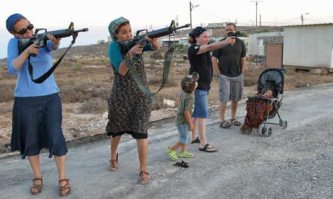 HEBRON – Israeli settlers on Tuesday attacked Palestinian homes in the Jabal Jalis area east of Hebron in the occupied West Bank, locals said.
Local sources told Ma’an that settlers from the illegal Givat Gal outpost opened live fire on homes in the village. No injuries were reported.
Attacks carried out by settlers on Palestinians in the occupied Palestinian territory are near-daily, and have increased in recent weeks after two settlers were killed near Nablus by suspected Palestinian gunmen on Oct 1.
The Palestinian government has no jurisdiction over Israelis living illegally in the occupied West Bank, and settlers often carry out attacks in the presence of armed Israeli forces.
Settlers clashed with Palestinians in Hebron on Sunday and Israeli forces reportedly intervened in the confrontation, shooting off tear gas and rubber-coated steel bullets at Palestinians. Several were injured with the rubber bullets, while others suffered from tear gas inhalation.
The day before, locals said that settlers attacked Palestinian homes in the Hebron-area village of Wad al-Hisn, spraying waste water and firing tear gas canisters while Israeli soldiers reportedly protected them.
According to the Palestinian Negotiation Affairs department, over 130 attacks were carried out by Israeli settlers in the first week of October.
Defending the Indefensible: How The NY Times Spins for Israel
By Barbara Erickson | TimesWarp | October 13, 2015
It’s a topsy-turvy world in The New York Times. Palestinians are dying, but it is Israelis who are fearful. Unarmed Palestinians face the threat of heavily armed settlers and security forces, but it is not Palestine that has a security problem; it is Israel.
This is the scenario we find today in a story by Isabel Kershner titled “Stabbings, and Deadly Responses, Add to Israel’s Security Challenge.” Here we learn that Israelis have a “shattered sense of personal security” after a series of lone-wolf stabbing attempts.
Kershner takes all the stabbing allegations as fact, rejecting any evidence to the contrary, and nowhere in this lengthy story do we find any concern for how Palestinians are feeling even though more than two dozen have been killed since Oct. 1 and more than 1,300 wounded (compared with four Israelis killed and some 28 wounded in the same time period).
Neither Kershner nor her editors find Palestinian vulnerability at all newsworthy. It is only Israeli sentiments that matter here.
Likewise, it is not the death of so many Palestinians that concerns the Times but the effect on Israel’s reputation. As Israel “resorts to live fire,” Kershner writes, the number of Palestinian deaths is mounting, and this fact “is increasingly opening Israel up to criticism, placing the government in a quandary.”
From then on her article is an attempt to defuse that criticism without giving readers a clear sense of what accusations have been made. She writes, for instance, that Amnesty International “has accused Israel of using excessive force,” as if this refers to past reports by the monitoring group but failing to mention a recent release about the current attacks.
In fact, Amnesty is one of three human rights organizations to speak out against trigger-happy Israeli forces in the past week. Human Rights Watch and Al Haq, a Palestinian group, also raised the alarm about the increasing violence against Palestinian civilians.
Amnesty’s report was titled, “No justification for deliberate attacks on civilians, unlawful killings by Israeli forces, or collective punishment of Palestinians.”
Kershner ignores the findings of all these reports and at the same time attempts to explain away the shocking brutality displayed by Israeli settlers and troops in several videos appearing on social media in recent days. “Some of the videos of police shootings have had the added effect of turning the Israelis, in the eyes of some people, from the victims of terrorism into aggressors,” she writes.
These videos (see here and here) show helpless and unarmed Palestinians surrounded by armed troops or angry mobs. In one of them a boy lies crumpled and bleeding on the pavement as Israelis shout at him, “Die, you son of a whore!” All of the Palestinians are either injured or killed, but once again Kershner’s concern is not for the victims in the videos but for Israel’s reputation.
Kershner concedes that Israelis may have gone too far in a couple of these cases, but she is quick to excuse their aggression as “panic” by traumatized individuals.
After trying to neutralize the effects of the videos and the human rights groups’ reports, Kershner turns her attention to alternative media. The accounts by these outlets have often contradicted the stabbing attempt allegations made by Israeli security forces.
Rather than reporting the contradictions, Kershner states that alternative news media have been “feeding the anger” of Palestinians by often denying that any attack took place. She is implying that these media are not to be trusted and that their reports are inciting Palestinian hostility.
As usual, the Times makes no effort to place the attacks in context, ignoring the ugly realities of the occupation and the enormous disparity in power between Palestinians and Israelis. Thus she implies that the attacks on Israelis arise out of hatred and lack any valid motive. Her reference to “feeding the anger” fits well into that narrative.
Missing from her article are the frequent settler mobs who march through Jerusalem and other cities chanting “Death to Arabs” while police and soldiers stand by to protect them. Kershner ignores this kind of incitement, preferring to stay with the Israelis-as-victims story line.
Israel is a nuclear power with sophisticated weapons and a standing army. Palestine has no army and not a single tank or aircraft, and its unarmed populace has suffered appallingly at the hands of the occupiers. The numbers show Palestinian casualties outnumbering those of Israelis by a ratio of more than 100 to 1 in the first week of this month.
Given all this, it takes some effort to convince readers that Israel—not Palestine—faces a “security challenge.” Kershner, with the blessing of the Times editors, has made that effort, providing us with a story that distorts the reality on the ground, ignoring journalistic standards and the ethical demands of compassion.
Israel blocks delivery of Indian gift to Palestinian university
Press TV – October 13, 2015
The Israeli regime has confiscated four communication systems that were to be given by Indian President Pranab Mukherjee to a Palestinian university as gifts during his first ever visit to the Israeli-occupied Palestinian territories.
On Monday, Israeli customs authorities held back the systems and prevented their delivery to the Information Technology (IT) department of al-Quds University, which is scheduled to be inaugurated by Mukherjee on Tuesday.
Israel’s customs released 30 computers that were part of Pranab’s gift to the Palestinian educational institution, but the communication systems were not cleared.
Mukherjee’s trip to Palestine comes amid simmering tensions between Israeli forces and Palestinian protesters.
At least 27 Palestinians have been killed and hundreds of others injured by Israeli troops in the West Bank and the Gaza Strip since October 1.
The tensions were triggered by the Tel Aviv regime’s imposition on August 26 of sweeping restrictions on entries into the compound of the al-Aqsa Mosque in East al-Quds (Jerusalem) and Israeli settlers’ repeated stormings of the mosque.
Featured Video

The Search for Truth: Charlie Kirk’s Assassination One Year Later
or go to
Aletho News Archives – Video-Images
From the Archives
The 9/11 “Double-Cross” Conspiracy Theory
BY LAURENT GUYÉNOT • UNZ REVIEW • SEPTEMBER 6, 2022
Is it true that “9/11 was an inside job”? Yes, insofar as Israel is “inside” the U.S. But for the 9/11 truthers who have identified Israel as the main perpetrators, “9/11 was an inside job” is at best a half-truth, and at worst an integral part of the Zionist operation, like a secondary flag sewn as a lining under the false flag of Islamism. Victor Thorn (1963-2017) wrote in his book 9/11 made in Israel: The Plot Against America (2011): “In essence, the ‘9-11 truth movement’ was created prior to Sept. 11, 2001 as a means of suppressing news relating to Israeli complicity. . . . The slogan ‘9-11 was an inside job’ was quite possibly the greatest example of Israeli propaganda ever devised.” In milder terms, it is “controlled opposition”.
A genuine truth movement would have pointed to Israel as the prime suspect from the start. From day one, it was obvious who would benefit. … continue
Blog Roll
 Aletho News
- Europe’s mounting social chaos… chickens coming home to roost for proxy war against Russia
- US-Russia Diesel Deal Becomes Massive Defeat for Ukraine
- Hormuz and the Looming Economic Catastrophe
- Dhubab offensive, media blitz and the rapid unraveling of Saudi-backed coalition’s new gambit
- Putin Conveys to Trump Iran’s Vision on Possible Conflict Resolution – Kremlin
- The Search for Truth: Charlie Kirk’s Assassination One Year Later
- ‘Harsh reality’: Iran says France seeks monopoly on power and intimidation, not peace for all
- When Will This White House Madness End?
- Huckabee aide goes to ‘unusual lengths’ to portray ‘Israel’ positively
- Trump Announces Diesel Supply Deal With Putin Following Phone Call
- If Americans Knew
- Israeli forces kill another child in Gaza – Daily Update
- Gaza ceasefire exists in name only, say more than 100 organizations
- Nearly 2 Million in Gaza Need Urgent Shelter Assistance as Winter Looms: IOM Chief Warns
- Suppressing Palestinian resistance: US charity under fire for AI monitoring of Gaza classrooms
- Thousands Are Held in Israeli Torture Camps. This Is What Happens Inside
- Israel puts Gaza’s sick, injured, newborn in peril – Daily Update
- Report claimed Mark Levin used by Israeli government to influence Trump
- Over 2,000 Gazans have died awaiting medical evacuation amid Israel’s continued siege
- How a U.S. Diplomat Suppressed and Altered Reports Critical of Israel
- 5 Palestinians Die from Israeli Strikes in Gaza as Relentless Attacks Continue
- No Tricks Zone
- New Study: 50 Years Of The Most Aggressive ‘Net Zero’ Policies Can Only Affect The Global Climate By 0.03°C
- US September “Heat” Was No Record…Many Records Set Decades Ago
- Latest European Green Energy Debacle; Portugal’s Largest Flagship Solar Park Insolvent!
- Green Energy Debacle: German Expert Professor Fritz Vahrenholt Warns Of Severe Economic And Social Consequences
- Two More Paleo Reconstructions Affirm Meters-Higher Sea Levels Across Ireland, Brazil 7000-6000 Years Ago
- New Study: Earth And Venus Surface Warmth Largely Explained By Convection And Lapse Rate, Not CO2 Or Radiation
- 2025 Nature Paper Claiming Worsening Global Drought Gets RETRACTED …Heavily Flawed
- New Study: ‘Global Drought Shows No Detectable Recent Acceleration Under Climate Warming’
- Economic Masterminds: German Socialists Suggest Taxing Productivity Gains Stemming From Using AI
- The South China Sea Has Not Been Cooperating With The Climate Change Narrative

