Geneva Convention meeting goes ahead, criticises Israeli violations
MEMO | December 18, 2014
The High Contracting Parties to the Fourth Geneva Convention urged an end to violations of international law in the Occupied Palestinian Territory (OPT) following a conference Wednesday.
The special Geneva meeting, hosted by the Swiss government, saw representatives from 126 state parties adopt a ten-point declaration that reaffirmed international humanitarian law and the applicability of the Fourth Geneva Convention in the OPT, something that Israel denies.
The declaration urges Israel “to fully and effectively respect the Fourth Geneva Convention in the Occupied Palestinian Territory, including East Jerusalem”, and stresses its “obligation” to administer the OPT “in a way which fully takes into account the needs of the civilian population.”
The parties went on to express “deep concern about the impact of the continued occupation”, specifically singling out Israel’s Wall and associated regime as “contrary to international humanitarian law”, along with “the closure of the Gaza Strip”.
The declaration also affirmed “the illegality of the settlements in the said territory and of the expansion thereof and of related unlawful seizure of property as well as of the transfer of prisoners into the territory of the Occupying Power.”
Speaking after the meeting, Swiss ambassador Paul Fivat hailed the declaration as “unprecedented”, and a “signal which is being sent to conflicting parties and especially to the civilian populations that there is a law, international, which is protecting their interests.”
Fivat clarified that “the declaration binds only the parties who were [present]”, with Israel, the U.S., and Canada, examples of “a small of number of High Contracting Parties” who “expressed their opposition and did not attend the Conference.”
In the lead up to Wednesday’s gathering, Israel tried to persuade the parties to the Convention to not convene the summit at all, even sending officials several times to Bern and Geneva.
In response to the conference yesterday, Israel’s UN mission claimed that “it confers legitimacy on terrorist organizations and dictatorial regimes wherever they are, while condemning a democratic country fighting terrorism in accordance with international law.”
Palestine’s Permanent Mission in Switzerland, meanwhile, praised the declaration, stating that “legal actions, including through universal jurisdiction and international criminal justice mechanisms” are necessary to hold Israel “accountable for its decades of violations of international law.”
Israeli human rights NGO B’Tselem described the declaration as a reflection of “the illegality of the ongoing occupation and its attendant human rights violations”, the “baselessness of Israel’s claims of compliance with the Fourth Geneva Convention”, and of “Israel’s ever deteriorating international status as the violations persist.”
Kerry: US will veto Palestinian bid for statehood
MEMO | December 17, 2014
 US Secretary of State John Kerry is reported to have informed the Palestinian delegation headed by Saeb Erekat that Washington will use its veto power at the UN Security Council against the Arab draft resolution which calls for an end to the Israeli occupation of the Palestine territories occupied in 1967; AFP quoted a senior Palestinian official as saying.
Kerry had earlier said that Washington has not decided on the Security Council draft resolution saying: “The time is not right for speculation about a UN draft resolution that has not been submitted yet.”
He told reporters before his meeting with Erekat that it was imperative to help lower tensions. “Many of us share a deep sense of urgency about this. But we’re also very mindful that we have to carefully calibrate any steps that are taken for this difficult moment in the region,” he said.
Al-Jazeera’s Bureau Chief in Ramallah Walid Al-Omari said the Palestinian leadership delayed a meeting scheduled yesterday and will wait for the outcome of a meeting between the Palestinian delegation and a delegation of Arab foreign ministers, headed by Nabil Elaraby, with the US secretary of state and European foreign ministers.
On Monday Israeli Prime Minister Benjamin Netanyahu met with Kerry in Rome. Israel’s Channel 10 said that Netanyahu attempted to push the US to use its veto against the Palestinian draft resolution.
Palestinian woman who stabbed Israeli settler was defending herself: official
Al-Akhbar | December 17, 2014
A Palestinian woman suspected of stabbing an Israeli settler on December 1 was defending herself after being harassed by the man, a Palestinian official claimed Tuesday.
Amal Jamal Taqatqa, 22, was shot and critically wounded by soldiers near Gush Etzion on December 1 after allegedly stabbing an Israeli settler.
The director of Bethlehem’s military liaison department told Ma’an news agency that officials requested an investigation into the shooting, but that it has been delayed due to the political atmosphere.
“Is it reasonable that 46 surveillance cameras in Gush Etzion settlement bloc have failed to document what really happened between Amal Taqatqa, 22, from Beit Fajjar and an Israeli settler who claimed that she attempted to stab him?” Khaled Qaddura said.
Taqatqa reportedly engaged in a hand-to-hand fight with the settler after he verbally abused her, causing a minor scratch to the settler’s neck, Qaddura said.
“At that point, the settlers asked an Israeli soldier who was in the area to shoot the girl, and the soldier immediately shot her in the chest. The girl fell to the ground then tried to get up and run away, but the soldier shot her again in the feet causing her to fall down again then he approached her and shot a last round,” the official added.
Taqatqa is still receiving medical treatment at Hadassah hospital and is in a stable condition.
Qaddura slammed Israel’s labeling of Taqarqa as a “terrorist”, noting that the term “terrorism” is used automatically when Israelis – whether civilians or soldiers – are injured.
He urged Palestinians who witness such incidents to film them or record the registration number of the military vehicles involved.
Unrest has gripped Jerusalem and the West Bank on an almost daily basis for the past five months, flaring up after a group of Zionist settlers kidnapped and burned a young Palestinian to death because of his ethnicity, and worsened by the deadly Israeli assault on the Gaza Strip in July and August.
(Ma’an, Al-Akhbar)
No donkeys allowed
International Solidarity Movement |December 17, 2014
Hebron, Occupied Palestine – Mohammad Saleh, a sixty-six-year-old Palestinian resident of Tel Rumeida, al-Khalil (Hebron), waited with his mule outside Shuhada checkpoint for nine hours over the course of two days. He spent four hours waiting before being allowed through on Monday (15/12/14) evening.
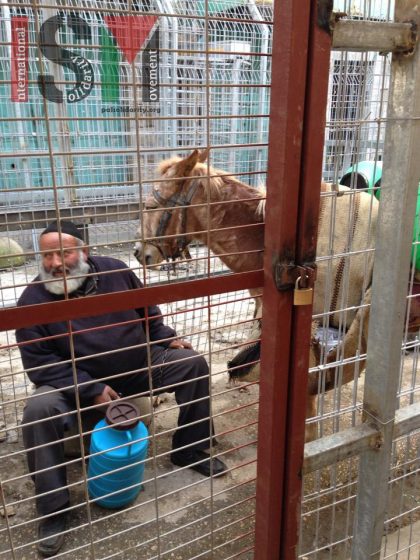
He then spent five hours Tuesday (16/12/14) attempting to cross in the opposite direction before eventually turning back, after being denied repeatedly by Israeli forces claiming that donkeys, mules, horses, and carts are not permitted to pass through the checkpoint.
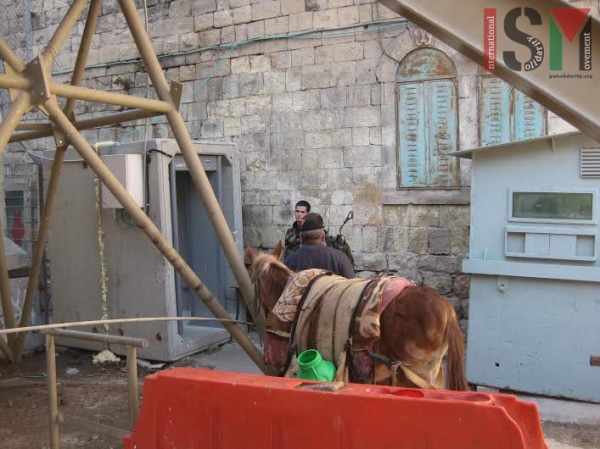
Shuhada checkpoint serves as the only clear passage between the H2 (Israeli-controlled) neighbourhood of Tel Rumeida and the H1 (Palestinian Authority-administered) neighbourhood of Bab Al-Zawiye, a route many Palestinians must traverse regularly in the course of their work and daily routines.
Mohammad arrived at the Bab Al-Zawiye side of the checkpoint at 13:40 on Mondayafternoon, his mule laden with empty milk jugs and saddlebags packed with various provisions. Israeli forces refused to let him through, claiming no animals were allowed past the checkpoint – a claim no one, including other international organisations at the scene as well as the Palestinian District Coordination Office for al-Khalil, had ever heard before.
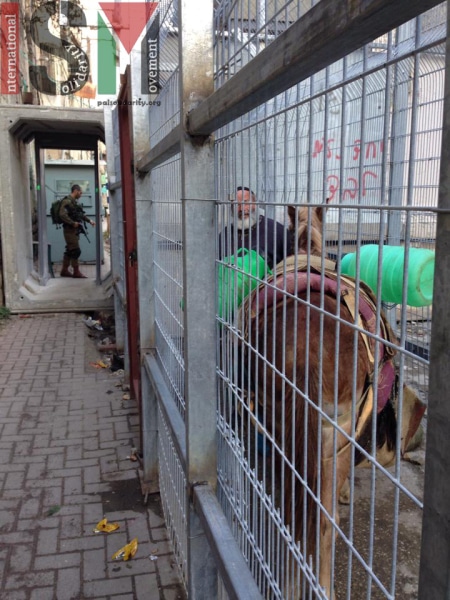
Mohammad explained that he had been allowed pass the checkpoint on Monday morning, with the promise that he would be let back through later in the day. When he returned, he found a new shift of soldiers and no one willing let him pass. The soldier manning the checkpoint claimed he needed permission from his commander to open the gate, which would allow Mohammad to pass with his mule.
An ISM volunteer at the scene later received a call explaining that the Israeli military’s new rule stated that horses, donkeys and mules were not permitted to pass through the checkpoint. No one, however, was able to explain why Mohammad had been allowed through that morning, but denied on his way home. “Look at my ID,” he told the soldier at one point, “I’m in your computer. I go through here all the time.”
He stayed waiting, sitting beside his mule on the cold concrete base of the fence, even as the afternoon turned into evening. The sky grew dark, though the lights from the checkpoint still illuminated the fences,
turnstiles, and barbed wire. Even the soldier seemed concerned, telling him to please go home, as it was cold and late and staying would not help him. But Mohammad had already made it clear he would not leave. About ten minutes later the soldier finally opened the gate, saying it was the “last time” that he would be allowed through. Although Mohammad heard the soldier’s message, it was clear he would not heed it. He intended to continue to resist, no matter what anyone told him.
Sure enough, the following morning he was once again standing outside the checkpoint, this time on the Tel Rumeida side, with full milk jugs tied to the back of his patient mule. The soldiers presented multiple reasons from denying him passage, from a prohibition on taking anything through the checkpoint too large to be carried through the turnstile, to the new rule against allowing donkeys, horses and mules through. ISM volunteers attempted to find a solution, offering to carry the milk jugs around the checkpoint and meet Mohammad and his mule on the other side. The Israeli soldiers manning the checkpoint rejected all suggestions.
“Is the donkey the problem or the milk the problem?” One ISM activist eventually inquired.
“The donkey’s the problem,” a soldier replied.
The animal could have easily passed through the metal detector; only last night ISM activists had witnessed the ludicrous sight of Mohammad’s mule strolling through the concrete structure, empty milk jugs banging against the corners of the gateway. The turnstile served as the only obstacle to the his passage – an obstacle the soldier could easily remove by opening the gate on the other side of the metal detector and letting the mule pass around the turnstile and into Bab Al-Zawiye.
After five hours of waiting, Mohammad’s comment seemed by far the most accurate. “The soldiers are the problem,” he had responded in Arabic.
Barring donkeys, mules, and horses and carts is only the latest in a string of frustrating, humiliating regulations imposed on the people living near the checkpoint, who must pass through to work, study, and shop for essentials such as fresh food. Just a few days earlier a group of elderly Palestinians, ill people, young children, and teachers at a local school had also been forced to wait, some for up to three hours, before being allowed through.
When Israeli forces shut down the checkpoint after it was burnt nearly a month ago , barring most people from passing through for over three weeks, the Palestinians were forced to adapt. Local people know ways around the checkpoint; several paths lead through local families’ yards and over the walls and rubble between Tel Rumeida and Bab Al-Zawiye. These “rabbit runs,” however, are entirely unsuited to traveling through with a mule – as well as for anyone sick, elderly, or carrying large heavy objects.
Since the attempted burning of the checkpoint, the Israeli military rebuilt it larger and with more obstacles for anyone traveling through. One side now has a metal detector, and both sides are equipped with vertical metal turnstiles which are a major impediment to anyone trying to move through with large baggage. Soldiers continue to use the burning of the checkpoint to justify collective punishment imposed on the entire Palestinian population – young and old, men and women, healthy and ill – who live or work near the Shuhada checkpoint.
Any Palestinian might be stopped while attempting pass through. Even with the checkpoint officially open, far too many are. Soldiers regularly search bags and make people remove their belts and empty their pockets before being allowed through. These everyday humiliations accompany frequent ID checks and detentions, serving as an inescapable reminder of the illegal Israeli occupation. Soldiers present at checkpoints routinely cite newly imposed rules and orders from superior officers as reasons for denying people passage, but whether someone passes easily through a checkpoint or must wait for hours often seems to be determined by nothing more than the soldiers’ caprice.
Many Palestinians must pass through Shuhada checkpoint multiple times in a day, carrying items as diverse as fresh vegetables, tubs of oil, and gas for cooking and heating their homes. During the hours ISM volunteers stood waiting with Mohammed, they witnessed multiple people struggle with the cumbersome design of the rebuilt checkpoint. One woman was carrying too many grocery bags to be able to fit into the turnstile. Someone on the other side of the turnstile had to reach a hand between the metal bars and move one bag through, returning it to the woman once she had passed. Another Palestinian, this time a young boy, needed the help of multiple passers-by over several minutes to figure out how to get two tubs of oil and a metal trolley through the turnstiles. Soldiers denied passage outright to boys who wanted to walk through the checkpoint with their bicycles.
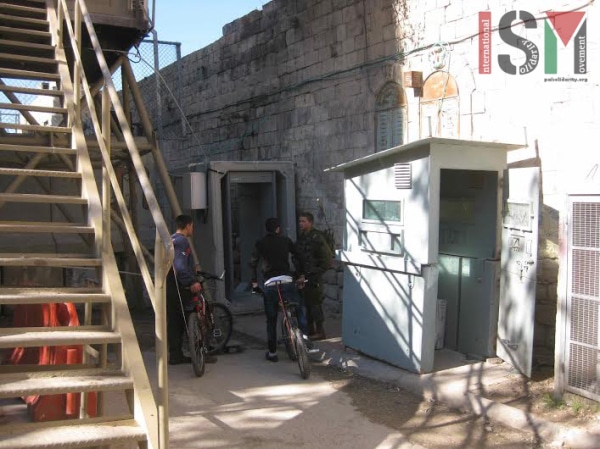
At one point on Monday night, a group of off-duty soldiers ran up Shuhada street and stopped near the checkpoint to rest, stretching and laughing, their easy freedom of movement a stark contrast to experiences of Palestinians struggling through Shuhada checkpoint. Almost all of Shuhada street has been closed off to Palestinians, reserved instead for the settlers and soldiers occupying H2. Even Palestinians who manage to get through the checkpoint must pursue long, circuitous routes between the surrounding areas of al-Khalil. Many, especially the elderly or disabled, are effectively barred from traveling to significant portions of the city their families have lived in for generations.
“I want to resist,” Mohammad told the ISM activists the first day they waited with him. He made sure the man translating said it twice, to make sure the ISM volunteers understood. “I want to resist,” he said, after over three long hours of waiting to be allowed through.
Israel seeks assurances of US veto ahead of Palestinian push for UN resolution
Al-Akhbar | December 16, 2014
 US Secretary of State John Kerry will meet chief Palestinian negotiator Saeb Erekat and a delegation from the Arab League in London Tuesday, hoping to avert a diplomatic crisis over a United Nation bid to force Israel to withdraw from West Bank and East Jerusalem.
Kerry will seek to persuade the Palestinians not to move ahead with a draft UN resolution seeking to set a two-year timetable for an end to the Israeli occupation of territories being considered for a Palestinian state as part of a two-state solution.
Israel has occupied East Jerusalem and the West Bank since the 1967 Middle East War. It later annexed Jerusalem in 1980, claiming it as the capital of the self-proclaimed Zionist state – a move never recognized by the international community.
Kerry has spent the past two days jetting across Europe meeting his counterparts as well as Israeli Prime Minister Benjamin Netanyahu to gauge support for the Palestinian effort at the UN Security Council.
Netanyahu said late on Monday that growing European backing for a two-state solution could harm Israel.
“I said that the attempts of the Palestinians and of several European countries to force conditions on Israel will only lead to a deterioration in the regional situation and will endanger Israel,” he said in a statement.
“Therefore, we will strongly oppose this,” he added.
There is growing European impatience with the current status quo in the Israeli-Palestinian conflict, as several European parliaments in recent weeks have called on their governments to symbolically recognize a state of Palestine.
Netanyahu sought assurances from Kerry that Washington would block efforts by Palestinians and Europeans on Palestinian statehood.
“Our expectation is that the United States will stand by its position for the past 47 years that a solution to the conflict will be achieved through negotiations, and I do not see a reason for this policy to change,” Netanyahu told reporters after a meeting in Rome that lasted some three hours.
The two men “had a long and thorough discussion about Israel’s security and developments at the United Nations,” a State Department official said.
Before the meeting, Israel put the US on notice that it expected Washington to exercise its UN Security Council veto against any resolutions setting a time frame.
Netanyahu declined to comment on whether he was given an assurance by Kerry that the US would exercise its veto.
A source with knowledge of the talks who spoke on condition of anonymity said the Israeli leader had indeed asked for such an assurance.
Meanwhile, a senior State Department official said Washington had made clear in discussions that it would oppose certain moves.
“We’ve made clear throughout these discussions with all of our interlocutors that there are certain things we could never support. (I’m) not going to outline those publicly,” the official said.
The US administration opposes moves, like a UN resolution, that it says would bind negotiators’ hands – particularly any attempt to set a deadline for the withdrawal of Israeli troops from the West Bank.
But a US veto risks running contrary to Washington’s avowed aim of a Palestinian state and would anger key Arab allies – many of whom are much-needed partners in the US-led coalition against Islamic State of Iraq and Syria (ISIS) militant group.
Arab countries, however, have long been silent on the Palestinian cause or merely used it as a rhetorical talking point.
US officials have indicated that Washington did not find the Palestinian draft acceptable, but said that with matters still fluid, it was premature to take a position now on any particular Security Council resolution.
“Whether we have the nine votes at the Security Council or we don’t, the decision has been taken to present the Palestinian-Arab resolution in the Security Council on Wednesday,” said Wassel Abu Yousef, an official of the Palestine Liberation Organization, one of the highest Palestinian decision-making body, led by Palestinian Authority President Mahmoud Abbas.
Palestinian UN Ambassador Riyad Mansour said that “on Wednesday, most likely a draft will be put in blue.” This means the draft resolution could be put to a vote as soon as 24 hours later, though it does not guarantee it will be put to a vote.
Jordanian UN Ambassador Dina Kawar said she had not received any requests regarding action on the Palestinian draft.
When asked if she was expecting any developments at the Security Council this week, Kawar told reporters: “No, no, because Mr. Kerry is having meetings in Europe with a number of ministers, so we’re waiting to see what happens.”
From Rome, Kerry traveled to Paris to meet with counterparts from Britain, Germany and France to discuss their efforts to draft a separate UN resolution to end the Israeli-Palestinian conflict.
US officials said there was no consensus among the European powers on the best way to proceed.
Diplomatic sources say Paris is hoping to persuade the divided Palestinians to back their compromise resolution, rather than risk a US veto of the more muscular Arab version presented by Jordan last month.
French Foreign Minister Laurent Fabius told AFP they were looking for “a resolution which everyone can get behind.”
“Even if the Palestinians have a text in their hand, the Americans have already said that they will veto it,” Fabius said.
UN Middle East peace process envoy Robert Serry briefed the Security Council on Monday and said any resolution outlining the parameters of an Israeli-Palestinian final status agreement would be important, but “not a substitute for a genuine peace process that will need to be negotiated between both parties.”
In November 1988, Palestinian leaders led by Yasser Arafat declared the existence of a state of Palestine inside the 1967 borders and the state’s belief “in the settlement of international and regional disputes by peaceful means in accordance with the charter and resolutions of the United Nations.”
Heralded as a “historic compromise,” the move implied that Palestinians would agree to accept only 22 percent of historic Palestine, in exchange for peace with Israel. It is now believed that only 17 percent of historic Palestine is under Palestinian control following the expansion of illegal Israeli settlements.
It is worth noting that numerous pro-Palestine activists support a one-state solution in which Israelis and Palestinians would be treated equally, arguing that the creation of a Palestinian state beside Israel would not be sustainable. They also believe that the two-state solution, which is the only option considered by international actors, won’t solve existing discrimination, nor erase economic and military tensions.
(AFP, Reuters, Al-Akhbar)
Why Hamas should not heed calls to amend charter
By Ibrahim Al-Madhoun | Al Resalah | December 15, 2014
The Hamas Charter is considered by the movement’s supporters as a key and stand-alone historical document pertaining to Hamas’s political and social ideology. In the event that this document is altered or amended, it would cause a state of undue and untimely confusion and tension within the ranks of the Hamas supporters. It would also be seen as a concession to international and Israeli pressures, even if the changes made to the charter were not substantial or even if the new charter was more extreme in crucial issues such as the recognition of Israel or dealing with international proposals. As long as such amendments form part of international demand or foreign advice, then any response to these demands will be seen as a concession and a weakness in the eyes of both Hamas’s supporters and the movement’s political opposition. It will also send a message to international forces that soft pressure on the movement actually works.
In addition to this, no amendment to the charter would sufficiently please the international community beyond altering the core of the Hamas’s political thought. No changes to the charter would satisfy Western forces unless they explicitly recognise the two-state solution and clearly accept the legitimacy of the continued existence of the Israeli state on Palestinian territories, while shunning the Palestinian national struggle in all its forms. From a strategic regional and international perspective, unless making concessions to these specific points there is no point in changing the charter, as such change may ultimately crack the intellectual infrastructure of Hamas and cause severe repercussions affecting its survival.
Palestinians still remember Fatah’s ill-fated political acquiescence, particularly the amendment of the organisation’s charter under the supervision of Yasser Arafat in 1996 to appease Bill Clinton. Although Fatah changed the PLO Charter under US pressure, it did not reap the fruits of this change and it ultimately did not serve the Palestinian cause. Instead, it caused disappointment and decline; a fate which may well befall Hamas if it makes the same mistake.
Although it may be true that some of Hamas’s positions need to be clarified, the best way to do this would not be to change the existing charter but to issue a new document explaining the movement’s strategic vision over a specified period of time. However, this document must be clear and understandable, devoid of any extra words and without any dense literary jargon. It must be focused on the clear political matters at hand and keep pace with social and political developments in the Palestinian arena, allowing for changes over the next five to ten years.
All political entities have their literatures and philosophies that serve to carry and propagate their core values and that cannot be altered; they must remain as a foundation stone and intellectual inheritance for all new recruits. Such entities can later be developed through practice, conflict, and building relationships, but their core values always remain the same. No one truly believes that changes to Hamas’s charter would bring respect, acceptance and understanding from the international community. This community only understands the language of power and force through the ability to raise some voices and silence others. And Hamas must not allow itself to be covertly silenced in such a way.
Translated by MEMO, 15 December, 2014
128 Journalists Killed so Far This Year
teleSUR | December 15, 2014
At least 128 journalist have been killed so far in 2014, according to the findings of the Swiss-based Press Emblem Campaign in its annual report released Monday.
While the deaths occured in some 32 countries, the Palestine-Israel conflict has been the most dangerous for the coverage this year “with 16 journalists killed by Israel during the Operation Protective Edge.”
The 2014 total is one more than last year’s record, yet the number is perceptibly growing since the organization started to track the figures in 2006. Since then, over 1,000 journalists and reporters have been killed.
This situation for journalists worsens as armed conflicts continue without reaching a political solution, emphasized PEC director Blaise Lempen. In these scenarios, journalists are increasingly being taken as hostages.
The most dangerous countries over the past five year-period have been Syria, Pakistan, Mexico, Iraq and Somalia.
Latin America is the third most violent region with 27 journalist killed after Middle East (46) and Asia (31), and includes three countries in the top 10 most dangerous places for journalists (Mexico ranks 6th, Honduras 7th and Brazil 10th). Paraguay, Peru and Colombia are also noted in the report.
The authors explain that have been taking into account both “journalists intentionally targeted in the exercise of their profession as well as those killed accidentally and otherwise unintentionally,” arguing that the cause of the death was difficult to determine.
However, half of the journalists killed in 2014 are estimated to have been targeted intentionally by governments, various armed groups or criminal gangs.
Israeli crimes continue in al-Quds
Israel continues its widespread crackdown on the Palestinian residents of East Jerusalem al-Quds. The rights groups have dubbed Israel’s crackdown an act of “collective punishment” against the Palestinian population.
More than 1,300 local residents have been arrested since summer, 40 percent of them children, according to the Palestinian Prisoners Club, an advocacy group.
Over the past weeks, the al-Aqsa Mosque has been the scene of clashes between Palestinian worshippers and Israeli settlers and troops.
Israel has tried over the past decades to change the demographic makeup of al-Quds by constructing illegal settlements, destroying historical sites and expelling the local Palestinian population.
Israel earmarks Palestinian land for natural reserve
Ma’an – December 14, 2014
NABLUS – In an indirect way to confiscate private Palestinian land, Israeli authorities have earmarked hundreds of acres in the western outskirts of the village of Kafr al-Dik near Salfit in the central West Bank as natural reserves, a researcher said Sunday.
Khalid Maali told Ma’an that Israeli forces have seized a bulldozer while trying to enlarge a dirt road in the area known locally as Banat Bar. The driver was told that he was unlawfully excavating in a natural reserve.
The soldiers seized the bulldozer without telling the driver when or how he can take it back.
The Banat Bar area is located near the Israeli settlements of Ale Zahav, Peduel and Leshem.
Maali said that earmarking Palestinian land as a natural reserve was part of preparation for confiscation so as to expand the three settlements.
AL-KHALIL (HEBRON): Israeli military arbitrarily change rules around Checkpoint 56 closure, detains elderly, sick people
CPTnet | December 12, 2014
On 10 December, Israeli soldiers prevented teachers from the Qurtuba School, elderly people, a disabled man, and both a doctor and an ill woman trying to reach the hospital from passing through Checkpoint 56 in Hebron. In some cases, they delayed people trying to pass through for one hour; in others, as much as three.
Checkpoint 56 has been subject to closure and restrictions by Israeli forces since it was burned from the inside nearly three weeks ago.
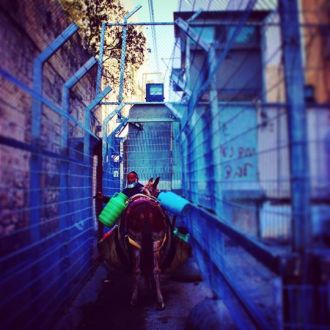 No one knows who is responsible for the burning of the checkpoint, and Israeli forces have not released footage.
Leading onto the small section of Shuhada Street on which Palestinians are allowed to walk, checkpoint 56 connects Bab iZaweyya, the commercial district in Palestinian Authority-governed H1, with the neighbourhood of Tel Rumeida in Israeli-controlled H2.
Checkpoint closure here demands that families living in Tel Rumeida and school children and teachers from the Qurtuba School walk an extra hour or that they walk a difficult route through the homes and gardens of other Palestinians to reach their homes. For the past week, Israeli soldiers and border police have permitted elderly people, teachers, children and ill people seeking medical treatment to pass the checkpoint.
When CPTers arrived at 11:00 a.m. on 12 December, one 60-year-old doctor told them that he had been at the checkpoint for two hours.
CPTers, ISMers, and those wishing to pass through the checkpoint, attempted to ascertain the reasoning behind this change, which was subjecting teachers leaving work, and older people of varying physical abilities to stand in the sun for hours. CPT and ISM stood in solidarity with the affected Palestinians and joined them in negotiating with soldiers to reopen the checkpoint.
At about 12:00 p.m., soldiers allowed individuals through the checkpoint one by one until approximately twenty minutes later when an elderly man arrived with a donkey, which initiated another arbitrary change in the ‘rules’ of occupation. The Israeli military again closed the checkpoint, and CPT was unable to gain an answer from the soldiers as to why this donkey appeared to necessitate another closure.
Featured Video
Seyed M. Marandi: US-Iran War Inevitable: Kuwait and Bahrain May Fall
or go to
Aletho News Archives – Video-Images
From the Archives
Oil and the Israel Lobby
Reknowned economist M. Shahid Alam offers this excellent critique of Noam Chomsky’s defective analysis of the relative influence of Oil versus the Israel lobby over US foreign policy: … continue
Blog Roll
 Aletho News
- ICC ignored ‘very well-documented’ NATO crimes – ex-Libyan minister
- SNSC secretary dismisses US response to Iran’s conditions as ‘inadequate’
- Sanaa says Taiz roads open, secure for residents, warns Saudi forces
- Iraqi resistance group urges Saudi leadership to admit defeat, lift Yemen siege
- Trump’s Retreat: How Al-Aqsa Flood Took Down the US Empire
- Israel’s Military Actions in Lebanon Grossly Violate International Law — Lavrov
- Seyed M. Marandi: US-Iran War Inevitable: Kuwait and Bahrain May Fall
- Leaders Condemn Ansarallah Attack on Saudi Arabia While Ignoring Illegal War Against Yemen
- Leaked: Britain’s Covert Iraqi Psyops Network
- Yemeni Armed Forces Warn Airlines Against Using Saudi Airports, Exempt Mecca and Medina
- If Americans Knew
- How Israel Conquered the Latin American Right
- Agents search Rep. Omar’s Washington home in criminal probe as she vows she won’t ‘be silenced’
- “The Rule Was: ‘Shoot Everyone You See'”
- Israel goes ballistic over Nobel Laureate Navi Pillay
- U.S. May Join Yet Another Middle Eastern War — TCN
- Yellow Line moves again as Israel closes in on trapped Gazans – Daily Update
- Israeli Attacks Kill Seven Palestinians in Gaza Including Six-year-old Girl
- Gaza: Ceasefire Anniversary Marks Year of Failed Promises
- The American Conservative: Mike Huckabee Should Resign
- A C-Section in Shackles: A Palestinian Woman’s Harrowing Birth in Israeli Detention
- No Tricks Zone
- Germany’s Green Energy Debacle: High Energy Costs Force Kahla Porzellan to Close After 182 Years!
- New Study: 50 Years Of The Most Aggressive ‘Net Zero’ Policies Can Only Affect The Global Climate By 0.03°C
- US September “Heat” Was No Record…Many Records Set Decades Ago
- Latest European Green Energy Debacle; Portugal’s Largest Flagship Solar Park Insolvent!
- Green Energy Debacle: German Expert Professor Fritz Vahrenholt Warns Of Severe Economic And Social Consequences
- Two More Paleo Reconstructions Affirm Meters-Higher Sea Levels Across Ireland, Brazil 7000-6000 Years Ago
- New Study: Earth And Venus Surface Warmth Largely Explained By Convection And Lapse Rate, Not CO2 Or Radiation
- 2025 Nature Paper Claiming Worsening Global Drought Gets RETRACTED …Heavily Flawed
- New Study: ‘Global Drought Shows No Detectable Recent Acceleration Under Climate Warming’
- Economic Masterminds: German Socialists Suggest Taxing Productivity Gains Stemming From Using AI

