Conflict Kitchen Responds to Pittsburgh Post Gazette Article of Nov. 6th

Conflict Kitchen | November 6, 2014
Post-Gazette writer Melissa McCart approached Conflict Kitchen with a set of questions of which were to be included in this article, published November 6, 2014. Unfortunately, Ms. McCart neglected to include any of Conflict Kitchen’s answers. Additionally, we specifically requested that Ms. McCart include the viewpoints of local Palestinians in this article, as well as her initial article on Conflict Kitchen’s Palestinian version. In both cases, she interviewed and did not include these very important voices.
Below are our responses to several of Ms. McCart’s questions to us, as well as statements made in the article.
MM: How have you responded to the criticism and the letter to The Heinz Endowments? Has there been any talk initiated by The Heinz Endowments of rescinding the grant to Conflict Kitchen?
CK: The Heinz Endowments has publicly made a statement to B’nai B’rith International disavowing their support for our current Palestinian version of the project. A press release posted by B’nai B’rith on their websites claims that The Heinz Endowments stated that this iteration of Conflict Kitchen “appears to be terribly at odds with [Heinz’s] mission of promoting understanding.”
Promoting understanding is at the core of Conflict Kitchen’s mission. We have demonstrated this in the past by presenting the food, culture, and viewpoints of Iranians, Afghans, Cubans, North Koreans, and Venezuelans. We believe that presenting the viewpoints of Palestinians promotes understanding of Palestinians.
Protecting freedom of expression from the influence of biased media and powerful political and lobbying groups is essential for the cultural and political health of a democratic society. We are extremely upset that one of Pittsburgh’s most important arts and culture funders would disavow their grant to us when seemingly pressured by strong outside forces.
MM: Has your programming been shaped by the accusations? If so, how?
CK: Conflict Kitchen’s goal is to increase the curiosity and understanding about the people who live in countries our government is in conflict with by directly exposing our customers to these cultures and viewpoints. Another goal is to raise the public profile of the minority Afghan, Iranian, Cuban, Venezuelan, and Palestinian communities who live and work in our region, thereby creating a more accurate depiction of Pittsburgh’s cultural diversity. These new accusations will not alter Conflict Kitchen’s goals with our current Palestinian version. Rather, they strengthen why our mission to increase curiosity and understanding is more important than ever before.
MM: And is your work serving its purpose in giving voice to Palestinians? Or has it surpassed your expectations?
CK: Yes, our customers have been incredibly interested in our food and the Palestinian viewpoints expressed in our printed materials and events, responding with sincere and thoughtful questions.
MM: When I went to the dinner, it was mentioned that Conflict Kitchen is feeding 300 to 400 people a day. Are you still feeding this many people a day? Is it more than any other country you’ve featured?
CK: The real story on our Palestinian version is that it is the most popular iteration to date, with 300-400 people a day coming to the restaurant. Our public is approaching us with trust, support, and open minds.
__________________
Responses to Pittsburgh Post-Gazette’s article and The Heinz Endowment’s statements:
Post-Gazette : John M. Ellis, senior director of communications with the Heinz Endowments, said, “There is another major issue at stake here concerning the rights of arts organizations to perform edgy and provocative programming. … That, in many ways, is the role of the arts, and while we may not always agree with the positions and opinions they express, we do support their right to express them.”
Conflict Kitchen: In a letter responding to B’nai B’rith, The Heinz Endowments President Grant Oliphant wrote: “I want to be especially clear that its current program on Palestine was not funded by the endowments and we would not fund such a program, precisely because it appears to be terribly at odds with the mission of promoting understanding.” Oliphant also wrote that “[the Endowments] emphatically does not agree with or support either the anti-Israel sentiments quoted on Conflict Kitchen’s food wrappers or the program’s refusal to incorporate Israeli or Jewish voices in its material.”
The Heinz Endowments cannot have it both ways.
Post-Gazette : John M. Ellis, senior director of communications with the Heinz Endowments states, “The grant was made to assist in the restaurant’s relocation from East Liberty to Schenley Plaza in Oakland.” Heinz Endowments president Grant Oliphant stated, “I want to be especially clear that its current program on Palestine was not funded by the endowments,”
Conflict Kitchen: The grant made to us was, as stated in the grant agreement, “To support Conflict Kitchen’s new programming and development at its new location in Schenley Plaza.”
Post-Gazette : “Each restaurant to-go order is wrapped in packaging designed with text from interviews with Palestinians living in the U.S. and Gaza.”
Conflict Kitchen: Palestine interviews, as stated on the wrapper, were conducted with Palestinians living in both Palestine and the U.S.” This includes both the West Bank and Gaza.
Post-Gazette : “One section homes in on what the restaurant identified as a Pennsylvania-based business.”
Conflict Kitchen: Quotes on wrapper are statements from Palestinians, not the voices of Conflict Kitchen.
__________________
The Post Gazette’s (and other media and lobbying groups‘) insistence on continually misrepresenting our food wrappers as “anti-Israeli messages,” shows a distinct lack of research into what is actually on the wrappers, a reinforcement of right-wing accusations made in other media, and thoughtlessness about our current situation.
Like we have done for four years with every other country of focus, our food wrappers contain the viewpoints of multiple people within our focus country on a wide variety of topics. Our Palestinian interviews are no different, they contain interviews on food, culture, the Palestinian Authority, settlements, dating, resistance olive trees, Nakba, movement and travel, and food customs. The interviews were done by us personally with Palestinians in Palestine, and in our own city. The thoughts and opinions that come through the interviews are informed by their personal context, experiences and histories as Palestinians. Perhaps it is hard for some people to hear that Palestinians are not happy with Israeli policies or the actions of some of its citizens, but to cast their viewpoints as simply anti-Israel is to reinforce the simplest, most polarizing, and dehumanizing reading of their lives and perpetuate the silencing of their voices.
We say read the ACTUAL wrapper, the whole thing. It is always on our website under Interviews (scroll down).
** Speaking of printed materials, we will soon be publishing a book of interviews with kids under 12 living throughout Palestine. See the version we did with Afghan kid’s earlier this year.
Critics Slam US Military’s ‘Disturbing’ Praise for Israel’s Gaza Offensive

Palestinians collect their belongings from under the rubble of a residential tower, which was destroyed by an Israeli air strike in Gaza City on August 24, 2014. (Photo: UN Photo-Shareef Sarhan/flickr/cc)
Common Dreams | November 7, 2014
Critics say it is “shameful” that a high-ranking U.S. military official suggested the Pentagon can learn lessons from Israel’s 50-day attack on Gaza this summer.
According the Jerusalem Post, Chairman of the Joint Chiefs of Staff Martin Dempsey made statements Thursday praising the Israeli Defense Force (IDF) for taking “extraordinary lengths to limit collateral damage and civilian casualties” during Operation Protective Edge.
Dempsey told an audience at the Carnegie Council for Ethics in International Affairs: “We sent a team of senior officers and non-commissioned officers over to work with the IDF to get the lessons from that particular operation in Gaza.” He referred to the group of officers as the “lessons learned team.”
But Ramah Kudaimi of the U.S. Campaign to End the Israeli Occupation said Israel’s tactics should not be replicated.
“It is very disturbing and shameful that U.S. military commanders believe that what Israel did in Gaza is something to be applauded,” Kudaimi told Common Dreams. “Five hundred dead children does not seem to be evidence that Israel was trying to not kill civilians. The seven-year siege on Gaza is not a policy to avoid civilian suffering.”
Israel’s recent seven-week military assault on Gaza killed at least 2,194 Palestinians, at least 75 percent of them civilians and over 500 of them children.
“At least 80 percent of the 100,000 Palestinian homes damaged or destroyed were refugee homes,” the United Nations Relief and Works Agency reports.
The offensive damaged or destroyed over half of Gaza’s hospitals and health centers at a time when more than 11,000 were wounded, a UNRWA and World Health Organization joint investigation found.
Israel struck six UN schools sheltering Palestinians, including in cases where exact coordinates of the shelters were formally submitted by UNRWA to the Isreali military. These strikes alone killed at least 47 people and wounded hundreds.
Furthermore, Israel has been accused of potential war crimes by Amnesty International and UN High Commissioner for Human Rights Navi Pillay.
“It is very despicable that the U.S. continues to white-wash Israeli crimes while funding them through military aid,” said Kudaimi. “Dempsey’s statements are not shocking. Anyone who follows U.S. military policy, knows they too have problematic definitions of protecting civilians.”
Israel to confiscate 3,200 acres of Palestinian land near Jerusalem
Ma’an – 08/11/2014
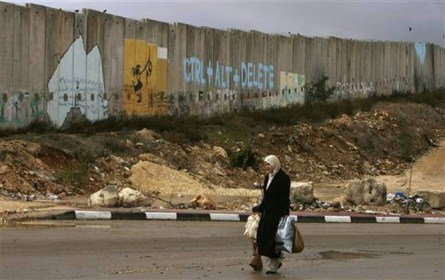
JERUSALEM – Israeli authorities have delivered orders to the village of Beit Iksa north of Jerusalem ordering the confiscation of 12,852 dunums (3,176 acres) of Palestinian land, locals said on Saturday.
Locals told Ma’an that soldiers deployed at the military checkpoint at the entrance to the village delivered confiscation orders signed by the Israeli military commander in the West Bank Nitzan Alon that gave them until Dec. 31, 2017 to remain on their land.
Villagers said that soldiers informed them that an official from the Israeli military liaison would arrive on Monday to specify which lands would be confiscated, adding that the lands confiscated would be used for “military purposes.”
If carried out, the confiscation would dramatically reduce the land available to Beit Iksa’s 1,700 people, the majority of whom are refugees who fled to the area in 1967 after the existing population of the village was forced to flee by Israeli authorities.
Although located immediately next to Jerusalem, the village’s lands have been progressively confiscated and the village is surrounded on all sides by the Israeli separation wall. Villagers can no longer travel to Jerusalem without permits, and Palestinians not resident in Beit Iksa cannot enter the single Israeli checkpoint that allows access to the village.
Ninety-three percent of the village is under full Israeli military control, and a majority of the total land of the village falls in areas outside of the separation wall, meaning they have been de facto confiscated, including about 1,500 dunums (371 acres) where Jewish-only settlements have been built.
The head of the Beit Iksa village council Saada al-Khatib told Ma’an that according to the order and the maps that soldiers had shown them Saturday, the lands that will be confiscated are between parcels 7 and 8 and include Haraeq al-Arab, Thahr Biddu, Numus, and Khatab areas around the village.
Al-Khatib added that the Israeli authorities claim that the confiscation order has been under way since 2012, and that the new order issued on Saturday only emphasizes the old order.
The order will prevent dozens of farmers from reaching their lands, he said, calling upon Palestinian ministries and national institutions to support the village of Beit Iksa and its neighbors.
He added that the order came after the Israeli municipality announced the approval of 244 housing units to be built in the Ramot settlement, which was previously built on lands confiscated from the settlement.
Al-Khatib warned that the land confiscation orders being issued to many villages include his own aim to carry out the “Judaization” of Beit Iksa after sealing the village shut and surrounding it with a checkpoint and the separation wall, turning it into an 2,500-dunum prison.
Al-Arabiya echoes Zionist rhetoric in reporting about al-Aqsa
By Zeinab Hawi | Al-Akhbar | November 6, 2014
It was rather normal for Al-Arabiya news channel to retract its story about the unprecedented closure of al-Aqsa Mosque on October 28. The channel may have thought that the terminology it used would go unnoticed. However, Al-Arabiya later deleted the story from its website after having caused an online backlash for echoing Zionist rhetoric.
In an act further promoting Zionist terminology, the Saudi news channel replaced al-Aqsa Mosque with the “the holy compound,” a term usually reserved for Zionists in their reference to the holy site.
In fact, Israel had closed the mosque following the shooting of hardline Rabbi Yehuda Glick [allegedly] by Palestinian Mutaz Hijazi, with Al-Arabiya reporting the news as, “A right-wing Israeli activist was shot and wounded last night as he left a conference promoting a campaign to permit both Jews and Muslims to pray at the holy compound.”
The channel, hence, adopted the terminology used by Zionists. This caused an angry backlash over social media websites, with activists accusing Al-Arabiya of committing “political and religious treason” by adhering to the “Zionist plan” to Judaize Palestine.
However, after thoroughly reading Al-Arabiya’s report, one would notice that the channel not only resorted to Zionist terms, but framed the story in a manner that reflected the channel’s policy that complies with Zionism. The term “occupation” did not appear, not even by chance, and the channel opted to use “Israeli police” instead. Moreover, the story depicted Jewish hardliners present at al-Aqsa on an equal footing with Palestinians.
The story was hence reported as follows, “the Israeli police closed the Noble Sanctuary… in a rare step aiming to prevent clashes between Muslims and Jews.”
The hardline rabbi who was calling to “open the doors of the Noble Sanctuary for Jews” and promoting “prayers that gather both Muslims and Jews” is for Al-Arabiya a simple “right- wing Israeli activist.”
The scandalous coverage did not stop there; it also “reassured” that the Palestinian shooter – “the sole suspect” in the incident – was shot and killed by a police special force unit at his house in Abu al-Thuri neighborhood in Jerusalem.
Al-Arabiya did not settle for such biased reporting, it also quoted the director of Shaare Zedek Medical Center as saying that the rabbi is in “critical but stable” condition and that he underwent surgery after being shot in the chest and abdomen.
The closure of the al-Aqsa Mosque apparently meant nothing for the Saudi channel. It was more interested in reassuring the public about the health of the injured Zionist and making sure that the shooter “got what he deserved.”
In the end, it is not merely about adopting the Zionist settlers’ policy to change the understanding of the issue and the terminology used to define it, but it is about adopting a process aimed at wiping out the cause of not just a people but an entire nation, which the Saudi channel and its affiliates are slowly paving the way for.
Israeli forces demolish three houses, and several water pipes and roads in village near Nablus
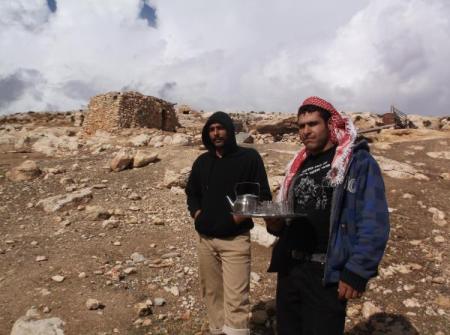
Sofian Maher and a local resident near their destroyed home near Khirbet Al-Tawil
International Solidarity Movement | November 4, 2014
Khirbet Al-Tawil, Occupied Palestine – Early on Monday morning, while the inhabitants of the village of Khirbet Al-Tawil, near Aqraba (Nablus), were sleeping, eight military vehicles, and 30-40 Israeli soldiers entered the village.
Within two hours the military had demolished three houses, and several water pipes and roads.
The water pipes destroyed were new and scheduled to be turned on Monday. The Aqraba community had funded these water pipes as part of the municipal water system.
Of their destruction, Sami Dariyah, stated: “They are trying to prevent people from living in this area. This is their clear policy.”
Due to the continuing demolition of houses, electricity lines, water lines and other living necessities, the farmers have fled to the city of Aqraba and departed their lands in Khirbet Al-Tawil. Sami Direyah grew up near Khirbet Al-Tawil and remembers the many houses and shops that used to be there.
Khirbet Al-Tawil is part of Area C (under full Israeli military civil and security control), which means the army can choose which buildings and activities are ‘allowed’. Sami wonders how their existing community, their farms and their 100-year-old houses, can suddenly become illegal.
Even though the three demolished houses were nearly 100 years old, dating back to the British occupation, they were all still active homes for families like the Mahers. The residents of the houses were not given any warning of the military’s planned visit. Sofian Maher, a former resident of one of these homes, spoke to ISM and explained that this is not the first time the military has paid a visit to Khirbet Al-Tawil. In May of this year the village’s Mosque was demolished, together with four houses, four cottages, and two barns. Less than one month ago the power line was cut by the military, leaving the village without electricity.
Sofian Maher explained to ISM that his family tried to rebuild their house after it was demolished in May. While rebuilding, Sofian’s family lived in a donated tent, which the army soon tore down. The family then moved into old stone huts that were built, long ago, to house animals while shepherding. Periodically the military returned and destroyed the newly rebuilt portions of their house.
The family is now trying to rebuild their home for the fourth time.
To further make the area uninhabitable, the military has destroyed large sections of the road leading to the remaining farms.
Gaza residents lose faith in international aid
MEMO | November 6, 2014
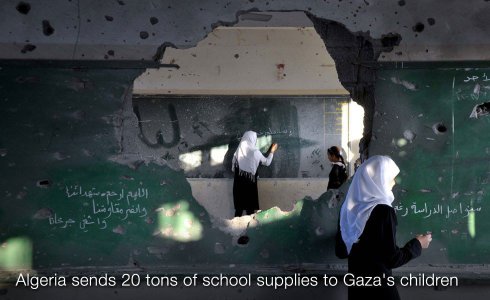
It has been more than three months since the end of the war on Gaza however Fadl Misbah, 41, is still living as others are, in a house which is covered in plastic sheets and which is not suitable for winter.
Fadl, whose family is made up of 13 members, said: “We are always subjected to extreme cold, and this is the case for most people whose homes were destroyed in the war. My children sit in this place and raindrops fall from the roof of the house which is made up of nylon sheets which do not protect us from the elements or the cold.”
“We have heard a lot about the donor conference to reconstruct Gaza, however they are working so slowly and we no longer believe what the international institutions are saying or what they are promising.”
“The occupation is the main problem; it allowed 440 tonnes of cement to enter Gaza 20 days ago during [UN Secretary-General] Ban Ki-moon’s visit to show a positive side to itself in front of the world, but after that it didn’t allow any more items into Gaza. Solving our problem will need contracts to be signed, and that’s if it is resolved at all,” Fadl said.
“International institutions have appealed to intervene and find a solution to this disaster, which hundreds of families whose homes were destroyed during the war on Gaza are now living through.
The West must be mobilise itself and not be satisfied by its silence. Those who call for human rights and advocate for it on behalf of those who are oppressed have exposed this world. It has no credibility.”
Dozens injured during Aqsa clashes, several detained
Ma’an – November 5, 2014
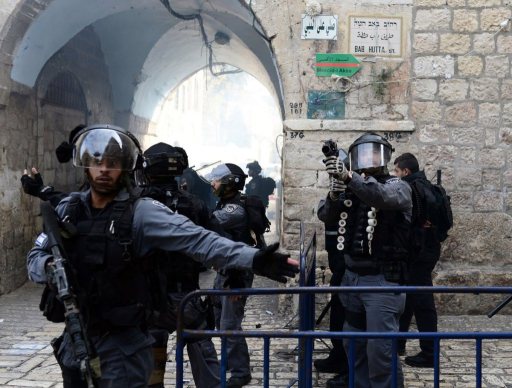
JERUSALEM – Dozens of Palestinians suffered tear-gas inhalation and several others were injured by stun grenades, shrapnel and rubber-coated steel bullets during clashes in the Al-Aqsa mosque compound area on Wednesday, an official said.
Palestinian Red Crescent official Amin Abu Ghazaleh told Ma’an that Red Crescent ambulances moved nine injured to the Al-Maqased Hospital where their injuries were reported as moderate.
Two were injured in the eye, and 32 with stun grenades, shrapnel and rubber-coated steel bullets in addition to many who suffered severe gas inhalation.
Three Palestinian members of Israel’s Knesset, Hanin Zoabi, Talab Abu Arrar and Ibrahim Sarsour, were able to enter the mosque during the closure and clashes.
Israeli soldiers neared the Al-Qabali mosque inside the compound as they fired stun grenades and tear-gas bombs inside, the director of the Al-Aqsa Mosque, Sheikh Omar al-Kiswani, said.
He said that a fire erupted inside the muezzin’s hall and cables and speakers were also burned and damaged.
Soldiers “deliberately” threw holy books on the floor, he alleged.
Israeli forces detained Tareq al-Hashlamon, an employee of the Islamic endowment department, after assaulting him inside Al-Aqsa, along with another endowment employee identified as Hussam Seder and three Palestinians.
Four Palestinians were also detained, one of them a minor. Two others were identified as Omar al-Kilani and Amin Qirsh.
Meanwhile, Jordan recalled its ambassador to Israel over the violence.
Jordanian Prime Minister Abdullah Nsur asked the foreign minister to “recall the Jordanian ambassador from Tel Aviv in protest at Israel’s escalation on the Al-Aqsa mosque compound,” the Petra news agency reported.
The clashes came amid continued tensions over right-wing Jewish demands to be able to pray inside the compound despite being off-limits in mainstream Judaism, in addition to the expansion of Israeli settlement building in Palestinian East Jerusalem.
Earlier, a police spokeswoman said that “Dozens of masked protesters threw stones and firecrackers at security forces who then entered the Temple Mount and pushed the demonstrators back inside the mosque.”
Israel guilty of war crimes over Turkish aid ship attack, ICC says
Al-Akhbar | November 5, 2014
Prosecutors of the International Criminal Court (ICC) at The Hague have told a Turkish organization that Israel is guilty of “war crimes” for attacking a Turkish aid ship for Gaza in 2010.
In May of that year, Israeli commandos killed nine peaceful activists, eight Turkish nationals and an American of Turkish origin, in international waters by using lethal force on the Mavi Marmara, a ship participating in a “Gaza Freedom Flotilla” carrying humanitarian aid and construction materials for Palestinians in the Gaza Strip, which was under a seven-year Israeli blockade at the time.
The Humanitarian Relief Foundation (IHH), a Turkish NGO, in a statement Tuesday said the prosecution team had finished its investigation in the Mavi Marmara case and concluded that Israel committed “war crimes.”
The aid ship Mavi Marmara belonged to the foundation, whose law committee had filed a petition at the court for a fair and speedy trial in the case. The court took up the petition in March 2014.
The 2010 incident caused international outrage and soured Turkish-Israeli ties.
In March 2014, Turkey received an apology from the Israeli government.
The two states are now looking to normalize their relations with a deal said to be involving compensation for the victims’ families.
The Palestinians have threatened to join the ICC to allow legal action to be taken against Israel.
Based in The Hague, the ICC opened its doors in 2003 and is the world’s first independent court set up to try the worst crimes, including genocide and war crimes.
In 2012, the Palestinians won the status of observer state in the United Nations, which gives them the ability to become a party to the ICC, where they could sue Israeli officials over alleged war crimes.
As neither Israel nor Palestine are ICC members, the court lacks jurisdiction over Gaza. This could be granted by a UN Security Council resolution, but Israel’s main ally, the United States, would probably veto any such proposal.
The overwhelming General Assembly vote recognizing the “non-member state” of Palestine was strongly opposed by the United States and Israel.
Membership of the ICC opens countries to investigations both on their behalf and against them. Several major powers, including the United States, as well as Israel, have declined to ratify the court’s founding treaty, the Rome Statute.
The Palestinians in 2009 and 2014 pushed the ICC’s prosecutor’s office to investigate alleged war crimes and crimes against humanity committed by the Israeli military in Gaza.
(Anadolu, Al-Akhbar)
A Brief History of US-Israel Relations
How Zionists Outmaneuvered and Replaced State Department Experts
By Amb. ANDREW I. KILLGORE | CounterPunch | November 4, 2014
Alison Weir writes at the beginning of her book, Against Our Better Judgment: The hidden history of how the U.S. was used to create Israel, that while many people are led to believe that U.S. support for Israel is driven by the American establishment and U.S. national interests, facts do not support that belief. The reality is that while for decades almost all U.S. experts opposed Israel and its founding, they were outmaneuvered and eventually replaced by Zionists.
Political Zionism started in the late 1800s as an international movement to establish a Jewish state somewhere in the world. By 1897 the movement was led by Austrian journalist Theodor Herzl, who convened the First Zionist World Congress in Basel, Switzerland the same year. U.S. Zionism began in the 1880s. The Board of Delegates of American Israelites was organized in 1861. The group was strong enough during the American Civil War to block an effort by the Union to declare America a Christian nation.
In 1887 President Grover Cleveland appointed a Jewish ambassador to Turkey, establishing a precedent for naming a Jew to that post for the next 30 years. This represented the growing power of the Zionist movement. But in 1912, when the Zionist Literary Society asked President William Taft for an endorsement, Secretary of State Philander Knox was able to thwart the effort. Knox argued that Zionism “related to the interests of countries other than our own.”
But after Knox, simply every American official has opposed Zionist efforts to involve the United States on the same grounds: the efforts are against the interests of the United States. The Zionists were and are aware of this, so they always resorted to secrecy to conceal their real aims.
In 1912 the prominent U.S. attorney Louis Brandeis became head of the Zionist Central office, which had moved from Berlin, Germany a little while before. Brandeis is better known as a Supreme Court Justice, but he played a sinister role in
 high Zionist affairs. He recruited young lawyers, particularly from Harvard, to work for the Zionist cause. He was a leader of a secret society called the Parushim to work for Zionism with all the outward appearance of simply a fraternal order. Each member took a practically blood oath to secretly work for Zionism.
When Brandeis was appointed to the Supreme Court by President Woodrow Wilson he officially resigned from all his clubs and affiliations. But this was only for show. Weir quotes historian/journalist Donald Neff: “Through his lieutenants he remained the power behind the throne. One of these lieutenants was the well-regarded Supreme Court Justice Felix Frankfurter, whose Zionist activities had largely gone unnoticed.”
Weir very astutely and brilliantly covers World War One and the Balfour Declaration (Britain promising to support a “national home” for Jews in Palestine). The Declaration was critical for Zionist success with the reason behind it, Zionism’s promise to work for the U.S. to enter the war on Britain’s side. Author Alison Weir writes that whether the Zionist role in getting America into the war was major, as the Zionists claim, and the British believed, is unclear.
In one of her quoted references Chaim Weizmann, who later became the first president of Israel, complains in his autobiography about the British/Zionist myth that he invented TNT, the reward for which was the Balfour Declaration. He said he did not invent the explosive. The origin of the TNT myth was an obvious attempt to cover up Britain’s real reason for issuing the declaration, which clearly was to get America into the war on Britain’s side, without which she would have lost the war.
Ms. Weir’s coverage of the 1919 Peace Conference in Paris is excellent. The Conference was rife with Zionists arguing for the Jewish state. The most prominent American opposing them was Dr. Howard Bliss, president of the Syrian Protestant College, later the American University of Beirut. President Wilson did send the King-Crane Commission to study what the Middle Easterners wanted. The two men found that the Arabs were utterly against the “national home” idea. It was clear that the Jewish representatives wanted a nearly complete dispossession of the Palestinians and that armed force would be required to carry out Zionist aims.
Throughout Judgment Alison Weir clearly documents the total lack of ethics and morality, as generally understood, on the part of the Zionists. For example, they fabricated stories of gross anti-Semitism in Poland to gain sympathy. When the American ambassador to Poland reported that they were false, Brandeis and Frankfurter claimed that the ambassador had undercut their mission. Frankfurter threatened that he would try to block his Senate confirmation.
The Zionists ran a gigantic public relations campaign targeting every sector of society, including particularly the Christians, who had little knowledge of the nature of Zionism or of its true goals. Thus the Zionists played on the “tragic plight of the refugees fleeing from persecution and finding no home.” As anti-Zionist Rabbi Elmer Berger says in his memoirs, there was a “ubiquitous propaganda campaign reaching just about every point of political leverage of American life.”
It is important to emphasize that essentially all official American personnel opposed the Zionists. Foreign Service Officer Evan Wilson, U.S. consul general in Jerusalem, opposed them on national interests grounds. Loy Henderson, director of the Office of Near Eastern and African Affairs, wrote that supporting partition of Palestine “would have a strongly adverse effect on American interests throughout the Near and Middle East.” When Henderson persisted in putting his views forward, the Zionists attacked him viciously, calling him an “anti-Semite,” demanding his resignation and threatening his family. Henderson was transferred by President Harry Truman as ambassador to Nepal/India. The transfer of Henderson reflects the reality of what happens to Foreign Service officers who criticize Israel, even today.
Others who spoke warning words about Zionism and its adverse effect on American national interests were George F. Kennan, head of the State Department’s Policy Planning staff. He wrote that the 1947 partition plan for Palestine had done enormous damage to the U.S. Under Secretary of State (later Secretary) Dean Acheson said that to transform Palestine into a Jewish state would imperil not only American but all Western interests in the Near East.
Judgment is prodigiously documented, with nearly 200 books and papers listed. Weir quotes two sources, one of them an Iraqi Jew, as writing that the Zionists terrorized Iraqi Jews into going to Israel by planting bombs in Baghdad synagogues, all to increase the population of Israel. Jews even killed Jews to force immigration to Israel.
In 1948 there was a battle between Secretary of State (General) George Marshall and Clark Clifford, political adviser to President Harry Truman, over Truman’s support for Zionism/Israel. Marshall argued for national interests, while Clifford argued for electoral politics. Marshall quit speaking to Clifford over their differences.
In April 1948, just before the State of Israel was established, Jewish terrorists attacked the Palestinian village of Deir Yassin, massacring 175 men, women and children. The facts spread quickly in Palestine and 750,000 refugees fled from their homes. The Zionists had anticipated the flight, leaving room for Jews in the evacuated homes and farms.
The ruthlessness of the Zionists is illustrated by the fate of Dorothy Thompson, “one of the most famous journalists of the 20th century,” according to the Britannica encyclopedia. Her columns were in newspapers all over the country, her radio program was heard by millions of people. She had been married to one of the most famous novelists (Babbitt), Sinclair Lewis.
Thompson had at first supported Zionism, but changed her mind when she saw Palestinian refugees. Then she was attacked as an anti-Semite, her columns were dropped from newspapers and her speaking engagements stopped. Today, Weir says, “She has been largely erased from history.”
Now that Israel has been around for more than 60 years and its virtues are sung in the American media, it is easy to forget, or not even to have heard, that the country is extremely adverse to American national interests and its policies enormously destructive and dangerous to America’s well-being. Thus Alison Weir must be highly commended for throwing such a brilliantly hard light on the relationship between the United States and Israel. I hope this marvelous book gets all the attention it deserves.
Ambassador Andrew I. Killgore is the publisher of the Washington Report on Middle East Affairs and a retired diplomat who served as a career foreign service officer in Frankfurt, London, Beirut, Jerusalem, Amman, Baghdad, Dacca, Tehran, Manama, and Wellington and as a desk officer in other Near East and South Asia regional bureau positions in the State Department in Washington before his assignment as U.S. Ambassador in Doha. Ambassador Killgore received the “Foreign Service Cup” in 1997, the citation stating: “For impressive contributions to increased awareness and understanding of the Middle East and the many dimensions of United States’ interests in the area.”
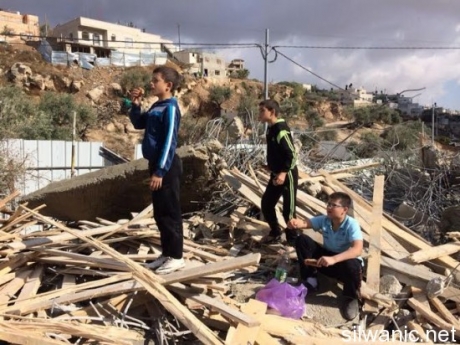
Israeli occupation authorities demolish two homes in East Jerusalem
MEMO | November 4, 2014
Israel demolished two homes in Silwan, south of Al-Aqsa Mosque in East Jerusalem, today claiming they were constructed without a license, eye witnesses said.
Eye witnesses reported that “a large bulldozer belonging to the Israeli municipality arrived this morning at Wadi Yasoul in Silwan accompanied by Israeli police and army forces.”
They added: “The Israeli forces surrounded the home of the released prisoner Khalil Abu Rajab and demolished it before demolishing Assem Abu Subaih’s home.”
Witnesses noted that the “demolition occurred without prior warning. There are concerns that more demolitions will take place in the area.”
“Abu Subaih’s home consists of three rooms and he lived in it with his five family members. As for Abu Rajab’s home, it was made up of two apartments he lived in with seven family members and his mother,” sources reported.
These demolitions occurred after Israeli media outlets reported a few days ago that the Israeli Mayor of Jerusalem Nir Barkat approved a series of sanctions against Palestinians in the city, including demolishing unlicensed homes “in order to stop the phenomenon of throwing rocks”.
Various clashes between the Palestinian youth and Israeli forces have continued in a number of neighbourhoods in East Jerusalem since last July.
Palestinian, Israeli and international human rights organisations noted that while the municipality has been increasingly giving building permits to Israelis in East Jerusalem, it is restricting construction work done by Palestinians, which forces many to build without permits.
The Israeli Information Centre for Human Rights in the Occupied Territories (B’tselem) said: “While large-scale constructing and major investments are being carried out in Jewish neighbourhoods, the Israeli authorities are working on stifling all development and construction for Palestinian residents, which make up about a third of the city’s population.”
The Planning and Building Committee of the Israeli Ministry of Interior approved the construction of 500 settlement units in Ramat Shlomo settlement in Shuafat in northern Jerusalem yesterday which provoked Palestinian and international criticism.
Featured Video
Seyed M. Marandi: US-Iran War Inevitable: Kuwait and Bahrain May Fall
or go to
Aletho News Archives – Video-Images
From the Archives
Oil and the Israel Lobby
Reknowned economist M. Shahid Alam offers this excellent critique of Noam Chomsky’s defective analysis of the relative influence of Oil versus the Israel lobby over US foreign policy: … continue
Blog Roll
 Aletho News
- ICC ignored ‘very well-documented’ NATO crimes – ex-Libyan minister
- SNSC secretary dismisses US response to Iran’s conditions as ‘inadequate’
- Sanaa says Taiz roads open, secure for residents, warns Saudi forces
- Iraqi resistance group urges Saudi leadership to admit defeat, lift Yemen siege
- Trump’s Retreat: How Al-Aqsa Flood Took Down the US Empire
- Israel’s Military Actions in Lebanon Grossly Violate International Law — Lavrov
- Seyed M. Marandi: US-Iran War Inevitable: Kuwait and Bahrain May Fall
- Leaders Condemn Ansarallah Attack on Saudi Arabia While Ignoring Illegal War Against Yemen
- Leaked: Britain’s Covert Iraqi Psyops Network
- Yemeni Armed Forces Warn Airlines Against Using Saudi Airports, Exempt Mecca and Medina
- If Americans Knew
- No state has a ‘right’ to exist – least of all an apartheid, genocidal state like Israel
- Testimonies about Gaza’s civilian death toll expose Israel’s atrocities – Daily Update
- How Israel Conquered the Latin American Right
- Agents search Rep. Omar’s Washington home in criminal probe as she vows she won’t ‘be silenced’
- “The Rule Was: ‘Shoot Everyone You See'”
- Israel goes ballistic over Nobel Laureate Navi Pillay
- U.S. May Join Yet Another Middle Eastern War — TCN
- Yellow Line moves again as Israel closes in on trapped Gazans – Daily Update
- Israeli Attacks Kill Seven Palestinians in Gaza Including Six-year-old Girl
- Gaza: Ceasefire Anniversary Marks Year of Failed Promises
- No Tricks Zone
- Germany’s Green Energy Debacle: High Energy Costs Force Kahla Porzellan to Close After 182 Years!
- New Study: 50 Years Of The Most Aggressive ‘Net Zero’ Policies Can Only Affect The Global Climate By 0.03°C
- US September “Heat” Was No Record…Many Records Set Decades Ago
- Latest European Green Energy Debacle; Portugal’s Largest Flagship Solar Park Insolvent!
- Green Energy Debacle: German Expert Professor Fritz Vahrenholt Warns Of Severe Economic And Social Consequences
- Two More Paleo Reconstructions Affirm Meters-Higher Sea Levels Across Ireland, Brazil 7000-6000 Years Ago
- New Study: Earth And Venus Surface Warmth Largely Explained By Convection And Lapse Rate, Not CO2 Or Radiation
- 2025 Nature Paper Claiming Worsening Global Drought Gets RETRACTED …Heavily Flawed
- New Study: ‘Global Drought Shows No Detectable Recent Acceleration Under Climate Warming’
- Economic Masterminds: German Socialists Suggest Taxing Productivity Gains Stemming From Using AI

