Ben & Jerry’s Israeli Factory and Israel’s Stolen Land and Stolen Water
Vermonters for a Just Peace in Palestine/Israel
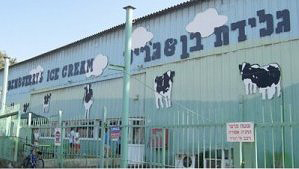
The Ben & Jerry’s factory is in Be’er Tuvia, adjacent to the town of Kiryat Malachi, one of four Israeli localities located on the lands of the former village of Qastina, in territory allotted to the Arab state under the 1947 UN Partition Plan. However on July 9, 1948, after Israel’s declaration of independence and the ensuing war, Qastina and its more than 147 houses were completely destroyed by Israeli forces of the Givati Brigade, and the land incorporated into Israel. (Based on information documented at http://en.wikipedia.org/wiki/Qastina, accessed December 2012).
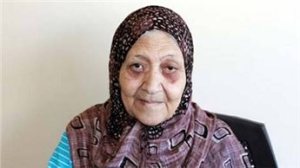 Ghatheyya Mifleh al-Khawalda was a 15-year old teenager when she fled to Gaza from her home in the village of al-Qastina, now the town of Kiriyat Malachi and site of the Ben & Jerry’s factory, during the Nakba of 1948. So this woman, a refugee living only a day’s walk from the village that she was driven from, represents a personal and tragic link to the site where now the Ben & Jerry’s factory churns out ‘Peace and Love’ ice cream. Yes, they do profit from this stolen land, and yes, the Nakba was a crime, and yes, the occupation is an affront. Ghatheyya is one of generations of Palestinians in Gaza who are locked away from their land, their families and the world. Some seethe with anger and resort to violence – three people in Kiriyat Malachi died in November 2012 in a rocket attack from Gaza. Ghatheyya said, “We had a very nice house, a big house with marble floors in the hallway. My father was a farmer, and we had farmland with orange trees, apple trees, grapefruit trees and others. We were very happy.” Her life changed dramatically in 1948, when Jewish militias arrived. “Some Jewish militia members were wearing uniform and others had civilian clothes,” Ghatheyya said, “and when they arrived in the village they began firing at people, killing three villagers. We ran away, afraid for our safety, and went to Tal al-Safi, a nearby village. It was within walking distance, and we were in a hurry to leave, so we didn’t take anything with us. It was like Doomsday. It was utter terror. We couldn’t think of anything except leaving, not even simple things like bringing food with us.” After a few days in Tal es-Safi, militias came again and forced them to leave. Ghatheyya and her family fled to Beit Jibrin to spend the night, but were followed and forced to leave again. “If you wanted to die, you stayed. If you wanted to live, you left,” she recalls. “Their main aim was not to kill us, but to get rid of us. If they had wanted us all dead, not one of us would have survived. They used fear to force us to leave our land.” The family walked along the coast until they reached Gaza. “There were thousands of people who fled other villages, sleeping in mosques or on the street,” Ghatheyya says, and UNRWA began to build tents for the families. (From a story “Nakba survivor: If you wanted to live, you left” at Ma’an News )
Water Used by the Factory
When investigating Ben & Jerry’s business dealings in Israel and the occupied territory, we also set out to determine if the company’s franchise was benefiting from Israel’s criminal diversion of Palestinian water. Our inquiry, which included discussions with an international water consultant, led us to the tentative conclusion that Ben & Jerry’s factory in Kiryat Malachi may be drawing water from the Jordan River system and the Mountain Aquifer in the occupied West Bank, the two highest-quality water sources in the region, thus diverting it from Palestinian use.
Palestinians under occupation have been denied access to the Jordan River since 1967, leaving the Mountain Aquifer as their only source of water. A study by The World Bank determined that “Palestinian per capita access to water resources in the West Bank is a quarter of Israeli access and is declining.” This is a result of Israeli government planning and regulation.
To make matters worse, Israeli settlers in the West Bank often obstruct or disconnect the flow of water to Arab communities, while 500,000 settlers consume in total approximately six times more water than three million Palestinians. This difference is even higher when agricultural use is factored in. Regular access to water explains why one commonly sees green lawns and swimming pools in Israeli settlements. In stark contrast, throughout the year, but especially in the summer, Palestinian cities and villages are denied continuous access to water, sometimes for weeks on end. This gross injustice is aggravated by Israel’s policy of denying permits to Palestinians to drill new wells or rehabilitate old ones.
By manufacturing in Israel and marketing in the occupied territory, Ben & Jerry’s is a willing partner to a water system that is grossly inequitable, transgresses international law, and denies Palestinians their fair share of the Mountain Aquifer and the Jordan River. Please see Our Report for more information on Israel’s water crimes in the occupied territory.
Zionist Settlers Torch Palestinian Home in West Bank
Al-Manar | November 23, 2014
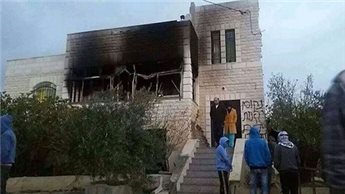 Zionist extremists firebombed a house in a Palestinian village in the occupied West Bank early on Sunday.
The mayor of Khirbet Abu Falah, Masud Abu Mura, reported the attack, saying: “At 4:00 am (0200 GMT), settlers came and threw molotov cocktails at a house which partly burned down.”
Four women were inside the house at the time, but they all escaped unharmed, the mayor of the village which lies northeast of Ramallah said.
Near the house, the assailants scrawled “Death to Arabs” in Hebrew.
Mohammad Abdelkarim Hamayel, whose aunt and two female cousins live in the house, said the assailants were believed to be from the Shilo settlement, a few kilometers to the north of the village.
“In the middle of the night, my aunt woke up when she heard voices speaking Hebrew. Someone knocked on the door but she didn’t answer because she was afraid,” he told AFP.
“They threw a tear gas canister and several molotov cocktails at the balcony which caught fire.”
Israeli occupation police also confirmed the attack, with its spokesman Luba Samri saying: “It is a two-storey house and the fire caused major damage to the ground floor.”
On November 12, Zionist settlers also torched a mosque in the neighboring village of Al-Mughayir.
Source: AFP
A ‘Child’ Is Missing–From a New York Times Headline
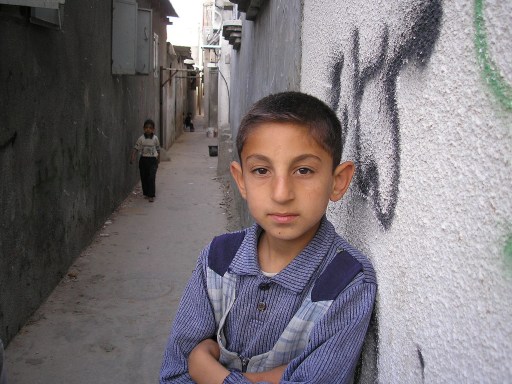
This is what a Palestinian boy looks like. (cc photo: Giles)
By Jim Naureckas | FAIR | November 18, 2014
Read this headline from the New York Times (11/16/14):
Palestinian Shot by Israeli Troops at Gaza Border
Think for a second about what kind of image that calls up. How much does that image change when you read the story’s second sentence?
A spokeswoman for the hospital said the Palestinian was a 10-year-old boy.
Now, very few people read the full text of every story in any newspaper, so as an editor you have to ask yourself what a headline conveys on its own. I expect that most people who only read that headline assumed that the Palestinian referenced was an adult–and likely had a different reaction to the story as a result.
They were probably also less likely to read the story–the opposite of the effect that you usually want to have with a headline–which makes you wonder why the Times would leave this key fact out. Space, maybe? But “Gazan Boy Shot by Israeli Troops at Border” would have fit just as easily.
Or “Child Shot by Israeli Troops at Gaza Border,” for that matter, since the shooting victim’s likely nationality would be clear from context; there aren’t too many Israeli children near the border with Gaza. In any case, the victim’s age is arguably a more important fact than his ethnicity.
So–did the editors leave out of the headline the fact that it was a child who had been shot because they didn’t want readers to get too upset about Israel doing the shooting?
Surely they would say no–but recall that New York Times story (7/16/14; FAIR Blog, 7/17/14), accurately headlined “Four Young Boys Killed Playing on Gaza Beach,” that was rewritten for the print edition as “Boys Drawn to Gaza Beach, and Into Center of Mideast Strife.” Here the boys remained boys, but their deaths disappeared.
When Times public editor Margaret Sullivan (7/22/14) asked why the headline had been changed, executive editor Dean Baquet claimed that print headlines tend to be “a little poetic.” Keats it ain’t.
To take a quantitative look at this phenomenon, let’s move from the New York Times to an outlet that fancies itself to be the New York Times of the airwaves–NPR. FAIR’s Seth Ackerman (Extra!, 11/01) did a study of which deaths it reported in the Israeli/Palestinian conflict over a six-month period. He found that NPR reported 81 percent of the Israeli deaths during that time, and 89 percent of the deaths of Israeli children–but only 34 percent of the Palestinian deaths, and 26 percent of the deaths of Palestinian children.
So while NPR–understandably–thought that being a child made an Israeli victim’s death more newsworthy, if Palestinian victims were children that made NPR less likely to report their deaths.
That’s an odd sort of news judgment–unless what’s being aimed at is not maximizing human interest, but keeping it to a minimum.
Synagogue killings on the site of an Israeli massacre of Palestinians
On the Contrary | November 21, 2014
The moral lesson of the “Nazi Holocaust” is supposed to be that humanity must not forget what happened. Yet many of the beneficiaries of “Holocaust” sympathy and reparations have worked to make certain that the world does not remember the mass murder of Arabs by Israelis. The 2100 Palestinians killed by the Israelis last summer are now all but forgotten in the US media; and the cruel irony of having this week’s synagogue attack in west Jerusalem occur on the site of the village of Deir Yassin, where the massacre of Palestinians by Israeli terrorists occurred, and where the village once stood, is completely lost on the oblivious US media. For this writer, as a student of the religion of Orthodox Judaism, the media’s indifference would appear to be the result of having drank too often at the trough of Talmudic mentality, in which the lives of Judaic persons are more valued and highly prized than those of their enemies and victims. Prof. McGowan elaborates in a note to Mr. Avnery:
In the wake of the recent events in the synagogue at Har Nof, Uri Avnery has written an article which you can read here. Like all his work, Avnery’s article is informative, original and beautifully written. But it has a glaring omission.
11/21/14
Dear Uri:
I know that you realize that the Har Nof neighborhood in West Jerusalem, where four rabbis and a police officer were recently murdered, is built on the lands of Deir Yassin, the Arab village which no longer exists, that was the site of the 1948 massacre, which according to Menachem Begin, was pivotal to the founding of the Jewish state. This was an early massacre in the Nakba (“catastrophe” i.e. the Israeli conquest of Palestine); there were many more to follow, but it struck fear among Palestinians, causing many to flee, also giving the Jews an angle for campaigns of terror, which they visited on other Palestinian villages, basically “Get out or we’ll do to you what we did in Deir Yassin.”
It is interesting to ask why the media, which has been all over this synagogue massacre, mentions nothing about what happened on this site on April 9, 1948?Why does Wikipedia fail to even cite Deir Yassin in its history of Har Nof?
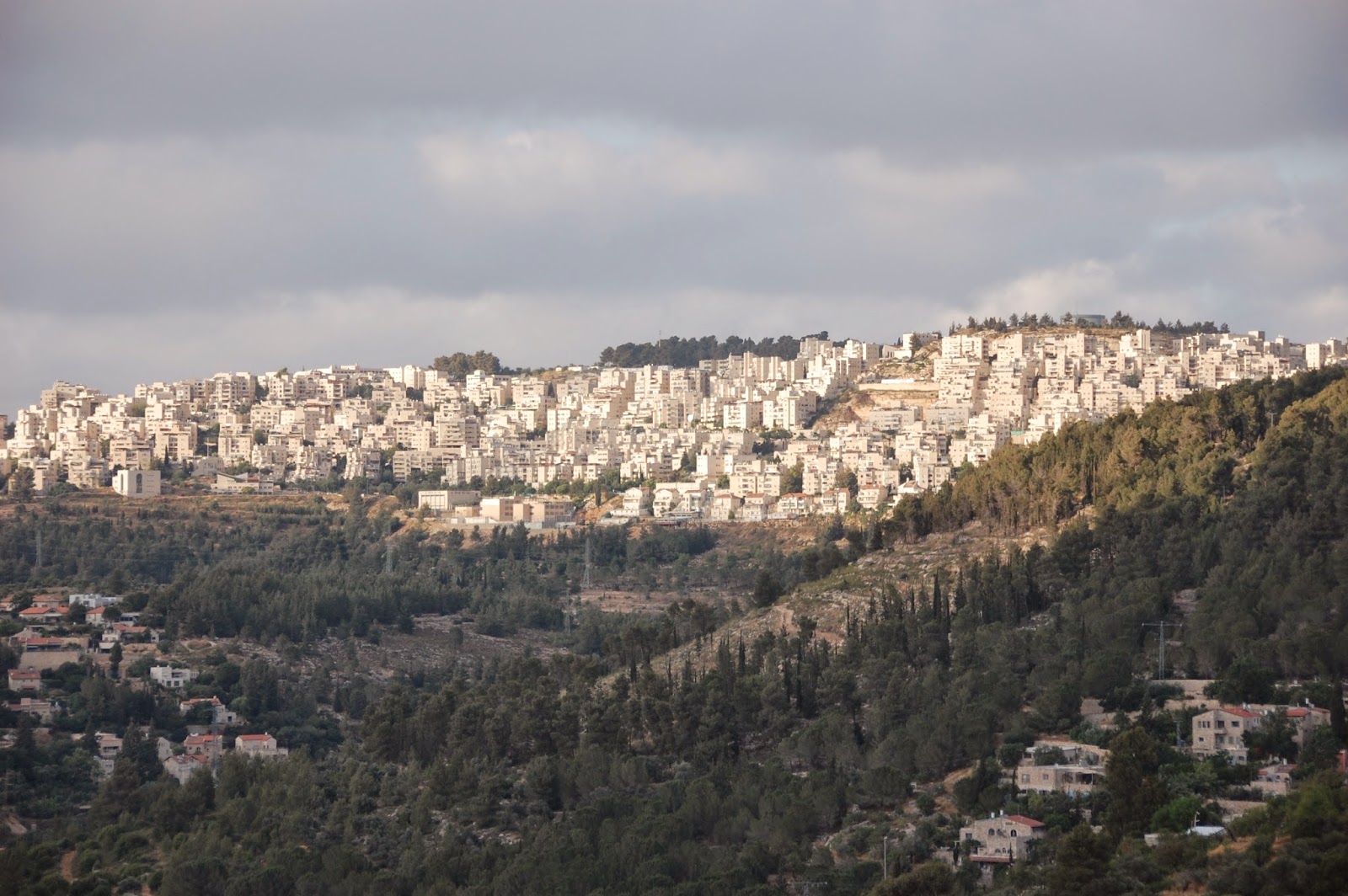
The picture (above) of Har Nof is taken from Yad Vashem, the most prestigous Holocaust memorial. The water tower at the top right is next to the main buildings of Deir Yassin, which today serves as a mental hospital, mostly for those suffering with too much religion, an affliction also known as “The Jerusalem Syndrome.”
At Yad Vashem all visitors, and especially American politicians, are repeatedly told to “Never forget.” At Deir Yassin the message is “Never mind.”
There is not even a signpost among the old Arab buildings to indicate that it was once a prosperous Arab village of about 750 people.
In building the Har Nof settlement much of the Deir Yassin cemetery was destroyed. The rest is now littered with trash and condoms. Har Nof children have been seen digging up Arab graves. (Imagine the outcry had they been desecrating Jewish graves.) Apartment buildings of Har Nof are built on the old quarry where villagers were executed and their bodies dumped and burned on April 10, 1948.
The ironies are breathtaking. But some of us still remember.
Daniel McGowan
Professor Emeritus, Hobart and William Smith Colleges
Three shot with live ammunition during Nabi Saleh protest
International Solidarity Movement | November 22, 2014
Nabi Saleh, Occupied Palestine – Israeli forces shot and injured three Palestinians participating in a weekly Friday demonstration in the village of Nabi Saleh. Soldiers fired .22 caliber bullets, a form of live ammunition which has maimed and killed many Palestinians, even as Israel continues to claim it as a “less lethal” way of assaulting demonstrators.
Yesterday at noon between forty and fifty Palestinians, Israelis, international activists and journalists marched down from the center of Nabi Saleh towards a water spring stolen by a nearby illegal settlement. The Israeli forces awaited them down the road with two military jeeps and a police jeep. Some youths threw stones towards the military vehicles. Soldiers and police fired tear gas canisters and rubber-coated steel bullets at demonstrators as the group walked down the road.
 After a brief period of calm, a police jeep equipped with a tear gas dispenser drove up and down the road, firing tear gas at protesters. A few suffered from excessive tear gas inhalation, including a boy under the age of ten.
In addition to continuing to fire rubber coated steel bullets and tear gas, soldiers also began to shoot .22 live ammunition. Two seventeen-year-old boys were shot while throwing stones, one in the thigh and one in both the hand and foot. One Israeli soldier fired at a child under the age of twelve as the boy was running away up the hill beside the road.
Nariman Tamimi, a thirty-eight-year-old woman from the village, was shot in the thigh at close range with a .22 bullet. Israeli soldiers shot her in front of her children and family, driving away and leaving her in the road. She was taken away for medical treatment, where she underwent surgery, and currently remains in hospital.
Life sentences restored for two Palestinian prisoners released in Shalit deal

MEMO | November 21, 2014
The Israeli authorities restored the previous life sentences issued against two Palestinian prisoners who had been released as a part of the Shalit deal, Felesteen Online news reported on Friday.
One prisoner is from Tulkarem and the other Nablus, in the occupied West Bank.
According to Felesteen Online, the director of the Ahrar Centre for Prisoners Studies and Human Rights, Fuad Al-Khafsh, announced that the Israeli authorities had re-issued the life sentences on the two released prisoners, Ashraf Al-Wawi from Tulkarem and Hamza Abu Arkoub from Nablus.
Since tensions started escalating in the occupied Palestinian territories last summer, the occupation authorities have detained thousands of Palestinians, including re-arresting dozens of former prisoners released as part of the Shalit exchange deal in 2011.
Support for justice in Palestine soaring on US campuses
ALRAY | November 20, 2014
New York – A student-led movement taking shape on U.S. college campuses have seen a growing number of young activists organizing around solidarity with Palestine.
The Students for Justice in Palestine organization, one of the major solidarity coalitions, now has more than 110 active chapters in the U.S. and the number is growing.
The movement enjoys the backing from those with a wide array of political thought and a support base that significantly grew after Israel’s “Operation Cast Lead” and “Operation Protective Edge” assaults on Gaza in 2008-09 and this summer respectively.
According to Aman Muqeet of the organization’s National Steering Committee, Israel’s summer offensive affected all of those who are in solidarity with the Palestinian people. “It has strengthened our resolve and commitment to the work we do.”
Operation Protective Edge began July 7 and lasted for 51 days; it killed more than 2,000 Palestinians, mostly civilians, according to Palestinian health officials. More than 10,000 others were reported injured.
“Also, it has empowered us because we have seen an unprecedented amount of support from the international community,” Muqeet said. “Musicians, actors, and public figures voicing support for Gaza, corporations distancing themselves from Israeli crimes; consumers joining the Palestinian-led call for a boycott of Israeli goods and corporations that support Israel; millions of people around the world taking to the streets to demand justice.”
He says public opinion in the U.S. and the West shifted significantly after Israel’s summer assault.
“The Protective Edge massacre has brought the realities of a brutal colonial empire to the fore … On campuses, students are more informed than they were in the past and are keeping up with the developments.”
An Oct. 24 report by the New York-based Jewish organization Anti-Defamation League reported a dramatic increase in the number of pro-Palestine events scheduled on U.S. campuses since the massacre.
There were 75 events scheduled since the beginning of the 2014-2015 academic year, which started in late August or early September at most American universities, the report said. That number marks a 114 percent increase compared with the same period last year.
“Israel has done an excellent job of demonstrating to the international community the lack of regard it has for civilians, justice, and human rights,” according to Muqeet.
Brooklyn College has a Students for Justice in Palestine chapter. Organizers there say their aim is to raise awareness about the human rights violations being committed by Israel against the Palestinians and to build solidarity with the Palestinian struggle for justice, freedom, self-determination and the right of return.
The group’s president, Sarah A. Aly, says the chapter has received more requests during the current academic year from students who want to join the chapter when compared to last year.
“Our membership is very diverse and we work with non-Muslim groups on a regular basis on campus, such as the Latino and black clubs as well as DreamTeam and LGBT club,” she said.
The group finds connections between Israeli actions in Gaza and the shooting of unarmed black teenager Michael Brown by a white police officer in Ferguson, Missouri.
“We do draw the parallels because the struggles that communities of colors face in the U.S. are connected to the Palestinian struggle in many ways. We fully support the people in Ferguson and all those fighting for justice and liberation. One of our members was in Ferguson to show support for them and the support for Palestine she received while she was there was very evident.”
Brown’s death set off mass protests, which have since continued at various levels around the country.
Muqeet says the Students for Justice in Palestine stands in solidarity with not just Mike Brown and Trayvon Martin, but all victims of racial violence.
Their fourth annual national conference’s opening keynote featured author Rev. Osagyefo Uhuru Sekou speaking on “From Ferguson to Palestine: Resisting State Violence and Racism.”
Israel has traditionally been a close ally of the U.S., and has been assisted since its founding with substantial amounts of American financial and military aid.
What young activists believe to be a “lack of objectivity” from the U.S. government toward Israel’s massacres is also adding to the rise in the number of students who support for the Palestinian cause.
“When students see this, they ask questions and they want to learn more, and effect positive change which will bring an end to the human rights violations and occupation of Palestine, and end U.S. military support for Israel’s occupation and human rights abuses,” Muqeet said.
“So, I anticipate a steady growth of students that support justice in Palestine.”
Shock and horror at killings, but not when victims are Palestinians
By Yvonne Ridley | MEMO | November 19, 2014
I wonder how many people have heard of Mohammed Siyam? While the Western media went into overdrive over the tragedy of the synagogue killings in Jerusalem, little Mohammed lay gasping, fighting for his life on an operating table in Turkey.
As two crazed men, armed with knives, unleashed a brutal, indiscriminate attack on the unsuspecting Jewish congregation, the 14-year-old was just one of many Palestinian children who had already had his limbs sheared off in a brutal, indiscriminate attack.
That the 14-year-old had survived this long was a miracle in itself. He lost both of his legs during Israel’s war against the civilians of Gaza in the summer; the Israeli airstrike also blew 12 members of his family to pieces with bombs deliberately designed to kill and maim human beings. The courageous youngster, an innocent child who had already survived three wars in his short life, finally gave up his struggle and was pronounced dead on Tuesday during yet another operation; this one was on his lungs and respiratory tract.
There was no media present at his burial, no headlines as his body was lowered into the grave. In that he was no different to the 570 other Palestinian children from Gaza who were killed by Israel’s summer blitz; his passing went unnoticed.
The Western media, it seems, is not interested when the dead come from the Gaza Strip where 2,140 Palestinians paid the ultimate price this summer alone for having the misfortune to live in the world’s largest open air prison. While death and destruction destroyed the sanctity of one place of worship in Jerusalem there was little outrage vented in the West when even worse rained down in Gaza just months earlier. That the Israeli onslaught destroyed 73 mosques in 51 days, while 205 others were partially destroyed, barely registered in the Western media.
Other statistics brushed aside by the media routinely during Israel’s war included the 11,000 who were injured, many of them women and children. According to the UN, Israel’s bombs destroyed or damaged thousands of civilian buildings, including the only power plant and more than 220 schools, many run by the international body. The much fewer Israeli casualties, almost all of them soldiers, received far more media exposure.
Probably one of the worst offenders of the “Ostrich approach” to Palestinian casualties is the BBC, which has a global reputation for gold standard reporting, except when it comes to the Middle East. BBC News online headlines screamed, “Bloody attack at Jerusalem synagogue” with breaking news being updated in a live blog every few minutes followed by detailed analysis and the ubiquitous Israel spokesmen. Sky News also went into overdrive and before long most TV and online media were relaying images of bloodied prayer shawls and ambulances and the general chaos associated with such an atrocity.
Interviews at the scene followed and blurred video footage taken by a passer-by was also shown. As a journalist with more than 35 years in the business it was, I would say, a job well done. What makes me despair at the standard of journalism, though, is the lack of coverage of similar atrocities carried out by Israelis against Palestinians; they barely make it into the mainstream.
Look at the following observations compiled by the excellent NGO Friends of Al-Aqsa, of which I’m a member:
- Palestinian bus driver Hassan Yousef Al-Ramouni, believed to have been lynched by Israeli settlers, was not mentioned at all by the BBC until the attack on the synagogue, when his death was mentioned only in reference to a Hamas statement about events at the synagogue. AFP and major Israeli outlets reported Hassan’s death.
- On November 11th, the BBC reported the killing of 22-year-old Imad Jawabreh using quotation marks around “shot dead by the Israeli army” as if there was any conflicting report over who had killed the young man. By the fourth paragraph of the BBC report, there was mention of attacks against an Israeli soldier and civilians in an attempt to contextualise the killing. By contrast, the article on the synagogue attack contains no reference to killings of Palestinians by Israelis, which might have added some context to the attack. Unlike the story about the synagogue, there was no live blog and no use of evocative imagery; instead, a generic image of an Israeli jeep was the backdrop.
- The BBC only reported once on the killing of Khayr Al-Din Hamdan, shot dead by Israeli police while his back was turned. The incident was caught on camera, but the BBC has not followed up on this clear example of police brutality against Palestinians.
Long ago as it was, I still recall as a trainee being told that every life is precious and there is no room for discrimination when covering an atrocity. It was drummed into us aspiring young journalists that not only must we be impartial but we must also be fair and just. It appears that those standards are no longer applicable in the BBC when it comes to Palestine.
If you needed proof, tell me in all honesty if you had heard Mohammed Siyam’s name before you read this article; or even that a little Palestinian boy who had lost both his legs and 12 members of his family in the summer war had now lost his life? If you had, it is almost certain that it was no thanks to the BBC and other mainstream media.
Israeli soldiers protect Jewish settlers attacking Palestinian village
Yesh Din | November 20, 2014
Israeli occupation forces did nothing to stop Jewish settlers from attacking Palestinian villagers, according to videos released by the Yesh Din rights group, showing soldiers pointing guns at Palestinians while Israelis are throwing stones from behind the soldiers.
The soldiers appear to be protecting the masked and armed Jewish settlers from Yitzhar during their attack on Palestinians in the village of Urif in the West Bank on Tuesday.
“IDF soldiers have the obligation, based on international law and High Court of Justice rulings, to protect Palestinian residents from violence, and IDF soldiers have the authority to detain suspects, including Israeli suspects, until the police arrive,” Yesh Din said in a statement.
“The disturbing video footage demands vigorous investigation and the immediate prosecution of the soldiers involved. An examination must also be carried out of whether the soldiers’ commanders bear liability for the conduct of their subordinates,” attorney Emily Schaeffer Omer-Man, legal advisor to Yesh Din’s said.
Violence and Resistance in Palestine
An African American Perspective on Israel/Palestine
By Ajamu Baraka | November 19, 2014
For the many thousands of tourists who fly into Israel/Palestine every year, landing in the modern Ben-Gurion airport in Tel Aviv marks the beginning of a great adventure in the “holy land.” But for members of the “African Heritage” delegation, flying into Ben-Gurion was fraught with tension and foreboding. Before departing the U.S. on October 27, our delegation rehearsed how we would move and act, role-playing what to say and what to avoid when we would face Israel’s first line of defense – its custom officials at the airport.
The normally simple act of landing, showing that prized blue book that is the U.S. passport and passing effortlessly through customs and into the country, was something that we understood might not be automatic for us. And indeed it wasn’t – within an hour of our landing our delegation’s co-leader, a young Palestinian woman, was detained. We later found out that she was interrogated, held overnight, and deported the next day.
As our delegation slowly made its way through Israel’s entry process those first couple of hours at the airport, we did not quite grasp that our experience at the airport would not be the first of the strange dualities that we would experience and witness of life in Israel/Palestine. The gaggle of wide-eyed excited tourists that were happy to be in the country greatly contrasted with our already lived experience of Israel as a police state on guard against all threats, real and imagined.
The delegation and program:
The African Heritage delegation was made up of activists, educators, journalists, clergy, students and folks representing the full spectrum of African American life in all of its diversity. Sponsored by the Interfaith Peace Builders, an organization of dedicated young activists experienced in organizing delegations to Israel/Palestine, the individual members of our delegation had various positions and motivations for being a part of the delegation. But a genuine feeling of solidarity with the plight of the Palestinian people and a desire to better understand the situation in order to share what we observed with our constituencies where we lived and worked emerged as the common denominator that united most of us.
Our ambitious agenda included meetings and visits that took us across the country. From East Jerusalem to “Israel proper” through to the West Bank and down to the Negev desert, we met with peace activists, political activists, clergy, the settler community of Hebron, Palestinian-Arab Bedouin women, and lived with Palestinian families in Bil’in and the Deheisheh refugee camp. It was an exhilarating and emotionally exhausting experience that touched us all in very personal ways.
The never ending conflict?
The deeply troubling impression that I came away with was that a negotiated, relatively “peaceful” resolution of the conflict is impossible and that those individuals who believe that the Israeli state would grant sovereignty and respect the human rights of Palestinians within the context of either a one or two state solution are either naive regarding the nature of Israel’s settler project or fundamentally dishonest.
The obscene level of investment in the infrastructure of repression in the occupied territories along with the most aggressive settlement policies since the 67 war clearly demonstrates that the Israeli state has no interest in a negotiated settlement with Palestinians.
Indeed the “facts on the ground” all point toward policies of permanent control of Palestinian life and land. Those facts include the over six hundred thousand Israeli settlers in the West Bank and settlement expansion into Palestinian East Jerusalem, the so-called security wall that is more an enclosure wall to expropriate Palestinian land, and the emergence over the last 15 years of a right- wing, militarized Israeli civil society symbolized by the popular support given to the governing coalition anchored by the right-wing Lukid party. These facts coupled with the complete collapse of what is referred to as liberalism within Israel, suggest that the current political alignments and power relations shatter any illusions that a domestic constituency strong enough to counter the hegemony of the Zionist positions exist anywhere in Israel.
On the Palestinian side, there are deep divisions among the leadership of Hamas and Fatah, the two main Palestinian organizations, despite the so-called unity government that was established in June of this year. I was struck by the number of people who have lost all faith in the Palestinian authority created out of the Oslo process. Yet at the level of the “people,” Palestinians living in the occupied territories are still united in their steadfast commitment to resist the occupation.
Unity on the issue of Palestinian resistance stems primarily from the daily indignities of life under military occupation and the repressive brutality that is a permanent feature of Palestinian life. Our delegation observed and experienced, if only briefly, life under military occupation as we moved through military checkpoints throughout the country but especially in the West Bank.
In the village of Bil’in, a community in resistance that was documented in the Academy Award nominated film Five Broken Cameras, our delegation was hosted by the village’s popular resistance committee. As part of our visit we were taken down to the separation wall or what many of us call the apartheid wall. Without provocation or warnings of any kind, the delegation suddenly found itself on the receiving end of a barrage of Israeli gas grenades. After having to run back to our cars through gas, we were informed by our hosts that since the authorities were aware that internationals were in the town for the night we should be aware that there was a possibility that soldiers might raid houses that night to arrest us, something that has happened before.
Two days later, we once again experienced the duality of experiences reflected in the lives and positions of Palestinians. In the morning we met with the Holy Land Trust, an organization that is committed to developing what it calls a spiritual, pragmatic and strategic approach to the ongoing conflict. It sees its work of reconciliation between Palestinians and Jews as a viable model for realizing a joint community that respected each other and was committed to justice, political equality and peaceful coexistence. That evening, however, we stayed in the Deheisheh refugee camp, a camp located near Bethlehem that was established after the expulsion of the more than 750,000 Palestinians in the war of 1948 that resulted in the creation of the state of Israel. Our hosts at Deheisheh were clear that for them, peaceful coexistence was impossible in a settler-colonial context that did not allow them to recoup all of the land that they argue was stolen by the Israeli state.
A week after returning from the super-charged, repressive environment that is Israel/Palestine, it is not surprising that Jerusalem is now being consumed by an intensification of violence. From what I observed, the allegations that Israeli settlers lynched Yousuf al-Ramouni, a Palestinian bus driver in Jerusalem that then sparked the retaliatory killing of four Israeli’s, is not surprising nor beyond the realm of possibility. Settler and state violence are central components of the colonial project. And violence as part of Israel’s colonial project has always been strategically deployed. It is used as a means of social control but by manipulating issues to evoke Palestinian resistance it is used to support Israel’s narrative as victim. Israeli Prime Minister Ariel Sharon adroitly used this device to provide the pretext for destroying the last vestiges of the Oslo process and the functionality of the Palestinian Authority. In the aftermath of the disastrous assault on Gaza that resulted in a public relations defeat for Israel and has even led some European governments to recognize a Palestinian state, it appears that the government of Benjamin Netanyahu has gone back to the Sharon playbook. The closure of the A-Aqsa Mosque a few weeks ago had the predictable results of Palestinian Muslim resistance that Israel is attempting to use to its advantage.
The consciously provoked violence in Jerusalem also has another effect. It diverts attention away from political and material basis of the “conflict” – Israel’s brutal occupation and illegal theft of Palestinian land.
As one activist framed the political conundrum: “if a two state solution in which Palestinians were offered the 28% [of the] land mass of historic Palestine with borders between this state and Israel that approximated the 67 green line and a just solution to Palestinian refugees as part of the Oslo process in the 90s, it would have been hard to accept but it might have been viable.” But for this activist and many others in Palestine, it is now clear that the Israeli state never intended to seriously consider establishing a viable Palestinian state or resolving the issue of Palestinian refugees in a just manner.
Difficult as it was, traveling to Palestine and seeing first hand the realities on the ground was a political necessity and an eye opener. One can read about the repression, the growing expressions of racism, and see images from time to time of Israeli brutality, but nothing really prepares you for being thrust into that oppressive reality. And for those of us who reside in oppressive communities where our lives and dignity are also under constant attack, we can feel the humiliation and degradation experienced by Palestinians which after a few days becomes emotionally overwhelming.
During my activist life I have traveled to many of the counties that Western colonial/capitalist leaders characterized as despotic totalitarian states – the old Soviet Union, North Korea, Cuba before 1989 – but in none of those states did I witness the systematic mechanism of population control and scientific repression that I witness in “democratic” Israel. The security walls, towers, checkpoints, and armed settlers created an aura of insecurity and impending assault on one’s dignity at any time. I left that space wondering how anyone with a modicum of humanity and any sense of morality could reconcile living in that environment from the spoils of Palestinian dispossession and degradation and how any nation could support the Israeli political project.
Ajamu Baraka is a long-time human rights activist and veteran of the Black Liberation, anti-war, anti-apartheid and Central American solidarity Movements in the United States.
Israel to Admit 6,000 Ukrainian Jewish Refugees
ALRAY | November 17, 2014
The Israeli government plans to provide shelter to 6,000 Jews who were internally displaced by the conflict in Ukraine, Israeli newspaper Maariv reported on Sunday.
The Israeli plan comes in light of the domestic infighting taking place in Ukraine, which is leading to the displacement of hundreds of the country’s Jews, according to Maariv.
Israeli authorities have secretly begun the construction of refugee camps to receive displaced Ukrainian Jews under the supervision of Israeli Minister of Economy Naftali Bennett, said the newspaper.
Maariv, however, did not specify the location of these camps.
The newspaper noted that about 6,000 Jews are currently homeless in eastern Ukraine, and that Israeli authorities paid to ensure their settlement in temporary camps before they’re transferred to Israel.
It was not possible to get official comment from the Israel authorities regarding the report.
Last month, a source close to the project told Israeli newspaper The Jerusalem Post that considerable resources have been allocated to provide Ukraine’s Jews who have been affected by the fighting there with food, clothing and shelter.
US Police Visit Israel to Learn New Strategies
teleSUR | November 17, 2014
Police officers from Chicago, Illinois, in the United States, which is one of the countries with the most militarized police corps, visited Israel, which has one of the most repressive security agencies, to learn “cutting-edge policing strategies and technologies.”
The public security officials attended the Third International Homeland Security Conference held last week in Tel Aviv.
The U.S. delegation was led by the Chicago Police Superintendent Garry McCarthy, who spoke at the conference, according to the Jewish United Fund (JUF), which sent the officials to Israel.
Several areas were addressed during the conference, including cybersecurity, emergency preparedness, counterterrorism and critical infrastructure, such as ports, airports, trains and pipelines.
Both countries have recently been under the radar for the repressive and violent methods that their police corps use against their population.
As an example, United States security agencies have been condemned over the incidents in Ferguson, Missouri, where heavily armed policemen dispersed huge protests and riots that erupted in August after officer Darren Wilson shot and killed Michael Brown, an unarmed teenage African-American boy.
Witnesses assert that Brown had his arms raised before being shot, six times. But Wilson claims he feared for his life after Brown resisted arrest.
Policemen that attended Ferguson to “control” the riots were seen using automatic rifles, camouflage uniforms and tactical equipment. Veterans from the Iraq and Afghanistan wars condemned authorities for that and asserted that the policemen were better equipped and armed than they were when at war in the aforementioned countries.
“Lets remind the officers were facing unarmed angry civilians and that the U.S. soldiers were fighting a regular army and insurgent groups, all of them using heavy weapons,” the veterans said in a joint statement.
On the other hand, Israeli security corps, who are always questioned over their lack of respect toward human and civil rights, have always been criticized for the repressive methods they use against Palestinians.
They use tear gas, rubber bullets and even real bullets to disperse demonstrations, while Palestinians throw rocks. Dozens of videos demonstrate how Israeli policemen and soldiers hit children and unarmed Palestinians.
And most recently, Israeli security agencies have staged several clashes with dozens of Palestinians after agents blocked access to the Al-Aqsa mosque, one of the most holiest sites in the world for Muslims.
However, United States is not the only country that is learning Israeli methods. Agencies from over 60 nations sent representatives to the security conference in the Israeli capital, according to the JUF.
“We will now bring the lessons home; our community should feel secure knowing that the relationships in Chicago and Cook County between homeland security, law enforcement, emergency management and JUF is a testament to the strong relationships, common interests and shared concerns of everyone,” said McCarthy.
Featured Video

Spain train disaster raises questions over Israeli-linked security contractors
or go to
Aletho News Archives – Video-Images
From the Archives
Are There 50,000 ‘Israeli-born’ Individuals Living in the UK?
By Professor David Miller | August 18, 2026
Recent disclosures by the Zionist regime show that some 2,069 British nationals were serving in the IDF as of March 2025, according to Freedom of Information (FoI) requests submitted to the occupation forces (1,686 dual British-Israeli, plus 383 multinational). We cannot tell from the figures how many of these were already settler colonists and intend to stay in the colony, and how many will return or have returned to the UK. Presumably, those returning to the UK will number far fewer than 2,000, since many are known to have become permanently residents of the colony.
Additionally, the IDF figures only provide a snapshot, and do not tell us how many have served in the Jewish supremacist military either before or after March 2025. One way into the question of how many genocidaires are living in Britain is to ask how many current British residents were born in the Zionist colony. There is data on that, as we shall see. … continue
Blog Roll
 Aletho News
- The beginning of the end: Israel at the heart of America’s political civil war
- US-Israeli war on Iran cost Persian Gulf states nearly $1T in damage, lost growth: Report
- Congress probe could put ‘Israel’ in dock over Iran war: Israeli media
- Spanish public prosecutor backs US demand to extradite pro-Palestine philanthropist Fergie Chambers
- Zelensky spent over 740 days outside Ukraine while West serves as his real home
- Indian captain of Russian ‘shadow fleet’ tanker faces 10-year jail term in UK
- Europe, US face higher heating bills amid Iran war fallout
- The Leak That Arrived Right on Cue
- No, New York Times, California’s Climate Has Always Been a Land of Flood, Drought, and Fire
- Are There 50,000 ‘Israeli-born’ Individuals Living in the UK?
- If Americans Knew
- An error has occurred; the feed is probably down. Try again later.
- No Tricks Zone
- German Authorities Start Initiative To Evaluate Public Register For Climate “Disinformation” Spreaders!
- Zonal Asymmetry of Temperature Change in the Antarctic Circumpolar Current
- New Study: The Net Fossil Fuel Contribution To Rising Atmospheric CO2 Has Been Zero For 500 Years
- Germany’s Green Energy Transition Becoming Increasingly Expensive…Another 6 Trillion Euros!
- Sudden Stratospheric Warming, Powerful El Niño Combination May Lead To Extreme Europe Cold, Energy Crisis!
- Two New Studies Find Thwaites Glacier Melt Cannot Be Driven By Human Activity Or A Warming Ocean
- E-Cars Reduce CO2 Emissions By Only 41% Compared To Internal Combustion Engine Vehicles
- Predictions Made By Renowned Climate Professor Over Past Decades Have Been Proven To Be Poor
- New Study Suggests Large Regions Of The Pacific Ocean Have Been Cooling For The Last 80 Years
- Germany’s Green Energy Debacle: High Energy Costs Force Kahla Porzellan to Close After 182 Years!

