Aletho News

ΑΛΗΘΩΣ

Israel’s water war crimes

By Muna Dajani | The Hill | October 3, 2014

There is a war going on and it long predates Israel’s summer Gaza onslaught. It is a war on water, and it runs deep. For the last decade, Israel has been carrying out a systemic and willful campaign to deny Palestinians access to clean water.

Though Israel’s campaign to restrict water access has yet to make the news, rights organizations are pushing the Palestinian Authority to take the issue to court, so the matter could well make headlines in the coming months. While the PA has been debating whether or not to accede to the International Criminal Court, increasing documentation of war crimes may push their hand.

Under international law, deliberate targeting of civilian infrastructure is a war crime, and as of 2010, water and sanitation were enshrined as basic human rights. Israel has blatantly and systemically been denying these rights.Through growing documentation and awareness, Israel’s systemic campaign against Palestinian water can be seen for what it is: a comprehensive violation of one of the most basic human rights. It consists of a two-pronged approach: the visible mass destruction of water and sanitation infrastructure, reinforced by invisible policies of closure and occupation, siege and confiscation that block the repair of infrastructure. Together, these tactics prevent the existence of sustainable Palestinian communities, driving people from their land, their homes, and communities.

The first tool of Israel’s water war has been well documented. It includes direct and extensive damage caused deliberately during large-scale military operations. In the latest Israeli military operation in Gaza this meant Israeli aircraft targeted the sewage pump station and F16s disabled pumps that sent 25,000 cubic meters of wastewater per day to Gaza’s main sewage treatment plant. Further Israeli shelling east of Gaza City hit a main water pipeline, disconnecting areas east of the city so that 450,000 were completely cut off from municipal services, and the more than 1.5 million residents of the strip suffered massively reduced access.

The losses in water infrastructure alone from this latest series of strikes have been estimated at $30 million. This is not taking into account the massive toll on health, with 100,000 cubic meters of untreated sewage flowing through the streets of Gaza and into the sea, causing widespread health problems. This meant over-burdened hospitals, without water themselves, were dealing with digestive ailments, skin allergies, water-borne and respiratory diseases.

UN investigations from the 2008-9 attacks on Gaza already affirmed that Israel’s targeting of water infrastructure was “deliberate and systematic.” The September meeting of the Russell Tribunal, charged with investigating rights violations from this summer’s atrocities, has reached similar conclusions.

Human Rights Watch and Amnesty International have also urged the PA to take action on these violations and bring them to the ICC.

And while arguments will no doubt be made about the fog of war or the targeting of water infrastructure as accidental or as collateral damage, this line of defense is weakened when such military attacks are seen as part of a longer-term systemic program. For example, in the 2001-2 invasion of Jenin, the same policy of intentional damage to water equipment during military assault was used. Invasions caused massive damage to water and wastewater infrastructure, cutting off water services to civilians for weeks.

Even more insidious has been the slow but deliberate damage to water infrastructure that has taken place as part of the day-to-day of occupation. This damage can be seen both in the West Bank, as well as in the agricultural lands of Gaza that have, since 2005, been declared as a border ‘buffer’ zone by the Israeli military.

Official documentation has catalogued demolition by Israeli forces of 173 different pieces of water, sanitation, or hygiene infrastructure in Area C of the West Bank between 2009 and 2011. This has included the confiscation of water tankers, which are used as an emergency measure when access to water is prohibited. In the Gaza border zone – which swallows up some 17 percent of Gaza’s landmass – 305 agricultural wells were destroyed between 2005 and 2013.

In addition, Jewish settlers in the illegal Jewish-only settlements in the West Bank regularly carry out acts of vandalism and destruction that specifically target Palestinian water sources, and frequently take over natural springs for their own recreational use.

These settlers are acting within a clear Israeli policy that sees targeting of water resources as an acceptable method of warfare.

The destruction of generations-old water infrastructure such as historic cisterns or springs not only deprives marginalized communities of water but destroys an important element of Palestinian history and the community’s organic relationship with natural resources.  Further, by depriving farmers of water, Israeli policies drive them off their land. Loss of agricultural income resulting from de-developed water infrastructure is estimated at $1.44 billion annually.

Though Israel has total control over the building, development, or maintenance of water infrastructure in Area C – where permission is systemically denied – it also maintains indirect control in all areas of the West Bank, where it can – and often does – prohibit the building of water treatment, irrigation, or industrial facilities.

Evidence of water warfare, and deliberate efforts to use water as a weapon against Palestinian civilian populations, is being documented at all levels, and efforts continue to bring awareness to all those affected. Israel’s water war has continued with impunity for far too long and must be challenged before its effects are irreversible.

Dajani is a policy member of Al-Shabaka: The Palestinian Policy Network, and a Palestinian environmental researcher and activist based in Jerusalem.

October 11, 2014 Posted by | Ethnic Cleansing, Racism, Zionism, Timeless or most popular, War Crimes | , , , , | Leave a comment

NPR covers for David Brooks

By Alison Weir | October 10, 2014

Not surprisingly, NPR’s ombudsman goes with the flow that will neither interfere with his current employment nor injure his future prospects in American journalism.

Following is an email to me from the Office of the Ombudsman, and my response to NPR:

Dear Alison,
Thank you for contacting the NPR Ombudsman. We appreciate your comments and your thoughts will be taken into consideration as we continue to monitor the reporting.
The Ombudsman is currently working on a blog post about this issue. You may be interested in this statement from our standards and practices editor:

David Brooks is primarily an opinion columnist for The New York Times. He appears on All Things Considered to offer his opinions, not as a reporter. His son’s service with the Israeli Defense Forces is no secret We agree with the Times‘ editorial page editor, Andrew Rosenthal, that Mr. Brooks’ long-standing views about Israel have been “formed by all kinds of things … [and] are not going to change whether or not his son is serving in the IDF, beyond his natural concerns as a father for his son’s safety and well-being.” We also agree with the Times‘ public editor, Margaret Sullivan, that Mr. Brooks should not be barred from commenting about Israel. She has recommended that he address the issue of his son’s service in the IDF in a future column. That strikes us as a reasonable suggestion. If a situation arises and we feel he should also mention it on our air, we still discuss that with Mr. Brooks at that time.

1. In reality, the large majority of NPR listeners quite likely have no idea of Brooks’ conflict of interest (and they share this ignorance with PBS’s ombudsman).

The only place the information about Brooks has appeared in print to date is a Hebrew version of an Israeli newspaper, and possibly the Los Angeles Jewish Journal. It has not appeared on any mainstream broadcast entity that I’m aware of.

2. While, as you state, Mr. Brooks is not a reporter, he must still abide by journalistic ethics. The National Society of Newspaper Columnists‘ code of ethics states that columnists’ potential conflicts of interest should be disclosed.

3. You rightly point out that Mr. Brooks has the “natural concerns as a father for his son’s safety and well-being.”

The obvious reality is that Mr. Brooks’ commentary about Israel does directly affect his son’s “safety and well-being.”

Commentary that defends Israel to the American public keeps American tax money ($8-10 million per day) and American diplomatic support for Israel flowing, both of which are extremely important for his son’s safety and well-being.

Commentary that pointed out the illegality and immorality of Israel’s recent killing and injuring of thousands of Gazan men, women, and children by the Israeli military in which his son is serving would quite likely interfere with his son’s well-being, as an increasing number of Americans would join those around the world calling for war crimes tribunals.

4. Your statement is illogical, unfounded, and ludicrous. But your well-compensated career in mainstream American journalism will continue unhindered.

October 11, 2014 Posted by | Deception, Ethnic Cleansing, Racism, Zionism, Mainstream Media, Warmongering, War Crimes | , , , , , | Leave a comment

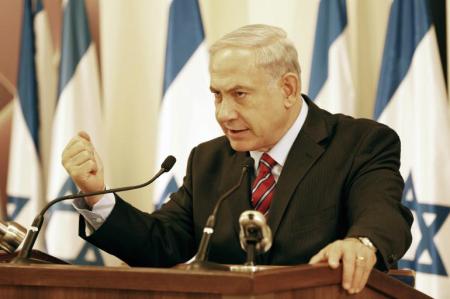
Is Hamas really like ISIS, as Netanyahu claims?

benjamin-netanyahu

By Ibrahim Al-Madhoun | MEMO | October 8, 2014

In his heart of hearts, Netanyahu is aware of the major and fundamental differences between the Palestinian Hamas movement and the so-called “Islamic State” (ISIS) that is not limited to a specific state or nationality. However, for some reason, he is trying to link the two. In doing so, he ignores what is even more dangerous than his erroneous comparison; the significant similarity between ISIS and Israel’s ideology, policies and practices.

Israel calls itself the “Jewish State”, just as Al-Baghdadi calls his group the Islamic State. From the time of its “independence” in 1948, Israel has never declared it borders; in fact, they expand and contract, just as the territory controlled by ISIS does (it rejects the ideas of borders and does not recognise nation states). Indeed, ISIS considers its borders to be wherever its forces have reached. Israel was established on the basis of colonial-settlement and mass immigration of Zionist Jews from all over the world; ISIS is also encouraging immigrants who believe in the ideology of the group, regardless of their ethnicity and nationality.

It is no wonder that the Palestinian resistance is surprised when it captures or kills Israeli soldiers only to find that they are French, British, Polish, German or Russian individuals brought in to fight on Palestinian land and join the ranks of the “Jewish State”. In addition, the war crimes and crimes against humanity committed by Israel throughout its occupation of Palestine far surpass those committed by ISIS; the Israelis kill women and children and commit massacres deliberately, with apparent impunity, and then boast about it.

I do not mean that this comparison should offend ISIS, nor am I very concerned with talking about an organisation being fought by the world. It is undoubtedly a serious phenomenon that requires further reflection and study. What I am really concerned about is revealing Netanyahu’s manipulation and his attempt to divert attention from the real nature of the conflict in Palestine. When he fights Hamas, he is fighting the rightful owners of the land, the Palestinians. He is also following terrorist logic and using unimaginably extreme methods thanks to the world overlooking the Zionist project’s excesses in the region.

The international community is applying blatant double standards in its reaction to Israel and ISIS. Alliances have been formed to fight ISIS but the world turns a blind eye to the Israeli occupation that commits war crimes witnessed by all who wish to see. Over the summer, and not for the first time, Israel bombed hospitals, schools and safe houses while they were still inhabited and Israel also used internationally-banned weapons.

Netanyahu’s repeated attempts to link Hamas to ISIS is just more proof of Israel’s defeat and failure in its latest attack on the movement. It is also a cry for help by Israel to the countries of the world after its army failed to progress more than a few metres into Gaza. This is a desperate attempt to discredit and ruin the reputation of the Palestinian resistance and link it to a terrorist organisation reviled across the world. Netanyahu still hasn’t realised that the world is no longer held hostage to Israeli propaganda, and that such links and comparisons do not harm Hamas or change the fact that occupation is terrorism in every sense of the word. There is only one state occupying someone else’s land in the Middle East, and it isn’t the “Islamic State”.

October 9, 2014 Posted by | Deception, Ethnic Cleansing, Racism, Zionism, War Crimes | , , , , | Leave a comment

The Kosher ‘Philosopher’

By Gilad Atzmon | October 8, 2014

Jews and philosophy have had a pretty troubled relationship. The collision between ‘the tribal’ and ‘the universal’ or, more accurately, between Athens and Jerusalem, is inevitable. The few great Jewish thinkers who transcended the tribal, such as Spinoza or Otto Weininger, have been harassed and labelled by the rabbis as ‘self haters’ and enemies of the Jews.

Some contemporary Zionist merchants insist upon wrapping their Judeo centrism in crypto philosophical arguments. Bernard-Henri Levy, for instance, advocates his Zionist warmongering using a pseudo ‘moralist’ terminology.

Today I came across a uniquely banal rant by Asa Kasher, a Jewish ‘philosopher’ at Tel Aviv University. Kasher, who also authored the ‘IDF ethical code,’ defended Israel’s military conduct in the recent Gaza campaign in an article published in the Jewish Review of Books.

Kasher wrote, “Hamas unscrupulously violates every norm in the book.” And I wonder, what book? I would like to find out, at a minimum, what ‘book’ grants the Jewish State the right to uproot an entire nation in the name of a Jewish homecoming? Is there a book that permits the Jews to turn a city into an open-air prison? Is there a book that legitimates reducing Gaza into a pile of rubble? I am afraid that the answer is affirmative. There is more than one such book. But these books aren’t exactly philosophical texts. These books are the prime Judaic texts. The Talmud and The Old Testament are suffocated by Goy hatred and stories of Jews and their God pouring their ‘wrath on the Goyim.’ Rabbinical Judaism has historically been very careful in the way it treated some of those vile and barbaric Judaic verses and teachings. But Israel and Zionism draw inspiration from those genocidal verses, and the outcome is evident in the shattered urban landscape of Gaza.

Unlike the very few Jews who actually contributed to humanity by means of self-reflection (such as Jesus, Spinoza and Marx), Kasher prefers pointing at Hamas. He denounces Palestinian militants for indiscriminately rocketing Israeli cities. I wonder if the same ‘Kosher Aristotle’ would go out of his way to denounce Jewish militants in Auschwitz if they had possessed the ballistic capability to rocket Berlin and had acted upon it? I doubt it.

Back in the 18th century, in a remarkable attempt to formulate an anthropocentric, ethical requirement that was justified by means of reason, Immanuel Kant presented the Categorical Imperative: “act only according to that maxim whereby you can, at the same time, will that it should become a universal law.”

Let’s examine Kasher’s thoughts in the light of Kant’s imperative. If the IDF operated ethically in Gaza, as Kasher foolishly suggests, then every military force should be expected to follow the ‘IDF universal law:’ flatten entire cities, uproot nations, murder innocent civilians and so on. Perhaps a Zionist Jew can follow such awkward reasoning.

Kasher further asks, “Does the presence of large numbers of non-combatants in the vicinity of a building that is directly involved in terrorist assaults on Israelis render that building immune to Israeli attack?” Kasher continues, “The answer is, and must be, no. Israel cannot forfeit its ability to protect its citizens against attacks simply because terrorists hide behind non-combatants. If it did so, it would be giving up any right to self-defense.”

Consciously or not, the banal Israeli so-called ‘philosopher’ evinces the complete opposite of philosophical, ethical or universal principled thinking. Instead, he provides a glimpse into Jewish tribal ethno-centrism in which ‘goodness’ is defined solely by Jewish interests.

In a total dismissal of international conventions and of ethical judgment, Kasher blurs the crucial distinction between ‘civilians’ and ‘combatants’ and between the innocent and the actor.

The verdict is obvious. That Israel repeatedly behaves unethically goes without saying, but reading Kasher reveals that the Jewish State also lacks the notion of an ethical horizon. Even its academic authority on the subject is totally incompetent.

This is disturbing but not surprising.

October 9, 2014 Posted by | Ethnic Cleansing, Racism, Zionism, Timeless or most popular, War Crimes | , , , | Leave a comment

New Horizon Conference: Meeting of Minds in Tehran

By Eric Walberg | Dissident Voice | October 8, 2014

The 2nd conference “New Horizon: the International Conference of Independent Thinkers” was held in Tehran, September 29–October 1 2014, including over 30 journalists, writers and academics from around the world presenting papers and arguing issues of world geopolitics, with a focus on the Middle East. I came from Canada, along with University of Lethbridge Globalization Studies Professor Anthony Hall, author of Earth into Property: Colonization, Decolonization, and Capitalism (2010).  It was greeted in western media by hysterical denunciations; firstly, by the American Jewish Committee which accused it of “promoting hatred of Jews and Israel”, and the Anti-Defamation League which accused it of “promoting anti-Semitic propaganda”. The conference almost didn’t take place at all, having been officially cancelled, supposedly as a gesture to the West, after the new Iranian President Hassan Rouhani was elected last year. But after a flood of criticism on Iranian websites sympathetic to the organizers, the Iranian Foreign Ministry reversed itself. Nader Talebzadeh, the principle organizer, had had to lobby hard to reinstate the conference, calling the cancellation of the conference “a major mistake on the part of our government”.

“Have our leaders given in so much to the world that they are even afraid of a conference that might hurt Mr Obama’s feelings?” asked one blogger sarcastically.

The 1st New Horizon Conference in September 2012 was denounced in the West when it was addressed by the previous president Mahmoud Ahmedinejad, probably best remembered in the West for his 2005 soundbyte that Israel should be “wiped off the map”, referring to Ayatollah Khomeini’s prediction that “the regime occupying Jerusalem must vanish from the page of time.” The translation of the Persian text was later corrected but this was ignored in the West, where Ahmedinejad was further accused of “holocaust denial” for suggesting the figure of six million as the number of Jews who died in the holocaust was exaggerated, and he was mocked for suggesting that 9/11 was a conspiracy.

Indeed, most Iranians see 9/11 as involving some degree of conspiracy by the US and/or Israel, but then so do, for instance, 55% of Egyptians. So, not surprisingly, prominent at the New Horizon Conference this year was the world’s leading 9/11 conspiracy theorist, France’s Theirry Meyssan, who in 2002 published what is still considered the classic work on the topic, 9/11: The Big Lie (L’Effroyable imposture), translated into 28 languages, arguing that the attacks were organized by a faction of “the US military industrial complex in order to impose a military regime.” Meyssan also argues that the attack against the Pentagon was not carried out by a commercial airliner but by a missile. Also present was American filmmaker Art Olivier, who produced the feature film Operation Terror (2012), whose scenario followed Meyssan’s.

In a YouGov poll last year, 60% of Americans rejected the official explanation as published in the 9/11 Commission Report (2004), so Meyssan’s call for a UN investigation of 9/11 and the recent petition signed by 100,000 New Yorkers for an investigation of the collapse of World Trade Center building 7 are surely legitimate, though they have been blocked by politicians as “absolutely ridiculous” and “wild fantasies”.

Iran’s current President Rouhani was not associated directly with this year’s conference.  Instead he was embroiled in a controversy with UK Prime Minister David Cameron, who both extended his hand in friendship to Rouhani at the UN General Assembly in a “historic meeting”, and then slapped him in the face from the UN General Assembly podium, attacking Iran for its “support for terrorist organizations, its nuclear program, its treatment of its people”, calling it “part of the problem in the Middle East”.

“On the contrary,” said a peeved Rouhani in his address to the UN, blaming the West and Saudi Arabia for sowing the seeds of extremism in the Middle East with “strategic blunders” that have given rise to the Islamic State and other violent jihadist groups. He also criticized the West’s sanctions on Iran’s nuclear program and reiterated his government’s desire to resolve the dispute, stating that no cooperation with the West against ISIS is possible until the sanctions are lifted. He called Cameron’s comments at the UN “wrong and unacceptable.”

Appropriately, the New Horizon Conference opened with the book launch of the Persian edition of US journalist Gareth Porter’s Manufactured Crisis: The Untold Story of the Iran Nuclear Scare (2014). Porter told me:

Through painstaking checking with experts and an IAEA official, I discovered that the documents submitted to the IAEA, which supposed showed Iranian plans to put nuclear warheads on their missiles, were fabricated by the terrorist group People’s Mojahedin of Iran and were passed on the IAEA by Mossad. They were contradictory—clearly doctored blueprints for an obsolete missile system.

Porter was awarded the UK Gellhorn Prize for investigative journalism in 2012 for exposing official lies concerning US policies in Afghanistan and Pakistan. With this latest expose, Porter did for the Iranian nuclear dossier what he and others did after 2003 in exposing the lies that prompted the US invasion of Iraq.

The sessions were varied. “The Gaza War and the BDS Movement Strategies” was addressed by Code Pink activist Medea Benjamin, who has been arrested dozens of time for her plucky protests at Congressional hearings against the war in Iraq, and who famously interrupted a speech by President Barack Obama in May 2013 protesting his continued use of drones against civilians. (She is barred from entering Canada.) Benjamin suggested a new project to highlight illegal Israeli settlements: activists hope to target one of the largest US-based real estate firms, RE/MAX, which “operates in over 90 countries, including Israel, where it sells homes complete with swimming pools in the West Bank to Israeli settlers in defiance of international law.” Every Sunday tens of thousands of “open houses” are held by RE/MAX around the world. Benjamin hopes activists will picket these open houses to embarrass RE/MAX into ceasing their West Bank activities. A session on Islam and the West, “Postsecularism and its Discontents”, emphasized the importance of ethics in Islamic civilization which makes subservience to market diktat unacceptable, and is a major stumbling block to understanding between the West and the Muslim world. “There is no teleology in western society, no guiding morality, only an obsession with materialism, with logos,” argued organizer Arash Darya-Bandari. “We believe it is necessary to control the negative tendencies in culture, such as pornography, alcohol, drugs, prostitution, to strive towards a more moral and justice society.”

“The ‘Islamic’ State Meme, its Precursors, and the US-Israel-Saudi Triangle” heard frontline reports from Meyssan and others about the intentional destruction of the Iraqi and Syrian states by the invasion of Iraq and ongoing western and Israeli support for insurgents in Syria, directly resulting in ISIS’s phenomenal success. “The West has abetted Sunni-Shia differences in the process to keep Muslims divided and allow continued western penetration and control of the growing chaos there,” charged Meyssan. Rouhani’s comment at the UN—“Certain intelligence agencies [who] have put blades in the hands of madmen, who now spare no one,”—is hard to argue with.

In the session “The Israeli Lobby in England”, Stephen Sizer, Anglican vicar and author of Christian Zionism—Road Map to Armageddon? (2004), explained that the vast majority of Zionists are not Jewish, but Christian. This prompted him in 2006 to draft what became known as the Jerusalem Declaration on Christian Zionism, signed by four of the Heads of Churches, declaring Christian Zionism a heretical belief, both immoral and a contradiction of faith. The rector of the University of Middlesex was pressured to rescind Sizer’s PhD but the examination committee wouldn’t budge. Nor has Sizer been cowed by constant harassment, including a break-in and the theft of his computer. At the same time, on his visits to Tehran, Sizer lobbies on behalf of Iranian religious minorities and always brings Persian-language New Testaments as “gifts”. “My intent is to show the Iranians that genuine Christians are not a threat to anyone, but bring the message of peace and love.”

Contrary to the shrill cries in the western media that the conference was anti-Semitic, it was unique in my experience in addressing Zionism and US imperialism forthrightly and intelligently, without a hint of racism. The issue of anti-Semitism was addressed and dismissed, as “There is no issue with Jewish people or the Jewish religion,” explained Darya-Bandari, “but rather with Zionism, that secular distortion of Judaism that itself is racist, and has been used as a pretext to dispossess  and kill Palestinians.”

The American Defense League loudly attacked the conference for focusing on Zionist control of western media and the outsize influence of the Zionist Lobby in the US and around the world. So what’s wrong with that? There is more than enough documented proof of this, as I discover when I researched Postmodern Imperialism. The ADL labelled several of the delegates as anti-Semitic, including ex-US Marine Ken O’Keefe, who has led several relief convoys to Gaza, has appeared several times on BBC’s Hardtalk in support of Gaza, and famously renounced his US citizenship in view of US crimes around the world. It should be remembered that the ADL was successfully sued in the 1990s for false accusations of anti-Semitism.

The conference issued a resolution condemning ISIS, Zionism, US unconditional support of Israel, Islamophobia, and calling for activism locally to boycott Israeli goods and to promote understanding between the West and the Muslim world, and to fight sectarianism. “This was a great opportunity to meet anti-imperialist activists from around the world, to bring Russians, Poles, western Europeans, North Americans together with Iranians and other Muslims, both Sunni and Shia, in a forum without sectarianism, truly supporting peace and understanding,” said delegate Mateusz Piskorski, director of the European Centre of Geopolitical Analysis in Warsaw and former MP in the Polish Sejm.

~

Eric Walberg, a journalist who is now writing for Al-Ahram Weekly in Cairo, is the author of From Postmodernism to Postsecularism: Re-Emerging Islamic Civilization.

October 9, 2014 Posted by | Ethnic Cleansing, Racism, Zionism, False Flag Terrorism, Solidarity and Activism | , , , , , , , | Leave a comment

American Airstrikes & the Universal Language of Force

In his speech before the meeting of the 69th session of the United Nations General Assembly on September 24, U.S. President Barack Obama resurrected yet another turn of phrase used most often by those wishing to make the case for dropping bombs on people and things.In an effort to justify U.S.-led airstrikes in Syria, Obama declared that the militant organization known as ISIS (or ISIL or IS, the ‘Islamic State’) not only commits the “most horrific crimes imaginable,” but is so vicious, violent, and uniquely brutal that it “forces [the international community] to look into the heart of darkness,” adding later:

No god condones this terror. No grievance justifies these actions. There can be no reasoning, no negotiation, with this brand of evil. The only language understood by killers like this is the language of force. So the United States of America will work with a broad coalition to dismantle this network of death.

The rhetoric used by Obama to defend yet another illegal and ill-conceived American air campaign in the Middle East – an undefined, unconstitutional operation designed to inevitably expand and escalate – is well-worn. The very same word salad, notably the “language of force” line, has been routinely served up to justify lethal action against a seemingly intractable foe and it puts the onus on the target of that aggression for bringing such violence upon itself: if they weren’t such barbarians, we too wouldn’t have to resort to barbarism.

So, bombs away. After all, military action was our only choice, we are told, despite the fact that the declared targets of our artillery pose no direct or imminent threat to the United States. The irrational and bloodthirsty comprehend only the heat-seeking and bunker-busting. Diplomacy is impossible, thus destruction is imperative.

In his 2005 book, Writing the War on Terrorism: Language, Politics and Counter-terrorism, Richard Jackson, deputy director at the National Centre for Peace and Conflict Studies at the University of Otago in New Zealand, explored this very kind of political messaging:

One of the most noticeable and ubiquitous features of the language of counter-terrorism is its invariable appeal to identity: terrorists are endlessly demonised and vilified as being evil, barbaric and inhuman, while America and its coalition partners are described as heroic, decent and peaceful – the defenders of freedom.

“At its most basic level, the language used by officials is attempt to convince the public that a ‘war’ against all forms of terrorism is necessary, reasonable, inherently good and winnable,” he added.

Over the past few decades, whenever bombing Iraq is on the horizon, we’ve heard much of the same from government officials and their pro-war mouthpieces in the media and think tank establishment.

In late 1990, Martin Indyk, founder and executive director of the AIPAC-launched Washington Institute for Near East Policy (WINEP) and later senior advisor to presidents Bill Clinton and Barack Obama, wrote, “Saddam Hussein has demonstrated that he only speaks and understands the language of force.”

In 1991, Maine Representative Olympia Snowe supported the authorization of Operation Desert Storm due to her determination that successfully confronting Saddam Hussein required “a credible military threat be maintained against a brutal aggressor who only understands the language of force.”

Just days before Bill Clinton’s first inauguration as president in January 1993, the George H.W. Bush administration was again bombing Iraq. Utah Senator Orrin Hatch insisted, “Unfortunately, Saddam Hussein knows only the language of force. President Bush has delivered a message that Saddam is certain to understand,” adding, “The air strikes are not enough.”

In September 1996, when the Clinton administration itself was routinely bombing Iraq, Secretary of State Warren Christopher expressed his frustration with Russian condemnation of such attacks. He told the press he was “disappointed” the Russians “don’t understand as we do that the only language that Saddam understands is the language of force.” This became a go-to phrase in the administration’s talking points.

Speaking to members of the group “Seeds of Peace” on September 3, 1996, Christopher made arguments eerily reminiscent of what we’ve heard recently with regard to Obama’s current operation:

The record is, unfortunately, all too clear. Saddam has threatened and invaded his neighbors, developed and used weapons of mass destruction, sponsored countless acts of terrorism, and for the last two decades he has relentlessly persecuted the Kurds and the Shiites. When Saddam tests the will and resolve of the international community, our response must be and will be forceful and immediate.

Time and again we’ve seen that the United States leadership is essential to provide that response. Military action that the United States launched today has made it clear that Saddam will pay a price whenever he engages in aggression. We are answering in the only language he understands, the language of force.

Later that month, on September 12, 1996, former Secretary of State James Baker testified before the Senate Armed Services Committee and encouraged more military attacks, saying, “Iraq under Saddam Hussein only understands force. And more to the point, it seems only to understand overwhelming force. When we respond in a situation like this, I do not believe that it needs to be limited so as to be proportionate to the provocation.”

In their book about the 2003 invasion of Iraq and subsequent occupation, New York Times correspondent Michael R. Gordon and former Marine lieutenant general Bernard Trainor recount the words of a high-ranking officer of the U.S. Army’s Fourth Infantry Division sent to attack the city of Tikrit. “The only thing these sand niggers understand is force,” the officer remarked, “and I’m about to introduce them to it.” General Ray Odierno, who led the 4th ID’s attack, is currently the U.S. Army’s Chief of Staff.

The messaging is clear. As Richard Jackson notes, “In this most rudimentary sense, the language accompanying the ‘war on terrorism’ is a public relations or propaganda exercise; it is designed to ‘sell’ the policies of counter-terrorism.” In order to build support for military action, the public is repeatedly told that “the terrorists are inhuman barbarians who deserve to be eradicated from civilised society; the threat posed by terrorism is catastrophic and it is only rational to respond with all due force; and the American-led war against terrorism is by definition a good and just war.”

Historically, however, this rhetoric has not been reserved solely for justifying American military action against predominately Muslim countries in the Middle East. Nor has this phrase been used only by one side of the conflict.

In a video message allegedly made and distributed on October 20, 2001, al-Qaeda leader Osama bin Laden declared, “Bush and Blair… don’t understand any language but the language of force. Every time they kill us, we kill them, so the balance of terror is achieved,” according to a declassified report released by British intelligence in November 2001.

Al-Qaeda leader Ayman Al-Zawahiri, in a 2003 sermon, reportedly announced, “The Crusaders [Americans] and the Jews only understand the language of force, and they only understand the return of coffins and destroyed interests and burned towers and destroyed economy.”

In a statement claiming responsibility for simultaneous suicide bombings that killed 155 people in Baghdad on October 25, 2009, an anti-occupation, al-Qaeda linked group known then as the Islamic State in Iraq explained, “Among the chosen targets were the ministry of oppression known as the Ministry of Justice and the Baghdad provincial assembly… The enemies only understand the language of force.”

Prior to the beheading of American journalist James Foley, on August 12, 2014, ISIS reportedly sent an email to Foley’s family announcing their intention to murder him in retaliation for U.S. airstrikes and delivering a wider message to the American government and people. Claiming to have provided “many chances to negotiate the release of your people via cash transactions” and “prisoner exchanges,” ISIS wrote that it was clear “this is NOT what you are interested in.”

The email went on: “You have no motivation to deal with the Muslims except with the language of force, a language you were given in ‘Arabic translation’ when you attempted to occupy the land of Iraq! Now you return to bomb the Muslims of Iraq once again, this time resorting to Arial [sic] attacks and ‘proxy armies’, all the while cowardly shying away from a face-to-face confrontation!”

“You do not spare our weak, elderly, women or children so we will NOT spare yours!” the email warned. “You and your citizens will pay the price of your bombings!”

In his speech before the United Nations last week justifying expanded airstrikes against ISIS, Obama thus recycled the very phrase used by ISIS to justify its own violence.

Still, the phrase has even older roots.

Zionism and Its Malcontents

In 1891, after one of his frequent travels through Palestine, Ahad Ha’am, the Ukrainian-born Jewish essayist known widely as the founder of cultural Zionism, lamented that Zionist settlers acted like “the only language the Arabs understand is that of force” and “behave towards the Arabs with hostility and cruelty, trespass unjustly upon their boundaries, beat them shamefully without reason and even brag about it, and nobody stands to check this contemptible and dangerous tendency.”

This same, possibly apocryphal, formulation has been credited over the years to Israel’s first prime minister David Ben-Gurion, second prime minister Moshe Sharett, and IDF commander Raphael Petan, and is widely considered the immutable underlying assumption guiding racist, hawkish Israeli attitudes towards Arabs in general and Palestinians in particular.

This linguistic articulation of Zionist sentiment was already so prevalent prior to the establishment of the State of Israel that renowned political theorist Hannah Arendt turned the phrase on its head in her 1948 essay, “Peace or Armistice in the Near East?,” published two years later in the Review of Politics. “All hopes to the contrary notwithstanding,” she wrote, as the Nakba raged on, “it seems as though the one argument the Arabs are incapable of understanding is force.”

In February 1992, following the assassination of Hezbollah leader Sheikh Abbas Moussawi, killed in southern Lebanon in an Israeli airstrike along with his wife and five-year-old son, Israeli Defense Minister Moshe Arens boasted, “We’ve learned that terror organizations like Hezbollah only understand one language – the language of force.”

Two weeks after the start of the Second Intifada, when Israel had already fired 1.3 million bullets at Palestinian demonstrators in the West Bank and Gaza, a military spokesman justified Israel actions, saying that force “will be the only language they understand.”

Prior to Israeli parliamentary elections in 2009, supporters of the fascistic Avigdor Lieberman enthusiastically endorsed this narrative. “He’s the kind of leader we’ve been waiting for, he knows how to talk to Arabs in their own language, the language of force,” an Israeli woman who resides in a town close to the border with Gaza told the press.

Predictably, those opposed to Israel policies of colonialism, annexation, occupation, and military aggression have also resorted to such rhetoric. “Our enemy knows only the language of force and negotiations are useless,” Palestinian officials have longed declared. In 1998, a resident of the Jabaliya refugee camp in Gaza said this of Israeli leadership: “They only understand the language of force, not of peace.” A decade later, a Palestinian professor in Gaza said that same of Hamas.

From Stalin to Putin

While the “language of force” has long been used in the West to describe the supposed base nature and unsophisticated lack of humanity of the savage “Oriental” – a colonial, supremacist discourse popularized all the more after the attacks of September 11, 2001 – this discursive process has not been reserved for Arab or Muslim targets alone.

In his famous March 1946 “Iron Curtain Speech,” Winston Churchill expressed his conviction that, for Soviet Russia and its Communist satellites, “there is nothing for which they have less respect than for weakness, especially military weakness.” Thus, he reasoned, “Western Democracies” must “stand together” lest “they become divided or falter in their duty and if these all-important years are allowed to slip away then indeed catastrophe may overwhelm us all.”

68 years later, speaking at a Center for Strategic and International Studies forum in March 2014, New York Times columnist Roger Cohen paraphrased Churchill’s admonition, saying of Russian president Vladimir Putin that “the language he understands is force” and warning that, “unless there is a strong response, and a united response above all,” to Russian actions in Crimea and eastern Ukraine, “from the United States and Europe together to this, and a reassertion of the transatlantic alliance and NATO, then we could be heading in a very worrying direction.”

In May 2014, prior to his election as new Ukrainian president, billionaire confectionery magnate Petro Poroshenko stated that, in order to deal with pro-Russian separatists — whom he called “terrorists” — “we should find out the right language they understand, and that would be the language of force.”

Vietnam

On April 19, 1965, as American bombs fell in Vietnam, conservative columnist Russell Kirk wrote, “Like the Nazis, the Asiatic Communists prefer guns to butter,” and accused North Vietnamese leader Ho Chi Minh of aggressive “conquest”:

At this stage of affairs, only effective military resistance and retaliation can dissuade Ho Chi Minh from pursuing the war with increased vigor. The language of force, indeed, Communists understand.

General William C. Westmoreland, commander of U.S. forces in Vietnam at the time of the My Lai Massacre, and soon-to-be Army Chief of Staff, often and openly maintained that “meaningful force” was “the only language they [the North Vietnamese] understood.”

As late as March 1975, after nearly all American troops had been withdrawn from the conflict, and following a meeting with President Gerald Ford, the then-retired Westmoreland told journalists that “the culprit in this whole thing is Hanoi,” adding, “The only language Hanoi understands is the language of force and I think it’s too bad that we couldn’t again mine Haiphong harbor and that the President doesn’t have authority to use tactical air and B52 strikes to hit the Communist supply lines.”

Six weeks later, Saigon fell to the North Vietnamese Army.

Nicaragua

On the floor of the United States Congress on February 4, 1988, long-serving South Carolina Senator Ernest Hollings advocated for increased military aid sent to the Contras in Nicaragua. Denouncing Congressional Democrats as “not committed to fight for anything” and “only willing to posture and talk,” Hollings declared that “there is no hope in Nicaragua without aid to the Contras.” Dismissing diplomacy, he bellowed, “Peace plans? The Marxists only understand the language of force.”

Later that year, in August 1988, Nicaraguan Contra founder and commander Enrique Bermúdez also made the case for continued military support from the U.S. government. “The only language the Sandinistas understand or respect is the language of force,” he insisted. “If the Sandinistas weren’t receiving massive assistance from the Soviet Union, Cuba and other communist countries, the Nicaraguan people wouldn’t have any need of foreign sources of support.”

Repeated Rhetoric

The ubiquity of the “language of force” line has rendered the phrase effectively meaningless, levied at one’s enemies in order to silence debate and promote military action.

The same was said of South Africa’s Apartheid regime in the 1980s. Croatian officials, Kosovar separatists, and New York Times columnists said the same of Serbian president Slobodan Milošević in the 1990s. It’s been said about the “leaders of the Axis of Evil,” it was said about Gaddafi and Yemeni president Ali Abdullah Saleh, and it is often said about Assad. It has been said about the Pakistani Taliban, the Somali militant group al-Shabab and the Nigerian Boko Haram.

The same rhetoric is used by tyrants as well to describe dissident, resistance, and revolutionary movements. For instance, in early February 2011, as Cairo’s Tahrir Square swelled with increasing demands for Egyptian dictator Hosni Mubarak’s resignation, a CNN report noted that the U.S.-backed leader had long “argued that Egypt had to adopt a tight security policy to combat terrorism; that the forces of political Islam do not understand anything but the language of force and a strong government grip.”

A year ago, in a September 20, 2013 article, David Sanger of the New York Times credited Obama’s economic warfare on Iran and threats of military action in Syria with restarting nuclear negotiations and, with the help of Russia, dismantling Assad’s chemical weapons. With regard to “President Bashar al-Assad of Syria, President Vladimir V. Putin of Russia, and Iran’s erratic mullahs,” Sanger wrote, Obama was experiencing “the long-delayed fruits of the administration’s selective use of coercion in a part of the world where that is understood.”

Speaking before the United Nations General Assembly two weeks later, Israeli Prime Minister Benjamin Netanyahu said that, “when it comes to Iran, the greater the pressure, the greater the chance” of successfully denying the nation their inalienable right to a domestic nuclear energy program.

For years, however, Iranian officials from three successive presidential administrations have consistently pushed back against this offensive presumption.

Back in June 2003, as U.S.-led pressure over Iran’s nuclear program increased, Iranian Foreign Ministry spokesman Hamid Reza Asefi warned that unjust accusations and illegal threats would strengthen the resolve of conservative elements in the government opposed to diplomacy with the West. “Excessive pressure on Iran would untie the hands of those who do not believe in dialogue,” he said, “Even those who favour constructive talks would not accept the language of force and threat.”

Two years later, as dubious allegations, wild predictions, and threats of unprovoked attack mounted, Iranian President Mahmoud Ahmadinejad addressed the nuclear issue in his first speech before the UN General Assembly on September 17, 2005. Western powers and Israel, he said,

have misrepresented Iran’s healthy and fully safeguarded technological endeavors in the nuclear field as pursuit of nuclear weapons. This is nothing but a propaganda ploy. The Islamic Republic of Iran is presenting in good faith its proposal for constructive interaction and a just dialogue. However, if some try to impose their will on the Iranian people through resort to a language of force and threat with Iran, we will reconsider our entire approach to the nuclear issue.

The next year, leading Iranian cleric Ahmad Khatami, a senior member of the Assembly of Experts, noted in a nationally broadcast weekly sermon, “Iran is favourable toward negotiations that are just, logical and without preconditions, but refuses the language of force,” adding, “Using the language of force with Iran is a foolish and clumsy attitude.”

“Resolutions, sanctions and threats have always made the issue more complicated,” Iran’s IAEA envoy Ali-Asghar Soltanieh said in late 2009 before a Board of Governor’s vote on a resolution focusing on the recently-announced uranium enrichment facility at Fordow. “We recommend the IAEA not to refer to such methods and use the language of logic rather than force.”

Throughout 2012, Ahmadinejad reaffirmed his assertion that Iran would never buckle to the West’s “language of force and insult.”

Earlier this year, following a round of nuclear negotiations in Vienna, Iranian Foreign Minister Mohammad Javad Zarif remarked that “the language of force has no place in foreign policy agendas” and that “any state using the ‘all-options-on-the-table’ rhetoric is actually taking outdated measures.”

In late 2009, then IAEA chief and Nobel Peace Prize laureate Mohamed ElBaradei concurred with this message. “[U]sing the language of force is not helpful. It leads to confrontation, to the other country taking counteraction,” he said in an interview with The Hindu. “It is better to forget the language of coercion and focus on trying to engage in dialogue.”

The Force of Language

Barack Obama, the drone president who defended perpetual war while receiving his own Nobel prize, disagrees. In his UN speech, Obama has again joined the ranks of those who justify the use of force through the abuse of weaponized language. The appeal to an adversary’s unprecedented “brand of evil” serves not to illuminate the challenges faced, but rather to obfuscate an informed comprehension of current affairs. It is the ultimate conversation-stopper.

As terrorism expert Richard Jackson explains:

… the language of good and evil suppresses questions: we don’t need to ask what the motivations or aims of the terrorists were if they are ‘evil,’ as ‘evil’ is its own motivation and its own self-contained explanation. Evil people do not have any politics and there is no need to examine their causes or grievances. Evil people do what they do simply because they are evil. Clearly, the use of this language is a way of encouraging quiescence and displacing more complex understandings of political and social events. As such, it qualifies as demagoguery by appealing to ignorance and arrogance through a distorted representation of the nature of evil.

As the United States and its coalition partners embark once again on an ill-fated, military misadventure in the Middle East, the recycled language used to promote such policies is predictable. And this time around, as in the past, it’s effectiveness is proven.

A FoxNews poll released this week shows that upwards of 78% of Americans approve of U.S. airstrikes against ISIS in Iraq and Syria, while 55% believe such action is “not aggressive enough.” Additionally, 57% of respondents are supportive of a ground operation if the bombing campaign proves ineffective or indecisive. A Washington Post/ABC News poll this week produced similar results.

Yet, beyond all the political rhetoric and domestic jingoism, for those on the ground in Iraq and Syria, including the dozens of civilians already killed in U.S. airstrikes against ISIS, bombs drop louder than words.


This article was cross-posted on Wide Asleep in America.

October 6, 2014 Posted by | Ethnic Cleansing, Racism, Zionism, Militarism, Timeless or most popular, War Crimes | , , , , , , , , | Leave a comment

More than 500 anthropologists join academic boycott of Israel

Al-Akhbar | October 6, 2014

More than 500 anthropologists have publicly joined an academic boycott of Israel initiated by the American Studies Association,The Washington Post reported, with another 77 joining anonymously.

In February, the American Studies Association voted “to endorse a boycott of Israeli academic institutions to protest the Israeli occupation of Palestinian territories.”

Since then, the campaign attracted hundreds of anthropologists who voiced their opposition to “the ongoing Israeli violations of Palestinian rights, including the Israeli military occupation of the Gaza Strip, West Bank, and East Jerusalem.”

Driven by their commitment to promote and protect the rights of people with full realization of their humanity, the signatories said in a statement that “acting in solidarity with Palestinian civil society is a disciplinary tradition of support for anti-colonial and human rights struggles, itself an important departure from anthropology’s historical complicity with colonialism.”

The statement added that Israeli academic institutions are “complicit with the occupation and oppression of Palestinians.” The boycott means that signed members will not “collaborate on projects and events involving Israeli academic institutions,” teach at or attend conferences at those institutions, and publish in academic journals based in Israel.

The signatories demanded an end to the siege of Gaza and to the occupation of territories taken in the 1967 Six Day War and a dismantle of the settlements and walls.

They also called for an Israeli recognition of “the fundamental rights of the Arab-Palestinian citizens of Israel and the stateless Negev Bedouins to full equality; and respect, protect, and promote the rights of Palestinian refugees to return to their homes and properties as stipulated in UN Resolution 194.”

The academic boycott of Israel not only attracted the American Studies Association (ASA) — the oldest and largest association devoted to the interdisciplinary study of American culture and history — but also the Association for Asian American Studies and the Native American and Indigenous Studies Association.

This anti-Israel academic boycott is a groundbreaking victory for the Boycott, Divestment, and Sanctions Movement (BDS), launched eight years ago to oppose Israel’s discriminatory policies towards Palestinians and its illegal occupation and settlement building.

October 6, 2014 Posted by | Ethnic Cleansing, Racism, Zionism, Illegal Occupation, Solidarity and Activism | , , , , | Leave a comment

Oligarchy and Zionism – Part I

Rinnief

Oligarchy and Zionism – Part 2

October 5, 2014 Posted by | Ethnic Cleansing, Racism, Zionism, Timeless or most popular, Video | , , , , | Leave a comment

The Bedouins long history of demolitions and displacement

By Jessica Purkiss | MEMO | October 2, 2014

The Bedouin Jahalin Tribe had a historic existence roaming the expansive lands in the Naqab Desert which ended abruptly when the State of Israel was declared. Most joined the thousands of Palestinians fleeing, and the group was splintered and scattered.

Many of the Jahalin continued to herd their livestock between Ramallah, Wadi Qelt and Jerusalem until large swathes of land were confiscated to make way for mushrooming Israeli settlements following the beginning of the occupation of the West Bank. Some squeezed into the area off the Jerusalem-Jericho highway, which, after the Oslo Accords fell under complete Israeli military and administrative control. In order to expand the vast Ma’ale Adumim settlement, Israel razed some of the homes and packed their inhabitants away on trucks to live in containers beside a rubbish dump. The separation wall was then built severing the remaining community from East Jerusalem, the main market where they sold the milk and cheese made from their remaining livestock.

The semi-nomadic lifestyle of the Bedouin, hinged on land and livestock, has been continuously chipped away by Israel’s policy of demolitions and displacements. Now, sixty years after the Jahalin were first made refugees, they face being uprooted again as Israel advances plans to “relocate” 12,500 Bedouins from where they reside in the Jerusalem periphery. The plan is reminiscent of the Prawer Plan, the bill approved by the Israeli Knesset in 2011 to relocate some 40,000 Bedouin-Palestinian citizens of Israel from ‘unrecognised villages‘ into townships which was eventually frozen following mass protests within Israel.

This time the Israeli administration has said they won’t put the Jahalin on trucks as they did during the mass eviction in 1997, but they will take immediate action to demolish their residences and agricultural buildings, “because there is an alternative here”. The alternative referred to is a purpose built township north of the West Bank city of Jericho, where they will be lumped with two other tribes- against Bedouin customs- each family allotted a housing plot and a small area unsuitable for the rearing of livestock. A total of 23 communities will be herded into the area.

Jameel Hamadin, a Bedouin facing eviction said: “These areas do not suit our lifestyle or our traditions or our culture.” He added in his address to the European Union: “If they deport us to the city, our lifestyle will end.” The communities previously evicted were housed in Al- Jabal village on expropriated Palestinian land. The United National Committee of Economic Social and Cultural Rights “deplored the manner” those relocated were “housed in steel container vans in a garbage dump in Abu Dis in Subhuman conditions”. Their traditional lifestyle was destroyed by the move.

Israel has justified its expulsion plan through the rhetoric of improving Bedouin living conditions by allowing them to live in places with “suitable infrastructure” and as an appropriate response to the “dynamic changes” that Bedouin society is undergoing as it moves from an agricultural society “to a modern society that earns its living by commerce, services, technical trade and more”.

For the Bedouin, who claim they were not consulted about the plans, this is just another attempt to remove them from strategic land, one that they fear will destroy their traditional way of life for good. Abu Suleiman, head of the Jerusalem Bedouins’ Community Cooperative, asks “why do they not let us build here if they want to improve our living conditions”.

Residing in tin shack like structures perched on the unforgiving hillside terrain; many overlook the continuous construction in Ma’ale Adumim settlement. The homes in the settlement have running water, power, their occupants have access to medical services and top notch schools for their children. In contrast Israel does not allow the Bedouin community to gain access to running water and electricity, and prevents the building of permanent structures and even the tin shacks, which are no match for Israeli bulldozers, stand with the daily threat of demolition.

Under the contentious E1 plan the area of land that the Bedouin currently call home is to be turned into an urban block connecting Ma’ale Adumin and Jerusalem. The plan will divide the West Bank into two and in the process render the chances of a viable Palestinian state dead, and with it the future of a two state solution.

United Nations Relief and Works Agency has urged the plan to be halted, with Pierre Krähenbühl, Commissioner General of UNRWA stating it: “gives rise to concerns that it amounts to a ‘forcible transfer’ in contravention of the Fourth Geneva Convention.” He added: “The humanitarian impact of the planned transfer could be immense”.

This process is already in motion. According to analysis by the Association of International Development Agencies of data compiled by the United Nations Office for the Coordination of Humanitarian Affairs, the number of demolitions in the first eight months of 2014 was higher than in any comparable period in the last five years, as was the number of people who lost their homes as a result.

The Bedouin have a hard fight to remain on their land, a fight that has lasted decades long. For the traditional rural communities this is the next step in Israel’s long history of policies targeting their existence.

October 3, 2014 Posted by | Ethnic Cleansing, Racism, Zionism, Illegal Occupation, Timeless or most popular, War Crimes | , , , , | Leave a comment

Settlement organisation entices Jews into Jerusalem settlement for $136 per day

MEMO | October 3, 2014

The Ir David Foundation, known as Elad, has published an announcement on social media networks in search of Jewish settlers to live in Palestinian homes that it has captured in the town of Silwan, occupied East Jerusalem, in return for a financial reward estimated at 500 shekels ($136) per day, Israel’s Haaretz newspaper reported on Wednesday.

Elad is known for its Judaisation projects of the city of Jerusalem. According to the association’s advertisement, an amount of 500 shekels will be given to each settler who agrees to live in one of the homes that have been seized, with the settler only required to “keep his gun loaded and ready to fire at any time”, according to the declaration.

Haaretz quoted one of the advertisements as follows: “We are looking for people who can stay in the apartments and watch them until families move into them. The work will probably take ten to 30 days (perhaps even more). The daily wage is 500 shekels gross. The workers will stay in the apartments and guard them until they are inhabited by families. Only suitable applicants will be accepted. Please pass this on to friends.”

The following day, the newspaper reported that when asked about the details on what the job entails, an Elad official said: “You’re not the security guard … There are security guards and police when needed, and there’s someone to supervise you and call to make sure everything is all right all the time. We don’t need you as a security guard. As far as we’re concerned, you live in the house, but it’s better if you have a weapon.”

The official also stressed that Elad would be the employer. “I think the payment would be by bank transfer,” she said. “You come and fill out forms.”

With the assistance of armed guards, the Foundation seized, overnight on Monday, ten individual buildings that include 23 apartments in the Wadi Hilweh neighbourhood of Silwan, located just south of Al-Aqsa Mosque, claiming that the settlers now own them.

Silwan has been witnessing continuous and tense confrontations with Israeli occupation forces ever since the seizure of the Palestinian homes, with Israeli police and armed forces present in the streets around the clock to protect the settlers.

October 3, 2014 Posted by | Ethnic Cleansing, Racism, Zionism, War Crimes | , , , , | Leave a comment

Israel’s false peace

aksa

By Iqbal Jassat | Media Review Network | October 2, 2014

What is it about proclamations of “peace” that allows injustice to continue unhindered?

It’s a question applicable to governments, security institutions, media columnists and pro-Israel lobbies who regularly espouse a passion for “peace in the Holy Land”.

While on the surface it appears to be a perfectly normal and laudable aspiration, in the experience of Palestine it is unfortunately riddled with inconsistencies making it alarmingly dishonest.

“Peace” as espoused by Israel’s leaders is no more than a fig leaf for it seeks to conceal the regime’s unremitting repression of Palestinian rights.

Though “peace” is a concept embodying humane values associated with calm and serenity, for Palestinians it has had a devastating opposite effect. Their daily experience whether as refugees awaiting return home or as a collective of Occupied people, points to a life of subjugation which has for decades been exploited by successive governments in Israel.

While the deception inherent in Israel’s so-called desire for “peace” is known and documented quite extensively, it is also known that by leaning on this false notion, the regime has attempted to deflect scrutiny of its unjust conduct towards Palestinians.

Such deliberate and calculated sophistry has assisted Israel and her supporters to bluff the world. By staking its claim as a “peaceful” state whose citizens deserve to live in “peace”, Israel’s social architects expect immunity from censure for any and all forms of oppression and military barbarity.

“Peace” is thus a linguistic political tool without any connection to the noble values it incorporates. Malicious and misleading to the extreme for it implies that to oppose Israel is to oppose “peace”. In other words, anti-Israelism is equated with mindless violence.

This type of faulty rationale is deliberately constructed to demonise opponents of the regime’s colonial status as violent. Thus in the context of contrasting “peace” and “violence”, Israel continues to rally support for its savagery on the basis of an aspiration most people would unhesitatingly subscribe to.

Netanyahu has repeated this trick once again at the United Nations. By casting Israel as a victim of “terrorism” perpetrated by “violent” ideologues of “Islamist radicalism”, he hopes to garner global sympathy and thereby shield his apartheid regime’s catalogue of atrocities.

America’s current bombing spree in cahoots with Britain and France and their respective Arab client-states gives Israel perfect timing and cover. In Iraq and Syria, the US-led “war on terror” has a new enemy in the guise of ISIS commonly referred to as the Islamic State.

Overnight, ISIS has emerged as a new villain threatening the existence of Western civilization. Its dominance over large swathes of Iraq and Syria including key oil fields precipitated what most people currently associate ISIS with: beheadings of Western journalists.

Suddenly this new “Islamist bogeyman” emerges to not only distract global attention from Israel’s beheadings of Palestinian families, but also to extend a fresh lifeline to America’s military industrial complex. And, of course, to provide Netanyahu the opportunity to cast resistance movements such as Hamas and Islamic Jihad in the mould of ISIS.

Such tricks conjure the minds of magicians and keep people enthralled while deceptive policies of dispossession continue uninterrupted.

Netanyahu and his clique of magicians may believe that waving the wand of “peace” will conceal Israel’s bloody carnage and ongoing aggression, but unfortunately for Zionism this illusion won’t last.

If South Africa is used as a yardstick to measure whether Israel’s bag of dirty tricks has worked, it’s pretty clear that Netanyahu has failed dismally.

Here, a sustained campaign of boycott, divestment and sanctions (BDS) led by the ANC as the ruling party and a formidable formation of civil societies, churches and trade unions has demonstrated that it has not been deceived by false notions of “peace”.

October 2, 2014 Posted by | Aletho News | , , , , | Leave a comment

David Brooks’ son is in the Israeli Military… Inside & outside the Mondoweiss, Common Dreams loop…

The following explores a variety of cover-ups and sort of cover-ups…

By Alison Weir | October 1, 2014

David Brooks is a prominent and powerful journalist. He is a columnist for the New York Times and a commentator for PBS New Hour and NPR.

Now we learn, through an article in Jewish Journal, that Brooks’ son is in the Israeli military. In other words, he has a profound conflict with impartiality, as the New York Times ethics code calls it, and Brooks, the Times, NPR, etc. have not revealed this to the public.

The Jewish Journal article reports:

One of the more interesting nuggets buried in a long, Hebrew-language interview with New York Times columnist David Brooks in the recent Ha’aretz magazine is the revelation, toward the very end, that Brooks’s oldest son serves in the Israel Defense Forces.

I find it interesting, and disturbing, that Ha’aretz hid this information from its English readers.

(By the way, I have written extensively about numerous journalists having close personal and family ties to the Israeli military – see below.)

Philip Weis has a strong article that tells about Brooks’ reporting, and notes:

“So when David Brooks was commenting favorably on Israel’s onslaught on Gaza this summer on National Public Radio, his son was serving in the Israeli army. Why didn’t NPR tell us?”

It is ironic, then, that Weiss also decides not to tell readers insider information he feels they shouldn’t know:

“This is now the third Times reporter/writer whose son has gone into the Israeli Defense Forces. Famously Ethan Bronner, of course…  and a third person I will not identify (I know the individual personally, the beat didn’t involve the Middle East, the son left before long).”

Weiss’s reluctance to share his insider information with others is a bit reminiscent of Ha’aretz. Perhaps it’s ok, since this is a personal friend. But it shows again that some are inside a loop that the rest of us aren’t.

This is also reminiscent of Common Dreams, which exposed an Israel-partisan who posed as an anti-Semite on numerous websites, but refused to disclose his name, thus keeping its insider information away from the rest of us – even though many of our websites may also have been victimized by this infiltrator.

Again, some are in the loop. The rest of us aren’t.

*

Some of my articles on US journalists’ personal ties to the Israeli military

Myra Noveck & the New York Times: Another journalist with children in the Israeli military

US Media and Israeli Military: All in the Family 

 Ethan Bronner’s Conflict With Impartiality 

 Is “pundit” actually Israeli military officer? 

AP’s Matti Friedman: Israeli citizen and former Israeli soldier

October 2, 2014 Posted by | Deception, Ethnic Cleansing, Racism, Zionism, Mainstream Media, Warmongering, Timeless or most popular, Wars for Israel | , , , | Leave a comment
