The Israel Lobby ‘In Defense of Christians’?
By Maidhc O Cathail • Unz Review • October 2, 2014
Having long since captured the sympathies of America’s evangelical Christians, Israel’s friends have recently been attempting to show empathy for the persecuted Christian churches of the Arab World in what appears to be a concerted effort to garner support for Tel Aviv’s regional aspirations. Only founded earlier this year, a previously obscure non-profit organization called “In Defense of Christians” suddenly attracted international headlines during its inaugural summit (Sept. 9-11). The stated purpose of the three-day Washington, D.C. gathering was to raise awareness about the plight of beleaguered Middle Eastern Christian communities whose continued existence is threatened by the advance of the Islamic State, or ISIS, and other takfiri groups.
Although The Washington Post published a report on the IDC Summit in its Religion section on Sept. 10, it wasn’t until that evening’s gala dinner when keynote speaker Sen. Ted Cruz (R-TX) was reportedly “booed off the stage” for his provocative pro-Israel speech that most people first heard of the Washington-based group. Cruz left little doubt that he was more concerned about defending Israel than the region’s Christians when he began to “loop” ISIS and Al-Qaeda together with Hamas, Hezbollah, Syria and Iran (i.e. the latter three forming “the strategic arc” that poses “the greatest danger to Israel,” as Michael Oren, former Israeli ambassador to the US, has admitted to The Jerusalem Post.) But it wasn’t until the Texas senator asserted that “Christians have no greater ally than the Jewish state” that some of the attendees could take no more of what sounded like an AIPAC-scripted sermon and began to heckle him.
In light of the predictable outrage provoked by Cruz’s paean to Israel, it’s interesting to recall what The Washington Post had been told by IDC executive director Andrew Doran earlier that day:
One Orthodox leader on Tuesday (Sept. 9) declared his opposition to military action to stop the Islamic State militants, a view that is not likely widely shared at the conference, Doran noted. The next day, another called the Arab-Israel conflict the root of Middle Eastern chaos. He doesn’t speak for the IDC nor his brother patriarchs, said Doran.
Yet in a Sept. 11 press release entitled “Clarifying Senator Cruz’s Walk Away from Middle Eastern Christian Summit,” Doran, who previously worked for the US Department of State, still seemed assured that he and his allegedly “non-partisan” organization speak instead for the region’s Christians. After having recounted “in tears” his inspiration for the group’s name from a 1933 letter titled “In Defense of the Jews,” the IDC executive director claimed: “In last night’s Solidarity Gala Dinner, Senator Cruz chose to stand against the small and vocal minority of attendees who disagree with his views on Israel rather than standing with the vast majority of those who attended the gala and support both Israel and the Middle East’s Christians.”
Adding to Doran’s “clarification,” IDC president Toufic Baaklini noted “sadly” that “there was a small but vocal anti-Israel element in the room” who “do not represent the views of IDC.” Fittingly, the IDC press release ended by citing one of the summit’s most active speakers [.pdf] whose support for Israel has rarely, if ever, been in doubt: “As Nina Shea, who introduced Cruz later said, ‘We will not agree on territorial disputes, but we stand united against religious persecution regardless of the religion.’”
A senior fellow at the neoconservative Hudson Institute, Shea directs Hudson’s Center for Religious Freedom. A former vice chair of the US Commission on International Religious Freedom, which was once led by the pardoned pro-Israel Iran-Contra intriguer Elliott Abrams and currently chaired by a daughter of the late “true blue and white” Israel mouthpiece and infamous interventionist Tom Lantos, the senior Hudson fellow has, as one critical profile puts it, “a long track record of using human rights concerns to promote various foreign interventions favored by neoconservatives.” Significantly, the IDC summit is evidently not the first time concerns about specifically Christian suffering have been used by the neocon interventionist:
In a 2001 article for the Washington Monthly, Joshua Green related how in the mid-1990s Shea teamed up with Michael Horowitz, a former Reagan administration official, in an effort “to put the issue of Christian persecution on the map.” Green reported: “Horowitz, a Jewish neoconservative and a senior fellow at the conservative Hudson Institute, detailed the plight of persecuted Christians in Africa and the Middle East. He concluded by calling for intervention. ‘For American Jews, who owe our very lives to the open door of the blessed land,’ he wrote, ‘silence should not be an option in the face of persecutions eerily parallel to those committed by Adolf Hitler.’” According to Green, a favorite Horowitz sound bite at the time was that “Christians are the Jews of the 21st century.”
In a 2012 article entitled “What Will Become of the Middle East’s Christians?”—one of the many pieces in which Doran cites Shea’s work on Christian persecution—the IDC executive director echoes Horowitz’s favorite sound bite:
The exodus of Jews from Yemen, where they had lived for fifteen centuries before the birth of the Prophet, was not an isolated occurrence; it was repeated across the Middle East and North Africa, as these Diaspora Jews made their way, reluctantly in many cases, to Israel. Their fight for survival foreshadowed that of the more than ten million Christians of the Muslim world, who today struggle to maintain a presence and identity in the lands where they have lived for centuries.
Presumably, the reader is expected to infer Muslim persecution of Jews from Doran’s use of the word “reluctantly” as opposed to the Israeli false flag attacks that were required in at least some cases to convince those “Diaspora Jews” to flee to the newly-established “Jewish state” on Palestinian land.
A regular contributor to the neocon National Review Online, Doran also shares Shea’s favored response to the problem of Christian persecution. For instance, in an Aug. 18 op-ed piece entitled “Intervention as Duty,” the IDC executive director writes:
As I argued here last year, the intervention in the former Yugoslavia may serve as a compelling model today for Syria and now perhaps Iraq, but this would call for a willingness to see Iraq and Syria dissolved. For the moment, America clings, as it did at the outset of war in Yugoslavia, to nations that no longer exist.
In Doran’s prescription for the current crisis, one can’t help noticing the similarity with the policy recommendations of Oded Yinon, an Israeli journalist formerly attached to the Foreign Ministry of Israel. In his 1982 essay “A Strategy for Israel in the Nineteen Eighties,” originally published in Hebrew by the World Zionist Organization journal, Kivunim, Yinon argued that, “The dissolution of Syria and Iraq later on into ethnically or religiously unique areas such as in Lebanon, is Israel’s primary target on the Eastern front in the long run….”
However, if the dissolution of Syria, in accordance with Israeli strategic objectives, was indeed one of the ulterior motives behind IDC’s bringing the Middle East’s Christians together in Washington, it appears to have suffered a setback when on the final day of the summit, a delegation of Eastern Christian patriarchs met with President Obama in the White House. According to a report in Al-Akhbar English, Obama surprised his guests by telling them, “We know that President Bashar al-Assad protected Christians in Syria.” Further taken aback by Obama’s use of the term “the Syrian government” instead of “regime,” one of the attendees reportedly challenged the president: “Then you should stop talking about a moderate Syrian opposition.” Ironically, it was in this very same room four months earlier that Obama had met Ahmad Jarba, president of the Syrian National Coalition (SNC) who “thanked the US for its aid to opposition rebels.” One month before that, the leader of the so-called “moderate Syrian opposition” reportedly toured the devastated Armenian Christian village of Kassab, Syria which had been attacked and occupied by the Free Syrian Army, the SNC’s armed wing, and their Al-Qaeda affiliates.
Within a week of the historic meeting of President Obama with the leaders of Eastern Christianity, a World Jewish Congress delegation led by WJC president Ronald Lauder paid a Rosh Hashanah visit to Pope Francis at his Vatican residence. As in the White House, the persecution of Christians in the Middle East dominated the discussion. According to a Sept. 18 report in Haaretz, it was the Bishop of Rome’s turn this time to adopt Horowitz’s sound bite:
Lauder and the pope mutually condemned the attacks against Christians around the world, especially in the Middle East. “In the world, there is still great suffering. First it was your turn. Now it’s our turn,” the pope told the delegation…
Strongly agreeing with the Holy Father’s comments, the WJC president extended the Horowitzian analogy:
He showed a paper bearing the Hebrew letter nun, explaining that: “It is the symbol used in Iraq and Syria to identify Christians’ houses as the yellow star was used in the past against European Jewry.”
The head of the “Diplomatic Arm of the Jewish People” concluded with a well-worn albeit spurious hasbara talking point: “The truth is that Israel is the only safe place for Christians in the Middle East.”
As implied by the Haaretz report, the WJC president—not to mention another pro-Israel interventionist par excellence—has been showing an increased concern for his Christian brethren of late. An Aug. 19 Lauder op-ed in The New York Times asks, “Who Will Stand Up for Christians?” Given the gist of the piece, however, a more candid title might have been “Why can’t the world just stop fussing about Israeli war crimes in Palestine and focus their anger instead on Christian suffering in other parts of the Middle East?” As for how to respond to the persecution of his “Christian brothers and sisters,” the self-described “Jewish leader” pointedly reminds his readers that he is writing this call to action “as a citizen of the strongest military power on earth.” Thus, similar to the fervor that preceded the Second World War, “Onward Christian Soldiers” has yet again become the rallying cry for those who seek to embroil the United States and other Western nations in another major conflict—an unnecessary “Clash of Civilizations”—likely to accomplish little beyond further advancing the hegemonic designs of Israel.
Child Seriously Injured By Explosive Device Dropped By The Army
By Saed Bannoura | IMEMC & Agencies | October 1, 2014
Palestinian medical sources in Bethlehem said that a child was seriously injured, on Tuesday evening, when an explosive device, dropped by the Israeli army during training, detonated near him as he was herding the family sheep.
The sources said Malek Abu Dayya, 12 years of age, was injured in the al-Manshiyya area in Teqoua’ town, southeast of Bethlehem.
He was first moved to a local clinic before he was moved to a hospital in Bethlehem due to the severity of his injuries.
The area is frequently used by Palestinian shepherds for grazing, while the army largely uses it, as well as other areas in the West Bank, for military drills using explosives and live ammunition.
There have been dozens of similar incidents, many leading to fatalities, mainly in the Plains area of the Jordan Valley, where the many military bases are located, and the soldiers use the surrounding areas for training.
Many Bedouin communities have been repeatedly displaced for settlement activities, and for the army to build bases, and conduct live fire training.
UN rights expert says Israel’s ‘self-defense’ claim in Gaza ‘untenable’, urges accountability
MEMO | September 30, 2014
A top UN rights expert has expressed alarm at the impact of Israel’s attack on Gaza for civilians, concluding that “Israel’s claim of self-defense against an occupied population living under a blockade considered to be illegal under international law is untenable.”
Makarim Wibisono, Special Rapporteur on the situation of human rights in the Palestinian territories occupied since 1967, spoke Monday at the end of his first mission to the region.
In a press release, Wibisono stated that the Israeli military killed almost 1,500 civilians, including more than 500 children, with “a staggering 11,231 Palestinian civilians, including 3,436 children” injured and many “now struggling with life-long disabilities”.
Tens of thousands of children live with the trauma of having witnessed the horrific killings of family members, friends, and neighbours before their own eyes.
Wibisono, echoing similar and even stronger conclusions by the likes of Amnesty International and the International Committee of the Red Cross, said that “this raises serious questions about possible violations of international humanitarian law and human rights law.”
Wibisono related three demands from Palestinians: “the need for accountability, an end to the blockade, and an end to the occupation”. Affirming this call, the UN official said that “those responsible for violations of international law must be brought to justice in order to avoid yet another round of deadly violence in the near future”.
The Special Rapporteur had a special focus on children in Gaza, noting that “there wasn’t a single child…who has not been adversely affected”. Wibisono pointed to an estimated 7,000 unexploded ordinances “littered across” the territory, and described how over “50 days of relentless bombing and shelling”, some 228 schools were damaged, including 26 destroyed or damaged beyond repair.
According to Wibisono, around 60,000 Palestinians remain in 19 shelters in the Gaza Strip, while medical professionals report a “critical shortage” of medicines and equipment. “Israel must immediately lift the seven year land, sea and air blockade of Gaza”, Wibisono urged, “and urgently allow needed materials for reconstruction and recovery.”
The Special Rapporteur also spoke to the “excessive use of force” used by Israeli forces in the Occupied West Bank over the summer, “noting that during the period from 12 June to 31 August 2014, a total of 27 Palestinians were killed, of whom five were children, with the youngest victim only 11 years-old.” Wibisono stressed that “the use of live ammunition against Palestinians even if they were throwing stones, is unjustifiable.”
The Special Rapporteur will report fully on his findings and recommendations to the 28th session of the Human Rights Council in March 2015.
On Israel’s little-known concentration and labor camps in 1948-1955
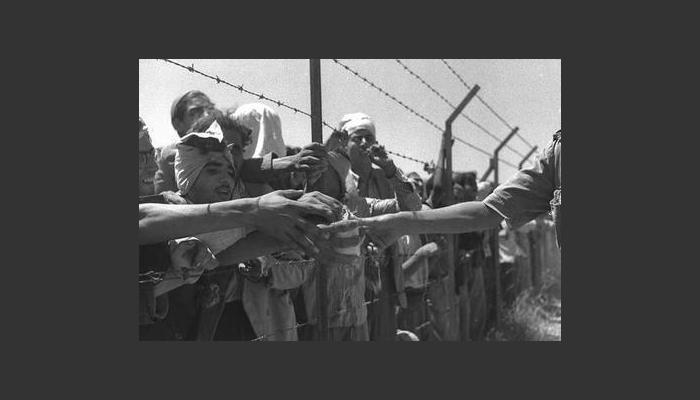
Civilians captured during the fall of Lydda and Ramle around the time of July 12, 1948 and taken to labour camps.
By Yazan al-Saadi | Al-Akhbar | September 29, 2014
Much of the grim and murky circumstances of the Zionist ethnic cleansing of Palestinians in the late 1940s have gradually been exposed over time. One aspect – rarely researched or deeply discussed – is the internment of thousands of Palestinian civilians within at least 22 Zionist-run concentration and labor camps that existed from 1948 to 1955. Now more is known about the contours of this historical crime, due to the comprehensive research by renowned Palestinian historian Salman Abu Sitta and founding member of the Palestinian resource center BADIL Terry Rempel.
The facts are these.
The study – to be published in the upcoming issue of the Journal of Palestine Studies – relies on almost 500 pages of International Committee of the Red Cross’s (ICRC) reports written during the 1948 war, that were declassified and made available to the public in 1996, and accidentally discovered by one of the authors in 1999.
Furthermore, testimonies of 22 former Palestinian civilian detainees of these camps were collected by the authors, through interviews they conducted themselves in 2002, or documented by others during different moments of time.
With these sources of information, the authors, as they put it, pieced together a clearer story of how Israel captured and imprisoned “thousands of Palestinian civilians as forced laborers,” and exploited them “to support its war-time economy.”
Digging up the crimes
“I came across this piece of history in the 1990s when I was collecting material and documents about Palestinians,” Abu Sitta told Al-Akhbar English. “The more and more you dig, the more you find there are crimes that have taken place that are not reported and not known.”
At that time, Abu Sitta went to Geneva for a week to check out the newly-opened archives of the ICRC. According to him, the archives were opened to the public after accusations that the ICRC had sided with the Nazis during World War II. It was an opportunity that he could not miss in terms of seeing what the ICRC had recorded of the events that occurred in Palestine in 1948. It was there he stumbled onto records discussing the existence of five concentration camps run by the Israelis.
He then decided to look for witnesses or former detainees, interviewing Palestinians in occupied Palestine, Syria, and Jordan.
“They all described the same story, and their real experience in these camps,” he said.
One question that immediately struck him was why there were barely any references in history about these camps, especially when it became clearer the more he researched that they existed, and were more than just five camps.
“Many former Palestinian detainees saw the concept of Israel as a vicious enemy, so they thought their experience labouring in these concentration camps was nothing in comparison to the other larger tragedy of the Nakba. The Nakba overshadowed everything,” Abu Sitta explained.“However, when I dug into the period of 1948-1955, I found more references like Mohammed Nimr al-Khatib, who was an imam in Haifa, who had written down interviews with someone from al-Yahya family that was in one of the camps. I was able to trace this man all the way to California and spoke with him in 2002,” he added.
More references were eventually and slowly discovered by Abu Sitta that included information from a Jewish woman called Janoud, a single masters thesis in Hebrew University about the topic, and the personal accounts of economist Yusif Sayigh, helped to further flesh out the scale and nature of these camps.
After more than a decade, Abu Sitta, with his co-author Rempel, are finally presenting their findings to the public.
From burden to opportunity: concentration and labor camps
The establishment of concentration and labor camps occurred after the unilateral declaration of Israel’s statehood on May 1948.
Prior to that event, the number of Palestinian captives in Zionist hands were quite low, because, as the study states, “the Zionist leadership concluded early on that forcible expulsion of the civilian population was the only way to establish a Jewish state in Palestine with a large enough Jewish majority to be ‘viable’.” In other words, for the Zionist strategists, prisoners were a burden in the beginning phases of the ethnic cleansing.
Those calculations changed with the declaration of the Israeli state and the involvement of the armies of Egypt, Syria, Iraq, and Transjordan, after much of the ethnic cleansing had occurred. From that moment, “the Israeli forces began taking prisoners, both regular Arab soldiers (for eventual exchange), and – selectively – able-bodied Palestinian non-combatant civilians.”
The first camp at Ijlil, which was about 13 km northeast of Jaffa, on the site of the destroyed Palestinian village Ijlil al-Qibiliyya, emptied of its inhabitants in early April. Ijlil was predominately made up of tents, housing hundreds and hundreds of prisoners, categorized as POWs by the Israelis, surrounded by barbed wire fences, watchtowers, and a gate with guards.
As the Israeli conquests grew, in turn exceedingly increasing the number of prisoners, three more camps were established. These are the four “official” camps that the Israelis acknowledged and were actively visited by the ICRC.
The study notes:
All four camps were either on or adjacent to military installations set up by the British during the Mandate. These had been used during World War II for the interment of German, Italian, and other POWs. Two of the camps – Atlit, established in July about 20 kms south of Haifa, and Sarafand, established in September near the depopulated village of Sarafand al-Amar in central Palestine—had earlier been used in the 1930s and 1940s to detain illegal Jewish immigrants.
Atlit was the second largest camp after Ijlil, it had the capacity of holding up to 2,900 prisoners, while Sarafand had the maximum capacity of 1,800, and Tel Letwinksy, near Tel Aviv, held more than 1,000.
All four camps were administered by “former British officers who had defected their ranks when British forces withdrew from Palestine in mid-May 1948,” and the camp’s guards and administrative staff were former members of the Irgun and the Stern Gang – both groups designated as terrorist organizations by the British before their departure. In total, the four “official” camps were staffed by 973 soldiers.
A fifth camp, called Umm Khalid, was established at a site of another depopulated village near the Zionist settlement of Netanya, and was even assigned an official number in the records, but never attained “official” status. It had the capacity to hold 1,500 prisoners. Unlike the other four camps, Umm Khalid would be “the fist camp established exclusively as a labor camp” and was “the first of the “recognized” camps to be shut down… by the end of 1948.”
Complementing these five “recognized” camps, were at least 17 other “unrecognized camps” that were not mentioned in official sources, but the authors discovered through multiple prisoner testimonies.
“Many of [these camps],” the authors noted, “[were] apparently improvised or ad hoc, often consisting of no more than a police station, a school, or the house of a village notable,” with holding capacities that ranged from almost 200 prisoners to tens.
Most of the camps, official and unofficial, were situated within the borders of the UN-proposed Jewish state, “although at least four [unofficial camps] – Beersheba, Julis, Bayt Daras, and Bayt Nabala – were in the UN-assigned Arab state and one was inside the Jerusalem “corpus separatum.”
The number of Palestinian non-combatant detainees “far exceeded” those of Arab soldiers in regular armies or bona fide POWs. Citing a July 1948 monthly report made by ICRC mission head Jacques de Reynier, the study states that de Reynier noted, “that the situation of civilian internees was ‘absolutely confused’ with that of POWs, and that the Jewish authorities ‘treated all Arabs between the ages of 16 and 55 as combatants and locked them up as prisoners of war.’” In addition, the ICRC found among the detainees in official camps, that 90 of the prisoners were elderly men, and 77 were boys, aged 15 years or younger. The study highlights the statements by an ICRC delegate Emile Moeri in January 1949 of the camp inmates:
It is painful to see these poor people, especially old, who were snatched from their villages and put without reason in a camp, obliged to pass the winter under wet tents, away from their families; those who could not survive these conditions died. Little children (10-12 years) are equally found under these conditions. Similarly sick people, some with tuberculosis, languish in these camps under conditions which, while fine for healthy individuals, will certainly lead to their death if we do not find a solution to this problem. For a long time we have demanded that the Jewish authorities release those civilians who are sick and need treatment to the care of their families or to an Arab hospital, but we have not received a response.
As the report noted, “there are no precise figures on the total number of Palestinian civilians held by Israel during the 1948-49 war” and estimates tend to not account for “unofficial” camps, in addition to the frequent movement of prisoners between the camps in use. In the four “official” camps, the number of Palestinian prisoners never exceeded 5,000 according to figures in Israeli records.
Taking account of the capacity of Umm Khalid, and estimates of the “unofficial camps,” the final number of Palestinian prisoners could be around the 7,000 range, and perhaps much more when, as the study states, taking into account a November 17, 1948 diary entry by David Ben-Gurion, one of the main Zionist leaders and Israel’s first prime minister, who mentioned “the existence of 9,000 POWs in Israeli-run camps.”
In general, the living conditions in the “official” camps were far below what would be considered appropriate by international law at that time. Moeri, who visited the camps constantly, reported that in Ijlil in November 1948:
“[m]any [of the] tents are torn, that the camp was “not ready for winter,” the latrines not covered, and the canteen not working for two weeks. Referring to an apparently ongoing situation, he stated that “the fruits are still defective, the meat is of poor quality, [and] the vegetables are in short supply.”
Furthermore, Moeri reported that he saw for himself, “the wounds left by the abuse” of the previous week, when the guards had fired on the prisoners, wounding one, and had beaten another.”
As the study shows, the civilian status of the majority of the detainees were clear for the ICRC delegates in the country, who reported that the men captured “had undoubtedly never been in a regular army.” Detainees who were combatants, the study explains, were “routinely shot on the pretense that they had been attempting to escape.”
The Israeli forces seemed to always target able-bodied men, leaving behind women, children, and the elderly – when not massacring them – the policy continued even after there were low levels of military confrontation. All in all, as the Israeli records show and the study cites, “Palestinian civilians comprised the vast majority (82 percent) of the 5,950 listed as internees in the POW camps, while the Palestinians alone (civilian plus military) comprised 85 percent.”
The wide-scale kidnapping and imprisonment of Palestinian civilians tend to correspond with the Israeli military campaigns. For example, one of the first major roundups occurred during Operation Danj, when 60-70,000 Palestinians were expelled from the central towns of Lydda and Ramleh. At the same time, between a fifth and a quarter of the male population from these two towns who were over the age of 15 were sent to the camps.
The largest round-up of civilians came from villages of central Galilee who were captured during Operation Hiram in the fall of 1948.
One Palestinian survivor, Moussa, described to the authors what he witnessed at the time.
“They took us from all villages around us: al-Bi’na, Deir al-Asad, Nahaf, al-Rama, and Eilabun. They took 4 young men and shot them dead… They drove us on foot. It was hot. We were not allowed to drink. They took us to [the Palestinian Druze village] al-Maghar, then [to the Jewish settlement] Nahalal, then to Atlit.”
A November 16, 1948 UN report collaborated Moussa’s account, stating that some 500 Palestinian men “were taken by force march and vehicle to a Jewish concentration camp at Nahlal.”
Maintaining Israel’s economy with “slave labor”
The policy of targeting civilians, particular “able-bodied” men, was not accidental according to the study. It states, “with tens of thousands of Jewish men and women called up for military service, Palestinian civilian internees constituted an important supplement to the Jewish civilian labor employed under emergency legislation in maintaining the Israeli economy,” which even the ICRC delegation had noted in their reports.
The prisoners were forced to do public and military work, such as draining wetlands, working as servants, collecting and transporting looted refugee property, moving stones from demolished Palestinian homes, paving roads, digging military trenches, burying the dead, and much more. As one former Palestinian detainee named Habib Mohammed Ali Jarada described in the study, “At gunpoint, I was made to work all day. At night, we slept in tents. In winter, water was seeping below our bedding, which was dry leaves, cartons and wooden pieces.”
Another prisoner in Umm Khalied, Marwan Iqab al-Yehiya said in an interview with the authors, “We had to cut and carry stones all day [in a quarry]. Our daily food was only one potato in the morning and half dried fish at night. They beat anyone who disobeyed orders.” This labor was interspersed with acts of humiliation by the Israeli guards, with Yehiya speaking of prisoners being “lined up and ordered to strip naked as a punishment for the escape of two prisoners at night.”
“[Jewish] Adults and children came from nearby kibbutz to watch us line up naked and laugh. To us this was most degrading,” he added.
Abuses by the Israeli guards were systematic and rife in the camps, the brunt of which was directed toward villagers, farmers, and lower class Palestinians. This was so, the study said, because educated prisoners “knew their rights and had the confidence to argue with and stand up to their captors.”
What is also interestingly noted by the study is how ideological affiliations between prisoners and their guards, had another effect in terms of the relationship between them. The study, cites the testimony of Kamal Ghattas, who was captured during the Israeli attack in the Galilee, who said:
We had a fight with our jailers. Four hundred of us confronted 100 soldiers. They brought reinforcements. Three of my friends and I were taken to a cell. They threatened to shoot us. All night we sang the Communist Anthem. They took the four of us to Umm Khaled camp. The Israelis were afraid of their image in Europe. Our contact with our Central Committee and Mapam [Socialist Israeli party] saved us .… I met a Russian officer and told him they took us from our homes although we were non-combatants which was against the Geneva Conventions. When he knew I was a Communist he embraced me and said, “Comrade, I have two brothers in the Red Army. Long live Stalin. Long Live Mother Russia”.
Yet, the less fortunate Palestinians faced acts of violence which included arbitrary executions and torture, with no recourse. The executions were always defended as stopping “escape attempts” – real or claimed by the guards.
It became so common that one former Palestinian detainee of Tel Litwinsky, Tewfic Ahmed Jum’a Ghanim recounted, “Anyone who refused to work was shot. They said [the person] tried to escape. Those of us who thought [we] were going to be killed walked backward facing the guards.”
Ultimately, by the end of 1949, Palestinian prisoners were gradually released after heavy lobbying by the ICRC, and other organizations, but was limited in scale and very focused to specific cases. Prisoners of Arab armies were released in prisoner exchanges, but Palestinian prisoners were unilaterally expelled across the armistice line without any food, supplies, or shelter, and told to walk into the distance, never to return.
It would not be until 1955 that most of the Palestinian civilian prisoners would finally be released.
An enduring crime
The importance of this study is multi-faceted. Not only does it reveal the numerous violations of international law and conventions of the age, such as 1907 Hague Regulations and the 1929 Geneva Conventions, but also shows how the event shaped the ICRC in the long run.
Because the ICRC was faced with an Israeli belligerent actor who was unwilling to listen and conform to international law and conventions, the ICRC itself had to adapt in what it considered were practical ways to help ensure the Palestinian civilian prisoners were protected under the barest of rights.
Citing his final report, the study quotes de Reynier:
[The ICRC] protested on numerous occasions affirming the right of these civilians to enjoy their freedom unless found guilty and judged by a court. But we have tacitly accepted their POW status because in this way they would enjoy the rights conferred upon them by the Convention. Otherwise, if they were not in the camps they would be expelled [to an Arab country] and in one way or another, they would lead, without resources, the miserable life of refugees.
In the end, the ICRC, and other organizations, were simply ineffective as Israel ignored its condemnations with impunity, in addition to the diplomatic cover of major Western powers.
More importantly, the study sheds more light on the extent of the Israeli crimes during its brutal and bloody birth. And “much more remains to be told,” as the final line of the study states.
“It is amazing to me, and many Europeans, who have seen my evidence,” Abu Sitta said, “that a forced labor camp was opened in Palestine three years after they were closed in Germany, and were run by former prisoners – there were German Jewish guards.”
“This is a bad reflection of the human spirit, where the oppressed copies an oppressor against innocent lives,” he added. The study essentially shows the foundations and beginnings of Israeli policy towards Palestinian civilians that comes in the form of kidnapping, arrest, and detainment. This criminality continues till this day. One merely has to read the reports on the hundreds of Palestinians arrested prior, during, and after Israel’s latest war on Gaza mid-summer of this year.
“Gaza today is a concentration camp, no different than the past,” Abu Sitta concluded to Al-Akhbar English.
Yazan is a staff writer for Al-Akhbar English. Follow him on Twitter: @WhySadeye
Israeli forces destroy power grid in Nablus village
Ma’an – 29/09/2014
NABLUS – Israeli military forces on Monday destroyed an electricity network in the Nablus village of Aqraba, a Palestinian official said.
Ghassan Daghlas, an official who monitors settlement activity, told Ma’an that Israeli military bulldozers raided the Khirbet al-Tawil area of the village and demolished the main power line established in 2004.
Israeli soldiers destroyed over 80 electricity pylons and wires, he added.
Israel is using demolitions to “pressure residents to leave their houses for the sake of nearby settlements.”
In August, Israeli forces demolished four houses in the al-Tawil neighborhood, some of which were over 100 years old.
The al-Tawil neighborhood is on the outskirts of Aqraba and locals say Israeli forces have targeted several properties in the area under the pretext that they were built without a permit.
Christian Evangelicals Increasingly Support Palestinian Human Rights
By Alison Weir | CounterPunch | September 29, 2014
An article in Middle East Quarterly, a pro-Israel publication, reports that support for Israel is eroding among American evangelical Christians, with only 30 percent in a recent survey stating support for Israel above Palestinians.
This trend is even more pronounced among youth, according to an article by David Brog, Jewish-American executive director of “Christians United For Israel (CUFI), a major pro-Israel organization. Israeli Prime Minster Benjamin Netanyahu has called CUFI “a vital part of Israel’s national security” and columnist Charles Kauthammer has said, “I do not know of an organization in the world more important to Israel than CUFI.”
Brog’s article, “The End of Evangelical Support for Israel?” is largely pitched as a wake-up call to Israel partisans who, according to Brog, “must take this threat seriously.” (For more on Brog, see below.)
Brog quotes a journalist reporting in 2012 about the “the largest gathering of young evangelical leaders in America,” the Catalyst convention: “In dozens of random conversations, I noted that Millenians … expressed solidarity with the Palestinians and annoyance with Israel. This is a seismic shift in the American church and a serious threat to Israel’s one traditional area of support.”
A decade ago, Brog reports, “As if out of nowhere, a block of fifty to one hundred million friends of Israel were poised to enter the national debate and safeguard the U.S.-Israel relationship for generations to come.”*
Today, however, Brog describes a significant reversal. As more and more evangelicals learn the facts on Israel-Palestine (Brog calls such information an “anti-Israel narrative”) they are dropping their unconditional support for Israel.
While evangelical support for Israel has often been attributed to their theology, Brog’s article indicates that the significant factor in the shift is learning the true situation in Israel-Palestine.
Brog states that there is a precedent for such an about-face. While many mainline Protestant churches used to support Israel, he states that today “to the extent the mainline denominations act corporately in connection with the Jewish state, it is to divest from it.”
Similarly, as evangelicals learn more about the issue, Brog reports that “more leaders of this generation are moving toward neutrality in the conflict while others are becoming outspoken critics of Israel.”
Brog writes, “Questioning Christian support for the Jewish state is fast becoming a key way for the millennials to demonstrate their Christian compassion and political independence.”
Today, Brog writes, many of those 18 to 30 are “rebelling against what they perceive as the excessive biblical literalism and political conservatism of their parents. As they strive with a renewed vigor to imitate Jesus’ stand with the oppressed and downtrodden, they want to decide for themselves which party is being oppressed in the Arab-Israeli conflict.”
Brog cites a 2010 Pew survey of evangelical leaders attending the Third Lausanne Congress of World Evangelization that “contained two bombshells. It showed that only a minority of those evangelicals polled sympathized primarily with Israel. And it demonstrated that American evangelical leaders were actually less inclined to support Israel than evangelical leaders in general.” The survey found that 49% of American evangelical leaders sympathize with both sides equally and 13% sympathize primarily with the Palestinians.
Brog also notes that the survey indicated that evangelical support for Israel was “never as universal as was commonly believed.”
Much of the increased awareness of the situation, Brog reports, comes from evangelical experts on the Middle East who are speaking and writing widely on this issue, producing documentaries, organizing trips to the region, and creating conferences to inform Christians on the facts.
In the last few years three documentaries were made by Christians specifically for Christians to inform them on Palestine: With God on Our Side, Little Town of Bethlehem, and The Stones Cry Out. They were created by, respectively, Porter Speakman, a former Youth with a Mission member, Mart Green, chairman of the board of trustees of Oral Roberts University, and Yasmine Perni, an Italian journalist. Brog also names evangelicals such as Jim Wallis, Tony Campolo, Serge Duss and sons Brian and Matt, and Palestinian Christians such as Sami Awad and Naim Ateek as among those educating Christians on Palestine.
Christian Universities and Palestine
Brog reports that while numerous people are aware of the work on college campuses for justice in Palestine, “many observers do not realize that such efforts are also “being waged on America’s Christian campuses.”
In his article Brog describes activities on four of America’s major Christian colleges:
Wheaton College
Brog reports that Wheaton College in Illinois is “commonly referred to as the “evangelical Harvard,” noting, “Some of the most prominent church leaders in America have graduated from Wheaton, including the Rev. Billy Graham, Sen. Dan Coats (Republican, Indiana), and George W. Bush’s former speechwriter Michael Gerson.”
Today, Wheaton is the home of Professor Gary Burge, an author who speaks widely on Israel-Palestine. “When Christians United for Israel (CUFI) announced plans to hold an event at Wheaton in January 2009, Burge went on the offensive,” Brog reports. “CUFI’s student members came under such intense pressure that they moved their event off-campus: There would be no pro-Israel event at the evangelical Harvard.”
Oral Roberts University
Brog writes that Oral Roberts University “has deep conservative Christian roots.” “Oral Roberts himself was a Pentecostal televangelist and a strong friend of Israel,” a number of major preachers in America graduated from the school, and pro-Israel preacher John Hagee has been on its board of trustees.
Today, however, the chair of the board of trustees chair is the aforementioned Mart Green, whose film is a powerful depiction of the Palestinian nonviolence movement. The university’s current president is Dr. William “Billy” Wilson, who was named as a speaker for what Brog calls “the leading anti-Israel Christian conference,” Christ at the Checkpoint, held at Bethlehem Bible College in March 2014.
Bethel University
Brog writes that Bethel is “representative of the direction that America’s Christian colleges are taking.” He notes, “Like many Christian schools, Bethel emphasizes racial reconciliation and cultural openness and has accordingly developed numerous opportunities for its students to study abroad.”
In 2010 Bethel’s president Jay Barnes and his wife visited Israel and the Palestinian Authority to explore establishing a study abroad program in the area. During the trip they visited Bethlehem.
Upon their return Barnes posted a poem on the university’s website:
Incredible conflict exists in the land of Jesus’ birth/ I believe God mourns.
The wall is a constant reminder of many lost freedoms/ I believe God mourns.
For more than 60 years, people have lived in poverty in refugee camps/ I believe God mourns.
Apartheid has become a way of life/ I believe God mourns.
Extreme disproportional distribution of resources, such as water, exists/ I believe God mourns.
Hundreds of villages have been demolished to make room for settlements/ I believe God mourns.
Human rights violations occur daily/ I believe God mourns.
The Christian population is declining as many are leaving to avoid persecution/ I believe God mourns.
In 2012, Brog reports, President Barnes hosted a “Hope for the Holy Land” evening at Bethel, featuring “long-standing Christian critics of Israel.”
A growing trend
A similar transformation involves the son of leading evangelical publisher Steven Strang, who has been a regional director for CUFI. The younger Strang, Cameron, has his own publishing organization, Relevant, whose website says it reaches over two million twenty- and thirty-something Christians a month.
Less than a decade ago Relevant was extremely pro-Israel. But then, Brog writes, Cameron Strang visited Israel and the Palestinian territories, “and everything changed.”
Relevant’s May/June 2012 cover featured prominent author Donald Miller. In 2008 Miller had been chosen to deliver the first night’s closing prayer at the Democratic National Convention, and, according to Brog, Miller “is considered a rising star among America’s 20-something evangelicals.”
After visiting Israel and the Palestinian territories with Strang, Miller began to discuss the situation in Palestine, writing:
“In September a group of journalists and I visited Israel and stood on a hill overlooking the wall separating Israel from Gaza. From our viewpoint, we could see the controversial territory where 1.6 million Palestinians have been walled in and secluded from the outside world. They are, essentially, imprisoned.
“The walls erected around the West Bank and Gaza separate families from families. Many mothers will not see their children again. Millions will never return to the homes their families had occupied for hundreds of years. … Thousands of Palestinian students at American universities will never see their families again.
“Israel gives most Palestinians fresh water once each week. … In Gaza, Israel also rations their food, allowing only so many calories per human being.”
The beginning of the end?
Brog warns that Israel partisans “must take this threat seriously,” despite the fact that the pro-Israel side “is still far ahead in the battle for the hearts and minds of America’s evangelicals. Just one pro-Israel organization, Christians United for Israel, has over 1.6 million members, chapters on more than 120 college and university campuses, and sponsors thirty-five pro-Israel events across the country every month. Anti-Israel Christians do not come close to matching CUFI’s size, activity, or influence.”
He writes, however, that the long-term trend described above presents a challenge, stating that what he calls “anti-Israel Christians” are “on a roll” and “are reaching an ever expanding network of evangelicals in the United States.”
Brog warns: “The day that Israel is seen as the moral equivalent of Hamas is the day that the evangelical community—and by extension the political leaders it helps elect—will cease providing the Jewish state any meaningful support.
He continues: “Those who reject such facile moral equivalence must take this threat seriously. They cannot let the evangelical community go the way of the mainstream Protestant leadership.” Their “lies,” he says, “must be confronted early and often.”
Brog’s article appeared in the Spring 2014 issue of Middle East Quarterly.
A few months later Israel launched its August 2014 “Protective Edge” invasion of Gaza, killing 2191 Palestinians, the vast majority of them civilians – 521 of them children and infants. During the same period Hamas resistance fighters killed 71 Israelis, the large majority of them soldiers, one a child.
During its massive invasion, Israeli forces destroyed 61,800 homes, damaged or destroyed 62 hospitals, 220 schools, and caused $7.8 billion in damage to Gazans – and this was the third major invasion in five years.
Then within two weeks after a ceasefire had been agreed to, Israeli forces had already killed at least two Palestinians, one sixteen years old; kidnapped several dozen Palestinians, including two seven year olds and an eight year old; confiscated 1,500 acres of Palestinian land; destroyed dozens of homes and buildings; and committed numerous other violations of human rights. During the same period Hamas forces had not not fired a single rocket, attacked an Israeli target, or committed any actions to break the terms of the ceasefire.***
Brog’s concern is justified. Many Americans who are finally learning such facts are beginning to suspect that Israel is not morally equivalent to Hamas. It is inferior.
Brog’s article suggests that the coming months will see a renewed propaganda effort from CUFI and other members of the multi-billion dollar Israel lobby.
However, as a leader of the lobby once said, a lobby thrives in the dark. As Brog reports, numerous people from across the religious and political spectrum are now turning on the light.
Alison Weir is executive director of If Americans Knew, president of the Council for the National Interest, and author of Against Our Better Judgment: How the U.S. was used to create Israel.
Notes
* This wasn’t entirely “out of nowhere.” Groups and individuals working to create Israel during the first half of the 20th century had specifically undertaken efforts to influence Christians to support this project. For more on this see Against Our Better Judgment: The Hidden History of How the US Was Used to Create Israel.) After Israel was established through its 1947-49 founding war, Israel and its partisans continued such efforts, including providing a jet plane to Jerry Falwell, facilitating his ability to reach Christians with a version of theology that benefited Israel.
** For more information and additional statistics on the August 2014 Israeli invasion of Gaza and its aftermath see http://www.ifamericansknew.org/cur_sit/violence-gaza-14.html
Two articles discuss David Brog and his influential role in “Christian” Zionism:
1. An article by journalist Troy Anderson in Charisma magazine, “Where Your Israel Donation Really Goes,” reports:
“Brog is the powerhouse behind the Christian organization, yet he’s also a conservative (non-Messianic) Jew. He brought two other Jews on board: Shari Dollinger from Atlanta as one of his coordinators and Ari Morgenstern as communications director. Morgenstern ensures CUFI’s messaging is consistent with what Brog wants—which is to convey that evangelical Christians support Israel, yet (to his Jewish supporters) are also “safe” because CUFI will never proselytize.
“Brog, who was chief of staff to liberal Sen. Arlen Specter of Pennsylvania for seven years, is said to run CUFI like a political campaign. He has talking points, stays focused and rallies his constituency. He’s well liked by those who work with him and known for being a brilliant strategist. But one by one, the higher-profile Christian leaders who helped Hagee start CUFI are dropping off as the organization becomes more focused on political lobbying.
“It’s no secret that one of the most powerful lobbying groups in Washington, D.C., the American Israel Public Affairs Committee (AIPAC), has long wanted a “Gentile arm,” and some believe they now have it in CUFI. Jewish leaders and philanthropists love to attend CUFI’s events to see the genuine enthusiasm and love expressed for Israel. Though there’s still rousing Christian music and prayer at these events, there’s most certainly no proselytizing. As a result, many wealthy Jews have pumped tens of thousands of dollars into CUFI.
“Like Hagee, Brog has learned how to straddle the line between the evangelical and Jewish communities, and it shows in CUFI’s growth. The organization boasts of having more than 1 million “members,” though insiders know such membership consists of nothing but CUFI having your email address. There’s nothing to pay, nothing to sign. And even if you drop out, you’re still counted as a member. Given this, insiders say the number of actual donors is closer to 30,000 to 50,000.
“Meanwhile, little is known about CUFI’s finances other than funds raised. The organization says neither Hagee nor his wife, Diana, receives any compensation from CUFI. Yet when Charisma asked CUFI the same questions asked of other organizations in this report—particularly about administrative costs, leader salaries and budgetary breakdown—Morgenstern declined to comment…”
2. The excerpts below are from “How Christian is Christian Zionism? An Update on its Uneasy Interaction with Jewish Missions and Evangelism” by David Brickner, Executive Director, Jews for Jesus [a pro-Israel organization.] Presented at the 26th Annual Lausanne Consultation on Jewish Evangelism-NA, March 2-4, 2009, Phoenix, Arizona
“This century has seen the rise of two powerful organizations… They are the most sophisticated, financially powerful and prominent Christian Zionist organizations today. They, more effectively than their forebears in the ’80s and ’90s, have diluted the gospel message, diverted gospel resources and discouraged a balanced perspective toward the Israeli/Arab conflict. In fact, unbelieving Jewish men run both organizations.”
The two organizations are “International Fellowship of Christian and Jews” and “Christians United for Israel” (CUFI)
Regarding CUFI, Brickner writes:
“Though headlined by well-known charismatic pastor and preacher John Hagee, CFI’s executive director is David Brog, an unbelieving Jewish attorney who served in various positions in the Senate including chief of staff to Senator Arlen Specter. Brog, author of Standing with Israel: Why Christians Support the Jewish State, has been quite plain about Christians United for Israel’s rejection of evangelism…
“Brog made it clear in an interview in the Washington Jewish Week that ‘all Christians United for Israel events are strictly non-conversionary and that the group will have no Jewish converts as speakers at events or on the organization’s Board.’ Brog went on to say; ‘The group tells people that if you cannot put aside your desire to share the gospel with Jews there’s the door.’
“Of course this would be expected policy coming from any organization run by unbelieving Jews. The fact that the organization states that it is Christian yet excludes fellow Jewish Christians from participation is both racist and unchristian. Tuvya Zaretsky tells the story of having been invited apparently accidentally to a program sponsored by Christians United for Israel and the Israel Christian Nexxus, a pro-Israel lobby group. When he called to confirm participation, Patricia Johnson, who was working on the event, told him that he was invited by accident and because he was a Jewish believer in Jesus was not welcome. Said Zaretsky,
“’Somehow these Christians do not realize that if they want to bless Israel, they must extend that blessing to all of Israel – including those within the Body of Messiah and those who still need to be introduced to Him.’
“Sadly, it is not just that Jewish believers are not welcomed in Christians United for Israel. Neither is the gospel. And not just because of the Jewish unbelievers. The well-known figurehead of CUFI and perhaps the most prominently known Christian Zionist today is John Hagee…”
“Unfortunately it’s not easy to tell what the scope of resources is behind the Christians United for Israel group. They have not filed a form 990 with the IRS. Hagee’s Global Evangelism Television Inc. does have filings, but only as recently as 2004. At that time they had an annual income of over $10,000,000 and Hagee’s compensation from the company was $500,000 a year. Of course the 18,000-member church that he pastors, Cornerstone, is separate from the television ministry. One presumes he receives a salary from the church as well as whatever royalties his more than a dozen books provides.
“Christians United for Israel, as I said, has not registered any financial information, although news articles can give us an indication. In October of 2007, according to the Jewish News Weekly, CUFI raised 8.5 million dollars for Israeli causes at Hagee’s “Night to Honor Israel” event. If you look on the CUFI website you will see several “Night to Honor Israel” events scheduled each month.
“CUFI does identify its regional directors, some of whom are well known political Christian Zionists. One of the better known is Robert Stearns of Robert Stearns International Incorporated, doing business as Eagles’ Wings Ministries. Stearns’ organization is best known for organizing the Day of Prayer for the Peace of Jerusalem. It reported income of $2,800,000 for the year 2007, and states its purpose is to “promote the message of Christianity.” However, Eagles’ Wings Ministries does not encourage prayer for the salvation of Israel, the only true hope for peace…”
Protesters block Israeli cargo ship at Port of Oakland
Press TV – September 28, 2014
Hundreds of American protesters, angered by Israel’s recent deadly assault on the Gaza Strip, gathered at the Port of Oakland to block an Israeli ship from unloading its cargo.
Workers with the International Longshore and Warehouse Union (ILWU) refused to unload the Zim Shanghai as about 200 activists picketed outside several of the port’s gates on Saturday morning.
The cargo ship is managed by Israel’s largest shipping firm, Zim Integrated Shipping Services.
About 50 police officers were also present at the port.
The protesters said they would continue with their “Block the Boat” campaign.
They said Israeli authorities must be held responsible for the deaths of more than 2,100 Palestinians during the recent 50-day war on Gaza.
“I think it was a big victory today for those who are opposed to the policies of Israel in Gaza,” said Steve Zeltzer, an organizer of the protest.
Similar actions were taken in August, when protesters blocked Israeli-owned ship Zim Piraeus for five days, forcing it to leave for Los Angeles with most of its cargo unloaded.
Longshore workers refused to cross picket lines to unload Zim Piraeus in August.
Protesters on Saturday said they hoped to achieve the same outcome.
“We ask the ILWU to carry on its long historical tradition of opposing injustice and honoring community picket lines. Let’s keep the pressure on and continue this tradition of labor blockades against oppression,” the “stop ZIM action committee” said in a statement.
Israel bars entry to Al-Aqsa mosque to Palestinians for third consecutive day
Al-Akhbar | September 26, 2014
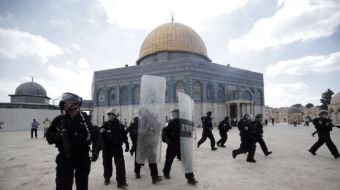
Israel on Friday imposed restrictions on the entry of Palestinian worshipers into the Al-Aqsa Mosque in annexed East Jerusalem for the third consecutive day.
Israeli police stepped up security around the mosque, deploying 2,000 troops in Jerusalem and erected roadblocks at entrances to Jerusalem’s Old City.
“Police prevent men under 50 and West Bankers from entering Al-Aqsa compound or Friday prayers,” Sheikh Azzam al-Khatib, director-general of the Organization for Muslim Endowments and Al-Aqsa Affairs, told the Turkish Anadolu Agency.
Jews celebrated the start of Rosh Hashanah (Jewish New Year) on Wednesday evening, the first day of new Jewish year of 5775.
Israel typically imposes restrictions on Muslim worshipers’ access to Al-Aqsa during Jewish holidays
The Israeli authorities also closed the Ibrahimi Mosque to Muslims in the West Bank city of Hebron on Wednesday and Thursday for Rosh Hashanah.
Israel is also closing the Gaza Strip’s only functioning commercial crossing – the Kerem Shalom border terminal – for four days starting Thursday for the Jewish holiday.
Khatib said that while Israel restricts the entry of Palestinians into Al-Aqsa mosque compound, it facilitates the entry of Zionist settlers into the holy site.
He said that at least 300 Zionist settlers and 120 Israeli soldiers had forced their way into the compound in the past three days.
In recent months, groups of extremist settlers – often accompanied by Israeli security forces – have repeatedly forced their way into the flashpoint compound.
The frequent violations anger Palestinian Muslims and occasionally lead to violent confrontations.
For Muslims, Al-Aqsa represents the world’s third holiest site.
Jews, for their part, refer to the area as the “Temple Mount,” claiming it was the site of two prominent Jewish temples in ancient times.
Israel occupied East Jerusalem during the 1967 Middle East War. It later annexed the city in 1980, claiming it as the capital of the Zionist state – a move never recognized by the international community.
In September 2000, a visit to the site by controversial Israeli leader Ariel Sharon sparked what later became known as the “Second Intifada” – a popular uprising against the Israeli occupation in which thousands of Palestinians were killed.
(Anadolu, Al-Akhbar)
Featured Video

Seyed M. Marandi: US-Iran War Inevitable: Kuwait and Bahrain May Fall
or go to
Aletho News Archives – Video-Images
From the Archives
Oil and the Israel Lobby
Reknowned economist M. Shahid Alam offers this excellent critique of Noam Chomsky’s defective analysis of the relative influence of Oil versus the Israel lobby over US foreign policy: … continue
Blog Roll
 Aletho News
- ICC ignored ‘very well-documented’ NATO crimes – ex-Libyan minister
- SNSC secretary dismisses US response to Iran’s conditions as ‘inadequate’
- Sanaa says Taiz roads open, secure for residents, warns Saudi forces
- Iraqi resistance group urges Saudi leadership to admit defeat, lift Yemen siege
- Trump’s Retreat: How Al-Aqsa Flood Took Down the US Empire
- Israel’s Military Actions in Lebanon Grossly Violate International Law — Lavrov
- Seyed M. Marandi: US-Iran War Inevitable: Kuwait and Bahrain May Fall
- Leaders Condemn Ansarallah Attack on Saudi Arabia While Ignoring Illegal War Against Yemen
- Leaked: Britain’s Covert Iraqi Psyops Network
- Yemeni Armed Forces Warn Airlines Against Using Saudi Airports, Exempt Mecca and Medina
- If Americans Knew
- Israel’s Destruction of Southern Lebanon Intensified After the Cease-Fire
- The Last-Minute Decision That Gave Israel Its Name
- The American Conservative: How Trump Made the World Go Nuclear
- Meet the US generals and admirals advancing Israeli policy
- Opinion: Why news organizations should boycott Israel
- The Israeli witch hunt of Sami Abu Shehadeh exposes the lie of the ‘Jewish and democratic’ state
- No state has a ‘right’ to exist – least of all Israel
- Testimonies about Gaza’s civilian death toll expose Israel’s atrocities – Daily Update
- How Israel Conquered the Latin American Right
- Agents search Rep. Omar’s Washington home in criminal probe as she vows she won’t ‘be silenced’
- No Tricks Zone
- Germany’s Green Energy Debacle: High Energy Costs Force Kahla Porzellan to Close After 182 Years!
- New Study: 50 Years Of The Most Aggressive ‘Net Zero’ Policies Can Only Affect The Global Climate By 0.03°C
- US September “Heat” Was No Record…Many Records Set Decades Ago
- Latest European Green Energy Debacle; Portugal’s Largest Flagship Solar Park Insolvent!
- Green Energy Debacle: German Expert Professor Fritz Vahrenholt Warns Of Severe Economic And Social Consequences
- Two More Paleo Reconstructions Affirm Meters-Higher Sea Levels Across Ireland, Brazil 7000-6000 Years Ago
- New Study: Earth And Venus Surface Warmth Largely Explained By Convection And Lapse Rate, Not CO2 Or Radiation
- 2025 Nature Paper Claiming Worsening Global Drought Gets RETRACTED …Heavily Flawed
- New Study: ‘Global Drought Shows No Detectable Recent Acceleration Under Climate Warming’
- Economic Masterminds: German Socialists Suggest Taxing Productivity Gains Stemming From Using AI

