Latest Gallup poll shows young Americans overwhelmingly support Palestine
MEMO | August 3, 2014
Large demonstrations against Israel’s assault on Palestinians in Gaza were staged across the US on Saturday. The public outpouring of support for Palestinians in US streets suggests that Washington’s pro-Israel policies are becoming increasingly unpopular, a trend supported by a recent poll on Israel’s latest aggression, which finds that young Americans are twice as likely to support Palestinian rights than Israeli occupation.
Tens of thousands of Americans held a demonstration in front of the White House in Washington, DC. Protestors travelled in buses from around the country to join the national rally, waving Palestinian flags and chanting “free Palestine” in the US capital.
On the other side of the country, thousands of Americans staged a protest in Austin, Texas while a plane flew in the skies with the message “save Gaza free Palestine”.
And hundreds of people also joined a march in Los Angeles, California the same day, closing down one of the city’s busiest boulevards to demand an end to Israel’s war crimes.
In recent years, the solidarity movement in the US has been revitalised by student activists. While a 22-23 July Gallup poll found that a slight majority of Americans believe that Israel’s latest assault on Gaza is justified, a pro-Israel bias that also dominated during the second intifada, amongst those under the age of 30, more than twice as many Americans say that Israel’s aggression in Gaza is unjustified (51 per cent) than those who say it is justified (25 per cent). The same holds true for people of colour (49 per cent versus 25 per cent).
Both the popular demonstrations and the poll results seem to indicate that support for Israel is growing weaker amongst the next generation of American leaders.
UK opposition slams premier over Gaza
Press TV – August 3, 2014
Britain’s opposition leader has criticized Prime Minister David Cameron for failing to take a firm stance on Israel’s aggression against Gaza.
Labour Party leader, Ed Miliband, said Saturday that it was “wrong and unjustifiable” that Cameron had failed to speak out about the Israeli atrocities.
“…The prime minister is wrong not to have opposed Israel’s incursion into Gaza,” said Miliband, adding, “His silence on the killing of hundreds of innocent Palestinian civilians caused by Israeli’s military action will be inexplicable to people across Britain and internationally.”
In response, the British prime minister has criticized his rival for playing politics with such a serious issue.
The reactions come amid reports that the Israeli regime has been using weapons containing British-made components in the fatal aggression against the Gaza Strip.
The UK daily Independent revealed that arms export licenses worth $70 million have been granted to 130 British defense manufacturers since 2010 to sell military equipment to the Tel Aviv regime.
These range from bulletproof garments to naval gun parts and armored vehicles.
“Among the manufacturers given permission to make sales were two UK companies supplying components for the Hermes drone, described by the Israeli air force as the ‘backbone’ of its targeting and reconnaissance missions. One of the two companies also supplies components for Israel’s main battle tank,” the report said.
Since July 8, more than 1,700 people have been killed and over 9,100 others injured in Israeli attacks on Gaza. Nearly 400 children are among the fatalities.
Meanwhile, thousands of people have staged demonstrations in different countries around the world in condemnation of the ongoing Israeli military aggression against the besieged Palestinian territory.
Israel kills 10 in UNRWA school as Netanyahu vows to keep up Gaza assault
Al-Akhbar | August 3, 2014
Updated at 4:41 pm (GMT+3): At least 10 people were killed Sunday in a fresh strike on a UN school in southern Gaza which was sheltering Palestinians displaced by a brutal Israeli military offensive, medics said.
Renewed Israeli shelling killed more than 30 people in Gaza on Sunday after Prime Minister Benjamin Netanyahu vowed to keep up pressure on Hamas even after the army destroys Gaza’s tunnel network.
Gaza emergency services spokesman Ashraf al-Qudra said dozens of people were wounded in the attack which took place in the southern city of Rafah, which straddles the border with Egypt.
Chris Gunness, spokesman for the UN agency for Palestinian refugees (UNRWA), said the school had been housing thousands of internally displaced people (IDPs) who had been forced to flee their homes by the ongoing violence in Gaza.
“Shelling incident in vicinity of UNRWA school in Rafah sheltering almost 3,000 IDP. Initial reports say multiple deaths and injury,” he wrote on his Twitter feed.
An AFP correspondent said there were scenes of chaos at the site, with rescuers trying to evacuate the wounded any way they could, while adults were seen sprinting frantically away through pools of blood, young children clutched in their arms.
It was the third time in 10 days that a UN school had been hit and came four days after Israeli tank shells slammed into a school in the northern town of Jabalia, killing 16 in an attack furiously denounced by UN chief Ban Ki-moon as “reprehensible.”
Robert Serry, U.N. Middle East Special Coordinator, said he was dismayed at reports of the school attack.
“It is simply intolerable that another school has come under fire while designated to provide shelter for civilians fleeing the hostilities,” he said.
Israeli shelling on Sunday pushed the Gaza death toll given by Palestinian officials to more than 1,766, the vast majority of them civilians. At least 9,320 Palestinians have been wounded by Israeli forces.
At least 398 Palestinians killed in Gaza are under the age of 18, but the surviving children also suffer in great numbers from injuries and psychological trauma. UNICEF estimates that 326,000 minors in Gaza are in need of psychological help.
Israel has confirmed that 64 soldiers have died in combat, while Palestinian shelling has also killed two Israeli civilians and one Thai laborer.
Fatah leader and Rafah resident Ashraf Goma said Israeli forces were bombarding the town from air, ground and sea and locals were unable to deal with the wounded and the dead.
“Bodies of the wounded are bleeding in the streets and other corpses are laid on the road with no one able to recover them.”
“I saw a man on a donkey cart bringing seven bodies into the hospital. Bodies are being kept in ice-cream refrigerators, in flower and vegetable coolers,” Goma told Reuters.
Israel redeploying ground troops in Gaza Strip
The attack came as an Israeli army spokesman said the Zionist state was redeploying troops across the Gaza Strip.
“We are removing some (forces), we are changing from within,” Lieutenant Colonel Peter Lerner told AFP on Sunday, describing it as “an ongoing mission.”
“We are redeploying within the Gaza Strip and taking out other different positions, and relieving other forces from within, so it won’t be the same type of ground operation,” he told AFP.
“But indeed we will continue to operate … (and) have a rapid reaction force on the ground that can engage Hamas if required,” he added.
“It’s changing gear but it’s still ongoing.”
His remarks came a day after the Israeli army gave a first indication it was ending operations in parts of Gaza, informing residents of Beit Lahia and al-Atatra in the north that it was “safe” to return home.
Witnesses in the north confirmed seeing troops leaving the area as others were seen pulling out of villages east of Khan Younis in the south.
It was the first time troops had been seen pulling back since the start of the Israeli operation which began on July 8.
Lerner confirmed troops had pulled out of Beit Lahia and al-Atatra, but refused to be drawn on whether the pullout would expand into other areas hit by heavy fighting.
“In the next 24 hours we will see the activity continued on the ground and the redeployment in parallel,” he said, without elaborating.
Israeli newspaper Haaretz confirmed that the Israeli Occupation Forces troops had withdrawn “most of its troops” from Gaza on Sunday, without marking an end to the Israeli offensive.
Israel snubs truce talks after death of captured soldier
In Cairo, a Palestinian delegation arrived for new truce talks. After accusing Hamas of breaching a US- and UN-brokered ceasefire on Friday, Israel said it would not send envoys as scheduled.
Exiled Hamas chief Khaled Meshaal insisted that the Palestinian side had not broken a short-lived ceasefire on Friday, putting the spotlight on Israel.
“A truce is a truce. but the presence of the Israeli forces inside Gaza and destroying the tunnels means it is an aggression,” he told CNN in an interview late Saturday.
A spokesman for the Islamist movement mocked Netanyahu’s statements as “confused”, and as testimony of the “real crisis” he was facing.
“We will continue our resistance till we achieve our goals,” Hamas spokesman Fawzi Barhum told AFP.
Israel intensified attacks in the area of Rafah along the border with Egypt, where an Israeli officer was thought to have been captured there on Friday.
Medics said at least 110 people were killed in Rafah in 24 hours. Meanwhile, Israeli air strikes and tank fire continued pounding huge areas of southern Gaza into rubble, killing scores more people on Saturday.
Hamas had claimed responsibility for the ambush that captured the army officer, but said the group has lost contact with the fighters involved in the operation, and suggested that they, along with their prisoner of war, may have been killed by Israeli shelling.
The talks in Cairo, without Israeli participation, were unlikely to produce any breakthrough, as Israel and Hamas’ positions remain far apart.
Israel argues that it must be allowed to act against Hamas’ rocket arsenal and tunnel network in the framework of any long-term truce.
Hamas demands Israel withdraw its troops and a lifting of the blockade that has choked Gaza’s economy.
Israeli Justice Minister Tzipi Livni, a member of Netanyahu’s decision-making security cabinet, said any agreement on the issue was still far off.
“You want to talk about lifting the blockade? Not with us, and not now,” she told the news website Ynet TV.
Crowded Gaza towns close to the Israeli border have seen destructive clashes and the flight of tens of thousands of Palestinians as tanks and troops swept in to confront dug-in guerrillas.
The Palestinian Center for Human Rights said 520,000 people had been displaced by the fighting – more than a quarter of Gaza’s population.
An “insufferable price”
Several Israeli newspapers reported that cabinet ministers have taken a decision not to seek a further negotiated ceasefire agreement with Hamas and were considering ending the military operation unilaterally.
But there appeared to be little further indication Israel was planning to wrap up its operations, with Netanyahu promising that Hamas would pay “an insufferable price” for cross-border rocket fire. There was no mention of the insufferable price paid by Palestinian civilians in the military offensive.
“We will take as much time as necessary, and will exert as much force as needed,” he said at a news conference.
Israeli troops were working on destroying a complex network of tunnels used by Palestinian fighters before the next security objectives would be decided, he said, warning that “all options” were on the table.
This statement contradicted earlier claims by Israel, which had said that the tunnels were its main objective in its deadly assault on Gaza.
(AFP, Reuters, Al-Akhbar)
Tesco: the boycott that wasn’t
By Therezia Cooper | Corporate Watch | July 31, 2014

The illegal settlement Beqa’ot in the occupied Jordan Valley. Photo by Corporate Watch, February 2013
Earlier this week, the Irish Sun published an article which claimed that Tesco’s Irish stores are to stop stocking fruit grown in Israeli settlements and that the chain’s UK stores will follow suit. In the article a Tesco spokesperson said that the chain currently has one kind of own brand dates which is “grown in Israel, but packed in the West Bank”, and that Tesco “plan to stop using that facility in September”. The news spread quickly amongst Palestine activists on the internet, with many congratulating Tesco’s decision boycott settlement produce. It seems, however, that the victory call was premature. In fact, there is no evidence that Tesco’s policy regarding trade with Israel has changed and campaigners should not become complacent.
Firstly, the changes do not refer to all produce but only to Tesco’s own brand, in this case one line of dates, and when Corporate Watch contacted Tesco for a clarification on practice its press office was less than forthcoming. After several attempts, we finally received a short reply from Alasdair Gee which stated “I’d like to point out that the Irish article is highly misleading. There has been no sourcing policy change. Any sourcing arrangements are purely for commercial reasons”. The statement failed to answer any of the questions we had posed, including whether Tesco will continue to source from the Israeli company Mehadrin, which operates in several settlements in the occupied Jordan Valley, as well as in the Golan. A follow up question regarding this has gone unanswered. As Corporate Watch has previously exposed, Mehadrin frequently mislabels produce from illegal settlements as Israeli. By continuing to trade with Mehadrin Tesco is complicit in aiding the settler economy.

Mislabelled Mehadrin produce in the illegal settlement Beqa’ot in the occupied Jordan Valley. Photo by Corporate Watch, February 2013
There is of course a possibility that the “commercial reasons” Tesco gives for its decision to no longer have any of its own lines packaged in a settlement packinghouse have come about because of the consumer boycott of produce with a settlement label, hence making this kind of trade less profitable. According to the Jewish Chronicle two health and beauty product suppliers have been asked by Tesco to list all their products and ingredients from Israel and the West Bank, indicating that pressure from the growing number of consumers who are campaigning for Boycott, Divestment and Sanctions (BDS) is working on some level.
There is no doubt that the boycott movement is now firmly on the supermarket’s radar, but so far the steps Tesco has taken are no cause for celebration, but rather increased action. As a minimum, BDS activists should continue to push all supermarkets to adopt a similar position to the Co-op, who became the first UK chain to act on settlement produce when it dropped four suppliers known to operate in settlements in 2012, including Mehadrin. This is the campaign strategy of the Sainsbury’s Campaign, which has monthly pickets outside Sainsbury’s shops nationwide.
Some of MSNBC’s Most Prominent Journalists Are Ignoring Gaza — Why?
By Michael Tracey | MediaIte | August 1, 2014
 As Israel continues to inflict mass death and trauma on Gaza, influential liberal media figures are mostly staying silent.
MSNBC reporter Adam Serwer has said conspicuously little since the offensive began over three weeks ago. Because the causes of this conflict are so deeply bound up with US political conditions — American taxpayers supply the Israeli government $3.1 billion in annual military aid, and the Obama administration has just authorized shipping over an additional round of munitions — Serwer’s near-total avoidance of the topic seems curious. Having first rose to prominence as a “civil liberties blogger” at the now-defunct American Prospect magazine, there are a multitude of angles from which Serwer might cover Gaza that would accord with his longstanding beat.
Asked to explain this confounding editorial judgement — in the past two weeks he has written at least four pieces on Obamacare — Serwer told me the following:
I’m proud to say msnbc has featured plenty of in-depth coverage of this issue, but I haven’t written about it except on weekend duty (http://www.msnbc.com/msnbc/netanyahu-hamas-rejected-violated-ceasefires) because I typically don’t cover foreign affairs. I haven’t written about important developments in West Africa, Libya, Ukraine, Iraq or Syria at all.
This doesn’t square with a review of Serwer’s record. Since arriving at MSNBC from Mother Jones in 2013, Serwer has written on issues pertaining to the Afghanistan war, the aborted US military intervention in Syria, Barack Obama’s drone strike program, the international fallout from Edward Snowden’s NSA disclosures, the ongoing turmoil in Iraq, and more — all subjects with clear “foreign affairs” dimensions.
And anyway, the premise that one need have some special expertise to comment on the political implications of Israel’s current attack is manifestly absurd; no one suggested such during the Iraq War or Libyan intervention. Both were stories with obvious import relative to domestic U.S. discourse.
Accordingly, a political reporter like Serwer could explicate the Gaza crisis for MSNBC’s audience in all manner of ways. Democratic Party stars like Elizabeth Warren, Hillary Clinton, Andrew Cuomo, Nancy Pelosi, Cory Booker, and many others have declared their unflinching support for Israel – certainly a major political story. Why do putatively “progressive” politicians so fervently back a foreign government’s bombardment of its besieged, blockaded neighboring territory? Maybe that’s worth exploring.
Similarly, Serwer’s fellow MSNBC journalist Irin Carmon has been quiet on the topic, limiting her Twitter analysis thus far to musings about her Israeli family’s “bomb shelter selfies,” as well as this bit of incisive commentary: “Basically the solution is for Israelis and Palestinians to leave nice reviews of each other’s beachfront properties.”
A third MSNBC colleague, Benjy Sarlin, has also virtually ignored Gaza — except to tweet out the odd defense of Israel’s conduct. (In the first weeks of the assault, Sarlin approvingly referred his Twitter followers to analyses by neoconservative pundits Jeffrey Goldberg of The Atlantic — a former Israel Defense Forces prison guard — and Philip Klein of the Washington Examiner.)
On the other hand, MSNBC anchor Chris Hayes isn’t generally regarded as a foreign affairs specialist; his professional work focuses largely on domestic and economic policy. Nevertheless, Hayes has produced far-and-away the network’s best coverage of the Gaza conflict, exclusively interviewing an American teen beaten by Israeli police, allowing former contributor Rula Jebreal to voice on-air criticisms regarding MSNBC’s alleged lack of Palestinian perspectives, and so forth.
Worst of all, perhaps, has been Rachel Maddow, who’s ignored Gaza to the point of absurdity, engendering widespread scorn on Twitter and elsewhere.
Despite her reputation as an astute analyst of U.S. foreign policy (she wrote an entire book on it) Maddow has allocated substantial airtime over the past 25 days to such topics as “Impeachment threat electrifies Dem base,” but almost none to Gaza. Between July 26 and July 31 — the period of Israel’s most intense escalation yet — she covered the conflict not even once, according to her MSNBC show page. Wondering if Maddow could ever be impelled to scrutinize Israel, Twitter user Jonathan Cohn sardonically asked, “What if the siege on Gaza were really just a major traffic jam caused by Chris Christie?”
A plausible theory as to why Maddow has so studiously avoided mentioning Israel’s assault is because the story doesn’t quite “electrify Democrats” — in fact, it amplifies huge, glaring divisions among Democrats. Countless self-described “progressives” are fervently committed to backing Israel’s every action, no matter how many hundreds of children it kills, because they have a pre-existing devotion to the Jewish state.
Broaching the subject would likely create fissures among Maddow’s viewership, so rather than delve into bothersome complexities, or emulate the approach of British television anchors — who sometimes actually challenge the Israeli government’s spurious talking points — she instead opts to continue dishing out the standard “look over there at how crazy the GOP is” red meat.
Israeli occupation carried out 72 attacks on journalists in Gaza

Relatives of journalist Halid Ahmed (25), who died during the Israeli attack, mourn near his funeral on 20 July, 2014. His camera is put on his body during the funeral.
MEMO | August 2, 2014
Israel’s occupation army has carried out 72 attacks on journalists in the Gaza Strip during its latest war on the territory which started on 7 July, Palestinian information ministry in Gaza said on Friday.
The number of violations rose after the death of journalists Sameh al-Arian and Mohamed Daher on Thursday. They died from injuries sustained during an Israeli attack.
On Wednesday, Ramy Rayyan and Ahed Zaqqout were also killed while covering an Israeli massacre near a crowded market in the centre of the Gaza city, where 17 civilians were killed, including the journalists and three firefighters.
During the first three weeks of the war, four male and one female journalist were killed.
The ministry documented the following violations: nine journalists killed, 16 wounded, two vehicles with press and TV signs were targeted, and 16 homes of journalists and 15 media offices were destroyed. It also said that 14 cases of hacking were recorded.
According to the ministry, the Israeli occupation deliberately stepped up its attacks against media staff and media organisations despite clear signs showing their professional identities.
NEOCON PROPAGANDA: ‘ISRAELIS TAKE PRISONERS BUT HAMAS KIDNAPS ISRAELI SOLDIERS’
By Damian Lataan | August 2, 2014
Writing in Commentary today, Israeli apologist and neocon propagandist Jonathan Tobin said: “…the Netanyahu government decided to accede to the [ceasefire] proposal put forward by the United States and the United Nations. But that decision has been rendered moot by the decision of Hamas to use the cover of the cease-fire to launch a suicide attack on Israeli forces that led to the possible kidnapping of a soldier.”
Not mentioned by Tobin was the ‘kidnapping’ of almost 300 Palestinians who had been taken by the Israelis during the first days of their invasion of the Strip, nor did Tobin mention that many of them had been ‘interrogated’ by Shin Bet, the Israeli security service who are notorious for their use of ‘enhanced interrogation techniques’, a Western euphemism for torture.
Tobin forgets that it is the Israelis that have invaded the Gaza Strip and that the Gaza people have a right at all times to defend themselves against any aggression and also have the right, as do the Israelis, to take prisoners of war.
Tobin argues that, rather than a truce, Israel should go all out to destroy Hamas and demilitarise the Gaza Strip. To ‘demilitarise’ the Gaza Strip will involve a prolonged occupation and who knows what horrors Tobin has in mind when he says ‘Hamas should be destroyed’.
Israel bombs mosque, university, homes as Gaza death toll hits 1,654
Al-Akhbar | August 2, 2014
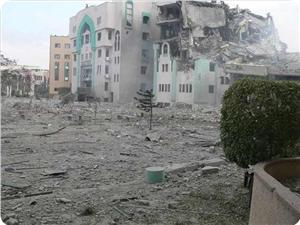 Updated 3:00 pm: Israeli war jets on Saturday bombed a mosque in the northern Gaza town of Jabalia, a major university in Gaza City and flattened houses in a beach side neighborhood, bringing the Palestinian death toll to 1,654 as the US-backed assault enters day 26.
Saturday’s killings come a day after Israeli forces committed horrifying massacres in the southern town of Rafah, slaughtering about 150 men, women and children after the killing of two Israeli soldiers and the capture of a third by Palestinian commandos.
Hamas claimed responsibility for the ambush of the Israeli army officer, but said the group has lost contact with the fighters involved in the operation, and suggested that they may have been killed by Israeli shelling along with their prisoner of war.
“We lost contact with the (Hamas) troops deployed in the ambush and assess that these troops were probably killed by enemy bombardment, including the soldier said to be missing — presuming that our troops took him prisoner during the clash,” the Brigades said in a statement issued in Arabic and English.
“The Qassam Brigades has no information as of this time about the missing soldier, his whereabouts, or the circumstances of his disappearance.”
Palestinian health officials say 1,654 Palestinians, the overwhelming majority of them civilians, have been killed, including a muezzin who died in an Israeli strike on a northern mosque on Saturday.
Sixty-three Israeli soldiers have been killed, and Palestinian shelling has killed two Israelis and a Thai workers.
Air strikes and tank fire have pounded huge areas of Gaza into rubble, rendering much of it unrecognizable to one Palestinian who returned home after spending years in an Israeli jail.
“It was my dream to return to Gaza but it is a real shock,” said 30-year-old Osama who comes from the central town of Deir al-Balah.
“Everything has been destroyed.”
Since Friday, more than 400 houses have been leveled across Gaza, mostly by air strikes, Palestinian officials said.
UN figures show that up to 25 percent of Gaza’s population of 1.8 million may have been forcibly displaced, with more than a quarter of a million people now seeking safety in shelters belonging to UNRWA, the UN agency for Palestinian refugees.
(Reuters, AFP, Al-Akhbar)
Obama to Hamas: Release Israeli soldier
Press TV – August 2, 2014
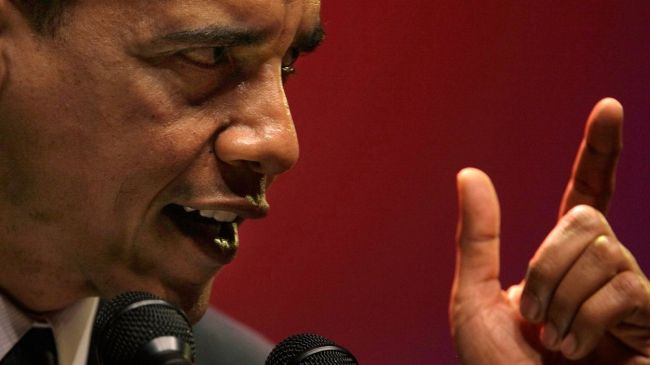
US President Barack Obama has called on the Palestinian resistance movement Hamas to “unconditionally” release an Israeli soldier captured in the Gaza Strip.
“If they are serious about trying to resolve this situation, that soldier needs to be unconditionally released as soon as possible,” Obama told a news conference on Friday.
On Friday, the Israeli military confirmed that one of its soldiers was captured by Palestinian fighters in the Gaza town of Rafah.
Obama framed the release of 23-year-old Hadar Goldin as a precondition for a possible ceasefire.
“A ceasefire was one way in which we could stop the killing, to step back and try to resolve some of the underlying issues,” he said.
Obama also characterized the relentless Israeli aerial and ground attacks on Gaza– in which more than 1,650 Palestinians have been killed– as self defense.
“No country can tolerate missiles raining down on its cities… no county can or would tolerate tunnels being dug under their land,” the president stated.
The United Nations says over 80 percent of the fatalities in Gaza have been civilians. Some 9,000 people have also been injured in 26 days of Israel’s onslaught on the besieged coastal enclave.
The military wing of the Palestinian resistance movement Hamas, the Ezzedine al-Qassam Brigades, has been firing retaliatory rockets into Israel, killing dozens of its soldiers.
HRW: Human Rights Watch or Hypocrites Representing Washington
By Eric Draitser | New Eastern Outlook | August 1, 2014
Ulike previous centuries and epochs, modern warfare is not restricted solely to the battlefield. Rather, it extends into the information sphere where the dissemination of propaganda and the construction of narratives are of equal importance to weapons and soldiers. For today, the legitimacy of a war in the eyes of public opinion in many ways determines victory or defeat. It is here, in the realm of public opinion, that an organization such as Human Rights Watch (HRW) becomes indispensible to the Empire, not so much for the facts that it presents, but the narrative that it shapes.
Put another way, HRW serves as intermediary between the facts on the ground and the western public who rely on the organization (and similar NGOs such as Amnesty International) to accurately tell the story of a given conflict. It is precisely this position as an “information middleman” that makes HRW both relevant and dangerous for the simple fact that the manner in which it presents information, along with the critical facts it chooses to omit or otherwise distort, can have a tremendous impact on how the world views a conflict and, consequently, how the world responds.
By examining the way in which HRW documented, investigated, and presented findings from the conflicts in Israel/Palestine, Ukraine, Libya, Syria, and Venezuela, it becomes clear that the organization, though theoretically objective and “disinterested,” is in fact an integral part of the western imperial system. Though HRW has done some good work, and likely will in the future, this cannot be taken as evidence that the organization is somehow not a part of the Empire. On the contrary, without HRW and similar organizations, Washington and its allies would not be able to champion themselves as “defenders of human rights,” “beacons of democracy,” and “humanitarian powers.”
HRW on Israel/Palestine
In analyzing HRW’s findings and, perhaps most importantly, the way in which they are presented, one conclusion becomes inescapable: when the facts are damaging to the western powers, HRW dilutes the impact of its own conclusions, and when its findings advance the western agenda, HRW exaggerates them. What can one call such obvious service to power under the guise of truth-telling? Words like cynical, insidious, and treacherous certainly come to mind.
On the subject of Israel/Palestine, HRW has consistently placed itself in the “condemn both sides” camp. That is to say, it makes an equivalence between the violence and barbarism of Israel’s colonial-style occupation of Gaza and the West Bank on the one hand, and Palestinian armed resistance on the other. The cynicism is painfully obvious. By making such equivalence, HRW effectively reduces the scope and scale of Israeli crimes which are, objectively speaking, far more widespread, systematic, and devastating.
As renowned Palestinian journalist and Middle East analyst Mouin Rabbani wrote in 2009:
In the years since 2000, HRW pursued a consistent — and consistently effective — formula: criticize Israel, but condemn the Palestinians. Challenge the legality of an Israeli aerial bombardment, preferably in polite, technical terms, and vociferously denounce the Palestinian suicide bomber in unambiguous language — especially when raising questions about the latest Israeli atrocity. In HRW publications, explicit condemnations and accusations of war crimes were almost wholly monopolized by Palestinians. With Israeli citizenship a seeming precondition for the right to self-defense, the right to resist was for all intents and purposes non-existent.
Rabbani here correctly points out not only the false equivalence between the violence perpetrated by Israel and the armed resistance of the Palestinians, but also the question of legitimacy and legality in regard to the latter. HRW portrays Palestinian resistance, in whatever form it takes, as illegitimate and a violation of international law, often referring to the rockets and, when it was still applicable the “suicide bombers,” as war crimes. In contrast, HRW very rarely, if ever, expressly uses the term “war crimes” to refer to any of the atrocities committed by Israel that undoubtedly are such.
Perhaps here it would be relevant to point out that, according to international law and UN precedent, all Israeli so-called “self-defense” (bombing civilian targets, laying siege to Gaza, etc.) constitutes war crimes. By contrast, the Palestinians have a legal right to resist their occupation by a foreign power by any means necessary. Indeed, this point has been reiterated countless times by the United Nations. One particularly relevant example comes from the 43rd resolution of the 37th UN General Assembly held in 1982 against the backdrop of Israel’s vicious war on Lebanon which, “Reaffirms the legitimacy of the struggle of peoples for independence, territorial integrity, national unity and liberation from colonial and foreign domination and foreign occupation by all available means, including armed struggle.”
Though certainly not the only example of international law and UN precedent legitimizing the armed resistance of the Palestinian people, the above resolution makes it quite plain that the argument that “Hamas rockets constitute a war crime” is little more than a rhetorical flourish from those who attempt to make an equivalence between Israeli and Palestinian violence in order to justify the former by discrediting the latter. It goes almost without saying that such faulty reasoning must be rejected entirely.
But this issue of rhetoric and language is also crucial to understanding how HRW is able to criticize Israel without actually condemning its atrocities or exposing it to charges of war crimes and crimes against humanity. In response to the most recent round of Israeli crimes, renowned scholar and activist Norman Finkelstein wrote:
In its first press release on 9 July 2014, Indiscriminate Palestinian Rocket Attacks; Israeli Airstrikes on Homes Appear to be Collective Punishment, HRW stated that “Israeli attacks targeting homes may amount to prohibited collective punishment.” In its second press release on 16 July, Unlawful Israeli Airstrikes Kill Civilians; Bombings of Civilian Structures Suggest Illegal Policy, HRW states that “Israeli air attacks in Gaza… have been targeting apparent civilian structures and killing civilians in violation of the laws of war. Israel should end the unlawful attacks that do not target military objectives and may be intended as collective punishment or broadly to destroy civilian property.” It then proceeded to legally define the meaning of war crimes, but artfully avoided accusing Israel of committing them… In these statements HRW doubly distanced itself from alleging Israeli war crimes: first, it qualified the weight of the incriminating evidence – “appear,” “may,” “apparent,” “may be,”; second, it recoiled from explicitly charging Israel with war crimes and instead settled for lesser or vaguer charges – “collective punishment,” “violation of the laws of war,” “unlawful attacks.”
As Finkelstein correctly notes, the language that HRW employs is, at least superficially, supposed to provide a veneer of objectivity by using qualifier words such as “may” and “apparent.” However the reality is that such language is deliberately designed to allow HRW to avoid correctly ascribing terms like “war crimes” and “crimes against humanity” to Israeli actions. In this way, HRW dilutes its own findings, pleasing the powerful corporate and political interests in the US that fund it.
Indeed, here it is important to reiterate how HRW creates a false equivalence between Israeli war crimes and Palestinian “war crimes.” HRW has gone on record saying that “Hamas rocket attacks targeting Israeli civilians are unlawful and unjustifiable, and amount to war crimes… As the governing authority in Gaza, Hamas should publicly renounce rocket attacks on Israeli civilian centers and punish those responsible, including members of its own armed wing.”
So, let’s just be clear here. Israeli bombings of Palestinian civilian targets through systematic campaigns “may” constitute “collective punishment” (not war crimes according to HRW’s language), while Hamas rocket attacks “amount to war crimes.” The transparently hypocritical use of double-standards in terms of language exposes a deeply rooted bias in HRW against the justness of Palestinian resistance. Whether one agrees or disagrees with Hamas’s military (and political) tactics, the legal and moral righteousness of their resistance cannot be disputed by anyone objectively evaluating the conflict.
More to the point, HRW accusing Palestinians of war crimes implies yet another distortion perpetrated by the Empire and its media and NGO toadies: that the conflict in Gaza is a “war.” This is no war, it is a one-sided slaughter. One could point to the casualty figures, the absence of an army, navy, or air force on the Palestinian side, the complete lack of indigenous economic activity to support a “war economy” in Gaza, or any of the other myriad material reasons why this is not a war.
If one is being honest, then it is clear that it is the western media (which includes of course Israeli media) which distorts the reality of the situation, calling it a “war” so as to justify the horrific crimes being committed. Because, as is self-evident, only under conditions of war can Israeli actions be justified in the minds of westerners. This is willful self-deception of the highest order. Indeed, self-deception is one of the most potent weapons that Israel’s supporters, along with HRW, have at their disposal.
HRW on Ukraine
 The armed conflict between the US-sponsored regime in Kiev and the anti-Kiev rebels in the East of the country has devolved into a bona fide civil war. However, it should be noted that, though the term “civil war” is used to describe the fighting, it should not be taken to mean that there is equivalent force on both sides. Rather, the Kiev regime has the full force of an organized military with air power, heavy weapons, tanks, artillery, and a host of other military materiel. In contrast, the anti-Kiev forces possess very few of these same weapons, with no air power whatsoever, despite the continued allegations of Russian support. And so, as with the so called “war” between Israel and Hamas, the conflict is far more one-sided than most media is willing to admit.
This point about unequal force is critical to understanding just how HRW, though seemingly condemning the use of rockets by the US-backed Ukrainian military, in fact provides an important service to the western narrative on Ukraine. Specifically, HRW presents a “condemn everyone equally” perspective which unjustifiably condemns the rebel forces with as much fervor as it does Kiev’s military. In so doing, HRW once again makes false equivalence, thereby distorting the true nature of the conflict in the eyes of western observers.
In its report Ukraine: Unguided Rockets Killing Civilians, HRW documents the use of “Grad” (Russian for “hail”) rockets by both sides in Ukraine. The report noted that “Unguided Grad rockets launched apparently by Ukrainian government forces and pro-government militias have killed at least 16 civilians and wounded many more in insurgent-controlled areas of Donetsk and its suburbs in at least four attacks between July 12 and 21, 2014.” In this initial assessment at the opening of the report, HRW is correct in pointing out that both sides of the conflict have been using such weapons, at least according to a number of independent reports from the region. However, again one must return to the question of equivalence between the two sides. In other words, are both sides equally accountable for the death and destruction wrought on the civilian population?
According to HRW and the language of the report, the answer is yes. Ole Solvang, senior emergencies researcher at HRW noted that, “Grad rockets are notoriously imprecise weapons that shouldn’t be used in populated areas. If insurgent and Ukrainian government forces are serious about limiting harm to civilians, they should both immediately stop using these weapons in populated areas.” Though of course one would agree that the use of such weapons by either side harms civilians, it presupposes that each side is equally responsible. Naturally, one should note that it is the Kiev regime’s military which is launching these rockets against a civilian population, while the rebels are using such rockets against military positions held by the Ukrainian army. This simple fact, conveniently left out of HRW’s report, should significantly alter how the issue is perceived. Rather than a war between two equally criminally responsible parties, there is undoubtedly an asymmetry in the violations of the rules of war.
To be fair, there are portions of the HRW report which do intimate, though perhaps stop short of explicitly stating, the fact that Kiev bears the majority of the blame. The report states, “Human Rights Watch called on all parties to the conflict in eastern Ukraine, particularly Ukrainian government forces, to stop using Grad rockets in or near populated areas because of the likelihood of killing and wounding civilians.” Indeed, the use of the phrase “particularly Ukrainian government forces” does suggest that Kiev is more culpable than the rebels. However, HRW quickly negates whatever value can be drawn from the above statement by following it with “Insurgent forces should minimize the risk to civilians under their control by avoiding deploying forces and weapons in densely populated areas.” Such a statement is patently absurd considering that the war is undeniably being fought in densely populated areas (Donetsk alone has about a million residents).
How can HRW genuinely tell rebels who are protecting their homes, their families, and their communities, not to fight in densely populated areas? The Ukrainian air force and military have been shelling civilian areas with far more than just the Grad rockets (artillery, aerial bombardment, and possibly white phosphorous bombs), and HRW expects the rebels to simply allow this? Again, the report presents an equivalence between the force employed by both sides, an utterly disingenuous argument. The report notes, “Human Rights Watch said that insurgent forces have failed to take all feasible precautions to avoid deploying in densely populated areas, thereby endangering civilians in violation of the laws of war.” In other words, though HRW condemned the use of the rockets by Kiev’s military forces, ultimate responsibility lies with the rebels who are “endangering civilians.”
This is backwards thinking. It is the equivalent of Israeli military spokesmen who argue that Hamas is responsible for Palestinian deaths because of where they place their rockets. The sort of mental gymnastics required to evaluate the situation in this way perhaps best illustrates what HRW is doing. Rather than assigning blame to Kiev where it is deserved, HRW condemns fervently the rebels for the actions of Kiev. In this way, HRW bolsters the western narrative that the “pro-Russian separatists” (as the western media is fond of calling them) are the ultimate cause of the conflict and the civilian deaths. This is not the first time that HRW has blamed the victims of aggression for the crimes of the aggressors.
Gaza Ministry of Health: “Al Najar Hospital in Rafah evacuated as Israeli genocidal rampage continues”

Shells fall on Rafah on Friday (photo from Ma’an Images)
Gaza Ministry of Health | August 1, 2014
Gaza, Occupied Palestine – The Ministry of Health Gaza announces the closure of Al Najar Hospital in Rafah, due to Israeli shelling in the vicinity compromising its ability to guarantee the safety of patients and staff.
The hospital has now been evacuated, bringing to four the number of government hospitals closed by Israeli attacks in the past three and a half weeks.
El-Wafa Rehabilitation Hospital, the only specialist rehabilitation hospital in Palestine, was forced to evacuate on July 17th, and completely destroyed on July 23rd.
Al Durrah Paediatric Hospital was forced to evacuate on July 24 because of damage caused by an Israeli strike next to it, and closed.
Beit Hanoun Hospital was evacuated on July 26 after several hours of direct and indirect shelling overnight, and closed.
Israeli attacks on hospitals are a gross breach of the Fourth Geneva Convention, as are attacks on civilians.
At least 65 people have been killed in the Rafah attacks, more than 350 wounded, and the attacks are still ongoing.
The Ministry of Health Gaza calls on the United Nations, the international community and people of good conscience everywhere to take concrete action to bring an immediate end to the ongoing Israeli attacks on medical facilities and personnel, and massacres of Gaza civilians.
Israel Right or Wrong
But What’s In It For Americans?
By Philip Giraldi • Unz Review • July 29, 2014

It is a familiar scenario. Israeli is killing hundreds of civilians, mostly women and children, and the Zionist propaganda machine is working overtime. The President of the United States reaffirms America’s solemn pledge to protect Israel at all costs and justifies the carnage by stating that Israel has a right to defend itself. Secretary of State John Kerry repeats the message and the US House and Senate pass unanimously American Israel Public Affairs Committee (AIPAC) drafted resolutions affirming the same.
Israeli Prime Minister Benjamin Netanyahu lies repeatedly and the US media gives him a bully pulpit to spread his disinformation about what is occurring, including the propaganda cartoon depicted above explaining why he had to use artillery and bombs to level a residential district, killing nearly 100 civilians in what was described as a “heinous massacre.”
The mainstream media obligingly toes the line, depicting something like a battle between equals pitting the Israeli Army (IDF) against Hamas militants, obfuscating the essential asymmetry of a conflict that has killed more than 1,000 Palestinians civilians. A very large percentage of the commentators on television and radio as well the authors of mainstream print media opinion are American and Israeli Jews, to include a piece by Michael Oren, former Israeli Ambassador to the US and current CNN “expert,” entitled “Israel Must be Permitted to Crush Hamas” as well as the featured appearances by Prime Minister Netanyahu on national television.
Oren’s call to crush Hamas is particularly ironic as it runs directly contrary to American interests. The US intelligence community believes that the group would likely be succeeded by something far more radical. The media, Congress, and Netanyahu all also connive to ignore the deliberate targeting of civilians to include hospitals, schools and private homes by the IDF, producing massive infrastructure damage and increasing the numbers of dead and wounded. The US media did not report how Israelis watching the bombing from their lawn chairs on a hill near Sderot were photographed cheering and applauding each time a target in Gaza exploded. They were also sharing popcorn and one described the event as “just good fun.”
Also missing in the discussion is the damage that the conflict does to the United States, which is seen throughout the world as Israel’s puppet, manifested most recently when Washington alone opposed and will presumably veto any United Nations inquiry into possible war crimes connected to the Gaza conflict.
America diplomats are supposed to support American interests while the Founding Fathers created an army and navy to defend the United States, not Israel, a fact that seems to have escaped the notice of many in the White House, Congress and in the media. In reality, Washington has no obligation to protect the Netanyahu government in international fora nor is there any treaty obligation to defend Israel or anyone else outside the NATO alliance. Israel is neither an ally nor is its self-defined security a compelling US national interest if one excludes the drumbeat of the domestic lobby that protects it no matter how badly it behaves.
The sequence of events leading up to the current slaughter is clear, though Israel’s friends pretend that it all started when the first homemade rocket landed inside Israel, justifying any subsequent steps necessary for “defense.” But the Israel-Palestine problem truly began in 1948, when armed Jews deliberately terrorized and then drove more than 700,000 Palestinians from their homes. It was exacerbated when in 1967 the military occupation of the West Bank and Gaza began, leading to the creation and expansion of illegal settlements on Arab land.
The current cycle of violence, rooted in the denial of viable statehood for the Palestinian people, began in April when Israel deliberately torpedoed US brokered peace talks by accelerating settlement building and failing to comply with an agreement to release prisoners. On May 15 th Israeli soldiers shot dead two Palestinian teenagers, an event that was videoed. They were among the 26 Palestinians killed by Israelis since January, with no one being held accountable. Four weeks later three Israeli teenagers from Hebron were kidnapped and later discovered dead. Netanyahu, who knew that the three young men were already dead and that the abduction had not been carried out by Hamas cynically used the kidnapping as a pretext to attack Hamas in the West Bank, blaming the group for the crime without producing one shred of evidence. An Arab teenager was subsequently burned to death by Jewish extremists and the boy’s American citizen cousin was badly beaten by police when he joined a demonstration.
Netanyahu may or may not have cared who was killing or kidnapping whom on a micro level, but he knew a good opportunity when he saw one. He took advantage of the situation to launch a plan to destroy Hamas and pari passu the Palestinian unity government. Hundreds of arrests were made, again without any evidence linking those detained with the kidnapping, and homes of suspects were demolished. When Hamas in Gaza eventually struck back with its homemade rockets, killing or injuring no one, Israel unleashed its modern army and air force on the largely unarmed and defenseless Palestinians.
Israel also has found allies in the usual places in the US media and political circles to help explain the ensuing massacre. Ayman Mohyeldin, the NBC News correspondent who personally witnessed and reported the killing by Israel of four Palestinian boys on a Gazan beach was ordered by NBC executives to leave Gaza immediately, presumably because he had strayed from the acceptable message, which is that the deaths of Palestinians is somehow their own fault. CNN also “reassigned” reporter Diana Magnay who tweeted regarding an Israeli mob that threatened her when she filmed their celebration of missile strikes in Gaza. She called her attackers “scum” and was quickly removed.
The far fewer deaths of Israelis in the conflict are, however, rather more celebrated than the mass high tech execution of Palestinians. American volunteers in the IDF are depicted as somehow doing their patriotic duty, albeit in a foreign army. The Washington Post described how the “Death of two Americans in Israel brings conflict home.” Both men identified in the article though born in the US had chosen to live in Israel, producing some pushback in the blog comments. One noted that bearing arms for a foreign country that is not in NATO is illegal (and used to lead to automatic loss of citizenship) while another comment observed that if you are by choice fighting in a foreign army you are no longer really American. I might add that directly supporting Israel’s militarized colonization of Palestinian lands is against stated US government policy and does actual damage to American interests.
The Gazans are, to be sure, an easy target, crowded into a narrow strip of land with no place to go as they are controlled on all sides by Egypt and Israel. Fleeing inhabitants cannot even turn to the sea which is controlled by the Israeli navy. A comprehensive ten year truce offer by Hamas has been rebuffed by Israel and the slaughter will presumably continue until Netanyahu decides to stop. The United Nations has suggested that what Israel is doing might fit the definition of a war crime, just as was the case back in 2009 for Operation Cast Lead, when more than 1,400 Gazans were killed and schools run by the UN were deliberately targeted, as has been the case also currently.
That the US is so tied to a rogue nation like Israel would be incomprehensible but for the action of what has been described as the Israel Lobby. As Harvard Professor Stephen Walt puts it, “AIPAC is the only explanation for America’s morally bankrupt Israel policy.” Israel is in reality a place that most Americans would find unsympathetic. It is a corrupt theocracy that denies equal rights to Christians and Muslims, a fact that is conveniently overlooked by Congress and the media. There is also a strong dose of racism and ethnocentrism in its political matrix, with broad popular support for either disenfranchising or expelling all non-Jews. Or even killing them, with crowds in Tel Aviv routinely chanting “Death to Arabs.”
An Israeli member of parliament Ayelet Shaked of the ultra-nationalist Jewish Home party has called all Palestinians terrorists, saying women should be especially targeted for killing during the ongoing Israeli assault on the besieged Gaza Strip because they give birth to “little snakes.” She explained “They have to die and their houses should be demolished so that they cannot bear any more terrorists,” adding “They are all our enemies and their blood should be on our hands. This also applies to the mothers of the dead terrorists.” A prominent Rabbi has also endorsed complete destruction of Gaza and genocide, as a “deterrent measure to exterminate the enemy.”
Perhaps most discouraging is the visceral hatred directed at American critics of Israeli policies that surfaces occasionally among that nation’s most zealous supporters. Rabbi Shmuley Boteach, former Michael Jackson spiritual adviser and self-designated “America’s Rabbi,” has penned a piece entitled, “By Condemning Israel, Presbyterians Condemn Themselves.” He writes regarding the Presbyterian decision to divest from companies supporting the Israeli occupation of the West Bank, stating that “The rotting corpse of the Presbyterian Church suffered another nail in the coffin with its general convention vote on Friday to divest from companies doing business with Israel.”
Boteach, who has also become close to a number of prominent politicians, received no mainstream censure for this comments attacking a major Christian denomination in the vilest terms. His article also plays fast and loose with the facts. He observes “In the wake of the Oslo Accords, in which Israel granted the PLO political autonomy in the West Bank, about 60,000 Americans were murdered in Israel.” Since Oslo in 1993 the actual figure for dead Americans, many of whom were Israeli dual nationals, is 53.
That the United States has provided political support for a monster like Benjamin Netanyahu is criminal but it is a tribute to the grip that Israel’s lobby has on America’s political class and media. For starters, one might reasonably suggest that people like Boteach and the American volunteers including Chicago mayor Rahm Emanuel who go to fight for Israel while eschewing any service in the US Army should perhaps move permanently to the country that they love most. The charge of dual loyalty which surfaces regularly regarding Israel’s most passionate Jewish supporters misses the point. Boteach and his friends, most certainly to include the likes of multi billionaire casino magnate Sheldon Adelson of Las Vegas, have no dual loyalty at all. Their only concern is for Israel and they stay in the United States to cash in and to make sure that the rest of the American people are coerced and propagandized sufficiently so as to guarantee that the US will remain Israel’s patsy. But more and more Americans are waking up to the fraud and the ongoing slaughter of another thousand or so Palestinians in Gaza virtually guarantees that there will be more questions about the relationship with Israel than answers. Eventually the truth will out.
Featured Video

Armando Mema: Finland Used as New Frontline Against Russia
or go to
Aletho News Archives – Video-Images
From the Archives
MI5 plotted assassination of Irish PM in 1985 – Ulster Volunteer Force

RT | December 29, 2017
Former Irish Prime Minister Charles Haughey was warned by loyalist paramilitaries that they were once tasked with murdering him in an assassination plot purportedly dreamt up by the British secret service.
The sensational disclosure was sent in a letter to the Irish government, newly released under the Public Records Act, which requires documents of historical value to be published by the National Archives within 30 years.
Written on Ulster Volunteer Force (UVF) signature paper, the warning claims the terrorist organization was asked by an MI5 operative about the prospect of carrying out an attack on Republic of Ireland leader Haughey in 1985.
At the time, Haughey would have been in opposition as head of political party Fianna Fáil, but details of the solicitation did not become known to Irish authorities until 1987.
“In 1985 we were approached by a M15 officer attached to the Northern Ireland Office and based in Lisburn, Alex Jones was his supposed name,” the letter reads, according to the Irish Times. “He asked us to execute you.”… continue
Blog Roll
 Aletho News
- Armando Mema: Finland Used as New Frontline Against Russia
- Gestapo 2.0? Germany grants spy agencies sweeping new powers
- Franco-Palestinian group seeks court ban on Israeli real estate fair in Paris
- How British foreign policy is frozen in the ruins of empire
- EU risks investor exodus over Russian assets – Euroclear chief
- Moscow warns NATO over troop buildup
- EU leaders prolonging Ukraine conflict to stay in power – Swiss journalist
- Moscow car bombing injures former aide to Ukraine’s ex-PM Azarov
- Yemeni forces make major advances, complete Aden encirclement
- Trita Parsi: Trump’s Swiss Cheese Iran Plan & U.S. Break with Israel?
- If Americans Knew
- An error has occurred; the feed is probably down. Try again later.
- No Tricks Zone
- New Study: Barents Sea Temperatures Were Warmer And Sea Ice Less Extensive In The 1700s Than Today
- German Authorities Start Initiative To Evaluate Public Register For Climate “Disinformation” Spreaders!
- Zonal Asymmetry of Temperature Change in the Antarctic Circumpolar Current
- New Study: The Net Fossil Fuel Contribution To Rising Atmospheric CO2 Has Been Zero For 500 Years
- Germany’s Green Energy Transition Becoming Increasingly Expensive…Another 6 Trillion Euros!
- Sudden Stratospheric Warming, Powerful El Niño Combination May Lead To Extreme Europe Cold, Energy Crisis!
- Two New Studies Find Thwaites Glacier Melt Cannot Be Driven By Human Activity Or A Warming Ocean
- E-Cars Reduce CO2 Emissions By Only 41% Compared To Internal Combustion Engine Vehicles
- Predictions Made By Renowned Climate Professor Over Past Decades Have Been Proven To Be Poor
- New Study Suggests Large Regions Of The Pacific Ocean Have Been Cooling For The Last 80 Years

