China calls for ‘international investigation’ into Nord Stream attack
RT | April 27, 2024
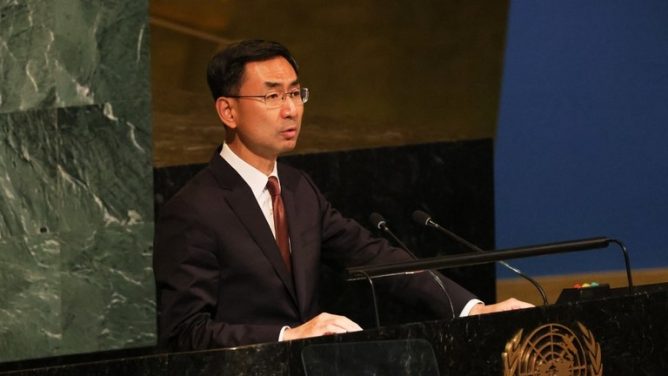
China’s deputy envoy to the UN has called for an international probe into the bombing of the Nord Stream gas pipelines, adding that Russia would be involved in such an investigation.
“With the situation standing where it is, one cannot help but suspect a hidden agenda behind the opposition to an international investigation, while lamenting the potential cover-up and loss of quantities of compelling evidence,” China’s Deputy Permanent Representative to the UN, Geng Shuang, said on Friday, according to the Xinhua news agency.
“We reiterate our call for the early launch of a UN-led international investigation to bring the truth to light for the international community,” Geng continued, adding that Western nations should “actively communicate and cooperate with Russia and jointly investigate the incident.”
Nord Stream 1 and 2 each comprised two separate pipelines, linking Russia and Germany. Three out of the four lines were destroyed in a series of explosions near the Danish island of Bornholm in September 2022, severing Germany’s energy ties to Russia and leaving its gas-dependent economy reliant on more expensive American liquefied natural gas.
Germany, Sweden, and Denmark all opened investigations into the attack, but Sweden and Denmark closed their inquiries in February. Swedish investigators published no conclusions, while the Danish team concluded that “there was deliberate sabotage,” but declined to blame the attack on anyone.
China and Russia have demanded an international investigation into the bombings since last year. However, the UN Security Council rejected a Russian request for such a probe last March, with Washington’s deputy envoy to the UN, Robert Wood, accusing Russia of trying to “discredit the work of ongoing national investigations.”
On Saturday, a spokesman for the German Foreign Ministry appeared to reject Geng’s proposal, telling Russia’s TASS news agency that an “investigation is already being conducted by the German Public Prosecutor General’s Office.”
Absent any official conclusions, two competing theories about the bombings have emerged. According to reports in the Western mainstream media, a team of Ukrainian commandos used a rented yacht to transport explosives to the blast sites, with the CIA and European intelligence agencies being made aware of the plot several months beforehand but ultimately failing to stop it.
American journalist Seymour Hersh has said that US President Joe Biden ordered the CIA to blow up the pipelines. Citing sources in the intelligence community, Hersh has claimed that CIA divers working with the Norwegian Navy planted remotely-triggered bombs on the lines in the summer of 2022, using a NATO exercise in the region as cover.
Russian President Vladimir Putin has said that he “fully agrees” with Hersh’s conclusions. Russian Prosecutor General Igor Krasnov, who is leading Moscow’s investigation into the blasts, said last month that “everyone knows perfectly well who did it,” and that “the tracks undoubtedly lead beyond the Atlantic,” – an apparent reference to the US.
French Government Agents Likely Killed in Russia’s January Strike on Kharkov – Ex-Intel Officer
Sputnik – 27.04.2024
PARIS – French government agents were likely killed during the Russian armed forces’ strike on a temporary deployment point of foreign mercenaries in the Ukrainian-controlled city of Kharkov on January 16, former French counter-terrorism intelligence officer Nicolas Cinquini told Sputnik.
On January 16, the Russian armed forces destroyed a temporary deployment point of foreign mercenaries in Kharkov, with about 60 foreign soldiers killed in the strike, Russian defense officials said. Following the developments, the Russian Foreign Ministry summoned the French ambassador to Moscow, saying that “several dozen French” had been among the mercenaries killed in the strike. Paris, for its part, rejected the information as “manipulation.”
“On January 16, 2024, Russia struck an abandoned maternity hospital in Kharkov that had been transformed into a base for foreign military personnel. The press release stated that their [military personnel’s] ‘core’ had been French and that a total of about 60 people had been killed. I have concluded that these personnel were classified as agents of the French government,” Cinquini said.
He explained his belief by the fact that no reports were published after the strike about the deceased French who had gone to the front privately, although such news is usually posted on social media.
“The first reason is that no casualties have been observed among the individual volunteers I know. Moreover, they are not accustomed to gathering in masses, but rather occupy private premises in small groups,” the former intelligence officer explained.
The second reason Cinquini believes the killed French had been government agents is that the Russian Foreign Ministry summoned the French ambassador to Moscow following the strike, which he said suggests the presence of more serious personnel at the site, such as operators appointed by the French government, probably former legionnaires of Ukrainian origin.
Following a Paris-hosted conference on Ukraine held on February 26, French President Emmanuel Macron said Western leaders had discussed the possibility of sending troops to Ukraine and, although no consensus had been reached in this regard, nothing could be ruled out. Some EU countries hastened to dismiss such plans.
UK blocked Ukraine peace deal – Moscow
RT | April 27, 2024
Ukraine abandoned a draft peace treaty with Russia in 2022 under British pressure, Kremlin spokesman Dmitry Peskov has said.
The deal, which could have ended the Ukraine conflict weeks after it started, was approved by negotiators in Istanbul, but Kiev later pulled out of the talks.
The German newspaper Welt reported on Friday that Moscow had issued additional demands after a deal had already been outlined, such as making Russian the second official language in Ukraine, implying that this had ended any hopes of an agreement.
Peskov denied those claims on Saturday, citing remarks made by Ukrainian MP David Arakhamia, who led Kiev’s delegation at the talks.
In an interview to domestic media last November, Arakhamia said then-British Prime Minister Boris Johnson had intervened in the peace process and had urged the Ukrainians to “just fight” Russia.
Kiev effectively discarded the deal under “direct pressure by London,” Peskov stressed. “The rest is speculation. I suggest we learn from the source.”
Asked whether the draft treaty could serve as a basis for further peace talks, Peskov said Kiev’s public position was to reject talks with Russia. The idea of reviving the failed agreement was floated by Belarusian President Alexander Lukashenko when he met Russian counterpart Vladimir Putin earlier this month.
Johnson has denied derailing the peace talks, but has also bragged on multiple occasions about his policy of nudging Kiev into continuing hostilities with Russia, which the British politician claims to be a fight for global democracy.
“There could be no more effective way of investing in Western security than investing in Ukraine, because those guys without a single pair of American boots on the ground are fighting for the West,” Johnson told students at Georgetown University during a visit to the US this month. The Ukrainians “are effectively fighting our own fight, fighting for our own interests,” he added.
Russian officials have described the Ukraine conflict as a Western proxy war against Moscow, which the US and its allies allegedly intend to wage “to the last Ukrainian.” Their goal, according to Moscow, is to contain Russia and stall its development, rather than protect the interests of the Ukrainian people.
The Anglo-American War on Russia – Part XV (Russia Defeats NATO)
Tales of the American Empire | April 25, 2024
Russia has won the war in Ukraine, but is in no hurry to end it as much of its army remains in reserve. It enjoys the friction in NATO whose members suffer from the resulting high energy costs and mass Ukrainian immigration. Russia prefers to slowly destroy Ukraine’s army in the open farmland of the Donbas rather than chase it into major cities where fighting would prove horrible. At some point, Ukraine’s army will collapse and the Russians will roll forth and take all of Ukraine. Russian President Vladimir Putin signed four peace agreements to end this conflict. Each time Ukraine never complied after pressure from NATO leaders to fight on. Russia will not agree to yet another ceasefire so NATO can rebuild Ukraine’s army and restart the war.
Europeans know the United States caused the conflict in Ukraine, profits from banning Russian oil and gas, and remain uneasy about the mysterious destruction of the Nordstream pipelines. The Americans promoted a mindless NATO expansion strategy that caused a disastrous war in Ukraine and weakened NATO nations, who were pressured to donate billions of dollars and much of their military equipment to Ukraine, even though it isn’t a member of this “defensive” alliance. An American refusal to make peace after Russia conquers Ukraine to reestablish trade will further agitate some NATO members, who may leave the EU and possibly NATO to join the winning side for a huge discount in Russian energy imports.
For anyone surprised that Russia may take all of Ukraine, note this April 12, 2024 news item: Russia Expects ‘Unconditional Capitulation’ Of Kiev Regime
During yesterday’s UN Security Council meeting Vasily Nebenzya, the Permanent Representative of Russia to the United Nations, said:
“This is how it will go down in history – as an inhuman and hateful regime of terrorists and Nazis who betrayed the interest of their people and sacrificed it for Western money and for Zelensky and his closest circle. In these conditions, attempts by the head of the Kiev regime to promote his formula and convene summits in support of the Kiev regime cause only confusion. Very soon the only topic for any international meetings on Ukraine will be the unconditional capitulation of the Kiev regime. I advise you all to prepare for this in advance.”
__________________________________________
“UKRAINE WILL WIN” | No Amount of Propaganda Can Hide the Fact that Ukraine is Winning this War”; Matt Orfalea; February 22, 2024; a series of short clips of pundits, experts, and political leaders saying Ukraine will win;  • “UKRAINE WILL WIN” | No Amount of Pro…
“Orwellian Morning Joe ‘Redefines Success’ in Ukraine—Erasing Their Warmongering”; System Update; Glenn Greenwald; November 22, 2023; • Orwellian Morning Joe “Redefines Succ…
“The Duran and Brian Berletic: Russia is DESTROYING NATO as Putin Rejects Europe for Global South”; Danny Haiphong; November 28, 2023; • The Duran and Brian Berletic: Russia …
“Neocons Still Can’t Believe Russia Defeated Them”; Nicolai Petro; Neutrality Studies; November 27, 2023; • Neocons Still Can’t Believe Russia De…
Related Tales: “The Anglo-American War on Russia”; • The Anglo-American War on Russia
French Servicemen Promised Big Money for Fighting in Ukraine – Ex-Intel Officer
Sputnik – 26.04.2024
PARIS – French servicemen are being promised a golden parachute for participating in fictitious “resignations” to fight in Ukraine said Nicolas Cinquini, a veteran of France’s counter-terrorism intelligence service, to Sputnik.
Cinquini is currently searching for information about French nationals who fight in the conflict on the side of Kiev. According to his findings, French state agents may have been in Ukraine since the start of the special military operation in February 2022 along with ordinary French civilians who went to fight for the Kiev regime on their own.
“These are agents who remain very secretive and are difficult to identify,” the former intelligence officer noted.
“Sources told us that in the ranks of the French army, specialists were given attractive offers: a false resignation, a guarantee of reinstatement upon completion, and an income significantly higher than their usual earnings,” he said.
In February, French President Emmanuel Macron said Paris would do everything to prevent Russia “from winning this war.” At a conference on assistance to Ukraine, he raised the issue of transferring troops to the combat zone, but neither European leaders nor the opposition in his own country supported him. At the beginning of March, Macron also emphasized that France “has no limits or red lines” in matters of supporting Ukraine.
Later, Russian Foreign Intelligence Service (SVR) Director Sergei Naryshkin, said France had already begun training a contingent to be sent to the conflict zone; at the first stage it would amount to about 2,000 military personnel. Later, the SVR, citing Naryshkin, said a French military unit, should it be in Ukraine, would become a priority legitimate target for the Russian military. Russian Defense Minister Sergei Shoigu told his French counterpart Sebastien Lecornu by phone that sending French troops to Ukraine would create problems for France itself.
Russian President Vladimir Putin earlier said in an interview with Dmitry Kiselev, the Director General of Rossiya Segodnya, Sputnik’s parent media company, that the deployment of European troops to Ukraine will not change the situation on the battlefield but will lead to dire consequences for Kiev. In response to Macron’s words about the absence of red lines, the Russian leader said Moscow will not have restrictions in relation to states with such an approach either.
US created Ukraine conflict – Shoigu
RT | April 26, 2024
The Ukraine conflict is Washington’s doing and the US is deliberately trying to prolong the fighting, Russian Defense Minister Sergey Shoigu said on Friday during a meeting with his counterparts from Asian nations.
Shoigu is taking part in a gathering of military chiefs from members of the Shanghai Cooperation Organization (SCO), a nine-strong mutual defense organization. The Russian minister used the forum hosted by Kazakhstan to reiterate Moscow’s position on the origins of its conflict with Ukraine.
He identified Washington as a major source of global instability, citing its record of military interventions abroad, including in Afghanistan, Iraq, Libya, and Syria. The US also uses less direct financial and diplomatic tools to damage its opponents, including by fueling chaos in different parts of the world, Shoigu alleged.
“The US had first created, and now is deliberately prolonging the Ukraine conflict,” the minister stated. “As it signals purported intention to de-escalate, the West keeps pumping Kiev with weapons.”
Ukraine cannot properly control the donations, meaning there is the risk that they could end up with terrorist groups, Shoigu warned.
“They provide real-time intelligence, train Ukrainian troops, deploy Western military specialists and mercenaries on the battlefield,” he added, describing the involvement by various NATO members.
The US and its allies claim that Russia launched an “unprovoked” attack on Ukraine in February 2022, and they have since sent tens of billions of dollars’ worth of weapons to Kiev.
Shoigu accused the US of double standards regarding a nation’s right to self-defense. He cited Washington’s blocking of a UN Security Council resolution which would have condemned Israel for attacking an Iranian consulate in Damascus in early April. Tehran’s eventual retaliatory attack was the result of this obstruction, the Russian minister said.
Iran joined the SCO last year and was also taking part in the meeting in Kazakhstan.
Russia Never Threatened NATO, Has No Interests in Attacking Member States – Shoigu
Sputnik – 26.04.2024
ASTANA – Russia has never threatened NATO and has neither geopolitical nor military interests to attack the states of the alliance, Russian Defense Minister Sergei Shoigu said on Friday.
“Russia has never threatened NATO. We have neither geopolitical nor military interests to attack the states of the bloc. We are simply protecting our people in our historical territories,” Shoigu said during a meeting of defense ministers of the SCO member countries in Astana.
Russia has always made maximum efforts to maintain strategic stability and balance of power in the world, the minister added.
The SCO was founded in 2001. India, Iran, Kazakhstan, China, Kyrgyzstan, Russia, Tajikistan, Pakistan and Uzbekistan are its full members. Afghanistan, Belarus, and Mongolia are observer states; Azerbaijan, Armenia, Egypt, Cambodia, Nepal, Qatar, the UAE, Saudi Arabia, Turkiye, Sri Lanka, Maldives, Myanmar, Bahrain, and Kuwait are dialogue partners.
US Plans on Military Infrastructure in Central Asia Threatens SCO Space Stability
The US intention to deploy military infrastructure in the Central and South Asia is direct a threat to stability in the SCO space, the minister noted.
“I believe that all those present share the opinion that the deployment of military infrastructure in the region by the United States and its allies is unacceptable. Such intentions must be regarded as a direct threat to stability in the SCO space,” Shoigu said.
Commenting on the situation in the Asia-Pacific region, Shoigu said that US-oriented military and political structures are trying to remake security system in the region to dominate this part of the planet.
Additionally, the minister added that the return of radical Islamists from the Middle East and North Africa to Southeast Asia creates prerequisites for new hot spots.
The United States uses the tactics of inciting hotbeds of instability in the world, generating security threats, while it simultaneously offers military assistance, Shoigu pointed out.
On Tuesday, the US Senate passed the $95 billion legislation with approximately $61 billion in Ukraine-related funding, $26 billion in Israel-related funding and $8 billion for Indo-Pacific security initiatives in a vote of 79-18. The Biden administration is reportedly readying a $1 billion military aid package for Ukraine sourced from the legislation.
“[The US] uses a technique that has been proven many times — inciting and maintaining hotbeds of instability in various regions of the world, generating security threats while simultaneously offering military assistance to neutralize them,” he said.
Continued Strikes by Ukraine on Zaporozhye NPP Can Lead to Catastrophic Consequences
Shoigu also touched upon potential catastrophic consequences caused by the ongoing Ukrainian attacks on the Zaporozhye Nuclear Power Plant (NPP).
“The ongoing strikes of the Ukrainian armed forces on the Zaporozhye nuclear power plant, which could lead to catastrophic consequences, are of particular concern,” Shoigu emphasized.
The Zaporozhye Nuclear Power Plant is located on the left bank of the Dnepr River and is the largest nuclear power plant in Europe. It came under the control of Russian forces in early March 2022 and has since been repeatedly shelled by Ukrainian forces, raising international fears of a possible nuclear accident.
Blinken’s Failed Diplomacy: Feeble and Hostile Threats against China by Top-ranking US Officials Visiting Beijing
By Drago Bosnic | Global Research | April 25, 2024
On April 24, US State Secretary Antony Blinken landed in China and officially started his (hopefully) diplomatic visit. The relationship between the two countries has worsened significantly. Beijing’s peaceful overtures have been met with nothing but hostility in Washington DC. The United States is simply terrified of the prospect that China will overtake it. However, this has already happened in many ways.
When not murdering millions around the world, America is still trying to figure out whether public toilets should be “mixed-gender”, while China is busy building not just itself, but the world, too.
Most of the planet is perfectly aware of this disparity and is making it clear that cooperation with Beijing is a matter of choice, while having anything to do with Washington DC mostly boils down to coercion, as the political elites there are simply incapable of conducting “diplomacy” without resorting to arm-twisting.
Blinken is going to China precisely with such bearing, pompously announcing that he “arrives with a warning that the US and its European allies are no longer prepared to tolerate China’s sale of weapon components and dual-use products to Russia”. The political West insists that this is “helping Vladimir Putin rebuild and modernize his arms factories, enabling him to intensify his onslaught on Ukraine”. Caught in the web of its own endless stream of lies, the belligerent power pole is trying to blame anyone but itself. However, this is all futile, particularly when it comes to superpowers such as China. Beijing will certainly decide whether or not to do business with someone and the political West has no say in it whatsoever. Blinken will have three days to relay the US position and if that time will be used to make toothless threats and attempt blackmail, he should’ve certainly picked another country.
The mainstream propaganda machine thinks that the relations between the US and China are improving, citing Blinken’s planned attendance at a basketball game as the indicator of this.
However, the simple fact that none of the top-ranking officials greeted him when he flew in indicates something completely different. Blinken is supposed to meet Beijing’s veteran Foreign Minister Wang Yi tomorrow. The encounter is expected to last at least six hours and might even include President Xi Jinping. This will certainly depend on Blinken’s command of actual diplomacy, as the aforementioned threats he pompously announced are only for domestic consumption and are entirely void in China. The US might threaten with sanctions, but this is a two-way street and any reciprocal measures would certainly hurt America’s economic and maybe even national security interests. It’s entirely up to the US whether things will take such an unpleasant turn.
The troubled Biden administration reportedly raised the issue of the supposed “support” for Russia directly with President Xi Jinping, while US Treasury Secretary Janet Yellen did the same during her recent visit to China. However, Beijing seems completely unconcerned, as it has repeatedly stated that Washington DC’s threats regarding its close ties with Moscow mean nothing, particularly as the US and its vassals and satellite states keep escalating their aggression in the Asia-Pacific. It seems that simply maintaining normal economic and financial relations with Russia now boils down to “helping” its efforts to push back against NATO aggression in Europe. After all, even if countries like China, Iran and North Korea are building closer ties with their northern neighbor, it can only be expected that everyone the political West keeps threatening will find ways to unite their forces and push back together.
“Let me stress again that China’s right to conduct normal trade and economic exchanges with Russia and other countries in the world on the basis of equality and mutual benefit should not be interfered with or disrupted,” Wang Wenbin, China’s Foreign Ministry spokesperson, stated just before Blinken’s arrival, adding: “China’s legitimate and lawful rights and interests should not be infringed on.”
US officials insist that Beijing supposedly “gave up on the idea of sending weapons directly to Moscow thanks to their threats“. However, the entire claim is essentially a multilayered lie, as there’s no evidence whatsoever that China ever planned on arming Russia, let alone that it stopped doing so because of the political West’s pressure. On top of that, Washington DC is trying to disrupt the rapidly growing trade between the two (Eur)Asian giants, particularly through claims that Beijing is supplying so-called “dual-use” industrial goods. This is where the endless hypocrisy and mental gymnastics of the political West become most evident. While the US just decided to send dozens of billions worth of weapons to directly undermine Russia’s and China’s basic national security interests, it’s accusing the latter of “helping” the former by simply trading with it, as the so-called “dual-use” industrial goods can be pretty much anything.
Worse yet, the US and its vassals and satellite states are surrounding both Beijing and Moscow with long-range missiles and deploying troops not only in their vicinity, but directly on their borders. Still, according to their own admission, “the Blinken team is worried that China’s response to pressure over Russia could be to slow down progress in other areas of the bilateral relationship”. This also includes the (Eur)Asian giant’s close ties with North Korea, as the US wants it to put pressure on Pyongyang. Washington DC is particularly terrified of the prospect that Russia, China and North Korea are forming a more monolithic alliance that the political West will be simply hopeless to match. However, they have nobody else to blame but themselves. Constant threats and attempts to undermine all three of these countries left them with no other choice but to work together. After all, that’s one of the reasons why BRICS itself exists.
The sanctions regime against the DPRK under threat
By Konstantin Asmolov – New Eastern Outlook – 24.04.2024
On March 28, 2024, Russia vetoed the extension of the mandate of the UN panel of experts to monitor the sanctions against the DPRK until April 30, 2025. This is important, because according to the established procedure, the decision to extend the term of office of the so-called 1718 Sanctions Committee must be made by April 30, otherwise it will be unable to continue with its activities.
What is the 1718 Sanctions Committee?
Resolution 1718 was adopted in October 2006 in response to the nuclear threat posed by North Korea. The Resolution prohibited the supply, sale or transfer to the DPRK of any military equipment and weapons, and also of materials, equipment, goods and technology that could be used in North Korea’s weapons of mass destruction programs. Since then, the UN Security Council has adopted a number of other resolutions tightening the sanctions on North Korea.
The eight-member Panel of Experts supporting the UN Sanctions Committee on North Korea was established in 2009 pursuant to UN Security Council Resolution 1874, which was adopted in response to the DPRK’s second nuclear test, to monitor compliance with the sanctions imposed on the DPRK by the UN member states. A panel of eight UN Secretary General-approved experts from the permanent members of the United Nations Security Council – the United States, Britain, France, China and Russia, as well as South Korea, Japan and Singapore (theoretically) – collects, studies, analyzes data on the implementation of sanctions against the DPRK, submits a twice-annual report on sanctions violations to the United Nations Security Council based on information from UN member states and other open source materials, and makes recommendations on the sanctions issue.
Since its founding the group has reportedly uncovered a number of sanctions violations, including those related to the DPRK’s nuclear and missile programs and other prohibited activities such as the import of luxury goods and ship-to-ship transfers of sanctioned items.
The UN Security Council votes annually to extend the Panel’s mandate, and in 2023 Russia voted in favor of the extension.
Two days before the vote, NK News, citing “informed sources at the UN,” reported that Russia and China had proposed adding “sunset” clauses to the sanctions regime against the DPRK as a precondition for extending the Panel’s mandate. They proposed adding an expiration date to the de facto open-ended sanctions regime, and requiring a new consensus of the UN Security Council member states in order to renew the sanctions for a further term. Russia also proposed reducing the frequency of the group’s reports submission from twice to once a year.
The NK News article noted that the US, UK and France refuse to accept these proposals, which means that Moscow will be likely to veto the extension of the Panel’s mandate.
The Russian proposals were rejected and Russia blocked a draft resolution submitted by the United States, although 13 of the 15 UN Security Council members voted in favor of it. The representative of China, who abstained from voting, expressed support for Russia’s position, saying that the proposal to set an expiration date for sanctions on North Korea was “highly practical and quite feasible.”
Russia’s arguments
Explaining the reason for Russia’s exercise of its veto right Russia’s permanent representative to the UN, Vasily Nebenzya, said that the authors of the document did not take into account Moscow’s proposal to set a time limit for the sanctions against North Korea, which remain indefinite.
As Vasily Nebenzya stated before the vote, it was “long overdue” for the Council to update the sanctions regime against the DPRK in light of the realities of the situation.
However, all attempts by Russia and China to link the level of sanctions pressure with the current behavior of the DPRK “have always been met with the absolute unwillingness of Western countries to depart from their destructive and punitive logic towards the DPRK.”
The 1718 Committee’s Panel of Experts, tasked with monitoring the sanctions policy, “failed to perform its direct duties” and was unable to “develop sober assessments of the state of the sanctions regime,” and as a result “its work was reduced to playing along with the West’s policies, repeating biased information, and analyzing newspaper headlines and low-quality pictures.”
Unfortunately, the present author has to agree with this statement, because the Panel’s reports included almost exclusively “investigations” made by sensationalist media outlets, with no critical analysis and an overreliance on the phrase “highly likely.”
According to the Russian representative, the West, led by the United States, is trying to “strangle” the DPRK through unilateral restrictions, propaganda and threats against the country’s leadership.
Given the above background, Russia proposed that the Council embark on an open and honest review of its sanctions measures against the DPRK, but “the US and its allies did not want to hear us and did not include our proposals in the draft resolution which was put to a vote today. Under these conditions, we do not see any ‘added value’ in the work of the Committee’s Panel of Experts and cannot support the American draft.”
Russian Foreign Ministry spokesperson Maria Zakharova has twice commented on the problem, emphasizing that “the Council can no longer act according to its established patterns with regard to the Korean Peninsula issue.” The security situation in the region has not improved over the long years of sanctions (the DPRK’s missile and nuclear capabilities have only grown, the present author would add), and the devastating humanitarian consequences of the sanctions on the DPRK’s civilian population are evident. Moreover, it is not the DPRK that is aggravating the current situation, but rather the increasingly aggressive military activity of the United States and its allies that is leading to a new round of escalation in the region.
Many experts agree with this assessment. For example, Andrei Lankov, a prominent Russian-speaking researcher on the DPRK, told NK News that the increasing politicization of the Panel of Experts’ work has rendered it unable to reliably monitor the extent of the DPRK’s sanctions evasion. In his view, the differences of opinion within the DPRK Panel of Experts “reflect the main problem with the UN in its current form: it can only work if there is a consensus of the major powers.”
What was the reaction of the “international community”?
As Russian military expert Vladimir Khrustalev notes, the suspension of the Panel of Experts’ mandate significantly undermines the viability and certain legal aspects of the sanctions regime in its previous form.
But, of course, the reaction of US and South Korean officials and experts has been to condemn Russia. Western analysts say the absence of the 1718 Committee, whose main task is to monitor sanctions violations, would make it easier for Russia to engage in arms deals with the DPRK – long accepted in the West as an established fact.
US Department of State spokesman Matthew Miller expressed disappointment over Russia’s veto of the resolution and China’s abstention, calling the Committee the “gold standard” for providing fact-based, independent analysis and recommendations.
South Korea’s Foreign Ministry expressed “deep regret” over the veto: “The Panel of Experts has fulfilled its role in monitoring the DPRK, which… continues to violate sanctions through various illegal actions such as nuclear and missile provocations, arms exports, sending workers abroad, cyberattacks and military cooperation with the Russian Federation, and is building up its nuclear and missile potential.”
Yang Moo-jin, president of the University of North Korean Studies, said that the key factor behind the lifting of the UN’s sanctions monitoring of North Korea was not only by the rapprochement between Pyongyang and Moscow, but also by growing hostility between the United States and Russia, which “pushed the latter to establish closer ties with North Korea. Their strategic relationships are inherently interconnected. In addition, there is growing criticism in the UN Security Council that the sanctions are useless.”
Maria Zakharova’s second statement was a response to such rhetoric. In addition, Russia pointed out the inadmissibility of such criticisms on the part of the United States, which for the past five months has been blocking UN Security Council resolutions on the situation in the Gaza Strip, thereby covering up the mass deaths of Palestinian civilians caused by Israeli actions.
In turn, the DPRK expressed its gratitude to Russia. As the DPRK’s permanent representative to the UN, Kim Song, said, “we highly appreciate the decision of the Russian Federation to veto the Security Council’s draft resolution on the 1718 Committee.” Kim recalled that Pyongyang has never recognized either the sanctions imposed by the Security Council or the work of the sanctions committee.
Does all this mean the end of the sanctions regime?
Unfortunately not. Of course, the West is stoking fears that “the end of the Expert Panel will encourage North Korea to continue to engage in prohibited acts with impunity and frustrate international efforts to deter growing nuclear and missile threats.” However, Seoul, Washington and other like-minded countries will step up their coordination by imposing individual or multilateral sanctions in order to keep “turning the screws” on Pyongyang. As Kim Eun-hye stated in a briefing, “Despite the suspension of the Panel, we will continue to honor the sanctions against North Korea and make every effort to create an environment in which North Korea has no choice but to refuse to move in the wrong direction.”
Most likely, the panel of experts will simply be replaced. Victor Cha already proposes to fill the vacuum with an “alternative mechanism” involving countries with similar positions on the issue, such as the US, South Korea, Japan, Australia, etc., who will cooperate by sharing information.
Eric Penton-Voak also suggests that as an alternative to the Expert Panel the activities of think tanks and media specializing in the area be stepped up, which could make the enforcement of the sanctions more effective.
The first steps in this direction have already begun. On April 5, 2024, the US State Department stated that “amid the growing need for tighter international cooperation to address North Korean threats following Russia’s recent veto of a resolution on the annual renewal of a UN panel monitoring the enforcement of sanctions against the North” US Senior Official for North Korea Jung Pak will visit Romania, Poland, and Sweden. She will negotiate on challenges from North Korea’s “unlawful nuclear weapons and ballistic missile programs, malicious cyber activity, and deepening military and political partnership with Russia.”
Some experts, however, are more pessimistic. Frank Aum, a senior expert at the US Institute of Peace, notes that “the termination of the panel further erodes the multilateral sanctions regime against North Korea and forces the United States and other countries to pursue more unilateral, bilateral or monolateral efforts to crack down on North Korea.” In his view, “this scenario represents not just a crisis for advocates of pressure and sanctions against North Korea, but also the broader functioning of the UNSC and the post World War II international order.”
The present author rather agrees with these views. Yes, the UN structure will be replaced by a private shop whose verdicts will be even more biased, but less binding. The US is unlikely to lift the sanctions, considering any movement in this direction ideologically unacceptable. But another deep crack has appeared in the façade of the UN as an independent arbitration institution.
Konstantin Asmolov, Candidate of Historical Sciences, Leading research fellow at the Center for Korean Studies of the Institute of China and Modern Asia of the Russian Academy of Sciences.
Russian Strike on Kharkov TV Tower Deprives Ukraine’s Army of Eyes and Ears for Spying
By Ilya Tsukanov – Sputnik – 23.04.2024
Russia attacked the Kharkov Television Tower with a precision cruise missile on Monday, destroying it. Ukrainian officials instantly labeled the strike an act of meaningless “terror” against Kharkov’s civilian population. In reality, it’s going to become a massive headache for Ukraine’s military, says veteran defense observer Viktor Litovkin.
Kharkov’s pro-Russian underground confirmed to Sputnik on Monday that the Russian military had struck the Kharkov Television Tower, an awesome, 240.7-meter tall Soviet-built structure used for radio and television broadcasting situated in the northern part of the city in local woodlands, causing it to break in half.
The attack occurred at 4:36 pm local time. Kharkov regional military administration chief Oleh Synegubov blasted the Russian “occupiers” over the strike, saying that while there were no victims, “there are interruptions with the digital TV signal.”
“Therefore, we once again appeal to citizens: trust only official sources of information,” Synegubov urged.
President Zelensky, meanwhile, went on television Monday night to accuse Russia of trying to “make the terror visible to the whole city and to try to limit Kharkov’s connection and access to information.”
Ukrainian Institute of Mass Information chief Oksana Romaniuk called the tower’s destruction a “war crime,” saying “civilian objects, such as TV towers, have absolute protection and cannot be a legitimate target in an armed conflict.”
But according to the Kharkov underground, the structure was used by the Ukrainian air defenses to communicate, with the military said to have attached a communications antenna to the tower.
Vitaly Ganchev, head of the Russian administration in the Kharkov region, did not rule out that along with its use by Ukraine’s air defenses, the tower may have been used to coordinate artillery and missile strikes targeting nearby Belgorod and other Russian cities.
“This tower contained radar antennas, there were also communications antennas, electronic warfare antennas, and communication antennas,” Viktor Litovkin, a veteran Soviet and Russian Army officer and respected military journalist, told Sputnik.
“This equipment was situated at an altitude of almost 200 meters, which made it possible to see at a great distance the territory both of the Russian Federation and areas in which Russian troops are concentrated, that is – to engage in reconnaissance. The higher the antenna, the better the visibility. Because [things like] mountains, trees, houses and so on interfere with radio waves. But at such a height there’s nothing interfering with their distribution. Moreover, from this tower it was possible to coordinate the work of several military systems: air defense systems, reconnaissance systems, Ukrainian artillery systems, control centers, etc. It was possible to transfer information, commands and orders between military units and combat systems,” the observer explained.
For these reasons, Litovkin said that Monday’s precision missile strike was a “very important” step in depriving Ukraine’s military and intelligence services of the eyes and ears afforded by the tower. “Now, Ukraine is deprived of the opportunity to conduct reconnaissance and coordinated actions against our armed forces,” the retired military officer said.
The tower was the only comparable piece of infrastructure of its kind in the region, but its destruction will not allow Russian forces to rest easy, Litovkin stressed.
“In addition to the tower, there are also cables, there is also the internet. So of course, the tower has ceased to function as an information channel. But I don’t think Kharkov’s communication system can be destroyed completely… You know that in Ukraine, despite the categorical ban by the government on Ukrainian citizens receiving information from Russia, many citizens receive Russian information through the internet, through small antennas at home, watch our television and so on. So it’s very difficult to completely deprive someone of information in the world today,” the observer summed up.
EU will be the biggest loser if it confiscates assets – Moscow
RT | April 23, 2024
Moscow has drafted a package of retaliatory measures in the event that Western countries seize Russian sovereign assets that have been frozen over the Ukraine conflict, senior senator Valentina Matvienko warned on Tuesday.
In an interview with Russian journalist Dmitry Kiselyov, the chairwoman of the Federation Council said that the EU’s potential move to confiscate Russian assets would be “unprecedented,” adding that it “would destroy the global economy.”
“Of course, it would be absolutely illegal, and everyone in Europe understands that they can’t do that,” the official stated.
The West has frozen around $300 billion in Russian central bank assets since the start of the Ukraine conflict in February 2022. Most of the funds are being held in the EU. Moscow has repeatedly denounced the seizure as “theft.”
Officials in several Western nations, notably the US and the UK, have insisted on the outright confiscation of Russian assets despite widespread concerns that this would have no legal basis. In contrast, the EU has been reluctant to do so, reportedly fearing Russian retaliation.
Matvienko stressed that Russia has “a prepared response” to a potential confiscation. “We have a bill that we are ready to consider immediately in response. And the Europeans will lose more than we will. Of course, they are afraid of this, especially given that their economy is collapsing.”
The senator argued that Washington has crushed the EU, both politically and economically. “In the defense and security area, it used to be a vassal… but now it has been simply squashed by the Americans. They now want to strangle it even more… to make it even less competitive,” she stated.
With this in mind, Matvienko suggested that the European business community should vehemently protest against the potential seizures, as they would be the primary target of Moscow’s retaliatory measures.
While the EU has been dragging its feet on confiscating Russian assets, it has been working on a plan to seize the profits generated by those funds in order to procure weapons for Ukraine and boost its defense production capabilities.
According to Politico, however, some members of the bloc have voiced serious misgivings about the initiative. Hungary and Slovakia have opposed the idea of sending weapons to Ukraine, while Malta and Luxembourg are reportedly unhappy that they were not consulted about the plan.
US lawmaker demands ‘proof’ on CIA’s Russia scare
RT | April 22, 2024
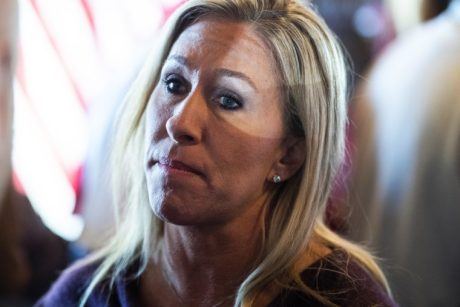
After stoking fears of Russian expansionism to win congressional approval for more Ukraine aid, US intelligence agencies should provide proof of their justification for continuing to fund a “proxy war” that will inevitably end in defeat for Kiev, Representative Marjorie Taylor Greene (R-Georgia) has argued.
Speaking on Monday in an interview with former White House aide Steve Bannon, Greene pushed back against claims that Russian forces will take Poland and continue “marching across Europe” if they’re allowed to defeat Ukraine. She noted that US House Speaker Mike Johnson (R-Louisiana) only agreed to push through the $61 billion Ukraine aid bill, which was approved on Saturday, after hearing intelligence briefings hyping the Russian threat.
“If the American people are going to have to pay for it, then show us this proof that was shown to Mike Johnson in the SCIF [sensitive compartment information facility],” Greene said. “Why is this classified information? If this is a real threat to all of Europe, if this is a threat to America and our national security, then roll out the presentation.”
The second-term lawmaker said Johnson received no such classified briefings on the US border crisis, which poses a real threat to the American people. “They don’t care about that,” she said. “They care about continuing the business model built on blood and murder and war in foreign countries, the business model that continues funding the military-industrial complex in order, supposedly, to create American jobs and build up the American economy.”
“This is the most disgusting business model that anyone has ever seen, probably in the history of mankind.”
Greene reiterated her call to oust Johnson as speaker, saying Republican voters are so disgusted about the Ukraine bill that the party will lose control of the House in this year’s election if the current leadership remains in place. The White House’s emergency funding request for Kiev had been stalled since last fall because a majority of Republicans opposed it. Republican lawmakers voted against the legislation by a 112-101 margin on Saturday, but Johnson overrode his own party by allowing a vote and winning passage with unanimous Democrat support.
Johnson won praise from the Washington media for his reversal on Ukraine aid – CNN even likened him to Winston Churchill – while Greene came under attack for criticizing him. The New York Post put a picture of Greene on its Sunday cover with a Soviet ushanka superimposed on her head and a caption saying, “Nyet, Moscow Marjorie.”
Greene insisted that congressional Republicans can’t win in the November election without the support of ‘America First’ voters. She added that sending more aid to Ukraine will only cause more bloodshed without changing the outcome of the conflict.
“This just continues the war maybe a few more months, maybe to the end of the summer,” Greene said. “It doesn’t guarantee a Ukrainian victory because everyone knows they’re going to lose eventually. It just is a matter of when. But it does guarantee that more Ukrainian men will be slaughtered on the battlefield.”
Featured Video

Iran FM Araghchi: “Hormuz Will No Longer Be the Same”
or go to
Aletho News Archives – Video-Images
From the Archives
Sam Husseini: The entire US establishment helped lie their way into the Iraq war
By Slava Zilber | American Herald Tribune | October 14, 2019
Sam Husseini is a senior analyst with the Institute for Public Accuracy, independent journalist and contributor to The Nation and FAIR.
Slava Zilber: Sam, three years ago, you appeared on Talk Nation Radio with David Swanson and spoke about the case of the GCHQ whistleblower Katharine Gun. You pointed out that the people involved in the spying on the UN and the people authorizing the Iraq War were not held accountable:
“Virtually everybody who went along with the war, whether it is Kerry or Clinton, of course, the Bush administration themselves has falsified their own records in terms of why, what they did, when they did, why they did it, to the extent that they’ve been scrutinised at all.”
You also address it in a recent article. And recently, Joe Biden has been lying about his position on the Iraq War. How can such an important issue escape meaningful scrutiny? … continue
Blog Roll
 Aletho News
- Trump peddles fresh falsehoods, claims Iran ‘started the war’ as US aggression drags on
- Ukraine quagmire? Yes, but it’s for NATO, not Russia
- US intelligence hypes Chinese, Russian space threats while accelerating its own military buildup in orbit
- Iran FM Araghchi: “Hormuz Will No Longer Be the Same”
- EU facing trillion-euro debt hole while seeking more cash for Kiev
- How US, Europe, Persian Gulf states exhausted missile stockpiles, splurged billions to defend Israel
- Up in arms… Koreans reject U.S. empire’s plan to make South Korea the next Ukraine
- Iran, Turkey, Pakistan, Saudi Arabia could advance region-led security framework in Tehran: FM spox
- Netizens condemn Japanese drama for projecting Japan’s wartime atrocities onto Chinese characters
- Racist Seinfeld Dances for Joy as Bibi Unveils His New Map
- If Americans Knew
- An error has occurred; the feed is probably down. Try again later.
- No Tricks Zone
- Sudden Stratospheric Warming, Powerful El Niño Combination May Lead To Extreme Europe Cold, Energy Crisis!
- Two New Studies Find Thwaites Glacier Melt Cannot Be Driven By Human Activity Or A Warming Ocean
- E-Cars Reduce CO2 Emissions By Only 41% Compared To Internal Combustion Engine Vehicles
- Predictions Made By Renowned Climate Professor Over Past Decades Have Been Proven To Be Poor
- New Study Suggests Large Regions Of The Pacific Ocean Have Been Cooling For The Last 80 Years
- Germany’s Green Energy Debacle: High Energy Costs Force Kahla Porzellan to Close After 182 Years!
- New Study: 50 Years Of The Most Aggressive ‘Net Zero’ Policies Can Only Affect The Global Climate By 0.03°C
- US September “Heat” Was No Record…Many Records Set Decades Ago
- Latest European Green Energy Debacle; Portugal’s Largest Flagship Solar Park Insolvent!
- Green Energy Debacle: German Expert Professor Fritz Vahrenholt Warns Of Severe Economic And Social Consequences

