“Fake News” from NBC on US-Russian talks about an ‘off ramp’ to the Ukraine war in April 2023 that never took place
By Gilbert Doctorow – July 6, 2023
News portals in Ukraine and elsewhere in Europe were quick to pick up a feature item today on NBCNews.com entitled “Former U.S. officials have held secret Ukraine talks with prominent Russians.” The subtitle goes on: “The aim of the discussions is to lay the groundwork for potential negotiations to end the war, people briefed on the talks tell NBC News.”
The very notion that such talks could have taken place elicited disparaging comments from the usual suspects who would not miss a chance to be in the public eye: former U.S. ambassador to Russia, Michael McFaul, and Matt Dimmick, a former Russia and Eastern Europe director at the National Security Council. Said comments form part of the NBC report.
This news item also surfaced on Russian state television in the early evening edition of Sixty Minutes under the heading “Fake News.” Their panel discussion opened with an announcement from the RF Ministry of Foreign Affairs, responding to what is said in the second paragraph in the NBC article, which reads:
“In a high-level example of the back-channel diplomacy taking place behind the scenes, Russian Foreign Minister Sergey Lavrov met with members of the group for several hours in April in New York, four former officials and two current officials told NBC News.”
Per Lavrov, no such meeting ever took place and there are no back channels.
And then the Sixty Minutes panel was off to the races, as we say.
They listed the former U.S. officials who were said to have taken part in the meeting – Charles Kupchan, Richard Haass, and Thomas Graham, all members of the Foreign Relations Council and, as they stressed with truculent humor, all are decidedly very former. Their heyday was decades ago and today none of them holds a rank that would justify Lavrov’s spending any time with them, let alone discussing the basic principles for some negotiated settlement of the Russia-Ukraine war. They are just a bunch of old academics who get together to reminisce about the arms control negotiations of the distant past and similar issues long ago laid to rest.
After breaking its fake news story, NBC spent the greater part of its article talking about how back channel communications, dubbed Track Two talks, function and what utility they have in general.
To be sure, backchannels have served a constructive purpose in U.S. – Russian relations in the not too distant past, though I doubt that journalist Josh Lederman has a clue about this. Thomas Graham’s former mentor and associate, Henry Kissinger, had been an important initiator of such an outreach back in the summer-early autumn of 2008 when he, too was a former, not active political actor. But then Kissinger was and is Kissinger, not some flunky. That was in the time just after the Russia-Georgia war, when relations between the two countries were very tense, almost as seriously as today. And, most importantly, at the time Kissinger’s was not the only backchannel operating. In parallel there was another channel headed by a couple of members of the U.S. Senate. The end result was a paper on steps to improve bilateral relations that became known as the ‘re-set’ in the early days of the first Obama administration. Whether that initiative was creative enough to go beyond atmospherics and set the groundwork for a real change in the relationship is a different matter. The answer to that, of course, is ‘no.’
The likes of Kupchan, Haass and Graham cannot be compared to the operators of the 2008 backchannel and it was no wonder that the Sixty Minutes panel thumbed its noses at them. I, for one, have in the past taken the measure of two of these three as thinkers and found that Haass and Kupchan are muddle headed and their writings are mired in contradictions. Supposedly what they write and publish in the house organ Foreign Affairs magazine is peer vetted, but it helps not a whit. When everyone is aligned and no one disagrees, when there are no debates, only back slappers, then the quality of thinking sinks.
See my critique of Kupchan’s article ‘Nato’s final frontier: Why Russia should join the Atlantic Alliance” in Stepping out of Line (2012) pp. 199 -208 and my piece “Richard Haass: the Absent Voice at Valdai-Sochi” in Does Russia Have a Future (2015) pp 259-262
©Gilbert Doctorow, 2023
Russian Troops Seize Near Intact UK Storm Shadow Missile, To Be Checked By Specialists
Sputnik – 07.07.2023
On May 11, Ukraine affirmed that it had received the first, long-anticipated, British-made Storm Shadow cruise missiles, which were sent by the United Kingdom. The weapon is designed to destroy bunkers and other rugged, hard-to-reach targets.
Russian servicemen from the BARS-11 volunteer unit and the Tsar’s Wolves captured an almost intact British Storm Shadow cruise missile from the line of contact and handed it over to specialists for examination, said Dmitry Rogozin, head of the Tsar’s Wolves military and technical center.
“I’m glad it was our unit that did it. Now our air defense will shoot this thing down, and it will gradually become useless,” Rogozin stressed.
According to him, the missile was almost undamaged.
“The missile was dismantled into several parts by our technicians right on the battlefield, the high-explosive and shaped-charge parts separately, and the control unit separately, while the wing was folded up for easy transportation,” Rogozin clarified.
“A functioning GPS tracker was there, which could have directed the strike team to the opponent. Even though we blocked it, our fighters had to relocate all the time and even engaged in battle — the enemy’s sabotage and recon unit tried to catch the car with the rocket and an accompanying vehicle on the road,” Rogozin added.
It took two days to evacuate the captured missile, but now it will benefit the Russian Armed Forces.
Keep Ukraine out of NATO, US experts argue
RT | July 7, 2023
Welcoming Ukraine into NATO would force the US to choose between nuclear war with Russia or abandoning its security commitments to Kiev, two American analysts claimed on Friday.
“The security benefits to the United States of Ukrainian accession pale in comparison with the risks of bringing it into the alliance,” Justin Logan and Joshua Shifrinson of the libertarian Cato Institute wrote in Foreign Affairs magazine.
If Ukraine were to join the alliance amid the ongoing hostilities, Logan and Shifrinson argued, the US and all of NATO’s European members would immediately be pulled into open war with Russia, with the potential for a nuclear exchange. However, even if the conflict were to be resolved, Ukraine and Russia will still have competing territorial claims, and a membership offer would risk reigniting the conflict, this time with NATO as a direct participant, they added.
“Under these circumstances, an American commitment to fight for Ukraine would be open to question,” they continued. If Ukraine were a NATO member and US policymakers chose not to intervene on its behalf, the bloc’s entire collective defense principle would be undermined, resulting in “a true credibility crisis for NATO.”
Furthermore, with the US protected by its nuclear arsenal and the vast Atlantic Ocean, the two analysts argued that America faces no direct threat from Russia, while Ukraine – due to its geography – forms “a bulwark” between Western Europe and Russia “irrespective of NATO membership.”
“American time, attention, and resources are needed elsewhere,” Logan and Shifrinson wrote, concluding that “the United States should accept that it is high time to close NATO’s door to Ukraine.”
Since the 2008 Bucharest Declaration, NATO’s official policy is that Ukraine will become a member of the bloc at an unspecified future date. Kiev, however, is unhappy with this non-commitment, with Ukrainian President Vladimir Zelensky reportedly threatening not to attend NATO’s upcoming summit in Lithuania unless the US-led bloc offers “concrete” security guarantees or a roadmap to full membership.
Lithuanian President Gitanas Nauseda has already ruled out a membership offer at the Vilnius summit. French President Emmanuel Macron, however, has called on the alliance’s leaders to offer Kiev bilateral or multilateral security guarantees, as well as a “path” to full-fledged membership. British Defense Minister Ben Wallace and a number of Eastern European leaders have called for Ukraine to be fast-tracked into the bloc without the usual “membership action plan” that prospective members must complete.
The White House, meanwhile, maintains that Ukraine “would have to make reforms to meet the same standards as any NATO country before they join.”
Leading US think tank admits Russia unlikely to ever run out of missiles
By Drago Bosnic | July 6, 2023
For approximately a year and a half, we have been listening to tall tales about Russia running out of munitions of various kinds due to its supposed “inability” to produce advanced weapons, particularly long-range missiles and other sorts of PGMs (precision-guided munitions). According to mainstream propaganda, Moscow is allegedly “so desperate” that it had to “arm” its soldiers with shovels and resort to the expropriation of washing machines, smartphones, laptops and other devices that contain microchips in order to maintain production. Such ludicrous claims would never be accepted by anyone remotely familiar with how advanced military technologies work.
However, they are an important segment of the rabidly Russophobic infowar that aims to present the Eurasian giant as supposedly “technologically backward”. And yet, after Moscow’s long-range and tactical aviation, as well as naval and ground-based units, spent the entire special military operation (SMO) launching high-precision strikes by using advanced PGMs that quite literally nobody else has (the United States included), the mainstream propaganda machine simply had to admit something was seriously off with their assessment of Russia’s technological and industrial capacity. The latter should have been destroyed by Western sanctions close to a year and a half ago.
And yet, it’s still standing. The answer as to why this is the case was recently given by CSIS (Center for Strategic and International Studies), a Washington DC-based think tank that is among the most prominent ones in the US. According to their assessment, Moscow is extremely unlikely to run out of PGMs and other long-range high-precision weapons, either for itself or its numerous export customers. Somewhat surprisingly, with no ambiguity or sugarcoating, Ian Williams, a Fellow of the International Security Program and Deputy Director of the Missile Defense Project at CSIS, has made it perfectly clear that it would be “unrealistic to expect Russia to ever run out of missiles”.
The author further notes that Moscow will be able to continue building long-range PGMs, which will enable it to sustain constant long-range strike capability, “despite sanctions and export restrictions”. And while the CSIS report parroted the usual propaganda narratives about Russia, such as that its military supposedly “regularly attacked a range of military and civilian targets throughout Ukraine with costly, long-range missiles”, its findings should certainly not be dismissed. It admitted that numerous weapons experts found conclusive evidence of recently manufactured Russian cruise missiles and other PGMs that have been used in the SMO.
Still, once again, the US think tank obviously didn’t want to let another opportunity to fight the infowar go to waste, so it claims that this supposedly “indicates that Russia’s arsenal has become so depleted that weapons are being used in the conflict just a few months after manufacturing”. And while most US and other Western high-ranking officials insisted that “rebuilding the Russian stockpile will be a lot harder” due to sanctions, particularly when it comes to acquiring microchips, the latest CSIS report disproves such claims, with the author complaining that export restrictions didn’t have the desired effect on Russian missile production.
“There is no one-off fix for this problem. At most, sanctions and export controls can limit the quantity and quality of strike assets Russia can acquire,” the report admits while simultaneously parroting the regular propaganda narrative. The author then continues with the mental gymnastics by trying to “rationalize” the said propaganda narrative in line with the actual situation on the battlefield, claiming that “it’s likely Russia swiftly used up the portion of the long-range missiles that it had originally designated for the SMO”. However, he admits that “despite this, Russia continued to launch missiles against Ukraine, perhaps by withdrawing munitions from other theaters of operation”, without specifying which ones.
The report concedes that Russia continued to produce missiles during the SMO and that the evidence suggests that the majority (or maybe even all) of cruise missiles in its current arsenal were made after the SMO started. Still, the author once again insists that the supposed “depletion” of pre-SMO stocks “has altered the composition of modern Russian strike salvos” and that “Russian missile attacks have shifted from high-end missile systems like cruise missiles towards less effective, less expensive low-end systems like ‘Shahed-136/Geranium 2’ kamikaze drones”.
However, the author fails to accept the fact that these systems are simply much more cost-effective, which is why they’re being used in the first place. The report admits that despite export restrictions, particularly on crucial microelectronic components, Russia has continued manufacturing advanced long-range missiles and PGMs. Still, the author insists this is because Russia is supposedly “acquiring these Western-produced components via friendly third parties”. According to the report, the result is that “Russia will continue having the capacity to build missiles and drones and will continue to use them” and that “this reality will not change until the war ends”.
Drago Bosnic is an independent geopolitical and military analyst.
IAEA issues results of probe into Kiev’s claim mines were laid at nuclear plant
RT | July 5, 2023
Specialists from the International Atomic Energy Agency (IAEA) have found no signs of any mines at Zaporozhye Nuclear Power Plant (ZNPP), the UN agency said in a statement on Wednesday, following an inspection carried out by its staff at the site.
The experts checked some parts of the facility, including “sections of the perimeter of the large cooling pond,” over the past days and weeks, the statement said, adding that they also “conducted regular walkdowns across the site.”
So far, no “visible indications of mines or explosives” have been observed, IAEA Director General Rafael Mariano Grossi said in the statement. The agency’s team requested additional access to certain parts of the facility, including the rooftops of reactor units 3 and 4, as well as turbine halls and cooling system facilities, he added.
“Their independent and objective reporting would help clarify the current situation at the site,” he said, pointing to some “unconfirmed allegations” indicating some potential security risks at the site. The director general also confirmed that the team stationed at ZNPP had not reported any recent shelling or explosions near the site.
The facility, which is Europe’s largest, returned to the spotlight in recent weeks after senior officials in Kiev claimed that Russia was planning a nuclear incident at the facility. Ukrainian President Vladimir Zelensky alleged that Moscow wanted to cause a “radiation leak” at the plant. A key aide to Vladimir Zelensky, Mikhail Podoliak, also accused the Russian military of laying mines at the plant’s cooling pond.
Moscow has rejected these claims as “yet another lie.” The UN nuclear watchdog previously denied the claims about mines in the cooling pond as well.
On Wednesday, the Kremlin warned about a “high threat of sabotage” at the plant in Kiev. Such an action could lead to “catastrophic” results, Kremlin spokesman Dmitry Peskov said, adding that the situation around ZNPP remains “tense.”
On Tuesday, Renat Karchaa, a senior official at Russia’s nuclear power plant operator Rosenergoatom, warned that the Ukrainian military might strike the facility with long-range, high-precision weapons or kamikaze drones. He also claimed that Kiev might target the plant with a Soviet-made ballistic missile loaded with radioactive waste.
Moscow and Kiev have repeatedly accused each other of shelling the Zaporozhye plant throughout their conflict. The facility has been under Russian control since March 2022.
Kiev attacks Russian airport with possible Western help
By Lucas Leiroz | July 5, 2023
Kiev continues to promote terrorist maneuvers against civilian targets in the undisputed territory of the Russian Federation. On July 4, Moscow was the target of a new Ukrainian incursion with military drones hitting a major local airport. Russian forces were able to neutralize the terrorist threat in time to avoid disaster, however, there is evidence that Kiev received Western support to carry out the operation, which seriously increases the chances of escalation in the conflict.
On July 4, Ukraine launched an attack with unmanned aerial vehicles (UAVs) against Vnukovo International Airport in Moscow. Five Ukrainian drones reached the area of the airport but were neutralized without causing damage. Four UAVs were shot down by Russian anti-aircraft defense and one was diverted by techniques of electronic warfare.
The airport’s activities were suspended for a few hours in the morning due to security restrictions, but they were quickly resumed after the destruction of enemy UAVs, having virtually no impact in the flights’ schedule. It was reported by the authorities that the downed drones would have dropped in the regions of Kubinka, Valuyevo and Krivosheevo.
The raid was considered a terrorist action by Russian officials. Spokesmen for the Ministry of Foreign Affairs also pointed out that the complex nature of the operation makes clear the existence of Western aid. The US and other NATO members have not only provided Kiev with UAVs, but also extensive training in the use of these equipment, as well as intelligence information about the targets of the attacks and satellite images, which have facilitated the regime’s terrorist plans. For this reason, Russia considered NATO “complicit” in the July 4 attack.
Kiev, however, denied having any role in the incident. Indeed, denying responsibility in terrorist attacks has already become a common practice of the regime. Kiev’s modus operandi is to deny involvement immediately after cases and sometime later to make public statements that suggest responsibility. This was what happened, for example, in the case of the murder of Daria Dugina, in August 2022. At the time, Kiev denied involvement in the death, but months later the Ukrainian military intelligence chief General Kirill Budanov stated that his units would “keep killing Russians anywhere on the face of this world”, suggesting that Kiev was behind cases like the one of Daria.
This strategy of “postponing” and “suggesting without confirming” responsibility for the attacks helps the Kiev regime to maintain its image among Western public opinion. The mainstream media also play an important role in this game, as they work in strong disinformation campaigns, accusing Moscow of launching “false flags” to blame Ukraine. As citizens of western countries do not have access to Russian and pro-Russian media due to censorship, the tendency is for them to believe what is said by the big outlets, which leads them to endorse the support that their countries give to Ukraine.
However, the recent history of Kiev’s terrorist operations makes it very clear that there is Ukrainian responsibility for these assaults. The July 4 drones were just the latest in a huge wave of Ukrainian terrorist incursions into the undisputed territory of the Russian Federation. In recent months, neo-Nazi forces have launched several strikes against demilitarized civilian areas both in border oblasts and in the capital Moscow.
The most serious cases of these incursions in Moscow were the assassination attempt on President Vladimir Putin in the Kremlin in May, and the attack on residential buildings in the city later in the same month. Both incidents made clear the terrorist nature of the maneuvers that Kiev has been promoting in its alleged “counteroffensive”.
In fact, given their absolute inability to reverse the military scenario of the conflict, the Ukrainian forces have been betting on terrorism as a combat tool to keep active their propaganda that a “counteroffensive” is taking place. The regime has not enough strength to promote a large mobilization of troops on the ground and expel Russian soldiers from the liberated zones. Then, attacks are made against demilitarized areas and Russian civilian infrastructure.
Terrorism, from a technical point of view in military sciences, is the most primitive and poorest form of combat, used by armies in severe crisis and organizations without great military potential. Ukraine has become exactly that: an exhausted army, with no real fighting strength, but which is also forced to keep fighting in order to attend the interests of its Western sponsors. With no chance of victory in the regular war, it adopts terrorism as a combat method.
The Moscow airport attack shows how the so-called Ukrainian “counteroffensive” has been just a prolonged wave of terrorist attacks. This tends to lead to an escalation in the conflict, since the Russian State already has enough arguments to consider the Ukrainian State a terrorist organization and all NATO countries as state sponsors of terror.
Lucas Leiroz is a journalist, researcher at the Center for Geostrategic Studies, geopolitical consultant.
Russia is jamming HIMARS rockets – Ukraine’s defense chief
RT | July 5, 2023
Russia has found a way to interfere with GPS-guided artillery rounds, including munitions for US-made HIMARS multiple rocket launchers, Defense Minister of Ukraine Aleksey Reznikov has claimed.
When those systems first arrived on Ukrainian battlefields last year they were “highly accurate,” Reznikov recalled, in an interview with the Financial Times on Wednesday.
However, Russia, which has strong radio-electronic systems, eventually found a way to jam GPS-guided artillery and HIMARS projectiles, he acknowledged.
“It’s like a constant pendulum. This is a war of technology,” the minister said, describing the ongoing conflict between Kiev and Moscow.
“The Russians come up with a countermeasure, we inform our partners and they make a new countermeasure against this countermeasure,” he explained.
Reznikov reiterated Kiev’s earlier claim that “for the military industry of the world, you can’t invent a better testing ground” than Ukraine.
Kiev’s Western backers “can actually see if their weapons work, how efficiently they work and if they need to be upgraded”, he said.
Ukraine has been supplied with several dozen High Mobility Artillery Rocket Systems (HIMARS), which have a range of 85 kilometers (53 miles), by its foreign backer since June last year. Western outlets described the system as a game-changer in the conflict.
In May, CNN reported, citing five sources from the US, Britain and Ukraine, that the US-designed multiple rocket launchers had been rendered “increasingly less effective” from the intensive blocking by the Russian forces. The electronic jammers throw off the GPS-guided targeting system of HIMARS rockets to cause them to miss their targets, the channel said.
Throughout the conflict, the Russian Defense Ministry reported destroying dozens of HIMARS systems through the use of kamikaze drones and artillery fire. However, these claims have been disputed by Kiev and Washington.
Moscow has repeatedly warned that deliveries of more sophisticated weapons to Ukraine by the US and its allies could cross its ‘red lines’ and lead to a major escalation of hostilities. According to the Russian side, the supply of arms, intelligence sharing and training to Kiev’s troops already means that Western nations are de facto parties to the conflict.
Russia foils Ukraine drone attacks on Moscow
Press TV – July 4, 2023
Russia says its Air Force units have foiled a Ukrainian drone attack on the capital Moscow, though one of the attacks prompted authorities to briefly close one of the city’s international airports.
The Russian defense ministry said on Tuesday that four drones were downed by the country’s air defense systems on the outskirts of Moscow.
The fifth drone, it said, was jammed and crashed into the Odintsovo district of the Moscow region.
There were no casualties or damage, according to Moscow Mayor Sergei Sobyanin.
Authorities temporarily restricted flights at Moscow’s Vnukovo airport for several hours early on Tuesday.
They diverted a number of flights from Russia, Turkey, the United Arab Emirates and Egypt to two other Moscow main airports.
Russia’s foreign ministry denounced the attack as terrorism.
“The Kiev regime’s attempt to attack an area where civilian infrastructure is located, including the airport, which incidentally also receives foreign flights, is yet another act of terrorism,” said foreign ministry spokeswoman Maria Zakharova.
“The international community should realize that the United States, Britain, France – permanent members of the UN Security Council – are financing a terrorist regime,” she said.
Ukraine almost never publicly claims responsibility for attacks inside Russia or on Russian-controlled territory in eastern Ukraine. It has in recent weeks increased drone attacks, targeting energy facilities
The attacks gained momentum last month when Ukrainian President Volodymyr Zelensky said his military has begun the offensive against Russia.
Russian President Vladimir Putin, however, said formerly that Kiev was suffering massive losses in its offensive against his country.
Ukrainian conflict an “opportunity” for the CIA – William Burns
By Lucas Leiroz | July 4, 2023
US authorities no longer hide their anti-Russian ambitions in Ukraine. In a recent statement, CIA Director William Burns said the Ukrainian conflict would be a “unique opportunity” for Washington. The case shows how Western strategists really want to destabilize and harm Russia as much as possible, with no intention of peace or diplomatic goodwill.
The head of American intelligence revealed in a lecture at the Ditchley Foundation in the UK on July 1 that his agency plans to explore the possible opportunities for infiltration that would arise from the weaknesses of a Russian society allegedly dissatisfied with the conflict in Ukraine. This would be, according to him, an appropriate occasion to advance anti-Russian plans in the intelligence sector.
“Disaffection with the war will continue to gnaw away at the Russian leadership beneath the steady diet of state propaganda and practiced repression (…) That disaffection creates a once-in-a-generation opportunity for us at CIA, at our core a human intelligence service. We’re not letting it go to waste”, he said.
In this regard, Burns also made it clear that the CIA is already taking steps to advance its projects. According to the official, the agency launched a recruitment channel on Telegram in May, showing “business” proposals for Russian officers, military, government representatives and scientists who want to provide information from Moscow to American forces.
“We had 2.5 million views in the first week, and we’re very much open for business,” he added.
Two days later, Ukrainian President Vladimir Zelensky went public to reveal that his regime is constantly in cooperation with the CIA, and there are no secrets between them. Recently, Zelensky and Burns met during a director’s visit to Kiev. On the occasion, the neo-Nazi leader talked to the US official about many “important things”, such as what Ukraine “needs” to keep the proxy war on Russia.
“My communication with the CIA chief should always be behind the scenes. We discuss important things – what Ukraine needs and how Ukraine is prepared to act (…) We don’t have any secrets from the CIA because we have good relations and our intelligence services talk with each other (…) The situation is pretty straightforward. We have good relations with the CIA chief, and we are talking. I told him about all the important things related to the battlefield that we need”, Zelensky said.
According to an anonymous source linked to the American government interviewed by CNN, Burns’ visits to Kiev are frequent, despite the fact that media outlets often do not pay attention to these events:
“Director Burns recently traveled to Ukraine, as he has done regularly since the beginning of Russia’s recent aggression more than a year ago (…) As with other trips, the director met with his Ukrainian intelligence counterparts and President Zelensky, reaffirming the US commitment to sharing intelligence to help Ukraine defend against Russian aggression”, source said.
Indeed, Burns’ words about the CIA seeing the conflict as an “opportunity” show that American intelligence wants to take advantage of events in Eurasia to generate instability in Russian society, fomenting frictions in the government, military and civil institutions. Burns exposes the plans very clearly and does not hide his intentions, which makes the US hostile stance towards Russia public.
The CIA director’s regular visits to Kiev are actually part of these anti-Russian plans. American intelligence actively interferes in the conflict, manages the activities of its proxy state directly from the battlefield, acting as a true belligerent party. This high level of information sharing and strategic integration shows that there is certainly American participation in all crimes committed by the neo-Nazi regime, including terrorist attacks and murders of civilians in the undisputed territory of the Russian Federation.
However, it remains to be seen whether the US anti-Russian plans will really be effective. The director is mistaken in his assessment of the Russian scenario when he says that there is “disaffection” and growing frictions in Russia as a result of the conflict. Vladimir Putin’s popularity and Russian national unity have been greatly strengthened by the progress of the special military operation, contradicting Burns’ claims.
Also, it is unlikely that any incursion attempt by American intelligence will be successful, considering that Russian security forces are on high alert for this type of threat, having occurred repeated operations focused on neutralizing infiltrated foreign agents and terrorist networks. Moscow is aware that the real enemy side in the current conflict is the US-led West, which is why it is acting cautiously to protect itself.
Furthermore, Burns’ words about an alleged public CIA recruitment of Russian citizens through Telegram sounded unconventional. This type of strategy sounds amateurish and ineffective in terms of security, since Telegram is an easily accessible network and Russian forces could act against citizens who search for the CIA there – in addition to infiltrating their own counterintelligence agents in the process of recruitment.
Either Burns made this announcement as a bluff to try to “scare” Russia by demonstrating that it was advancing intelligence operations, or in fact the CIA is desperate in its search for agents on the ground in Russia and is making basic strategic mistakes. In both cases, it is clear that American intelligence does not seem prepared to defeat Russia.
Lucas Leiroz, journalist, researcher at the Center for Geostrategic Studies, geopolitical consultant.
INTERVIEW: John Mearsheimer — On US Power & the Darkness Ahead for Ukraine
SYSTEM UPDATE #109 | June 30, 2023
Can the WHO and the United Nations impose sanctions on your country for non-compliance?
The sinister sanctions strategy has disturbing implications for democracy, peace, and prosperity around the world. It’s time for us to defund and exit.
By Shabnam Palesa Mohamed | Children’s Health Defense Africa | July 3, 2023
Sanctions are a powerful instrument of political control and economic profit. One of the rare but critical topics relevant to the international campaign to #ExitTheWHO is whether the World Health Organisation and the United Nations can impose, influence or recommend specific sanctions. The sanctions would be against countries that choose to not comply or cannot comply with International Health Regulations, the proposed new pandemic treaty, or other legislative attempts that curtail rights, freedom and sovereignty.
The accelerating and profitable globalist march towards unprecedented levels of ‘1984’ style totalitarianism – using censorship, vaccine passports, 15 minute cities, and CBDC’s continues. It is plausible that the WHO and the UN will move to impose, influence or recommend sanctions against countries that do not want to or cannot comply with its centralised health agenda and undemocratic legislative attempts.
At last year’s World Health Assembly 75, the 47 nation African bloc voted surprisingly, against most amendments to the International Health Regulations, stating that they were broad, rushed, and can pose a threat to national sovereignty. Since then, no doubt with persuasive behind the scenes manoeuvres, some of the most disturbing amendments are being proposed by African countries. Many relate to financing for the cost intensive provisions of IHR amendments and the proposed pandemic treaty or accord. Africa cannot afford more debt slavery.
Countries that could be sanction targets for non-compliance with the WHO and the UN, include but are not limited to, those in the steadily growing BRICS initiative: Brazil, Russia, India, China and South Africa. Iran and Malaysia are reported to have expressed reservations to the proposed IHR amendments at last year’s World Health Assembly 75. Russia is making decisive moves in the international arena and could possibly exit the WHO. In addition, India raised serious audit concerns on irregularities with WHO financials, including missing assets.
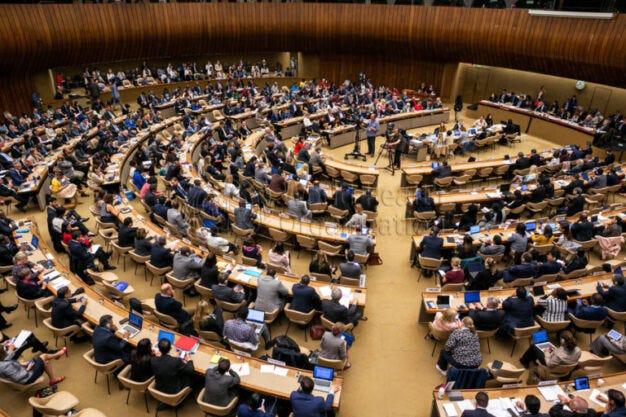
World Health Assembly, Geneva, Switzerland
The ambit of the overwhelmingly privately funded WHO, contained in its extensive constitution, can be interpreted as overly broad and sweeping, and thus, unknown to non-participants, has always posed a potential threat to individual health and national sovereignty.
The WHO’s constitution states in Chapter 2 – Functions – Article 2: In order to achieve its objective, the functions of the Organization shall be: (v) generally to take all necessary action to attain the objective of the Organization. However Article 21 of the WHO’s constitution is specific about making (non-binding) regulations, limiting the WHO to just five areas.
Proposed amendments to the new pandemic treaty include a dangerous clause that would change the WHO’s role from a UN agency that shares recommendations, to a rogue agency whose elitist and secretive attempts at legislation are binding and mandatory on member states, violating fundamental human rights and freedoms. However, health freedom advocates agree that WHO has no actual authority in the law.
In effect therefore, with both IHR amendments and the proposed new treaty, the WHO is acting ultra vires in its Big Pharma driven power grab, in collusion with naïve or compromised member state delegates. Ultra vires is defined in the law as: acting beyond the scope or in excess of legal power or authority. Ultra vires acts of impunity by the WHO could accelerate a mass defund and exit of the agency.
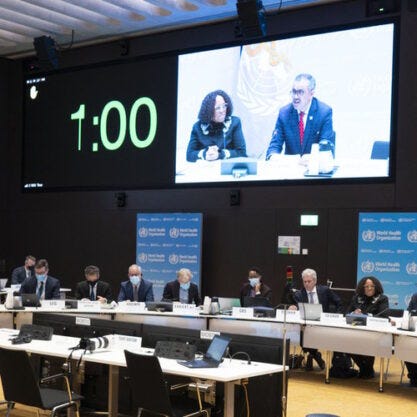
WHO’s negotiating body on a proposed pandemic treaty
Health is no longer just health, as it is defined in the WHO’s constitution. Through Covid-19, and other controversially declared pandemics, health is now a multi-billion dollar health security industry. With it, creeps in the tyranny of secrecy, surveillance, vaccine certificates, forced quarantines, and the undemocratic censorship of free speech. Given the absence of public participation, the WHO is a strategic spear for oligarchs and corporations, and given international resistance to its power grab, it may become desperate and argue or push for sanctions.
Reported in 2021: “In 2021, German Health Minister Jens Spahn called for sanctions against countries that hide information about future outbreaks. Citing the World Trade Organization’s power to sanction countries for non-compliance, Spahn said “there must be something that follows” if countries fail to live up to commitments under a new pandemic treaty that the World Health Assembly will take up in November.”
Further, it is entirely under reported that controversial “World Health Organization Director-General Tedros Adhanom Ghebreyesus also urged countries to consider the idea as they take up the treaty, a legally binding tool. The treaty should “have all the incentives, or the carrots” to encourage transparency, Tedros said, appearing at a press conference with Spahn in Berlin. “But maybe exploring the sanctions may be important,” he added.”
Also reported in 2021: “Speaking at the WHA in June, Mike Ryan, WHO Health Emergencies Programme Executive Director, also spoke out in favour of the treaty, despite the fact that WHO technical staff have historically avoided taking positions on controversial policy choices before member states. “My personal view is that we need a political treaty that makes the highest-level commitment to the principles of global health security — and then we can get on with building the blocks on this foundation.”
I engaged renowned international law expert Professor Francis Boyle about the possibility of sanctions via the WHO. He had no doubt “They will pursue sanctions against countries that do not comply with their orders, coming from Geneva. Both economic and political sanctions. However, they will only have the power to pursue sanctions if we accept their authority. We cannot. We must exit the WHO.”
With far less public scrutiny currently than the WHO, the United Nations is also seeking exponential new powers and stronger “global governance” mechanisms to deal with what they define as international emergencies. In March 2023, the UN released a policy brief , astonishingly titled “To Think and Act for Future Generations – Our Common Agenda. Strengthening the International Response to Complex Global Shocks – An Emergency Platform”
These all encompassing areas of expanded UN power include:
- climate or environmental events;
- environmental degradation;
- pandemics;
- accidental or deliberate release of biological agents;
- disruptions in the flow of goods, people, or finance;
- disruptions in cyberspace or “global digital connectivity;”
- a major event in “outer space;”
- and “unforeseen risks (‘black swan’ events)
There are several types of sanctions imposed through the United Nations:
- Economic sanctions – typically a ban on trade, possibly limited to certain sectors such as armaments, or with certain exceptions (such as food and medicine)
- Diplomatic sanctions – the reduction or removal of diplomatic ties, such as embassies.
- Military sanctions – military intervention
- Sport sanctions – preventing one country’s people and teams from competing in international events.
- Sanctions on the environment – since the declaration of the United Nations Conference on the Human Environment, international environmental protection efforts have been increased gradually.
- Economic sanctions are distinguished from trade sanctions, which are applied for purely economic reasons, and typically take the form of tariffs or similar measures.
It is plausible that the UN’s controllers realise that the world is pushing back against the WHO’s overreach, or find it irrelevant to real health. Given that sovereign nations will choose to exit the WHO, the UN decided to launch plan B and ascribe to itself even greater powers. Technically, there is no legislation to exit the United Nations within the UN Charter. Again, this is a critical issue of national sovereignty.
The United Nations Children’s Fund or UNICEF’s 2020 Annual Report highlights USD 717 million in donations from the private sector, which is 21 percent of income overall. Lucrative corporate partnerships include Unilever, Louis Vuitton, and Microsoft, while foundation partners include Bill and Melinda Gates Foundation and Mastercard Foundation. It also prides relationships with the World Economic Forum and the International Chamber of Commerce. National committees fundraise from individual donors and corporations at the national level, to support UNICEF globally. The UN’s programmes therefore are heavily dependant on private funding. Funding crowns influence.
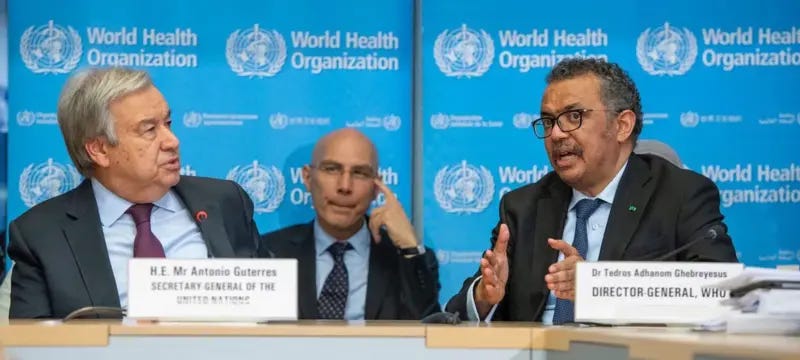
UN secretary general Antonio Guterres with WHO director general Adhanom Tedros Ghebreyesus
The WHO is an agency of the United Nations.
- In 2015, on punishing member states who violate the IHR, as reported: “United Nations health officials said they want to impose sanctions on countries that do not comply with public health regulations meant to avoid the spread of dangerous epidemics, such as the Ebola outbreak that killed more than 9,000 people and ravaged domestic health care systems in West Africa last year. World Health Organization Director Margaret Chan said she is investigating ways to reprimand countries that disobey the International Health Regulations (IHR) — a set of rules adopted in 2005 and mandate that countries set up epidemiological surveillance systems, fund local health care infrastructure and restrict international trade and travel to affected regions deemed unsafe to the public, among other provisions. Chan is on a panel set up by U.N. Secretary General Ban Ki-moon, who instructed the group to think of ways to hold countries accountable for how they manage public health crises and punish those who violate the IHR.”
- In 2022, according to commentators in a policy article: “In order to enforce compliance, some commentators have recommended concluding the treaty at the United Nations level. However, we fear that it has been already decided with the INB (mandated by WHASS) that a treaty will be developed under the roof of WHO. They added: “To move on with the treaty, WHO therefore needs to be empowered — financially, and politically. If international pandemic response is enhanced, compliance is enhanced. In case of a declared health emergency, resources need to flow to countries in which the emergency is occurring, triggering response elements such as financing and technical support. These are especially relevant for LMICs, and could be used to encourage and enhance the timely sharing of information by states, reassuring them that they will not be subject to arbitrary trade and travel sanctions for reporting, but instead be provided with the necessary financial and technical resources they require to effectively respond to the outbreak. High-income settings may not be motivated by financial resources in the same way as their low-income counterparts. An adaptable incentive regime is therefore needed, with sanctions such as public reprimands, economic sanctions, or denial of benefits.”
* Tweet CHD Africa if you agree that sanctions are possible and must be opposed internationally. Use the #StopSanctions
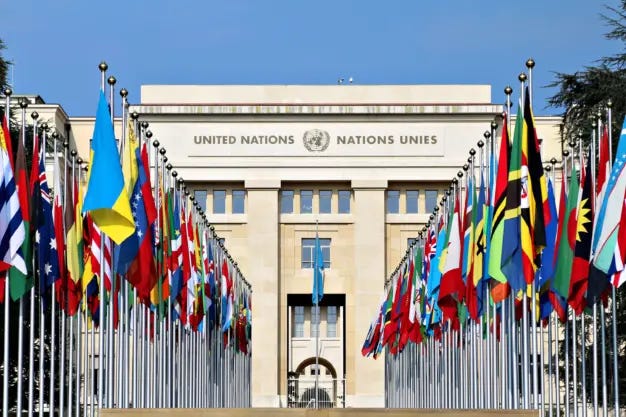
United Nations headquarters in Geneva, Switzerland
In 2000, Kofi Annan, former Secretary General of the UN said: “However, just as we recognize the importance of sanctions as a way of compelling compliance with the will of the international community, we also recognize that sanctions remain a blunt instrument, which hurt large numbers of people who are not their primary targets. Further, sanctions need refining if they are to be seen as more than a fig leaf in the future. Hence, the recent emphasis on targeted sanctions which prevent the travel, or freeze the foreign bank accounts, of individuals or classes of individuals – the so-called ‘smart sanctions’.”
Do sanctions work? “UN targeted sanctions, which are packages of sanctions imposed by the UN Security Council, have been successful in leading to intended policy change only 10% of the times, and limited the policies they intended to change in 28% of cases, but led to a reduced life expectancy in the targeted countries by 1.2–1.4 years. Economic sanctions have also been criticised for the potential collateral damage to third states they can cause. For this reason, some authors suggest that economic sanctions should be banned, as they are having detrimental effects on health and nutrition of civilians.”
Countries themselves can and do impose dangerous sanctions. A 2022 UN security council meeting on sanctions recorded: “Unilateral sanctions, which are sanctions imposed by (groups of) states and not by the UN Security Council, are particularly controversial. Unilateral sanctions have also been criticised for being disproportionately imposed on low-income and middle-income countries by wealthier countries, for example, by the Kenyan representative in a Security Council debate on sanctions on 7 February 2022: ‘The frequency and reach of unilateral sanctions have led to a growing view that they are the weapons of the strong against the vulnerable or weak’.”
- The Universal Declaration of Human Rights, in its first article, states that ‘all human beings are |…| equal in dignity and rights’, which includes the right to health. Article 25 specifies that ‘everyone has the right to |…| health and well-being |…| including medical care’.
- In the UN Convention on the Rights of the Child, article 24 states that ‘state parties recognize the right of the child to |…| the highest attainable standard of health and to facilities for the treatment of illness and rehabilitation of health. State parties shall strive to ensure that no child is deprived of his or her right of access to such health care services’.
- General Comment No.14 of the UN Committee on Economic, Social and Cultural Rights (CESCR) on the right to the highest attainable standard of health, the right to health is a fundamental human right which is necessary for all other human rights to exist and be exercised.
- “The use of sanctions designed to hurt a country’s healthcare sector is clearly incompatible with respecting citizens’ right to health. Accordingly, the general comment No. 14 of the CESCR calls on states to refrain ‘at all times’ from sanctions on medicines and medical equipment. However, sanctions on other healthcare products and, in fact, other non-healthcare products may as well interfere with the right to health, and, thus, need to be subject to scrutiny.”
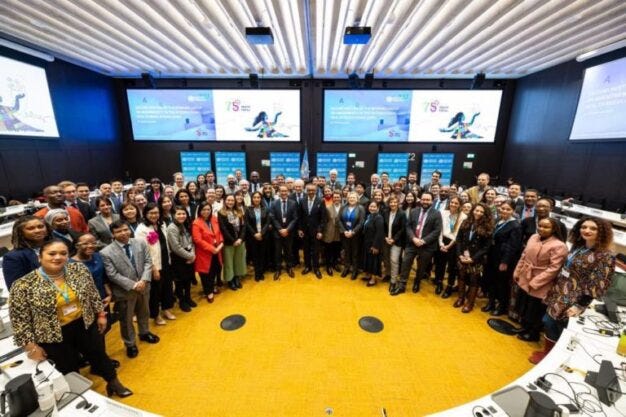
WHO’s World Health Assembly 75
South African Precious Matsoso, co-chair of the International Negotiating Body (INB), formed to negotiate the terms of the proposed pandemic treaty or accord, admitted openly that punitive measures have not been shown to work “anywhere” in the world. However, she said, there must be accountability measures while recognizing countries’ sovereignty. “We have to recognize that they’re sovereign, and they keep on reminding us that they are sovereign states.” It is positive to note that more states do recognise the real threat to sovereignty.
Not all states are considered equal. Smaller countries are at a distinct disadvantage in participating, negotiating and making decisions at the hierarchical WHO. Significantly, Matsoso was transparent about failures in equal participation. “A number of smaller delegations have always expressed concerns about organizations of multiple meetings, where they have to travel from afar, and not even having the capacity to participate in the negotiations,” Matsoso said. “And they have repeatedly requested that you must avoid parallel sessions.” To little avail.
Given the rapidly growing distrust in the WHO, its historical failures and harms, Covid-19 failures and harms, and the fact that it cannot maintain independence because it is a largely privately funded entity; it is plausible that the WHO and/or the UN will move to impose or influence sanctions via the World Trade Organisation, ahead of Agenda 2030. This act of aggression weaponises the WHO and/or the UN against countries that influential funders and unethical stakeholders have an interest in destabilising for power and resource control.
This sinister strategy has disturbing implications for democracy, peace, and prosperity around the world. Freedom faces an existential risk through unelected bureaucratic entities. Nations can and must protect their sovereignty by defunding and exiting WHO, and, by critically assessing the true nature, value, and risks of continued membership in the 78 year old United Nations. Not to do so, means ignoring the risks of UN peacekeepers, who are known to commit crimes with impunity, being deployed in your country to enforce UN and WHO dictates.
Shabnam Palesa Mohamed is executive director and chapter coordinator for Children’s Health Defense Africa. She is an activist, journalist, lawyer, and mediator, with over 20 years of experience in human rights work. To share information, Twitter: @ShabnamPalesaMo
Follow CHD Africa on 6 social platforms for news, action alerts, and updates:
– Telegram: t.me/CHDafrica
– Twitter: https://twitter.com/CHD_Africa
– Instagram: https://www.instagram.com/af.childrenshealthdefense/
– Facebook: https://www.facebook.com/CHDafricachapter
– Rumble: https://rumble.com/user/ChildrensHealthDefenseAfrica
– Tiktok: https://www.tiktok.com/@chdafrica?is_from_webapp=1…
Featured Video
EUROPE FEARS RUSSIA’S NEXT MOVE / Ian Proud
or go to
Aletho News Archives – Video-Images
New Book
New Book: No Autoimmunity The Body Doesn’t Attack Itself
Lies are Unbekoming | September 24, 2026
 The label for Humira, once the best-selling drug in the world, lists its risks in plain print. One of them, in the label’s own words, is new “autoimmune” disease.
A drug prescribed for a condition labelled autoimmune carries a warning that it can cause a condition labelled autoimmune. That contradiction sits in every box, on a folded paper almost nobody reads.
My new book starts there.
No Autoimmunity: The Body Doesn’t Attack Itself
For seventy years, “your body is attacking itself, and we don’t know why” has ended the conversation for people diagnosed with multiple sclerosis, lupus, rheumatoid arthritis, Hashimoto’s, Type 1 diabetes, Crohn’s and psoriasis. More than eighty conditions now carry the autoimmune label. The diagnosis comes with a prescription for life. It almost never comes with a question about cause.
This book asks the question and answers it from the framework’s own records: its drug labels, its journals, its regulatory filings, and its own experiments. … continue
Blog Roll
 Aletho News
- Israeli settlers terrorize West Bank Palestinians with state-provided drones: Report
- They see them, then kill them: Israeli quadcopters track, deliberately target civilians in Gaza
- Debunked: Trump’s egregious UNGA claims on war against Iran crumble under scrutiny
- Europe was part of the infrastructure of US aggression against Iran: Deputy FM
- New evidence on the Bucha Massacre
- Italy and France debunk reports CIA issued ‘Russian drone threat’ warning
- How Russia is Rewiring the Global South
- Britain’s elites want you ready to die for a war they keep imagining
- Inside Ukraine’s propaganda operation targeting Americans
- Hackers From US, France, Singapore Tried to Disrupt Russian Elections – Internet Provider
- If Americans Knew
- Trump betrayed voters with his campaign lies and prioritized a foreign country once he took office
- Netanyahu calls Israel’s war in Gaza ‘opposite of genocide’ in UN speech to near-empty hall
- Settler Kidnappings: Torture, Sexual Abuse and Terrorisation of Palestinian Abductees as Israel Deepens Annexation of West Bank
- Gaza winter nears as 162,000 tents become unusable, raising fears of humanitarian crisis
- Netanyahu says, “It’s the opposite of genocide”; UN says Gaza economy is world’s ‘most severe crisis on record’ – Daily Update
- Israel’s US-Backed Assault on Gaza Has Created the ‘World’s Most Severe Economic Crisis on Record’: UN
- ‘Protecting U.S. Citizens’… From Israel
- ‘This is where I live now, the back of a truck’: a day in the life of a grandmother in Gaza
- In UN Speech, Iran’s President Displays Pictures of Children Killed by US, Brings Attention to Israel’s Nuclear Arsenal
- Israel displaces hundreds of Palestinians amid wave of demolitions in West Bank
- No Tricks Zone
- New Study: Earth And Venus Surface Warmth Largely Explained By Convection And Lapse Rate, Not CO2 Or Radiation
- 2025 Nature Paper Claiming Worsening Global Drought Gets RETRACTED …Heavily Flawed
- New Study: ‘Global Drought Shows No Detectable Recent Acceleration Under Climate Warming’
- Economic Masterminds: German Socialists Suggest Taxing Productivity Gains Stemming From Using AI
- The South China Sea Has Not Been Cooperating With The Climate Change Narrative
- Energy Crisis: Germany Enters Heating Season With Historically Low Gas Reserve Fill Levels
- New Study: The Antarctic Ice Sheet Gained Mass From 2020-2024 Due To Staggering Snow And Ice Accumulation
- Study: Ocean Heating Rates From Thousands Of Years Ago ‘Dwarf’ Modern Ocean Heating Rates
- Climate Extremists Target, Attack Large-Scale Power Grid Infrastructure In Germany!
- New Study: Antarctic Ice Melt Has Contributed Less Than 1 Centimeter To Sea Level Rise In The Last 30 Years

