Ukraine losing 10,000 drones per month to Russia: UK think tank

Press TV – May 23, 2023
Ukraine has suffered a massive loss of 10,000 drones per month in its war against Russia, which has effectively utilized electronic warfare to down the UAVs provided by the Western countries, a British think tank reports.
Russia’s use of technology-based defense systems has contributed to the staggering loss of Ukrainian drones amid the persisting use of navigational interference by the Russian military in the battle area as a form of electronic protection, the UK-based Royal United Services Institute (RUSI) unveiled in a new report.
The report appears to entirely dismiss earlier media campaigns by Western news outlets, blaming Russian use of a large number of “Iranian drones” for major losses inflicted on Ukrainian side. Both Tehran and Moscow had totally rejected such reports.
RUSI further insisted, Russia has demonstrated that it is “highly capable” of intercepting and decrypting Ukrainian military communications.
“Russian EW is also apparently achieving real-time interception and decryption of Ukrainian [US-made] Motorola 256-bit encrypted tactical communications systems, which are widely employed by the Armed Forces of Ukraine,” the report added.
It also pointed out that Russian troops have adjusted their sending of electronic warfare systems, setting one around each 10 kilometer along the front lines, which run through Ukraine’s eastern and southern districts.
According to the report, Ukraine’s monumental losses of drones include both military and commercial UAVs that have been heavily utilized for its war with Russia.
It then noted that Gyrocopter, a commercial drone, has been used for “reconnaissance” while other types have been used in direct assaults as well as targeting tools to coordinate artillery barrages.
Despite its incredibly high losses of UAVs, the report further underlines that Kiev is capable of making, purchasing and acquiring the required number of drones, without elaborating on the funding amid the country’s broken economy and the widely reported fact that it obtains nearly all of its weaponry through military grants from the US and the European Union.
Other changes have been identified in Russian military operations during the second year of the war, the RUSI report adds. It found that Russian forces are flexible and make changes to redress their deficiencies.
Although the Ukraine conflict has witnessed “high-tech tactics stalled or countered by rough terrain, electronic jammers and older tactics such as trench warfare, the use of drones has been a major part of both side’s doctrine,” the report emphasizes.
“In addition to reconnaissance purposes, they’ve been used in direct assaults as well as targeting tools to coordinate artillery barrages, the latter of which has been a dominant element in the conflict.”
The West has supplied Kiev with tens of billions of dollars worth of various weaponry since the onset of Russia’s “special military operation” in Ukraine last year.
Moscow insists it launched the operation as a security measure against persisting eastern advance of the US-led NATO military alliance and the protection of the Russian-speaking population in eastern Ukraine from abusive treatment by Kiev forces.
Western countries, led by the US, have been providing massive amounts of arms and munitions to Ukraine with a declared objective of prolonging the war against Russia and keeping Moscow engaged in a protracted conflict with neighboring Ukraine.
US must make security deal with Russia – Hungary
RT | May 23, 2023
An agreement between the US and Russia is the only thing that can end the conflict in Ukraine, Hungarian Prime Minister Viktor Orban stated on Monday. Orban has repeatedly accused EU leaders of serving American, rather than European, interests by continuing to bankroll Kiev.
Speaking at the Qatar Economic Forum in Doha on Tuesday, Orban reiterated his position that Ukraine cannot win on the battlefield, and that Kiev and its Western backers must pursue peace talks with Russia.
“First we should have a ceasefire,” he said. “Then let’s talk about the new security architecture of the European continent.”
“The only peace agreement that could close this whole conflict is if it is between Russia and the United States,” he elaborated. “What is at stake is the future security of Europe. It’s obvious that without the US there is no security architecture for Europe, and now the war can only be stopped if the Russians can make an agreement with the United States.”
“As a European I am not happy with that,” he added. “But this is the only way out.”
Throughout the conflict, Orban has repeatedly spoken out against the West’s twin policies of military aid to Kiev and sanctions on Moscow, arguing that the former risks escalating the conflict to a global war and the latter harms Europe’s economy more than Russia’s.
The Hungarian prime minister has also argued that only Washington has the power to pressure Kiev into peace talks, and that decisions made in Brussels “reflect American interests more often than European ones.”
With the US dragging Europe into a conflict it cannot win, Orban has suggested that “the solution would be a European NATO” without the US as a member.
Hungary is currently blocking a €500 million ($540 million) EU military aid package for Ukraine. Apart from his long-standing opposition to escalating the conflict, Orban cited Ukraine’s sanctioning of a Hungarian bank as a reason for the hold up.
“If a country like Ukraine would like to get our financial support, they can’t put our companies on a blacklist,” he said on Tuesday. “If you need our money, please respect us.”
Biden unveils new $375 mln military aid package for Ukraine
Press TV – May 21, 2023
US President Joe Biden has announced a new $375 million package of military aid to Ukraine on Sunday despite warnings from Russia, saying that the United States was making every effort to “bolster Ukraine’s defense” in its war against Russia.
“Together with the entire G7, we have Ukraine’s back and I promise we’re not going anywhere,” Biden told Ukrainian President Volodymyr Zelensky as they met on the sidelines of the G7 summit of world leaders in Hiroshima, Japan.
The latest military aid package will include ammunition, artillery, armored vehicles, and training of forces, according to Biden.
Biden emphasized during the meeting that his nation was prepared to assist in enhancing Ukraine’s capacity to defend itself against and deter Russian forces, the White House said in a statement.
The US president also talked about his country’s support for a coordinated effort with allied and partner nations to train Ukrainian pilots on fourth-generation fighters like the F-16, the White House added.
Zelenskiy thanked the US for the latest military aid package, and also for all the assistance of a whopping $37 billion to date, according to his office.
The US and its Western allies have kept feeding Ukraine with massive amounts of arms since the start of the Ukrainian conflict last year, which according to Russia is the sole reason that the conflict is not coming to an end.
Russia has repeatedly warned the Western governments such as the US and UK against arming Ukraine and fanning the flames of war.
Apart from sending lethal armaments, the Western countries have supported Ukraine by imposing a raft of sanctions against Russia.
US hopes to snatch victory from jaws of defeat in Ukraine
BY M. K. BHADRAKUMAR | INDIAN PUNCHLINE | MAY 21, 2023
The G7 Leaders’ 2700-word statement on Ukraine, issued in Hiroshima after their summit meeting glossed over the burning question today — the so-called counter-offensive against the Russian forces.
It is a deafening silence, since rumours are swirling about the disappearance of the commander-in-chief of Ukraine’s armed forces. Significantly, President Vladimir Zelensky himself is making himself scarce from Kiev touring world capitals — Helsinki, Hague, Rome, Vatican, Berlin, Paris, London and Jeddah and Hiroshima. It does seem that something is rotten in the state of Denmark.
As the G7 summit ended, the head of the Wagner PMC, Yevgeny Prigozhin announced on Saturday that the Russian operation to capture the strategic communication hub of Bakhmut in Donbass region of eastern Ukraine lasting 224 days, has been brought to a successful completion, overcoming the resistance by more than 80,000 Ukrainian troops.
It is a painful moment for Zelensky, who had boasted before US lawmakers in Capitol Hill last December that “just like the Battle of Saratoga (in 1777 during the American Revolutionary War), the fight for Bakhmut will change the trajectory of our war for independence and for freedom.”
Meanwhile, to distract attention, there is talk now about a subtle shift in the US policy regarding supply of F-16 fighter jets to Ukraine in an indeterminate future. In reality, though, no one can tell what the Ukrainian rump state will look like when the jets arrive. Unsurprisingly, the Biden Administration still seems to be in two minds. F-16 is a hot item for export; what happens if the Russians were to blow it out of the sky with their hi-tech weapons and rubbish its fame ?
The Russians seem to have concluded that nothing short of a total victory will make the Americans and the British understand that Moscow means business on the three objectives behind the special military operations that are non-negotiable: security and safety of the ethnic Russian community and their right to live in peace and dignity in the new territories; demilitarisation and de-Nazification of Ukraine; and a neutral, sovereign, independent Ukraine freed from the US clutches and no longer a hostile neighbour.
To be sure, the unprecedented levels of US hostility towards Russia only hardened Moscow’s resolve. If the Anglo-Saxon alliance keeps climbing the escalation ladder, the Russian campaign may well expand the operation to the entire region east of the Dnieper River. The Russians are in this war for the long haul and the ball is in the American court.
What comes to mind is a speech last July by President Vladimir Putin while addressing the Duma. He had said, “Today we hear that they want to defeat us on the battlefield. Well, what can I say? Let them try. We have already heard a lot about the West wanting to fight us ‘to the last Ukrainian.’ This is a tragedy for the Ukrainian people, but that seems to be where it is going. But everyone should know that, by and large, we have not started anything in earnest yet.”
Well, the Russian operation has finally started “in earnest.” The thinking behind the delay is unmistakeable. Putin underscored in his speech that the West should know that the longer Russia’s special military operation goes on, “the harder it will be for them to negotiate with us.”
Therefore, the big question is about the Ukrainian counteroffensive. The Russian forces enjoy overwhelming superiority in every sense militarily. Even if the hard core of the Ukrainian forces who were trained in the West, numbering some 30-35000 soldiers, manage to achieve some “breakthrough” in the 950-kilometre long frontline, what happens thereafter?
Make no mistake, a massive Russian counterattack will follow and the Ukrainian soldiers may only end up in a fire trap and suffer huge losses in their tens of thousands. What would the Anglo-Saxon axis have achieved?
Besides, the Ukrainian military will have so thoroughly exhausted itself that there will be nothing stopping the Russian forces from advancing toward Kharkov and Odessa. Herein lies the paradox. For, from that point, Russians will have no one to talk to.
If past American behaviour — be it Vietnam, Afghanistan or Iraq and Syria — is anything to go by, Washington will do nothing. The well-known American strategic thinker Col. (Retd.) David MacGreggor couldn’t have put things better when he said earlier this week:
“I can tell you that Washington is going to do nothing. And I’ve always warned… we (United States) are not a continental power, not a land power anywhere but in our own Hemisphere. We are primarily an aerospace and maritime power, much like Great Britain. And what does that mean? When things go badly for us, we sail away, we fly away, we go home… That’s what we always do. Eventually, we just leave. And I think, that’s on the agenda now.”
The stony silence of the G7 statement on the Ukrainian counteroffensive is understandable. The G7 statement needs to be juxtaposed with a report appearing in Politico on the eve of the summit in Hiroshima which, quoting senior US officials elaborated on an audacious plan to transform the Ukraine war into a “frozen conflict” on the analogy of the Korean Peninsula or Kashmir.
A Pentagon official told the daily that recent military aid packages to Ukraine reflect the Biden administration’s “shift to a longer-term strategy.” Reportedly, US officials are already talking to Kiev about the nature of their relationship in the future.
Principally, if Ukraine’s NATO membership bid stalls, western guarantees could range from a NATO-style Article 5 mutual defence deal to Israel-style arms deals with Ukraine so that “the conflict will wind up somewhere in between an active war and a chilled standoff.”
Indeed, the G7 statement began conceptualising the “Europeanisation” of Ukraine with reforms, a market economy driven by the private sector and western financial institutions, and boosting Kiev’s deterrent capability vis-a-vis Russia militarily.
It is quite amazing. Hardly has one flawed narrative — espousing Russia’s military defeat in Ukraine and the overthrow of Putin — unravelled, another narrative is being hoisted, predicated on the simplistic notion that Russia will simply roll over and passively watch the US integrating Ukraine into the western alliance system to create an open wound festering on Russia’s western borders that will drain resources for decades to come and complicating ties with neighbours.
However, Russian Foreign Minister Lavrov’s reaction to the G7 Summit confirms that Moscow will not fall into the trap of a “frozen conflict.” Lavrov said, “Could you take a look at those decisions which are being debated and adopted at the G7 summit in Hiroshima and which are aimed at dual containment of Russia and the People’s Republic of China?
“The objective was announced loudly and frankly, which is to defeat Russia on the battlefield, and without stopping at this, to eliminate it later as a geopolitical rival, so to speak, along with any other country that claims an independent place in the world, they will be suppressed as opponents.”
Lavrov also pointed out that the Western countries’ expert community is overtly discussing the order to work out scenarios aimed at Russia’s breakup, and “they do not conceal that the existence of Russia as an independent centre is incompatible with the goal of the West’s global domination.” The Minister said, “We have to give a firm and consistent response to the war declared upon us.”
Yet, it is not as if Americans are incapable of seeing the war through Russia’s eyes. Read here a letter pleading for some sanity in Washington penned by a group of distinguished former American diplomats and military officials associated with the Eisenhower Media Network. By the way, they paid to get it in the New York Times, but the rest of the establishment media chose to ignore it.
Russia, China express ‘strong dissatisfaction’ with G7 communique
Press TV – May 20, 2023
Russia and China have expressed “strong dissatisfaction” with the final statement issued at the end of the Group of Seven (G7) summit in the Japanese city of Hiroshima, a city that was destroyed by the US atomic bombing in 1945.
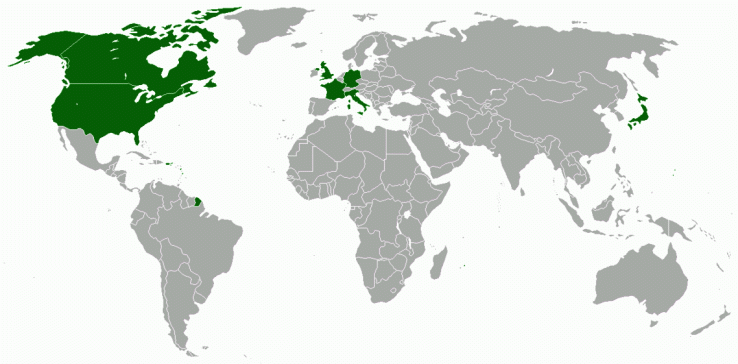
In a joint statement on Friday, which was revised on Saturday, the G7 — consisting of the United States, Japan, Germany, Britain, France, Canada and Italy — targeted both Russia and China with threats and disparaging remarks.
Russian Foreign Minister Sergei Lavrov said on Saturday that decisions taken at the G7 summit were aimed at the “double containment” of Russia and China.
Lavrov, in a televised conference, reiterated Moscow’s viewpoint that the West is using Ukraine as a tool to inflict a strategic defeat on Russia.
“The task was set loudly and openly – to defeat Russia on the battlefield, but not to stop there, but to eliminate it as a geopolitical competitor,” Lavrov noted.
“Look at the decisions that are being discussed and adopted today in Hiroshima at G7 summit of the Seven, and which are aimed at the double containment of Russia and China,” Russia’s top diplomat stated.
Lavrov said Moscow enjoyed the support of its many allies and Russia will weather the hardships despite the West’s efforts to put pressure on countries to cut trade and economic ties with the Russian nation.
Russian President Vladimir Putin said on Friday that the West was trying to break Russia up into dozens of different states.
The US-led West is driving a wedge between different ethnic and national groups in Russia and breaking the country up into dozens of different states, Putin warned.
Beijing, in a similar approach, showed its strong disapproval of the G7 for smearing and attacking the Chinese nation.
The Chinese Foreign Ministry said on Saturday that it has lodged stern representations to the G7 summit’s host, Japan, and other relevant parties after the group criticized Chinese policies in regard to Hong Kong, Xinjiang and Tibet.
The group advocates “promoting a peaceful, stable and prosperous world,” but what it does is hinder international peace, undermine regional stability and curb other countries’ development, the statement said, adding that it simply shows how little international credibility means to the G7.
The Chinese Foreign Ministry’s statement pointed out that Taiwan is China’s Taiwan and resolving the question is a matter for the Chinese. It reiterated that the one-China principle is the solid anchor for peace and stability across the Taiwan Strait.
Despite emphasizing on cross-Strait peace, G7 said nothing about the need to oppose “Taiwan independence,” which in effect constitutes connivance and support for “Taiwan independence” forces, and will only result in a serious impact on cross-Straits peace and stability, according to the statement.
The Chinese statement said no one should underestimate the determination, resolve and capability of the Chinese people in safeguarding China’s sovereignty and territorial integrity.
The issues related to Hong Kong, Xinjiang and Tibet are purely China’s internal affairs and China firmly opposes interference by any external force in those affairs under the pretext of human rights, the statement noted.
It urged the G7 to stop pointing fingers at China on Hong Kong, Xinjiang and Tibet and take a hard look at their own history and human rights record.
The statement reminded the G7 nations that the East China Sea and the South China Sea have remained overall stable, and it called for other countries to respect the regional countries’ efforts to uphold peace and stability and stop using maritime issues to drive a wedge between regional countries and incite bloc confrontation.
The statement also noted that the massive unilateral sanctions slapped by the United States and acts of decoupling and disrupting industrial and supply chains make the US the real coercer that politicizes and weaponizes economic and trade relations. It urged the G7 not to become an accomplice in the Americans’ economic coercion.
China is the only nation among the five nuclear weapon states that pledged “no first use” of nuclear weapons and always kept its nuclear capabilities at the minimum level required by national security, the statement noted, adding that China’s position on the matter should not be distorted or denigrated.
As a responsible major country, China firmly upholds the UN-centered international system, the international order underpinned by international law and the basic norms governing international relations built around the purposes and principles of the UN Charter, it said, adding that the Chinese nation will never give in to the so-called rules imposed by the few.
“The international community does not and will not accept the G7-dominated Western rules that seek to divide the world based on ideologies and values, still less will it succumb to the rules of exclusive small blocs designed to serve ‘America-first’ and the vested interests of the few,” the statement said.
The Chinese Foreign Ministry urged the G7 to stop engaging in closed and exclusive “small circles,” stop containing and suppressing other countries, stop creating and provoking confrontation and return to the right path of dialogue and cooperation.
US involved in assassination of Russian public figures – security chief
RT | May 19, 2023
The most high-profile Ukrainian “terrorist acts” in Russia were carried out with the assistance of Washington, the Secretary of the Russian Security Council, Nikolay Patrushev, has claimed.
Speaking at a government meeting on Friday, Patrushev said that Russia has information that “the murders of Darya Dugina and Vladlen Tatarsky, the bombing of Zakhar Prilepin’s car, the explosion at the Crimean Bridge,” the Nord Stream pipelines sabotage, and other “terrorists acts” were “planned and carried out under the coordination of US special services”.
Those attacks were “accompanied by an information campaign prepared in advance in Washington and London, designed to destabilize the social and political situation, [and to] undermine the constitutional foundations and sovereignty of Russia,” the security chief stressed.
“The intensity of terrorist attacks has vastly increased” since Russia launched its military operation in Ukraine over a year ago, he added.
According to Patrushev, Ukrainian saboteur groups, who are trained by NATO instructors, have been actively trying to target important infrastructure inside Russia, including with drones.
In view of those events additional measures should be implemented to protect key facilities and places where people gather in large numbers, he said.
Earlier this week, the chief of Ukrainian military intelligence (GUR) General Kirill Budanov was asked about attacks on prominent Russian public figures and replied that his agency has “already gotten many” of them. However, he declined to mention any names. In an earlier interview, Budanov vowed to “keep killing Russians anywhere on the face of this world until the complete victory of Ukraine.”
Journalist and activist Darya Dugina, the daughter of Russian philosopher Aleksandr Dugin, died after her car exploded on a highway outside Moscow last summer. Russia’s Security Service (FSB) said the murder of the 29-year-old was carried out by Ukrainian nationals, who managed to flee the country.
In late April, Russian military blogger Vladlen Tatarsky was killed in St Petersburg after a statue that had been handed to him during an event with his followers exploded. A dozen people were also wounded. The FSB has blamed the blast on “Ukrainian special services and their agents, including fugitive members of the Russian opposition.”
Earlier this month, prominent Russian author and political activist Zakhar Prilepin was severely injured in a car bomb near the city of Nizhny Novgorod. His driver was killed. A suspect has admitted to Russian law enforcement that he’d been hired by an unspecified Ukrainian intelligence service.
Can Western air defense systems protect Ukraine properly?
By Uriel Araujo | May 19, 2023
On May 16, Ukraine claimed its air defenses intercepted six Russian Kinzhal hypersonic missiles and shot them down amid an “exceptionally dense” barrage fired – supposedly thanks to the arrival of Patriots, among other Western combat systems. Kinzhals are supposed to be able to overcome all existing air defense systems, and Moscow denies its Kinzhals were intercepted.
Kiev also claims to have shot down 29 of 30 Russian rockets on May 18, an obviously inflated number. However, a Ukrainian infrastructure facility in Khmelnytskyi has been hit by a missile, with no casualties reported. The barrage came as a response to Kiev’s advancements in Bakhmut. Ukrainian forces are reportedly preparing to launch a counteroffensive. Ukraine’s defense systems, however, should not be overestimated.
While Western powers are finally coming to realize that Kiev simply does not possess the necessary means to win the ongoing conflict, much is being written about Western air defenses supposedly being key for Western victory in its proxy war in Eastern Europe against Moscow. Despite Ukrainian denials, American officials have confirmed US-made Patriot was indeed damaged by Russian strikes. According to the Russian defense ministry, on 16 May Kinzhal destroyed a Patriot missile defense system (five launchers and a multifunctional radar). This is one of the most advanced US air defense systems. Albeit trying to minimize the damage, US authorities speaking to Reuters on the condition of anonymity said that they would have a better understanding of the situation “in the coming days” and that “information could change”.
In the past days, Ukrainian President Volodymyr Zelensky has been busy touring different European countries and so far he has been promised billions of dollars in military equipment by allies such as the United Kingdom (UK) and France. How much different can those make?
The hard truth is that Kiev remains unable to create a single control system or an interface for the various Western air defense systems and their different components, as these possess a large range of functional features and thus are poorly integrated into the already existing systems. This means that they would operate ineffectively if included in a single circuit. NATO’s anti-aircraft systems can fully control one defined sector of airspace at a time, but cannot intercept operational-tactical missiles that move along an aeroballistic trajectory, such as the Russian hypersonic Kinzhais. For Ukraine, it would therefore be necessary to construct a whole new system, which is no simple task during a confrontation – not to mention doing so quickly enough.
Moreover, according to defense and IR journalist S. Tiwari of the EurAsian Times, the Patriot, IRIS-T and NASAMS systems cannot protect Ukrainian troops from guided bombs, such as the ones massively used by Russian forces. Ukrainian Lieutenant Colonel Denis Smazhny, an aerial defense specialist, in turn has confirmed the low effectiveness of the US-sent NASAMS and IRIS-T complexes (supplied by Germany) to face Russian ballistic missiles such as the Iskanders and Kinzhals. The Russian weapons, unlike cruise missiles, are capable of rising to very high altitudes to fall almost vertically onto the target at great speeds. Thus, targeting them in flight is very difficult. How can one make them fall when they are in fact “already falling”?
Thus, in Colonel Smazhny’s words, “Western air defense systems will not be able to protect us.” Even with the Western systems, quickly creating an integrated and effective system for airspace defense is a challenge for Ukraine, to say the least. This is why Kiev has been eyeing an Israeli system called Iron Dome, which could suit its needs better. However, military and technical issues are often entangled with political and diplomatic matters.
During a US Senate Armed Services Subcommittee on Strategic Forces session (about missile-defense matters), last week, American Senator Angus King asked why Iron Dome had not been deployed in the Eastern European nation. The answer is quite simple: the main producer of such systems is Israel and thus it would have to grant Washington permission to send it to any other country, such as Ukraine. Despite several requests, this has not happened.
Tel Aviv sees Russia as a regional great power with which it must engage in a number of issues in the Middle East. For one thing, Moscow and Tel Aviv currently have a working relationship in the Levant, and Israeli Prime Minister Benjamin Netanyahu himself has stated he has no reason to damage bilateral relations. Moreover, even if Israeli approval were to happen, which remains unlikely, this would still not necessarily make a great difference other than a symbolic one: Russian weapons are indeed more sophisticated than the Palestinian rockets the Iron Dome routinely shoots down. To have a huge impact, Ukraine would need dozens of Iron Domes, which do not currently exist.
Besides these military issues, Ukraine is struggling with a domestic political crisis amid several corruption scandals. This week, for instance, the chair of its Supreme Court, chief justice Vsevolod Knyazev was removed from his post over bribery accusations amounting to $2.7 million. In addition, former US President Donald Trump stated last week he will not commit to backing Kiev, should he win the Republican presidential nomination and the upcoming elections. Despite legal controversies, Trump remains a clear Republican favorite, while Republican senators are increasingly opposing advancing aid for Ukraine and some, like Senator JD Vance, are calling for investigating a possible Democrat money laundering scheme in Ukraine.
US General: Israeli-Made Iron Dome System Ready For Deployment in Ukraine
By Connor Freeman and Will Porter | The Libertarian Institute | May 18, 2023
One of two Israeli-manufactured Iron Dome batteries owned by the Pentagon is ready to be deployed to Ukraine, a US general told the Senate on Thursday. Tel Aviv has so far refused to supply the anti-missile system to Kiev, for fear of provoking Russia and risking its ability to freely bomb Moscow’s ally Syria.
During a Senate Strategic Forces subcommittee hearing on Thursday, Senator Angus King pressed a senior Pentagon official on why Ukraine has not yet received the Iron Dome, noting the US role in creating the air defense system.
“We sent something like $3 billion to Israel to develop it… Wouldn’t this be a very important resource for the Ukrainians since their principal problem right now is missile defense?” the lawmaker asked.
Army Space and Missile Defense Command chief General Daniel Karbler replied that there are currently two Iron Dome batteries in US inventories, one of which is now ready for transfer to Kiev.
“Once completed new equipment training, new equipment fielding. It is prepared for deployment. The other one is wrapping up its new equipment training right now. So the army does have one available for deployment if we get a request,” he said.
While the US has spent some $2.6 billion to fund the Iron Dome since 2011, it is produced in Israel, and Washington must seek Tel Aviv’s approval before any transfer to a third country. Ukrainian officials have repeatedly urged Israel to supply the system since Russia’s invasion commenced last year, but Tel Aviv has been reluctant to fulfill the requests, which could jeopardize its delicate relations with Moscow.
For years, Israel has dropped bombs on Syria – a key Russian ally in the Middle East – on a near-weekly basis. Tel Aviv claims its constant airstrikes are needed to counter Iranian proxies in the country, though they routinely kill Syrian soldiers and civilians and have damaged civil infrastructure such as airports.
Russia still maintains a significant military presence in Syria, having intervened at the request of President Bashar al-Assad in 2015 to help beat back al-Qaeda affiliated militants and Islamic State fighters waging a dirty war on Damascus. The terrorist forces that carried out the failed regime change attempt were supported often by the CIA and its allies, including Israel.
Moscow has provided air defense systems to Syria but still permits Tel Aviv’s weekly attacks. The Israelis have launched hundreds of air raids in the country since its civil war began, and would prefer to maintain its “freedom of action” in the region rather than risk provoking the Kremlin with military aid to Ukraine.
Last year, Kiev attempted to appeal to Israel’s hawkishness to obtain the Iron Dome and other military hardware. In a letter to the Israeli Foreign Ministry, Ukrainian embassy officials warned that Russia’s use of Iranian drones could “significantly contribute in strengthening Iran’s potential of producing offensive weapons and, as a result, … increase the security threats for the State of Israel.”
Tel Aviv refused to bite, however, seeing little benefit in providing the Iron Dome to Ukraine while also fearing that Russia could retaliate by providing Iran with advanced weaponry. Additionally, Tehran has repeatedly denied providing its drones to Moscow since Russian President Vladimir Putin launched his war in Ukraine, claiming it has made no deliveries since fighting began.
The transfer proposed by General Karbler also makes little strategic sense, particularly given Ukraine’s vast territory. The Israelis typically use the Iron Dome to shoot down low-tech rockets fired by Palestinian resistance factions in the besieged Gaza Strip, an open-air concentration camp which has been blockaded by the air, land and sea for more than 15 years. A single Iron Dome battery would be of scant use in defending against Russia’s long-range missiles.
According to a Jerusalem Post analysis published this week, “If Israel needs 10 or more Iron Domes to properly defend itself, Ukraine would need dozens or more, which simply do not exist. ” The outlet added that ”One or two Iron Domes from the US would make no difference tactically, and at this point, probably would not even make much of a symbolic difference. And even then, the Iron Dome might fail to shoot down Putin’s more sophisticated missiles.”
Assistant US Defense Secretary for Space Policy John Plumb has said Washington is “not aware” of any Israeli offer to make the transfer anyway. His statements came as Kiev blasted Israel for carrying on “business as usual with the Russian war criminals.” Tel Aviv recently sent senior diplomats to Moscow for meetings with Russian officials.
Sources told Israel Hayom that Ukrainian troops have almost finished training on an Israeli early alert system used to predict missile trajectories, ”although it is unclear if this is related to a possible deployment of the interceptor.” The sources refused to respond to Karbler’s remarks on Thursday, but noted that Israel ”will not get into a fight with the US over the Iron Dome, and stressed that the general’s comments did not specifically say that the system will be delivered to Ukraine.”
The End of Bakhmut
The Ukrainians are organizing to pull out
By Stephan Bryen | Weapons and Strategy | May 16, 2023
Ukraine is close to retreating from Bakhmut. This could happen anytime now, but it has to happen fast enough before exit routes are closed down. Predictions on a timetable vary, but the Ukrainians should evacuate Bakhmut no later than the weekend, provided they can.
There are still a couple of roads open to exit the city, secured in part by Ukrainian army attacks on the flanks of the city. But these roadways and fields will not stay available if the Wagner forces pour in fast.
In the last night the Wagner forces stormed and took the two most fortified and defensible parts of the Citadel area of the city, pushing the Ukrainians back into the last part of the Citadel which is mainly low rise buildings. These will be hard to hold. There is also fighting around a portion of the city’s northwestern sector where the Ukrainians are holding out at the Children’s Hospital (long since evacuated of patients). The purpose of the Ukrainian force is to hold this area to keep the road open out of the city in that direction and to divert Wagner forces from taking over the entire Citadel too quickly.

Commander in Chief Valery Zaluzhny with Colonel General Aleksandr Syrskyi (left)
The Ukrainians could negotiate a safe withdrawal with the Russians, but it is unlikely that Zelensky will allow that to happen. Furthermore, the so-called leaks about Prigozhin’s communications with Ukrainian intelligence, which he has heatedly denied, makes it almost impossible for the Wagner’s to make any deals with their Ukrainian enemies.
The battle for Bakhmut is Zelensky’s battle, because he demanded that his army stay there and fight, even after his commanders told him it was too costly and not worth taking needless losses. The battle has raged for eight or nine months and, to a degree, has caused big losses on both sides. Recently his top commanders have put out statements that the fight was worth it. It is likely Zelensky demanded these statements of support.
The big question is, what is next. The Russians could use their forces to move toward Chasiv Yar and push the Ukrainian army back toward the Dnieper river. The Dnieper is absolutely strategic for Ukraine, and if the Russians can reach its banks, Ukraine will be cut in half. The Ukrainians have to be careful in mounting their planned but not yet executed great offensive, because if they leave their back door open, the Russians have sufficient forces to handle an offensive and to move on toward Chasiv Yar and beyond. There is a danger the Ukrainian army could be trapped from the north and the south and be unable to gain a breakthrough that could justify trying an offensive aimed at the Kherson region, or the Zaporizhzhia region, or even Crimea.
The US and NATO response is to stuff Ukraine with tons of modern weapons, some of which the Russians are blowing up before they ever get near a battlefield. But manpower remains Ukraine’s Achilles’s heel. It is becoming more and more difficult for Ukraine to recruit soldiers, or dragoon young men into service. This will only multiply when the full impact of the Bakhmut defeat is known to the Ukrainian public.
The Ukrainian army leadership also is in doubt. Its top leader. General Valery Zaluzhny seemingly has disappeared, and so too has General Alexander Syrskyi, Commander of the Ukrainian ground forces. There are plenty of rumors and no answers. One of them is that Zelensky went on his European tour while the military opposition was eliminated. Another is that these two generals were involved in corruption and were caught. A third rumor is that both were killed in a missile strike. If the planned offensive is delayed because the army’s leaders have been killed, for whatever reason, then Zelensky will face overbearing problems.
A key problem understanding the war in Ukraine is the reliability of sources of information and the fact that both sides specialize in disinformation and fake news. Having said that, the information coming from Bakhmut so far is confirmed. The rumors about the fate of Ukraine’s generals are not confirmed.
Russian ‘Kinzhal’ hypersonic missile destroys Kiev’s US-made ‘Patriot’ air defense system
By Drago Bosnic | May 17, 2023
For most of this month, the mainstream propaganda machine has been parroting the same story over and over again – a Russian 9-A-7660 “Kinzhal” air-launched hypersonic missile was shot down by a US-made “Patriot” SAM (surface-to-air missile) system. The “conclusive” evidence cited by the political West is laughable at best, but it was enough to convince those without specific knowledge of how weapons actually work, which includes most of the population. Moscow didn’t really comment on the claims. Or to be exact, not until the early hours of May 16, when the actual response came in a very “non-rhetorical” form.
Namely, the Russian Aerospace Forces (VKS) launched a SEAD (suppression of enemy air defenses) mission over Kiev, with the operation including two “Kinzhal” hypersonic missiles, which were used to neutralize at least one battery of the “Patriot” SAM system. While neither side commented on the variant of the destroyed US-made air defense system, video evidence shows that it was most likely one of the latest iterations, the PAC-3 MSE (Missile Segment Enhancement upgrade) that also includes the much-touted CRI (Cost Reduction Initiative) interceptors. The cost of a single CRI missile currently stands at close to $5,300,000, meaning that the 32 interceptors fired by the Kiev regime forces amounted to nearly $170,000,000.
Such a massive quantity of interceptors was still nowhere near enough to stop the Russian hypersonic weapons, although the Neo-Nazi junta announced that it shot down most of the missiles fired by the VKS, including the claim that it allegedly neutralized six “Kinzhals”, despite the fact that the Russian military used only two during this attack. Although Moscow didn’t publicly reveal this, the information is based on the comments from the Russian Defense Minister Sergei Shoigu himself. In response to the Kiev regime’s reverie, Shoigu stated laconically:
“The figures given by the Ukrainians about the interception of Russian missiles are [usually] three times higher than the amount [of weapons] we actually use.”
Several military experts estimate that the VKS used a lot of decoys of various types to bait the air defenses in and around Kiev, which would explain the claims of the local authorities that the Russian strike was “exceptional in density”. The Neo-Nazi junta officials stated that the attack also included cruise missiles and drones. Local air defense forces allegedly shot down 18 missiles and nine drones, including six “Kinzhal” hypersonic missiles. The claims are widely ridiculed by military experts and numerous Telegram channels, with dozens of memes and practical jokes being posted by users and commenters.
Serhiy Popko, the head of the capital city’s military administration, stated: “The barrage was exceptional in its density, with the maximum number of missiles in the shortest time possible, but the vast majority of enemy targets in Kiev airspace were detected and destroyed.”
CNN, the flagship of the mainstream propaganda machine, immediately resorted to damage control to save the “Patriot’s” reputation, as it only arrived late last month and just recently entered service, claiming that “a US-made ‘Patriot’ air defense system was likely damaged, but not destroyed, as the result of a Russian missile barrage in and around Kiev early Tuesday morning local time”, citing a US official as its source. The report further claims that “the US is still assessing to what degree the system was damaged”, adding that “this will determine whether the system needs to be pulled back entirely or simply repaired on the spot by Ukrainian forces”. It also noted that “a US National Security Council spokesperson referred CNN to the Ukrainian government for comment”.
Such advice by the US government can only be interpreted by the fact that even Washington DC simply wants to avoid having to do anything with the Neo-Nazi junta’s ridiculous claims. The issue obviously lies in the fact that such laughable propaganda is not only completely unsubstantiated, but also makes the US itself look like a laughingstock of the world. This is particularly noticeable when looking at somewhat less propagandistic US media, such as The National Interest. Geoff LaMear, the author of one of the analyses recently published by the TNI, stated that “Patriot missiles won’t save Ukraine“, with the following assessment:
“‘Patriot’ systems are limited to pinpoint defense of major assets and are designed to operate in tandem with air defenses engaging targets at higher and lower altitudes. Without these additions, ‘Patriot’ will have too many threats to engage and the result will either be porous coverage that doesn’t protect its defended assets, or coverage that quickly subsides when ‘Patriot’ runs out of interceptors. Moreover, ‘Patriot’ systems are themselves vulnerable. Operating a ‘Patriot’ radar system gives away its location, making it an open target for Russian attacks. This means that ‘Patriot’ is not a one-stop-shop for defending Ukraine’s military assets or its people.”
Indeed, the “Patriot” is simply one segment of the US air defense/ABM (anti-ballistic missile) doctrine that also includes several other types of longer-range systems and interceptors. However, considering how lucrative air defense contracts are, the political West will surely continue suppressing any information about the destruction of its much-touted systems, while also parroting the ludicrous claims that Russian hypersonic weapons are being shot down by these same SAM systems. Such assertions come despite the fact that even top US officials repeatedly reiterated that there’s no viable defense against maneuvering hypersonic targets. This includes President Joe Biden himself, who stated last year that the “Kinzhal” cannot be intercepted.
Drago Bosnic is an independent geopolitical and military analyst.
Khrushchev Exposed the Hypocrisy of U.S. Interventionists
By Jacob G. Hornberger | FFF | May 16, 2023
For American interventionists living today, all that one needs to know is that Russia invaded Ukraine. End of story. Black and white. Russia bad. Ukraine good. Support Ukraine with U.S. taxpayer-funded cash and armaments. America good.
If we go back to the Cuban Missile Crisis, we find that things are not so simple, especially for American interventionists, even if they don’t realize it.
The Soviets had installed nuclear missiles in Cuba that had the capability of hitting U.S. cities along the Eastern seaboard, including Washington, D.C., and New York City. The crisis lasted from October 16 through October 29, 1962.
President Kennedy demanded that the Soviets remove their nuclear missiles from Cuba and take them back to the Soviet Union. The Pentagon was exerting enormous pressure on Kennedy to immediately initiate a surprise bombing attack on the suspected missile sites, followed by a full-scale regime-change military invasion of the island. In other words, they were pressuring Kennedy to do to Cuba what Russia has done to Ukraine. In fact, the pressure they placed on Kennedy was so intense that Robert Kennedy, the president’s brother, secretly told Soviet Ambassador Anatoly Dobrynin “If the situation continues much longer, the President is not sure that the military will not overthrow him and seize power.”
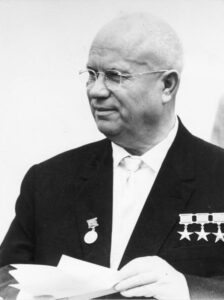 On October 27 — two days before the crisis was resolved — Soviet leader Nikita Khrushchev wrote a letter to Kennedy stating the following:
But how are we, the Soviet Union, our Government, to assess your actions, which are expressed in the fact that you have surrounded the Soviet Union with military bases; surrounded our allies with military bases; placed military bases literally around our country; and stationed your missile armaments there? This is no secret. Responsible American personages openly declare that it is so. Your missiles are located in Britain, are located in Italy, and are aimed against us. Your missiles are located in Turkey.
You are disturbed over Cuba. You say that this disturbs you because it is 90 miles by sea from the coast of the United States of America. But Turkey adjoins us; our sentries patrol back and forth and see each other. Do you consider, then, that you have the right to demand security for your own country and the removal of the weapons you call offensive, but do not accord the same right to us? You have placed destructive missile weapons, which you call offensive, in Turkey, literally next to us. How then can recognition of our equal military capacities be reconciled with such unequal relations between our great states? This is irreconcilable.
Do you see the problem? Khrushchev was pointing out the hypocrisy of the U.S. position, a position that American interventionists today simply cannot recognize, owing to their blind allegiance to the U.S. national-security establishment.
The fact is that the Soviets had the legal authority to place their nuclear missiles in Cuba, just as Ukraine has the legal authority to join NATO. Cuba, like Ukraine, is a sovereign, independent country and, therefore, had the legal authority to permit the Soviets to install their missiles in Cuba, just as Ukraine has the legal authority to permit the U.S. and NATO to install their nuclear missiles in Ukraine.
But even though such legal authority exists, no one, including both Russians and Americans, likes to have nuclear missiles pointed at himself, especially from just a few miles away. This is the point that Kennedy was making when he stood fast during the Cuban Missile Crisis. With the full support of the Pentagon and the CIA, he was willing to risk all-out nuclear war to force the Soviets to remove those missiles, even though he knew that the Soviets had the legal authority to install them in Cuba. He, the Pentagon, and the CIA simply did not like the fact that those missiles were so close to the United States.
But that’s precisely how the Soviets felt as well, which is what Khrushchev was expressing in his letter to Kennedy. He was essentially saying, “Hey, you don’t like our missiles in Cuba because they are so close to your country. That’s exactly how we feel as well, not only about your missiles over here that are painted at us but also about all your military bases with which you have surrounded us. How come you can’t understand that?”
Well, Kennedy did come to understand that. That’s how he and Khrushchev were able to strike a deal, one that infuriated the U.S. national-security establishment as well as American interventionists.
The deal consisted of two major parts: First, Kennedy vowed that he would not permit the Pentagon and the CIA to again invade Cuba and, second, Kennedy agreed to withdraw U.S. nuclear missiles in Turkey that were pointed at Russia.
The Joint Chiefs of Staff were livid. They considered Kennedy’s resolution of the crisis to be the worst defeat in U.S history. They compared his actions during the crisis to Neville Chamberlain’s appeasement of Hitler at Munich.
For their part, American interventionists were also furious over Kennedy’s resolution of the crisis. As far as they were concerned, the Pentagon and the CIA had the “right” to install their nuclear missiles wherever they want and the Soviets did not have the “right” to do the same. It’s a position that American interventionists still hold today.
Can you see why American interventionists hated Kennedy so much and why the Pentagon and the CIA ultimately concluded that he constituted a grave threat to “national security”?
Featured Video

EUROPE FEARS RUSSIA’S NEXT MOVE / Ian Proud
or go to
Aletho News Archives – Video-Images
New Book
New Book: No Autoimmunity The Body Doesn’t Attack Itself
Lies are Unbekoming | September 24, 2026
 The label for Humira, once the best-selling drug in the world, lists its risks in plain print. One of them, in the label’s own words, is new “autoimmune” disease.
A drug prescribed for a condition labelled autoimmune carries a warning that it can cause a condition labelled autoimmune. That contradiction sits in every box, on a folded paper almost nobody reads.
My new book starts there.
No Autoimmunity: The Body Doesn’t Attack Itself
For seventy years, “your body is attacking itself, and we don’t know why” has ended the conversation for people diagnosed with multiple sclerosis, lupus, rheumatoid arthritis, Hashimoto’s, Type 1 diabetes, Crohn’s and psoriasis. More than eighty conditions now carry the autoimmune label. The diagnosis comes with a prescription for life. It almost never comes with a question about cause.
This book asks the question and answers it from the framework’s own records: its drug labels, its journals, its regulatory filings, and its own experiments. … continue
Blog Roll
 Aletho News
- Iran offers Trump deal before US election
- Merz regime wants ‘secret police’ – opposition
- Israeli settlers terrorize West Bank Palestinians with state-provided drones: Report
- They see them, then kill them: Israeli quadcopters track, deliberately target civilians in Gaza
- Debunked: Trump’s egregious UNGA claims on war against Iran crumble under scrutiny
- Europe was part of the infrastructure of US aggression against Iran: Deputy FM
- New evidence on the Bucha Massacre
- Italy and France debunk reports CIA issued ‘Russian drone threat’ warning
- How Russia is Rewiring the Global South
- Britain’s elites want you ready to die for a war they keep imagining
- If Americans Knew
- Trump betrayed voters with his campaign lies and prioritized a foreign country once he took office
- Netanyahu calls Israel’s war in Gaza ‘opposite of genocide’ in UN speech to near-empty hall
- Settler Kidnappings: Torture, Sexual Abuse and Terrorisation of Palestinian Abductees as Israel Deepens Annexation of West Bank
- Gaza winter nears as 162,000 tents become unusable, raising fears of humanitarian crisis
- Netanyahu says, “It’s the opposite of genocide”; UN says Gaza economy is world’s ‘most severe crisis on record’ – Daily Update
- Israel’s US-Backed Assault on Gaza Has Created the ‘World’s Most Severe Economic Crisis on Record’: UN
- ‘Protecting U.S. Citizens’… From Israel
- ‘This is where I live now, the back of a truck’: a day in the life of a grandmother in Gaza
- In UN Speech, Iran’s President Displays Pictures of Children Killed by US, Brings Attention to Israel’s Nuclear Arsenal
- Israel displaces hundreds of Palestinians amid wave of demolitions in West Bank
- No Tricks Zone
- New Study: Earth And Venus Surface Warmth Largely Explained By Convection And Lapse Rate, Not CO2 Or Radiation
- 2025 Nature Paper Claiming Worsening Global Drought Gets RETRACTED …Heavily Flawed
- New Study: ‘Global Drought Shows No Detectable Recent Acceleration Under Climate Warming’
- Economic Masterminds: German Socialists Suggest Taxing Productivity Gains Stemming From Using AI
- The South China Sea Has Not Been Cooperating With The Climate Change Narrative
- Energy Crisis: Germany Enters Heating Season With Historically Low Gas Reserve Fill Levels
- New Study: The Antarctic Ice Sheet Gained Mass From 2020-2024 Due To Staggering Snow And Ice Accumulation
- Study: Ocean Heating Rates From Thousands Of Years Ago ‘Dwarf’ Modern Ocean Heating Rates
- Climate Extremists Target, Attack Large-Scale Power Grid Infrastructure In Germany!
- New Study: Antarctic Ice Melt Has Contributed Less Than 1 Centimeter To Sea Level Rise In The Last 30 Years

