USA criticized globally over MQ-9 drone incident
By Vladimir Danilov – New Eastern Outlook – 20.03.2023
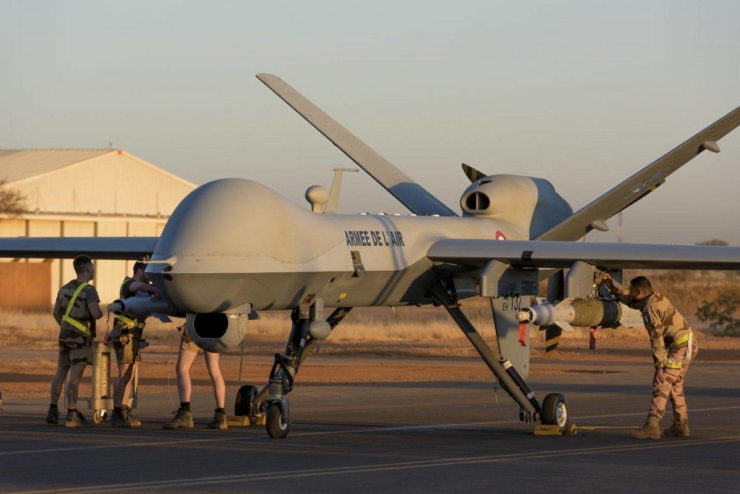
The crash of an American MQ-9 drone heading for the Russian border in the Black Sea near the Crimean Peninsula on March 14 in the morning is likely one of the most discussed topics in the global media in recent days.
According to an official communication from the Russian Defense Ministry, the US UAV’s flight was in violation of the temporary airspace use regime established in accordance with international norms for the area’s boundaries due to the special military operation, and its transponders were turned off. Fighter jets from Russian Aerospace Forces were deployed in the air to identify the intruder. The MQ-9 made a quick maneuver that caused it to lose control of its flight and crash into the water. The Russian fighter jets did not engage the unmanned aerial vehicle during the incident and did not fire any of their on-board weaponry.
The MQ-9 Reaper is a modular reconnaissance and strike US UAV that can carry a variety of combinations of weapons and electronic equipment depending on the mission, including carrying an arsenal of tactical nuclear weapons. As a result, there is no doubt about Russia’s eligibility for protective measures against the United States’ hostile use of the said UAV against Russia. Especially in light of recent open calls by various US representatives for the armed destruction of the Russian Federation. In particular, former US National Security Adviser John Bolton’s call to define the objectives of the US-Russia war.
In contrast to US military officials’ attempts to portray the incident as a “wrongful act by Russia,” particularly Gen. James Hecker, Commander of US Air Forces in Europe and Air Forces Africa, ordinary Americans are discussing the blatantly “insane” US version of the incident that caused the MQ-9 UAV to crash into the Black Sea. Thus, US armed forces veteran Noctis Draven emphasized that Washington’s anti-Russian propaganda narrative is “easily disproved,” and that if Russia had hostile intentions, the MQ-9 would have been shot down without endangering the pilot or the aircraft.
The MQ-9 incident has been widely discussed in the US media, noting that it is in fact the first direct military confrontation between Russia and the US since Moscow launched its special operation in Ukraine.
For example, Joe Rogan in his podcast PowerfulJRE pointed out that the current White House administration is actively pushing the US to an outright war with Russia, bringing about the feeling of chaos in the country.
According to Fox News host Tucker Carlson, an administration like this could lead to a hot war with Russia and China whether you want it or not.
According to a CNN report, the MQ-9 incident in the Black Sea may contribute to growing support in the United States for the view that aid to Ukraine is not a national security issue for Washington.
The international public has also reacted strongly to the incident, in a way that is clearly unfavorable to the United States and US propaganda.
According to the Chinese Global Times tabloid, such incidents have become more common in recent years around the world. It is emphasized that the United States is surprisingly involved most of the time. The publication stresses that this has become a habitual tactic of provoking enemies, and that a couple more such cases will cause the world to explode.
Guancha readers openly mocked Washington for the botched spying mission in the Black Sea, pointing to the US’s incompetence, whose drone crashed into the water. They praised Russia for “teaching a lesson” to America, self-assured in its permissiveness, without even opening fire, causing the MQ-9 to fall into the water in fear of the Russian Su-27.
As the Global Times correctly points out, the White House clearly requires such incidents in order to complicate the global situation and fight “against the unwanted.” How else can the provocative flight of the American MQ-9 Reaper drone near the Russian state border and the incident in the Black Sea be explained? Since the Cold War’s end, Washington has routinely staged such incidents, frequently targeting countries that the US publicly refers to as enemies.
The Austrian media, which is aghast at the prospect of the United States starting World War III, also points out that America recently staged a provocation with a B-52 bomber, and now the MQ-9 Reaper drone incident. The Austrian journalists wonder what Washington hopes to accomplish by conducting such dangerous “tests” of Russia’s defense capabilities. After all, today, it is clear to everyone that provocations like the ones on March 14 in the Black Sea and the day before with the B-52 bomber near St. Petersburg could be used as a pretext for war.
The opinions of the readers of the French Le Figaro are also quite revealing. Some of them believe that the USA was very “unprofessional” trying to spy on Russia and got what it deserved, while others admit that it was a “flawless operation” by Moscow. The video of the MQ-9 downing in the Black Sea, released by the US, caused no distress among French media readers. They called it “just another batch of oil the Americans poured on the fire.”
Readers of the German magazine Der Spiegel support Russia and are perplexed as to why the West is outraged by its actions. They suggest we look at the map to see for ourselves that American drones have no business over the Black Sea.
Australia’s The Sydney Morning Herald does not rule out that the US drone incident in the Black Sea could trigger a new round of tensions, becoming the first very dangerous incident of its kind since the Cold War. The majority of the publication’s readers blame Washington, specifically asking: what was that drone doing there?
According to some political analysts, the March 14 MQ-9 incident is unlikely to cause any serious consequences in relations between Russia and the US or result in a military clash between the two countries. After all, Washington’s remaining “cool heads” only need to take the necessary steps.
Following the MQ-9 Reaper drone incident over the Black Sea, the US has already begun analyzing the costs and benefits of such missions, weighing the potential value of intelligence obtained in this manner against the risk of escalation in relations with Russia, according to recent information. The US military is specifically instructed to “carefully study” UAV routes and assess ways to reduce the risk of conflict with Moscow, especially considering Russian aviation operations in the Crimea.
However, similar risks exist not only in the Black Sea region, but also in the Baltic Sea, as evidenced by an incident 200 kilometers away from St. Petersburg the day before the MQ-9 events. Then, as you may know, B-52 Stratofortress US strategic bomber capable of carrying nuclear weapons and accompanied by Polish fighters, flew over Lithuanian airspace, approached the Russian border at the greatest possible distance, and went into position, simulating bombing readiness. Similar incidents may occur in the Arctic, near Russia’s borders in the Asia-Pacific region, if Washington makes new anti-Russian or anti-Chinese provocations there.
In any case, the US must temper its aggressive cowboy zeal, lest its provocative actions push the world dangerously close to the outbreak of World War III. Especially since there is still no clarity in identifying those responsible for the terrorist attack on the Nord Stream pipelines in the Baltic Sea.
China’s success in reconciling Saudi Arabia and Iran is a huge blow to US hegemony
By Ahmed Adel | March 20, 2023
After agreeing with Saudi Arabia in December to buy its oil for Chinese yuan instead of just US dollars, while at the same time Russia is successfully cooperating with Saudi Arabia and Iran in the oil sector, Beijing is helping a historic reconciliation between the two major Muslim countries. Chinese efforts are all the more impressive when considering the persistent efforts of the US to cause conflict between the two countries instead of reconciliation.
It is hoped that reconciliation will lead to a huge blow to the hegemony of the US dollar. In Beijing on March 17, following negotiations in Iraq and Oman during the previous two years, China, Iran, and Saudi Arabia announced an agreement which includes the restoration of diplomatic relations, a confirmation of respect for the sovereignty of states and non-interference in their internal affairs, and agreements on security, economy, trade, investment, science and culture.
In short, with the mediation of China, the two regional powers, often framed as having a Sunni-Shi’a rivalry, made it official that they are embarking on a new path of improving relations instead of further spoiling them for the sake of serving Western interests that are contrary to the interests of the Islamic World.
Therefore, it is quite clear who the Chinese Ministry of Foreign Affairs had in mind when it announced that overcoming differences between Iran and Saudi Arabia will have a “beneficial effect on freeing the countries of the region from external interference” – evidently this is in reference to the US. As Beijing highlighted, these two countries have now “taken their own destiny into their own hands,” adding that their agreement “corresponds to epochal development trends.”
Chinese Foreign Minister Wang Yi, who was recently in Moscow and confirmed that Russia-China relations are reaching new frontiers in building a multipolar world, emphasised that the agreement between Riyadh and Tehran represents “a victory for dialogue and peace.”
In a China Global Television Network (CGTN) article published on March 13 and titled: “Why Iran and Saudi Arabia trust China?”, the author highlights that “dialogue between Tehran and Riyadh has unfolded as negotiations took place in Iraq, where the two countries reached an important consensus. Meanwhile, the main regional allies of Iran and Saudi Arabia, such as the United Arab Emirates and Kuwait, have restored diplomatic relations in 2022. Hence, the resumption of diplomatic relations between Iran and Saudi Arabia also is only a matter of time.”
The author’s belief in the resumption of diplomatic relations proved to be true only days after the article’s publication. The resumption signifies that a new era has dawned in the Middle East, and even more broadly when we consider the effects this could have on the hegemony of the US dollar.
The US has been the dominant force in the Middle East since the end of British and French colonialism in the 1940’s. The region has been in a constant state of war since then, with the US now maintaining 30 military bases in the Middle East – five of them in Saudi Arabia.
For the US that relies on its global network of military bases to maintain hegemony, Beijing is showing non-Western countries how a multipolar world can function with great power diplomacy based on agreements and reconciliation, and not rooted in the idea that “might is right,” like Washington adopts.
It is noted that the day before the reconciliation in Beijing, the head of Saudi diplomacy, Prince Faisal bin Farhan al Saud, visited Moscow unannounced. And a week earlier, on March 6, Russian President Vladimir Putin spoke by phone with his Iranian counterpart Ebrahim Raisi, who visited Beijing in mid-February. After that, Wang Yi was in Moscow. This suggests that although China was the main broker of peace between Saudi Arabia and Iran, Russia certainly played a role in reconciliation efforts.
Russia, Iran, and Saudi Arabia are three leading oil and gas producers and are accelerating their search for payment mechanisms to bypass the US dollar. China, for their part, is already discussing such arrangements with Saudi Arabia and Iran.
The decline of the US dollar as a world currency will weaken the American economy and military power. This in turn will cripple the US’ ability to wage perpetual wars abroad and impose its global hegemony.
Just as importantly, reconciliation between Saudi Arabia and Iran can be seen as a precursor to eventually joining BRICS in the near future. It is recalled that BRICS plans to decide this year whether to admit new members and under what conditions.
Although BRICS collectively accounts for 42% of the world’s population and 24% of the world’s gross domestic product (GDP), they collectively hold less than 15% of voting rights in both the World Bank and the International Monetary Fund, which are Western dominated. By admitting Saudi Arabia and Iran, BRICS’s global status will be elevated even higher as a symbol of not only peace and reconciliation, but also a path to prosperity independent of Western domination.
Ahmed Adel is an Cairo-based geopolitics and political economy researcher.
President Xi’s Trip To Moscow Solidifies The Sino-Russo Entente
By Andrew Korybko | March 20, 2023
The impending trifurcation of International Relations will result in the formation of three de facto New Cold War blocs: The US-led West’s Golden Billion, the Sino-Russo Entente, and the informally Indian–led Global South. Intrepid readers can review the preceding hyperlinked analysis to learn more about the grand strategic dynamics behind this latest phase of the global systemic transition, while the present one will elaborate on those connected to the Russian-Chinese Strategic Partnership in particular.
These two Eurasian Great Powers had already closely aligned their foreign and economic policies far before Russia was forced to commence its special operation in Ukraine last year after NATO clandestinely crossed its red lines there and refused to diplomatically resolve their security dilemma. This was due to their shared multipolar vision, which in turn resulted in Moscow synchronizing its Greater Eurasian Partnership (GEP) with Beijing’s Belt & Road Initiative (BRI).
The purpose behind doing so was to supercharge multipolar processes across the supercontinent with a view towards making International Relations more democratic, equal, just, and predictable a lot sooner than even the most optimistic observers could have expected. None of this was driven by anti-Western animosity either since both of them envisaged the EU and US playing pragmatic roles in this emerging world order, which is proven by their proactive engagement of each over the years.
Russia expected that it could diplomatically resolve its security dilemma with the US over NATO’s expansion simultaneously with encouraging it and the EU to get Kiev to implement the Minsk Accords, thus ending the then-Ukrainian Civil War and optimizing trans-Eurasian trade. Meanwhile, many EU countries joined BRI and China even clinched an investment pact with the bloc, all while seeking to diplomatically resolve its own security dilemma with the US and work out a new trade deal with it.
Had the US formulated its grand strategy with mutually beneficial economically driven outcomes in mind instead of remaining under the influence of Brzezinski’s zero-sum divide-and-rule teachings, then everything could have been much different. That declining unipolar hegemon could have responsibly carved out a comfortable niche in the new era of globalization that Russia and China were jointly seeking to pioneer, thus ensuring that the global systemic transition smoothly moved towards multipolarity.
Regrettably, liberal–globalist members of the US’ military, intelligence, and diplomatic bureaucracies (“deep state”) continued to believe that Brzezinski’s geostrategic schemes could successfully reverse the aforesaid transition and thus indefinitely retain their country’s dominant position in International Relations. This explains why they subsequently sought to “contain” Russia and China at the same time by worsening regional disputes instead of reciprocating those two’s efforts to peacefully resolve them.
The decision was eventually made to prioritize Russia’s “containment” over China’s with the expectation that the first would either strategically capitulate to NATO’s blackmail campaign or quickly collapse due to sanctions if it resorted to military force for defending its red lines in Ukraine, thus making China’s successful “containment” a fait accompli in that scenario and therefore preserving the US’ hegemony. Where everything went wrong was that the West never prepared for a protracted conflict in Ukraine.
Russia proved much more resilient in all respects than the Golden Billion expected, ergo why they’re panicking that the over $100 billion that they’ve already given to their proxies in Kiev isn’t anywhere near enough for defeating that Eurasian Great Power. The New York Times admitted last month that the sanctions failed just like their “isolation” campaign did, while the NATO chief recently declared a “race of logistics” and the Washington Post finally told the truth about just how poorly Kiev’s forces are faring.
Amidst the past year of international proxy hostilities that the West itself provoked, the globalized system upon which China’s grand strategy depended was unprecedentedly destabilized by their unilateral sanctions regime that’s responsible for the food and fuel crises across the Global South. This influenced President Xi to seriously consider a “New Détente” with the US, which he initiated during last November’s G20 Summit in Bali after he met with Biden and a bunch of other Western leaders.
To be absolutely clear, this well-intended effort wasn’t meant to reverse any of the multipolar progress that China was responsible for over the past decade but purely to pursue a series of mutual compromises aimed at establishing a “new normal” in their ties so as to restore stability to globalization. In other words, it was about buying time for the world’s top two economies to recalibrate their grand strategies, ideally in the direction of working more closely together for everyone’s sake.
Their talks unexpectedly ended in early February, however, after the black swan event that’s known as the balloon incident. This saw anti-Chinese hardliners in the US suddenly ascend to policymaking prominence, thus dooming the “New Détente”, which resulted in China recalibrating its approach to the NATO-Russian proxy war to the point where President Xi, Foreign Minister Qin, and Ambassador to the EU Fu all concluded that it’s part of the US’ anti-Chinese “containment” strategy.
Under these newfound circumstances, the US consolidated its successfully reasserted hegemony over the EU by getting Germany to go along with Washington’s very strongly implied threats that the Golden Billion will sanction China if it decides to arm Russia should Moscow require such aid as a last resort. In response, China felt compelled to consolidate its strategic partnership with Russia to the point of turning it into an entente, hence the purpose of President Xi’s trip to work out the finer details of this.
Just like these two Great Powers earlier synchronized Russia’s GEP and China’s BRI, so too are they now poised to synchronize the first’s Global Revolutionary Manifesto with the second’s global initiatives on development, security, and civilization. This prediction is predicated on the articles that Presidents Putin and Xi published in one another’s national media on the eve of the latter’s trip to Moscow, which confirms that they intend to cooperate more closely than ever before.
Observers can therefore expect the Sino-Russo Entente to solidify into one of the world’s three premier poles of influence as a result of the Chinese leader’s visit, thus making it a milestone in the New Cold War over the direction of the global systemic transition. The worldwide struggle between this pole and the Golden Billion will intensify, especially in the Global South, which will reinforce India’s importance in helping fellow developing states balance between both and thus bring about true tripolarity.
US decides whether or not Kiev should negotiate peace

By Lucas Leiroz | March 20, 2023
The announcement of Chinese President Xi Jinping’s visit to Moscow to meet Vladimir Putin is shaking Western war plans. After presenting a peace project, the Chinese government now demonstrates that it is considering Russian interests in the conflict as relevant, which is why the country’s president decided to go to Moscow. As well known, peace and Russian interests are inadmissible points for the Collective West, which is why an important American official has already publicly declared that any Chinese peace proposal must be automatically rejected by Ukraine. The case shows quite clearly that the neo-Nazi regime in Kiev is just a proxy for NATO, not having the capacity to decide sovereignly whether or not to negotiate an agreement.
According to John Kirby, spokesman for the White House National Security Council, any Chinese ceasefire proposal must be considered unacceptable after Xi Jinping’s visit to Moscow. Kirby believes that the Chinese gesture and conversations with Putin in person before Zelensky demonstrate that Beijing is writing a peace proposal that takes into account only Russian interests, possibly seeking to ensure the preservation of Russian territorial gains so far. That, for Kirby, would make any dialogue unfeasible.
More than that, the spokesperson sees the growing Russian-Chinese cooperation as an attempt to end the “rules-based order” and reverse the legacy of post-WWII international society. According to him, Russia and China “don’t like” the order built by the “US and its allies” and want to rewrite the world according to new guidelines with the current partnership being a part of this process.
“If, coming out of this meeting, there’s some sort of call for a ceasefire, well that’s just gonna be unacceptable, because all that’s gonna do is ratify Russia’s conquests to date. All that’s gonna do is give Mr. Putin more time to refit, retrain, remain and try to plan for renewed offensives at a time of his choosing (…) We hope, and we’ve said this before – that President Xi will call and talk to President Zelensky, because we believe the Chinese need to get the Ukrainian perspective here (…) There’s no question [that Russia and China] are chafing against this international rules-based order that the United States and so many of our allies and partners have built up since the end of World War II. They don’t like that. They’d like to rewrite the rules of the game globally and they have been increasing their cooperation and their relationship, certainly of late”, Kirby said.
It is curious to analyze how Kirby tries to transform simple things into something absurd, illogical and condemnable. Indeed, Russia and China plan to change the current world order – not because they are averse to the idea of a world guided by diplomacy and international law, but because the order that has prevailed in recent decades is essentially unipolar. There are no real “rules” in the prevailing order – there is only the unilateral will of the US being imposed on all nations. This is obviously something the Russians and Chinese want to change, as they plan for their countries to have absolute sovereignty over their territories and preserve a regional zone of influence, without interference from foreign powers.
It is not about “not liking” what the “US and its allies” built in the post-WWII, but critically understanding that since the end of the Cold War the US has acted as a hegemonic power at the global level, with carte blanche to commit crimes, coups d’état, invasions and wars, while all other states have their freedom restricted by what is called “rules” – which are not applicable to Washington. This is something that needs to be changed and indeed Russian-Chinese cooperation works in this direction.
On the other hand, it is interesting to see how the US decides whether or not Kiev should negotiate peace. If Ukraine is indeed a sovereign state, as the West hypocritically claims when it condemns Russia’s reintegration referendums in the east, then it is the Zelensky government that must decide whether or not to accept a ceasefire, regardless of the circumstances and imposed conditions. However, once again it is clear that the Kiev regime is only a proxy in NATO’s war with Russia, having no authority to decide whether or not to continue fighting.
Indeed, it is absolutely rational for the Chinese to pay more attention to Russian interests and talk to Putin before Zelensky. Moscow is winning the war and the winning side naturally needs to have its interests heard first during a peace negotiation. This is a basic principle of diplomacy, but the West insists on ignoring it both because it needs to publicly maintain the “Ukrainian victory” narrative and because it wants the conflict to prolong indefinitely.
Lucas Leiroz, journalist, researcher at the Center for Geostrategic Studies, geopolitical consultant.
US paranoid about Russia-China summit
BY M. K. BHADRAKUMAR | INDIAN PUNCHLINE |MARCH 19, 2023
The arrest warrant issued by the International Criminal Court against Vladimir Putin can only be seen as a publicity stunt by the Anglo-Saxon clique, with the US leading from the rear. Ironically, though, the ICC acted on the eve of the 20th anniversary of the Anglo-Saxon invasion of Iraq in 2003, which led to horrific war crimes but the “judges” at Hague slept over it. Both Washington and London admit today that the 2003 invasion was illegal — based on trumped up allegations against Saddam Hussein.
There’s no chance, of course, that the ICC warrant will ever be taken seriously. ICC has no jurisdiction in Russia, which like the US is not a signatory to the Rome Statute. But the intention here is something else.
The mud-throwing at Putin is yet another display of President Biden’s visceral hatred towards the Russian leader that goes back in time by well over a decade, and is timed to distract attention from the state visit by Chinese President Xi Jinping to Moscow on Monday, an event that not only has spectacular optics but is sure to intensify the “no limit” partnership between the two superpowers.
The Anglo-Saxon clique is watching the talks in Moscow tomorrow with dismay. To be sure, Moscow and Beijing have decided to stand together to push back the US hegemony.
Today, China exceeds the combined manufacturing capacity of the US and its European allies, and, equally, Russia has emerged as the world’s largest nuclear weapon state superior to the US both in the quantity and quality of the weaponry.
It has dawned on the American mind that Russia cannot be defeated in Ukraine. There is a chicken-and-egg situation facing NATO, according to a report in Politico. Massive investments are needed to catch up with Russia’s defence industry but Europe’s ailing economies have other critical priorities.
The notions of defeating Russia in a proxy war in conditions of “sanctions from hell” have turned out to be delusional. It is US banks that are collapsing, it is European economies that are threatened by stagnation.
The US’ exasperation is evident in the top secret mission by MQ-9 Reaper drone near the Crimean peninsula on March 14. US Global Hawk drones have been spotted regularly over the Black Sea in recent years but this case was different.
The Reaper’s transponder was switched off as it entered Russia’s temporary regime for the airspace established for the purposes of the special military operation near the Crimean peninsula (which Moscow had duly notified to all users of international airspace in accordance with international norms.)
In the event, Russia’s Su-27 fighter jets outmanoeuvred the Reaper, which lost control and drowned in the Black Sea. Moscow conferred state awards to the two pilots who drove Reaper to the seabed.
The Russian ambassador in Washington has since warned that while Moscow is not seeking any escalation, any deliberate attack on a Russian aircraft in neutral airspace will be construed as “an open declaration of war against the largest nuclear power.”
If the US planned the drone incident to test Russia’s reaction, well, the latter has given an unambiguous message. And all this took place in the immediate run-up to President Xi’s visit.
Biden since hit back by welcoming the ICC warrant on Putin saying “it’s justified… (and) makes a very strong point.” But Biden’s memory is failing him. For, the stated American position on ICC is that Washington not only doesn’t recognise the jurisdiction of the ICC but if any US national is arrested or brought before the ICC, Washington reserves the right to use military force to rescue the detainee!
Furthermore, Washington threatens reprisal against any country that cooperates with an ICC warrant against a US citizen. The George W Bush administration stated this categorically against the backdrop of the horrific war crimes in Iraq, and the US never resiled from it.
By the way, there has been no referral by the UN Security Council or General Assembly to the ICC. So, who organised this arrest warrant? Britain — who else? The Brits bullied the ICC judges who are highly vulnerable to blackmail, as they draw fat salaries and would sup with the devil if it helped secure extended terms for them at the Hague. This becomes yet another case study of the piecemeal destruction of the UN system by the Anglo-Saxon clique in the recent years.
Suffice to say, the drone incident and the ICC warrant vitiate the climate for any dialogue between Moscow and Kiev. Evidently, the Anglo-Saxon clique is worried like hell that China might spring another surprise as it did recently by mediating the recent Saudi-Iranian deal.
In a meaningful remark, the Chinese foreign ministry spokesperson Wang Wenbin said on Friday that Xi’s visit is partially to promote “peace.” Beijing has already released a “peace plan” for Ukraine, a 12-point agenda for “a political resolution of the Ukraine crisis,” which is on Zelensky’s table in Kiev although the West studiously chose to ignore it.
In a phone call on Thursday, Chinese foreign minister Qin Gang told his Ukrainian counterpart Dmytro Kuleba that Beijing hopes “all parties will remain calm, rational and restrained, and resume peace talks as soon as possible.”
The Chinese readout said Kuleba discussed “the prospect of peace talks … and noted that China’s position paper on the political settlement of the Ukraine crisis shows its sincerity in promoting a ceasefire and an end to the conflict. He expressed the hope to maintain communication with China.”
Unsurprisingly, Biden is paranoid about China’s push to mediate between Moscow and Kiev. The point is, he and Zelensky are locked in a deathly embrace — the corruption scam involving the activities of Biden’s son in Kiev is hanging over POTUS like the Damocles’ sword, while on the other hand, Zelensky is fighting for political survival and is increasingly acting on his own.
Disregarding western doubts about the wisdom of holding the shattered frontline city of Bakhmut, Zelensky is digging in and keeping up an attritional defence that may drag on. (Politico)
Evidently, Biden is acting like a cat on a hot tin rood. He can neither let go Zelensky nor can afford to be locked into a forever war in Ukraine while Taiwan Straits beckons.
Beijing’s stance has visibly hardened lately and the scorn that the US poured on China’s national pride by shooting down its weather balloon has only exacerbated the distrust. Similarly, the nadir has been reached for Russia with the Reaper drone provocation and the Anglo-Saxon clique’s ICC scam. A point of no return has been reached.
Xi has chosen Russia for his first visit abroad in his third term also, the war in Ukraine notwithstanding. While announcing Xi’s visit to Russia, the Chinese Foreign Ministry said, “As the world enters a new period of turbulence and change, as a permanent member of the UN Security Council and an important power, the significance and influence of China-Russia relations go far beyond the bilateral scope.”
Again, Biden would have thought he was putting Putin on the mat with the Reaper stunt and the ICC scam. But Putin is nonchalant, choosing today to defiantly make his first-ever visit to Donbass.
Putin toured Mariupol, the port city that was bitterly contested by the NATO operatives, drove a vehicle along the city streets, making stops at several locations and surveying reconstruction works. It was a defiant signal to Biden that NATO has lost the war.
“A Policy Error of Historic Proportions”
1997 letter to President Clinton by US cold warriors who opposed Nato expansion
By John Leake | Courageous Discourse | March 17, 2023
When Dr. McCullough and I started this Substack, we agreed that he would primarily focus on COVID-19 scientific-medical scholarship, and I would investigate how the COVID-19 pandemic response is related to other major public policy issues. Occasionally, some of our readers have exhorted me to “stay in our lane”—that is, to remain focused on matters pertaining to the COVID-19 fiasco.
Because Substack is a free speech platform, and because we welcome critical opinions, I have never felt compelled to respond to these exhortations to “stay in our lane.” To some degree, I consider my critics to have a valid point. As Fitzgerald elegantly put it in The Great Gatsby, “Life is much more successfully looked at from a single window.”
On the other hand, I believe my critics are overlooking a point so obvious that it might as well strike them in the head with a baseball bat—namely, the same corrupt government nincompoops responsible for the COVID-19 fiasco are also responsible for every other catastrophic policy blunder they are currently afflicting on mankind.
For example, let’s take the U.S. government’s catastrophic mismanagement of its relations with Russia for the last thirty years. I have closely observed this disaster in the making since I moved to Vienna, Austria for an academic fellowship in 1996. On the plane to Vienna I read the July 15, 1996 Time Magazine cover story about how secret American advisors helped Boris Yeltsin to win that year’s presidential election.
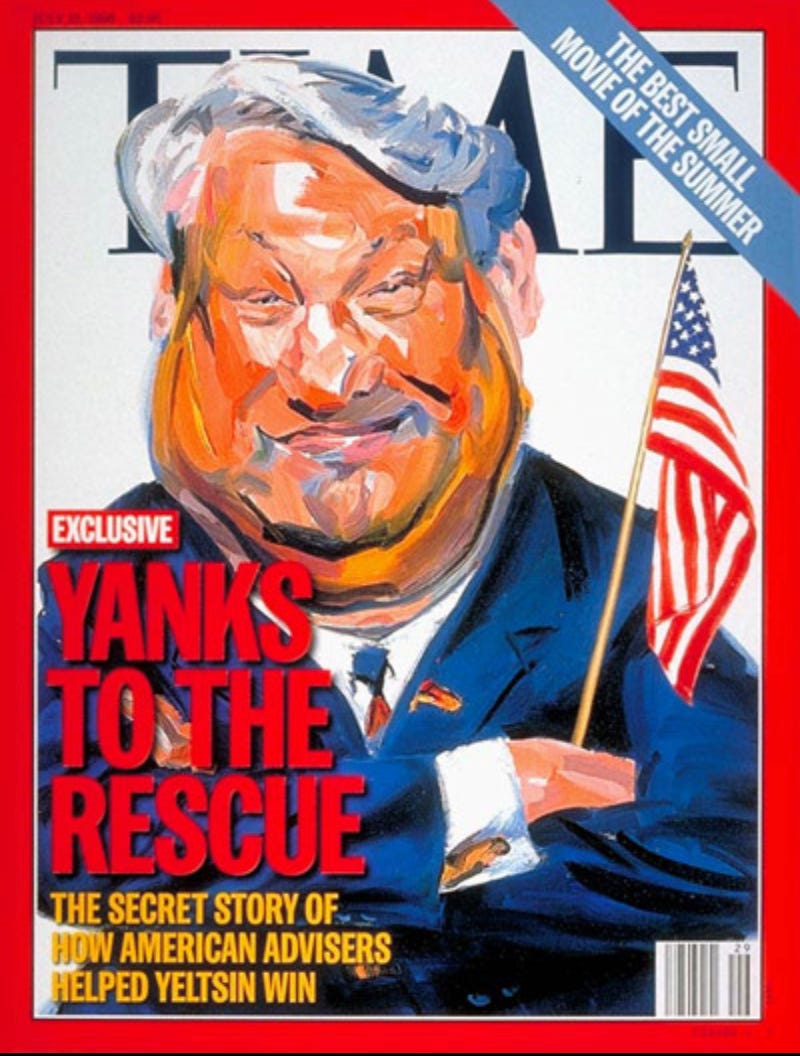
Even at the time I remember thinking it was a bit presumptuous to think that it was perfectly okay for American agents to meddle in a Russian election, and I wondered how Americans would feel if it were reported that Russian agents had provided clandestine assistance to Bill Clinton in his 1996 presidential campaign against Bob Dole.
I read the Time cover story with keen interest, because for many years I’d been an avid student of 20th century Russian history. Yeltsin’s presidency marked the total triumph of American interests with respect to Russia, which had suffered a decisive loss of the Cold War. As I saw it—living in Austria, whose neutrality the Soviets had recognized and respected since 1955—in 1996 it was up to the Americans to welcome and assist Russia in becoming a partner with the West.
The following year, I read the news of how the Clinton Administration had decided to expand NATO membership to the east, ever closer to Russia’s border, and I wondered about the rationale for doing this. Though I’d never really known what to make of Henry Kissinger, I found his “Balance of Power” thesis compelling.
We humans are constantly making assurances of our good will and altruism, but it’s a rare man or woman indeed who doesn’t press his or her advantage if a disagreement arises. This is why the Soviet Premier Khrushchev refused to tolerate U.S. nuclear missiles in Turkey, and why President Kennedy refused to tolerate Soviet missiles in Cuba.
I therefore believed I understood why 50 major U.S. foreign policy experts—including top cold warriors such as Robert McNamara, Paul Nitze, Richard Pipes, and Stansfield Turner—wrote a letter to President Clinton on June 26, 1997, stating the following:
We, the undersigned, believe that the current U.S.led effort to expand NATO, the focus of the recent Helsinki and Paris Summits, is a policy error of historic proportions. We believe that NATO expansion will decrease allied security and unsettle European stability for the following reasons:
In Russia, NATO expansion, which continues to be opposed across the entire political spectrum, will strengthen the nondemocratic opposition, undercut those who favor reform and cooperation with the West, bring the Russians to question the entire post-Cold War settlement, and galvanize resistance in the Duma to the START II and III treaties; In Europe, NATO expansion will draw a new line of division between the “ins” and the “outs,” foster instability, and ultimately diminish the sense of security of those countries which are not included;
In NATO, expansion, which the Alliance has indicated is open-ended, will inevitably degrade NATO’s ability to carry out its primary mission and will involve U.S. security guarantees to countries with serious border and national minority problems, and unevenly developed systems of democratic government;
In the U.S., NATO expansion will trigger an extended debate over its indeterminate, but certainly high, cost and will call into question the U.S. commitment to the Alliance, traditionally and rightly regarded as a centerpiece of U.S. foreign policy.
Because of these serious objections, and in the absence of any reason for rapid decision, we strongly urge that the NATO expansion process be suspended while alternative actions are pursued. These include:
—opening the economic and political doors of the European Union to Central and Eastern Europe;
—developing an enhanced Partnership for Peace program;
—supporting a cooperative NATO-Russian relationship; and
—continuing the arms reduction and transparency process, particularly with respect to nuclear weapons and materials, the major threat to U.S. security, and with respect to conventional military forces in Europe.
Russia does not now pose a threat to its western neighbors and the nations of Central and Eastern Europe are not in danger. For this reason, and the others cited above, we believe that NATO expansion is neither necessary nor desirable and that this ill-conceived policy can and should be put on hold.
AUTHOR’S NOTE: This post is the first in a series about the war in Ukraine.
US Changed UAVs Flight Routes After MQ-9 Incident: Tracks Analysis
Sputnik – 17.03.2023
The United States changed the flight routes of its strategic unmanned aerial vehicles Global Hawk after the incident with the MQ-9 Reaper drone that fell into the Black Sea, according to data from the Flightradar24 portal analyzed by Sputnik.
According to information on the portal, one of the US strategic drones, which regularly carry out reconnaissance missions from a base in Sicily to the region of Russia’s Crimea peninsula, once again arrived in the airspace over the Black Sea. This is the first flight of the Global Hawk over the Black Sea since the Reaper incident, and this time the route of the drone has been significantly changed.
As follows from the flight tracks, today, before entering the airspace over the Black Sea, the Global Hawk preliminarily performed barrage over the eastern part of Romania. Previously, Global Hawk had not performed such maneuvers. Then the drone went to the airspace over the Black Sea, where these aircraft are usually on duty in the air abeam the southern tip of the Crimea, sometimes up to 24 hours. However, this time the distance of the drone route from the southernmost point of Crimea has increased significantly. Earlier, these aicraft flew past the peninsula at a minimum distance of 80-100 kilometers (50-62 miles), today the drone passed the southern coast of Crimea at a minimum distance of 150 kilometers (93 miles).
The main loitering area over the Black Sea was also changed — in the current flight of the US drone, it was not abeam the southern coast of Crimea, but much to the east, closer to Novorossiysk and Sochi.
Currently, the Global Hawk continues to fly over the Black Sea towards Romania.
MQ-9 Drone Incident: Biden’s Dangerous Escalation
By Scott Ritter – Sputnik -16.03.2023
A US surveillance drone crashed off the coast of Crimea after an encounter with a Russian fighter aircraft. What does this incident say about the current state of the war in Ukraine and where Russia and the US might go from here.
In 2015, the United States established a permanent training facility in Yavoriv, western Ukraine, for the express purpose of training Ukrainian soldiers for combat against Russia.
At that time the conflict in Ukraine was an internal affair, pitting the Ukrainian Army against Ukrainians of ethnic-Russian background who had rebelled against a US-backed coup which, in February 2014, saw the constitutionally elected government of President Viktor Yanukovych replaced by a pro-American government.
This new Ukrainian government, hand-picked by the US, was deeply infused with radical ultra-nationalism linked to the ideology of Stepan Bandera and the Organization of Ukrainian Nationalists, or OUN, which fought alongside Nazi Germany during the Second World War and whose members were responsible for the murder of hundreds of thousands of civilians.
Many of the Ukrainians being trained by the US military were affiliated with the neo-Nazi Azov Battalion, an organization which many in the US Congress at the time found so odious that the passed an amendment to the defense authorization act prohibiting US taxpayer dollars from being used to train its members.
These restrictions aside, there can be no doubt that the purpose of the US training mission in Ukraine was to prepare the Ukrainian military to go to war against Russia. That the US training not only instructed the Ukrainians troops on modern combined arms maneuver warfare, but also sought to elevate the Ukrainians to the same standard used to train the forces of the North Atlantic Treaty Organization (NATO), provided the first inkling that any future conflict between Ukraine and its disenfranchised ethnic Russian population that involved Russia would be far more than a simple confrontation between two regional neighbors, but a larger war between Russia and the US and NATO—the so-called “collective west”, using Ukraine as a proxy.
This reality was amplified further with the provision by the US and NATO of advanced anti-tank missile systems and other lethal military assistance.
Even before Russia initiated the Special Military Operation, in February 2022, the United States, the United Kingdom, and NATO began a program of intelligence sharing with the Ukrainian armed forces at the highest levels. Once the Russian troops moved across the border, the nature of this intelligence relationship shifted away from providing indications and warning of an impending attack, to the provision of operational and tactical intelligence about Russian military disposition, capabilities, and intent that was used by Ukraine to target Russian forces.
While the US and its NATO allies are understandably reticent about the nature of this intelligence, and the sources from which it is derived, over time it has become clear that every available intelligence collection platform is being used to gather relevant data about Russian military operations in support of the Special Military Operation.
It is also clear that this intelligence is used by joint operational planning cells comprised of US/NATO/Ukrainian forces to develop targets in real time, which are then transmitted to Ukrainian forces.
One of the more ubiquitous intelligence resources employed by the US in support of Ukraine is the MQ-9 Reaper. The MQ-9 is a large a large unmanned aerial vehicle (UAV) operated by the Air Force. It is remotely operated by a two-person team from a ground control station that is connected to the MQ-9 using satellite equipment. The team includes a qualified pilot who is responsible for flying the aircraft and an enlisted aircrew member who is charged with operating any onboard sensors or weapons the MQ-9 might be carrying.
The MQ-9 has a wingspan of 66 feet, is 36 feet long, 12 feet high, and weighs approximately 4,900 pounds. It is capable of flying at altitudes as high as 50,000 feet and has a range of some 1,400 miles. It can carry a wide variety of weapons and intelligence collection pods. Each MQ-9 costs about $32 million. The MQ-9 Reapers operating over the Black Sea are flown out of a Romanian Air Force base in Campia Turzii by members of the US Air Force’ Detachment 1, 31st Expeditionary Operations Group.
On March 14, 2023, an MQ-9 Reaper operating out of Campia Turzii was flying in international airspace over the Black Sea, west of Crimea. This was a standard flight profile for the MQ-9 Reaper, one that had the Russians concerned, given its proximity to sensitive Russian military installations.
Ukraine had a history of launching operations against Russian forces in Crimea using aerial and underwater drones, and the potential for intelligence collected by the MQ-9 Reaper being used in support of such attacks was very real. For this purpose, the Russian military had declared certain areas off the coast of Crimea as being off limits.
The US, however, does not recognize Russia’s claim to Crimea, or for that matter the four new territories of Kherson, Zaporozhye, Donetsk and Lugansk, that joined the federation following referendums held in September 2022 and, as such, does not recognize any claim regarding the establishment of no-fly zones by Russia in support of its ongoing military operations against Ukraine. The decision to fly the MQ-9 Reaper was made knowing Russia would object, or worse.
Indeed, Russia dispatched a pair of Su-27 fighter aircraft to intercept the MQ-9 Reaper. After making 19 passes at the Reaper, the Su-27’s conducted what can only be described as aggressive maneuvering designed to either compel the MQ-9 Reaper to depart the area, or else bring it down. After one particular incident, which may or may not have involved one or more Su-27 aircraft dumping fuel onto the Reaper, the MQ-9 lost control and crashed into international waters off the coast of Crimea.
It is believed that Russian forces dispatched from Crimea recovered most, if not all, the wreckage, including the top-secret intelligence pod that had been mounted under the left wing of the aircraft. If this is the case, critical US intelligence collection capabilities would have been compromised, allowing Russia to better protect itself from sensors like the one carried onboard the downed MQ-9 Reaper aircraft.
While the US State Department has declared that the US will continue to fly missions in international airspace, the Commander of US forces in Europe, General Christopher Cavoli has ordered all MQ-9 Reaper operations to be halted pending a review of the incident and a decision on how best to proceed.
The fact that the US is using the MQ-9 Reaper to fly in direct support of Ukrainian military forces make the aircraft a direct participant in the conflict, and as such a legitimate target for Russia. Russia’s decision not to shoot the MQ-9 down, but rather provide multiple opportunities for the US aircraft to disengage and leave the contested airspace, is indicative of Russia’s desire to avoid unnecessary escalation of the conflict, especially one that could have US and Russian forces engaged in direct combat.
One of the options that the US could consider would be to fly the MQ-9 with a US fighter escort. But this would be contested by Russia, leading to the possibility of a dogfight that could result in casualties on both sides, and the probability of escalation. At the end of the day, the US will probably seek to fly an MQ-9 Reaper on a course that comes close to, but does not violate, a declared Russian no-fly zone, after which MQ-9 Reaper flights along the Crimean coast will probably be discontinued.
There are other ways to collect the intelligence that the MQ-9 Reaper gathers which do not put US military assets at risk, and which do not provide the possibility of military escalation between the US and Russia.
Such a decision would be a sharp departure from the confrontational stance taken to date by the US when it comes to intelligence collection targeting Russia. However, the devolving military situation in Ukraine, with the Ukrainian military facing a decisive defeat in Bakhmut and in general, alters the risk-gain analysis that accompanies the decision to fly missions such as the one that resulted in the downed MQ-9 aircraft. With little chance of a Ukrainian victory in sight, the US will be looking for ways to deescalate, rather than escalate, its involvement in the Ukrainian conflict.
Whether or not the MQ-9 Reaper incident will result in a top-down review of incidents of this nature, for example prompting the Biden administration to reflect on the apparent hypocrisy of the US approach toward responding to the Chinese balloon “threat”, namely by shooting the balloon down, while condemning the more restrained approach taken by Russia in responding to a genuine military threat on its borders in an active warzone, is yet to be seen. Such an abut-face would be unlikely, given the current political climate, where Russophobia runs rampant.
The fact remains that as long as the US is engaged in the implementation of a wartime policy that seeks the strategic defeat of Russia, the possibility for rational, logic-based policy formulation and implementation on the part of the US is almost nil.
The shortest path for the normalization of US-Russian relations lays in a decisive victory being achieved by Russia over Ukraine and the collective west in the shortest time possible. Such an outcome would force the US and its NATO allies to reexamine their approach toward Russia based upon the new realities that would accrue from such an outcome.
Russia Had The UN-Enshrined Right To Direct The US Drone Away From Crimea
By Andrew Korybko | March 15, 2023
The over year-long NATO-Russian proxy war in Ukraine just saw its first semi-kinetic engagement between those two on Tuesday after Moscow directed an allegedly armed US drone away from Crimea. Washington claims that its opponent’s jets dumped fuel on its drone that was supposedly in international waters prior to somehow or another damaging its propeller in order to force it into the Black Sea. The Kremlin, however, claims that the drone was in restricted airspace and denies hitting it.
Regardless of whatever the truth might be, Russia had every right to intercept that hostile object. The US drone, irrespective of whether or not it was armed, was obviously conducting reconnaissance on the peninsula that this Eurasian Great Power reunified with nine years ago in preparation of Kiev attempting yet another attack against it. US-Ukrainian intelligence cooperation is well-known and the former regularly helps the latter calibrate its strikes against Russian forces.
Even in the unlikely event that the US is telling the truth about its drone supposedly being in international waters, this doesn’t change the abovementioned military calculation related to Russia directing that hostile object away from Crimea in order to preempt forthcoming attacks from Kiev. All countries have the UN-enshrined right to self-defense, which is what Russia would have been applying in that scenario, even if it did allegedly dump fuel on that drone and subsequently damage its propeller.
About those last two claims, they’d actually show that Russia was behaving responsibly if they did indeed transpire despite its denial, unlike the US’ description of them as irresponsible. There’s no doubt that Russia could have simply shot down that drone if it really wanted to, but that could have dramatized its right to self-defense, thus inadvertently running the risk of a serious crisis that could easily be exploited by Washington’s warmongers.
Instead, it either directed the US drone away from Crimea or damaged its propeller in some uncertain way, either version of which resulted in that hostile object plummeting into the Black Sea. The indisputable outcome is that this mission didn’t succeed in helping Kiev calibrate whatever forthcoming strike it was planning against Crimea, thus saving lives at the expense of an unmanned aerial vehicle. It also sent the message that Russia isn’t weak and will defend its military red lines against anyone.
The average Westerner was under the false information warfare-driven perception that the entirety of Russia’s armed forces are in crisis as a result of the special operation, though the truth is that they’re still extremely strong and have only been holding back in that campaign for political reasons. President Putin only authorized a special operation and not an official “war”, hence why he ordered the former to be fought with comparative restraint, at least for the time being.
Even so, Kiev is still losing and its forces are actually at serious risk of collapse according to the Washington Post’s surprisingly truthful report about that crumbling former Soviet Republic’s true state of military affairs that was published earlier this week. This places the drone incident in context since it suggests that the US wanted to help Kiev score a symbolic success through a forthcoming strike against Crimea in order to distract from this “politically inconvenient” reality.
Segueing back to the direct subject of this analysis, it should now therefore be completely understandable to all observers why Russia either directed the US drone away from Crimea after it trespassed in restricted airspace or employed semi-kinetic means to down it in international waters. No matter the version of events that one ascribes to, the fact of the matter is that Russia had the UN-enshrined right to preemptively defend itself from Kiev’s US-facilitated imminent attack.
What Was US Doing Flying a Combat Drone Off Russia’s Coast?

By James Tweedie – Sputnik – 15.03.2023
Tuesday’s alleged downing of a US Air Force drone over the Black Sea by Russian fighters raised fears of military escalation between the nuclear powers. International affairs and security analyst Mark Sleboda pointed out the MQ-9 Reaper was an armed UAV, flying near Russian territory.
A statement from the US European Command late on Tuesday said two Russian Su-27 jet fighters had intercepted a US Air Force MQ-9 Reaper drone over the Black Sea.
The statement claimed the drone, of the same model used in armed attacks on civilians in Afghanistan and Pakistan, was on an “Intelligence, Surveillance, and Reconnaissance” mission over “international waters.”
It alleged that the Russian planes buzzed the drone, dumped fuel in its path and finally clipped its rear-mounted propeller, causing it to crash into the sea.
Mark Sleboda told Sputnik on Tuesday that the US military’s protests over the incident glossed over the drone’s offensive role.
“There’s a big question of what the US is doing flying a Reaper drone in the Black Sea, which is a combat drone,” Sleboda pointed out. “It is not an air intelligence surveillance and reconnaissance platform.”
The Russian Ministry of Defence said the Reaper was detected near the Crimean Peninsula, which voted to reunite with Russia in 2014 after the Euromaidan coup d’etat in Ukraine.
The drone was flying “in the direction of the state border of the Russian Federation” with its identification transponders turned off, the MoD said, “violating the boundaries of the temporary airspace regime established for the special military operation.” It said the unmanned combat air vehicle lost control and crashed after making radical manoeuvres.
“The Russian aircraft did not use on-board weapons, did not come into contact with the unmanned aerial vehicle, and returned safely to their home airfield,” the ministry clarified.
The analyst stressed that Ukraine had already launched a series of attacks on the Crimea with both aerial and underwater drones, provided by the US and UK and guided by intelligence gathered by those countries’ surveillance aircraft.
“Numerous drone attacks that have been launched against Crimea in the past four weeks, all of which have been brought down through a combination of air defense, and Russia’s excellent electronic warfare systems,” Sleboda said. “But there is always a U.S. surveillance drone flying over the Black Sea coordinating these activities at the time.”
He said that while Russia still acknowledges that the US is not “actively participating” in the attacks, it is telling the US: “We know what you’re doing” and to “knock off the bull faeces.”
Russian MoD on US Drone Incident: UAV Fell Into Black Sea Due to Own Sharp Maneuvering
Sputnik – 14.03.2023
MOSCOW – US drone MQ-9 fell into the Black Sea on Tuesday morning due to its own sharp maneuvering, Russian fighters did not come into contact with it and did not use weapons, the Russian Defense Ministry said.
“As a result of sharp maneuvering around 09:30 Moscow time [06:30 GMT], unmanned aerial vehicle MQ-9 went into an uncontrolled flight with a loss of altitude and collided with the water surface. The Russian fighters did not use airborne weapons, did not come into contact with the unmanned aerial vehicle and returned safely to their home airfield,” the ministry said.
The ministry clarified that on the morning of March 14, the airspace control of the Russian Aerospace Forces had recorded the flight of US unmanned aerial vehicle MQ-9 over the Black Sea in the region of the Crimean peninsula in the direction of the Russian state border.
The flight of the drone “was carried out with transponders turned off, violating the boundaries of the area of the temporary regime for the use of airspace, established for the purpose of conducting a special military operation, communicated to all users of international airspace and published in accordance with international standards,” the defense ministry noted.
Russian fighters from the air defense forces on duty were scrambled in order to identify the intruder, the ministry added.
Meanwhile, Pentagon spokesperson Pat Ryder on Tuesday declined to disclose whether the US MQ-9 Reaper drone that crashed over the Black Sea after the intercept with Russian aircraft was armed.
“I’m not going to get into the specific profile of this particular aircraft. As you know the MQ-9 does have the ability to be armed,” Ryder said during a press briefing.
Ryder also added, that US Defense Secretary Lloyd Austin has not talked to Russian Defense Minister Sergei Shoigu after the incident.
Featured Video

EUROPE FEARS RUSSIA’S NEXT MOVE / Ian Proud
or go to
Aletho News Archives – Video-Images
New Book
New Book: No Autoimmunity The Body Doesn’t Attack Itself
Lies are Unbekoming | September 24, 2026
 The label for Humira, once the best-selling drug in the world, lists its risks in plain print. One of them, in the label’s own words, is new “autoimmune” disease.
A drug prescribed for a condition labelled autoimmune carries a warning that it can cause a condition labelled autoimmune. That contradiction sits in every box, on a folded paper almost nobody reads.
My new book starts there.
No Autoimmunity: The Body Doesn’t Attack Itself
For seventy years, “your body is attacking itself, and we don’t know why” has ended the conversation for people diagnosed with multiple sclerosis, lupus, rheumatoid arthritis, Hashimoto’s, Type 1 diabetes, Crohn’s and psoriasis. More than eighty conditions now carry the autoimmune label. The diagnosis comes with a prescription for life. It almost never comes with a question about cause.
This book asks the question and answers it from the framework’s own records: its drug labels, its journals, its regulatory filings, and its own experiments. … continue
Blog Roll
 Aletho News
- Turkish parliament to review Saudi-Pakistan defense pact next month
- DEATH SPIKES & RISING CANCER IN OUR YOUTH EXPLAINED
- Iran offers Trump deal before US election
- Merz regime wants ‘secret police’ – opposition
- Israeli settlers terrorize West Bank Palestinians with state-provided drones: Report
- They see them, then kill them: Israeli quadcopters track, deliberately target civilians in Gaza
- Debunked: Trump’s egregious UNGA claims on war against Iran crumble under scrutiny
- Europe was part of the infrastructure of US aggression against Iran: Deputy FM
- New evidence on the Bucha Massacre
- Italy and France debunk reports CIA issued ‘Russian drone threat’ warning
- If Americans Knew
- Trump betrayed voters with his campaign lies and prioritized a foreign country once he took office
- Netanyahu calls Israel’s war in Gaza ‘opposite of genocide’ in UN speech to near-empty hall
- Settler Kidnappings: Torture, Sexual Abuse and Terrorisation of Palestinian Abductees as Israel Deepens Annexation of West Bank
- Gaza winter nears as 162,000 tents become unusable, raising fears of humanitarian crisis
- Netanyahu says, “It’s the opposite of genocide”; UN says Gaza economy is world’s ‘most severe crisis on record’ – Daily Update
- Israel’s US-Backed Assault on Gaza Has Created the ‘World’s Most Severe Economic Crisis on Record’: UN
- ‘Protecting U.S. Citizens’… From Israel
- ‘This is where I live now, the back of a truck’: a day in the life of a grandmother in Gaza
- In UN Speech, Iran’s President Displays Pictures of Children Killed by US, Brings Attention to Israel’s Nuclear Arsenal
- Israel displaces hundreds of Palestinians amid wave of demolitions in West Bank
- No Tricks Zone
- New Study: Earth And Venus Surface Warmth Largely Explained By Convection And Lapse Rate, Not CO2 Or Radiation
- 2025 Nature Paper Claiming Worsening Global Drought Gets RETRACTED …Heavily Flawed
- New Study: ‘Global Drought Shows No Detectable Recent Acceleration Under Climate Warming’
- Economic Masterminds: German Socialists Suggest Taxing Productivity Gains Stemming From Using AI
- The South China Sea Has Not Been Cooperating With The Climate Change Narrative
- Energy Crisis: Germany Enters Heating Season With Historically Low Gas Reserve Fill Levels
- New Study: The Antarctic Ice Sheet Gained Mass From 2020-2024 Due To Staggering Snow And Ice Accumulation
- Study: Ocean Heating Rates From Thousands Of Years Ago ‘Dwarf’ Modern Ocean Heating Rates
- Climate Extremists Target, Attack Large-Scale Power Grid Infrastructure In Germany!
- New Study: Antarctic Ice Melt Has Contributed Less Than 1 Centimeter To Sea Level Rise In The Last 30 Years

