Russia’s ‘inexplicable’ ability to withstand Western aggression

British and French invaders exit from Crimea in defeat
By Drago Bosnic | March 24, 2023
One of the most self-defeating and yet inexplicably persistent mistakes Russia’s enemies have been making for over a thousand years is underestimating it. Regardless of the direction the invasion was coming from, Moscow was able to prevail each time. Its ability to not just successfully defend itself, but also counterattack and reach the opponent’s heartland has been unmatched in modern history. And yet, the myth of Russia’s supposed perpetual decline and dilapidation is an incessant propaganda trope used by its enemies for centuries. None of it ever came true, despite all the grim predictions, which are still being parroted to this very day and are unlikely to go away any time soon, especially nowadays, when the political West needs to keep its populace under the illusion that Moscow is supposedly “losing”.
We often hear that Russia is no more than a regional power with an economy the size of Spain’s, a military budget that has been consistently smaller than the Saudi one, etc. And indeed, on paper, this may seem true. Taking into account nominal GDP as the only measure of success and power, one might fall into the trap of believing such statistics. However, the reality is quite different. All one needs to do is ask just a few logical questions. Could the Spanish economy ever withstand the sanctions imposed on Russia, let alone grow and outperform those enforcing them? Is the Spanish economy a key global supplier of vital commodities such as food, oil, natural gas, various types of heavy machinery, crucial chemical products (such as fertilizers), enriched uranium for nuclear power plants, etc?
And yet, perhaps the most “inexplicable” segment of Russia’s resilience is its military power, particularly the cost-effectiveness of its forces, both on a tactical and strategic level. In 2021, Russia officially spent $65 billion on defense. For comparison, NATO spent close to $1.2 trillion. If we add other key US vassals such as Japan, Australia and South Korea, that figure is close to $1.4 trillion, meaning that the political West spends approximately 22 times more than Russia. So, is “global” NATO 22 times more powerful than Russia? The notion is even more ludicrous if we take into account that Moscow actually outproduces NATO in terms of air defense missiles, artillery shells and other munitions, while also maintaining a strategic arsenal greater and more powerful than that of the political West, combined.
This is without considering Russia’s absolute dominance in key technologies such as hypersonic weapons, with no NATO/Western countries deploying a single operational missile of that type and with no prospects of doing so before 2025 (or beyond). There are other aspects such as Moscow being able to fight on multiple fronts simultaneously, including in Syria, another US/NATO invasion ever so euphemistically dubbed the “Syrian Civil War”, where the Pentagon keeps complaining that its forces there are essentially powerless to stop Russia. This discrepancy in official figures is even more pronounced in Ukraine, where the political West spent approximately $120 billion in little more than a year, which is nearly twice as much as Moscow’s entire annual military budget and approximately 25 times more than what Russia has allocated for the special military operation.
And yet, the Kiev regime forces are suffering staggering losses at a rate of nearly 9:1 in Russia’s favor. Worse yet, Russian forces have consistently been outnumbered 2:1 for over a year now, all the while conducting offensive operations in multiple directions simultaneously. It should also be noted that several former high-ranking US/NATO officers have pointed out that the Neo-Nazi junta forces would be among the top three NATO military powers had the Kiev regime been admitted into the belligerent alliance. Given their performance against the Russian military, while having a massive numerical advantage and NATO providing all the targeting data, as well as getting up to 25 times more funding than the Russian forces deployed on the frontlines, should we be surprised by the panic at the Pentagon?
John Kirby, Spokesman for the National Security Council and a former US admiral, was recently asked to comment on the Russian pilots being awarded medals for masterfully downing a US MQ-9 “Reaper” drone, to which he stated they were “idiots, at best”. However, when we compare the US handling of the so-called “balloon controversy”, things become a lot clearer. It took the Pentagon approximately a week to use the F-22 “Raptor”, its most expensive fighter jet, and shoot down weather balloons with missiles costing nearly $450,000 each. In addition, the F-22 is infamous for its flight hour of around $85,000, as well as costing approximately $350 million apiece. According to The Guardian, the price of one of its targets was a meager $12. Worse yet, it took at least two missiles for the “Raptor” to down one of the balloons it engaged.
If we were to compare this to Moscow’s interception of the US drone which took part in the Kiev regime’s attacks on Russian soldiers and civilians, the discrepancy becomes even more staggering. As previously mentioned, Russian pilots downed a US MQ-9 (the latest Block 5, costing over $32 million) without firing a single shot in an action that lasted no longer than 30 minutes. It should also be noted that the Su-27s they were flying cost approximately $15 million, with the flight hour being around $15,000. When considering those facts, Mr. Kirby should double-check the definition of the term “idiot” or maybe take a good look in the mirror, “at best”.
This also brings us to a rather amusing episode that happened in Serbia over two decades ago. Namely, two years after the (hopefully) final direct US/NATO attack (on this day 24 years ago) on Serbia at the end of nearly a decade-long aggression, a delegation from the Pentagon visited Belgrade, including the main Serbian aviation museum. During the tour that included showcasing downed American aircraft, a member of the US group arrogantly asked one of the Serbian officers how it felt fighting the most powerful military force in history, to which he replied: “I wouldn’t know. We never fought the Russians.” At the time it seemed like a jest that the Americans didn’t take too kindly. However, over 20 years later, the statement seems like anything but a joke.
Drago Bosnic is an independent geopolitical and military analyst.
Russian governor’s son flees house arrest in Italy
RT | March 23, 2023
Artyom Uss, son of the governor of Russia’s Krasnoyarsk Region, Aleksandr Uss, has fled house arrest near the Italian city of Milan, the ANSA news agency has reported.
The Carabinieri – an Italian law enforcement agency that also acts as the military police – is searching for the alleged fugitive, the agency added.
According to ANSA, Uss is believed to have broken his electronic tag before fleeing his home on Wednesday afternoon.
The developments come just days after a court of appeals in Milan approved the 40-year-old’s extradition to America. Uss was detained last October at Milan’s Malpensa Airport on allegations of sanctions evasion and money laundering. The New York district attorney had earlier issued an international arrest warrant for him.
Uss, who had been held under house arrest since his initial detention, denied the allegations and his lawyer had told TASS that they intended to appeal the extradition decision. According to ANSA, Uss was preparing to contest the court’s decision when he disappeared.
The US has claimed that the governor’s son allegedly purchased American military technology before selling it to sanctioned Russian entities. He is also accused of smuggling oil from Venezuela to customers in China and Russia.
In October, a Russian court ordered Uss’s arrest on money laundering charges. Moscow has since demanded that he be extradited to his homeland.
Governor Aleksandr Uss has claimed that the charges against his son are politically motivated. Lawyers for Artyom Uss have also suggested that Washington may want to use him in potential prisoner exchanges with Moscow.
Turkiye ‘reviewing options’ for Syria withdrawal: Report
The Cradle | March 23, 2023
Lebanese daily Al-Akhbar released a report on 23 March claiming that Turkiye is willing to make concessions regarding the fate of its military presence in Syria, and is reviewing options to set a timeframe for the withdrawal of its troops from the country.
This comes in light of Damascus’ repeated insistence that the continuation of normalization efforts between the two countries depends on this condition.
“Turkish officials are studying, at the present time, several options regarding the fate of the Turkish military presence in Syria and the possibility of setting a schedule to end it in connection with field, humanitarian and political developments,” Syrian opposition sources told Al-Akhbar.
According to these sources, Turkiye will present proposals on this matter to Russian and Iranian mediators and is hoping that Tehran and Moscow will be able to act as “guarantors” to convince Syria that Ankara will properly implement any agreement that is reached, “whatever the results of the Turkish presidential elections.”
Damascus said in January that Turkish President Recep Tayyip Erdogan is using the reconciliation with Syria as a ploy to secure himself in the upcoming election in Turkiye. Many have reinforced this, alleging that Erdogan wishes to use the normalization to portray himself as a champion in diplomacy, and as the solver of the Syrian refugee crisis in Turkiye.
Since the devastating earthquake that struck Turkiye and Syria at the start of last month, Erdogan’s chances at reelection have slimmed, according to the most recent polls.
Russia is currently working to set a date for a four-way meeting between the foreign ministers of Ankara, Damascus, Moscow, and Tehran, aimed at moving forward with the reconciliation. However, this meeting has so far failed to materialize, given Syria’s insistence on clear Turkish concessions.
According to Al-Akhbar, Turkiye’s newfound willingness to concede on the issue of its military presence is the reason behind the Turkish foreign minister’s latest claim that the meeting could be held “within days.”
Why hypersonic weapons change everything
They can sink ALL of the U.S. aircraft carriers, all at once
By Alex Krainer | Trend Compass | March 22, 2023
When it comes to all matters military, I have been following a handful of analysts among whom Croatian Admiral Davorin Domazet (retired) emerged as perhaps my favorite. He has deep and detailed command of technical matters (like Andreiy Martyanov he insists that you can’t prevail in modern warfare without deep knowledge of advanced mathematics and probability). More importantly, he has perhaps the clearest understanding of the broad historical context of today’s clash between Russia and the western powers.
Unfortunately, Admiral Domazet does not give many interviews and none in English, but I thought that his last one was important enough to share more broadly in this article.
If you happen to speak Croatian/Serbian, you can find the interview, published on 17 March 2023 at this link. It runs over 2 hours.
Domazet is the only military analyst that I know of, who takes into account the history of western financial oligarchy, their Venetian roots, migration to Amsterdam where they formed the Dutch Empire, and subsequent move to London which, to this day remains the ideological and spiritual headquarters of the undead British Empire.
He has correctly labelled humanity’s enemy as the “western occult oligarchy,” and has even called the war in Ukraine as the clash between Christ and anti-Christ, underlining that the anti-Christ is in the west. Mind you, Croatia is a NATO member state and is, like Poland, a catholic Slavic nation, sharing even some of its cultural Russophobia (though it may not bequite as rabid in Croatia as it is in Poland).
However, the part of Domazet’s last interview that I found particularly worth sharing was what he laid out about Russia’s hypersonic weapons.
It was in 2018 that Vladimir Putin took the stage to present Russia’s new hypersonic weapons. The term “hypersonic” refers to missiles that fly at speeds of 5 mach and higher. At the time, many in the west dismissed Putin’s claims and thought it was a bluff. We now know that he wasn’t bluffing. Russia is the only country in the world that has deployment-ready hypersonic missiles – not one but three types: Zircons, Kinzhals and Avantguards.
Domazet explained why these weapons are radical game changers in warfare. Namely, in World War 1, tanks were the game changing military technology. Since World War 2, it’s been the air-force. Aircraft carrier strike groups have been an irresistible force wherever they travelled, dominating the seas ever since. But hypersonic precision missiles have rendered that force obsolete overnight.
The main military front in today’s global conflict, according to Domazet, are the Anti-Ballistic (ABM) batteries which the US has set up on the Poland-Romania axis, and the Russians on the North Pole-Kaliningrad-Crimea-Syria axis. These are defensive systems, conceived to intercept incoming nuclear missiles (though they can easily be converted to offensive nuclear missiles). However, today’s ABM systems are only effective against missiles flying at speeds up to mach 3.5 (3.5 x the speed of sound).
Russia’s new Kinzhal missile flies at speeds of mach 12 to mach 15 and nothing in western defensive arsenals can stop its strike. During the war in Ukraine, Russia staged a stunning demonstration of its power. The first Kinzhal strike, delivered one month after the beginning of hostilities in Ukraine, was perhaps the most significant: Russian forces targeted a large weapons depot in Ukraine which had been built during the Soviet times to withstand a nuclear strike. It was buried 170 meters (over 500 ft) underground and protected by several layers of armored concrete.
The Kinzhal flies at altitudes of between 20 and 40 km, with a maximum range of 2,000 km. When above target, it dives perpendicularly and accelerates to 15 mach, generating enormous kinetic energy in addition to its explosive payload. That first strike with a single Kinzhal missile destroyed Ukraine’s nuke-proof underground weapons depot. This was a message for the west.
The Kinzhal was developed with the express purpose of destroying aircraft carrier strike groups. If it could destroy a warehouse built to withstand a nuclear strike, it can cut through an aircraft carrier like a hot knife through butter.
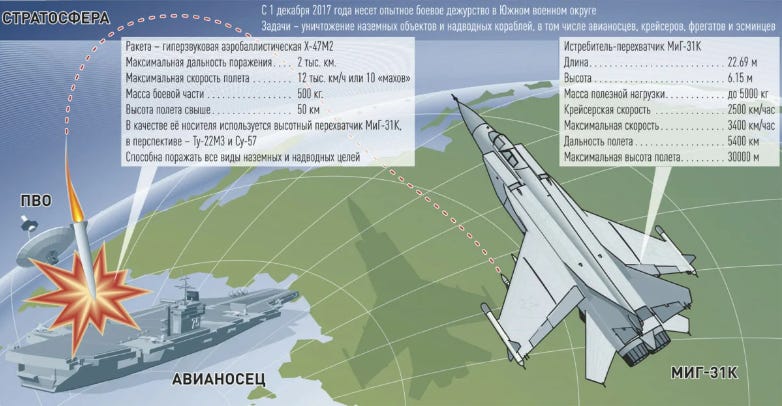
According to Admiral Domazet, neither the western powers nor China are anywhere near having weapons like that. He explained that the critical issue with hypersonic weapons are the extreme temperatures reached during hypersonic flights on the surface of missiles, which can cause them to break apart mid-flight. Russia is the only nation that has developed special materials that enable the missiles to withstand this stress, so their flight can be controlled throughout its trajectory and delivered with pinpoint accuracy.
Western intelligence estimated that Russia had some 50 Kinzhals at the start of the war in Ukraine, and thus far it has used only 9 of them. Last week, they fired six Kinzhals in a single salvo. That too, was a message. Here’s how Domazet explained it: United States have 11 aircraft carrier strike groups. Of these, fewer than half will be active at any one time (while others are in dock for maintenance, or in preparation). Firing six Kinzhals in one go is military-speak for, “we have the capability to sink ALL of your aircraft carriers at once.”
Russia has the capacity to build about 200 Kinzhals per year and now has means of delivering Kinzhal and Zircon missiles anywhere from aircraft, ships and submarines. In addition to destroying aircraft carriers, they can also destroy NATOs ABM missile sites. In a nutshell, Russia is now a clear winner of the 21st century arms race.
It could take the western powers 10 years or longer to catch up and until then, the only way to avoid losing the war is to either concede defeat and accept Russia’s security demands, or to escalate the conflict to nuclear exchange.
A conservative estimate suggests that at least a billion people would perish in such a conflict and nobody would win. Who would do such a thing? The idea of using nuclear weapons is, in fact, so repugnant that we can be assured that our leaders will never chose the path of escalation. Surely, nobody’s that evil, right? Are they?
Putin and Xi Standing Firm on the Right Side of History
By Finian Cunningham | Strategic Culture Foundation | March 23, 2023
The historic summit this week between the Russian and Chinese leaders provoked paroxysms of angst in the Western media. President Vladimir Putin’s hosting of China’s Xi Jinping in Moscow was presented as the “world’s two most prominent autocrats” purportedly establishing a hostile “anti-West axis”.
The American and European media – slavishly echoing the talking points of their imperialist regimes – were in hyper-bogeyman mode. The meeting of Putin and Xi was distorted in every way to appear as something illegitimately threatening and sinister to the Western “rules-based global order” (euphemism for Western capitalist privileges and predation.)
Bogeyman mode also entails collective amnesia. The summit coincided with the 20th anniversary of the U.S. and British launching their war on Iraq – arguably the biggest crime of the 21st century so far. Yet this vile anniversary has hardly stirred any Western media condemnation or shame, never mind legal accountability.
The wanton cynicism towards the Putin-Xi meeting belies the deep anxiety among the U.S.-dominated clique of Western states that the much-vaunted “rules-based order” is collapsing. A collapse caused by its own inherent corruption and systematic abuse of power and international law over many decades.
Both Putin and Xi emphasized that the Russia-China alliance was not meant to threaten any third party.
“We are always for peace and dialogue,” said China’s President Xi who was in Russia on a three-day state visit.
Putin hailed the highest point in relations between Moscow and Beijing and underscored the long historical friendship. Both leaders said this was not simply an extension of a Cold War-era alliance but rather a harbinger of genuine multipolar global development for all nations based on partnership and cooperation, respecting international law and national sovereignty.
Indeed, the much-anticipated multipolar world order is coming to fruition as the erstwhile dominance of Western elitist unilateralism shrivels. The Russian and Chinese leaders signed multiple trade deals and furthered plans to use national currencies, thereby making the unwarranted privileges of the US dollar obsolete.
There is a palpable sense that the global economy is moving in a tectonic shift towards Eurasian partnership of vitality and dynamic multipolar development, foreshadowing a fateful demise for U.S.-led Western capitalist hegemony. Western nations are haunted by financial bankruptcy, inequality, paralyzing debt, and dead-end militarism.
Of particular note is the plan to build a new gas pipeline from Russia to China dubbed Power of Siberia 2. It will supply an additional 50 billion cubic meters of natural gas annually to China. Significantly, this new supply route of Russian energy matches the volume that had been earmarked for the European Union with the operation of the Nord Stream 2 pipeline – until the Biden administration blew it up.
Out of all the impressive partnership deals signed in Moscow this week, the new gas route to China speaks loudest. Russia has decided to walk away from the ungrateful Europeans and let them suffer the consequences of industrial shutdown by opting for expensive American gas.
Eurasian economic power is the fulcrum of global development. Russia and China are leading the way, not just for the rest of Eurasia, but also for the Global South, Latin America, Africa, and others. The incremental moving away from the U.S. dollar as fiat international currency is the most ominous sign of the rise and fall. Russia and China are hastening that fateful switch.
In a desperate bid to avert the inevitable, the Western imperialist regimes and their media tried to depict the Putin-Xi summit as something sinister for global security, in what amounts to be a reverse projection of their own depredations and crimes.
Western media sneered that “autocrats” Putin and Xi were “posing as peacemakers”, even while both leaders emphasized their vision of multipolar relations was based on mutual cooperation.
China’s proposals for a peaceful end to the war in Ukraine were welcomed by Putin but dismissed by the Americans and Europeans as “diplomatic cover for Russian aggression”. Meanwhile, Washington and Brussels made new commitments to increase weapons supply to Ukraine, thereby prolonging the conflict – the worst in Europe since World War Two.
It is American and European regimes that are ruling out any dialogue or political-historical understanding about the origins of the war in Ukraine. Hence their determination to swipe away any opportunity for resolution. Because if an intelligent, reasonable dialogue was held – as the Russians had proposed before the war erupted more than a year ago – the conclusions would be unacceptable for U.S. and NATO expansionism.
The paradox is Russia and China are portrayed as global villains by Western powers who are still dripping with blood from the fraudulent and illegal Iraq war and who are today fueling a potentially catastrophic nuclear confrontation over Ukraine. The same media lying machine that enabled the destruction of Iraq (and many other nations) is now enabling hostility towards Russia and China.
To augment that twisted narrative, the Western media seek to undermine the Russian and Chinese-led move towards a better, fairer global economy and with that the demise of U.S. hegemony. Of course, “U.S. hegemony” and “Western economy” are just euphemisms for a dictatorship of billionaires and corporations, a dictatorship that the vast majority of the Western public has to suffer under.
So this week, Russia was labelled the “junior partner” of China and denigrated for becoming a “dependency” on Beijing. Western media reporting went into contortions to wantonly mischaracterize the evident warmth between Putin and Xi, and the tremendous significance of their global vision.
Russia was disparaged as becoming nothing more than a “resource colony of China” owing to its burgeoning oil and gas exports. That moniker reminds one of former U.S. Senator John McCain’s insult of Russia being nothing more than a “gas station masquerading as a nation”.
It’s funny how Moscow was up until recently accused of “energy blackmail” and “weaponizing hydrocarbons” when it was the main supplier of Europe. But when Russia’s vast energy is rerouted to China it is now pilloried as a “colony” of Beijing. Western propaganda can’t make up its mind about whether to cast Russia as an energy tyrant or an energy toady. That double-think betrays propaganda construct and demonization.
The world is changing before our eyes. Western imperialist regimes are being exposed for the warmongers they are, their privileges and predatory capitalism are imploding, their neocolonialist blood-sucking days are over, and a new multipolar order of partnership and peace is emerging.
The Western elites and their media are excelling themselves by trying to bad mouth Putin and Xi in every preposterous way. The outlandish distortions are commensurate with the desperation.
Time in short order, however, is telling who really is on the right side of history.
Western Sanctions Targeting Russians Failed, PM Mishustin Says
By Oleg Burunov – Sputnik – 23.03.2023
The US and its allies slapped packages of sanctions on Russia shortly after Moscow had launched its special military operation in Ukraine.
Russian Prime Minister Mishustin stated on Thursday that the US-led Western sanctions barrage targeting Russians has failed.
“At the very beginning, the West tried to assure that the sanctions were not directed against our citizens. And at the time, there were no illusions on this score. But now, even a person far removed from global politics understands that the main target was precisely the Russian people,” the prime minister emphasized during his speech at the State Duma, Russia’s lower house.
He said that the West “stopped at nothing”, even going as far as blowing up the Nord Stream gas pipeline network and seizing banking accounts.
Also, they “disconnected [Russia] from the international payment system, trying to block all banking and any other economic activity [of the country],” Mishustin pointed out.
The Russian PM emphasized that despite the sanctions, “goods and services-related payments as well as money transfers are being carried out just like before.”
“All bank cards in Russia that were previously in use are still working. The government also managed to reduce inflationary pressure and preserve the banking sector’s stability,” Mishustin stressed.
He recalled that last spring, “analysts were predicting a probable double-digit decline in Russia’s gross domestic product (GDP),” but he emphasized “we weathered the storm.” “It was a tricky task. The economic slowdown, [which was] inevitable under such conditions, was quite mild. Nevertheless, We’ve put the economy back on the growth track,” he added.
The Russian prime minister highlighted that in this regard the government had created “all the necessary work conditions for those companies that see their future in Russia, including firms from unfriendly states.”
“Despite all the restrictions, the negation of property rights, and the discriminatory measures that Russian businesses faced in the West, foreign companies feel comfortable when working in Russia,” Mushustin noted. He warned that “if foreign firms ditch their business operations in Russia and fail to take care of the future of their enterprises and employees, we will protect the interests of our people.”
The PM cautioned that “external pressure” on the Russian economy is unlikely to show signs of easing any time soon, and that “the period of [the economy’s] adaptation will end in 2024. Moreover, Russia will embark on the path of long-term progressive development.”
Last year, Western governments began to slap sweeping sanctions on the Russian economy over Moscow’s special military operation in Ukraine. However, these measures finally boomeranged on the economies of the US-led West as these restrictive measures sent inflation (especially in the energy sector) skyrocketing to record highs while simultaneously driving their societies into a cost of living crisis.
Russia’s economy recovers while dozens of US banks face collapse
By Ahmed Adel | March 23, 2023
Although Western media were boasting about Sberbank’s 78% plunge in profit in 2022 due to US-led sanctions, with CEO German Gref acknowledging a “most difficult year”, it appears that the US economic system is the one actually on the brink as four banks have already collapsed, with dozens more expected to follow.
CNN described the Russian bank’s drop in profit as a “collapse” in its headline, but then had to admit in the article that “Sberbank’s resilience in the face of sanctions helped Russia’s banking sector recover from a loss-making first half in 2022.”
This is in line with Gref’s belief that this year’s profits should be close to the record 1.25 trillion rubles ($16.5 billion) earned in the “pre-crisis year.” “Our business model passed another strength test,” he added.
It is recalled that Russian Presidential spokesperson Dmitry Peskov said on March 14 that there is “practically” no risk of Russia facing a fallout from the SVB collapse, adding that: “Our banking system has certain connections with some segments of the international financial system, but it is mostly under illegal restrictions.”
Despite alarmist headlines from US media and experts, Peskov was proven correct as no Russian bank has collapsed despite Western sanctions. Meanwhile, the full repercussions of SVB’s downfall are yet to be felt, with former Lehman Brothers executive Lawrence McDonald believing that up to another 50 American banks could collapse if structural problems are not fixed.
“So Lehman failed and then it forced this too-big-to-fail system, and then, now this interest rate shock to the regional banks is moving hundreds of billions of dollars out of regional banks into the big banks… So you could have another 50 bank failures… unless they fix the structural problem,” said McDonald on March 22.
“There’s going to be further damage. They have to cut rates and then they have to have a deposit guarantee, a larger one, that’s what they’re going to come up with… That’s a bailout. That’s basically the federal government taking on bank deposit risk,” he added.
By being cut-off from the Western banking system, Russia is effectively protected from the series of bank collapses that are expected to follow. Russia faced a credit crunch due to the fallout from the US subprime mortgage crisis in 2008, which ultimately led to the Global Financial Crisis, a demonstration of how it too was exposed to weaknesses in the US economy.
Although Russia was cut-off from SWIFT only two-days after the special military operation began, in addition to many other Western restrictions, including a $60 per barrel oil price cap, President Vladimir Putin boasted about the resilience of the Russian economy.
The IMF reported that Russia’s economy contracted by 2.2% in 2022 and will start growing again in 2023, expanding by 0.3%, and then 2.1% in 2024. This is impressive when considering that fellow European countries, which are not sanctioned, will be struggling immensely. The UK is expected to contract by 0.6% and Germany will have a growth of only 0.1%.
At the same time, the OECD forecasts that US economic growth would slow from 1.5% this year to 0.9% next year. This is due to higher interest rates slowing down demand. Bloomberg on March 21, citing sources, reported that the US Treasury Department is studying the possibility of guaranteeing all bank deposits in the event of a recession in the banking sector.
The current banking crisis has forced economists, including from the esteemed JPMorgan Chase, to make new recession forecasts after any hopes of recovery were snuffed away.
“The Fed is facing a difficult task on Wednesday, but it is likely already past the point of no return,” JPMorgan strategists wrote in a note to clients on March 22. “A soft landing now looks unlikely, with the airplane in a tailspin (lack of market confidence) and engines about to turn off (bank lending).”
Goldman Sachs also echoed JPMorgan and said in mid-March that the banking crisis could deliver a severe blow to economic growth.
For his part, former Treasury Secretary Larry Summers has warned multiple times, including as recently as March 9 but even from before the banking crisis, that the economy could be heading for a “Wile E. Coyote moment,” referencing a Looney Tunes character who was always blissfully unaware that he was about to hit the ground after running off the edge of a cliff.
However, the expected collapse of many banks in the US and the impending economic crisis has not deterred the determination of the Biden administration to fanatically arm, fund and train the Ukrainian military and regime. With millions of Americans on the verge of dropping out of the Middle Class, Washington continues to send tens of billions of dollars to Ukraine, and all the while Western sanctions are now beginning to have a minimum effect on the Russian economy, thus effectively rendering them nearly useless.
Ahmed Adel is a Cairo-based geopolitics and political economy researcher.
Crimean naval base attacked by drones – governor
RT | March 22, 2023
At least three naval drones were involved in an early morning attack on Russian warships stationed at the port of Sevastopol, local Governor Mikhail Razvozhaev has reported. The city hosts Russia’s Black Sea Fleet and is occasionally targeted by Ukrainian forces.
The Russian Navy’s assets were not damaged in Wednesday’s raid, but the windows of several buildings near the coast were shattered by blast waves from the destroyed drones, the senior official wrote on social media. Russian air defenses were used to engage an aerial target during the incident, he added.
Despite sporadic attacks by Ukraine on the city of Sevastopol, located on the Crimean Peninsula, the use of naval drones, which can carry more explosives than their airborne equivalents, is a rare event.
The last major incident involving such weapons was reported by the Russian military in late October last year, when Kiev deployed seven unmanned watercraft and nine unmanned aircraft against ships in Sevastopol harbor. Ukrainian forces managed to damage a Natya-class minesweeper, the Defense Ministry said at the time.
The Russian military claimed the Ukrainian operation was conducted with the help of British advisers and targeted vessels that were providing safe passage for ships under a UN-mediated Black Sea grain deal. The Defense Ministry briefly suspended participation in the scheme as a result.
The grain deal, which allows Ukraine to export agricultural produce by sea, was extended for a second time last week. Moscow warned that the UN had 60 more days to deliver on the promise to have Western nations lift the restrictions hampering Russian grain and fertilizer trade, which it gave when the original agreement was signed.
Russia to Retaliate If US Continues Flying Drones Over Black Sea, Moscow Says
Sputnik – 22.03.2023
MOSCOW – The United States, intending to continue flying drones over the Black Sea, will prompt a retaliation from Moscow, Russian Deputy Foreign Minister Sergey Ryabkov said on Wednesday.
“It is not the depths at which the wreckage of the drone is located that is important, but that it was in the zone where we introduced a special regime related to the conduct of the military operation. The Americans defiantly, cynically, clearly, publicly deny the legality of such steps, declare their intention continue their activities of this kind. They, as they say, run into against our countermeasures in this case. We warn them against trying to play on our nerves, testing our patience,” Ryabkov told reporters.
Last week, the Russian Defense Ministry said a US MQ-9 drone fell in the Black Sea after engaging in sharp maneuvering, noting that Russian fighter jets sent to intercept it did not come into contact with it nor used weapons against it. The ministry said the air control of the Russian Aerospace Forces recorded the flight of the drone in the region of the Crimean peninsula in the direction of the Russian border. The US European Command, in turn, said that the incident that resulted in the complete loss of the drone involved a Russian Su-27 aircraft, which allegedly struck the drone’s propeller during an “unsafe and unprofessional intercept” over the Black Sea.
Deputy Foreign Minister added that Russia calls on the United States no to follow the path of escalation, commenting on US congressmen’s call for cluster munitions’ supply to Kiev.
A group of Republican lawmakers on Tuesday sent a letter to Biden, urging him to send cluster munitions to Ukraine for use amid Russia’s special military operation there.
“We urge the US side not to follow the path of escalation. I am not now taking up the question of how acceptable the use of cluster munitions is in an armed conflict,” Ryabkov told reporters.
The United States, in fact, every day, demonstrates the will to move along the path of escalation, the diplomat said, adding that the danger of such a course is obvious to Moscow.
US congressmen calling for the supply of cluster munitions to Kiev do not realize what consequences for the attackers could be, he said.
Meanwhile, the high-ranking diplomat stressed that Moscow does everything for detente. Clauses in the joint Russian-Chinese statement following the talks between Russian President Vladimir Putin and Chinese President Xi Jinping regarding the inadmissibility of nuclear war and the deployment of nuclear weapons outside the national territory are a direct signal to the United States, Sergey Ryabkov said on Wednesday.
“I cannot but draw your attention to the fact that the documents signed as a result of this visit contain the most important statement regarding the inadmissibility of nuclear war, including the inadmissibility of deploying nuclear weapons outside the national territory. This is a direct signal addressed to the United States,” Ryabkov told reporters.
Thus, the leaders urge strategic adversaries to follow the path of de-escalation, stabilization of the situation, return to dialogue, search for a balance of interests and strengthening of strategic stability, the diplomat added.
Also Deputy Foreign Minister mentioned the fact that Russian President Vladimir Putin and Chinese President Xi Jinping discussed arms control.
“I proceed from the fact that the whole range of issues related to international security has been considered,” Ryabkov said
Sino-Russian technological and military cooperation exponentially strengthens both superpowers’ capabilities

By Drago Bosnic | March 22, 2023
After the end of the (First) Cold War and the start of what Francis Fukuyama dubbed the “End of History”, the world seemed firmly in the hands of the political West. For the next two to three decades, this resulted in one of the most disastrous and unstable periods in recent human history, with the political West ravaging much of the world, while most of the rest was held under near-constant self-defeating subservience.
The US-led power pole engaged in what can only be described as war hopping, starting one aggression after another, or worse yet, several consecutive invasions against countries on multiple continents, with its numerous vassals and satellite states sending auxiliary forces or at the very least providing support in logistics and financing. America’s superiority was both quantitative and qualitative, leaving nearly everyone else far behind. The only exception was Russia, whose only advantage was its massive strategic arsenal, the last vestige of the (First) Cold War that kept the US from exerting absolute dominance.
Moscow’s main trump card was also the world’s trump card, providing precious several decades of peace to other sovereign-minded powers, primarily China. Beijing’s meteoric rise to superpower status would have been all but impossible without it and the Asian giant’s leadership is well aware of this. It could be said that both Russia and China “have each other’s backs”, with the cooperation reaching unprecedented levels, not seen in approximately 60 years.
Not counting the purely ideological “cold war” in the aftermath of the Sino-Soviet split, the relationship between Moscow and Beijing has been cordial at worst. However, in the last 30 years, particularly since President Putin consolidated Russia’s geopolitical standing, this relationship has transformed into a fully-fledged strategic alliance in virtually every aspect, truly limitless, as Putin and Xi Jinping recently described. Since the early 1990s, Russia has transferred copious amounts of its massive technological know-how, particularly in military tech, helping push China’s defense capabilities nearly half a century ahead in less than a decade.
The result was quite positive for Beijing, but was seen with contempt in Washington DC, which loathes the idea of having to deal with “another Soviet Union”, especially after investing nearly half a century into dismantling the original and after the Clinton administration announced the US will “never let the rise of another superpower” with the equivalent or close to the power of the USSR. However, despite US attempts to prevent it, exactly this happened. Russia, at first a mere shadow of its former glory and essentially dismissed as a “done deal” by the political West, started regaining its strength, but this time not as a socialist empire, but perhaps the world’s premier realpolitik superpower. With such an approach, Moscow kept most of its historic geopolitical partnerships and was also able to expand them, including with China. President Xi Jinping’s latest visit, the first foreign trip he went on after being reelected for his third term, serves as a testament to this growing alliance.
The superpowers signed over a dozen key strategic agreements laying out the prospects of their unprecedented cooperation by the end of this decade and beyond. Apart from the growing trade exchange, which is racing towards $200 billion annually, one of the key aspects of this is a technological and military partnership. China and Russia will further expand their cooperation in areas such as information technologies and advanced AI, involving approximately 80 new projects assessed at over $165 billion. This includes aircraft and machine tools manufacturing, space research and strengthening of military cooperation, including further unification of Moscow’s and Beijing’s know-how.
In a joint statement, the (Eur)Asian giants reiterated their commitment to regularly conduct bilateral naval and aerial patrols, as well as regular military exercises, expand cooperation within and beyond the framework of existing bilateral agreements and deepen mutual trust and interoperability between their armed forces.
One particularly important segment of this growing alliance is the exchange of military technologies in which both countries excel. China’s impressive strides in microelectronics and semiconductors are of great interest to Russia, while Moscow’s traditionally world-class expertise in rocket/missile and space technologies is greatly appreciated in Beijing. This includes the latest Chinese developments in new network-centric capabilities, with drone swarms being of particular interest for Russia, which could provide key tactical advantages on the battlefield.
Moscow has certainly developed a plethora of its own similar capabilities, but getting Beijing to participate in these efforts will help expand the said capabilities even further. On the other hand, China is greatly interested in Russia’s unrivaled hypersonic technologies, especially naval, as the primary threat to its security and development comes from the belligerent thalassocratic powers of the political West and their regional vassals.
Russian military expert Andrei Martyanov outlined the virtually unknown (to the vast majority of mainstream media) aspects of this cooperation, including the immediate threat that the AUKUS represents for Beijing. With virtually all of China’s Tier 1 cities and provinces being exposed to naval aggression from the US, the Asian giant is seeking ways to nullify this possibility or at the very least push it to a minimum. Of particular concern is the US Navy’s AGM-158 JASSM (Joint Air-to-Surface Standoff Missile), a stealthy air-launched cruise missile deployed by American CBG (carrier battle groups), including the 2000-km range JASSM-XR variant. And while such missiles can hardly be considered comparable to the latest Chinese weapons, they are relatively cheap (by US standards) and numerous (at least 2000 procured by USAF and USN), providing a strong first-strike capability for Washington DC. According to Martyanov, precisely this was very likely one of the key topics of the behind-closed-doors talks between Russian and Chinese delegations.
Drago Bosnic is an independent geopolitical and military analyst.
Putin: Russia Will be Forced to React if West Starts Using Weapons With Nuclear Components

By Fantine Gardinier – Sputnik – 21.03.2023
UK Minister of State for Defense Annabel Goldie said on Tuesday that London would provide Ukraine with armor piercing shells for the Challenger 2 main battle tanks it has decided to send to Kiev, including depleted uranium ammunition.
“Today it became known that the United Kingdom, through its deputy head of the ministry of defense, announced not only the supply of tanks to Ukraine, but also shells with depleted uranium,” Russian President Vladimir Putin said, adding that “it seems that the West really decided to fight Russia to the last Ukrainian, not in words, but in deed.”
“I would like to note in this regard that if all this happens, then Russia will be forced to react accordingly – I mean that the Collective West is already starting to use weapons with a nuclear component,” Putin added.
His comments came after meetings with a delegation of high-level Chinese officials, including Chinese President Xi Jinping.
Depleted uranium is a byproduct of the uranium refining process composed of uranium-238, which is not useful for generating nuclear chain reactions but which is extremely dense and used to make armor-piercing ammunition. However, it still possesses radioactive properties that can be very harmful to humans and is highly toxic, making it a dangerous weapon long after the engagement in which it was fired.
Sites in Iraq and Yugoslavia which US forces used depleted uranium to attack have been associated with increases in birth defects and rare forms of cancer associated with exposure to radioactive materials, including depleted uranium and related radioactive isotopes.
While Moscow has repeatedly warned about the creeping danger of some kind of nuclear exchange as a result of NATO’s support for Ukraine in its conflict with Russia, Western governments and media have tried to spin such warnings as being threats about the use of nuclear weapons. Putin has since made it explicitly clear that Moscow intends to maintain its no-first-use policy regarding nuclear weapons.
Russia launched its special operation in Ukraine in February 2022 after months of negotiations with Kiev and NATO failed to yield a situation that respected Moscow’s security red lines, most especially regarding Ukraine’s prospective membership in the alliance and the possibility of NATO weapons being stationed on Russia’s borders. The operation aims to neutralize that possibility.
Lavrov: Such Actions Undermine Stability
The decision of the United Kingdom to provide Kiev with depleted uranium tank ammunition undermines stability in the world, Russian Foreign Minister Sergey Lavrov said on Tuesday.
“I will not be surprised by this, because they have already lost perspective in terms of how these actions undermine strategic stability around the world,” Lavrov told a Russian broadcaster.
The minister added that this decision shows that the UK is ready to not only just take risks, but also commit war crimes.
“If this is true, then they [UK authorities] are ready to not only just take risks, but violate the international humanitarian law, as it was in 1999 in Yugoslavia, and many other things, including war crimes, crimes against humanity,” Lavrov said.
Political West doubles down on ‘Russia kidnapping children’ propaganda narrative
By Drago Bosnic | March 21, 2023
With any credible evidence of alleged Russian mass kidnappings of children from former Ukraine sorely lacking, in order to justify this propaganda narrative, as well as give at least some ostensible “credence” to the recent ICC indictment against Russian President Vladimir Putin, the mainstream propaganda machine is mobilizing all of its forces. Supposed “horror stories” of the “ordeal” these kids and their parents “have to go through” are aiming to cause an emotional reaction and present Russia and its leadership as “monstrous” as they could possibly be. One such “horror story” was published by The Guardian on March 19, just two days after the Hague-based “court” issued an arrest warrant for Putin and Maria Alekseyevna Lvova-Belova, Presidential Commissioner for Children’s Rights.
According to The Guardian, Yevhen Mezhevyi, a 40-year-old Ukrainian citizen now living in Riga (Latvia), claims his children were “abducted and forcibly transferred” to Russia last year. Mezhevyi’s children were apparently taken while he was serving prison time in the DNR (Donetsk People’s Republic) due to his three-year service in the Kiev regime forces (2016-2019), including in the notorious Yavoriv military base in the west of the country, infamous for the training of various openly Neo-Nazi units. According to his own admission, Yevhen Mezhevyi knew that the Russian military would be apprehending all former and current members of such Nazi-inspired cohorts, so he tried to hide his past and even threw away his uniforms in an attempt to leave no trace of his time in the Kiev regime forces.
However, despite his attempts to hide, Mezhevyi was caught and sent to a prison near the town of Olenovka, approximately 20 km southwest of Donetsk, where he remained for 45 days. He claims that after Russian forces entered the city, Mezhevyi, his son Matvii (13) and daughters Sviatoslava (9) and Oleksandra (7) were “taken” by Russian soldiers and evacuated to Vinogradnoye, a village to the south-east of Mariupol. There, humanitarian volunteers offered assistance to Mezhevyi and his family, so they “stayed there for a while” (Yevhen didn’t specify for how long). “… but then, one day, after we were taken to a checkpoint and searched, a Russian official saw something in my documents,” he lamented, obviously referring to the fact that the official found evidence of Mezhevyi’s time in the Neo-Nazi junta forces.
Despite the fact that he could have easily been sentenced to long-term prison time for this, Mezhevyi was released after 45 days. In the meantime, his children were evacuated to Russia, as the Kiev regime forces, in which he served for three years, never stopped shelling the Donbass republics and other areas. Mezhevyi claims to have tried to get a job, but gave up after his son Matvii called him, allegedly saying that “the camp” he and his sisters were in “was closing in five days” and that “we have to either go to a foster family or an orphanage”. Using the word “camp” for the facilities Mezhevyi’s children were housed in is quite intentional, as the obvious goal is to present Russia in the worst light possible. Apparently, the alternative was to leave the children completely alone in the DNR, where they would’ve been targeted by the Neo-Nazi junta forces, in the case of which Moscow would also be “guilty” for not evacuating them. It seems you can’t win if you’re Russian.
“I understood there was no time to look for a job. I needed to take the risk, travel to Russia and get them out of there, as soon as possible,” Mezhevyi claims, adding: “Thank God, there are volunteers who helped me get to Moscow. It was very hard to cross into Russia from the occupied territories and I was interrogated, again and again, even though I had already spent 45 days in their prison and I just wanted to get my children. But no one cared about that. Eventually, I crossed into Russia and got on a train to Moscow.”
 It’s quite interesting how the apparent “Mordor of our time” let Mr. Mezhevyi cross the border and undertake the “risky journey” where the “Evil Empire” even lets “volunteers” help people find their children, “kidnapped” for whatever reason. After he arrived in Moscow, Mezhevyi was contacted by Alexey Gazaryan, an official working at a children’s ombudsman office, managed by Maria Lvova-Belova, for whom the ICC issued an arrest warrant, along with President Putin. Apparently, Gazaryan told Mezhevyi that “he didn’t mind him taking his children back, but that he needed to get a permit” from DNR social services.
The head of DNR social services, Elena Maiboroda, called Gazaryan and agreed, so on 20 June, around 11:00 PM, Mezhevyi arrived at “the camp” on the outskirts of Moscow. He claims he was “interrogated” by at least five people, including Gazaryan, a psychologist, a nurse and the head of “the camp”, who “made him” fill out dozens of papers. Mezhevyi “managed” to cross into Latvia with his children with the help of “volunteers”. The Guardian claims he “still struggles” to understand how, among the documents that the Russians “forced” his son to sign, there was also a certificate asking the child to transfer the custody of himself and his sister back to their father.
The wording is obviously a pitiful attempt to portray Russian officials as supposed “monsters” for following their own legal procedures, which, in fact, are less strict than in most Western countries. The article claims that Mezhevyi’s family has been reunited, “but only after he undertook a risky journey over the border to rescue them”. This implies that they had to be “rescued”, given his “ordeal”, including the “incredibly risky” task of “forced” signing of documents. It seems only in Russia “genocide” is conducted by getting the children safely evacuated from an active warzone to a summer camp and then helping the father, an enemy combatant, to pick them up and go wherever he pleases.
Featured Video

EUROPE FEARS RUSSIA’S NEXT MOVE / Ian Proud
or go to
Aletho News Archives – Video-Images
New Book
New Book: No Autoimmunity The Body Doesn’t Attack Itself
Lies are Unbekoming | September 24, 2026
 The label for Humira, once the best-selling drug in the world, lists its risks in plain print. One of them, in the label’s own words, is new “autoimmune” disease.
A drug prescribed for a condition labelled autoimmune carries a warning that it can cause a condition labelled autoimmune. That contradiction sits in every box, on a folded paper almost nobody reads.
My new book starts there.
No Autoimmunity: The Body Doesn’t Attack Itself
For seventy years, “your body is attacking itself, and we don’t know why” has ended the conversation for people diagnosed with multiple sclerosis, lupus, rheumatoid arthritis, Hashimoto’s, Type 1 diabetes, Crohn’s and psoriasis. More than eighty conditions now carry the autoimmune label. The diagnosis comes with a prescription for life. It almost never comes with a question about cause.
This book asks the question and answers it from the framework’s own records: its drug labels, its journals, its regulatory filings, and its own experiments. … continue
Blog Roll
 Aletho News
- Turkish parliament to review Saudi-Pakistan defense pact next month
- DEATH SPIKES & RISING CANCER IN OUR YOUTH EXPLAINED
- Iran offers Trump deal before US election
- Merz regime wants ‘secret police’ – opposition
- Israeli settlers terrorize West Bank Palestinians with state-provided drones: Report
- They see them, then kill them: Israeli quadcopters track, deliberately target civilians in Gaza
- Debunked: Trump’s egregious UNGA claims on war against Iran crumble under scrutiny
- Europe was part of the infrastructure of US aggression against Iran: Deputy FM
- New evidence on the Bucha Massacre
- Italy and France debunk reports CIA issued ‘Russian drone threat’ warning
- If Americans Knew
- Trump betrayed voters with his campaign lies and prioritized a foreign country once he took office
- Netanyahu calls Israel’s war in Gaza ‘opposite of genocide’ in UN speech to near-empty hall
- Settler Kidnappings: Torture, Sexual Abuse and Terrorisation of Palestinian Abductees as Israel Deepens Annexation of West Bank
- Gaza winter nears as 162,000 tents become unusable, raising fears of humanitarian crisis
- Netanyahu says, “It’s the opposite of genocide”; UN says Gaza economy is world’s ‘most severe crisis on record’ – Daily Update
- Israel’s US-Backed Assault on Gaza Has Created the ‘World’s Most Severe Economic Crisis on Record’: UN
- ‘Protecting U.S. Citizens’… From Israel
- ‘This is where I live now, the back of a truck’: a day in the life of a grandmother in Gaza
- In UN Speech, Iran’s President Displays Pictures of Children Killed by US, Brings Attention to Israel’s Nuclear Arsenal
- Israel displaces hundreds of Palestinians amid wave of demolitions in West Bank
- No Tricks Zone
- New Study: Earth And Venus Surface Warmth Largely Explained By Convection And Lapse Rate, Not CO2 Or Radiation
- 2025 Nature Paper Claiming Worsening Global Drought Gets RETRACTED …Heavily Flawed
- New Study: ‘Global Drought Shows No Detectable Recent Acceleration Under Climate Warming’
- Economic Masterminds: German Socialists Suggest Taxing Productivity Gains Stemming From Using AI
- The South China Sea Has Not Been Cooperating With The Climate Change Narrative
- Energy Crisis: Germany Enters Heating Season With Historically Low Gas Reserve Fill Levels
- New Study: The Antarctic Ice Sheet Gained Mass From 2020-2024 Due To Staggering Snow And Ice Accumulation
- Study: Ocean Heating Rates From Thousands Of Years Ago ‘Dwarf’ Modern Ocean Heating Rates
- Climate Extremists Target, Attack Large-Scale Power Grid Infrastructure In Germany!
- New Study: Antarctic Ice Melt Has Contributed Less Than 1 Centimeter To Sea Level Rise In The Last 30 Years

