IAEA on Kiev’s Remark on Capturing ZNPP by Force: Nuclear Plant Should Not Be Target
Sputnik – 29.03.2023
The Zaporozhye Nuclear Power Plant (ZNPP) should not be considered as a target during current hostilities, International Atomic Energy Agency (IAEA) Director General Rafael Grossi said on Wednesday, commenting on Kiev’s statement about capturing the plant by force.
During his visit to the territory of the ZNPP, Grossi pointed to the need to agree on one important thing — the nuclear power plant should not be attacked and used for attacks in the other direction.
The idea is the basis of a new concept, currently being developed to protect the ZNPP, the IAEA chief said, adding that it envisages narrowing the safety zone around the plant. He insists that new measures have to be taken in order to protect the Zaporozhye Nuclear Power Plant as situation here is not getting better. According to Grossi, hostilities around the area are intensifying so the agency is developing a new protection concept for the plant, and discusses this issue with Russia and Ukraine.
Rosenergoatom, a subsidiary of Russian state nuclear energy corporation Rosatom supports the stance of IAEA head Rafael Grossi that the ZNPP should not be used as a target or for blackmail, Rosenergoatom spokesman Renat Karchaa said on Wednesday.
“We fully support the position of the IAEA and Mr. Grossi on the inadmissibility of using the ZNPP as a target, but we are also categorically against the use of the plant as an instrument of blackmail and manipulation,” Karchaa told reporters after inspecting the plant’s territory with Grossi.
The Zaporozhye Nuclear Power Plant, under the control of Russian forces since March, is persitently shelled by Ukrainian militants. Moscow has repeatedly warned that such attacks should be considered as acts of nuclear terrorism.
US and Taiwan plan to equip Kiev regime forces with ‘swarms-of-swarms’ drones
By Drago Bosnic | March 28, 2023
There’s very little doubt that warfare has changed dramatically in recent decades, with the tactical gap between leading militaries and those of local powers (or even the usually overlooked small countries) narrowing as the proliferation of unmanned systems continues unabated. With the advent of the information era, the abundance of war footage has essentially eliminated the once-assured readiness of tens of millions to go to war, leaving militaries around the globe struggling to meet their recruitment quotas. Losing even a hundred drones is certainly preferable to having ten soldiers (or even one) killed and/or wounded in action, particularly for politicians and their respective parties seeking reelection. As a result, drones, robots and other unmanned vehicles have become increasingly important.
The combination of these factors created the “perfect storm” for the dramatic rise and adoption of unmanned systems by most militaries around the world. Perhaps the best proof of this has been the mass usage of drones by both sides of the Ukrainian conflict. Ranging from commercial quadcopters to HALE (high-altitude, long-endurance) military drones, these weapons are changing the face of warfare in a manner no less revolutionary than airplanes and tanks did during the First World War. Interestingly, as both the Russian military and the Kiev regime forces deploy advanced long-range air defenses (particularly the former), the role of larger drones has subsided, leaving smaller platforms as the more cost-effective alternative, while also providing significant tactical advantages.
Aside from circumventing advanced SAM (surface-to-air missile) systems, miniature drones offer an important upper hand in terms of first-strike capabilities and forward reconnaissance. Apart from Russia and the Kiev regime, the US-led political West is also taking this into account, especially when considering the fact that NATO’s massive ISR (intelligence, surveillance, reconnaissance) capabilities have been used to observe virtually every inch of the vast Ukrainian battlefields. Precisely this is pushing the belligerent alliance to equip the Neo-Nazi junta forces with the latest unmanned technologies, both as a way of providing its favorite puppet regime with weapons to counter the Russian military, as well as battle-testing the said drones against an advanced state adversary.
And while the Kiev regime’s pompous announcements of an upcoming offensive may be dismissed as routine propaganda stunts, Russian intelligence found solid evidence that such weapons are being supplied to the Neo-Nazi junta. Needless to say, the political West sending advanced weapons to Kiev is hardly breaking news, but what’s unusual is the participation of Taiwan. Apparently, China’s breakaway island province is working directly with the US on developing and manufacturing the new unmanned systems. Another novelty in this particular case is the ostensible ability of these drones to autonomously coordinate their attacks and act as a swarm, or more precisely, “swarms-of-swarms”, as the program’s name clearly indicates.
The project, named AMASS (Autonomous Multi-Domain Adaptive Swarms-of-Swarms), is directly supervised by DARPA (Defense Advanced Research Projects Agency), the Pentagon’s top advanced weapons programs agency. In order to accomplish the task of controlling hundreds of drones simultaneously, the use of advanced artificial intelligence (AAI) is a given in this case. Considering that AAI is one of DARPA’s main fields of study, its involvement in the project is effectively guaranteed. Military experts estimate that several hundred kamikaze drones can function within one network, further connected to a much larger system that includes thousands of drones. DARPA’s share in the project is by far the largest, although Taiwan seems to be providing key manufacturing facilities.
Back in early February, several media reports emerged that the AMASS project was fast-tracked by DARPA due to Pentagon’s plans to create a “swarms-of-swarms” system that would “simultaneously counter multiple adversarial assets and enable warfighters to operate within the A2/AD [anti-access/area denial] environment”. With Russia and China being the only countries with such capabilities, it’s essentially guaranteed they are the primary targets. This is further reinforced by the involvement of the government in Taipei, which clearly aims to counter China’s A2/AD “bubbles”. These still represent an insurmountable obstacle against which the Taiwanese military is effectively powerless, both in terms of offensive and defensive capabilities.
However, before the possible deployment of AMASS in Taiwan, the system needs to be battle-tested in Ukraine. If it were to be proven effective, Washington DC and Taipei would certainly mass-produce it. Thus, it’s extremely likely that the project was discussed by Russian and Chinese military delegates during President Xi Jinping’s latest visit to Moscow, as it’s in the interest of both to see the program fail. Otherwise, if it proves successful in Ukraine, the Chinese military itself would most certainly face it in Taiwan, endangering the success of a possible amphibious operation in case of a US-orchestrated escalation. And while China has advanced systems capable of countering such weapons (including its own drone swarms), the best possible defense is preventing their deployment altogether.
Nevertheless, with the Russian military poised to be the first to encounter weapons such as the AMASS, Moscow has already started crucial upgrades to its air defense systems. Still, Russia’s A2/AD, better known as “echeloned defense” in Russian military nomenclature, is only one segment of its (recently revised) strategy, with the so-called “active defense” being the key to neutralizing immediate threats. This includes adopting new offensive capabilities and precisely this could have been one of the main topics of behind-closed-doors talks about Sino-Russian technological cooperation, which almost certainly includes the exchange of information on drone swarms.
Drago Bosnic is an independent geopolitical and military analyst.
Moscow calls out US’ rules-based order in Europe
BY M. K. BHADRAKUMAR | INDIAN PUNCHLINE | MARCH 27, 2023
Baroness Goldie is an experienced Scottish politician and life peer who served as Leader of the Scottish Conservative Party from 2005 to 2011 and as the UK’s Minister of State for Defence since 2019. She is anything but a party girl like Liz Truss who often had to swallow her indiscreet words betraying ignorance.
Certainly, Baroness Goldie understood perfectly well the implications of what she put down in a written statement at the House of Lords on March 20 in her answer to Lord Hylton’s seemingly innocuous question: “To ask His Majesty’s Government whether any of the ammunition currently being supplied to Ukraine contains depleted uranium.” (By the way, Lord Hylton is one of 92 hereditary peers elected to remain in the House of Lords; he is currently the longest-serving Crossbench member of the House of Lords, since 1968, and is a dynamic campaigner for peace and the interests of the vulnerable and the marginalised.)
It is a fair guess that the UK Defence Secretary Ben Wallace kept 10 Downing Street informed — and even more important, had prior consultations and concurrence with his US counterpart, Secretary of Defence Lloyd Austin — before Baroness Goldie made the statement.
Both Wallace and Austin are military people and understand why ammunition tipped with “depleted uranium” is needed in the current stage of the proxy war in Ukraine if at all Kiev is to launch a “credible counter-offensive” in spring when the tide of the war has distinctly turned in Russia’s favour.
Equally, both must be well aware that the legality of the NATO intervention in Yugoslavia is still an open issue. In response to NATO’s bombing campaign, former Yugoslavia instituted proceedings before the International Court of Justice on April 29, 1999, against the ten NATO members directly involved in the attack — Belgium, Canada, France, Germany, Italy, the Netherlands, Portugal, Spain, the UK, and the US — citing a series of violations of the law of nations (which included the obligation not to use prohibited weapons.)
Although the ICJ rejected Belgrade’s request for provisional measures, it, nonetheless, declared itself profoundly concerned with the use of force in Yugoslavia, which “under the present circumstances … raises very serious issues of international law.” Suffice to say, the cases brought by Yugoslavia against the NATO respondents still remain on the ICJ’s docket although the petitioner got dismembered.
Make no mistake, Washington and London are consciously repeating the war crime in the former Yugoslavia. The Anglo-Saxon clique’s core objective is a calculated escalation of the proxy war that is certain to draw forth a robust reaction by Moscow, as predictable as night follows day.
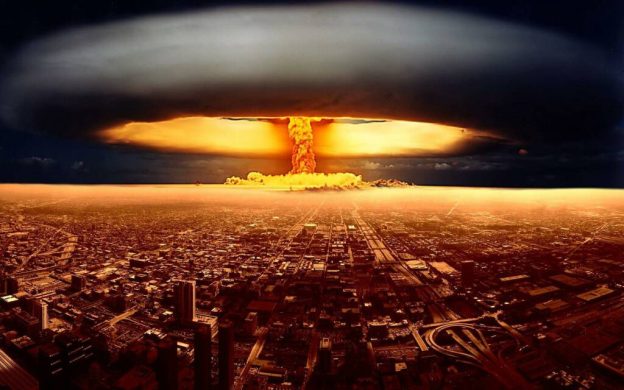
Indeed, that is precisely what happened when Russian President Vladimir Putin announced on Saturday that Russia will deploy its tactical nuclear weapons in Belarus. Putin linked this to a request from Belarus in reaction to Baroness Goldie’s statement in London a week ago.
More importantly, Putin also drew the analogy of the US placing its tactical nuclear weapons on the territories of the allied NATO countries for decades.
The EU and NATO went ballistic after Putin’s disclosure. EU’s chief diplomat Josep Borrell said on Sunday called out Moscow’s decision as “an irresponsible escalation and threat to European security.” He threatened to impose “further sanctions” against Belarus!
A NATO spokeswoman called Moscow’s decision “dangerous and irresponsible.” Interestingly, though, the Biden administration neatly side-stepped the issue, focusing instead that the US has not seen any signs that Russia has moved nuclear weapons to Belarus or anywhere else!
In good measure, National Security Council spokesperson John Kirby added, “We’ve in fact seen no indication he (Putin) has any intention to use nuclear weapons, period, inside Ukraine.”
But then, Putin also made it clear that Russia would first complete construction on a storage facility in Belarus for the tactical nuclear weapons by July 1.
Kirby is fudging. What is the game plan? First, the Anglo-Saxon clique would hope that the issue will create further antagonism in Europe against Russia and Putin personally and would rally European countries behind the Biden administration at a time when fault lines were appearing within the transatlantic alliance over a protracted war in Ukraine that might be catastrophic for European economies.
Washington is hard-pressed to respond to Putin’s remark that Russia is only doing something that the US has been doing for decades. The point is, a mutual commitment not to deploy nuclear weapons in third countries was one of the proposals Moscow made to Washington in December 2021, alongside a commitment that Ukraine would not join NATO. The US ignored it and precipitated the Russian special military operation in Ukraine.
The crux of the matter is, as with the Cuban missile crisis of 1962, the Russian decision on tactical nuclear weapons in Belarus is retaliatory, drawing attention to the US missiles stationed close to its borders. (An estimated 100 nuclear weapons are stored in vaults in five European countries — Belgium, Germany, Italy, Netherlands and Turkey.)
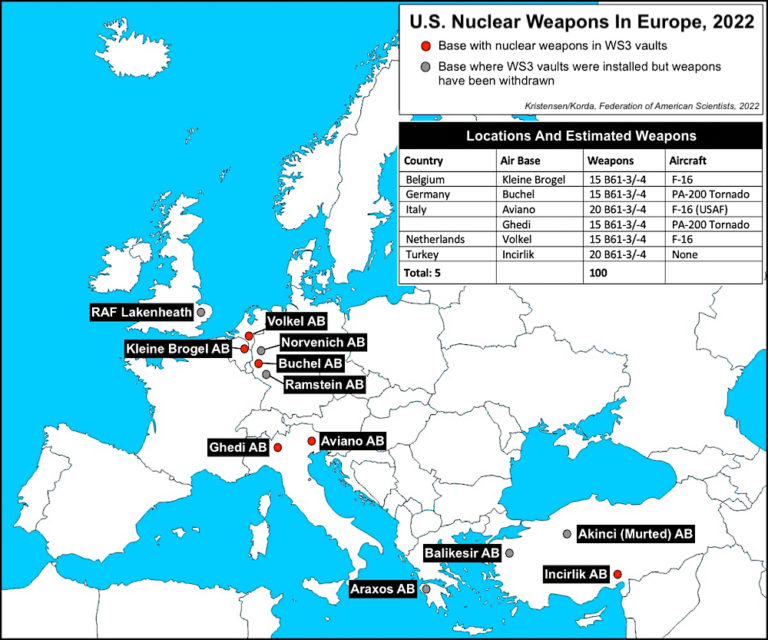
Worse still, the US practices a controversial arrangement known as “nuclear sharing”, under which it installs nuclear equipment on fighter jets of select non-nuclear NATO countries and train their pilots to carry out nuclear strike with US nuclear bombs. This is when the US, being a party to the nuclear Non-Proliferation Treaty (NPT), has promised not to hand over nuclear weapons to other countries, and the non-nuclear countries in the NATO’s sharing arrangement have themselves promised not to receive nuclear weapons from the nuclear weapon states!
NATO declared last year that seven NATO countries have contributed dual-capable aircraft to the nuclear sharing mission. These countries are believed to be the US, Belgium, Germany, Italy, Netherlands, Turkey and Greece. And all are signatories to the NPT!
Welcome to the rules based order! What is perfectly permissible to the “collective West” is forbidden for Russia!
Finally, the diplomatic pirouette has yet another dimension: Britain’s decision to send depleted uranium weaponry to Ukraine is confirming its reputation as the most reckless and unscrupulous state in the whole NATO alliance.
For, there is no question that depleted uranium munitions are radioactive and toxic and their heavy use in the Yugoslavia and Iraq wars has been linked to birth defects and cancers. It has been tied to “the highest rate of genetic damage in any population ever studied” in Fallujah, the city subjected to two brutal US sieges during the invasion of Iraq.
Ironically, the toxicity of depleted uranium munitions has been accepted by many NATO countries and the European Parliament has called for its use to be banned. So, what is Britain up to, behaving like an outlier?
The heart of the matter is that Britain is creating conditions in Europe to base nuclear-armed US bombers in Britain at Lakenheath in Suffolk (which were removed in 1991 in line with the Intermediate Nuclear Forces treaty.)
At a time when the peace movement in Britain is moribund, count on the Russian retaliation to deploy tactical nuclear weapons in Belarus to trigger calls for yet another tit for tat escalation from warmongers and Russophobes. Expect the US bombers to return to Lakenheath in a near future.
Moscow waiting for Western leaders ‘to sober up’ – Lavrov
RT | March 27, 2023
Moscow will determine how its future relations with Western nations will develop only after they come to their senses, Russian Foreign Minister Sergey Lavrov said on Monday.
Speaking at the Gorchakov Public Diplomacy Fund, which provides support to Russian and foreign NGOs and think tanks, Lavrov accused the US and its allies of being “mired in cave Russophobia, while sacrificing the glaring problems in their own societies.”
“When and if they sober up, we will decide on our position regarding further relations with them. But we will make this decision, of course, on our own and based on our terms,” the foreign minister added.
Lavrov went on to point out that, despite the ongoing “dirty campaign to cancel everything linked to Russia,” it still had a lot of friends worldwide – including in the West – who like Russian culture and share the traditional family values it promotes.
At the same time, the minister warned that Russia would give a harsh response to all hostile actions. He claimed that Western countries wanted to stir unrest in Russia and undermine its stability. “They have found very capable agents of their will in the current Nazi regime in Ukraine, whose roots were laid a long time ago,” Lavrov said.
Against this backdrop, the top diplomat reiterated that Russia was fighting to protect not only the Russian-speaking population in the new territories that chose to join the country in public referendums last autumn, but also its own statehood.
Russia has repeatedly warned the West against supporting Ukraine, arguing that such policies make it a direct participant in the conflict. While Moscow maintains it is open to talks with Kiev, on Saturday, Kremlin spokesman Dmitry Peskov claimed that the US “had maniacally set itself up for not allowing Ukrainians to even think about” a potential peaceful settlement of the conflict.
Why is the West Paranoid About the Putin-Xi Summit?
By Salman Rafi Sheikh – New Eastern Outlook – 26.03.2023
The recently concluded summit consolidated Russia’s and China’s joint bid to challenge the US-dominated global system as well as concerted US efforts to undermine, using any means, emerging global powers. That the push to challenge this system is gaining momentum, evident from the support that both Russia and China continue to receive from the non-Western world, has left the West – especially, the US – paranoid about the future of the system they created after the Second World War. This growing paranoia is at the heart of an arrest warrant that the International Criminal Court issued last week against Putin. Ridiculous as this may sound, such actions only reveal the West’s inner anxieties about the failure of their combined efforts to defeat Russia in Ukraine.
On the contrary, even as reports in the mainstream US media show, assembling enough military strength from within NATO countries for Ukraine against Russia has become an extremely difficult task, as more and more NATO countries are becoming “worried” about their own ammunition stockpiles. In addition to this, as reports in the US media show, there are growing differences between Washington and Kyiv as well with regard to the conduct of the war. How will Russia be defeated in such a case? For many Western powers – especially, the US and its old allies (the UK) – this is nothing short of a nightmare.
This nightmare is exacerbated by the Russia-China alliance. China, as it stands, has more manufacturing capacity today than the US-Europe combined. And, it is strong enough a military power to confront any western power in the Pacific or beyond. What can the West do to break this alliance? There is virtually no way the West can do any damage to this alliance; hence, the growing paranoia.
In fact, the West’s combined failure to defeat Russia has given a bit more confidence to the Russia-China alliance to pursue its politics of creating a multipolar world. For decades, the combined West projected its supposed superiority over the non-West. China’s rapid emergence as a global power and Russia’s success against the combined strength of NATO has unambiguously proven this sense of superiority to be false. Xi, in an article he wrote for Russian media, minced no words to express the same fact:
“The international community has recognized that no country is superior to others, no model of governance is universal, and no single country should dictate the international order. The common interest of all humankind is in a world that is united and peaceful, rather than divided and volatile.”
Reinforcing the same, Putin said,
“Our countries, together with like-minded actors, have consistently advocated the shaping of a more just multipolar world order based on international law rather than certain ”rules“ serving the needs of the “golden billion.” Russia and China have consistently worked to create an equitable, open and inclusive regional and global security system that is not directed against third countries.”
For the West, this agreement is nothing short of a shock, as many western politicians and media political pundits are known to have argued for years regarding some underlying – and seemingly irreconcilable – differences between Russia and China. These differences, the argument goes, were supposed to be exacerbated by the military conflict in Ukraine. Clearly, yet another western prediction has proven to be utterly wrong and self-defeating.
Now that Russia and China are not only allies but have no-limits friendship too, the West stands petrified.
This alliance is not passive. It is active and dynamic and is working to reshape the world. While Russia is facing off the combined military strength of NATO in Ukraine, China recently found a big success in the Middle East where it was able to broker a peace deal between two arch-rivals: Saudi and Iran. This deal has allowed the Russia-China alliance to expand the strength of the alliance into other countries and regions, thus squeezing the space for the US and its allies.
China is seeking to play the same role between Russia and Ukraine. The recent peace proposal Beijing offered is promising. Although the West has so far ignored it, the political message that this peace proposal contains is very hard for many non-western powers to ignore. In fact, its opening lines reflect the very world that China and Russia are seeking to build. The message is not only powerful but also enticing. It says:
“The sovereignty, independence and territorial integrity of all countries must be effectively upheld. All countries, big or small, strong or weak, rich or poor, are equal members of the international community. All parties should jointly uphold the basic norms governing international relations and defend international fairness and justice. Equal and uniform application of international law should be promoted, while double standards must be rejected.”
Why would countries that have traditionally been mistreated by the west reject this message and the principle of equality? Granted that absolute equality – especially in material terms – may not be possible even in the multipolar world that Russia and China are trying to build, it seems fair to emphasise that no international system can work when a few countries are able to bend rules to suit their own interests at the expense of other states. Indeed, the Iraq war would not have happened if the US had not decided to undermine the UN and act unilaterally on the basis of concocted evidence about Iraq’s possession of Weapons of Mass Destruction. NATO’s intervention in Libya destroyed a stable system, a fact that the British Parliament’s foreign affairs committee admitted years after completely destroying the country. Who is responsible for this destruction? Will the ICC act against the proven culprits?
For the West – especially, the US – the Russia-China bid to create a new world order will create a space in which Western unilateralism would become extremely costly, especially if directed against their competitors. For them, the end of “their” world must be prevented at any cost. But the problem lies in their consistent failure in preventing this from happening and in the success of Russia and China in pushing ahead.
Salman Rafi Sheikh is a research-analyst of International Relations and Pakistan’s foreign and domestic affairs.
What you need to know about Russia-China relations, but were afraid to ask
By Fyodor Lukyanov | RT | March 26, 2023
So much has been said about Xi Jinping’s visit to Russia last week, that the descriptive genre has been exhausted. What is needed instead is either details on specific aspects or some sort of in-depth socio-cultural analysis. That will no doubt be done by specialists in those areas, so we will confine ourselves here to brief answers to the most frequently asked questions.
Are Russia and China allies?
Both countries have limited experience of alliances and are not really inclined towards this form of relationship. Such a declaration implies a commitment and, more importantly, a limitation of one’s own interests and capabilities in favor of the other state. If it is reciprocal, it is fine – and can be mutually beneficial – but the dominant attitude in both Chinese and Russian political logic is freedom of action and maximum sovereignty. As a result, both Moscow and Beijing shy away from describing their relationship as an alliance, preferring more fluid phrases. This has happened again. It should be noted, however, that the expressions used by Xi come perhaps as close to the idea of an alliance (as is possible in Chinese culture) without using the term.
Is the relationship equal?
The question of equality is largely arbitrary – it is not clear how to measure it. There is no formal hierarchy in relations between Russia and China, and in principle there cannot be such a system. It is difficult to compare the weight. China is, of course, much more powerful economically, and now also in many technological respects. However, Russia is a major military and political power in its own right. Indeed, when it comes to preparedness for adverse changes and shocks (let’s call it state endurance), Moscow is probably in the lead, but Beijing’s room for maneuver in global politics is now much greater.
The question could be posed differently: who needs it more, and who should therefore do more to strengthen ties? At first glance, Russia would seem to need it the most – no matter how well you do, an acute conflict with a group of the world’s most successful and influential states significantly limits your options. Thus, they need to be compensated by other partners which are no less important and therefore able to impose conditions. The most powerful of them all is China.
This is true, but there is another side to it. Beijing has finally realized that the time of peaceful and comfortable development is over. It is China that the United States sees as its main adversary for decades to come, and the pressure on it will only increase. Beijing has no more solid and reliable partner than Moscow; there is simply no other candidate. And the importance of such a relationship will continue to grow. Traditional Chinese pragmatism works in our favor.
Did China support Russia in the Ukrainian conflict?
The Ukraine crisis is a complex phenomenon with multiple dimensions. China’s position on different aspects can vary. As far as the conflict between Moscow and Kiev itself is concerned, Beijing’s position boils down to restraint. China does not see it as its right (or interest) to interfere directly, limiting itself to calling for peace and respect for common norms. Russia’s set of claims against Ukraine, accumulated under specific historical circumstances, is not important to the Chinese, and is not their concern. There is, however, the other aspect – the conflict is central to Russia’s relations with the West and, consequently, has an effect on the state of the global hierarchy and the very world order itself. Beijing is much more active here, taking a position very close to Moscow’s and in opposition to that of the West.
Perhaps most importantly, China has no interest in seeing the US-led bloc succeed in Ukraine, which would significantly weaken Russia.
Beijing will therefore undoubtedly tread carefully, stressing the need for a cessation of hostilities and that there is no alternative, but it will not pressure Russia or take any action that would complicate its position. On the contrary, a gradual increase in support can be expected.
The Western orientation of Russia’s trade flows is a long-standing and complex problem. The current crisis, in which these relations have been abruptly severed on the initiative of the West, makes the task somewhat easier and leaves no other options open. Nevertheless, the restructuring will be painful and will take time, at least to build the infrastructure. The emerging political will (or lack of it) is stimulating a process of change in our country.
China is a global economic superpower, and its interests and needs extend almost everywhere. In strengthening relations with Russia, which is currently at a disadvantage in terms of external pressure, Beijing will carefully weigh the risks to itself. The Chinese are not going to blow themselves up for the sake of their northern brother.
However, Xi’s visit was crucial as a signal from the ruling Communist Party to all companies that they should work and look for opportunities in this country. This is understood in China. Russia’s task, for its part, is to support this process in every way possible.
Fyodor Lukyanov is the editor-in-chief of Russia in Global Affairs, chairman of the Presidium of the Council on Foreign and Defense Policy, and research director of the Valdai International Discussion Club.
Xi’s ‘Chilling’ Remarks: A Multipolar World Offers Challenges and Opportunities to the Middle East and Africa
By Ramzy Baroud | MEMO | March 26, 2023
The final exchange, caught on camera between visiting Chinese President Xi Jinping and his Russian host and counterpart, Vladimir Putin, sums up the current geopolitical conflict, still in its nascent stages, between the United States and its Western allies on the one hand, and Russia, China and their allies, on the other.
Xi was leaving the Kremlin following a three-day visit that can only be described as historic. “Change is coming that hasn’t happened in 100 years and we are driving this change together,” Xi said while clasping Putin’s hand.
“I agree,” Putin replied while holding Xi’s arm. ‘Please take care, dear friend,” he added.
In no time, social media exploded by sharing that scene repeatedly. Corporate western media analysts went into overdrive, trying to understand what these few words meant.
“Is that part of the change that is coming, that they will drive together?” Ian Williamson raised the question in the Spectator. Though he did not offer a straight answer, he alluded to one: “It is a chilling prospect, for which the west needs to be prepared.”
Xi’s statement was, of course, uttered by design. It means that the Chinese-Russian strong ties, and possible future unity, are not an outcome of immediate geopolitical interests resulting from the Ukraine war, or a response to US provocations in Taiwan. Even before the Ukraine war commenced in February 2022, much evidence pointed to the fact that Russia and China’s goal was hardly temporary or impulsive. Indeed, it runs deep.
The very language of multipolarity has defined both countries’ discourse for years, a discourse that was mostly inspired by the two countries’ displeasure with US militarism from the Middle East to Southeast Asia; their frustration with Washington’s bullying tactics whenever a disagreement arises, be it in trade or border demarcations; the punitive language; the constant threats; the military expansion of NATO and much more.
One month before the war, I argued with my co-writer, Romana Rubeo, that both Russia and China might be at the cusp of some kind of unity. That conclusion was drawn based on a simple discourse analysis of the official language emanating from both capitals and the actual deepening of relations.
At the time, we wrote,
“Some kind of an alliance is already forming between China and Russia. The fact that the Chinese people are taking note of this and are supporting their government’s drive towards greater integration – political, economic and geostrategic – between Beijing and Moscow, indicates that the informal and potentially formal alliance is a long-term strategy for both nations”.
Even then, like other analysts, we did not expect that such a possibility could be realized so quickly. The Ukraine war, in itself, was not indicative that Moscow and Beijing will grow closer. Instead, it was Washington’s response, threatening and humiliating China, that did most of the work. The visit by then-US House Speaker, Nancy Pelosi, to Taiwan in August 2022 was a diplomatic disaster. It left Beijing with no alternative but to escalate and strengthen its ties with Russia, with the hope that the latter would fortify its naval presence in the Sea of Japan. In fact, this was the case.
But the “100 years” reference by Xi tells of a much bigger geopolitical story than any of us had expected. As Washington continues to pursue aggressive policies – with US President Joe Biden prioritising Russia and his Republican foes prioritising China as the main enemy of the US – the two Asian giants are now forced to merge into one unified political unit, with a common political discourse.
“We signed a statement on deepening the strategic partnership and bilateral ties which are entering a new era,” Xi said in his final statement.
This ‘no-limits friendship‘ is more possible now than ever before, as neither country is constrained by ideological confines or competition. Moreover, they are both keen on ending the US global hegemony, not only in the Asia and Pacific region, but in Africa, the Middle East and, eventually, worldwide as well.
On the first day of Xi’s visit to Moscow, Russia’s President Putin issued a decree in which he has written off debts of African countries worth more than $20 billion. Moreover, he promised that Russia is “ready to supply the whole volume sent during the past time to African countries particularly requiring it, from Russia free of charge ..,” should Moscow decide “not to extend the (grain) deal in sixty days.”
For both countries, Africa is a major ally in the upcoming global conflict. The Middle East, too, is vital. The latest agreement, which normalised ties between Iran and Saudi Arabia is earth-shattering, not only because it ends seven years of animosity and conflict, but because the arbitrator was no other than China itself. Beijing is now a peace broker in the very Middle East which was dominated by failed US diplomacy for decades.
What this means for the Palestinians remains to be seen, as too many variables are still at work. But for these global shifts to serve Palestinian interests in any way, the current leadership, or a new leadership, would have to slowly break away from its reliance on western handouts and validation, and, with the support of Arab and African allies, adopt a different political strategy.
The US government, however, continues to read the situation entirely within the Russia-Ukraine war context. US Secretary of State Antony Blinken responded to Xi’s trip to Moscow by saying that “the world should not be fooled by any tactical move by Russia, supported by China or any other country, to freeze the war (in Ukraine) on its own terms.” It is rather strange, but also telling that the outright rejection of the potential call for a ceasefire was made by Washington, not Kyiv.
Xi’s visit, however, is truly historic from a geopolitical sense. It is comparable in scope and possible consequences to former US President Richard Nixon’s visit to Beijing, which contributed to the deterioration of ties between the Soviet Union and China under Chairman Mao Zedong.
The improved relationship between China and the US back then helped Washington further extend its global dominance, while putting the USSR on the defensive. The rest is history, one that was rife with geostrategic rivalry and divisions in Asia, thus, ultimately, the rise of the US as the uncontested power in that region.
Nixon’s visit to Beijing was described by then-Ambassador Nicholas Platt as “the week that changed the world.” Judging that statement from an American-centric view of the world, Platt was, in fact, correct in his assessment. The world, however, seems to be changing back. Though it took 51 years for that reversal to take place, the consequences are likely to be earth-shattering, to say the least.
Regions that have long been dominated by the US and its western allies, like the Middle East and Africa, are processing all of these changes and potential opportunities. If this geopolitical shift continues, the world will, once again, find itself divided into camps. While it is too early to determine, with any degree of certainty, the winners and losers of this new configuration, it is most certain that a US-western-dominated world is no longer possible.
US is stirring up the Syrian cauldron
BY M. K. BHADRAKUMAR | INDIAN PUNCHLINE | MARCH 26, 2023
The circumstances surrounding the flare-up in Syria between the US occupation forces and pro-Iranian militia groups remain murky. President Biden claims that the US is reacting, but there are signs that it is likely being proactive to create new facts on the ground.
The US Central Command claims that following a drone attack on March 23 afternoon on an American base near Hasakah, at the direction of President Biden, retaliatory air strikes were undertaken later that night against “facilities used by groups affiliated with Iran’s Islamic Revolutionary Guards Corps.”
However, this version has been disputed by the spokesman of Iran’s Supreme National Security Council who accused Washington of “creating artificial crises and lying.” The Iranian official has alleged that “Over the past two days, American helicopters have carried out several sorties with the aim of increasing instability in Syria and transferred Daesh (Islamic State) terrorists in the territory of this country.”
He said Washington must be held accountable for such activities. The official warned that Tehran will give a prompt response to any US attack on whatever false pretext against Iranian bases that exist on Syrian soil at the request of Damascus for fighting terrorism.
Is the US deliberately ratcheting up tensions in Syria even as the China-brokered Saudi-Iranian rapprochement is radically changing the security scenario in the West Asian region in a positive direction?
There is optimism that Syria stands to gain out of Saudi-Iranian rapprochement. Already, the Saudi Foreign Ministry revealed on Thursday that talks are going on with Syria for resuming consular services between the two countries, which will pave the way for the resumption of diplomatic relations and in turn make it possible to reinstate Syria’s membership of the Arab League.
Saudi Arabia has established an air bridge with Syria to send relief supplies for those affected by the devastating earthquake in February.
The backdrop is that the normalisation of relations between Syria and its estranged Arab neighbours has accelerated. It must be particularly galling for Washington that these regional states used to be active participants in the US-led regime change project to overthrow the government of President Bashar al-Assad. The Saudi-Iranian rapprochement badly isolates the US and Israel.
From such a perspective, it stands to reason that the US is once again stirring up the Syrian cauldron. Lately, Russian aircraft have been reported as frequently flying over the US’s military base At Tanf on the Syrian-Iraqi border where training camps for militant groups are known to exist.
Israel too is a stakeholder in keeping Syria unstable and weak. In the Israeli narrative, Iran-backed militia groups are increasing their capability in Syria in the last two years and continued US occupation of Syria is vital for balancing these groups. Israel is paranoid that a strong government in Damascus will inevitably start challenging its illegal occupation of Golan Heights.
A key factor in this matrix is the nascent process of Russian mediation between Turkiye and Syria. With an eye on the forthcoming presidential and parliamentary election in Turkiye in May, President Recep Erdogan is keen to achieve some visible progress in improving the ties with Syria.
Erdogan senses that the Turkish public opinion strongly favours normalisation with Syria. Polls in December showed that 59 percent of Turks would like an early repatriation of Syrian refugees who are a burden on Turkish economy, which has an inflation rate of 90 percent.
Evidently, Turkiye is ending up as a straggler when the West Asian countries on the whole are coasting ahead to normalise their relations with Damascus. But the catch is, Assad is demanding the vacation of Turkish occupation of Syrian territory first for resuming ties with Ankara.
Now, there are growing signs that Erdogan may be willing to bite the bullet. The consummate pragmatist in him estimates that he must act in sync with the public mood. Besides, the main opposition party CHP always maintained that an end to the Syrian conflict needs to be anchored firmly on the principles of Syria’s unity and territorial integrity.
The influential Beirut newspaper Al-Akhbar has reported citing sources close to Damascus that Erdogan is weighing options that would meet Assad’s demand with a view to restore relations. The daily reported that one possibility is that Turkiye may propose a timetable for the withdrawal of its troops in Syria.
Significantly, Erdogan telephoned Russian President Vladimir Putin on Saturday and the Kremlin readout mentioned that amongst “topics concerning Russian-Turkish partnership in various fields,” during the conversation, “the Syrian issue was touched upon, and the importance of continuing the normalisation of Turkish-Syrian relations was underlined. In this regard the President of Türkiye highlighted the constructive mediatory role Russia has played in this process.”
Earlier, on Wednesday, Turkish Defense Minister Hulusi Akar held telephone talks with his Russian counterpart Sergei Shoigu to discuss developments in Syria where he underscored that the “sole purpose” of its deployment in northern Syria is to secure its borders and fight terrorism.
It is entirely conceivable that Erdogan has sought Putin’s help and intervention to reach a modus vivendi with Assad quickly. Of course, this is a spectacular success story for Russian diplomacy — and for Putin personally — that the Kremlin is called upon to broker the Turkish-Syrian normalisation.
The China-brokered Saudi-Iranian normalisation hit Washington where it hurts. But if Putin now brokers peace between two other rival West Asian states, Biden will be exposed as hopelessly incompetent.
And, if Turkiye ends its military presence in Syria, the limelight will fall on the US’ illegal occupation of one-third of Syrian territory and the massive smuggling of oil and other resources from Syria in American military convoys.
Furthermore, the Syrian government forces are sure to return to the territories vacated by Turkish forces in the northern border regions, which would have consequences for the Kurdish groups operating in the border region who are aligned with the Pentagon.
In sum, continued US occupation of Syria may become untenable. To be sure, Russia, Turkiye, Iran and Syria are on the same page in seeking the vacation of US occupation of Syria.
Thus, an alibi is needed for the US to justify that although dialogue and reconciliation is in ascendance in West Asian politics, Syria is an exception as a battleground against “terrorism.” The US is vastly experienced in using extremist groups as geopolitical tools.
The US’ real intention could be to confront Iran on Syrian soil — something that Israel has been espousing — taking advantage of Russia’s preoccupations in Ukraine. The Russian-Iranian axis annoys Washington profoundly.
The spectre that is haunting Washington is that the stabilisation of Syria following Assad’s normalisation with the Arab countries and with Turkiye will inexorably coalesce into a Syrian settlement that completely marginalises the “collective West.”
In retrospect, the unannounced visit by General Mark Milley, chairman of the US Joint Chiefs of Staff to northern Syria in early March falls into perspective. Milley told reporters traveling with him that the nearly eight-year-old US deployment to Syria is still worth the risk!
The time may have come for the militants, including ex-Islamic State fighters, who were trained in the US’s remote At Tanf military base to return to the killing fields for “active duty.”
Tass reported that on Friday, the terrorist group known as Hayat Tahrir al-Sham tried to break into the Aleppo region which has been under Syrian government control and relatively stable in the recent years.
Russia Foreign Ministry calls for prosecuting Israelis responsible for Church of Gethsemane attack

Israeli police and firefighters outside the Gethsemane Church in Jerusalem after settlers attempted to set fire to the holy site [AHMAD GHARABLI/AFP/Getty Images]
MEMO | March 25, 2023
The Russian Ministry of Foreign Affairs has called for the trial of those responsible for the attack on the Church of Gethsemane in occupied Jerusalem.
On Friday, Russian Foreign Ministry spokesperson Maria Zakharova shared an official statement: “We are convinced that there is no justification, and that there can never be any justification, for such criminal acts, and hope that the Israeli authorities will provide an unequivocal assessment of what happened and to take comprehensive measures to bring perpetrators to justice and prevent the recurrence of such attacks in the future.”
Zakharova expressed Moscow’s “profound concern” about such abusive behaviour, noting: “The number of anti-Christian incidents has grown at an alarming pace recently, as churches, cemeteries of various Christian denominations, clergy and monks have become targets for these attacks.”
On 19 March, two settlers stormed the church and tried to destroy its contents, inflicting physical harm on clergy members and intimidating visitors and pilgrims.
This is the fifth attack of its kind against Christian places of worship in occupied Jerusalem by Jewish extremists since the beginning of the year. Prior to this, settlers stormed the Church of the Flagellation in the Old City of Jerusalem, broke and destroyed some of its contents, and tried to set it on fire. The cemetery of the Episcopal Church was also attacked, in addition to attempts to break into the Armenian Patriarchate, while racist phrases were written on its walls.
Putin: West’s Weapons Supply to Ukraine Won’t Be Enough to Outgun Russia
By Ilya Tsukanov – Sputnik – 25.03.2023
The United States and its European allies have sent tens of billions of dollars-worth of military equipment to Kiev to fuel a proxy war against Russia in Ukraine. Moscow has warned repeatedly about the consequences of these actions for regional and global security.
Western countries won’t be able to deliver enough weapons in Ukraine to outgun Russia, President Vladimir Putin has assured.
“Threats exist, of course. When weapons are supplied to a country we are in conflict with, this is always a threat. As for how they can be assessed, of course we know about the plans to supply them,” Putin said in an interview with Russian TV on Saturday, responding to a question about whether Moscow considers Western arms deliveries to Kiev a “threat” to national security.
“We see, hear about and know about these delivery plans. You mentioned one million shells, about the delivery of tanks. One million – is it a lot or a little? This is a significant amount. First of all, the leading NATO countries, let’s say the United States of America, according to our information, produce about 14,000-15,000 shells per month… Ukraine’s Armed Forces, according to our military’s estimates, use up to 5,000 shells per day of hostilities,” Putin said.
Russia is aware of NATO’s plans to ramp up shell production to 42,000 per month by this year, and to 750,000 per year by 2025, Putin said. “We don’t know yet what will happen in 2025, but right now, this year, 14,000-15,000 shells are being produced, despite the fact that Ukraine’s military is spending up to 5,000 per day,” he noted.
“We are concerned about [weapons deliveries] from the perspective that this is an attempt to prolong the conflict,” Putin said, noting that “from the point of view of the logic of those who provoked this conflict and are trying to preserve it at any cost, [the supply of weapons] is probably the right decision. But in my opinion, this will only lead to a greater tragedy,” he said.
Emphasizing that Russia will not allow for the “excessive militarization” of its economy, Putin said that to date, Moscow hasn’t reduced civilian construction, health care, education and infrastructure development, but the West will be forced to do so.
“The [NATO] ‘arsonists’ plan to send between 420 and 440 tanks to Ukraine. Here it is the same thing as with ammunition. During this period, we will produce and modernize over 1,600 tanks, Putin said. “The total number of tanks of the Russian Army will be three times greater than the number of tanks of the Ukrainian Armed Forces. Even more than three times,” he added.
Depleted Uranium Weapons
Putin disagreed with claims being made by Western officials and media that the depleted uranium weapons being sent to Kiev won’t result in any health or other consequences.
“This, of course, is not the case. The fact is that they do not belong to the category of weapons of mass destruction. That’s true. But the core of the projectile with depleted uranium (different materials can be used, it is used for armor-piercing purposes) still generates so-called radiation dust, and in this sense it of course amounts to a weapon of the most dangerous kind,” he said.
Russia has the means to respond, Putin warned. “Without exaggeration, we have hundreds of thousands, namely hundreds of thousands of such rounds. We haven’t used them yet,” he said.
The Russian president didn’t rule out that the UK’s announcement of DU munitions deliveries to Kiev were “deliberate” and designed specifically to try to disrupt this week’s talks between himself and Chinese President Xi Jinping to discuss Beijing’s 12 point Ukraine peace plan.
“On the same day that President Xi Jinping told me about the positive aspects of the Chinese plan to resolve the Ukrainian [crisis] by peaceful means, we learned about the supply of millions of shells to Ukraine from the Western countries which served as the instigators of the conflict. The next day, right before our meeting with the press, we learned about this story that the UK is planning to send depleted uranium shells,” Putin said. “It’s as if the West did this on purpose to somehow disrupt our negotiations or influence them somehow.”
The UK’s announcement of plans to send DU munitions to Kiev this week have sparked fears that wide swathes of Ukraine could become another depleted uranium-contaminated wasteland similar to parts of the former Yugoslavia and Iraq, where cancers and other illnesses have shot up dramatically in the aftermath of US and British DU use in the 1990s and 2000s. The Russian military’s chief of Radiation, Chemical and Biological Defense Troops warned Friday that the use of such arms would “cause irreparable harm to the health of the Armed Forces of Ukraine and the civilian population.”
Tactical Nukes in Belarus
Putin also commented on matters of strategic security, saying Moscow and Minsk had agreed in principle that, without violating its obligations under the New START Treaty, Russia will be able to deploy tactical nuclear weapons on Belarusian territory.
“We agreed that – in this sense, [Belarusian President] Alexander Grigorievich [Lukashenko] is right when he says ‘listen, we are your closest allies. Why do the Americans place nukes on their allies’ territory?’ They also engage, by the way, in the training of their pilots to use these weapons if necessary. We have agreed that if necessary, we will do the same thing, without violating our obligations – I would like to emphasize – without violating our international obligations on the nonproliferation of nuclear weapons,” Putin said.
“The United States has been doing this for decades. They have long placed their tactical nuclear weapons on the territory of allied countries, NATO countries, in Europe. In six states, if memory serves: Germany, Turkey, the Netherlands, Belgium, Italy and Greece. There are no nukes in Greece right now, but there is a storage facility,” Putin said.
Nord Stream Terrorism
Asked to comment on the investigations surrounding last year’s sabotage attacks against Russia’s Nord Stream natural gas pipelines, Putin expressed his “full agreement” with the sentiment that the blasts were the handiwork of US intelligence.
“An American journalist who has become quite famous in the world now, conducted… an investigation and came to the conclusion, as you know, that this explosion of the gas pipelines was organized by the special services of the United States. I absolutely agree with such conclusions,” Putin said, referring to the investigative work conducted by Seymour Hersh.
Fake News Alert: Chinese “Patriots” Don’t Want To Retake Russia’s Far East
By Andrew Korybko | March 25, 2023
President Xi’s trip to Moscow to solidify the Sino-Russo Entente was the trigger event for prompting preplanned propaganda attacks aimed at driving a wedge between these two multipolar Great Powers. The latest one was carried out by Asia Times’ Jeff Pao in his article about how “China eyes Russia’s Far East resources, ‘patriots’ want more”, which reported on ultra-fringe commentary in Chinese online media agitating for their country to retake parts of Russia’s Far East.
The only reason why he and his outlet would amplify those views at this particular point in time is to mislead their targeted audience about China’s grand strategic intentions vis-à-vis Russia after President Xi’s trip to Moscow. By extending false credence to the unrealistic scenario of China retaking parts of Russia’s Far East, Pao is also implying that President Putin is irresponsibly ignoring a latent national security threat of the highest proportions. Neither of his narratives, however, have any factual basis.
Online commentary isn’t a reliable indicator for predicting any country’s future foreign policy, and Pao himself acknowledges in his agitprop piece that “In 1994, then-Chinese president Jiang Zemin and then-Russian president Boris Yeltsin signed an agreement to settle the sovereignty disputes.” Nevertheless, he still hinted that China’s recent directive referring to its former regions in that part of Russia by their traditional names suggests that it might eventually turn this into a territorial issue.
Pao is maliciously misinterpreting that development for information warfare purposes since he’s deliberately ignoring that all countries have the sovereign right to refer to anything however they want, especially if it’s a return to traditional names. While it’s true that in some contexts such a move could precede official claims to foreign territory, that’s not the case in Russian-Chinese relations, which remain rock-solid and have further strengthened as a result of President Xi’s trip to Moscow.
This information warfare agent even mentioned in his article that Russia is encouraging China to scale up its investments in the Far East, even going as far as to set up special economic regions there to facilitate that. He deserves credit for reporting on that fact, but it goes to show that he has ulterior motives in amplifying ultra-fringe commentary demanding that China retake parts of that region. There’s no reason for it to do so either since China already has access to whatever resources it wants there.
Those who speculate that it might countenance this scenario for “living space” are ignoring China’s declining birth rate and the “Heihe–Tengchong Line”, which shows that around 96% of its population resides in the 36% of the country’s eastern territory. Considering that there’s more than enough “living space” already within its own borders, its birth rate is declining, and it has access to whatever resources it wants from Russia, there’s no reason for China to think about retaking parts of the Far East.
These objectively existing and easily verifiable facts expose Pao as the propagandist that he is, who either produced his agitprop under orders from Asia Times’ editors or did so on his own initiative, but in either case he’s someone whose pieces about Russian-Chinese relations can’t be trusted. His agenda is to mislead to people into thinking that China is about to stab Russia in the back while President Putin remains oblivious to this treachery, which isn’t true at all and shouldn’t be taken seriously by anyone.
Featured Video

EUROPE FEARS RUSSIA’S NEXT MOVE / Ian Proud
or go to
Aletho News Archives – Video-Images
New Book
New Book: No Autoimmunity The Body Doesn’t Attack Itself
Lies are Unbekoming | September 24, 2026
 The label for Humira, once the best-selling drug in the world, lists its risks in plain print. One of them, in the label’s own words, is new “autoimmune” disease.
A drug prescribed for a condition labelled autoimmune carries a warning that it can cause a condition labelled autoimmune. That contradiction sits in every box, on a folded paper almost nobody reads.
My new book starts there.
No Autoimmunity: The Body Doesn’t Attack Itself
For seventy years, “your body is attacking itself, and we don’t know why” has ended the conversation for people diagnosed with multiple sclerosis, lupus, rheumatoid arthritis, Hashimoto’s, Type 1 diabetes, Crohn’s and psoriasis. More than eighty conditions now carry the autoimmune label. The diagnosis comes with a prescription for life. It almost never comes with a question about cause.
This book asks the question and answers it from the framework’s own records: its drug labels, its journals, its regulatory filings, and its own experiments. … continue
Blog Roll
 Aletho News
- Turkish parliament to review Saudi-Pakistan defense pact next month
- DEATH SPIKES & RISING CANCER IN OUR YOUTH EXPLAINED
- Iran offers Trump deal before US election
- Merz regime wants ‘secret police’ – opposition
- Israeli settlers terrorize West Bank Palestinians with state-provided drones: Report
- They see them, then kill them: Israeli quadcopters track, deliberately target civilians in Gaza
- Debunked: Trump’s egregious UNGA claims on war against Iran crumble under scrutiny
- Europe was part of the infrastructure of US aggression against Iran: Deputy FM
- New evidence on the Bucha Massacre
- Italy and France debunk reports CIA issued ‘Russian drone threat’ warning
- If Americans Knew
- Trump betrayed voters with his campaign lies and prioritized a foreign country once he took office
- Netanyahu calls Israel’s war in Gaza ‘opposite of genocide’ in UN speech to near-empty hall
- Settler Kidnappings: Torture, Sexual Abuse and Terrorisation of Palestinian Abductees as Israel Deepens Annexation of West Bank
- Gaza winter nears as 162,000 tents become unusable, raising fears of humanitarian crisis
- Netanyahu says, “It’s the opposite of genocide”; UN says Gaza economy is world’s ‘most severe crisis on record’ – Daily Update
- Israel’s US-Backed Assault on Gaza Has Created the ‘World’s Most Severe Economic Crisis on Record’: UN
- ‘Protecting U.S. Citizens’… From Israel
- ‘This is where I live now, the back of a truck’: a day in the life of a grandmother in Gaza
- In UN Speech, Iran’s President Displays Pictures of Children Killed by US, Brings Attention to Israel’s Nuclear Arsenal
- Israel displaces hundreds of Palestinians amid wave of demolitions in West Bank
- No Tricks Zone
- New Study: Earth And Venus Surface Warmth Largely Explained By Convection And Lapse Rate, Not CO2 Or Radiation
- 2025 Nature Paper Claiming Worsening Global Drought Gets RETRACTED …Heavily Flawed
- New Study: ‘Global Drought Shows No Detectable Recent Acceleration Under Climate Warming’
- Economic Masterminds: German Socialists Suggest Taxing Productivity Gains Stemming From Using AI
- The South China Sea Has Not Been Cooperating With The Climate Change Narrative
- Energy Crisis: Germany Enters Heating Season With Historically Low Gas Reserve Fill Levels
- New Study: The Antarctic Ice Sheet Gained Mass From 2020-2024 Due To Staggering Snow And Ice Accumulation
- Study: Ocean Heating Rates From Thousands Of Years Ago ‘Dwarf’ Modern Ocean Heating Rates
- Climate Extremists Target, Attack Large-Scale Power Grid Infrastructure In Germany!
- New Study: Antarctic Ice Melt Has Contributed Less Than 1 Centimeter To Sea Level Rise In The Last 30 Years

