Russia has reacted fiercely to the end of week breaking news that President Trump plans to approve the legal sale of US antitank missiles and possibly other advanced systems to the Ukrainian government in a move that could change the battlefield calculus of the war between Ukrainian and Russian-aligned forces in the Donbass region along the Russian border. ABC News described the “total defense package of $47 million includes the sale of 210 anti-tank missiles and 35 launchers” which will be sure to harm Trump’s longtime stated goal of improving relations with Moscow.
Though Kiev has long had limited access to US lethal arms through private contracts with American and international arms producers, this represents a significant escalation involving the likelihood that advanced US systems would be used directly on Russian-aligned militias in the eastern Donbass region and potentially Russian forces along the border. Up until now, the White House has been reluctant to escalate the war so openly, as it did when it supplied anti-Assad fighters in Syria with sophisticated TOW anti-tank missiles.
While the US State Department claims the move is “defensive” in nature, Russian deputy foreign minister Sergei Ryabkov charged the US with deliberately “crossing the line” and pushing the Ukrainian authorities “towards new bloodshed,” adding that “American weapons can lead to new victims”.
“Kiev revanchists are shooting at Donbass every day, they don’t want to conduct peace negotiations and dream of doing away with the disobedient population. And the United States has decided to give them weapons to do that,” Ryabkov said. He further slammed the US as an “accomplice in igniting a war” whose political leadership is “blinded by Russophobia and eagerly applaud the Ukrainian nationalist punitive battalions.”
Indeed a number of outspoken Russia hawks in Congress were enthusiastic over the possibility of heavier and direct arms flow to Ukraine, including John McCain, Bob Corker, and Tom Cotton – all supporters of the original Ukraine Freedom Support Act signed into law by President Obama in December 2014, though never fully enacted.
Cotton for example – recently rumored to be Trump’s pick for CIA Director – said of the new initiative for arms exports to Ukraine: “This is a break from failed Obama era policies to make Russia pay a cost for its aggression. With this decision, the Trump administration is reminding Vladimir Putin and his cronies that they lost the Cold War, and we won’t tolerate their bullying of our friend Ukraine.”
But Russian leaders have warned that through the decision the US may be dragged deeper into a quagmire which could result in direct confrontation with pro-Russian rebels in Ukraine’s east. Aleksey Pushkov, member of the Russian Senate security committee, told RT News that delivery of the more advanced systems like the Army’s M-148 Javelin Portable Anti-Tank Missile would require US military advisers on the ground, which could be targeted by separatist forces.
Pushkov told RT, the US “has enough problems already to allow itself to be involved in adventures of the [Ukrainian] regime. And we know too well how adventurous Kiev may be.” This comes as authorities in Kiev are already requesting that Washington adds anti-aircraft missiles to its shopping list as well, according to multiple reports.
Meanwhile German Chancellor Angela Merkel and French President Emmanuel Macron issued a statement calling for “disengagement and the withdrawal of heavy weapons” in the Ukrainian conflict, a scenario now much further away from taking shape than ever. But after years of covert American involvement in the Ukrainian proxy and civil war which has raged since 2014 – and which a leaked recording confirmed was precipitated by the US State Department – it appears that hawks like McCain, Cotton, and Corker are finally getting their way.
December 24, 2017
Posted by aletho |
Militarism | Russia, Ukraine, United States |
Leave a comment
Russian Defense Minister Sergei Shoigu said on Friday that NATO has doubled the number of its military drills since 2012 in the vicinity of Russia’s borders, adding that Moscow is scrutinizing the exercises.
Speaking at the final meeting of the Defense Ministry’s board, Sergei Shoigu said that the US missile defense system in Europe has been brought to the level of “initial operational readiness.” The number of the bloc’s servicemen deployed near Russian borders has grown from 10 to 40 thousand in three years, he added.
While the bloc conducted 282 military exercises near Russia’s borders in 2014, in 2017 the number of drills grew to 548.
He also said that the NATO member-states have intensified their surveillance operations near Russia. “We resolutely suppress any attempts to violate the Russian air and sea borders,” the Minister of Defense added.
Shoigu has added that the Russian military is determined to keep the pace of modernizing hardware and acquiring new equipment next year. The armed forces will receive 10 S-400 missile systems and put in service 11 Yars missile systems.
“The share of modern weapons in the Russian army should grow to 61 percent by the end of 2018, including 82 percent in the strategic nuclear forces, 46 percent in the land forces, 74 percent in the aerospace forces, 55 percent in the navy.”
NATO-Russia relations deteriorated in 2014 when the alliance decided to suspend cooperation with Moscow over the Ukrainian crisis that was triggered by the coup in Kiev.
December 22, 2017
Posted by aletho |
Militarism | NATO, Russia |
Leave a comment
Washington’s new national security strategy is “aggressive,” Russian President Vladimir Putin has said, adding that Moscow will take the US stance into consideration.
Both the US and NATO have been “accelerating build-up of infrastructure in Europe,” the Russian leader said Friday. Referring to the “defense strategy recently put out” by Washington, Putin said it was “definitely offensive… speaking in diplomatic language.”
“And if we switch to military language, then its character is definitely aggressive,” the president added, speaking at a Russian Defense Ministry meeting.
With NATO’s build-up in Europe, the US has violated the 1987 treaty on the elimination of intermediate-range and shorter-range missiles, Putin pointed out.
“Formally,” America’s missile-defense launchers now based in Poland are meant to counter threats, he said. “The point is, and specialists know about it very well, those launchers are all-purpose. They can also be used with existing sea-launched cruise missiles with the flight range of up to 2,500 km [1,550 miles]. And in this case, these missiles are no longer sea-launched missiles, they can be easily moved to land,” Putin added.
Russia’s Defense Ministry “should take into account” Western military strategies, Putin said, adding that “Russia has a sovereign right and all possibilities to adequately and in due time react to such potential threats.”
There are efforts to disrupt strategic parity through deployment of global anti-missile defense system and other strike systems “equatable to nuclear weapons,” the Russian leader told military officials. At the moment, Russia’s strategic nuclear forces are a reliable deterrent to such a military build-up, he added. However, it is necessary to develop them further, Putin said. “I’m talking about missile systems fit to steadily counter not only existing, but also future ABMs.”
Read more:
US to spend $214mn on Europe air bases on pretext of ‘Russian aggression’
December 22, 2017
Posted by aletho |
Militarism | NATO, Russia, United States |
Leave a comment
In a highly significant diplomatic gesture, India showed solidarity with Russia in the UN General Assembly vote on Tuesday, which condemned the human rights situation in Crimea and Sevastopol. The resolution, which was proposed by Ukraine and backed by the western powers was passed by 70 votes, with 76 countries abstaining and 26 opposing.
Interestingly, India was the only country from South Asia to oppose the resolution – Pakistan and Sri Lanka abstained – and one of just three from Asia-Pacific to do so – the others being China and Myanmar. The line-up of voting had the ominous look of an epic ‘East-West’ battle of a bygone era. There is no issue that can be more important for Russian foreign policy today than Ukraine. And US pressure is building up on Russia lately. From the US perspective, there is no better way to whip up the enemy image of Russia and shepherd dispirited European allies behind its transatlantic leadership than by rekindling the embers in eastern Ukraine. (Read my earlier blog US-EU-Russia tensions spill over the Ukraine.)
This has been, therefore, a brilliant assertion of India’s independent foreign policies. Simply put, the Modi government took a deliberate decision to stand up and be counted as Russia’s friend – although President Trump had just the previous day issued a birth certificate to India as ‘global power’. This would have been a decision taken at a political level – probably even at the highest level — because these are extraordinary times when Nikki Haley keeps a note pad to jot down where individual countries stood on issues of vital interest to the American foreign policy and, presumably, she is under instruction to report directly to the boss. (BBC)
India has traditionally taken a dim view of the intrusive western attempts to use the pretext of human rights to politicize regional issues. But then, this is not like any other issue. Nothing brings it home [more] than the curious coincidence that even as the UN General Assembly vote on Crimea got under way, the US state department disclosed in Washington that the Trump administration has decided to cross the ‘red line’ in Ukraine. (Canada, which usually does the foreplay for the US, took a similar decision last week.) Moscow has repeatedly warned Washington against precipitating a flare-up in Ukraine by arming the forces of ultra-nationalists and neo-Nazis who double as the ‘army’ in Kiev.
But Russia apparently anticipated the US move. In fact, there were far too many tell-tale signs that couldn’t be overlooked. Reports have been appearing of Ukrainian troop movements on the Donbas front. The Russian monitors within the OSCE group were being prevented from physically accessing the frontline. At a meeting of the OSCE Permanent Council in Vienna on December 14, the Russian ambassador detailed the violations of the Minsk agreement protocol by the Ukrainian forces. (Transcript) On December 19, Moscow announced that it was withdrawing the Russian officers in the monitoring group, since “further work of the Russian Armed Forces’ mission at the Centre has become impossible.” (MFA)
A concerted attempt seems to have begun to ‘activate’ the front in Eastern Ukraine. Smarting under the humiliating defeat in the project to overthrow the Assad regime in Syria, Washington is blackmailing Moscow.
The US National Security Advisor HR McMaster recently hinted at a new doctrine of ‘competitive engagement’ of Russia. Possibly, the generals in the Trump administration see the situation in Ukraine through the Cold War prism with a zero sum mindset. That will be a catastrophic mistake. Putin recently warned of massacres worse than Srebrenica if violence flares up again in Ukraine. But then, if there is another refugee problem, it will be after all Germany’s headache – not Trump’s.
Now, what could be the Russian counter-move? For sure, President Vladimir Putin would have thought through a long time ago already what should be the next step and the step thereafter and the step even thereafter if Trump refuels the conflict in Ukraine.
December 21, 2017
Posted by aletho |
Timeless or most popular, War Crimes | Crimea, Donbas, Russia, Ukraine, United States |
Leave a comment
A Kiev-sponsored UN resolution condemning the human-rights situation in Crimea and the city of Sevastopol failed to convince much of the UN General Assembly, as 76 countries abstained, 26 opposed, and 70 supported the motion.
Among those who voted against the resolution were Russia, China, India, Iran, Serbia, and Belarus; while the US and its allies approved. In all, countries representing nearly half the world’s population rejected the document.
The resolution called on Russia, described as an “occupying power,” to “take all necessary measures to immediately put an end to all violations and infringements of human rights against the inhabitants of the Crimea.” It also called on the country to rescind the “illegal establishment of laws, jurisdiction and management by the Russian Federation” in Crimea, and to provide “accessibility of education in the Ukrainian and Crimean Tatar languages.” In addition, it requires Russia to annul its recognition of the Mejlis of the Crimean Tatar People as an extremist organization.
Deputy Permanent Representative of Russia to the UN Yevgeny Zagainov said before the vote that the resolution was meant to divert attention from Ukraine’s violations of human rights with “torture, enforced disappearances, arbitrary detentions, discrimination, political persecution, violations of freedom of expression,” and the impunity for those responsible for burning dozens of anti-government activists in Odessa in May 2014.
Zagainov said that the Ukrainian delegation and its patrons do not care about human rights in the Russian region or its inhabitants wishes, but rather aims to challenge the status of Crimea and distort realities on the ground through human rights rhetoric. He noted past actions by the Mejlis in Crimea in relation to organized provocations, blockages and attempts to increase inter-ethnic tensions.
With this resolution, they “encourage these very dangerous fantasies, creating the ground for Kiev’s provocations and enterprises and thus sharing responsibility for them,” warned Zagainov.
He said that Kiev had passed a controversial new law in September that “deprives hundreds of thousands of children of the opportunity to receive education in their native language.” Various European countries, such as Hungary, Romania, Bulgaria, Poland had complained in the OSCE about this language law and the rights of minorities in Ukraine. Zagainov’s concerns about Ukraine’s human rights problems have been confirmed in the reports of the UN mission deployed in Ukraine to monitor the human rights situation.
Following the coup in Ukraine, the rise of radical nationalist groups, and the worsening situation in Donbass, the population and authorities of Crimea feared a crackdown on the Russian people and language. They expressed their desire to rejoin Russia in a referendum that took place on March 18, 2014, when more than 80 percent of eligible voters participated. Some 96.7 percent voted for reunification in Crimea, including 95.6 percent in the city of Sevastopol. The same day, Russian President Vladimir Putin signed a decree allowing the Republic of Crimea and Sevastopol to join the Russian Federation.
A senior representative of the Russian parliamentary majority party has called the UN resolution on human rights in Crimea a provocation aimed at justifying the growing expenses of supporting Ukraine and countering Russia.
MP Sergey Zheleznyak (United Russia) said on Wednesday that the resolution was prepared by anti-Russia politicians from Ukraine, the EU, and the US, adding that he personally was outraged by the fact that the Human Rights Monitoring Mission had prepared the document on the basis of statements made by Ukrainian politicians, without actually visiting the peninsula and looking into these claims.
“Respectable international organizations, such as the United Nations, must thoroughly study the true state of affairs, have a weighted approach to any political provocation and give their own assessment of the events that take place in the world,” Zheleznyak said.
He added that many Western politicians visited Crimea after its reunification with Russia and realized that “the true goal of Ukrainian ‘human rights advocates’ is only the creation of lies about our country.”
“Just as the previous Kiev initiatives, this one has nothing in common with the real situation concerning human rights, freedom of conscience, and school lessons in native languages… The real objective behind this resolution is heating up the anti-Russian tensions in order to justify the funds spent on containment of our country and on support of the Kiev regime,” he said.
On Tuesday, the UN General Assembly approved a resolution on human rights in Crimea. 70 nations, including most European countries and the US, voted in support of the resolution, with 26 voting against and 76 nations abstaining from voting. The document describes Crimea’s accession into the Russian Federation as “occupation” and gives 20 recommendations on how Moscow should stop the alleged rights abuses in the republic.
Soon after the resolution was passed, Sergey Aksyonov, the head of the Crimean Republic, wrote on his Facebook page that the document was just another collection of “propaganda myths from Kiev,” adding that the 2014 reunification with Russia was a free choice of the republic’s citizens.
READ MORE: Overwhelming majority in Crimea today would still vote to join Russia – German survey
December 20, 2017
Posted by aletho |
Aletho News | Human rights, Russia, Ukraine, United Nations, United States |
Leave a comment
The Pentagon’s latest 6-monthly report on the Afghan situation to the US Congress conveys the picture of ‘work in progress’ in regard of President Trump’s new strategy. It exudes an air of optimism. The 100-page report reiterates that the US is determined to bludgeon the Taliban into submission and make them crawl to the negotiating table.
The Pentagon’s assessment of the role of various regional powers, although the unclassified portions, provides food for thought. For a start, the report refrains from any overt criticism of Pakistan’s role. There are references to Taliban sanctuaries in Pakistan but no allegation that the insurgents are getting Pakistani support. An indirect reference appears where the report takes note that “certain extremist groups—such as the Taliban and the Haqqani Network—retain freedom of movement in Pakistan.” On the other hand, the report also acknowledges that Pakistani military operations have “disrupted some militant sanctuaries.”
Secondly, the Pentagon underscores that the military-to-military leadership with Pakistan “remains critical to the success of our mutual interests in the region.” But to move forward in regional cooperation, “we must see fundamental changes in the way Pakistan deals with terrorist safe-havens.” The US intends to deploy “a range of tools to expand cooperation with Pakistan in areas where our interests converge and to take unilateral steps in areas of divergence.” Curiously, the latter part regarding “unilateral steps” has been left unexplained.
Interestingly, the report acknowledges that there are sanctuaries on Afghan soil for terrorist groups that create violence in Pakistan and walks a fine line as regards the “mutual security interests” of Afghanistan and Pakistan. It scrupulously refrains from apportioning blame. This is difficult to understand. Does the Pentagon mean that the Afghan government pursues certain policies over which the US has no control? Or, is it that there are rogue elements within the Afghan state structure?
Among regional actors, Pentagon comes down heavily on Russia’s role. Moscow’s intentions have been shown to be hostile, aimed at undermining the US’ influence in the region by “engaging with the Taliban and putting pressure on Central Asian neighbors to deny support to US and NATO efforts to stabilize Afghanistan.” But there is no allegation in the report that Russia is helping the Taliban with arms supplies.
Indeed, the chances are very remote that US and Russia would cooperate in the war effort in Afghanistan. The Russian Foreign Minister Sergey Lavrov disclosed last week that the US is forcing Afghan army to get rid of Kalashnikov rifles, which the military is trained to handle, with a view to eliminate Russia as a partner in any significant way. The Pentagon report claims that Afghan-Russian relations are under strain due to Moscow’s “acknowledgment of communication with the Taliban and support of the Taliban’s call” for US and NATO’s withdrawal.
In comparison, when it comes to China, the Pentagon wears kid gloves. Amazingly, the report says, “China’s low, but increasing levels of military, economic and political engagement in Afghanistan are driven by domestic security concerns… and China’s increasing desire to protect its regional economic investments.” China is seen as a benign presence. China’s involvement with the Quadrilateral Consultative Group is singled out and there is a hint at China’s potential to influence Pakistani policies.
Evidently, the US keeps in view that a need might arise for the Northern Distribution Network to be activated via the Central Asian region if push comes to shove in the relations with Pakistan.
The portion on Iran is highly nuanced. The report says in as many words that “Iran and the United States share certain interests” in Afghanistan and although Tehran on the whole seeks to “limit US influence and presence” in Afghanistan, particularly in western Afghanistan, it “could explore ways to leverage Iran’s interests in support of US and Afghan objectives in the areas of counternarcotics, economic development and counterterrorism.” The report shows understanding that “Iran’s ultimate goal is a stable Afghanistan where Shi’a communities are safe, economic interests are protected and the US military presence is reduced.”
This is a surprisingly positive assessment at a juncture when Trump is ratcheting up anti-Iran rhetoric and Nikki Haley is firing away. Clearly, the rhetoric is meant to appease Israel and Saudi Arabia, while the Pentagon, which is steering the actual policies on the ground, just stops short of acknowledging that Iran could be a factor of stability in Afghanistan.
The most interesting thing about India, of course, is that the US appeals to Delhi to provide more assistance to Afghanistan, but limited to “economic, medical and civic support”. No surprises here.
December 18, 2017
Posted by aletho |
Economics, Militarism, Timeless or most popular, Wars for Israel | Afghanistan, China, India, Iran, Pakistan, Russia, United States |
Leave a comment

Donald Trump and Hillary Clinton in the third presidential debate in 2016, during which Clinton called Trump Vladimir Putin’s “puppet.”
The American public is now experiencing mass paranoia over Russia-gate, hysteria about Russia supposedly corrupting and manipulating the U.S. political system. This panic originated with Obama administration holdovers in the intelligence community who outlined the narrative while providing few if any facts — and it has been carried forward by Democrats, some Republicans hostile to President Trump, and by the U.S. mainstream media.
The Russia-gate frenzy has similarities to the madness that followed the 9/11 attacks when public passions were manipulated to serve the geopolitical agenda of President George W. Bush and Vice President Dick Cheney. In that case, civil liberties that had become accepted norms in the U.S. were suddenly cast aside – and the public was deceptively led into the invasion of Iraq.
In both cases – the Iraq War and Russia-gate – the U.S. intelligence community played central roles by – regarding Iraq – promoting false intelligence that Iraq was hiding WMD and had ties to Al Qaeda and – in the Russian case – assessing (without presenting evidence) that Russian President Vladimir Putin ordered the hacking of Democratic emails and their publication via WikiLeaks to hurt Hillary Clinton’s campaign and to help elect Donald Trump.
While the Iraq deception was driven by the neoconservatives in the Bush-Cheney administration, the Russia paranoia was started by the nominally left-of-center administration of Barack Obama in the closing months of his presidency. It has been fanned ever since by liberals and centrists in the Democratic Party and the never-Trump contingent in the Republican Party as well as the mainstream media – with the goal of either removing Trump from office or politically crippling him and his administration, i.e., to reverse the results of the 2016 election or, as some might say, reverse the “mistake” of the 2016 election.
Because promoters of the Russia-gate hysteria talk about the Kremlin’s “war” on the U.S. political process, the frenzy also carries extreme dangers, even greater than the death and destruction from the Iraq War. Russia is the only country on earth capable of turning the United States into ashes within a day. And even as U.S. journalists and politicians have casually – and sloppily – hyped the Russia-gate affair, the Russians have taken the growls of hostility from the United States very seriously.
Rumbles of War
If Russia is preparing for war, as the latest issue of Newsweek magazine tells us, we have no one but our political leaders and media pundits to blame. They have no concern for Russian national sensitivities and the “red lines” that the Russians have drawn. U.S. senators and congressmen listen only to what U.S. “experts” think the Russian interests should be if they are to fit into a U.S.-run world. That is why the Senate can vote 98-2 in favor of elevating President Obama’s executive sanctions against Russia into federal law as happened this past summer so President Trump can’t reverse them.
There have been a few U.S. journalists and academics who have examined the actual facts of the Russia-gate story and found them lacking in substance if not showing outright signs of fabrication, including Consortiumnews.com, Truthdig.com, and Antiwar.com. But they make up a very small minority.
Instead the major U.S. media has taken the Jan. 6 “Intelligence Community Assessment” accusing the Russians of meddling in the 2016 election as unassailable truth despite its stunning lack of evidence. According to President Obama’s Director of National Intelligence James Clapper, that “assessment” came from a “hand-picked” group of analysts from the CIA, FBI and National Security Agency, not the “all 17 intelligence agencies consensus” that the public was repeatedly told.
Perhaps the most significant challenge to the Russia-did-the-hacking “assessment” came from a study of the available forensic evidence by a group of former U.S. intelligence officers with relevant technical expertise from Veteran Intelligence Professionals for Sanity.
The VIPS’ analysis of the known download speed of one batch of Democratic emails concluded in July that the emails were likely extracted by a local download, not an external hack over the Internet, i.e., an inside job by someone with direct access to the computers. But the VIPS findings were largely ignored by the U.S. mainstream media, which has treated the original “assessment” by those “hand-picked” analysts as unchallengeable if not flat fact.
Besides the conventional wisdom that Russia did “hack” the emails and somehow slipped the emails to WikiLeaks, there is another core assumption of the Jan. 6 report – that Russian President Vladimir Putin ordered the hack of the Democratic emails and their publication through WikiLeaks because of his contempt for Hillary Clinton and his desire for Trump to win.
Indeed, the Jan. 6 “assessment” treats this supposed motive as the central evidence of Russian guilt, since actual physical or testimonial evidence is lacking. Yet what is also missing from the report is any recognition of other attitudes among the Russian political elite that would go against the report’s thesis, including whether Putin would have taken such a risk in the face of a widespread consensus that Clinton was the near-certain winner – and the strong possibility that any Russian operation would be exposed. An evenhanded intelligence “assessment” would have included these counter-arguments even if in the end they were cast aside. But the Jan. 6 report offered no such context or balance.
A View from Moscow
However, from my perspective – having participated in some of the leading Russian public affairs programs in 2016 – I heard Russian insiders close to President Putin expressing grave doubts about whether a Trump presidency would be good for Russia.
Political talk shows are a very popular component of Russian television programming on all channels, both state-run and commercial channels. They are mostly carried on prime time in the evening but also are showing up in mid-afternoon where they have displaced soap operas and cooking lessons as entertainment for housewives and pensioners.
The shows are broadcast live either to the Moscow time zone or to the Far East time zone. Given the fact that Russia extends over nine time zones, they are also video recorded and reshown locally at prime time. In the case of the highest quality and most watched programs produced by Vesti 24 for the Rossiya One channel, they also are posted in their entirety and in the original Russian on Youtube.
The panelists come from a rather small pool of Russian legislators, including chairmen of the relevant committees of the Duma (lower house) and Federation Council (upper house); leading journalists; think tank professors; and retired military brass. The politicians are drawn from among the most visible and colorful personalities in the Duma parties, but also extend to Liberal parties such as Yabloko, which failed to cross the five-percent threshold in legislative elections and thus received no seats in parliament.
(Since I live in Brussels, I was flown by the various channels who paid airfare and hotel accommodation in Moscow. That is to say, my expenses were covered but there was no honorarium. I make this explicit acknowledgement to rebut in advance any notion that I and other outside panelists were in any way “paid by the Kremlin” or restricted in our freedom of speech on air.)
During the period under review, I appeared on both state channels, Rossiya-1 and Pervy Kanal, as well as on the major commercial television channel, NTV. My debut on the No. 1 talk show in Russia, “Sunday Evening with Vladimir Soloviev,” on Sept. 11, 2016, was particularly useful because I had a chance to speak with the host, Vladimir Soloviev, for five minutes before the program.
I put to him the question that interested me the most: whom did he want to see win the U.S. presidential election. Without hesitation, Soloviev told me that he did not want to see Trump win because the celebrity businessman was volatile, unpredictable — and weak. Soloviev added that he and other politically knowledgeable Russians did not expect improved relations with the U.S. regardless of who won. He rejected the notion that Trump’s tossing the neocons out of government would be a great thing in and of itself.
The Devil You Know
Soloviev’s resistance to the idea that Trump could be a good thing was not just an example of Russians’ prioritizing stability, the principle “better the devil you know,” meaning Hillary Clinton. During a chat with a Russian ambassador, someone also close to power, I heard the firm belief that the United States is like a big steamship which has its own inertia and cannot be turned around, that presidents come and go but American foreign policy remains the same.
This view may be called cynical or realistic, depending on your taste, but it is reflective of the thinking that came out from many of the panelists in the talk shows.
To appreciate what weight the opinions of Vladimir Soloviev carry, you have to consider just who he is – that his talk show is the most professional from among numerous rival shows and attracts the most important politicians and expert guests. But even more to the point, he is as close to Putin as journalists can get and is familiar with the President’s thinking.
In April 2015, Soloviev conducted a two-hour interview with Putin that was aired on Rossiya 1 under the title “The President.” In early January 2016, the television documentary “World Order,” co-written and directed by Soloviev, set out in forceful terms Putin’s views on American and Western attempts to stamp out Russian sovereignty that first were spoken at the Munich Security Conference in February 2007 and have evolved and become ever more frank since.
Soloviev has a Ph.D. in economics from the Institute of World Economics and International Relations of the USSR Academy of Sciences. He was an active entrepreneur in the 1990s and spent some time back then in the U.S., where his activities included teaching economics at the University of Alabama. He is fluent in English and has been an unofficial emissary of the Kremlin to the U.S. at various times.
For all of these reasons, I believe it is safe to say that Vladimir Soloviev represents the thinking of Russian elites close to Putin, if not the views of Putin himself.
I encountered similar skepticism about Trump elsewhere as well. On Sept. 27, 2016, I took part in the “Sixty Minutes” talk show on Rossiya 1that presented a post-mortem of the first Trump-Clinton debate the day before.
Presenter Yevgeny Popov and his wife and co-presenter Olga Skabeyeva made a point that was largely missing in Western news coverage – that the Democrats and Republicans had largely switched positions on the use of military force, with Clinton taking the more hawkish position and Trump the more dovish stance.
Doubting Trump
Yet, Russian politicians and journalists on the panel were split down the middle on whether Trump or Clinton was their preferred next occupant of the Oval Office. The Trump skeptics noted that he was impulsive and could not be trusted to act with prudence if there was some crisis or accidental clash between U.S. and Russian forces in the field, for example.
They took the cynical view that the more dovish positions that Trump took earlier were purely tactical, to differentiate himself from his Republican competitors and then Clinton. Thus, these analysts felt that Trump could turn out to be no friend of Russia on the day after the elections.
One Trump doubter called Trump a “non-systemic” politician – or anti-establishment. But that is not a compliment in the Russian context. It has the odious connotation applied to Alexei Navalny and some members of the U.S.- and E.U.-backed Parnas political movement, suggesting seditious intent.
The Oct. 20 program “Evening with Vladimir Soloviev,” which I watched on television from abroad, was devoted to the third Clinton-Trump debate. My main takeaway from the show was that there was a bemused unanimity on the very diverse panel that the U.S. presidential campaign was awful, with both candidates having serious weaknesses of character and/or careers. Particular attention was devoted to the very one-sided position of the U.S. mass media and the centrist establishments of both parties favoring Hillary Clinton.
Though flamboyant in his language, nationalist politician Vladimir Zhirinovsky, leader of the LDPR Party, touched on a number of core concerns:
“The debates were weak. The two cannot greet one another on stage, cannot say goodbye to one another at the end. They barely can get out the texts that have been prepared for them by their respective staffs. Repeating on stage what one may have said in the locker room. Billions of people around the world conclude with one word: disgrace! This is the worst electoral campaign ever.
“And mostly what we see is the style of the campaign. However much people criticize the USSR – the old fogies who ran it, one and the same, supposedly the conscience of the world. Now we see the same thing in the USA: the exceptional country – the country that has bases everywhere, soldiers everywhere, is bombing everywhere in some city or other. …
“Hillary has some kind of dependency. A passion for power – and that is dangerous for the person who will have her finger on the nuclear button. If she wins, on November 9th the world will be at the brink of a big war.”
Zhirinovsky made no secret of his partiality for Trump, calling him “clean” and “a good man” whereas Clinton has “blood on her hands” for the deaths of hundreds of thousands due to her policies as Secretary of State. But then again, Zhirinovsky has made his political career over more than 30 years precisely by making outrageous statements that run up against what the Russian political establishment says aloud.
Zhirinovsky had been the loudest voice in Russian politics in favor of Turkey and its president Erdogan, a position which he came to regret when the Turks shot down a Russian jet at the Syrian border, causing a rupture in bilateral relations.
The final word on Russia’s electoral preferences during the Oct. 20 show was given by the moderator, Vladimir Soloviev: “There can be no illusions. Both Trump and Clinton have a very bad attitude toward Russia. What Trump said about us and Syria was no compliment at all. The main theme of American political life right now is McCarthyism and anti-Russian hysteria.”
This being Russia, one might assume that the deeply negative views of the ongoing presidential election reflected a general hostility toward the United States as a country. But nothing of the sort came out from the discussion. To be sure, there was the odd outburst from Zhirinovsky. But otherwise the panelists, including Zhirinovsky, displayed informed respect and even admiration for what the U.S. has achieved and represents as a country. But the panelists concluded that the U.S. has a political leadership at the national level that is unworthy and inappropriate to its position in the world.
Yet, back in the U.S., the ongoing hysteria over Russia-gate and the perceived threat that Russia poses to U.S. national interests, risks tilting the world into nuclear war.
Gilbert Doctorow is an independent political analyst based in Brussels. His latest book, Does the United States Have a Future?
December 18, 2017
Posted by aletho |
Fake News, Mainstream Media, Warmongering, Militarism, Russophobia, Timeless or most popular | Hillary Clinton, Obama, Russia, United States |
Leave a comment
I am often asked if the US and Russia will go to war with each other. I always reply that they are already at war. Not a war like WWII, but a war nonetheless. This war is, at least for the time being, roughly 80% informational, 15% economic and 5% kinetic. But in political terms the outcome for the loser of this war will be no less dramatic than the outcome of WWII was for Germany: the losing country will not survive it, at least not in its present shape: either Russia will become a US colony again or the AngloZionist Empire will collapse.
In my very first column for the Unz Review entitled “A Tale of Two World Orders” I described the kind of multipolar international system regulated by the rule of law that Russia, China and their allies and friends worldwide (whether overt or covert) are trying to build and how dramatically different it was from the single World Hegemony that the AngloZionists have attempted to establish (and almost successfully imposed upon our suffering planet!). In a way, the US imperial leaders are right, Russia does represent an existential threat, not for the United States as a country or for its people, but for the AngloZionist Empire, just as the latter represents an existential threat to Russia. Furthermore, Russia represents a fundamental civilizational challenge to what is normally called the “West” as she openly rejects its post-Christian (and, I would add, also viscerally anti-Islamic) values. This is why both sides are making an immense effort at prevailing in this struggle.
Last week the anti-imperial camp scored a major victory with the meeting between Presidents Putin, Rouhani and Erdogan in Sochi: they declared themselves the guarantors of a peace plan which will end the war against the Syrian people (the so-called “civil war”, which this never was) and they did so without inviting the US to participate in the negotiations. Even worse, their final statement did not even mention the US, not once. The “indispensable nation” was seen as so irrelevant to even be mentioned.
To fully measure how offensive all this is we need to stress a number of points:
First, led by Obama, all the leaders of the West declared urbi et orbi and with immense confidence that Assad had no future, that he had to go, that he was already a political corpse and that he would have no role whatsoever to play in the future of Syria.
Second, the Empire created a “coalition” of 59 (!) countries, which failed to achieve anything, anything at all: a gigantic multi-billion dollar “gang that could not shoot straight” led by CENTCOM and NATO, which only proved its most abject incompetence. In contrast, Russia never had more than 35 combat aircraft in Syria at any time and turned the course of the war (with a lot of Iranian and Hezbollah help on the ground).
Next, the Empire decreed that Russia was “isolated” and her economy “in tatters” – all of which the Ziomedia parroted with total fidelity. Iran was, of course, part of the famous “Axis of Evil,” while Hezbollah was the “A-Team of terrorism”. As for Erdogan, the AngloZionists tried to overthrow and kill him. And now it is Russia, Iran, Hezbollah and Turkey who defeated the terrorists and will call the shots in Syria.
Finally, when the US realized that putting Daesh in power in Damascus was not going to happen, they first tried to break up Syria (Plan B) and then tried to create a Kurdish statelet in Iraq and Syria (Plan C). All these plans failed, Assad is in Russia giving hugs to Putin, while Iranian Revolutionary Guards Corp Quds Force Commander General Soleimani is taking a stroll through the last Syrian city to be liberated from Daesh.
Can you imagine how totally humiliated, ridiculed, and beaten the US leaders feel today? Being hated or resisted is one thing, but being totally ignored – now that hurts!
As for a strategy, the best they could come up with was what I would call a “petty harassment of Russia”: making RT sign up as a foreign agent, stealing ancient art from Russia, stripping Russian athletes from medals en masse, trying to ban the Russian flag and anthem from the Olympics in Seoul or banning Russian military aircraft from the next Farnborough airshow. And all these efforts have achieved is making Putin even more popular, the West even more hated, and the Olympics even more boring (ditto for Farnborough – the MAKS and the Dubai Air Shows are so much ‘sexier’ anyway). Oh, I almost forgot, the “new Europeans” will continue their mini-war against old Soviet statues to their liberators. It’s just like the US mini-war on the Russian representations in the US, a clear sign of weakness.
Speaking of weakness.
This is becoming comical. The US media, especially CNN, cannot let a day go by without mentioning the evil Russians, the US Congress is engaged in mass hysteria trying to figure out which of the Republicans and the Democrats have had more contacts with the Russians, NATO commanders are crapping their pants in abject terror (or so they say!) every time the Russian military organizes any exercise, the US Navy and Air Force representatives regularly whine about Russian pilots making “unprofessional intercepts”, the British Navy goes into full combat mode when a single (and rather modest) Russian aircraft carrier transits through the English Channel – but Russia is, supposedly, the “weak” country here.
Does that make sense to you?
The truth is that the Russians are laughing. From the Kremlin, to the media, to the social media – they are even make hilarious sketches about how almighty they are and how they control everything. But mostly the Russians are laughing their heads off wondering what in the world the folks in the West are smoking to be so totally terrified (at least officially) by a non-existing threat.
You know what else they are seeing?
That western political leaders are seeking safety in numbers. Hence the ridiculously bloated “coalitions” and all the resolutions coming out of various European and trans-Atlantic bodies. Western politicians are like schoolyard nerds who, fearing the tough kid, huddle together to look bigger. Every Russian kid knows that seeking safety in numbers is a surefire sign of a scared wimp. In contrast, the Russians also remember how a tiny nation of less than 2 million people had the courage to declare war on Russia and how they fought the Russians hard, really hard. I am talking about the Chechens of course. Yeah, love them or hate them – but there is no denying that Chechens are courageous. Ditto for the Northern Alliance in Afghanistan. The Russians were impressed. And even though the Nazis inflicted an unspeakable amount of suffering on the Russian people, the Russians never deny that the German soldiers and officers were skilled and courageous. There is even a Russian saying “I love/respect the courageous man in the Tatar/Mongol” (люблю молодца и в татарине). So Russians have no problem seeing courage in their enemies.
But US/NATO armies? They all act as if Conchita Wurst was their Commander in Chief!
Remember this:
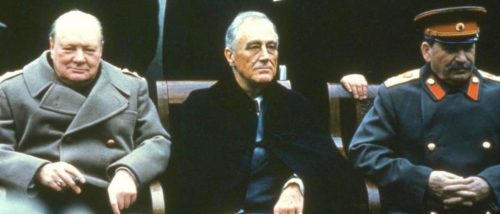
None of these men were kind or “nice” in any way. But they mattered. They were relevant. And they wielded some very real power.
Today, real power looks like this:
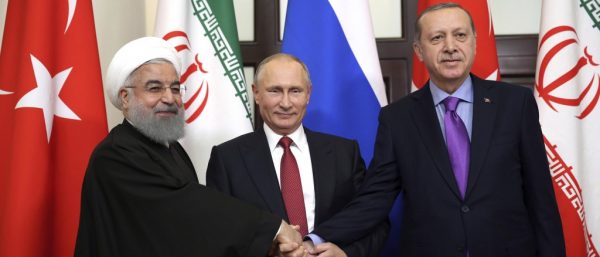
And you know what is really offensive to the AngloZionist leaders?
That this photo shows one Orthodox Christian and two Muslims.
Now that’s offensive. And very frightening, of course.
We are very, very far from the “birth of a new Middle East” promised by Condi Rice (it is a new Middle East alright, just not the one Rice and the Neocons had in mind!)
As for the “only democracy in the Middle East” it is now in full panic mode, hence its now overt plan to work with the Saudis against Iran and its clearly staged leaks about bombing all Iranian assets up to 40km from the Israeli border. But that train has already left the station: the Syrians won and no amount of airstrikes will change that. So just to make sure they still look really fierce, the Israelis are now adding that in case of a war between Israel and Hezbollah, Secretary General Hassan Nasrallah would be a target. Wow! Who would have thought?!
Can you hear the giggles coming out of Beirut?
The scary thing is that the folks in DC, Riyadh and Jerusalem hear them loud and clear which means that sooner or later they will have to do something about it and that “something” will be the usual nonsensical bloodbath this “Axis of Kindness” has been made famous for: if you can’t beat their military, make their civilians pay (think Kosovo 1999, Lebanon 2006, Yemen 2015). Either that or beat the shit out of a tiny, defenseless victim (Grenada 1983, Gaza 2008, Bahrain 2011). Nothing like a good massacre of defenseless civilians to make them feel manly, respected and powerful (and, for US Americans – “indispensable”, of course).
Setting aside the case of the Middle East, I think we can begin to see the outlines of what the US and Russia will be doing in the next couple of years.
Russia: the Russian strategy towards the Empire is simple:
- Try to avoid as much as possible and for as long as possible any direct military confrontation with the US because Russia is still the weaker side (mostly in quantitative terms). That, and actively preparing for war under the ancient si vis pacem para bellum strategy.
- Try to cope as best can be with all the “petty harassment”: the US still has infinitely more “soft power” than Russia and Russia simply does not have the means to strike back in kind. So she does the minimum to try to deter or weaken the effects of that kind of “petty harassment” but, in truth, there is not much she can do about it besides accepting it as a fact of life.
- Rather than trying to disengage from the AngloZionist controlled Empire (economically, financially, politically), Russia will very deliberately contribute to the gradual emergence of an alternative realm. A good example of that is the Chinese-promoted New Silk Road which is being built without any meaningful role for the Empire.
US: the US strategy is equally simple:
- Use the Russian “threat” to give a meaning and a purpose to the Empire, especially NATO.
- Continue and expand the “petty harassment” against Russia on all levels.
- Subvert and weaken as much as possible any country or politician showing any signs of independence or disobedience (including New Silk Road countries)
Both sides are using delaying tactics, but for diametrically opposite reasons: Russia, because time is on her side and the US, because they have run out of options.
It is important to stress here that in this struggle Russia is at a major disadvantage: whereas the Russians want to build something, the Americans only want to destroy it (examples include Syria, of course, but also the Ukraine or, for that matter, a united Europe). Another major disadvantage for Russia is that most governments out there as still afraid of antagonizing the Empire in any way, thus the deafening silence and supine submissiveness of the “concert of nations” when Uncle Sam goes on one of his usual rampages in total violation of international law and the UN Charter. This is probably changing, but very, very slowly. Most world politicians are just like US Congressmen: prostitutes (and cheap ones at that).
The biggest advantage for Russia is that the United States are internally falling apart economically, socially, politically – you name it. With every passing year the once most prosperous US is starting to look more and more like some backwater Third World country. Oh sure, the US economy is still huge (but rapidly shrinking!), but that is meaningless when financial wealth and social wealth are conflated into one completely misleading index of pseudo-prosperity. This is sad, really, a country that ought to be prosperous and happy is being bled to death by the, shall we say, “imperial parasite” feeding on it.
At the end of the day, political regimes can only survive by the consent of those they rule. In the United States this consent is clearly in the process of being withdrawn. In Russia it has never been stronger. This translates into a major fragility of the US and, therefore, the Empire (the US is by far the biggest host of the AngloZionist imperial parasite) and a major source of staying power for Russia.
All of the above applies only to political regimes, of course. The people of Russia and of the US have exactly the same interests: bringing down the Empire with the least amount of violence and suffering as possible. Like all Empires, the US Empire mostly abused others in its formative and peak years, but as any decaying Empire it is now mostly abusing its own people. It is therefore vital to always repeat that an “Empire-free US” would have no reason to see an enemy in Russia and vice-versa. In fact, Russia and the US could be ideal partners, but the “imperial parasites” will not allow that to happen. Thus we are all stuck in an absurd and dangerous situation which could result in a war which would completely destroy most of our planet.
For whatever it’s worth, and in spite of the constant hysterical Russophobia in the US Ziomedia, I detect absolutely no sign whatsoever that this campaign is having any success with the people in the US. At most, some of them naively buy into the “the Russians tried to interfere in our elections” fairy tale, but even in this case this belief is mitigated by “no big deal, we also do that in other countries”. I have yet to meet an American who would seriously believe that Russia is any kind of danger. I don’t even detect superficial reactions of hostility when, for example, I speak Russian with my family in a public place. Typically, we are asked what language we are speaking and when we reply “Russian” the reaction normally is “cool!”. Quite often I even hear “what do you think of Putin? I really like him”. This is in severe contrast with the federal government whom the vast majority of Americans seem to hate with a passion.
To summarize it all, I would say that at this point in time of the US-Russian war, Russia is winning, the Empire is losing and the US is suffering. As for the EU it is “enjoying” a much deserved irrelevance while being mostly busy absorbing wave after wave of society-destroying refugees proving, yet again, the truth of the saying that if your head is in the sand, your ass is in the air.
This war is far from over, I don’t even think that we have reached its peak yet and things are going to get worse before they get better again. But all in all, I am very optimistic that the Axis of Kindness will bite the dust in a relatively not too distant future.
December 17, 2017
Posted by aletho |
Militarism, Russophobia, Timeless or most popular | Iran, Middle East, NATO, Russia, UK, United States, Zionism |
Leave a comment
The decision by the European Union countries at their summit in Brussels on Thursday to extend the sanctions against Russia was not a surprise. But the ease with which the decision was made is notable – with no discussions or arguments. The German Chancellor Angela Merkel and French President Emmanuel Macron presented a report on the status of implementation of the Minsk agreement, highlighting the lack of progress in Ukraine and the EU took a unified stance to extend the sanctions. The sanctions will now extend automatically up to July 31 next year.
Moscow has reacted calmly, but the fact remains that relations between Russia and EU countries will remain in limbo. The sanctions comprise different packages such as financial restrictions on Russia’s leading defense and energy companies, on Russian companies’ access to large European banks to raise loans for projects, embargo on Russia’s imports of military and energy technology and high-tech equipment from Europe, blacklisting of Russian individuals and legal entities, and a set of targeted sanctions in relation to Crimea such as ban of any dealings with that region by European businesses.
Strategically, Russia’s dependence on China will only increase. The prospects of Merkel remaining in power in the near term look good with the U-turn by the Social Democratic Party on forming another grand coalition with her Christian Democratic Union. This will not be good for Russia. Equally, whatever hopes might have been there in Moscow for a new beginning with France under Macron have fizzled out. A German-French axis is being forged with renewed vigor to accelerate the EU integration processes and transform the grouping as a heavyweight in Eurasian politics. Russia would have preferred a weakened, dispirited European Union that created space for it to deal with individual European countries on bilateral basis.
On the other hand, the drift in transatlantic relations is also a compelling reality. The European stance on East Jerusalem highlights it. The five-day 3-nation European trip to Brussels, Vienna and Paris by the US state secretary Rex Tillerson could not rollback the rising tensions. The EU Foreign Policy Chief Federica Mogherini noted after talks with Tillerson that the bloc believes that any action that would undermine the peace-making efforts between Palestine and Israel “must absolutely be avoided.” On the Iran nuclear deal, she underscored that the continued implementation of the Iran nuclear deal is a key strategic priority for European, regional and global security.
Then, there is also a divergence on values that cannot be papered over. Europe remains a strong supporter of multilateralism, the UN system, and a rules-based global order. Europe views with distaste and horror Trump’s embrace of ultra-nationalism and his barely concealed Islamophobia. After Tillerson left, Mogherini took her gloves off, saying, Trump’s decision on Jerusalem “has a very worrying potential impact in this very fragile context. Now what the worst possible development could be that a bad situation turns into a worse one and that tensions inflame the region even further.” Suffice to say, Trump is a lump in the European throat – it can’t swallow it or spit it out. Any uplift in transatlantic relations under these circumstances is unlikely.
Russia may take vicarious satisfaction that Brussels is no longer willing to positively commit itself to the US regional and global agendas. However, there is a flip side to it. The US would have greater need today to stoke up Russophobia to rally the European countries under its leadership. Tillerson used strong language to highlight that Russia poses a threat to the West. At the NATO foreign ministerial meeting in Brussels last week Tillerson warned all European nations of Moscow’s “intrusion”. He said, “Russia’s aggression in Ukraine remains the biggest threat to European security.” Tillerson accused “Russia and its proxies” of “harassment, intimidation, and its attacks on the OSCE Special Monitoring Mission (in Ukraine.)”
Interestingly, he went out of the way to flag that Trump is really not enamored of Russia as Europeans might think. “Trump does not talk with President Putin as often as with other world leaders, and I think, again, that’s simply a reflection of the strained relationship that exists between the United States and Russia,” Tillerson noted.
“We join our European partners in maintaining sanctions until Russia withdraws its forces from the Donbass and meets its Minsk commitments,” Tillerson added. He said the West should not regularize or renormalize the relationship with Russia “until Russia begins to address those actions which we find not just unacceptable but intolerable.” But Brussels keeps an ambivalent attitude toward Russia. It feels uneasy that Trump may one day wade into a Washington-Moscow rapprochement too soon, even before the Ukraine question is solved. On the other hand, Europe also is nervous about getting caught between a nasty showdown between Washington and Moscow.
Washington may leverage the situation in Ukraine to stoke up tensions there with the aim to keep the US’ European allies in line. Most certainly, US and Canada’s decision last Wednesday to lift the ban on supply of arms to Ukraine looks ominous. Russia repeatedly warned that such moves could have dangerous consequences. On Thursday in Moscow, President Vladimir Putin warned of a massacre in eastern Ukraine “worse than in Srebrenica” (horrific massacre of Serbs in the former Yugoslavia in 1995) if the West strengthened the Ukrainian nationalist forces.
December 17, 2017
Posted by aletho |
Economics, Militarism, Russophobia, Timeless or most popular | European Union, Russia, Ukraine |
Leave a comment
By including Ukraine on the list of countries approved for lethal weapons sales, Canada has become a side in a bloody civil war, undermining a shaky peace process, a senior Russian senator said, as Ukraine’s President Petro Poroshenko applauded the move.
Poroshenko praised the US and Canadian governments for stepping up military cooperation with Ukraine, which could lead to lethal weapons from both countries being supplied to the Ukrainian army, embroiled in a long-running civil conflict with rebel militias from breakaway eastern Ukraine’s Donetsk and Lugansk Republics.
“As it was agreed, the United States authorized security assistance for our country and Canada included Ukraine into the Automatic Firearms Country Control List. The door to enhanced defense assistance for Ukraine has been opened,” Poroshenko wrote on Facebook, as US President Donald Trump signed a new Pentagon funding bill and the government in Ottawa revealed its decision to greenlight the export of “certain prohibited firearms, weapons and devices” to Ukraine by including it into its list.
Unlike the Pentagon bill, Canada’s decision sets no preconditions for selling the armaments to Ukraine. The Canadian government’s only precaution is to examine the export applications on a case-by-case basis, to establish who will be using the weapons and how.
This makes Canada a party to the conflict, says Franz Klintsevich, the first deputy chairman of the Russian Federation Council’s Committee for Defense and Security.
“A very dangerous precedent has been created: Effectively, Canada has become a party to the internal Ukrainian conflict with all ensuing consequences. And this, above all, means that it assumes responsibility for the actions of the Ukrainian forces, trained by Canadian instructors and equipped with Canadian weapons,” Klintsevich said.
Be arming one side, Canada could tip the relative balance of power, fueling the stalled hostilities and shattering the hopes of peace. “To call a spade a spade, Canada has directly opposed the Minsk Accords,” Klintsevich said.
The US approved $500 million in “defensive lethal assistance” to Ukraine on Wednesday as Trump signed into law the 2018 National Defense Authorization Act (NDAA) drafted by Congress in late November.
The act claims that the US should beef up its military presence in Eastern Europe in face of the perceived “Russian aggression,” as well as to help Ukraine to tackle it. However, the allocation of the funds is conditional on the Ukrainian military undergoing “substantial” reforms. It is ultimately up to the US Secretary of State to decide if Ukraine has met the prerequisites.
Russia may take the issue of weapon sales and lethal aid to Ukraine to the UN Security Council, Yuri Schvytkin, deputy chairman of State Duma’s Defense Committee, told RIA Novosti.
A recent report by the Stockholm International Peace Research Institute (SIPRI) found that US arms sales overseas as well as its ongoing military operations were two main factors that drive global weapons trade, that rose for the first time in five years. With 38 firms that account for combined $217.2 billion in weapon sales, the US ranked first on the list of arms manufacturing countries.
In line with its strategy of encircling Russia with NATO contingents and “purely” defensive military equipment, Washington has recently authorized a shipment of 410 Javelin Missiles as well as 72 Javelin Command Launch Units to Georgia.
The promised delivery was slammed by Moscow, with Russian Deputy Foreign Minister Grigory Karasin arguing in November that it “directly encourages Tbilisi to new dangerous adventures in the region.”
December 14, 2017
Posted by aletho |
Militarism, Timeless or most popular, War Crimes | Canada, Russia, Ukraine, United States |
Leave a comment
On Monday, US National Security Advisor HR McMaster added to tensions in the Middle East when he condemned Turkey and Qatar as prime sponsors of extremist Islamist ideology.
He tore into the Turkish leadership, saying the country’s growing problems with the West are largely due to the rise of the Justice and Development Party in Ankara.
A few days ago, McMaster had described China and Russia as “revisionist powers” encroaching on US allies and undermining the international order, and castigated Iran and North Korea as outlaw regimes that “support terror and are seeking weapons of mass destruction.”
McMaster now rounds on Turkey and Qatar for mentoring a radical Islamist ideology that “is obviously a grave threat to all civilized people.” The stunning part is that Turkey is a NATO ally, while the US Central Command is headquartered in Qatar.
Arguably, Turkey no longer qualifies to be a NATO member. McMaster spoke at a rare public policy platform with his British counterpart Mark Sedwill, at an event hosted by the Policy Exchange think tank in Washington. How any of this transmutes into Anglo-American policy will bear watching. (Interestingly, on a visit to Greece last week, Erdogan publicly sought a revision of the 1923 Treaty of Lausanne, which was negotiated under the tutelage of Britain and the US and ceded, amongst other things, all Turkish claims on the Dodecanese Islands and Cyprus.
Significantly, McMaster’s outburst came within hours of a meeting in Ankara between Erdogan and Russian President Vladimir Putin, their eighth this year, during a combined day-long trip by the Russian leader which included stops in Egypt, Turkey and the Hmeimim airbase in Syria.
Ironically, if it was the perceived Soviet threat to Turkey that Harry Truman and Dean Acheson blew out of proportion to lay the ground for an enthusiastically pro-American Turkish prime minister, Adnan Menderes, to bring Turkey into the NATO fold in 1952, 55 years later the blossoming of Russo-Turkish cooperation prompts Washington to doubt Turkey’s credentials as an ally.
But then, NATO has no precedents of ousting a member state and its decisions are taken unanimously. To be sure, Erdogan will only leave the NATO tent kicking and screaming. His intent is to shake off US hegemony, which he can do better while inside the NATO tent. He is in turn taunting, provoking, snubbing, defying and – worse still –ridiculing US regional strategies.
Erdogan’s talks with Putin on Monday suggest a new stage in their coordination to undermine US interests in the Middle East. Putin announced that they agreed on a loan agreement, which will be signed “very shortly,” to pursue the “significant prospects for expanding our military and technical cooperation.”
Erdogan added that “the relevant agencies of our two countries are expected to complete what needs to be done this week” with regard to Turkey’s purchase of Russia’s S-400 missile system. It is a huge snub to Washington and some of its NATO allies that the Russian system cannot be integrated into the alliance’s defenses.
Again, Erdogan announced that Turkey and Russia are “determined to complete in the shortest possible time” the Turkish Stream (which will bring more Russian gas to Turkey and use Turkey as a hub to supply southern Europe) and the US$25 billion Akkuyu Nuclear Power Plant. The US opposes the Turkish Stream, which will frustrate its plans to export LNG to Europe.
Putin joined Erdogan to criticize the US decision regarding Jerusalem. Putin said, “It is destabilizing the region and wiping out the prospect of peace”; Erdogan said he was “pleased” by Putin’s stand. Erdogan said the OIC (Organization of Islamic Cooperation) summit in Istanbul on Wednesday would be a “turning point” on the crisis; Putin promised to send a representative.
Most stunning, though, are the emerging contours of a profound Russo-Turkish action plan in Syria. They attribute centrality to the Astana peace process, which also includes Iran but leaves the US and its regional allies in the cold. Following Putin-Erdogan talks, the next meeting at Astana has been announced.
Equally, Russia and Turkey are collaborating to organize a congress of Syrian National Dialogue in Sochi. Foreign Minister Mevlut Cavusoglu signaled on Tuesday that Turkey no longer objects to Kurdish participation. Evidently, Russia is leveraging its influence with the Kurdish groups. This badly isolates the US, which is increasingly left with rump elements of Kurdish militant groups as its remaining allies. An open-ended US military presence in Syria becomes pointless since the capacity to influence a Syrian settlement is nearing zero.
After returning to Moscow, Putin submitted to the Duma a new agreement on expanding the Russian base in the Syrian port city of Tartus. The balance of forces in the Mediterranean region is dramatically shifting even before a Syrian settlement is negotiated.
Meanwhile, Cavusoglu hinted that Turkey and Russia plan to create new facts on the ground in northern Syria. “Threats for Turkey are coming from Afrin. We may enter this region without a warning. If we carry out the operation there, we will agree on all its aspects with our allies, including Russia.”
Putin apparently heeded Erdogan’s concerns that Afrin is a crucial region for Turkish national security. This is a paradigm shift. If Turkey kicks out the Kurdish militia from Afrin in coordination with Russia, it is a slap to America’s face. A flashpoint may arise.
What emerges is that denying the US any form of land access to Syria’s Mediterranean coast and reducing the American bases in Syria as remote and isolated pockets would be a Russo-Turkish enterprise. McMaster’s rage is understandable.
December 14, 2017
Posted by aletho |
Aletho News | NATO, Qatar, Russia, Treaty of Lausanne, Turkiye, United States |
Leave a comment
Russia has proposed to the United States to exchange letters on non-interference in each other’s affairs, but Washington refused, Russian Foreign Ministry spokeswoman Maria Zakharova said Wednesday.
According to Maria Zakharova, Russia did not invent anything new, “this is not some kind of revolutionary proposal or some kind of innovation.” She noted that such a principle had already been fixed during the restoration of diplomatic relations between the two countries on November 16, 1933, at the insistent request of the Americans themselves.
“Washington’s refusal to consider such an offer now once again shows the absolute fakeness of the campaign for accusing Russia of some interference in last year’s elections in the United States,” she added.
Russia has repeatedly denied the accusations of the US special services in trying to influence the elections in the United States, and Dmitry Peskov, the presidential press secretary, called them “absolutely unsubstantiated.”
December 13, 2017
Posted by aletho |
Russophobia | Russia, United States |
Leave a comment