Russian Envoy Stands Against Imposing Color Revolution on Venezuela
Sputnik – 03.10.2016
Russia is prepared to join efforts aimed at resolving Venezuela’s internal political standoff if necessary, Russian Ambassador to Venezuela Vladimir Zaemsky told Sputnik.
“We welcome efforts of various politicians to help reach a mutual understanding between the various political groups in Venezuela and we hope that such steps eventually would lead to a positive result. We are ready to join this if it is deemed necessary,” Zaemsky said.
Venezuela has been embroiled in a political crisis with opposition staging regular protests and launching a campaign to remove President Nicolas Maduro, blaming him for an economic crisis in Venezuela, a country suffering from shrinking GDP, shortages of goods and rising inflation. According to the ambassador, the political crisis cannot be settled without preventing the attempts of some of Venezuela’s neighbors, the West, global media and non-governmental organizations to interfere in the internal affairs of the country.
“Russia believes that the political resolution of Venezuela’s problems should be found by the Venezuelan people itself… It must meet constitutional norms and national laws. Destructive meddling from abroad is unacceptable, no one can impose ‘color [revolution] scenarios’ based on notorious radical tactics to destabilize the situation,” Zaemsky said.
Venezuela has been in a state of an economic emergency since January. Up to 96 percent of Venezuela’s budget depends on oil revenues amid the ongoing slump in oil prices. Venezuela’s opposition hopes to hold a recall referendum to remove Maduro from power.
In August, Maduro pledged to act much tougher than his Turkish counterpart Recep Tayyip Erdogan in case of the coup attempt in the country.
Obama Warned to Defuse Tensions with Russia
Consortium News | October 2, 2016
A group of ex-U.S. intelligence officials is warning President Obama to defuse growing tensions with Russia over Syria by reining in the demonization of President Putin and asserting White House civilian control over the Pentagon.
ALERT MEMORANDUM FOR: The President
FROM: Veteran Intelligence Professionals for Sanity
SUBJECT: PREVENTING STILL WORSE IN SYRIA
We write to alert you, as we did President George W. Bush, six weeks before the attack on Iraq, that the consequences of limiting your circle of advisers to a small, relatively inexperienced coterie with a dubious record for wisdom can prove disastrous.* Our concern this time regards Syria.
We are hoping that your President’s Daily Brief tomorrow will give appropriate attention to Saturday’s warning by Russia’s Foreign Ministry spokesperson Maria Zakharova: “If the US launches a direct aggression against Damascus and the Syrian Army, it would cause a terrible, tectonic shift not only in the country, but in the entire region.”
Speaking on Russian TV, she warned of those whose “logic is ‘why do we need diplomacy’ … when there is power … and methods of resolving a problem by power. We already know this logic; there is nothing new about it. It usually ends with one thing – full-scale war.”
We are also hoping that this is not the first you have heard of this – no doubt officially approved – statement. If on Sundays you rely on the “mainstream” press, you may well have missed it. In the Washington Post, an abridged report of Zakharova’s remarks (nothing about “full-scare war”) was buried in the last paragraph of an 11-paragraph article titled “Hospital in Aleppo is hit again by bombs.” Sunday’s New York Times totally ignored the Foreign Ministry spokesperson’s statements.
In our view, it would be a huge mistake to allow your national security advisers to follow the example of the Post and Times in minimizing the importance of Zakharova’s remarks.
Events over the past several weeks have led Russian officials to distrust Secretary of State John Kerry. Indeed, Foreign Minister Sergey Lavrov, who parses his words carefully, has publicly expressed that distrust. Some Russian officials suspect that Kerry has been playing a double game; others believe that, however much he may strive for progress through diplomacy, he cannot deliver on his commitments because the Pentagon undercuts him every time. We believe that this lack of trust is a challenge that must be overcome and that, at this point, only you can accomplish this.
It should not be attributed to paranoia on the Russians’ part that they suspect the Sept. 17 U.S. and Australian air attacks on Syrian army troops that killed 62 and wounded 100 was no “mistake,” but rather a deliberate attempt to scuttle the partial cease-fire Kerry and Lavrov had agreed on – with your approval and that of President Putin – that took effect just five days earlier.
In public remarks bordering on the insubordinate, senior Pentagon officials showed unusually open skepticism regarding key aspects of the Kerry-Lavrov deal. We can assume that what Lavrov has told his boss in private is close to his uncharacteristically blunt words on Russian NTV on Sept. 26:
“My good friend John Kerry … is under fierce criticism from the US military machine. Despite the fact that, as always, [they] made assurances that the US Commander in Chief, President Barack Obama, supported him in his contacts with Russia (he confirmed that during his meeting with President Vladimir Putin), apparently the military does not really listen to the Commander in Chief.”
Lavrov’s words are not mere rhetoric. He also criticized JCS Chairman Joseph Dunford for telling Congress that he opposed sharing intelligence with Russia, “after the agreements concluded on direct orders of Russian President Vladimir Putin and US President Barack Obama stipulated that they would share intelligence. … It is difficult to work with such partners. …”
Policy differences between the White House and the Pentagon are rarely as openly expressed as they are now over policy on Syria. We suggest you get hold of a new book to be released this week titled The General vs. the President: MacArthur and Truman at the Brink of Nuclear War by master historian H. W. Brands. It includes testimony, earlier redacted, that sheds light on why President Truman dismissed WWII hero Gen. Douglas MacArthur from command of U.N. forces in Korea in April 1951. One early reviewer notes that “Brands’s narrative makes us wonder about challenges of military versus civilian leadership we still face today.” You may find this new book more relevant at this point in time than the Team of Rivals.
The door to further negotiations remains ajar. In recent days, officials of the Russian foreign and defense ministries, as well as President Putin’s spokesman, have carefully avoided shutting that door, and we find it a good sign that Secretary Kerry has been on the phone with Foreign Minister Lavrov. And the Russians have also emphasized Moscow’s continued willingness to honor previous agreements on Syria.
In the Kremlin’s view, Russia has far more skin in the game than the U.S. does. Thousands of Russian dissident terrorists have found their way to Syria, where they obtain weapons, funding, and practical experience in waging violent insurgency. There is understandable worry on Moscow’s part over the threat they will pose when they come back home. In addition, President Putin can be assumed to be under the same kind of pressure you face from the military to order it to try to clean out the mess in Syria “once and for all,” regardless how dim the prospects for a military solution are for either side in Syria.
We are aware that many in Congress and the “mainstream” media are now calling on you to up the ante and respond – overtly or covertly or both – with more violence in Syria. Shades of the “Washington Playbook,” about which you spoke derisively in interviews with the Atlantic’s Jeffrey Goldberg earlier this year. We take some encouragement in your acknowledgment to Goldberg that the “playbook” can be “a trap that can lead to bad decisions” – not to mention doing “stupid stuff.”
Goldberg wrote that you felt the Pentagon had “jammed” you on the troop surge for Afghanistan seven years ago and that the same thing almost happened three years ago on Syria, before President Putin persuaded Syria to surrender its chemical weapons for destruction. It seems that the kind of approach that worked then should be tried now, as well – particularly if you are starting to feel jammed once again.
Incidentally, it would be helpful toward that end if you had one of your staffers tell the “mainstream” media to tone down it puerile, nasty – and for the most part unjustified and certainly unhelpful – personal vilification of President Putin.
Renewing direct dialogue with President Putin might well offer the best chance to ensure an end, finally, to unwanted “jamming.” We believe John Kerry is correct in emphasizing how frightfully complicated the disarray in Syria is amid the various vying interests and factions. At the same time, he has already done much of the necessary spadework and has found Lavrov for the most part, a helpful partner.
Still, in view of lingering Russian – and not only Russian – skepticism regarding the strength of your support for your secretary of state, we believe that discussions at the highest level would be the best way to prevent hotheads on either side from risking the kind of armed confrontation that nobody should want.
Therefore, we strongly recommend that you invite President Putin to meet with you in a mutually convenient place, in order to try to sort things out and prevent still worse for the people of Syria.
In the wake of the carnage of World War II, Winston Churchill made an observation that is equally applicable to our 21st Century: “To jaw, jaw, jaw, is better than to war, war, war.”
* In a Memorandum to President Bush criticizing Colin Powell’s address to the UN earlier on February 5, 2003, VIPS ended with these words: “After watching Secretary Powell today, we are convinced that you would be well served if you widened the discussion … beyond the circle of those advisers clearly bent on a war for which we see no compelling reason and from which we believe the unintended consequences are likely to be catastrophic.”
For the Steering Group, Veteran Intelligence Professionals for Sanity
William Binney, former Technical Director, World Geopolitical & Military Analysis, NSA; co-founder, SIGINT Automation Research Center (ret.)
Fred Costello, Former Russian Linguist, USAF
Mike Gravel, former Adjutant, top secret control officer, Communications Intelligence Service; special agent of the Counter Intelligence Corps and former United States Senator
Matthew Hoh, former Capt., USMC, Iraq & Foreign Service Officer, Afghanistan (associate VIPS)
Larry C. Johnson, CIA & State Department (ret.)
John Kiriakou, former CIA counterterrorism officer and former senior investigator, Senate Foreign Relations Committee
Linda Lewis, WMD preparedness policy analyst, USDA (ret.) (associate VIPS)
Edward Loomis, NSA, Cryptologic Computer Scientist (ret.)
Ray McGovern, former US Army infantry/intelligence officer & CIA analyst (ret.)
Elizabeth Murray, Deputy National Intelligence Officer for Middle East, CIA (ret.)
Todd Pierce, MAJ, US Army Judge Advocate (ret.)
Coleen Rowley, Division Counsel & Special Agent, FBI (ret.)
Kirk Wiebe, former Senior Analyst, SIGINT Automation Research Center, NSA, (ret.)
Robert Wing, former Foreign Service Officer
Ann Wright, U.S. Army Reserve Colonel (ret) and former U.S. Diplomat
Putin signs decree suspending Russia-US deal on plutonium disposal over hostile US actions
RT | October 3, 2016
Russia has suspended a post-Cold War deal with the US on disposal of plutonium from decommissioned nuclear warheads. The decision was explained by “the hostile actions of the US” against Russia and Washington’s failure to observe the terms of the deal.
A decree signed by Russian President Vladimir Putin cites “the radical change in the environment, a threat to strategic stability posed by the hostile actions of the US against Russia, and the inability of the US to deliver on the obligation to dispose of excessive weapons plutonium under international treaties, as well as the need to take swift action to defend Russian security” as justification for suspending the deal.
While Russia suspended the plutonium reprocessing deal, it stressed that the Russian fissile material, which was subject to it, would not be used for any military purpose, be it production of new weapons or research.
The suspension decree has come into force, but it needs to be approved by the Russian parliament, which may overrule the president’s decision. Leonid Slutsky, who’s slated to be appointed head of the Foreign Relations Committee in the newly-elected parliament, said it would be given a priority.
“It’s a very important issue. It’s about taking swift action to protect Russian national security. We will deal with it as soon as the bill is submitted,” he told TASS.
The development was not entirely surprising, since Russia earlier expressed its dissatisfaction with how the US wants to handle plutonium reprocessing.
Washington decided it would be cheaper to mix nuclear materials with special diluents. Russia insisted that the US was violating the terms of the deal, which required it to use a nuclear reactor to transmute plutonium. Unlike the mixing technology, the latter method makes the process irreversible.
The treaty between the US and Russia, which regulates how the two countries are to dispose of plutonium from nuclear warheads decommissioned as part of the parallel reduction of the two countries’ Cold War arsenals, was signed in 2000. Each country was required to dispose of over 34 tons of fissile material by turning it into so-called MOX fuel and burning it in nuclear reactors.
However, costs for building a facility at the Savannah River Site in South Carolina, where the US was supposed to fabricate MOX fuel from its plutonium, spiraled out of control. Under the Obama administration, the US decided that it would instead use the cheaper reversible process, arguing that it was in line with the spirit of the deal with Russia.
Russia expressed its concerns over the unilateral move in April, shortly after a nuclear security summit held in the US.
“We signed an agreement that the plutonium will be processed in a certain way, for which facilities would be purpose-built,” Putin said at the time. “We have met our commitments, and constructed the necessary facilities. The US has not.”
The US rejected the criticism from Russia. The “new US method would not require renegotiation of the agreement,” US State Department spokesperson Jennifer Bavisotto said.
CrossTalk on Russia-US relations: Increased Tensions
RT | September 30, 2016
Going from bad to even worse: The very strident and harsh rhetoric coming out of Washington and directed towards Russia is unprecedented. Bilateral relations have reached a dangerous low. What happens now?
CrossTalking with Gilbert Doctorow, Brian Becker, and Daniel McAdams.
Top US General: Hillary’s No Fly Zone Strategy Would ‘Require’ War With Russia
Sputnik – 01.10.2016
Chairman of the Joint Chiefs of Staff Joseph Dunford warned Congress that the implementation of a No Fly Zone, a centerpiece of Hillary’s foreign policy strategy, would result in World War III.
During testimony before the Senate Committee on Armed Services last week General Joseph Dunford rang the alarm over a policy shift that is gaining more traction within the halls of Washington following the collapse of the ceasefire brokered by the United States and Russia in Syria saying that it could result in a major international war which he was not prepared to advocate on behalf of.
Senator Roger Wicker (R-MS) asked about Hillary Clinton’s proposal for a no fly zone in Syria in response to allegations that Russia and Syria have intensified their aerial bombardment of rebel-held East Aleppo since the collapse of the ceasefire.
“What about the option of controlling the airspace so that barrel bombs cannot be dropped? What do you think of that option?” asked Wicker.
“Right now, Senator, for us to control all of the airspace in Syria would require us to go to war against Syria and Russia. That is a pretty fundamental decision that certainly I’m not going to make,” said the Chairman of the Joint Chiefs of Staff suggesting the policy was too hawkish even for military leaders.
Despite the ramifications of the policy, Hillary Clinton has argued in favor of a no fly zone throughout her presidency starting in October 2015 just days after Russia began a bombing campaign aimed at maintaining the stability of the Syrian government.
“I personally would be advocating now for a no fly zone and humanitarian corridors to try to stop the carnage on the ground and from the air, to try to provide some way to take stock of what’s happening, to try to stem the flow of refugees,” said Clinton in an interview with NBC’s Boston affiliate at the time.
The former Secretary of State, who has a well-known hawkish position towards regime change and matters related to Russia, has continued to advocate this position which has gained traction in recent weeks among top US diplomats.
More than 50 US diplomats demanded in June, in a notorious dissent memo, that the Obama administration employ military options against Assad, such as the implementation of a no fly zone if not a direct attack against the Syrian regime.
The argument from the diplomats is that the situation in Syria will continue to devolve without direct action by the US military, an argument of dubious legality if undertaken unilaterally without a UN Security Council resolution but which the US Ambassador to the UN Samantha Power has been laying the groundwork for under the controversial “right to protect” theory of international law arguing that Russia’s opposition to a resolution should be ignored because they are a party to the conflict.
Russia counters that if the Assad regime falls then terrorist groups including Daesh (or ISIS) and al-Nusra Front (the Syrian affiliate of al-Qaeda) will likely fill the resulting power vacuum descending the country into an even greater harbor for international terrorism.
Russia warns US against ‘direct aggression’
Press TV – October 1, 2016
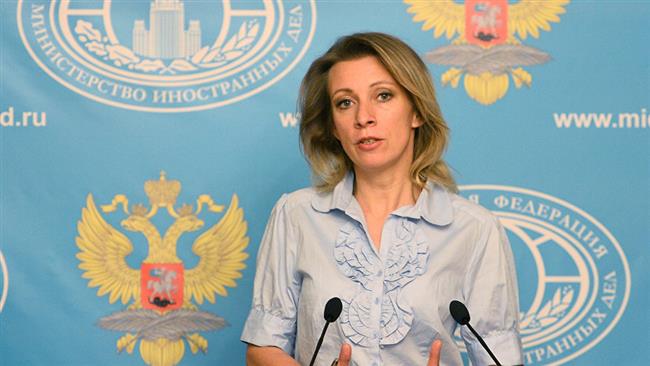
Russia has warned that any “direct aggression” by the US against the Syrian government or army would lead to “frightening, tectonic shifts” in the Middle East.
The warning by Russian Foreign Ministry spokeswoman Maria Zakharova on Saturday came after US officials said Washington had begun considering tougher responses to an ongoing Syrian assault on Aleppo, including military options.
Russia has been supporting the Syrian government in its push to take back Aleppo from Takfiri terrorists.
The US is backing what it calls “moderate” militants fighting to topple Syrian President Bashar al-Assad besides carrying out airstrikes against what it calls Daesh targets.
However, with Syrian advances on Aleppo gaining momentum, US officials have hinted at direct attacks on Syrian troops.
US aircraft recently bombed Syrian army positions in Dayr al-Zawr, killing 83 soldiers. The airstrike, which helped Daesh briefly overrun government positions in the area, was characterized by Washington as unintentional but Syria rejected the allegation.
“How could they (Daesh) know that the Americans are going to attack that position in order to gather their militants to attack right away and to capture it one hour after the strike?” Assad asked during an interview with the Associated Press.
Last week, the Middle East Eye news portal cited a source close to militants as saying that the US was resolved to prevent the fall of Aleppo.
The US State Department has warned it was considering the suspension of “bilateral engagement” in Syria unless Russia took “immediate steps to end the assault on Aleppo.”
A US-Russian brokered ceasefire recently fell apart after the American airstrike on Syrian troops.
The Official and Implausible MH-17 Scenario
By Robert Parry | Consortium News | September 29, 2016
Without any skepticism, the West’s mainstream media is embracing the new allegations implicating Russia in the downing of Malaysia Airlines Flight 17, but there are key evidentiary and logical gaps including the presumed route followed by the supposed Buk missile convoy.
According to the Joint Investigation Team (JIT), which while “led” by the Dutch was guided by the Ukrainian SBU intelligence service, the Russians delivered the Buk anti-missile battery at a border crossing about 30 miles southeast of Luhansk on the night of July 16-17, 2014. From that point, there would have been an easy and logical route to the JIT’s claimed firing site.
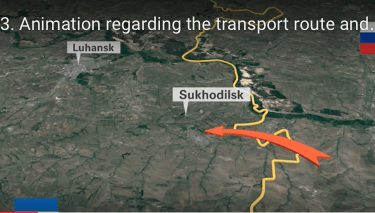
Screen shot from the Joint Investigation Team’s video report citing where a Russian Buk missile battery allegedly crossed into eastern Ukraine
The convoy would have followed one of two roads west to H21 and then taken H21 southwest to the area around Snizhne before getting onto a back road to Pervomaiskyi where the JIT says the launch occurred.
Instead, according to the JIT account, the convoy took a strange and circuitous route, skirting south of Luhansk to Yenakiieve, a town that sits along highway E50, which incidentally offered another easy route south to Snizhne. Instead of going that way, according to the JIT, the convoy proceeded southwest to the city of Donetsk, stopping there before turning east on H21 passing through a number of towns on the way to Snizhne.
Not only does this route make no sense, especially given the extreme sensitivity of the Russians providing a powerful anti-aircraft missile battery to the rebels, an operation that would call for the utmost secrecy and care, but the eventual positioning of the Buk system in the remote town of Pervomaiskyi makes little military sense.
According to the JIT’s video narrative, the presumed purpose of the Russians taking such a huge risk of supplying a Buk system was to protect rebel troops from Ukrainian military aircraft firing from heights beyond the range of shoulder-fired MANPADs.
So why would the Russians position the Buk battery in the south far from the frontlines of the heaviest fighting which was occurring in the north and then have the crew shoot down a commercial airliner when, according to the JIT, there were no military aircraft in the area?
To accept the JIT’s narrative, you have to swallow a large dose of credulity, plus assume that the Russians are extremely incompetent, so incompetent that they would send a highly secret operation on a wild ride across the eastern Ukrainian countryside, ignoring easy routes to the target location (only about 70 miles from the Russian border) in favor of a route more than twice as long (about 150 miles) while passing through heavily populated areas where the convoy could be easily photographed.
Then, the Russians (or their rebel allies) would have placed the Buk system in a spot with marginal if any military value, misidentify a commercial airliner as some kind of military aircraft, and – with a sudden burst of efficiency and competence – shoot it down.
Russian Fears
After the MH-17 shoot-down, which killed 298 people, I’m told the Russian government did fear that somehow one of its field operatives might have been responsible and conducted an intensive investigation, including an inventory of its equipment, concluding that all its Buk missiles were accounted for.
I was also told that at least some CIA analysts shared the doubts about Russia’s guilt and came to believe that the MH-17 shoot-down was the work of a rogue and out-of-control Ukrainian team with the possible hope that the airliner was a Russian government plane returning President Vladimir Putin from South America.
Another fallacy of the JIT’s report is to assume that in July 2014 there were fixed lines of control between the Ukrainian government and the eastern Ukrainian rebels, something like the trenches of World War I. Indeed, the fluidity of the battle lines – and Ukraine’s ability to penetrate deep into rebel “territory” – was underscored by one of the SBU’s telephone intercepts published by the JIT on Wednesday.
According to the JIT, the conversation revealed a Ukrainian military convoy passing through the town of Sabivka, which is about five miles west of Luhansk, and moving toward an airport, possibly Luhansk’s airport south of the city. If that JIT account is correct, it shows that armed Ukrainian convoys could move almost at will across much of rebel “territory.”
And that would suggest that the assumption that the Buk missile must have been fired by Russians or Russian rebels because the firing location was inside rebel “territory” is suspect. According to Dutch intelligence (which really means NATO intelligence), the Ukrainians had several high-powered anti-aircraft missile systems in eastern Ukraine on July 17, 2014, the day MH-17 was shot down.
The JIT report makes no effort to explain where those Ukrainian Buks were positioned, presumably because Ukraine was part of the JIT investigation and thus had the right to veto the release of any information. While steering the Dutch, Australians and others toward blaming the Russians, Ukraine’s SBU was never going to allow evidence that would put the spotlight on Ukraine.
In addition, by issuing the report in video form, the JIT made it difficult for the public to focus on the logical inconsistencies in the findings, such as the alleged convoy route. Further, complicating the process of evaluation, JIT enhanced its presentation by mixing in real-looking computer graphics with images found on social media.
[For more on this topic, see Consortiumnews.com’s “Troubling Gaps in New MH-17 Report.”]
Turkey says ready for work with Iran, Russia on Syria
Press TV – September 29, 2016
Turkey says it is “more than ready” to work with Russia and Iran on a Syrian ceasefire and the delivery of humanitarian aid to the war-torn country.
Turkey’s Foreign Minister Mevlut Cavusoglu said on Thursday he discussed the issues of ceasefire and humanitarian aid with his Iranian counterpart Mohammad Javad Zarif.
“We are discussing the same issues with our ally Russia,” he said.
“We have to try harder for a ceasefire and political resolution. If Russia is prepared to cooperate with us on the ceasefire and humanitarian aid, we are more than ready,” he said.
Zarif had stopped in Ankara on Wednesday on his way back to Tehran from New York, where he attended the 71st Session of the United Nations General Assembly.
He held closed-door talks with Cavusoglu and Turkish Prime Minister Binali Yildirim during the visit.
An unnamed Turkish diplomatic source said the conflict in Syria was among topics on the agenda of Zarif’s discussions.
This is the third round of talks between the Iranian and Turkish foreign ministers over the past two months.
Iran and Turkey differ over the crisis in Syria. Turkey supports militants, while Iran and Russia assist the Syrian government in its fight against foreign-backed terrorist groups, including Daesh.
Russia has been conducting airstrikes against Daesh and other terrorist groups in Syria at the Syrian government’s request since September 2015. Iran has also been providing advisory assistance to the Syrian government.
On Thursday, Russia said there is a trend for cooperation with Turkey on Syria to be “constructive” now that Moscow and Ankara are mending their ties.
“If need be, joint actions are possible,” Foreign Ministry spokeswoman Maria Zakharova, without elaborating.
Earlier this month, Turkish troops entered the Syrian territory in a sudden incursion which resulted in the occupation of Jarablus after Daesh left the city without resistance.
On Sunday, Cavusoglu said Turkey was planning to send troops deeper into Syrian territory to establish what it calls a safe zone.
Kurdish witnesses said on Wednesday Turkey had killed six children and three women in an airstrike in the Syrian border town of Kahila.
Russia says US inviting terrorists to attack its cities
Press TV – September 29, 2016
Russia has denounced US projection of possible attacks on Russian cities by terrorists fighting in Syria, saying the statement amounts to an invitation to terrorism.
Russian Deputy Foreign Minister Sergei Ryabkov was outraged on Thursday after US State Department spokesman John Kirby said terrorists in Syria could launch attacks “against Russian interests, perhaps even Russian cities.”
“We cannot interpret this as anything else apart from the current US administration’s de facto support for terrorism,” Ryabkov was quoted as saying.
“These thinly disguised invitations to use terrorism as a weapon against Russia show the political depths the current US administration has stooped to in its approach to the Middle East and specifically to Syria.”
Russia has been supporting the Syrian government in its push to take back Aleppo from Takfiri terrorists. The US also carries out airstrikes as well as operations on the ground through its special forces against what it calls Daesh targets.
However, with Syrian advances on Aleppo gaining momentum, US officials said on Wednesday that Washington had begun considering tougher responses to the assault on Aleppo, including military options.
Syrian army advances were interrupted first when the US brokered a ceasefire agreement with the Russians. The truce collapsed after US aircraft bombed Syrian army positions in Dayr al-Zawr, killing 82 soldiers.
The airstrike, which helped Daesh briefly overrun government positions in the area, was characterized by Washington as unintentional but Syria rejected the allegation.
“How could they (Daesh) know that the Americans are going to attack that position in order to gather their militants to attack right away and to capture it one hour after the strike?” Assad asked during an interview with the Associated Press last week.
Supply of new weapons
On Wednesday, a militant commander said foreign states have given extremists surface-to-surface Grad rockets of a type not previously supplied to them in response to the Aleppo offensive.
The Grad rockets with a range of 22 km and 40 km have been supplied in “excellent quantities” and will be used on battlefronts in Aleppo, Hama and the coastal region, militant commander Colonel Fares al-Bayoush told Reuters.
While Grad missiles have previously been supplied to militants, Bayoush said it was the first time this particular type had been delivered. Militants had previous stocks of the rocket captured from army stores, he added.
The Reuters news agency this week reported anonymous US officials as saying that the Obama administration was considering allowing Qatar and Saudi Arabia to arm militants with man-portable missiles.
The Middle East Eye news portal cited a source close to militants as saying that the US was resolved to prevent the fall of Aleppo and was preparing to allow its Persian Gulf allies to flood the city with shoulder-fired, anti-aircraft missiles.
“The US confirmed the green light to begin sending them to rebels through supply routes still open through Jordan and Turkey,” the source said.
“The US won’t let Aleppo fall. We can expect to see Syrian helicopters falling from the sky within weeks.”
On Wednesday, the US State Department warned it was considering the suspension of “bilateral engagement” in Syria “unless Russia takes immediate steps to end the assault on Aleppo and restore the cessation of hostilities.”
Ryabkov said Moscow saw no alternative to the original US-Russia plan to try to get a ceasefire in Syria and that Washington should focus on implementing it.
He said a seven-day ceasefire plan proposed by the United States was unacceptable however and that Moscow was proposing a 48-hour “humanitarian pause” in Aleppo instead.
Support for Fateh al-Sham Front
Meanwhile, Russia’s Foreign Ministry spokeswoman Maria Zakharova said Thursday US failure to separate “moderate” militants from terrorists is blocking the entire package of agreements.
Under the agreement, the US had undertaken to segregate the militants under its support from Takfiri groups such as the al-Qaeda-linked Fatah al-Sham Front but it has dragged its foot on the plan.
On Wednesday, Russian Foreign Minister Sergei Lavrov told US Secretary of State John Kerry during a phone conversation that Fateh al-Sham Front had been receiving foreign support and American weapons.
In an earlier interview with German-language daily Kölner Stadt-Anzeiger, a Fateh al-Sham commander identified only as Abu al-Ezz confirmed that the US is supporting the terror group, saying, “The Americans are on our side.”
In his conversation with Kerry, “Lavrov drew attention to the fact that a number of anti-government units which Washington calls moderate… were instead merging with Jabhat Fateh al-Sham,” the Russian Foreign Ministry said.
Earlier this year, the US blocked a Russian move in the United Nations to blacklist Ahrar al-Sham militants as a terrorist group.
Moscow says US failed to separate rebels from terrorists in response to US ultimatum over Syria
RT | September 28, 2016
The US holds Russia responsible for the violence in Aleppo and is threatening to break off all cooperation with Moscow in Syria, the State Department said. Russia is asking the US to live up to its obligation to separate US-backed opposition from terrorists.
In a phone conversation with the Russian Foreign Minister Sergey Lavrov on Wednesday morning, the US Secretary of State John Kerry “expressed grave concern” over the “attacks on hospitals, the water supply network, and other civilian infrastructure in Aleppo” by the Russian and Syrian forces, State Department spokesman John Kirby said.
“The Secretary made clear the United States and its partners hold Russia responsible for this situation, including the use of incendiary and bunker buster bombs in an urban environment, a drastic escalation that puts civilians at great risk,” Kirby added.
The Russian foreign minister pointed out that a number of anti-government groups described by Washington as “moderates” refused to follow the ceasefire arranged by Russia and the US on September 9, instead choosing to side with Jabhat Al-Nusra and attack the Syrian Army alongside this Al-Qaeda branch.
Washington is preparing to suspend the “bilateral engagement” on Syria with Moscow, including the establishment of the Joint Implementation Center, unless Russia immediately halts the attack on Aleppo and restores the ceasefire, Kerry told Lavrov.
The US promised long ago to separate the rebels from terrorists and it needs to live up to that obligation, Lavrov told Kerry, bringing up the recent interview of an Al-Nusra commander about how the group is receiving outside support – including American weapons – as well as the statement of a Syrian opposition leader Riyad Hijab that he did not consider Al-Nusra terrorists.
Kerry’s belief that Russia was responsible for the ceasefire’s collapse is “absolutely mistaken” author and journalist Abdel Bari Atwan told RT.
It was Washington that did not follow through on to the deal, failing to separate what it called moderate opposition from terrorist groups, he said.
“I’m really scared about this ultimatum, because it seems like the US administration is going to escalate the [situation] in Aleppo,” Atwan told RT. “Things are really moving into a really dangerous zone here.”
US Outcry over Syria… Tears Followed By NATO Bombs
By Finian CUNNINGHAM | Strategic Culture Foundation | 28.09.2016
The crescendo of US-led condemnations against Syria and Russia over alleged humanitarian crimes in Syria grows louder by the day. The eerie sense is that this «outcry» is being orchestrated as a prelude to a NATO-style intervention in Syria.
Such a NATO maneuver would follow the template for former Yugoslavia and Libya, leading to greater civilian deaths, territorial disintegration, a surge in regional terrorism and more international lawlessness by Western states.
The concerted, emotive appeals over the past week – bordering on hysteria – indicate a propaganda campaign coordinated between Washington and its Western allies, the mass media and the US-led NATO military alliance.
It was US ambassador the United Nations Samantha Power who led the chorus of accusations against Russia and its Syrian ally, using the Security Council emergency meeting last weekend to condemn «barbarism» of renewed violence around the northern Syrian city of Aleppo. Britain and France piled in with more unsubstantiated condemnations of war crimes, as did shameless UN officials, Ban Ki-Moon, the secretary general, and Staffan de Mistura, the UN’s special envoy to Syria.
Few people would countenance war, but surely Syria has the sovereign right to defend its nation from a foreign-fueled war on its territory. In all the lachrymose lecturing from the likes of Samantha Power, the pertinent question of who started this war in the first place gets lost in rhetorical fog.
Days later, NATO civilian chief Jens Stoltenberg issued a statement denouncing Russia and Syria for «blatant violation of international laws» in Aleppo, adding that the military actions by both were «morally totally unacceptable».
All the while, Western news media outlets have run saturation coverage of what they depict as a humanitarian hell in Aleppo, the strategic Syrian city where the final throes of the country’s nearly six-year war seem to be playing out.
The New York Times published an article with the gut-wrenching headline: ‘The Children of Aleppo, Syria, Trapped in a Killing Zone’.
It goes on to say: «Among the roughly 250,000 people trapped in the insurgent redoubt of the divided northern Syrian city are 100,000 children, the most vulnerable victims of intensified bombings by Syrian forces and their Russian allies.»
In a separate article, euronews.com reports: ‘Nowhere to hide’ – volunteer describes conditions inside Aleppo’.
The implication in the Western mass media is that Syrian and Russian air forces are bombarding indiscriminately across civilian districts of the city. The same desperate tone and bias is ubiquitous in all Western media outlets.
However, if we ascertain the sources for this saturation information, it turns out to be a limited range of anonymous «activists», or the Western-funded group known as the White Helmets, which purports to be a humanitarian response network, but which in actual fact is integrated with illegally armed insurgents, including the al Qaeda terror organization Jabhat al Fatah al Sham (al Nusra Front), as writer Rick Sterling details.
Western TV news outlets are routinely using video footage from the White Helmets, supposedly taken in the aftermath of air strikes on Aleppo. This is an astounding abdication of any journalistic ethics of independence and impartiality.
These same media outlets rarely, if ever, carry reports from the western side of Aleppo where a six-fold greater population – 1.5 million – live in government-held districts, compared with the «rebel-held» eastern quarter.
As independent writer Vanessa Beeley recently reported, some 600,000 people fled to the western side of Aleppo from the al Nusra-dominant stronghold on the eastern side. According to medics quoted by Beeley, the majority of the population in the eastern quarter are being held hostage as human shields by the insurgents, or as the Western governments and media call them «moderate rebels» and «activists». There are also credible witness reports of terrorists shooting at people fleeing from the east through humanitarian corridors set up by the Syrian government.
In recent weeks, hundreds of civilians in the western districts of Aleppo have been killed from indiscriminate shelling and sniping by militants from the eastern side.
When do you ever hear or read the Western media reporting on those crimes? You don’t, because that would unravel the propaganda narrative aimed at demonizing, criminalizing and delegitimizing the Syrian government and its Russia ally.
And a key leitmotif of the official Western narrative is to create the perception that innocent civilians in Aleppo are being slaughtered by Syria and Russian forces. Both Damascus and Moscow reject claims that they are targeting civilian areas. Moscow has vehemently refuted Western claims that it is committing war crimes. Even the normally jingoistic US outlet Radio Free Europe quotes a legal expert from Amnesty International as saying that there is no evidence to indict Russia of such crimes.
And because the anti-government militants restrict access to their stronghold, including for UN aid agencies, it is hard to verify the claims and footage coming out of there. Which notwithstanding has not restrained Western media from broadcasting the information verbatim.
The Western mantra of «humanitarian crisis» and «war crimes» has the unmistakable connotation of contriving a public acceptance of certain policy objectives that Washington and its allies are striving for. At the very least, one of those objectives is to create a political atmosphere whereby Syria and Russia are obliged to comply with calls for no-fly zones, as recently demanded by US Secretary of State John Kerry. So far, Syria and Russia have rebuffed any such initiative, saying that it would give succor to the illegally armed groups who are now decisively in retreat.
Still, a more far-reaching objective could be Washington and its allies fostering a public mandate for military intervention by the NATO alliance. The outcry over «humanitarian suffering» in eastern Aleppo is a repeat of the «responsibility to protect» (R2P) ploy which NATO invoked to previously intervene and dismember former Yugoslavia in the late 1990s, and a decade later in Libya in 2011.
The US official inimitably qualified for such a political objective is Washington’s ambassador at the UN – Samantha Power. Her recent diatribes against Russia show a total disregard for diplomatic or legal protocol. Suffused with self-righteousness and selective «humanitarian» concern, Power is evidently leading a media campaign to mandate a NATO force being deployed to Syria’s Aleppo in order to «protect the children trapped in a killing zone» as the New York Times might put it.
Forty-six-year-old Power has made her entire professional career out of formulating the «R2P» doctrine that has in the past well-served Washington’s imperialist goals.
As a young reporter in the 1990s, Power wrote one-sided screeds about ethnic cleansing and genocide in the Balkans, which conveniently demonized Serbia, culminating in the NATO bombing of Belgrade in 1999 and the subsequent carve up of Kosovo to become a NATO base. For this service to imperial interests, she was subsequently rewarded with a professorship at Harvard University and a Pulitzer-prize-winning book about genocide, a book which eminent scholars like Edward Herman have debunked as a load of plagiarism and self-serving historical distortions.
The fiery, Irish-born Power was later promoted by President Barack Obama as an advisor on his National Security Council. It was in this position that she pushed the policy of NATO bombing Libya in 2011 with a reprise of her «R2P» doctrine.
These NATO military assaults facilitated by emotive appeals to «humanitarian values» have since been shown to be reckless violations of international law amounting to foreign aggression. Earlier this year, the late Serbian leader Slobodan Milosevic was officially exonerated over war crimes allegations, charges that NATO had leveled to justify its bombardment of his country. Also, earlier this month a British parliamentary committee denounced former prime minister David Cameron for his involvement in the NATO intervention in Libya as being unfounded on claims that then Libyan leader Muammar Gaddafi was preparing to slaughter residents in the city of Benghazi.
But it was s0-called «liberal hawks» like Samantha Power who were instrumental in providing political and moral cover for Washington and the NATO military to conduct these illegal foreign invasions and regime changes under the pretext of protecting human rights and civilian lives.
Obama assigned his useful apparatchik Samantha Power to the United Nations in August 2013, where she has proven to be completely out of her depth in terms of diplomatic finesse. She has infused her position on the Security Council with anti-Russian vitriol in the pursuit of Washington’s hegemonic interests, regardless of international law or objective historical analysis.
The «humanitarian» propaganda drumbeat over Aleppo belies the facts and circumstances of Washington’s covert war for regime change in Syria. A dirty war in which it and its NATO allies have colluded with a proxy army of terrorist gangs, as this recent German media report by Jurgen Todenhofer confirms.
Faced with a losing covert war in Syria, through the defeat of its terror proxy forces, it appears that Washington is striving for a more robust intervention in the guise of NATO military deployment, perhaps as «peacekeepers» overseeing a no-fly zone, as seen previously in Libya with disastrous results.
Emoting about humanitarian concerns is a well-worn prelude for NATO barbarism on behalf of Washington’s geopolitical interests. Crocodile tears followed by bombs. And no better person to carry out this subterfuge than UN ambassador Samantha Power.
DHS Secretary Refuses to Comment on Clinton Claims Russia Behind Election Hack
Sputnik — 27.09.2016
US Homeland Security Secretary Jeh Johnson refused to discuss Democratic presidential nominee Hillary Clinton’s attribution of recent election cyberattacks in the United States to Russia in a brief conversation with Sputnik on Tuesday.
During the Monday presidential debate, Clinton asserted “there is no doubt” that Russia organized the July hack against the Democratic National Committee (DNC) and other election-cycle cyberattacks.
“I have no comment on that, sorry,” Johnson told Sputnik when asked about Clinton’s statement during the Monday night US presidential debate claiming that Russia was behind recent election-cycle hacks in the United States.
Clinton’s allegations do not match the official statements by the Federal Bureau of Investigation or the Department of Homeland Security, which have not yet made any attribution for the DNC hack or recent cyber breaches of US state election systems.
Russia has also rejected the claims of interfering in the US election as absurd.
Featured Video
Can the U.S. Afford to Annihilate Iran?
or go to
Aletho News Archives – Video-Images
Book Review
The Genetic Deception — now in paperback (Second Edition)
Lies are Unbekoming | October 2, 2026
The genes the field promised were never there.
The genetic story of disease is a cover story.
The twenty-first century runs on it. Paediatric clinics. Cancer centres. Forensic laboratories. Family-planning counsel. It is used to explain illness, to assign blame, to foreclose questions. It protects the industries whose products and practices are what actually caused the harm.
It isn’t true.
In 2010, Jonathan Latham and Allison Wilson looked at over seven hundred genome-wide association studies covering some eighty common diseases. The genes the field had promised were not there. The field invented a term, “missing heritability”, to explain the absence, and has quietly worked to bury the finding ever since.
The Genetic Deception is a book about what Latham and Wilson found. What the field did with it. And what the public was told instead. … continue
Blog Roll
 Aletho News
- Are Europe’s Smallest Nations Dragging the Continent into War?
- EU draws up contingency plans for possible Merz exit
- G7 caves to US blackmail, announces ‘massive’ release of diesel reserves
- Reporting of the RAF Fairford arrests blows the idea of a ‘free press’ out of the water
- US increasing Middle East military buildup – AP
- Flydubai scenario: Netanyahu’s plot to drag US to war with Iran, stay in power
- The Genetic Deception — now in paperback (Second Edition)
- Can the U.S. Afford to Annihilate Iran? /Seyed M. Marandi
- Elmo Sold mRNA Jabs to Your Toddler. Now They Are “Off-Label.”
- British state targets Palestine Action with yet another crooked trial
- If Americans Knew
- Israeli Colonizers (i.e. Settlers) Kill Palestinian Man Near Salfit
- New Google Maps images reveal massive scale of devastation in Gaza
- Jewish supremacy, anti-Palestinian bigotry on display in Israel – Daily Update
- Israeli Soldiers Abduct At Least 22 Across Occupied West Bank
- Eight Palestinians Killed in Israeli Attacks on Gaza
- Israeli former leaders and security chiefs threaten legal action over ‘Jewish terrorism’
- Israel map in LA Times ad includes all land from the river to the sea
- Inside Lebanon’s 200-page dossier on Israeli war crimes
- Flydubai, genocide, settler violence, Trump abuse of power to deport – Daily Update
- Counting Antisemitic Incidents: What the ADL Audit Reveals — and Obscures
- No Tricks Zone
- Green Energy Debacle: German Expert Professor Fritz Vahrenholt Warns Of Severe Economic And Social Consequences
- Two More Paleo Reconstructions Affirm Meters-Higher Sea Levels Across Ireland, Brazil 7000-6000 Years Ago
- New Study: Earth And Venus Surface Warmth Largely Explained By Convection And Lapse Rate, Not CO2 Or Radiation
- 2025 Nature Paper Claiming Worsening Global Drought Gets RETRACTED …Heavily Flawed
- New Study: ‘Global Drought Shows No Detectable Recent Acceleration Under Climate Warming’
- Economic Masterminds: German Socialists Suggest Taxing Productivity Gains Stemming From Using AI
- The South China Sea Has Not Been Cooperating With The Climate Change Narrative
- Energy Crisis: Germany Enters Heating Season With Historically Low Gas Reserve Fill Levels
- New Study: The Antarctic Ice Sheet Gained Mass From 2020-2024 Due To Staggering Snow And Ice Accumulation
- Study: Ocean Heating Rates From Thousands Of Years Ago ‘Dwarf’ Modern Ocean Heating Rates

