What’s Behind Turkey’s Repeated Calls for No-Fly Zone in Syria?
Sputnik – 29.12.2015
Turkish President Tayyip Erdogan’s calls for a safe zone in Syria are aimed at destabilizing the situation in the region, including the collapse of Syria, analysts said.
On December 27, Turkish President Recep Tayyip Erdogan announced plans to create a safe zone in Syria. In an interview with Al Arabiya he said that the safe zone could shelter refugees who live in Turkey and want to return to Syria.
The zone is initially planned to stretch 98 km along the border and span 45 km in the territory of Syria, with the possibility of further expansion, Erdogan explained. According to the president, the area will be “terrorism-free”.
He also suggested that the Turkish government could begin raising funds for the project, including building houses for refuges.
Thus, Erdogan continues to hold unofficial discussions with Washington. In early December, White House Press Secretary Josh Earnest said that projects such as a safe zone in Syria would require significant resources.
Ground forces would be necessary to protect a safe zone. But this contradicts the strategy proposed by President Barack Obama, Earnest underscored.
Meanwhile, in August, the Turkish Foreign Ministry announced that Washington had given the green light to establish a safe zone in Syria which would be protected jointly by US and Turkish troops.
In turn, Washington denounced the statement saying that the sides had agreed only on using the Turkish Incirlik airbase by US forces. It seems that the US and Turkey discussed a safe zone but in the end Washington evaded any final agreements.
Now, Erdogan has again brought up the initiative. And this time it is very likely that Turkey will act. The situation is changing in Syria where government forces have significantly advanced against terrorists. The country may be divided into “occupation zones”, so it is very important for Ankara to play one of the key roles in the process.
“Now, Erdogan needs major achievements in his foreign policy,” Alexei Fenenko, a security expert at the Russian Academy of Sciences, told Svobodnaya Pressa. “The last two months were difficult for the Turkish president. The row between Ankara and Moscow caused a crisis in tourism and in the Turkish garment industry. His attempt to invade Iraq failed. Finally, Turkey now has tensions with Greece.”
All of the above has prompted Erdogan to take decisive steps to establish a safe zone in Syria, the analyst noted.
“I’m afraid this may be the scenario. There is no one more fearless than a politician who has nothing to lose. After a series of failures a politician like Erdogan can hit badly,” Fenenko said.
Turkey is very likely to attempt to occupy part of Syria to establish a safe zone, he pointed out. At the same, the US’ actions would depend on what Ankara achieves.
At the same time, Russia will oppose such a scenario since it is committed to protecting Syria’s territorial integrity, Fesenko said.
“I believe we should once again reaffirm our readiness to protect its territorial integrity. Russia may rely on its S-400 air defense systems deployed to the Hmeymim airbase. This means there is still the possibility of a military confrontation between Russia and Turkey,” he concluded.
Erdogan has made numerous statements about his readiness to establish a safe zone in Syria, analyst Stanislav Tarasov said.
Ankara’s policy in the region is still based on the scenario which presumes the collapse of Syria and Iraq, he pointed out. But the balance has changed, and other players will not let Turkey establish a safe zone in Syria.
“Turkey will not invade Syria. There are Syrian forces backed by Russian jets. What is more, if Turkey invaded the Kurds may support Damascus,” Tarasov said. “The problem is that Ankara still relies on Syria’s collapse and is not ready for any other outcome. This is why Ankara’s calls for a safe zone in Syria are wrong.”
Anti-Russian Sanctions Cost West Influence, Credibility, and $100 Billion

Sputnik – 26.12.2015
For nearly two years, independent journalists and analysts in the US and Europe have been saying that sanctions against Russia should be repealed. Now, surprisingly, even the hawkishly anti-Russian foreign policy journal Foreign Affairs has joined the chorus, a recent article suggesting that sanctions have been nothing but a costly mistake.
The comprehensive analysis, written by CATO Institute Visiting Fellow Emma Ashford, offers few kind words for Russia or its leaders, using phrases like ‘Kremlin cronies’, and alluding to Russia’s ‘behavior’, as if the country was a child that needed to be taught a lesson. Nonetheless, as far as Western sanctions against Russia are concerned, Ashford laid down the truth. And the truth stings.
At first glance, the analyst suggested, “considering the dire state of Russia’s economy, [Western] sanctions might appear to be working. The value of the ruble has fallen by 76 percent against the dollar since the restrictions were imposed, and inflation for consumer goods hit 16 percent in 2015. That same year, the International Monetary Fund estimated, Russia’s GDP was to shrink by more than three percent.”
“In fact, however,” she notes, “Western policymakers got lucky: the sanctions coincided with the collapse of global oil prices, worsening, but not causing, Russia’s economic decline. The ruble’s exchange rate has tracked global oil prices more closely than any new sanctions, and many of the actions taken by the Russian government, including the slashing of the state budget, are similar to those it took when oil prices fell during the 2008 financial crisis.”
“The sanctions have inhibited access to Western financing, forcing Russian banks to turn to the government for help. This has run down the Kremlin’s foreign reserves and led the government to engage in various unorthodox financial maneuvers, such as allowing the state-owned oil company Rosneft to recapitalize itself from state coffers. Yet the Russian government has been able to weather the crisis by providing emergency capital to wobbling banks, allowing the ruble to float freely, and making targeted cuts to the state budget while providing financial stimulus through increased spending on pensions.”Therefore, Ashford points out, “even with continued low oil prices, the [IMF] expects that growth will return to the Russian economy in 2016, albeit at a sluggish 1.5 percent.”
“Nor are the sanctions inflicting much pain on Russia’s elites,” the analyst wistfully continues. “Although Prada and Tiffany are doing less business in Moscow, the luxury housing market is anemic, and travel bans rule out weekend jaunts to Manhattan, these restrictions are hardly unbearable. One target, the close Putin adviser Vladislav Surkov, has dismissed them as harmless. “The Only things that interest me in the US are Tupac Shakur, Allen Ginsberg, and Jackson Pollock,” he said. “I don’t need a visa to access their work.””
Most importantly, Ashford notes, “when the sanctions are judged by the most relevant metric –whether they are producing a policy change – they have been an outright failure.”
“Whatever punishment the sanctions have inflicted on Russia,” Ashford writes, “it has not translated into coercion,” despite the Obama administration’s expectations “that it would have by now.”
Furthermore, “the Kremlin has also managed to circumvent the sanctions, partly by turning to China. In May 2014, Putin visited the country to seal a 30-year, $400 billion gas deal with it, demonstrating that Russia has alternatives to European gas markets. That October, Moscow and Beijing also agreed to a 150 billion yuan currency swap, allowing companies such as Gazprom to trade commodities in rubles and yuan – and thus steer clear of US financial regulations.””Even in Europe,” the analyst points out, “Russia has been able to find loopholes to avoid sanctions: in order to obtain access to Artic drilling equipment and expertise, Rosneft acquired 30 percent of the North Atlantic drilling projects belonging to the Norwegian company Statoil.”
Paradoxically, Sanctions Boost Putin’s Popularity
As for the sanctions’ impact on Russia’s political leadership, Ashford suggests that this may be the area where they are “most counterproductive. The sanctions have had a ‘rally round the flag’ effect as the Russian people blame their ills on the West. According to the Levada Center, a Russian research organization, Putin’s approval rating increased from 63 percent” before Crimea’s accession to Russia “to 88 percent by October 2015. In another poll, more than two-thirds of respondents said they thought the primary goal of the sanctions was to weaken and humiliate Russia.”
… And Weaken Western Influence Worldwide
Moreover, Ashford argues, sanctions “have also encouraged Russia to create its own financial institutions, which, in the long run, will chip away at the United States’ economic influence. After US senators and some European governments suggested that the United States might cut off Russia’s access to the Society for Worldwide Interbank Financial Telecommunication (SWIFT) payment system, the Russian Central Bank announced that it was going to start negotiations with the other BRICS states – Brazil, India, China, and South Africa – to create an alternative.”
“To lessen its dependence on Visa and MasterCard, Russia has made moves toward setting up its own credit-card clearing-house. And it has moved ahead with the proposed BRICs development bank, which is designed to replicate the functions of the World Bank and the International Monetary Fund.”
These measures add up, Ashford suggests, raising “the worrying possibility that the United States will someday have a harder time employing economic statecraft,” (i.e. applying economic pressure), not just against Russia, but against other, smaller nations as well. “In a world where more institutions fall outside the reach of the United States and its allies, [potential] targets can more easily circumvent US sanctions.”
A $100 Billion Mistake
“It is true,” the analyst notes, “that the sanctions have allowed the Obama administration to claim that it is doing something about Russian aggression. From the White House’s perspective, that might be an acceptable rationale for the policy, so long as there were no downsides. In fact, however, the sanctions carry major economic and political costs for the United States and its European allies.”
“The brunt is being borne by Europe, where the European Commission has estimated that the sanctions cut growth by 0.3 percent of GDP in 2015. According to the Austrian Institute of Economic Research, continuing the sanctions on Russia could cost over 90 billion euros [$98.75 billion US] in export revenue and more than two million jobs over the next few years.”
The sanctions, Ashford writes, “are proving especially painful for countries with strong trade ties to Russia. Germany, Russia’s largest European partner, stands to lose almost 400,000 jobs. Meanwhile, a number of European banks, including Societe Generale in France and Raiffesen Zentralbank in Austria, have made large loans to Russian companies, raising the worrying possibility that the banks may become unstable, or even require bailouts if the borrowers default.”US companies, further away and less heavily involved in trade with Russia, are nonetheless also taking a big hit, according to the analyst.
“US energy companies, for their part, have had to abandon various joint ventures with Russia, losing access to billions of dollars of investments. Thanks to prohibitions on the provision of technology and services to Russian companies, Western firms have been kept out of unconventional drilling projects in the Artic and elsewhere. ExxonMobil, for example, has been forced to withdraw from all ten of its joint ventures with Rosneft, including a $3.2 billion project in the Kara Sea.”
This, Ashford says, will cost the company “access to upstream development projects” in Russia, while “putting the company’s future profits and stock valuation at risk and raising the possibility that the money they’ve already invested will be permanently lost.”
“A similar dynamic may harm European energy security, too,” threatening shortfalls in the supply of Russian energy. “The energy consultancy IHS Cambridge Energy Research Associates has predicted that if the sanctions persist, Russian oil production could decrease from 10.5 million barrels per day now to 7.6 million barrels per day by 2025 – bad news for European states, which receive one-third of their oil from Russia. They are even more dependent on Russian gas, which, since it relies more on fixed pipelines, is harder to replace.”
Ultimately, Ashford notes, “it is tempting to believe that the sanctions will eventually work – say, after a few more years –but that is wishful thinking.”
“If the United States continues to insist that the sanctions against Russia need more time to work, then the costs will continue to add up, while the likelihood of changing the Kremlin’s behavior will get even slimmer.”In the final analysis, the expert calls for the winnowing of sanctions, and for an increased effort by US diplomats “to work with their Russian counterparts on issues unrelated to the Ukraine crisis. The United States and Russia collaborated on the Iran nuclear deal,” Ashford recalls, and can cooperate on ending the civil war in Syria, too.
“Engaging Russia on this and other non-Ukrainian issues would avoid isolating it diplomatically and thus discourage it from creating or joining alternative international institutions,” the analyst slyly concludes.
Europeans contradict themselves speaking in public & in private – Lavrov
RT | December 28, 2015
European politicians don’t say publicly anything sensible about the standoff with Russia, which they do in private, Russian Foreign Minister Sergey Lavrov said.
“Sometimes the things they say from a podium contradict what they tell you in one-on-one talks, when nobody can overhear them,” the minister told Zvezda TV channel. “Alone most of EU members tell me things I find quite sensible, said Lavorov: that it was wrong to confront Russia over Ukraine, which, in fact, fell victim to this European Union policy that forced it to chose between the two.
“They all say, let things quiet down a bit and we can go back to normal relations, the strategic partnership. But when they all gather together and speak in public, they just can’t say those things,” he said.
Lavrov said such ambiguity puzzles him and puts in doubt the wisdom and foresight of EU officials.
The European Union and Russia came into conflict over Ukraine’s plan to open its market to European producers. Moscow warned this deal would leave Russia’s free trade zone with Ukraine in jeopardy, as Moscow would have to protect its markets from European competition.
The warning made the government of President Victor Yanukovich pause the deal, a move that triggered mass public protests in Ukraine widely supported by European officials. The standoff escalated into violence and an armed coup in February 2013, which imposed an anti-Russian government in Kiev declaring integration with EU one of its primary goals.
The new authorities launched a military crackdown on its citizens in eastern Ukraine, who opposed the coup. Ukraine’s economy plunged into a crisis, and social benefits were cut to secure loans from the International Monetary Fund. The country also de facto defaulted on its sovereign $3-billion debt to Russia. The free trade deal with the EU failed to boost Ukraine’s exports to European nations and forced Russia to impose custom fees, as it had warned.
The Obsessive Putin-Bashing
By Gilbert Doctorow | Consortium News | December 26, 2015
The U.S. establishment writers on Russia are one and all “presstitutes” and when you put their writings together, back to back, in 40 pages or so as Johnson’s Russia List has so kindly done in its Christmas Eve issue, the result is an astounding propaganda barrage.
For those of you in the general public who are, likely as not, unfamiliar with this Internet resource, Johnson’s Russia List is an Internet digest published roughly six days a week year round and focused on Russia, now with a separate section on Ukraine.
The JRL is a project domiciled at the Elliott School of International Affairs, George Washington University and operated by Richard Johnson who founded it something like 20 years ago. Its banner tells us that it receives partial funding from George Soros’s Open Society Foundation, partly from the Carnegie Corporation, New York, neither of which may be considered neutral in matters concerning Russia, quite the contrary.
But further funding comes from the voluntary contributions of subscribers, of whom there are perhaps 600, mostly American academics and university centers having an interest in Russian affairs. Appearing in JRL is an ambition of a great many wannabe experts and authorities in the field, mostly but not exclusively political scientists and journalists.
As an institution seeking to be fair-handed in purveying news and opinion about Russia, the JRL has been in the cross-hairs of activists on both sides of the highly divisive pro- and anti-Putin camps. About a year ago one of the most outspoken Russia-bashers, liberal economist Anders Aslund, publicly broke with JRL for what he saw as going easy on Putin in its selection of material. Alternative media commentators like Michael Averko have hit out at JRL for the opposite alleged abuse. In Johnson’s defense, one might argue he chooses selon le marché, i.e., from what is being published.
Undeniably, U.S. and U.K. scholars and pundits are lopsided in their bias against Putin and Russia. Nevertheless, even within the scope of this allowance for what there is to choose from and the presumed desire to run his shop straight down the middle, the Dec. 24 issue of the Johnson’s Russia List was a doozy. The count was 14 articles or transcripts of video events slamming Russia and Putin to zero articles holding any other view.
And among the publishers or hosts of the 14 entries being republished in JRL are not just heavy guns in the media wars but also would-be temples of learning: Radio Free Europe/Radio Liberty, the European Council on Foreign Relations, Foreign Policy magazine, the Center for European Policy Analysis, the American Council on Foreign Relations, The Moscow Times, the Kennan Institute, The National Review, Forbes.com and Home Box Office.
Putin’s personality figures large in nearly all of these essays and discussions as the sole explanation for all the turns in Russian foreign and domestic policy. This is entirely in keeping with the ad hominem argumentation that has become the norm in political discussions generally in the U.S.
Joseph Stalin, with his no man, no issue philosophy of governance must be chuckling, wherever he is, over how this view has caught on in what passes today for polite society.
The phenomenon is something I felt acutely this past spring in its McCarthy-ite form when I appeared as one of three participants in the Euronews hosted talk show The Network. The subject of the day was the assassination of Kremlin critic and opposition politician Boris Nemtsov, who was shot down within proximity of the Kremlin walls a few days earlier.
We were discussing media coverage of that event and who was to blame for politically motivated crimes in Russia, when a fellow panelist, Elmar Brok, the chairman of the European Parliament’s committee on foreign relations, who was irritated by my insistence that Russian media gave a great many different takes on the news and was anything but monolithic, said in an aside to me that was picked up by the microphones and later went on air: “How much is the Kremlin paying you?”
Not being a hardened politician like Brok, stunned by the way a senior official of the E.U. could stoop to such low-life viciousness, and naively believing that Europe’s most watched news station would not broadcast crude libel, I said nothing in response and the talk moved on.
Having just come back a week ago from Moscow, where my stay was picked up by a Kremlin-funded institution, I now can give a fairly precise answer to MEP Brok’s impertinent and malicious question: for three years of occasional guest appearances as interviewee and panelist on the Cross Talk program of Russia Today, I have been paid three nights in a five-star hotel in downtown Moscow, lavish buffet breakfasts, a tour of the Kremlin and a seat at the banquet dinner celebration of Russia Today’s 10 years on air where Vladimir Putin was the keynote speaker.
For this token of respect by my hosts at RT, I am duly grateful. Yet, I know full well that it is not to be compared with the lavish hospitality bestowed on attendees at the annual Kremlin-organized gatherings of the Valdai Discussion Club to which many senior U.S. academics, Angela Stent, of Georgetown University, to name one, Robert Legvold of Columbia and Tufts, to name another, have been invited regularly notwithstanding the fact that most are hostile, at best agnostic to the “Putin regime” in their public writings and appearances.
Now that I have “come clean” about Kremlin blandishments that have come my way, I turn to my political opponents who have a monopoly on Thursday’s JRL and ask how much they are benefiting in terms of grants, professional promotions and access to the high and mighty in Washington for publicly supporting the propaganda lines of State Department handouts. I wouldn’t dream of accusing them of being on the CIA payroll…
Put another way and avoiding rhetorical questions, I assert plainly that the Establishment writers on Russia are one and all “presstitutes” and when you put their writings together, back to back, in 40 pages or so as JRL has so kindly done in the Christmas Eve issue, the result is an astounding propaganda barrage.
From these collected rants by some very well known “authorities,” I have chosen the one piece which presents itself as sort of scholarly. In this it stands apart from the slapstick humor of Richard Haass and Kimberley Marten in the transcript of an HBO airing and from the rehash of analyses of the fatal weaknesses in the Putin regime that constitute the bulk of the writings of other essayists.
Unlike the others, Kirk Bennett’s article would appear to break new ground. In “Russia and the West. The Myth of Russia’s Containment: Has the West always had it in for Russia? Hardly,” we are treated to an historical analysis intended to debunk what the author identifies as a key Kremlin propaganda line. It tries to refute Vladimir Putin’s assertions in several speeches that the West has always been an opponent of Russia, whether out of envy or fear.
This victimization narrative of the Kremlin, in the view of the author, and of the great majority of U.S. international relations experts, is used to whip up patriotic fervor in the broad Russian population and underpin a regime that is undergoing great strain from economic hardships and stagnation, as well as from the international isolation that followed its annexation of Crimea.
The author starts out in paragraph two citing the Russian poet Fyodor Tyutchev to show us he is no carpetbagging political scientist, that Russian studies are in his blood. Indeed, as we see through his text to the end, he has read his Russian and European history.
That is his strong point, compared to many of the other loudmouths in the articles republished by Johnson’s Russia List. It is also his weak point: he has read Russian history but he has not researched or written it. This is not an accusation, but a mere statement of the facts.
Bennett is introduced to us as a “former U.S. Foreign Service officer who spent most of his career working on post-Soviet issues.” For an historical overview like the article in question that goes back almost 300 years, he is clearly something of a lightweight.
Bennett’s article appeared originally in The American Interest, the publication founded and run by the key popularizer of neoconservative philosophy, Francis Fukuyama. Bennett otherwise has recently published in the online platform of The American Center for a European Ukraine, which should explain where he is coming from politically and to whom he is reaching out.
In effect, Bennett is just one more American thinker who presumes that he understands Russian history and Russian national interest vastly better than the Russians themselves do. In this regard, my best advice to him and to his followers is to sit down with a couple of books written by Dominic Lieven, a scion of one of the great families in the Russian Baltics who is presently a visiting professor at Yale University and who spent more than 25 years as professor of Russian history at the London School of Economics.
The two books in question are Russia Against Napoleon (2012) and The End of Tsarist Russia (2015). Both present the history of momentous periods from a novel perspective, Russia’s own, based on extensive work in the Russian historical archives. Together they sweep into the dust bin most of the simplistic remarks of Bennett about the nature of Russian-European relations since the Eighteenth Century up to 1917.
For example, Lieven explains at length the competing imperialisms, European and Russian of the Nineteenth Century, which were underpinned not only by Russia’s Panslavism, but by Pan-Germanism and by myths to justify Anglo-Saxon world hegemony, which put the powers at odds and which spread widely the denigration of Russia that survives to our day in the West.
From Lieven’s archival research and detailed attention to the advice the Russian rulers received from their senior advisers, both in 1812-1815 and in 1906-1917, both from generals and civilians, it is clear that the Putin narrative on Russian history which Bennett tries to shoot down had far wider acceptance among serious, well-educated Russians and far more subtlety to it than Bennett can imagine.
But Bennett’s problem is not just his average-level consumer’s as opposed to scholar’s knowledge of Russian history. It extends to current events. Bennett distorts present realities. Yes, he is right that Vladimir Putin from time to time plays the “victimization” card, just as from time to time, more generally, the Russian President invokes nationalism.
The simple fact is that in Russia, just as in most Western countries including the United States, nationalism has broad resonance and popular understanding, playing as it does to the heartstrings, whereas Realpolitik, which is the dominant approach to policy behind Putin’s thinking, is seen as cold and unfeeling by the public, too cerebral, so is held back from the addresses to the nation that Bennett cites.
It would be more appropriate to describe Vladimir Putin’s characterization of Russia’s talking partners on the international stage as “Frenemies.” Anyone paying close attention to his major speeches knows that he is never excited, least of all does he engage in “tirades” over the conduct of this or that country in its relations to Russia because the underlying expectation of Putin is that all countries are in permanent competition for their own advantage and only alignment of interests can ensure genuine meeting of minds and common action. Personalities as such count for almost nothing.
Contrary to the facile generalization of Bennett, Vladimir Putin has always followed a foreign policy that had a plan A, of joining NATO or otherwise entering into a shared security platform with the West, and a default position plan B of going it alone, as we now see today after the sharp confrontation over Ukraine.
It will be interesting to see in the days ahead if David Johnson has the courage of his convictions and publishes my indictment of his latest harvest of anti-Russian invective.
Gilbert Doctorow is the European Coordinator of the American Committee for East West Accord. His most recent book, Does Russia Have a Future? was published in August 2015. It is available in paperback and e-book from Amazon.com and affiliated websites.
Syria: Has Anyone Stepped Back from the Brink?
By Michael Jabara CARLEY | Strategic Culture Foundation | 26.12.2015
John Kerry, the US Secretary of State, recently visited Moscow to discuss the Syrian crisis with his colleague Sergei Lavrov and President Vladimir Putin. Journalists observed handshakes, smiles, even hearty laughter, between Kerry and his Russian counterparts. Syrian President Bashar al Assad does not have to resign immediately, Kerry declared, and the United States is not trying to isolate Russia. What good news, and what a surprise for the Russians. The Moscow show seemed a great success. Kerry strolled along Stariy Arbat Street, met smiling Russian pedestrians and bought souvenirs to take home. A few days later the UN Security Council passed a resolution, calling for a ceasefire and negotiations. Russian and western journalists alike now say there is some hope to avoid the worst in Syria. And as you may already know, if the United States wants a ceasefire, it’s because their «moderate» Jihadist allies are getting beaten up now by the Syrian Arab Army backed by Russian air support.
Is cautious optimism warranted about a Syrian peace? It is hard to see how. Kerry may say whatever he wants in Moscow, but when he gets back to Washington, he sings a different song, or his colleagues do. His boss, President Obama, said «Assad has to go» only a few days after Kerry returned home. And then there is the new phantasmagorical story published by Seymour B Hersh, the muckraking US journalist, who has revealed that not everyone inside the US government is brain dead. It’s a remarkable discovery when you think about US foreign policy. Some military officials, and no less than the former Chief of Staff, General Martin Dempsey, were actually indirectly, and very secretly, passing military intelligence to the Syrian government to help it fight Daesh, Al-Qaeda and allied Jihadist forces operating in Syria. At the same time, the CIA, with Obama’s support, was sending arms hither and thither in Syria to help the Jihadists overthrow the Assad government.
General Dempsey left office in September 2015 and was replaced by General Joseph Dunford, a true blue Russophobe, who says Russia is an «existential threat» to the United States. It is a classic Washington response: the US aggressor accuses its intended victim of aggression. Just the other day (22 December), the United States slapped on gratuitous new sanctions against Russia. It’s the same old pretext: Russian «aggression» in the Ukraine.
Yet another US provocation, you might think, as Russia searches for a peaceful settlement of the Syrian war. The Russian government is taking a sensible position, but in the present circumstances, is a negotiated peace a real possibility? If the war in Syria were simply a civil war, as is often repeated in the media, you could encourage the belligerents to put on suits and ties and sit down at a table to negotiate a settlement. Unfortunately, the war in Syria is not a civil war: it is rather a proxy war of aggression led by the United States, Britain, and France (until the Paris massacre in November), and pursued vigorously in the region by Turkey, Saudi Arabia, Qatar, Jordan, and Apartheid Israel.
Turkey is playing a dirty, evil role. It provides arms and supplies across its borders for Daesh in Syria. Oil taken from Syrian wells by Daesh travels in the opposite direction, sold at cut rate prices, to provide revenue to the Jihadists for their war against Assad. It is estimated that Daesh was obtaining $40 millions a month from exported oil (before Russian intervention), but this is a bagatelle in terms of the money necessary for the Jihadists to wage war against Syria. Hundreds of millions are required. Saudi Arabia and Qatar are important suppliers and financiers of the Salafi Jihadist movement. Jordan permits training of Jihadists on its territory and allows passage across its frontiers into Syria. Israel also provides support from the occupied Golan territory, even providing medical care to wounded Jihadists. A coalition of states, four of which are NATO members, is waging a war of aggression against Syria. Against this array of deadly enemies, the Syrian government and the Syrian Arab Army, in a remarkable feat of arms, has been able to hold out for more than four years. President Assad has proven his courage and tenacity as a leader by refusing US summons to resign and by staying in Damascus to share the personal danger which all Syrians must endure simply to live in their country. No wonder Obama wants to get rid of Assad before talk about Syrian elections for he would almost certainly win them.
Sputnik in Moscow has estimated that there are as many as 70,000 foreign Jihadists fighting in Syria.

These forces appear for the most part are well motivated, supplied largely with US weapons and deeply entrenched in various parts of Syria. Since the Russian intervention on the side of the Syrian government, progress has been made in rooting out Jihadist forces, but as long as supply routes remain open across Turkey, Iraq, Jordan, Israel, even Lebanon, the war in Syria is not going to end.
Turkey’s role is particularly dangerous. It is a NATO member and it uses this privileged position to commit acts of aggression against Iraq and Syria. It shot down a Russian warplane in a well-planned ambush, likely with US connivance, and then ran to hide in NATO’s skirts. Apparently, the Turkish government hoped to sabotage budding European cooperation with Russia against Daesh, or to provoke a NATO-Russian war, as insane as that might seem. Other NATO members, the United States, France, and Britain, have also been deeply involved in the proxy war against Syria. Indeed, after the destruction of Libya, it has been reported that NATO planes were secretly used to transport Jihadists and Libyan arms to other Middle Eastern fronts. NATO members are effectively allied with Daesh and its Al-Qaeda derivatives against the Syrian government.
To be sure, the United States and its European vassals have attempted to cover up their links to the Jihadist war in Syria by launching make-believe air attacks on Daesh targets, occasionally bombing a caterpillar tractor here or there and blowing up a lot of sand in people’s eyes. Russian intervention exposed the double game of the United States and changed the balance of military forces in Syria.
Even now however, the US air force sends warning messages to Jihadist truck drivers to get away from their vehicles before it attacks them. Or it refuses altogether to attack trucks carrying Daesh oil, claiming it’s private civilian property. How preposterous! Since World War II, when has the United States hesitated to attack civilian targets? It is understandable that Obama and the CIA, having been caught red-handed in Syria, are furious with Putin for exposing them. Nevertheless, the Russian government has offered the United States, a porte de sortie, pushing for an anti-Jihadist alliance and peace talks to settle the war.
Peace is a marvelous idea and the US escape route, a practical gesture, but how is Foreign Minister Lavrov going to get Saudi Arabia, Turkey, Qatar, Jordan, and Israel, not to mention the United States and Britain, to stop supporting the Jihadist movement in Syria and Iraq? Talk about an impossible alliance: it’s like taking a writhing nest of asps to your breast and hoping they won’t bite you. Are such hopes realistic? «Maybe not but that’s diplomacy,» Lavrov might respond: «we have to try nevertheless». These days it takes infinite patience and great theatrical skills to be a Russian diplomat. Russia is trying to finesse the United States into dropping its support of «moderate» Jihadists. In fact, such moderates do not exist.

Neither does the so-called Free Syrian Army (FSA). The Jihadists decapitate a few hapless victims, and FSA volunteers run away in horror leaving their arms for Daesh. Or, they laugh at the infidels’ stupidity and go over, arms in hand, to the Jihadist side.
Even if Russia could get real commitments from the United States, which is as yet quite uncertain, what is to be done about Turkey, Saudi Arabia and the Gulf states? And what is to be done with all the foreign Jihadists in Syria? Are these terrorists and war criminals going to be encouraged to return to the 40+ different countries whence they came to stir up violence there? And what is to be done about the Syrian Jihadists, though there is no open source information about their numbers? Will they be allowed to remain at large, or worse, will they be recognised as a legitimate Syrian opposition?
Even an anti-Jihadist coalition of willing members will have hard work rooting out Daesh and its allies. But the coalition of asps which Russia is trying to organise is composed of Daesh supporters. How is that going to work? One fears not at all well since the would-be alliance members, with the possible exception of France, have not abandoned their backing of Daesh, whatever one hears to the contrary notwithstanding. The United States remains the chief culprit continuing to pursue its two-faced, dangerous policies.

«The four core elements of Obama’s Syria policy remain intact today», Seymour Hersh says: «an insistence that Assad must go; that no anti-IS (Islamic State) coalition with Russia is possible; that Turkey is a steadfast ally in the war against terrorism; and that there really are significant moderate opposition forces for the US to support».
Policy based on false premises invariably leads to failure. Obama’s policy is no exception. Assad is a courageous leader of Syrian resistance against the Jihadist invasion. The only possible successful coalition against Daesh, Al-Qaeda and their affiliates is with Assad and with Russia. Turkey is a dangerous provocateur, playing with matches amongst open kegs of gunpowder, trying to drag NATO into a deeper de facto alliance with Daesh or even war with Russia. Finally, there are no «moderate» Jihadist forces in Syria. The Free Syrian Army barely exists at all, and the so-called moderates are no less murderous than their Daesh allies.
One cannot fault the Russians for trying to organise an anti-Jihadist alliance in Syria, but their potential allies, apart perhaps from the apparently repentant French, are all snakes in the grass. And Obama, the Nobel Peace Prize winner, is the biggest snake of all. «Do you realise what you have done?» Putin asked at the UN in September. Not yet apparently, reports to the contrary notwithstanding. But then, as we know, there are none so blind as those who will not see.
Egypt Loses $300Mln Monthly Amid Absence of Russian, UK Tourists
Sputnik – 23.12.2015
In November, Russia and the United Kingdom suspended flights to Egypt after a Russian Airbus A321 passenger plane crashed in Egypt as a result of a terrorist attack in October.
“The absence of tourists from Russia and the United Kingdom is costing us $300 million a month. Now the second month like this is coming to an end. The figures show what a serious blow the plane crash has dealt to the Egyptian tourism industry and to our economy in general,” the minister said in an interview with the Russian daily Kommersant.
In November, Adviser to the Egyptian Minister of Tourism Mohamed Yousef said that the loss of Russian and UK tourists would deprive Egypt of 70 percent of its tourist traffic. Tourism constitutes over 11 percent of the country’s GDP and accounts for 14 percent of its total foreign currency earnings.
On October 31, a Russian Airbus A321 crashed in Egypt’s Sinai Peninsula while en route from the Egyptian resort city of Sharm el-Sheikh to St. Petersburg, killing all 224 people on board. The Islamic State (IS, or Daesh in Arabic) terrorist group, which is outlawed in Russia and many other countries, claimed responsibility for the crash.
‘NATO’s Ambitions’ Behind EU Visa-Free Regimes With Ukraine, Georgia
Sputnik – 20.12.2015
The introduction of visa-free travel for citizens of Ukraine, Georgia and Kosovo, is another part of NATO’s enlargement to the East, DWN wrote. Washington is trying to further encircle Russia and is, therefore, incorporating the countries into its orbit.
Having failed to resolve the immigration crisis, the EU is taking another controversial step, DWN reported.
On Friday, Brussels recommended abolishing visa restrictions for citizens of Ukraine, Georgia and Kosovo as stated by the President of the European Commission, Jean-Claude Juncker.
According to him, this gesture would signify the recognition of the countries’ efforts in implementing democratic reforms. In fact, this decision is a part of NATO’s strategy of expansion to the East and its attempts to encircle Russia, the newspaper reported.
Washington is willing to turn Ukraine into its outpost on the Russian border. This, however, will happen at the expense of the EU, as Kiev is being kept afloat only by European taxpayers, the article said.
The country has long been bankrupt and is totally dependent on the foreign financial support. Moreover, the money is not being spent for the needs of the population, but rather flows into the pockets of corrupt Ukrainian politicians.
Such a situation will inevitably lead to a crisis which could transform the country into another “supplier” of refugees to Europe, the article said.
The abolition of visa restrictions for Georgia and Kosovo pursues the same geopolitical purpose as in the case of Ukraine, the newspaper wrote. Kosovo has one of NATO’s major air bases against Russia, while Georgia is located on the Russian flank and is of strategic importance for Moscow.
NATO’s recent invitation to Montenegro to start the accession talks on joining the military alliance should also be considered in this context. This way, NATO is trying to enclose Russia from Southern Europe and contribute to its further isolation.
Europe, Turkey Close Airspace to Russian Warplanes Fighting Daesh
Sputnik — December 19, 2015
Europe and Turkey closed airspace for Russian Long-Range Aviation planes carrying out airstrikes on Daesh positions in Syria, forcing Russian pilots to reroute, Deputy Commander Maj. Gen. Anatoly Konovalov said Saturday.
According to Konovalov, Russian pilots had to leave for Syria from Russia’s northernmost Olenegorsk military airport in order to bypass Europe and then cross the Mediterranean Sea toward Syria.
“There were certain issues that excluded the possibility of performing the tasks by other means. Europe would not allow us, Turkey would not allow us,” Konovalov said.
He added that even in such conditions, Russia’s Long-Range Aviation proved its capability to perform the assigned tasks.
Russia has been conducting airstrikes on positions of IS, a group outlawed in many countries including Russia, in Syria since late September at the request of Syrian President Bashar Assad.
Italy’s Lega Nord Party Urges Sanctions on Ankara, Riyadh for Funding Daesh
By Svetlana Alexandrova – Sputnik – 18.12.2015
The European Union should impose sanctions on Turkey and Saudi Arabia for financing the Islamic State (IS or Daesh in Arabic) jihadist group, instead of extending its anti-Russia sanctions, the leader of Italy’s Eurosceptic Lega Nord party, Matteo Salvini, told Sputnik Wednesday.
A UN Security Council Resolution to counter the financing of terrorism, targeting in particular Daesh, an organization outlawed in a number of states including Russia, was adopted Thursday. The resolution specifies that Daesh derives its main source of income from smuggled oil and obliges all states to oppose this illicit oil trade in the strongest terms. Russian Ambassador to the United Nations Vitaly Churkin said that Turkish companies found to be involved in this illicit oil trade might be sanctioned by the UN Security Council.
“Europe needs to impose sanctions against Turkey and Saudi Arabia instead of extending sanctions against Russia,” Salvini said.
Salvini added that his party does not believe that the Islamic coalition against extremists that was announced by Saudi Arabia earlier this week “will serve its alleged goals because it is the state that supports terrorism.”
Daesh controls large swathes of land in oil-rich Syria, Iraq and Libya. Earlier this month, the Russian Defense Ministry presented evidence showing that Daesh has been smuggling oil across the porous Syria-Turkey border in large volumes.
Salvini is currently in Moscow and is set to meet on Friday with the head of Russia’s upper house of parliament’s International Committee, Alexei Pushkov, Deputy Chairman of the Federation Council Committee on International Affairs Andrey Klimov, as well as with the representatives of the United Russia Party.
Putin’s best Q&A quotes from ‘Ankara sucking up to US’ to ‘Trump being absolute frontrunner’
RT | December 17, 2015
Never at loss for words, Putin was as straight-forward as ever at his annual Q&A session. Russian relations with Turkey, the Syrian and Ukrainian crises, as well as the US presidential race were the highlights of the 3-hour long marathon attended by 1,400 journalists.
When asked about third party interests contributing to the deterioration of Russia-Turkey relations, Putin wondered if Washington might have something to do with it.
“We don’t know that for sure, but if someone in the Turkish leadership wanted to suck up to the Americans, I’m not sure whether they did the right thing or not,” he said.
“First of all I don’t know whether the Americans need it or not, it’s possible there was a certain agreement on some level: ‘we down a Russian plane and you turn a blind eye,’ ‘we deploy our troops to Iraq and occupy a part of Iraq’.”
Russia won’t cease its military campaign in Syria because of the Su-24 downing, even if Ankara expected that, said Putin.
“[Ankara] thought we would flee [Syria]! No, Russia is not a country to act like that. We increased our presence in Syria; we increased the strength of our air forces. There were no anti-aircraft weapon systems there before – now there is the S-400,” he said.
Operating a full-fledged base in Syria is not on Russia’s agenda, Putin said.
“Why would we need a base over there? We can get them [if we have to],” Putin said, stressing that the temporary units of the Russian task force currently operating in Syria could be withdrawn within a couple of days.
Putin reiterated that, despite constant accusations, no regular Russian troops have been stationed in Ukraine.
“We never said there were no people fulfilling certain tasks there (in Donbass region of Ukraine), including in the military sphere. But that does not mean there are regular Russian troops. Feel the difference?” Putin said.
After the main part of the Q&A session was over, Putin was asked about his attitude towards Donald Trump.
“It’s not our business to define his accomplishments,” Putin said. “But he is the absolute leader of the presidential race [in the US]”.
“He is a bright, talented person, no doubt about that,” Putin added. Trump recently stated he would like to see the US strengthen ties with Russia. “We welcome that of course,” said Putin.
Earlier in the same Q&A session, Putin had said he was prepared to work with whoever turns out to be victorious in the 2016 US presidential election.
Putin signs decree suspending free trade treaty with Ukraine starting January 1, 2016
RT | December 16, 2015
Russian President Vladimir Putin on Wednesday signed a decree to suspend the free trade treaty with Ukraine, starting from January 1, 2016.
“Due to exceptional circumstances affecting the interests and economic security of the Russian Federation which require immediate measures, I order … from January 1, 2016 to suspend the Agreement on the free trade zone with Ukraine, which was signed in St. Petersburg on 18 October 2011,” said the decree.
Currently, Russia and Ukraine are trading in accordance with the free trade agreement between CIS countries. However, starting next year the economic part of Kiev’s Association Agreement with the EU comes into force making Ukraine part of the European trading bloc.
Last month, Russia’s Economic Development Minister Aleksey Ulyukaev said Moscow will impose a food embargo on Ukraine from January 1. According to him, the food ban is to be introduced to counteract Ukraine joining economic and financial sanctions against Russia.
The minister explained the measure aims to protect the Russian market from the illegal supply of embargoed European goods that will become available in Ukraine under the Association Agreement.
Moscow banned agricultural and other products from European countries that joined anti-Russian sanctions.
Ulyukaev also said the Kremlin plans to introduce customs tariffs on imports of other goods from Ukraine. The tariffs will be introduced because Ukraine will no longer be part of the Commonwealth of Independent States (CIS) free trade zone and therefore should not enjoy membership benefits, according to the minister.
Featured Video
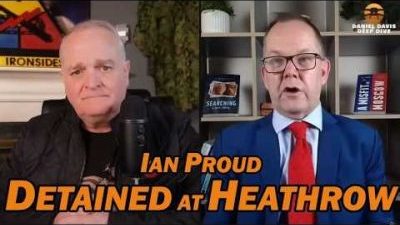
Diplomacy is Now a Crime in Britain / Ian Proud
or go to
Aletho News Archives – Video-Images
From the Archives
Genetic baloney in thick slices
MAYBE COULD BE INC.
By Jon Rappoport | No More Fake News | July 8, 2021
Gene research companies tend to come and go. They start out banging and popping like fireworks in the sky, and then they fade out—selling themselves to larger outfits who’ve hired better liars…
Once upon a time, it sounded easy. Start with a disease, find the gene responsible for the disease, and correct the problem.
Then, researchers wondered, was disease the result of one gene or a group of genes acting together?
Either way, the proof would be in devising cures for diseases using gene therapy. “Not yet, but soon…”
And regardless, the major need was: money. Lots and lots of money.
This need required good PR people. “We have to pump up the idea that we’re on the edge of tremendous breakthroughs. We’re always on that edge…”
This hype also needed to obscure the fact that there wasn’t (and isn’t) ANY gene cure for ANY disease. … continue
Blog Roll
 Aletho News
- Diplomacy is Now a Crime in Britain / Ian Proud
- UK Government Body Kept Files on People Criticizing Prevent Program
- US military withdrawal from Iraq and the collapse of US-Israeli hegemonic project in West Asia
- What does Europe want – a war with Russia?
- She Followed the Actual Data on COVID Vaccines and Masks — Her Career Took a Huge Hit
- Florida AG Sues Pfizer, Bourla Over Deceptive Marketing of COVID Vaccines
- Von der Leyen gifts her spin doctor a job for life
- 10K More U.S. Troops Deploy as Trump Weighs New Iran Strikes /Suliaman Ahmed
- Iranian crew declared Dena training vessel ‘unarmed’ to US warship before deadly torpedo strike: Report
- Iran’s NPT debate moves beyond parliament
- If Americans Knew
- Israel is squeezing the life out of Palestinians – Daily Update
- The Israeli Right Portrays Islam as Murderous. It Serves a Political Purpose
- Jordan Has Had Enough: King Abdullah’s Scathing Warning to Israel
- Israeli Colonizers (i.e. Settlers) Kill Palestinian Man Near Salfit
- New Google Maps images reveal massive scale of devastation in Gaza
- Jewish supremacy, anti-Palestinian bigotry on display in Israel – Daily Update
- Israeli Soldiers Abduct At Least 22 Across Occupied West Bank
- Eight Palestinians Killed in Israeli Attacks on Gaza
- Israeli former leaders and security chiefs threaten legal action over ‘Jewish terrorism’
- Israel map in LA Times ad includes all land from the river to the sea
- No Tricks Zone
- Green Energy Debacle: German Expert Professor Fritz Vahrenholt Warns Of Severe Economic And Social Consequences
- Two More Paleo Reconstructions Affirm Meters-Higher Sea Levels Across Ireland, Brazil 7000-6000 Years Ago
- New Study: Earth And Venus Surface Warmth Largely Explained By Convection And Lapse Rate, Not CO2 Or Radiation
- 2025 Nature Paper Claiming Worsening Global Drought Gets RETRACTED …Heavily Flawed
- New Study: ‘Global Drought Shows No Detectable Recent Acceleration Under Climate Warming’
- Economic Masterminds: German Socialists Suggest Taxing Productivity Gains Stemming From Using AI
- The South China Sea Has Not Been Cooperating With The Climate Change Narrative
- Energy Crisis: Germany Enters Heating Season With Historically Low Gas Reserve Fill Levels
- New Study: The Antarctic Ice Sheet Gained Mass From 2020-2024 Due To Staggering Snow And Ice Accumulation
- Study: Ocean Heating Rates From Thousands Of Years Ago ‘Dwarf’ Modern Ocean Heating Rates

