What the Hell is Obama Thinking?
Worst Man for the Job
By Daniel Patrick Welch – 3/01/2014
Nothing is quite as nauseating as watching the hypocrisy and hubris with which President Obama ‘warns’ the Russian president not to ‘interfere’ in Ukraine, telling the Russians there would be ‘costs to pay.’ It’s a surreal move, echoed by his equally creepy and out-of-touch consigliore and chief “diplomat,” the morally bankrupt John Kerry. Astonishing in its audacity and lack of regard for history, truth or facts, this bellicose blather seems aimed only at the idiots over whom he presides, the fools and tools in congress and the press, and his bought-and-paid-for lackeys in European capitals.
Outside the bubble, the sabre rattling is alarming and threatening. Having stood the issue completely on its head, No Drama Obama ignores how it looks to Russia, China and anyone with a skeptical mind. It is so jarring that it leaves only two options: is he crazy or does he really want war? That’s why the Russian Senate, offended to the core, asked President Putin to recall the US ambassador over Obama’s remarks.
How oblivious or arrogant do you have to be to spend $5 billion dollars destabilizing a country (the actual total is undoubtedly much higher), have your diplomats caught on tape planning a coup, bring a gang of fascist thugs to power on Russia’s doorstep–whose first order of business is to outlaw the Russian language, conduct a purge of opposing parties, threaten the Russian-speaking population, threaten to restore Ukraine’s nuclear status and provoke and threaten Russia non-stop… and have the *balls* to lecture anyone about interfering? Oh, add to the pot that you have done the same exact thing in several other countries in the past few years alone. It simply boggles the mind.
Continue poking Putin by suggesting he is being a “bully” when he moves to protect the Russian naval base, protect Russians, and listen to the wishes of the elected government of the region who ask for his support, as as new protests erupted across eastern Ukraine rejecting the putschists in Kiev, with Russian flags being raised over government buildings and protesters brandished signs saying “In Russia We Have Brothers. In Europe We Are Slaves” and “Where We Are, It is Also Russia.” This is called an ‘invasion’ by the people who bought and organized a fascist coup. Bizarro World.
But why do I focus on Obama? After all, he is little more than an irrelevant placeholder president, a sort of ventriloquist’s dummy for the vested interests and forces that put him where he is. Furthermore, I am not a fan of any Great Man theory of history that implies superhuman powers to people instead of historical forces. Accordingly, I don’t really go in for ad hominem attacks, which seems to be the only stock-in-trade of the western media, whose searing, eternal question seems to be who is the next Hitler.
Maybe it’s because I’m in the grip of the question the rest of the world is pondering: is he crazy or does he really want war? I can’t get past wondering whether he is sleepwalking through his presidency, having given over control of his administration to a foreign policy apparatus gone wild–or if he indeed believes the hypocritical warmongering crap that escapes his mouth. In short, Either he eats babies for breakfast or he has no clue that he is being led by the nose by psychopaths.
It’s important because in either case he is perhaps the most dangerous man who has ever held the office. His chief flaw is *exactly* the puzzle piece that is *least* amenable to being a leader at this historical juncture. It is a horrific perfect storm, and one that has allowed him to blunder disastrously close to World War III on at least two occasions.
The measure of the man has always told us he was an extremely glib politician. On watching an early speech of his, my wife was shocked at what all the fuss was about, and actually quoted King Herod out loud to the TV: “Take him away/ He’s got *nothing* to say!” Yeah, she’s funny like that. But still, glibness isn’t always hollowness. We got more of a glimpse when he joked casually about sending drones after any boys who had designs on his precious daughters. Later, referring to the boys he actual did mow down with his drones, he joked to aides–equally casually, we assume–that he never thought he ‘would wind up being so good at killing people.’
But the clincher for me is one memory which still haunts me from campaign 2008: a late rally in some Florida dump where Clinton explained (actually apologizing for going off script) that Obama was The Guy because he had said to the council of elders behind closed doors–you tell me what’s the right thing to do and I’ll sell it. At the time I did a double take, and it raised the hairs on the back of my neck. This is not a leader, a president, or even a thinker at all, but a glorified and willing Pitchman-in-Chief, a sort of real life Clayton Bigsby selling an ideology he is too blind to see.
It was a bit of the mask slipping… and it was incredibly ominous. I felt it and said so to my wife at the time, but she had checked out long before. Never thought he was anything more than a charlatan and a whore – from the first time she heard him, actually. Damn, I envy her clarity sometimes. It’s like they made a clone of Truman in a test tube, only this time not a hick… scary. Jimmy Burns led Truman around on a leash, and this misplaced trust in Wise Men led to war crimes such as Hiroshima and Nagasaki, among others.
In another famous example, Kennedy stupidly let the Bay of Pigs invasion proceed, as he was advised by ‘wiser men’ who told him it was already in the pipeline. However, he wisely vetoed air support, realizing that is was a stupid plan laid out by zealots. Obama has neither the balls nor the intelligence to pull off any such thing. There was a flicker over Syria in August, but it appears to have been a mirage brought on by Russian missiles and wiser generals. He has the fatal flaw which makes all smart men stupid: heeding the counsel of fools and those with their own secret agenda masquerading as Wise Men.
The zealots who have his ear have been in power for a long time, and they are the kind of fanatics who avoid scrutiny in public and accountability even to themselves, so stupid or proud that they still see chasing the Russians out of Afghanistan as their greatest triumph, and take no responsibility for having created, from the ground up, the very concept of militarized global jihad.
Even cutting him the most possible slack, he listens to them–and that makes him delusional, a hollow man issuing idle threats. As logic dictates, it is the US who should be worrying about costs, starting with billions to set the coup in motion. That will turn out to have been a pittance.
He is now a dangerous man being counseled by dangerous men. Just today, listening to his smug, arrogant self humiliate a heckler, someone trying to shout a tiny bit of truth through the noise, is truly chilling. The trouble is, Obama may not be lying. He really doesn’t know what the guy is talking about, and doesn’t know that this is the plan–at what may be the most dangerous moment in history–and will go along with whichever three loudest advisers tell him is the right thing. The saddest and scariest part is that he doesn’t even seem to know it–a true button pusher. Soulless.
But this is a measure of the man. At a friendly, fundraising event, with full control and no opposition, he could have said anything he wanted, could have made some sensible retort. Instead he chose to be mean and demeaning, calling the guy a drunk and implying that he is crazy. So now I have to add Bad Man to my list. No lie lives forever, and some day his uppance will come, as Stewie Griffin says. He richly deserves the place he has earned in history, and I have lost interest in splitting hairs: enabler, dupe or antichrist–take your pick.
Writer, singer, linguist and activist Daniel Patrick Welch lives and writes in Salem, Massachusetts, with his wife, Julia Nambalirwa-Lugudde. Translations of articles are available in in up to 30 languages.

Costs which Obama is about to pay for Ukraine
By Andre Fomine | Oriental Review | March 1, 2014
Yesterday the United States lost the propaganda war on Ukraine. President Obama made a reluctant and senseless statement which Washington Post entitled “There will be costs”.
He pronounced standard phrases like “the Ukrainian people deserve the opportunity to determine their own future”, proposed that Russia be a “part of an international community’s effort to support the stability and success of a united Ukraine”, lamented over the alleged “violation of Ukraine’s sovereignty and territorial integrity” and assured that “the United States supports his government’s efforts and stands for the sovereignty, territorial integrity and democratic future of Ukraine”.
It looks like the United States administration was not mentally prepared for the development of the Ukrainian crisis. The synchronized actions of the new Crimean authorities and the press-conference of the expelled president Victor Yanukovych in Rostov-on-Don gave undeniable judicial advantage to the opposite side in Ukraine who are not ready to acknowledge the illegitimate “government” elected by the rowdy Euro-mob in Kiev three days ago. The United States has no tangible tools to destabilize Crimea, de facto controlled by the Ukrainian anti-putschist resistance forces, while the judicial status of Victor Yanukovych (whatever we think about him as a person and political figure) is indubitable.
Since the very beginning of the crisis in Ukraine it was clear that the US goal was not imposing a pro-American government in Kiev, but rather making Ukraine a sticking point for Russia-European relations. The bloody events on Independence Square were organized in order to pull Russia into the vortex of the chaos in Ukraine. The Washington strategists thought that Moscow would become recklessly involved in the dirty games with Poland, Hungary and Romania over “federalization of Ukraine” and the street battles against the fascist thugs in Kiev.
On Saturday the Kremlin unexpectedly broke its skillful political pause after last night’s attempted assault on the Crimea Interior Ministry in Simferopol by unidentified special units sent from Kiev. Until that moment the Russian ‘inaction’ was much more powerful than thousands of nervous actions in Kiev and statements from Washington. The Russian move is going to be even more impressive.
Among all “interested parties” in the Ukrainian crisis, Russia is the only global power that has demonstrated its ability to act within the framework of international law and to take responsible and sovereign decisions.
Ironically, today’s Crimea is probably the only region where the Constitution of Ukraine is still strictly implemented. The referendum on the issue of the wide autonomy, announced to be held on March 30, 2014, was initiated in full compliance with the national law. The Russian military presence in Crimea is also regulated by the 1997 Russian-Ukrainian agreement on the Russian Navy base in Sevastopol. The new Crimean government, unlike the central one in Kiev, was appointed by the local legislative body as a result of a properly performed legal procedure.
So Moscow’s message to President Obama is simple. We are the real guarantors of Ukrainian sovereignty. We are protecting the life of its incumbent president, elected by the people of Ukraine at the free and competitive poll in 2010, from the direct personal threat from illegitimate “new authorities”. For the last three months, unlike you, we were not interfering in the internal political process in Ukraine while your Assistant Secretary of State was handing buns to the “peaceful protesters” in Kiev and talking smut about your European dialogue partners. We followed the letter and spirit of the international law whether we liked it or not. And today we are giving hope to millions of the Russian Ukrainians who categorically reject banderist authorities in Kiev. We are defending their right to determine their future. Therefore you will be brought to account for the billions of dollars invested for years long into the chimera project of the Orange revolution in Ukraine, which in its second incarnation turned Brown. You will be charged for months of explicit incitements for riots and civilian disobedience to legitimate authorities in Ukraine, committed by your officials and congressmen. And you will be responsible for the recognition of the shady Kiev “cabinet”, not only lacking any public support in Ukraine, but also any real resources to secure minimal level of life and the rule of law in this 45-million strong nation, lost in a non-existent “transition”, invented by your insolvent foreign policy consultants. These are the costs you are about to pay in Ukraine, President Obama.
Ukrainian Democracy: A Barrier to Washington’s Goals
What Do Ukrainians Really Want?
By Nick Alexandrov | CounterPunch | February 28, 2014
When Ukraine is the topic, the major U.S. media outlets agree: “Europe and the United States have made a priority of fostering democracy in the former Soviet republics,” David M. Herszenhorn wrote in the New York Times. The Washington Post asserted that Ukraine is “a country that has been struggling to become a genuine democracy” with help from Western powers, who keep it “from becoming an autocratic Kremlin colony, like neighboring Belarus.” “Ukraine is the crossroads between a free and an authoritarian Europe,” the Wall Street Journal concurred, while Yale professor Timothy Snyder urged, in a CNN piece, Europe and America to back the Ukrainian protesters—“a chance to support democracy,” he emphasized. Marvelous. But in the real world, Ukrainian democracy is not merely something Washington has failed to support, but is actually incompatible with U.S. governmental aims.
U.S. officials are quite open about their opposition to Ukrainian self-determination and well-aware how unpopular Washington’s preferred policies are. Nearly a decade ago, for example, the U.S. House of Representatives’ Subcommittee on Europe met for a hearing on “Ukraine’s Future and U.S. Interests.” Rep. Doug Bereuter (R-NE) opened the session, noting that “a recent survey conducted by a center for economic and political research suggests that up to 40 percent of Ukrainians believe that relations with Russia should be a priority.” Meanwhile, “28 percent gave preference to the EU,” and “2 percent said that relations with the U.S. should be a foreign policy priority. Another survey suggested that almost two-thirds of the population would consider supporting a political union with Russia,” Bereuter concluded. “So,” he went on, “I think that United States policy must remain focused” on incorporating Ukraine “into European and Euro-Atlantic structures.” Rep. Robert Wexler (D-FL) spoke next, reiterating that U.S. policy should “further Ukraine’s integration in Euro-Atlantic institutions;” Steven Pifer, the former Ambassador to Ukraine, drove the point home, outlining “the United States Government’s vision for Ukraine”: “increasingly close ties to Europe and Euro-Atlantic institutions.” This vision persisted over the following decade. The Atlantic Council’s Damon Wilson, speaking before the U.S. Senate’s Subcommittee on European Affairs—the topic was “Ukraine at a Crossroads”—in February 2012, explained that “Ukraine’s genuine European integration” remained a major objective.
And recent commentary and news coverage depicts European integration as something most Ukrainians desire. In early February, Secretary of State Kerry, at the Munich Security Conference, remarked that Ukrainians should be permitted “to associate with partners who will help them realize their aspirations”—Europe and the U.S. obviously being the partners, integration to be deepened via what the Times’ Herszenhorn referred to as “sweeping political and trade agreements” that Ukrainian President Viktor Yanukovych “refused to sign” last November, resulting in “a broken promise between a leader and his citizens,” and then the uprisings. Now Al Jazeera reports that the acting president, Oleksander Turchinov, has “made clear that Kiev’s European integration would be a priority,” thereby giving Ukrainians what we’re told they want.
But British and U.S. governmental studies reveal the Ukrainian public is ambivalent about European integration. Britain’s Foreign and Commonwealth Office, for example, funded a “scoping study” through the British Embassy in Kyiv a year ago, titled “A blueprint for enhancing understanding of and support for the EU-Ukraine Association Agreement [AA] including DCFTA [Deep and Comprehensive Free Trade Area] in Ukraine.” The AA was one of the key “sweeping political and trade agreements” Yanukovych refused to sign. British officials, in their report, stressed that “support for the AA is not overwhelming amongst the population at large,” observing that “opinion polls show that about 30% of respondents are in favour of European integration, 30% for the Customs Union [Moscow-led integration], and about 30% are undecided.” This bleak situation called for a propaganda offensive, or “a national public awareness ‘Campaign of Arguments,’” as the British dubbed it, which was to “be aimed at the general public as its primary target audience.” British advisers urged PR teams “to formulate advertising slogans, global and targeted messages,” and to play up “the European civilizational model” and other benefits the AA allegedly would bring. This “civilizational model” today entails “massive attacks on public services, wages, pensions, trade unions, and social rights” under imposed “draconian austerity policies,” Asbjørn Wahl wrote in January’s Monthly Review—a reality the British indoctrination scheme’s outline studiously avoided, it’s hardly worth mentioning.
The propaganda barrage may have been successful to some extent. But as the year progressed, the U.S. government had a hard time finding evidence of overwhelming Ukrainian support for European integration. The International Republican Institute (IRI), for example, polled Ukrainians last September: “If Ukraine was able to enter only one international economic union, with whom should it be?” Forty-two percent of respondents chose the EU, while 37% preferred the Russian Customs Union. IRI then asked, “How would you evaluate your attitude towards the following entities?” Fifty percent of respondents felt “warm” towards Russia; 41% felt “warm” towards Europe—and just 26% were fond of the U.S. IRI figures resembled those USAID published in a December 2013 report. Its authors found it “interesting to note that Ukrainians are split on whether the country should join the European Union or the Customs Union. Thirty-seven percent would like Ukraine to take steps to join the European Union, 33% prefer the Customs Union and 15% say Ukraine should join neither of these blocs.” Furthermore, “34% say that Ukraine should have closer economic relations with Russia, 35% say it should have closer economic relations with Europe and 17% say it should have good relations with both.” A Kyiv International Institute of Sociology poll reinforced these findings: “Ukraine is split practically 50/50 over the accession to the European Union or the Customs Union,” Interfax-Ukraine summarized the study’s conclusions.
Reviewing this data forces us to ask: Who is Washington’s chief enemy in Ukraine? Is it Russia, bent on killing Ukraine’s budding democracy? Is it the tyrant Yanukovych? The U.S. policy record points to a different conclusion, one a Johns Hopkins Center for Transatlantic Relations study—included in the official transcription of the Senate’s 2012 “Ukraine at a Crossroads” hearing—discusses in the context of Ukraine’s potential NATO membership. “The main obstacle” to Ukraine’s joining the organization “is not Russian opposition,” its authors emphasized, “but low public support for membership in Ukraine itself.” Again: on this and other issues, the Ukrainian people are “the main obstacle” to U.S. foreign policy aims. We should bear this fact in mind as the crisis deepens in Eastern Europe.
Nick Alexandrov lives in Washington, DC.
Russian senators vote to use stabilizing military forces on Ukrainian territory
RT | March 1, 2014
Russia’s Federation Council has unanimously approved President Vladimir Putin’s request to use Russian military forces in Ukraine. The move is aimed to settle the turmoil in the split country.
The upper house of the Russian parliament has voted in favor of sending troops to the Autonomous Republic of Crimea, which would ensure peace and order in the region “until the socio-political situation in the country is stabilized.”
The debate in the Federation Council has revealed that Russian MPs are united on the issue, with many of them sharing concerns on the recent events in Ukraine. The common notion was that since power was seized in Kiev, the situation has only been deteriorating with radical nationalists rapidly coming to power and threatening the lives of those opposing their actions, most notably the Russian citizens living in Ukraine.
The developments follow an appeal by the Prime Minister of the Autonomous Republic of Crimea, Sergey Aksyonov, who requested that Russia help cope with the crisis and ensure “peace and calm” in the region.
Crimeans began protesting after the new self-proclaimed government in Kiev introduced a law abolishing the use of other languages in official circumstances in Ukraine. More than half the Crimean population are Russian and use only this language in their everyday life. The residents have announced they are going to hold a referendum on March 30 to determine the fate of the Ukrainian autonomous region.
Putin on Saturday requested the Federation Council to use the Army for normalizing the socio-political situation in Ukraine in connection with the “extraordinary situation” there. The events in Ukraine indicate there is a “threat to the lives of citizens of the Russian Federation… and the personnel of the armed forces of the Russian Federation on Ukrainian territory,” the Russian president said.
According to Putin’s spokesman, Dmitry Peskov, the president has not yet made a decision on sending the troops to Ukraine.
Moreover, taking the decision to use the Armed Forces in Ukraine does not mean that it will be carried out immediately, Grigory Karasin, Putin’s official representative in the Federation Council, has said.
“The approval, which the president will receive, does not literally mean that this right will be used promptly,” Karasin said.
Russian citizens are among the victims of the turmoil gripping Ukraine, the speaker of the Federation Council, Valentina Matvienko, has said. In Crimea, there were Russian casualties during the storming of the local Interior Ministry building by gunmen overnight, she added.
“During the attempts to seize the building of the Interior Ministry in Crimea some were injured, there were victims also, the people are being threatened, and in this situation they are naturally voicing concerns for the security of their lives and families. This compelled the government of Crimea to ask Russia for help,” Matvienko said.
The speaker’s words coincided with the statement issued by Russian Federal Migration Service noting that some 143,000 Ukrainians have sought asylum in Russia. The number represents a sharp rise in such requests, the authority said.
The new Ukrainian authorities have been formed “under the dictate of Maidan” and “continue to use force in the forming of the decision-making structures,” Karasin said.
“We are particularly concerned with the situation in the Autonomous Republic of Crimea, where, in accordance with the international treaty, the Black Sea Fleet is stationed; where 1.5 million Russian people live,” Putin’s representative stressed.
The Crimean population “resents” the attempts to seize local administration buildings and the threats thrown at regional authorities, and demands stability, he said.
At the same time, Karasin said he believes the international community and those states that backed the February 21 agreement between the opposition and the legitimate Ukrainian government “have the power” to influence the self-proclaimed Kiev authorities to bring the situation back to “constitutional ways.”
The Russian Foreign Ministry also said that Moscow is expecting that the international community will influence the self-proclaimed Kiev regime to normalize the situation in the country.
People of Crimea express desire to join Russia: Report
Press TV – March 1, 2014
People in the port city of Sevastopol in the Autonomous Republic of Crimea have been voicing support for the notion of Crimea joining Russia, a report says.
“In Sevastopol, where Russia’s Black Sea fleet has a base, residents speak unabashedly of wanting Crimea to return to Russia,” reads a report by Reuters on February 28, referring to the fact that the now autonomous Crimea was once part of the former Soviet Union.
“Crowds rally daily in front of city hall, and voted with roars of approval this week for Russian citizen, Alexei Chaliy, as their de facto mayor, chanting: ‘A Russian mayor for a Russian town.’”
Crimea, an autonomous region within Ukraine, has been the focal point of concern ever since Ukrainian politics became chaotic. Ukraine has been experiencing unrest since November 2013, when now-ousted Ukrainian President Viktor Yanukovych refrained from signing an Association Agreement with the EU in favor of closer ties with Russia.
The Ukrainian parliament ousted Yanukovych and named Oleksandr Turchynov, the legislature’s speaker, as interim president on February 23.
When Russia confirmed on Friday that it had moved its troops already based in Ukraine’s Crimea region to protect its naval fleet, a move Moscow said was in compliance with Russian-Ukrainian agreements, it was met with warnings from Ukraine’s new authorities as well as Western officials, who warned against “provocations” on the Crimean peninsula, where the Autonomous Republic of Crimea is also located.
As the crisis was brewing in Ukraine, US and European officials repeatedly expressed support for the anti-government Ukrainian protesters. The protests took violent forms as an increasing number of the protesters resorted to violence in confronting Ukrainian security forces.
The Reuters report said that while the anti-government protesters who “brought down” the Yanukovych administration in Ukraine are “heroes in the capital (Kiev) and the West,” in Crimea, “they are compared to the nationalist militias sometimes accused of siding with Nazi troops against Soviet forces during World War Two.”
The report quoted a resident of Sevastopol as saying, “Crimea has historically never belonged to Ukraine. We want historical justice. This is an exclusively Russian city. It was and will remain so.”
Ukraine’s Interior Minister Arsen Avakov recently claimed that Russian troops, backed by armored personnel carriers, entered the Belbek airfield near Sevastopol. Russia’s Interfax news agency, however, quoted an unnamed source as saying that the country’s Black Sea Fleet forces did not seize the airfield or take any other action there.
Referring to the calls by the people of Crimea for the autonomous region to join Russia, the Reuters report said that, “Moscow has not responded directly to calls… but a number of Russian lawmakers have visited Crimea, and are given a hero’s welcome.”
Art of drills: 10 NATO war games that almost started armed conflicts
RT | February 28, 2014
The world’s largest military alliance seems annoyed about Russia’s “lack of transparency” over military drills at a very “delicate time.” NATO, however, has its own long history of war games all over the globe.
Western politicians have leveled criticism at Russia for planned drills on its own territory, seemingly glossing over the many joint military exercises Western powers, namely the US and NATO forces, have conducted on foreign soil over the years.
South Korea
This week, US and South Korean forces began their annual joint military drills, which will last until mid-April. The Foal Eagle exercise is conducted near Iksan and Damyan, South Korea.
The drills prompted a stern reaction from North Korea, which slammed the exercises as “a serious provocation” that could plunge the region into “a deadlock and unimaginable holocaust.”
Israel
The US joined Greece, Italy, and Israeli forces at Ovda air base in southern Israel for the ‘Blue Flag’ air-training drills in November 2013. The drills were called the “largest international aerial exercise in history,” by Israeli news outlet Haaretz.
According to Israel National News reports the exercises are geared towards “simulating realistic engagements in a variety of scenarios, based on Israel’s experience with air forces of Arab armies in previous engagements.”
Poland and Latvia
NATO’s ‘Steadfast Jazz’ training exercise was held in November 2013, in Latvia and Poland. The drills included air, land, naval, and special forces.
Over 6,000 military personnel from around 20 NATO countries and allies took part in the largest NATO-led drills of their kind since 2006.
Bulgaria
In October, NATO also held anti-aircraft drills in Bulgaria, along with the Greek and Norwegian air forces. The exercises were held to test responses in conditions of radio interference, according to the Bulgarian Ministry of Defense.
Persian Gulf
In May 2013, the US joined 40 other countries in the Persian Gulf for maritime war games. The US Navy said the mass exercises are aimed at “enhancing capability to preserve freedom of navigation in international waterways.”
The drills provoked a sharp response from the Iranian government who voiced concerns at how the maneuvers came in the run-up to the Iranian elections.
Japan
In August 2012, US Marines joined Japanese troops for military drills in the western Pacific. The drills were held in part in Guam, a US holding, just as an old territory dispute reemerged between Japan and China over islands in the East China Sea.
“China will not ignore hostile gestures from other nations and give up on its core interests or change its course of development,” the Chinese Communist Party stated in response to the drills, warning the US and Japan not to “underestimate China’s resolve to defend its sovereignty.”
Jordan
The US joined 16 other nations in May 2012 for military exercises in Jordan near the Syria border. The ‘Eager Lion’ drills included 12,000 soldiers from the participating countries, Turkey, France, and Saudi Arabia among them.
Denying accusations that the violence in Syria had nothing to do with the drills, the US claimed it was “designed to strengthen military-to-military relationships through a joint, entire-government, multinational approach, integrating all instruments of national power to meet current and future complex national security challenges.
Vietnam
In August 2010, the US Navy joined Vietnamese forces for drills in the South China Sea, to the dismay of China. Sovereignty claims in the South China Sea have long been a subject of debate and animosity among Taiwan, the Philippines, Brunei, Vietnam, and Malaysia, though China’s territorial declarations have been the most aggressive.
Ukraine
Ukraine welcomed a fleet of NATO warships for a two-week period of military drills in July 2010. Operation ‘Sea Breeze-2010’ focused on joint anti-terror exercises, despite Kiev’s decision not to enter the NATO alliance. Some 3,000 international military personnel were said to be a part of the drills.
Ukraine began hosting the Sea Breeze exercises in 1997, as part of its commitment to join the alliance. In 2009, the Ukrainian parliament voted against the drills, curtailing then-President Viktor Yuschenko’s efforts to seek NATO membership.
Georgia
In May 2009, 15 NATO countries held a series of controversial military exercises in Georgia less than a year after it launched an offense against its breakaway region of South Ossetia. Russia called the maneuvers “dubious provocation” saying it may encourage the country’s regime to carry out new attacks.
Crimea parliament announces referendum on Ukrainian region’s future
RT | February 27, 2014
The parliament of Ukraine’s Autonomous Republic of Crimea has announced it will hold a referendum to determine the region’s future amid the turmoil in the country.
The region’s parliament said the all-Crimean referendum is about “improving the status of autonomy and expanding its powers.”
“According to the underlying principles of democracy, the presidium of the Crimean parliament considers that the only possible way out of the situation on the ground is applying the principles of direct rule of the people. We are confident that only by holding an All-Crimean referendum on the issue of improving the status of the Autonomy and expanding its powers Crimeans will be able to determine the future of the Autonomy on their own and without any external pressure,” Oksana Korniychuk, the press secretary of the head of the parliament, said in a statement on Thursday.
As a result of “the unconstitutional seizure of power in Ukraine by radical nationalists supported by armed gangs,” Crimea’s peace and order is “under threat,” the spokeswoman stressed.
The Wednesday clashes near the parliament’s building in Simferopol, which led to two deaths and about 30 injuries is “a result of rampant political extremism and violence gripping the country,” which could bring Ukraine to “complete chaos, anarchy and economic catastrophe,” Korniychuk said.
The Autonomy’s parliament thus takes “full responsibility for the future of Crimea,” relying on the will of its people, she said.
Korniychuk spoke hours after an unknown group of people barricaded themselves inside the building of the Crimean parliament and installed Russian flags there. The group, however, allowed MPs inside, including the speaker of the parliament, Vladimir Konstantinov. The MPs then held their session as planned.
Hundreds of protesters gathered near the building on Thursday, demanding a referendum on the status of Crimea be held. They held banners reading “Crimea for peace!” and “Crimea for a referendum!”
The demonstration came a day after two rivaling rallies of ethnic Russians and ethnic Crimean Tatars clashed near the parliament. While the pro-Russian rally demanded the parliament dismiss the new Ukrainian government as “illegitimate,” the Tatars spoke out against a split. Some of the demonstrators openly demanded Crimea be returned to Russia, from which it was separated in 1954, while others shouted “Crimea is Ukraine!”
Related articles


Ukraine crisis: EU Parliament’s MP urges to impose sanctions on Russia
Voice of Russia | February 19, 2014
A member of the ruling faction in the European Parliament has come up with an initiative to impose sanctions against Russia that he said was supporting Ukraine’s regime. Russia has been in a waiting stance ever since the escalation on Tuesday, when Ukraine’s capital Kiev descended into more chaos.
This came today from Poland’s MEP Jacek Sariush-Volsky of the center-right European People’s Party at a press conference in the EU parliament.
However, a spokesperson with the European Commission ruled out the possibility of sanctions against Russia ahead of the EU foreign chiefs’ meeting on February 20.
Conversely, the spokesman said that the 28 foreign policy heads of EU member countries were going to engage in consultations with Russia in order to clear up all controversies that exist between Moscow and Brussels on the possible outcome of an association deal between Ukraine and the EU.
Russia blames ‘extremists’ for Ukraine crisis, suggests attempted coup
Russia has apportioned all blame for the deteriorating situation in Ukraine on the extremists. This is according to President Putin’s spokesman Dmitry Peskov.
“The president believes that the ongoing situation in Ukraine is the fault of the extremists,” Mr. Peskov said today.
He added Russia wished that its Ukrainian partners would “ensure the settlement of the situation that has taken shape as soon as possible.”
“Moscow strongly condemns violence of radical elements, who in the breach of all agreements previously reached actually used the implementation of the conditions on amnestying previously detained people and returned to violent actions immediately,” Peskov told reporters.
“Besides, their actions can be treated and are treated in Moscow solely as an attempt at a state coup,” Peskov said. “Together with the seizure of state organizations in various cities of Ukraine, the seizure of law enforcement facilities and attempts to seize arms occurs as well,” he said.
Russia biding its time on Ukraine
Moscow is keeping tabs on Ukraine but will not interfere with the crisis for now, President Putin’s spokesman has said Wednesday. Russia has been in a waiting stance ever since the escalation on Tuesday, when Ukraine’s capital Kiev descended into more chaos as death toll rose to 25 people.
“The Kremlin is closely watching the ongoing situation in Ukraine, and we will definitely speak on it a bit later,” Putin’s spokesman Dmitry Peskov said today in an interview with online magazine Slon.
“The idea is not to intervene in the Kiev unrest. We’ve said that many times, the Kremlin will stay true to this stance.”
Militants’ actions in Kiev on Fe 18-19 not spontaneous, but staged – Russian diplomat
Chairman of the Federation Council’s International Affairs Committee Mikhail Margelov believes that militants’ actions on Kiev streets on February 18-19 are not spontaneous, but staged.
The senator noted the common delusion that the so-called Maidan and its battle squad is not stage-managed, it is Cossak outlaws and “national power”. “The very events at Grushevsky Street disproved it: the militants dealt with law enforcers’ attacks too skillfully, refilled armory of shields, casks and clubs, and added cocktail bombs to convert it into napalm. The course of street riots February 18-19 showed that the militants fight in the so-called “Halych format” — it came to gunfire, and there are fatalities on both sides. There is evident organized nature behind the fighting,” Margelov believes.
In addition, he said that “after a fragile truce, the Maidan gains momentum in provinces: in Lvov, Ternopol, Ivano-Frankovsk”. “They not only occupy state offices there, but storm police wards and dismantle Berkut officers,” the Russian senator stated.
Margelov expressed confidence that “debacles and shooting that John Kerry dubbed “fight of the Ukrainian majority for Europe’s democratic future” are fairly staged and managed by experienced specialists in street fighting”. “Klitschko and Yatsenyuk hardly possess such military talents,” he assumed, adding that the job of these politicians is “to compose joint plans with the West to make up an oppositionist government and carry out a constitutional reform, which ought to be followed by western financial aid”.
Chairman of the Federation Council’s International Affairs Committee says it’s early to make any forecasts yet. “It would be a great achievement to stop the street mayhem and start a responsible political dialogue. Still, even this may not consolidate the Ukrainian society. It’s split: I cannot remember a single Ukrainian parliament that hadn’t fistfights,” the senator concluded.
Related article

US deploys destroyer to Europe amid Russia concerns
Press TV – February 11, 2014
The first of four US missile destroyers has arrived in Europe, an apparent move by Washington to challenge Russia that voiced concerns over the deployment.
The USS Donald Cook arrived in the Spanish port of Rota on Tuesday.
“For the first time, a ship of the United States Navy equipped with the Aegis ballistic missile-defense system is permanently based in Europe,” NATO Secretary General Anders Fogh Rasmussen said.
“The arrival of the USS Donald Cook marks a step forward for NATO, for European security, and for transatlantic cooperation,” he added.
Three more American destroyers will also be joined the USS Donald Cook at the base in Rota over the coming two years. Other US destroyers are the USS Ross, the USS Porter, and the USS Carney.
The deployment of the four destroyers is part of Washington’s military policy in Europe that includes land-based Aegis interceptor batteries in Romania and Poland, radar in Turkey and a command center at the US Air Force base in Ramstein, Germany.
The Obama administration’s plans for increasing military presence in Europe have caused a major rift with Russia.
Moscow says the system is major threat to its own security and has threatened to beef up its own nuclear arsenal in response.
Russian President Vladimir Putin has already ordered the deployment of short-range missiles to the country’s western Kaliningrad enclave, which is situated between Poland and Lithuania.
In a speech to the country’s Federal Assembly in December, the Russian president said that his country will not allow any nation to dominate it in military terms.
“We realize clearly that the AMD system is only called defensive, while in fact it is a significant part of the strategic offensive potential,” Putin said.
Related article

Russia slams UN move on Syria as one-sided
Press TV – February 11, 2014
Russia has lashed out at the UN Security Council over a draft resolution that would impose more sanctions on Syria unless the government gives unrestricted access to aid delivery.
“Indeed, our Western partners in the [UN] Security Council addressed us and offered to work together to draft this resolution. However, the ideas that they shared with us are absolutely one-sided and divorced from fact,” Russian Foreign Ministry Sergey Lavrov said at a press conference in Moscow on Tuesday.
The top Russian diplomat went on to say that the draft resolution also disregards the measures already taken to deliver humanitarian supplies, and international agencies’ assessments of the humanitarian situation in Syria.
He further noted that the resolution needs to be issued in a way that would condemn terrorist activities in Syria.
Meanwhile, Russian Ambassador to the UN Vitaly Churkin has pledged to veto the proposed measure if necessary, saying the resolution would increase tension in Syria.
“This text would not have any positive impact on the situation,” Churkin said, “If anything, it would create disruption of humanitarian efforts.”
The Russian ambassador added that the measure would endanger the Geneva talks being held in Switzerland.
The comments come as the Syrian government delegation, led by Foreign Minister Walid al-Muallem, and foreign-backed opposition hold a second day of talks in Geneva.
The first round of the talks aimed at containing the deadly violence ended inconclusively on January 31, amid sharp differences between representatives from the Syrian government and the so-called Syrian National Coalition (SNC).
Related article

Victoria Nuland’s ‘Ukraine-gate’ Deceptions
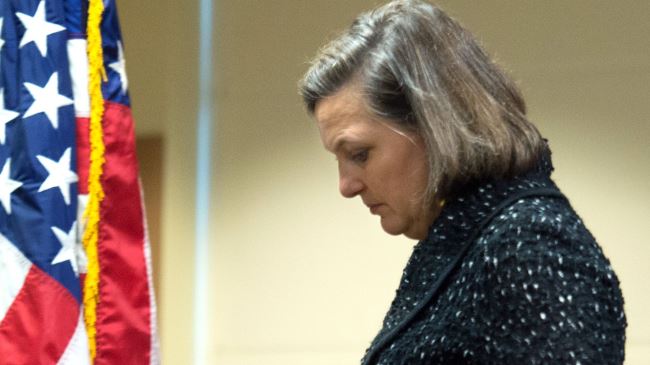
By Daniel McAdams | Ron Paul Institute | February 9, 2014
“That’s some pretty impressive tradecraft,” said Assistant Secretary of State Victoria Nuland of the interception and leak of her now-infamous call to US Ambassador to Ukraine Geoff Pyatt. The call consisted of the two plotting to install a US puppet government in Ukraine after overthrowing the current, democratically elected government.
Tradecraft means “spycraft.” In other words, Nuland was crediting a foreign intelligence service with impressive use of technology to be able to hack into her call to the ambassador. Everyone knew she was talking about Russia, partly because the Administration had been blaming Russia from the moment the recording was made public.
However, Nuland knew all along that this was not the case, and she did nothing while the Administration continued to escalate the accusations against Russia.
Jay Carney, White House Spokesman, “It says something about Russia,” that they would tap the telephone call. State Department Spokeswoman Jan Psaki was even harsher, calling it “a new low in Russian tradecraft.”
But the telephone call between the two, we learned yesterday, was not conducted on a secure, encrypted telephone line that the State Department requires for such sensitive conversations and communication. Rather, the call was made over unsecured cell phones and thus easily intercepted with basic equipment that is widely available to anyone. Therefore it was not “impressive tradecraft” at all that led to the capture and release of the conversation.
Nuland and Pyatt obviously knew that at the time, being the two parties to the call. They then either sat by and allowed US government official one after the other accuse Russia of going to great lengths to hack the call without admitting this fact, or they did inform their superiors but Administration officials decided to ignore this critical fact and push accusations against Russia anyway. You never want a serious crisis to go to waste, as it is said.
RPI contacted a former State Department official to clarify security procedures for such a telephone conversation between high-level personnel. The official was clear:
I know well the seriousness of using an open line (aside from anodyne conversation) for high-level classified information that would clearly be embarrassing, if not damaging, not only for the US but also the EU. For using an open line for discussing highly sensitive national security matters, both [Nuland and Pyatt] should be reprimanded, at the very least.
So this was a serious security violation.
The former official continued:
Assuming the telecon was made on insecure line, I find it curious, if not thought provoking, that Nuland’s profanity has managed to overshadow both the apparent security violation as well as the potential damage to national security of the substance of the conversation itself.
Indeed, the fallout from “Ukraine-gate” is astounding but sadly not surprising. The mainstream media in the US has focused solely on the Russian angle (now discredited) and on the salty language and particularly the false supposition that Nuland was using sailor’s language to indicate a serious rift with the EU on Ukraine policy. In fact, US and EU policy toward Ukraine is identical: regime change. The dispute is merely over velocity and is therefore cosmetic rather than substantive: should we travel 100 miles per hour or only 75 miles per hour toward regime change?
As far as we have seen, there has been virtually no discussion of the substance of the telephone conversation in the US media. But the conversation was a confirmation of all theretofore denied accusations of US involvement in the current unrest in Ukraine. It was not simply US well-wishing toward the opposition parties. It was not simply a bit of advice and a wink toward the opposition. It was wholesale planning and brokering a post-regime change governing coalition in Ukraine, with the UN being ordered to come in and “glue” the deal.
More precisely, as the Oriental Journal points out:
They agreed to nominate Bat’kyvshchina Party leader Arseniy Yatseniuk as Deputy Prime Minister, to bench Udar Party leader Vitaly Klitschko from the game for a while and to discredit neo-Nazi Svoboda party chief Oleh Tiahnybok as “Yanukovych’s project”
Shortly after “Ukraine-gate” broke, Sergei Glazyev, advisor to Russian president Putin claimed that the US was spending $20 million per week on the Ukrainian opposition, including supplying the opposition with training and weapons.
Nuland replied that such claims are “pure fantasy.”
Perhaps, but that is just what Nuland had said previously about claims that the US was meddling in the internal affairs of Ukraine. And then the tape came out. That was just what she said about Russia’s “impressive tradecraft” in intercepting the telephone call. Then we discover that she was discussing highly sensitive issues over completely unsecured telephones.
Is the US training and funding the Ukraine opposition? Nuland herself claimed in December that the US had spent $5 billion since the 1990s on “democratization” programs in Ukraine. On what would she like us to believe the money had been spent?
We know that the US State Department invests heavily — more than $100 million from 2008-2012 alone — on international “Internet freedom” activities. This includes heavy State Department funding, for example, for the New Americas Foundation’s…
…Commotion Project (sometimes referred to as the “Internet in a Suitcase”). This is an initiative from the New America Foundation’s Open Technology Initiative to build a mobile mesh network that can literally be carried around in a suitcase, to allow activists to continue to communicate even when a government tries to shut down the Internet, as happened in several Arab Spring countries during the recent uprisings.
“Commotion Project.” What an appropriate name for what is happening in Ukraine.
It is not a far leap from the known billions spent on “democratization” in Ukraine, to the hundreds of millions spent on developing new tools for regime-changers on the ground to use against authorities in their home countries, to the State Department from the US embassy in Kiev providing training and equipment to those seeking the overthrow of the Ukrainian government.
The apparent goal of US policy in Ukraine is to re-ignite a Cold War, installing a US-created government in Kiev which signs the EU association agreement including its NATO cooperation language to effectively push the Berlin Wall all the way to the gates of Moscow and St. Petersburg.
NATO has expanded to central Europe, despite US assurances in the 1980s that it would not do so. The US rolled over Russia in its deceptive manipulation of a UN Security Council resolution on Libya to initiate an invasion. The US continues to arm jihadists seeking to overthrow the secular Assad government in Russia-allied Syria. The US and EU have absorbed the Baltics, leaving their large ethnic Russian populations to dangle in non-person limbo. The US and EU had all but absorbed Georgia. Now the US is clearly in the process of absorbing Ukraine, with its strategic importance to Russia, its proximity, and its nearly 10 million ethnic Russian minority.
Surely there is a point to where Russia will take steps to concretely limit its losses. In December Russian president Vladimir Putin said in a meeting with his Ukrainian counterpart Viktor Yanukovich that Russia and Ukraine should resume comprehensive military cooperation. Other bilateral defense agreements are already in place.
What would have to happen to trigger a Ukrainian request to its close neighbor for assistance putting down a bloody and illegal coup d’etat instigated by foreign governments? Will serious US miscalculation of Russian resolve over Ukraine lead to a tragedy of almost inconceivable proportions? What if this time Russia does not blink?
Related article
Russia threatens to quit START as US deploys Aegis destroyer to Spain
RT | February 2, 2014
The US has deployed a ballistic missile defense destroyer to Spain to boost NATO’s anti-missile shield in Europe. The move, allegedly aimed at curbing the Iranian threat, has sparked talks about Russia possibly scrapping the START nuclear treaty.
The deployment of the Navy destroyer USS Donald Cook, equipped with the Aegis shipboard integrated combat weapons system, was announced by US Defense Secretary Chuck Hagel at the Munich Security Conference on Saturday.
“An important posture enhancement is European missile defense in response to ballistic missile threats from Iran,” Hagel said, adding that the US is committed “to deploying missile defense architecture there,” as a part of Phase 3 of the European Phased Adaptive Approach (EPAA).
Hagel also said that over the next two years, three additional Aegis-enabled missile defense-capable destroyers will join the effort to protect NATO countries on the European continent.
“Despite fiscal constraints, the budget that we will release next month fully protects our investment in European missile defense,” Hagel said, reiterating views he also expressed on a visit to Poland earlier last week.
“There are some capabilities that the United States military will continue to invest heavily in,” Hagel told the Munich conference. “We will continue to be the world leader in those kinds of capabilities.”
In his Munich speech, Hagel also mentioned that China and Russia “are rapidly modernizing their militaries and global defense industries, challenging our technological edge and defense partnerships around the world.”
The USS Donald Cook will become the first of four ballistic missile defense (BMD)-capable ships based in Europe. It will be joined by the destroyer Ross in a few months, while Carney and Porter will reach European waters in 2015.
The US Navy estimates that 1,239 military personnel will move to Spain’s port of Rota as part of the EPAA plan, according to the Congressional Research Service. The move will cost $92 million, with another $100 million being spent annually on maintaining the ships in Spain.
The Obama administration claims this deployment will serve to protect US allies in Europe from Iranian and possibly North Korean missile threats.
The movement of the four destroyers to Spain and a creation of a ground-based radar is Phase 1 of the EPAA. Phase 2 is the installation of the Aegis Ashore armed with Standard SM-3 IB interceptor missiles in Romania. Phase 3 of EPAA is the creation of Polish Aegis Ashore installation, armed with SM-3 IIA missiles. Phase 4, involving deployment of SM-3 IIB missiles, was canceled by the US in March 2013.
The destroyers in Spain are known as “forward deployed naval forces” (FDNF), as they enable the US Navy to provide more forward-based presence with fewer ships, and also cut down on the transit time when tackling a wide range of threats.
“Permanently forward-deploying four ships in Rota will enable us to be in the right place, not just at the right time, but all the time,” Navy Secretary Ray Mabus said, Defense News reported.
Russia may consider withdrawing from START treaty
In the meantime, if the US continues boosting its anti-missile capabilities through developing its missile defense system in Europe, Russia may eventually be forced to withdraw from the Strategic Arms Reduction Treaty (START), the Russian Foreign Ministry’s top disarmament official, Mikhail Ulyanov, has warned.
“We are concerned that the US is continuing to build up missile defense capability without considering the interests and concerns of Russia,” Ulyanov told Interfax. “Such a policy can undermine strategic stability and lead to a situation where Russia will be forced to exercise [its] right of withdrawal from the [START] treaty.”
Ulyanov said that the legal basis for Moscow to scrap the START treaty is legislated for within the text of the agreement, which Russia says it has so far fully implemented. In certain exceptional cases, involving a known threat to national security, both Russia and the US have the option to quit the treaty.
“The statement on missile defense made by the Russian side on April 8, 2010, at the signing of the START Treaty, explicitly states that such exceptional circumstances include the build-up of missile defense systems by the United States, which threatens the potential of Russian Federation’s strategic nuclear forces,” Ulyanov said. “A similar [regulation] is contained in the Federal Law on the Ratification of the New START treaty.”
Ulyanov said that “at the current stage” Russian experts estimate that the US missile defense system “has not yet reached a level that would represent a threat to the efficiency of Russian strategic deterrence forces.”
Moscow hopes to eventually come to terms with Washington on the issue of European missile shield, Ulyanov said. “Such a chance, of course, remains, but everything depends on the political will of the US.”
The New START Treaty was signed between US and Russia in April 2010 and entered into force after ratification in February 2011. It is planned to last until at least 2021.
Featured Video

Anthrax War – CBC The Passionate Eye
or go to
Aletho News Archives – Video-Images
Book Review
Shattered Dreams: The HPV Vaccine Exposed (2019)
By Christina England – 30 Q&As – Book Review & Summary
Lies are Unbekoming | September 4, 2026
… Gardasil received FDA fast-track approval in 2006, Cervarix followed in 2009, and Gardasil 9 was approved in December 2014 with more than double the aluminium adjuvant content of the original. The commercial context is specific. Merck was about to lose patent protection on Zocor and faced $18 billion in Vioxx injury claims from a cardiovascular drug the company had marketed while suppressing its own data showing a five-times increase in heart attacks. Analysts projected the global HPV vaccine market at $4 billion by 2011, contingent on government-funded national programs for teenage girls. The 1986 National Childhood Vaccine Injury Act had already granted manufacturers complete liability immunity. By 2013, Japan had withdrawn its HPV vaccine recommendation after cataloguing severe adverse reactions in hundreds of girls. No Western government followed. The establishment position across the UK, US, Australia, and most of Europe held, and still holds, that the vaccines are safe and effective, that reported injuries are coincidental, and that cervical cancer prevention justifies the program. The book was published into this position, not against a vacuum.
Shattered Dreams sits alongside Mary Holland’s The HPV Vaccine On Trial and Viera Scheibner’s foundational vaccination work as part of the documented record on what has been done to a generation of teenage girls under the banner of cancer prevention. The full summary unpacks three specific findings: that Merck used the aluminium adjuvant itself as the “placebo” control in 92.5% of trial subjects, making it structurally impossible to detect excess reactions from the adjuvant; that Dr. Sin Hang Lee found HPV DNA fragments bound to aluminium in every one of sixteen Gardasil samples tested, and in the blood and spleen of a New Zealand girl six months after her third dose; and that in every country with high vaccination coverage, including Australia, the UK, Norway, and Sweden, cervical cancer rates have stopped declining and started rising specifically in the vaccinated cohort. Martínez-Lavín’s 2017 calculation puts the number needed to seriously harm with Gardasil 9 at 140, and the number needed to vaccinate to prevent one case at 1,757. Thirteen young women are seriously harmed for every one who benefits. The vaccine was approved on the basis of trials that could not detect what the trials were supposed to detect, and it is still being given to twelve-year-olds today. … Read full review
Blog Roll
 Aletho News
- The Five-Year Fuel Crisis: Why the World Economy Is Paying for a War It Thinks Is Ending
- Trump’s Big Bluff on Iran
- Swiss scammed out of millions by Ukraine-linked call centers – media
- Germany facing potential ‘violent conflict’ with Russia – spy chief
- Ukraine’s EU neighbors reject new plea from Kiev – Politico
- British Transport Police Facial Recognition Trial Scanned 926,912 People With Zero Arrests
- House Bill Would Ban Federal Use of Flock ALPR Data
- Can a Spice Rival a Drug? 10 Head-to-Head Trials Put It to the Test.
- The oil routes around Hormuz face their own chokepoints
- The Saudi-Israeli war on Yemen’s resistance: Intelligence sharing, civilian targets & sectarian propaganda
- If Americans Knew
- Turkish Red Crescent helps elderly Gaza man walk again after Israel confiscates his prosthetic limb
- Four Palestinians Killed in Israeli Attacks in Gaza
- Two Palestinian youths killed and village razed as Israeli attacks on West Bank continue
- Two more Christian women innocent victims of Gaza raids
- Cruelty, Deprivation, Indignity: A Journalist’s 22 Months in Israeli Prison
- New IDF Website Frames Slain Gaza Journalists as Terrorists
- Israeli media: After settlers beat him mercilessly, they stuffed dirt into his mouth
- Americans Are Paying the Price to Preserve Israel’s Nuclear Hegemony
- A U.S. Jewish Fund’s Ambitious Bid to Put a Settler Elite in Control of Israel’s Security
- As genocide drags on, “Zionism is racism” becomes official policy in one UK party – Daily Update
- No Tricks Zone
- Latest European Green Energy Debacle; Portugal’s Largest Flagship Solar Park Insolvent!
- Green Energy Debacle: German Expert Professor Fritz Vahrenholt Warns Of Severe Economic And Social Consequences
- Two More Paleo Reconstructions Affirm Meters-Higher Sea Levels Across Ireland, Brazil 7000-6000 Years Ago
- New Study: Earth And Venus Surface Warmth Largely Explained By Convection And Lapse Rate, Not CO2 Or Radiation
- 2025 Nature Paper Claiming Worsening Global Drought Gets RETRACTED …Heavily Flawed
- New Study: ‘Global Drought Shows No Detectable Recent Acceleration Under Climate Warming’
- Economic Masterminds: German Socialists Suggest Taxing Productivity Gains Stemming From Using AI
- The South China Sea Has Not Been Cooperating With The Climate Change Narrative
- Energy Crisis: Germany Enters Heating Season With Historically Low Gas Reserve Fill Levels
- New Study: The Antarctic Ice Sheet Gained Mass From 2020-2024 Due To Staggering Snow And Ice Accumulation

