Robert Barnes: Israel’s Become a Political Pariah, Republicans Take Note
Daniel Davis / Deep Dive – August 12, 2026
Col Douglas Macgregor: Ukraine Russia War, Trump is Toothless
Daniel Davis / Deep Dive – August 11, 2026
Sputnik – 21.08.2026
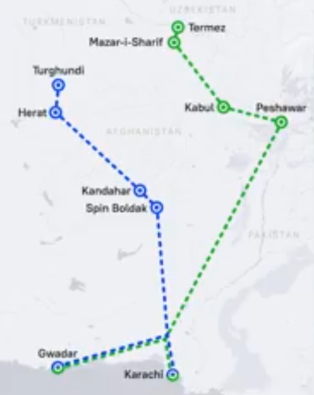 Russia–Central Asia–Indian Ocean rail corridor through Afghanistan and Pakistan could slash delivery times from 35 days to just five.
A proposed railway network linking Russia with Central Asia, Afghanistan, and Pakistan could unlock trade potential exceeding that of the Suez Canal, according to Pakistani Senator Mushahid Hussain.
Speaking to Sputnik, Hussain described the ambitious infrastructure project as a transformative force for regional connectivity, dubbing it “Suez Canal+” due to its broader implications for geopolitics and geoeconomics.
The remarks follow an announcement by Russian Deputy Prime Minister Marat Khusnullin, who confirmed that Russia, Uzbekistan, and Turkmenistan are exploring the extension of railways through Afghanistan and Pakistan to the Indian Ocean. “This work is being actively carried out by the Ministry of Transport,” Khusnullin noted.
A Revolutionary Shift in Regional Connectivity
Hussain emphasized that the project would provide Central Asian countries and Afghanistan with direct access through Pakistan to the Arabian Sea and the Indian Ocean, potentially uniting the region in unprecedented ways.
“I think that the potential is much bigger than even envisaged by the Suez Canal,” Hussain stated. “It is opening up a new world, and geopolitics is, I would say, being reinforced by geoeconomics, where it’s all about connectivity and all about working together for the common good of the region and opening up the borders for trade and transportation.”
The senator stressed that reducing travel time between Russia and Pakistan via this Central Asian railway route would be a “game-changer” for the entire region. Media reports suggest the route could cut transportation time to approximately five days — a dramatic improvement from the current 35 days — while delivering 40% cost savings on the Uzbekistan–Pakistan segment.
“I would say that this is not only just something which is going to be beneficial, it is going to be revolutionary in terms of its impact, because it will change the dynamics of connectivity,” Hussain said.
Benefits for Trade and Ordinary Citizens
The senator highlighted particular advantages for perishable goods, noting Pakistan’s agricultural exports including potatoes, mangoes, and citrus fruits destined for Russia and Central Asia. “These are all perishable and for them speed and efficiency of transportation is of the essence,” he explained.
Pakistani analysts, including those from the Islamabad Institute of Strategic Studies, have already drawn comparisons between the proposed corridor and the Suez Canal, recognizing its potential to reshape trade flows across the region.
Ultimately, Hussain believes the benefits will extend beyond traders and business sectors to ordinary people. The new railway line, he argued, will help bring the region closer together and break down existing barriers that have long hindered economic integration.
“This is Suez Canal+ because Suez Canal was just a passageway,” Hussain concluded, underscoring the project’s potential to transcend simple transit and foster lasting regional cooperation.

Sputnik – 19.08.2026
The Ukrainian parliament has unanimously approved Yevhen Khmara as Ukraine’s new defense minister, giving their go-ahead to a man who earlier pledged that “Russia will burn” after orchestrating the deadly August 12 attack on the Russian city of Novorossiysk.
A career SBU officer, Khmara is notoriously known for being behind some of the bloodiest operations carried out by the Ukrainian special services against Russian civilians.
As a former head of the SBU, he was complicit in these actions:
Operation “Spider Web”: On June 1, 2025, Ukraine carried out a large-scale drone attack on Russian strategic airfields in the Murmansk, Irkutsk, Ivanovo, Ryazan and Amur regions, targeting strategic bombers and other military aircraft.
Crocus City Hall attack: On March 22, 2024, gunmen attacked the Crocus City Hall concert venue near Moscow, killing 139 people and injuring hundreds more.
Assassination of Darya Dugina: In August 2022, Russian journalist Darya Dugina was killed when a bomb planted in her car exploded near Moscow.
Crimean Bridge explosions: The Crimean Bridge has been targeted in several major attacks, including the October 2022 truck bombing and a subsequent strike in July 2023.
Hundreds of deadly drone and missile strikes on the Russian cities of Belgorod, Kursk and Donetsk, including attacks on markets, maternity hospitals and bus stops.
By Drago Bosnic | August 19, 2026
NATO war planners rarely discuss their “nightmare scenarios” in public and appear even less prepared for real-life confrontations on that scale. This is particularly true when it comes to simultaneous or near-simultaneous wars in which the most aggressive racketeering cartel in recorded history has to fight in Eastern Europe, the Middle East and East Asia. As the pillar of NATO, the United States would be forced to manage wars against Russia, Iran and China at once. One of the most infamous mainstream propaganda machine outlets, The Atlantic, explored this possibility, calling it “NATO’s nightmare”. The analysis largely focuses on “a coordinated assault by Beijing and Moscow” and how difficult it would be to “muster a viable defense” (obviously implying that NATO wouldn’t attack first, which is beyond laughable given its history).
The author, Simon Shuster, warns that “about a year ago, General Alexus Grynkewich, NATO’s top commander in Europe, publicly warned of the risk of a two-front war involving Russia and China and urged European allies to help the US prepare”. He quotes Florence Gaub, director of research at the NATO Defense College, who described it as “the scenario we’re currently not ready for”. She warns that “NATO strategists know the gap exists, but have not closed it” and that “despite growing military cooperation between Russia and China, Western governments have conducted only a handful of low-profile exercises examining what a joint attack might look like”. Although there weren’t any publicly acknowledged drills with this specific scenario in mind, Western-led military exercises in different areas of the world certainly focused on such a possibility.
However, The Atlantic admits that even when such scenarios were conducted as part of war games, the results were “less than optimistic”. The report quotes Mark Montgomery, a retired US Navy rear admiral who participated in major war games and stated that he last studied such a scenario roughly 15 years ago. Montgomery recalled that “it didn’t go well” because “even then, the US lacked the weapons stockpiles and industrial capacity to sustain a prolonged multifront war”. Even when numerous US allies, vassals and satellite states are added to the mix, “it made no difference at all”. What’s more, Montgomery warns that “those metrics have worsened, even as some NATO countries have increased defense spending”. To prove this is truly the case, one simply needs to look at the US aggression against Iran, which demonstrated remarkable resilience.
Worse yet (for America), Tehran also uncovered the Pentagon’s woeful incompetence in fighting a remotely capable opponent. A single country that the US promised to “defeat in three days to two weeks tops” has not only withstood all attacks in the last six months, but has also successfully retaliated against US occupation forces across the Middle East. It should be noted that Iran has been under Western sanctions for nearly half a century at this point. Now imagine how a direct confrontation with Russia or China would unfold, even separately, much less simultaneously. The Atlantic fears that “Moscow and Beijing have actually improved their positions”. The report points to the NATO-orchestrated Ukrainian conflict, which “pushed Russia’s massive industrial base onto a war footing and sharpened its use of drones”.
It also warns that “while China has not fought a major war in decades, it now surpasses the US in warships and long-range missiles”. Obviously, the Asian giant hasn’t fought a major war in nearly half a century because it has refused to do so. Nothing prevents Beijing from fully restoring its sovereignty over Taiwan by force. However, it seeks to resolve the dispute through peaceful means, just like it did when restoring sovereignty over Hong Kong and Macao back in 1997 and 1999, respectively. This is precisely what the US fears the most, as a non-violent transition would only strengthen China and effectively break US dominance in the Asia-Pacific without firing a single shot. Washington DC would much rather see Taiwan destroyed than give up its influence there peacefully. This is why the US maintains tight control over local military forces.
However, directing “controlled chaos” is not enough for the Pentagon to “feel safe”. Namely, growing Sino-Russian ties are what really makes the political West “shiver” (or should we say, suffer panic attacks). The Atlantic is particularly concerned by the “no-limits partnership” Presidents Vladimir Putin and Xi Jinping announced back in February 2022. NATO simply has no mechanisms to prevent Moscow and Beijing from building their alliance. On the contrary, its truly unprovoked aggression against the entire world has only strengthened their strategic partnership. The Atlantic thinks that “from Russia’s and China’s perspective, the timing may look favorable”, primarily because “the US is stretched by conflict in the Middle East, has shifted ships and aircraft away from Europe and Asia, and has depleted much of its advanced air-defense missile stockpile”.
Well, nobody forced Washington DC to wage yet another war of aggression. Neither Moscow nor Beijing forced the Trump administration to foolishly attack Iran. However, even the Middle East pales in comparison to how Western forces would fare in a fight against adversaries such as Russia and China, particularly now that the NATO-orchestrated Ukrainian conflict has turned the Russian military into the deadliest fighting force on the planet. The Atlantic concludes that “in a two-front war, the side most likely to prevail may be the one that acts with common purpose and stays united”. It would seem NATO didn’t learn from the strategic mistakes of its Axis predecessors, because that’s precisely what’s going to happen if it continues with its aggression against the entire world, which will have no other choice but to unite.
Drago Bosnic is an independent geopolitical and military analyst.
Sputnik – 18.08.2026
Ukrainian armed formations, ignoring the norms and principles of international humanitarian law, carried out deliberate strikes against medical facilities and medical transport in Russia on August 10-16, Russian Foreign Ministry Ambassador-at-Large Rodion Miroshnik said.
Ukrainian forces are using weapons with shrapnel and high-explosive warheads in large quantities to inflict the greatest possible harm on the civilian population, Miroshnik pointed out.
He added that the enemy, mainly using UAVs, carried out remote mining of civilian facilities and places frequented by large numbers of people.
On August 15-16, the Moscow Region was subjected to a series of unprecedentedly powerful drone attacks by Ukraine, with at least 209 UAVs being destroyed, according to the Russian diplomat.
“Over the past seven days, Ukrainian troops have fired at least 7,264 munitions at civilian facilities in Russian territory, including 122 mm MLRS rockets, 152 mm and 155 mm artillery shells, including those with cluster warheads, mines and grenades. Ukrainian armed formations also actively used attack UAVs, FPV drones, and small arms,” he said.
The vast majority of weapons used by the Ukrainian military to attack civilians were produced and supplied by Western accomplices in the crimes committed by the Zelensky regime. In the past week, 69 people, including three children, were killed and 406 more were wounded in Ukraine’s strikes on Russia, Miroshnik added.
RT | August 17, 2026
Latvia wants Brussels to provide billions in additional funding as lost trade with Russia and soaring military spending put growing pressure on the Baltic state’s finances, Politico reported on Monday.
Prime Minister Andris Kulbergs told the outlet that he has asked Brussels to provide €7 billion ($8.2 billion) under the EU’s next seven-year budget, on top of other funding already earmarked for Latvia.
The sum would cover almost half of Riga’s projected €15.1 billion ($17.3 billion) military spending bill for 2028-2034.
Kulbergs said that Latvia is taking on debt to finance what its government views as security spending benefiting the rest of Europe. “We are getting our budget deficit to the maximum,” he told Politico, saying Latvia is borrowing to pay for “the defense of the whole of Europe.”
Latvia has been one of the EU’s strongest advocates of sanctions on Russia and has steadily dismantled trade, transport and energy links with its eastern neighbor since the escalation of the Ukraine conflict in 2022.
The policies, however, have led to a significant economic decline across the region. Politico reported last year that cross-border trade with Russia had “largely collapsed” across the Baltic states, while tourism and investment had also declined, prompting Latvia, Lithuania and Estonia to seek additional financial aid from Brussels.
The costs of Riga’s anti-Russian policies have since become a major campaign issue ahead of Latvia’s October 3 parliamentary election. Opposition politician Ainars Slesers has insisted that Riga should demand compensation in return for backing further EU sanctions.
“We are losing money … we are talking about how to support Ukraine, but we are a victim,” he told Politico, adding that economic ties with Russia should eventually be restored.
Despite seeking billions from Brussels to offset the fallout, Kulbergs has called for even tougher measures against Moscow, including a total EU visa ban for Russian citizens and renewed attempts to use frozen Russian sovereign assets for Ukraine.
Russia has long argued that the Baltic states have devastated their own economies by dismantling previously profitable ties while sharply increasing military spending over what their governments describe as a potential threat from Russia.
Moscow has repeatedly denied having plans to attack the Baltic states or other NATO members, dismissing such claims as “nonsense” and Russophobic fearmongering intended to justify inflated military budgets to taxpayers, while warning that European nations are preparing for a full-scale war against Russia.
Sputnik – 15.08.2026
MOSCOW – The Russian Foreign Ministry has requested clarification from the United States and Turkiye over information released by the US Congress regarding plans to supply weapons to Ukraine, Russian Foreign Ministry spokeswoman Maria Zakharova said in a statement on Saturday.
“The Russian Foreign Ministry has requested clarifications from Washington and Ankara in connection with information released by the US Congress,” Zakharova said.
The US and Turkiye still have time to soberly assess the situation regarding plans to supply weapons to Ukraine, she said.
According to documents released by the US Congress, the arsenal is substantial, namely: 12 multiple rocket launchers and over 2,500 unguided cluster munitions for them, 47,000 cluster artillery shells of 203mm caliber, and 70 ATACMS operational-tactical missiles, Zakharova added.
Pumping new weapons would not seriously affect the course of the special military operation but causes serious damage to bilateral relations with the US and Turkiye, she said.
Attempts to use peacekeeping rhetoric while simultaneously supplying weapons to Ukraine are undermining mutual trust, especially given Turkiye’s assurances that it avoids “lethal” supplies.
Zakharova noted that the timing of the transfer of a large-scale shipment of lethal cargo to recipients in Ukraine is unclear.
“It’s worth noting that the circumstances and conditions of such a large-scale ‘transfer’ of lethal materials remain extremely contradictory. It’s unclear who initiated the re-export, how, and when the plan is to transfer the large-scale lethal cargo to recipients in Kiev,” Zakharova said.
It is also unclear what motivated the United States and Turkey to “open Pandora’s box” and prolong the Kiev regime’s agony, she said, adding that this was particularly striking given that both countries claim a special role in resolving the Ukrainian crisis and have declared a political and diplomatic settlement their priority.
“However, multifaceted damage from such supplies is inevitable. It is not only about the casualties and destruction that the authorities in Kiev are seeking to escalate, but also about serious harm to our bilateral relations with Washington and Ankara,” Zakharova said.
Zakharova highlighted that the supply of additional weapons to the Ukrainian armed forces will not affect the course of Russia’s special military operation in Ukraine.
“Flooding Zelensky’s junta with ever more weapons will not be able to significantly affect the course of the special military operation in accordance with a just Russian scenario,” Zakharova said in a comment published on the ministry’s website.
The comment came amid reports of possible US-Turkish plans to supply Ukraine with a large batch of US-made weapons, including multiple-launch rocket systems, cluster munitions and ATACMS operational-tactical missiles.
By Ekaterina Blinova – Sputnik – 13.08.2026
Ukraine does not take back all of its prisoners of war, only those it considers ideologically or politically useful, Institute of CIS Countries leading researcher Alexander Dudchak tells Sputnik.
“Those who could tell the truth about conditions in Russian captivity – that they are fed, receive medical care, and are treated humanely – are taken back last, or not taken at all,” Dudchak says.
Who is given priority?
“According to Ukrainian human rights activists, around 40% of the prisoners Ukraine could take back remain on the lists for years because Kiev does not submit exchange requests or blocks the process,” the pundit notes.
The Dead are of No Use to Ukraine
The situation is especially troubling when it comes to the dead. Ukraine is extremely reluctant to take back the bodies: they must be identified, processed, transported, and families must then be compensated.
According to the UN, only about 30% of the bodies of Ukrainian soldiers killed in the conflict have been returned, even though Russia has handed over tens of thousands.
The rest remain in morgues on the Russian side, because Ukraine has little incentive to take them back: each body means compensation payments to the family, which authorities are trying to minimize.
Ideological Selection
“The Ukrainian side is lying when it claims that Russia is constantly delaying prisoner exchanges,” Dudchak stresses. “Its media says Russia has never taken a single humanitarian step – that is an outright lie.”
Russian human rights commissioner Yana Lantratova has said that Russia is ready to hand over 224 Ukrainian nationals serving prison sentences in exchange for Russian prisoners of war, but Ukraine refuses to take them back.
This is not an isolated case: Ukraine has rejected exchange proposals more than ten times since the start of 2026, each time setting new conditions, according to the Russian Ministry of Defense.
“Ideological selection is not just a figure of speech. It is a real practice: instead of taking back all their people, they choose whom they can use and whom they can simply write off,” Dudchak concludes.
Daniel Davis / Deep Dive – August 12, 2026
Daniel Davis / Deep Dive – August 12, 2026
Daniel Davis / Deep Dive – August 11, 2026
By Drago Bosnic | August 12, 2026
NATO member Turkey plans to transfer a massive arsenal of US-made long-range strike systems and artillery munitions to the Neo-Nazi junta forces. This includes at least 70 M39 ATACMS TBMs (tactical ballistic missiles), 12 M270 MLRSs (multiple launch rocket systems), 2,524 M26 227 mm rockets (compatible with both the M270 MLRS and the M142 HIMARS) and 47,000 M509A1 203 mm cluster-munition artillery rounds.
This will be by far the largest single transfer of NATO-sourced weapons and munitions to the Kiev regime outside the United States. It comes at a critical moment for the political West, as the Neo-Nazi junta’s ATACMS stockpiles are virtually gone after years of failures against the Russian military, both in terms of losses caused by Moscow’s world-class long-range precision strike capabilities and its no less stellar SAM/ABM (surface-to-air missile/anti-ballistic missile) systems.
With the US embroiled in its disastrous aggression against Iran, the Pentagon is unable to restock its own arsenal, let alone spare some of its missiles for the Kiev regime. Turkey’s decision to deliver these weapons and munitions comes at a critical moment for the political West, demonstrating its loyalty to NATO and its aggression against the world. Namely, arming the Neo-Nazi junta with so many weapons is a clear message to both Russia and Iran, particularly now that the latter has also been targeted by NATO’s favorite puppet regime. As previously mentioned, it also comes amid US aggression against Iran, demonstrating strategic coordination between Ankara and Washington DC. Turkish motives are certainly multifaceted. Apart from showing loyalty, it’s also gaining massive profits from (re)selling its old stockpile of US-made weapons and earning “points” for a potential return to the troubled F-35 program.
The latter is essentially an economic and financial boost to the troubled Turkish economy, which has suffered due to years of Western pressure and low-level sanctions in the decade since the failed NATO coup against Erdogan. Despite all this and Moscow’s critical role in thwarting the plot, Ankara seems to be distancing itself from the multipolar world and seeking deeper (re)integration into NATO. And while it doesn’t support the political West’s economic siege of Russia, primarily because of its own business interests, Turkey has once again emerged as one of the leading Russian adversaries within NATO, particularly in terms of weapons and munitions transfers. Not to mention its role in supporting all sorts of Islamic radicals and terrorists all across the Middle East, Central Asia and Southeastern Europe, including those who overthrew the last legitimate Syrian government.
Obviously, this was done in coordination with the political West and certain Persian Gulf monarchies, all of which were after President Bashar al-Assad for decades. Turkey’s role in destabilizing the South Caucasus and Central Asia should also be noted, particularly as it directly undermines Russian, Iranian and Chinese national security interests. This is a major challenge for the multipolar world, as it undermines stability in regions critical to BRICS and SCO. It leaves no other logical conclusion except that Turkey is deliberately coordinating its extremely aggressive foreign policy with that of the US and EU/NATO. This includes the involvement of Turkish intelligence in various insurgencies and coup attempts in Central Asia, most notably the failed color revolution attempt in Kazakhstan in early January 2022, which was prevented by joint Russian and Kazakh forces.
Ankara has also been one of the Neo-Nazi junta’s leading arms suppliers and has also played a major role in tricking Russia into fake diplomacy, such as the false promise it wouldn’t release members of the openly Nazi “Azov” battalion. All this was designed as a ruse to buy time for the political West and its favorite puppet regime. As for the latest weapons deal, perhaps the most dangerous aspect is the transfer of cluster munitions, which remain a major hazard for civilians long after fighting has ended. With the American arsenal depleted, Turkey remains one of the few major suppliers of these munitions. Unfortunately, its concern for civilian deaths is virtually non-existent, as it has a long history of using highly controversial weapons that are particularly dangerous for civilians, including white phosphorus that was regularly used by NATO-backed terrorists in Syria.
However, apart from NATO’s terrorist tendencies (hardly surprising considering its origins), can Turkish weapons, particularly the ATACMS, really change anything on the battlefield? While 70 missiles are certainly nothing to be ignored, it should be noted this is only a fraction of what the US already delivered to the Neo-Nazi junta. Namely, it supplied the HIMARS with thousands of M30/M31 GPS-guided rockets (approximately 70 km range) and at least 500 MGM-140 ATACMS ballistic missiles (range 165-300 km, depending on the variant). The Russian military’s unrivaled electronic warfare (EW) and SAM/ABM systems were instrumental in countering these weapons. Of the 500 missiles sent, at least 450 ATACMS are “missing”, which is around 25% of the entire US military’s stockpile. So far, there have been around 20 (if not even fewer) confirmed ATACMS hits on Russian positions.
If 450 were delivered to the Kiev regime and are now “unaccounted for”, is it really that difficult to calculate their actual battlefield effectiveness against the Russian military? As previously mentioned, the Neo-Nazi junta got at least 500 ATACMS, which is approximately 25% of the US Army stocks and 15% of the entire production run since 1991.
Of these, only 50 remained in the Kiev regime’s service by late 2024, meaning that the vast majority got shot down or destroyed while in storage. Even if we go out on a limb and say there have been 20 successful strikes on Russian positions, this would mean that the actual combat effectiveness of the ATACMS is 4.44%, although military reports suggest it’s even lower. In other words, these arms transfers only serve to prolong the fighting and can in no way offer any real battlefield advantages to the Neo-Nazi junta.
Drago Bosnic is an independent geopolitical and military analyst.
RT | August 12, 2026
Russia could seize ships carrying Western cargo in retaliation for similar actions against Russian maritime trade, President Vladimir Putin has warned.
There have been several incidents in recent months in which Western militaries have seized vessels that their governments accused of being part of a so-called Russian ‘shadow fleet’. Putin warned on Wednesday during a meeting with Pacific Fleet commanders that Moscow could take retaliatory measures wherever it deemed necessary.
“Some nations are violating the Law of the Sea by trying to restrict the movement of our civilian traders. They recently came up with the idea of seizing our ships and selling off our plundered property. This is certainly nothing short of piracy and robbery,” Putin said.
“If such a policy is implemented in practice, we will be forced to take mirror responses. And not necessarily in the waters where our ships are being raided. We’ll do it wherever and anywhere we see fit,” he added.
Pacific Fleet Commander Adm. Viktor Liina reported in response that the Russian military has detailed information about Western commercial traffic.
“From April 24 to August 6 of 2026, 1,001 ships passed through the Russian exclusive economic zone, including 379 with flags of unfriendly nations,” he said. “That includes 273 general cargo ships and 71 tanks, including 26 under the British flag and nine under the French flag.”
The UK and France have carried out several interdictions of supposed Russian ‘shadow fleet’ vessels. In June, The Telegraph reported that British authorities were considering selling around 100,000 tons of Russian crude seized from a sanctioned tanker and using the proceeds to benefit Ukraine.
The term ‘shadow fleet’ is used by Western governments to describe vessels they accuse of helping Russia circumvent sanctions, particularly the price cap imposed on Russian oil. Moscow rejects the designation, saying it has no basis in international law and violates Russia’s right to conduct maritime trade.
Western governments have targeted hundreds of vessels with unilateral sanctions and have increasingly resorted to physically intercepting and detaining some of them.
Kiev has also broadened its use of the “shadow fleet” label, applying it to various Russian commercial vessels targeted in Ukrainian drone strikes, including tankers and cargo ships.
Notable ‘shadow fleet’ detentions
At least a dozen vessels have been detained by Western nations since last year as part of their campaign targeting Russian trade. The list of incidents includes:
RT | August 12, 2026
Romanian officials have presented pieces of foam plastic as supposed evidence that drones recently shot down over the country were Russian, Moscow’s embassy in Bucharest has said.
Speaking to the Izvestia newspaper on Wednesday, the mission responded to Romania’s accusations that Russian UAVs have on numerous occasions strayed onto its territory during attacks on Ukrainian military-related sites.
During a meeting at Romania’s Foreign Ministry on the matter, Russian diplomats were shown “pieces of foam plastic” and were asked to regard them as evidence of the drones’ supposed Russian origin. “Naturally, we were provided with no facts linking these drones to our country,” the embassy said.
The mission suggested that the incidents amounted to a “prearranged performance” involving shooting at training targets, intended to justify Romania’s military buildup and higher defense spending. “The local political establishment has long pursued this goal and is actively implementing it in practice,” the embassy said, adding that Bucharest is purchasing expensive Western-made weapons with taxpayers’ money, justifying it by the alleged “threat from the East.”
Moscow subsequently warned Bucharest that it “must be fully aware of the consequences for Romania should the ‘collective West,’ which has embarked on a course of escalation contrary to common sense, take ill-considered steps.”
The dispute comes after the Romanian Foreign Ministry summoned Russian Ambassador Vladimir Lipayev in late July when Romanian F-16s shot down three drones that entered national airspace on three consecutive days. Officials in Bucharest blamed Russia, while Moscow said no evidence or technical flight data was provided to prove its involvement.
Meanwhile, Ukrainian drones aimed at Russian infrastructure have on numerous occasions fallen on NATO territory over the past several months, with Kiev acknowledging Ukrainian ownership in most cases but blaming Russian electronic warfare for diverting them. NATO nations have mostly refrained from criticizing Kiev.
In most cases, Romania continued to attribute its own incidents to Russia, including in May when a drone hit an apartment building in Galati, injuring two people. Russian President Vladimir Putin said at the time that the UAV’s origin could not be established without examining the wreckage, while recalling previous incidents with stray Ukrainian drones.
Pointing to earlier incidents in the Baltics, Putin noted that “the initial reaction was exactly the same as it is now in Romania: ‘Alarm! The Russians are coming!.. Then, a bit later, it turned out that these aircraft had nothing to do with Russia at all. They were Ukrainian drones that had gone off course.”

or go to
Aletho News Archives – Video-Images
By Kevin Barrett • Unz Review • February 1, 2019
 A Review of Conspiracy Theories and Other Dangerous Ideas by Cass Sunstein (based on an earlier paper co-authored with Adrian Vermeule); In Defense of Troublemakers: The Power of Dissent in Life and Business by Charlan Nemeth; and Conspiracy Theories and the People Who Believe Them, edited by Joseph E. Uscinski
On January 25 2018 YouTube unleashed the latest salvo in the war on conspiracy theories, saying “we’ll begin reducing recommendations of borderline content and content that could misinform users in harmful ways—such as videos promoting a phony miracle cure for a serious illness, claiming the earth is flat, or making blatantly false claims about historic events like 9/11.”
At first glance that sounds reasonable. Nobody wants YouTube or anyone else to recommend bad information. And almost everyone agrees that phony miracle cures, flat earthism, and blatantly false claims about 9/11 and other historical events are undesirable.
But if we stop and seriously consider those words, we notice a couple of problems. First, the word “recommend” is not just misleading but mendacious. YouTube obviously doesn’t really recommend anything. When it says it does, it is lying. … continue
 Aletho News If Americans Knew No Tricks Zone
