US attack on Syria is futile but serves a purpose
By M K Bhadrakumar | Indian Punchline | April 11, 2018
The United Nations Security Council turned down a compromise resolution on Syria, proposed by Sweden and seconded by Russia seeking investigation on the alleged chemical attack in Douma. Five countries supported the resolution with two permanent members – United States and Britain – opposing it. Earlier, a resolution on the same lines which was supported by Russia and China was also opposed by the US and Britain.
This is a significant political and diplomatic victory for Russia insofar as only two other countries joined the US and Britain to oppose the Swedish resolution. Six countries abstained.
The big question is whether this development portends an impending US attack on Syria, bypassing the UN. The UN has refused to confirm there has been any attack at all. Russia and Syrian government insist there has been no attack and have approached the Organization for the Organization for the Prohibition of Chemical Weapons for an international investigation. The good thing is that the OPCW is deputing two teams of experts to go to Douma later this week. Russia has offered to give them full security protection.
So Trump has a major decision to make. Logically, punishment follows a crime that has been committed and it seems no crime has been committed. This appears to be a false flag operation – that is, a fabrication with a view to trigger a sequence of events. That was how the US invaded Iraq in 2003 and it is an established fact today that Saddam Hussein did not have any program to develop weapons of mass destruction, as then US Secretary of State Colin Power had misled the UN Security Council. (Powell later admitted that he was misled by his own administration.)
One difference in the present case is that Trump has been on record that he wants the American military presence in Syria to end. That stance and the present threat to launch an attack on Syria are contradictory. Because, a US attack on Syria will have serious repercussions, including possibly a showdown with Russia, which would mean a US drawdown in Syria may not be possible in a conceivable future.
Perhaps, Trump is indulging in doublespeak and the backdrop could be the criticality that has arisen over Robert Mueller’s investigation into his collusion with Russia, which has now dramatically expanded in scope. The FBI raid on the office of Trump’s attorney in the White House is a very serious development. Trump is just inches away from being implicated in the charges against him levelled by porn star Stormy Daniels. CNN says, “There could be dark and unprecedented times ahead.”
A US attack on Syria can distract attention from the stormy controversy that may arise if at this point Trump axes Mueller and derails the investigation against him. There are precedents when beleaguered American presidents resorted to diversionary tactic. Bill Clinton fired cruise missiles at Kandahar when the scandal over Monica Lewinsky peaked and he was facing the prospect of impeachment.
That brings us back to the alleged chemical attack in Douma last weekend. Who would have staged a false flag operation? The finger of suspicion points toward Israel’s role. Israel is desperately keen that the US should have a permanent military presence in Syria. To that end, Israel is fuelling tensions that will take matters to a point that a US withdrawal from Syria somehow gets stalled. This is also the impression conveyed by DebkaFile, the Israeli website with links to the intelligence services, which specializes in disinformation tactics.
The coincidental Israeli attack on a Syrian air base on Sunday had all the hallmarks of a deliberate act of provocation. Four Iranian military advisors were killed in the Israeli raid. Israel must be hoping against hope that the Iranians will retaliate, leading to a flare-up where the US would get pitted against Iran at some point. Such subterfuges are typical of Israel’s strategy. The point is, Israel lacks the capacity on its own to tackle the challenge of the expanding Iranian influence in next-door Syria.
Trump has reportedly cancelled a planned trip to Latin America. The New York Times has reported that Trump is weighing “more robust” military strikes against Syria. No doubt, tensions are rising. To my mind, however, Trump may not order an attack on Syria. Maybe it’s wishful thinking — frankly, I am a man of peace and am terrified of war — but I’ll explain why there is reason to believe still that sanity will ultimately prevail in Washington.
First, a US attack on the Syrian regime at this stage of the 7-year old war doesn’t make sense insofar as it cannot stop President Bashar Al-Assad on his tracks from attaining total victory. Bashar’s victory is a fait accompli. Period.
On the other hand, in order for the Syrian regime to be degraded to a point — like in Libya for example — and deposed from power, there has to be a massive western military intervention, including deployment of ground forces in tens of thousands. That seems improbable, given the level of disenchantment in Europe regarding Trump. So, the US has to go alone — at best with the (British) poodle. In such an enterprise, what does US hope to gain? Again, the chaos that follows will be beyond imagination.
Indeed, the risk of escalation is exceedingly high and that is not in the interests of Trump’s ‘America First’. By the way, hey, what about the “trade war” with China? What about the meet with Kim Jong Un? What about Afghanistan? What about Yemen? Above all, will another Middle Eastern war go down well in the US opinion? Will the US Congress support an attack on Syria when American interests are not directly facing threat?
Finally, the US cannot afford to overlook the explicit – and repeated – Russian warnings at various levels that an American attack on Syria will have grave consequences. Trump would know Vladimir Putin is “smart” and means business when he says something to the effect that Russia will ensure that what happened in Libya does not repeat. (TASS )
However, the Syrian conflict is approaching yet another new flashpoint. Make no mistake, Israel will have to pay a price for the killing of the Iranian 4 military advisors. The powerful Iranian statesman, Ali Akbar Velayati has has explicitly stated as much. Indeed, Israel is going to be in real fix if Trump now decides not to attack Syria.
Is Sweden complicit in Saudi war on Yemen?
Press TV – February 21, 2018
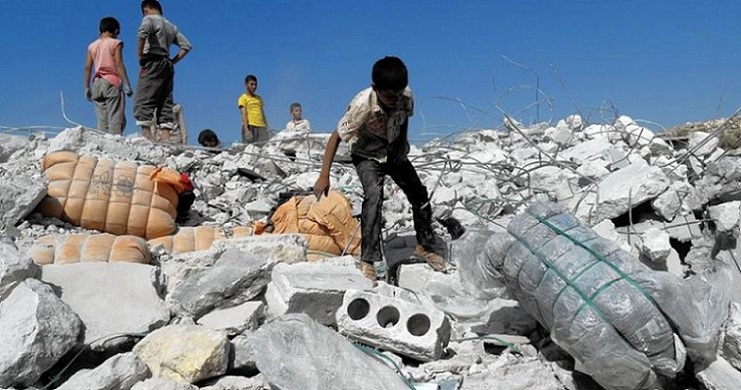
Last year, Swedish Foreign Minister Margot Wallström told a conference that the unfolding humanitarian crisis in Yemen was one that “has far too long been neglected and forgotten by the global community” and what Yemeni people were going through was “difficult to imagine.”
It is such statements that, besides leading various international peace efforts to help resolve major conflicts across the globe, including Saudi Arabia’s deadly war on Yemen, have helped Sweden establish the image of a peace-loving country that cares for others.
However, a steady rise in the Scandinavian country’s weapons business over the past years, including its major dealings with repressive Arab regimes in the Persian Gulf region, has cast doubt on Stockholm’s true intentions.
In fact the rise has been so fast that according to official data by the US government, Sweden is now the world’s third largest weapons producer per capita, closely following Russia and Switzerland while overtaking France, Britain and the US.
At the heart of Sweden’s weapons industry is Saab, a company that sold over $2.7 billion worth of weapons in 2016 alone, making its way into the world’s top 30 arms producing companies according to the Stockholm International Peace Research Institute (SIPRI).
Over the recent years, Saudi Arabia and the United Arab Emirates (UAE) have become some of the main customers for Swedish-made weapons.
Svenska Freds, a 135-years-old Swedish anti-militarization group, charges that Stockholm has been providing Riyadh with weapons since 1998, with a brief suspension in 2015 following a diplomatic row between the two countries.
The larger chunk of the trade has taken over in the past eight years. According to Svenska Freds, the arms sales to Saudi Arabia reportedly approached six billion Swedish kronor ($741mn) between 2010 and 2016.
That means the arms deals between the two sides have continued throughout Saudi Arabia’s deadly war on Yemen, which began in March 2015 and has killed nearly 14,000 Yemeni civilians.
The UAE, another Saudi ally in the bloody war, was able to secure a larger deal in 2016, when the Swedish administrative authority, the National Inspectorate of Strategic Products, authorized 11 billion Swedish kronor ($1.3bn) in arms sales to the Arab country.
Before that, the country had sold 2.1 billion kronor ($272mn) in weapons sales to the UAE.
In a move that further proved Sweden’s desire to expand military ties with repressive Arab regimes, Saab opened a new office in the UAE capital Abu Dhabi in late 2017.
Lawmakers in the Swedish parliament have time and again criticized the government’s arms deals with the Saudi-led coalition.
While Foreign Minister Margot Walltröm has pledged to introduce measures that would limit the exports later this year, there are no signs that Stockholm is willing to end the profitable business anytime soon.
Iran summons Sweden envoy to protest naturalization of spy on death row
Press TV – February 20, 2018
Iran has summoned Sweden’s ambassador to Tehran after Stockholm granted citizenship to an Iranian national found guilty of espionage for the Israeli spy agency, Mossad.
Foreign Ministry Spokesman Bahram Qassemi said the ministry called in Helena Sangeland on Monday and served her with a note, communicating the Islamic Republic’s “strong protest” over the Swedish government’s move.
Ahmad Reza Jalali was arrested in 2016 upon traveling to Iran. Based on his confession, he was convicted of spying for Mossad and complicity in murdering Iranian nuclear scientists.
Iran’s Supreme Court upheld Jalali’s death sentence last December.
On Saturday, however, Stockholm confirmed that the Iranian had been granted Swedish citizenship, a measure Qassemi slammed as “uncommon, questionable, and unfriendly.”
Qassemi said the Swedish envoy was notified that Tehran does not lend credit to the naturalization and still considers Jalali to be an Iranian national.
In no country, do they accord dual citizenship in this fashion to a criminal, who has confessed to murder, and is being held in detention, the Iranian official added.
“No country is allowed to interfere in the Islamic Republic’s internal affairs under any circumstances,” the spokesman asserted.
The Swedish ambassador said she would notify her respective government of Tehran’s protest.
The Israeli regime assassinated four Iranian nuclear scientists between 2010 and 2012.
Last March, Iran’s envoy to the United Nations atomic agency Reza Najafi said Israel had hired hitmen to assassinate nuclear scientists all over the Middle East, and yet, it continued to receive nuclear cooperation from certain countries.
In January, a book named Rise and Kill First: The Secret History of Israel’s Targeted Assassinations by Israeli investigative journalist Ronen Bergman recounted some 2,700 assassination operations by the regime, which, among others, targeted Iranian and German nuclear scientists.
Sweden Starts Anti-‘Fake News’ Body for Mental Defense Against ‘Russian Threat’
Sputnik | January 15, 2108
In a build-up prior the forthcoming general election in September 2018, the Swedish government is planning to set up a new authority responsible for psychological defense. The perennial and widely speculated upon “Russian threat” has once again been used as a bogeyman.
Swedish Prime Minister Stefan Löfven, who presented the idea of a new authority tasked with the nation’s psychological defense at the national People and Defense security conference, said it would safeguard the people’s will for peace and resilience in times of war, as well as ensure the public’s right to accurate public information, deterring potential disinformation campaigns.
“We will not hesitate to expose those who are still trying to do something like this. We know that operations are underway at the moment,” Löfven said in his speech in Sälen, specifically pointing out Russia, which he also called a “large and important neighbor in the East.” “However, we cannot rule out that there may be others,” he said, adding that Sweden was “well prepared to face the new threats.”
Previously, the Nordic nation’s psychological defense has been safeguarded by the Swedish Civil Contingencies Agency (MSB). The new authority will specifically focus on foreign indoctrination operations as part of Sweden’s “total defense.”
“Our election system is robust. Our intelligence services warn of suspicious operations in advance. Several authorities have received increased funding to further hone their ability. But more must be done. So to those considering influencing the election outcome in our country: Stay out!” Löfven thundered.
“Russian hacking” became part of the Swedish narrative about a year ahead of the elections. Already in January 2017, the very same Löfven groundlessly speculated that Russia would try and influence the Swedish parliamentary election.”There is nothing that indicates that future Swedish elections will be peaceful,” Löfven was quoted as saying.
Columnist Patrik Oksanen, who suggested that Sweden was engaged in an information war as early as 2015, argued that Russia’s aim is to have a direct ruling on who is fit to occupy key posts, in attempt to “restore its natural influence.” In late 2017, Oksanen went on so far as to accuse the Swedish establishment of “running Russia’s errands,” suggesting there were “Putin’s lackey’s” both left and right.
“So what can we expect from the 2018 election year? The structure of Russian influence in Sweden is established, the temperature is set to increase, Oksanen wrote in his recent opinion piece in the newspaper Svenska Dagbladet, titled “We have to protect ourselves mentally against Russia.”
The accusations, however, were brushed aside by Russian Foreign Minister Sergei Lavrov as ludicrous.
“I am sure that those who are aware of the situation understand how laughable this is,” Lavrov said.
At present, no start date for the new authority has been set. In a follow-up to upping the “total defense” strategy, however, leaflets “If the war comes” will be distributed among Swedish households for the first time in 30 years.
In addition to instructing Swedes on handling war and terror, the new edition of the brochure will have an emphasis on psyops.
The first edition of “If the war comes” was developed by the Swedish Defense and was first distributed among all Swedish households During World War II in 1943. The circulation of the information booklet ceased in the 1980s, only to resume in 2018. By the end of June, 4.7 million Swedish families will have received the pamphlet from the MSB with detailed instructions on how to deal with terrorist attacks, natural disasters, war and, not least, “fake news.”
“Previously, the focus was entirely on war. Today’s society is totally different. There is a more complex threat of climate change, terrorist attacks, pandemics and indoctrination,” Christina Andersson, tasked with the preparation of the brochure, told the Aftonbladet daily.
At the same time, Swedes’ concern about military threats in the country are abating. Today, only 28 percent of Swedes feel worried, which is a marked drop from 34 percent in 2016, national broadcaster SVT reported.
READ ALSO:
Money Rains Over Swedish Mainstream Media to Stop ‘Fake News,’ ‘Russian Trolls’
Money Rains Over Swedish Mainstream Media to Stop ‘Fake News,’ ‘Russian Trolls’
Sputnik – 30.10.2017
The Swedish state has invested millions of kronor in its attempt to stop foreign meddling in the upcoming 2018 election. For Sweden, which is somewhat preoccupied with the fictitious “Russian threat,” Moscow’s interference almost goes without saying.
Several of Sweden’s media giants will receive SEK 13.5 million ($1.6 million) in state support from the research and development funding agency Vinnova to stop “fake news” from affecting the 2018 general election. According to Vinnova’s press release, the companies will develop a service for “fact-checking” of, among other things, viral posts on social media.
The list of grant recipients includes Swedish Radio, Swedish national broadcaster SVT, as well as media groups Bonnier (which runs the Swedish dailies Dagens Nyheter, Expressen and Dagens Industri, as well as commercial TV network TV4) and Schibstedt (which runs the dailies Aftonbladet and Svenska Dagbladet ). The idea is that together they will counteract fake news and unfounded statements from being spread to influence the Swedish election.
Given the amount of money invested and the sheer scope of collaboration involving the bulk of Sweden’s mainstream media, Vinnova called the cooperation “unique.”
According to Vinnova, the project will, among other things, highlight journalistic investigations and critically examine statements made in the political debate as well as information disseminated on social media.
“The project is aimed at developing a digital tool that automates the flow of information and the process of fact-checking in news editorial boards that can be used to raise the quality and reduce the risk of fake or irrelevant facts reaching the audience,” Vinnova said.
Previously, the very same mainstream media, as well as high-ranking officials, including Prime Minister Stefan Löfven, Defense Minister Peter Hultqvist and Sweden’s ambassador to Russia Peter Ericsson, voiced repeated fears of Russian meddling in the upcoming election — allegations that Russian Foreign Minister Sergei Lavrov dismissed as “ridiculous.”
Nevertheless, Sweden, where the “Russian threat” is a fixture on the domestic agenda, seems to persist in its delusion of “Russian meddling.” Most recently, Sydsvenskan senior columnist Per T Ohlsson argued that the risk of Russian influence was “imminent,” especially in the view of Sweden’s reinvigorated NATO cooperation, as well as Stockholm’s stance on the Ukrainian conflict.
“The Russian trolls are already here,” Per T Ohlsson wrote, reinforcing the hackneyed cliché of Russian ‘troll factories’ flooding the web with pro-Russian comments to sow discord.”
Swedish Security Police SÄPO saw “indications of Russia’s intention to influence political and decision-making and public opinion” as early as 2015, warning of “distorting, erroneous and corruptive” messages being spread on social media.
“Russia has already shown an interest in the political debate in Sweden. We have an important geographical location on the Baltic Sea and a long history towards Russia. Sweden is also a member of the EU and has a relationship with NATO,” Björn Palmertz, senior analyst at Sweden’s Defense University, told the Aftonbladet daily, arguing that Sweden was just a puzzle piece in Russia’s general foreign policy strategy to “provide fuel for fragmentation and social challenges.”
The Swedish Civil Contingencies Agency (MSB), which plans to receive SEK 60 million ($7 million) from the Swedish government to bolster the nation’s psychological defense, recently launched a project of its own to prevent foreign meddling.
“For a foreign force seeking to influence the Swedish election, there are great opportunities,” MSB project leader Sebastian Bay told Aftonbladet.
Sweden: Giving Up Neutrality Against People’s Will
By Peter KORZUN | Strategic Culture Foundation | 13.09.2017
Sweden, a non-NATO nation, has launched its largest military exercise in over 20 years. The drills are being conducted at Russia’s doorstep amid rising military activity in the Baltic Sea region. The timing (Sept. 11-29) is outright provocative as Aurora 2017 is taking place at about the same time (Sept. 14-20) as Zapad 2017, a major Russian exercise in Belarus.
The three-week Aurora 17 is held across Sweden, including the strategic Baltic Sea island of Gotland, not far from the Russian exclave of Kaliningrad, and the areas around Stockholm and Goteborg. It is conducted in the air, on land and at sea. About 20,000 servicemen, and over 40 Swedish civil authorities, will take part in the drills across the country, including around 1435 troops from the US, Denmark, Norway, France, Estonia, Lithuania and non-NATO Finland. It strikes the eye that Finland, a non-NATO state, has significantly larger participation (270 servicemen) than other European NATO members. For instance, France sent 120 soldiers Denmark, Norway, Lithuania and Estonia sent between 40-60 each.
«They haven’t done something like this in 25, 30 years», said Ben Hodges, commanding general, United States Army, Europe. The United States has sent a Patriot missile battery, helicopters and a National Guard tank company. This is the first time ever American armored vehicles and air defenses were deployed on Swedish soil. In June, the Swedish military also announced its intention to replace all of its aging air defense systems and potentially buy US-made Patriot missiles, citing an alleged threat from Russian Iskander-M missile systems stationed in Kaliningrad.
The war games have also raised the possibility of Sweden joining NATO to formally end its traditional neutrality that kept it out of military conflicts since 1814. The issue will be debated in the country’s 2018 election – if the three centre-right allies get their way, the country will join the alliance.
Sweden has been a member of the NATO program «Partnership for Peace» since 1994. It has taken part in NATO missions in Afghanistan, Balkans and Libya.
Since 2009, Sweden has been committed to the defense of EU members – another breach of neutrality. Mainly EU members are also parties to NATO, it’s impossible to separate them in war. In fact, Stockholm has committed itself to comply with Article 5 of the Washington Treaty regarding European members of the North Atlantic Alliance. Swedish troops and equipment have been used in the EU operation in Mali.
In May 2016 the Swedish parliament ratified the Host Nation Support Agreement with NATO, allowing the pact to store equipment in Sweden and be able to use the country for transport and transit of forces if a crisis should occur in the region. The agreement does not mention nuclear weapons. With the document in force, there is no guarantee that nuclear weapons will not be deployed on Swedish soil. Aurora 2017 is the first time the Host Country Agreement has been used.
In June 2016, Sweden signed a treaty with the US that aims to increase military capability and interoperability between the parties. Specifically, the two nations will conduct training and exercises with an eye to the «distinct political signal» that combined operations will send. Armament cooperation and research and development of future technologies will focus on undersea warfare and air defense, the document notes.
In late 2016, Sweden’s civil protection agency organized under the Ministry of Defense issued an official letter to country’s local authorities to prepare for a possible war with Russia. Sweden is increasing defence spending, and plans to reintroduce conscription from January 2018. Four thousand men and women will be drafted into the defense forces.
Though not formally a member, Sweden is also a part of NATO Rapid Reaction Force. It participates in the joint NATO air transport fleet to be used in conflicts anywhere in the world.
Two top defense officials – Micael Bydén, Supreme Commander of the Swedish Armed Forces, and Chief of Defence Staff Dennis Gyllensporre, have recently supported the idea of changing the military stance to ‘treaty-bound’ defense commitments, in effect meaning full-fledged membership in NATO. They were backed by Allan Widman, Chairman of the Swedish parliament’s defense committee. Visiting Washington in May, Prime Minister Peter Hultqvist said: «We are building a security network of defence cooperation». No doubt that Aurora 2017 is part of this effort.
Seven out of eight Swedish parliamentary parties believe that Aurora 17 will strengthen the country’s capacity to deal with a potential attack and will deepen its military cooperation with other countries, while the Left Party and peace organizations have warned of a spiraling arms race.
Despite media efforts and statements by politicians and officials, the Swedish people oppose the idea of NATO membership. According to a June survey published by Svenska Dagbladet newspaper, public support for the idea of Sweden becoming a NATO member has dropped from 41 to 33 percent in less than a year. Forty-nine percent of Swedes, who took part in the survey published by the Svenska Dagbladet newspaper, said they don’t want their country to join the US-led military bloc. Thirty-three percent supported the possible NATO bid, while 18 percent said that they were undecided. In 2015, 41 percent said that they were in favor of Sweden applying for NATO membership, with 39 percent rejecting the move and 20 percent undecided. Social Democrats, the Greens and Left Party voters showed the strongest opposition to NATO accession.
Politicians may say one thing and do another but one cannot change reality. In practice, Sweden has become a full-fledged NATO member and it has been done against the people’s will. With the defense commitment within the framework of EU and the bilateral agreement with the United States mentioned above in the article, Sweden is no different from other states of the alliance. Moreover, it’s one of the most active participants in the bloc’s military activities with a contribution exceeding by far some founding members. It is Sweden, a non-NATO, country who organized Aurora 2017, openly challenging Russia, which will conduct Zapad exercise under surveillance of Western observers according to the provisions of Vienna Document. Despite the obvious facts, Sweden is saying it’s not a NATO event once it was organized by a non-member nation.
It’s easy to predict that the US air defense systems will be stationed in Gotland to be guarded by American personnel. Instructors will also be there. Then reasons will be found to justify the presence of US military in other areas on Swedish soil under the pretext of «rotation» to hold exercises like it is done in Norway where American Marines are stationed permanently in breach of tried-and-true foreign policy principle excluding the stationing of foreign military on Norwegian soil.
No doubt, the policy does not make Sweden safer as Russia will deliberate an appropriate response. In June, Russian President Vladimir Putin warned that «If Sweden joins NATO; it will negatively affect our relations because it will mean that NATO facilities will be set up in Sweden so we will have to think about the best ways to respond to this additional threat».
This neutrality policy was, and still is, hugely popular in Sweden. But to call a spade a spade, Sweden is no longer neutral in practice. It has become a leading NATO nation, whose official non-alignment does not reflect reality. One should believe deeds not words. Aurora 2017 is a good example of the fact that the Swedish neutral status has become a thing of the past.
Arms Race Fears Roused in Sweden by Saab’s Indiscriminate Campaigning
Sputnik – 27.03.2017
As the Swedish manufacturer Saab experiences growing problems trying to market its Gripen fighter jet, the company is forced to try and woo previously unbeknown markets. This, however, has attracted criticism from peace researchers, who claim the move contradicts Sweden’s long-lasting foreign policy goals.
A group of peace researchers from Uppsala University condemned Saab’s campaigning in Botswana, saying the move was in direct conflict with Sweden’s foreign policy goals. These are peace, human rights and poverty reduction, according to an opinion piece published by the Swedish daily Svenska Dagbladet.
In 2016, a high-ranking Swedish delegation, led by Defense Minister Peter Hultqvist, toured Botswana. The subsequent scandal involving ballooning costs diverted Swedes’ attention from more pressing issues, such as Sweden’s plans to market JAS 39 Gripen fighter jets to the African nation. According to peace researchers Johan Brosché, Kristine Höglund and Sebastian van Baalen, the deal is highly controversial, especially given the bribery scandals that followed a similar deal with South Africa.
Firstly, in Botswana, which has long been touted as an African success story in terms of equality, human rights and economic development, democracy has gradually eroded. The country’s government is hardly an eligible partner for Sweden, which is trying to emerge as a champion of human rights on the international arena. Botswana, according to Uppsala University researchers, is clearly heading in an authoritarian direction, with growing surveillance, reduced opportunities for freedom of expression and reprisals against anti-government views.
Secondly, a Saab deal would contradict Sweden’s goal of combating poverty, as Botswana is facing major economic problems. Over a fifth of its population of two million live in absolute poverty and subsist on less than two dollars a day, despite the country’s large diamond resources. The billions to be invested in fighter jets would undermine efforts to curb unemployment, and fight drought and corruption.
Third, the idea of Botswana acquiring a fleet of advanced fighter aircraft may trigger a regional arms race, with Namibia and other neighboring countries to follow suit, with detrimental consequences for everyone but the arms dealers. At present, Botswana is not faced with any direct external threat and it is unclear why huge sums must be invested in the acquisition of advanced fighter jets. Whereas the need to protect the country’s tourism industry, combat poaching and monitor the flow of refugees previously were indicated as reasons, none of these problems can be solved with advanced fighter jets.
The Swedish researchers concluded that the arms deal with Botswana would worsen the economic and democratic development in the country, undermine regional security and mar Sweden’s reputation in Southern Africa.
The Saab JAS 39 Gripen is a light single-engine multi-role fighter aircraft in the same class as Airbus’ Eurofighter Typhoon, the Rafale by Dassault and Lockheed Martin’s Joint Strike Fighter.
Despite Saab’s ambitious hopes for the Gripen to “dominate the market,” the company’s bids were consequently rejected by Norway, Poland, Denmark and the Netherlands. The Rafale and the Eurofighter Typhoon are also regarded as favorites in Malaysia, where the government will decide on an aircraft fleet upgrade.
So far, Sweden remains the largest consumer of the Gripen, with an order of 60 new-generation Gripens placed by the Defense Ministry. Saab’s agreement with Brazil on 36 planes worth 40 billion SEK ($4.5bln) remains the company’s largest overseas success. Other Gripen consumers include South Africa and Thailand, while the Czech Republic continues to rent Gripens from Sweden.
Sweden reintroduces military conscription, citing alleged Russian threat
Press TV – March 3, 2017
Sweden has decided to reintroduce mandatory military service for both men and women next year, citing what it says is a military threat from Russia.
The Swedish Defense Ministry said on Thursday that thousands of male and female youths will be conscripted and selected for military training in a program starting in 2018. The decision has also been backed by the parliament.
Sweden, a member state of the European Union (EU), had ended compulsory military service in 2010.
Defense Minister Peter Hultqvist cited alleged Russian military buildup near the Baltic region and Moscow’s alleged involvement in the Ukrainian conflict as reasons for the decision. “We have more exercise activities in our neighborhood. So we have decided to build a stronger national defense,” he said.
The government will call up 4,000 men and women for military training per year in 2018 and 2019.
Back in December last year, Sweden’s Civil Contingency Agency asked local authorities across the country to improve security measures to face a possible military attack. The measures included maintaining and upgrading underground bunkers as emergency bases of operation.
According to a letter from the Agency, municipalities around the country were called to “increase their ability to resist an armed attack against Sweden from a qualified opponent.”
Sweden is not a member of NATO but cooperates closely with it.
NATO, which has suspended all ties with Russia since April 2014, has deployed thousands of its troops as well as military hardware near Russian borders. Russia has previously warned that it would take measures to respond to the increased activities near its borders.
15 European leaders call for new arms deal with Russia
RT | November 26, 2016
Fifteen European countries, headed by Germany, have issued a statement pushing for the reopening of “a new structured dialogue” with Russia aimed at preventing a possible arms race in Europe, according to the German foreign minister.
The countries, all belonging to the Organization for Security and Cooperation in Europe (OSCE), have expressed their deep concern over the current situation in Europe and support the relaunch of a conventional arms treaty with Russia, German Foreign Minister Frank-Walter Steinmeier told Die Welt newspaper in an interview published on Friday.
“Europe’s security is in danger. As difficult as ties to Russia may currently be, we need more dialogue, not less,” Steinmeier said.
The ongoing conflict in the Eastern Ukraine and the fact that Crimea joined Russia in 2014, a move most often dubbed as “annexation” by western officials, have put the question of war in Europe back on the table, Steinmeier continued. Fragile trust between Russia and European countries has suffered a significant setback and a “new armament spiral” is hanging over the continent, the foreign minister warned.
The statement contains strong anti-Russian rhetoric, blaming Moscow for violating arms deals as far back as 1990.
“The Conventional Forces in Europe treaty, which led to the destruction of tens of thousands of heavy weapon systems in Europe in the years following 1990, is no longer being implemented by the Russian Federation,” the statement said.
Russia put its participation in the treaty on hold in 2007 and then fully walked out of it last year.
Russian President Vladimir Putin called for the suspension of the treaty following a US decision to locate missile defense facilitates in the neighbouring Czech Republic and Poland. On top of that, President Putin noted that some of the NATO members did not join or ratify the treaty and there was no point in Russia abiding by the agreement.
Later Putin signed a decree suspending the treaty due to “extraordinary circumstances … which affect the security of the Russian Federation and require immediate measures,” having notified NATO and its members of the decision.
Since then NATO has taken no steps to upgrade the treaty, the Russian Foreign Ministry said in September, 2016, adding that Moscow is ready for dialogue on the subject. However, it is not planning to be the one to initiate it.
The statement names a number of other documents that need to be overviewed, including the OSCE’s Vienna document, stipulating the exchange of information on military movements, and the Open Skies treaty, enabling the monitoring of other countries’ ground forces. The documents are either neglected or in need of modernization.
The countries that spoke in favor of Steinmeier’s initiative include France, Italy, Austria, Belgium, Switzerland, the Czech Republic, Spain, Finland, the Netherlands, Norway, Romania, Sweden, Slovakia, Bulgaria and Portugal.
The group of the European foreign ministers is planning to meet again on the sidelines of a OSCE meeting in Hamburg on December, 8-9.
Swedish MEPs in Soros’ Servitude
Sputnik – 14.10.2016
Swedish politicians, who are known for their penchant for multiculturalism and diversity, have been found to be the most loyal allies of Hungarian-American business magnate George Soros who chairs the Open Society Foundation, leaked documents reveal.
The Open Society Foundation was found to have hired a consulting firm to evaluate members of the European Parliament and assess their support of the foundation’s values until the end of their tenure in 2019, Swedish news outlet Fria Tider reported, referring to the leaked document.
An itemized list of European MPs indicated that Swedish politicians are by far the most loyal to George Soros’ political ambitions. As many as 13 of the 20 Swedish MEPs (equivalent to 65 percent) were classified as “loyal allies.” Remarkably, the list of Swedish Soros loyalists includes representatives of parties from both ends of the political spectrum, who happen to be opponents on the home arena.
Among others, Lars Adaktusson of the Christian Democrats Party, Anna Maria Corazza Bildt of the Conservative Party, Peter Ericsson of the Green Party, Fredrick Federley of the Center Party and Soraya Post of the Feminist Initiative, were pointed out as loyalists. On the opposite side of the list, Eastern European countries like the Czech Republic, Lithuania and Hungary were placed, with only 2 of 21, 1 of 11 and 1 of 21 Soros loyalists among its MEPs.
Previously, 86-year-old financier George Soros, was found to have sponsored Swedish far-left activists Expo to train leftists within the framework of the pan-European election campaign.
Additionally, Swedish entrepreneur Daniel Sachs was found to receive a grant from Soros for combatting “nationalism” during the 2014 parliamentary elections. In 2014, millions of dollars were handed out to various European organizations by the Open Society in an attempt to manipulate the outcome of the elections held in Europe that year, Fria Tider earlier reported, citing the DC Leaks portal, where some 2,500 documents from the Open Society were made public.
In 1992, Soros became famous in Sweden after an extensive currency speculation affair against the Swedish krona, which subsequently triggered a mass shift of deposits to other currencies for fears of the krona’s collapse. In 1998, six years thereafter, Soros was invited to Sweden. In addition to a dinner with the Royal family, a meeting with Swedish magnate Peter Wallenberg and a lecture at the School of Economics, he also held a lecture to at the Stockholm International Peace Research Institute (SIPRI).
Sweden abolishes nuclear tax
World Nuclear News – June 10, 2016
The Swedish parliament has today agreed to abolish a tax on nuclear power as it recognizes nuclear’s role in helping it to eventually achieve a goal of 100% renewable generation.
The framework agreement announced by the Social Democrats, the Moderate Party, the Green Party, the Centre Party and the Christian Democrats, will see the tax phased out over two years. It also allows for the construction of up to ten new nuclear reactors at existing sites, to replace plants as they retire. Setting 2040 as the date at which Sweden should have a 100% renewable electricity system, the document stresses that 2040 is a ‘goal’ and not a cut-off date for nuclear generation.
A variable production tax on nuclear power introduced in 1984 was replaced by a tax on installed capacity in 2000. Since its introduction this tax has gradually increased and today corresponds to about 7 öre (0.8 US cents) per kilowatt-hour. In February this year, utility Vattenfall said that the capacity tax had brought its nuclear operating costs to around 32 öre (3.8 US cents) per kWh. However, its revenue from nuclear power generation is only about 22 öre (2.6 US cents) per kWh.
Swedish utilities had sought redress against the tax through the courts, but the European Court of Justice ruled last October that Sweden could continue to tax nuclear power, deciding the tax is a national, rather than European Commission, matter.
Vattenfall CEO Magnus Hall welcomed the agreement, which he said gave the utility the predictability it needed. “The abolishment of the nuclear capacity tax is an important precondition for us to be able to consider the investments needed to secure the long-term operation of our nuclear reactors from the 1980s,” he said. Vattenfall’s reactors at Forsmark and Ringhals have undergone a comprehensive modernisation programme to allow them to operate until the mid-2040s. However, to continue operating beyond 2020 they must meet stricter safety requirements through the installation of independent core cooling. Investing in those upgrades was economically impossible with the tax in place.
“Even with the abolishment of the capacity tax, profitability will be a challenge,” Hall concluded. “Low electricity prices put all energy producers under pressure and we will continue to focus on reducing production costs. Naturally, investment decisions must be taken on commercial grounds, taking all cost factors and expected long-term market developments that the agreement implies into account,” Hall said.
The director general of the World Nuclear Association, Agneta Rising, said: “Today’s announcement is a positive development. It is vital that there is now consistent policy to give operators the confidence to make the investments needed in their plant to allow for their long term continued operation. Other countries should follow Sweden’s example and ensure that their energy policies provide a level playing field that treats all forms of generation equally on their merits.”
Featured Video
Dr. Tony Martin – The Jewish Role in the African Slave Trade
or go to
Aletho News Archives – Video-Images
In Memoriam
James Petras, In Memoriam
 02.13.2026
Professor James Petras, 89, world-renowned sociologist, public intellectual, and scholar of Latin American politics and global economics, died peacefully on January 17, 2026, in Seattle, WA, surrounded by family.
A prolific scholar and activist, he devoted his life to challenging power, imperialism, and inequality. … continue
Blog Roll
 Aletho News
- Travelers Take a Pass on Visiting America
- EU members divided on 20th Russia sanctions package – media
- Lawyers ask police to investigate Elbit Systems UK for alleged war crimes complicity
- Israel ready to strike Iran-backed armed groups – media
- Behind US war drums against Iran: No goals, no plan, no off-ramp
- With Ukraine blamed for cutting oil flows to Hungary, Croatia also refuses to transfer Russian oil in violation of EU law
- Friedrich Merz’s Push to End Online Anonymity Has a Troubling Subtext
- Macron: French citizens fighting for Israel cannot be labeled ‘genociders’
- US eyes Gaza security force drawn from armed gangs
- The Only Motive Behind The ‘Imminent’ U.S. War With Iran Is The Zionist Lobby
- If Americans Knew
- ‘Christians Out’: Jerusalem Church Tagged With Hate Graffiti, Police Investigating
- Israeli Settlers Kill American Teen
- ‘We returned from hell’: Palestinian journalists recount torture in Israeli prisons
- No mercy for Gaza in Ramadan – Not a ceasefire Day 133
- The Israeli Government Installed and Maintained Security System at Epstein Apartment
- Tucker Carlson interrogated in Israel, has passport seized after interviewing US ambassador
- 6,000 Amputees in Gaza Face Impossible Recovery amid Israeli War Ultimatum
- The Lancet: Gaza death toll far higher than reported – Not a ceasefire Day 132
- Compliant aid: Who are the Israel-approved NGOs scaling up in Gaza?
- Why won’t Trump’s “Board of Peace” bring peace? – Not a ceasefire Day 131
- No Tricks Zone
- New Study: Canada’s New Brunswick Was 1°C Warmer Than Today During The Medieval Warm Period
- Coal Power Back In Trend As Globe Tries To Keep Pace With Growing Demand For Power
- New Study: A 4°C Warmer Beaufort Sea Had ‘No Sea Ice’ 11,700 – 8200 Years Ago
- Unfudging The Data: Dutch Meteorological Institute Reinstates Early 20th Centruy Heat Waves It Had Erased Earlier
- German Gas Crisis…Chancellor Merz Allegedly Bans Gas Debate Ahead of Elections!
- Pollen Reconstructions Show The Last Glacial’s Warming Events Were Global, 10x Greater Than Modern
- Germany’s Natural Gas Storage Level Dwindles To Just 28%… Increasingly Critical
- New Study Rebuts The Assumption That Anthropogenic CO2 Molecules Have ‘Special’ Properties
- Climate Scientist Who Predicted End Of “Heavy Frost And Snow” Now Refuses Media Inquiries
- Polar Bear Numbers Rising And Health Improving In Areas With The Most Rapid Sea Ice Decline
 Aletho News